24. Mary Johnston’s Adventure
Reading edition
i
There lives in the city of New York a large, blond man who knows many authors and editors and publishers and who goes between them. That is his business, and yet, in spite of this dreadful occupation he is a merry man with a childlike countenance and a cheerful and carefree manner. Insouciant words bubble from his lips while his head rolls round on his shoulders; his invariable air is one of entire helplessness even in propitious circumstances; his tone is a tone of gay despair. His attitude toward all authors is fatherly and tender, and so is his attitude toward editors and publishers; he as much as admits that literature is a deplorable affair all around, and his expressive eye and accent say: “Courage! We shall yet make the best of this situation. You, who are about to buy, salute us.” At times a strange gleam comes into his face and on more than one such occasion I have heard him murmur that some day he will turn publisher and bring out two books which were published, indeed, but not read. And one of those books is Michael Forth, by Mary Johnston.
Miss Johnston was read before the publication of Michael Forth and she has been read since. Her best work of one kind lies before it; her best work of another and more significant kind has followed it. Michael Forth is simply a chrysalis, escaping notice, from which was to come, in place of the writer of superb historical romances like To Have and To Hold and historical novels like The Long Roll and Cease Firing, an author as strange as William Blake, a woman whose proper company in American literature is Emily Dickinson, Emerson, Thoreau, Whitman, Margaret Fuller and Melville.
“She is a mystic bent upon the expressive embodiment of what eye hath not seen and ear hath not heard until she saw and heard it,” concludes an anonymous writer.[99] The account of Mary Johnston’s adventure given by this writer is as unsatisfactory as secondhand versions of a mystical experience must necessarily be. Miss Johnston may or may not write the story; Emerson said that “the highest cannot be spoken,” and, most certainly, it cannot with adequacy be written. Miss Johnston has made some attempt to put her adventure on paper, but the result so far discourages her. In what follows I am merely trying to convey the quality of her strange experience. I have not her sanction for what I say; I had rather not make the trial. But there is really no escape. If we are to understand the growth of the writer we must have some notion of the thing that befell.
ii
The child was not strong, and her Scots grandmother first, an aunt afterward, taught her. She grew up in the village of Buchanan, Botetourt County, Virginia, still in the 1870’s a place of canalboats and the stagecoach. Major John William Johnston was a Confederate veteran, a lawyer and ex-member of the Virginia Legislature. Naturally the house was not without books. Mary Johnston found the histories particularly engrossing. Then the family moved to Birmingham, Alabama, and this daughter was sent to school at Atlanta. She was then sixteen. In a few months her health compelled her to return home where, a year later, her mother died. As she was the eldest of several children the direction of the household fell to her. She suffered intermittently from illness for many years. In her twenties and while living in a New York apartment she began a romance of colonial Virginia in the seventeenth century, writing much of it in a quiet corner of Central Park, so as to be outdoors. She had been writing short stories which editors sent back to her and which she burned on the first rejection. It is said that the late Walter H. Page, at the time with Houghton Mifflin Company, discovered her.[100] The historical romance, Prisoners of Hope (1898) became her first book and was successful; her second novel, To Have and To Hold (1900) was a record-making best seller and had literary merits most exceptional in the flood of historical fiction then running. Miss Johnston traveled considerably in Europe in quest of better health. After the death of her father she lived for some time at 110 East Franklin Street, Richmond. Then she built a home, “Three Hills,” near Warm Springs, Virginia, where she has lived since. Knowing that her Civil War novels, The Long Roll and Cease Firing, owe much to Major Johnston’s analyses and recollections, some Southerners have said that Mary Johnston’s father was at least equally responsible with her for the splendid performance in her earlier novels. They quite misunderstand the nature of the inspiration he undoubtedly gave her. Of direct help—which is what these people really have in mind—he gave much, as she has acknowledged; it was, however, unimportant. Direct help can as well be got from books. If today you tell Miss Johnston how well you liked such a novel of hers as Lewis Rand (1908), she will probably respond: “Of course you realize that the picture of those times is idealized.” In other words, although hers is one of those natures which must seek the ideal, possess and be possessed by it, the conception of the ideal has completely changed. Where once she found it in the bright glints of an earlier American day, now she finds it in our day and every day, past or present or to be—the pure silver of the human spirit that runs in a deep if irregular vein through the worn old rock of human destiny.
For she is like silver herself, like old silver choicely patterned. The small, oval face and pointed chin are serene in expression beneath a fine forehead and crisp hair with a great deal of its blackness still in it. Her manner is reposeful, friendly, unaffected and sympathetic. She talks readily about anything and everything but you have a feeling that she is also, at moments, somewhere else—this quite without any sacrifice or lessening of her hereness and attentiveness. I now come to the personal experience which, to be intelligible to most of us, must be put in a crude and simple kind of paraphrase.
If one has suffered much from illness and pain, one is very likely to have occasional moments in which one returns to life newly-washed, like the world in trembling freshness and sunlight on a morning after storm. If one stands on a Virginia hill, or a hill anywhere, one may sometimes have a distinct awareness that the length and breadth and depth round about and below are only a kind of length and breadth and descent to a creature measuring them with his legs; even the eye seems to declare that genuine dimensions are elsewhere. Stand on the hill one day, return to it one, five or ten years afterward, standing in the same place. It is quite possible that nothing has changed in the scene about you. A certain time has passed, but you, to yourself, haven’t changed. You have grown a little older, but the essential you is not anybody else. Suddenly you realize that time is not a dimension, either, any more than the length and breadth round about or the drop to the valley below; and that as long as you are you and no one else, the day, the year or the century would make no genuine difference. The only distance or direction lies between the unchanging you and somebody else. You are really no farther from Balboa discovering the Pacific from a Panama summit than if you were standing beside him now sharing the discovery; the direction is from your spirit to his, from his to yours, and the distance is neither lessened nor increased by race, nationality, religion, leagues or centuries.
That is, instead of merely acquiring the notion of the fourth dimension of mathematics, you have come to see that all the so-called dimensions, length, breadth, height, time and imaginable others are merely conveniences of earthly existence, or necessities of earthly existence, like eating and breathing.
As you stand on the hill, you are alone and yet not alone. The physical you is alone, as always; but the unchanging you is one of a company whom you can identify only to the extent of what you may have read or heard about them. In the company will be Francis of Assisi, Joan of Arc, Spinoza, Ludwig van Beethoven, Cardinal Newman, William Blake, Walt Whitman—to mention a few of various times and countries—as well as countless others.
Then will follow the strangest part of the experience and the part most difficult to put in words. It is, however, something of which some intimation comes even to the humblest pair of lovers, just as it is the passionate fulfillment of the great, the immortal lovers of legend.
There is a feeling so intense that it can find coherent expression only in poetry which holds it securely in the rigid mold of metre and rhyme; there is another feeling, or degree of feeling either more intense or more delicate which can communicate itself only in a language of cunningly-related sounds which we call music. And there is even a pitch of feeling greater than these, higher and very tranquil and most piercing in its intensity and loveliness. This feeling has only one expression—love. The object of that love is immaterial to it. That object may be, outwardly, the body of the beloved. It may be a person or an idea. It may be anything. The effects of this feeling are almost infinitely various. You will find some of them described in William James’s Varieties of Religious Experience. The feeling itself is a religious feeling but it may not expend itself on a religious object. The feeling made Francis of Assisi the Clown of God. It brought visions to Joan of Arc and put her at the head of a victorious army. Under its influence Beethoven wrote symphonies, Blake made pictures, and Whitman wrote Leaves of Grass. Sometimes, when the effects are tranquil, we say that the Lover has found peace—to which has sometimes been added a phrase of further description, “the peace that passeth understanding.”
Nearly all these aspects of a continuous human experience came to Mary Johnston. There was the not unusual preliminary circumstance of invalidism. There was the loss of a father, much-loved. There were the Virginia hills she walked upon and there was frequent solitude. The sense of passing the boundaries of time and space was facilitated by two things: first, her devotion to history, and second, her strongly-developed novelist’s imagination. Shortly after she was forty, therefore, she came to a day when, for an hour or part of an hour, she had access to a state of knowledge, of sympathy, of understanding which is so sane that it infuses its sanity into every act of living and so joyous that those to whom the experience is vouchsafed can throw aside every lesser joy. After that first experience Mary Johnston waited for it to renew itself, and gradually what had come as a miracle remained as a human faculty; so that since then she has acquired the apparent power or privilege of leaning out from the gold bar of Heaven, of letting earth slip without loosing herself from earth. You know how your mind will pass behind the stars while your feet yet continue to tread firm soil as you go on walking. That is a feeble likeness to the thing.
iii
It was bound to affect her writing, and perhaps the first traces of it are in The Witch (1914), but it was clearly apparent in Foes (1918), where, as I have said before this, “upthrusting through the surface of a stirring historical adventure, we had the evidence of the author’s breathless personal adventure.” It is one thing to be by temperament a mystic; quite another to become, as Miss Johnston had now become, a mystic by the witness of some inner illumination. In some cases the change has brought with it a proselyting spirit of great fervor; in Miss Johnston’s there was a complete absence of any such missionary zeal. All the same she could not go on writing novels in which the picture of some bygone time was idealized simply for the sake of a charming picture. Foes has been correctly described as “a dramatic story of eighteenth century Scotland with a lasting feud, a long chase, and a crescendo of hatred and peril.” But it is also a story of sublime forgiveness, as much so as John Masefield’s The Everlasting Mercy. In Michael Forth (1919) and Sweet Rocket (1920) there was, as in certain novels of Herman Melville’s, notably Pierre, more transcendentalism than story. It was inevitable that she should be inarticulate for a while, but it was only for a while. For in 1922 appeared her story, Silver Cross, a tale of England in the time of Henry VII. and of two rival religious establishments. Silver Cross was both beautiful and intelligible. For the prose style I like best Stewart Edward White’s word, “stippling.” It has also been said of what was to be her mode of utterance for a book or two: “Written in a clipped sort of prose stripped of ‘a’ and ‘an’ and ‘the’ and other particles as well as articles, the text is a highly mannered English replete with cadenced sentences and animated by nervous rhythms. The very diction bears poetic surcharges, and the whole effect on the reader is to distill in his soul a delicate enchantment or else to exasperate him to death.”[101] The core of the tale is irony, irony directed at religious bigotry and religious intolerance; it lies there at the base of the flower and from it the reader may make his own bitter honey. Or, if he have no stomach for that, he may take his satisfaction and pleasure in the rich sound of ecclesiastical trumpets, the green England, the pageant of a simple world unrolled before him.
In the same year with Silver Cross Miss Johnston’s 1492 was published. The book is, of course, the story of Columbus, told with the accurate historical coloring and the poetic feeling one would expect of the author; but it uses a technical device which, while not novel, is deserving of attention from the analyst of fiction. This is the employment as narrator of the story of Jayme de Marchena, a fictional person, represented as a Jew who has been banished from Spain under the decree of exile promulgated by Ferdinand and Isabella. Miss Johnston makes of him a man of philosophical mind, an “obscure Spinoza” whose thoughts are a constant commentary on the voyage from Palos and the succeeding voyages. Thus, without distorting history or creating an imaginary portrait of the Genoese sailor and discoverer, the book (in form a novel) gives us one of the great events in human affairs in a perspective that neither history nor biography affords. Again what we have is the vision of one standing on a hilltop, alone and yet not alone—of one who is at the same instant standing in the night watches on the deck of a caravel and listening to the cry from the man on lookout....
iv
Slow turns the water by the green marshes, In Virginia. Overhead the sea fowl Make silver flashes, cry harsh as peacocks. Capes and islands stand, Ocean thunders, The light houses burn red and gold stars. In Virginia Run a hundred rivers.[102]
The fine opening of Miss Johnston’s poem might serve as an evocation, except in the detail of the lighthouses, for her novel, Croatan (1923). The mere fact of her return to the Virginia of colonial days must have served to entice many readers to this book—who were held, I think, by the tale itself, once they had begun it. The legend of Raleigh’s lost colony of Roanoke and of a first white child born in Virginia, “Virginia Dare,” is skilfully utilized for a romance quite the most perfect Miss Johnston had imagined. The story of the three young people who grew up together in the forest—English girl, Spanish boy and Indian youth—is one of many overtones deftly sounded. Is Miss Johnston proclaiming a creed of racial tolerance and interracial understanding? Then the proclamation is made pianissimo and with muted strings, not with brass instruments. And the forest scenes—what delicious notes from oboes!
It is very natural to contrast Mary Johnston and Ellen Glasgow, both Virginians and both novelists of distinction as well as contemporaries. Their very agreeable personalities are, however, markedly different. Miss Glasgow is a product of her background and her time, as much so, for example, as Edith Wharton; Miss Johnston has a great deal more likeness to, let us say, Miss May Sinclair. Where Miss Glasgow tends to concern herself with Virginia of the last half century, Miss Johnston, from going back to the beginnings of her State, is quite as likely to plunge effortlessly forward into the farthest imaginable future. For a witness of what she can do in that direction one does well to read such a short story as “There Were No More People,”[103] dealing with the extinction of man and the slow emergence of “a creature who must be classed among aves. He was small, two-footed, feathered and winged.... Slowly, taking aeons to do it, he put out, in addition to his wings, rudimentary arms that grew, taking a vast number of generations to accomplish it, into true arm and hand. At the same time he began, very, very slowly, to heighten and broaden his skull. Man would have thought him—as he would have thought man—a strange looking creature.... It took time, but at last there dawned self-consciousness. The old vehicle for sensation, emotion, memory and thought that had been called man was gone. But sensation, emotion, memory and thought are eternals, and a new vehicle has been wrought. It is not a perfect vehicle. In much it betters man, but it is not perfect. The new Thinker resembles the old in that he knows selfishness and greed and uses violence.... It remains to be seen if he can outwear and lay aside all that and remain—as man could not remain.”
MARY JOHNSTON
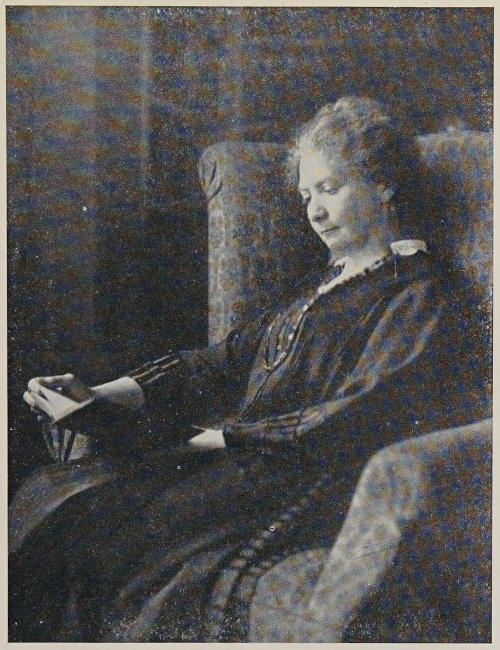
Copyright, E. L. Mix.
v
Carl Van Doren’s words about Miss Johnston, in his Contemporary American Novelists, 1900-1920, that she brings to the legends and traditions of the Old Dominion no fresh interpretations, have been made obsolete by Croatan, and are, of course, so far as they are made applicable to legends in general, denied by her last half dozen novels. It is most true, though, that Miss Johnston is an historian and a scholar in her tastes. To the series of fifty volumes interlocking to form a complete American history, and published by the Yale University Press under the general title, The Chronicles of America, Miss Johnston contributed the volume on Pioneers of the Old South. The book deals with Maryland, the Carolinas and Georgia as well, but Virginia is, of course, the principal subject. The period is 1607-1735 and Miss Johnston’s short account is an admirable piece of writing, concise, accurate, uncontroversial; alive with crisp human portraits and touched with poetry and imagination in its occasional descriptive passages.
Miss Johnston’s new novel, to be published late in 1924, under the title, The Slave Ship, is a story of the American slave trade in the eighteenth century. David Scott, a prisoner after the battle of Culloden, is sold into slavery on the American plantations. The cruelty with which he is treated hardens his conscience, so that when he escapes he goes without much hesitation or scruple into a slave ship and then into slave trading. The novel follows with intensity and compassion the career which takes him from this most abominable traffic to an understanding of what it means. The novel is, therefore, a story (like Foes) of one who journeyed on the road to Damascus. But I recall no story which pictures with more vividness and power the Middle Passage of infamous memory. The Slave Ship is notable, too, for the greater suavity of Miss Johnston’s prose style; the “a’s,” “an’s,” and “the’s” are recovered and there are less tangible changes—all for the better.
“Nothing can be done but by being greater than the thing to be done” is a piece of wisdom uttered in Miss Johnston’s fable, “The Return of Magic.”[104] A writer is, or should be, capable of growth in two directions—as an artisan and as a source of emotion to be communicated in terms of beauty. The number who show growth in either fashion is not large; the number who grow both ways is very small. Five years ago I had occasion to survey the work of thirty-five American women novelists, three of whom have since died. One or two others have produced no new work in the period since. With the most liberal disposition toward the thirty or so others, it does not seem to me that more than a half dozen show growth either as writers or artists. Possibly three have produced work in these five years indicative of a mind enlarging as the hand serving it has grown more certain. Mary Johnston is one of the three.[105]
BOOKS BY MARY JOHNSTON
1898 Prisoners of Hope.
In England: The Old Dominion
1900 To Have and To Hold
In England: By Order of the Company
1902 Audrey
1904 Sir Mortimer
1907 The Goddess of Reason. Poetic drama.
1908 Lewis Rand
1911 The Long Roll
1912 Cease Firing
1913 Hagar
1914 The Witch
1915 The Fortunes of Garin
1917 The Wanderers
1918 Foes
In England: The Laird of Glenfernie
1919 Michael Forth
1920 Sweet Rocket
1922 Silver Cross
1922 1492
In England: Admiral of the Ocean-Sea
1923 Croatan
1924 The Slave Ship
SOURCES ON MARY JOHNSTON
Besides those referred to in the text of the chapter and in footnotes, the following are suggested:
The Women Who Make Our Novels, by Grant Overton. Moffat, Yard, 1918, 1919, 1922; Dodd, Mead, 1924. There is a chapter on Miss Johnston.
“Silver Cross, by Mary Johnston.” Circular published by Little, Brown and Company, 1922.
Carl Brandt, Brandt & Kirkpatrick, 101 Park Avenue, New York, N. Y.