New Testament Story in Verse
Reading edition
By ANNE FLETCHER.
The Archangel's First Visit.
TWAS in the days of Herod— First king of that proud name— Who reigned over Judea, The land of Scripture fame. A certain Zacharias, Of the large, priestly force, The temple of Jerusalem Was serving in his course. His wife, Elizabeth, belonged To Aaron's favored line; And they were righteous before God, And kept the law Divine. But this couple had no children, And they were very old; And lived alone, nor ever hoped A son they should behold. And it came to pass one morning— As Scripture doth record— That Zacharias burned incense On the altar of the Lord; And outside the people waited, And stood in silent prayer;— For in this way they worshiped In that holy temple fair. And, in that solemn season To Zacharias' sight— Standing beside the altar— Appeared an angel bright. And the good priest was troubled, When he saw the spirit form, And fear fell on him, and he shook Like willow in a storm. But the angel said to him: "Fear not, Thy prayer is heard in heaven, And to thy wife, Elizabeth, A son shall now be given. "And thou shalt call the baby John, And thou shalt have great joy; And many shall rejoice with thee Over this precious boy. "And he shall, in the holy sight Of God, be great and high; And wine, or ardent spirit, His lips shall ne'er come nigh. "The Holy Ghost shall early Spread through his heart abroad, And many of your ancient race Shall he turn to their God. "And in the power and spirit Of Elias, he shall go Before Him who is coming To save the world from woe." Then Zacharias, in surprise And overwhelming bliss, Demanded of the angel: "Whereby shall I know this?" And the angel, answering, said: "I am that Gabriel, Who stand in God's high presence, And am sent glad news to tell. "And, now, because thou doubtest, Behold thou shalt be dumb, And shalt not speak, until the child I have foretold has come." Meanwhile the people waited till The priest should come outside, And marvelled at his long delay— What could to him betide? And, when to them he did appear, And could not speak a word, They knew that he had seen, within, A vision from the Lord. And so he served the temple Until the day had come When, his ministration over, He departed to his home.
The Archangel's Second Visit.
SIX months, and, sent again from God, The angel Gabriel came To a city of fair Galilee, And Nazareth by name, To a virgin, spouse to Joseph Of David's royal race; And the virgin's name was Mary, Whose life was truth and grace. The angel entered softly, Where Mary sat alone, Saying: "Hail! the Lord is with thee, Thou highly favored one." But, when she saw the stranger, Mary was troubled sore; For such a salutation She ne'er had heard before.. But: "Fear not," said the angel, "For, Mary, thou hast found Favor with God, whose goodness And mercy doth abound. "And thou art greatly honored, For God hath chosen thee To nurse the high, anointed One Whose name shall Jesus be. "He shall be great, and shall be called The high Jehovah's Son And the Lord God shall give to Him His father David's throne. "And he shall reign o'er Jacob's house For ever, evermore; His Kingdom still shall flourish When earthly reigns are o'er. "Behold," he said, "Elizabeth, Thy cousin, good and kind, I've also promised her a son, And the promise true she'll find. "For God is the omnipotent, All power is in His hand, And nothing is impossible To His Divine command." Then Mary meekly said: "Behold The handmaid of the Lord; And let the honor be to me According to thy word." The angel then departed— Ascending up above— And left the gentle virgin bowed In humble trust and love.
Mary's Visit to Elizabeth.
NOW Mary felt a longing To see her cousin dear, And with Elizabeth to spend A season of good cheer. And so in haste, and early, She started forth one day, And journeyed to a city In Judea's hills away. For there dwelt Zacharias, And Elizabeth so pure, And, entering in, the virgin found A welcome, warm and sure. For the Holy Ghost gave token To Elizabeth's glad heart, That her visitor, in God's wise plan, Should have a happy part. Then out she spake, exultant, "O, why to me accord The honor of a visit From the mother of my Lord? "And blessed is she for evermore, Who humbly hath believed, For every word shall come to pass Which she from God received." And Mary said: "O, how my soul Jehovah magnifies! And how my spirit joys in God, My Saviour, 'bove the skies! "For He hath had regard unto His handmaid's low estate, And henceforth all shall call me blest— The humble and the great. "For He, the high and mighty One Hath done to me great things, And holy is His honored name; His praise my spirit sings. "His mercy they that fear His name Enjoy from day to day; From age to age it is the same, And shall be so alway. "And He hath shown abroad the strength Of His almighty arm; For He hath chased the proud, who sought To do the humble harm. "He hath put down the mighty From their haughty seats on high; And lifted up the lowly to The region of the sky. "His hand hath filled the hungry poor With daintiest of food, And the rich he hath sent empty Away from hope of good. "He hath come to the assistance Of His servant Israel's race; In remembrance of His mercy, His promise and His grace, "As He spake, in the beginning, To Abraham, our head, And to Jewish tribes for ever— Naught hath failed of all He said." After this the virgin Mary With Elizabeth, so true, Made a pleasant three months' visit, Then to her home withdrew. Now that great thing did come to pass, Which Gabriel had foretold, In the sacred temple service, To Zacharias old. And soon Elizabeth received The promised baby boy; And gazing on the heavenly gift, Her heart was filled with joy. And all her friends and cousins, To whom the tidings went, Came with their gratulations, Upon the glad event. Then on the day of naming, The parents both agreed That John the infant should be called, As Gabriel had decreed. And the speech of Zacharias Immediately returned; He praised and glorified the Lord, His heart with fervor burned. And fear came on the neighbors all, As these things were noised abroad; And they said: "What kind of child is this Who comes, foretold of God? But the hand of God rich blessings On the babe, each day, bestowed; And the heart of Zacharias With the Holy Ghost o'erflowed. And he burst forth in thankfulness, And praised, and prophesied Of all the wondrous goodness That should to men betide. For the light of inspiration Had shown to him, indeed, That his son was the Elias, Who should the Lord precede.
The Holy Child.
ROME was the world's proud mistress, And would tax her subjects all: Thus every man, to his own town, Received Imperial call. And Joseph, wed to Mary, Must go to Judah's land, And, with the sons of David, Must take his lineal stand. Then, from Nazareth, he journeyed, With his fair and gentle spouse To Bethlehem of Judea, The place of David's house. But when—their journey ended— They sought repose to win, Their lodging was a stable, So crowded was the inn. And to that stable, lowly, In humble, human guise, There came a babe most holy, Descended from the skies. 'Tis written that the angel Had to the virgin come, And told her that this Holy Child With her should make his home. And now a rosy light from heaven On Bethlehem's city shone; And this was the first Christmas The world had ever known. For Jesus was the promised Christ, So long ago foretold— The King that all the Jewish race Were longing to behold.
The Shepherds.
THE men, who watched the sheep that night, Were seated on the ground, When a glorious light from heaven Shone brightly all around. And, lo! an angel of the Lord Appeared before their eyes, And they were filled with sore affright, With wonder and surprise. The angel said to them: "Fear not, For I have come to tell News of the joyfullest event The world has e'er befell. "For, this day, unto you is born, In David's' city fair, A Saviour, who is Christ, the Lord, And David's lineal heir. "And this shall be a sign to you That true is what I've said: You'll find the babe in swaddling clothes, And in a manger laid." Then suddenly a crowd appeared Of spirits, bright and fair, And their glad voices, praising God, Resounded through the air. "Glory to God," they sweetly chant, Who reigns in highest heaven, And peace on earth for evermore, And love to men be given. Thus singing, shining, up they went Away to heaven again; And night and silence were restored To ancient Bethlehem's plain. "Come," said the shepherds, "let us go Into the city old, And see the strange, mysterious child, Of whom we have been told." And, leaving there their flocks, they went Into the town near by; And found the babe, as they had heard, His gentle mother nigh. And, having seen him, they made known, To people all abroad, The things that had been told to them About the Son of God. The people listened to the news With very great surprise, The wondrous things the shepherds heard, And witnessed with their eyes. But these strange things within her heart The mother kept concealed, And pondered o'er them, nor her thoughts To any she revealed. The shepherds, thrilled with gladness, praised The God of heaven above, For all things they had heard and seen Of His unbounded love.
Good Old Simeon.
NOW, when a week had passed, the babe Received the sacred sign Which God to Abraham had given, As covenant divine. They gave him Jesus for his name, According to the word Of the archangel Gabriel, Who stands before the Lord. And, then, a few weeks later, To Jerusalem they went, Before the great Jehovah The young child to present; And to offer, on the altar, In thankful sacrifice, A pair of doves, or pigeons, Of small and humble price. At that time, in the temple gate, There was an aged saint, Who waited for the promised Christ Nor did his firm faith faint. A just and righteous man was he, And Simeon was his name, And the Holy Ghost, with power, Upon his spirit came. And it was thus revealed to him That he should never die, Until his mortal eyes had seen The Lord's Christ, from on high. And he came, by the spirit, The temple court within Just as his earthly parents Their infant child brought in. Then Simeon took the Holy Child Into his arms, and said: "Bless Thee, my God, for all the way Thou hast Thy servant led. "And now let me depart in peace According to Thy word, Since my old eyes have haply seen My Saviour and my Lord; "Whom Thou hast sent into the world, To lighten all mankind, And that Thy people, Israel, Their precious Prince may find." Then Joseph and the virgin Were filled with great surprise At the words that Simeon uttered— So grave, devout and wise. And Simeon blessed both parents, And said to Mary then, "This child is set that Israel May fall and rise again; "And for a sign, which wicked tongues Shall slander and indict, And that the thoughts of evil hearts May be exposed to sight."
The Prophetess.
THEN, also, lived one Anna, A prophetess of God, Who, in His faith and service, Her way, through life, had trod. She was an aged widow, too, Daughter of Israel's race; And, coming in that instant, She joined in thanks and praise; And then throughout the city went, And told the glorious news From house to house, wherever dwelt The pious, hopeful Jews; Told that the great Messiah, Long looked for, now had come, An infant in a virgin's arms, And in a lowly home.
The Wise Men.
NOW, when this wondrous babe was born Into his low estate, Another strange event occurred, Which Scripture doth relate. There dwelt, far off, in eastern land, Wise men devout and good Who nature's grandest mysteries Revered and understood. One night as eagerly they scanned The splendors of the sky, They saw a new, strange star appear Among the worlds on high; And said it came thus suddenly Important news to bring— The sign that Balaam had foretold— Of Israel's glorious King. And when they reached Jerusalem, "Where is your King?" they said, "For we have come to worship Him, And by his star were led." This question greatly troubled Proud Herod, on the throne, For, in the land of Judah, He would be King alone. At once he called the priests and scribes, Demanding they should tell In what place had it been foretold That Christ should come to dwell. And readily they answered— Nor waited to take note— "In Bethlehem of Judea," For thus the prophet wrote: "Thou Bethlehem, in Judah's land, Art not 'mongst princes small; For out of thee shall come a Prince And rule my people all." Then Herod for the wise men called, And, with foreboding fear, He bade them tell him just what time The star did first appear; And said: "Go search in Bethlehem, And when the babe you find, I, too, will come and worship Him, For thus I am inclined." The wise men were rejoiced to see The radiant star once more, And gladly followed, as it led The way to Joseph's door. They opened, then, their treasures, Gold, frankincense and myrrh— Fit offering to a Prince Divine, From reverent worshipper— And joyfully bestowed their gifts Upon the Son of Man— And thus the custom, since observed, Of Christmas gifts began. The wise men to their lodging went, For rest and sleep, that night; But God came to them in a dream, Before the morning light; And said, "To Herod ye shall not return, Nor tell my Son's abode." And so returning to their home, They took a different road.
Away to Egypt.
AND when they had departed thence, To Joseph came a dream, In which an angel of the Lord Appeared and spoke to him: "Rise, take the babe and mother, And into Egypt flee. For Herod seeks to kill the child— Go, till I call for thee." Then Joseph rose, obedient, And while it still was night, With the young child and mother, To Egypt took his flight. Then cruel, wicked Herod, When the wise men told him naught, Or let him know what house contained The babe whose life he sought, Sent forth his brutal servants To kill each little boy, In and around old Bethlehem— Each mother's hope and joy; All—every tender nursling, From two years old and less; Nor heeded Rachael's weeping, Her mourning and distress. But wicked, wicked Herod, Who would be king alone, Was soon thereafter called to die, And leave Judea's throne. And now the wrathful tyrant Has no more power to harm; And his fierce and jealous hatred No more can cause alarm. To Joseph, down in Egypt, Now comes another dream, Wherein an angel of the Lord Appears again to him; And says: "Now, back to Israel's land With child and mother go; For he, the murderer, is dead, Who was the infant's foe." Then Joseph rose and willingly Obeyed this new command, And, taking child and mother, Returned to Israel's land. But hearing Archelaüs Was king in Herod's room, He turned aside to Galilee, Which was his former home; And dwelt in Nazareth city, Thus plainly may be seen The truth of Scripture words: "He shall Be called a Nazarene." And there the blessed Jesus Spent childhood's simple days, And, as he grew, waxed strong and wise By God's unholding grace.
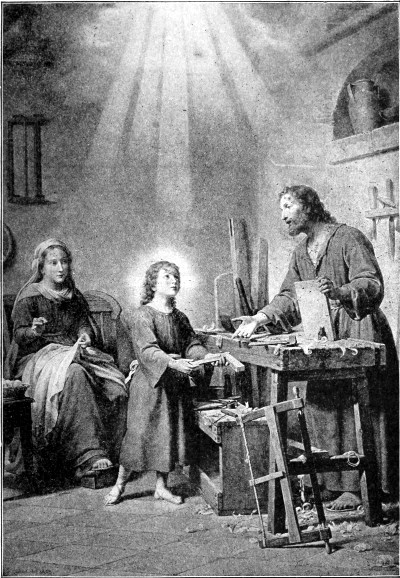
THE CHILD CHRIST, MARY HIS MOTHER AND JOSEPH JESUS RENDERED OBEDIENCE, NOT ONLY TO MARY, BUT TO JOSEPH—LUKE 2:51.
The Child in the Temple.
NOW, every year, these parents Jerusalem did seek; To keep the feast of passover, And spend the holy week. And when the child was twelve years old, They did as heretofore; And went up to Jerusalem, The road oft traveled o'er. They kept the feast as usual, And, then, with cheerful mind, Returned the way that they had come— But Jesus stayed behind. The parents traveled all day long, Believing that their Son, Somewhere, among the company, Was coming safely on. But when, at evening, they encamped, And sought for Him around, To their surprise and sore distress, He was not to be found. Still seeking Him they turned their face, And traveled back again, The old road to Jerusalem; But seeking was in vain. For three days long they went about, Within the city lines, Then, in the temple, found the lad, Among the great divines. He sat and heard the doctors talk, And asked them questions wise; And all who listened were amazed At his profound replies. And His parents were astonished When they beheld Him thus, And Mary said: "O why, my son, Hast thou so dealt with us? "Thy father, Joseph, and myself Have three days sought for thee, And sorrowed greatly, fearing we Thy face no more would see." Then Jesus, gravely, said to them: "Wherefore my absence mourn? My Father's work I have to do, Till I to Him return." And Mary, in her inmost heart, Did secretely confine The things He did, the words he spoke, This wondrous Child Divine. And Jesus rich in wisdom grew, As passed the years of youth, And gained the favor of all men, By virtue and by truth.
John the Baptist.
NOW, in the fifteenth year, when reigned Tiberias Cæsar grand, And Pontius Pilate, under him, Ruled over Judah's land, And three of Herod's sons controlled The regions North and East, And Annas and Caiaphas were Appointed, each, high priest, The word of God came unto John— Old Zacharias' son— Who, in Judea's wilderness, Had dwelt and prayed alone. His raiment was of camel's hair, There in his strange retreat, While locusts and wild-honey Comprised his only meat. He preached where flowed the Jordan Down through Judea's land; Saying: "Repent ye, for the kingdom Of heaven is at hand." Now, the people all expecting Their Messiah at that time, Mused in their hearts if John were not That prophet most sublime. So the Jews sent priests and Levites, Down from Jerusalem, To see this new, strange preacher, And closely question him. And, "Who art thou?" they asked of him, And humbly he confessed "I'm not the Christ, looked for by you, Nor with such honor dressed." "What then? Art thou Elias?" He said: "Not that I know." Art thou a risen prophet?" He firmly answered, "No." Then said they: "Tell us who thou art, That we may answer give To them that sent us thither Some knowledge to receive." He said: "I am the voice of one Who through the land doth cry, 'Make straight, as said Esaias, The way of the Most High.'" The messengers were Pharisees, Who said: "Why then baptize, If thou be not the promised Christ, Or he that should arise?" John answered: "I, indeed, baptize With water from the stream; But there is one among you now Of whom you do not dream. "'Tis He who cometh after me, The latchet of whose shoes, Because He is so mighty, I'm not worthy to unloose. "And He shall, with the Holy Ghost, Baptize you and inspire, And fill your souls with power divine, And with celestial fire. "Whose fan is in His hand, and He Will thoroughly purge His floor; And gather up His wheat, but then, With fire the chaff devour." And many other things said he, Exhorting all who heard; And preaching unto them, with zeal, The Gospel's precious Word.
Emmanuel.
AND in those days it came to pass That Jesus—Holy One— From Nazareth came to Jordan, To be baptized of John. For He had reached just thirty years, The age the law declared Those called into the priesthood, For service were prepared. But John forbade Him, saying, "'Tis I have need to be A subject of Thy baptism, And comest Thou to me?" And Jesus, answering, said, to him, "Suffer it now, for thus To keep the law of righteousness, It well becometh us." Then, meekly, and with solemn awe, Did John the Lord baptize, And when the heavens were parted wide, He saw, with great surprise, As Jesus felt the water, and With humble reverence prayed— The Holy Ghost descending, like A dove, upon His head. And a voice, in tones majestic, Came from the heavens, so bright, Exclaiming, "This is my beloved Son, In whom I take delight."
The Temptation.
THEN Jesus, with the Spirit filled, And soul exalted high, Was led from Jordan's bank into The wilderness near by, To be tempted of the devil— Who in evil most delights. There He, with wild beasts, made his home For forty days and nights. After this the Lord was hungry, When the devil came, and said, "If thou'rt the Son of God, command These stones to be made bread." But He answered, "It is written, Man doth not live by bread alone, But by each word, proceeding From God, upon the throne." The devil then conducts Him through The holy city, fair, And sets Him on the temple roof, High in the ambient air; And says to Him, "If so Thou be The Son of God, indeed, Cast thyself down from hence, and for Thy safety take no heed; "Since it is written, 'Unto God In danger thou shalt flee, For to His angel band He gives A charge concerning thee.'" Then Jesus unto him replied, "Again the written word Rebukes presumption and declares, Thou shalt not tempt the Lord." Again the devil takes Him up Into a mountain—high, And shows Him all the kingdoms of The world, both far and nigh. And saith unto Him, "All these things Will I give unto thee If Thou wilt own my princely power, Fall down and worship me." Then Jesus called him by his name, "Satan," He said, "be gone, For it is written, 'Worship pay To Israel's God alone.'" Then, thus repulsed, the devil fled, Pursued his wicked way, And angels came and ministered Unto their Lord that day.
The Meeting with John.
THE next day Jesus, calm and pure, Was walking all alone, Down, near the banks of Jordan, When He was seen by John; Who said, while pointing unto Him, "Behold the Lamb of God, Who takes the world's dark sin away, And bears the awful load." Again did Jesus walk, when John With two disciples stood, Who, looking on Him, said to them, "Behold the Lamb of God!" And the disciples, at this word, Followed where Jesus went; Who, turning, gently asked of them, Their purpose and intent. "Master," they said, "Where dwellest thou?" He answer, "Come and see." They went, and stayed with Him that day, In holy converse free. Now, one of these men was Andrew, Who, filled with thoughts profound, And, meeting his brother, Simon, Said, "We the Christ have found." And brought him straight to Jesus, who Said to him, as he came, "Thou'rt Simon, son of Jonah, now "Cephas shall be thy name."
The Meeting with Nathanael.
THE following day would Jesus Return to Galilee; And, finding Philip, saith to him, "Come thou and follow me." Then Philip found Nathanael, And, unto him, he saith, "We've seen the Christ of prophecy Jesus of Nazareth." Nathanael answered shortly, "Thinkest thou can it be That good come out of Nazareth?" Saith Philip, "Come and see." When Jesus saw Nathanael come, Him did He kindly greet; "Behold an Israelite," He said, "In whom is no deceit." Nathanael asked, "Whence know'st thou me?" "Beneath the fig tree's shade, Before that Philip called to thee, "I saw thee," Jesus said. Nathanael said to Him, "Rabbi"— With wonder overawed— "Thou art the King of Israel, Thou art the Son of God." "Because I told thee," Jesus said, "I saw thee 'neath the tree, Believest thou? Yet shall thine eyes Much greater wonders see. "For thou shalt see bright angels, Through heaven's open span, Ascending and descending Upon the Son of man."
The Marriage at Cana.
THE third day spent in Galilee There was a marriage feast; In Cana was the wedding held, And Mary was a guest. And Jesus, to this marriage feast Received a formal call— The wondrous Gospel Teacher, With His disciples all. And when more wine was wanted, The mother of the Lord Requested Him to show His power, And wine to them afford. But Jesus answered, "Woman, My youthful days are o'er, And to direct my actions Should be your part no more. "To show to men, by miracles My power, the wondrous sum, 'Tis mine to choose the proper time Which has not fully come." Then, Mary to the servants said, "Hark what He saith to you; And, whatsoever it may be, That thou shalt surely do." And there were set six waterpots, That cleanly Jews might reach To wash their hands, and they contained Two or three firkins each. Jesus unto the servants said— Who paid respect to Him— "These vessels all with water fill;" They filled them to the brim. Then He commanded, "Draw out now, And bear a cup well filled Unto the ruler of the feast;" And they did as He willed. And the ruler, when he tasted The wine from water made, Not knowing how it was produced, Unto the bridegroom said: "Each man who spreads a feast, sets forth Good wine at first, of course, And, when the guests have drunk it all Produces what is worse. "But never at a marriage feast Has bridegroom done as thou Who gave poor wine at first and kept The good wine until now." Thus, by this first of miracles, Did Jesus show His power, And His disciples knew Him Christ, From that important hour.
Driving Out the Money-Changers.
THEN the Jews' passover drew nigh, And to Jerusalem Went Jesus, and His followers The journey made with Him. But when they reached the temple court A market there they found; Creatures on sale, for sacrifice, And merchants sitting round. Then Jesus made a scourge of cords, And drove them all outside, And, angered by their wickedness, The money scattered wide. And the disciples then recalled The Psalmist's ancient word, "I have been eaten up with zeal Unto thy house, my Lord." Then said the Jews, "We want to see What evidence you show That you possess authority Such things as these to do?" "Cast down this temple," Jesus said, Let its proud walls decay, And I will raise it up again, Ere three days pass away." They answer, "Forty years and six This temple took to build, And wilt thou rear it in three days? Art thou so strangely skilled?" But of his body thus he spoke, A temple strong to view, And the disciples, when He rose, Recalled that word most true. Now, while in old Jerusalem, At the passover feast, Jesus performed great miracles, By which His fame increased. Yet He gave not His confidence To any, great or small, Because He read the human mind And knew the hearts of all. And needed not to be informed That man is weak and vain, Who will applaud and honor now, And persecute again.
A Ruler of the Jews.
THERE was a man, a Pharisee, One of the chosen race, Who, in the council of the Jews, Maintained an honored place. The same to Jesus came by night, Saying, "Rabbi, well we know Thou art from God, for no mere man Such miracles can do." Jesus replied, "Thou dost believe, Yet such a faith as thine Is naught, unless thou undergo An inward change divine. "Except a man be born again, I truly say to thee, The holy kingdom of his God His eyes shall never see." Then Nicodemus said, surprised, "How can a man, when old Become a little babe again, Such wonders to behold?" And Jesus answered, "Verily, The birth of which I speak Is by the Spirit's gracious power, Which every one must seek. "That which is born a little babe Is but a fleshly frame, But inward birth to all imparts The Spirit's living flame. "And, as the way the wind doth blow Is not known by the sound, So shalt thou feel, but not discern, The inward change profound." Then Nicodemus asked again, "How can these things be so?" Christ answered, "Dost thou rule thy race And yet these things not know? "I verily declare to you The truths that are divine, And ye receive not in your heart These precious words of mine. "If I have told you earthly things And you do not believe, How shall you of these heavenly things, My truthful words receive? "And no man hath ascended up To heaven's throne, above, But the eternal Son of man, Who hath come down in love. "And as a serpent Moses raised, Upon on upright pole, That those who felt a poisonous bite Might look and be made whole, "So must the Son of man be raised— In hate, and wrath and strife— That whoso shall believe on Him May have eternal life. "For God so loved this sinful world He gave His only Son, That those who should believe on Him Might find their heaven begun. "For God sent not His Son below The wicked to condemn: But that, through Him, salvation might In mercy reach to them. "He that believes is saved from death, But he that doubts must die; Because he has rejected, thus, The Son of God, most high. "And this is what condemns their lives, That light is shining clear, And men love darkness lest their deeds Of evil should appear."
John the Baptist.
AFTER these things did Jesus go Forth into Judah's land, Attended by his followers, A faithful holy band. John in his holy zeal baptized The people all around, In Aenon, near to Salim, Where water did abound. And John's disciples told him all— How Jesus, too, baptized, And crowds of people went to Him; But John was not surprised. He answered, "Man can nothing take, Except to him 'tis given, And to baptize with water Was my command from Heaven. "And ye, yourselves, can witness true I said, I am not He— The Christ, the long expected one— He cometh after me. "Full happy is the bridegroom, but His friend, which standeth near, Rejoiceth in his happiness, So I am filled with cheer. "He will go on, in power and might, His glory must increase; While I, His humble forerunner, Must dwindle and decrease. "He that descendeth from above Is Lord and King of all; While he that is mere earthly man Is tainted by the fall. "He that from heaven comes to earth— The mighty Prince and Lord— Tells men what He has seen and heard, And none receive His word. "Yet he that hath received His word Hath set his loyal seal, That God's eternal righteousness He doth to man reveal." But John's bold, fearless preaching Now, suddenly, must cease— How truly he had prophesied Unto himself decrease!
Wicked Herod.
HEROD, tetrarch of Galilee, John's teaching oft did seek, Thought him a just and holy man, And gladly heard him speak. Yet Herod had a wicked heart, And crime had stained his name, For he lived with his brother's wife, And none had dared to blame. But John, with holy courage, had Condemned his sinful life, And said, "It is not right for thee To have thy brother's wife." Therefore, the woman hated him— Herodias was her name— And would have killed him if she could, With neither fear nor shame. But Herod she persuaded, To seize the preacher bold, And in a dungeon's gloomy cell His prisoner to hold. Now, when the news of this event To Jesus had been brought, While in the land of Judah, Where He baptized and taught, And He well knew that word unto The Pharisees had gone, How, in His mission here and there, He plainly favored John, He left Judea's flowerey land, And turned His face again To Galilee, His early home, In Herod's proud domain. Yet neither horse nor chariot had This royal Son of God; But traveled humbly and afoot The hot and dusty road.
The Woman at the Well.
HIS way lay through Samaria, And, as the noon was high, He came to Jacob's ancient well, The town of Sychar nigh. And, wearied with His journey, He by the well sat down, While His disciples went to buy Some food within the town. Then, presently, a woman came— A daughter of the land, To draw some water from the well— Her pitcher in her hand. And Jesus, full of pitying grace, Beyond what we can think, Looked gently in the woman's eyes, And said, "Give me to drink?" And thus, this poor Samaritan, Who knew but sin and shame, Was led to seek the living draught, Found in Messiah's name. And she, that single pupil, heard, By the old patriarch's well, The greatest, grandest lesson That e'er from Jesus fell. And she believed. O, woman fair, Though fallen thou hadst been, The Searcher of all hearts in thee The seed of faith had seen; And traveled through Samaria, To meet you, and to tell The new and wondrous doctrine That you received so well. And now came the disciples back, Who wondered that He taught One humble woman there alone, Yet wherefore no man sought. But the woman left her pitcher, And to the city went, And told to every one she met The wonderful event; How she had seen a traveler, Sitting by Jacob's well, Who all her secret history Did accurately tell. And, "Come and see him!" she exclaimed, "For he the Christ must be; Such wisdom, dignity and grace None e'er possessed as He." Meanwhile the Lord's disciples Before Him set some meat, And urging Him with gentle words, Said, "Master, come and eat." But, in that hour, no mortal food His craving want could fill, His heart and mind were wholly set To work His gracious will. 'Twas now the harvest day of souls, In old Samaria's fields, And He would gather all the fruit That faithful labor yields. So He, in answer to the call That He partake of food, Taught the great lesson to all men Of always doing good. And, now, came the Samaritans And begged the Lord to stay And lodge within their city's walls, And teach them every day. And He who hearkens when we ask, Complied with their request; And in their city He abode Two days, an honored guest. And many of those men believed He was the Christ—the Lord, When they beheld His holy life, And heard His gracious word.
The Nobleman's Son.
AND, now, upon His journey bent, He turned His eager face To tread the road to Galilee, Urged on by love and grace. And on before Him went His fame. 'Mongst Jews both great and small, And teaching in their synagogues, Was glorified of all. And He was well received by them— The men of Galilee— Who, at the feast of passover, His miracles did see. There was a certain nobleman, Who in Capernaum dwelt; Whose son was sick, and nigh to death, And great concern he felt. But hearing Jesus had returned To Galilee, was glad, And hastened to Him, to entreat That He would heal the lad. Then Jesus said, to try his faith, "Unless ye wonders see Ye will not yield your hearts to God, Nor yet believe on me." To this remark the nobleman Made no direct reply; But said: "Oh, Sir, come down with me Before my child shall die." Jesus responded: "Go thy way, Thy son doth surely live;" And the man went, nor did he doubt The word the Lord did give. And as he traveled to his home, His servants came to meet, And tell him that his son was well; His joy was now complete. He asked them when the child improved, And they, in answer, said "The seventh hour of yesterday The burning fever fled." That very hour, the father knew Had Jesus said he lived; And he, himself, and all his house, On Christ, the Lord, believed.
In the Synagogue.
THEN Jesus came to Nazareth, His childhood's quiet home; And, as to teach on Sabbath days His custom had become, He, in the synagogue, stood up, To read the holy Book; And the writings of Isaias, When handed Him, He took; And opened it, and found the place Wherein the prophet spake Of Israel's Messiah, Who should their bondage break. He read the text, distinct and clear, Then closed the Book again, And took His seat, while on Him gazed The eyes of all the men. And He began to say to them: "This day, in all your ears, This holy Scripture is fulfilled, After so many years." And they, in awe and wonder, heard His words of grace and truth, And said: "Is not this Joseph's son, Whom we have known from youth?" But soon their kind and gentle mood Began to disappear, Because He told them homely truths They did not wish to hear. At last, the fickle people rose In wild and wicked wrath, Seized Him, and roughly led Him up The sloping, hillside path; That, in their raging anger, they Might cast Him headlong down The precipice, one side the hill, On which was built their town. But He passed through their very midst, An unfelt, spirit shape; And left them, standing wonder-struck At this most strange escape. And so He went from Nazareth; His home was there no more; But in Capernaum He dwelt, And showed His grace and power.
The Draught of Fishes.
ONE day the Lord stood by the shore Of lake Gennesaret; And watched the fishermen, as there They pulled the outspread net. And, as He stood, the people came, And pressed upon Him round, To hear Him preach the Gospel news, Which they so precious found. Then Jesus, seeing Simon's ship Was anchored close at hand, Stepped quick aboard, and gave command To push a space from land. And, sitting down, He taught the throng Who crowded on the shore, And heard, with joy, such heavenly truth As ne'er was preached before. The sermon ended, then He bade Simon launch out for fish; And Simon answered that he would, If 'twere the Master's wish. But added: "We have toiled all night, Nor sleep nor rest have sought, But through the water dragged out nets, And yet no fish have caught." Still, while he spoke, he launched the ship Out on the waters wide, And let the net down in the sea, The vessel's' rail beside. And lo! at once, with fish 'twas filled, A multitude so great That the strong net came wide apart, So heavy was their weight. The fishermen their partners called To bring another ship; And soon both vessels were quite full, And sinking in the deep. Then Simon Peter, in amaze, At Jesus' knees fell down; And said: "O Lord, depart from me, My sins to Thee are known." But Jesus gently said to him: "Thou need'st not be afraid; From henceforth thou shalt sinners catch, By my Almighty aid." And when they brought their ships to land, They—Peter, James and John— Forsook their vessels and their friends And followed Christ alone.
The Unclean Spirit.
NEXT Sabbath, in the synagogue, When He stood forth to teach, The people wondered at His force, And mighty power to preach. And one was there within whose breast A devil foul had sway; Who, held in bondage most unclean, Yet sought to praise and pray; But, by the devil moved, cried out, And called the Lord by name; Declaring that he knew Him well, And also whence He came. Then Jesus to the devil said: "Silence and come thou forth;" Who came forth, hurting not the man, But casting him to earth. And all the people were amazed At what they saw that day, And said, "With power doth He speak, And spirits vile obey." And the news spread round the country, And was told from place to place, Of the wonder-working prophet, And this miracle of grace.
Simon's Wife's Mother.
WHEN Jesus left the synagogue He did not go alone, But with Simon and with Andrew, Followed by James and John, And entered into Simon's house, Where they besought His aid, For the kind mother of Simon's wife Was in a fever laid. The raging fever quickly fled At His divine behest, And she arose and ministered To every waiting guest.
Casting Out Devils.
NOW, when the sun was setting low They brought all the diseased; He laid His hands on every one; To heal them He was pleased. And many devils He cast out By His command and power; And all the people quickly came Together at the door. The devils He forbad to speak, As they around Him trod— For one and all acknowledged Him The Christ—the Son of God. And so the word Esaias spoke, Foretelling Him, came true: "Himself bare our infirmities, And all our sickness knew." The next morn, rising early, Before the break of day, He went out to a desert place, To meditate and pray. And Simon and his company Went after Him, and said: "All seek for Thee and are amazed, Supposing Thou hast fled." He said to them: "I go to preach In other cities too; For therefore came I down from heaven, To teach the Gospel true." And He preached in their synagogues Throughout all Galilee; While, from before Him, as He went, He made the demons flee.
Healing a Leper.
AND now it came to pass, one day, When in a certain town, A leper, seeing Jesus, came, And on his face fell down. And worshipped, and beseeching Him, Said: "Lord, if but Thou please, Thou hast the power to make me clean, From this most foul disease." At once the Lord put forth His hand, And, with a gracious touch, Said: "It doth please me—be thou clean;" Thus prayer availeth much. But Jesus charged him not to tell The miracle abroad; But go straightway unto the priest, And offer gifts to God. Yet so much more His fame went forth, And multitudes came near, That He might heal their sicknesses, And they His words might hear. But He stayed in the desert drear While blazed abroad the news, Fearing they would proclaim Him King, And thus provoke the Jews. After some days He came again Into Capernaum; And it was quickly noised abroad The Master was at home.
The Man Sick of the Palsy.
AND many people gathered, till The house could hold no more; Grave doctors and proud Pharisees Thronged in and round the door. And Jesus preached, and taught them all The precious, Gospel Word; And healed the sick who recognized The power of the Lord. And now behold a kindly act: A bed is borne by four— On which one sick of palsy lies— Near to the crowded door. And when they cannot enter in, They to the roof ascend; And, breaking it, let down the bed On which is laid their friend. Thus to the sick man Jesus spake: "Thy sins are all forgiven." And then the scribes said in their hearts, "Who thus blasphemeth Heaven?" Immediately the Lord perceived Their thoughts, and answer gave, "Which is the easier, from sin Or from disease to save? "But that ye now may learn the fact, And know it from this hour, That to forgive all sin on earth The Son of man hath power;" He said unto the sick man: "Rise, Take up thy bed and bear It on thy shoulders hence away, And to thy house repair." Immediately the man arose, To perfect health restored; And taking up his bed, went home, And glorified the Lord.
The Calling of Matthew.
NOW, after this, as Jesus passed Where customs were received, He saw a man named Matthew sit And, knowing he believed, Said to him only: "Follow me," And Matthew, leaving all, Rose up and the disciples joined, At this most simple call. Then Matthew—sometimes Levi called— Prepared a splendid feast, Inviting a great company, With Jesus, honored guest! But Matthew was a publican, On whom the Jews did frown, And so were many of his friends, Who at the feast sat down. And thus the scribes and Pharisees To the disciples said: "With publicans and sinners vile Why doth your Lord eat bread?" Then Jesus said: "Not to the well, But sick, are doctors sent; And I came, not to call the good, But sinners to repent.
The Pool of Bethesda.
SOON after this, again the feast Of passover came round, And Jesus, at Jerusalem, All worshipful was found. For, to fulfill all righteousness He taught the people all, And joined the service in God's house At every stated call. Now, in Jerusalem, there is At the sheep-gate a pool, Bethesda called in Hebrew phrase, Five-porched, of water full. And in these porches lay a throng, Diseased and racked with pain; Blind, halt and withered, hoping from The water help to gain. For, sometimes, down an angel went And tossed the quiet pool; And who could, after, step in first, Was sure to be made whole. And one poor sufferer lay there, On that unhappy ground, Who eight and thirty tedious years Infirmity had bound. When Jesus, passing, saw him lie, He knew his wretched case; And He who shares His peoples' woes, Looked down with pitying grace; And kindly asked the man: "Wilt thou Be healed of thy disease?" Well knowing that no earthly boon Could more the cripple please; Who answered, in dejected tone, "Sir, I have no kind friend— Whene'er the water is stirred up— His kindly help to lend. "But while with slow and painful steps, I try to move alone, Another suff'rer gets down first, Whose limbs are good and strong;" Then Jesus said: "Rise, lift thy bed, And walk with it away." Immediately the man obeyed; And 'twas the Sabbath day. The Jews who met him, therefore, said: "Thou'rt doing very wrong, Upon this holy, Sabbath day, To bear thy bed along." He answered them: "The man who did The wondrous work on me, Of healing by His own command My long infirmity— "He said: 'Take up thy bed and walk,' And, instantly, there came A healthful glow through all my limbs, With power to do the same." Then asked they him: "What man is he, Who thus irreverent spake, Commanding thee thus wickedly The Sabbath law to break?" But the healed man knew not the friend Who did him so much good; For Jesus bore Himself away To escape the multitude. But afterward, as Jesus taught Within the temple gate, He found this man and said to him, "Behold thy healthy state; "Now sin no more, lest worse should come Upon the guilty soul." Then went the man and told the Jews 'Twas Jesus made him whole. Therefore the Jews did persecute The Lord and seek to slay, Because He did these wondrous things Upon the Sabbath day. But Jesus preached to them the truth, In language strong and clear; And happy were they who believed, And lent a willing ear.
The Man With a Withered Hand.
AGAIN, as in the synagogue, The Lord on Sabbath taught, A man who had a withered hand His kind attention sought. And scribes and Pharisees around Watched if the Lord would use His power to heal upon this day, That they might Him accuse. But He, who knew their evil thoughts, Unto the sufferer said: "Arise, and stand forth in the midst;" And the poor man obeyed. Then He, to those who watched Him, said: "I one thing ask of you; Is it on Sabbath days correct Evil or good to do?" But they replied not, then He said: "What man among you all Shall have one sheep which on this day Into a pit shall fall; "And he will not lay hold on it, And quickly lift it out? That man is better than a sheep, You surely cannot doubt. "Wherefore 'tis lawful thus to do Good on the Sabbath days;" And He looked on them with surprise, Grieved by their wicked ways. Then to the man who meekly stood, Waiting the Lord's command, In centre of the synagogue, He said: "Stretch forth thine hand." And though the hand hung helpless down, The heart with faith was strong; And instantly ran vital force The arm's whole length along. Then went the haughty Pharisees And the Herodians rude, And held a council to destroy Him who did only good, But Jesus, knowing it, withdrew, Still followed by the crowd; He healed them all, but charged that they Speak not His name aloud.
The Twelve are Chosen.
AND then up to a mountain's side, One day, the path He trod, And there alone He bowed Himself All night in prayer to God; And in the morning called all those Who Him their Master claimed, And, from amongst them, chose out twelve, Whom He apostles named. And He ordained this favored few, With privilege to each To be with Him when He so willed, Or be sent forth to preach; And to have power to heal the sick The dumb, the halt, the blind, And cast all evil spirits out, That vex and curse mankind. And these were the twelve chosen men: Simon, to whom the Lord Had given the name of Peter— A stone, both strong and hard; And Andrew, Simon's brother, and The sons of Zebadee, Bold James and John, whom Jesus said Should Boanerges be, Which means the sons of thunder, and Philip, Bartholomew, Matthew and Thomas, James and Jude, Both sons of Alpheus true; Simon, who was a Canaanite— By Luke Zelotes named— And Judas called Iscariot; Traitor, for evil famed.
Healing the Sick.
HE then descended to the plain, To seek for food and rest, When all the people of the land In crowds around Him pressed. The weary sick and those who felt The pangs of racking pain, And others vexed with devils hoped From Him relief to gain; And, following, sought to touch Him, As power from Him had flown; But in compassion He beheld And healed them, every one.
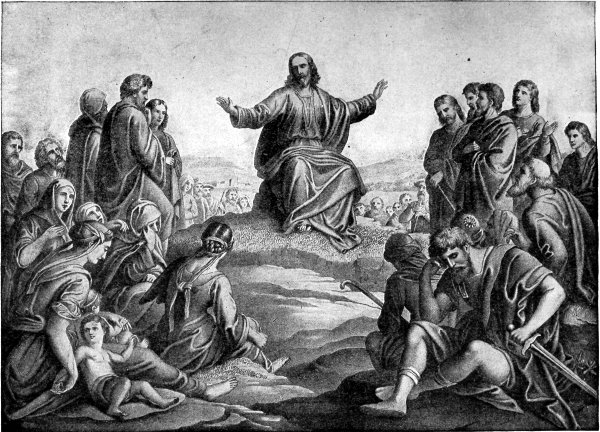
THE SERMON ON THE MOUNT St. Matthew 5:5-7. St. Luke 6:20-49.
The Sermon on The Mount.
AGAIN, up to the mountain side He went, and took His seat; And His disciples followed Him, And gathered round His feet. And lifting up His eyes on them, He raised His voice to teach, Declaring those exalted truths He came on earth to preach. He told them, first, the blessedness Of purity and grace; And that the souls most like to God Should see the Father's face. Then told them of their high estate, Their privilege sublime, To upright stand, and shed forth light Upon the realms of time. And taught them of the moral law, And of the law of love, For heart and spirit to be kept, All human laws above. In simple words He framed for them A solemn, fervent prayer, By which they could approach to God, And on Him cast their care. He taught that, if their neighbors' faults Were lovingly forgiven, They all might claim in humble faith The Fatherhood of Heaven. Then charged them 'gainst the error made From that time until now, That men to different masters Allegiance can avow. "For God," He said, "ye cannot serve, And mammon serve beside; In love to one and not to both, Your spirit must abide." He then the precious lesson taught Of God's vast providence, Which is our faithful guardian, And our secure defence. The little songsters of the air, The lilies of the field, Are fed, and clothed, from day to day, While they no forethought yield. And man, much better in His sight— How little faith has he, To doubt the providential care That all his needs can see! "Seek first the kingdom of your God, His righteousness divine, And all the stores of earthly good Shall graciously be thine." The Preacher then went on to charge 'Gainst judging others' sin— Those fond of spying evil deeds, Should with their own begin. And they who ask, or seek, or knock, God never will deny; And men to other men should do As they would be done by. And it is wise to enter in The narrow way and straight; And shun the way where many go— The wide and open gate. Though men may openly appear What they are not within; Yet you shall know, if in their lives You see the fruit of sin. For every good and perfect tree Doth faultless fruit bring forth; But when you see an evil tree, Its fruit is nothing worth. And each tree bearing not good fruit Into the fire is cast; Wherefore, 'tis by their deeds ye know The doom of all, at last. "Not every one who says to Me; "Lord, Lord,' shall enter heaven; But he that does my Father's will; And knows his sins forgiven. "Many will say to me that day: 'I've done good in Thy Name;' I never knew you, I will say, I disregard your claim. "Therefore, who hears these words of mine And doth not doubt or mock, Is like a man who wisely built His house upon a rock. "And the rain fell and floods came on, And winds blew fierce and long; But that house stood, securely firm, On its foundation strong. "And every one that hears my words And disobeys, shall stand Like to a foolish man, who built His house upon the sand; "And the rain fell and floods came on, And winds blew round and round Upon that house, and soon it fell In ruins on the ground."
The Centurion's Servant.
AND, now, when Jesus entered Into Capernaum; A Centurion besought Him for A servant, sick at home. "I will come," He said, "and heal him." The Centurion answered: "Lord, I am not worthy Thou should'st come, But only speak the word. "For I, myself, am in command, And whatsoe'er I say To one, or to another man, They instantly obey." When Jesus heard him, in surprise He said to those around: "I verily, in Israel, Such great faith have not found." Then said to the Centurion: "Go, Thy faith the work has sealed;" And in the self-same hour he found His servant had been healed.
Raising the Widow's Son.
IT came to pass upon the day Succeeding this event, That as He journeyed on His way, Much people with Him went. Along the road He traveled on, Until He came to Nain; When, just outside the city gate, He met a funeral train. In sorrow they were bearing forth A weeping widow's son; And many sympathized with her— He was her only one. And when the Lord saw her He had Compassion on her grief; And said unto her: "Weep no more, I bring you sure relief." He touched the bier, and all the friends Stood still in mute surprise, When to the dead He spoke: "Young man, I say to thee arise." And the dead youth sat up, alive, And to her speechless joy, The mother from the Lord received Her resurrected boy.
The Pharisee and the Woman.
IT happened that a Pharisee Invited Christ to eat, When a poor, sinful woman came And worshipped at His feet; And washed them with her copious tears, And wiped them with her hair, And kissed them, and anointed them With ointment rich and rare. The Pharisee, within himself, Said: "If this man were wise, And were a prophet, he would know This sinner to despise." And Jesus, answering his thought, Explained the woman's love: She was a sinner who, now saved, Her gratitude would prove. And while the guests in wonder gazed, He to the woman spoke: "Thy sins are all forgiven—thy faith Hath broken Satan's yoke."
The Blind and Dumb Man.
AGAIN a man they bring to Him, Of Satan sore possessed, Both blind and dumb, in wretched plight, But Jesus gave him rest. The sufferer both spake and saw, When people, every one, Who saw this miracle, exclaimed: "Is not this David's Son?" But the proud Pharisees, in heart Ignored this title true; And said the wondrous healing gift To Satan's power was due. Then Jesus knew their thoughts and said: "What logic ye command! If Satan cast out Satan, then His kingdom cannot stand."
The Storm on Galilee.
AND as the multitudes increased, And thronged about the Lord, He said: "I other towns must seek, And in them preach the word." So He commandment forthwith gave That His disciples go, And get a ship in readiness, Across the lake to row. Then a certain scribe said: "Master, I'll follow Thee to-day, By land or water, wheresoe'er Thou goest or shalt stay." And Jesus answered: "Foxes can Run into holes for rest, And every bird of air can fly Into a pleasant nest; "But no place hath the Son of Man Whereof it can be said: 'That is His home, where He may lay In peace His weary head.'" The scribe had nothing more to say; He, doubtless, did not care The fortunes of so poor a man To follow and to share. Another said: "Lord, let me go My father's grave to make." Said Jesus: "Let the world do that, Come thou, my portion take." And now the followers of Christ Were all aboard the ship, And He, o'ercome with weariness, Lay down and fell asleep. And the disciples, in alarm, Their Master woke from sleep; "Lord, we must have thine instant help Or perish in the deep;" When He, in calm and gentle voice, Said: "Wherefore do ye fear, O ye of little faith and trust. While I, your Lord, am here?" Then He arose in dignity, And spoke His sovereign will, Commanding both the winds and sea To hearken and be still. And instantly all nature's face A tranquil aspect wears, Hushed is the tempest, and the sky Again serene appears. The men each to the others, said, In awe and great amaze: "What kind of man is this, whose word The fearful storm obeys?"
The Legion of Devils.
NOW when they reached the other side, All fright and danger o'er, The country of the Gadarenes Received them to its shore. But many steps they have not gone To reach the city near, When suddenly two unclad men From 'mongst the tombs appear. By unclean spirits sorely vexed, No firm restraints could hold Their demon-strengthened limbs, or keep Their frantic souls controlled. And in the mountains and the tombs, With cries, both night and day, They cut themselves, and caused such fear, None dared to pass that way. But when the Lord approached, a change Came o'er these men possessed; One fled—the other, falling down In worship, sore distressed, Cried: "What have I to do with Thee, Jesus, Thou Son of God? Torment me not, nor banish me To my most drear abode." Then Jesus said: "Come out of him, Thou unclean spirit, vile, And let thy presence ne'er again His tortured soul defile." And then He asked: "What is thy name?" "Legion," the man did say, For many, many devils bold Within him had held sway. The devils, knowing they no more In this poor man could dwell, Imploringly besought the Lord To drive them not to hell; And seeing a great herd of swine Upon the mountain side, Begged His consent to enter them, With which the Lord complied. But though there were two thousand swine They could not fight nor flee, The legion entered them, and all Rushed headlong in the sea. And they that fed the swine, alarmed, Ran hastily away, And told in town and country round The wonders of that day. Then every one went out to see What wondrous things were done, And still and calm the country lay, And all the swine were gone. And he who long had raged around, A terror to mankind, Sat peacefully at Jesus' feet, Clothed, and of rightful mind. And they who saw the miracle, With eager tongues revealed How he of legion once possessed So suddenly was healed. Then the whole multitude from all The country round appear, And beg the Lord to leave their coasts For they were filled with fear. Now, as the Lord took ship again, The man thus saved from woe, Prayed that he might be with the Christ, Wherever He should go. But Jesus answered: "Nay, return To thine own house, and tell What God hath done for thee, and hence With thine own kindred dwell." And the man did as Jesus said, And told to great and small Of his most glad deliverance From Satan's dreadful thrall.
The Daughter of Jarius.
IT came to pass as Jesus thence Returned, across the sea, Many He found awaiting Him— The men of Galilee. And behold, Jarius, ruler of The synagogue, drew near, And knelt at Jesus' feet, and prayed, In great distress and fear, That Jesus to his house would go And heal his dying child— A little daughter, twelve years old, In manners sweet and mild. Then Jesus, whose glad work it was To cheer each broken heart, Went with him, followed by the crowd, Who would not from Him part. And a poor woman, suffering From a severe disease, Who, for twelve years, her money all Had spent in doctors' fees; When told that He was passing by Came in the crowd, behind, And said: "If I may touch His clothes, I sure relief shall find." And, stooping down, she gently touched His garment's hem: when, lo! She felt the fountain of her plague Had ceased at once to flow. When He, perceiving in Himself Some loss of power Divine, Turned and demanded of the crowd: "Who touched this robe of mine?" Then His disciples said to Him: "The people throng round Thee, They closely press on every side, And sayest Thou: "Who touched me?'" But He still looked around, when she, Knowing she was not hid, Came, trembling, fell down at His feet, And told Him what she did. But He said, kindly: "Daughter, thou This act must not deplore, Thy faith hath healed thee, go in peace; No plague shall vex thee more!" And while He spoke, from Jairus' house Came messengers, who said: "Trouble the Master now no more; The little maid is dead." But Jesus to the ruler turned, And said: "You need not grieve; All shall be well with thee and thine, If only thou believe." Before He reached the ruler's house, He told the rest to wait, And none but Peter, James and John, Went with Him through the gate. And when He entered in the house, He found it full of grief, Nor did the mourning company Expect from Him relief. Then He said gently to the friends: "Why make this noise, and weep? The damsel is not truly dead, But taketh rest in sleep." And they all laughed—a laugh of scorn— Well knowing she was dead, When He turned out the sneering crowd, And calmly onward led. The father and the mother, who No doubting did betray, And His believing followers, To where the maiden lay; Then took her gently by the hand, And said, with pitying eyes: "Talitha Cumi; damsel, I Now say to thee arise." Then instantly the maid arose, And walked upon her feet, When He in kindness ordered that They give her food to eat.
Two Blind Men Healed.
NOW when the Lord departed thence, Two blind men followed close, And, "Oh! Thou Son of David," cried, "Have mercy upon us." And when He reached His lodging house, The blind men entered too; Then Jesus asked: "Do ye believe That I this thing can do?" They said: "Yea, Lord;" then did he touch Their eyes, with fingers kind, And said: "According to your faith, Be ye no longer blind." Forthwith they saw, and Jesus charged That they let no man know; But they went out and spread His fame Wherever they did go.
The Disciples Sent Forth.
STRAIGHTWAY the Lord departed thence, And came to His own home, And in the synagogue He taught When Sabbath-day had come. The people wondered at His words, And asked: "How can it be That this man has such power gained As we both hear and see? "For is not this the carpenter? We know his mother well; His brethren and his sisters, too, All here among us dwell." And so they took offence at Him, And Jesus said: "In vain A prophet much esteemed abroad At home would honor gain." And He could do no mighty works— Save healing a few sick, And teaching in the villages— Because their faith was weak. But looking on the people with Compassion in His heart, As scattered sheep, and ignorant— He called the twelve apart, And sent them forth, through all the land, To preach, by two and two, To the lost sheep of Israel, The Gospel, pure and true.
Death of John the Baptist.
HEROD, the king, his birthday kept, And festive supper spread, For lords, high captains and chief men, Of Galilee the head. And with the flowing of rich wines, And strains of music sweet, The daughter of Herodias danced On light and airy feet; Which dancing so much pleased the king He promised, with an oath, That whatsoever she would ask He'd give her—nothing loth. The daughter of her mother asked: "What gift shall I desire?" The wicked woman answered her: "John Baptist's head require." Straightway the brazen damsel came, And, with petition bold, Demanded John the Baptist's head, Just as she had been told. Although the king was sorely grieved, He would not break his word, In honor of the company By whom the oath was heard. Now, soon as John's disciples knew Of his most cruel doom, They took his body, tenderly, And laid it in a tomb; And to the Master straightly told What had befallen John— The deed which at the king's command His servile guard had done. But fear's dread torment soon drew near, When Herod heard the news Of the wonder working Jesus, Now preaching to the Jews. And he, with pale and trembling lips, Unto his servants said: "This is the Baptist whom I slew, Arisen from the dead. "Therefore do wondrous works in him Show forth themselves, to prove That he a mighty prophet was, Appointed from above."
Feeding the Multitude.
THE twelve apostles, when the time For their return had come, Betook themselves with one accord To Jesus, at His home; And told Him all things that befell While they had been away; What they had done, what they had taught, And how they fared each day. Then Jesus at Bethsaida Was with compassion moved, To see the people crowd around— The sheep He so much loved. He talked to them of God and heaven— The land above all lands— And healed as many as had need Of healing at His hands. Then said the twelve: "Lord do Thou send The multitude away, That they some victuals may procure Before the close of day." But Jesus knew that poverty Oppressed the multitude, And kindly to His followers said: "Can ye not give them food?" "Two hundred pennyworth of bread," Philip at once replied, "Would not a little food for each Of this great crowd provide." Then Andrew, Peter's brother, spoke: "Here is a lad," he said, "Who two small fishes has, beside Five loaves of barley bread. "But, what are they to such a crowd?" The Lord said: "Bring them here. Then seat the people on the grass, By fifties, far and near." And taking in His hands the bread And fish, He looked toward heaven And blest it in the name of Him From whom all bread is given; Then brake, and the disciples passed The broken food around To all the multitude, who sat Expectant on the ground. Then Jesus said: "Go, gather up The fragments careless tossed Upon the ground, in wanton waste, That nothing may be lost." And the disciples—patient men, Went, stooping, o'er the field, And fragment of the late repast Twelve baskets full did yield. And when the Lord perceived that they Did meditate to bring United force with the intent That they might crown Him king, He urged that His disciples should Take ship and cross the sea, While He dispersed the multitudes, And followed secretly.
Jesus Walks Upon the Sea.
WHEN Jesus, up the mountain side Ascended all alone, To spend some hours in peaceful prayer Before His Father's throne. Meanwhile the twelve were toiling hard In rowing o'er the lake, But 'gainst the stormy winds they could But little progress make. And Jesus, on the mountain high, Engaged in fervent prayer, Looks on the lake and sees his friends, And feels their toil and care. Now comes the fourth watch of the night; The tired men still row Against a rising, boisterous sea, While angry tempests blow. But now, amid the wild uproar, And darkness of the storm, They saw approaching, o'er the waves, Their Master's much loved form. They failed to recognize their Lord, With storm and darkness near, Supposed He was a spirit form, And cried aloud for fear. Then straightway Jesus hushed their cries; "Be of good cheer," He said; They knew the kind, assuring voice: "'Tis I, be not afraid." Then Peter, warm, impulsive, bold, Said: "Lord, if it be Thou, Bid me and let me come to Thee Upon the waters now." Jesus said: "Come." Then Peter stepped Over the vessel's side, And walked securely and alone Upon the stormy tide. His eyes were on the Master fixed, But, looking on the wave, At once he did begin to sink, And cried out: "Lord! Oh, save!" Then Jesus quickly stretched His hand And raised the sinking man, Said: "Wherefore did'st thou doubt?" and placed Him on his feet again. And when they step aboard the ship, There is a sudden peace, The wind is still, the stars are bright, The waves their motion cease. And the disciples, bending low, Their spirits deeply awed, Said: "Of a truth we now are sure Thou art the Son of God." Then comes to pass another thing, They cannot understand; The ship, so lately out at sea, Is now quite close to land. And, resting from their hours of toil, And filled with wonder deep, The twelve around their Master's feet Lie down in peaceful sleep.
The Bread from Heaven.
THE next day, for the absent Lord, The people searched around, Near to the place where He had fed Five thousand on the ground. Then Jesus said: "Ye seek me not In honor of my power, But for the bread I brake to you In hunger's helpless hour. "Labor not so for earthly meat, Which perisheth away, But for that meat which shall endure Through everlasting day." And then He preached to them the words Of saving, Gospel truth, Of Bread that keeps the soul in strength And in immortal youth. He told them that He was the Bread Which had been sent from heaven, That Bread of everlasting life, To all believers given. And some went back, and walked no more With Him—the Truth, the Way; Then to the chosen twelve He said: "Will ye, too, go away?" Then Simon Peter answered Him: "Lord, to whom shall we go? Thou hast the words of endless life; From Thee doth wisdom flow. "And we believe, and we are sure That Thou are Jesse's Rod; The promised Christ of Israel— Son of the living God." Jesus said: "Have I not chosen Twelve of you to believe, And witness to a sinful world The truth which ye receive; "And one of you a devil is?" He spoke of Judas vile, Who should, by wicked treachery, The bishopric defile. Now, when around Capernaum The Lord had done much good, He rose and traveled forth, to where Old Tyre and Sidon stood; And entered in a house, that He Might of the crowd be rid, And rest in peace there for a day; But He could not be hid. For a woman, whose young daughter Had an unclean spirit, heard That He was that great prophet who Could heal her with a word. And, hast'ning to Him, she knelt down, And bowed her weeping face, Relating in His willing ear Her daughter's grievous case. But Jesus answered not a word; The apostles wondered why, And said to Him: "Send her away, We're weary of her cry." And then He said: "I am not sent Save to the sheep astray From Israel's fold—beloved of God— To guide them in the way." Now this poor woman was a Greek, And of Phœnician birth; But she believed great David's Son Was Prince of all the earth; And that He loved all human kind, Of every degree; So, drawing near, she worshipped Him Exclaiming: "Lord, help me!" Then He replied: "It is not meet To take the children's bread And cast it out to dogs, while they— The children—are not fed." But she said: "Yea, Lord, very true, Yet dogs, Thou know'st, do eat The crumbs that from the table fall, Beneath the children's feet." "O, woman," Jesus answered then, "Great is thy trusting faith; And be it unto thee, and thine, Whatever thy heart saith." And she went joyful to her house, And found the devil fled, And her fair daughter calm and well, And laid upon her bed.
Feeding the Hungry.
AND now, this gracious work performed The Lord returned again Unto the sea of Galilee, And through Decapolis plain. Unto a mountain He repaired, And sought a quiet seat; But many sufferers followed Him, And crowded round His feet. The eager multitudes brought forth The blind, and dumb, and lame, And Jesus healed them, every one, Who to His presence came. And all the people glorified The God of Israel; And, much astonished, they exclaimed, "He hath done all things well!" Then the Lord sent the people home, And, taking ship again, Sailed with the twelve along the sea, Unto Magdala's plain. There Pharisees and Sadducees Came, tempting Him, and sought A sign from heaven that they might know The doctrines that He taught. But He refused to give a sign To hypocrites so base, And leaving them, and taking ship, Sailed to another place.
Curing the Blind.
NOW, coming to Bethsaida, They bring a blind man down, Beseeching Him to touch him, But He leads him out of town. Then, spitting, moistens the blind eyes, And asks him if he sees; And the man looks up and answers: "I see men walk, as trees." Then Jesus put His gentle hands On the man's eyes again, Made him look up—his eyes were healed, And he saw all things plain.
The Apostle Peter.
THEN, after that, as Jesus with His twelve disciples walked To Cæsarea Philippi, And gravely with them talked, He asked them who the people said That He, Himself, might be; They answered John, Elias, and The prophet Jeremy. He saith: "But whom say ye am I, Who long with you have trod?" Peter exclaimed: "Thou art the Christ, Son of the living God!" Then Jesus answered him: "How blest Simon Bar-jona, thou, For flesh and blood hath not revealed What thou, from heaven, dost know. "And I say also unto thee, That thou art Peter sure, And on this rock I'll build my church From gates of hell secure. "Keys of authority and truth Shall unto thee be given; What thou dost bind or loose on earth Is bound and loosed in heaven." From that time forth the Lord began To tell, and to explain To His disciples, how He should Be killed, and rise again. But Peter said: "Nay, nay, my Lord This, surely, shall not be; Such treatment of the Prince of Life— Were great indignity." But Jesus turned and said to him: "Satan, get thee behind, Thou savorest not the things of God, But pride of carnal mind." And then said Jesus to them all: "Who will my servant be, Must deny self, take up his cross, And humbly follow me. "For whosoe'er will save his life, Shall lose it in the end; But he who yields it for my sake, To life in heaven shall tend. "For what is a man profited If he shall gain the whole Of this world's pompous wealth and power, Yet lose his own poor soul?"
Jesus is Transfigured.
NOW Jesus tarried round these coasts Till six days passed away; Then He took Peter, James and John Up in a mount to pray. And, as He prayed, His face was changed, And shining as the Sun; His raiment became white as snow, When glistening at noon. And while He thus transfigured stood, In His apostles' sight, They suddenly beheld two men Appear, with Him, in light. 'Twas Moses and Elias, who Talked feelingly with Him About the death He must endure Soon at Jerusalem. Then Peter spoke—his heart was full Of holy love and fear: "Lord, it is good," he said, "for us To dwell forever here. "Let us three tabernacles build; The first shall be for Thee, One be for Moses, man of God, One for Elias be." He spoke his heart's sincere desire, But ere the words were said, A bright cloud overshadowed them, And covered every head. And from the cloud a voice was heard, "This is my Son beloved, In whom I am well pleased—hear Him, If ye would be approved!" When the disciples heard the voice, They fell upon their face, O'ercome by fear and sore dismay, In that most awful place. And Jesus, touching each one, said: "Arise and do not fear;" And when they looked around they saw No one but Jesus near. And as they came down from the mount, He bade them not disclose What they had seen and heard that day, Till from the dead He rose. And they obeyed, and of that scene No word to others said; But 'mongst themselves enquired what meant The rising from the dead.
An Only Child Healed.
THE next day, coming to the place Where they had left the nine, They found a crowd, glad to behold The Master's face, Divine. He asked the scribes: "What question ye With my disciples here?" When one in haste approaching Him, And kneeling down in fear, Said: "Lord, have mercy on my son— He is my only child; And a dumb spirit tortures him, And makes him fierce and wild. "And often in the fire he falls, And in the water too; And I spoke to Thy disciples, But they could nothing do." Then Jesus said: "O, men perverse, Why can ye not believe? How long shall I be with you ere The faith ye will receive?" Then to the father: "Bring to me Your son." The child was brought, When he fell, foaming, on the ground, By the foul spirit wrought. Then Jesus asked the man: "How long Has he been troubled thus?" He answered: "From a little child; But, Lord, canst Thou help us?" Jesus replied: "If thou hast faith, Then thou shalt have relief." The man cried out: "Lord, I believe; Help Thou mine unbelief." Then Jesus to the demon spoke: "Deaf and dumb spirit sore, I charge thee to come out of him, And enter him no more." The spirit cried and troubled him, Till, like one dead, he fell; But Jesus took him by the hand, And, lo! the child was well. And now the Master and the twelve Into a house retired; And the nine came to Him and asked That which they most desired: The twelve then asked: "Why could we not Cast out that spirit, pray?" He said: "Because your unbelief Stood boldly in the way. "For, verily, if ye have faith As a small, mustard grain, Then shall unto this mountain say, 'Remove to yonder plain.' "It shall remove. Nothing shall be Impossible to you; Yet these foul spirits go not, save By prayer and fasting, too."
Jesus Teaches Humility.
ONE day while Jesus sat at rest He asked the twelve to say What was it they disputed, as They walked along the way. But they replied not, for they had Disputed which should gain The greatest rank and power, when Their Lord should come to reign. Then Jesus said: "If any man Desire the highest place, He shall be last, and servant, too, Within the realm of grace." He set a child in midst of them, Then took him in His arm, And said: "Whoso receiveth such, And shieldeth him from harm, "Receiveth me, if, with true love, He does it in my name, And not only receiveth me, But Him from whom I came."
The Young Lawyer.
AND now behold a lawyer rose With tempting question vain, And said: "Master, what must I do Eternal life to gain?" Jesus addressed His questioner With manner frank and kind, And by a parable He taught His keen and doubting mind; Told of the good Samaritan Who succored a poor Jew; Then, in conclusion, counseled him: "Go thou and like wise do."
At Bethany.
AND as they went, He and the twelve, Along the public road, They entered into Bethany, Where Martha, kind, abode; Who hospitably welcomed Him Into her house to rest, Then hastened to provide for Him Refreshments of the best. Meanwhile her sister Mary, Who long had wished to meet The gracious Lord and hear His voice Sat meekly at His feet. But Martha, cumbered and perplexed With anxious, household care, And wishing for her welcome Guest A banquet to prepare, Entered the room where Jesus sat, And said: "Lord, dost Thou know My sister lets me serve alone? Bid her some help bestow." And Jesus answered in a tone Of grace yet kind concern, "O, Martha, Martha, good and true, Thou something hast to learn. "Thou careful art, and troubled much All good things to enjoy, And that thy friends may feast full well Thy time and means employ; "And yet there's but one needful thing, Worthy thine utmost thought, And that good part is Mary's choice, Which from her take thou not."
The Lord's Prayer.
AGAIN, did Jesus journey on, When, in a certain place, He lifted up His voice in prayer With unction, power and grace. When He had ceased one of the twelve Said: "Lord, teach us to pray, As John taught those who followed him, "We wish to do as they." He taught them then that form of prayer Which pure devotion is; Known as The Lord's Prayer ever since, Because the words are His. Then on He went, and preached the truth, Along each country road, And taught the people, high and low, The love and fear of God; And told them how God answers prayer, If prayer be warm and true— With far more loving, swift response Than earthly parents do.
The Woman with an Infirmity.
NOW, in a synagogue, as He One Sabbath day did preach, Behold a woman, quite bowed down And listening to His speech, A poor, afflicted sufferer, Who bore with groans and tears, A spirit of infirmity For fully eighteen years. Upon her Jesus laid His hand, And, suddenly made straight, She rose and glorified her God, Whose mercies are so great. The ruler of the synagogue, Indignant that the Lord Upon the Sabbath day had wrought This healing by His word, Unto the people said: "There are Six days in which you may Do all your works;—in them be healed— Not on the Sabbath day." Then Jesus answered: "Hypocrite, Doth not each of you think It right, on Sabbath day, to lead His beast away to drink? "And ought not this poor woman, who Is Abraham's daughter, be Made loose from pain she bore so long Through Satan's tyranny?" And all His adversaries were Ashamed when thus He chid, While others wondered and rejoiced For all the works He did.
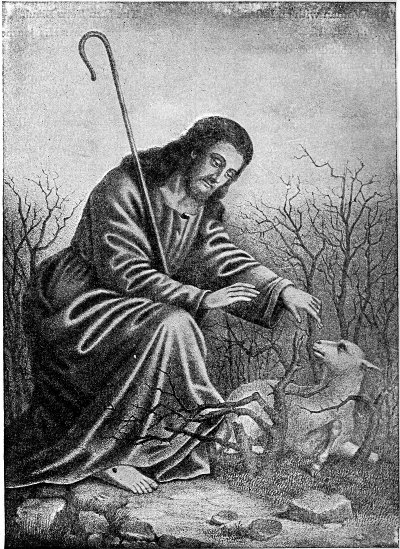
FINDING OF THE LOST SHEEP. St. Matthew 18.12-14; St. Luke 15.3-7
The Man Born Blind.
WHEN, coming near His journey's end, Jerusalem was nigh, He, one day, saw a man, born blind, As He was passing by. And His disciples questioned Him: "Master, whose sin hath done Such evil as is this man's lot— His parents' or his own?" And Jesus answered: "Neither hath His parents sinned nor he, But that the works of God, in him, Might be made plain to see. "I must perform my Father's works While it is day; the night Is coming, when no man can work; But I am the world's light, "As long as I am in the world." And when He thus did say He spat upon the ground, and made The spittle into clay; And with it He anointed thick The eyes that ne'er had seen, Then said unto the man: "Go wash In water pure and clean." Then went the man obediently, And washed his sightless eyes, And instantly he saw all round, With grateful, glad surprise. The neighbors said: "Is this the man Who begged, and could not see?" Said others: "He is like to him." But he said: "I am he." They asked him how he gained his sight, And he, with thankful voice, Told all about the wondrous work That made his heart rejoice. And now unto the Pharisees The happy man they brought; And it was on the Sabbath day This miracle was wrought. Questioned by doubting Pharisees, He did to them relate The way by which he was relieved From his unhappy state. They said the man who gave him sight A sinner, sure must be Or He would not, on such a day, Make a blind man to see. Yet others said: "How can a man Who is a sinner do Such miracles?" The healed man said: "He is a prophet true." The Jews would not believe the man Was ever blind at all; And, to find out if it were so, They did his parents call, And asked them: "Is this man your son, Who without sight was born? How, then, doth he now see so well, Yet blind until this morn?" The parents said: "He is our son, And was born blind, we know; But know not how he gained his sight; Himself the truth must show." The Jews straightway recalled the man, And said: "Give God the praise, We know this man's a sinner, by His Sabbath-breaking ways." He answered them: "I know not if This man a sinner be; One thing I know, that whereas I Was blind, yet now I see. "We know that God regardeth not A sinful man's appeal; But to obedient worshippers He will Himself reveal. "Since first the world began can ye Such wondrous power find As that a mortal man could heal The eyes of one born blind? "And if this man were not of God, Nor down from heaven came, He could do nothing in my case— All glory to His name!" And then they answered, wrathfully: "Thou, who believest thus, Wast altogether born in sin, And art thou teaching us?" They cast him out; which Jesus heard, And found him, when alone: "Believ'st thou on the Son of God?" He asked in gentle tone. The man said: "Lord who is He, that My faith to Him might bow?" Said Jesus: "Thou beholdest Him, He talketh with thee now." Then he said: "Lord, I do believe," With fervent voice, and loud, And bending forward to the earth, In reverent worship bowed.
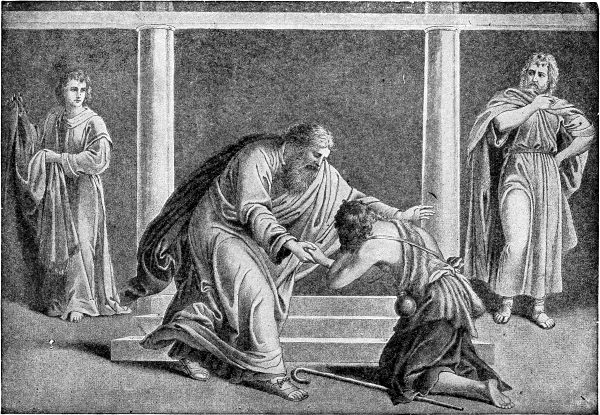
RETURN OF THE PRODIGAL SON. St. Luke 15.15-32
The Raising of Lazarus.
OF Martha you've already heard, Who entertained the Lord When once He passed through Bethany, And Mary heard His word. They had a brother, Lazarus, And Jesus loved the three, And now the young man was brought low, And very ill was he. And his sisters sent a message Unto the Lord, in haste: "Behold, he whom Thou lovest well Is sick and failing fast." But Jesus said: "This sickness Comes not that he must die, But for God's glory, that His Son Be glorified thereby. "Our friend, Lazarus, sleepeth," Were the next words He spake: "And I go hence that I may him Out of his sleep awake." Then said they: "Lord, if Laz'rus sleep He surely shall do well"— Thinking that it was natural rest That o'er his eyelids fell. Then He said, plainly: "Lazarus Is cold and still in death. But well, for your sakes, 'tis that I Went not while he had breath. "For so your faith shall be made bright, That may be somewhat dim; But now arise and leave this place, That we may go to him." Then Thomas said—called Didymus— To the disciples all, "Let's go, that we may die with Him, If death should Him befall." And now all hearts are sad and still, And many throb with fear, As Jesus and His followers To Bethany draw near. And those who meet Him tell the news Of sorrow and of gloom, That Lazarus has already lain Three days within his tomb. Now Bethany was very near Unto Jerusalem; And many to the sisters came, To see, and comfort them. And as they sat in silence, Their hearts with grief bowed down, The word was brought that Jesus Was coming into town. Then Martha went to meet the Christ, And said unto Him: "Lord, If Thou hadst been here, my brother Had recovered by Thy word." "Thy brother," thus the answer came, "Shall rise again, I say." "Yea, in the resurrection morn," She said, "at the last day." "I am the resurrection, and The Life," the Lord replied. "He that upon my name believes Shall live, though he had died." "Oh, Lord," she answered fervently, "I truly do believe Thou art the Christ, the Son of God, Whom this world should receive." When Jesus saw the sisters' tears, And tears of those around, He groaned in spirit and was sad, With troubled thoughts profound. He said to them: "Where have ye laid Your friend and mine to sleep?" They say to Him: "Lord, come and see," Then all beheld Him weep. And then they took away the stone From where the dead was laid, And Jesus lifted up His eyes, And solemnly He said: "Father I thank Thee that Thou hast Heard my heart's secret prayer, And I know that Thou dost always Bow down to me Thine ear." And when He thus had spoken, He cried in accents loud: "Lazarus, come forth," and the dead Came forth, bound in his shroud, And his face bound with a napkin; His movements thus were slow; But Jesus called out, with command: "Loose him and let him go." Then O, what deep and solemn joy The sisters' hearts conceived! While many of the Jews around On Jesus Christ believed.
They Brought Little Children to Him.
ONE day the mothers, who believed, Their little children brought, And from the Master's gentle hand A gracious blessing sought. But the disciples, in their zeal, Said: "Take these children home, They're in the way of older ones, Who for some good have come." But Jesus loved the little lambs, And much displeased was He, Saying: "Suffer little children, That they may come to me. "For 'tis such innocents as these That God's high kingdom win; And all must have as simple hearts Who gain a place therein." Then gently lifting in His arms, And folding to His breast, He put His hands upon their heads, And every infant blest.
The Young Ruler.
NOW, as He went forth in the way, A certain ruler came; "What shall I do," he frankly asked, "That I may heaven claim?" "Why callest thou me good?" the Lord Enquired in gentle tone. "There is none good in earth or heaven But God, and God alone. "Thou knowest the Commandments; Keep them in deed and truth, He answered and said: "Master, I've Observed them from my youth." Then Jesus looked at the young man, And loved him in His heart, And said: "One thing thou lackest yet, Thou with thy wealth must part. "Go sell, and give all to the poor, And stored in heaven 'twill be, Then come and cheerfully take up The cross and follow me." But the young man was sad at heart, Unwilling to obey; His riches he would not give up, So, grieved, he went away. And then to His disciples The Lord said, grave but kind: "How hardly shall the rich their way Into God's kingdom find? "It is easier for a camel Through a needle's eye to go Than he who loves his worldly goods The bliss of heaven should know."
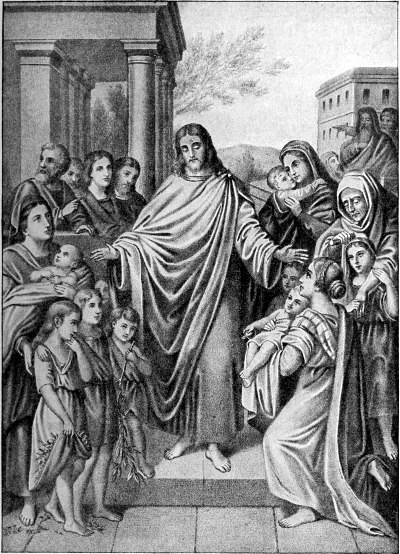
CHRIST BLESSING LITTLE CHILDREN ST. MATTHEW 19:13-15; ST. MARK 10:13-16; ST. LUKE 18.15, 16.
Peter Questions Him.
AND Peter then began to say: "Lo! we have given up all, And followed and believed on Thee; What shall to us befall?" And Jesus answered, "Verily, I say, no man hath left Parents or brethren, wife or child, Of home or lands bereft, "To suffer for the Gospel's sake, Who shall not find much more, Both in this world and that to come, Laid up for him in store. "But they who will be first on earth Shall be the last in heaven; And they who here take lowest seats Shall then have highest given."
Parable of the Laborers.
AND Jesus taught them as they walked, By pointed parable, That all shall have an equal right Who serve the Master well. He told them of a man who hired Some laborers to work, And promised each a penny, for The day, from morn to dark. Again at noon, and later still, He others idle found, And sent them into his vineyard To work upon the ground. And then again, and just before The closing of the day, He hired others who should get A penny for their pay. But when the eventide had come, And the day's work was done, The men were called, that each might get Whatever was his own. The last come were paid first, and each A pleased expression wore. But when the first were paid they thought That they should get still more. And when a penny each received, They murmured at the pay, Which was the same for one hour's work As for the long, warm day. The good man answered one of them: "Friend, I do thee no wrong; A penny I agreed to give— That doth to thee belong. "Take that thine is and go thy way, I will to this last one Give just the same as unto thee— Is it not all my own? "So shall the last be as the first, And first as last to view; For many be the called of God, And yet, the chosen, few."