The Principal Ruins
Reading edition
Within the national monument are perhaps 800 prehistoric and historic Indian village sites, representing various stages of Pueblo and later Navajo cultural development and spanning a period of about 1,800 years. The most interesting and important ruins are described below.
WHITE HOUSE
Located up the main canyon, about 6 miles from Park Service headquarters, White House is one of the largest, best preserved, and most accessible ruins in the monument.
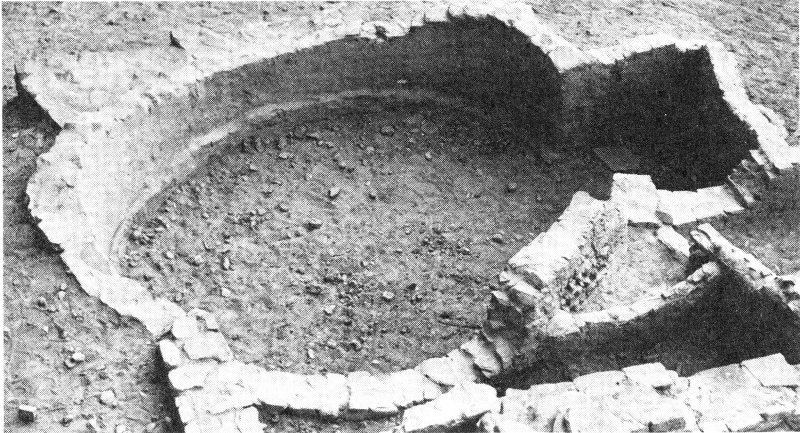
A kiva at the White House ruin, where religious and other ceremonies were held.
Lt. J. H. Simpson described this ruin after his 1849 visit, calling it Casa Blanca (White House). It is also known by its Navajo name, Kini-na-e-kai. Both names derive from a conspicuous white-plastered wall in the upper portion.
White House was constructed in two sections; one stands against the base of the cliff on the canyon floor, and the other is in a small cave immediately above. Mindeleff estimated that at one time the whole ruin contained as many as 80 rooms. Much of the lower building has probably been washed away by the stream nearby (a retaining wall now helps to prevent this), but evidence of about 60 rooms and 4 kivas (special ceremonial chambers) still survives.
Behind the back walls of the lower ruin the smooth cliff face rises 35 feet to the floor of the cave above. Marks on the face indicate that at one time the rooms of the lower building stood several stories high, and its roof came to within 4 feet of the cave floor above.
8
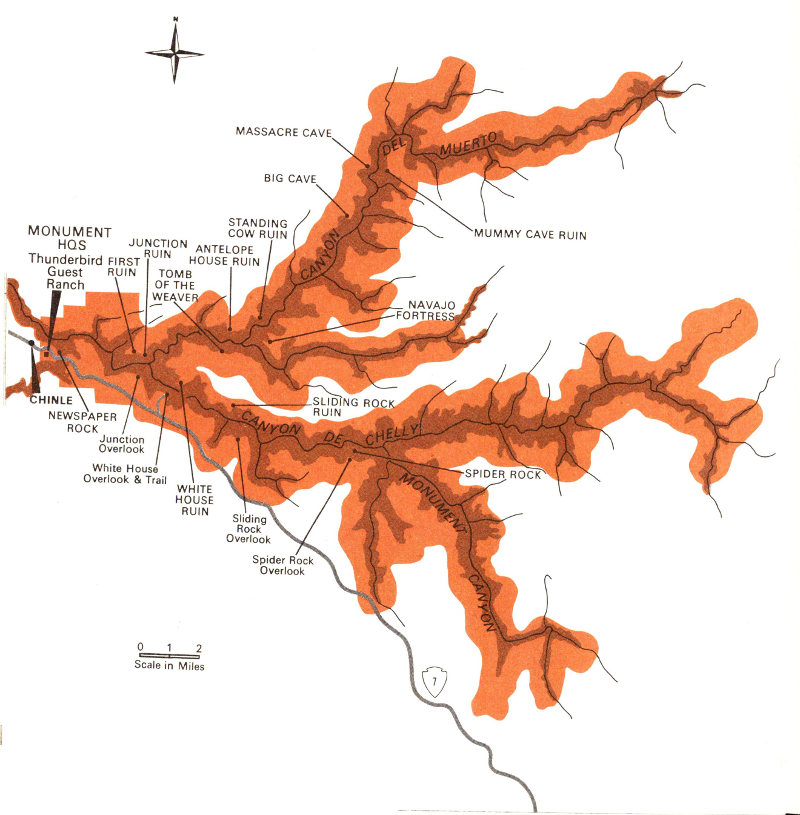
This map shows only the principal ruins in the canyons that are open to visitors. Only some of these are discussed in the text. The rock formations of these canyons eroded easily, thus producing the steep cliffs and cave formations that provided protection for the Anasazi.
9
The upper ruin contains 10 rooms and has a large room nearly in the center of the cave. The outside front wall of this room is 12 feet high and still has the coating of white gypsum clay plaster with a decorative band of yellow clay for which the ruin was named.
At the western edge of the lower ruin are the partial remains of two well-built kivas. One kiva used to have holes in the floor like those used to support looms in modern Pueblo kivas. The other kiva shows evidence of six layers of plaster. Modern Zuni Indians have a ceremony every 4 years in which they replaster the smoke-stained kiva interior, and this tradition may give some idea of how long this kiva was in use.
A study of the annual growth rings of its roof timbers indicates that most of the lower ruin was built after A.D. 1070.
ANTELOPE HOUSE
Many large ruins are located in the narrow and twisting Canyon del Muerto. One of the biggest is Antelope House, some 5 miles above del Muerto’s junction with Canyon de Chelly. This 40- to 50-room village was built on the stream bank against the base of a cliff which towers nearly 600 feet above it.
Antelope House received its name from four antelopes painted in tan and white, about half life size, high on the cliff nearby. Navajo families living in the canyon believe that these well-executed paintings were done by Dibe Yazhi (Little Sheep), a Navajo artist who lived here in the 1830’s. Other figures in white paint are probably the work of the prehistoric inhabitants of Antelope House.
Because it stands on the river bank, Antelope House has also eroded badly. Yet many of the house walls still rise two and three stories high, and the masonry outlines of dozens of unexcavated rubble-filled rooms and of two kivas can still be seen.
10
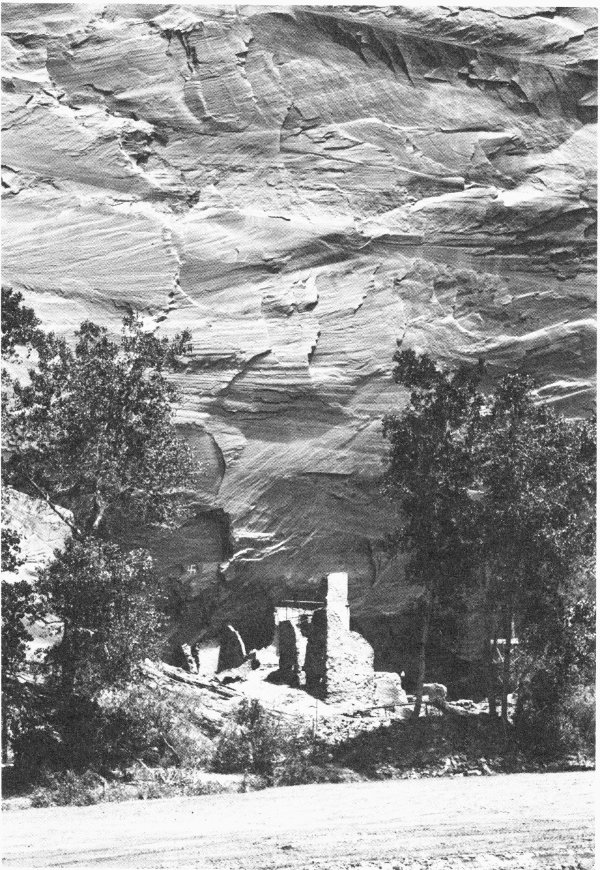
Antelope House in Canyon del Muerto is on the canyon floor under a towering, overhanging cliff.
11
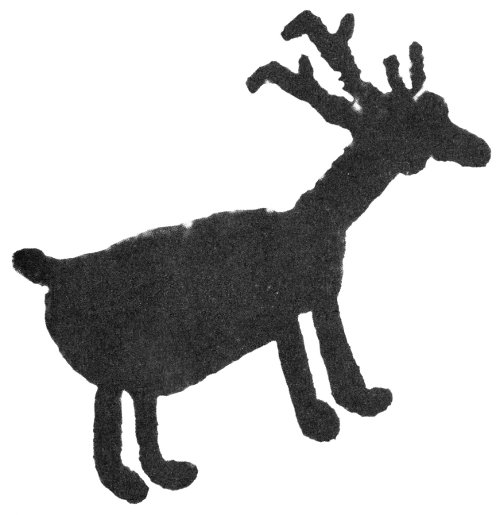
An Anasazi pictograph.
The famous “Burial of the Weaver” was found in a small cliff alcove not far from Antelope House. The grave was against the cliff, and a curved masonry wall in front held back the earth. Inside was the tightly flexed body of an old man lying on his left side. His hair was streaked with gray and tied back in a bob; a billet of wood served as a pillow. The body’s outer wrapping was a feather blanket made from the breast down of golden eagles. Under the feather cloth was a white cotton blanket, excellently made and appearing as clean and new as if freshly woven; and under the white blanket was an old gray cotton blanket. Beneath that blanket, lying on the mummy’s breast, was a single ear of corn.
A reed mat covered the floor of the grave, and the amount and variety of objects laid away with the body suggest that the individual was highly respected in life. A long wooden digging stick, broken to fit into the grave, lay across the burial bundle. Beside this, and also broken, was a bow so thick that only a powerful arm could have pulled it. With the bow was a single reed arrow with a fire-hardened wooden point. Five pottery jars, one broken, together with four bowl-shaped baskets woven from yucca leaves, were also in the grave. These containers were filled with cornmeal, shelled corn, four ears of husked corn, pinyon nuts, beans, and salt. Tightly packed around the body and offerings were thick skeins of cotton yarn which measured more than 2 miles in length. A spindle whorl—a wooden disc on a reed stem which probably had been used to spin the cotton—lay on the yarn.
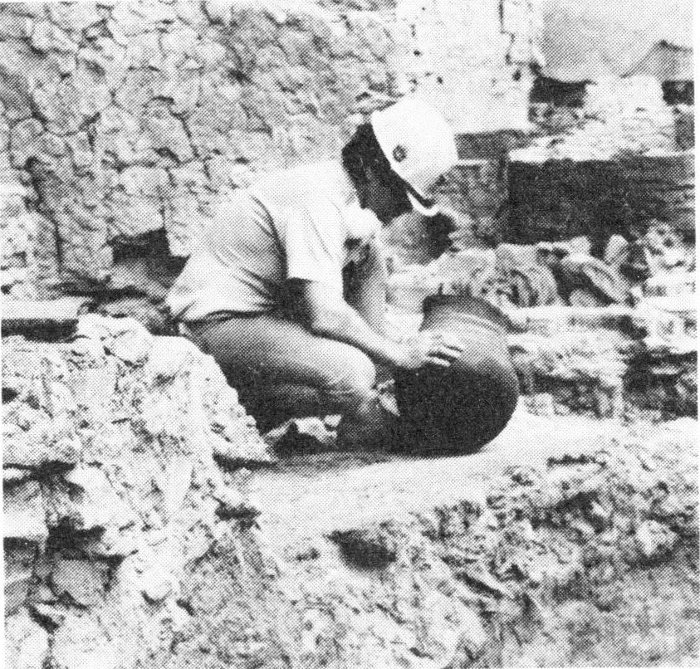
A National Park Service archeologist examines a storage jar found at Antelope House.
12
STANDING COW
This cave in Canyon del Muerto was named for a large white and blue pictograph of a cow, drawn in the historic period and undoubtedly the work of a Navajo. Not much can be seen of this ancient ruin, for Navajos have lived on the site in recent times and still use the old bins for storing corn and the leveled areas for drying peaches.
On the cliff near this ruin is an interesting old Navajo painting of Spanish cavalrymen.
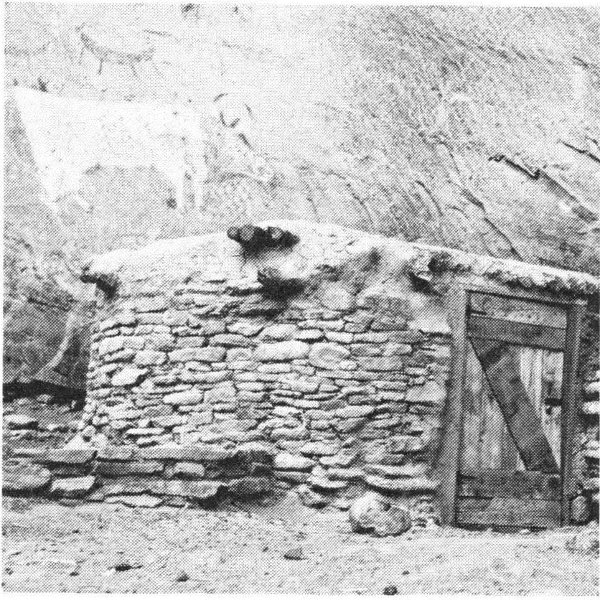
This blue-headed cow, painted by an early Navajo artist on the shelter wall, gave Standing Cow Ruin its name.
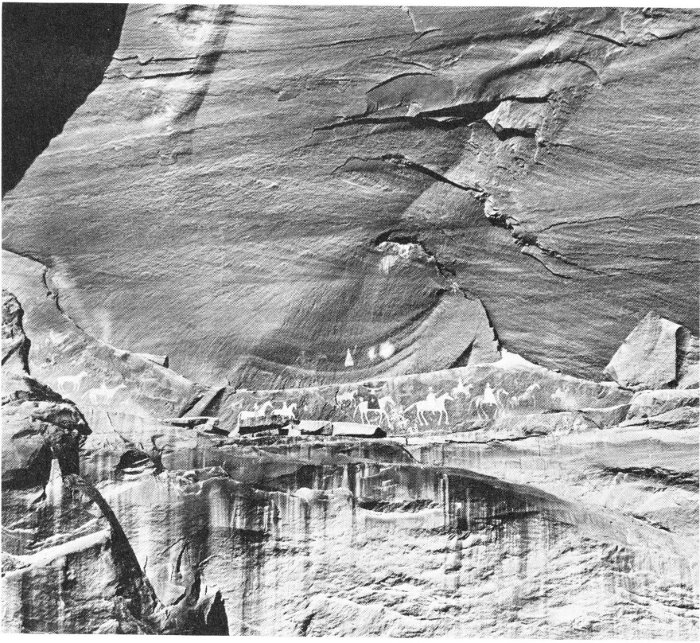
This Navajo rock painting in Canyon del Muerto shows a procession of soldiers. It probably records a Spanish expedition in the 19th century.
13
BIG CAVE
One of the largest concentrations of very early material at Canyon de Chelly came from Big Cave (Tse-Ya-Tso) in Canyon del Muerto. Tree-ring dates ranging from A.D. 331 to 835 indicate an intensive occupation of the site in Basketmaker times.
Several burials of interest were found at Big Cave. One was of an old man who had broken both legs across the shin bones. The fractures were set so well that only the smallest of bumps were left.
The remains of 14 infants were found in a slab-lined cist used earlier as a storage bin. Below the infants were the bodies of four other children packed in an enormous basket. None showed any signs of violence, and it is thought that some disease must have swept through the cave, killing many children in a short time.
The unique “Burial of the Hands” was discovered in another part of Big Cave. This burial consisted of just a pair of arms and hands lying side by side on a bed of grass. The elbows touched the wall of the cave in a way that suggested that the rest of the body had not been removed at a later time. Three necklaces of abalone shell pendants were wrapped around the wrists, and two pairs of exceptionally fine, unworn sandals, patterned in black and red, were lying beside the hands, as was a small basket half full of white shell beads. Another basket nearly 2 feet in diameter covered the burial. No satisfactory explanation of this burial has ever been advanced.
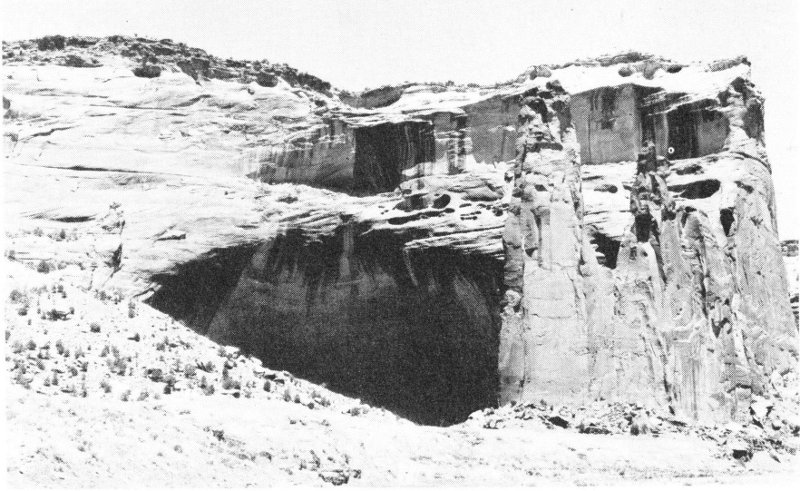
Excavations at Big Cave in Canyon del Muerto yielded valuable artifacts of the Basketmaker period.
14
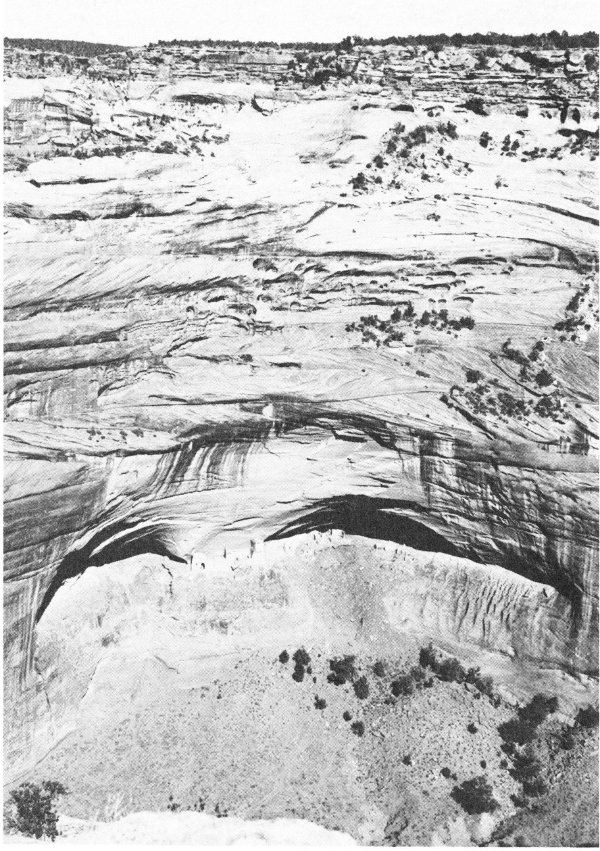
Mummy Cave, bathed in sun with its flanking ruins almost hidden in shadows.
15
MUMMY CAVE
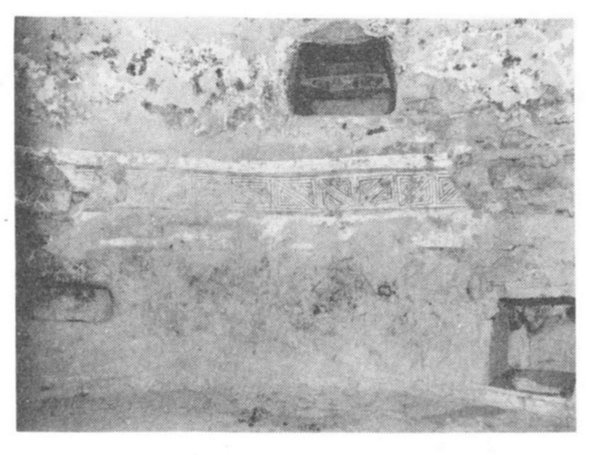
This fretwork design decorates a kiva in Mummy Cave.
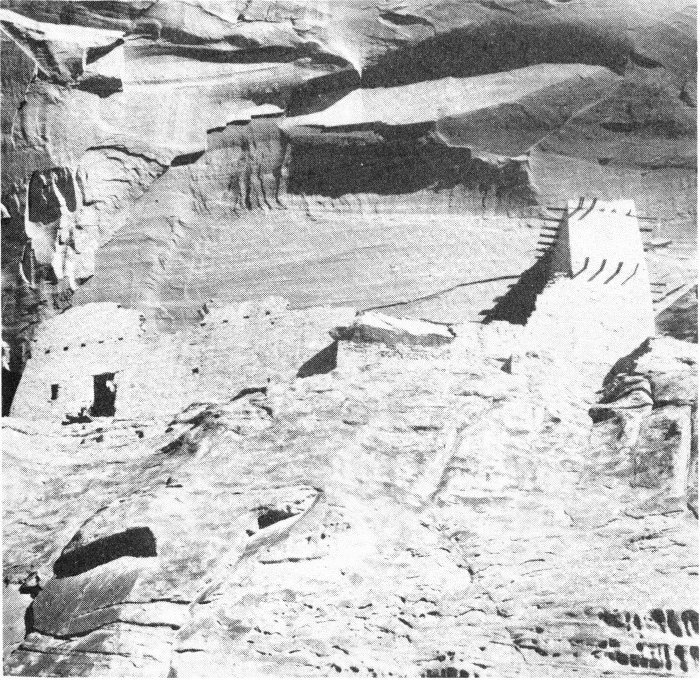
The central tower structure at Mummy Cave shows strong Mesa Verde affiliations and was constructed in A.D. 1284.
One of the most beautifully situated ruins in the national monument is Mummy Cave in Canyon del Muerto 21 miles northeast of park headquarters. This dwelling, the largest in the canyons, was built in two adjacent caves about 300 feet up a talus slope from the streambed.
The largest part of the structure, about 55 rooms and 4 kivas, was built in the eastern cave. The western cave, with about 20 rooms, is now accessible only by a ledge from the east cave, although traces of an eroded hand-and-toe trail can be seen leading directly from the top of the talus to the ruin. Along the ledge connecting the two caves are 15 rooms, including a “tower” house; these are the best preserved of all the ruins here. Much original plaster in several colors remains on inner and outer walls throughout the village. Especially notable is the white clay plaster on the interior of the third story of the tower house and the red-painted fret design on white plaster in the large kiva of the east cave.
16
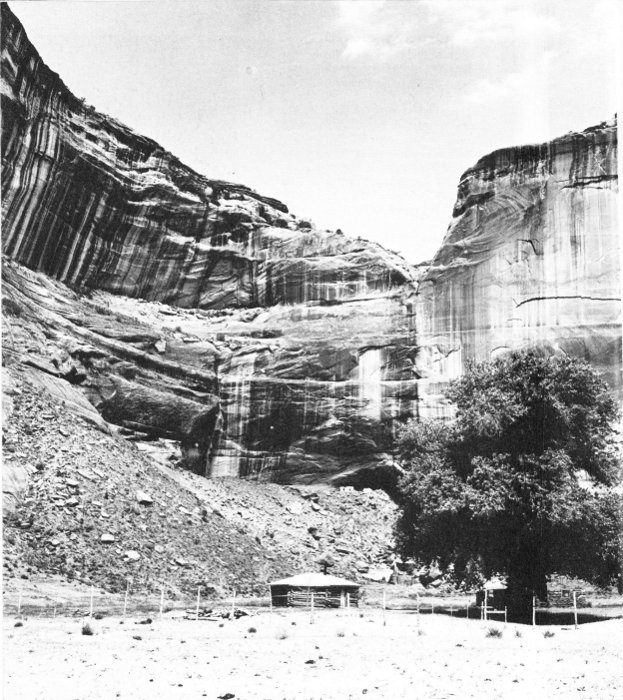
A Navajo family has settled below the ruins of the ancient ones in Canyon del Muerto.
17