CHAP. VI.
Reading edition
IMPRESSIONS OF CANADA, NIAGARA, THE ST. LAWRENCE, ETC. UPON EMIGRANT
SETTLERS.
The Falls of Niagara impress travellers very differently. Most persons, having heard of this wonder of the world from their childhood, have aggrandized their imagination of its appearance in proportion with the growth of their minds, and visit Niagara, at last, with the expectation of seeing an ocean poured from the height of the clouds. A very graphic and sketchy account of past impressions at the Falls is given by a traveller, whose book is less known than it deserves; and we quote from him, quite sure that his description will be new to the reader. “I first visited these celebrated Falls,” he says, “in the month of September—a season of the year which, in America, is peculiarly pleasant. The violent heats have then considerably abated; the musquito, satiated with human blood, has given rest to his proboscis; and man, free from the irritating bite of innumerable tormenting insects, and from the scorching heat of an almost insupportable sun, enjoys an agreeable respite, and ranges through the country in quiet and comfort. Until I arrived within a mile of the Falls, the sky was perfectly clear, the sun shone with his wonted splendour, and the atmosphere was remarkably dry and uncommonly lucid. But no sooner had I approached their immediate vicinity, than a sudden and singular change took place in the whole aspect of nature. The earth, before parched and immovable, became damp and tremulous; and the sky, till then unsullied by a single cloud, assumed a frowning, dark, and portentous appearance. The atmosphere, previously dry and rarefied, now presented a dense and humid visage; and my fancy, unreined by my reason transported me into a world essentially different from that in which, a few minutes before, I ‘lived, and moved, and had my being.’
“Still, however, I pursued my course, and at length gained the summit of the craggy hills which flank this noble river. My increased elevation did not contribute to dissipate the preconceived delusion, and I still felt inclined to doubt of my own or the world’s identity. Mountains of water, belching forth the most appalling sounds—globes of foam, boiling with rage—rainbows, embracing within their numerous and splendid arches a surprising variety of newly-formed impending clouds—rocks, boldly projecting over the tumultuous abyss—and spray-covered forests, decorated with pearly drops, now rendered more brilliant than crystal by the reflected rays of the setting sun, and now blown into feathery streams by sudden gusts of the impetuous wind;—these were some of the most striking features of the gorgeous scenery by which I was surrounded. Long did I luxuriate in pleasing contemplation, admiring its peculiar grandeur; and still did I find myself lingering amidst these stupendous and matchless displays of creative excellence, until the sun, wearied with shedding his beams on the transatlantic wilds, had retired, in all his glory, ‘to rove o’r other lands, and give to other men the kindest boon of heaven.’
“For the first time of my life did I regret the shortness of a September day. But my regret soon ceased; for ere night had completely drawn her sable mantle across the objects of my admiration, over which I still lingered, a glorious moon, enshrouded in golden robes, kindly lent me the aid of her beauteous lustre, and quickly diffused through every part of the landscape new features of loveliness, giving it a character far more soft and interesting than that with which proud day had invested it. The stupendous and magnificent machinery of nature, which had recently bound me in abstraction, was now divested of many of its peculiar charms. A perfect calm succeeded. The forests appeared sunk in deep repose. The winds had subsided. The green leaves, no longer agitated by the breeze, ceased their rustling. Not a cloud floated along the face of heaven. Every thing around and above seemed to have found
‘Tir’d nature’s sweet restorer, balmy sleep.’
All was still, except the wakeful cataracts that roared with their wonted violence, and disturbed the basin which groaned beneath the undiminished burden. Never was there a finer contrast than that between the noise of the water and the stillness of the air; the golden effulgence of the rushing flood, and the impenetrable shades of the surrounding forests; the blackness of the frightful gulf, down which the waves, with unabating force, are precipitated in crashing confusion, and the light and cheering face of the spangled heavens, over which the crescent moon was sailing with modest pride and conscious dignity.
“Sick and insensible must be the soul that could behold with indifference an exhibition so fine, so varied, so replete with all that is calculated to please the eye, to arouse the mind, and, in a word, to raise the whole man above the vulgar level of existence, and make him sensible, that while he thus contrasts the piccuresque scenery of the earth with the inimitable grandeur of the heavens, he is standing, as it were, in the immediate presence of that Deity who ‘measured the waters in the hollow of his hand, and meted out the heavens with a span’—to whom he is indebted for all he sees, and all he feels—by whose almighty power and wisdom the rivers had their appointed sources and obtained leave to flow, and from whose hands the mountains first received their appropriate bulk and due conformation.
“I cannot convey to you any idea of the poverty of language that is felt when one attempts to describe such a combination of grand and uncommon objects, among which is found every thing essential to constitute the romantic, the terrific, the picturesque, and the sublime. All that is awfully grand here occupies a prominent station; and every part is so tastefully arranged as to make the deepest impression upon beholders, and to proclaim, in language not less loud than the ‘music of the spheres,’
The hand that made us is divine.
“The country in which Lake Erie lies is elevated nearly 300 feet above that which surrounds Ontario. The extensive slope, or mountain, as it is called, which divides the lower country from the upper, is, in many places, nearly perpendicular. It commences on the northern side of Lake Ontario, and runs thence round its north-western point, until it is intersected by the road which leads from York to Amherstburgh. It afterwards pursues an eastern direction, and finally embanks the strait or river of Niagara.
“Persons who visit the Falls generally stop at an adjacent village—(this account was written some twelve or fifteen years ago),—consisting of about a dozen houses, and two very excellent hotels, in which as good accommodation may be found as in any other part of the country. From the balcony of that which is styled the ‘Niagara Falls’ Pavilion,’ there is a very fine view of the Horse-shoe Fall, and of the island which bisects the river. From the same house there is a difficult foot-path, which leads down a very steep bank to the edge of the river, immediately adjoining the place where the Table Rock formerly stood. It must also be recollected that the river issues from Lake Erie about twenty miles above the Falls, and, until it arrives within three miles of them, runs with a smooth current and an undisturbed surface. The bed of the stream then becomes rocky; and the water is so violently agitated by passing down successive rapids, that a person of the strongest nerves, standing on the shore, cannot without difficulty refrain from shuddering at the sight.
“Notwithstanding the rapidity of the current, its violence is displayed only on each side of the river, the middle remaining sufficiently smooth to admit of boats passing down to the island that separates the river into two branches, before the waters are dashed down the precipice which forms the Fall. As the current approaches this island, it seems to run with redoubled velocity. It is impossible to conceive any thing equal to the force and swiftness of its progress to the ledge of rocks, over which it is propelled, till it impetuously tumbles into the bed of the river beneath, with a noise louder than thunder. When the waters fall into the deep basin, they rebound into the air in immense spherical figures, white as snow and sparkling as diamonds. These figures, after rising, and, apparently, remaining stationary for a moment, explode at the top, and emit columns of spray to an astonishing height. They then subside, and are succeeded by others, which appear and disappear in the same manner.
“From that part of the Table Rock which yet remains, and the path to which I have already described, the spectator commands one of the grandest and most romantic views in nature. The tremendous rapids above the Falls—Goat Island in their midst, covered with trees, which seem at every moment about to be swept away—the Horse-shoe Fall, immediately below Table Rock—Fort Schlosser Fall, beyond Goat Island, and the frightful gulf beneath, boiling with perpetual rage, and shooting upwards immense volumes of sparkling foam, smoking with the apparent intensity of heat, are a few of the great objects which are forced upon his attention.
“Another place from which the Falls assume, if possible, a more striking and awful appearance, is at the bottom of the cataract. The precipice leading to this spot is descended by means of a ladder, commonly called ‘the Indian ladder’—a piece of mechanism simply consisting of a cedar-tree, the boughs of which are lopped off at a sufficient distance from the trunk to make them answer all the purposes of irregular steps. After descending this ladder, the perpendicular height of which is upwards of sixty feet, you proceed along the edge of the river, which is covered with broken rocks, the wrecks of boats, and other exuviæ, until you arrive at the bottom of the Horse-shoe Fall. From this place visitors frequently proceed on foot several hundred yards, within a prodigious sheet of caverned water, which is formed by the overshooting of the cataract. But they must be men of the firmest nerve who venture on such a daring enterprise; for the most undaunted resolution is in danger of being shaken on looking upward at the impending rock, which continually seems to bend and groan beneath the rolling flood, to which it serves as a fearful support. From the projecting edge of this rock, the mass of waters is impelled forward, and leaves a large and smooth expanse, which reaches from the natural sheet of falling water to the very base of the gradually undermined mountain. If the atmosphere be dense, it is still more dangerous to engage in the bold attempt of exploring the stable foundations of the river; for people at such times not unfrequently lose the power of respiration in proceeding far beneath the rocky ceiling. Notwithstanding this and various other dangers, to which all are equally exposed who venture to approach the Fall in boats, the fisherman frequently continues there for hours together, apparently without any apprehension of danger.
“The whole breadth of the precipice or Falls, including the islands which intervene, is 1,335 yards. The greatest body of water falls on the Canadian side of the river; and on account of the form assumed by the waters before they are dashed from the top of the rocks, it is designated the Horse-shoe Fall. It extends from the shore to the intermediate island, a distance of 600 yards. Fort Schlosser Fall, which is on the American side, presents a sheet of water 350 yards in breadth; and the Little Fall extends across a ledge of rocks for upwards of 140 yards. The quantity of water which pours over all three, in every minute, is estimated at 169,344,000 gallons.
“Many stories are told of the melancholy fate of persons who at various times have been carried down the rapids, in attempting to cross the river above; but I believe the only well-authenticated anecdote of this kind is that of an Indian, who, having become intoxicated with liquor, made his canoe fast to a rock, a few miles above the Falls, and fell asleep. By some unknown accident, the canoe was loosed from its moorings, and immediately floated down the current. While the surface of the water continued to be smooth, the slumbers of the unconscious savage were undisturbed; but when his frail bark entered on the rapids, and became agitated by the turbulent eddies, he suddenly awoke. On perceiving his perilous situation, and recovering a little from his first astonishment, he laid hold upon his paddle, and used the most violent exertions to escape from the impending destruction. When his repeated failures to avert the swift course of the vessel had convinced him that all endeavours on his part would be unavailing, he laid aside his paddle, composedly rolled himself up in his blanket, and putting the whiskey bottle for the last time to his lips, quietly lay down, as if all danger were over. In a few moments he and his bark were precipitated down the Falls; and no one ever saw trace again of the Indian or his canoe.
“In the summer of 1822, a similar accident befel two unfortunate white men. It appears that, for some time past, a part of Goat Island, which separates the Falls, has been inhabited, and under cultivation. Some of the residents, who were on the point of quitting their perilous abode, were engaged in conveying their movable effects to the Canada shore. The day was exceedingly boisterous, and the current of the river consequently more violent than usual. Four men, with two boats, were engaged in taking away the furniture; and when the first trip had been accomplished, two of them, being apprehensive of danger from the fury with which the wind blew in the direction of the stream, resolved to venture no more until the storm should abate. They communicated this determination to their companions, who, laughing them to scorn, boasted largely of their own freedom from fear, and returned to their hazardous employment. But in a few minutes afterwards, they were carried down the cataract, and dashed to pieces. A day or two after this event, a table which had been in the same boat, was discovered in the river at the foot of the Falls, uninjured.
“The noise of the Falls is said to be heard, on a calm evening, as far as Burlington Heights, a distance of nearly fifty miles. But when this is true, the wind, which is an excellent transmitter of sound, must blow exactly in that direction. The waters make a report which might be heard at a much greater distance, if, instead of falling into a profound gulf, surrounded on every side with hills of at least 350 feet perpendicular height, which confine the sound, they fell upon a horizontal plain of sufficient altitude to allow the sound to pass without interruption into the circumjacent country. As an illustration:—If a stone were let fall from the surface of the earth into a well 100 feet deep, the noise would not be distinctly heard by a person standing twenty yards from its mouth; but if the same stone were dropped from the apex of a steeple of only half that height, into a cistern of water, the surface of which was on a level with the earth, the noise, occasioned by its splashing in the water, would be distinctly heard at above five times the former distance.
“Previous to the settlement of the country along the banks of the Niagara river, great numbers of wild beasts, birds, and fishes might be seen dashed to pieces on the shore near the bottom of the Falls. But since this part of the country has been thickly settled, scarcely any thing is to be found in the bed of the river below the Falls, except fishes and a few water fowl, which, on alighting in the rapids, are unable to take wing again, and are soon hurried down the dreadful abyss.
“It is generally supposed that the Falls were once as far down as Queenston, and the supposition seems plausible. The appearance of the banks on each side of the river affords very strong presumptive evidence in favour of this notion; and the fact of the constant recession of the Falls, observed by the people who reside in their vicinity, is no less confirmatory. That seven miles of limestone strata of such great depth should be worn away by nothing but water, will appear too preposterous for belief, by those who have never stooped to the drudgery of calculation; but if only the fiftieth part of a barleycorn had been worn away in every hour since the creation, supposing the Falls to have been then at Queenston, or a little above it, they would now be within a few perches of their present position. These calculations receive an air of great plausibility, at least, from the rugged features of the banks between the Falls and Queenston, which afford numerous and strong indications of the violence to which the strata have there been subjected.”
The writer from whom the foregoing account of Niagara is quoted, went out with his father and a few labourers to settle in Canada. His voyage up the St. Lawrence is very descriptive of the scenery and adventures which fell to the lot of all travellers on the same errand at that time, and may be useful as well as interesting here. He says:—“I embarked at La Chine with my father and his settlers, twenty days after our arrival in Quebec. On account of the shallows immediately below this village, goods and passengers intended for a higher destination up the river are conveyed by land from Montreal. Previous to our leaving La Chine, thirty-one of the settlers, dreading, the expense of transporting their families to the Upper Province, separated from us and accepted of a settlement at or near Perth, about 140 miles north-west of Montreal. Owing to the rapidity of the St. Lawrence immediately above Montreal, ship navigation terminates at that city. Such is the vehemence of the current in various places, that it is totally impossible to ascend the river in vessels of ordinary construction. Batteaux, or flat-bottomed boats, narrow at bow and stern, and made of pine boards, have been found much better adapted to the river than any others. These boats are about forty feet long, and six across the centre, and are navigated by four men and a pilot. Each boat carries about five tons, and is provided with a small mast and sails, six setting poles about nine feet long, shod at their lower extremities with iron, which terminates in a sharp point, and the necessary cooking apparatus. In these boats, all the merchandise destined for Upper Canada is conveyed; and, fitted out in this style, they depart from La Chine, four or five of them generally forming one party. They quickly arrive in Lake St. Louis, which is formed by the junction of the Ottawa, or Grand River, with the St Lawrence. If the wind happen to blow favourably when they are passing through this lake, they haul up their sails until they arrive at the Cascades, which are about thirty miles from Montreal.
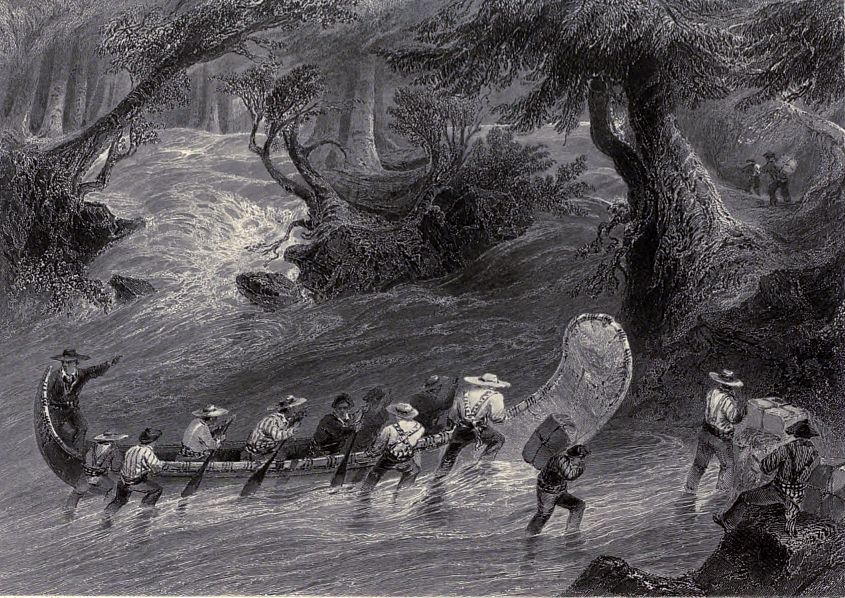
Working a Canoe up a Rapid.
At the Cascades a short canal has been cut, and locks formed by the government, through which the vessels pass, till they attain the head of these rapids, after which they proceed without departing from the river till they arrive at the Cedars, where, by other locks, they ascend the most difficult part of the rapids. The current between the Cascades and the Cedars is so very impetuous, that the boatmen are obliged to have recourse to their setting-poles, which they fix in the bed of the river, and thus propel their boats with considerable celerity. These exertions, though fatiguing in the extreme, they are often obliged to continue for several hours without intermission, and not unfrequently even their best endeavours in this may prove abortive. When this is the case, they make a rope fast to the bow of the boat; and leaving only the helmsman on board, they plunge into the water and tow her by main strength up the rapids. This is the manner in which they perform the arduous passage, which, though only 120 miles, they seldom accomplish in less than ten days. How the men who are employed in this difficult navigation exist without ruining their constitutions is a mystery which I am utterly unable to explain. They are compelled, almost every hour, when actually melting with heat and fainting with fatigue, to jump into the water, frequently up to their arm-pits, and to remain in it towing their boats until they are completely chilled. They then have recourse to the aid of ardent spirits, of which on all occasions they freely partake, and, in a few minutes, are once more bathed in perspiration. The principal rapids between Montreal and Prescott are the Cedars and the Cascades already mentioned, the Coteau du Lac and the Long Sault, the latter of which are about nine miles in length; and though they are seldom ascended in less than a day, boats have been known to descend through their whole length in fifteen minutes.
While about 140 of the settlers took their passage from La Chine in what the Canadians call Durham boats, my father and his family, with the remainder of the settlers, embarked in a vessel of the same description. The accommodation which the boat afforded was so poor, that our situation, during the thirteen days of our voyage from La Chine to Prescott, was in reality “below the reach of envy.” To make room for my mother and the children in the wretched little hole of a cabin, my brother and I were frequently obliged to sleep on the shore in the open air—the refreshing zephyrs being our only curtains, and the “spangled heavens, a shining frame,” our resplendent canopy. Taverns are undoubtedly found in many parts along the banks of the river; but, as the boats do not always stop in the neighbourhood of these refectories, we seldom had any other method of reposing our weary bodies than the one to which I have now alluded.
One night in particular, when we felt the air rather too cool for sleeping on the ground, my brother and I, with three of the settlers, solicited permission of a Canadian farmer to lie on the floor of his kitchen. This request, though humble and moderate, was peremptorily refused. We asked for neither bed nor blanket, meat nor drink, but barely for leave to stretch our fatigued limbs on the uncovered boards; yet even this was denied. We were in the act of quietly returning to the boat, when, on approaching the door of his stable, we found it open, entered, and had but just discovered some clean straw, upon which we designed to rest our heads for the night, when the owner stalked in, and on recognising us, commanded our instant departure. We were therefore compelled to decamp and to take our usual nightly station on the shore. This little incident banished sleep from my eyes; and I spent the greater part of the night in the indulgence of the most gloomy reflections. That fondly beloved Isle of Erin, where the genius of hospitality continually holds her court, and freely spreads her social influence, again recurred to my memory. I thought of her humblest sons, generous and humane, sons of benevolence and toil, whose hard labour just gives what life requires, but gives no more; yet who, with the ever ready smile of heart-felt sympathy, are willing to share that hard-earned little with the weary traveller whom chance directs to their threshold, or necessity throws upon their bounty.
We were from the 18th of August to the 1st of September in accomplishing this voyage of only 120 miles. I think I may say, without any danger of hyperbole, that, during this short period, each of us encountered greater difficulties, endured more privations, and submitted to stronger proofs of our fortitude, than had been our lot in all the preceding years of our lives. We were obliged by day, in consequence of the great weight of our luggage, to assist the sailors in towing the boat up the rapids, often up to the arm-pits in the water; and by night to rest our enervated and shivering limbs on the inhospitable shore of this river of cataracts.
On the ninth day of our amphibious journey my brother and I with several of the settlers, for the sake of a little variety, left the boat, and walked a few miles along the shore of the St. Lawrence. As we were entirely unacquainted with the country, we resolved to keep as close as possible to the bank, which in this part was completely covered with thick woods. When we had walked about a mile, our progress was interrupted by a large tract of swampy land, which we found to be totally impassable. Before we had reached the head of the swamp, and once more gained the shore, the boat was out of sight. However, we pursued our route along the bank until night approached, when we perceived a light about two miles down the river, which we concluded to be that of the boat. This conjecture proved to be correct. It appeared that, in our hurry to overtake her, we had over-reached the mark, and got too far a-head. As the night was dark, we whistled, hallooed, and fired off our guns, hoping to induce them to pull up and take us on board. But all our efforts proved ineffectual; we could neither make them hear us, nor understand our signals. At length one of our party observed a house about half a mile above us;—a discovery which afforded no small degree of pleasure. We had walked nearly ten miles through a dismal forest, over swamps and marshes, and were hungry and fatigued. A few moments before we had no prospect of discovering even a dry spot of land on which we might lay ourselves down to rest. Nothing appeared—
“But matted woods, where birds forget to sing,
And silent bats in drowsy clusters cling.”
Judge, then, what was our pleasure on beholding a human habitation; for a human one it was, though its title to humanity was founded solely on the fact of its being the abode of man, without the least reference to the gentleness of his nature.
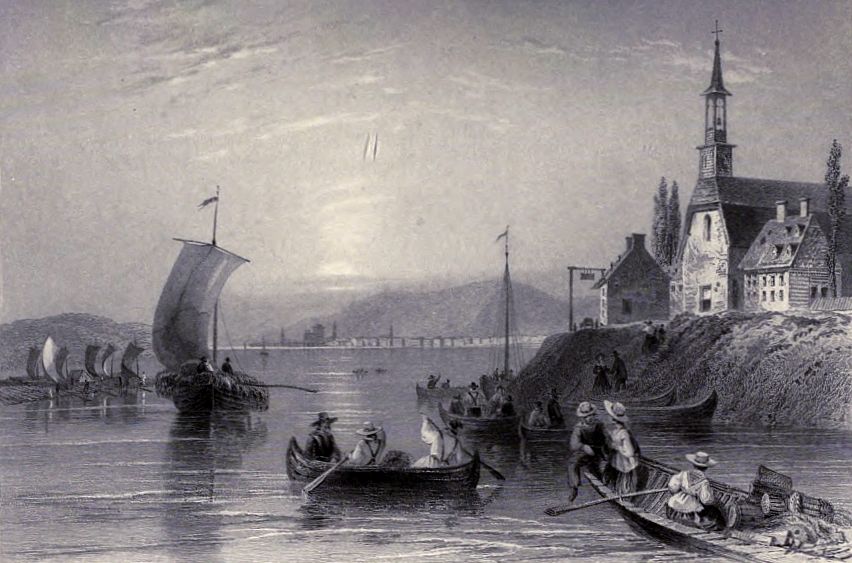
Scene on the River St. Lawrence. (Near Montreal.)
When we entered within the door, and informed the owner of the circumstances which obliged us to become intruders, and to claim his hospitality, he muttered out a few words with unfeeling frigidity, the purport of which was that we might lie upon the floor if we pleased! It was then about nine o’clock; and from that hour until eleven, when they retired to bed, I do not recollect that we had the pleasure of any further conversation either with our host or his lady. When they withdrew from the apartment we were left sole monarchs of the kitchen; but our throne was, in one respect, like that which the sycophantic courtiers of king Canute urged him to usurp—it was covered with coarse sand, and presented no very agreeable aspect as a resting-place to us, who presumed to think that we had done sufficient penance for our transgressions in this country, by the sufferings which we necessarily endured in the day during the course of our unfortunate perambulations. It was some time before we could reconcile ourselves to the idea of lying down on the rough kitchen floor; but at length the god of dreams prevailed over all our apprehensive sensibilities, and compelled us to resume a recumbent posture. I converted my hat into a pillow, and my cravat into a cap or turban; and, after promising my companions in tribulation a glass of rum in the morning by way of toasting Canadian hospitality, I fell asleep; but awoke some time before day-break with sore limbs and an aching head.
From the perusal of such incidents as these, one would probably form a very low and indifferent opinion of Canadian hospitality; but justice compels me to add, that the people who live on the shores of the St. Lawrence have so frequently been imposed upon, plundered, and otherwise maltreated by various evil-disposed emigrants in their progress to the Upper Province, that, if we had experienced even worse treatment than this which I have related, it ought not, under such provoking circumstances, to excite much astonishment.
The country on each side of the river, between Prescott and Montreal, is similar in appearance to that between the latter city and Quebec, with this difference, that the houses above Montreal are much inferior to those below. For about 60 miles beyond Montreal almost all the inhabitants are of French extraction, and still speak the language of their ancestors. They scarcely understand a word of English, and seem to be of very humble origin. Their habitations are constructed in the style of cottages; and though they certainly are not reproachable with any great degree of taste or elegance in their design, they have a just claim to honourable mention for the compensating attributes of cleanliness and of neatness, if not of refinement, in the simple decorations of their interiors. The traveller, who may have occasion to cross their thresholds, will seldom witness the semblance of poverty, or the shadow of discontent. Since my arrival in the country, I have not beheld a single trace of anxiety or care in the countenances of the people. In the city, the town, the village, and the open country, every eye sparkles with contentment, and every tongue speaks the language of independence. If the maxim of our ethic poet be correct, that—
“Reason’s whole pleasure, all the joys of sense,
Lie in three words, health, peace, and competence,”
I do not wonder at beholding such an invariable picture of enjoyment in the looks of the Canadians; for they certainly possess, to a perfection which cannot be surpassed, every one of those integral elements in the happiness of man which the poet has thus tersely described. How melancholy the contrast to an Irishman! How delightfully, yet mournfully exhilarating to a Canadian, if, from a knowledge of the unhappy condition of our unfortunate countrymen, he should make the comparison, and find in it an inducement to bless his happier lot!
The only villages at this time (1820) between Montreal and Prescott are La Chine and Point Clear; the latter of which is eighteen miles from Montreal. It has a church and parsonage-house; contains about I,000 inhabitants, all of whom are Roman catholics.
The Village of the Cedars consists of a few houses, inhabited chiefly by mechanics. Coteau du Lac is equally small, but of more importance as a military post, a fort having been erected in its immediate vicinity for the protection of the trade upon the river, and for the purpose of intercepting the passage of an enemy, whether ascending or descending.
Cornwall, which is dignified with the appellation of a town, is more extensive than either of the two just mentioned. It is 86 miles from Montreal, and has a gaol, a court-house, a Roman catholic chapel, and a Presbyterian meeting-house. In Prescott, which contains about 150 inhabitants, there is a military fort, called “Fort Wellington.” At this place ship navigation commences, and continues as far as Niagara.
We remained two days at Prescott; and, on the 3d of September, we embarked for York (now Toronto) on board a small schooner, called the Caledonia. We performed this voyage, which is a distance of 250 miles, in six days.
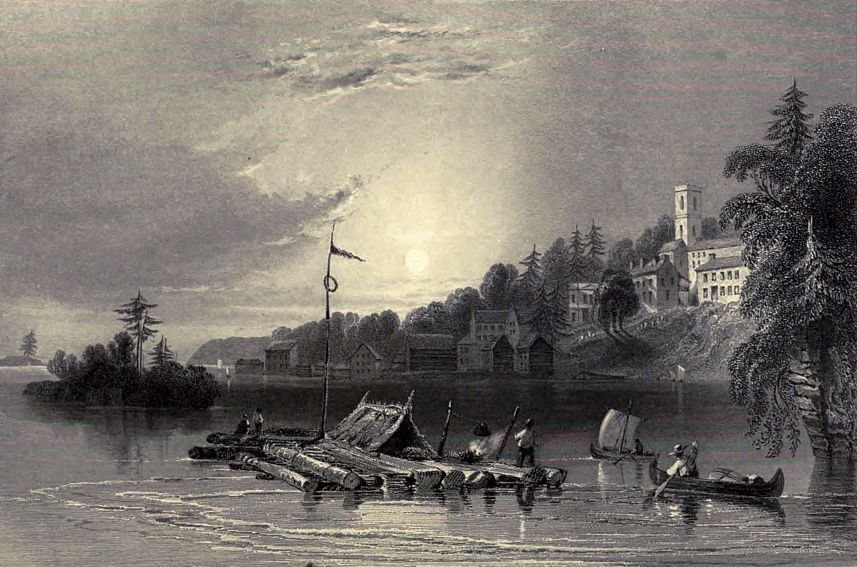
Brockville—St. Lawrence.
The St. Lawrence, between Prescott and Kingston, presents an aspect the most wild and fanciful. The Lake of the Thousand Isles, which is situated between them, exhibits a delightful combination of the varied scenery of nature. It has all the features of the placid, the picturesque, and the sublime, with a striking inter-mixture of the savage and the uncouth. While slowly gliding up the stream the stranger observes the northern shores thickly settled. The lowly cottage and the large mansion alternately attract his notice. The bustle and activity of life are everywhere visible upon the land; while, upon the lake, all is solemn stillness and solitude. Hundreds of little islands, assuming every variety of form, and covered with stunted trees of almost every species, are spread over the watery expanse, and afford a finished specimen of that peculiar sort of scenery which is produced when the several principles and causes of vegetation are not consentaneous—when the seed is planted by the hand of nature in a sterile soil; and fertilizing rains, morning dews, and fostering breezes, severally contribute their appointed quota of natural assistance, but seem to lose much of their accustomed efficacy by having no suitable objects on which to operate.
The rocky and barren soil of these islands invites not the hand of industry to redeem them from their unproductiveness; nor do their unfrequented retreats discover to the beholder even a solitary wigwam. They are the abode of silence, and the resting-place of solitude. The contemplative observer cannot view them without some feelings of regret: while his eye roves with delight over spots of earth disposed into all imaginary shapes, in which matchless beauty and proofs of skilful design are apparent in every direction, his judgment detects the fallacy of his sight; and he laments to find these picturesque creations yielding nothing for supplying the wants of man but such products as serve to gratify his curious vision. Scarcely can he restrain the wish, presumptuous though it be, that Providence in its wisdom had distinguished this portion of the universe by something of greater utility and of more substantial excellence.
Immediately opposite Prescott, on the shore of the United States, is the town of Ogdensburg; and twelve miles higher up, on the Canada shore, stands the delightful village of Brockville, so called in honour of the late lamented Sir Isaac Brock. This enchanting little spot unites in its situation every beauty of nature. In front of it flows the river St. Lawrence, interspersed with numerous islands, variously formed, and thickly wooded. Behind it is an assemblage of small hills, rising one above another in “gay theatric pride;” and on each side are well-cleared farms, in an advanced state of cultivation. Every thing combines to render it preeminently beautiful. The dwellings are of wood, and tastefully painted; and the court-house, on an elevated situation at the back of the village, seems, from its superior size, to be the guardian of the villagers—an idea of my fancy, which I did not venture to confirm by entering within its doors.
Sixty-seven miles from Prescott, and seventy-nine from Brockville, is the town of Kingston, built in 1784, and a place of great importance to the British interests in Canada. It is the naval depôt of the Upper Province, and is strongly protected by a fort, called Fort Frederick. In Kingston harbour, which is deep and well-sheltered, there were at this time several large ships, and one, the St. Lawrence, of 102 guns, which is said to have cost the enormous sum of 300,000l. Some of these vessels were constructed in England, and sent to Quebec in frame, whence they were transported to Kingston, at immense cost, on board of such boats as have been already described. The carriage of the Psyche frigate alone, from Quebec to Kingston, is said to have cost 12,000l. What could induce government to build ships in England, where timber is so dear, for the service of Canada? The policy of this “sending of coals to Newcastle” is a mystery which could not be solved by the best informed men in the Canadas. A sufficient number of mechanics to construct every ship necessary for the lake-service, might have been sent out for one-fourth of the expense incurred by the bare transportation of a single frigate from Quebec to Kingston.
Lake Ontario, to which Kingston serves as a kind of entrance, is in length 171 miles, in breadth 59, and in circumference 467. The depth of the water varies very much, but is seldom less than three, or more than 50 fathoms, although, in the centre of the lake, soundings have been made with a line of 350 fathoms without finding a bottom. It is often visited with violent storms, which render its navigation peculiarly dangerous; and though none except experienced seamen ought to be entrusted with the management of the craft which sail upon its wide and deceitful bosom, yet many have obtained the command of vessels who were utterly ignorant of the science of navigation.
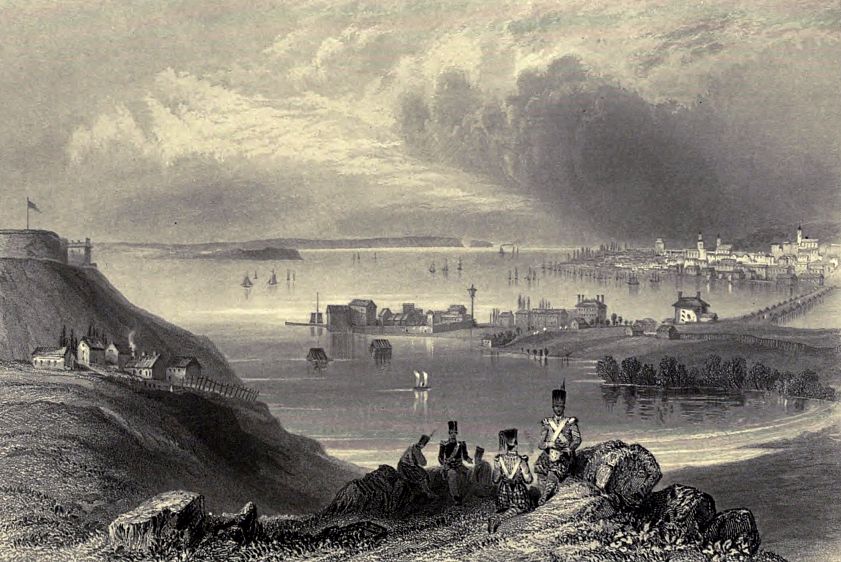
Kingston—Lake Ontario.
The waters of this lake, as well as those of Lakes Erie, Huron, and Superior, rise to an unusual height in every thirty-five years. In 1816, Ontario was seven feet higher than it is known to have been for upwards of thirty years before that time. Does not this form a very interesting subject for the speculations of the natural philosopher? While the waters of these lakes never rise or fall more than eight or ten inches above or below their usual height, excepting at these stated periods, what cause can be assigned for the production of such a body of water as is sufficient to effect this extraordinary change?
Between Kingston and York there are two or three very small villages, the largest of which is Belleville, containing at present about 150 inhabitants.
York (Toronto) is the seat of government for Upper Canada, and is situated on the north side of Lake Ontario. Its harbour, which is a very extensive one, is formed by a long narrow peninsula, commonly called Gibraltar Point. Though it is the capital of an extensive colony, it would, as it stands at this time, be considered in Europe but a village. Its defenceless situation, which cannot be much improved, renders it of little importance in time of war. It was captured by the Americans on the 27th of April, 1813. They had not, however, held possession of it many days when they evacuated it, having first destroyed all the public buildings.
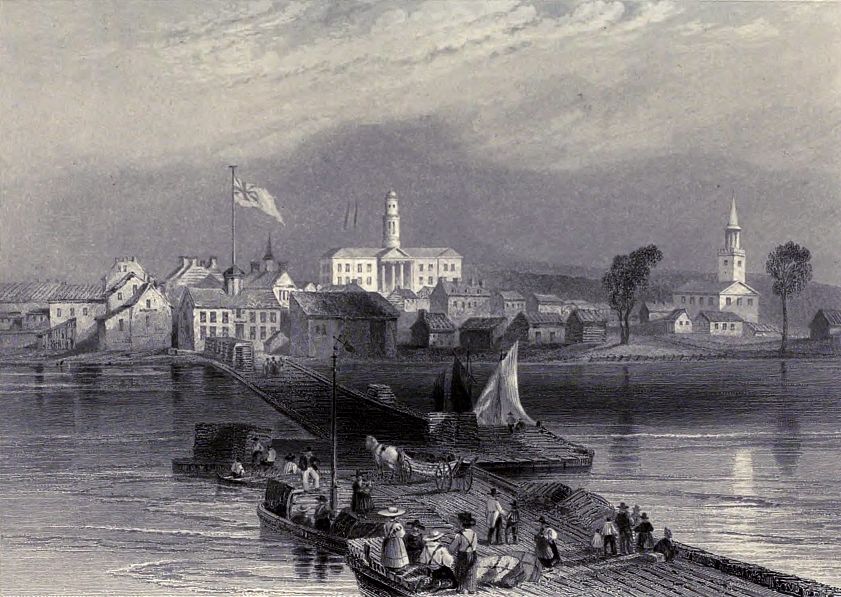
Coburg.
The garrison is about a mile west of the town, and consists of a barrack for the troops, a residence for the commanding officer, a battery and two blockhouses, which are intended for the protection of the harbour. In the year 1793 there was only one wigwam on the present site of the town. It now contains 1,336 inhabitants, and about 250 houses, many of which exhibit a very neat appearance. The parliament-house, erected lately, is a large and convenient brick building, finished off in the plainest possible manner. The house in which the Lieut.-Governor resides is built of wood, and though by no means contemptible, is much inferior to some private houses in the town. Many of the law and government officers have very elegant seats in and about the town; and, with few exceptions, they are built of wood, and assume a most inviting aspect.
The streets of the capital are regularly laid out, intersecting each other at right angles. Only one of them, however, is yet completely built; and, in wet weather, the unfinished streets are, if possible, muddier and dirtier than those of Kingston. The situation of the town is very unhealthy, for it stands on a piece of low marshy land, which is better calculated for a frog-pond, or beaver meadow, than for the residence of human beings. The inhabitants are, on this account, much subject, particularly in spring and autumn, to agues and intermittent fevers; and, probably, five-sevenths of the people are annually afflicted with these complaints. He who first fixed upon this spot as the site of the capital of Upper Canada, whatever predilection he may have had for the roaring of frogs, or for the effluvia arising from stagnated waters and putrid vegetables, can certainly have had no very great regard for preserving the lives of his Majesty’s subjects. The town possesses one great advantage, however, which is that of a good though defenceless harbour.
When we arrived at York, my father waited on the Lieut.-Governor, and handed him the order for land which we had received from Earl Bathurst. His Excellency told him that he might select his land from any township in the Province at that time open for location; but assured him, that as he himself had been only a short time in the country, it was out of his power to recommend any particular division to his notice. He then referred my father to the Surveyor-General, and also gave him a letter of introduction to that officer, directing him to afford us such information as might be required. We called upon the Surveyor-General accordingly, but obtained very little satisfactory intelligence.
A short time afterwards, my father met with Col. Thomas Talbot, who came to Canada about thirty years before, an officer, if I mistake not, in the fifth regiment of foot. During the period of his being stationed here, he became so much attached to the woods and wilds, that, on his return home, he felt half dissatisfied with his native country. He, therefore, sold his commission, and obtained a grant of 100,000 acres of land, under the condition that he should place a settler upon every 200 acres. He selected an extensive tract on the northern borders of Lake Erie, about 150 miles S.W. of Toronto. In the year 1802, when there was not a single christian habitation within forty miles of his own estate, the Colonel commenced a settlement under the most discouraging and inauspicious circumstances imaginable. He called his domain Port Talbot, and, in eight or ten years, saw a thriving settlement gradually rise up around him. But he has not yet been able to fulfil his engagement with the government; nor is it likely that he will, if he continue to estimate his land at its present price—three dollars per acre for 150 acres, and 50 acres gratis.
The Colonel is one of the most eccentric characters on the whole continent. He not only lives a life of cheerless celibacy, but enjoys no human society whatever. So great was his aversion to the fair sex, that, for many years after his arrival at Port Talbot, he refused to hire a female servant, but milked his own cows, made his own butter, and performed every other function of kitchen-maid, house-maid, cook, and dairy-woman. Is it not rather strange that a British officer, of such high rank in the army, and respectable connexions in civil life, should be induced to settle in the pathless wilderness, where he is totally excluded from society, unless he should associate with a class of people whom he considers entirely beneath him, and with whom he has never yet in any respect confederated? Being a member of the legislative council of Upper Canada, he goes to York once or twice in the year. These visits, and an occasional one to England, at intervals of five or six years, serve to rub off the rust contracted in his lonely cottage, and to remind him that the world is still as merry as it was when he figured in its gayest circles.
From the Colonel’s extensive knowledge of the country, my father considered him to be well qualified for giving advice with respect to the choice of a settlement. He, therefore, made him acquainted with our circumstances and want of information. The Colonel mentioned several settlements as eligible, but particularly recommended the township of London, a tract of land surveyed many years ago by order of General Simcoe, the first Lieut.-General of Upper Canada. It was, therefore, agreed that we should immediately proceed to London; and, on the 11th of September, our whole party set off for Niagara on board the same schooner that brought us from Prescott.
Weary of travelling by water, I separated from the party at York, and proceeded by land to Port Talbot, where I agreed to join them. The road from York to Port Talbot, for the first fifty miles, runs nearly in a south-west course, through a thickly settled country, the soil of which is light and sandy, and therefore not susceptible of any great improvement. Several small rivers, whose banks are very high, and nearly perpendicular, intersect this part of the country, and render travelling an undertaking of difficult and dangerous performance. Horses, in ascending and descending these steep banks, frequently fall, and are sometimes dashed to pieces, in spite of the best exertions of their drivers. From the head of Lake Ontario to the Grand River Ouse, the river takes a western direction, and thence to the township of Woodhouse its inclination is southern, but from Woodhouse to Port Talbot it preserves a south-western course.
On the banks of the Grand River Ouse, twenty-one miles from Dundas, I passed through several villages inhabited by the Six Nations of Indians. These villages, which, from their proximity to each other, appear to be comprised in one settlement, are composed of about 200 houses, which contain nearly 1,500 inhabitants. The land upon which they reside is some of the most fertile in the whole province. It was given to the Indians of the Five Nations, who have since admitted another nation to participate in all their rights and immunities, immediately after the revolutionary war, as a compensation for lands which they had forfeited in the United States by their adherence to Great Britain. Six miles on each side of the river, from its source to its mouth, originally composed this grant; but they have since sold several townships to different individuals. Still, however, they retain a quantity of land sufficient, under proper cultivation, for the maintenance of half a million of people. In one of the Indian villages a neat church has been erected at the expense of government. It is greatly superior in workmanship, as well as in size, to many of the parish churches in Great Britain. The pulpit is situated at the upper extremity of the aisle, and is surmounted with the royal arms of England, executed in bas-relief.
A clergyman of the Established Church occasionally performs divine service in the church; and when he is absent, his place in the pulpit is supplied by an Indian, whom his countrymen dignify with the title of “Dr. John.” This worthy divine, in the absence of the English clergyman, affords his brethren a specimen of his oratorical abilities; but it is very evident that the gospel has not yet obtained much influence in the hearts of these Indians, or in that of the native preacher. It cannot, therefore, be supposed to exercise any great control over their conduct.
As I happened to be at this village on the sabbath, and felt curious to see uncivilised men engaged in the worship of the Deity, I called upon Dr. John, and requested to know if there would be any service in the forenoon. He had little the appearance of a minister of that gospel, the principle of which is—“Peace upon earth, and good will towards men,” for he was busily engaged in whetting a tomahawk, and replied to my question with the utmost indifference: “I meant,” said he, “to have had a meeting to-day, but I lost my spectacles in a frolic last night, and cannot, therefore, preach again till Mr. Smith (a neighbouring shopkeeper) gets his goods from Montreal.”
After crossing the Grand River, the road for many miles has a very delightful aspect. On each side of the road, extensive plains, thinly planted, apparently, by the hand of man, spread further than the eye can reach, and afford a pleasant contrast to the sombre gloom which hangs, like the shadow of darkness, over the greater part of this extensive continent. These plains are almost wholly uninhabited, although possessed of many superior advantages. But the want of timber and water for domestic purposes, and the inferiority of the soil, which is light and sandy, render them of little comparative value. To the traveller alone, wearied with his wanderings through interminable forests, these beautiful plantations and flower-covered fields afford an exhilarating prospect. Towards Long Point, in the neighbourhood of which there are also similar extensive plains, the country on each side of the road is tolerably well settled; but the houses of public entertainment afford the most wretched accommodations, and exhibit an appearance, both inside and out, which by no means induces one to form a favourable opinion of Canadian hostelries.
I reached Port Talbot on the 15th of September, and found that my friends had not arrived. As I was sitting a while after in a tavern contiguous to the river, and I expected to have met with my father and his family, a lady and gentleman rode up to the door. When the lady entered, I handed her a seat. The gentleman next appeared, and, on seating himself, inquired, as is customary in the country, whether I was travelling east or west. I told him that I had already explored as much of the western country as I then intended; and added, that, during the last four months, I had travelled from within seven degrees of the Observatory at Greenwich, and that it was not my design to go farther into the country until I had seen my friends, whom I daily expected from the east, safely and comfortably settled a few miles farther to the northward. This topographical reply a little surprised them, for it was too general, and did not descend to such minutiæ as is usually expected.
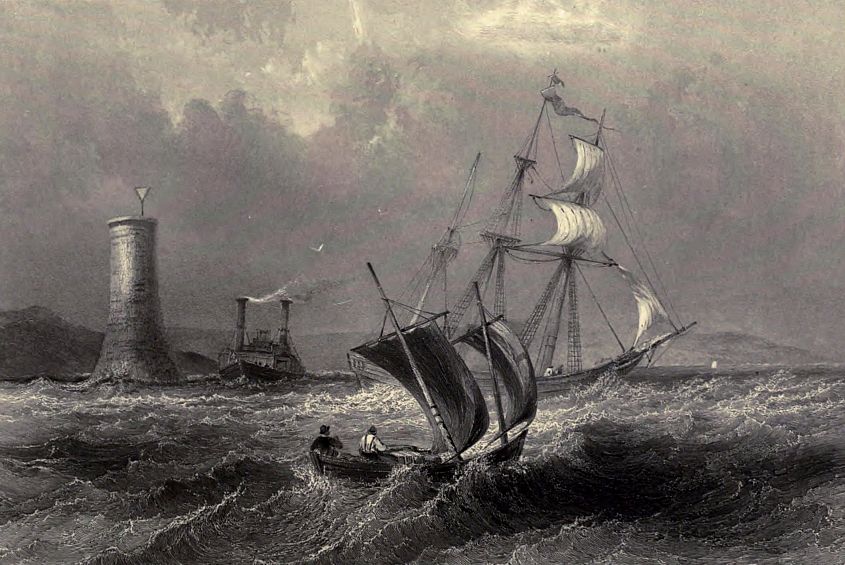
Light-tower, near Coburg. (Lake Ontario.)
The lady, who appeared a good deal embarrassed, or rather in a state of mental anxiety, said, with much apparent concern, “Alas, Sir, I fear your friends in America are few, and your hope of seeing them comfortably settled, like most worldly hopes, vain and unfeasible.” I conjured her to explain herself; and, after some hesitation, she reluctantly complied, for her exclamation had undoubtedly been involuntary:—“You are not altogether friendless! You have at least one brother! I saw him a few hours ago, in health, but unhappy. He is travelling in this direction, and will be with you in a few hours.” With this expression on her lips, she rose from her seat, and retired hastily to an adjoining apartment, where, addressing the landlady, she continued—“About eight o’clock this morning we overtook a number of young men, all Europeans, among whom was a gentleman, evidently the brother of this young man. They are the only surviving passengers of a large party belonging to the Fort Erie schooner, which was wrecked a few nights ago on the United States’ shore.” I heard this with undefinable emotions, and, rushing into the apartment, in which the lady was still conversing with the hostess, entreated her to tell me all she knew of the melancholy catastrophe. She said, “About three o’clock on the evening of the 19th of September, I saw your friends embark at Fort Erie for Port Talbot, on board a large schooner; and from the great number of passengers who embarked, and the indifferent quality of the vessel, the people of Fort Erie entertained serious apprehensions for the safety of the travellers—the weather being very boisterous, and the captain of the schooner an inefficient and inexperienced man. In a few days afterwards news arrived at Fort Erie that the vessel had been wrecked on the morning of the 21st, on the shore of the United States; and that the few young men who survived were taken up by a New York schooner, and landed in Canada.”
On hearing this awful intelligence, I immediately set off to meet my brother and his companions. Before I had proceeded more than half a dozen miles I met the whole party; and judged from their countenances that the information I had received was not exactly correct. I told them what I had heard, and desired to know whether or not I had been misinformed. My brother replied, that my information was in the main correct; that they had indeed been shipwrecked, but that no lives had been lost, except that of a Mrs. Lewis, who had died in consequence of severe cold and fatigue. I was also further given to understand that my father and his family were all well and safe, and in the United States, waiting only a vessel to bring them over to the shores of Canada. It is impossible to describe the sudden transition of my feelings on hearing these joyful tidings. A few moments before I had the strongest grounds for believing that my nearest relations were lodged in a cold and watery grave; but now I could indulge in the joyful anticipation of meeting them once more, restored, as it were, to life. In about a fortnight after this they all arrived at Port Talbot, after having experienced much kindness from the inhabitants of the State of New York during their continuance among them.
In the latter part of October, my father removed his family from Port Talbot to Westminster, where he procured lodgings for them until a house was erected on his own lands. The township of Westminster is separated from that of Port Talbot only by the river Thames. London is situated about 24 miles north of Lake Erie. On the 1st of November, 1818, it was entirely unsettled, and its surface studded with the various trees which are to be found in Canada. The land is considered, if not superior to every township hitherto opened for location, at least inferior to none in the whole province. The township forms a square, and is divided into 16 concessions, in each of which are 6,400 acres. These concessions are subdivided into lots of 200 acres, of which there are 32 in each. Between every two concessions there are 66 feet set apart for roads, which are called concession lines. These, together with seven side roads of equal width, which intersect them at right angles, and are equi-distant from each other, comprise all the public roads in a township.
On the 26th of October, my brother and I, with six men carrying provisions and felling-axes, took our departure from Westminster; and, having hired a guide, proceeded into London, to fix upon the most desirable lot for the erection of a house. 1,200 acres were assigned to my father for his own demesne, if I may so call it. We had, therefore, a large tract of land to explore before we could decide on the most eligible site. After spending the greater part of the day in approving and disapproving of particular lots, we unanimously determined on making the second lot in the sixth concession the future asylum of our exiled family.
When we had agreed on this point, our next consideration was to procure shelter for the night; for we were upwards of nine miles from the abodes of civilised beings, and in the midst of desolate wilds,—
“Where beasts with men divided empire claim,
And the brown Indian marks with murd’rous aim.”
After walking about for some time in quest of a suitable place for making a fire, we discovered an old Indian wigwam, deserted by its inhabitants. In this little hut we resolved to continue during the night; and, having a tinder-box, with all the other necessary materials, we speedily lighted an excellent fire. After we had taken supper on the trunk of a tree, we lay down to rest, each rolling himself up in a blanket, and each in his turn supplying fuel to the fire. Thus did we pass the first night on our American estate.
In the morning, about sunrise, we were suddenly awakened by the howling of a pack of wolves, which were in full cry after an unfortunate deer. The howl of these ferocious animals so nearly resembles the cry of fox-dogs, that, when I awoke and heard it, I fancied myself in the midst of the sporting woods of Erin. But the delusion was not of long continuance, for I speedily discovered, that, instead of being in my native land,—
”Where the tints of the earth, and the hue of the sky,
In colour though varied, in beauty may vie,”
I was in the midst of a dreary and monotonous wilderness.
To increase our consternation, or, at least, to direct it into another channel, the horses, which we brought with us to carry our bed-clothes and provisions, had broken from their tethers during the night, and consumed every ounce of our bread!—
“Calm is my soul, nor apt to rise in arms,
Except when fast approaching danger warns.”
And yet I was on this occasion sufficiently provoked to revenge our loss on the sides of the ill-natured brutes. We had brought our provender, with the utmost difficulty, a distance of nearly twelve miles through woods and swamps; and then to be deprived of it in this way, was too much for a man of the firmest philosophy to bear without impatience. We should have been under the disagreeable necessity of dispensing with our breakfast, if we had not had the consideration to bring some potatoes with us, which, happily, under the circumstances, are not so well suited to the appetite of an American horse as they are to the palate of an Irishman.
We continued encamped in the woods from the 26th of October until the 1st of December. During this period, we laid the foundation of a house 46 feet long, and 21 feet wide; one half of which we finished first, for the accommodation of the family, who removed into it on the 2d of December—five months and nineteen days after our embarkation for America. During the thirty-five days which we spent in the woods, previous to the arrival of the family, our only lodging was the miserable wigwam, which had a hundred holes in its roof, through which, when lying awake at night, we could easily note every remarkable star that passed the meridian. Our only bed was composed of withered leaves, while
“A log contriv’d a double debt to pay—
By night a pillow, and a seat by day.”
These are only slight specimens of the hardships which must be encountered by those who settle in a wilderness; and yet, no small degree of fortitude is requisite to support the mind of him who is obliged to submit to them. It is a grievance of no inconsiderable magnitude to be compelled, after a day of severe labour, to stretch one’s weary limbs on the bare ground in the cold month of November, and to be protected from the fierce north wind, and from the chilling frost, only by a miserable hut, with a fire sufficiently near it to counteract, in some degree, their benumbing effects.
But the hope of independence is sufficient to sustain the mind under privations still greater than these; and he who can bring himself to think, when lying down to rest on the bare earth, that the day is not far distant when he may happily repose on a more inviting couch, without one anxious thought respecting the future prospects of himself and his family, regards these transient sufferings with a kind of feeling nearly allied to actual pleasure. He sees the time fast approaching when the wilderness to him shall be ‘a fruitful field, and the desert shall blossom as the rose;’ when the productive soil shall gratefully yield an ample reward to his toils; and when the hardships of his situation shall, by the blessing of Heaven on his exertions, gradually disappear, and leave him in possession of health, plenty, and independence. While indulging in such joyful and ecstatic visions, the wooden pillow of a new and industrious settler becomes softer than bolsters of down, and his solitary blanket feels more comfortable than sheets of Holland.
We have presented the views of almost every class of observers on this interesting country; but there yet remains unquoted an observer of the difficulties, toils, and trials to which woman is subjected in Canada; and from her admirable, graphic, and womanly record we make large extracts. The book is the “Backwoods of Canada,” and the authoress the wife of an emigrant officer.
“It is now settled that we abide here till after the government sale has taken place. We are, then, to remain with —— and his family till we have got a few acres chopped, and a log-house put up on our own land. Having determined to go at once into the bush, on account of our military grant, which we have been so fortunate as to draw in the neighbourhood of S——, we have fully made up our minds to enter at once, and cheerfully, on the privations and inconveniences attending such a situation, as there is no choice between relinquishing that great advantage and doing our settlement duties. We shall not be worse off than others who have gone before us to the unsettled townships, many of whom, naval and military officers with their families, have had to struggle with considerable difficulties, but who are now beginning to feel the advantages arising from their exertions.
“In addition to the land he is entitled to as an officer in the British service, my husband is in treaty for the purchase of an eligible lot by Small Lakes. This will give us a water frontage, and a further inducement to bring us within a little distance of S——; so that we shall not be quite so lonely as if we had gone on to our government lot at once.”
We have experienced some attention and hospitality from several of the residents at Peterborough. There is a very genteel society, chiefly composed of officers and their families, besides the professional men and storekeepers. Many of the latter are persons of respectable family and good education. Though a store is, in fact, nothing better than what we should call in the country towns at home a “general shop,” yet the storekeeper in Canada holds a very different rank from the storekeeper of the English village. The storekeepers are the merchants and bankers of the places in which they reside. Almost all money matters are transacted by them; and they are often men of landed property and consequence, not unfrequently filling the situations of magistrates, commissioners, and even members of the provincial parliament.
As they maintain a rank in society which entitles them to equality with the aristocracy of the country, you must not be surprised when I tell you that it is no uncommon circumstance to see the sons of naval and military officers and clergymen standing behind a counter, or wielding an axe in the woods with their fathers’ choppers; nor do they lose their grade in society by such employment. After all, it is education and manners that must distinguish the gentleman in this country, seeing that the labouring man, if he is diligent and industrious, may soon become his equal in point of worldly possessions. The ignorant man, let him be ever so wealthy, can never be equal to the man of education. It is the mind that forms the distinction between the classes in this country. “Knowledge is power!”
We had heard so much of the odious manners of the Yankees in this country, that I was rather agreeably surprised by the few specimens of native Americans that I have seen. They were, for the most part, polite, well-behaved people. The only peculiarities I observed in them were a certain nasal twang in speaking, and some few odd phrases; but these were only used by the lower class, who “guess,” and “calculate,” a little more than we do. One of their most remarkable terms is to “Fix.” Whatever work requires to be done, it must be fixed. “Fix the room,” is, set it in order. “Fix the table,”—“Fix the fire,”—says the mistress to her servants; and the things are fixed accordingly.
I was amused one day by hearing a woman tell her husband the chimney wanted fixing. I thought it seemed secure enough, and was a little surprised when the man got a rope and a few cedar boughs, with which he dislodged an accumulation of soot that caused the fire to smoke. The chimney being fixed, all went right again. This odd term is not confined to the lower orders alone; it becomes a standard word even among the later emigrants from our country.
With the exception of some few remarkable expressions, and an attempt at introducing fine words in their every-day conversation, the lower orders of Yankees have a decided advantage over our English peasantry in the use of grammatical language; they speak better English than you will hear from persons of the same class in any part of England, Ireland, or Scotland—a fact that we should be unwilling, I suppose, to allow at home.
If I were asked, what appeared to me the most striking feature in the manners of the Americans that I had met with, I should say it was coldness, approaching to apathy. I do not at all imagine them to be deficient in feeling or real sensibility, but they do not suffer their emotion to be seen. They are less profuse in their expressions of welcome and kindness than we are, though probably quite as sincere. No one doubts their hospitality; but, after all, one likes to see the hearty shake of the hand, and hear the cordial word that makes one feel oneself welcome.
Persons who come to this country are very apt to confound the old settlers from Britain with the native Americans; and when they meet with people of rude, offensive manners, using certain Yankee words in their conversation, and making a display of independence, not exactly suitable to their own aristocratical notions, they immediately suppose they must be genuine Yankees, while they are, in fact, only imitators; and you well know the fact, that a bad imitation is always worse than the original.
You would be surprised to see how soon the new comers fall into this disagreeable manner and affectation of equality, especially the inferior class of Irish and Scotch; the English less so. We were rather entertained by the behaviour of a young Scotchman, the engineer of the steamer, on my husband addressing him with regard to the management of the engine. His manners were surly, and almost insolent. He scrupulously avoided the least approach to courtesy or outward respect; nay, he even went so far as to seat himself on the bench close beside me, and observed, that, among the many advantages this country offered to settlers like him, he did not reckon it the least of them, that he was not obliged to take off his hat when he spoke to people, (meaning persons of our degree,) or address them by any other title than their name; besides, he could go and take his seat beside any gentleman, or lady either, and think himself to the full as good as them.
“Very likely,” I replied, hardly able to refrain from laughing at this sally; “but I doubt you greatly overrate the advantage of such privileges, for you cannot oblige the lady or gentleman to entertain the same opinion of your qualifications, or to remain seated beside you, unless it pleases them to do so.” With these words I rose up and left the independent gentleman, evidently a little confounded at the manœuvre: however, he soon recovered his self-possession, and continued swinging the axe he held in his hand, and said, “It is no crime, I guess, being born a poor man.”
“None in the world,” replied my husband; “a man’s birth is not of his own choosing. A man can no more help being born poor than rich; neither is it the fault of a gentleman being born of parents who occupy a higher station in society than his neighbour. I hope you will allow this?”
The Scotchman was obliged to yield a reluctant affirmative to the latter position, but concluded with again repeating his satisfaction at not being obliged in this country to take off his hat, or speak with respect to gentlemen, as they styled themselves.
“No one, my friend, could have obliged you to be well-mannered at home any more than in Canada. Surely you could have kept your hat on your head, if you had been so disposed; no gentleman would have knocked it off, I am sure. As to the boasted advantage of rude manners in Canada, I should think something of it, if it benefited you in the least, or put one extra dollar in your pocket; but I have my doubts if it has that profitable effect.”
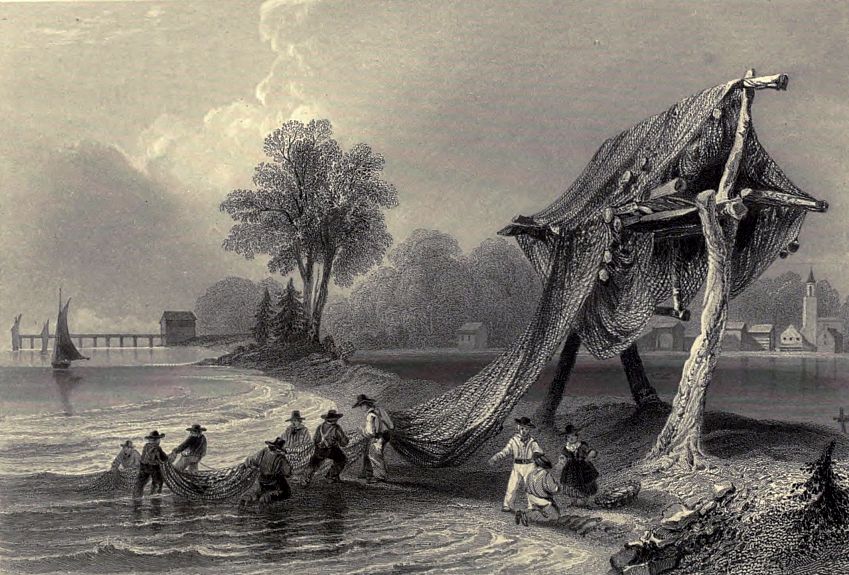
Wellington, on Lake Ontario. (Fishing Nets.)
“There is a comfort, I guess, in considering oneself equal to a gentleman.”
“Particularly if you could induce the gentleman to think the same.” This was a point that seemed rather to disconcert our candidate for equality, who commenced whistling and kicking his heels with redoubled energy.
“Now,” said his tormentor, “you have explained your notions of Canadian independence, be so good as to explain the machinery of your engine, with which you seem very well acquainted.”
The man eyed my husband for a minute, half sulking, half pleased with the implied compliment on his skill, and, walking off to the engine, discussed the management of it with considerable fluency, and from that time treated us with perfect respect. He was evidently struck with my husband’s reply to his question, put in a most discourteous tone, “Pray, what makes a gentleman; I’ll thank you to answer me that?” “Good manners, and good education,” was the reply. “A rich man, or a high-born man, if he is rude, ill-mannered, and ignorant, is no more a gentleman than yourself.”
This put the matter on a different footing; and the engineer had the good sense to perceive that rude familiarity did not constitute a gentleman.
But it is now time I should give you some account of Peterborough, which, in point of situation, is superior to any place I have yet seen in the Upper Province. It occupies a central point between the townships of Monaghan, Smith, Cavan, Otanahee, and Douro: and may, with propriety, be considered as the capital of the Newcastle District.
It is situated on a fine elevated plain, just above the small lake, where the river is divided by two low wooded islets. The original or government part of the town is laid out in half-acre lots; the streets, which are now fast filling up, are nearly at right-angles with the river, and extend towards the plains to the north-east. These plains form a beautiful natural park, finely diversified with hill and dale, covered with a lovely greensward, enamelled with a variety of the most exquisite flowers, and planted, as if by Nature’s own hand, with groups of feathery pines, oaks, balsams, poplars, and silver birch. The views from these plains are delightful; whichever way you turn your eyes they are gratified by a diversity of hill and dale, wood and water, with the town spreading over a considerable tract of ground.
The plains descend with a steep declivity towards the river, which rushes with considerable impetuosity between its banks. Fancy a long narrow valley, and separating the east and west portions of the town into two distinct villages.
The Otanahee bank rises to a loftier elevation than the Monaghan side, and commands an extensive view over the intervening valley, the opposite town, and the boundary forest and hills behind it: this is called Peterborough East, and is in the hands of two or three individuals of large capital, from whom the town lots are purchased.
Peterborough, thus divided, covers a great extent of ground, more than sufficient for the formation of a large city. The number of inhabitants is now reckoned at 700 and upwards; and if it continues to increase as rapidly in the next few years as it has done lately, it will soon be a very populous town.
There is great water-power, both as regards the river and the fine broad creek which winds its way through the town, and falls into the small lake below. There are several saw and grist-mills, a distillery, fulling-mill, two principal inns, besides smaller ones, a number of good stores, and a government school-house, which also serves for a church till one more suitable should be built. The plains are sold off in pack lots, and some pretty little dwellings are being built; but I much fear the natural beauties of this lovely spot will be soon spoiled.
I am never weary with strolling about, climbing the hills in every direction, to catch some new prospect, or gather some new flowers, which, though getting late in the summer, are still abundant.
Among the plants with whose names I am acquainted, are a variety of shrubby asters, of every tint of blue, purple, and pearly white; a lilac monarda, most delightfully aromatic, even to the dry stalks and seed-vessels; the white gnaphalium, or everlasting flower; roses of several kinds, a few late buds of which I found in a valley near the church. I also noticed among the shrubs a very pretty little plant, resembling our box; it trails along the ground, sending up branches and shoots; the leaves turn of a deep copper red, yet, in spite of this contradiction, it is an evergreen. I also noticed some beautiful lichens, with coral caps surmounting the grey hollow foot-stalks, which grow in irregular tufts among the dry mosses; or more frequently I found them covering the roots of the trees or half-decayed timbers. Among a variety of fungi, I gathered a hollow cup, of the most splendid scarlet within, and a pale fawn colour without; another very beautiful fungi consisted of small branches, like clusters of white coral, but of so delicate a texture, that the slightest touch caused them to break.
The ground in many places was covered with a thick carpet of strawberries, of many varieties, which afford a constant dessert during the season to those who choose to pick them,—a privilege of which I am sure I should gladly avail myself were I near them in the summer. Besides the plants I have myself observed in blossom, I am told the spring and summer produce many others; the orange lily; the phlox, or purple lichnidea; the mocassin flower, or lady’s slipper; lilies of the valley in abundance; and, towards the banks of the creek and the Otanahee, the splendid cardinal flower (lobelia cardinalis) waves its scarlet spikes of blossoms.
I am half inclined ta be angry, when I admire the beauty of the Canadian flowers, to be constantly reminded that they are scentless, and therefore scarcely worthy of attention; as if the eye could not be charmed by beauty of form and harmony of colours, independent of the sense of smelling being gratified.
To redeem this country from the censure cast on it by a very clever gentleman I once met in London, who said, “the flowers were without perfume, and the birds without song,” I have already discovered several highly aromatic plants and flowers. The milkweed must not be omitted among these—a beautiful shrubby plant, with purple flowers, which are alike remarkable for beauty of colour and richness of scent.
I consider this country opens a wide and fruitful field to the inquiries of the botanist. I now deeply regret I did not benefit by the frequent offers —— made me of prosecuting a study which I once thought dry, but now regard as highly interesting, and the fertile source of mental enjoyment, especially to those who, living in the bush, must necessarily be shut out from the pleasures of a large circle of friends, and the varieties that a town or village offer.
On Sunday I went to church; the first opportunity I had had of attending public worship since I was in the highlands of Scotland; and surely I had reason to bow my knees in thankfulness to that merciful God, who had brought us through the perils of the great deep, and the horrors of the pestilence.
Never did our beautiful Liturgy seem so touching and impressive as it did that day,—offered up in our lowly log-built church in the wilderness.
This simple edifice is situated at the foot of a gentle slope on the plains, surrounded by groups of oaks and feathery pines, which, though inferior in point of size to the huge pines and oaks of the forest, are far more agreeable to our eye, branching out in a variety of fantastic forms. The turf here is of an emerald greenness; in short, it is a sweet spot, retired from the noise and bustle of the town, a fitting place in which to worship God in spirit and in truth.
There are many beautiful walks towards the Smith-town hills, and along the bank that overlooks the river. The summit of this ridge is sterile, and is thickly set with loose blocks of red and grey granite, interspersed with large masses of limestone scattered in every direction; they are mostly smooth and rounded, as if by the action of water. As they are detached, and merely occupy the surface of the ground, it seems strange to me how they came at that elevation. A geologist would doubtless be able to solve the mystery in a few minutes. The oaks that grow on this high bank are rather larger and more flourishing than those in the valleys and more fertile portions of the soil.
Behind the town, in the direction of the Cavan and Emily roads, is a wide space, which I call the “squatters’ ground,” it being entirely covered with shanties, in which the poor emigrants, commuted pensioners, and the like, have located themselves and families. Some remain here under the ostensible reason of providing a shelter for their wives and children, till they have prepared a home for their reception on their respective grants; but not unfrequently it happens that they are too indolent, or really unable to work on their lots, often situated many miles in the backwoods, and in distant and unsettled townships, presenting great obstacles to the poor emigrant, which it requires more energy and courage to encounter than is possessed by a vast number of them. Others, of idle and profligate habits, spend the money they received, and sell the land, for which they gave away their pensions, after which they remain miserable squatters in the shanty ground.
The shanty is a sort of primitive hut in Canadian architecture, and is nothing more than a shed built of logs, the chinks between the round edges of the timbers being filled with mud, moss, and bits of wood; the roof is frequently composed of logs split and hollowed with the axe, and placed side by side, so that the edges rest on each other; the concave and convex surfaces being alternately uppermost, every other log forms a channel to carry off the rain and melting snow. The eaves of this building resemble the scalloped edges of a clam shell; but, rude as this covering is, it effectually answers the purpose of keeping the interior dry, far more so than the roofs formed of bark or boards, through which the rain will find entrance. Sometimes the shanty has a window, sometimes only an open doorway, which admits the light and lets out the smoke. A rude chimney, which is often nothing better than an opening cut in one of the top logs above the hearth, and a few boards fastened in a square form, serves as the vent for the smoke; the only precaution against the fire catching the log-walls behind the hearth being a few large stones, placed in a half circular form, or more commonly a bank of dry earth raised against the wall.
Nothing can be more comfortless than some of these rude shanties, reeking with smoke and dirt, the common receptacle for children, pigs, and fowls. But I have given you the dark side of the picture; I am happy to say all the shanties on the squatters’ ground were not like these. On the contrary, by far the larger proportion were inhabited by tidy folks, and had one or even two small windows, and a clay chimney, regularly built up through the roof; some were even roughly floored, and possessed similar comforts with the small log-houses.
You will, perhaps, think it strange when I assure you that many respectable settlers, with their wives and families, persons delicately nurtured, and accustomed to every comfort before they came hither, have been contented to inhabit a hut of this kind during the first or second year of their settlement in the woods.
I have listened with feelings of great interest to the history of the hardships endured by some of the first settlers in the neighbourhood, when Peterborough contained but two dwelling-houses. Then there were neither roads cut, nor boats built, for communicating with the distant and settled parts of the district; consequently the difficulties of procuring supplies of provisions was very great, beyond what any one who has lately come hither can form any notion of.
When I heard of a whole family having had no better supply of flour than what could be daily ground by a small hand-mill, and for weeks being destitute of every necessary, not even excepting bread, I could not help expressing some surprise, never having met with any account in the works I had read concerning emigration that at all prepared one for such evils.
“These particular trials,” observed my intelligent friend, “are confined principally to the first breakers of the soil in the unsettled parts of the country, as was our case. If you diligently question some of the families of the lower class that are located far from the towns, and who had little or no means to support them during the first twelve months, till they could take a crop off the land, you will hear many sad tales of distress.”
Writers on emigration do not take the trouble of searching out these things, nor does it answer their purpose to state disagreeable facts. Few have written exclusively on the “Bush.” Travellers generally make a hasty journey through the long-settled and prosperous portions of the country; they see a tract of fertile, well-cultivated land, the result of many years of labour; they see comfortable dwellings, abounding with all the substantial necessaries of life; the farmer’s wife makes her own soap, candles, and sugar; the family are clothed in cloth of their own spinning, and hose of their own knitting. The bread, the beer, butter, cheese, meat, poultry, &c., are all the produce of the farm. He concludes, therefore, that Canada is a land of Canaan, and writes a book setting forth these advantages, with the addition of obtaining land for a mere song; and advises all persons who would be independent, and secure from want, to emigrate.
He forgets that these advantages are the result of long years of unremitting and patient labour; that these things are the crown, not the first-fruits of the settler’s toil; and that, during the interval, many and great privations must be submitted to by almost every class of emigrants.
Many persons on first coming out, especially if they go back into any of the unsettled townships, are dispirited by the unpromising appearance of things about them. They find none of the advantages and comforts of which they had heard and read, and they are unprepared for the present difficulties; some give way to despondency, and others quit the place in disgust.
A little reflection would have shown them that every rood of land must be cleared of the thick forest of timber that encumbers it before an ear of wheat can be grown; that, after the trees have been chopped, cut into lengths, drawn together, or logged, as we call it, and burned, the field must be fenced, the sped sown, harvested, and thrashed, before any returns con be obtained; that this requires time and much labour, and, if hired labour, considerable outlay of ready money; and, in the mean time, a family must eat. If at a distance from a store, every article must be brought through bad roads, either by hand or with a team, the hire of which is generally costly in proportion to the distance and difficulty to be encountered in the conveyance. Now these things are better known beforehand, and then people are aware what they have to encounter.
Even a labouring man, though he have land of his own, is often, I may say generally, obliged to hire out to work for the first year or two, to earn sufficient for the maintenance of his family; and ever so many of them suffer much privation before they reap the benefit of their independence. Were it not for the hope and certain prospect of bettering their condition ultimately, they would sink under what they have to endure; but this thought buoys them up. They do not fear an old age of want and pauperism; the present evils must yield to industry and perseverance; they think also for their children; and the trials of the present time are lost in pleasing anticipations for the future.
“Surely,” said I, “cows, and pigs, and poultry might be kept; and you know where there is plenty of milk, butter, cheese, and eggs, with pork and fowls, persons cannot be very badly off for food.”
“Very true,” replied my friend; “but I must tell you it is easier to talk of these things at first than to keep them, unless on cleared or partially cleared farms; but we are speaking of a first settlement in the backwoods. Cows, pigs, and fowls must eat; and if you have nothing to give them unless you purchase it, and perhaps have to bring it from some distance, you had better not be troubled with them, as the trouble is certain, and the profit doubtful. A cow, it is true, will get her living during the open months of the year in the bush, but sometimes she will ramble away for days together, and then you lose the use of her, and possibly much time in seeking her; then, in the winter, she requires some additional food to the browse that she gets during the chopping season, or ten to one but she dies before spring; and as cows generally lose their milk during the cold weather if not very well kept, it is best to part with them in the fall, and buy again in the spring, unless you have plenty of food for them, which is not often the case the first winter. As to pigs, they are great plagues on a newly-cleared farm if you cannot fat them off hand; and that you cannot do without you buy food for them, which does not answer to do at first. If they run loose, they are a terrible annoyance both to your own crops and your neighbour’s, if you happen to be within half a mile of one, for though you may fence out cattle you cannot pigs: even poultry require something more than they pick up about the dwelling to be of any service to you, and are often taken off by hawks, eagles, foxes, and pole-cats, till you have proper securities for them.”
“Then how are we to spin our own wool, and make our own soap and candles?” said I. “When you are able to kill your own sheep, and hogs, and oxen, unless you buy wool and tallow.” Then, seeing me begin to look somewhat disappointed, he said, “Be not cast down, you will have all these things in time, and more than these, never fear, if you have patience, and use the means of obtaining them. In the meanwhile prepare your mind for many privations to which at present you are a stranger; and if you would desire to see your husband happy and prosperous, be content to use economy, and, above all, be cheerful. In a few years the farm will supply you with all the necessaries of life, and by and by you may even enjoy many of the luxuries. Then it is that a settler begins to taste the real and solid advantages of his emigration; then he feels the blessings of a country where there are no taxes, tithes, nor poor-rates; then he truly feels the benefit of independence. It is looking forward to this happy fulfilment of his desires that makes the rough paths smooth, and lightens the burden of present ills. He looks round upon a numerous family, without those anxious fears that beset a father in moderate circumstances at home; for he knows he does not leave them destitute of an honest means of support.”
In spite of all the trials he had encountered, I found this gentleman was so much attached to a settler’s life, that he declared he would not go back to his own country to reside for a permanence on any account; nor is he the only one that I have heard express the same opinion; and it likewise seems a universal one among the lower class of emigrants. They are encouraged by the example of others, whom they see enjoying comforts that they could never have obtained had they laboured ever so hard at home; and they wisely reflect they must have had hardships to endure had they remained in their native land, (many indeed had been driven out by want,) without the most remote chance of bettering themselves, or becoming the possessors of land free of all restrictions. “What to us are the sufferings of one, two, three, or even four years, compared with a whole life of labour and poverty?” was the remark of a poor labourer, who was recounting to us the other day some of the hardships he had met with in this country. He said, he “knew they were only for a short time, and that by industry he should soon get over them.”
I have already seen two of our poor neighbours that left the parish a twelve-month ago; they are settled in Canada Company lots, and are getting on well. They have some few acres cleared and cropped, but are obliged to “hire out,” to enable their families to live, working on their own land when they can. The men are in good spirits; and say, “they shall in a few years have many comforts about them that they never could have got at home, had they worked late and early; but they complain that their wives are always pining for home, and lamenting that ever they crossed the seas.” This seems to be the general complaint with all classes; the women are discontented and unhappy. Few enter with their whole heart into a settler’s life. They miss the little domestic comforts they had been used to enjoy; they regret the friends and relations they left in the old country; and they cannot endure the loneliness of the backwoods.
This prospect does not discourage me; I know I shall find plenty of occupation within doors, and I have sources of enjoyment when I walk abroad that will keep me from being dull. Besides, have I not a right to be cheerful and contented for the sake of my beloved partner? The change is not greater for me than him; and if, for his sake, I have voluntarily left home, and friends, and country, shall I therefore sadden him by useless regrets? I am always inclined to subscribe to that sentiment of my favourite poet, Goldsmith,—
“Still to ourselves in every place consign’d,
Our own felicity we make or find.”
But I shall very soon be put to the test, as we leave this town to-morrow by ten o’clock. The purchase of the Lake lot is concluded. There are three acres chopped, and a shanty up; but the shanty is not a habitable dwelling, being merely an open shed that was put up by the choppers as a temporary shelter; so we shall have to build a house. Late enough we are; too late to get in a full crop, as the land is merely chopped, not cleared; and it is too late now to log and burn the fallow, and get the seed-wheat in; but it will be ready for spring crops. We paid five dollars and a half per acre for the lot; this was rather high for wild land, so far from a town, and in a scantily-settled part of the township; but the situation is good, and has a water-frontage, for which my husband was willing to pay something more than if the lot had been further inland. * * * *
I shall begin my letter with a description of our journey through the bush, and so go on, giving an account of our proceedings, both within doors and without. I know my little domestic details will not prove wholly uninteresting to you; for well I am assured that a mother’s eye is never weary with reading lines traced by the hand of an absent and beloved child.
After some difficulty, we succeeded in hiring a waggon and span (i. e. pair a-breast) of stout horses, to convey us and our luggage through the woods to the banks of one of the lakes, where——had appointed to ferry us across. There was no palpable road, only a blaze on the other side, encumbered by fallen trees, and interrupted by a great cedar swamp, into which one might sink up to one’s knees, unless we took the precaution to step along the trunks of the mossy, decaying timbers, or make our footing sure on some friendly block of granite or limestone. What is termed in bush language a blaze, is nothing more than notches or slices cut off the back of the trees, to mark out the line of road. The boundaries of the different lots are often marked by a blazed tree, also the concession-lines.[1] These blazes are of as much use as finger-posts of a dark night.
The road we were compelled to take lay over the Peterborough plains, in the direction of the river; the scenery of which pleased me much, though it presented little appearance of fertility, with the exception of two or three extensive clearings.
About three miles above Peterborough the road winds along the brow of a steep ridge, the bottom of which has every appearance of having been formerly the bed of a lateral branch of the present river, or perhaps some small lake, which has been diverted from its channel, and merged into the Otanabee.
On either side of this ridge there is a steep descent; on the right, the Otanabee breaks upon you, rushing with great velocity over its rocky bed, forming rapids in miniature, resembling those of the St. Lawrence; its dark frowning woods of sombre pine give a grandeur to the scene which is very impressive. On the left lies below you a sweet secluded dell of evergreens, cedar, hemlock, and pine, enlivened by a few deciduous trees. Through this dell there is a road-track, leading to a fine cleared farm, the green pastures of which were rendered more pleasing by the absence of the odious stumps that disfigure the clearings in this part of the country. A pretty bright stream flows through the low meadow that lies at the foot of the hill, which you descend suddenly close by a small grist-mill that is worked by the waters, just where they meet the rapids of the river.