ANOTHER GOOD YEAR IN WESTERN CANADA
Reading edition
Top
Manitoba, Saskatchewan, and Alberta Have Splendid Crops.
The grain crop of 1913 was harvested and threshed in perfect condition. Excepting flax, the average yield was excellent; wheat almost universally graded near the top. Wheat from many fields averaged forty bushels per acre, weighing sixty-five pounds to the measured bushel. Oats ran from fifty to one hundred and fifteen bushels to the acre, and barley kept up the reputation of Western Canada as a producer of that cereal. In many sections the yield of flax exceeded earlier expectations, although in places, winds which blew off the boll caused some loss. Hundreds of farmers of small means who have been in the country only three or four years, paid up all their indebtedness out of the crop of 1913 and put aside something for farm and home improvements. Not only for the farmer with limited means and small acreage has the year been prosperous; the man able to conduct farming on a large scale has been equally successful—and for such, Western Canada offers many opportunities.
A farmer in southern Alberta raised 350,000 bushels of grain last year, and made a fortune out of it. In Saskatchewan and in Manitoba is heard the same story of the successful working of large areas.
As was to be expected with its unprecedented development, the financial stress during 1913 was felt as keenly throughout Western Canada as anywhere in the country. The fact is that money could not keep pace with the natural demands of 400,000 new people a year. Towns and cities had to be built, farming operations were extensive, and capitalists had not made sufficient preparation. But last year's crop has restored conditions to a normal state, and natural and reasonable development will continue.
Owing to a wet fall in 1912 and a heavy snowfall the succeeding winter, seeding in some districts was later than usual. But with the favourable weather of May, June, and July, wheat sown in May ripened early in August. Rains came at the right time, and throughout the season the best of weather prevailed.
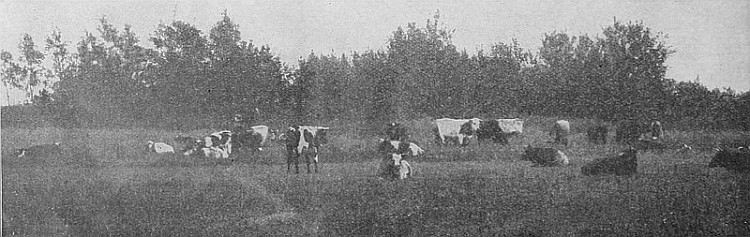
These cattle winter out in Western Canada and do well. Shelter and water are abundant.
The Cities Reflect the Growth of the Country.—Passing through Western Canada from Winnipeg, and observing the cities and towns along the network of railways in Manitoba, Saskatchewan, and Alberta, one feels there must be "something of a country" behind them all. Gaze in any direction and the same view is presented: field after field of waving grain; labourers at work converting the virgin prairie into more fields; wide pasture lands where cattle are fattening on grasses rich in both milk- and beef-producing properties. Here is the wealth that builds the cities.
In thirty years Winnipeg has increased in population from 2,000 to 200,000; and become an important gateway of commerce. The wheat alone grown in the three prairie provinces in 1913 is sufficient to keep a steady stream of 1,000 bushels per minute continuously night and day going to the head of the lakes for three and a half months, and in addition to that, the oats and barley would supply this stream for another four months. The value of the grain crop alone would be sufficient to build any of our great transcontinental railroads and all their equipment, everything connected with them, from ocean to ocean. With only 10 per cent of the arable land under cultivation, what will the possibilities be when 288 million acres of the best land that the sun shines on is brought under the plough? Do you not see the portent of a great, vigorous, populous nation living under those sunny skies north of the 49th parallel?
New Railway Mileage Grows at Rapid Rate.—Every year long stretches of new rails are extended into some hitherto untravelled domain, bringing into subjugation mountain, plain, and forest. Mighty rivers are being bridged, massive mountains are being tunnelled, and real zest is being given this work in the exciting race between the rival companies as they strive to outstrip each other in surmounting Nature's obstacles. During 1913, more than 4,000 miles of new road have been built in Canada, the bulk of this in Western Canada.
The latest reports give the total railway mileage in Manitoba, Saskatchewan, and Alberta as 12,760 miles, the Canadian Pacific Railway having 5,534; the Canadian Northern, 4,187; the Grand Trunk Pacific, 1,476; the Great Northern Railway, 162. Manitoba has a total mileage of 4,014; Saskatchewan, 5,679; Alberta, 3,073. The gain over 1912 is about 3,400 miles.
Western Canada's Wheat.—The quality of Western Canada wheat is recognized everywhere. Recently a U. S. senator said of the Canadian grain fields: "The wheat that Canada raises is the Northwestern hard spring wheat. The cost of raising is less in Canada than in the States, because the new lands there will produce larger crops than the older land on this side of the line, and the land is cheaper than in the United States."
According to official figures the total estimated wheat production of Western Canada in 1913 was 209,262,000 bushels, an increase of more than 5 million bushels in 1912. Oats show a total yield of more than 242,413,000 bushels, barley more than 30 million bushels, rye more than 2,500,000 bushels, flax more than 14 million bushels, and mixed grains more than 17 million bushels. Wheat, oats, barley, and rye are above the average quality of the last two years, and potatoes and root crops show a good percentage of standard condition during growth. The value of the harvest is approximately 209 million dollars as compared with about 200 million in 1912.
Winnipeg, the grain centre of Western Canada, has received and handled more wheat per day than Chicago, Minneapolis, and Duluth combined.
Approximately 191 million bushels of grain were shipped from the elevators at Fort William and Port Arthur during the season of navigation; from the first of September, 1913, until December 20, 127 million bushels of grain were shipped to the east—52,000,000 bushels more than for the same period last year.
What Farmers Receive.—The amount of grain marketed, and the estimated receipts, based on an average price for September, October, and November, are as follows:
BushelsPrice per bushel
Wheat97,000,000.73$70,000,000
Oats30,000,000.309,000,000
Barley9,500,000.403,800,000
Flax6,500,000$1.107,150,000
Total$89,950,000
A Splendid Fall.—The fall of 1913 was exceedingly favourable to the farmer of Western Canada. The weather made it possible to harvest and thresh in the minimum of time, and in some cases permitted a start on fall ploughing early in September, in many parts continuing until December 1st. Owners of traction engines took advantage of clear nights to plough, the powerful headlights throwing a brilliant light across the fields. The men worked in relays, and it was frequently midnight before the big outfits quit.
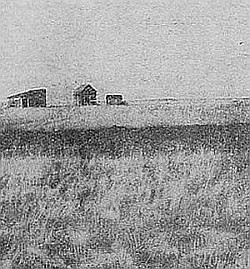
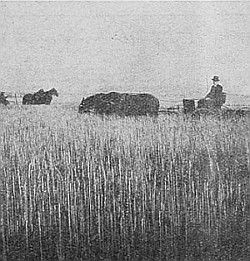
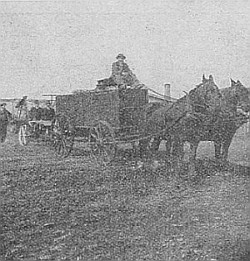
Beginning a home in the prairie—house and table "lands" are built on cement foundation. Sizing up quantity of hay per acre he would get from his hayfield. Starting from town with loads of posts for pasture fence.
Mixed Farming.—Mixed farming is yielding large profits to those who work intelligently along the lines of intensive farming. In addition to wheat, oats, barley, and flax—alfalfa and other fodder crops are grown, and in some places corn.
Every variety of vegetable grows abundantly and sugar beets are a moneymaker. Stock-raising is an important branch of mixed farming, and hogs and sheep are commanding high prices, the demand greatly exceeding the supply.
Sheep.—The sheep industry in Western Canada pays exceedingly well. In the early days—but a few short years ago—a district south of the Canadian Pacific Railway from Swift Current to Maple Creek was stocked with sheep, and several large ranches made money, but with the onrush of settlement these ranches have been vacated and are now given up to successful grain growing. However, the farmers who now cross the boundary to purchase the best Montana breeds and take them to their farms, in every case report a success as great as that in grain growing. Although no country could be better fitted for sheep raising, and numerous successes have been made, Western Canada imports much of its mutton.
Profits in Horse Raising.—The raising of horses is receiving increasing attention. Here also a rare opportunity for profit exists, for the market is woefully unsupplied.
Dairying offers splendid opportunities for profit. In the rapidly growing cities and towns there is a demand for milk, cream, and butter. Creameries and cheese factories are established at accessible points. The feeding of cattle is nominal.
Poultry Products can be readily marketed, and poultry raisers have done remarkably well. No one knows better than the farmer's wife the saving effected by having a flock of hens, some turkeys, geese and ducks, and the cost of feed is not noticed.
Hog Raising.—Hog-raising has equal advantages with grain growing. A large quantity of pork that should be supplied at home is now shipped in. Barley, the best staple for hog raising, is easily grown and yields heavily. Alfalfa can be grown with little trouble, and with two crops in a season, and three tons to the acre to a crop, it will play an important part in the hog industry of the future. The Canadian field pea and the rape, also are good feed and produce the very best of pork.
Chas. Reid, of Swift Current, who sold a thousand dollars' worth of pork last summer, and then had considerable on hand, has demonstrated that hogs pay better than straight grain raising. He has an income from his farm the whole year round.
A farmer near Moose Jaw sold some hogs for $130.00. To the question, "What did they cost?" he answered: "Really nothing. I bought one sow; I have kept two, and I have three to kill for my own use. Of course we had skim milk and buttermilk, and I fed some chop, but what is left is worth all I paid out. I call the $130.00 clear profit."
It is the same story in all parts of Manitoba, Saskatchewan, and Alberta. A little attention, plenty of such grain as would go to waste, some shelter, and that's all. Last year many farmers went into hog-raising extensively, and it saved many of them from financial embarrassment; for when money was not obtainable at the banks, farmers having marketable hogs sold them with handsome profit. Several made from $1.00 to $1.20 per bushel for wheat by feeding it to hogs.
Butter and Eggs.—Large sums are spent regularly in United States markets for butter and eggs to supply the cities and towns of Western Canada, and large quantities of butter are imported from New Zealand. Not only is the demand in the towns, but many wheat-raisers purchase these commodities when they might produce them on their own farms at trifling cost.
William Elliott, near Moose Jaw, has eight cows and eighty hens. In less than eight months, his butter and eggs sold for more than $500. All the groceries and the children's clothing and boots, are paid for with butter and egg money.
W. H. Johnston, five miles south of Moose Jaw, has thirty cows and milks an average of twenty-five. His gross receipts last summer were from $600 to $700 per month, of which $300 was profit. He grows his own feed, principally oats and hay, and has no worries over harvesting or grain prices.
Truck Gardening.—Long days of abundant sunshine from May to September, and adequate moisture in the spring and early summer permit of a wide variety of products. The soil is rich and warm, and easily worked. Close attention to cultivation has resulted in record yields of vegetables and small fruits, which bring good prices in the cities.
A farmer within five miles of Moose Jaw, who sold vegetables at the city market last year realized more than $300 between August 1, and October 30. He had half an acre in carrots, cabbage, cauliflower, radishes, beans, lettuce and onions, and half an acre in potatoes and turnips. His own table was supplied all summer and enough vegetables were put in the cellar to supply him during the winter and seed potatoes in the spring.
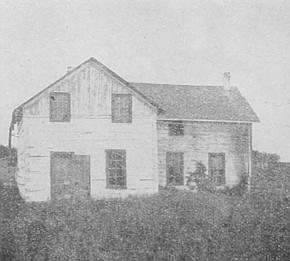
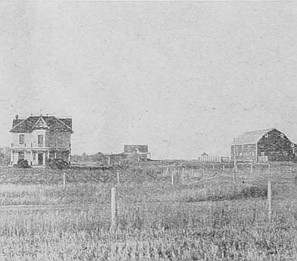
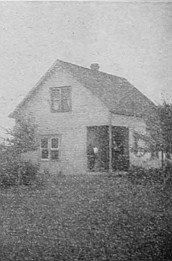
R. P. O. Uwell's old home, Clover Bar, Alberta. This old home is now replaced by one of more modern structure. A comfortable modern home in Western Canada, the old home now used as a granary. William Hamilton—Pioneer. Segar Wheeler's residence "Rosthern," Sask. is a fair type of many homes in the Canadians.
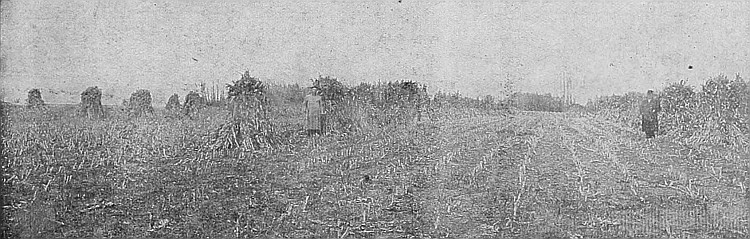
Corn Can Be Grown on Canadian Prairies.—Manitoba is producing corn, chiefly for feed. On September 28, corn nine feet high had developed to the dough stage, and the crop would easily exceed twenty tons to the acre. There are also scattered fields of corn in Saskatchewan and Alberta.
Corn is successfully grown in the northern part of Minnesota in similar soil and under the same climatic condition, and there is no apparent reason why like results should not be secured in Western Canada. Many American farmers of experience believe the corn belt is extending northward.
Alfalfa is an assured crop in many parts of Western Canada and is destined to be the leading forage crop. In a recent competition forty-three entries were made, and every field was one of which farmers of the older alfalfa countries might be proud. In southern Alberta alfalfa is a success; at Edmonton it grows abundantly. Battleford, Prince Albert, Regina, Indian Head, Lacombe, Brandon, and in many other districts alfalfa is grown.
Post Offices.—Throughout the settled portions of Western Canada are found post offices at which mails are delivered regularly, thus bringing Eastern friends within a few days' reach of those who have gone forward to make homes under new but favourable conditions on the fertile lands of the West. Last year hundreds of new post offices were established, many of them at points remote from the railway, but all demanded by new settlements made during the year.
Roads and Bridges.—It is said to be the policy of the Canadian Government to do everything possible for the welfare of the settler, whether in accessible new town or remote hamlet. This solicitude is shown in every branch dealing with the organizing of new districts. Bridges have been built, roads constructed, the district policed, and a dozen other conveniences provided. Is it any wonder that with the splendid, high-yielding land, free to the homesteader or open to purchase at reasonable prices from railway and land companies, the Canadian immigration records for 1913 were so high?
Land Laws.—Canada's land laws were formed after the United States had applied its methods to the free lands of the West, and embody the best United States provisions. They are so framed as not to bear heavily on the settler, whose interests are carefully watched, and are liberally administered. After several years' trial they have proved satisfactory.
Titles, or patents, come from the Crown, and on being registered in a Land Titles Office these patents secure a transfer.
Taxes outside of cities, towns, and the larger municipalities, are merely nominal and are devoted entirely to the improvement of roads, to educational purposes, to the payment of salaries, and to the erection of public buildings. At least 50 per cent of these costs, and in small struggling communities, 60 per cent or more, is paid by the Government out of the fund produced by the sale of school lands, one-eighth of the country having been reserved for that purpose.
The Banks of Canada.—The close of 1913 has brought the usual bank statements accompanied by the addresses of the presidents and general managers of these institutions. They deal with economic matters first hand, and show in striking manner the prosperity of the country. Those who know anything of Canadian banking methods know the stability of these institutions, and the high character of the men in charge of them.
Mr. Coulson, of the Canadian Bank of Commerce says:
"We have had a good harvest. The yield has been generally good, and the quality on the average has never been surpassed. This has been especially so in the Western Provinces, and the unusually favourable weather and abundant transportation facilities afforded by the railroads enabled the movement of grain to be made rapidly."
Canada's New Bank Act.—During 1913 the decennial revision of the Bank Act took place. Among important changes were:
The establishment of the Central Gold Reserves. Authority to lend to farmers on their threshed grain.
The provision which enables a bank to lend to a farmer on the security of his threshed grain is extensively utilized. This class of loan is regarded as a moral risk, and banks still depend more upon the character of the borrower than upon the security.
What Bank Managers Have to Say.—Mr. Balfour, manager of the Union Bank of Canada:
"The railway companies have carried out the grain from the Western Provinces this year in a very satisfactory manner."
Mr. John Galt, president of the Union Bank of Canada:
"Speaking generally, the crop results have been satisfactory. In the three great wheat growing provinces this has been a banner year. Not only has the yield been large, but the average quality has never been equalled, and the cost of harvesting has been unusually low, owing to the magnificent weather. This has, to some extent, offset the low prices which prevailed. The railways have done splendid work in handling the crop.
"There is a marked increase in the number of livestock. Farmers are becoming more fully alive to the advantages they derive from this source and are realizing that their borrowing credit is greatly enhanced if they can show a good proportion of cattle in their assets, and banks should look with favour on loans for the purchase and handling of livestock."
Robert Campbell, general manager of the Northern Crown Bank, gives strong testimony of the wealth of Western Canada:
"It is important at a time like the present for every business concern, financial or otherwise, to show by its statement that collections have been good. We may congratulate ourselves upon the showing we have made in this. Notwithstanding that we have made new loans amounting to millions of dollars since the crop was harvested, our old loans have been paid off so rapidly that our liquid assets were not reduced.
"This state of affairs is attributable to the fine weather we have experienced in the West, which enabled the farmers to harvest their grain early and quickly and to the unusual rapidity with which the crop was moved by the railway companies."
Corn is not generally grown in Western Canada, but this 320 acres shows a splendid yield, and considerable is now grown for fodder.
PROVINCIAL PREMIERS ARE OPTIMISTIC
Manitoba is Stronger.—Sir Rodmond Roblin has no pessimism regarding the outlook in Manitoba. He says: "The improvements upon farm and field excite the admiration of those interested in agriculture, while our population has been very considerably increased by a healthy, intelligent, and industrious class of new-comers. Manitoba, is much stronger financially, numerically, commercially, industrially and educationally than she was in the year 1912. Her progress and development are rapid, healthy, and permanent."
Hope and Cheer in Saskatchewan.—Hon. Walter Scott: "The sheet anchor of Saskatchewan is its soil, which (excluding, of course, the far north) comprises a larger proportion of land capable of sustaining a farming population than any area of similar vastness on the globe. Nothing but inconceivable recklessness and waste can prevent its remaining for all time a great agricultural province, and nothing can seriously check its steady forward movement."
Alberta on Sound Footing.—Hon. A. L. Sifton: "Alberta was never on a sounder footing than it is to-day. It has reaped the best crop in her history, and stands in line for her share of the millions earned by the farmers of Western Canada for their wheat and other grains. Coarse grains for feeding purposes are beginning to predominate with the advent of mixed farming. A gratifying increase in the number of dairy cows and hogs is reported from every district, indicating a new source of wealth, a more constant revenue for the farmer and a new basis of credit for farming operations."
Splendid Outlook in British Columbia.—Sir Richard McBride says: "That British Columbia, judged by the healthy growth in population and in general industries during the past year, and the splendid outlook, may confidently be expected to have increased prosperity in 1914. Mining will show a larger output for the current year and the same may be said of agriculture and other occupations. Generous and wise expenditure for adding to the already extensive road system, the building of necessary public works, as well as the enormous amount of railway construction all conduce to the opening up and settlement of immense areas, hitherto almost dormant."
PANAMA CANAL AND CANADA
The London Times, speaking of the Panama Canal, says: "Although there is considerable speculation in trade and political circles as to the effect of the opening of the Panama Canal, enthusiasts in the West predict that Western Canada generally will increase in population and wealth to an extent beyond conception. The Canal will have the effect of bringing the outposts of Empire inside the commercial arena. The new water route, combined with improved railway facilities, will certainly improve the position of Western Canada in the battle for the world's markets."
WHAT HAS BEEN SAID ABOUT WESTERN CANADA
Mr. James J. Hill.—"Within a few years the United States will not be exporting any wheat, but it will become a market for the wheat of Canada."
Dr. Wm. Saunders, Director of the Canadian Government Experimental Farm at Ottawa, Canada: "The Canadian Northwest can supply not only sufficient wheat for a local population of thirty millions, but have left over for export three times as much as the total import of the British Isles. One-fourth of its arable land is devoted to wheat."
Professor Shaw.—"The first foot of soil in the provinces of Manitoba, Saskatchewan and Alberta is worth more than all the mines from Alaska to Mexico, and more than all the forests from the boundary to the Arctic ocean. One acre of the average soil in Western Canada is worth more than ten acres of average land in the United States."
Professor Tanner.—"The black earth of Central Russia, the richest soil in the world, has to yield its distinguished position to rich, deep, fertile soil of Western Canada. Here the most fertile soil of the world is to be found. These soils are rich vegetable humus or clay loam with good clay subsoil. To the high percentage of nitrogen is due the high percentage of gluten which gives the 'Canadian No. 1 Hard' the flouring qualities which have spread its fame abroad to the ends of the earth."
St. Paul Farmer.—During a recent trip through Western Canada, the editor of the St. Paul Farmer, in referring to Government forces in agriculture, spoke of the interest that the Dominion and the Provincial Governments took in farming and farm education, as "complete and effective."
The General Manager of a Canadian bank is reported to have said that, "owing to the speedy manner in which grain came forward in the fall of 1913, our farmer customers in the prairie provinces paid off about three million dollars of liabilities between September 20, and October 10."
Hon. W. T. White, speaking at a New York meeting, said: "We used to give you good Canadians but now we are getting back good Americans. Ours came from the east, yours are going into our west. Some of the most practical citizens, the best Canada has to-day, are the Americans. We received last year no less than 140,000. Manitoba, Saskatchewan, Alberta, three provinces, have each a larger territory than modern Germany, less than ten per cent under cultivation. This year they had a crop of over 200 million bushels of wheat. You cannot get any country where contracts are more faithfully regarded or obligations more carefully safeguarded by law than in Canada."
Sir Thomas Shaughnessy.—"Immigration into Canada cannot cease, for it is due to economic conditions which show no signs of changing."
David R. Forgan.—"Nothing can check a country which can raise the amount of wheat which has been raised in Western Canada this year. Any checks which the country may have had as a result of the world-wide money conditions are entirely beneficial to the country. Numbers of young men, the sons of farmers in the States, are now coming to Canada, and are taking up land much cheaper and equally as good as they could get in the States."
Lord William Percy of England: "The possibilities and opportunities offered by the West are infinitely greater than those which exist in England."
Colonel Donald Walter Cameron of Lochiel, Scotland, Chief of the Cameron Clan: "We cannot blame our people for coming out here, where there are so many opportunities as compared with those afforded in Scotland. I thought possibly a trip through Canada would give us some plan as to how to stop the wholesale emigration from Scotland, but, after seeing this wonderful country and the opportunities on every side, where one man has as good chances as his neighbor, I have come to the conclusion that nothing more can be done."
Speaker Clark.—In commenting on Speaker Clark's remarks expressing regret at the number of Americans who had gone to Canada in one week, the Chicago News says: "The appropriate sentiment for the occasion would seem to be a God-speed to the emigrants. They are acting as the American pioneers did before them, and are taking what appears to them to be the most promising step for improving their fortunes. The bait is wild land, and it is not affected by national boundaries."
Mayor Deacon, Winnipeg: "No man who sets foot in Canada is more entirely and heartily welcome than the agriculturist from the South."
An eminent American writer after a recent visit to the Canadian West in speaking of the American immigration to Canada, says:
"Any country that can draw our citizens to it on such a scale must have about it something above the ordinary, and that Canada has in many ways."
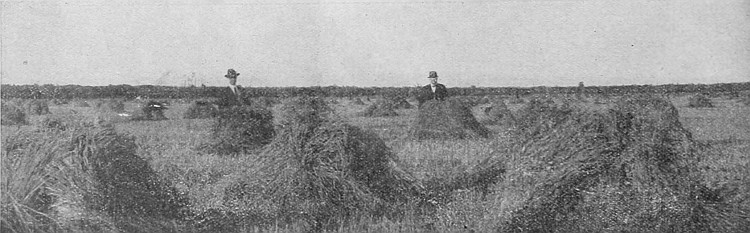
Figuring out the result of the year's crop. The yield of which he estimates at over forty bushels per acre of wheat.
Dean Curtiss of Ames Agricultural College, Iowa, says:
"We of the United States think we know how to get behind agriculture and push, but the Canadians dare to do even more than we do in some respects. They have wonderful faith in the future: they hesitate at no undertaking that offers prospects of results. More significant still is the wide co-operation for agricultural promotion, including the government, private individuals, and corporations and the railroads.
"Manitoba has in the last two years provided about as much money for the building of an agricultural plant as Iowa has appropriated in half a century. It has given in two years $2,500,000 for buildings and grounds for its agricultural institutions. Saskatchewan is building a plant for its university and agricultural college on a broader and more substantial plan than has been applied to any similar institution in this country. Yet neither province has more than half a million population.
"For public schools equally generous provision is made. They are being built up to give vocational and technical training as well as cultural. They fit the needs of the country excellently and should turn out fine types of boys and girls. They do this with a remarkable faith in the value of right education."
Dean Curtiss was much interested in the many ways the Canadian Government aids agriculture, aside from appropriations for education. It is helping to solve marketing problems; encouraging better breeding of livestock by buying sires and reselling them at cost, and doing many other things of like character. He says:
"I found that the Government is advancing from 50 to 85 per cent of the money necessary to build coöperative creameries and elevators. Where cattle need breeding up, the Government buys bulls of dairy, Shorthorn, or special dairy breeds, and sends them in at cost and long time payments."
The words "Canadian wheat" are familiar to all, but many have not yet participated in the benefits derived by those who, within the past few years, have placed their capital in Canadian wheat lands. They, who, through foresight, so invested, they who broke the first furrow, have reaped bountifully.
The development of the fertile plains and valleys of Western Canada is still in its infancy. The accomplishments of the past few years, while truly wonderful, have but proven the great resources and future capabilities of this vast country.
The growth of to-day will be insignificant compared with the achievements of the next few years.
The homestead shack is now giving place to the comfortable residence, large barns are being erected where the improvised log and mud stable sheltered a few head of cattle, fields are fenced, roads built, and great fields of grain and luxuriant pastures are always in evidence.
The Climate.—Owing to the altitude, Western Canada is one of the finest and most healthful sections in the world. Speaking generally it is at least a thousand feet higher above sea level than the Middle Western States, thus giving a dry, bracing air, much like portions of Colorado. During a large part of the summer the days are hot and sunny, with more than twenty hours of daylight and consequently growing weather, in each day. The nights, however, are always cool and restful and are largely responsible for the splendid vitality of Western men.
The winters are truly splendid. Usually farming operations on the land are stopped by frost from the 12th to the 15th of November although some years they have been continued into December. Usually late in November snow falls, and with the exception of those districts where Chinook winds are frequent, will remain until the following spring, disappearing early in March. During this time there is clear, bright, dry, sunny weather and an intensely invigorating atmosphere. The average winter temperature ranges from zero to twenty-two above zero, according to the district. Occasionally severe cold weather will occur, lasting for two or three days, but this is not unknown in the Middle Western States. One of the greatest advantages is the hard frost, during the winter. This freezes the ground to a depth of several feet. In the spring, thawing naturally commences at the top. As soon as the top soil is sufficiently thawed the land is sown, the cultivation forming a mulch which conserves the moisture in the frozen ground underneath. With the increasing warmth of early summer, the lower frost gradually thaws out and this moisture aids largely in the growth of the young crop.
The heaviest rainfall occurs in June, when it is most needed and does the most good to the growing crops. The rainfall of western Canada varies from 16 to 28 inches. The farmers are usually working upon the land during the first week in April. This gives a long growing season and plenty of time to dispose of the crop and get the land prepared, ready for the next season's operation.
METEOROLOGICAL RECORD FOR JANUARY, 1913
Experimental Farm or Station at Degrees of Temperature Precipitation in Inches Hours of Sunshine
Highest Lowest Mean Possible Actual
Brandon, Man 36.9 -37.6 24.60 .11 268 73.6
Indian Head, Sask 40.0 -45.0 -6.51 .80 266 57.9
Rosthern, Sask 38.6 -49.5 13.30 .55 252 73.9
Scott, Sask 38.8 -48.8 -9.47 .59 255 83.9
Lacombe, Alta 45.3 -35.6 .67 .93 257 63.3
Lethbridge, Alta 47.0 -30.0 7.49 .80 269 91.9
DECEMBER, 1912
Brandon, Man 39.9 27.2 9.30 1.00 254 61.1
Indian Head, Sask 39.0 19.0 13.19 1.23 248 53.2
Rosthern, Sask 38.8 23.2 8.15 .50 233 62.4
Scott, Sask 44.1 19.8 16.86 .27 238 91.3
Lacombe, Alta 58.6 10.6 21.98 .03 238 7.42
Lethbridge, Alta 50.1 0.9 27.16 .23 254 102.3
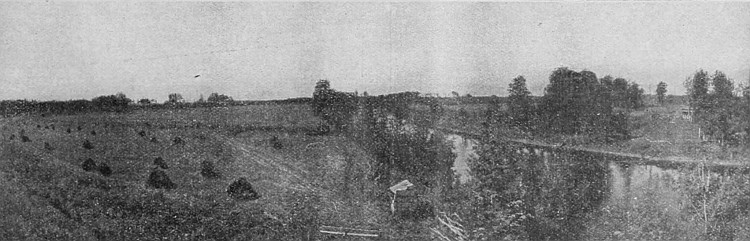
A scene showing farming on a large scale in the park districts of Western Canada. Water is good and plentiful in this district.
SWEEPSTAKE UPON SWEEPSTAKE
A Manitoba Steer Carries Off Honors Similar to Those Won by a Half-brother in 1912.
Saskatchewan wins and now owns the Colorado Silver Trophy for best oats in the world.
When Glencarnock I, the Aberdeen-Angus steer, owned by Mr. McGregor of Brandon, Manitoba, carried off the Sweepstakes at the Chicago Live Stock Show in 1912, it was considered a great victory for barley, oats and grass, versus corn. That there might be no doubt as to the superiority of barley feeding, Manitoba climate, and judgment in selecting the animal, in 1913 Mr. McGregor entered another Aberdeen-Angus, a half-brother to the winner of 1912, and secured a second victory. In other classes also Mr. McGregor had excellent winnings. Glencarnock's victory proves not only the superiority of the new feeding, but that the climate of the prairie provinces of Western Canada, in combination with the rich foods possessed by that country, tends to make cattle raising a success at little cost.
Other winnings at the Live Stock Show which placed Western Canada in the class of big victories were: three firsts, seven seconds, and five other prizes in Clydesdales.
Among recent victories won by Western Canada within the past three years:
In February, 1911, Hill & Sons, of Lloydminster, Saskatchewan, showed a peck of oats at the National Corn Exposition in Columbus, Ohio, and carried off the Colorado Silver Trophy, valued at $1,500.00. In February, 1913, they had a similar victory at Columbia, N. C., the third and final winning was at Dallas, Texas, on February 17, 1914, when Hill & Son's oats defeated all other entries.
In 1911, Seager Wheeler, of Rosthern, won $1,000 in gold at the New York Land Show for best hundred pounds of wheat.
In 1912, at the Dry Farming Congress, Lethbridge, Mr. Holmes of Cardston won an engine for best wheat in the world.
In 1913, at Tulsa, Oklahoma, Mr. P. Gerlack, of Allan, Saskatchewan, carried off the honors and a threshing machine for the best bushel of wheat shown in a world competition. It was the Marquis variety and weighed 71 lbs. to the bushel. At this congress, Canada won a majority of the world's honours in individual classes, and seven out of the sixteen sweepstakes.
Other first prizes taken at the same place were:
Barley, Nicholas Tétinger, Claresholm, Alberta. Oats, E. J. Lanigan, Elfross, Saskatchewan. Flax, John Plews, Carnduff, Saskatchewan. Sheaf of barley, A. H. Crossman, Kindersley, Saskatchewan. Sheaf of flax, R. C. West, Kindersley, Saskatchewan. Sheaf of oats, Arthur Perry, Cardston, Alberta. In district exhibits, Swift Current, Saskatchewan, won the Board of Trade Award, with Maple Creek second. Red Fife Spring Wheat, E. A. Fredrick, Maple Creek. Other variety of Hard Spring Wheat, S. Englehart, Abernethy, Saskatchewan. Black Oats, Alex Wooley, Norton, Alberta. Oats, any other variety, Wm. S. Simpson, Pambrun, Saskatchewan. Western Rye Grass, W. S. Creighton, Stalwart, Saskatchewan. Sheaf of Red Fife Wheat, R. H. Carter, Fort Qu'Appelle, Saskatchewan. Sheaf of Marquis Wheat, G. H. Carney, Dysart, Saskatchewan. Two-Rowed Barley, R. H. Carter, Fort Qu'Appelle, Saskatchewan. Six-Rowed Barley, R. H. Carter, Fort Qu'Appelle, Saskatchewan. Western Rye Grass, Arthur Perry, Cardston, Alberta. Alsike Clover, Seager Wheeler, Rosthern, Saskatchewan.
Agricultural Education in Western Canada.—Scientific farming probably can be pursued with more profit and advantage in Western Canada than in any other portion of the continent. What can be achieved may be judged by what has been accomplished by the thousands who with not even a theoretical knowledge have made it a success. The various governments have provided for the development of a class of farmers who, in the possession of the rich soil of the country, with its abundant humus, its phosphates, and large endowment of other properties will make of it the greatest farming region of the known world.
AREAS OF LAND AND WATER
According to the latest measurements the land and water areas of the three provinces, as at the Census of 1911, are as follows:
ProvincesLandWaterTotal
acresacresacres
Manitoba41,169,0986,019,20047,188,298
Saskatchewan155,764,4805,323,520161,088,000
Alberta161,872,0001,510,400163,382,400
Total358,805,57812,853,120371,658,698
Note—By the Extension of Boundaries Act, 1912, the area of Manitoba was increased by 113,984,000 acres, bringing the total to 161,172,298 acres, of which 12,739,600 acres are water. The areas of Manitoba in this article relate solely however to the province as constituted before the Act of 1912.
Comparative Areas of wheat, oats, and barley in the three Western Provinces:
Provinces 1900 1910 1911 1912 1913 Average for 5 years 1908-1912
Bushels Acres Bushels Acres Bushels Acres Bushels Acres Bushels Acres Bush. Price
Manitoba—
Wheat 18,352,929 1,965,193 34,125,949 2,760,371 62,689,000 3,094,833 63,017,000 2,839,000 53,331,000 2,804,000 18.17 $0.75
Oats 10,952,365 573,848 30,378,379 1,209,173 60,037,000 1,307,434 57,154,000 1,348,000 56,759,000 1,398,000 37.40 0.30
Barley 2,666,567 139,660 6,506,634 416,016 14,949,000 448,105 15,826,000 481,000 14,305,000 496,000 27.54 0.40
Saskatchewan—
Wheat 4,306,091 487,170 66,978,996 4,228,222 109,075,000 5,256,474 106,960,000 5,582,000 121,559,000 5,720,000 19.06 0.65
Oats 2,270,057 141,517 58,922,791 1,888,359 107,594,000 2,332,912 117,537,000 2,556,000 114,112,000 2,755,000 40.88 0.27
Barley 187,211 11,798 3,061,007 129,621 8,661,000 273,988 9,595,000 292,000 10,421,000 332,000 29.09 0.38
Alberta—
Wheat 797,839 43,103 9,060,210 879,301 36,602,000 1,639,974 34,303,000 1,590,000 34,372,000 1,512,000 20.22 0.61
Oats 3,791,259 118,025 16,099,223 783,072 59,034,000 1,221,217 67,630,000 1,461,000 71,542,000 1,639,000 41.18 0.27
Barley 287,343 11,099 2,480,165 121,435 4,356,000 164,132 6,179,000 187,000 6,334,000 197,000 28.98 0.35
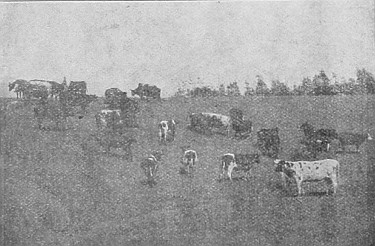
Cattle on the uplands as well as the open plain do well in all parts of Western Canada.
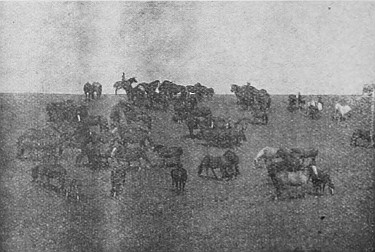
Horses range most of the year in many parts of Saskatchewan and Alberta.
MANITOBA

Top
The most easterly of the three Central Provinces—lies in the centre of the North American continent—midway between the Pacific and Atlantic oceans, its southern boundary running down to the 49th parallel, which separates it from the United States, its northeasterly boundary being Hudson Bay. It may well be termed one of the Maritime Provinces of Canada. Manitoba is one-fourth larger than Germany, its area covering 252,000 square miles or about 161 million acres. If a family were placed on every half section of the surveyed land in Manitoba, more than 600,000 persons would be actually living in the Province.
Available Homesteads.—One and a half million acres of land are open for free homesteading in Manitoba—east of the Red River, and between lakes Winnipeg and Manitoba, also west of Lake Manitoba and in the newly opened districts along the railway lines. The wooded areas of these districts will make a strong appeal to those who appreciate the picturesque. Where the timber is light scrub, it is easily removed, while the heavy forest richly repays the cost of clearing. Lakes, rivers, and creeks are numerous, and wells of moderate depth furnish water for domestic purposes. Homestead lands are easily reached and the value of land is steadily advancing. Two hundred and thirty-two homesteads were filed in Winnipeg in December, 1913—almost twice the number filed during December, 1912.
Available Farm Lands, apart from homesteads, can be secured at $12 to $15 per acre for raw prairie, while improved farms command $35 to $40.
Improved Farms may be secured in all parts of Manitoba from owners who have grown wealthy and are in a position to retire.
Soil and Surface.—The surface of Manitoba is not a flat, bare stretch, a "bald-headed prairie." A large part of the land, especially in the south, is, indeed, the flat bed of a wide, prehistoric lake; but even in the southwest the land rises into wooded hills, and in the southeast, close to the Lake-of-the-Woods country, there is a genuine forest. In Western Manitoba are forested areas, and timbered districts exist on the Turtle Mountains and the Brandon Hills. The true forest persists in Central Manitoba as far as the Duck Mountains. From all these points quantities of lumber, fence posts, and firewood are sent to the prairie settlers. The rivers and lakes are skirted by a plentiful tree growth. Down through the heart of the Province stretch two great lake chains. Lake Winnipeg and lakes Winnipegosis and Manitoba, which receive the waters of the Saskatchewan and Assiniboine from the west, and discharge through the Nelson River to Hudson Bay. Sloping to the west from the Lake Manitoba plain is a range of gentle hills known as the Duck Mountains, Riding Mountains, and the Porcupine Hills. These hills in no way alter the fact that almost the whole land surface of Central and Southern Manitoba west of its great lakes is ready for cultivation. The northern portion of the Province, though not surveyed, is known to contain a large area of good agricultural land. Manitoba's soil is a deep rich loam, inexhaustible in its productiveness. There are 25½ million acres of land surveyed, about one-fourth of which was under crop in 1913.
Grain Growing.—Manitoba is noted for its wheat crops and has already an established prestige in yields of oats, rye, and flax; in some parts corn is being grown. In certain districts good yields of winter wheat are reported.
The grain statistics for the Province reveal an interesting condition. In 1901 there were 1,965,200 acres of land under wheat, and in 1910 the area had grown to 3,094,833 acres. In 1913, this had increased to 3,141,218 acres. The land under oats, in 1913, amounted to 1,939,723 acres; barley, 1,153,834 acres, and flax, 115,054 acres. The average yield of wheat in 1913 was 20 bushels; oats, 42 bushels.
The total grain crop in the Province for 1913 was 178,775,946 bushels, grown on 6,364,880 acres, compared with 182,357,494 for 1912, the decrease being due to a falling off in oats of nearly 7 million bushels and in flax of more than 1 million bushels. Of the 1913 grain crop spring and fall wheat together occupied an area of 3,141,218 acres and yielded 62,755,455 bushels. Oats occupied an area of 1,939,723 acres and yielded 81,410,174 bushels. Barley occupied an area of 1,153,834 acres and yielded 33,014,693 bushels. Flax, rye, and peas occupied an area of 130,105 acres and yielded 1,595,624 bushels. The above are Provincial Government returns.
Potatoes and Field Roots.—The yield of potatoes for 1913 was 9,977,263 bushels from an area of 55,743 acres, and that of field roots 4,196,612 bushels from an area of 16,275 acres. The average yield of potatoes was about 180 bushels per acre; field roots 257 bushels. Total value, about $2,100,000.
Fodder Crops.—Brome grass contributed 43,432 tons from an area of 24,912 acres. Rye grass 33,907 tons from an area of 21,197 acres. Timothy 181,407 from an area of 118,812 acres. Clover and alfalfa together contributed 20,454 tons from an area of 10,037 acres, and fodder corn 119,764 tons from an area of 20,223 acres. Total value about 2 million dollars. Alfalfa is largely grown at Gilbert Plains, Roblin, Swan River and Grand View. The figures given are from Provincial Government returns.
The Season.—Although spring opened a few days earlier than usual, seeding was quite general on well drained land by April 15th. From that date until the end of the month the weather was exceptionally favourable, and by May 10th, on well prepared land, nearly all the seeding was over.
During the first three weeks of May the weather was quite cool, and growth was slow; but with warmer weather the last week's growth was more rapid. There was an abundance of moisture from the previous fall, and despite the low temperature during May, wheat was well advanced by the end of the month.
Putting up wild hay in Manitoba, which frequently yields from 1½ to 2 tons per acre.
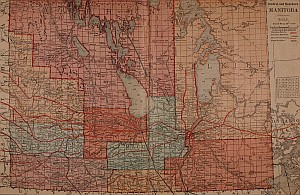
Central and Southern MANITOBA For Map of Northern Manitoba see pages 14 and 15
The early part of June was dry with high temperature; but in the latter part of this month rain was more plentiful, especially in the western part of the Province. The rainfall in July was below the average, and the temperature lower than usual. Harvesting was general by the middle of August.
The excellent condition of the land at seeding time, the favourable weather during germination and growth, and the ideal harvesting and threshing weather, exercised the greatest influence in determining the high grade of all grains as well as materially reducing the cost of harvesting.
Mixed Farming has become quite general in Manitoba, practically every farmer now having his herd of cattle or flock of sheep. His fattened hogs find a steadily increasing market at good prices, while poultry is a source of revenue. The vegetable crop is always a success; wonderful yields of potatoes and roots are regularly recorded. Many portions of the country, partially wooded and somewhat broken, which were formerly overlooked, are now proving desirable for mixed farming. These park districts have sufficient area for growing grain, hay, and grasses.
The poplar groves scattered here afford excellent shelter for cattle and, in many cases, furnish valuable building material. The district lying east and southeast of Winnipeg is rapidly being settled. It is well served by the Canadian Pacific, Canadian Northern, and Grand Trunk Pacific Railways. Rainfall here as elsewhere throughout the Province is adequate, and well water easily secured. Much of this land is available for homesteads, while other portions may be purchased at a low price from the railway and land companies. This applies to Swan River and Dauphin districts.
Hon. George Lawrence, Minister of Agriculture, says: "Conditions in Manitoba are excellent for livestock of all kinds, and the money-making possibilities in producing all manner of food are beyond question.
"The output of the creameries last year was close to 4,000,000 pounds. They cannot, however, begin to meet the demand. It is the same with eggs, poultry, beef, pork, mutton, vegetables, and all foodstuffs. The opportunity for the man who will go in for mixed farming in this Province is consequently obvious."
Dairying yielded about 3½ million dollars in 1913 for butter, and then failed to supply local demand, a quantity of milk, cream, and butter being imported. Winnipeg alone used over three-quarters of a million dollars' worth of milk and cream in 1913. The demand is increasing with the growth of the cities throughout the west, and splendid opportunities exist in this field. Cheese sold in 1913 at 12½ cents per pound, dairy butter at 23.4 cents, and creamery butter at 27.5 cents.
Dairy schools, under control of the Agricultural College are well equipped and under the guidance of professors of high standing.
Businesslike Farming.—Nowhere on the continent more than in Manitoba has farming advanced to the dignity of a thoroughly businesslike occupation. Here the farmer works, not merely for a living, but for a handsome profit. Instances are frequent where large areas under wheat have given a clear profit of over $12 an acre. All the labour of ploughing, seeding, harvesting, and marketing is included at $7.50 per acre with hired help. Even allowing $8, it is a poor year that will not yield a handsome margin.
The greatest monopoly of the future will be land.
Wheat is the greatest food cereal. Lands suitable to the growth of No. 1 hard wheat are extremely limited. While the demand for wheat is increasing, the wheat belt of the United States is decreasing yearly in acreage and yield, with the result that within a few years the United States will have to import and scramble for a lion's share of the wheat crops of the world.
The following tables give the acreage, average and total yield of wheat oats, barley, and flax for the last seven years. Provincial government returns,
WHEAT OATS
Year Acreage Average Total Acreage Average Total
Yield Yield Yield Yield
1907 2,789,553 14.220 39,688,266.6 1,213,596 34.8 42,140,744
1908 2,850,640 17.230 49,252,539.0 1,216,632 36.8 44,686,043
1909 2,642,111 17.330 45,774,707.7 1,373,683 37.1 50,983,056
1910 2,962,187 13.475 39,916,391.7 1,486,436 28.7 42,647,766
1911 3,350,000 18.290 61,058,786.0 1,625,000 45.3 73,786,683
1912 2,823,362 20.070 58,433,579.0 1,939,982 46.0 87,190,677
1913 3,141,218 19.300 62,755,455.0 1,939,723 42.0 81,410,174
BARLEY FLAX
Year Acreage Average Total Acreage Average Total
Yield Yield Yield Yield
1907 649,570 25.70 16,752,724.3 25,915 12.25 317,347
1908 658,441 27.54 18,135,757.0 50,187 11.18 502,206
1909 601,008 27.31 16,416,634.0 20,635 12.26 253,636
1910 624,644 20.75 12,960,038.7 41,002 9.97 410,928
1911 760,000 31.50 21,000,000.0 86,000 14.00 1,205,727
1912 962,928 35.00 33,795,191.0 191,315 13.06 2,671,729
1913 1,153,834 28.00 33,014,693.0 — — —
Education.—Manitobans expend a greater percentage of public funds for schools than for any other purpose. Private schools, business colleges and public libraries, as numerous and as well equipped as those in similar communities anywhere, are established in all important cities and towns and these with the excellent public schools afford educational facilities equal to those of any country. There are also a number of Catholic parochial schools.
The Dominion Experimental Farm at Brandon is doing much to educate the farming population of the Province. Accurate records of all practical experiments are kept and the information is given to settlers free. Dairy schools, farmers' institutes, livestock, fruit growers, agricultural, and horticultural associations also furnish free instruction as to the most successful methods practised in their callings.
Railways have anticipated the future, so that few farmers are more than eight or ten miles from a railway. Manitoba now has 3,895 miles of railway as compared with 1,470 miles in 1893. The Canadian Pacific has 1,620 miles, Canadian Northern 1,809, and the Grand Trunk 366, and extensions will be made by all lines this year. Railway lines being built to Hudson Bay will make large mineral deposits available. When this territory is surveyed there will be opened up a wonderfully rich area, capable of maintaining an immense population. This added territory gives a port on Hudson Bay, from which vessels can carry the farm produce of the West to old country markets.
Climate.—Unlike some other provinces, Manitoba's climatic conditions are uniform throughout. There is much sunshine the year round. The summer is pleasant, warm, and conducive to rapid and successful growth.
The long autumns are usually agreeable, ploughing weather sometimes extending to the end of November.
The winters rarely last more than three or four months, and because of the dry atmosphere, the low temperature is not as much felt as in countries with more moisture. The snow is never deep, and travel in winter by team or rail is rarely impeded by drifts. The annual precipitation is 21.4 inches.
The crop season in Manitoba extends from April to October, inclusive. Seeding frequently starts early in April, and threshing usually lasts through October. The mean temperature for the period, April 1 to September 30, in 1913 was 55 degrees Fahrenheit. The mean temperature in October was only 34.40 Fahrenheit, but threshing can be done in cold weather as readily as in warm, with no injurious effects. The total precipitation in the Province was smaller than usual—for the growing season 9.67 inches, but rain was well distributed: May 1.04 inches; June 2.34 inches; July 1.70 inches; August 3.56 inches, and September .68 inches. The average sunshine was 7.3 hours daily. The mean temperature of the country is 32.7; January 5.2; July 66.1.
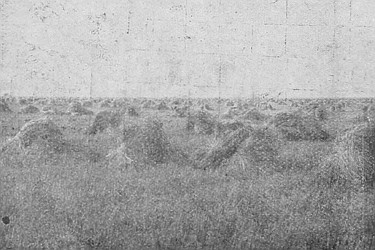
Here is a usual scene in Western Canada during the harvesting season.
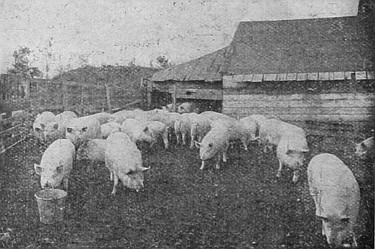
The raising of hogs is a highly profitable industry in Western Canada. They are easily fattened on barley, oats and alfalfa.
Picnicing on December 11, 1913.—The mild weather of the past few months has been general throughout the Province of Manitoba. At Melita, on December 11th, the citizens suspended business and had a picnic at River Park on the outskirts of the town, and there was no discomfort from heat or cold.
Fruit.—Small fruits did well in 1913. Apples are not grown extensively, but several orchards in the Province were well laden. The orchard of Mr. Stephenson, near Morden, was the most notable, and produced a crop of several hundred barrels of apples, as well as an abundance of crabs, cherries, and other fruits. At the recent Land and Apple Show in Winnipeg, native apples compared very favourably with those from Provinces which pride themselves on their horticultural possibilities.
Sugar Beets.—In growing sugar beet, Manitoba has had success. Syrup produced from sugar beets grown at Morden was of good consistency and the colour indicated that good sugar could be manufactured from it.
Game and Fish.—Manitoba's fishery output represents an annual value of over one million dollars. There is plenty of good fishing. Wild ducks, geese, and swans haunt the lakes and rivers, while on the prairies are flocks of prairie chicken.
Manitoba Farm Lands Year.—In addition to circumstances which point to next year as an important one to farming interests, there is one great factor which will undoubtedly have much to do with the sale and development of farms. This is the fact that the people of Manitoba realize the necessity for mixed farming. This means the breaking up of large tracts of land into smaller farms and therefore a largely increased population. Even while the present year has been one of some financial stringency the demand for farm lands has steadily increased.
WHAT SOME MANITOBA FARMERS HAVE DONE
Gladstone, Man., reports that the wheat crop of 1913 exceeded all expectations; 30 bushels per acre was the general yield. The grade was never better. One farmer had 400 acres in wheat, which weighed 66 pounds to the bushel.
Portage Plains, Man., showed some remarkable yields. Noah Elgert had 61 bushels of wheat per acre; the government farm, 61 bushels; Geo. E. Stacey, 54; T. J. Hall, John Ross and D. W. McCuaig, 50; W. Richardson, 51; M. Owens, 61½; Anderson and Turnbull, 60; J. Lloyd, 48½; Jas. Bell and Robt. Brown, 48; R. S. Tully, 52; J. Wishart, 49¼; Philip Page, 47; J. Stewart, 45; J. W. Brown, 30; Chester Johnson, 44; E. H. Muir, 42; L. A. Bradley, 43; W. Boddy, 40; Albert Davis, 43; E. McLenaghen, 37. After farming the same land for forty years, J. Wishart secured a crop of 49½ bushels to the acre, the best he ever had. Mr. Bradley's yield was on land plowed this spring.
Marquette, Man., September 21. Splendid weather has enabled the farmers of this section to make good progress with the cutting and harvesting of this season's crop. Wheat is averaging 20 bushels to the acre, with barley 45 and oats going 70. There has been no damage of any description.
Binscarth, Man., says good reports are coming from the machines of high yields and good sample. The elevators are busy shipping cars every day.
Dauphin, Man., September 13. Threshing is general. The grain is in good shape and the weather is ideal. The samples are best ever grown here, grading No. 1 Northern. The returns are larger than expected in nearly every case. E. B. Armstrong's wheat went 34 bushels to the acre; others, 25 to 27.
Balmoral.—John Simpson says: "Very prosperous has been our first year's farming in Canada. Shipped two carloads of wheat that graded No. 1 Northern and sold for eighty-five cents. Weather for the last two weeks was perfect—no snow and just enough frost to keep the roads from getting muddy."
Brandon.—Hard wheats have long been the choice product of Manitoba soil, but nothing more significant is required to announce a new industry in the Province than that Glencarnock Victor, a Manitoba-finished steer, owned by Mr. J. D. McGregor, was last year grand champion of America, and his half-brother from the same stables, won like honours this year. Neither had ever been fed any corn, but fattened on prairie hay, alfalfa, and barley.
CITIES AND TOWNS
Winnipeg, with a population of about 200,000, is a natural distributing point for Western Canada, as well as the shipping point for the wonderful crops from the tributary prairie lands. The prosperity of Western Canada is here reflected in substantial buildings, wide boulevards, quarries, water works, street lighting systems, asphalt plants, and a park system of 29 parks, covering 500 acres. There are 40 modern school buildings with 378 teachers and 21,210 pupils.
Winnipeg has four live daily papers and forty weekly and monthly publications. Twenty-four railway tracks radiate from the city, making Winnipeg the leading grain centre of the world. A photograph taken at any point in the financial centre of the city shows magnificent new buildings under construction, representing immense investment and indicating the confidence felt in the city's future. Municipal improvements are constantly being made. The city now has 466 miles of sidewalk, 112 miles of boulevard and 162 miles of street pavement. There are 115 churches.
St. Boniface, the seat of the Roman Catholic archdiocese of St. Boniface, adjoins and is partly surrounded by the business district: 17,000 population.
Brandon—With 18,000 population is the second city in the Province and is located on the main line of the Canadian Pacific Railway, with its seven branch railway lines. The Canadian Northern runs through the town and has erected a fine new modern hotel. The Great Northern entering from the south and the Grand Trunk Pacific completed, there is afforded excellent shipping facilities, necessary to the factories, flour mills, machine shops, and wholesale houses established here. There are fourteen branch banks here with clearings totalling $33,000,000. As an educational centre Brandon might be ranked with cities several times larger. The high school would be a credit to any city of first rank. A Dominion Experimental Farm is located here.
Portage la Prairie—Enjoys splendid railway facilities at the junction of four lines of railway. This fortunate situation has brought a number of industries. The city owns its park and has a fine educational system, including a Collegiate Institute. Many churches and fraternal organizations are supported by this city of 7,000 population. Municipal improvements are constantly being made.
Selkirk is a distributing point of supplies for points on Lake Winnipeg.
Carberry and Morden are flourishing railway towns in the heart of fine wheat-growing sections, as are Minnedosa, Neepawa, Dauphin, Carman, Virden, and Souris.
Scores of towns now developing afford openings for those desiring business opportunities; each has its mills and warehouses for wheat. Among these centres may be named Manitou, Birtle, Emerson, Gretna, Wawanesa, Rivers, Somerset, Baldur, Deloraine, Melita, Rapid City, Hamiota, Gladstone, Killarney, Hartney, Stonewall, Boissevain, Elkhorn, Gilbert Plains, Pilot Mound, Winkler and Plum Coulee.
Provincial Government returns.
POPULATION AND LIVESTOCK
1891 1908 1909 1911 1912 1913
Population 152,506 455,614
Horses 86,735 230,926 237,161 232,725 273,395 304,100
Milch cows 82,710 173,546 167,442 146,841 154,400
Other horned cattle 147,984 357,988 333,752 397,261 428,274 460,200
Sheep 35,838 29,265 29,074 32,223 42,087 112,500
Hogs 54,177 192,489 172,374 176,212 216,640 176,000
Cultivated farms 45,380 49,755 50,000
Increase in population in ten years was 78.52 per cent.
The exhibit of grains, grasses, clover, fodder crops, vegetables, and natural products shown at the 1913 United States Land Show spoke well for the soil and climate of Manitoba.
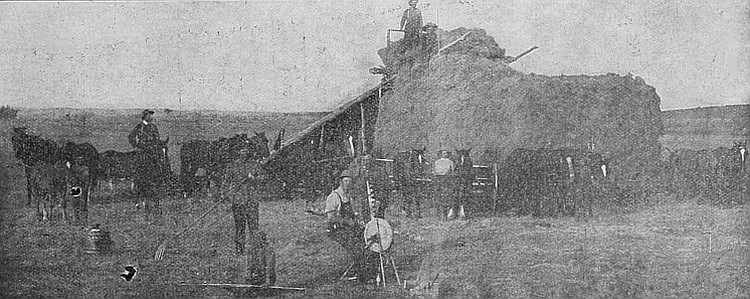
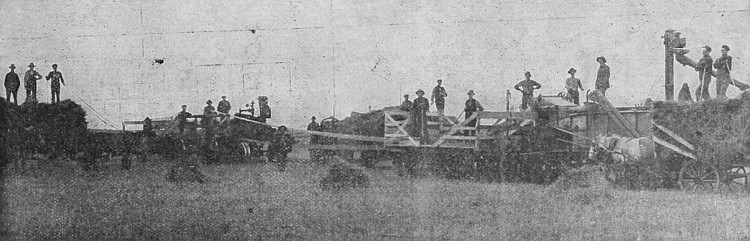
An ordinary threshing scene in Manitoba, where fields of wheat, oats and barley pay the farmer well.
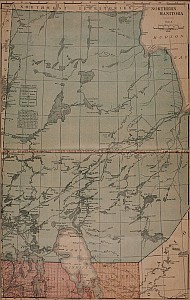
NORTHERN MANITOBA
SASKATCHEWAN

Top
Saskatchewan, the central Prairie Province, is a huge rectangle extending from the 49th to the 60th parallel, with an area as large as France and twice the size of the British Isles.
It comprises 155,092,480 acres, and extends 760 miles north and south and 390 miles east and west at the southern boundary bordering on the United States. The average altitude is about 1,500 feet above sea level.
Saskatchewan claims to be without a rival in North America as a producer of wheat and small grains. Only physical and geographical conditions retard even a more phenomenal agricultural development. Its growth and acquisition of wealth has been phenomenal. There are four distinct zones extending north and south: (a) rolling prairie, (b) prairie and woodland, (c) forest, (d) sparsely timbered belt. All the land is suitable for cultivation and will yield the highest quality of cereals, though less than 13 million acres are now under the plough. The population of approximately 550,000 thriving, vigorous people will eventually be a million. The increase in ten years was 440 per cent.
The Government forces in Saskatchewan are complete and effective. Every branch of agricultural work conducted by the Provincial Government is a part of the Department of Agriculture.
Soil and Surface.—The soil in all of Saskatchewan is a rich loam, running from eight to twenty inches deep over a chocolate clay subsoil. Moisture is evaporated from this subsoil so gradually that the fertility is almost inexhaustible. With few exceptions the southern portion of the Province from a line east and west through Saskatoon is almost flat.
In certain portions the surface is undulating, but in no case so hilly as to preclude ploughing every acre; near some of the rivers in the more hilly sections the soil becomes lighter with some stone and gravel.
Five reasons may be given for the exceptionally favourable conditions awaiting the grower of wheat in Saskatchewan: 1. The soil is of almost inexhaustible fertility. 2. The climate brings the plant to fruition very quickly. 3. The northern latitude gives the wheat more sunshine during the growing period than is had in districts farther south. 4. Rust is of infrequent occurrence. 5. Insect foes are unknown.
Fuel and Water.—The coal areas to the south, and the partially wooded areas in the north, provide an ample supply of fuel, while water can be secured anywhere at a reasonable depth.
CENTRAL SASKATCHEWAN
The Available Homesteads are principally in the northern portion of Central Saskatchewan which is watered east and west by the main Saskatchewan River and by its chief branch, the North Saskatchewan, a great part of whose navigable length lies within this section. The surface generally is rolling prairie interspersed with wooded bluffs of poplar, spruce, and pine, alternating with intruding portions of the great plain from the south. In soil and climate Central Saskatchewan is well adapted to the raising of cattle, also wheat and other grains. North of township Thirty there is unlimited grazing land, horses, cattle and sheep feeding in the open most of the year. There is the necessary shelter when extreme cold weather sets in and water is plentiful. Sheep do well. Many farmers have from 50 to 100 sheep and lambs. The district also possesses everything required for the growing of crops and there are satisfactory yields of all the smaller grains. The homesteader may add to his holdings by purchasing adjoining land from the Canadian Northern, Canadian Pacific Railway and other corporations. These unimproved lands range from $15 an acre upwards.
Districts recently opened for settlement are Shellbrook, Beaver River, and Green Lake, into which the Canadian Northern Railway is projected. Other new districts are Jack Fish Lake and Turtle Lake, north of Battleford, into which the same road is built. These districts are favourable for grain and cattle raising. North of North Battleford are several townships which will not long be without transportation, and to the east of these there are available homesteads which can be reached through the Prince Albert gateway.
SOUTHERN SASKATCHEWAN
Available Farm Land.—There are but few homesteads available in Southeastern Saskatchewan. The land is occupied by an excellent class of farmers, and values range from $15 per acre to $25 for unimproved prairie, and from $40 to $50 per acre for improved farms. In the neighbourhood of Moose Jaw mixed farming and grain raising are carried on with success. North and northwest, towards the Saskatchewan, are large settlements; but to the south and southwest is a tract of land available for homesteading, and a land office at Moose Jaw makes it easy to inspect the land and secure speedy entry. These lands are easily reached from Moose Jaw, Mortlach, Herbert, Gull Lake, and Swift Current.
Maple Creek district is an important stock centre. Some of the best sheep, cattle, and horses in Canada are raised on the succulent grass here but the wheat grower and mixed farmer are treading on the heels of the ranchman.
West of Swift Current to the Alberta boundary herds of cattle roam and largely find for themselves. Snowfall is light and winters so mild that hardy animals graze through the whole year. The Chinook winds are felt as far east as Swift Current. Grain growing is successful.
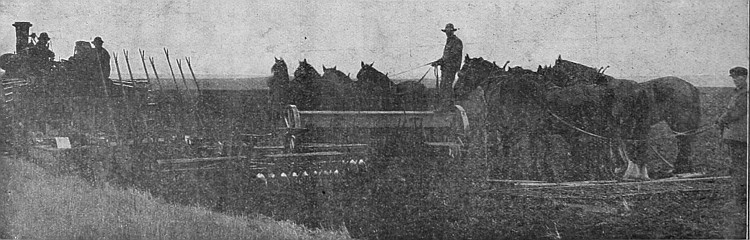
In many parts of Western Canada, large farms are operated by steam or gasoline power. This shows its use, and also discing, seeding and harrowing.
Farm land can be purchased from railway and other land companies in Southeastern Saskatchewan, which includes that section between Manitoba on the east and the third meridian on the west, extending some distance north of the main line of the Canadian Pacific Railway. It has more rainfall than portions farther west and less wood than the portion lying north. In character and productiveness of soil, Southeastern Saskatchewan is a continuation of Manitoba, but contains more prairie area.
NORTHERN SASKATCHEWAN
Available Homesteads.—Northern Saskatchewan has not yet been opened to any extent for settlement. There are approximately 80 million acres beyond the railway at Prince Albert which time, zeal, and railway enterprise will eventually make accessible. Furs, forest wealth, and fisheries are recognized as a national asset, but thousands of acres of fertile land lie beyond the existing lines of railway awaiting development. Northern Saskatchewan has natural resources sufficient to maintain a population equal to that of any European country in corresponding latitude.
Saskatchewan Crops.—Saskatchewan leads all other provinces in wheat production, though only a comparatively small portion of its tillable area is under cultivation. In 1898 the area under wheat was 276,253 acres; 910,359 acres in 1905; 2,703,563 acres in 1908, and in 1913, five years' time, it had more than doubled, the area being 5,720,000 acres. On this there were grown approximately 121½ million bushels of wheat, an average of about 21¼ bushels to the acre. The farmers realized about 124 million dollars for products apart from field and fodder crops, valued at 5 million dollars.
The following figures are from Provincial Government returns. Saskatchewan has easily 50,000,000 acres of unbroken prairie to grow just such good crops, and another 25,000,000 acres on which to graze live stock.
Acreage Yield per Acre Total Production Price per Bushel Total Value
Wheat 5,760,249 19.5 112,369,405 At 63c $ 70,792,725.15
Oats 2,638,562 41.7 110,210,436 At 23c 25,348,400.28
Barley 307,177 30.2 9,279,263 At 26c 2,412,608.38
Flax 967,137 12.0 11,654,280 At $1.00 11,654,280.00
Province 9,673,125 243,513,384 110,208,013.81
While the average yield of wheat is shown to be 19.5 bushels per acre, thousands of farmers raised 35 bushels and some more than 40. Considerable was sown on stubble, and there were many low yields occasioned by indifferent farming, and anxiety to secure a crop from late seeding, without which the general average would have exceeded 30 bushels per acre. The same is true of other grains. On the Experimental Farm at Indian Head, Marquis wheat produced 48 bushels to the acre, and Red Fife on the stubble 28 bushels.
Almost the entire wheat crop was within the contract grades, (none less than 3 Northern, the great bulk graded No. 1) and by the end of October 75 per cent of the crop was threshed. In many instances wheat weighed 64 and as high as 66 pounds to the bushel. Mr. Paul Gerlach of Allan, Saskatchewan, had 71 pounds per bushel, and carried off the honours at the International Dry Farming Congress at Tulsa last November.
Mixed Farming is so successful in Saskatchewan that only passing comment is necessary. The Province is famous for its high-class horses, well-bred cattle, sheep, and hogs. At the Live Stock Show in Chicago in 1913, the Province carried off high premiums. The Department of Agriculture secures good breeding stock for the farmers and encourages the preservation of females.
Poultry Raising is so profitable that many Saskatchewan farmers have gone into it extensively. Of 10,000 turkeys marketed at Moose Jaw there was not a single "cull." They brought an average of $2.80 each. Chickens provide a certain profit and constant income.
Dairying is successful. An established market and excellent natural facilities favour this branch of mixed farming. 997,000 pounds of creamery butter yielded $271,185 in 1912 and private dairies realized $189,000 from 700,000 pounds, making a total increase of $177,376.69 over 1911. With the exception of cream delivery, a government superintendent supervises all business transactions of most creameries.
Fodder Corn.—At Prince Albert fodder corn has reached a height of eight feet with not a poor sample in the lot and there are strong indications that before many years corn will be grown here for ensilage with general success. At the Experimental Farm, fodder corn yielded about 18 tons of green fodder per acre, which went into the silo in good condition.
Railways.—About five hundred miles of new road opened in 1912 gives Saskatchewan a total mileage of about 5,000 miles as compared with 1,000 in 1905, of which 1,230 is main line and 3,700 branches. The Province is so well served by the Canadian Pacific, Canadian Northern, and Grand Trunk Pacific that few of the established settlements are more than 10 to 20 miles from transportation; new settlements do not have to wait long for railway advantages. The Hudson Bay Railway will afford a short haul to ocean shipping from Saskatchewan grain fields. One and a half million dollars have been appropriated by the local government for improvements and building highways. From 1905-13 the population has doubled, and whole districts which were practically uninhabited but a short time ago are now filled with farmers.
Rivers.—The chief rivers are the North Saskatchewan, South Saskatchewan, Qu'Appelle, and Carrot. The North and South Saskatchewan rise in the Rockies and have a general easterly trend. The Red Deer flows into the South Saskatchewan, about 150 miles north of the United States boundary. The South Saskatchewan runs east nearly half way across the Province, then turns north and enters the North Saskatchewan a little east of Prince Albert. The South Saskatchewan, with the Qu'Appelle, intersects the Province from east to west. The Carrot rises south of Prince Albert and runs parallel to the North Saskatchewan, into which it flows near "The Pas," and the junction point of the Hudson Bay Railway, now under construction.
Lumbering.—North and east of Prince Albert, the present centre of the lumber industry, lumbering is extensive. In the northern forest the timber is black and white spruce, larch or tamarack, jack pine, aspen or white poplar, balsam or black poplar, and white birch.
Game and Fish.—In the north, furs are secured for the world's markets and fishing is carried on extensively.
Education.—Schools are sustained by provincial aid and local rates. Except in special cases where qualified teachers cannot be obtained, the teacher must hold a certificate from the Department of Education. The university is supported and controlled by the Province, a department of which is a college of agriculture with some of Canada's best educators and agricultural specialists on the faculty. Nowhere do agricultural authorities give greater attention to the welfare and education of the farmer than in the newer districts of this Province.
CITIES AND TOWNS
Regina.—Capital of Saskatchewan, lies in the heart of a splendid agricultural section, and is distributing centre for a large district. With a population of about 45,000 it supports a dozen banks which had clearings of 116 million dollars in 1912. It has good hotels, is noted for its substantial public buildings, wide, well-paved streets, and metropolitan spirit. The Canadian Pacific, Canadian Northern and Grand Trunk Pacific unite to make it an important railway centre. The collegiate institute and provincial normal school add to its educational importance. The Northwest Mounted Police headquarters are located here, also the judiciary of Saskatchewan.
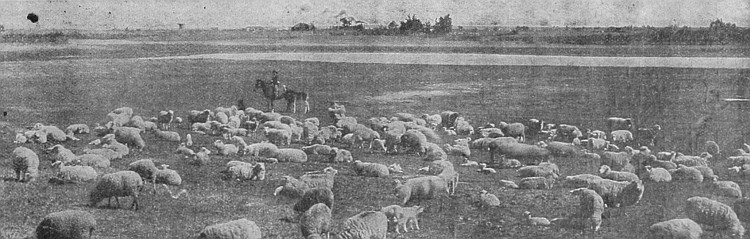
The sheep industry in Western Canada is one of certain profit. There are many large flocks in all parts of the three Provinces.
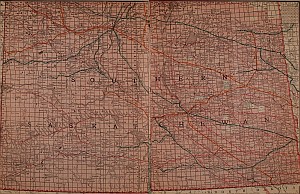
SOUTHERN SASKATCHEWAN Surveyed lands shown in colour. For Map of Central Saskatchewan see pages 22 and 23.
Saskatoon.—The seat of the University of Saskatchewan, is a growing city beautifully situated on the South Saskatchewan River. It is well served by the Canadian Northern's Regina-Prince Albert line which passes through an extensive and productive farming district to the southwest and joins the main line at Warman, and is also on the route of the Canadian Pacific from Winnipeg to Edmonton. Population about 28,000; in 1903 it was about 100. There are four bridges crossing the South Saskatchewan River, with another in contemplation.
Moose Jaw is a divisional point on the Canadian Pacific, is a terminus of the Soo Line and is also served by the Canadian Northern and Grand Trunk Pacific. Population approximately 23,000. It is noted for its schools and churches. Splendid street car facilities exist here. This district is well settled by progressive farmers. They have brought raw prairie land, which cost from $8 to $10 per acre, to a state of cultivation, that makes their farms worth from $25 to $40 per acre.
Prince Albert is the northern terminus of the Canadian Northern and is delightfully situated on the North Saskatchewan River. It is served by a line of the Grand Trunk Pacific built from the main line at Young. The Canadian Northern Battleford-Prince Albert line will be completed this fall. It has four big sawmills, and several banks, churches, schools, and hotels. Population, 12,000. The three flour mills grind about 400 barrels a day. One mill ships its product largely to Scotland.
Swift Current is a divisional point of the Canadian Pacific Railway and a busy railway centre. It is said to be the largest initial wheat market in America. Population about 2,500. A few years ago the district from a point twelve miles west of Moose Jaw to the western boundary of the Province, and south to the United States boundary was considered fit only for horse ranching, cattle and sheep grazing, but now the land is practically all homesteaded in every direction from Swift Current. Branch lines extended to the northwest and southeast enter fairly well settled districts; other lines are contemplated. It was incorporated as a city.
North Battleford is wonderfully well situated agriculturally and picturesquely. It has a population of over 7,000, and is incorporated as a city. Several important industries and large wholesale places are established. The Canadian Northern Railway passes through the town, having its divisional headquarters here, and during the year will complete its line to Prince Albert. There is excellent passenger and freight service on the same company's line northwest, which is under construction to Athabaska Landing, Alberta. A traffic bridge connects North Battleford with Battleford.
Weyburn is a prosperous city on the "Soo" Line between Moose Jaw and North Portal. Its railway connection with Stoughton furnishes a direct route to the east. The Lethbridge line of the Canadian Pacific starts here and will be completed this year. Building permits, 1912, $760,000.
Yorkton within the last five years has more than doubled its population and ships annually over 2 million bushels of grain. It is an up-to-date town of about 2,500 inhabitants with creditable municipal buildings, eight grain elevators, water works, sewerage system, flour mill, saw mill, cement sidewalks, telephone, and a municipal gas plant.
Battleford.—Population about 3,000. Has one of the most picturesque situations in the west, and was the first capital of the Old Territories. During the past year it has made remarkable growth owing to the agricultural possibilities of the surrounding country. The Grand Trunk Pacific reaches the town from Biggar on the south and is building a line west from Saskatoon. The Canadian Northern has a branch entering the town. The Canadian Pacific is expected to build from Asquith. A number of industries have embraced the encouraging opportunities offered by the town, and large wholesale houses have erected distributing depots.
Rosetown, on the Canadian Northern Saskatoon-Calgary line, is progressive. It is of importance to-day, and marked for a good future. A splendid agricultural district peopled with excellent settlers surrounds it.
Zealandia, on the same line of railway, has wonderful physical advantages. Although of only a few short years' existence, as the centre of a farming country where lands have increased from $8 to $30 per acre, its fame has spread and its citizens are warranted in anticipating a bright future.
Kindersley has been on the map only four or five years. The surrounding fertile land that made the Goose Lake district famous in agriculture so soon after its discovery, gave to Kindersley a large portion of its glory and substance. It is growing rapidly, and confidence in what it will do is well bestowed.
Maple Creek, for many years the centre of a ranching section, has a population of 1,000, and the large surrounding area of free homestead land is rapidly being settled. Excellent crops are reported.
Estevan is noted for its coal mines and has rail connection with Winnipeg.
Rosthern, on the Regina-Prince Albert branch of the Canadian Northern, is in the centre of a good agricultural district.
Wolsely, three hundred miles west of Winnipeg, is the western terminus of the Wolsely-Reston branch of the Canadian Pacific Railway.
Indian Head, the largest incorporated town in Saskatchewan, has more elevators than any other town in the province. For some time it was the largest initial wheat-shipping point in the world. The Dominion Government Experimental Farm is here.
Moosomin, two hundred and twenty miles west of Winnipeg on the main line of the Canadian Pacific Railway, is a flourishing town surrounded by rolling prairie particularly adapted to mixed farming. Population 1,200. It has good churches, schools, banks, grain elevators and waterworks.
Qu'Appelle and Arcola are enterprising towns. Among the largest incorporated villages are Broadview, a divisional point on the Canadian Pacific Railway main line, Grenfell, Duck Lake, Alameda, Balgonie, Lemberg, Lloydminster, Melfort, Rouleau, and Sintaluta. Portal is the point where the "Soo" Line enters Saskatchewan. Yellow Grass, Milestone and Drinkwater are newer towns—settled within the past few years by progressive farmers from the States. Important and growing towns on the Grand Trunk Pacific, are Melville, Watrous, Scott, Nokomis and Young.
WHAT SASKATCHEWAN FARMERS ARE DOING
Regina.—During the week ending Sept. 21, 5119 cars of No. 1 Northern Hard were shipped out of the Province, as compared with 1,497 cars of No. 2 Northern and 290 cars of No. 3 Northern in 1912. There were, in addition, 111 cars of No. 1 Manitoba Hard shipped during the week.
Moose Jaw, Saskatchewan, Nov. 30.—Since Sept. 1, 19,850,000 bushels of grain have been shipped from the Moose Jaw district, against 32,000,000 for the previous entire crop year. Rouleau heads the list with 1,040,000 bushels, and Milestone comes second with 910,000 bushels. Vanguard, which led last year, is third, with 835,000 bushels.
Rutan.—Arthur Brondson, inexperienced in farming, having lived in London until eight years ago, last year raised 36 acres of Red Fife wheat, of 49 bushels per acre, and 48 acres Marquis wheat, 52 bushels per acre.
Regina.—James Cranston threshed 1,050 bushels oats from ten acres; James Hars's 60 acres yielded 106 bushels; W. J. Crawford's 60 acres produced 43 bushels Preston wheat; other yields of Marquis wheat show 40, 48, 50, and 63 bushels to the acre.
Esterhazy.—Esterhazy shared in the abundant harvest of 1913. A conservative estimate for the yield is from 25 to 30 bushels per acre for wheat, and 40 to 45 for oats. Some fields yielded 40 to 45 bushels per acre in wheat.
Tisdale.—D. McKibbon threshed 38 bushels wheat to the acre off 40 acres.
Wynyard.—Eggert Bjornson threshed 176 acres, averaging 36 bushels No. 1 Northern wheat.
Moose Jaw.—Chas. White's 80 acres wheat yielded 38 bushels to the acre. W. H. Johnston's 90 acres produced 35½ bushels wheat per acre.
A landscape view of Central Saskatchewan.
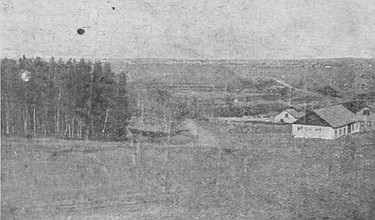
This man is sufficiently modest to start with oxen; in a year or two they will be replaced by horses. He now farms 320 acres.
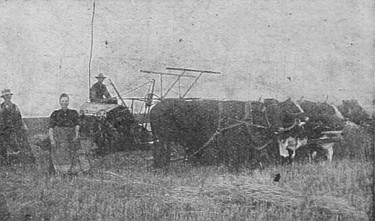
Pasqua.—E. S. Patterson, on 230 acres summer-fallow, threshed 31 acres Marquis, with a yield of 40-2/3 bushels per acre; 199 acres Red Fyfe with a yield of 35½ bushels per acre.
Caron.—Archie Dalrymple, 100 acres, 40½ bushels wheat per acre. Geo. Clemenshaw, 80 acres, 42½ bushels wheat per acre.
Boharm.—Geo. Campbell had 55 acres wheat that yielded 38 bushels per acre, and 100 acres that yielded 36 bushels.
Assiniboia.—E. Lennard threshed 1200 bushels oats, from a ten-acre field. His summer-fallow yielded 40 bushels No. 1 Northern wheat per acre.
Canora.—Mike Gabora had a yield of 120½ bushels oats per acre. C. R. Graham, who has a 3,000 acre farm in this district, for a number of years has grown oats that averaged 60 bushels to the acre, and sometimes yielded 100 bushels: one year the average was 117 bushels.
Arcola.—R. F. Harman, formerly of the County of Cork, Ireland, homesteaded in the North Battleford district in 1903, with $50.00 capital. He now owns 480 acres, clear of encumbrance, raises wheat, oats, barley, hay, and is a firm believer in mixed farming. In ten years his capital has increased from $50.00 to $25,000.
Swift Current.—Ed. K. Leep, of Chicago, homesteaded north of Swift Current. He had 30 acres of land in potatoes in June and lifted new potatoes on August 15. In the Fall little more than half an acre yielded over one hundred bushels. Some had been used in the meantime. Fuel was plentiful 8 miles away and good water was reached at twenty-five feet. The climate was agreeable, and good crops assured.
Nokomis.—J. Keys had oats in 1913 that went 110 bushels to the acre, and wheat, 40 bushels. He has paid off the mortgage on his farm, and now contemplates a trip to his old home in Denmark, to induce more of his people to settle in his neighbourhood.
W. E. Lewis of Dayton, Ohio, went to Saskatchewan seven years ago with $1,800 in money, a carload of household effects and farm implements, four horses and three cows. The first year he got only feed from the crops, but the second year threshed over 2,800 bushels of wheat from 100 acres. He has not had a crop failure and now has 22 horses, 15 cattle, 35 hogs, and owns 1,120 acres of land, all under cultivation. He has been offered $35.00 an acre for his land. Should he care to sell, he could pay all his debts, and have $30,000 to the good, but, he says, "Where could I go to invest my money and get as good returns?"
A. T. Smith of Southern Saskatchewan will grow alfalfa on 3,000 acres of land in 1914.
Mr. S. G. Cowan says: "I usually thresh from 60 to 65 bushels of oats, 30 of wheat, and 60 of barley. Vegetables grow well, and it is no trouble at all to grow potatoes. My farm has been under crop nine years, and has never been frozen, snowed under, or hailed. I have kept 100 cattle and 100 hogs. I usually give them their growth on green feed, wheat, oats, and barley, and fatten them on grain. With a little to start on we have cleared $10,000 in a little over four years."
Chaplin.—J. R. Lowe has matured two crops of fodder corn, and he says there is little difference between it and what he grew in Minnesota.
Industries.—The remarkable growth of the several cities and towns is but one of many evidences of increasing agricultural prosperity. With the coal resources of the southeastern part of the Province utilized, and the opportunities in northern parts for getting cheap water, Saskatchewan's industrial opportunities are many.
There is a great demand for help of all kinds. With seven cities, thirty or more towns, and five hundred villages, many men are constantly required for building trades and municipal work. The 90,000 farmers want help to put in and farm their crops. Boards of Trade in every city and town are ready to give information about openings for investment and assistance in locating men. The experimental stage is passed and people are developing beautiful homes surrounded by fertile fields.
A healthy family from Nebraska, now living in Western Canada. Observe the height of the oats. The crop yielded 70 bushels per acre.
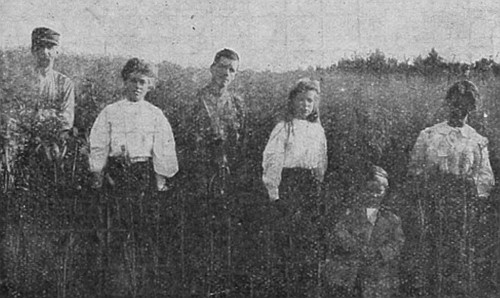
Cost of Farm Implements:
Disc Drill (single to twenty double) $ 96.00
Mowers 53.50
Twelve in. Gang Plows 82.00
Binders, six-foot cut 145.00
Binders, seven-foot cut 158.00
Binders, eight-foot cut 165.00
Rakes 35.00
Gasoline Tractors (Case) 2,480.00
Gasoline Tractors (Nicols) 3,665.00
Gasoline Tractors (International) 1,800.00
Steam Tractors (Case) 2,272.00
Steam Tractors (Nicols) 2,895.00
Case Separator 1,202.00
Nicols Separator 1,150.00
International Separator 1,280.00
Agricultural Cooperation.—The Provincial Government has established co-operation in creameries, elevators, telephone, hail insurance, agricultural societies and live stock. Five million dollars have been set aside for road improvements. The new agricultural college, with its 1,300 acre farm, costing one million dollars, is an evidence of public activity. The college has 100 students.
Temperatures and hours' sunshine in Saskatchewan ranged lower, and rainfall during the growing season higher, than the average for several years.
The average temperatures and precipitation for each of the first nine months of 1913:
Month Mean Maximum Minimum Precipitation
January -7.85 37.50 -45.30 .70
February 2.64 37.70 -34.30 .64
March 8.90 44.90 -31.90 .65
April 41.70 78.50 13.40 .31
May 47.20 84.70 20.70 1.00
June 59.20 87.70 30.70 3.00
July 61.10 86.60 37.40 3.18
August 60.80 85.90 38.90 2.80
September 52.10 85.50 32.90 .88
January-September, 1913 36.20 69.80 5.90 Total 13.16
April-September, 1913 53.60 84.80 27.50 " 11.17
April-September, 1912 50.90 79.90 27.50 " 13.92
Interior Storage Elevators.—A great advantage and an immense relief for the hundreds of elevators of from thirty to forty thousand bushels' capacity, will be the two interior storage elevators now under construction at Saskatoon and Moose Jaw, each with a capacity of 3 million bushels.
Farm Help in 1913.—Labourers work by the month, for $32 to $41. Servant girls were paid from $14 to $22 this year as compared with from $10 to $15 in 1907.
Population and Live Stock.—(Dominion Census Bureau):
1909 1910 1911 1912 1913
Population 492,432 [1]540,000
Horses 279,063 332,922 507,400 551,645 580,386
Milch cows 124,186 138,455 181,146 184,896 194,843
Other cattle 391,789 431,164 452,466 461,244 468,255
Sheep 129,630 135,360 114,216 114,810 115,568
Swine 131,757 125,788 286,295 344,298 387,684
Mr. J. C. Hill & Sons, of Lloydminster, Saskatchewan, who recently became winners for the third time of the Colorado Silver Trophy, valued at $1500 for best peck of oats in the world. They now own the trophy.
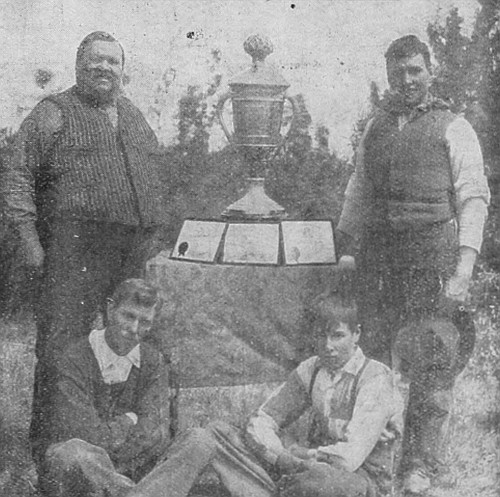
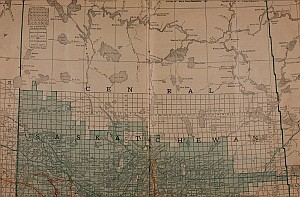
CENTRAL SASKATCHEWAN Surveyed land shown in colour. For Map of Southern Saskatchewan see pages 18 and 19
ALBERTA

Top
Alberta, the most westerly of the three Prairie Provinces, is twice the size of Great Britain and Ireland, much larger than either France or Germany, and has a greater area than the states of Maine, New Hampshire, Vermont, Massachusetts, Rhode Island, Connecticut, New York, New Jersey and Pennsylvania combined. The area of arable land alone in Alberta is estimated at 100 million acres, of which less than 3 million acres is under cultivation. This provincial empire, with its great wealth in agricultural lands, mines, forests, and fisheries, has less than 500,000 people.
Alberta is a vast plateau from 2,000 to 3,000 feet above sea-level, hung by its western edge on the foothills of the Rocky Mountains. It slopes gently toward the east and north. Absolutely level plains form no great proportion of the surface. While open, treeless country characterizes the southern part of the Province, the greater part is undulating, diversified by forest, stream, hill and open country, not unlike Ontario or New York State. Beautiful lakes, fringed with forest and abounding in whitefish are scattered over its central and northern area. Luxuriant grasses cover the open country, which once formed the chief feeding grounds of herds of bison.
The Province naturally falls into three divisions, exhibiting marked distinctions in climate and topography—Southern, Central and Northern Alberta.
Available Homesteads are to be found west and north of Edmonton—territory made accessible by the Grand Trunk Pacific and the Canadian Northern Railways—in an immense stretch of splendid country. Wheat and oats are reliable crops. Rainfall is certain. Mixed farming is highly successful. The wild grasses and pea vine supply ample feed for stock; water is plentiful and easily secured. On into the foothills and the mountains are stretches of prairie land, through which the Grand Trunk Pacific and Canadian Northern Railways are now constructed.
The northern and western portions of Central Alberta have some "brush" land with soil equal to that of the open prairie. The cost of clearing is slight, and there is the advantage of shelter for cattle, and an absolute assurance of splendid water. There is a good market for the fuel and timber obtained in clearing. Practically all of the land between Edmonton and Athabaska Landing—and between Edmonton and Lac la Biche to the northeast has been subdivided for homesteading.
NORTHERN ALBERTA
North of the end of steel extends 75 per cent of this rich Province, yet unexploited. When the railways push into the Athabaska and the Peace, it will be realized that Alberta owns an empire north of the Saskatchewan, a country set apart by nature to provide homes for millions of agrarian people.
SOUTHERN ALBERTA
Southern Alberta is open and rolling, and devoid of timber except along the streams and the Rocky Mountains' foothills. The soil is a fertile loam. The climate is ideal, with pleasing summers and mild winters. Stock pasture in the open air during winter, grazing on the nutritive sun-dried grasses. The absence of timber in Southern Alberta is compensated for by the supply of coal.
Typical school in rural district in Western Canada, which will soon be replaced by consolidated school, picture of which appears elsewhere.
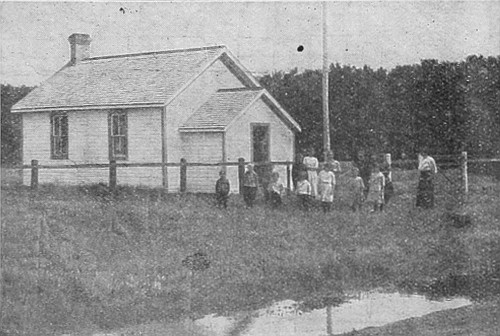
Ranching which once was predominant is fast being abandoned and settlers are dividing the limitless acres into small, productive holdings. As a grazing country, Southern Alberta has had few equals, for the hills and valleys, well watered, afford excellent pasturage. Winter wheat sown on new breaking, or summer-fallowed land, from the middle of July to the end of September is ready for harvest from the 1st to the 15th of August in the following year. Climate and soil make this an ideal wheat-growing district. Considerable spring wheat is grown, as well as oats, barley and flax. The production of sugar-beets compares favourably with that of Germany and the world.
The average of winter wheat for the Province in 1913, was 21 bushels an acre. The greater portion was grown around Lethbridge, Taber, Grassy Lake, Cardston, Spring Coulee, Pincher Creek, Macleod, Stavely, Leavitt, Claresholm, Nanton, High River, Okotoks, Carmangay and Calgary.
Water Supply and Irrigation.—Water for domestic and farm purposes is easily obtained at reasonable depth. In certain sections of the Canadian West, as in the American West, the soil is unexcelled for growing cereals, but the geographical location and relative position to the rain avenues is not advantageous, not only the requisite amount of rain but its conservation is essential to the growing of crops, and that is the meaning of "dry farming." This is being successfully followed in the southern portion of Southern Alberta. Some of the district can also be easily and successfully farmed by means of irrigation. Irrigation ditches have been constructed by the Canadian Pacific Railway and the Southern Alberta Land Company.
Typical school, such as many towns are building in Western Canada, where the education of the children is carefully looked after.
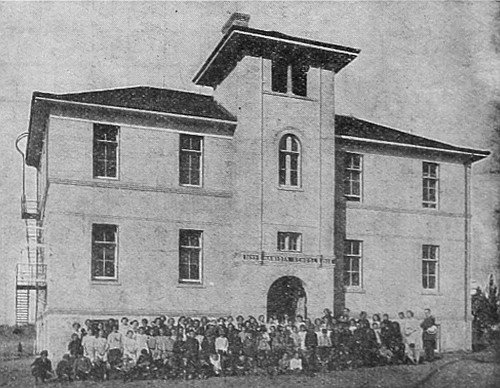
A most valuable asset to Southern Alberta is the Lethbridge Experimental Station, operated by the Dominion Department of Agriculture. Reports from the farm show that on land broken and backset in 1912, spring wheat sown April 3, 1913, ripened between July 31 and August 17, and yielded from 22 to 41 bushels per acre; oats sown April 13, 1913, ripened from July 31 to August 4, and yielded from 54 to 84 bushels per acre; barley sown April 15, 1913, ripened from July 28 to Aug. 5, and yielded from 28 to 40 bushels per acre. On irrigated land the yield of spring wheat was from 30 to 54 bushels, and the period of ripening about the same; oats yielded from 102 to 132 bushels per acre, same period for ripening; barley yield on irrigated land was from 65 to 100 bushels per acre, harvested from July 28 to August 11.
CENTRAL ALBERTA
Central Alberta extends from the Red Deer River northward to the height of land between the Saskatchewan and the Athabaska. Its great wealth is its deep black humus varying in depth from ten inches to three feet, overlying a warm subsoil.
Mixed Farming.—None of the three central provinces afford greater advantages for mixed farming than Alberta. In the south the great ranges of vacant area affords excellent pasturage. The central portion furnishes pasturage of equal quality, and the groves and park lands provide shelter, making it possible to raise cereals, as well as feed for cattle and hogs. Dairying and poultry raising meet with undoubted success.
Dairy Products have an unlimited market; cattle can be pastured most of the year; every variety of grass including clover and alfalfa thrive; the climate is healthful and water abundant. More than a million head of cattle could have been fed on the wild hay that went to waste last year. Hundreds of thousands of acres are literally overrun with rich wild grasses and pea vine. The dairy yield approximated $1,250,000 in 1913, and 50,000 cows could be added without affecting the price of dairy products. The government operates a travelling dairy to instruct new settlers, and manages permanent creameries which produced over three million pounds of butter last year. Fattening hogs on milk adds to the revenue.