Chapter XIX · BRITISH COLUMBIA AND SOME REFLECTIONS
Reading edition
A man might try to describe the Rockies as he sees them from the railway; but he could not succeed. Let me content myself with an ungrateful reflection. The through traveller in that astounding region is sated with scenery—bored with beauty. A hundred grand mountains, entrancing valleys, noble rivers, bewitching glades, and glorious waterfalls—that quantity would leave you still exclaiming, still in an extremity of enthusiasm. But when you have experienced a sunny day and starry night of peerless panorama, and find there is yet more to come, a heaviness comes over your senses. Because the eye has been debauched, the numbed brain can no longer receive definite impressions. In a feeble revolt, and hungry for contrast, you long for a sight of something ugly, like a row of London suburban villas.
Among the mountains there are halting-places of luxury, loveliness, and slippered ease. One of these is Banff, where you may swim in an open-air bath of sulphur water, which flows soft and warm from fiery entrails of the earth. On certain stretches of the line, trains pause beside pretty buildings, where fountains play in gardens ablaze with blossoms, and where in dainty observation-towers telescopes give you intimacy with the stretches of eternal snow high overhead.
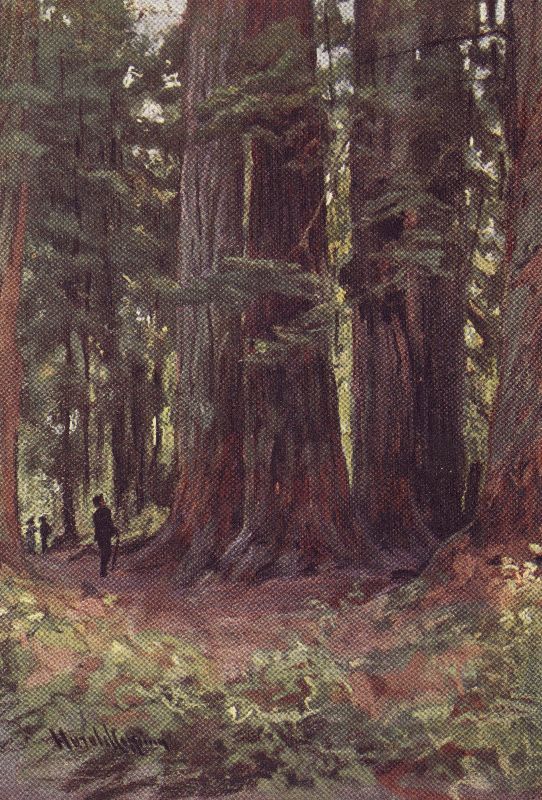
BIG TREES IN VANCOUVER, B.C.
Constantly in the hurrying waters of fairy rivers one sees the dismembered trunks of trees—some jolting onwards to be butchered into planks, the respited majority stranded on rocky islands or sandy shores. The trees of Canada are apt to excite one’s sympathy. You pass acre upon acre of mountain side that has been swept by prairie fires. They are a pathetic sight—those black, leafless forests of carbon. Some of the abbreviated trunks remain erect, some lean at perilous angles, some are prostrate. The ground is strewn with ashes and sorrow. In those regions of blackness and death, I saw no moving thing, save only, on occasion, a yellow flying grasshopper—a creature that flutters forward slowly, makes a grating noise. Conspicuous among plants that push their way through the desolate ashes is the great willow herb, commonly called the “fire rod.” Settlers tell you it appears only on land that has been swept by fire; but there is another justification for the very appropriate name. The spike of ruddy blossoms suggests flame, while the clouds of feathery seed resemble smoke.
The living forests are as inspiriting as the dead forests are depressing. Canada has vast tracts dense with majestic trees, which grow bolt upright to give one another room. In the island of Vancouver, that richly favoured region, I journeyed for hours, in the makeshift rolling stock of a mining railway, through an interminable paradise of lofty trees and lovely undergrowth. Sometimes we zig-zagged on a switchback track right up mountain sides; sometimes we crept cautiously along the edges of deep ravines. Away beyond the forest-wrapped island lay the Pacific Ocean—a broad stretch of soft blue.
Man looks a poor little thing in a forest. But, while incidentally unafraid of grizzly bears, he exercises over the trees a dominion as absolute as it is tyrannical. Far in the land of shadows and moss I came upon two specimens of my species—mere dots of creatures less than six feet high—who were assaulting a Douglas fir which, with a girth of three yards, rose to an altitude of over a hundred feet. This is what was happening: Standing on spring boards lodged in the trunk some four feet from the ground, they were working their saw towards a V-shaped cut previously chopped on the other side. I was encouraged by example to stand a few yards from the toilers, and facing the back of the saw. The tree, for all that it leaned slightly in our direction, was destined to fall—everybody was positive—on the other side.
A few years ago some men were felling a tall tree in a London suburb, and they worked for many hours with saws, axes and spades, likewise employing an elaborate tackle of ropes; but in the end that tree came down in an unintended direction, doing mischief to a cab horse. My brain was busy with this memory as, with head thrown back, I watched the top of the Douglas fir. It was at least some comfort to reflect that, if human judgment proved at fault, one would see the thing coming, and there should be time to dodge the danger. “She is moving,” someone said. I watched intently. Yes, she was—but how gently, slowly, and silently. No one spoke. Without a tremor, that one tufted tree top went on moving softly towards the other tufted tree tops that were motionless, and the direction of the fall was fulfilling prophecy. In the lapse of seconds, slowness became speed, and silence gave place to thunder. Creaking and groaning, the murdered monarch went crashing through the crowded company of his fellows, who seemed to yell with pain as their limbs were bruised and torn by the helpless falling form, which struck the ground with the report of cannon. Under the soles of my feet I felt the earth heave, and then came the gentle patter of a shower of branches.
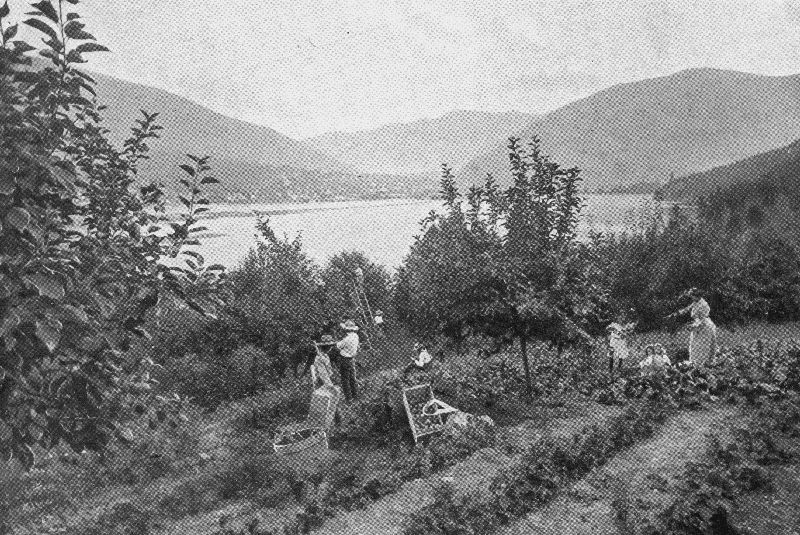
FRUIT-PICKING IN BRITISH COLUMBIA
Perspiration was streaming down the hairy chests of the woodmen. They told me why they waste so long a stump. The base of the tree is charged with resin, which proves an obstacle to the saw. They also told me that they can “throw” a tree in any direction with precision. Man’s mastery over these wooden giants is, indeed, complete. Elsewhere in the forest we saw a felled tree of formidable dimensions girt about with steel wire, which extended through the undergrowth to a raised platform beside a railway line. Presently from that platform there came the hullabaloo of escaping steam and revolving wheels, the steel wire tightened, and the huge bulk was hauled with contemptuous ease through the wilderness of ferns and shrubs. At an incline of stout logs some show of resistance was made, but the engine gave a vicious snort, and the poor old tree, jerked out of his momentary anchorage, was dragged without ceremony on to the platform. Anon we saw noble firs subjected to further indignities, they being either towed or shoved by a locomotive along a timbered track. Still later we beheld them drawn from the water into a saw-mill, whence they emerged as clean yellow planks, which were loaded into a steamer soon to depart for Liverpool.
There are growing communities of luxurious families who—in both senses of the phrase—live on fruit ranches in British Columbia. They dwell in paradise, and find it pays. But I have qualms about advertising their felicity. The existence seems to be altogether too restful and romantic to be deserved by mortal man. Instinctively I find myself recommending to my friends the prairie homestead rather than the British Columbia orchard.
Life on the plains is delightful enough in all conscience. It is good to wander in the sunny prairie, looking at the flowers, birds, and insects. Swallows and blackbirds occur in clouds. Pairs of milk-white doves float amorously by. There are rooks far in excess of the farmers’ wishes. You will occasionally see a robin that is larger and lankier than the English kind, suggesting a tiny eagle. In Eastern Canada I saw many sparrows, and Professor George Bryce, of Winnipeg College, told me these adventurous little immigrants have spread across the continent within his memory. They were introduced from England by ladies who, in 1880, made pets of them on Boston Common. Around Portage la Prairie I saw humming birds—sprightly scraps of gorgeousness. Prairie chickens and pin-tailed grouse are never far to seek. On almost every stretch of water you see cosy companies of wild duck among the lilies and rushes; while geese, swans, pelicans, herons and snipe may there be seen.
In sheltered places the little garter snake makes his home. When Winnipeg Penitentiary was being built, the workmen discovered thousands of these harmless reptiles in a neighbouring cave. Minks, weasels, squirrels, badgers and gophers are common enough. The gopher is a grey little creature something like a rat and more like a squirrel. He has the queerest way of squatting bolt upright upon his haunches, and staring defiance at passing carriages and trains. Often he holds a stalk of bearded grass in his mouth, and this gives him a comical whiskered appearance.
Frequently in the great grain district one sees the “French weed” (Thlaspi arvense), which seeds in silver discs. It is the farmer’s chief pest, being highly prolific and difficult to eradicate. In France, its native land, this innocent-looking member of the mustard family grows within decorous bounds, giving no trouble to agriculturists, so that French visitors to Canada resent the ill-will it there excites. The wild mustard, accidentally introduced in wheat imported years ago for cultivation, is another agricultural nuisance, though it works less havoc than the native thistle—a bright-hued offender. A while ago the Russian thistle filled farmers with fear, but stern measures were taken, and it has been exterminated. Many a flowery stretch of land owes part of its beauty to the wild oat, a frail, fluffy growth whose seed sails for miles at the impulse of the gentlest breeze.
I think Canada’s chief charm is her people, with their delightful freedom from snobbishness and their sense of the dignity of labour. Prime Ministers of Provinces give themselves no airs of superiority, and, so far as manner is concerned, there is nothing to distinguish a railway director from a railway porter. One class, however, does seem to occupy a position of some superiority. I refer to shoe-blacks. It is not in my heart to begrudge them their exaltation of spirit. They are artists. Canadians, not particularly concerned about dress in a general way, have agreed in attaching great importance to a well-polished boot. In the haphazard British Isles almost anyone is considered capable of applying blacking and brushes to footgear, but in Canada the operation ranks as an art, whose professors are understood to have been born with their special aptitude. Britishers on a first visit to the Dominion mechanically place their boots outside their bedroom doors on retiring for the night. How the bell boys smile! The desired end is not to be attained that way. In the morning you must go yourself, with your boots on your feet, to one of the palatial saloons where the art is practised. The result, attained by protracted and cunning exertions, is sure to surprise and please you. Nay, in the joy of finding your boots transformed to mirrors, it is likely you will not bewail the substantial fee demanded.
It is, by the way, a curious feature of the country that it dispenses with small payments. A box of matches, a newspaper, a tram ride—for each of these, five cents is the charge. A bronze coinage exists, but it can hardly be said to be used; indeed, in the west, shopkeepers refuse to accept it. The only thing you can buy for two cents, so far as my experience goes, is a postage stamp of that value. But note the happy significance of this disdain of coppers. Money is a utility constantly accessible to all classes in Canada, every form of manual and mental labour yielding in that country an easy margin beyond the living wage: wherein lies the difference between Great Britain on one side of the Atlantic and Greater Britain on the other—between the small country at the zenith of its development and the large country that offers ever-widening opportunities to industrious humanity.
Of what the Dominion is, and of what it will become, I have attempted to afford some glimpses in this book, which haply may assist in stimulating young Britons to cross the sea and enter into their inheritance. And with Canada’s expansion we may dream of the day when our Empire, grown strongest on the North-American continent, shall join with the sister democracy of the United States in leading the world to universal peace.