Chapter XIV · (continued 2)
Reading edition
Finding the way to the St. Lawrence barred by the old raiders' trail of Richelieu River, Hampton had struck across westward from Lake Champlain to join Wilkinson on the St. Lawrence, west of Montreal, somewhere near the road of Chateauguay River. With five thousand infantry and one hundred and eighty cavalry he has advanced to a ford beyond the fork of Chateauguay. Uncertain where the blow would be struck, Canada's governor had necessarily scattered his meager forces.
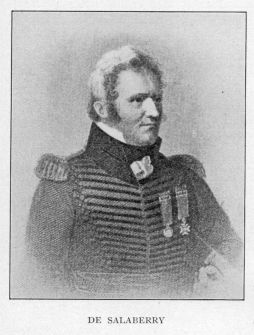
DE SALABERRY
To oppose advance by the Chateauguay he has sent a young Canadian officer, De Salaberry, with one hundred and fifty French Canadian sharp-shooters and one hundred Indians. De Salaberry does not court defeat by neglecting precautions because he is weak. Windfall is hurriedly thrown up as barricade along the trail. Where the path narrows between the river and the bleak forest, De Salaberry has tree trunks laid spike end towards the foe. At the last moment comes McDonnell of Brockville with six hundred men, but De Salaberry's three hundred occupy the front line facing the ford. McDonnell is farther along the river. By the night of October 25 the American army is close on the dauntless little band hidden in the forest. On the morning of the 26th three thousand Americans cross the south bank of the river, with the design of crossing north again farther down and swinging round on De Salaberry's rear. At the first shot of the bluecoats poor De Salaberry's forlorn little band broke in panic fright and fled, but De Salaberry on the river bank had grabbed his bugle boy by the scruff of the neck with a grip of iron, and in terms more forcible than polite bade him "sound—sound—sound the advance," till the forest was filled with flying echoes of bugle calls. McDonnell behind hears the challenge, and mistaking the cheering call for note of victory, bids his buglers blow, blow advance, blow and cheer like devils! The Americans pour shot into the forest. The bugle calls multiply till the woods seem filled with an advancing army and the yells split the sky. Also McDonnell has ordered his men to fire kneeling, so that few of the American shots take effect. The advancing host became demoralized. At 2.30 they sounded retreat, and it may truly be said that the battle of Chateauguay was won by De Salaberry's bugle boy, held to the sticking point, not because he was brave, but because he could not run away. It is said that Hampton simply would not believe the truth when told of the numbers by whom he had been defeated. It is also said that immediately after the victory De Salaberry fell ill from a bad attack of nerves, brought on by lack of sleep. However that may be, the Canadian governor, Prevost, did not suffer from an attack of conscience, for in his report to the English government he ascribed the victory to his own management and presence on the field.
The year of 1813 closes darkly for both sides. Before withdrawing from Niagara region the invaders ravage the country and set fire to the village of Newark, driving four hundred women and children roofless to December snows. Sir Gordon Drummond, who has just come to command in Ontario, retaliates swiftly and without mercy. He crosses the Niagara by night; the fort is carried at bayonet point, three hundred men captured and three thousand arms taken. Next, Lewiston is burned, then Black Rock, and on the last day of the year, Buffalo. Down on the Atlantic Coast both fleets win victories, but the English work the greater hurt, for they blockade the entire coast south of New York. On the English squadron are European mercenaries who have been given the name of Canadian battalions, because their work is to harry the American coast in order to draw off the American army from Canada. European mercenaries have been the same the world over,—riffraff blackguards, guilty of infamous outrages the moment they are out from under the officers' eye. These were the troops misnamed "Canadians," whose infamous conduct left a heritage of hate long after the war; but this is a story of the navy rather than of Canada.
The contest has now lasted for almost two years, and both sides are as far from decisive victory as when war was declared in June of 1812. Long since the embargo laws of France and England against neutral nations have been rescinded, and the American coast has suffered more from the blockade of this war than it ever did from the wars between France and England. The year 1814 opens with Napoleon defeated and England pouring aid across the Atlantic into Canada. Wilkinson's big army hovers inactive round Lake Champlain, and Prevost is afraid to weaken Montreal by forwarding aid to Drummond at Niagara. The British fleet blockades Sackett's Harbor, and the American fleet blockades Kingston. The Canadians raid Oswego on Lake Ontario for provisions. The Americans raid Port Dover on Lake Erie, leaving the country a blackened waste and Tom Talbot's Castle Malahide of logs a smoking ruin, with the determined aim of cutting off all supplies in Ontario. Drummond sends his troops scouring the country inland from Niagara for provisions. Military law is established for the seizure of cattle and grain, but for the latter as high a price is paid as $2.50 a bushel, and many a pioneer farmer back from York (Toronto) and Burlington (Hamilton) dates the foundation of his fortune from the famine prices paid for bread during the War of 1812.
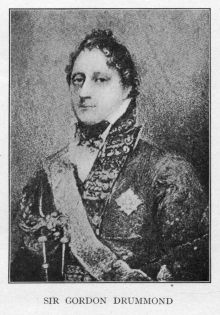
SIR GORDON DRUMMOND
Of course the United States did not purpose leaving the frontier of Niagara because Drummond had burnt the forts. By May, Major General Brown had taken command of the United States troops at Buffalo. The next two months pass, drilling and training, and bringing forward provisions. July 3, at day dawn, during fog thick as wool on the lake, five thousand American troops cross to the Canadian side. Fort Erie's English garrison capitulates on the spot, and the English retreat down Niagara River towards Chippewa by the Falls. At Chippewa, at Queenston, at Fort George, in all to guard the Canadian frontier are only some twenty-eight hundred men. Three fourths of these are kept doing garrison duty, leaving only seven hundred men free afield. Just beside Chippewa, a creek some twenty feet wide comes into Niagara River. The Canadians have destroyed the bridge as they retreat, but the Americans pursue, and at midnight of the 4th the two armies are facing each other across the brook, ominous dreadful silence through the darkness but for the sentry's arms or the lumbering advance of artillery wagons dragged cautiously near the Canadians. The bridge is repaired under peppering shot from the British. By four on the afternoon of the 5th, the Americans have crossed the stream. Their artillery is in place, and another battalion has forded higher up and swept round to take the Canadians on the flank. The Canadians must either flee in such blind panic as Procter displayed at Moraviantown, or turn and fight. Indians in ambush, reënforcements from Fort George and Queenston formed in three solid columns, the English wheel to face the foe. First there is the rattling clatter of musketry fire from shooters behind in the grass. Then the solid columns break from a march to a run, and charge with their bayonets. The artillery fire of the Americans meets the runners in a terrible death blast; but as the front lines drop, the men behind step in their places till the armies are not one hundred yards apart. Then another blast from the heavy guns of the Americans literally tears the Canadian columns to tatters. As the smoke lifts there are no columns left, only scattered groups of men retreating across a field strewn thick with the mangled dead. Out of twelve hundred men, the Canadians have lost five hundred. The charge of the forlorn twelve hundred at Chippewa against the artillery of four thousand Americans has been likened to the charge of the Light Brigade in the Russian War. Though the Canadians were defeated, their heroic defense had for a few days at least checked the advance of the invaders. And now the position of the beleaguered became desperate. At Fort George, at Queenston, and at Burlington Heights, the men were put on half rations.
Why did the Americans not advance at once against Queenston and Fort George? For three weeks they awaited Chauncey's fleet to attack from the water side, so the army could rush the fort from the land side; but Chauncey was ill and could not come, and the interval gave the hard-pressed Canadians their chance. Drummond comes from Kingston with four hundred fresh men; also he calls on the people to leave their farms and rally as volunteers to the last desperate fight. This increased his troops by another thousand, though many of the volunteers were mere boys, who scarcely knew how to hold a gun. Then, from a dozen signs, Drummond's practiced eye foresaw that a forward movement was being planned by the enemy without Chauncey's coöperation. All the American baggage was being ordered to rear. False attacks to draw off observation are made on Fort George outposts. American scouts are seen reconnoitering the Back Country. Drummond rightly guessed that the attack was being planned in one of two directions,—by rounding through the Back Country, either to fall in great numbers on Fort George, or to cut between the Canadian army of Hamilton region and of Niagara region, taking both battalions in the rear. From Fort George to Queenston Canadian troops are posted by Drummond, and where the road called Lundy's Lane runs from the Falls at right angles to the Back Country more battalions are ordered on guard against the advance of the invaders. Fitzgibbons, the famous scout, climbing to a tree on top of a high hill, sees the Americans, five thousand of them, gray coats, blue coats, white trousers, moving up from Chippewa towards Lundy's Lane. Quickly sixteen hundred Canadian troops under General Riall take possession of a hill fronting Lundy's Lane and the Falls. On the hill is a little brown church and an old-fashioned graveyard. In the midst of the graves the Canadian cannon are posted. Round the cemetery runs a stone wall screened by shrubbery, and on both sides of Lundy's Lane are endless orchards of cherry and peach and apples, the fruit just beginning to redden in the summer sun. Whether the enemy aim at Fort George or Hamilton, the Canadian position on Lundy's Lane must be passed and captured. As soon as Drummond had Fitzgibbons' report, he sent messengers galloping for Hercules Scott, who had been ordered to retreat to the lake, to come back to Lundy's Lane with his twelve hundred men. It may be imagined that the Americans guessed what message the horseman, in the slather of foam was bearing back to Hercules Scott; for they at once attacked the Canadians in Lundy's Lane with fury, to capture the guns on the hill before Hercules Scott's reënforcements could come.
It was now six o'clock in the evening of July 25, a sweltering hot night, and the troops on both sides were parched for water, though the roar of whole inland oceans of water could be heard pouring over the Falls of Niagara. As the Canadians had charged against the American guns at Chippewa, so now the Americans charged uphill against the guns of the Canadians, hurling their full strength against the enemy's center. Creeping under shelter of the cemetery stone walls, the bluecoats would fire a volley of musketry, jump over the fence, dash through the smoke, bayonet in hand, to capture the Canadian guns. Time, time again, the rush was dauntlessly made, and time, time again met by the withering blast. Before nine o'clock the attacking lines had lost more than five hundred men, and as many Canadians had fallen on the hill. The dead and mangled lay literally in heaps. As darkness deepened, lit only by the wan light of a fitful moon and the awesome flare of volley after volley, the fearful screams of the dying could be heard above the roar of the Falls and the whistle of cannon ball. Riall, the commander of the Canadians, had been wounded and captured. Of his sixteen hundred Canadians, Drummond had now left only one thousand, and he was himself bleeding from a deep wound in the neck. Half the American officers had been carried from the field injured, and still the command was repeated to rush the hill before Scott's reënforcements came, and each time the advancing line was driven back shattered and thinned, Canadians dashing in pursuit, cheering and whooping, till both armies were so inextricably mixed it was impossible to hear or heed commands. It was in one of these mêlées that Riall, the Canadian, found himself among the American lines and was captured to the wild and jubilant shouting of the boys in blue and gray. Pause fell at nine o'clock. The Americans were mustering for the final terrible rush. The moon had gone behind a cloud, and the darkness was inky. Then a shout from the Canadian side split the very welkin. Hercules Scott had arrived with his twelve hundred men on a run, breathless and tired from a march and countermarch of twenty miles. The Americans took up the yell; for fresh reserves had joined them, too, and Lundy's Lane became a bedlam of ear-shattering sounds,—heavy artillery wagons forcing up the hill at a gallop over dead and dying, bombs from the Canadian guns exploding in the darkness, horses taking fright and bolting from their riders, carrying American guns clear across the lines among the Canadians. A wild yell of triumph told that the Americans had captured the hill. For the next two hours it was a hand-to-hand fight in pitchy darkness. Drummond, the Englishman, could be heard right in the midst of the American lines, shouting, "Stick to them, men! stick to them! Don't give up! Don't turn! Stick to them! You 'll have it!" And American officers were found amidst Canadian battalions, shouting stentorian command: "Level low! Fire at their flashes! Watch the flash, and fire at their flashes!"
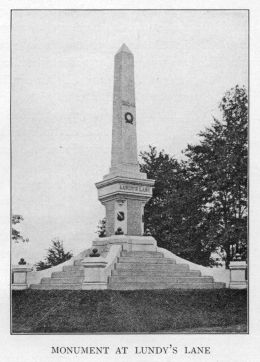
MONUMENT AT LUNDY'S LANE
The Americans have captured the Canadian guns, but in the darkness they cannot carry them off. Each side thinks the other beaten, and neither will retreat. In the confusion it is impossible to rally the battalions, and men are attacking their own side by mistake. Both sides claim victory, and each is afraid to await what daylight may reveal; for it is no exaggeration to say that at the battle of Lundy's Lane the blood of one third of each side dyed the field. The Canadians as defenders of their own homes, fighting in the last ditch, dare not retire. The Americans, having more to risk in numbers, withdraw their troops at two in the morning. Of her twenty-eight hundred men Canada had lost nine hundred; and the American loss is as great. Too exhausted to retire, Drummond's men flung themselves on the ground and slept lying among the dead, heedless alike of the drenching rain that follows artillery fire, of the roaring cataract, of the groans from the wounded. Men awakened in the gray dawn to find themselves unrecognizable from blood and powder smoke, to find, in some cases, that the comrade whose coat they had shared as pillow lay cold in death by morning. While Drummond's men bury the dead in heaps and carry the wounded to Toronto, the invaders have retreated with their wounded to Fort Erie.
It now became the dauntless Drummond's aim to expel the enemy from Fort Erie. Five days after the battle of Lundy's Lane he had moved his camp halfway between Chippewa and Fort Erie; but in addition to its garrison of two thousand, Fort Erie is guarded by three armed schooners lying at anchor on the lake front. Captain Dobbs of Drummond's forces makes the first move. At the head of seventy-five men, he deploys far to the rear of the fort through the woods, carrying five flatboats over the forest trail eight miles, and on the night of the 12th of August slips out through the water mist towards the American schooners.
"Who goes?" challenges the ships' watchman.
"Provision boats from Buffalo," calls back the Canadian oarsman; and the rowboats pass round within the shadow of the schooner. A moment later the American ships are boarded. A trampling on deck calls the sailors aloft; but Dobbs has mastered two vessels before the fort wakes to life with a rush to the rescue.
Delay means almost inevitable loss to Drummond; for Prevost will send no more reënforcements, and the Americans are daily strengthening Fort Erie. Bastions of stone have been built. Outer batteries command approach to the walls, and along the narrow margin between the fort and the lake earthworks have been thrown up, mounted with cannon elbowing to the water's edge. Taking advantage of the elation over Dobbs' raid on the schooners, Drummond plans a night assault on the 15th of August. Rain had been falling in splashes all day. The fort trenches were swimming like rivers, and it may be mentioned that Drummond's camp was swimming too, boding ill for his men's health. One of the foreign regiments was to lead the assault round by the lake side, while Drummond and his nephew rushed the bastions. It will be remembered these foreign regiments of Napoleonic wars were composed of the offscourings of Europe. The fighters were to depend "on bayonet alone, giving no quarter." Splashing along the rain-soaked road in silence and darkness, scaling ladders over shoulders, bayonets in hand, the foreign troops came to the earthwork elbowing out into the lake. This was passed by the men wading out in the lake to their chins; but the noise was overheard by the fort sentry, and a perfect blaze of musketry shattered the darkness and drove the mercenaries back pellmell, bellowing with terror. A few of the English and Canadian troops pressed forward, only to find that they could not reach within ladder distance of the walls at all, for spiked trees had been placed above the trenches in a perfect crisscross hurdle of sharpened ends. In old letters of the period one reads how the trenches were literally heaped with a jumbled mass of the dead. The other attacking columns fared almost as badly. One of the bastions had been entered by the cannon embrasures, Drummond, Junior, shouting to "give no quarter—give no quarter," when, from the cross firing in the courtyards, the powder magazine below this bastion was set on fire, and exploded with a terrific crash, killing the assailants almost to a man. In all,—killed, wounded, missing,—the assault cost Drummond's army nine hundred men. September proved a rainy month. Drummond's camp became almost a marsh, and the health of the troops compelled a move to higher ground. It was then the Americans sallied out in assault. Neither side could claim victory, but the skirmish cost each army more than five hundred men. Sir James Yeo now comes sailing up Lake Ontario with some of the sixteen thousand troops sent from England. The weather became unfavorable to movement on either side,—rain and sleet continuously. Drummond foresaw that the season would compel the abandonment of Fort Erie, and on November 5, a scout came in with word that the invaders had crossed to the American side and Fort Erie had been blown up.
While Drummond is fighting for the very life of Canada along the Niagara frontier, the war continues in desultory fashion elsewhere. Kentucky riflemen raid western Ontario from Detroit to Port Dover. Up on the lakes is a story of the war that reads like a page from border raiders. American fur traders destroy Sault Ste. Marie. Canadian fur traders retaliate by swooping on Mississippi fur posts. Out on the Pacific Coast an English gunboat has captured John Jacob Astor's fur post on the Columbia; and now in the fall of 1814 the Northwest Fur Company of Montreal are conveying from Astor's fort the furs, worth millions of dollars, in canoes across the Upper Lakes to Ottawa River. Two armed American schooners, hiding on the north shore of Lake Huron, lie in wait for the gay raiders of the Northwest Company; but at the Sault the Nor'west voyageurs get wind of the danger. They, in turn, hide their canoes in some of the blue coves of the north shore. Then, stealing out at night, in canoes with muffled paddles, the Nor'westers come on one schooner while the watch is asleep. They board her, bayonet the crew, "pinion some of the wounded to the decks," and with the captured vessel sidle up to the other vessel, and, before she is aware of the new masters on board, have captured her too. Then, scalps flaunting at the prows of their canoes, the Nor'west fur traders gayly go their way. Down at Lake Champlain occurs the great fiasco of the war,—the blot on Canada's escutcheon. Prevost with ten thousand reënforcements has been ordered by the English Governor to proceed from Montreal against the Americans by both water and land. While an English fleet attacks the Americans, Prevost is to lead the troops against Plattsburg. But the Canadian fleet meets terrible disaster. The commander is killed by a rebounding cannon ball just as the action begins; and twelve of the gunboats manned by the hired foreigners desert en masse. The rest of the fleet is literally destroyed. Instead of seconding attack by a battle on land, Prevost sits behind his trenches waiting for the little fleet to win the battle for him; and when the fleet is defeated, Prevost's courage sinks with the sinking ships. He gathers up his troops and retreats in a scare of haste,—such a fright of unseemly, unsoldierly haste that nearly one thousand of his soldiers desert in sheer disgust. Down at Nova Scotia are raid and counter-raid too. The British and American fleets wage fierce war that is not part of Canada's story; but in the contest the public buildings of Washington are burned in retaliation for the burning of Newark; and down at New Orleans the English suffer a crushing defeat.
Meanwhile the peace commissioners have been at work; and the war that ought never to have taken place, that settled not one jot of the dispute which caused it, was closed by the Treaty of Ghent, Christmas Eve of 1814. All captured forts, all plunder, all prisoners, are to be restored. Michilimackinac and Fort Niagara and Astoria on the Columbia go back to the United States; but of "impressment" and "right of search" and "embargo of neutrals" not a word. The waste of life and happiness accomplished not a feather's weight unless it were the lesson of the criminal folly of a war between nations akin in aim and speech and blood.