Chapter XXV · OFFICIAL STATIONERY
Reading edition
Outside of the Dead Letter Office seals the Canadian Government has issued no official adhesive stamps. An attempt, however, to foist a series of official stationery upon an unsuspecting philatelic public was made by one Henry Hechler, a stamp collector and dealer, who thought he saw his opportunity in the Indian troubles which broke out in the Canadian Northwest in 1884-5. Mr. Hechler belonged to the Militia and accompanied the troops that were sent to quell the disturbance. He took it upon himself to have a quantity of envelopes, post cards and wrappers surcharged OFFICIAL or SERVICE and evidently expected they would be accepted without question.
The first news of these surcharges seems to have come, very strangely, from Germany. The Philatelic Record for December, 1884,[241] says:—
Der Philatelist chronicles, on the faith of a correspondent, Herr Von Jerzabek, of Temesvar, a set of the adhesives with Queen's head ..., two envelopes, and the 1 cent post card, all surcharged in black, with the word OFFICIAL. It is alleged that they were prepared and issued in 1877, but after a short time were called in again. The surcharges are in some cases oblique, and in others perpendicular. It is at least strange that, considering our intercourse with Canada, our first knowledge of the issue of official stamps so far back as 1877 should reach us from Temesvar, wherever that may be.
The Secretary of the Philatelic Society, London, whose official journal the Philatelic Record then was, wrote direct to the Canadian Government to inquire into the authenticity of these so-called official issues, and received the following reply:[242]—
POST OFFICE DEPARTMENT, CANADA.
OTTAWA, 18th May, 1885.
Sir:—I am directed by the Postmaster-General to acknowledge receipt of your letter of the 29th ult., inquiring whether postage stamps bearing the word "Official" on their face are in circulation in the Dominion of Canada, and beg, in reply, to say that no such stamp, card, newspaper wrapper, or envelope has ever been issued by this department.
I am, sir, your obedient servant, (Signed) Wm. White, Secretary.
This would ordinarily seem to have been enough of a disclaimer, but like Banquo's ghost the official stationery would not down, though the stamps seem to have been lost sight of. Not only were the envelopes of 1 cent and 3 cents of the 1877 issue, but the newspaper wrappers of 1875 and 1882, and the post card of 1882, surcharged across the stamp with the word "OFFICIAL" or "Service" in black, blue or red ink, but sometimes the arms of Great Britain were added at the left of the stamp, and also, in the lower left corner, the words
"63RD. RIFLES" or HEADQUARTERS, 63RD. RIFLES. }
The lack of uniformity, or rather attempt at variety, was enough in itself to condemn the articles. Yet in the American Philatelist for June, 1888, we find an attempted defence of them. We quote:[243]—
Henry Hechler writes us as follows: "When the Indian outbreak in the Northwest occurred in 1885, and some of the militia of the various provinces were hurriedly ordered out for active service, stringent measures for notifying the men calling for prompt attention had to be adopted. To distinguish them from ordinary mail matter by showing their official character they were stamped across the "adhesive" with the word Service and at the lower left corner O. [H.] M. S. only. Some were thus printed in black, others in blue, and yet others in red. They served for that purpose only, until an Act of Parliament was passed to carry all military mail matter on active service free."
Mr. Hechler was captain of one of the companies of the Halifax Battalion, and, therefore, in a position to obtain definite information.
In other words Mr. Hechler knew all about these "official" stamps and the Postmaster-General and his secretary, as we have seen, knew absolutely nothing about them! This seems to tell its own story. In fact another letter from the Post Office Department, dated 13th April, 1888, and published in this same volume of the American Philatelist,[244] reiterates the denials of the previous letter which we have already quoted. The Philatelic Record received later,[245] from the Postmaster of Halifax, the information that Mr. Hechler had had this stationery surcharged and that it was neither issued nor recognized by the Government of Canada. The Record says:—"It was a smart notion of Mr. Hechler to turn his military duties into the direction of his business as a stamp dealer." Mr. Hechler "came back" at this in the columns of the Philatelic Journal of America[246] with the statement that "the Post Office Inspector here referred the question to headquarters, and, in reply, was instructed to allow such matter to pass through the mails without question or delay." The communication was enclosed in one of the envelopes in question, but the Editor's remarks on this are conclusive:—
The surcharging has not impaired the postal value of the envelope and they are permitted to pass through the Canadian mails, but as to their value from a philatelic standpoint it is quite another thing.
The printing in this case is of no more importance than any notice or inscription that might be placed on an envelope bearing a regular government stamp that in itself is sufficient to pay the postage.
In fact the above writer admits that the surcharge had no other value than to enable the recipient to distinguish the letter from his other mail. They are of no philatelic value whatever.
It was a private speculation, pure and simple, in spite of any claims of "recognition", and of the fact that copies passed the post. The only other quotation to make in the case is from Shakespeare—Exeunt.
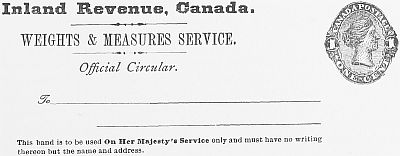
We now come to an actual official issue in the shape of a newspaper wrapper. It seems to have been first noted in Le Timbre-Poste for February, 1883, but is stated to have been issued in 1879. The stamp is of the 1875 issue (type 1) and at its left is printed in blue the following:—
[Link to text version of figure.]
Above the English inscription is its counterpart in French. The wrapper itself is of a cream tone and measures 280 × 132 mm.
The history of this wrapper does not seem to be known, save that it is accredited to be what it purports to be. It is quite rare, and as far as we have been able to find out is not known used. No mention is made of it in the Department reports, but it happens that the stamp accounts for 1879, the year of its supposed issue, give only 8,000 wrappers as received from the manufacturers. None had been received the two years previously, as there were plenty on hand, and 192,000 were received the next year. It would thus appear, on the face of it, that this small lot of 8,000 was quite probably the order of the Inland Revenue wrappers. If so, it was probably the only lot ever received and though they may have been used, the chances seem somewhat against any such number having actually been issued.
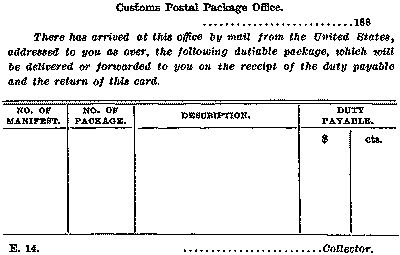
One other official issue comes in the form of a Customs' post card notice. It was first chronicled in the American Philatelist for 10th May, 1888, as having been issued in connection with the parcel post system just then inaugurated with the United States. Postmasters received instructions to forward these cards free through the mails, although there was no stamp or notice on the address side. It is of manila card, 130 × 88 mm., blank on one side and having printed on the other:—
[Link to text version of figure.]
In its September, 1888, number the Halifax Philatelist notes that the blank address side has been supplied with three dotted lines for the address, and inscriptions reading, in the upper left corner, "Advice Note", and in the upper right corner, "Free, by order of the Post Master General."
One further official variety is somewhat unusual. The American Philatelist for September, 1889,[247] says:—
"We are indebted to Donald A. King ... for information concerning what is certainly a novelty in the postal line, namely, an unpaid letter stamped envelope. When a letter is returned from the dead-letter office the sender is required to pay the regular postage and these envelopes have been prepared of various values. The only one we have seen is the 3 cent value. It is about 175 × 120 mm., and is made of manila paper. In the place for the stamp is a figure 3 about 23 mm. high. In the left hand upper corner RETURNED DEAD LETTER; in the lower corner—
POST OFFICE DEPARTMENT, CANADA, DEAD LETTER OFFICE.
On the reverse, The enclosed Dead Letter is returned by order of the Postmaster-General for the reasons thereon assigned. The following values are said to exist:
3cents, black onmanila.
6cents, black on?
9cents, black on?
12cents, black on?
18cents, black on?
We have no further information concerning them.
[Text alternative to illustration on page 269.]
Inland Revenue, Canada. WEIGHTS & MEASURES SERVICE. Official Circular. To This band is to be used On Her Majesty's Service only and must have no writing thereon but the name and address.
[Text alternative to illustration on page 270.]
Customs Postal Package Office.
...........................188
There has arrived at this office by mail from the United States, addressed to you as over, the following dutiable package, which will be delivered or forwarded to you on the receipt of the duty payable and the return of this card.
NO. OF MANIFEST. NO. OF PACKAGE. DESCRIPTION. DUTY PAYABLE.
$ cts.
E. 14.
................Collector.