Page 137 BOOK VI.
Reading edition
STEEL TRAPS AND THE ART OF TRAPPING.
assing from our full and extended illustrated list of extempore, or "rough and ready" examples of the trap kind, we will now turn our attention to the consideration of that well-known implement, the trade steel trap. Although the foregoing varieties often serve to good purpose, the Steel Trap is the principal device used by professional trappers, and possesses great advantages over all other traps. It is portable, sets easily and quickly, either on land or beneath the water; can be concealed with ease; secures its victims without injury to their fur, and by the application of the spring or sliding pole (hereafter described) will most effectually prevent the captive from making his escape by self-amputation, besides placing him beyond the reach of destruction by other animals.
The author has known trappers who have plied their vocation largely by the aid of the various hand made traps, described in the earlier pages of this book, and with good success. But in the regular business of systematic trapping, their extensive use is not common. The experience of modern trappers generally, warrants the assertion that for practical utility, from every point of view, the steel trap stands unrivalled.
These traps are made of all sizes, from that suitable for the capture of the house rat, to the immense and wieldy machine adapted to the grizzly, and known as the "bear tamer."
They may be bought at almost any hardware shop, although a large portion of the traps ordinarily sold are defective. They should be selected with care, and the springs always tested Page 138 before purchase. Besides the temper of the spring, there are also other necessary qualities in a steel trap, which we subjoin in order that the amateur may know how to judge and select his weapons judiciously.
REQUISITES OF A GOOD STEEL TRAP.
1. The jaws should not be too thin nor sharp cornered. In the cheaper class of steel traps the jaws approach to the thinness of sheet-iron, and the result is that the thin edges often sever the leg of their would-be captive in a single stroke. At other times the leg is so deeply cut as to easily enable the animal to gnaw or twist it off. This is the common mode of escape, with many animals.
2. The pan should not be too large. This is a very common fault with many steel traps and often defeats its very object. Where the pan is small, the foot of the animal in pressing it, will be directly in the centre of the snap of the jaw, and he is thus firmly secured far up on the leg. On the other hand, a large pan nearly filling the space between the jaws as the trap is set, may be sprung by a touch on its extreme edge, and the animal's toe is thus likely to get slightly pinched, if indeed the paw is not thrown off altogether by the forcible snap of the jaw.
3. The springs should be strong, scientifically tempered, and proportioned. The strength of a perfectly tempered spring will always remain the same, whether in winter or summer, never losing its elasticity. The best of tempering, however, is useless in a spring badly formed or clumsily tapered.
4. The jaws should be so curved as to give the bow of the spring a proper sweep to work upon. The jaws should lie flat when open, and should always work easily on their hinges.
5. Every trap should be furnished with a strong chain with ring and swivel attached, and in every case the swivel should turn easily.
The celebrated "Newhouse Trap" embodies all the above requisites, and has deservedly won a reputation for excellence second to no other in this or any other country.
They are made in eight sizes, as follows:
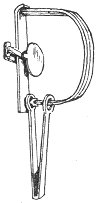
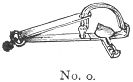
This is the smallest size and is known as the RAT TRAP. It has a single spring, and the jaws spread three and a half inches when set.
Page 139
Page 141 This size is called the MUSKRAT TRAP, and the jaws spread four inches. It is especially designed for the capture of the mink, marten, and animals of similar size.
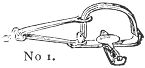
This is known in the trade as the MINK TRAP, and the jaws spread nearly five inches. It is adapted for the fox, raccoon, or fisher.
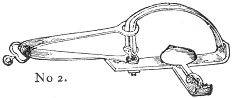
This size is called the FOX TRAP. The spread of the jaws is the same as in the foregoing, but the trap is provided with two springs, and consequently has double the power. It is strong enough for the otter, and is generally used for the capture of the fox and fisher.
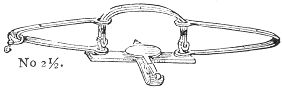
No.3 goes by the name of the OTTER TRAP. The jaws spread five and a half inches, and the powerful double springs do excellent service in the capture of the beaver, fox, badger, opossum, wild cat, and animals of like size.
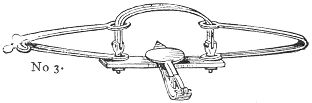
Commonly called the BEAVER TRAP. Jaws spread six and a half inches. This size is especially adapted to the wolf, lynx or wolverine. It may also be set for deer, and extra sets of jaws are made expressly for this purpose, being easily inserted in the place of the ordinary jaws, when desired.
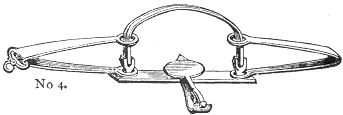
Page 142 This is known as the "GREAT BEAR TAMER," and is a most formidable weapon. The jaws spread sixteen inches, and the weight of the machine is forty-two pounds. It is extensively used in the capture of the moose and grizzly bear, and is the largest and most powerful steel trap made in this or any other country. The springs possess most tremendous power, and require to be set by a lever, as the weight of an ordinary man has not the slightest effect upon them. This lever may be easily applied, as follows: Have at hand four stout straps, supplied with buckles. These should always be carried by the trapper, where the larger double-spring traps are used. To adjust the lever, cut four heavy sticks about three feet long. Take two of them and secure their ends together, side by side, with one of the straps. Now insert the spring of the trap between them, near the strap. Bear down heavily on the other extremity of the lever, and the spring will be found to yield easily, after which the remaining ends of the levers should be secured by a second strap. The other spring should now be treated in the same way, after which the jaws should be spread and the pan adjusted. The removal of the straps and Page 143 levers is now an easy matter, after which the trap is set. The stoutest spring is easily made to yield by such treatment.
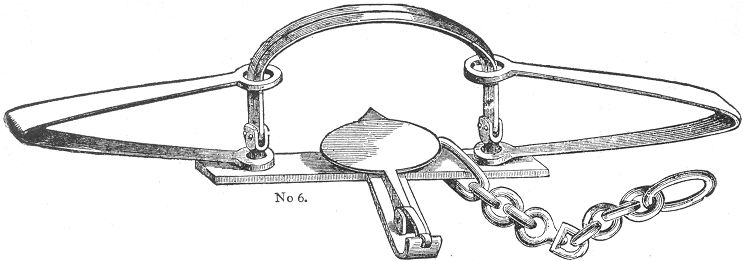
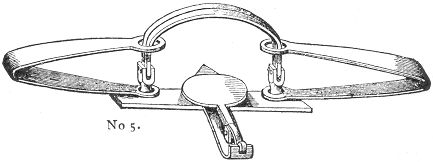
The SMALL BEAR TRAP. The jaws of this size spread nearly a foot, and the weight of the trap is seventeen pounds. It is used in the capture of the black bear, puma, and animals of similar size.
All of the foregoing are supplied with swivels and chains.
HINTS ON BAITING THE STEEL TRAP.
There is a very common and erroneous idea current among amateur sportsmen and others in regard to the baiting of the steel trap; viz., that the pan of the trap is intended for the bait. This was the old custom in the traps of bygone times, but no modern trap is intended to be so misused, and would indeed often defeat its object in such a case, wherein it will be easily Page 144 seen. The object of the professional trapper is the acquisition of furs; and a prime fur skin should be without break or bruise, from nose to tail. A trap set as above described, would of course catch its victim by the head or neck, and the fur would be more or less injured at the very spot where it should be particularly free from blemish.
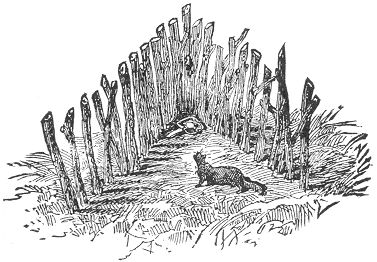
The true object of the steel trap is, that it shall take the animal by the leg, thus injuring the skin only in a part where it is totally valueless.
We give, then, this imperative rule—Never bait a steel trap on the pan.
The pan is intended for the foot of the game, and in order to insure capture by this means, the bait should be so placed as that the attention of the animal will be drawn away from the trap; the latter being in such a position as will cause the victim to step in it when reaching for the tempting allurement.
There are several ways of doing this, one of which we here illustrate.
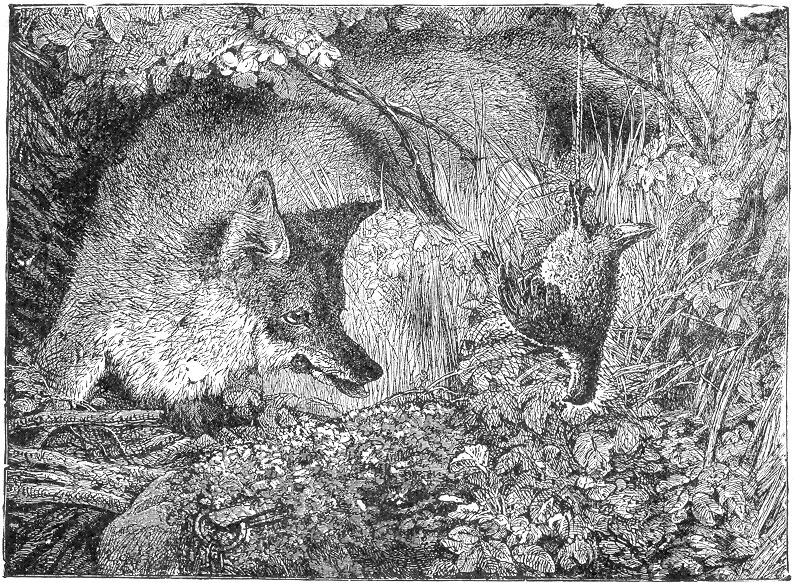
A pen of stakes, in the shape of the letter V, is first constructed. The trap is then set in the angle, and the bait attached to the end stake directly over it. Another method is shown in the picture on our title-page to this section, the bait being suspended on a stick above the trap. There are various other methods on the same principle, which will be described hereafter, under the titles of the various game.
THE SPRING POLE.
This is nearly always used in connection with the steel trap, in the capture of the smaller land animals. It not only lifts the creature into the air, and thus prevents its becoming a prey to other animals, but it also guards against the escape of the victim by the amputation of its own leg. This is a very common mode of release with many kinds of game—notably the mink, marten, and muskrat; and for the successful trapping of these, as well as many other animals, the spring and sliding pole are absolute necessities. It is a simple contrivance, consisting merely of a pole inserted in the ground near the trap. The pole is then bent down, and the trap chain secured to its end. A small, notched peg is next driven into the ground and the top of the pole caught in it, and thus held in a bent position. When the animal is caught, its struggles release the pole, and the latter, flying up with a jerk, Page 145 lifts the trap and its occupant high in the air, out of the reach of marauders, and beyond the power of escape by self-amputation. Even in the capture of large game the spring pole often serves to good purpose. The struggles of a heavy animal are often so violent as to break a stout trap or chain; and the force of the spring pole, although not sufficient to raise the animal from its feet, often succeeds in easing the strain, and often thus saves a trap from being broken to pieces. The power of the pole must of course be proportionate to the weight of the desired game.
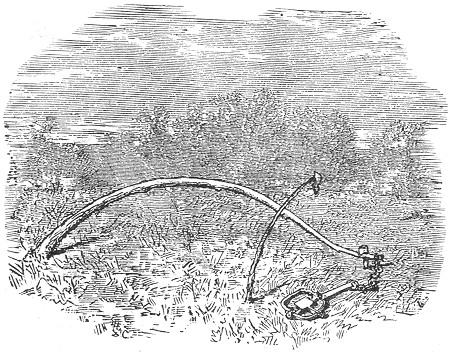
THE SLIDING POLE.
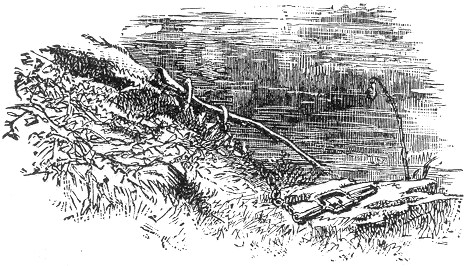
The first impulse with almost every aquatic animal when caught in a trap, is to plunge headlong into deep water. With the smaller animals, such as the mink and muskrat, this is all that is desired by the trapper, as the weight of the trap with the chain is sufficient to drown its victim. But with larger animals, the beaver and otter for instance, an additional precaution, in the shape of the "sliding pole," is necessary. This consists of a pole about ten feet long, smoothly trimmed of its branches, excepting at the tip, where a few stubs should be left. Insert this end obliquely into the bed of the stream, where the water is Page 146 deep, and secure the large end to the bank by means of a hooked stick, as seen in our illustration. The ring of the chain should be large enough to slide easily down the entire length of the pole. When the trap is set, the ring should be slipped on the large end of the pole, and held in place by resting a stick against it. The animal, when caught, plunges off into deep water, and guided by the pole, is led to the bottom of the river. The ring slides down to the bed of the stream, and there holds its victim until drowned.
THE CLOG.
A trap which is set for heavy game should never be secured to a stake. Many of the larger and more powerful animals when caught in a trap thus secured, are apt either to pull or twist their legs off, or break both trap and chain to pieces. To guard against this, the chain should be weighted with a pole or small log, of a size proportionate to the dimensions of the game, its weight being merely sufficient to offer a serious incumbrance to the animal, without positively checking its movements. This impediment is called the "clog," and is usually attached to the ring of the trap chain by its larger end, the ring being slipped over the latter, and secured in place by a wedge. A look at our frontispiece will give a clear idea of both clog and attachment.
Page 147 THE GRAPPLING IRON.
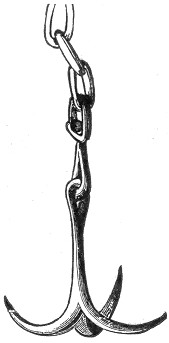
This answers the same purpose as the above, and is often used instead. It is manufactured in connection with the larger steel traps, and is attached to the chain by a swivel joint. Its general shape is shown in an engraving, and it offers a serious resistance to the victim, who endeavors to run away with it.
THE SEASON FOR TRAPPING.
The business of trapping for profit must be confined to the season between the first of October and the beginning of May, as furs of all kinds are worthless when taken during the other months of the year. The reason for this is obvious. A "prime fur" must be "thick" and "full," and as all our fur-bearing animals shed their heavy winter coats as warm weather approaches, it necessarily follows that the capture at this season would be unprofitable. As the autumn approaches the new growth appears, and the fur becomes thick and glossy. By the middle of October most furs are in their prime, but the heart of winter is the best time for general trapping. The furs of the Page 148 mink, muskrat, fisher, marten and beaver are not in their perfect prime until this season. And all other furs are sure to be in good condition at this time.
THE ART OF TRAPPING.
From time immemorial, and in every nation of the world, the art of trapping has been more or less practised. By some as a means of supplying their wants in the shape of daily food, and by others for the purpose of merchandise or profit.
To be a clever and successful trapper, much more is required than is generally supposed. The mere fact of a person's being able to set a trap cleverly and judiciously forms but a small part of his proficiency; and unless he enters deeper into the subject and learns something of the nature and habits of the animals he intends to catch, his traps will be set in vain, or at best meet with but indifferent success. The study of natural history here becomes a matter of necessity as well as pleasure and profit. And unless the trapper thoroughly acquaints himself with the habits of his various game, the sagacity and cunning of his intended victim will often outwit his most shrewd endeavors, much to his chagrin. The sense of smell, so largely developed in many animals, becomes one of the trappers most serious obstacles, and seems at times to amount almost to positive reason, so perfectly do the creatures baffle the most ingenious attempts of man in his efforts to capture them. A little insight into the ways of these artful animals, however, and a little experience with their odd tricks soon enables one to cope with them successfully and overcome their whims. For the benefit of the amateur who has not had the opportunity of studying for himself, the peculiarities of the various game, the author appends a comprehensive chapter on "Practical Natural History," in which will be found full accounts of the peculiar habits and leading characteristics of all the various animals commonly sought by the trapper, together with detailed directions for trapping each variety, supplemented with a faithful portrait of the animal in nearly every instance. A careful reading of the above mentioned chapter will do much towards acquainting the novice with the ways of the sly creatures, which he hopes to victimize, and will thus prepare him to contend with them successfully.
In the art of trapping the bait is often entirely dispensed with, the traps being set and carefully concealed in the runways of the various animals. These by-paths are easily detected by an Page 149 experienced trapper, and are indicated either by footprints or other evidences of the animal, together with the matted leaves and broken twigs and grasses.
Natural channels, such as hollow logs or crevices between rocks or fallen trees, offer excellent situations for steel traps, and a good trapper is always on the qui vive for such chance advantages, thus often saving much of the time and labor which would otherwise be spent in the building of artificial enclosures, etc.
The most effective baits used in the art of trapping are those which are used to attract the animal through its sense of smell, as distinct from that of its mere appetite for food. These baits are known in the profession as "medicine," or scent baits and possess the most remarkable power of attracting the various animals from great distances, and leading them almost irresistibly to any desired spot. Such is the barks tone or castoreum, of such value in the capture of the beaver, and the oil of anise, so commonly used for the trapping of animals in general. These various substances will presently be considered under their proper heading.
Many detailed and specific directions on the subject of trapping will be found in the long chapter following; and, in closing our preliminary remarks, we would add just one more word of general caution, which the young trapper should always bear in mind.
In all cases avoid handling the trap with the bare hand. Many an amateur has set and reset his traps in vain, and retired from the field of trapping in disgust, from the mere want of observing this rule. Animals of keen scent are quick in detecting the slightest odors, and that left by the touch of a human hand often suffices to drive the creature away from a trap which, under other circumstances, would have been its certain destruction. To be sure the various scent baits already alluded to, will in a measure overcome human traces, but not always effectually, and in order to insure success no precautions so simple should be neglected. A pair of clean buckskin gloves are valuable requisites to the trapper, and should always be "on hand" when setting or transporting traps.
"MEDICINES," OR SCENT BAITS.
These form one of the most important requisites of the trapper's art. A trap baited simply with the food of the Page 150 required animal, may and often will be successful, but with the addition of the trapper's "medicine" judicially applied, success is almost a certainty. These scent baits are of various kinds, some being almost universal in their usefulness, while others are attractive only to some particular species of animal. We give a few of the recipes of the most valued preparations used by trappers throughout the land. The application and use of each is fully described in its proper place hereafter.
CASTOREUM.
This substance, commonly known as "Barkstone," by trappers and fur dealers, is obtained from the beaver, and is a remarkable aid in the capture of that animal. It is an acrid secretion of a powerful musky odor, found in two glands beneath the root of the tail of the beaver. These glands are about two inches in length. They are cut out and the contents are squeezed into a small bottle. When fresh the substance is of a yellowish-red color, changing to a light-brown when dried. Both male and female animals yield the castoreum, but that of the male is generally considered the best. Castoreum is a commercial drug, and in many beaver countries it is quite an article of trade. There are other sacs lying directly behind the castor glands which contain a strong oil of rancid smell. This should not be confounded with the Castoreum.
CASTOREUM COMPOSITION.
The Barkstone is used both pure and in combination with other substances, the following prescription being much used: Into the contents of about ten of the castor bags, mix two ground nutmegs, thirty or forty cloves, also powdered, one drop essence of peppermint, and about two thimblefuls of ground cinnamon. Into this stir as much whisky as will give the whole the consistency of paste, after which the preparation should be bottled and kept carefully corked. At the expiration of a few days the odor increases ten-fold in power and is ready for use. A bottle, if thus prepared, will retain its strength for nearly a half year, provided it is kept closely corked. A few drops of either the pure castoreum or the combination spread upon the bait or in the neighborhood of the trap, as described under the chapter on the Beaver, will entice that animal from a great distance.
Page 151 MUSK.
This substance is a secretion obtained from several different animals, notably the otter and muskrat. The glands which contain it are located similarly to the castor glands of the beaver, and the musk should be discharged into a vial, as previously described. The musk of the female muskrat is said to be the most powerful, and is chiefly used by trappers in the capture of that animal, the otter being chiefly attracted by its own musk.
ASSAFŒTIDA.
This foul smelling production seems to have a specially attractive fragrance to many animals, and for general use is much esteemed by trappers. It is a vegetable drug from Persia and the East Indies, and is imported in the form of concrete juice, of a brown color.
OIL OF RHODIUM.
This is a vegetable oil obtained from a species of rose, and is quite costly. Its power of attracting animals is surprising, and it is in very common use among trappers.
FISH OIL.
This is especially useful in the capture of the majority of the fur tribe, and particularly the water animals.
The oil may be bought ready for use, or prepared with little trouble. The common method consists in cutting up fish of any kind, especially eels, into small bits, putting them in a bottle, and setting the latter in the full exposure to the sun. It should thus be left for about two weeks, at the end of which time a rancid oil will have formed. A few drops of this oil will entice many animals from surprising distances, often drawing their attention to a bait which otherwise they might never have scented.
OIL OF SKUNK.
This, the ne plus ultra, or quintessence of diabolical stench, yields the tempting savor which irresistibly attracts many animals to their final doom. It is contained in a pouch beneath the insertion of the tail of the animal, and is spread abroad by the Page 152 creature with lavish extravagance when circumstances demand, or we might say when occasion permits. It may be taken from the animal and bottled as already described in other instances, chloride of lime being used to eradicate the stench from the hands.
OIL OF AMBER.
This substance is frequently referred to in the following pages, and is a vegetable product of the amber gum of commerce. The Oil of Ambergris is also sometimes used by trappers, and is likewise known as Amber Oil. The two are thus often confounded, although the former is supposed to be most generally used.
OIL OF ANISE.
This is strongly recommended by many trappers as a most excellent "universal medicine." It is a vegetable product, and is obtainable at any drug store.
SWEET FENNEL.
This plant is commonly cultivated all over the United States, and the seeds are often powdered and used as a scent bait. The Oil of Fennel is preferable, however, and may be had at almost any drug store.
CUMMIN.
This is another plant, somewhat resembling the former, and, like it, cultivated for its seeds. It has an aromatic taste, and its strong pungent odor renders it of great value to the trapper. The seeds may be powdered and thus used, or the oil of the plant may be easily procured. The latter is preferable.
FENUGREEK.
Like the two foregoing this plant is valuable for its seeds, which are used for medicinal purposes. The oil or bruised seeds may be used.
LAVENDER.
This is another aromatic plant, the oil of which, either pure or diluted with alcohol, is much used in the trapper's art.
Page 153 COMPOUND.
For ordinary use, a mixture of Assafœtida, Musk, Oil of Anise, and Fish Oil, together with a few drops of the Oil of Rhodium, is especially recommended by our most skilled trappers. This preparation contains the various substances which are known to attract the different fur bearing animals, and its use often insures success where anyone of the simple substances would be ineffectual.
THE TRAIL.
The object of the "trail" consists in offering a leading scent which, when followed, will bring the animal to the various traps, and when properly made will be the means of drawing large numbers of game from all quarters and from great distances, whereas without it the traps might remain undiscovered.
Trails are sometimes made to connect a line of traps, as when set along the banks of streams for mink, etc., at other times, as in trapping the fox, for instance, they should extend from the trap on all sides, like the spokes of a wheel from the hub, thus covering considerable area, and rendering success more certain than it would be without this precaution.
The combination "medicine" just described is excellent for the purposes of a trail for minks, otter, muskrat, and many other animals.
Soak a piece of meat, or piece of wood in the preparation, and drag it along the ground between the traps. A dead fish smeared with the fluid will also answer the same purpose. The soles of the boots may also be smeared with the "medicine" and the trail thus accomplished. Trails of various kinds are considered under their respective and appropriate heads in the chapters on animals, all of which will be found useful and effective.
HOW TO TRAP.
In the following pages will be found full and ample directions for the trapping of all our leading game, together with detailed descriptions of peculiar habits of each species. The various articles contain careful descriptions, whereby the species may be readily recognized, and, in nearly every case, are accompanied by faithful illustrations. We add also valuable directions for the best manner of removing the skin of each animal, this being a matter of considerable importance, as affecting their pecuniary value.
Page 154 THE FOX.
Foremost in the list of animals noted for their sly craft, and the hero of a host of fables and well-authenticated stories, in which artful cunning gains the advantage over human intelligence, Reynard, the fox, reigns supreme. There is scarcely a professional trapper in the land who has not, in his day, been hoodwinked by the wily strategy of this sly creature, whose extreme cunning renders him the most difficult of all animals to trap. The fox belongs to the Dog family, and there are six varieties inhabiting the United States. The red species is the most common and is too well known to need a description here. The Cross Fox considerably resembles the above, only being much darker in color, the red hair being thickly speckled with black. This species varies considerably in color in different individuals, often much resembling the red variety, and again approaching nearer in color to the Black or Silver Fox. This variation, together with the name of the animal, has given rise among trappers to the wide-spread belief of the animal being a cross between the two species which it so nearly resembles. It seems to be a permanent variety, however, the term cross being applied, we believe, on account of a dark marking on the back, between the shoulders of the animal, suggestive of that title. The Silver or Black Fox is the most beautiful and most rare of the genus, and yields the most valuable fur produced in this country. Its color is black, with the exception of the tip of the tail, which is white. The Prairie Fox is the largest of the species. It inhabits the Western Prairies, and in color resembles the common red variety, only being a trifle yellower.
The Kit, or Swift Fox, is smaller than the Red, and abounds in the Western States.
The Gray Fox is a Southern variety, and is very beautiful. It is less daring and cunning than the Common Fox, and seldom approaches a farm-yard, where it is in close proximity to a dwelling.
The general habits and characteristics of all the foxes are similar. For natural cunning they take the lead of all other animals. They are all built for speed, and their senses of smell and hearing are acutely developed. Their food consists of wild fowl of all kinds, rabbits, squirrels, birds and their eggs, together with many kinds of ripe fruits, "sour grapes" not included. They live in burrows, often usurped, or crevices Page 155 between rocks; and their young, from three to nine in number, are brought forth in March.
We are strongly tempted to narrate a few remarkable instances of the animal's cunning, but we forbear for want of space. Our reader must take it for granted that when he attempts to trap a fox, he will be likely to find more than his match in the superior craftiness of that animal. If the trap is overturned and the bait gone, or if repeatedly sprung and found empty, he must not be surprised or discouraged, for he is experiencing only what all other trappers have experienced before him. There are instances on record where this knowing creature has sprung the trap by dropping a stick upon the pan, afterwards removing the suspended bait to enjoy it at his leisure. His movements are as lithe and subtile as those of a snake, and when "cornered" there is no telling what caper that cunning instinct and subtlety of body will not lead him to perform. When pursued by hounds he has been known to lead them a long chase at full speed up to the crest of a hill: here he leaps a shrub, swiftly as an arrow, and landing on the ground on the opposite declivity quickly returns beneath the brushwood and crouches down closely upon the ground. Presently the hounds come along in full cry, and blazing scent they dart over the shrub in full pursuit, dash down the hillside, never stopping until at the bottom of the hill they find they are off the trail. As soon as the hounds are passed, sly Reynard cautiously takes to his legs: creeping adroitly back over the brow of the hill, he runs for a considerable distance on his back trail, and at last, after taking a series of long jumps therefrom returns to his covert at leisure. Page after page might be filled to the glory of this creature's cunning, but enough has been said to give the young trapper an insight into the character of the animal he hopes to victimize, and prepare him for a trial of skill which, without this knowledge, would be a most one-sided affair.
We would not advise our young amateur to calculate very confidently on securing a fox at the first attempt, but we can truthfully vouch that if the creature can be caught at all, it can be done by following the directions we now give.
One of the most essential things in the trapping of this, as well as nearly all animals, is that the trap should be perfectly clean and free from rust. The steel trap No.2, page 141 is the best for animals of the size of the Fox. The trap should be washed in weak lye, being afterwards well greased and finally smoked over burning hen's feathers.
Page 156 All this and even more precaution is necessary. No matter how strongly scented the trap may be, with the smoke, or other substances, a mere touch of the bare hand will leave a human scent which the fox perceives as soon as the other, and this is enough to deaden his enthusiasm over the most tempting bait.
On this account, it is necessary always to handle the trap with buckskin gloves, never allowing the bare hand to come in contact with it, on any account, after once prepared for setting.
Before arranging the trap for its work, it is necessary to construct what is called a "bed." There are several methods of doing this; but from all we can learn from the most experienced trappers, the following is the most successful. The bed should be made on flat ground, using any of the following substances: Buckwheat chaff, which is the best, oat, wheat, or hay chaff, or in lieu of these, moss or wood ashes. Let the bed be three feet in diameter, and an inch and a half in depth. To insure success it is the best plan to bait the bed itself for several days with scraps of beef or cheese strewn upon, and near it. If the fox once visits the place, discovers the tempting morsels and enjoys a good meal unmolested, he will be sure to revisit the spot so long as he finds a "free lunch" awaiting him. When he is found to come regularly and take the bait, he is as good as caught, provided our instructions are carefully followed. Take the trap, previously prepared as already described, chain it securely to a small log of wood about two feet long. Dig a hole in the earth in the centre of the bed, large enough to receive the trap, with its log, and chain. Set the traps, supporting the pan by pushing some of the chaff beneath it. Now lay a piece of paper over the pan and sprinkle the chaff over it evenly and smoothly, until every trace of the trap and its appendages is obliterated. Endeavor to make the bed look as it has previously done, and bait it with the same materials. Avoid treading much about the bed and step in the same tracks as far as possible. Touch nothing with the naked hands. Cover up all the footprints as much as possible, and leave the trap to take care of itself and any intruder. If our directions have been accurately followed, and due care has been exercised on the part of the young trapper, there is every probability that the next morning will reward him with his fox. But if a day or two elapse without success, it is well to resort to the "scent baits" described on page 149. Take the trap out of the bed, and with a feather smear it with melted beeswax, or rub it with a little Oil of Rhodium, Assafœtida, or Musk. Oil of Amber, and Lavender water are also used for the same Page 157 purpose by many professional trappers. These are not always necessary but are often used as a last resort, and will most always insure success.
Another method of baiting is shown in our page illustration opposite, and consists in suspending the bait by a stick in such a position that the fox will be obliged to step upon the trap in order to reach it. The bed should be baited in this way several times before the trap is set. This method is very commonly employed.
Another still, is to bury the dead body of a rabbit or bird in loose earth, covering the whole with chaff. Sprinkle a few drops of Musk, or Oil of Amber over the bed. After the fox has taken the bait, the place should be rebaited and the trap inserted in the mound and covered with the chaff, being scented as before.
Some trappers employ the following method with good results: The trap is set, in a spring or at the edge of a small shallow brook and attached by a chain to a stake in the bank, the chain being under water. There should be only about an inch and a half of water over the trap, and its distance from the shore should be about a foot and a half, or even less. In order to induce the fox to place his foot in the trap it is necessary to cut a sod of grass, just the size of the inside of the jaws of the trap, and place it over the pan, so that it will project above the water and offer a tempting foot rest for the animal while he reaches for the bait which rests in the water just beyond. To accomplish this device without springing the trap by the weight of the sod, it is necessary to brace up the pan from beneath with a small perpendicular stick, sufficiently to neutralize the pressure from above. The bait may be a dead rabbit or bird thrown on the water outside of the trap and about a foot from it, being secured by a string and peg. If the fox spies the bait he will be almost sure to step upon the sod to reach it, and thus get caught.
If none of these methods are successful, the young trapper may at least content himself with the idea that the particular fox he is after is an old fellow and is "not to be caught with chaff" or any thing else,—for if these devices will not secure him nothing will. If he is a young and comparatively unsophisticated specimen, he will fall an easy victim to any of the foregoing stratagems.
Although steel traps are generally used in the capture of foxes, a cleverly constructed and baited dead-fall such as is described on page 113 will often do capital service in that direction. By Page 158 arranging and baiting the trap as therein described, even a fox is likely to become its prey.
To skin the fox the pelt should be first ripped down each hind leg to the vent. The skin being cut loose around this point, the bone of the tail should next be removed. This may be done by holding a split stick tightly over the bone after which the latter may be easily pulled out of the skin.
The hide should then be drawn back, and carefully removed, working with caution around the legs, and particularly so about the eyes, ears, and lips when these points are reached. The skin should be stretched as described on page 273.
THE WOLF.
The United States are blessed with several species of this animal. The Grey Wolf, which is the largest, and the smaller, Prairie Wolf or Coyote, being the most commonly known. There are also the White Wolf, Black Wolf and the Texan or Red Wolf. In outward form they all bear a considerable resemblance to each other, and their habits are generally similar in the different varieties.
Wolves are fierce and dangerous animals, and are very powerful of limb and fleet of foot. They are extremely cowardly in character, and will seldom attack man or animal except when by their greater numbers they would be sure of victory. Wolves are found in almost every quarter of the globe. Mountain and plain, field, jungle and prairie are alike infested with them, and they hunt in united bands, feeding upon almost any animal which by their combined attacks they can overpower.
Their inroads upon herds and sheep folds are sometimes horrifying, and a single wolf has been known to kill as many as forty sheep in a single night, seemingly from mere blood-thirsty desire.
In the early colonization of America, wolves ran wild over the country in immense numbers, and were a source of great danger; but now, owing to wide-spread civilization, they have disappeared from the more settled localities and are chiefly found in Western wilds and prairie lands.
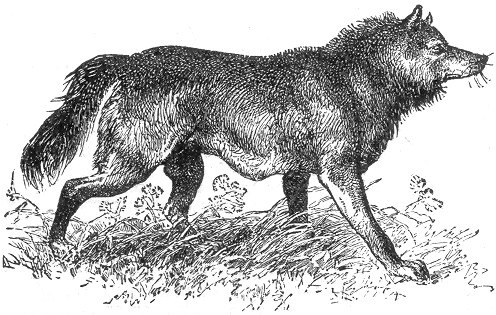
The Grey Wolf is the largest and most formidable representative of the Dog tribe on this continent. Its general appearance is truthfully given in our drawing. Its length, exclusive of the tail, is about four feet, the length of the tail being about a foot and a half. Its color varies from yellowish grey to almost Page 159 white in the northern countries, in which latitude the animal is sometimes found of an enormous size, measuring nearly seven feet in length. The fur is coarse and shaggy about the neck and haunches, and the tail is bushy. They abound in the region east of the Rocky Mountains and northward, and travel in packs of hundreds in search of prey. Bisons, wild horses, deer and even bears fall victims to their united fierceness, and human beings, too, often fall a prey to their ferocious attacks.
The Coyote, or Common Prairie Wolf, also known as the Burrowing Wolf, as its name implies inhabits the Western plains and prairies. They are much smaller than the Grey Wolf, and not so dangerous. They travel in bands and unitedly attack whatever animal they desire to kill. Their homes are made in burrows which they excavate in the ground. The Texan Wolf inhabits the latitude of Texas and southward. It is of a tawny red color and nearly as large as the grey species, possessing the same savage nature.
In April or May the female wolf retires to her burrow or den, and her young, from six to ten in number, are brought forth.
The wolf is almost as sly and cunning as the fox, and the same caution is required in trapping the animal. They are extremely keen scented, and the mere touch of a human hand on the trap is often enough to preclude the possibility of capture. A mere footprint, or the scent of tobacco juice, they look upon Page 160 with great suspicion, and the presence of either will often prevent success.
The same directions given in regard to trapping the fox are equally adapted for the wolf. The trap (size No, 4, page 141) should be smoked or smeared with beeswax or blood, and set in a bed of ashes or other material as therein described, covering with moss, chaff, leaves or some other light substance. The clog should be fully twice as heavy as that used for the fox. Some trappers rub the traps with "brake leaves," sweet fern, or even skunk's cabbage. Gloves should always be worn in handling the traps, and all tracks should be obliterated as much as if a fox were the object sought to be secured.
A common way of securing the wolf consists in setting the trap in a spring or puddle of water, throwing the dead body of some large animal in the water beyond the trap in such a position that the wolf will be obliged to tread upon the trap, in order to reach the bait. This method is described both under the head of the Fox and the Bear.
Another plan is to fasten the bait between two trees which are very close together, setting a trap on each side and carefully concealing them as already directed, and securing each to a clog of about twenty pounds in weight. The enclosure described on page 144 is also successful.
There are various scent or trail baits used in trapping the wolf. Oil of Assafœtida is by many trappers considered the best, but Oil of Rhodium, powdered fennel, fenugreek and Cummin Oil are also much used. It is well to smear a little of the first mentioned oil near the traps, using any one of the other substances, or indeed a mixture of them all, for the trail. This may be made by smearing the preparation on the sole of the boots and walking in the direction of the traps, or by dragging from one trap to another a piece of meat scented with the substance, as described under the head of Mink.
The wolf is an adept at feigning death, playing "'possum" with a skill which would do credit to that veritable animal itself.
A large dead-fall, constructed of logs, page 17, when skilfully scented and baited, will often allure a wolf into its clutches, and a very strong twitch-up, with a noose formed of heavy wire, or a strip of stout calf hide, will successfully capture the crafty creature.
In skinning the wolf the hide may be removed either by, first ripping up the belly, or in a circular piece, as described connection with the fox, both methods being much used. The Page 161 board and hoop stretchers used in preparing the skin are described on pages 273 and 275.
THE PUMA.
The puma, commonly known also as the panther or cougar, is the largest American representative of the Cat tribe, and for this reason is often dignified by the name of the "American Lion." It is found more or less abundantly throughout the United States; and although not generally considered a dangerous foe to mankind, it has often been known in the wild districts to steal upon the traveller unawares, and in many instances human beings have fallen a prey to the powerful claws and teeth of this powerful animal.
The life of the puma is mostly in the trees. Crouching upon the branches it watches for, or steals, cat-like, upon its prey. Should a solitary animal pass within reach, the puma will not hesitate in pouncing upon the unfortunate creature; but if a herd of animals, or party of men, should be travelling together, the caution of the brute asserts itself, and he will often dog their footsteps for a great distance, in hopes of securing a straggler. Birds are struck down by a single blow of the puma's ready paw, and so quick are his movements that even though a bird has risen on the wing, he can often make one of his wonderful bounds, and with a light, quick stroke, arrest the winged prey before it has time to soar beyond reach. The puma is a good angler. Sitting by the water's edge he watches for his victims, and no sooner does an unfortunate fish swim within reach, than the nimble paw is outstretched, and it is swept out of the water on dry land, and eagerly devoured.
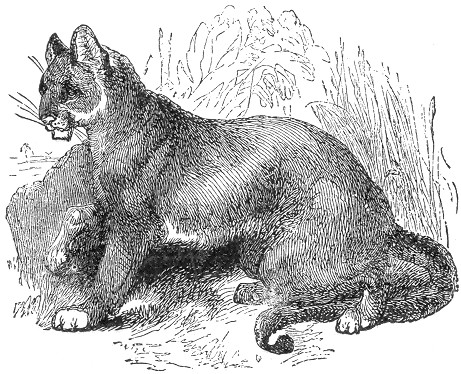
A puma has been known to follow the track of travellers for days together, only daring to show itself at rare intervals, and never endeavoring to make an attack except through stealth. The animal will often approach cautiously upon a traveller until sufficiently near to make its fatal spring; but if the pursued party suddenly turn round and face the crawling creature, the beast becomes discomfited at once, and will retreat from the gaze which seems to it a positive terror. So long as a puma can be kept in sight, no danger need be feared from the animal but it will improve every opportunity of springing unobservedly upon a heedless passer by. The total length of the puma is six feet and a half, of which the tail occupies a little over two feet. Its color is of a uniform light tawny tint, fading into light grey on Page 162 the under parts, and the tip of the tail is black. The puma is one of the few members of the Cat tribe, which are without the usual spots or stripes so observable in the tiger and leopard. The lion has the same uniformity of color, and it is perhaps partly on that account that the panther is so often known as the American lion. In infancy the young pumas possess decided tiger-like markings, and leopard-like spots, but these disappear altogether as the animal increases in size. The cougar has learned by experience a wholesome fear of man, and as civilization has extended throughout our country, the animals have been forced to retire from the neighborhood of human habitations and hide themselves in thick, uncultivated forest lands.
Sometimes, however, the animal, urged by fierce hunger, will venture on a marauding expedition for several miles, and although not an object of personal dread to the inhabitants, he often becomes a pestilent neighbor to the farmer, committing great ravages among his flocks and herds, and making sad havoc in his poultry yard. It is not the fortune of every puma, however, to reside in the neighborhood of such easy prey as pigs, sheep and poultry, and the greater number of these animals are Page 163 forced to depend for their subsistence on their own success in chasing or surprising the various animals on which they feed.
When a puma is treed by hunters, it is said to show great skill in selecting a spot wherein it shall be best concealed from the gazers below, and will even draw the neighboring branches about its body to hide itself from the aim of the hunter's rifle. While thus lying upon the branches the beast is almost invisible from below, as its fur, when seen, harmonizes so well with the the bark which covers the boughs, that the one can scarcely be distinguished from the other.
The puma loves to hide in the branches of trees, and from this eminence to launch itself upon the doomed animal that may pass within its reach. It may, therefore, be easily imagined how treacherous a foe the creature may be when ranging at will among the countless trees and jungles of our American forests.
Although so stealthy and sly a creature the cougar possesses very little cunning and is easily trapped. The Gun trap, page 20, is commonly and successfully employed in South America in the capture of the jaguar, as our title illustration, page 15, represents, and it may also be used with the same success in trapping the puma. The Bow trap, page 23, and the dead-fall described in the early part of the book, will all be found to work admirably in the destruction of this treacherous beast.
The animal may be entrapped alive, should any of our young trappers dare to try the experiment.
There are two ways of accomplishing this. The first is by the aid of a huge coop of logs, as described on page 30 or 33, and the other by the Pit-fall, as exemplified on page 31. Huge twitch-ups may also be constructed, using very strong wire. The bait may consist of a fowl, sheep's head, or the heart of any animal. Fresh meat of any kind will answer the purpose, and in the case of the Pit-fall a live fowl is preferable to a dead one as it will attract the puma by its motions, or by its cackling, and thus induce him to spring upon his prey, which will precipitate him to the bottom of the pit and thus effect his capture.
They are commonly taken with the steel trap. The puma seldom leaves the vicinity of the carcass of an animal it has killed until it is all devoured. When such a carcass can be found the capture of the beast is easily effected. Set the trap, size No. 5, page 143, near the remains, and cover the carcass with leaves. The next visit of the animal will find him more attached to the place than ever,—so much so that he will be unable to "tear himself away."
Page 164 The skin of the puma is properly removed by first cutting up the belly as described under the Beaver, using great care about the head and face. Use the hoop stretcher, page 275.
THE CANADIAN LYNX.
The lynx represents another of the Cat tribe, and as its name implies is a native of the regions north of the United States, although sometimes found in upper Maine and on the lower borders of the great lakes. It is commonly known throughout Canada as the Peshoo, or "Le Chat."
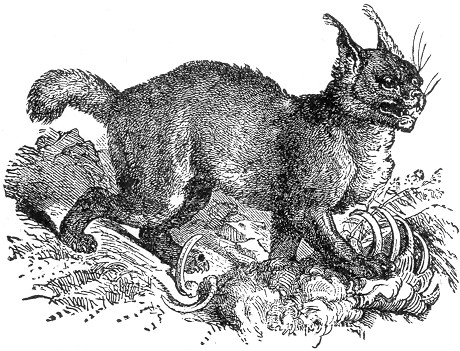
Our illustration is a truthful representation of the animal. Its total length exceeds three feet, and its tail is a mere stub. The fur is thick, and the hairs are long, the general color being grey, sprinkled with black. The legs are generally darker than the body, and the ears are often edged with white. The limbs and muscles are very powerful, the paws are very large for the size of the animal, and are furnished with strong white claws, which are imbedded in the fur of the feet when not in use, they are shown in our illustration. The ears of the lynx form a distinct feature, by which the animal could be easily identified; they are long and tipped with stiff projecting hairs, giving the creature a very odd appearance.
The peshoo can not be said to be a very dangerous animal, unless it is attacked, when it becomes a most ferocious antagonist. The writer knew of a gentleman who was pounced upon and very nearly killed by one of these infuriated creatures, and there are many like instances on record.
The principal food of the lynx consists of the smaller quadrupeds, the American hare being its favorite article of diet. It is a good swimmer, and a most agile climber, chasing its prey among the branches with great stealth and dexterity. Like the wolf, fox, and many other flesh eating-animals, the lynx does not content itself with the creatures which fall by the stroke of its own talons, or the grip of its own teeth, but will follow the trail of the puma, in its nocturnal quest after prey, and thankfully partake of the feast which remains after its predecessor has satisfied its appetite.
While running at full speed, the lynx presents a most ludicrous appearance, owing to its peculiar manner of leaping. It progresses in successive bounds, with its back slightly arched, and all the feet striking the ground nearly at the same instant. Powerful as the animal is, it is easily killed by a blow on the Page 165 back, a slight stick being a sufficient weapon wherewith to destroy the creature. For this reason the "Dead-fall" is particularly adapted for its capture, and is very successful, as the animal possesses very little cunning, and will enter an enclosure of any kind without the slightest compunction, when a tempting bait is in view. The dead-fall should of course be constructed on a large scale, and it is a good plan to have the enclosure deep, and the bait as far back as will necessitate the animal being well under the suspended log in order to reach it. The bait may consist of a dead quadruped or of fresh meat of any kind.
The Gun trap, page 20, and the Bow trap, page 23, will also be found efficient, and a very powerful twitch-up, constructed from a stout pole and extra strong wire will also serve to good purpose. The lynx is not so prolific as many of the feline tribe, the number of its young seldom exceeding two, and this only once a year. The fur of the animal is valuable for the purposes to which the feline skin is generally adapted, and commands a fair price in the market. Those who hunt or trap the lynx will do well to choose the winter months for the time of their operations, as during the cold season the animal possesses a thicker and warmer fur than it offers in the summer months.
When the steel trap is used, it should be of size No. 4, page 141, Page 166 set at the opening of a pen of stakes, the bait being placed at the back of the enclosure in such a position, as that the animal will be obliged to step upon the pan of the trap in order to reach it. Any of the devices described under "Hints on Baiting" will be found successful.
The skin of the animal may be removed as directed in the case of the fox, being drawn off the body whole, or it may be removed after the manner of the beaver, and similarly stretched.
THE WILD CAT.
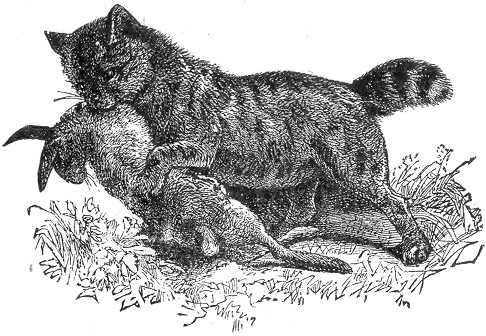
This animal is one of the most wide-spread species of the Cat tribe, being found not only in America, but throughout nearly the whole of Europe as well as in Northern Asia. In many parts of the United States, where the wild cat was wont to flourish, it has become exterminated, owing to civilization and the destruction of forest lands.
Many naturalists are of the opinion that the wild cat is the original progenitor of our domestic cat, but there is much difference of opinion in regard to the subject. Although they bear great resemblance to each other, there are several points of distinction between the two; one of the most decided differences being in the comparative length of the tails. The tail of the wild cat is little more than half the length of that of the domestic cat, and much more bushy.
The color of the wild animal is much more uniform than in the great raft of "domestic" mongrel specimens which make night hideous with their discordant yowls, although we sometimes see a high bred individual which, if his tail was cut off at half its length, might easily pass as an example of the wild variety.
The ground tint of the fur in the wild cat is yellowish grey, diversified with dark streaks over the body and limbs, much after the appearance of the so-called "tiger cat." A row of dark streaks and spots extends along the spine, and the tail is thick, short and bushy, tipped with black and encircled with a number of rings of a dark hue. In some individuals the markings are less distinct, and they are sometimes altogether wanting, but in the typical wild cat they are quite prominent. The fur is rather long and thick, particularly so during the winter season, and always in the colder northern regions.
The amount of havoc which these creatures often occasion is surprising, and their nocturnal inroads, in poultry yards and Page 167 sheep folds, render them most hated pests to farmers in the countries where these animals abound. They seem to have a special appetite for the heads of fowls, and will often decapitate a half dozen in a single night, leaving the bodies in otherwise good condition to tell the story of their midnight murders. The home of the wild cat is made in some cleft of rock, or in the hollow of some aged tree, from which the creature issues in the dark hours and starts upon its marauding excursions. Its family numbers from three to six, and the female parent is smaller than the male, the total length of the latter being three feet.
Inhabiting the most lonely and inaccessible ranges of rock and mountain, the wild cat is seldom seen during the daytime. At night, like its domestic relative, he prowls far and wide, walking with the same stealthy step and hunting his game in the same tiger-like manner. He is by no means a difficult animal to trap, being easily deceived and taking a bait without any hesitation. The wild cat haunts the shores of lakes and rivers, and it is here that the traps may be set for them. Having caught and killed one of the colony, the rest of them can be easily taken if the body of the dead victim be left near their hunting ground and surrounded with the traps carefully set and concealed beneath leaves moss or the like. Every wild cat Page 168 that is in the neighborhood will be certain to visit the body, and if the traps are rightly arranged many will be caught. The trap No. 3, page 141 is generally used. We would caution the young trapper in his approach to an entrapped wild cat, as the strength and ferocity of this animal under such circumstances, or when otherwise "hard pressed," is perfectly amazing. When caught in a trap they spring with terrible fury at any one who approaches them, not waiting to be assailed, and when cornered or hemmed in by a hunter they will often turn upon their pursuer, and springing at his face will attack him with most consummate fury, often inflicting serious and sometimes fatal wounds. When hunted and attacked by dogs, the wild cat is a most desperate and untiring fighter, and extremely difficult to kill, for which reason it has been truthfully said that "if a tame cat has nine lives, a wild cat must have a dozen."
The twitch-up, erected on a large scale, is utilized to a considerable extent in England in the capture of these animals; and these, together with steel traps and dead-falls, are about the only machines used for their capture. We would suggest the garrote, bow and gun trap also as being very effective. The bait may consist of the head of a fowl or a piece of rabbit or fowl flesh: or, indeed, flesh of almost any kind will answer, particularly of the bird kind.
In skinning the wild cat the same directions given under the head of the Fox may be followed, or the pelt may be ripped up the belly and spread on a hoop stretcher, page 275.
THE BEAR.
There are several species of the Bear tribe which inhabit our continent, the most prominent of which are the Grizzly, and the Musquaw or common Black Bear. There is no other animal of this country which is more widely and deservedly dreaded than the grizzly bear. There are other creatures, the puma and wild cat, for instance, which are dangerous when cornered or wounded, but they are not given to open and deliberate attack upon human beings. The grizzly, however, or "Ephraim," as he is commonly termed by trappers, often displays a most unpleasant readiness to attack and pursue a man, even in the face of fire arms. In many localities, however, where hunting has been pursued to considerable extent, these animals have learned from experience a wholesome fear of man, and are not so ready to assume the offensive, but a "wounded" grizzly is one of the Page 169 most horrible antagonists of which it is possible to conceive, rushing upon its victim with terrible fury, and dealing most tearing and heavy blows with its huge claws.
In length this formidable animal often exceeds eight feet, and its color varies from yellowish to brownish black, and some specimens are found of a dirty grey color.
The legs are usually darker than the rest of the body, and the face is generally of a lighter tint. The fore limbs of the animal are immensely powerful; and the foot of a full-grown individual is fully eighteen inches long, and armed with claws five inches in length. The grizzly inhabits the Rocky Mountain regions and northward, being found in considerable numbers in the western part of British America. Its hair is thick and coarse, except in the young animal, which possesses a beautiful fur.
All other creatures seem to stand in fear of this formidable beast. Even the huge bison, or buffalo, of the Western Prairies sometimes falls a victim to the grizzly bear, and the very imprint of a bear's foot upon the soil is a warning which not even a hungry wolf will disregard.
Its food consists of whatever animal it can seize, whether human or otherwise. He also devours green corn, nuts, and fruits of all kinds. In his earlier years he is a good climber, and will ascend a tree with an agility which is surprisingly inconsistent with the unwieldy proportions of his body.
The average weight of a full-grown grizzly is over eight hundred pounds, and the girth around the body is about eight feet.
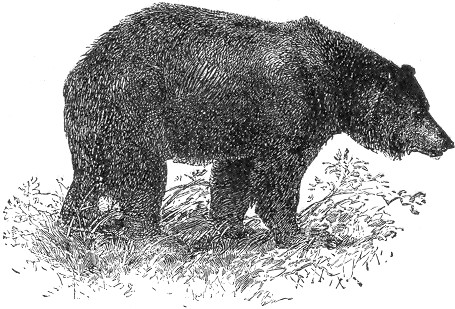
The Black bear, or Musquaw, which we illustrate is common throughout nearly all the half settled-districts of North America. But as the fur and fat are articles of great commercial value, the hunters and trappers have exercised their craft with such skill and determination that the animals are gradually decreasing in numbers. The total length of the black bear is seldom more than six feet, and its fur is smooth and glossy in appearance. The color of the animal is rightly conveyed by its name, the cheeks only partaking of a reddish fawn color.
It possesses little of that fierceness which characterizes the grizzly, being naturally a very quiet and retiring creature, keeping itself aloof from mankind, and never venturing near his habitations except when excited by the pangs of fierce hunger. When pursued or cornered it becomes a dangerous antagonist; and its furious rage often results in fearful catastrophes to both man and beast. Nothing but a rifle ball in the right spot will Page 170 check the creature, when wrought up to this pitch of fury, and an additional wound only serves to increase its terrible ferocity. Bear-chasing is an extremely dangerous sport; and there are few bear-hunters in the land, however skilful, but what can show scars from the claws or teeth of some exasperated bruin.
The food of the black bear is mostly of a vegetable character, animal diet not being indulged in unless pressed by hunger. At such times it seems to especially prefer a young pig as the most desirable delicacy; and even full-grown hogs, it is said, are sometimes lifted from their pens and carried off in his deadly embrace.
Honey is his especial delight; and he will climb trees with great agility in order to reach a nest of bees, there being few obstacles which his ready claws and teeth will not remove where that dainty is in view. He is also very fond of acorns, berries, and fruits of all kinds.
The young of the bear are produced in January or February, and are from one to four in number. They are very small and covered with grey hair, which coat they retain until they are one year of age. The flesh of the bear is held in high esteem among hunters, and when properly prepared is greatly esteemed by epicures.
The fat of the animal is much used under the title of "Bear Page 171 grease," and is believed to be an infallible hair rejuvenator, and therefore becomes a valuable article of commerce.
The bear generally hibernates during the winter, choosing some comfortable residence which it has prepared in the course of the summer, or perhaps betaking itself to the hollow of some tree. Sometimes, in case of early snow, the track of the bears may be distinguished, and if followed will probably lead to their dens, in which they can be secured with logs until it is desired to kill them.
The black bear has a habit of treading in a beaten track, which is easily detected by the eye of an experienced hunter or trapper, and turned to good account in trapping the animal.
There are various modes of accomplishing this result. The bear Dead-fall, described on page 17, is, perhaps, the most commonly used, and the Pit-fall, page 31, and "Giant Coop" trap are also excellent. The Gun trap and stone dead-fall, page 20, we also confidently recommend. When a steel trap is used it requires the largest size, especially made for the purpose. It should be supplied with a short and very strong chain firmly secured to a very heavy clog or grappling-iron page 147. If secured to a tree or other stationary object, the captured animal is likely to gnaw or tear his foot away, if, indeed, he does not break the trap altogether by the quick tightening of the chain. The clog should be only heavy enough to be an impediment, and may consist of a log or heavy stone. The grappling-iron, however, is more often used in connection with the bear trap. It is a common method in trapping the bear to construct a pen of upright branches, laying the trap at its opening, and covering it with leaves. The bait is then placed at the back in such a position that the animal, on reaching for it, will be sure to put his foot in the trap.
An experienced trapper soon discovers natural openings between rocks or trees, which may be easily modified, and by the addition of a few logs so improved upon as to answer his purpose as well as a more elaborate enclosure, with much less trouble. Any arrangement whereby the bear will be obliged to tread upon the trap in order to secure the bait, is, of course, all that is required. The bait may be hung on the edge of a rock five feet from the ground, and the trap set on a smaller rock beneath it. He will thus be almost sure to rest his forefoot on the latter rock in order to reach the bait, and will thus be captured.
Another way is to set the trap in a spring of water or swampy Page 172 spot. Lay a lump of moss over the pan, suspending the bait beyond the trap. The moss will offer a natural foot-rest, and the offending paw will be secured.
Bears possess but little cunning, and will enter any nook or corner without the slightest compunction when in quest of food. They are especially fond of sweets, and, as we have said, are strongly attracted by honey, being able to scent it from a great distance. On this account it is always used, when possible, by trappers in connection with other baits. These may consist of a fowl, fruit, or flesh of any kind, and the honey should be smeared over it. Skunk cabbage is said to be an excellent bait for the bear; and in all cases a free use of the Oil of Anise page 152, sprinkling it about the traps, is also advisable. Should the device fail, it is well to make a trail (see page 153) in several directions from the trap, and extending for several rods. A piece of wood, wet with Oil of Anise, will answer for the purpose.
The general method of skinning the bear consists in first cutting from the front of the lower jaw down the belly to the vent, after which the hide may be easily removed. The hoop-stretcher page 275, will then come into good use in the drying and preparing of the skin for market.
THE RACCOON.
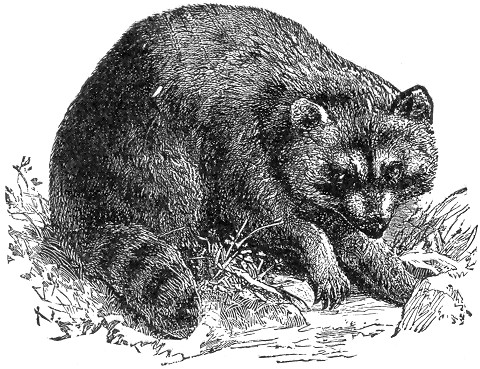
Although allied to the Bear family, this animal possesses much in common with the fox, as regards its general disposition and character. It has the same slyness and cunning, the same stealthy tread, besides an additional mischievousness and greed. It is too common to need any description here, being found plentifully throughout nearly the whole United States. The bushy tail, with its dark rings, will be sufficient to identify the animal in any community. Raccoon hunts form the subject of many very exciting and laughable stories, and a "coon chase," to this day is a favorite sport all over the country. The raccoon, or "coon," as he is popularly styled, is generally hunted by moonlight. An experienced dog is usually set on the trail and the fugitive soon seeks refuge in a tree, when its destruction is almost certain. Hence the term "treed coon," as applied to an individual when in a dangerous predicament. Besides possessing many of the peculiarities of the fox, the "coon" has the additional accomplishment of being a most agile and expert climber, holding so firmly to the limb by its sharp claws as to defy all attempts to shake it off.
Page 173 The home of the raccoon is generally in a hollow tree; the young are brought forth in May, and are from four to six in number.
In captivity this animal makes a very cunning and interesting pet, being easily tamed to follow its master, and when dainties are in view becomes a most adroit pickpocket. Its food is extensive in variety, thus making it quite an easy matter to keep the creature in confinement. Nuts and fruits of all kinds it eagerly devours, as well as bread, cake and potatoes. It manifests no hesitation at a meal of rabbit, rat, squirrel, or bird, and rather likes it for a change, and when he can partake of a dessert of honey or molasses his enjoyment knows no bounds. Frogs, fresh water clams, green corn, and a host of other delicacies come within the range of his diet, and he may sometimes be seen digging from the sand the eggs of the soft-shelled turtle, which he greedily sucks. We cordially recommend the coon as a pet. He becomes very docile, and is full of cunning ways, and if the young ones can be traced to their hiding-place in some hollow tree, and secured, if not too young, we could warrant our readers a great deal of real sport and pleasure in rearing the little animals and watching their ways.
In cold climates the raccoon lies dormant in the winter, only venturing out on occasional mild days; but in the Southern States he is active throughout the year, prowling about by day and by night in search of his food, inserting his little sharp nose into every corner, and feeling with his slender paws between stones for spiders and bugs of all kinds. He spies the innocent frog with his head just out of the water, and pouncing upon him, he despatches him without a moment's warning. There seems to be no limits to his rapacity, for he is always eating and always hungry. The print of the raccoon's paw in the mud or snow is easily recognized, much resembling the impression made by the foot of a babe.
The best season for trapping the coon is late in the fall, winter, and early spring, or from and between the months of October and April. During this time the pelts are in excellent condition. Early in the spring when the snow is disappearing, the coons come out of their hiding places to start on their foraging tours; and at this time are particularly susceptible to a tempting bait, and they may be successfully trapped in the following manner:—
Take a steel trap and set it on the edge of some pool, or stream where the coons are known to frequent: let it be an inch Page 174 or so under the water, and carefully chained to a clog. The bait may consist of a fish, frog, or head of a fowl, scented with Oil of Anise, and suspended over the traps about two feet higher, by the aid of a sapling secured in the ground. (See title page at the head of this section.) The object of this is to induce the animal to jump for it, when he will land with his foot in the trap. Another method is to construct a V shaped pen set the trap near the entrance, and, fastening the bait in the angle, cover the trap loosely with leaves, and scent the bait as before with the anise. The trap should be at such a distance from the bait that the animal, in order to reach it, will be obliged to tread upon the pan, which he will be sure to do, his greed overcoming his discretion. Any arrangement whereby the animal will be obliged to tread upon the trap in order to reach the bait will be successful.
The beaten track of the coons may often be discovered in soft ground, and a trap carefully concealed therein will soon secure its victim. Another method is to set the trap near the coon tracks, spreading a few drops of anise on the pan and covering the whole with leaves. The coon, attracted by the scent, will Page 175 feel around in the leaves for the bait, and thus "put his foot in it."
In the South they construct a coon trap from a hollow log, either having the ends supplied with lids, which fall just like the Rat trap page 100 as the animal passes through, or else constructed with nooses, similar to the Box-snare, page 56. Box traps of a style similar to that described on page 103 are also excellent, and a strong twitch-up, of any of the various kinds we have described, will be found to work admirably.
Many of the suggestions in trapping the mink, page 190, will be found equally, serviceable in regard to the coon.
The skin of this animal should be removed as recommended for the fox, and similarly stretched. It may also be skinned by first ripping up the belly, and spread on a hoop stretcher. page 275.
THE BADGER.
The American Badger is mostly confined to the Northwestern parts of the United States, and it is a curious little animal. In size its body is slightly smaller than the fox. Its general color is grey, approaching to black on the head and legs. There is a white streak extending from the tip of the animal's long nose over the top of the head and fading off near the shoulders. The cheeks are also white, and a broad and definitely marked black line extends from the snout back around the eyes ending at the neck. The grey of this animal is produced from the mixture of the varied tints of its fur, each hair presenting a succession of shades. At the root it is of a deep grey; this fades into a tawny yellow, and is followed by a black, the hair being finally tipped with white. The fur is much used in the manufacture of fine paint brushes, a good "Badger blender" being a most useful accessory in the painter's art. The badger is slow and clumsy in its actions, except when engaged in digging, his capacities in this direction being so great as to enable him to sink himself into the ground with marvellous rapidity. The nest of the animal is made in the burrow, and the young are three or four in number. His diet is as variable and extensive as that of the coon, and consists of anything in any way eatable. Snails, worms, rats, mice and moles, seem to have a particular attraction for him; and he seems to take especial delight in unearthing the stores of the wild bees, devouring honey, wax and grubs together, and Page 176 caring as little for the stings of the angry bees as he would of the bills of so many mosquitoes, the thick coating of fur forming a perfect protection against his winged antagonists. The badger is very susceptible to human influence, and can be effectually tamed with but little trouble. Although his general appearance would not indicate it, he is a sly and cunning animal, and not easily captured in a trap of any kind. He has been known to set at defiance all the traps that were set for him, and to devour the baits without suffering for his audacity. He will sometimes overturn a trap and spring it from the under side, before attempting to remove the bait. Although not quite as crafty as the fox, it is necessary to use much of the same caution in trapping the badger, as a bare trap seldom wins more than a look of contempt from the wary animal.
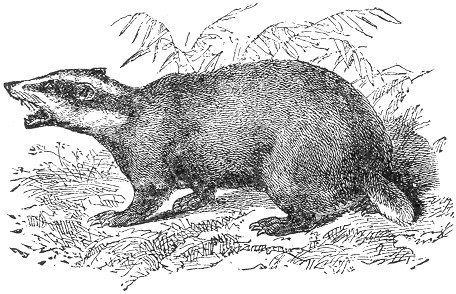
The usual mode of catching the creature is to set the trap size No. 3 at the mouth of its burrow, carefully covering it with loose earth and securing it by a chain to a stake. Any of the methods used in trapping the fox will also be found to work admirably. The dead-fall or garrote will also do good service. Bait with a rat, mouse, or with whatever else the animal is especially fond, and scent with Oil of Anise or Musk. In early spring, while the ground is still hard, badgers are easily captured by flooding their burrows. After being satisfied that the animal is in its hole, proceed to pour in pailful after pailful of water at the entrance. He will not long be able Page 177 to stand this sort of thing, and he may be secured as he makes his exit at the opening of the burrow.
The skin should be removed whole, as in the case of the fox, or as described for the beaver, and stretched as therein indicated.
THE BEAVER.
The Beaver of North America has now a world-wide reputation for its wonderful instinct and sagacity. The general appearance of this animal is that of a very large muskrat with a broad flattened tail, and the habits of both these animals are in many respects alike. The beaver is an amphibious creature and social in its habits of living, large numbers congregating together and forming little villages, and erecting their dome-like huts like little Esquimaux. The muskrat has this same propensity, but the habitation of the beaver is on a much more extensive scale. These huts or "Beaver lodges," are generally made in rivers and brooks; although sometimes in lakes or large ponds. They are chiefly composed of branches, moss, grass and mud, and are large enough to accommodate a family of five or six. The form of the "lodges" is dome-like, and it varies considerably in size. The foundation is made on the bottom of the river, and the hut is built up like a mound, often twenty feet in diameter and projecting several feet above the surface of the water. The walls of this structure are often five or six feet thick, and the roofs are all finished off with a thick layer of mud laid on with marvellous smoothness. These huts form the winter habitations of the beavers, and as this compost of mud, grass and branches becomes congealed into a solid mass by the severe frosts of our northern winter, it can easily be seen that they afford a safe shelter against any intruder and particularly the wolverine, which is a most deadly enemy to the beaver. So hard does this frozen mass become as to defy even the edges of iron tools, and the breaking open of the "Beaver houses" is at no time an easy task. Beavers work almost entirely in the dark; and a pond which is calm and placid in the day time will be found in the night to be full of life and motion, and the squealing and splashing in the water will bear evidence of their industry. Lest the beavers should not have a sufficient depth of water at all seasons, they are in the habit of constructing veritable dams to ensure that result. These dams display a wonderful amount of reason and skill, and, together with the huts, have won for the beaver a reputation Page 178 for engineering skill which the creature truly deserves. In constructing these ingenious dams the beavers, by the aid of their powerful teeth, gnaw down trees sometimes of large size, and after cutting them into smaller pieces float them on the water to the spot selected for the embankment. In swift streams this embankment is built so as to arch against the current, thus securing additional strength, and evincing an instinct on the part of the animal which amounts almost to reason. In cutting down the trees the beaver gnaws a circular cut around the trunk, cutting deepest on the side toward the water, thus causing the trunk to fall into the stream. The first step in constructing the embankment is to lay the logs down cautiously in the required line of the dam, afterwards weighting them with heavy stones, which the beavers by their united efforts roll upon them. The foundation of the embankment is often ten feet in width, and is built up by continued heaping of branches, stones and mud, until it forms a barrier of immense strength and resisting power. In many cases, through Page 179 a lapse of years, and through a consequent accumulation of floating leaves, twigs, and seeds of plants, these embankments become thickly covered with vegetation, and, in many cases in the Hudson Bay country, have even been known to nurture trees of considerable dimensions. The broad flat tail of the animal serves a most excellent purpose, in carrying the mud to the dams or huts, and in matting and smoothing it into a solidity.
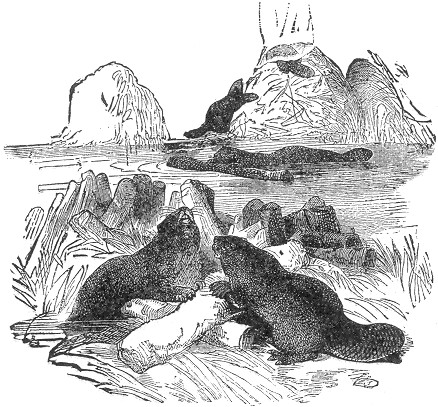
The entrances to the various huts are all beneath the water, and they all open into one common ditch, which is purposely dug in the bed of the river, and is too deep to be entirely frozen. In the summer time the huts are vacated, and the beavers make their abode in burrows on the banks of the stream, which serve as a secure retreat at all times, and particularly in winter when their houses are molested. The Indians of the Northwest are aware of this fact, and turn it to good account in the capture of the animals.
When the beaver's village is in a small creek, or brook, it is first necessary to stake the water across both above and below the huts. The next thing is to ascertain the exact spots of the burrows in the banks, and when we consider the river is covered with ice, this seems a rather difficult problem. But this is where the Indian shows his skill. He starts upon the ice, provided with an ice chisel secured to a long, stout handle. With this he strikes upon the ice, following the edge of the stream. The sound of the blow determines to his practiced ear the direct spot opposite the opening of the burrows, and at this point a hole a foot in diameter is made through the ice. Following the edge of the bank he continues his search, and in like manner cuts the holes through the ice until all the retreats are discovered. While the expert Indians are thus engaged, the "squaws" are occupied in the more laborious work of breaking open the houses, and the beavers, alarmed at the invasion of their sanctums, make for the banks, and the ready huntsmen stationed at the various holes, watch for their victims beneath the openings, until a violent motion or discoloration of the water betrays their passage beneath. The entrance to the holes in the bank are then instantly closed with stakes and the beaver is made prisoner in his burrow. When the depth of the burrow will admit, the arm of the hunter is introduced, and the animal pulled out, but otherwise a long hook lashed to a pole is employed for this purpose. Scores of beavers are sometimes taken in this way in a few hours. Spearing is also often successfully resorted to, and when the ice is thin and transparent the beavers may be Page 180 clearly observed as they come to the surface, beneath the ice, for air.
The general color of the animal is reddish brown, this tint being imparted principally by the long hairs of the fur. There is an inner and softer down of a grey color, which lies next the skin, and which is the valuable growth of the fur. The total length of the animal is about three feet and a half, the flat, paddle-shaped, scale-covered tail being about a foot in length.
The young are brought forth in April or May, from three to seven at a litter, and take to the water when a month old. The first four years in the beaver's life is spent under the "maternal roof," after which period they shift for themselves. To trap the beaver successfully, requires the utmost caution, as the senses of the animal are so keen, and he is so sagacious withal, that he will detect the recent presence of the trapper from the slightest evidences. The traps should be washed clean and soaked in ley, before using, and thereafter handled with gloves, as a mere touch of the finger will leave a scent which the acute sense of the beaver will easily perceive. All footprints should be carefully obliterated by throwing water upon them, and some trappers say that the mere act of spitting on the ground in the neighborhood of the traps has been known to thwart success.
Almost the only bait used in trapping the beaver is the preparation called "barkstone" by the trappers, or "castoreum" in commerce. This substance is fully described on page 150 under the head of "Scent Baits."
To the barkstone the trapper is mostly indebted for his success, and the effect of its odor on the beaver is something surprising. Our best trappers inform us that these animals will scent this odor for a great distance, and will fairly "squeal with delight," not being easy until the savory bait is discovered, which almost invariably results in capture.
Taking advantage of this curious propensity, the trapper always carries a supply of castoreum in a closed vessel.
There are various ways of trapping the beaver, of which we shall present the best. An examination of the river bank will easily disclose the feeding place of the beavers, as evinced by the absence of the bark on the branches and trunks of trees. At this spot, in about four inches of water, set your trap, which should be a Newhouse No. 4. Weight the end of the chain with a stone as large as your head, and, if possible, rest it on the edge of some rock projecting into deep water, having a smaller rope or chain leading from the stone to the shore. A Page 181 small twig, the size of your little finger, should then be stripped of its bark, and after chewing or mashing one end, it should be dipped in the castoreum. Insert this stick in the mud, between the jaws of the trap, letting it project about six inches above the water. The beaver is soon attracted by the odor of the bait, and in reaching for it, his foot is caught in the trap. In his fright he will immediately jump for deep water, thus dislodging the stone, which will sink him to the bottom, and thus drown him. The smaller chain or rope will serve as a guide to the trap, and the victim may be drawn to the surface. Another plan is to set the trap in about a foot of water, chaining it fast to a stout pole securely driven in the mud further out in the stream, and near deep water. Bait as before. The trap being thus fastened will prevent the efforts of the animal to drag it ashore, where he would be certain to amputate his leg and walk off. There is another method, which is said to work excellently. The chain is secured to a very heavy stone, and sunk in deep water, and the trap set and baited near shore, in about a foot of water. This accomplishes the same purpose as the pole first described, and is even surer, as the animal will sometimes use his teeth in severing the wood, and thereby make his escape. In the case of the stone a duplicate rope or chain will be required to lift it in case of capture.
The trap may be set at the entrance to the holes in the banks, two or three inches under water, implanting the stick with the castoreum bait directly over the pan, a few inches above the water. If the water should be deep near this spot, it is an excellent plan to weight the end of the chain with a large stone with a "leader" from it also, as already described. Insert two or three sticks in the bank beneath the water, and rest the stone upon them.
When the beaver is caught he will turn a somersault into deep water, at the same time dislodging the stone, which will sink him. No sooner is a break ascertained in the dam than all the beavers unite in fixing it, and this peculiarity of habit may be turned to account in trapping them. Make a slight break in the dam, five inches across, beneath the water. On the under side of the break, and of course, on the inside of the dam, the trap should be set. The beavers will soon discover the leak and the capture of at least one is certain. The trap may be also set where the beavers are wont to crawl on shore, being placed several inches below the water in such a position that they will step on it when in the act of ascending the banks. Where the weighted stone is not used, the sliding pole page 145 Page 182 should always be employed, as it is necessary to drown the animal, to prevent amputation and escape.
The food of the beaver consists chiefly of the bark of various trees, together with aquatic plants. The fur is valuable only in the late fall, winter, and early spring.
In skinning the beaver, a slit is made from the under jaw to the vent, after which it is easily removed. It should be tacked to a flat board, fur side in, or stretched by means of a hoop, as described on page 275.
THE MUSKRAT.
The muskrat, or musquash, is very much like a beaver on a small scale, and is so well-known throughout the United States that a detailed description or illustration will hardly be necessary. Reduce the size of the beaver to one foot in length, and add a long flattened tail, instead of the spatula-shaped appendage of this animal, and we will have a pretty good specimen of a muskrat. The body has that same thick-set appearance, and the gnawing teeth are very large and powerful. Like the beaver, the muskrat builds its dome-like huts in ponds or swamps, which it frequents; and although not as large as those of the beaver they are constructed in the same manner and of the same materials. Muskrats are mostly nocturnal in their habits; they are tireless swimmers, and in the winter travel great distances beneath the ice; all of which peculiarities are like the beaver. Their food is quite variable, consisting of grass and roots, oats, corn and other grain, apples and nuts, and even tomatoes, turnips, carrots, mussels and clams, whenever these can be found.
The muskrat is a native of all of the Eastern, Western, and Middle States and also the Southern States, with the exception of Georgia, Alabama and Florida. They are also found in Canada and the Arctic regions, and in the North-west. They are hunted and captured as a means of support to the native tribes of Indians who sell or trade the furs to Eastern dealers. The fur somewhat resembles that of the mink in texture, although not as fine, and the color varies from dark brown above to grey beneath. It is in its best condition during the winter, especially in March. The animal possesses a musky smell, from which it takes its name. It is said by many that the flesh of the animal, when carefully prepared, becomes quite palatable food.