CÆDWALLA (continued 6)
Reading edition
The fugitives had strained every nerve to get a good start and were rapidly rearing the ford, but they had had no food and were exhausted; gallantly they ran, but it was quite clear that some of them must be caught again. Panting, gasping, Beornwulf reached the ford, the tide was fortunately down and he dashed through it, followed closely by several others; they had scarcely reached the banks on the other side, when a wild cheer welcomed them, and Ceolwulf, with Wulfstan and a large force of boys sprang up and greeted them. Arwald and his few followers seeing that all the fugitives had now got within shelter of the stones, whose disastrous effects still left a mark on his forehead, thought it more prudent to retire, and all the fugitives were therefore saved.
"Oh, Beornwulf, I am so glad!" cried Wulfstan, as they all stood on the top of the bank and saw Arwald sullenly rein in his horse and give the order to return.
"Let's give him a parting volley. I do believe I could hit him," Wulfstan said, and swinging his sling round his head he sent a stone whizzing and humming through the air after Arwald, while all the band set up a derisive shout. Arwald was just turning round to shake his fist at them, when the stone struck his horse violently on the hind quarter, causing it to give a leap into the air. Arwald was pitched heavily forwards, and was nearly unseated; as it was he lost his stirrups, and had to clutch at the mane to keep himself from falling, while the horse galloped away towards the homestead, and in this undignified way the Wihtwara chieftain returned to his men.
Wulfstan and all the others shouted with mocking laughter, and then turned towards the stockade, their spirits considerably relieved at the safety of the fugitives, and at the unexpected addition to their little force.
One or two of the sharpest boys were left with Stuff to see how matters were going, and to watch the enemy, with strict orders to send up word of what was going on, and if any fresh attack seemed imminent.
"We did that fire well, didn't we, Beorney?" said Wulfstan, as they walked up to the stockade, passing the charred gorse on their right. "I heard Arwald say how nice our cooking smelt; he little thought how soon some of his men would feel the fire. I wish it had been the old fat knave himself."
CHAPTER XX.
"'TIS TRUE WE ARE IN GREAT DANGER; THE GREATER SHOULD OUR COURAGE BE."
When Ceolwulf and the rescued party reached the stockade it was a little past noon; the breeze that had been gently blowing from the east began to show signs of going round with the sun, for the weather was very fine. This fickleness of the wind was noted by Ceolwulf with a discontented grunt, for it was quite clear that any reinforcements that Cædwalla might send would be delayed by a westerly or south-westerly wind.
"Dost thou think Wulf the Atheling reached Selsea?" asked Wulfstan for about the hundredth time, and Ceolwulf, who was already grumpy enough at the prospect of the change in the wind, was exasperated at the persistency of his young lord.
"How can I tell thee? Why dost thou weary me so with such foolish questions? Thou wilt know fast enough when thou seest any boats coming," and with this answer Wulfstan had to be content, until, in a moment of thoughtlessness, he should ask the same question again in the course of a few more minutes.
"I tell thee what it is, Biggun!" said Beornwulf, "I shall not be sorry for a bit of food; so if thou hast got any hereabouts let me see it."
"All right, man. Thou shalt have it soon enough," replied Ceolwulf, leading the way into the now completed stockade.
Beornwulf was surprised to see how well everything had been done. The area inside had been made very much larger; unfortunately, now that all their fighting men were nearly exterminated, almost too large for the little force who could defend it. Stores of food were piled up at the sides, and boards laid on the top of these, to act as platforms; logs were rolled against the only entrance, and shelters made for the defending force against missiles. Ælfhere and Malachi had been taken away, and were carefully concealed in a very impervious and wild part of the country, known only to a few of the most adventurous of the inhabitants, and it was intended to try to mislead Arwald into thinking that all the household servants, dependents, and belongings of Ælfhere were assembled inside the stockade, and to carry out this impression a few cattle had been kept inside, carefully penned up. All the trees that in any way commanded a view into the interior of the little fortification were cleared away, and a path down to the spring of water was defended by stout palings. Altogether, everything that prudence, foresight, and energy could do to render their position secure had been done: the only thing wanted to crown the preparations was a suitable number of defenders, and this it was now impossible to obtain. The midday meal had been postponed until Ceolwulf returned, and they all sat down inside the stockade, and made an excellent dinner. Free, careless, and in the enjoyment of the most perfect health, the majority of the men, like thoughtless children, forgot the danger they had passed, or the almost certain death that awaited them, in the animal pleasure of the moment, and, like the Homeric heroes, they sat eating much flesh, and quaffing home-brewed beer, in most absolute and unconcerned satisfaction.
All listened to Beornwulf's account of what had gone on at the homestead, and there was a disapproving grunt from all when they heard how narrowly Arwald had missed being killed by Athelhune's knife, but the applause was great as they heard how nobly the West Saxon eorldoman had met his death. But when Beornwulf came to his own part in the tragedy the rejoicing was tumultuous. The recital of these stirring deeds, and the example of stern, enduring indifference to death, had an excellent effect upon the men, and when dinner was over they all felt equal to any number of enemies. Indeed, so carried away were they all, that many openly said it was too much like women to stay behind wooden walls; they ought to sally out into the open; they could easily defeat such a miserable lot as the followers of Arwald, and among these was Wulfstan, who was overjoyed at the successes that had crowned his part in the fray hitherto. Although they could not help being depressed at the loss of all their fighting men in the fatal slaughter down by the meadows near the Yare, yet they attributed this entirely to the gross mismanagement of Wulf the Atheling, and their subsequent diversion in harassing the enemy at the ford, and the final total rout and retreat of Arwald, had fully compensated in their eyes for their previous defeat. And now this last success, in which Arwald had been bearded in his own hall, as it were, crowned the whole, and not a man doubted but that they would not only hold their own until Cædwalla could send them reinforcements, but would totally annihilate Arwald by their own unaided valour.
Ceolwulf alone was not blinded by their successes; in fact he could not but see that unless help were to come to them soon they must all succumb to the enormous odds Arwald would bring against them. After all, what had they done? They had worried Arwald; they had driven him back by a most fortunate stratagem, but such as could not succeed again. They had rescued some twenty of their own men, who would never have had to be rescued but for the bad generalship of their leader; but they had lost more than seventy of their best men, and among them Athelhune and the Atheling Wulf. They had put off the evil day for a few hours, that was all—a great deal if they could see any help coming; but at best no help was likely to come for another twenty-four hours.
Anxiously Ceolwulf looked at the clouds, the wind was getting more and more to the west, but it might go back again at nightfall. But how could they hope to hold out if once Arwald attacked in earnest? There was one hope. Arwald did not show any signs of moving yet; at least, no news had come from the outposts, and it was now getting on well into the afternoon. Perhaps his reinforcements had not come up, or he might intend a night attack.
The force left to defend the stockade amounted to not more than a hundred men. There was a large number of boys, but they could be of little use in a hand-to-hand encounter, and Ceolwulf turned it over in his mind whether it would not be better to leave them outside under Wulfstan; they had shown such talents for annoying the enemy without themselves receiving any damage, and they were so perfectly at home in the intricate paths and rough tracks, over the hills and through the woods, that he thought it would be wisest to send them outside, they might thus escape the destruction which was sure to await those in the stockade, and might create a useful diversion by stoning the enemy from the cover of the woods, for in running they could outstrip most men, and knew the land well.
Full of these anxious thoughts Ceolwulf had been meditatively leaning, with his head on his hands looking dreamily over the parapet of the stockade. The stockade from this point commanded a view, through a gap in the trees, where the land fell abruptly to a wooded dell below, of the distant sea to the east of the island, and consequently towards Selsea. The sun was getting low in the heavens, but his rays were still bright; and the light shone full on the far-distant line of downs beyond Cissanceaster. Ceolwulf had been gazing vaguely in this direction for some time, in the see-nothing sort of way in which men look intently at objects without in the least grasping their reality.
"Why, Biggun, old man," called Beornwulf, who, now that he was thoroughly rested, and had had a good dinner, felt equal to anything, "What art thou looking so hard for? that is not where Arwald will come from;" and, as he spoke, he got up on to the platform by his side, but not looking in the same direction as Ceolwulf. Glancing up at the sky, he said, "I think the breeze is drawing more from the north again. We can't make another beacon fire for Arwald, can we?" Then he turned round and looked out towards the sea, and in another second shouted, "There's a fleet coming this way! Look at that dark patch on the water, half-way between Selsea and us."
Ceolwulf looked, and instantly perceived that he had been gazing at this object for some time, but had never given it a thought.
There was no doubt about it. That dark patch, with here and there a brighter speck in the midst of it, was a flotilla, and the brighter specks were sails.
It was Cædwalla coming to save them.
But would he—could he arrive in time? Other eyes must have seen the flotilla too. Arwald would never allow the invaders to land without crushing the rebels first; and the flotilla could not, under the most favourable circumstances, reach Brædynge haven before two or three hours, and then they would have to disembark and march three miles before they could help them; and in four hours there might not be a man alive in the stockade.
At this moment Stuff rushed up, shouting that Arwald had crossed the Yare with more men than ever, and was advancing upon the stockade.
"Well, then, that puts an end to all my doubts," said Ceolwulf. "Wulf, do thou take the boys outside. Thou art a sharp lad. Send two or three down to the point at the entrance to the haven. Tell them to light a fire there, and as soon as they can, let them tell Cædwalla where we are, and bid him hasten to our help. Anyhow," muttered Ceolwulf, "he will avenge us on Arwald, and the eorldoman Ælfhere will be saved, and the boy too. If that happens, what matters it what becomes of an old man like me?"
So saying, the old Wihtwara got down off the platform and prepared to give the final directions before the last decisive struggle began. It was now about an hour before sunset. Why Arwald had not attacked sooner he could not understand; and he argued that he would not have attacked now had he not seen the flotilla, from which he concluded that all the reinforcements had not reached him, or that there had been some accident. Ceolwulf directed Wulfstan to go outside at once, bidding him be sure to do nothing rashly, but make his way down to the shore, and, above all things, keep out of Arwald's way.
The boy took an affectionate leave of Biggun, but secretly resolved he would have a shot at Arwald before he retreated; and he was not sorry to have an opportunity of distinguishing himself without Ceolwulf's guidance and direction. He had every confidence in himself, indeed too much so, and was already turning over a deep scheme by which he might lead Arwald into destruction. When he got outside the stockade, therefore, he called Stuff to him, and the two boys entered into an earnest conversation, at the end of which Stuff, with a look of great and complacent cunning, and much mysterious importance, disappeared in the woods, while Wulfstan led the band of boys away towards the Brædynge haven side of the hill.
After they had gone about half a mile they came to a marshy piece of waste land, surrounded on two sides with steep hillocks and high thick gorse bushes. On the other side was a narrow strip of shingly beach, for it was close to the haven, and at the farther end was a dense wood. Wulfstan told the boys to lie concealed behind the bushes, and when he whistled they were to spring up and riddle the enemy with stones, and then rush away into the wood at the other end, and thence return towards the stockade, to give such aid as they could to Ceolwulf.
Stuff had been told by Wulfstan to let himself be caught by Arwald's men, who had been trying to capture some one to act as guide to where the rest of Ælfhere's party had hidden themselves. It was the accidental overhearing of the conversation between some of Arwald's eorls that first put the idea into Stuff's head; and he had suggested it to Wulfstan, who grasped at the scheme with joy. All went as they wished, Stuff allowed himself to be seen by one of the flanking party of Arwald's force. He pretended to run away, stumbled, and was caught. He made sufficient resistance to make his captor think that he was a desperate youngster, mad at being captured. Indeed, he acted his part so well that he got a very hard knock on the head to keep him quiet. He was brought up before Arwald, who, with many vituperations, ordered him to show them the way to Ælfhere. Stuff at first sullenly declared he didn't know it; then on being threatened with the most awful tortures if he didn't at once tell, he pretended to be overcome with terror, and said he did know. He was then ordered to lead the way at once, whereupon he implored them not to make him show them, "For," said he, "they will kill me if they see me." His terror seemed so real that one of the eorls said he might walk by his side, and he would protect him. Having at last very sullenly consented, he led them towards the spot where Wulfstan was in ambush, and which also seemed to Arwald to be in the right direction, as he had smelt the smell of cooking coming from the left hand when he advanced last night. Everybody was the more convinced that the boy was leading them right, because of his manifest reluctance to give the information, and because of his obvious terror. They little knew what a depth of cunning lay beneath that dull, stolid, cowed-looking exterior.
As they advanced towards the morass, the horses sank deeper into the soft spongy ground, and many of the eorls got off to walk in order to save their horses. Arwald, remembering the catastrophe of the night before, and, determining not to be so caught again, sent a strong body of men to scour the higher ground, directing them to push on some way to their right; and Stuff, seeing this, and knowing that they must come upon the stockade if they went on in that direction, muttered in a tone of satisfaction to himself, but loud enough for the eorl to hear:
"An' they go that way they'll get stuck in the mire, and on being interrogated by the eorl, he looked up in a startled way, and pretended he had not said anything. But the eorl was not going to be put off, and insisted on knowing what he meant, whereupon with much reluctance the boy said there were pitfalls and swamps up there. When Arwald was told this, he was about to give the order for the men to fall back, when a shout from one of the advance guard told him that something had been seen.
While the attention of everybody was directed to the point from which the man shouted, Stuff took the opportunity to duck under the belly of the eorl's horse and escape into a thick clump of furze, or gorse, where he lay hid, but listening eagerly for what was going to follow. He heard Arwald shout for the man to come and tell him what he had seen; and he heard the scout report that he had seen a clearing in the forest, and the palings of a well-built stockade; but whilst they were talking the sound of a rustling near him, made him lie very close. The next moment he saw Wulfstan crawl into the clump followed by a dozen boys. Stuff gave a low whistle which caused Wulfstan to pause. "Stuff, is that thou?" he whispered cautiously. "Ay, it's me sure enough," replied the boy in the same cautious tone.
"What's up, Stuff? Why don't they go on?" whispered Wulfstan.
"They've seen the stockade, and are going to attack it."
At this moment they could hear the eorl who had undertaken to look after Stuff exclaim with surprise that the boy had gone—and several men began beating the bushes round. This was getting too close; so Wulfstan and all of them begun to crawl back into thicker and more distant cover, when suddenly one of the men who was beating the bushes caught sight of them and instantly uttered a view halloo. "Gone away; gone away," he shouted, dashing after the boys who now that they were seen rose to their feet and darted off, scattering in different directions. Wulfstan and Stuff, with some three or four more, kept together, and made for the thickest part of the wood to the north of the stockade hoping to be able to baffle their pursuers, double round behind them, and then follow them up, and perhaps catch them at a disadvantage somewhere, and so do them some damage.
Three men on horseback, and about half-a-dozen footmen, had started after Wulfstan, while others had gone after the rest of the boys, for Arwald's force was now so numerous, that he could easily afford to send off parties to scour the country, while he, with the main body, could advance to the attack on the stockade, whose existence he now for the first time learnt; and thus a very great danger arose lest the rest of the women and children, who were encamped right away at the south-east extremity of Binbrygge, should be discovered and all be made prisoners.
Arwald, naturally concluding from the impracticable nature of the ground, and the accidental discovery of the stockade so far on his right, as well as from the disappearance of the captive guide, that they were being led into an ambush, gave the order for all the force, with the exception of the small bodies sent in pursuit of the boys, to advance upon the stockade.
The cavalry, led by Arwald, marched across the outskirts of the burnt common, the scene of their rout and disgrace the evening before, while the footmen pushed into the woods on either side.
"By Freya's golden hair," said Arwald, as he came in sight of the steep knoll, on the top of which was the stockade, "but these knaves have chosen a good position. We must carry this place quickly, or we shall have more to deal with than we know how." And he looked up anxiously at the sky.
The breeze was clearly fresher, and what was worse was blowing from the north-east. The sun was going down fast.
"Come, my men, there's no time to be lost. There are enough of us here to make an end of these cripples without much difficulty. Begin the assault."
The various eorls were at the head of their separate bands, and dismounting, as Arwald did, they led their men into the wood, leaving the horses outside under a guard. The attacking force was so powerful that there were enough men to assault the stockade all round. And Arwald trusted to a combined rush to carry the place. The palisades were about nine feet high, in some places higher; it was, therefore, no easy matter to get over, but the leaders ordered their men to cut down trees from the wood outside, and make a sloping approach to the palisades. The sharp noise of axes felling trees, resounded on all sides for the next quarter of an hour or more, and then crash, crack, swish, came the trees to the ground, and again the busy axes were plied, lopping off the limbs and trimming the trunks. As soon as the trees were ready, they were carried up to the stockade and rolled, or placed, at the foot of it, and here the service became dangerous, for the defenders were naturally not idle. They had pierced holes in the stockade, and putting their spears through, they tried to stab their assailants as they came near, while others leant over the top of the palisades and struck down at the men engaged in putting the timber in its place. They had very few missile weapons, and could therefore do little to annoy the enemy at a distance, and were compelled to await the completion of the preparations for the assault in enforced idleness. Ceolwulf had distributed his men to the best advantage, mingling the young with the old, in the way most likely to benefit both, and all were ready for the final death struggle. Few words were spoken on either side, while the placing of the logs outside went on rapidly. The thickest trees were first rolled up and then the ends of the next set of logs were placed on these, crosswise, with the other end on the ground; and in this way a rough, sloping, approach was made up to the stockade. Where one set of trees was not enough another log was rolled up on the cross ones, which were at right angles to the palisade, and these were wedged up so as to make them more secure. The stockade was approached by about twenty different sloping stages on all sides, but as they did not touch each other, there were intervening spaces which were not open to attack, thus the defenders were able to concentrate all their efforts on the spots which were most threatened.
Arwald, seeing that all the preparations were now completed, gave the signal for the assault to begin. With a shout of defiance and anticipated victory the Wihtwaras threw themselves upon the stages and rushed to the attack. Axes gleamed on all sides, and crowds of men pressed close behind each other. The front ranks tried to clamber over the palisade, and were sternly met by the desperate defenders. Such of the enemy as tried to get over, lost hands or arms from the quick blows of the watchful adherents of Ælfhere, and all the horrors of previous assaults were repeated over again with the same dreadful monotony. There was the same desperate valour in assailing, as in defending, and victory inclined to neither side decidedly as yet. But it was clear that the defence could not last long. Already many of Ceolwulf's party had received terrible wounds, although none had been killed outright; but they had inflicted much loss on their foe, who had hitherto failed to effect an entrance. But there was no cessation of the assault; as fast as the front rank succumbed there were others to take their places, pressing with furious ardour to annihilate the little band inside, for all Arwald's followers knew of the invasion with which they were threatened, and were keenly alive to the importance of sweeping away these few antagonists first.
Ceolwulf looked anxiously at the sky. The sun had just set, and the breeze came cool and keen from the north-east. Could there be any chance of their holding out another hour? He thought not. "Never mind," he kept saying to himself, "I have done all that could be done, all my lords are safe; and, anyway, I should not live for many more years. Better die now than live to be old and useless. But," he added, savagely chopping at a sturdy Wihtwara, who was boldly putting his leg over the stockade, "thou shalt not send me to Nifleheim, young man," and the luckless foeman fell back with a leg the less, to bleed to death outside the stockade; but there were many more to take his place, and weary work it was fighting against time, and hope, and terrible odds.
Arwald had given orders to break down the palisade that led to the spring, and a desperate fight was taking place here. The Wihtwaras had broken in, and were pushing back the defenders, but the narrow way got blocked with wounded and dead, and the assailants paused a moment to clear away the bodies which impeded them. Ceolwulf, seeing the lull, shouted to his men to leave the passage and pile up some logs that were inside, so as to close the entrance, but it was too late. The enemy dashed in, and a hand-to-hand fight took place in the narrow space inside the stockade. Beornwulf, seeing all was over, determined not to die cooped up in that shambles. He shouted to Ceolwulf to leap over the stockade, and cut their way into the woods. It was a hopeless and desperate venture, but Beornwulf had already escaped certain death once that day, and he believed he could not die for the next twenty-four hours, at least.[1] Behind them, inside, a fearful murder was going on; before them was at least a chance of life, at any rate, no worse death. Springing over the stockade, therefore, Ceolwulf and Beornwulf, with four or five more, dropped down into the interval between the raised stages that were crowded with the enemy pressing up to take their part in the awful scene going on inside. Armed and clothed like the other Wihtwaras, they were not recognised as the very men the followers of Arwald had come to slay, and they were able to push through the lines of assailants, who thought they were only some of the numerous men who had got pushed over the edge of the stages by the pressure from behind, and were returning to take up their places on the stages again to renew the assault, and some even jeered at them as clumsy fellows who had had to make room for their betters, while others openly laughed at them as cowards who were not sorry to get out of the way of the enemy.
[1] It was a popular superstition, and is still, that if a man escaped imminent death or had a man killed alongside of him, he could not be killed that day—vide Prosper Mérimée, "L'en lelvement de la Redoute."
"Thou art right there, my friend," said Ceolwulf, who, being a Wihtwara himself, ran no risk of his dialect betraying him. "But it will want someone to bury yon men, and so I intend stopping behind."
"Dost thou, though, my shirking knave," cried Arwald, who had taken no part in the assault himself, but waited outside to watch the attack, and encourage, or reprimand, his men. "Do thou go back at once, and don't let me—— Ah! By Woden, but thou art a bigger scoundrel——"
He did not finish his sentence, for Beornwulf and Biggun made a rush for him, overjoyed at the opportunity of revenging all their wrongs on the chieftain himself.
CHAPTER XXI.
"LET US DIE IN HONOUR; ONCE MORE BACK AGAIN."
Arwald, seeing the determined rush made upon him by Beornwulf and Biggun, reined in his horse, swung it round, and, striking his heels into the animal's side, caused it to leap past the two desperate men. As Arwald did so, he called out to the men nearest him to fall upon the traitors, for so at first he took them to be; but, seeing the woods before them, neither Beornwulf nor Biggun waited to have another attempt at Arwald. The instinct of life urged them on, and they dashed into the woods unmolested.
"There's some death the Norns are keeping for that knave," said Ceolwulf, as soon as he and Beornwulf found themselves at a sufficient distance to relax their speed. "He has always escaped hitherto, but let him look out, his time has nearly come now."
"Are we going right for the shore?"
"It's not far off, and Cædwalla ought to have reached it by now; but, hist! who's coming this way?"
They crouched down. A few horsemen and footmen were approaching through the wood, evidently guiding their course by the sounds that proceeded from the stockade, where the work of death was very nearly over. The troop now drawing near might be the advanced guard of their deliverers. This was almost too good to be hoped for; or it might be some of the raiders of Arwald's party; anyway, Beornwulf and Biggun had better lie still.
As the first horseman came up he was saying to the nearest footman who was walking by his side that they ought to make more haste or they would get none of the booty; and, besides, the news they had to bring was very important.
"I wish I knew what that news was," muttered Ceolwulf.
"Why, what have they got hanging down over the horses shoulders in front of him?" said Beornwulf whose sight was keener than his old companion's. "It's a body, I do believe, and the body of a boy, too."
Ceolwulf peered out between the dry leaves, and the next moment, without a second's reflection, flung himself out of the bushes, and rushed with a wild cry of rage straight at the horseman, oversetting the nearest footman in his rush. With one hand he seized the bridle of the horse, and with the other he struck the rider a tremendous blow on the arm, and before the man, taken utterly by surprise, could strike a blow in his own defence, Ceolwulf struck him again, and this time with a deep groan the man fell heavily from the saddle and dropped to the ground.
Beornwulf seeing the danger his old comrade was in rushed out after him, and began laying about him manfully, but the odds were against them; however, Biggun with great presence of mind jumped into the saddle, from which he had just ousted the owner, and, turning the horse's head, galloped back towards where they had come from, shouting to Beornwulf to follow him. The attention of the men was taken up in trying to stop Ceolwulf, or it would have gone hardly with the West Saxon; as it was, he was enabled to dash back into the wood again, and so escaped the notice of the enemy. Ceolwulf urged his horse at the utmost to escape from his pursuers, but the horse was heavily weighted with the double burden; however, for the first few minutes it managed to increase the slight start obtained by the unexpected rapidity of Ceolwulf's movements; gradually, however, it became clear to Ceolwulf that he must be captured, in spite all his efforts, and he did not know what to do.
The reason of this desperate onslaught was that he saw there hanging over the horse's shoulders his young lord Wulfstan; whether he were dead or not he could not tell, but he hoped, as they were taking the trouble to bring him into camp, that he was still alive, and on the wild hope of rescuing him, old Biggun had staked his life; and now, after all, with help so near at hand, it seemed as though both must lose their lives.
"Beornwulf," the old man shouted, "catch this horse when I get off it, and ride like the wind towards yonder copse," but no answer came, and Ceolwulf felt it was all over with both of them. Still he urged on the horse, every stride was bringing them nearer safety, but the horsemen behind were close upon him. Ceolwulf turned round, there was only one man quite close, and he was some distance from the others. Could not he manage to disable this man? The Wihtwara gradually drew nearer, his axe was uplifted, the weapon seemed over Ceolwulf's head, crash it came down, and with it the Wihtwara rolling on the ground, the blow had missed Ceolwulf, but what had knocked the man down? Ceolwulf had struck no blow, he was far too intent in pressing on his horse, and for the moment concluded the man's horse had stumbled on the rough ground; it was not until afterwards that he learnt how he had been saved. Without pausing a moment, Biggun rode steadily on; the fallen horseman caused the rest of the pursuers to stop where he fell, and one of them dismounting, went up to the man; turning the body over, he found that one eye was knocked out, and that the man was dead. Whether this was the result of the fall or not could not be told; but the man remounted his horse, and they then gave up the chase and returned to Arwald.
Meanwhile Ceolwulf continued his course towards the shore. The evening was changing into night; as he emerged from a dense part of the wood he suddenly came upon a brilliant blaze of light, and knew that his orders had been carried out. Riding up to the fire he found a crowd of boys assembled round it, and he was not long in learning the news. Cædwalla was within a mile of the land, and might disembark in less than half an hour. But why did not Arwald come down to meet him? He might do so yet; in any case, Ceolwulf could not longer delay attending to his young lord. Tenderly the boyish figure was lifted off the horse, and gently he was laid down by the fire. He lay quite still, only blood welled up in a deep cut on his head, and all could see that he was desperately wounded.
"Oh! my young master!" cried Ceolwulf, "Why could not I have received this instead of thee? How shall I meet my lord Ælfhere? Ah! Biggun, thou art a dolt and a dotard to have allowed him to go from thee."
And then he enquired of the boys around how it had happened. Several of the boys had seen it all, but could do nothing to save their young lord; at least so they said, but Ceolwulf would not believe them, and heaped maledictions on them for their cowardice and want of devotion to their lord. It appeared that Wulfstan, while running away, saw one of his companions fall, and the noble boy knowing that he would be killed, stopped and fitted a stone to the sling preparatory to casting it at the first man of the enemy who should approach the disabled boy. While he was doing this and was totally careless of his own safety, a Wihtwara on horseback, the same whom Ceolwulf had killed, broke through the bushes behind Wulfstan and fetching him a blow with his axe knocked him down, and then dismounting, put him on his horse as Ceolwulf had found him.
"If ye boys had had a quarter of your young lord's pluck ye would never have let him be hurt, much less taken. Could none of ye have tried to save the boy who fell, instead of letting your young lord do it? And could none of ye have got in the way of the knave who gave him this wound? Ah! I am ashamed of ye all! Ye are a set of cowardly do-nothings; and what a chance ye have let slip; it doesn't happen to a boy every day; no, nor once in a year in these more peaceful times—it's true we have had a little more life lately—(by which Ceolwulf meant death)—for a boy, I say, to have the good luck to get killed for his lord, and here with this chance before ye, not one of ye had the sense or the gratitude to take it. Ugh! get along with ye all for a pack of skulking foxes."
The upbraidings of Ceolwulf caused many of the boys to hang their heads, and several reproached themselves for not having got killed instead of Wulfstan. However, there was no help for it now, and all stood round looking at the pale and noble features of the senseless boy. His fair hair fell back round his face in waving locks, his eyes were shut, and the pallor of his cheeks, usually so full of colour and health, was very ominous. Ceolwulf raised his head on his knee and bandaged the cut as well as he could, telling the boys to get him some salt water from the sea.
"Shall I go and find old Deva and the bald-headed man?" suggested one of the boys.
"Ay, my son, that's the best thing thou canst do, and the sooner thou bringest them the better, for we shall have work enough to occupy us all soon. Which of ye knows the way?"
"I do," and "I do," resounded from all sides, and Ceolwulf chose the sharpest-looking of the lads, and sent off three of them, telling them to inform Malachi, or "the bald-headed one," of what had happened, but on no account to alarm Ælfhere, the eorldoman.
Away the boys darted, and were soon lost in the darkness. Ceolwulf continued to bathe the wound, watching anxiously for some return of consciousness; but the heavy lids remained shut, and the breathing seemed to grow weaker.
"Ah! Wulfstan, my dear young lord, hadst thou only stayed at Boseham with Ædric all would have been well. To think of the fights I have been through and my life worth nothing, and this boy, the joy of his father, and born to be an eorl and Heretoga, if ever there was one, to die before he is twelve years old!" and old Ceolwulf groaned bitterly. "How beautiful the lad is!" he went on. "Surely neither Baldur, nor Woden, nor Thor, could have looked handsomer; but Baldur died. Ah! yes, beauty is what death loves, and so Baldur died young."
While Ceolwulf was thus mourning over Wulfstan he forgot all about surrounding objects, and was suddenly startled into consciousness of this world and the present by a boy running up to him and saying, breathlessly:
"Master Biggun, here's some boats come ashore at yonder point, and there's a sight of people getting out."
"Why, whatever am I doing? I'm forgetting everything. Here, one of ye boys, run down and show the people the best way up; ask them, for some one will show thee—no, that won't do. Tell the first man thou seest that old Ceolwulf, who fought at Cissanceaster along with Cædwalla, is here, and wants help. Now, off with thee; what art thou waiting for?"
"But, maybe, they mayn't be friends; how do I know they won't hurt me?"
"By Thor's hammer but what are we coming to? These boys daren't get killed for their lord, and now they are frightened of their own friends! Get along with thee directly, and do what thou art told, or it will be the worse for thee."
The boy went off not much reassured, and intending fully to disobey Ceolwulf as soon as he got out of sight; but he had scarcely gone three steps into the darkness when he felt his arm seized, and a deep voice in a very different dialect to his own, but still such as he could understand well enough, say:
"Not so fast, youngster; tell us who they are round this fire, and why it is lighted?"
Paralysed with terror, the boy could not answer for a moment, but seeing the gleam of sharp steel as his captor held up a long knife before him, he called out:
"Oh, don't kill me! I was sent by old Ceolwulf, who did something somewhere, to find somebody—I can't remember who—and there he is sitting by the fire; and if thou wert to kill me I couldn't tell thee any more, indeed I couldn't, so please don't do it."
Recognizing the truth of the last statement, the man put his knife away, and called to some men behind. These now came up, and the boy saw a large body of tall, powerful, well-armed men, most of them in the prime of life. Among them he noticed a magnificent man, taller than any of the others, and with a helmet surmounted by a golden dragon. The light of the fire flashed upon his close-fitting shirt of mail, on his sword and battle-axe, and shone in his bright, clear eyes.
"Did I hear the name of Ceolwulf?" he asked, eagerly. "Where is the fine old man? Lead me at once to him, my boy; no harm shall happen to thee if thou wilt tell the truth and do what thou art told."
The boy pointed to where Ceolwulf was sitting, hidden by the fire being between them, and the dragon-crested warrior, closely followed by a younger figure, hastened to greet him. The next moment a cry of joy and grief rang out as the younger figure, in spite of his lameness, outran the chieftain.
"Oh! Wulfy, my dear brother Wulf, to think I should find thee like this;" and Ædric knelt down by Ceolwulf and burst into tears, sobbing bitterly as he took his brother's hand in his.
"What! Ceolwulf, my fine youth," said Cædwalla. "This is a bad business; the brave little lad is not dead, is he? Let me look at him." So saying, the kind-hearted king bent down and took the other limp hand, while he listened for his breathing. After a minute he rose and said, "He's not dead, but he wants attention; have ye no women near who can look after him?"
"I have sent, my lord, for help, and it ought soon to be here," answered Ceolwulf, sadly.
"Well, I can't be of any use, and I won't take thee away from the boy. While the rest of my men are coming ashore—By the way," broke off Cædwalla, "see that the boats are taken to a place of safety for the night. Thou canst send some of thy people to help us in this, canst thou not?" he added, turning to Ceolwulf.
"Our people are all slain," replied Biggun sadly.
"What! no one left? Has it gone so hardly with thee as all that?"
"There are none but women and children and feeble old men. All our bravest youth died with Wulf the Atheling, or were killed in cold blood by Arwald, or were slaughtered but now on yonder hill."
"Where are Athelhune, and Osborn, and Beornwulf, and the three that came with my brother Wulf?"
"All are dead for ought I know. Athelhune perished, slain by Arwald; Beornwulf may have escaped. Osborn and the others died an hour or so ago, on yonder hill."
Cædwalla's handsome features had gradually assumed a fierce expression; a wild, stern light shone in his eyes, and a tightening of his hand over his axe told of the storm within.
"By Woden's beard," he burst forth, "by all the joys of Valhalla, I swear to avenge their blood! Not unhonoured shall they be in the abodes above, or wherever the soul of man goeth. Before I leave this island, I vow to kill all of the race of Arwald that cometh in my way, be it man or woman or sucking child; for not in fair fight were they slain. Oh! Athelhune, my comrade, my right hand, my more than friend, why was I not here to save thee? But I am here to avenge thee, and right well shalt thou be avenged."
"Is this a time to talk of vengeance?" said a voice near Cædwalla. "Rather humble thyself before the strong hand of the Almighty, and give Him thanks that thou art yet in the land of the living, when so many souls have gone unregenerate, unbaptised, to their last account. Man, swear not such awful curses. There may come a time when they will recoil on thine own head."
"Who is this that dares to rebuke Cædwalla?" said the king haughtily.
"A poor servant of the Lord—one Malachi, of Boseham."
Ædric had turned joyfully at the voice, and felt new hope for his brother.
"Oh! brother Malachi, come here; see what has happened to Wulfstan."
"What! Ædric, my son; hast thou come to this sinful and blood-guilty land? And how are Father Dicoll and brother Corman? Verily my heart yearns for news of them."
"Oh, Malachi, I will tell thee all about them while thou art looking at Wulfstan; but do tell me if he is alive?"
Malachi stooped down—he had brought some balsam with him, and a few remedies—and he gently examined the wounded boy. With a very grave face he signed to Ceolwulf to let him feel his pulse, and then said, "Canst thou make a shelter for him here? it will be better to keep him quite quiet if we can."
Ceolwulf nodded assent, and Cædwalla directed some of the sails of the boats to be brought up, and a shelter was soon made.
"Deva will be here soon," said Malachi. "She has got some food with her. We will make some strong broth for him."
Cædwalla, seeing that the boy was in good hands, called Ceolwulf aside, and consulted on what was best to be done. After he had heard the old man's ideas, he gave orders that all the men he had brought with him should encamp where they were till morning, as now the stockade was lost there was no need to risk an advance through the thick woods in the dark. It was clearly ascertained that the women and children and old people belonging to Ælfhere were safe, so there was no occasion to weary the men with a march immediately after their voyage.
All through the night Malachi, in spite of his wounded arm, attended ceaselessly on Wulfstan. Ædric had intended keeping awake, but the sea voyage, the excitement, and the novelty of using his leg, had made him very sleepy, and in spite of himself he fell off into a sound sleep. Ceolwulf had been so busy helping Cædwalla that he had not had time to tell Ædric of his father being still alive, and Malachi had not thought of it; in fact, the critical condition of Wulfstan put all other ideas out of their heads. Wulfstan had opened his eyes once, but there was no consciousness in them, and a burning patch of red in each cheek had taken the place of the ghastly pallor of a few hours before.
With dawn, Cædwalla was up; he had brought sufficient food for his men for a couple of days, and therefore was not compelled to action from necessity; and, besides, there were all the supplies of Ælfhere's people hidden among the woods; but Cædwalla was nevertheless burning to come to blows with Arwald, and the order was given for all to advance directly breakfast was over. The number of men Cædwalla had brought was over a thousand, and their equipment and appearance left little to be desired. There had been a difficulty in bringing over any horses, but there were five or six brought over for Cædwalla, and his chief eorldomen, and Ceolwulf had despatched during the night some of the boys to bring over as many of Ælfhere's horses as they could. He himself had the horse he had captured from the Wihtwara he had killed, when he rescued Wulfstan the evening before.
"My old friend," said Cædwalla, when all was ready, "I must ask thee to ride along with us, and show us the way. I know thou wantest to be with thy young lord, but he is in careful hands, and we cannot get on without thee yet. I promise thee rest enough after we have established our right to rule the Wihtwaras."
Ceolwulf had not thought of being left behind, and was flattered at this public notice of himself before so many warriors, and many of them the chief eorldomen of Wessex. All being now ready, the advance began. Cædwalla had far too much experience of war to be led into any trap as Arwald had been. He sent on a powerful advance guard under the guidance of Ceolwulf, and the keenest and most experienced of his men were ordered to march at some little distance on each flank. In this way, although their progress was slow, their security against any surprise was certain. They had not proceeded far, when the leading footmen came across the body of a man lying on a bank. Turning him over, Ceolwulf found it was Beornwulf, and he was delighted to find that he was only asleep from exhaustion. He at once had him sent into the camp, and directed that every care should be taken of him. Cædwalla was much pleased to see his old follower again, and promised he would not forget him.
The little army advanced to the stockade without any further interruption. Here a dreadful sight presented itself. Arwald had abandoned the place, evidently feeling it necessary to retire to his own district, and call up all the fighting men of the island for the decisive battle that must take place; for he was not the man to allow himself to be killed without a fight. The scene inside the stockade was awful. Accustomed as Cædwalla and his men were to fearful sights, they had never seen so terrific a spectacle as was here, crowded into the narrow limits of that gory enclosure. Ceolwulf noted with grim satisfaction that many of Arwald's men had died; he found Osborn under a pile of slain, and many of Ælfhere's old servants had died hard.
Cædwalla made use of the ghastly spectacle to arouse his men to fiercer ardour, and then ordered the column to advance. When they emerged on the black and charred common, and the successful stratagem was explained by Ceolwulf to Cædwalla, the king was loud in his praises of the pluck, determination, and skill of the little band of defenders, and vowed that in all his experience he had never heard of or seen a better executed ambush. He was especially struck with the readiness and sagacity of the boys. As they advanced Cædwalla admired the fertility of the island, and the suitability of their choice in retiring into Binbrygge-ea. Crossing the ford, Ceolwulf pointed out the ruined Roman villa among the bushes, and told how nobly Athelhune had defended it against the attack of Arwald's people, and showed Cædwalla where the homestead was. The king declined to visit it now, but sent on a party to find Athelhune's remains, and have them decently laid out, with a view to burying him, as became a West Saxon eorldoman and faithful adherent of his.
As they advanced farther into the island, and the country became more open, Cædwalla directed Ceolwulf to take a force along the ridge of the downs that separated the north side of the island from the south, while he, with one of Ælfhere's old servants to act as guide, marched parallel to Ceolwulf, along the valley to the south. Every precaution was taken, and strict injunctions were given that each column was to halt if the other were attacked. Touch was kept up between the flanking and main column by a light band of active young men. In this way the army got as far as where Arreton now is without coming in contact with the enemy. Here Cædwalla gave orders that the two columns should halt, and have their mid-day meal. He himself rode up to the top of the hill and joined Ceolwulf, who pointed out to him, from this natural observatory, all the objects within sight. At his feet the land sloped away towards the north in a gradual descent to the Solent, clothed in dense oak woods, through which meandered three narrow openings of the sea. The one towards the north-west was the most important, and looked a noble inlet as it lay gleaming like silver far down below, embowered in dense oak forest. The creek more to the north-east seemed very narrow at the entrance, but widened out into a splendid sheet of water as it penetrated farther inland. The dense virgin forest surrounded the glassy surface, and there was no trace of life anywhere. Between these two creeks lay a third much smaller one, whose existence was only faintly indicated by a dip in the woods. Towards the east Cædwalla looked over woods, only bounded by the sea, and beyond the sea the coast of the South Saxons, and his own native forests and hills. The view south was more lovely even: at his feet the wide and fertile valley spread out to the magnificent bay, bounded on one side by the gleaming white cliffs of Binbrygge Down, and on the other the dun-coloured headland that rose into the noble down behind it, while toward the south-west hill upon hill, and ridge upon ridge, culminated in the highest hill of all—the broad-backed St. Catherine Down. The valley at his feet was hidden, towards the west, by the continuation of the ridge of downs upon which Cædwalla was standing, but Ceolwulf told him it wound round and passed into another valley, or valleys, which then turned westwards and northwards. This northern valley became the deeply indented creek near the head of which stood the only fortress in the island, the burg or castle of Wihtgar, known as Wihtgaresbyryg.
"Will Arwald make a stand there, thinkest thou?" asked Cædwalla.
"I doubt whether he will not fight in the open first. He has a powerful following with him, and he is not one to fight behind walls if he has any chance of crushing us in the open."
Cædwalla laughed. "He need not talk much of crushing. There won't be much left of him or his men if once I catch them in the open."
"Aye, no doubt thou art a doughty and powerful king, but Arwald will have as many or more than we have, and the Wihtwaras fight well."
"Tush, man! have I ever lost a battle yet?" said Cædwalla, disdainfully; and then he added, "Continue thy march until we unite in the valley in front of Wihtgaresbyryg; we may have to encamp there to-night." So saying, the West Saxon king rode down the hill again, and led his column along the lower ground.
The march was continued without further interruption until about two o'clock. They turned the northern line of Downs, and saw the ridge of the lower hills to the west, on the brow of which loomed up the grey walls of a circular castle—the rude and unscientific fortress of Wihtgar, built perhaps upon the foundations of a Roman castellum, and doubtless with much of the material. Hitherto it had been an accepted fact that whoever was lord of Wihtgaresbyryg was lord also of the Wihtwaras and the Wihtea.
When Ceolwulf's column, descending the steep declivity of the down now known as St. George's Down, joined Cædwalla and the main body below, they advanced together along the lower ground towards Wihtgaresbyryg, until they reached the ford over the marshes, that then formed the head of the long creek now known as the Medina. Here Cædwalla, having secured the ford and passed his troops safely across, halted until he could find out where the enemy were.
In the course of an hour one of his scouts brought back word that Arwald was marching out of Wihtgaresbyryg to give him battle, with a numerous and well-appointed force of horsemen and foot, and would be upon them in the course of half an hour or so.
This was joyful news to Cædwalla. His eyes sparkled and his figure became more upright, as he gave orders for his men to fall into battle order, and prepare for the decisive contest.
"Remember Athelhune and Osborn, and the stockade on Yavershute! Remember all your former victories—Edilwalch and the South Saxons, and the eorldoman Berchthune. The dragon of Wessex is spreading his wings for victory. Before night-fall, my eorls and my free Saxons, let us plant the standard of our nation on the tower of Wihtgar. Lands and possessions shall reward the victors, and ye all see what a smiling and fertile land it is. Standard bearer, advance the banner! My nobles, handle your weapons, and, O God of Battles, whom Wilfrid serves! if victory crowns our arms, I vow to become a servant of Thine. Let Woden and Thor fight for Arwald. Cædwalla will fight with the help of Christ."
CHAPTER XXII.
"NOW, BY MY FAITH, LORDS, 'TWAS A GLORIOUS DAY."
Cædwalla decided not to await the enemy, but to advance at once to meet him. He himself led the van, which was composed of his choicest troops, and he ordered old Ceolwulf to keep with him, as a mark of especial honour. The scout who had brought the news of Arwald's advance acted as guide, and in a short time the two rival forces came in sight of each other. Cædwalla saw that Arwald would have the advantage of position if he were allowed to attack from the higher ground where he was. He therefore ordered his men not to march directly for the enemy, but to leave them on their left and march as if with the intention of getting in between them and Wihtgaresbyryg. By this manoeuvre Arwald had to descend from his superior position, and the onus of attacking remained with him.
In those rude times there was not much attempt at marshalling the fighting men. The leaders brought their men on to the ground and put them as near to each other as possible, and then stout arm and keen steel had to decide the rest. Each chieftain acted as the bravest soldier, and his duty was to run the greatest risk.
In the present instance, there seemed a sort of tacit deferring of the awful struggle that must take place. When Cædwalla had obtained the equality of position he wanted, he halted, and drew up his men in a semblance of martial array; and in this respect he had a manifest advantage over his antagonist, for he and his men were well known to each other. Many of the West Saxon eorls had fought in numberless fights on the borders of Wales, and against Wulfhere of Mercia, the son of Penda. They were, therefore, used to discipline, and were likely to keep cool in the hottest of the fray; while Arwald's men had never seen a set battle, and many of them had scarcely ever fought before. But their numbers and strength seemed quite to counterbalance this disadvantage, and Cædwalla saw at a glance the Wihtwaras were not to be despised. Arwald had wrought his men's courage up to a desperate pitch by telling them that Cædwalla would deprive them of all their possessions, and, unless they won the battle, no man's life or property was safe.
Cædwalla's eyes sparkled with excitement, but he was otherwise very calm, and no observer would have known that he was inwardly burning with eagerness to begin the battle, and avenge the death of his dearest friend. He rode along in front of his men, mounted on his white horse, cheerily saying an encouraging word here, or passing a light jest there, and congratulating everyone on the immediate prospect of realizing all their hopes.
The forces of Arwald had now approached to within two hundred yards, and the combatants could see each other well. There was nothing between them, and the battle might begin at any moment.
Cædwalla had turned his horse's head towards the enemy, and was quietly glancing along their line. In front of him was Arwald, looking more brutal than ever. The cut over his eye, which he had received from Wulfstan's sling, was swollen and inflamed, so much so that one eye was nearly obscured. His red, bloated face, and coarse features, combined with his huge and corpulent person, mounted on a powerful, vicious-looking black horse, offered a striking contrast to the refined, intellectual, determined face of Cædwalla. bronzed with exposure, and looking a splendid, dashing soldier, as well as prudent, clear-headed king: a perfect type of the old Heretoga, or leader in war, chosen by the free acclamations of his fellow tribesmen for his brilliant qualities, and not necessarily because of any hereditary claim; the pure type of an earthly ruler, if only such could be elected without corruption and for worthy motives.
Cædwalla sat his horse tranquilly, and critically scanned Arwald with a contemptuous glance that made that fat chieftain furious. He was just going to give the order to his men to charge, when Cædwalla raised his battle-axe, and instantly the whole of the West Saxon army rushed straight for the Wihtwaras.
For the next few minutes there was the awful work of destruction, hideous sounds and confused sights, axes flashing, arms rising and falling, passionate shouts, groans, and wild cries. In the midst of the battle could be seen the golden dragon of Wessex, and ever and anon the clear, ringing stentorian voice of the king, cheerily and happily cleaving a way through the struggling mass. Such battles must have been all alike, and the monotony of the death fight could seldom be relieved. The victory must go to the side who had most "last," or endurance, in it; for the idea of running away while strength remained scarcely could occur to men taught from earliest childhood that no fate in this world or the next could await any man worse than the fate of the coward. But sheer brutal strength, or capacity for fighting with the largest number of wounds, must then, as now, have been very materially modified by the moral influences of will and determination. And in this way the personal qualities of a leader were certain to affect his followers. The energy, moral as well as physical, of Cædwalla, infused itself into his men, and each man fought with a certainty of winning. Gradually the coherent mass of striking, thrusting, wrestling humanity gave way, and the scene became changed into groups of individual combatants.
The battlefield was strewn with dead and dying. Cædwalla's standard bearer was down, but the banner was still waved above the foremost ranks, and the golden crest of Wessex was foremost in the fight.
Arwald's army was being pushed back, no man looked to see where, but as the foe retreated Cædwalla pressed on. The Wihtwaras were thrust away from Wihtgaresbyryg, and were slowly retiring towards the high hills behind them. Fighting every foot of ground at first, they gradually hastened their retreat until at last it became a rout.
All round deeds of "derring-do" were being performed, and Cædwalla cheered his men on to the pursuit with words of praise and encouragement. The king was followed by the main part of his army, and pressed hard upon the retreating Wihtwaras.
"Unless we kill Arwald, we have done nought," shouted Cædwalla, urging on his horse to fresh exertions.
They had now reached the foot of the down, whose ample slope rose from the valley in wooded clumps up to a height of some five hundred and fifty feet above them. Pursued and pursuers were alike becoming exhausted. Arwald and the few that were left of his personal following kept on their way up the hill. Cædwalla's horse, which had received several severe wounds, was clearly incapable of following much further, and the king got off, resolving to follow on foot. Arwald still bestrode his black horse, but that powerful animal was fast becoming distressed. Seeing that he could not escape from his pursuers, Arwald, who had now reached a grassy knoll, drew up and turned to look at his enemy.
Below him he could see the golden dragon and the broad shoulders of the West Saxon king, the centre of a little band of determined warriors, among whom the weather-beaten face of old Ceolwulf looked hard set and enduring, like a grey lichen-covered rock amid the saplings of the forest.
"By the golden hair of Freya," muttered Arwald "but they shall die as well as we, if die we must. Here, my men, we will wait them; and let each man fight as he never fought before."
So saying, the Wihtwara chieftain dismounted from his tired horse, and prepared for the fight. The scene was a fitting one for the arena on which the sovereignty of the island was to be finally decided between the rival chiefs. It was very near the summit of the lofty down, now known as Newbarn, or Chillerton Down. From the spot where Arwald stood he looked right down the lovely valley of the Medene; eastward and northward, his eye roamed over swelling down and wooded valley, and here and there the silver streak of the distant sea. The lovely scene lay spread out in mellow haze, for the sun was getting low behind the chieftain, and great shadows stretched from his feet far over the valley below; while patches of grey mist were rising here and there over the basins of the Medene and the Yare.
Grimly Arwald looked at the scene, but none of its peaceful beauty struck him. All he thought of was hatred of the man who had dared to come to disturb him in the enjoyment of his tyranny and power, and satisfaction at the thought of how he could take him at disadvantage, breathless as Cædwalla would be when he reached the summit of the knoll, and dazzled with the setting sun level with his eyes.
Arwald mustered about thirty adherents, most of them wounded, and not more than a dozen of whom were able-bodied. The chief of the Wihtwaras himself had not received any serious wounds, seeming to bear a charmed life in the midst of the battle; and owing to this immunity from wounds, he himself, as well as many of his followers, believed that he was not destined to lose his life on the battle-field. Full of these hopes, he waited for his antagonist.
Cædwalla, seeing that his enemy was resolved to await him, and that now there was to be no more retreat, but that here either he or Arwald was to leave his bones for ever, bid his men to take it easily and regain their breath. The West Saxons, therefore, paused a little below the summit of the knoll, and gazed back at the land behind them, where many of their comrades could be seen drawing together and advancing after their king. Many others were visible, lying on the ground; for them no more fighting remained. Of the Wihtwaras no coherent body existed. The victory was evidently complete, and Cædwalla could plainly see that there was no need for him to fight Arwald now. The Wihtwara must fall to superior numbers; he could fly no further, and the desperate nature of his situation was evidently known to himself. Ceolwulf urged waiting for the rest to come up, pointing out the folly of risking such a life as that of Cædwalla, now undoubted king of Wihtea, as of Wessex and the South Saxons.
"Leave this swine to be dealt with by thy faithful ceorls and eorls, my lord. Why risk thy life needlessly? Dost thou think thou must do more to show all men thy valour? Who does not know of Cædwalla?"
"Cease, old man," said Cædwalla. "I know well what is prudent, and what is rash. It becomes not Cædwalla to decline to punish the murderer of Athelhune, and I know my own duty as well as pleasure."
Arwald knew well that the game was up, but he counted on at least killing Cædwalla before the rest of the West Saxons could arrive. He ordered his men, therefore, to pay no attention to any other of the small following of Cædwalla, but to rush simultaneously upon the victorious king.
"What!" shouted Arwald, "is the dainty young chief of the robber-band afraid to meet the axes of warriors? Has he come thus far, and, finding himself face to face with brave men, does he now fear to meet their blows? Why does he not rush forward to avenge all his dead eorls? The axes of Arwald and the Wihtwaras have drunk deep of West Saxon blood."
"All in good time, my friend, all in good time. A king chooses his own season and means of punishment, and thou shalt not be forgotten," answered Cædwalla disdainfully.
All the West Saxons having now recovered their breath, Cædwalla advanced towards Arwald. Ceolwulf had seen the object of the Wihtwara chieftain, and he warned the few men round Cædwalla to look out for a rush.
As soon as the king set foot on the level sward on the summit of the knoll, Arwald and his men made a simultaneous charge upon him, which Cædwalla, on his part, sprang forward to anticipate.
Arwald, trusting to his huge strength and ponderous weight, struck with his battle-axe straight at Cædwalla's head, and the West Saxon king received the full force of the terrific blow on his already half-severed shield. The axe cut through the iron studs and ornaments that still kept the shield together, and buried itself sideways in Cædwalla's left arm. But Cædwalla's right arm was not idle. Striking with all his force at the same moment that he parried the blow of the Wihtwara, he cut through the steel hawberk, the under shirt of leather, and deep into the flesh of Arwald between the ribs over the heart; for Arwald was so determined to destroy his adversary that he took no thought of guarding himself. Before Arwald could recover from the overbalance of his own thundering blow, Cædwalla had struck again, and this time he aimed at the bare arms of the Wihtwara. So fiercely did he strike that the whole muscles and flesh of the upper arm were shorn off clean to the bone, and Arwald knew he could never fight again. The blood flowed down in torrents, but his rage still burnt fiercely. Wielding his axe in the other hand, he struck straight for Cædwalla's face, and the king had no use in his other arm to ward the blow. He parried it with his axe, but not sufficiently to prevent the axe glancing off and inflicting a deep gash in his neck. But Arwald had struck his last blow, for Cædwalla, swinging his axe over his head, brought it down with fearful force on the helmet of his antagonist. Right through the iron helmet it went, and deep into the skull, and there so wedged itself between the bones that Cædwalla could not draw it out, and the huge Wihtwara chieftain rolled over to the ground dead.
But Cædwalla would also have been dead before now had it not been for the trusty Ceolwulf. The adherents of Arwald, true to their orders, and reckless of their own lives, had crowded round Cædwalla, and struck at the same time as Arwald. Two fierce blows aimed at the king were caught on Ceolwulf's shield, which was not so much damaged as Cædwalla's. A third was parried by the old man's axe, while a fourth the noble old warrior received in his own body, which he interposed between his lord and the death blow. The Wihtwara's axe caught Biggun on the chest, and would have penetrated to the lung but for the soundness of the mail shirt he wore. As it was, the stout old man swung his axe round upon his foe who had given him the wound, and split his helmet and head, felling him to the ground. The other attendants of Cædwalla had not been idle. The blows intended for the king were intercepted, and in many cases the Wihtwaras were killed without offering the least resistance to their slayers, so intent were they in trying to kill the rival of Arwald, and thus fell an easy prey to their antagonists. The fall of their chieftain, however, caused them to turn much more desperately on the West Saxons, and fierce blows were showered on all sides; but the result could not be doubtful for a moment. After a few plunging blows, wild struggles, and fierce imprecations, all resistance ceased, and Wihtea was won to Cædwalla.
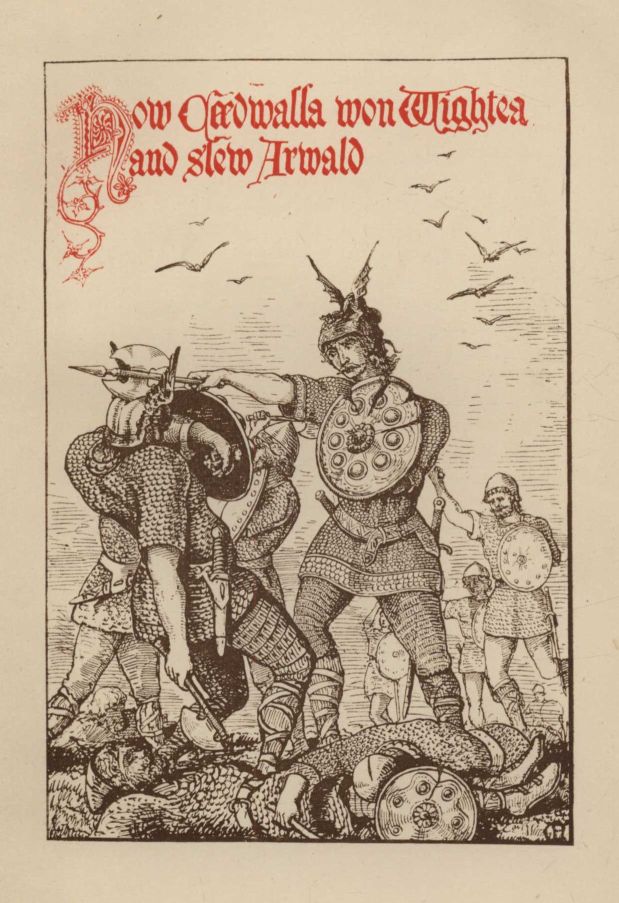
How Cædwalla won Wightea and slew Arwald
But that noble king was scarcely able to receive the congratulations of his supporters. He strove to remain standing, but the scene swam before his eyes; he forced himself to speak, but the words would not form themselves on his lips, and he would have fallen heavily on the ground had not two or three of his attendants run to support him. They laid him gently on the grass and stanched his wounds: both cuts were fortunately clean ones, and a simple bandage round the arm prevented much loss of blood there; but the cut in the neck was more serious. Ceolwulf was sitting near, a grim and satisfied expression on his weather-beaten face. The blood was oozing from the wound in his chest, but he was doing nothing to stop the bleeding. His eyes were fixed on Cædwalla's pale face, and he was muttering some grumbling remarks to himself. The little grassy platform high up on the hillside, so lately the scene of desperate, relentless strife, was now covered with dead or dying men, and the few survivors were too worn out to do more. They sat or reclined on the sward, waiting for the rest of their comrades to come up. The sun had now set, and the cold breeze of evening blew keen on that elevated spot.
Presently a West Saxon eorldoman rode up, attended by a few footmen, and gazed at the silent group. Seeing Cædwalla, he dismounted, and hastily went up to him, fearing the worst, but was reassured by the men who sat beside him.
"We must carry him down from here," said the eorl. "Get you as many young withies or hazel boughs from the copse down yonder," he added, turning to the men who had come with him, "and make a litter for your king."
Then he mounted his horse, rode to the brow of the hill, where the now numerous band of survivors were clearly seen in the valley below, raised his axe, on which he had put the helmet of Arwald, high above his head, and shouted, in a voice that rang over the silence of the hills:
"Long live Cædwalla, king of Wessex, Sussex, and Wihtea!"
Directly after a ringing cheer could be heard in the valley, and even the exhausted warriors on the summit joined in the shout of triumph. Again and again the cheers rang out, and rapidly the news spread over the island.
The men with the litter now returned, and carefully Cædwalla was lifted upon it. The movement caused him to open his eyes, and they happened to fall upon Ceolwulf. The king feebly beckoned him to his side, and, as the old man slowly and stiffly came up to him, the wounded king said: "Ceolwulf, old man, I owe my life to thee. Ask me what thou likest, and thou shalt have it."
But Ceolwulf made no reply. He merely shook his head slowly, and went on grumbling to himself.
Cædwalla was carried down the hill, and, as it was now too dark to go much further, the eorldoman who had taken charge of the little army gave directions that the king should be carried to a cottage near, and the rest of the men were to encamp around. With prudent foresight, another eorldoman had gone on with a party of men to make the country people bring them in provisions, and the victors were supplied with necessary food after their hard day's work.
The wounded men were cared for, and proper guards were set to keep watch during the night. Nothing, however, happened to disturb their rest.
The next morning the hardy West Saxons were all astir at an early hour, and parties were sent out to collect the arms and accoutrements of the dead, and to compel some of the inhabitants to help bury those who had fallen.
Arwald and those who died upon the grassy knoll of Chillerton Down were buried in five barrows, or tumuli, close to where they fell, but Arwald was honoured by having one all to himself.
Cædwalla had recovered consciousness for a short time in the early morning, and had given orders that Wihtgaresbyryg was to be occupied without delay, and all the able-bodied men throughout the island were to be slain as an atonement for the death of Athelhune and the other West Saxons.
It was evident he did not much realise the teaching of Christianity as yet, and the fierce spirit of his ancestors still burnt within him, unchecked by any softening influence.
Arwald had sent his two young sons away from the island as soon as he had received news of the probable invasion of Cædwalla, and they were in hiding near Stoneham, or as Bede calls it, ad Lapidem, a little village or manor to the north of Southampton. Cædwalla had given orders, in accordance with his vow, to kill all of the race of Arwald, and he expressly directed that search should be made for all his descendants and relatives; but these terrible orders could not be executed immediately, for much had yet to be done.
Ceolwulf was despatched to Binbrygge-ea with directions to see that Ælfhere and his sons were restored to their lands and possessions; and he was also charged with seeing that a force of men were levied to assist Cædwalla in getting in supplies and helping to crush the western and southern part of the island. The boats were to be sent round from Brædynge Haven to the north of the island, and one boat was to be sent over to Selsea, to report the success of the expedition, and to bring over Wilfrid, if he would come. The rest of the little army, now thoroughly recruited, although sadly diminished in numbers, marched on Wihtgaresbyryg, expecting to meet with a stubborn resistance; but Arwald had led out all the fighting men with him, and owing to the skilful way in which Cædwalla had thrust himself in between Arwald and the fortress, none of the routed force had been able to escape to it.
When, therefore, the West Saxon host appeared before its walls, they found the gates thrown open, and they had no more fighting to do. Cædwalla was carried to Arwald's house, and all men throughout the island knew that the power had passed from the nominee of Mercia to the kingdom of the house of Cerdic.
The eorldomen, who managed affairs during the illness of Cædwalla, acted with determination and relentless cruelty. The wretched Wihtwaras were hunted down and ruthlessly slain in strict fulfilment of the orders of Cædwalla.
But the king of the West Saxons himself lay ill, and mostly unconscious for the greater part of the next few days, and at last his faithful followers began to despair of his life, and all men longed for Wilfrid to come.
Ceolwulf had returned to Brædynge, and there, after having done all he was ordered to do, and arranged for the return of Ælfhere, had succumbed to the wound he had received, and which he had neglected. For some days he lay between life and death, but the faithful brother Malachi and Ædric nursed him well, and he and Wulfstan were laid in the same room for convenience of attendance. Ælfhere, the eorldoman, had been making great progress towards recovery, but it was observed that, as he grew stronger, he seemed to be less vengeful. The self-devotion of brother Malachi, who had saved his life at the risk of his own, and the unexpected and unaccountable solicitude of old Deva, had caused him to think over matters seriously; and he could not help being struck by the fact that there were noble actions, as brave as any performed in fighting, which arose from some hidden spring of conduct.
The fugitive tenants and small freeholders who looked to the eorldoman for protection had all returned to their homes, and things round Binbrygge-ea and Brædynge looked much as they did before the late exciting events.
The stockade was visited, and the dead all buried, care being taken to honour the defenders with a specially large tumulus high up over Binbrygge Down.
Malachi longed for news of Father Dicoll and brother Corman. He had heard of the adventure on the mud from Ædric, and was horror-stricken at the account he gave of what he had last seen of Father Dicoll, but was cheered by hearing that Ædric had since heard how Father Dicoll was taken into one of the cottages, and had been carefully attended to, and was probably by now quite well again.
Ædric had been told of his father's existence the day after he arrived. At first he could hardly believe the news, so joyful did it seem; but when he fully realised it, he only waited to know exactly where he was concealed, and then went off as fast as his lame leg would let him, in spite of all remonstrances, to find his father.
Fortunately he was met by one of his old servants, who was leading back a cow that had strayed away from the rest of the cattle, and thus he was able to have a ride; for the old cowherd, seeing how lame his young master was, lifted him up, and set him on the broad back of the patient beast, and he soon reached the secluded dell overlooking the sea under the great white cliff where his father was lying hid. The boy stole down softly to the side of the little wattled shelter that had been made for the wounded eorldoman, down close to the shore under a high pinnacle of red, sandy cliff, which here forms a striking contrast with the dazzling white of the lofty chalk precipice on the westward side of the tiny bay. The little cabin was difficult to find; it lay in a retired chine, and was carefully hollowed out of the soft sand under the over-arching shelter of thick bramble bushes and tall ferns. The perpetual sound of the breaking sea at the foot of the cliffs deadened any sound of voices.
Ædric approached quite close to the entrance: all was silent; he peeped in. There lay his father, pale and worn, his eyes closed; he appeared to be dying. Ædric stole in on tip-toe. His father moved; his eyes opened.
"Father!" said Ædric. The wounded eorl looked round.
"What, Wulfstan, my boy, is it thou? How goes the battle?"
"Father, it isn't Wulfstan: it is I—Ædric."
"What, Ædric! my son! Am I dreaming. How did'st thou get here?" and the father stretched out his hand for his son to come nearer.
"Why, it is Ædric, my own son—my boy! my boy! I thank the gods thou art returned to me. There, bless thee, my son; sit down and tell me all that has happened to thee."
And Ædric sat down, and, taking his father's hand, told him everything. As the old eorldoman heard of the kindness of the monks or baldheaded ones, and the splendour and power of Wilfrid, he murmured over and over again:
"Truly these are great men, and they know more than we. They can bear pain as well as we can, and they can rule without fighting; but I think they miss a good deal by that. But perhaps, after all, there is more to be got without it. I don't know though; if I get better, I will think over this."
CHAPTER XXIII.
"THE CONCLUSION OF THE WHOLE MATTER."
A few days after the decisive battle near Chillerton Down, Ædric, who had been sitting with Malachi and the invalids, went out to get some fresh air. He wandered up the hill behind the homestead to a freshly-raised mound on the hill side, looking away towards the Sussex shore, and commanding views of the far distant Andreadesweald. Here Athelhune had been buried, with his arms and battle-axe, like a free Saxon eorldoman, with his face towards the East, looking to the woods and the land where he had fought so well for his friend and king, Cædwalla, in the time of his adversity.
Ædric sat down on the newly-laid turf, and gazed towards Selsea. As he sat he fell into a deep reverie. He thought over all that had passed since that awful night when Arwald surprised their home, and he and Wulfstan and Biggun had had to fly over the water, they knew not where. He thought of the fearful slaughter that had since taken place; the dreadful suffering of the poor people, driven from their homes; the death in battle, in cold blood, and in misery of so many human beings. He saw how poverty, hunger, wretchedness, fell upon every one by the perpetual destruction going on. Cædwalla was nearly dead; Ceolwulf was prostrate; Wulfstan was only just showing signs of recovery; brother Malachi had received a desperate wound; Athelhune and Osborn were dead; and Wulf the Atheling might be dead, too, for all he knew; while his father, Ælfhere, as well as himself, would bear their wounds to their graves with them. And yet they and their party were victorious. They had won all the glory, all the land, all the wealth; and this was what their noblest, most cherished ideas pointed to. Could anything be more complete? Arwald was dead; all his bravest warriors were dead too, and all the rest of his supporters were being ruthlessly hunted down and slain. They were drinking to the full the cup of victory. Could anything be more triumphant? What more could heroes do? They had gloriously chopped in pieces their enemies, and were entering into possession of their goods. But meanwhile the people were mostly starving, and the women and children were suffering terribly; but
"Things like that, you know, must be at every famous victory."
And then Ædric thought of the monks—their kindness, their simplicity, their total surrender of themselves for others, their perpetual striving to conquer what, he could not help seeing, might make an individual great according to a slave's idea of greatness, but could only make all others miserable. For what was it the monks strove to overcome? Certainly nothing of anybody else's belongings, but their own passions, their own want of charity, their own worldly desires, their own incomprehension of the love of God; in fact, the world, the flesh, and the devil. And then he thought of the dead man below him, and he remembered all that had been told him of the shortness of this life and the certainty of death, and after death the judgment; and he remembered how terrible it had seemed to him, as Father Dicoll talked, if he should die, and have to enter upon eternity without having tried to follow the Christ-life while here on earth. The words of the Master, Christ, had often been told him, when He said, "Verily, I say unto you, inasmuch as ye did it not to one of the least of these, ye did it not to Me; and these shall go away into ever-lasting punishment, but the righteous into life eternal." Truly, death was very near; would it not be better to give up everything for the love of God? What could the world offer to him that for the brief space of this life could make up for the loss of life eternal? The truth of the question he had so often heard from brother Corman came back to him—What would it profit him if he gained the whole world and lost his own soul? or what could he give in exchange for his soul?
As Ædric thought over all these things, his eyes were fixed upon a distant speck beyond the entrance to Brædynge Haven. It was a boat, and was coming fast before the north-east breeze. For some few minutes he dreamily watched it. He saw it enter the narrow mouth of the harbour, and wondered who could be in it. The men on board evidently knew the channel. As the boat drew nearer his interest increased. "Who could it be?" And then it flashed across him that it must be Wilfrid. He jumped up with excitement, waited a minute to make certain, and then ran down as fast as he could, burst into the room where Malachi was, and shouted out the news.
All was bustle in the homestead. Ælfhere was anxious to receive the great man properly, and all the servants were sent here and there, and the cackling among the fowls told of slaughter going on there. Some of the servants were sent down with Ædric to receive the bishop.
It was as Ædric had guessed: the boat ran ashore, near the hard; the servants hastily put out boards on a trestle for the bishop to land, and presently Wilfrid, Hildila, and Bernwine disembarked on the shore.
The greeting between Ædric and the bishop was cordial, and Bernwine patted him on the head, with a pleasant smile, saying, "I told thee I wanted to see this island of thine, and here I am." The party then went up to the homestead, Ædric pointing out objects of interest as they went. The Wihtwaras were much impressed with Wilfrid's appearance, and the respect their young eorl paid him, as well as from the report of the magic charms he had with him, and which were relics he had brought from Rome.
Ælfhere welcomed his guests courteously, and the rest of the day passed in pleasant talk. Malachi asked eagerly after Father Dicoll and Corman, and was delighted to hear that both were well, the former having quite recovered from his wound, and that they sent him affectionate greetings. A messenger was despatched at once to announce the arrival of the bishop, and ask for instructions.
Ælfhere was pleased, as well as all his household, at the gentle manners and interesting conversation of Wilfrid and his attendant priests, and the evening passed away in pleasant intercourse. The stories Wilfrid had to tell of foreign lands, and the wonders of Rome, astonished every one. There was nothing he could not talk about; and when he asked permission, before retiring to rest, to have a little service in the hall, Ælfhere willingly gave his consent, and was much impressed with the earnestness, as well as ceremony, of the Christian ministers. There had never been seen anything like it, and all the household retired to rest awestruck and interested.
The next morning the messenger returned from Cædwalla, desiring that Wilfrid should come to him at once. The bishop, therefore, took an affectionate leave of his hospitable entertainer, and went off to Wihtgaresbyryg, leaving Bernwine behind to instruct and convert Ælfhere, already thoroughly predisposed to accept Christianity, through the example of Malachi and old Deva, to whom the late intercourse with Malachi had been a great happiness.
Ædric accompanied Wilfrid and Hildila, and when they arrived at the castle of Wihtgar they found there was some important discussion going on. When they entered the courtyard they found a few men loitering about, all armed and fully equipped for some expedition, and the eorl in command was just bidding them to fall in, as a tall, noble-looking man came out of the house where Cædwalla was lying. His face wore a sad look, and he walked past Wilfrid and his party without appearing to see them. He was dressed in monastic garb, and his head was bare, showing the tonsure cut in the orthodox western fashion.
Wilfrid inquired who he was, but no one knew. As soon as he had joined the eorldoman, the armed men defiled through the gate, and went down the hill towards the Medene, where the mast of a boat could be seen over the woods that lay between the creek and the castle; for the new port had not yet risen at the head of the estuary.
As soon as it was announced to Cædwalla that Wilfrid had come, he gave orders that he should be at once admitted, and the bishop was ushered into his presence.
The wounded king was lying on a couch, looking pale and worn. The wound in his arm had healed, but the severe cut in his neck had proved a difficult matter, as Cædwalla was impatient of control, and chafed at his enforced inaction. At the entrance of the bishop he tried to rise, and was only induced to lie down again by the urgent remonstrances of Wilfrid.
"Thou seest, bishop, thou and I can never meet without my having gained a victory. Truly, the more often I meet thee, the better I shall be pleased."
"I trust, my son, thou wilt have no more enemies to fight. The Lord has been merciful to thee, and saved thee in the midst of great dangers. I hope thou wilt be spared to perform a good work among the people He has committed to thy charge."
"I hope so too," answered Cædwalla coldly. "But I call to mind thy telling me how a great heretoga and chieftain led his people into a promised land, and slew every man, woman, and child of its former inhabitants, and thou saidest he was a man approved of by thy God. I have tried to do the same. There will not soon be any of these Wihtwaras left. I trust I shall receive thy blessing for the thorough way I have tried to imitate that eorldoman Joshua, as thou calledst him."