CÆDWALLA (continued 5)
Reading edition
[1] I have not ventured to convey literally the harsh expressions of St. Fulgentius, nor in this chapter or elsewhere have I attempted to render the severity of the early monastic ideas. In a rude age, and with the perpetual recurrence of awful crimes, severe measures and pitiless conclusions were necessary—but in a work intended for the young, it is better not to represent the full force of religious thought in the 7th century.
After this little discourse, Wilfrid arose, and saying that he would send Bernwine to them in a little time, left the refectory.
"He seems much better than I had expected," said Ædric to Corman, "but I don't think I could ever talk to him as I did to Father Dicoll. He seems as though he knew too much."
"I daresay thou wilt find Bernwine easier to talk to, although Father Dicoll could not have talked to you in a kinder way, or told you anything better. It is not with children Wilfrid would show anything that Father Dicoll or I should disapprove. He is far too wise and good a man to let children see that there are controversies among Christians, and I sometimes think we have done wrong in letting thee know that we differ on some points from the Bishop. If we have erred, may the Lord forgive us; but, truly, the heart of man is desperately deceitful and wicked, and the Evil one is always on the watch to catch one tripping. But here comes Bernwine. Now, I hope thou wilt remember all Father Dicoll and I have tried to teach thee."
As Corman spoke, Bernwine entered the refectory. The ecclesiastic who now appeared, had not contrasted favourably in appearance as he sat next Wilfrid. He was strongly built, stout, and florid in complexion; but his bright, black eyes twinkled with a kindly expression when he spoke, and the corners of his mouth had an occasional twitch, which added to the humorous way he had in talking.
"Well, my son, and so thou hast come to the island of the seals, hast thou? truly an amphibious kind of place at the best of times; but when it blows a gale, it is really hard to see where the dry land is. The sea flies over us in such sheets that I verily believe there won't be much island for the seals, or anyone else soon. And how dost thou feel after thy day on the plank bed, in the midst of the mud?"
Ædric was amused at the priest's garrulity, and said that he felt very nearly well.
"That's right, that's right. Thou wilt soon be able to walk to matins, complines, and vespers; and we'll give thee a job in the garden that will just suit thee."
"But mayn't I learn to read, and hear stories out of that splendid book?"
"All in good time, my son, and each in its place; doubtless, thou hast learnt many stories all the time thou hast been nursed by our kind brother Corman here."
"We have done all we could to awaken in him a lively faith in our holy religion," said Corman.
"I doubt it not, my brother, and the good seed will bear happy fruit some day. And so thou comest from Wihtea? Well, now, I have looked at that island many a time, for we can see it quite plainly from the shore, and wondered who lived there. I come from a very different part; my home was in Bernicia, on the borders of Deira. Thou rememberest Gregory's pun—De ira Dei? No; of course thou dost not—how shouldest thou. Thou never learnedst Latin. Ah! but we will teach thee; dost thou know anything at all?"
"Yes, I know many things. I can row, I can hit a mark with my bow and arrow at sixty paces, and I can ride."
"Ah, all excellent accomplishments, I don't doubt; I could do most of them myself at thy age; but that was not what I meant. Canst thou say any prayers? Dost thou know thy letters? Hast thou ever had the Bible read to thee?"
"I can say 'Our Father,' in Latin as well as English. I do not know any letters. Father Dicoll had no books, and so he could not teach me to read; but he tried to teach me my letters, when I lay outside the hut, by scratching them on the sand; but as there were stones in the way, I couldn't always make them out. But he used to say long pieces of tales from the Bible. He told me often about David, and that big giant: about a great ship that took in all the animals, and about a magician whom the lions would not eat."
"I see thou hast profited by thy stay at Boseham. We must see that thou dost not lose what thou hast learnt, and, perhaps, we may even add something to it. Now, the first thing is to explain to thee how thou wilt pass thy time here. Thou canst not yet do as the others do, for thou canst not move about freely; but I will tell a boy to take care of thee, and always help thee to move when there is need, and to be a companion to thee; his name is Sigfryd, and he is the son of the South Saxon Eorldoman Tosti. He will like to help thee, for he has been taught that 'whosoever will be great, let him be as a servant,' and again, that we should 'bear each other's burdens, and so fulfil the law of Christ.' For the present, then, thou wilt get up at seven and come to matins, then thou wilt spend an hour learning to read: then thou wilt have breakfast. After that, Father Hildila will teach thee the holy life, and Bible history. Then at noon, thou wilt try and take a little exercise, with Sigfryd's aid; which over, thou wilt come to me, with the other boys, and learn the meaning of the prayers and daily services, and practice responses and chaunting, according to the method of the sainted Gregory. After that, the bell will sound for service; thou wilt then go back to thy cell and meditate on all thou hast learnt, remembering to ask me such questions as have occurred to thee—— But Beate Martine! what is all this racket and noise about?" broke off Father Bernwine, as a confused din of shouts, and cries, and struggling, resounded outside, mingled with the tolling of the bell which summoned all the community to assemble in the hardly-finished stone church.
Bernwine and Corman instantly ran to the door, and were nearly knocked down by a crowd of men; some armed, some without arms, rushing into the room.
"Holy Benedict!" exclaimed Father Bernwine; "but who are ye, and what do ye want here? breaking in upon our pious meditation, with no more compunction than a wild hog into a garden of cucumbers. What means it all?"
One of the intruders, more collected than the rest, answered:
"Be not wroth, holy Father; to implore pity, shelter and protection, we have come. We have no wish to do thee injury, and will go where thou mayest appoint, if only thou wilt save our lives."
"Surely, man; but who threatens thy life? What means this noise and tumult outside? Let me get out to find Wilfrid; he may be slain in all this confusion, for aught I know."
All the while the bell kept tolling, and the burly form of Bernwine forced a way through the crowding mass. Outside there was even worse tumult. Men on horseback were galloping about—a few, who seemed not quite to have lost all self-control, were forming themselves into some sort of order, and under the guidance of a few mounted eorls, were marching off to take up a position on the road leading to Cissanceaster. Bernwine could see that a great many were grievously wounded, and many had fallen to the ground either from exhaustion, or from the dreadful nature of their wounds. Hastily forcing his way to the door of the church, which was thronged with fugitives, the priest elbowed his way through the crowd, and entering the sacred building, he found Wilfrid robed in his full episcopal vestments, the rest of the community drawn up in processional order, and Hildila carrying the cross of the Arch-episcopal see of York, before Wilfrid.
"What means all this tumult, quare fremuerunt gentes, holy Bishop," said the panting Bernwine.
"It is the rout of the Eorldoman Berchthune and Andhune by Cædwalla, whom they rashly strove to oppose. We must perform the noblest duty of a Christian shepherd, and guard the flock from the edge of the sword. That is why I ordered the bell to call us all together, that we may all go forth to turn away the wrath of the victor."
All being now ready, the choir led by the melodious voice of the chaunter, Ædbert, raised the Psalm, "Eripe me de inimicis meis, Deus meus, et ab insurgentibus in me, libera me," and slowly defiled through the thronging mass of fugitives.
As the procession, so entirely novel to the uncultured South Saxons, made its way across the open space between the church and the rest of the buildings of the little community, the panic-stricken crowd seemed to recover something like self-control, and many of the men followed or accompanied the procession. Wilfrid had given orders that they were to proceed slowly along the road towards Cissanceaster, in the hope that he would fall in with Cædwalla, and prevent any further fighting; for he had learnt that one of the South Saxon eorldoman still kept up a hopeless struggle, while it was reported that Berchthune was slain. With great difficulty, and at a very slow pace, the white-robed choir, the grey frocked monks, and the gorgeously vested Wilfrid, stemmed the still hurrying bodies of fugitives that drifted away from the rout ahead. Nearer and nearer came the shouts of the combatants, the flash of an axe, or the gleam of a spear, showed where blows were being given, and the clang of metal striking metal rang like an army of rivetters engaged in their noisy toil. Many of the rallied South Saxons were ready to rush forward to renew the fight, but the voice of Wilfrid restrained them, and in obedience to a sense of awe, which his presence always excited in their superstitious and ignorant minds, the men restrained their ardour, and waited to see what would happen.
Wilfrid, with the eye of a leader, at once saw that in the heat and confusion of the fight, his little company might easily be swept away; he therefore directed the leading priest to turn to one side and lead the procession to an embankment or little knoll on the way side, large enough to contain all the community. There stationing himself in the most conspicuous position, with his cross held aloft by his cross-bearer, surrounded by his clergy, and flanked by his choir of fair Saxon boys, he calmly awaited the approach of Cædwalla.
The stream of fugitives flowed past him uninterruptedly. At last a struggling band of horsemen, leading among them the fainting form of an old, grey-bearded warrior, his helmet hacked, the hawk's wings gone, one arm hanging down limp and useless, the other aimlessly holding the reins of his horse, came past in wild confusion, hard pressed by a victorious troop of warriors, flushed with victory, and striking mercilessly at the panic-stricken fugitives; brilliantly conspicuous among them was Cædwalla, his eyes flashing, his hair streaming behind him, on his head a steel cap, surmounted with a golden dragon, his steel-ringed hauberk gleaming in the sun. Both hands grasped his two-edged battle-axe, and the reins hung loose on his horse's neck; while the terrible axe flashed, and sank and flashed again, as he hewed his way up to the scarcely resisting band of South Saxons, who still strove to save their wounded eorldoman, the devoted personal following of the chief, who scorned to live if their lord were slain.
As the young king, looking the very impersonation of the god of battles, intoxicated with the strife, came abreast of Wilfrid, the Bishop called aloud in a clear, commanding voice:
"Cædwalla, my lord, put up thy sword now, and give thanks to God, who hath given thee the victory. As for the vanquished, I will answer for it, they shall not trouble thee. Hearken now to the voice of the Lord, who speaketh through me, His unworthy servant, and shed no more innocent blood. Remember, 'Vengeance is Mine, saith the Lord, I will repay'; and again, 'Whoso sheddeth man's blood, by man shall his blood be shed.'"
At the first sound of the clarion voice of the Bishop, Cædwalla had reined in his horse, and when he saw the striking group of calm men surrounding the ascetic and commanding figure of the celebrated Bishop, he at once gave orders to stop all further fighting, and turned his horse towards the speaker.
The scene was a very picturesque one. The handsome, bronzed face of the victorious young king, looking every inch a daring soldier, as well as commanding chieftain, mounted on a powerful white horse, whose trappings were adorned with large gold studs, mounting bosses of cairngorm and polished agate stones. Behind him a fierce band of eager warriors, eorls, and chiefs of the West-Saxon kingdom, with here and there the weather-beaten face of some of his own faithful band of outlaws, who had stood by Cædwalla in his desperate fortunes. In front, the tall figure and noble countenance of Wilfrid in his gorgeous robes, standing on the highest part of the little knoll, his cross-bearer holding the golden cross, richly embroidered with crystals and agates; the white surpliced choir mingling with the darker robes of the monks. Above, a cloud-flecked sky, bright and changing, casting flying shadows over the brown land, wind-blown and desolate, while all around were masses of men still flying in wild panic, or falling in death from the effects of their wounds. All these combined to make a striking picture.
Cædwalla, not yet a Christian, and seeing only in Wilfrid a wise man, and one who had seen much of the world, besides being surrounded with a halo of superstition, as the possessor of talismans and charms far above all others in England, was also mindful of the benefits he had lately received from him; with wise policy, therefore, he at once saluted the Bishop, and gave orders to stop all further slaughter.
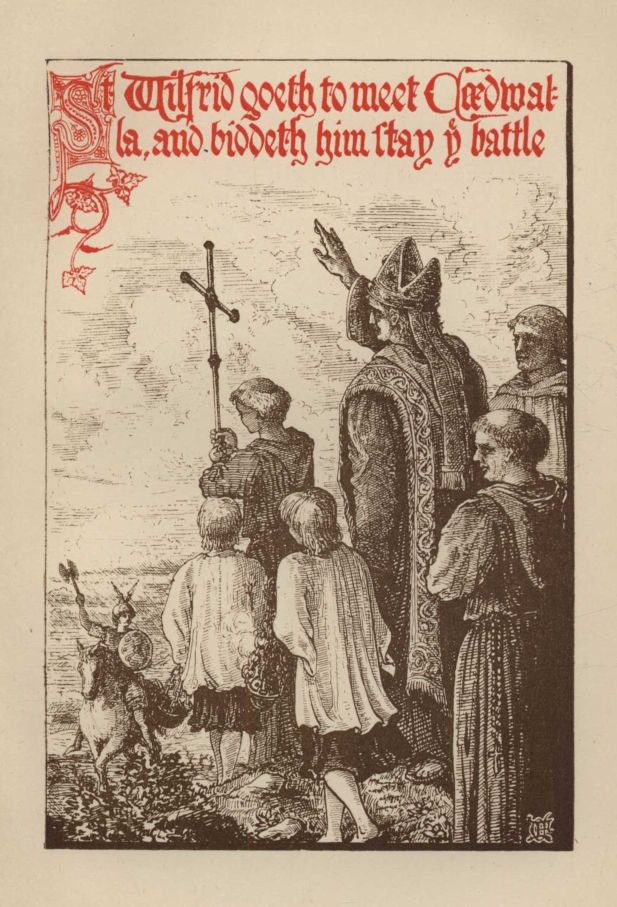
St. Wilfrid goeth to meet Cædwalla, and biddeth him stay ye battle
"My Father," he said, "I am fortunate in my meetings with thee. The last time we met I was a king, and now the next time, behold, I am king again, and this time my title is far above that of a petty prince of the South Saxons, and each time victory had smiled upon my arms."
"Give thanks, therefore, to the God of Hosts, my son, and humble thyself before the mighty hand of God, who bringeth down the lofty from their seat, and raiseth up them that are of low estate. But wilt thou and thy faithful adherents come back with me? Such as our poor community can offer is freely at thy service, and thou canst rest thee after the dangers and fatigues of the past day."
Cædwalla willingly accepted; and the little procession turned towards the settlement, raising the psalm, "Jubilate Deo, omnis terra, servite Domino in laetitia," followed by Cædwalla and his retinue. Arrived at the open space before the buildings, Cædwalla gave directions to his chief eorldoman to see that his men were kept well in hand, and to encourage the South Saxons to go to their homes peaceably. Parties were sent out to forage, and one band of warriors was sent back with the most important prisoners to garrison Cissanceaster, and take measures for pacifying the district. Cædwalla then entered the refectory, which had been cleared of all the fugitives, and where hasty preparations for an impromptu feast were being pushed rapidly forward, under the practical eye of Bernwine and Eolla, the cellarer.
The feast that followed was much like previous feasts, excepting that there was more order and ceremony. Cædwalla recognised his young friend Ædric, whom he had first met in the boat with Biggun and Wulfstan, and asked him what news he had of the expedition, and when he heard that no news had come, he looked grave.
The rest of the day passed tranquilly enough. Cædwalla had much to arrange with Wilfrid, and also received much sound advice from the prelate.
About dusk a monk came in, and reported that the sky all above Wihtea seemed on fire, and flames could plainly be seen arising from the hills at the east end of the island, and all men were marvelling what it could be. Cædwalla and Wilfrid hastened out to look, and when they got to the door, a wonderful sight met their eyes, a vast blaze was going up to the sky, and lurid smoke was spreading over the heavens. As they were looking, there was a commotion in the crowd, and a wounded and reeling warrior half staggered, was half supported, to where Cædwalla and Wilfrid were standing.
"Beate Augustine!" cried Wilfrid, "What more destruction has happened?"
CHAPTER XVII.
"IN THE LOST BATTLE, BORNE DOWN BY THE FLYING."
The night after the old eorldoman, Ælfhere, had been brought back to his homestead at Brædynge, passed away peacefully enough. The outposts were relieved at the proper times, and no movement of any kind was detected from the direction of Wihtgarsbyrig. The next morning Wulfstan woke up, and it took him some few moments to realise that he had ever been away from home, all the past week's adventures appearing like a dream. He was on his own bed in his own room, which he shared with Ædric, and the absence of his brother first brought back the reality of past events. Soon afterwards, the voice of old Biggun outside roused him from his dozing reverie. He sprang out of bed, hastily performed his simple toilet, and went quickly into the dining hall. There a not unusual sight met his eyes, for after every festival the dining hall formed the sleeping-place of those who had succumbed to their too-convivial propensities, and there had been no exception in last night's entertainment. Stepping across the prostrate Wihtwaras, Wulfstan sprang into the open air, rejoiced to see around him all the well-known home life. Although a great slaughter had fallen upon the poultry, who had suffered from a double attack, for Arwald's people had not stinted themselves, and yesterday they had every reason to regret the restoration of their lawful lord, there yet remained a promising brood. The lowing of some cows from a shed near, showed that all the animals were not killed. Crossing over to the shed, the boy found an old friend of his, the cowherd, Stuff's father, milking the cows.
"Why, Wulfstan, how thou beest grown, and they tells me thou hast done lots of things; but these have been sad times. The work I have had to please those villains Arwald left here! But they tell me thou hast killed one of them. Only think of that, now!"
"Oh, that was nothing. But dost thou know I saved old Biggun's life? He never told thee, I know."
After drinking a horn full of milk, the boy rushed off to explore his former favourite haunts, and did not return until the loud blast of a horn announced some important event. When he got back, he found the morning meal was nearly over in the great hall. Athelhune and Wulf were still sitting at the table, and Ceolwulf was listening to the report of one of the ceorls, who dwelt a few miles away on the Æscing Down[1] side of Brædynge. Ceolwulf's face looked grave, and after he had heard all the man had to say, he turned to Athelhune, and muttered a few words to him, upon which a consultation in a low voice was carried on by the two chieftains and the old man.
[1] Ashy Down.
Ælfhere was lying on a couch in a sheltered part of the hall, and brother Malachi was sitting up by his side with his arm in a sling. Wulfstan went up at once to his father, and was pleased to find that he still continued to gain strength, and rejoiced that brother Malachi was fast recovering from the hardships and wounds he had suffered. He then set to work to make up for the missing breakfast, and paid no further attention to anybody until this serious duty was satisfactorily performed.
Before he had finished, Ceolwulf left the hall, accompanied by Athelhune, while Wulf sat gazing vacantly before him, and caressing a large wolfhound, who was resting his head on his knee. Presently the prince got up, and, stretching himself, strolled out of the room, saying as he did so to the wounded Ælfhere, that he was just going to see how things were passing outside.
The news that had arrived was very serious. Arwald was on the march, with nearly the whole force of the Western Wihtwaras, to crush the little party that had so boldly effected a lodgement on Binbrygge-ea.
Ceolwulf had at once hastily sent out to fetch in all the following Ælfhere could count on. The bravest had unfortunately fallen fighting round their lord in the first assault and capture of the homestead, but a good number could still be reckoned on who would be likely to give a report of themselves in an encounter with the enemy. But the force that was on the march against them was treble, nearly quadruple, the number they could hope to oppose to them. Arwald fully realised the importance of crushing this little band of enemies before Cædwalla arrived in the island. And he had received sure information that he did intend to arrive and re-assert the dominion of Wessex as soon as ever he had settled with his opponents among the South Saxons.
No time therefore was to be lost if Ælfhere's men hoped to save their lives. The question which most seriously presented itself was whether they would abandon the old homestead, and retire to the ruins again, or retreat still further to the stockade Athelhune had made the evening after their shipwreck, on the summit of the wooded hill under Binbrygge down.
Ceolwulf and Athelhune were in favour of this plan, but Wulf liked the comfort of the old house and the abundance of good cheer which he saw around him; he was naturally reckless and preferred a positive, although precarious comfort, to a certainty of discomfort and a doubtful safety.
Ceolwulf was convinced that all would be lost if they remained at Brædynge. He knew the certain destruction that would await them, and urged that their only hope was to take up such a position as should enable them to hold out until Cædwalla could come or send them reinforcements; and they would send at once to tell him of their situation. Strongly stockaded as they would be at their old post, with the creek at their feet, dense woods behind and around them, and many defensible positions between them and the place where they had left the old boat; there they could fight with every advantage to themselves, and disadvantage to Arwald. To these arguments all that the Atheling Wulf replied, was by saying they were good men enough to fight any number of beggarly Wihtwaras, and he didn't see why he should stir out of comfortable quarters for anyone. The matter was at last referred to Ælfhere, who at once decided they must give up all hopes of defending the homestead, and must retire to the knoll above the Yare, locally known as Yaver wood. At this decision the Atheling Wulf was much dissatisfied, but there was no good disputing it, for he had only brought two men with him, and Athelhune quite agreed with Ælfhere.
All was now confusion. The neighbouring ceorls and thralls were rapidly coming in, and with them came such of their worldly goods as they could carry. Their wives and families accompanied them, and the dismay was universal when it was known that the homestead was to be abandoned, and all would have to cross to Binbrygge-ea, or be left at the mercy of Arwald. And what that mercy would be after this rising against his authority, all knew; and none were anxious to experience. Many would have liked to go back to their homes, but the thought that their lot would not be much better, deterred them; indeed it might be very much worse, for Arwald would be sure to plunder them although he might spare their lives, while in the event of Ælfhere being able to hold out until Cædwalla arrived, and victory then smiling upon their arms, as was not unlikely, a terrible punishment would await them at the hands of their justly enraged lord. Moved by such considerations, the crowd of armed ceorls with their households, and such belongings as they had brought, prepared to cross the ford over the Yare as the tide was now low, and make the best of their way to the wild fastnesses of Binbrygge-ea.
Athelhune and Ceolwulf showed much judgment in the direction and management of this heterogeneous mass, and Wulfstan, to his great joy, was allowed to act as a kind of aide-de-camp to Ceolwulf. The fighting men were sifted out, and formed up with the Boseham and West Saxon warriors. These numbered not more than seven men altogether, without counting Athelhune, Ceolwulf and the Atheling Wulf, each of whom, however, counted as hosts in themselves, for they were thoroughly experienced, toughened warriors. Including all the fighting men available, there was a respectable force of more than a hundred men. This body, on the whole well armed with shields, axes, spears, and swords, while some few possessed bows and arrows, was placed under the command of Wulf the Atheling, out of compliment to his rank, and were not to march until later in the day. Wulfstan was still more delighted at being told to get all the boys together and make them collect all the stones they could find, the sharper the flints the better; many of the boys possessed slings, and like boys of all ages in the lower order, were excellent shots at bringing down rabbits, or birds sitting. Ceolwulf had counted on this assistance to annoy the enemy on their advancing to attack the stockade. Ceolwulf himself had undertaken, with the aid of the most infirm and oldest of Ælfhere's servants, to go on with the crowd of ceorls and thralls who could be spared from the first fighting line under Wulf, and superintend the crossing of the ford, and then enlarge and perfect the stockade. The chieftains had carefully counted their time, and had arranged to have their forces concentrated on the Yaver hill before sunset. They reckoned that Arwald would not reach the homestead at Brædynge before the middle or end of the afternoon, that his men would be wearied with their march, and that, if they discovered where they had retreated, they would not attempt to cross the ford at high water, or care to stir at all for the matter of that, as all their food would either have to be brought with them, or they must go without, for it was carefully provided that every article of food, alive or dead, should be cleared out of the neighbourhood, and safely stored in the stockade, or else behind the protection of that little fortress, which commanded the only approach to the woods and commons beyond, between Binbrygge down and the Foreland, and which would serve as pasturage for the cattle. Thus Binbrygge-ea would form a little fortified settlement surrounded by the sea on nearly every side, and accessible only by the ford at low water, or else by the sandy beach which kept the sea from encroaching on the Yare; which stream must be in any case crossed before getting into the peninsula at all. Athelhune had undertaken the command of the outposts, whom it was most necessary to keep to their work properly; and it was arranged that as soon as his men caught sight of Arwald's column advancing, they should either make a pretended attack on the advanced body, and so drive them in on the main column, if the nature of the ground or Arwald's forces gave any opportunity of this being done without loss to Athelhune's men, or they should retire at once to the heavy troops under Wulf, and then the whole would retreat across the Yare in good order, and unseen by the enemy, who would find the old homestead totally deserted, and would most likely suspect some stratagem.
Everything was now perfectly arranged. The long line of straggling countrymen, with their wives, children, and cattle, had been slowly winding down to the ford across the Yare, for some time past, and were seen here and there among the bushes on the other side in their ascent to the woods behind Yaver hill. It was now a little past noon; there were many picturesque groups still left, however, seated around the homestead. Mothers looking after their little ones, and resting after the long walk they had already had before setting out again. Ælfhere and Malachi had been carried on litters down to the ford, and were already some way on the other side, and Ceolwulf had set all the able-bodied men who had reached the stockade, to fell more trees, clear the ground all round as far as possible, and enlarge the accommodation. It was not intended that the women and children should stop here. They were to go on with the less able-bodied men, and the cattle, and take shelter in a secluded dell under the Binbrygge down not more than a mile away, but in the midst of dense brushwood, and in a spot known only to the local inhabitants.
It was now getting on for two hours past noon. Athelhune had gone off with his band of skirmishers to try and get news of the enemy; not knowing the country himself he was compelled to have recourse to the aid of one of Ælfhere's servants for guidance. It would have been better if Ceolwulf had undertaken this service, but the pride of Athelhune would not allow him to superintend mere manual labour, however important, and so he was assigned the post of honour next to that of the Atheling Wulf.
Athelhune's guide led him up the route or track that passed behind the homestead, and crossing the ridge of Æscing down dipped again towards the central valley of the island. From this high ground the Wessex chieftain commanded a wide extending view; at his feet lay the wooded dell and half-ruined roofs of Ælfhere's homestead, beyond was the valley of the Yare, and the silver track of the stream as it meandered among the mud wastes of Brædynge haven to meet the incoming tide that would so soon convert the dreary swamp into a lovely lake. The little boat—a mere spot—in which Wulf, the Atheling, had come the day before, was lying high and dry near a shingle hard; across the Yare the long line of country people could be seen trailing like a long snake from the homestead below, till it was lost in the woods on the other side. The promontory or peninsula of Binbrygge, stood out in the midst of the sea, except where the long back of the magnificent down intercepted the horizon towards the south-east; far away, in the east, over the distant sea, could be seen a few dots edging the horizon. At that very moment among those dots which were the wind-blown trees of Selsea, Wilfrid and Cædwalla were discussing the invasion of Wihtea, and Ædric was wondering what had become of Wulfstan. The clear cloud-flecked sky looked down on a weary world. Wars and rumours of wars, and a people suffering much.
Suddenly one of Athelhune's men pointed to a spot far down below, on the southern side of the hill; a cloud of dust was driving before the south-westerly breeze; instantly Athelhune knew it must be the enemy; waiting one moment to take in the situation, he saw how perilous was their position. Not knowing the country, he had been ignorant that there was another road by which Arwald might come, and the guide, with the stolidity of a dull-witted Wihtwara, had never told him. The advancing cloud of dust was on a level with Athelhune, and he saw that it would be a race who should reach the homestead first. Mortified at the failure of his reconnaissance, and the imminent danger all would necessarily incur, he promptly made up his mind. Sending off the fastest runner of his men to tell the Atheling Wulf, Athelhune determined to descend the hill diagonally, and attempt a diversion in flank before the enemy should be aware of his proximity. Hastily calling to his men, he started at a rapid pace down the hill. There was not much more than half a mile between himself and the enemy, and he directed all his efforts to getting, if possible, to a clump of bushes which lay directly in the march of the advancing column. He hoped to be able to reach this unperceived, and then, by a well-timed rush, to throw the enemy into confusion, after which his men would all hasten back as fast as possible to join the Atheling Wulf. Full of this hope he urged his men to greater speed, and they were fortunately concealed from their foes by the cloud of dust which was carried towards them by the breeze.
Athelhune had with him about twenty men, all Wihtwaras, active men enough, but not well armed. However, he trusted more to their sudden rush, and unexpected appearance, for gaining his object, than to any real execution they could inflict on Arwald's men.
They had now reached the clump of gorse and thorns, where Athelhune rapidly explained what he intended to do, and impressed upon them the absolute necessity of the rush being simultaneous, determined, and rapid, and pointed out to the men that in this way only could their lives be saved. There was no time for more, already through the dusty veil the glint of spears and flash of armour could be seen, and a serried troop of horsemen came directly towards the clump of gorse behind which the little band was crouching. Athelhune could see that the advancing force was a strong one, the leading horsemen were all well armed, powerful men, and were evidently the most important eorldomen and chief ceorls in the island; the descendants of Whitgar, Stuffa, and their followers, who nearly two hundred years before had come to Cerdicsford, the modern Yarmouth, to help Cerdic. Among them rode Arwald himself, a powerful, thickset man, with bushy black beard, and coarse features, burly in form, and brutal in expression. He was clad in a loose mail shirt, his muscular arms were bare, and on his thick bushy hair he wore an iron helmet, adorned with the large wings of a heron. Behind him was slung a spear; at his saddle hung a huge two-edged axe, and a straight sword was suspended at his left hip by a chain across his right shoulder. He was laughing loudly at some jest of his own, and all were evidently in high spirits. Behind him was a body of some four hundred men, but all were not well armed, and very few were mounted.
Nearer and nearer the column advanced, in the confidence of their strength; and despising the numbers of their opponents, no scouts had been sent out, and all were marching at ease, and as if in a friendly country.
The leading files had passed the clump. Athelhune could hear Arwald saying, "By the golden hair of Freya, but we won't spare a man, woman, or child, this time."
Then Athelhune gave the signal quietly to his men.
Instantly with a wild yell the whole twenty men sprang up, clashing their arms, and rushing upon the column not more than ten yards from them. Athelhune had ordered them to strike first at the horses, and then, when the riders were down, if time were left, to attack the riders. In between the first and second ranks Athelhune forced his way, striking furiously at the hind legs of the horses of the leading rank, and the forelegs of the horses of the rank behind. He was ably supported by his followers, who plunged in behind him. The confusion and uproar were terrific; the frightened horses reared, plunged, and neighed horribly with pain, many came down bringing their riders with them, and in some few instances crushing their assailants in their fall. The horses of the front rank sprang madly forward, and such as had been hamstrung, struggled wildly with their forelegs, and then sank helplessly down. Many of them that had only received slanting slashes and had had no tendons severed, galloped madly away, in most cases throwing their riders at the first plunge. Hitherto the attack had been very successful, fortune, as usual, favouring the bold. Arwald had been one of those whose horse had fallen, and that burly chieftain had come heavily to the ground; but the fall of his horse had also saved his life, for Athelhune, determining to kill him, if possible, before they retreated, aimed a terrific blow at the Wihtwara's head, but the wounded horse at the same moment gave one despairing plunge, and kicking violently with its hind leg, it happened to strike Athelhune and break his leg with the force of the blow; seeing their leader fall, the few men who were behind him shouted to the others to escape while there was yet time, and such as were able to do so, extricated themselves from the plunging, writhing, mass of men and horses, and sped away towards the homestead. The success of this desperate onslaught was dearly purchased by the fall of Athelhune; it was true the onward march of Arwald and his men was delayed some few moments, and much damage was done to the horses, while some two or three of the men had been killed outright, and about ten more seriously wounded, either by cuts from the axes, or by bruises from their falls, several having had their legs broken by their falling horses; but the attacking party had also suffered severely, some having been crushed under the horses, and others having been kicked by the affrighted animals, as Athelhune had been. So that the sum total of the success of this act of devotion on the part of the West Saxon chieftain was the giving time for Wulf the Atheling to form his men, and evacuate the homestead, and the death or putting hors de combat of some dozen of their enemy. But these advantages were more than counterbalanced by the capture of Athelhune, and the desperate feeling of furious wrath now doubly aroused in the fierce Arwald.
Rising from the ground with difficulty, the chief of the Wihtwaras looked a truly awful spectacle. He was covered with blood; not that he had received any wound, but the blood from his fallen horse had flowed copiously over him as he lay on the ground. His eyes were red and fiery, like the wicked eyes of a furious wild boar. His first thought was to dash out the brains of his helpless assailant as he lay on the ground; but while watching his opportunity, for the struggling mass all round rendered a certain blow a matter of difficulty, a cruel thought crossed his mind, and he determined to spare Athelhune's life for the present. By this time the confusion had become a little less wild. The loud voice of Arwald shouted directions to the eorls who were nearest him, and in a little while something like order was restored. The mounted men were drawn up on one side, and the infantry were ordered to march past and then form up beyond, and halt until the casualties were counted up and fresh dispositions made. Athelhune was not forgotten. Arwald with a wicked light in his eye, had him seized by two fierce-looking Wihtwaras, and strict orders were given them to answer for him with their lives. It was found that fifteen horses were incapacitated or missing, and twelve men, among whom were five eorldomen and three ceorls of importance. More furious than ever, and burning to come to close quarters with Ælfhere's men, Arwald gave the order for the column to advance, but this time he took the precaution to send out some of the horsemen on either flank to act as scouts, and a small body some distance ahead as an advance guard. Arwald himself took the best horse he could find among those left, and the eorldoman who was thus compelled to give up his animal contented himself by taking another from one of the ceorls, who had to become a foot soldier, and was naturally very sulky in consequence. The whole episode, which has taken so many words, to describe, really only occupied a quarter of an hour but every moment was of importance, and the march was pressed on more rapidly to make up for lost time. In a few minutes more the advanced guard turned the foot of the hill, and came in sight of Ælfhere's house. At the same moment Wulf's men were descried hastening down to the ford, which was fast becoming impassable, owing to the rapidly rising tide. All the fugitives from Athelhune's force had not yet reached him, nor had all the tenants and dependants of Ælfhere yet got across the Yare. The news of the sudden approach of Arwald had caused the greatest consternation among these poor people, and all were hurrying down to get over the ford before it was too late. The position of affairs was at once reported to Arwald, who galloped up instantly to inspect the situation, giving orders for the rest of his men to come on at the double. With the quick glance of an experienced warrior, he decided that they must attack at once. He gave his men no rest, therefore, until he had brought them down to within a short distance of Wulf's men, who had not yet been able to cross the Yare, blocked as the ford was with fugitives.
Wulf, the Atheling, now that he saw his own supineness was likely to cause a great catastrophe, did all he could to remedy the evil. He drew up his men in the best way he could, and determined to stand on the defensive, for he saw that with so powerful a force within striking distance of him, if once he attempted to retire, destruction would await him. There was one thing in his favour—his men were all fresh, while Arwald's people were tired with their long march.
Arwald halted his men as they came up, and gave them time to recover their breath, an ominous sign to Wulf, who, seeing how leisurely Arwald was now going to work, knew that his foe felt sure he had caught them in his toils. Their position was very critical, almost desperate. In front, was a powerful force of nearly four hundred men led by a determined and infuriated chief; behind them, was an impassable stream, and no succour to come to them. Seeing the desperate nature of their plight, Wulf thought he would try what a parley would do. He called, therefore, to Arwald, and invited him to settle the dispute by a single combat with himself, "for," he said, "these men are all kinsfolk. Why should they shed each other's blood?"
Arwald only laughed a jeering laugh. "Young man," he said, "thou shalt fight fast enough, if that is what thou wantest. My men are thirsting for blood, but no power on earth can save these doomed slaves of the rascal Ælfhere. Before another sun sets I have vowed to have their lives."
"Thou hearest that, my men," said Wulf calmly, to his followers. "Arwald always was a liar and a villain. Let us show him once more as he really is."
CHAPTER XVIII.
"LET'S WHIP THE STRAGGLERS O'ER THE SEAS AGAIN."
All Arwald's men having now come in, that chieftain quickly drew them up ready for attack. His object was to let none escape; indeed, there was not much chance of any of them doing so, even if he had not taken especial precautions against it. The sea had by this time come up, and all the waste mud of Brædynge Haven was a glittering, sparkling lake. Wulf's little boat was floating not far off, dancing to its moorings on the rippling wavelets. A few despairing fugitives were sitting near the now impassable ford, awaiting the issue of the fight, with a listless expectancy. Their own fate would soon be settled, and the only doubt was how they would be killed. Some, however, who still kept their wits about them, were slipping away towards the other ford nearer Sandown Bay, where Ceolwulf had first crossed, and which was some two miles distant.
The few moments of suspense before the fight began, were demoralising to Wulf, the Atheling's, handful of men. To stand still to be attacked is at all times a trying business when the force to be attacked is equal, or larger, than the assailing force; but when the latter is four times the number of the former, and the fight is to be a desperate hand-to-hand mêlèe, with such formidable weapons as axe and broad sword, the trial to the nerves is naturally very much greater, and Wulf the Atheling would have acted much more wisely if he had charged the enemy before they had recovered their breath, or were drawn up in order. The one important thing was to keep his men's courage up, and for that there was nothing like action, and there Athelhune had shown better generalship, although the fortune of war had gone against him. Had Wulf possessed Athelhune's decision, he might have broken Arwald's men for a time, and then been able to cross the ford before they could rally again; but unfortunately, Wulf was only a handsome, careless, thoughtless fighter, of no more use than any other brave thrall or ceorl there. He had no judgment, no decision, no head.
Arwald, without further delay, gave the order to fall on, and rode straight for Wulf the Atheling. There was no indecision now on Wulf's part, the fight was coming; there was nothing more to do but use arm, and back, and foot—no head to direct others was now required; each man must fight his own way, and sell his life as dearly as possible. Calmly awaiting the charge of the heavy horseman, Wulf looked his antagonist straight in the face, and never blenched. The spear-point of Arwald's weapon came swiftly towards him, the powerful horse sprang, with long strides, to bear him to the ground; another second and Wulf would be transfixed, trampled on, dead. His axe flashed, his strong and active figure sprang aside; another gleam of the axe and Arwald was toppled off his horse. The first blow sheared off the spear-point, and the second, swung round at Arwald as he was carried past his victim, caught the chieftain between the shoulders, and rolled him over his horse's neck to the ground. But the blow had done no further injury, given as it was at an object that was retiring; it only had sufficient force to knock Arwald off, there was not power enough to cut through his mail shirt. Before Wulf could follow his blow by a second, he received a swinging cut on his helmet, which caused sparks to dance before his eyes, and his head to buzz with humming dizziness; instinctively striking straight before him, his axe clove the thigh of a horseman in the act to pierce Beornwulf, who was by his side. But blows were raining on all sides: the clash of sword and axe, the smashing sound of crashing wood, or sharp swish of cloven iron, as blows went home; the groan of sorely-stricken men, or the shriek of some agonised fallen one, as the combatants trode upon his prostrate body, wild yells and muttered oaths, and dust and ruin; so went on the dreadful work for some few minutes. So thick was the mêlèe that friend blindly hit friend, and no man could tell how the battle was going. Arwald had risen to his feet, more mad with rage than ever, and struck wildly, and with prodigious force, now right, now left, now down, hewing a way through the men opposed to him. Several heavy blows he received, but none that incapacitated him, and at last it dawned upon him that he was striking at empty air. Before him was the river Yare, behind him was the fight, he had cut right through the little force. Grimly he turned and looked at the raging mass. Savagely he smiled as he rested on his gory axe, and watched the wild and ghastly murder.
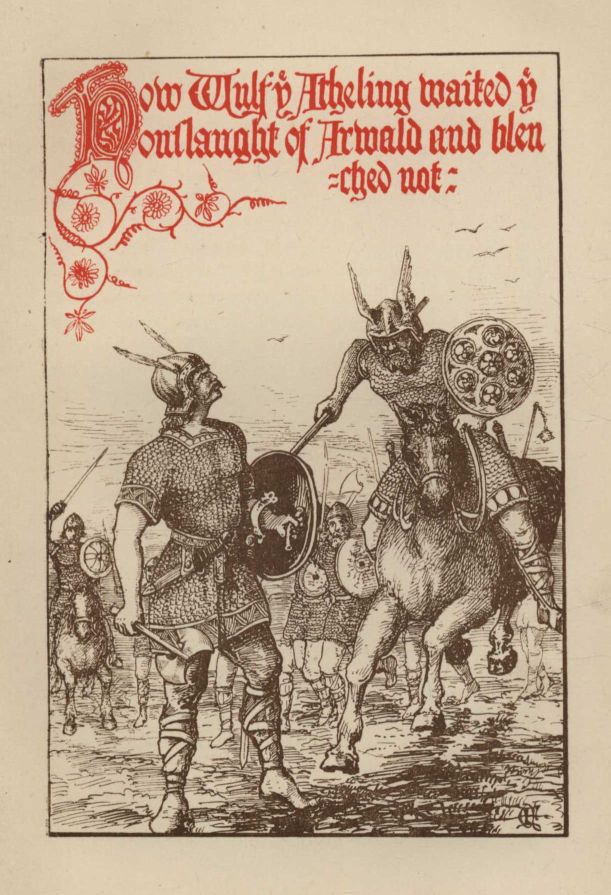
How Wulf ye Atheling waited ye onslaught of Arwald and blenched not
There was fierce fighting still going on, and it was difficult to see the extent of the loss; many men were down; some were trying to crawl from among the legs of the combatants, others lay still; while others again, in whom the fierce spirit of the fight still glowed in spite of their desperate wounds, clutched at the legs of their antagonists and brought them to the ground. But the fight was too fierce to last long, and they were too crowded to ply their ghastly blows with sufficient effect. Seeing this, Arwald shouted in a stentorian voice, when a lull in the murderous din allowed him a chance for his words to be heard, that all his men were to fall back and rally around him; at the same moment he cleft to the chin a wounded Wihtwara, who was trying to crawl down to the waterside to hide among the sedgy banks. Pleased with this dastardly stroke, he strode past the writhing, struggling mass, and took up his position some little way off on the right of the fight. His own men sullenly obeyed, drawing off from their antagonists reluctantly. It was then seen how terrible had been the few minutes of that cruel work. The ground was strewn with dead, the nature of many of their wounds was awful—too awful to be described—and the scanty remnant of Wulf's little force remained resting on their axes or their swords. The combatants were now able to judge of their losses, and the effects of the fight. Very few of Arwald's horsemen remained mounted, and many of his best warriors were lying on the ground; but Wulf's men were greatly reduced. About two-thirds were still left, and the Atheling himself was able to wield his axe; but many had received desperate wounds, and in several cases the power to use axe or sword was entirely gone, as from the close nature of the fighting, and the absence of any guard to sword or axe, the fingers had suffered severely; and the maimed appearance of the men told how hopeless the next struggle must be, for of the two-thirds that survived, at least half were disabled in either one hand or the other, while many had lost all four fingers of one hand, and a thumb off the other, and in some instances both hands were shorn off at the wrists. Arwald's people had suffered in the same way, but the proportion of fighters remained about the same as before.
Wulf the Atheling saw that their hours were numbered; each man of his force felt the same. He himself was bleeding profusely from a large gash in his shoulder, and one arm was nearly useless. His axe was notched, and stained deep-red. His helmet was deeply dented, and he looked faint and ghastly; but the spirit of his race was in him, and he prepared to sell his life as dearly as might be. Turning to his men he said briefly:
"Comrades, we shall meet ere long in Valhalla; remember, the more we slay, the happier we shall be; rejoice then, that we shall so soon live for ever, and shall have so many to meet us there."
Then turning to Arwald, he cried tauntingly:
"Boaster that thou art, where are thy young men? Look at the ground in front of thee. Who measured his length upon it? Dastard and villain, no wonder thou darest not fight it out with me, but must bring four to one to the fight, and yet canst not beat us. Are the Wihtwaras no better than this? But yesterday, an old woman—a bald-headed one—and a child, killed six of your warriors. Go bring thy women to kill us, they will fight better than thou."
Arwald, disdaining to reply, led his men nearer to the Yare, and advanced once more to the attack. Wulf and his men grimly awaited them. Suddenly the Atheling heard his name called, and looking across the Yare, he saw old Ceolwulf standing by the water's edge, and at the same moment a whizzing sound rushed through the air, followed by a yell from one of Arwald's men:
"Make for the boat, Prince Wulf; thou canst reach her if thou makest a dash for it; at least some of ye can be saved!" shouted Ceolwulf, pointing to the boat which rode at her moorings not more than a few hundred yards away.
The advice was good, but could Prince Wulf act on it? Could he leave his men to be slaughtered, and seek safety in flight? Life was dear to him: he was handsome, young, and loved pleasure. He could do more good with a few men to defend the stockade, than by dying there, he thought. Fresh hope came to him, he wavered, and as Arwald's advance seemed unaccountably checked, he determined to take advantage of the moment, and make a rush for the boat. Instantly the whole band broke up. The faith in the pleasures of Valhalla was overbalanced by the desire to realise those of this earth a little longer; and each man as he was able ran for dear life. Arwald gave a yell of rage, and shouted to his men to follow at the top of their speed; but as he started at a run to set the example himself, he received a violent blow on the side of his forehead, that for a moment stunned him; many of his men were falling, or were receiving severe cuts. What was it? Where did these invisible blows come from?
"There, there, from the other side of the water!" shouted one of his men, pointing to a large party of boys led by Wulfstan, who was plying his sling with delighted vigour. The speaker was unable to finish his sentence, for he received a crashing blow on his mouth which knocked several of his teeth down his throat. Arwald's rage was frightful to see, and the pain of his cut forehead, combined with the partial blindness which resulted from it, for the blood from the wound ran down over his eye, made him dangerous to approach. But he still pressed on after the fugitives, hoarsely shouting to his people to hasten up. But Wulfstan and his troop of boys kept plying the solid mass with stones, and richly they enjoyed the fun, for almost every stone took effect. Arwald's force was compelled to draw farther away from the water's edge. Unfortunately for the full success of the diversion, where the boat was riding at anchor was out of reach of the stones, and now that Arwald's people saw where the galling flights of stones came from, they kept out of range and continued the pursuit of Wulf and his men.
But the check the enemy had received gave a long start to the fugitives, which they had done their best to improve, and Wulf had reached the water's edge and was hastily splashing through the shallow sea; he was now wading out to the boat and was scrambling in, followed by two or three others, the rest were crowding behind; it was clear the boat would not hold more than nine or ten, and what would become of the others? Therefore each man ran, and splashed, with desperate haste; many had fallen as they ran, dizzy with loss of blood; one or two, sullenly desperate, giving up all hope and determined to die hard, turned to face the enemy, prepared to brain the first man that dared to come near them; a few even did not await the foe, but rushed fiercely to meet him, shouting their death song, and met their end like ancient northern heroes. Beornwulf and Osborn and two of the Boseham men, who had fought gallantly, still survived; the two latter were close beside Wulf the Atheling, and all three had now clambered into the boat. The breeze was blowing fresh off the land; one of the South Saxons ran to the bows, and with a blow of his axe severed the moorings, and instantly the boat drifted away from the shore. Wulf had lost so much blood that the moment he had climbed into the boat he fell into the bottom of it, and lost all consciousness. The two South Saxons were both wounded, one had lost three fingers off one hand, and the other had a terrific gash in his forearm, so that they were not able to do much in the way of rowing; indeed, they did not attempt it, but were content to sit down and let the boat drift before the wind, merely steering her by an oar over the stern.
Beornwulf and Osborn shouted to them to come back and take in more, but with the callousness of utter weariness and exhaustion, they paid no attention, scarcely looking up or heeding anything, and thus drifted far down the broad Brædynge haven towards the entrance.
When the fugitives saw that they were abandoned, and no hope left, they uttered yells of execration on their leader, and stood helpless and stunned for a moment. One or two tore off their armour, and began to wade out as far as they could, and then swam for the opposite shore. The shallowness of the water greatly aided them, and many more followed their example. In this way about twenty reached the shore of Binbrygge-ea, and were helped up to the stockade by Ceolwulf and the boys, many of whom, however, with the curiosity of their age, waited to see what would become of those left.
There were not many now; Osborn had swum across, Beornwulf was too much exhausted. He and three more stood gloomily resting on their notched swords awaiting their death.
Arwald, and some three or four others, had reached the edge of the sea. Grimly the wounded warriors in the sparkling water eyed them.
"Run to water at last," cried Arwald; "Look at the water rats that are afraid even of their own water."
"But we are not afraid of thee, thou nithing," shouted Beornwulf, "come and kill us if thou darest."
Whatever faults Arwald had, he certainly was not a coward; but the day was his, he had done enough fighting, and he saw no reason why he should risk his life in a desperate encounter with reckless men who must die sooner or later. He gave orders, therefore, for some of his people to sit down on the shore, and wait until the wounded men should be tired of standing in the water. He himself then drew off with the rest of his followers, and gave orders for all to repose, and get what refreshment they could, until the tide had gone down sufficiently to allow them all to cross the Yare at the ford, and advance upon the fugitives.
Beornwulf, seeing that he could not entice any of the men to come out to him in the water, where he hoped, from the unsteady nature of the foothold, to be able to obtain an advantage over his adversaries, felt it was no use standing there to slowly die a miserable death. He turned, therefore, to the two or three who still stood with him, and declared his intention of returning to the shore to sell his life as dearly as might be. The others gave a sullen assent, and without giving their wounds any more time to stiffen, they waded back to the land. Arwald, before he left the men on the shore, had given orders to take the West Saxon and the rebel Wihtwaras, alive if possible. He intended, when the rest of Ælfhere's men were taken, to have all the prisoners brought before him and his eorls at a banquet, and then put them to death. As Beornwulf and his companions therefore, approached the shore, Arwald's followers got up and warily awaited them, and no sooner had they emerged from the water than all the enemy hurled themselves upon them. Beornwulf had only time to whirl his sword round his head, severely wounding one of his adversaries, when he was borne to the ground, pinioned by four men, and bound hand and foot in a moment. One of his companions was, more fortunately, slain, but the other two shared the same fate as Beornwulf; faint, weary, and despondent, they were conveyed in triumph to the main body, and were placed beside Athelhune to await their fate.
The afternoon was now far advanced; but Arwald was so inflamed with rage against his opponents, that he did not intend to give his men much rest, only sufficient to allow them to get such fresh vigour as would enable them to overcome any further resistance with certainty.
But besides the incitements of passionate revenge, there were other and more practical reasons why the attack should go on at once. They had brought very little food with them, hoping to take Ælfhere by surprise, or, at least, capture the homestead before the cattle and provisions should have been carried off. They were now feeling strongly the calls of hunger, but there was no chance of their getting any substantial food until they had crossed the Yare and come up with the encampment of the fugitives, or discovered some of their cattle.
There was no possibility of crossing the ford for another hour at least, and Arwald and his chief eorldomen improved the occasion by inspecting the men, and appointing leaders in the place of those who had fallen, and also in having their arms and belongings collected and placed securely under the same guard which was watching the prisoners. The arms were distributed to the men who had lost their own or had them injured, and in this way a better equipped, although much smaller force, was ready once more to renew the attack. The followers of Ælfhere were in a very hopeless position; all the powerful able-bodied men were either killed or prisoners, and all their arms and accoutrements had become the spoil of the conquerors. Only Osborn, and a few men, had been able to escape to join their companions on Yaver Hill, and these had been compelled to throw away their arms. The little boat, with the Atheling Wulf, when last seen, was scudding before the wind, through the narrow entrance of Brædynge haven, for they had managed to set up a sail in her, and were evidently steering straight for Selsea. They had a fair wind, but the chances were small of their ever getting there, for the men were desperately exhausted with their wounds, and had no food. Impatiently, Arwald waited for the tide to fall. He did not want the wounds of his men to become stiff, and they were all extremely hungry; besides, every minute gave the fugitives time to strengthen such defences as they could make, or contrive hiding-places for themselves in the dense scrub and bush that clothed Binbrygge-ea.
With the wind blowing right on Selsea, there was not any fear of Cædwalla coming yet; even if he had defeated the South Saxon eorls; but should the wind change—and it appeared to be getting rather more off the land—there would be every possibility of an invasion from the West Saxons: and Arwald had received news before he left Wihtgaresbyrig, that Cædwalla had given orders for a fleet to assemble at Portanceaster, which might at any moment set sail for Wihtea.
"Get in, one of you men, and see how deep that ford is!" cried Arwald, at last. And one of his men waded carefully into the water. He got on very well for a few steps, when suddenly he gave a plunge and disappeared, but reappeared again in a few moments a little lower down. Being a good swimmer he soon got out, but in a very dismal condition, for he had to land by the muddy banks of the Yare, which the rapidly falling tide was leaving bare. He had slipped off the gravelly bottom of the ford, not knowing that it turned at an angle in the middle of the stream.
"Here, blockhead!" cried Arwald, who was getting more and more savage at the delay, "try again, and feel the bottom with the end of thy spear."
The man did as he was told, and this time he got across, after carefully feeling the gravelly hard which formed the ford. He was then told to cut down with his axe some withies, and stick them on the upper side of the ford. When this was done, Arwald gave the order for all to cross. As the leading men stepped into the water they were assailed by a violent shower of stones, one or two of which took serious effect, for one man lost an eye, and the others were cut about the face. Daunted by this warm reception the men drew back, but were driven to advance again by the fierce menaces of Arwald. The main body pressed hard upon them, and they were urged on by the weight behind. All they could do, therefore, was to put their shields up in front of their faces, and make a rush for it. The effect of this blind advance was that many of the men fell into the deeper part of the stream, and several were drowned, while many more were severely cut about the face. They could not see their stinging assailants, for the banks opposite were clothed with thick bushes down to the water's edge.
When all the men had passed the ford, Arwald sent off a small party to drive away the stone throwers, who hastily withdrew through the bushes, without being caught. Wulfstan and Ceolwulf were with the boys, and all of them knew the bye-paths through the gorse and scrub, so that they were able to retire to the stockade unseen by the enemy.
Taught by bitter experience with what an active and enterprising foe he had to deal, Arwald sent out an advanced guard, and also a party on either flank, and thus effectually guarded himself from surprise. After marching for about a mile, and meeting with not a sign of any human being, Arwald began to get suspicious that all was not right.
"Where has this Ælfhere betaken himself and his belongings? We may march all night, and find nothing at this rate," was the universal thought of the men, who were beginning to grow discontented at the amount of marching required of them.
It was obvious they must capture some one who should act as guide, or they would fare badly for that night. Wearily they trudged along through the narrow track, and it was getting more and more risky, penetrating such a bush with night coming on, and an active enemy near. True, Arwald had every reason to believe that scarcely any men capable of bearing arms were now left; for he knew how many had come from the mainland, and he also knew about the numbers Ælfhere could muster. Had it not been for this knowledge, even he, headstrong and passionate as he was, would scarcely have dared to go so far as he had done.
They had now come to a more open part of the wild land; it was a sort of common, covered with furze and brambles, which, in most places, grew very high and thick. The path lay through the middle of this, and the common appeared, as far as could be seen, to extend for some distance all round. Suddenly Arwald stopped and sniffed the air. The wind had now nearly died away, the sun was setting, and there was that stillness over nature which so sweetly harmonises with a lovely sunset. The light air, which gently came from the north, brought a smell of smoke with it, which caused Arwald to stop and look in that direction.
"The knaves are cooking over there," cried Arwald, his mouth watering as the delicious smell of roasting meat reached his senses. "But they are making a big fire for it," he added, as a great volume of smoke rose up not far off. "Call in the other men. They may mean to attack us under cover of this," he shouted.
The men came in, and all the force was drawn up ready to repel any sudden onset. But no enemy appeared; all was as silent as the grave, save that a sharp crackling could be heard all round, from the north to the east side of the gorse-covered common. The common was on fire.
Volumes of smoke began to drive across their faces, the atmosphere was stifling. Ahead of them they could see the whole common in a red blaze; behind them the flames were bursting out. The dry gorse crackled and blazed, and dense masses of smoke eddied round their faces. No one paid any attention to Arwald's orders; all with one thought broke away and tried to escape the blinding, smothering smoke. They rushed into the gorse on their right, they tried wildly to run through it. Faster and faster roared the flames, louder and louder crackled the gorse. The smoke became thicker, hotter, more stifling than ever, and which way to escape Arwald and his men, for the life of them, could not tell. The gorse on their right was impenetrable, while everywhere else it was on fire.
Of that well-armed, compact little band of some three hundred men, scarcely two or three remained together. Blindly, madly, they rushed through the tangled prickly bushes; numbers fell down; many fell into the deep gullies which lay hid in the furze all over the common; and all the while the fierce, glowing flames leaped, and crackled, and revelled in their hot destruction. Swiftly the curling smoke swept over and after the fugitives, suffocating the fallen ones; pursuing with its hot, stifling breath, the frantic, scared Wihtwaras. Where could they fly? The smoke was everywhere, and behind the smoke was the devouring fire.
The few men who preserved their presence of mind aimed for the corner of the common that was nearest to the wind, and with great difficulty, and many scratches, about a hundred managed to reach a place of safety on the edge of the common under some old gnarled oaks; the flames rolled away from this part and they were able to see the awful destruction of many of their comrades. As the fierce fire swept on in its rapid course, the charred and blackened limbs of the gorse curled and twisted like a million tortured snakes, and the shrill squeaking of innumerable agonised things filled the air. Here and there an awful figure writhed and rolled on the ground, and a sharp, thin voice, shrieked tortured cries. Some of these fearful forms rose up and ran madly a few paces, gibbering horribly, and then fell in a column of sparks among the smoking embers. Others sat, a shapeless heap, rocking to and fro, moaning in unearthly sounds. The fatal element had done its ghastly work. Ælfhere's followers were well avenged.
"We must return to the ford," said Arwald, sullenly. "They shall dearly pay for this."
Wearily the band retraced its steps, skirting the edge of the fire to windward; and, without further attack, reached the ford, and found the guard and the prisoners where they had left them. They then returned to the homestead, and prepared to spend the night as well as they could.
CHAPTER XIX.
"BE READY, CLAUDIO, FOR YOUR DEATH, TO-MORROW."
The night was spent by the weary followers of Arwald in dismal plight. They had scarcely any food, and now experienced all the hardships Athelhune, Ceolwulf, and their party had suffered when they were cast upon the island.
Some men had been sent to bring in food from the country behind Æscing Down, and to hasten up reinforcements and more supplies from the west end of the island. During the night many of the dispersed followers came in; in fact, they kept dropping in throughout the night, so that, when day broke, there was a large muster of men around the homestead; but they were, many of them, wounded, burnt, and listless; all heart seemed to have been taken out of them by the last awful event. In order to stir them out of their lethargy, Arwald determined to have the prisoners put to death. This was not only a matter of policy, but he was longing to gratify his revenge and cruelty.
Some small amount of provisions having been brought in at early dawn, they were distributed as far as they would go, many of the men having made a hearty meal off the slaughtered horses which were lying where they fell in yesterday's conflict.
At eight o'clock, all the men, who now numbered about two hundred and fifty, were drawn up in the large yard of the homestead, the remainder of the force having been either killed, placed hors de combat by their wounds, or been lost among the wild country on the other side of the Yare, while some few had deserted.
The prisoners were seated on a few logs of trees that had been rolled into the centre. Each man was placed some feet apart from his neighbours, and in his long hair was twisted a couple of tough withies, long enough for a man to hold the head steady from behind. All the men were bare-headed, stripped to the waist, and tied together. Only the chief prisoners were arranged in this way first; the common men were guarded in a crowd in a space separated from the spectators, but in full view of the ghastly proceedings.
On the right of the prisoners sat Beornwulf, next him were three of Ælfhere's chief ceorls, then came Athelhune, and next him one of the followers of Wulf the Atheling. Outside of these sat two South Saxons. Athelhune had suffered terrible pain from his broken leg, for no attention whatever had been paid him, and he had been roughly carried along with the other prisoners; but he still held up his head bravely, and smiled contemptuously at the preparations for his death. The old Teutonic spirit was strong in him, and he remembered how heroes had met their death. Although deadly pale from the sharp pain of his maimed leg, his eye was bright, and his bearing fearless. All the men preserved the most absolute composure, and did credit to the training of their race. Not a sigh or a regret seemed to announce their reluctance to leave this life; on the contrary, if there were any expression but absolute indifference to the whole proceedings, it was one of pleasure at the thought of so soon enjoying the delights of Valhalla.
The withies entwined in their hair were intended to be held by the thralls or slaves, who accompanied Arwald's force, so that the heads of the victims should not twitch, or avoid the stroke of the executioner's axe, and were long enough to allow the holders to be at a safe distance from the blow. Behind each man stood a thrall holding the withies, and these men were laughing and joking together.
When all was ready, Arwald and his chief eorldomen came out of the homestead, and seated themselves on settles placed directly opposite the victims. The Wihtwara chieftain was in high good humour: he had had an excellent breakfast, as far as quantity went, and had washed down his food with copious draughts of ale; for, however much his followers might suffer, he had no intention of being uncomfortable. He came out, therefore, with a hearty, loud laugh, as he cracked some coarse joke with one of his eorls, and took up his seat, lolling his large fat body in the most comfortable position he could. His little black eyes twinkled with cruel pleasure, and his puffy red face showed amid his large dark whiskers, beard, and hair, like a furnace against the black night. He wore his mail-linked shirt and his battered helmet, off which the heron's wings were shorn. His huge axe hung over his shoulder, but in his hand he held his hunting-knife, with which he played from time to time.
The executioner was a powerful, coarse-looking ceorl, with bare arms and legs, and holding a formidable axe, to whose edge he was giving a finishing touch with a sharpening stone.
The people were now all ready for the spectacle, and the interest was very great; but the disappointment was universal, for the victims were not apparently going to give them any sport by their cries and lamentations.
"Is all ready?" said Arwald carelessly.
"All is ready, eorldoman," said the executioner.
"Then begin, in Woden's name," answered the chieftain, and settled himself more comfortably for the better enjoyment of the tragedy.
The executioner advanced to the man seated on the log nearest to the left, looked at him, poised his axe, measured his distance, nodded to the thrall to hold the withy tight, planted his feet firmly on the ground, swung the axe swiftly through the air, and the man's head fell at some few paces from the body, which fell forward to the ground. The blow had been dealt so truly and well that the whole thing passed like an ordinary occurrence, and one could hardly realise that a man had just suffered a violent death. No sound had broken the silence of expectancy, only the whizz of the gleaming axe, and the dull thud of the head as it fell on the ground, interrupted the silence.
"Was that well done, eorldoman?" asked the executioner, turning to Arwald.
"Nothing could have been better," nodded the chieftain; "if thou doest thy work like that I will say thou art the best headsman in England."
"I hope thou wilt do something better than that," promptly replied the executioner. Arwald grunted an ambiguous reply, and bid him go on with the next man.
The executioner then stepped up to the next man and went through the ghastly preliminaries as before, performing the business as deftly as he had previously done, only the withies which were twisted into this man's hair were jerked out of the hands of the thrall, who was holding them, and struck the next thrall a stinging blow in the face, which caused him to cry out, and made all the spectators laugh.
Arwald was put into an extra good humour by this event, and he felt inclined for a little playful conversation with the victims. So addressing the West Saxon who was to be executed next, he asked him what he thought of the death he was so soon to suffer.
"We must all die some day, and as I am tired of looking at thy fat carcase, the sooner I can get away the better," answered the West Saxon contemptuously. The nearest bystanders, who had heard the remark, began to laugh, and Arwald became angry.
"What art thou waiting for, man?" he said to the executioner. "Let him have his wish at once," and the man's head fell with the others.
It was now Athelhune's turn, and Arwald, deceived by his exceeding pallor, hoped to obtain some sign of weakness from him, and asked him whether death did not look very dreadful.
"Not so unpleasant as thou dost," was the answer; "but before I die I would like to have a question settled."
"What is it?" said Arwald.
"We have often talked about death, and whether a man has any feeling after his head is off," said Athelhune. "Now, give me a knife. If I feel anything after my head is off, I will throw the knife at thee; if it falls to the ground, it will prove I have no feeling. Now strike, and see what will happen."
Arwald laughed, and bid a knife be given him. The executioner approached. Athelhune held up his hand with the knife pointed at Arwald. The executioner slowly measured his distance. Flash went the axe, and at the same moment the knife flew from Athelhune's hand and pierced Arwald's burly leg, causing that stout warrior to utter a yell of pain; but Athelhune's head was on the ground, and no man could say whether he had hurled the knife while his head was still on his shoulders or no. The knife still quivered in Arwald's flesh, as the headless body fell heavily to the ground, and the brave West Saxon eorldoman was numbered with his fathers; glad enough to be away from the pain and anguish he had been suffering from his broken leg, which now, owing to the want of care and cruel treatment he had suffered, was rapidly growing black, and had swollen to a great size. He knew he never could be of any use again, and had longed for death to relieve him for some hours past.
The brave warrior died true to the instincts and noblest teaching of his race and ancestors. A faithful, devoted friend, a recklessly brave man, and a skilful chief, he came on this expedition, well knowing the desperate nature of the enterprise, without a thought which could reflect upon his friend and king Cædwalla; his king wished him to go, that was enough for him. It was not his business to question or discuss the reasonableness of the wish; such an idea never crossed his mind; it could not occur to him. His sense of duty to his chief was comprised in those lines that so beautifully describe the whole duty of a soldier:—His "not to make reply," his "not to reason why," his "but to do and die." And this idea of a soldier's duty he carried out in its entirety, both towards his king and chief Cædwalla, as well as towards those who served under him, all of whom he tried to impress with the same spirit of noble discipline and self-sacrifice. He died contentedly, nay, happily; he had done all he could. If he had not succeeded, that was no affair of his; were there not the Norns or Fates, who ruled the affairs of men? And oftentimes, he knew, even in his own experience, what looked like failure was only the seed of success. Did not men put seed into the ground, and did not the seed disappear? Who could have told that that lost seed would come out of that dry, lumpy ground, green corn good for the food of man? The doing of one's duty, even if it ended in failure, was the sowing of good seed, it must bear fruit, only it might take a longer time, as some seeds took more time than others to come up. With the noble simplicity of his character, he also accepted implicitly the creed of his ancestors. Surely there was a place of reward for honest men, who struggled to live and die full of that virtue, that [Greek: andréia], that manfulness, which all men in all ages, and of all races, have known to be the essence of a good life. Full of this hope, he rejoiced at his departure to the new life, grateful too that the last few hours of pain had made the longed-for moment all the greater relief.
There was a great shout of triumph from the prisoners when they saw the knife flying from Athelhune's hand straight for Arwald, and the disappointment was great when it was seen that the wound was not in any way dangerous, although the knife had plunged deep into the fleshy part of the leg and caused the ruler of the Wihtwaras considerable pain as it was drawn out. However, a bandage soon stopped the bleeding, and Arwald called to the executioner to go on with his work, more irritable now than ever.
The courage of the previous victims re-acted upon those whose turn was now coming, and when the executioner stepped up to the next man, and was preparing to strike him sideways, like the others, the man called out to him to strike the blow in front.
"Many is the time I have looked death in the face without blenching, and thou shalt see now if I flinch or no."
The executioner took him at his word; he placed the edge of the axe against the man's neck under his chin. Took up the proper distance, planted his feet firmly on the ground, told the man to raise his head a little higher, swung the axe swiftly back and then struck with a swish through the air forwards, and the headless trunk rolled over on the ground, while the head dropped at the feet of the thrall who held the withy. The bystanders could see no change of expression as the axe gleamed in the act of striking, not a twitch of an eyebrow, or quiver of an eyelid told that the man dreaded the blow.
"Well sped, brave soul," cried the spectators, whose interest was growing deeper as each victim met his end so nobly. Five men had now died, there remained but three more on the log, of whom Beornwulf was the last. Beornwulf was getting weary of sitting so long, and he was irritated with the thrall who held the withy entwined in his hair, which was remarkably long and bushy, and of which Beornwulf was very proud. The thrall twitched his head every time an execution took place, not intentionally, but because he kept twisting round to get a good look at the performance, while Beornwulf also wished to see how each man met his death, with the result that his neck was now very stiff, and he himself was in an impatient, irritable, frame of mind. He did not care what became of him; he knew he would die in a few minutes, but none the less, or rather because of that certainty, he wished to excite Arwald before he died.
"Hi! old Wolf's head," he shouted, "thou mountain of flesh, thou! Arwald, or whatever thy name is; how long am I to sit here and have my head twisted off my shoulders by this lubberly thrall? Send that head-cutting knave down this way, and let me get away from here."
As Arwald paid no attention, Beornwulf began again.
"I say, thou round knave, thou, dost thou not hear?" and he proceeded to string together a collection of epithets considerably more apposite than elegant, which so enraged Arwald that to stop his abuse he told the executioner to go to him next, but Beornwulf had one more idea. He called out—
"By Woden's beard, I am not going to have my fair hair touched by a base knave; let one of thy eorls come here and hold my hair."
He had beautiful curly, long, fair hair, and took great care of it; and since great respect was paid to appearance even in those rough times, and the hair, curiously enough, in all savage tribes and races, is always the object of great solicitude, although no other attention is paid to the person, he was allowed to have his wish. One of the eorls sitting by Arwald said he would do as the merry knave wanted, and stepped up to Beornwulf. He took his position behind him, grasping firmly the thick, bushy, curly locks. The other two prisoners moved a little more to the left, so as to allow room for the executioner to have full play for his axe; and the headsman prepared to perform his horrid office. Beornwulf watched him very steadily, the proper distance was measured, the executioner told him to sit very steady. "For," he said, "thou art a fine young man, and I would be sorry to spoil thy beauty;" to which Beornwulf replied, "Thank thee, poor knave; but it would take a good deal to spoil thine." Which retort so enraged the executioner, who was a snub-nosed, blear-eyed, red-haired man, and therefore felt the truth of the remark, that he swung back his axe, poised it, and then struck with all his force. There was a sharp cutting sound, a shrill cry, and a shout of astonishment from the crowd, while a loud mocking laugh rang out from—whom? Could it be the dead man? The crowd strained to look. There was no doubt about it. There was Beornwulf roaring with laughter; but instead of his head being on the ground, it was still on his shoulders; but something was on the ground. What was it? The crowd looked at the eorl. What was the matter with him? He was holding up his arms. But what had happened to them? Where were his hands? And then the trick dawned upon every one. And there were loud shouts of applause at Beornwulf's cleverness, for this was just such a joke as those rude, barbarous men could understand; and they shouted and screamed, and roared with laughter.
"Why, Loki, the mischief lover, was nothing to him." "Let him go free." "He ought to live," were heard on all sides. And even Arwald laughed, so that the tears ran down his face as the splendid joke dawned upon him.
And this is what had happened. When the executioner struck his stroke, Beornwulf, who had been carefully watching him, ducked his head with all his might, and with a sudden jerk. The eorl, whose hands were firmly twisted in his luxuriant hair, was naturally pulled down; the executioner could not stop his blow, even if he had had time to notice the stratagem, and the wretched eorl received the full force of the sweeping cut, with the result that both his hands were shorn off at the wrists.[1]
[1] The greater part of the above account of these executions is taken from Mallet's "Northern Antiquities," where the execution of the Jomsberg Rovers is extracted from various Scandinavian sources. I have inserted them here to give a really true picture of the wild, fierce, brave manners of that rude epoch. The episode of the Jomsberg Rovers is more than 200 years subsequent to the events here narrated.
The exquisiteness of this stratagem consisted not only in the mortification of the executioner, and the momentary saving of Beornwulf's life, but, above all in the disabling of one more of Beornwulf's enemies, for so it would count, according to all the received ideas; and thus at a moment, the most supreme in the life of a man, Beornwulf had contrived to add one more to the number of victims he would have for his own particular portion when he arrived in Valhalla, and his renown for wit would be very great.
But the executioner was furious at the trick that had been played upon him: he paid no heed to the shouts of the crowd, and, uttering a savage cry, he rushed upon Beornwulf. Some of the bystanders shouted to Beornwulf, to warn him of his danger, but it seemed nothing could save him, for the man was upon him: when, quick as lightning, Beornwulf flung himself prostrate upon the ground at the feet of his would-be murderer. The man heavy, blundering, and blinded by passion, fell over him, severing the cord with his axe as he fell; and instantly Beornwulf rose to his feet, seized the axe out of his hand, and dealt him a swinging death-blow.
Again shouts of applause arose, but this time they were not so unanimous, the amour propre of the Wihtwaras was becoming hurt. Beornwulf was a West Saxon and a stranger; it was not right he should triumph thus over the islanders; it was time his conceit came to an end. Had he rested on his first success popular favour would have been with him, or had he simply managed to escape from the blow of the executioner; but the death of this latter, who was a well-known as well as a popular character at Wihtgaresbyryg, made many people angry, and especially Arwald; and he gave orders to have the West Saxon killed at once.
But Beornwulf's blood was up now. He held in his hand the axe; with a blow he cut the rope which attached the two other prisoners to the long row of prostrate dead bodies; he called to them to seize axes from the bystanders, and then rushed to where the other prisoners were standing; before the guards could interfere, he had cut down one of them, shouted to the prisoners to imitate him, and struck right and left at any who were near him. The whole thing was so sudden, the confusion and noise were so great, that many people did not know what was happening, while at the same time a great number of cattle which were being driven up for supplies, and were close behind the crowd, terrified at the hubbub, broke away from their drivers, and, with tails erect and lowered horns, rushed through the crowd, horning many and trampling on more. Arwald shouted, stormed, and raved; the leading eorls rushed in among the crowd and tried to restore some sort of order; but in such a fighting, struggling mass, confined between the building of the homestead, with plunging cattle, mad with terror, goring, trampling, rushing wildly here and there, with a desperate band of men, in whom the love of life was once more kindled, along with the hope of saving it, what could anyone do to restore order? The confusion could only cease with physical exhaustion. The noise was terrific.
Beornwulf cut his way towards the nearest opening in the buildings, followed by many of the prisoners. There was this advantage for them: they knew what they wanted and had a definite purpose, and were prompted by the most powerful impulse that could act on human beings when blindly yielding to the cry of nature. The instinct of self-preservation taught them where to go, which instinct, also acting upon their enemies, aided them in their efforts to escape. At last—how, scarcely any one could tell—Beornwulf and about twenty more found themselves outside the buildings with nothing before them but open country right down to the ford. With a wild rush they started for the creek, followed by very few of Arwald's men. The confusion, now that it was relieved of a considerable part of its cause, gradually quieted down, and then Arwald was able to see that nearly all his prisoners had escaped; heaping terrific abuse upon the guards who had allowed them to get away, he ordered his horse to be brought, and all who could to follow him.