CÆDWALLA (continued 4)
Reading edition
At the head of the whole procession marched a harper; there had not been time to get more than one. He was attended by a band of children, who sang desperately out of tune, and with a very hazy notion of the words, a song of welcome, and waved branches of oak leaves and holly, while some had bedecked themselves with the red berries of the wild iris, and sprigs of "Holm" or "butcher's broom."
The procession wound round the foot of the downs skirting the marshes, and then ascended a gentle rise, until, turning to the left among the tall trees, the old homestead suddenly appeared.
It was a long, low-built, thatched house, with no pretentions to architectural effect. One end was in ruins, and the gaunt, half-charred rafters produced a feeling of desolation, which was somewhat relieved by piles of straw lying ready to repair the damaged roof, while new timbers were in process of being sawn up in a pit close by; behind the house could be seen the higher roof of the barn, and other farm buildings, and the blue smoke curling up amid the brown trees gave a look of comfort very pleasing to Ælfhere and Wulfstan.
A few servants stood outside the house ready to receive their lord, and tables were set under the trees near, upon which a lavish amount of steaming joints, huge jugs of ale, and gigantic loaves were spread, and it was quite evident from the longing looks cast in this direction that unless the ceremonies were soon over the procession would dissolve of its own accord.
Ceolwulf therefore briefly welcomed his master home, to which Ælfhere as briefly replied, and then have directions that all should at once sit down and begin upon the feast, and he hoped that all would eat plenty and thoroughly enjoy themselves.
A loud cheer answered these few words, and instantly all was confusion. Ælfhere had told Ceolwulf to see that Wulfstan paid especial attention to Athelhune and his men, to whom seats of honour were assigned at the head of the principal table.
The feast passed off like all the feasts of those days: an enormous amount of food was consumed, a little wit went a very long way, and no one seemed much inclined to move. After the eating was over one or two loud voices seemed to show that some amount of quarrelling was going on, but Athelhune and Ceolwulf had determined that none of this should take place, and so order was well kept.
Had Arwald attacked them directly after the festivities he would have found an easy prey; but, fortunately for Ælfhere and his supporters, the news did not reach Arwald until late that day, and he was not in a position to move at once to the attack.
While the feast was at its height a boy rushed in and shouted that a boat was coming up the haven, and no one knew who it could be. Questioned by Ceolwulf, he said that the boat was not a large one but that there were several men on board, and from the sun shining on something bright, he thought they were well armed. Ceolwulf immediately sent a trusty man to find out what the boat was, and bring him word again.
Just as the festivities were ending this man returned, accompanied by four men in linked shirts of mail, and fully armed. On seeing them Athelhune leapt to his feet, and shouted:
"Welcome, noble Wulf. Thou comest at a happy time. Mayest thou bring us good tidings of our king."
"I do, indeed, bring thee good tidings, Athelhune," cried Wulf, or, as he is called in some histories Mollo. "King Centwine of Wessex is dead, and on his death-bed he named our Cædwalla his successor and directed the eorldomen of Wessex to go to find him, and bring him back as their king. This they did, and I left Cædwalla surrounded by the power of Wessex, recognised as their lawful lord, and successor to the line of Cerdic."
"This is indeed good news," said Athelhune, and then turning to the assembled crowd he called out:
"Men of Wihtea, our lawful overlord has got back his kingdom; let us all thank the gods for this good news, and raise three cheers for Cædwalla."
Instantly all caps were off, all the crowd of revellers were on their feet, and three deafening cheers burst from the lungs of the mob.
The news was really important, for now the tables were likely to be turned upon Arwald, and instead of his venturing to attack them, they would be able to attack him. As the news became known in Wihtea all men would return to their allegiance to Wessex, and it would fare very ill with Arwald. However, as the allegiance of the Wihtwaras had hitherto been more nominal than real, there was not any certainty that they would welcome any actual interference on the part of Cædwalla; for, like all islanders, they were very jealous of any external control. But it was a great object for the rival chiefs of the island to use the moral influence of the name of a powerful authority on the mainland; and, as it was everywhere known that Ælfhere had supported the authority of Wessex, while Arwald had represented Edilwalch and Mercia, it was easily understood that since Edilwalch was dead, and his slayer had succeeded to the throne of Cerdic, Ælfhere was likely to be more powerful than Arwald.
The arrival too of Cædwalla's own brother, Wulf, accompanied by three such stalwart-looking warriors, brought a very material support, as well as a moral one, to the cause of Ælfhere, and the feasting, which was nearly over, was renewed with more joyous ardour.
Wulfstan did the honours bravely, but presently got tired of all the noise and feasting, and very nearly fell asleep two or three times. At last, Athelhune suggested to Ceolwulf that the poor boy should be sent in to his father, to tell him the news.
When Wulfstan entered his father's room he found that he already knew the good tidings, and was deeply thankful for the turn of fortune, but at the same time, knowing Arwald as well as he did, he was not at all confident that all would go well, for he knew that Cædwalla would not be able to bring him assistance at once, and Arwald was too powerful to give up his pre-eminence in the island without a fight. Being also a skilful as well as brave leader, Ælfhere well knew he would realise the necessity of striking before the ceorls and thralls had recovered from their late crushing defeat, and especially before any reinforcements could reach the island from Cædwalla. Filled with such thoughts, therefore, Ælfhere did not respond to Wulfstan's joy quite so readily. This was a disappointment to the boy, who was brimful of happiness at the bright prospects that were opening up for them.
"Why, father, thou seemest not nearly so merry as I should have thought thou wouldst have been," said the boy, in a disappointed tone.
"We are not yet out of the wood," answered Ælfhere. "If we can resist the attack which Arwald is sure to make on us, either to-morrow, or the next day, or can hold our own until Cædwalla sends us reinforcements, all will be well."
"But, father, see how well we fought last night, and then there were only four of us, now there are ever so many. Thou hast not seen the Atheling Wulf who has just come; he is nearly as splendid as Cædwalla himself, and that is as much as saying he is like a god. Thou never sawest anyone so handsome or brave; and thou oughtest to hear old Biggun tell how he took Cissanceaster. Thou dost not really think we are not able to beat any of that villain Arwald's lot, dost thou?"
"Well, Wulfy, we've done very well, and Athelhune and the Atheling will no doubt guard against a surprise, but there will be hard knocks, and the Wihtwaras fight well."
"But we are Wihtwaras too, father."
"True, my son, but we are not as many as those whom Arwald will bring—but it is no good discouraging the lad," muttered Ælfhere to himself, "Like enough, being wounded and in sore pain, I look on the dark side, and the boy is right. Well, Wulfy, I have no doubt we shall do well enough, but I should like to see this same prince before night comes on; and Ceolwulf must see that proper guards are set, and all things made ready in case Arwald should come."
"Shall I bid Biggun come, father?"
"Aye, do, my boy, if he can be spared from the feast."
The boy left the room, and speedily gave his father's message to Ceolwulf, who immediately told Athelhune that the eorldoman would like to see the Atheling Wulf.
But Wulf the Atheling was very unlike his brother Cædwalla; he had been spoilt as a child, and was wilful, inconsiderate, and self-indulgent: the only quality he and his brother had in common was great personal courage. As, therefore, he was enjoying himself at the banquet, he declined to accede to Ælfhere's request, saying that he would come the next morning, when there was nothing better to do.
Ceolwulf was much displeased at this answer, but there was no help for it; so, asking Athelhune to do the honours in his absence, he accompanied his young master to the wounded eorldoman.
"Ceolwulf," said Ælfhere, "the news is indeed good, but let us not lose the wine now the cup is at our lips. You know Arwald, and that he is not likely to let the power he has got in this island slip through his fingers without fighting for it; and we have had too bitter experience already of what comes from keeping a careless watch. I trust, therefore, that thou wilt take every care for the night, and learn the earliest news thou canst of what is going on round Wihtgarsbyryg."
"Aye, that will I," answered old Biggun. "We had enough broken heads the last time to make those who were able to keep their brains in their skulls then, do all they can to keep them there now. I've sent Leofa and the boy Stuff to get as much news as they can, and to tell anything that comes into his head about us. The boy Stuff is a good boy at putting a man on a wrong trail; he has a way of looking stupid-like, and not seeming to understand, and then answering with a question that gets more out than he tells."
"When they come back, mind thou tellest me. How hast thou placed the outposts?"
"Oh, well enough! if they are not too drunk, that is," said Ceolwulf, scratching his head doubtfully. "Leastways, I shall have to go round myself, I doubt not; but they are all placed where they ought to be, and if they allow themselves to be knocked on the head they ought at least to give a squeak first; but there, they've drunk a sight of ale, they have, and perhaps if they get killed they'll only think they are dreaming, and forget to make any noise about it."
"Well, Ceolwulf, I shall trust to thee. I don't myself think there is much danger of attack before morning, and they will be all right by that time. What dost thou think of this Atheling Wulf?"
"Humph! He can fight well enough when he likes, but fighting isn't everything; he can't obey, and he has got no doggedness in him. However, the more we have the better, and Athelhune is here to keep him in order a bit, that's one comfort. Hark to that hubbub! If I don't go there'll be a fight before long."
And so it seemed, for angry voices could plainly be heard, and Ælfhere bid Ceolwulf go at once to restore order. When Ceolwulf returned to the festivities, he found that one of the Boseham men, excited by the ale, was loudly boasting of the superiority of the South Saxons to the Wihtwaras, and an excited Wihtwara was as clamorously proclaiming their superiority to the South Saxons; while Wulf, to amuse himself, was promoting the rivalry by timely words. Fortunately Ceolwulf returned just in time to prevent blows, and, with Athelhune's help, order was once more restored.
As it was now getting very dark, a move began to be made by most of the ceorls to their homes, and in a short time the old homestead was comparatively deserted.
Wulf, Athelhune, and their companions, were sheltered in the house and barns for the night, and Ceolwulf and some of the most faithful of the servants took it in turns to keep watch during the hours of darkness.
CHAPTER XIII.
"WHICH IS THE BETTER LIFE?"
After the departure of Ceolwulf and Athelhune from Boseham, only three days before the restoration of Ælfhere to his homestead had been so happily accomplished, considerable anxiety was caused to the worthy monks and Ædric as to what had become of Wulfstan. Father Dicoll had got the children and several of the older men to search everywhere, but naturally to no purpose, and as night set in the hopelessness of the search became evident.
"Oh! Father Dicoll, what can have become of him?" asked Ædric, piteously.
"My son, God will take care of him, and I should not be astonished if he had gone somehow with the others; if he has not, I feel sure, seeing that the lad is a quick lad and naturally endowed with the instincts of self-preservation, he will come in later on. He may, perchance, have gone out to kill some wild animal, a hare or a coney, maybe; but, wherever he is, he is in God's hands, so let us not be over-anxious, but pray for his safe return."
This was not very hopeful comfort, but certainly there were no means of giving any other, and Ædric had to spend a weary night, waking up frequently and putting out his hand in the darkness to feel if his brother had come back, and was sleeping on the pile of skins beside him; but in every case he was disappointed, and after an anxious reflection as to what could have become of him, Ædric fell off to sleep again.
The anxiety of the monks and Ædric was not allayed the next morning, when they found that it had been snowing during the night, and there were one or two ugly-looking footmarks outside the door of their hut, which looked very much as though a wolf or two had been prowling round during the night.
"Well, my son, it is no good making thyself unhappy about him," said brother Corman. "I think it is more than likely he managed to hide himself away on board the boat, and has sailed away to Wihtea as he wished."
"But he might have told me he was going. Why, and now I think of it, and so he did. What a stupid I was not to mind what he said! But I did not give heed to his words then, because I did not think he could possibly get on board without Ceolwulf seeing him, but, of course, he must have done it. Oh, how glad I am! But what a lucky fellow he is!" added Ædric, wistfully. "He will see our old home, and perhaps father; who knows?"
"Then, no doubt, he will send over and fetch thee, if all goes well; so now thou canst be happy again. But we shall have to take leave of thee soon, Ædric. Thou art to go to Wilfrid, the bishop, in Selsea."
"But I don't want to go. Why should I? I am much happier here with thee, Father Dicoll."
"Yes, but thou art not safe here, especially now that thy old ceorl has fought so well at Cissanceaster. All the country is talking about him, and they will soon know that he is gone on an expedition to Wihtea to turn out the ally of the South Saxons."
"Oh! I don't want to leave thee; thou hast been so kind to me. Canst thou not come too if I have to go?"
"I am afraid Wilfrid will not care to have us; and to tell thee the truth, I don't think he will say we are the sort of men who ought to bring thee up."
"Why not? You both believe in the same God. You are both Christians, are you not?"
"Yes; but I shall never make thee understand how little it takes to make men cease to be of one mind in a house. We think we are right, and Wilfrid thinks he is right, but we are willing to think the differences are of little importance, only we don't like to give up our old custom, while he thinks we are stubborn schismatics and obdurate stumbling-blocks, stiff-necked in our ignorance and blinded by our own conceits. Truly our blessed Lord was right when He said, 'I came not to bring peace upon the earth, but a sword.'"
This was all impossible for Ædric to understand. That Christians who took their lives in their hands to convert the heathen, whose whole doctrine turned upon love, charity, peace, should yet be so bitter against each other, was incomprehensible to him, and still more so that they should let this appear in the face of strangers and the common enemy.
"Well, brother Corman, Wulfstan and I often quarrel, but we always make it up and fight like anything against anyone who is our enemy, and we don't let them know we quarrel."
The conversation was interrupted by breakfast, after which arrangements were talked about for taking Ædric to Wilfrid.
The monks had shown a certain animosity and bitterness in speaking of Wilfrid which had communicated itself to Ædric, and he was very unwilling to go to him. He was eager to know more about him, but the monks, to do them justice, were not willing to speak against the bishop, or to prejudice the mind of the boy in any way; while feeling as they did that the branch of the Christian church which they represented was older than the later form introduced by St. Augustine the Monk, they could not but be irritated at the superiority which Wilfrid assumed, and his assertion that they were in error. Worst of all, the new missionaries from Rome had sided with the victorious and pagan Saxon, and had added insult to injury by branding the suffering British with the odious name of unorthodox. And after all, what were these great differences? A fashion of shaving the head dissimilar to that prevailing at Rome, and a different system for calculating the Paschal moon. For practical purposes this last was the more serious difficulty, for it occasioned the inconvenient anomaly of one set of Christians fasting while the other set were feasting, according as they observed the Roman or the Eastern custom of calculating Easter; but the fashion of the tonsure was quite as warmly disputed, and the Irish monks were taunted with being the imitators of Simon Magus![1]
[1] Vide Milman. Latin Christianity, vol. ii., pp. 247-269.
The preparations of the monks did not take very long, but it suddenly occurred to brother Corman that Ædric could not walk, and they had no conveyance by which he could be carried. It certainly would have seemed a matter of no great difficulty to have thought of this before, but their minds were so occupied with speculation, and the little daily round of their religious services, teaching the few children that came to be taught, and providing for their small daily wants, that they had not given any thought as to how Ædric was to get to Selsea, a distance of some five or six miles.
"Beate Columba!" said Father Dicoll, "but my head gets duller every day. Why did I not think of this before? We shall have to send someone to tell Wilfrid, and who will go?"
"True," said Corman, looking at Dicoll with a perplexed air. "We have nought that will tempt any of these South Saxons to go. I shall have to go myself."
"The matter is one that is somewhat urgent, I fear, for the boy ought to be with Wilfrid before night, in case the eorldoman Berchthune should send for him. But let us see if we cannot get any of these children to take a message for us."
So saying, Father Dicoll called out to a group of children that were making mud pies on the shore a little way off.
The children paid no attention at first, for they were making too much noise among themselves to be able to hear Father Dicoll. At last, a curly pated, blue-eyed, young Saxon heard him, and thumped a few of the other children to make them keep quiet, which, strangely enough, had the desired effect, which caused brother Corman, who was of a moralising turn, to observe how strangely the same process produced different results.
"For if I beat these younglings they don't keep quiet, but raise a greater clamour; whereas when that yellow-haired pagan beats his brethren they keep as quiet as mice. Perhaps they know that the process will go on until they stop, with him; whereas they have found out that after the blow has fallen there is no more danger from me. Truly, to get what one wants in this world, one ought to have no heart, and keep on thumping."
"Here, Ceolric, my child," called Father Dicoll, "I want to know if thou wilt do something for me."
The youngster ran up to the monk readily when he understood he wanted him, for the monks were favourites with the children and their mothers, and were not disliked by the men; indeed, by most they were decidedly liked.
"Dost thou think thou couldest find thy way to Cymenesora if brother Corman were to put thee over the creek?"
"I don't know, Father Dicoll; it is a good long way and father said I wasn't to go away far from home."
"Is thy father in?"
"Not as I know, but mother is. There she stands yonder, thou hadst best ask her."
"But wouldest thou go if she would let thee?"
Upon this the boy fell to scratching his head. It was quite clear he did not want to go, but, at the same time, did not want to disappoint the monks.
"Look here, Ceolric, if I were to promise thee a fishing line and hook, wouldest thou go then?"
"I've got one."
"Then what would make thee like to go?"
"I don't know as anything would that thou hast got to give me."
The poverty of the poor monks was very well known, and certainly, if they had made any converts from the rough and boorish South Saxons, such conversion must have been entirely brought about by conviction, unalloyed with any thoughts of earthly gain.
Seeing the hopelessness of finding a messenger among the Boseham children, and, consequently, among the rest of the population—for if they could not prevail on the children, among whom their influence was greatest and their little rewards most prized, they certainly would have no success with the adults—it became evident brother Corman would have to go himself.
Ædric could not help seeing what a great deal of trouble he was giving these excellent monks, and, being a good-hearted boy, he felt very grateful to them, and more than ever sorry to leave them. The contrast of their simple, unworldly ways, their gentleness, and readiness to do good to others, with the rough, quarrelsome boastfulness of the men among whom he had lived, was not lost upon him.
The conversations, too, that he had with Father Dicoll had taught him many things he had never dreamt of before. When he was suffering great pain from his leg, it had been a relief to him to listen to Corman telling him of the terrible sufferings of Him who had no need to suffer, but had voluntarily undergone the most dreadful agony of body and mind for the sake of His enemies. It had been quite a new thing to hear that pain was a blessing, that it purified and sanctified; and now, when Corman had started on Malachi's little raft to row down the creek, and cross about a mile further down to the other shore, and thence walk to Selsea, he longed to ask Father Dicoll a few questions, and fortunately Father Dicoll seemed in a talkative mood, for he presently turned to Ædric, and said:
"My son, this is perhaps the last time we may meet. Thou wilt go to a much more learned man than we are, if report speaks true, and one who has great reputation for piety. But remember, my son, that before honour is humility, and that the first thing in life is to be meek and lowly in heart, and then, loving unto all men; if we heartily desire to think others are better than ourselves, thou mayest depend upon it we shall live happier and die better. But what dost thou think should be the aim of our lives?"
After thinking a little Ædric answered, "I should have said a little while ago to be great and honoured in war, to kill a great number of my enemies, and to leave a great name behind me, was the noblest aim in life for a hero and a warrior."
"Dost thou think so now?"
"No, I don't think I do; and yet it is a great thing to be very brave, and do great deeds, and leave a name behind thee, is it not, Father Dicoll?"
"Certainly it is, my son; but what braver deed could anyone have done than He did who gave His life for us? What greater name can anyone leave behind than the name of Him who gave His life a ransom for many? Is not saving life as noble as killing? Is not making more noble than destroying? But what dost thou now think the aim of life?"
"I think," answered Ædric, slowly and meditatively, "the aim of a life ought to be to do something great, but I don't quite know what that ought to be."
"No, my son, no doubt thou dost not, for it all depends upon what we call 'great.' Hitherto thou hast thought—and no blame to thee, for thou knewest no better—that to live the life of a warrior, and make thy name more famous than others, was the highest object. It has never occurred to thee to think of others, but if thou wilt think, thou wilt see that in proportion as thy warlike fame should increase, others must suffer, and according to thy ideas of glory the more who suffer the greater will be thy renown. In other words, thy reputation would be the reputation of the most ferocious wild beast which preys on human food."
"But, Father, everybody I ever met praises the great warrior, the hero. Where canst thou meet a poet or skald who does not sing the fame of some noble chieftain?"
"True, my son, but because many are in error, does that make the mistake any the less? Now let us begin at the beginning: what is the thing in daily use thou thinkest has called for the most cleverness in making?"
Ædric thought a little; there were not many things in daily use at that time that were the result of much ingenuity, but at last he said, "I think a plough, or a boat, is a very useful thing, and must have taken a clever man to think of!"
"Well, yes; but I think a plough is much the more ingenious of the two, for a bit of wood will make a boat, and it is very easy to improve on that when once the idea is started, which any child can do by throwing a stick into a pond; but a plough requires much more thought. However, let us take a plough. Thinkest thou it is easier to make a plough—one that is complete and useful in all its parts—or to destroy one that is made?"
"Why, it is much easier to destroy it."
"Just so; and would the man who destroyed it be thought a more celebrated man than the one who made it?"
"No, certainly not; he would be thought an idle fool."
"Then the destroyer of what is useful is very much the same as an idle fool, is that so?"
"Yes, certainly."
"Now we all agree, heathen and Christian alike, that man was made by some Divine power: your legends say that the All-Father made men, which is exactly what Christians say. Is not a man more useful than a plough, and infinitely more cleverly made? Of course he is. Well, what must the man be who, to amuse himself, or gain glory, which is the same thing to him spends all his life in smashing the most wonderful of all created things? Is he not a destroyer? and we have said that a destroyer is the same as an idle fool. Now, dost thou think that to be an idle fool is a worthy aim? But I need not ask such a question."
"But, Father Dicoll, it is a glorious thing, whatever thou sayest, to die fighting, or, better still, to live fighting for what is one's own, to protect those who are being robbed by those who have no right to take from the weaker."
"Part of what thou sayest is not devoid of truth, and to the weak nature of man, who does not understand divine mysteries, it certainly seems to be a fine thing to be up and doing, to protect from wrong those who are too weak to protect themselves; but I think more is done in this world by the example of Christian meekness and heavenly wisdom, than by all the blows struck by earthly arms even in a just quarrel. What said our Lord Himself? 'If he smite thee on one cheek, offer to him the other also'; and again: 'Put up thy sword into his place, for all they that take the sword shall perish with the sword.' To fight with carnal weapons has always seemed to me to show an utter want of faith. Look at the Christian religion: it grew not by the power of earthly grandeur, but by the blood of the blessed martyrs. Through three centuries almost they died one after the other, until at last men came to see that killing would not stop the faith, but that, like a fabled monster, from each death a thousand more believers sprung up. It was the beauty of holiness that captivated the world at last, not the victory of Constantine: that was but the effect of the growth of Christianity, not the cause of its universal acceptance. But there was one part of thy remark, Ædric, that was wholly wrong: it is not a glorious thing to die or to live fighting for one's own; for what is thine own? Is anything thou hast thine own?"
"My life is, my clothes are, lots of things are."
"What dost thou consider thine own to mean?"
"Why, what is my own, what I can give away, keep to myself if I like; that nobody else can have or take away from me; that I can destroy, do what I like with, of course."
"Well, that is what most people understand by their own. But think if that is the correct description of what is thine own. Is thy life thine own? Canst thou keep it to thyself? Can nobody else take it away from thee? Thou canst certainly destroy it, or give it away, and therein lies the responsibility of ownership, which I will talk about later on, if we have time. But is it not the same with all that thou hast got? Cannot everything be taken from thee that thou hast? Dost thou not see that thou art entirely at the mercy of some over-ruling Power? If, then, thou wouldst fight for what thou callest thine own when anybody comes or wishes to take it away from thee, to save one thing thou wilt most likely lose another. Even if thou succeedest thou art certain to be the worse off; for no one would attempt to take away the goods of another unless he were pretty nearly equal to the other in strength, or some other quality; while he would not attack thee unless he thought he were superior to thee, or had a good chance of succeeding. Is it not better to have no 'thine own'? He who taught us the way of life, who, having all things, who being God, yet thought it not unworthy of Him to be the poorest man upon earth; who, having all things offered to Him (which He could have had indeed without such offer) by the Tempter, yet chose to wander upon earth, having nowhere to lay His head—He had no 'His own.' No, He preached, and practised what He preached—the universal love of God to man, and of man to his fellow. 'Give us this day our daily bread,' is all we ought to ask for ourselves in the way of earthly wants; all else has to do with our spirits, our souls.
"The instinct that causes us to wish for our own, to fight for our own, or to die for our own, is not the instinct of a Christian. 'Sell all thou hast and give to the poor,' are our Lord's words: for all we want in this world are food and raiment, which having, let us be therewith content. How did the first disciples of our Lord live after He was taken from them? 'Neither said any of them that ought of the things which he possessed was his own, but they had all things in common.' The more all of us realise that this is not our life, that our home is not here, the happier we shall be. A man's life consisteth not in the abundance of things which he possesseth, but in the possession of the Holy Spirit of God, which no human power can take from him; in fact, the more they try to take it away, the more the Spirit abideth, for as the soul resisteth temptation, so it becometh stronger, holier, purer. The aim of our lives should be to live like Christ; and I have often told thee how He lived. But we cannot attain to perfection by our own efforts, it must be the faith in Jesus, which will only do this; and this comes with His Holy Spirit. But by prayer and fasting and unceasing watchfulness we may prepare our bodies, and make them more fit to be the tabernacles of the Holy Ghost. But remember, my son, that the great danger to all men is to think of themselves. In deep religious meditation there is much danger of thinking only of yourself. The rule of life should be to work and to obey: laborare est orare—abolish self, forget self, annihilate self. So know thyself that thou mayest know thy faults; think not so to know thyself as to think thou hast any virtues. We have none but by the Spirit of God.
"But I fear I have not done my duty in telling thee how to live. Thou hast a mission before thee, my son, and God will help thee. Thou dost not yet know Him; but He will draw thee to Himself. If, as thou growest older, the pleasures of the world, the gibes of others, or the temptations of the flesh, should allure thee into sin, remember that a little endurance here will procure everlasting happiness hereafter. And, above all things, work; work is the great and homely friend that drives away temptation. Flee youthful lusts which war against the soul; yea, run away from them. Get up, run about; above all, work and pray. And now, my son, may the blessing of God go with thee. Thou hast been brought here in His wonderful wisdom to be as a brand plucked from the burning, and, perhaps, to be a great instrument to win souls to God. The aim of thy life must be to cast self on one side, and imitate the life of Christ. This will be a hard task. Thou wishest to be a hero. The greatest hero is he who unconsciously does simple or great deeds for the sake of others, but which may cause him unutterable suffering. But, remember, it is the unconsciousness of the actions that makes the heroism; I mean the unconsciousness that thou art doing anything great. And it is not the actions that the world calls great that are always great. I believe the greatest heroes are known only to God.
"And now, my son, let us pray that His Holy Spirit may fill thy heart, for thou hast a worthy object in life before thee, and wilt need much strength to fulfil it."
CHAPTER XIV.
"'TWIXT CUP AND LIP, THERE'S MANY A SLIP."
It was nearly dusk before brother Corman returned; Father Dicoll and Ædric were seated outside on the little quay looking for him.
"There he is," cried Ædric, as he caught sight of the little raft coming sluggishly up with the tide. "I wonder what message he has brought?"
"Whatever it is, it is now too late for thee to go away to-night."
"How glad I am! And perhaps it will rain to-morrow. I do wish it would, and then I couldn't leave thee. Dost thou think it looks like rain, Father Dicoll?"
Father Dicoll looked up.
"No, I can't say I think it does. The sun seems to me to be setting beautifully."
And now brother Corman was coming nearer; they could hear the splash of his oars, and he seemed to be singing.
Ædric was all impatience to know what was to happen to him, but walking was yet far too painful, so he had to master his eagerness until Corman got nearer. But at last he could stand it no longer, and called out:
"Am I to go to-morrow?"
Brother Corman ceased his chaunt and his rowing, and turned round; but all he said was:
"Wait till I get on shore."
"How provoking he is! Why can't he tell me at once?"
But Father Dicoll said nothing. If he had said anything it would have been to reprove Ædric for his impatience; but he was a wise man, who trusted to silence for doing the work of words—a method which, however, requires great knowledge in its application.
It was not long before Corman had run his raft alongside the quay, and with provoking deliberation, as it seemed to Ædric, moored her to a post; he then picked up the oars, and putting them over his shoulder, came up to Father Dicoll and Ædric.
"Well, brother Corman, and how hast thou fared?" said Father Dicoll.
"Well enough. Wilfrid will have a litter brought down to the shore yonder by noon to-morrow, and Ædric is to go there to meet him. He promises to care for him well; and he also told me news which, if it be true, may make a great deal of difference to the boy's fortunes, and indeed for all the country round."
"What was that?"
"Why, that Centwine of Wessex is dead, and bid all men own the outlaw Cædwalla to be king in his stead, before he died."
"How knew Wilfrid of that?"
"How knows Wilfrid of everything? He is not like us. He is troubled about much serving; the doings of the world concern him, and the great ones of the earth are those in whom he delights."
Father Dicoll said nothing, but turned towards their hut. Ædric followed, leaning on Corman's arm, and using a stick for a crutch.
When they got inside Father Dicoll prepared their frugal meal, as Corman was tired with his long walk and row. Then they had evening service, and after that Ædric was attended to; the bandages on his leg were changed, and he was made comfortable for the night. He felt very sad as he lay down, and felt much inclined to rebel at being sent away without having a voice in the matter; but the lessons of the last few days were beginning to bear fruit, and he recognised the duty of submitting his own inclinations to the wisdom of those whom he had found by experience to be kind and good.
The next morning they were all up at the usual hour. Not much was said. Father Dicoll thought it better to let the many conversations he had had with Ædric remain in the boy's mind without further comment, and Ædric himself was too unhappy at parting to say or ask much. As the hour drew near for him to be put on board the raft, he felt more than ever inclined to be rebellious; but again the kindness of the good monks, and their constant teaching on the subject of self-obliteration, came to his mind, and he sorrowfully prepared for his departure.
The little raft was made ready to receive Ædric by Corman, who placed on it a few skins and a pitcher of water. As the boy had brought nothing with him there was no difficulty about baggage. When all was ready, Father Dicoll assisted Ædric down the path to the quay, and helped him on board, directing him to lie down in such a position as not to inconvenience Corman while rowing. Then, giving him his blessing, he took an affectionate farewell.
Ædric could scarcely refrain from tears, but, remembering how Ceolwulf would have laughed at him if he had given way to his emotion, he mastered his feelings, and smiled back at Father Dicoll.
"I shall soon come back and see thee; thou knowest; my leg is very nearly well now, thou hast cured it so wonderfully, and when I go back to Wihtea thou and brother Corman will come over and teach us all to be good."
Father Dicoll nodded and said, "As God wills it, my son." Then brother Corman got on to the raft, and, pushing off, began to row slowly away.
Ædric waved his hand to the good monk, and then sank back on his couch with a wistful look.
"What is Wilfrid like, brother Corman? dost thou think I shall like him?"
"I am sure thou wilt; but I don't suppose thou wilt see very much of him, he is always so busy. Thou seest he is not like Father Dicoll and me. He is not a simple monk like us, and he has a great deal to look after."
"Then shall I have to be all by myself all day? Will no one talk to me or tell me stories as thou and Father Dicoll were always doing?"
"No, there is no fear of that; he has several monks and priests with him, and I expect Bernwine, or Hildila, will look after thee."
"And who are they?"
"Well, Bernwine is Wilfrid's nephew, and a priest. Hildila is also a priest, and they are reported to be good men."
They were going gently by the sedgy banks; the trees were a deeper russet-brown than they had been when Ædric came wearily past them a few weeks before. He had felt lonely and in great pain then; he was stronger now, and his leg was nearly well, but Dicoll doubted whether he would quite regain the full use of it, as the wound had been very severe and had cut through a tendon. But he felt more lonely now, and dreaded the going among an entirely new set of faces, without a single friend to welcome him.
They went on in silence for some little time. At last Ædric said:
"I wonder if Wulfstan did really go with Ceolwulf?"
"I should think there was no doubt about it."
"If people are dead dost thou think they can come and tell us where they are, and what they are doing?"
"I never knew myself any that did," answered Corman, cautiously. "But all men have believed it to be possible, and there are countless legends and stories which tell of such occurrences."[1]
[1] See "the Dialogues of St. Gregory the Great" for the belief in supernatural messages, a work not likely to be known by Corman, but surely representing the orthodox belief of the time.
"Then why dost thou think my father Ælfhere or my mother Alftruda never came to see me and tell me what has become of them?"
"Why, my son, what a very unreasonable question! How can I tell?"
Ædric looked dissatisfied. He thought the monks knew everything: a not uncommon belief with children in respect of those who are older than they are; a belief that is at the same time flattering and embarrassing, and which serves as the basis for the greatest number of impositions quackery and charlatanism have known how to successfully palm off on ignorance.
Again they lapsed into silence. Boseham was still in sight behind them. Ædric turned his head to look once more at the quiet little place where he had learnt so much.
"Why, Corman, isn't that a man on horseback on the quay?"
Corman looked. "Well, it does look like some one on a horse. I wonder who it can be."
"Hark! I think I hear somebody calling," said Ædric.
Corman ceased rowing, and the raft, sluggishly moving when Corman rowed his hardest, ceased to ripple through the water.
A loud halloo came over the water.
"What can he want. Is he calling us?" asked Ædric.
"Hush! he is saying something," said Corman.
An indistinguishable shout again reached them.
"I can't make out what he is saying, but it seems to be very important. I wonder who he is. Now, it may be right to go back, but it may be wrong. Hark! he's calling again."
"Something about 'back' is what he seems to say," said Ædric.
Corman still waited, and gazed in the direction of the horseman.
"What I can't understand is, why Father Dicoll is not there. I don't think it is all right, or he would be on the quay, and would wave to us, or make some signal."
Ædric looked carefully to see whether he could not make out his figure anywhere. At last he called out:
"I see him. There he is; he is waving his hands."
Corman looked where Ædric pointed, and saw Father Dicoll, who was certainly making some kind of sign, but it did not seem to him that they were signs to return.
"I think he means us to go on. Now do thou watch him, don't look at the other man at all. I will turn the raft round and row back. If he waves his hands, as if sending us away, tell me at once."
Corman then turned the raft round, while Ædric looked intently at Father Dicoll.
The man had stopped shouting as soon as he saw that the raft was coming back, but Dicoll went on waving his arms more than ever. He was standing a little way behind the man, so that his movements were not seen by him.
"Well," said Corman, "what dost thou make of it?"
"I think he means we are to return," said Ædric.
Corman turned round to look.
"Well, I don't know; it looks as though he were beckoning, certainly, but it is very difficult to see from this distance. However, I will go on rowing a little longer, and then, perhaps, we shall be able to make out what it all means."
So saying, Corman pulled against the tide, that was running out fast. He did not make much way, but Dicoll never ceased to make signs, waving his arms about frantically.
"I think he does perhaps mean we are to go on," said Ædric, who had been carefully watching him.
"Well, I will turn round again, and we shall see whether he changes his movements."
Directly the raft was turned round the horseman began to shout vigorously, but Father Dicoll ceased to wave his hands and arms.
"What dost thou think of that, Ædric?"
"I think it means we are to come back."
"I don't though; now see," and Corman once more turned the raft round as if to row back. Instantly Father Dicoll began to wave his arms frantically, and the horseman ceased to shout. Suddenly he caught sight of Father Dicoll, something flashed in the air, and Father Dicoll ceased to wave his arms.
"What does that mean? He hasn't struck Father Dicoll, has he?"
"I don't like the look of it. I certainly shall not go back until I have left thee in a safe place."
Corman again turned the raft round, and headed it for the entrance of the creek. As he did so, the shouting began again.
"Ah! thou mayest shout, shout till thou art hoarse too, but I shan't come back yet."
"Oh, Corman, he has struck Father Dicoll! I saw him raise his arm, and then I saw Father Dicoll fall. How dreadful! and all because Father Dicoll tried to save me."
Corman was very much overcome.
"If any ill hath happened to him, the Lord will requite the doer of it; but it would be a grievous thing for any evil to befall him. Oh, Dicoll, my father, what shall I do bereft of thee? Sweet has thy intercourse been to me. Desolate am I, and deprived of life, if thy life be taken from me," and Corman ceased rowing, and gazed ruefully towards Boseham.
"Oh, Corman, look! the man is galloping along the shore, and——why, there are several more men coming down. What are they going to do?"
Corman and Ædric remained for a few moments in speechless curiosity. The man on horseback had galloped furiously up to the men, and was gesticulating rapidly. The men dispersed and ran about the shore. At last they all seemed to be running to one spot. They all collected round something, the man on horseback appearing to be energetically directing them.
"Why, it's one of the Boseham boats they are launching, I do believe," said Corman.
"So it is, and now they are getting into it. What do you think it means?"
"I think they are going to row after us."
So saying, Corman began rowing again as hard as he could.
They were about three-quarters of a mile away, and had to go about a mile more before they could reach the "hard," or landing place, on the other side of the creek, for they had to row out of the little creek, at the head of which Boseham stands, and cross the larger creek that wound its muddy way up to within a mile of Cissanceaster.
The tide was running out strongly, and this was all in their favour, for as they got farther down the stream ran stronger.
Corman knew the importance of making the full use of the tide, and he strained every muscle to get into the main channel.
The other boat was now manned, and the crew were rowing vigorously, but unscientifically. The horseman had got in, and was steering.
"They are not gaining much, if at all," said Ædric.
Corman said nothing. He had need of all his strength and breath; the drops of perspiration on his brow told how hard he was working. The clumsy raft went sluggishly along in spite of all his toil, and the other boat came nearer.
"Why can't I row? I know how; I have often done it at home. I could at least take one oar."
Corman shook his head, and rowed hard.
Nothing more was said by Ædric, and the oars splashed and the water gurgled under the unwieldy logs of the raft, as it slushed its way through the water.
"They are gaining on us now. Well done!" cried Ædric, as one of the men twisted his oar under the water, and was knocked by the handle of it against the next man, and so into the bottom of the boat. It was comic to see his legs go up in the air, and to hear the shouts of wrath from the helmsman.
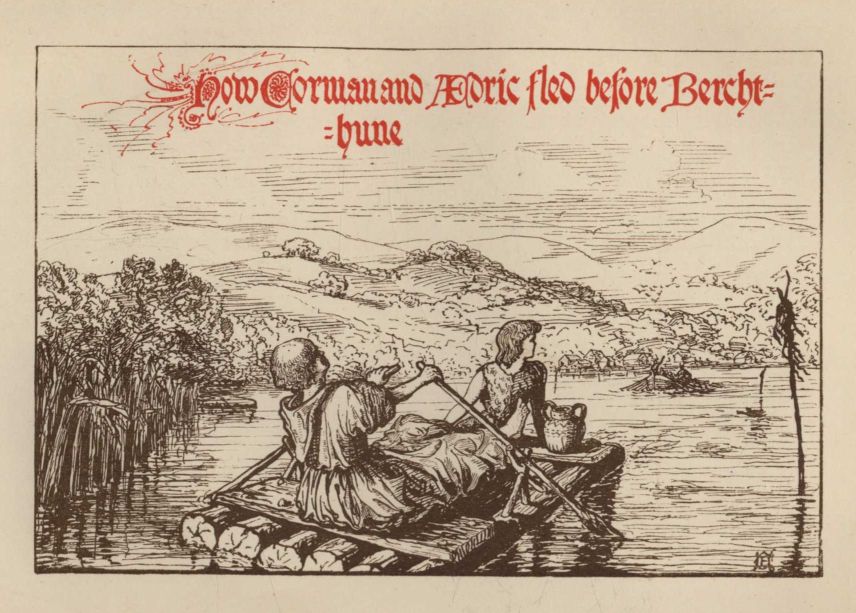
How Corman and Ædric fled before Berchthune
"That has stopped them a bit. Now if they only would stick in the mud! the tide is falling fast, and they couldn't get off."
Corman was getting tired with his exertions. It was quite clear, unless some accident happened to the other boat, they must be caught. They were so near to each other now that Ædric could distinguish the men. They were all strangers to him. The man who commanded was a tall, grey-bearded man, muscular and wiry. He wore a helmet and linked mail shirt, across which a chain hung supporting a two-edged battle axe; his keen eyes glared from under thick, bushy, grey eyebrows, and two wings of a hawk attached to his helmet gave him a very war-like air.
"Who can he be, I wonder?" said Ædric.
Corman only shook his head by way of answer, and kept rowing desperately, but there was evidently no chance. Suddenly an idea struck him. "Ædric," he gasped, "dost thou see any shallow spot ahead over which we could go, but on which they would stick? If thou dost, point to it, and I will row over it."
Ædric looked about; the sea was so muddy that it was difficult to tell where the deep water was, but the current ran in stronger eddies, and with more of ruffle on its surface in the channel, and the boy saw one bank that he thought would do.
They had now got to the part of the creek where the Boseham lake, or creek, joined the arm that went up to Cissanceaster. There was a long spit of mud running out from the western shore. If they could pass over this they would gain a good bit on their pursuers, who might, perhaps, be tempted to follow them, in which case they would inevitably run aground, and would have to remain for some hours.
"I see a lane of deeper water across that bank there, only you must row very hard for it. It is some way off yet!" cried Ædric.
Corman tugged at the oars, the awkward raft moved hardly any quicker, and the drops of perspiration rolled off the monk.
Nearer and nearer the other boat came after them. The steersman was laughing. Ædric could see his great mouth opening in a broad grin of triumph. The men were not rowing nearly so hard now, and he could hear them talking. They were quite confident of success.
"Pull, Corman, pull! we are just going into the shallow part."
And the poor monk rowed harder than ever. His eyes were straining and bloodshot, and the muscles of his neck stood out like knotted cords. The bow of the other boat was only a few yards off. The man in the bows had put his oar in, and was standing ready to jump on board the raft. The water curled under the bows.
Suddenly the man in the bows was jerked violently forward, a large rush of water spread over the yellow surface ahead, and a wild shout of joy rang out from Ædric.
"They are ashore, they are ashore! Hurrah!"
And so it was: the boat, drawing quite two feet of water, had plunged into the mud, and was now stuck fast. All was instantly confusion and clamour on board. The chieftain stormed and raged, notwithstanding it was entirely his own fault; for he had not followed the wake of the raft, but had tried to cut it off. The raft was still in comparatively deep water, and was going away merrily. The men on board all stood up, and pushed and tugged at their oars, but as fast as they pushed their oars in, and moved the boat at all, they pulled her on again by trying to get their oars out of the deep, clinging, holding mud. Fierce imprecations and abusive epithets flew from the commander, but all to no purpose.
"Get out, men! out with ye, or we shall remain here for ever. See how the tide is falling!" shouted the old man.
The men tumbled over the gunwale into the shallow water, but they could hardly have done a more useless thing. Instead of pushing the boat off they only pulled it all the deeper into the mud; for not being able to obtain any foothold, they hung on to the sides of the boat to prevent themselves sinking in. It was a ludicrous sight to see all these strong men hanging round the boat, wallowing and plunging in the black, clinging mud. The helmsman grew more and more furious, the more it became apparent that their position was hopeless. The men, disgusted with the mud and their fruitless exertions, tried to get in again, and the sight was still more comic, as they all struggled to climb over the side of the high and awkward boat. Their muddy legs all had the appearance of wearing long black silk stockings, and as they wriggled and plunged, they gradually became covered with the same horrible, greasy, shiny coating. Sometimes a man would be seen to raise himself up, get one leg over the gunwale, lie down on his side, and try to roll himself into the boat, his other leg would wave in the air, and just as he was succeeding, some of the other men, intent on their own endeavours, would pull the boat too much down on that side, and he would roll over into the mud again. At last one or two succeeded in getting in, and the others, with their assistance, were hauled over the side, not without much bruising of legs and arms, and a plentiful bedaubment of mud.
Meanwhile Ædric and Corman were getting on well. The monk had rested a little when he saw that they had got far enough away to be safe from any arrow, supposing the men had bows and arrows with them, and he and Ædric were laughing at the miserable plight of their pursuers.
Suddenly Corman began to row vigorously again. He had looked round, and instantly worked as hard, or harder, than ever at the oars.
"Why, Corman, what is the matter?" said Ædric; but the monk did not answer. Ædric looked about, puzzled; there was no other boat in sight, and the men were still far too busy trying to get into their boat to be thinking of any means of pursuing them, even if they had a chance of finding any. But while Ædric was wondering what had caused these renewed exertions of brother Corman, the raft came to a stop. It also had run on the mud.
Their position was now singular, and very tantalising to both parties, but especially so for Corman and Ædric, for a few strokes more or a few inches more water and they would have been over the bank and into the little lake that ran into the deep channel on the other side. But there was no help for it. They could not push the logs of wood across, tied together as they were, and they were compelled to sit patiently and watch the struggles of the men in the other boat.
These latter had at last got in again, and a loud shout told Corman and Ædric they had discovered that they also were aground.
"What shall we do?" asked Ædric, ruefully.
"Sit here, my son, until the Lord sends the water back again."
Poor Corman was not sorry altogether. It had been a terrible trial of his strength, and he had pluckily answered to it; but he was very exhausted. Fortunately he had the pitcher of water on board, which he had put there in case Ædric should want any, or feel faint, and it now came in very usefully. After taking a long draught, he uttered a sigh of satisfaction, and stretched himself at full length on the raft, closing his eyes and folding his hands together on his chest.
Ædric pushed a skin under his head, but the monk took no notice. The boy would have liked to have talked, but he respected Corman's fatigue, and watched the other boat's crew instead. They were doing nothing, sitting listlessly on the sides of the boat, some with their black legs hanging over, some with their legs inside, all looking disconsolate and foolish. They evidently had no bows with them, or they would have tried a shot at the raft.
The tide had now gone down a long way, and both boat and raft were left high and dry. Corman still slept, and Ædric was beginning to be very weary of their position, when he thought he heard some one hailing them. He looked about, but could see no one. Thinking it was his fancy, he was going to lie down when again he heard a voice calling, and this time there was no doubt it was some one calling Corman. The boy instantly awoke the monk, who sat up and rubbed his eyes with a dazed look.
"Corman, there is someone calling you."
"Is there? Where?" said Corman, sleepily.
"I don't know where. Listen, there it is again."
Corman got up and stood upon the raft, which had by this time settled down with its weight into the mud. He looked about; the tide had got down so low that the mud banks in places obscured a view of the water. But as Corman looked round he caught sight of a small boat in the Cissanceaster channel as near to him as it could get, which was about a quarter of a mile off however. As soon as the men—for there were two—in the boat saw Corman, they shouted to him again.
"Hullo!" cried Corman; "what dost thou want?"
A confused collection of sounds answered.
"I can't hear thee," shouted Corman. "Who art thou?"
"Wevcumfrolfrid" was all Ædric could make out.
"What does that mean?" said Corman. "Speak more clearly," he shouted.
Again the incomprehensible sound came back.
"Well, they've got very weak voices, whoever they are," said Corman.
"We've come from Wilfrid," came at last distinctly across the mud.
"They have come from Wilfrid," cried Ædric, joyously. "We shall escape, then, after all."
"I don't know that," said Corman. "How are we to get to them, or they to us?"
At last an idea occurred to him. He got up again.
"Hast thou any mud-pattens?" he shouted.
No answer. He yelled out his question again. This time the word "No" reached him.
"Canst thou not get any?" he yelled.
"We'll gongetsome."
"Well, that is sensible," said Corman, as he saw the boat go off towards the opposite shore.
CHAPTER XV.
"THE CRUEL CRAWLING FOAM, THE CRUEL HUNGRY FOAM."
"Well, Ædric, if we can once get over to the other shore we shall be all safe, for Wilfrid is feared by all these South Saxons in a way that I never could understand."
"But who dost thou think they are who are pursuing us?"
"It must be the Eorldoman Berchthune."
Corman had now stretched himself out again, and was preparing to have his doze out. Fortunately, the weather was fine. Their situation was uncomfortable enough with fair weather; it would have been deplorable had it rained. The little raft lay stranded on a wide-stretching bank of mud; all round little rivulets washed their muddy courses out of the soft ooze. On one side, but at some distance, a belt of shingle, marked with a long brown streak, the boundary of the sea at high water, was surmounted by a brown growth of wind-blown bushes, relieved here and there by a weird oak-tree, whose blighted growth appealed in outstretched leafless branches to the north-east to protect it from the violent treatment it always received at the hands of its tormentor, the south-west wind; above, a grey sky, windless and still, while all the world below looked sodden, and muddy, and brown. On this world of mud a sea-gull or two were having an eager feast, not unaccompanied by an occasional fight over some succulent crab or juicy winkle, while a curlew dipped its curved beak among the brown sludge, or plaintively cried to its more fortunate mate. Overhead a heron winged its way, looking sardonically down on the dot of the raft and the somewhat larger speck of the boat. It was a dull, dreary scene—a world of mud, a world of wood, a world of grey and brown.
Ædric looked at it all wearily enough. He began to feel sleepy too. It seemed so odd to be so close to their enemies, doing nothing, and yet perfectly safe. They were not more than five hundred yards off, and in the perfect quiet he could hear the voices of the men as they occasionally spoke.
Gradually he dozed off. The seagulls came nearer, the crabs crawled up on to the edges of the raft, and the lobworms busily raised their piles all round. So passed an hour. But what is it that causes the crabs to sidle away, and the gulls to get up on circling wings, screaming the while?
"Wake up, Corman, wake up, Ædric, and see what your pursuers are doing," the wild birds seemed to cry.
Weary of doing nothing, the idea had occurred to Berchthune to make a movable kind of platform of planks, by which two men could approach the raft. By laying down one set of boards and then standing on them, they were able to lay another set ahead, then getting on these, they were able to pull up the others, and slide them past and place them ahead again, and so they were able to make laborious but sure way up to their prey. In this way they had already advanced about fifty yards, and were getting more adroit in moving the boards.
Heavily Corman was sleeping, and Ædric was far away in dreamland. Nearer and nearer the boards were being pushed; not without much noise and mirth from those in the boat, however. Several times the two adventurous ones had, in the confidence of their skill, gone too much to the side of their treacherous platform, with the result that they had slipped into the fathomless mud, and had to crawl ignominiously back upon their fickle plank, blacker and humbler men. Each of these checks to their pride had evoked shouts of laughter from their comrades and showers of abuse from Berchthune, who was fretting at the delay.
Ædric was dreaming blissfully, and Corman still snored.
Nearer and nearer the men approached, when a shout from their comrades urged them to more activity. The other boat had been seen returning from the Selsea shore. It ran on the mud at the nearest point to the raft, and a man was seen to get out and walk over the slippery surface towards Corman and Ædric.
"Why, he's got boards on his feet!" said the begrimed and weary South Saxon, as he squatted on his precarious plank to look at the strange spectacle, disgusted at the mean advantage of the other man.
Quite safely the man slithered his way over the mud, carrying four flat boards in his hands. He had already gone nearly half the distance, and this in about five minutes; while the enterprising South Saxons had taken nearly an hour to get over an equal space.
"Get on with ye, sluggards, or they will escape yet!" shouted Berchthune, stamping with rage at the idea of his game getting away, after all the hours of waiting on the mud, and the certainty of its falling into his hands at last, on which he had consolingly counted. The two South Saxons now realised that they must make the most desperate exertions if they hoped to get to the raft before the other man. They tugged at their boards—splash they went, into the mud ahead; quickly they got upon them—splash came the last ones they had trodden on out of the mud behind; they toiled at them to put them into their places, then jumped upon them, and once more heaved at their last resting-place. They had no time to look up, splash—slosh—heated work; grimy, filthy, slimy toil—and all the time the crew shouted to them, cheering them on, and encouraging them to fresh exertions. Brother Corman was well avenged for the trouble they had given him in the morning. The men were a great deal nearer the raft than the other man was; but he was going on steadily, and well. And in spite of all the South Saxons could do, the boards would stick in the mud, and their labour was terrific. Their plight was piteous: the perspiration rained off their foreheads, and formed little lanes of white down their muddy faces. And all the time Berchthune yelled at them, and the crew hied them on. And now the men were not more than ten yards distant, while the other man was about the same. The excitement on board the boat became intense, for their men, going as they were in a line from them, seemed to be much nearer than the other man, whose whole distance was visible.
"Make a jump for it!" roared Berchthune. "By Woden's beard, I'll have ye flayed alive if ye don't beat that 'nithing' there."
The men tugged amain, but, alas for their success! they could not get their last resting-place up; they had, in their eagerness, placed the board they were standing on too far away from the one they had just left. They leant over the mud, they stretched themselves, they gasped, they dripped, but all to no purpose, and, worse than all, their last standing place began slowly to increase its distance.
They had placed their boards on the slippery brow of one of the many little rivulets which drained the mud-banks, and as they leant over to get at the other planks left behind, all their weight, being on one side, caused the boards to lift at the other end, and begin slowly to slide down into the little gully.
One of the men had reached over so far that, as the board receded, he fell forward on his face in the mud, clutching desperately to the other planks. The other man was just able to recover his balance before too late.
"Hold on to my legs, man, can't thee?" roared the prostrate South Saxon, as loud as he was able, for his mouth was very near the mud. The other man did as he was told. The situation was now too ludicrous, even for the man who was hastening, as fast as his awkward mud-pattens would allow him, to rescue Corman and Ædric. He stopped still and begun to roar with laughter.
By this time Corman was beginning to be aware that there were other existences besides his own. He sat up, rubbed his eyes, looked about him, and could scarcely take in the situation. When he did he also burst out laughing, and Ædric, waking up, was astonished to see Corman sitting on the raft, his mouth wide open, and peals of laughter shaking him from head to foot.
The unfortunate South Saxons were not nearly so much amused; the wretched one, who was now acting as a kind of animated tow-rope to the other planks, was hanging on grimly to the tenacious boards, while his comrade held on fast to his ankles and all the time the other boards were slowly slipping over the ooze. Neither man dare let go, and yet there was no hope of being able to pull the obstinate boards out of the mud, as there was no purchase by which they could be raised, and they were besides slimy with mud.
For a minute the tension lasted; then slowly the man's hands slipped off the greasy planks, and he lay spread out, face downwards, on the ooze. The other South Saxon still held on to his legs, and the two, now that his comrade had let go of the firmly-imbedded planks, glided more speedily into the bed of the little rivulet. There was no danger of the prostrate man sinking into the mud provided he did not attempt to walk. The long weed-like grass that spread over the surface kept him up, so long as he lay outstretched; but he wanted to get on the boards on which his comrade was seated, and the difficulty was how to do it. He wriggled and twisted, and sank his knees into the slime, but at last he succeeded in rolling himself down sideways on to the plank; and there the two men sat, disconsolate and helpless, within six yards of Corman and Ædric.
All this time the Eorldoman Berchthune was shouting himself hoarse with abuse at the wretched adventurers, and Corman and Ædric were enjoying the sport.
Their rescuer had now waddled up to them. Corman knew how to use mud-pattens, but the difficulty was how to carry Ædric. He could use one leg, and they managed by putting one mud-patten on his foot, and holding him between them, to get him off the raft.
The South Saxons, seeing their prey escaping them, when they had so nearly grasped it, and urged on by the abuse of Berchthune, determined to make one more effort. Profiting by his experience of the buoyant nature of the mud, if only its properties were clearly understood, the South Saxon who had wriggled on to the planks beside his comrade determined to try the plan again. It was only six yards—only three times his own length—and the mud-pattens were not yet adjusted. Throwing himself forward on to the mud, he began to wriggle over it towards the raft. The other man, not to be out-done, began doing the same.
"Quick, Ædric, or we shall be too late after all," cried Corman.
The South Saxons were just reaching the raft as Corman and their deliverer assisted Ædric off between them. Wildly their pursuers flung themselves upon it. The others were only a few paces off. Without hesitating a moment, the first South Saxon reared himself erect on the raft, and sprang fiercely after the retreating figures. He just managed to reach the skirts of Corman's frock, and plunged knee-deep in the mud. He held on to the poor, old worn gown of the monk, who struggled to wrench it out of his grasp, while Ædric and the other man pulled at Corman. Suddenly there was a crack, and the torn handful of Corman's garment remained in the South Saxon's hand, who sank deeper in the yielding mud with the recoil.
The other South Saxon had been more prudent; he stood upon the raft and looked at the now secure Corman and Ædric, and at his miserable comrade—for miserable he was, far more so than at first sight appeared. He wriggled and struggled to get out; plunged his hands and arms up to their elbows in the mud. The more he strove, the more hopeless his position became. Deeper—deeper, down he sank—the mud was now up to his waist. If only he could get one leg out, or throw himself flat upon the mud again; but the suction of the mud was upon him. Its awful grasp had got sure hold of him.
"For the love of Valhalla, lend me a hand!" he roared.
"I can't, man. I can't reach thee!" cried the other.
"Give me that oar—give me them both. Quick!"
The oars were flung to him; he placed them under his armpits, and so low had he sunk that he rested on them. For a time they bore him up, but the slight sticks, only roughly flattened at the end, began to sink too; and the pain in his shoulders was acute. His situation was desperate, for although he was being only very slowly engulfed now, yet none the less was the progress very sure. The tide had begun to rise—it was coming in rapidly. Would there be time for the raft to float before he was suffocated, or would the sea flow over his head first before there was water enough to float it? It was a desperate hope.
Meanwhile, Corman and Ædric were safe in the boat Wilfrid had sent for them, and were far away on the other side.
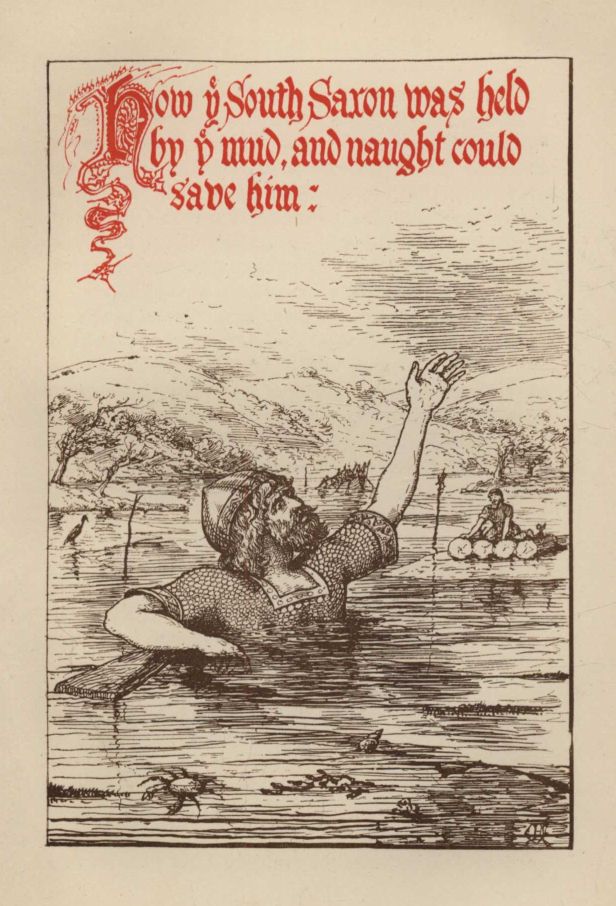
How ye South Saxon was held by ye mud, and naught could save him:
Up and up flowed the tide. The sea gulls had had their feast of crabs, and were screaming overhead. The wretched man's eyeballs were starting from his head; his head was sunk between his shoulders. Up and up crept the tide. The lobworms had ceased to pile their little heaps; the crabs were playfully scampering to meet the crawling froth, pushed further and further with each succeeding wavelet.
No hope! the water has reached his chin; the slimy froth and scum of the mud forms a collar round the doomed man's neck. One more prodigious effort, one despairing, gasping heave. No good! The hands are clasped over the mouth, with the instinct of self-preservation, even in inevitable death; but the water knows no barrier. The froth bubbles up, it is on a level with the lower lip, each wave and ripple washes higher, now the mouth is covered. With a desperate wrench, the gasping man raises his mouth above the water, but, unable to keep up the strain, his head sinks again, and this time the cruel water has reached the nose. The head falls down, a few bubbles, a little brown patch, hardly to be distinguished from seaweed, around which the yellow froth laps in the ripple, is all that marks where a strong man has died. Soon even that will have disappeared, and the place that knew him shall know him no more.
The sea had been washing round the raft for some minutes, but the water-soaked logs were heavy, and had been sucked into the mud. The drowned man's head had been entirely covered before the awkward structure showed any signs of lifting. Indeed, the water was nearly floating over it, and the South Saxon had begun to dread a similar death to that of his comrade, when the raft gave a lurch, and once more was afloat. The man had no oars, or anything to propel it with; but as the other boat would be afloat also before many minutes, they would come and pick him up.
Presently the idea occurred to him to push the raft with one leg on the bottom; in this way, and with a favouring tide he was enabled at last to reach his companions.
The Eorldoman Berchthune was very sullen, and greeted the man with violent abuse for not having made more haste at first; and this was all the misguided ceorl got for having volunteered on a perilous enterprise: for having been face to face with death, and that almost the slowest, most lingering, which could happen to man. But then in those days what were men made for but for death?
The tide had now risen high enough to float the boat. Berchthune was about to give orders to shove her off the bank, when a horseman galloping hastily down the shingle on the shore, and riding his horse as far out as he dared, shouted to the boat:
"Cædwalla has been made king of Wessex, and is marching upon us."
There was now no thought of pursuing Ædric. Orders were instantly given to turn the boat's head towards Boseham again, and it was not long before they reached its little quay. There the horseman met them, having ridden his horse at full speed, and then Berchthune learnt fuller particulars of the startling news.
Cædwalla was only a day's march distant, advancing with a powerful force of West Saxon eorls, and his own veteran band of faithful followers, no longer outlaws, but honoured friends of the king. He was burning to avenge his last defeat and reassert his claim to the throne of the South Saxons.
This was grave news. Berchthune mounted his horse and rode off at once towards Cissanceaster, directing his followers to come after him as soon as possible.
But all this time Ædric and Corman were making the best of their way to Wilfrid. Corman, indeed, when he saw that Ædric was safe, intended going back to look after Father Dicoll, but Wilfrid's men advised him not, and as there was no boat, for they would not lend him theirs, he was compelled to go on. He cast one more lingering, sad look at Boseham, and mourned over his dearly-loved friend, Father Dicoll.
But Ædric was delighted; he should not now have to live at Selsea among perfect strangers. After a long ride over a drearily flat country, they came to a clearing amid the gorse and bush; on the other side of this clearing a building, that to Corman and Ædric looked immense, towered aloft over a hamlet of low thatched houses and a few farm buildings. The smell of the sea was all round, and stacks of seaweed filled the air with their peculiar odour.
What struck Corman and Ædric, however, was the order and tidiness of everything. The thatched cottages were well thatched, the walls looked well built, and the few people they met all looked better fed and happier than those about Cissanceaster and Boseham. As they got nearer to the large building a solemn sound rose and fell in measured cadence. Ædric had never heard a sound like it, at least not produced by artificial means; it was to him like the wind playing among the tall trees and the sea rolling on the shore mingled with the deep mutter of thunder on the horizon.
"What is it, Corman? is it an enchantment?"
"No, my son; it is the service of vespers in the new church Wilfrid has been building. He has brought over from Rome new wind instruments; and Gregory, the celebrated bishop of Rome, who sent Augustine, the monk, hither, has set new music to the canticles of the church. Thou wilt now be able to see how Christians perform their service of the voice and heart to God."
"It is very grand," said Ædric, who had never heard any music more beautiful than the harp, and no singing in combination more than a chorus to some interminable gleeman's tale in verse.
They had now got well into the village, and were approaching a long, low, barn-like structure; round the entrance everything was unusually tidy, and some attempt had been made to form a path of shingle and sand, edged with white flints, from the neighbouring beach. In front of this door their guide stopped, Ædric was lifted off the horse-litter by Corman and the other man, and they entered a large room or hall. Ædric had never seen a room like it. The floor was very clean, and a fresh pile of reeds lay near the door, to replace the soiled ones that served as a mat. There was a long table down the middle of the room, and across one end was another table, in the centre of which was a large massive oaken chair; on each side of the table were wooden squares, or trenchers, which served for plates; by the side of these were horn drinking-cups. At the end of the room, opposite the large chair, was a wooden reading-desk, and on this was a splendid manuscript, heavily bound and chained to the desk. Ædric could see that there were some lovely pictures in it, and he longed to examine the volume. He had never seen a book in his life before, and the nearest idea he had ever had of a drawing had been some carvings on a horn which his father very highly prized, and some pictured hangings which were treasured among the family's most valued belongings, and which tradition said had been taken in the sack of the haunted ruins at Brædynge. Father Dicoll and the poor monks had no books; they had no parchment, and no paper. Ædric had heard of writing, but it had always been spoken of with awe, for it was considered to savour somewhat of magic. It was therefore with a solemn feeling, as well as one of curiosity, that he looked at the large mysterious volume. At the side of the room opposite the door, and nearly in the middle on that side, was a bright fire. The logs were piled up on iron bars, and a large square of hard trodden clay served as hearth. The smoke from the fire found its way up and out of the hall by an aperture in the roof immediately above it, but, as it did not always take this way out, there was a strong smell of burnt wood and smoke in the room.
Ædric and Corman were led up to the bench before the fire, and told that the clerks who were with Wilfrid were at service and they were to wait there until it was over. Ædric felt awestruck at the silence, the neatness, the comfort of everything, but especially at the stillness of the place, the hall of his own home having always been full of noisy domestics, familiar and lazy; the remains of the last, and indeed of several previous feasts, were left on the floor, and the whole place habitually reeked of feasting, rude plenty, and dirt. But here was something very different. Order and cleanliness were visible everywhere.
Presently there was a noise of feet outside on the shingle path, and a tall figure entered the room. It was Wilfrid, followed by his two faithful companions, Bernwine and Hildila. Corman at once arose and stood in submissive silence before the great churchman, while Ædric tried to get up, but was arrested by the kind voice of Wilfrid bidding him be seated.
The boy was at once won by the gentle voice and kind smile of the bishop, but was at the same time much in awe of him. Somehow he seemed so very much farther away from him than Father Dicoll had seemed; it was not that he did not greet him in quite as friendly a way, or with even a kinder smile, but the boy had a feeling that he was a much smaller object, and could not possibly be of any interest to Wilfrid. At the same time there came across him all that Dicoll had said about him, and, with the instinct of a boy who is quick to recognise what is put on or assumed in manner, he felt as if Wilfrid's kindness were a matter of policy, and not a matter of the heart. It is not to be supposed that Ædric could have given these reasons for his awe of him, but in very great awe of Wilfrid he certainly was, and what was even more curious, brother Corman seemed equally in awe of the bishop. As not infrequently happens when very ingenuous, candid natures come in contact with deeper, more intricate, more commanding minds, it seemed to strike both that it was Wilfrid's part to be both kind and sweet in manner, while with Corman himself it was his nature to be so.
"My son, thou must be very tired after thy journey," said Wilfrid. "Thy couch is prepared, and supper shall be taken to thee there. I will entrust thee to the care of Father Bernwine, who will make a careful nurse, and see that thou art well cared for. In the morning, if all be well, I will talk with thee. Meanwhile, Good-night, and may the peace of God go with thee."
This was all said with such sweet dignity that Ædric, who would much rather have sat up and did not feel at all sleepy, did not venture to dispute the arrangement, although at home he would undoubtedly have boisterously done so. He was supported out of the room, therefore, by Bernwine, after taking an affectionate leave of Corman, who remained awaiting the bishop's instructions.
CHAPTER XVI.
"BLESSED ARE THE PEACEMAKERS."
The next day Ædric awoke early. It took him some time to realise where he was. The dim light of morning came in through a narrow aperture in the walls, and he could only just make out surrounding objects. All was very quiet. He could see that he was in a little room, neatly furnished with a wooden settle or stool, and the wooden bed on which he lay. There was a little wooden cross on the wall by the side of his bed, and some writing underneath it, at which Ædric stared, not quite liking it. He thought it must be writing, for it was rather like some marks on the horn at home, and which he had been told were spells. He wished it was rather lighter, or that some one would come, for he could not tell what the runes might do, they might contain some enchantment, it was better not to look at them. Presently he heard the same solemn sound he had heard last night, it sounded very beautiful as it plaintively pealed through the building, now rising in sustained unison, then sinking in deeper notes, appearing to swell and sink and swell again, appealing in mystical utterance to an invisible but all-powerful Being. When the music ceased, Ædric could hear a continuous sound of human tongues, then one deep musical voice, followed by a solemn melodious blending of all the tones.
Soon after, he heard the noise of steps at his room, over the entrance of which a curtain hung, and in another moment Corman entered, much to the boy's relief.
"Oh! how glad I am to see thee, Corman, I feared thou hadst gone away."
"I should not have gone without seeing thee first, Ædric; how hast thou slept?"
"Very well. I feel much better, I believe I shall be able to walk without any help, to-morrow, if I am allowed to practise a little to-day—but what was that sound? what have they been doing? I never heard anything like it."
"That was the morning service, or matins, and I have just come from it. But thou hadst better get up now, and I will help thee into the Refectory, where we are all going to have breakfast."
When Corman and Ædric entered the large room or hall, into which they had first come the evening before, they found the room nearly full. Wilfrid was at the head of the table, on each side of him were Bernwine and Hildila, while all down the long table were a few monks, some lay domestics, and several boys, who all looked curiously at Ædric. One of the monks led Corman and Ædric to their vacant places, and then grace was said by another monk at the lower end of the table, after which all sat down, and the same monk who had said grace, began to read out of the beautiful book that had so attracted Ædric's attention the night before.
The breakfast consisted of a portion of fish to each person, and a portion of oatmeal porridge made with water. There was water to drink, but at Wilfrid's table there was a jug of milk, of which, however, the Bishop only took very sparingly, but he sent it down to Ædric, and another monk who seemed delicate, bidding them take it for their bodily comfort.
The fish had been caught by Wilfrid himself, who had taught the ignorant South Saxons how to supply themselves with this wholesome food, and, like many men remarkable for their intellectual gifts, he was especially pleased with the success of his skill in the gentle craft.
No word was spoken during the meal, all listened attentively to the reading of the monk. He was reading from "The Dialogues" of Pope Gregory the Great, but Ædric naturally did not understand a word, as it was all in Latin; when Corman afterwards told him the marvellous tales that the monk had read, he wished much that he could have understood it, and longed more than ever to look at the pictures, and made up his mind he would like to learn to read. When all had finished, the reader closed the book and said grace, after which he sat down and had his own breakfast, while the rest dispersed. It appeared that each man had his allotted task; some went to the outhouses whither the platters and other appliances of the breakfast table were taken, and were there washed up; one of the lay brothers winding up a bucket of water from the well hard by, and heating it in a copper. Others went to a tool-house, and taking their hoes and mattocks went out to the garden on the south side of the little settlement. The choir boys were taken off to the church and were there taught general knowledge, as well as music, by Bernwine. Hildila took two or three monks with him and they carefully practised writing under his instruction.
Wilfrid beckoned to Corman to bring Ædric up to him.
The boy felt very shy when he saw the clear piercing grey eyes of the celebrated Bishop searching him through and through. For in Wilfrid's face there was that presence of a will, which is always so marked in men who have been great in the world, and this will makes its presence felt without a word being spoken, as the needle, when magnetised, is powerless to resist the attraction of the mysterious pole.
"My son, brother Corman has told me all about thee. He tells me how patient thou hast been under suffering, and how thou hast been brought to wish to lead a better life. Thank God for thy pain, for by it thou hast been enabled to learn the way of salvation, and mayst be intended for a blessed purpose, even the awakening of thy people from the dark night of Paganism to the glorious light of the Gospel."
Ædric looked timidly at Wilfrid: he did not know what to say, he could not talk to him as he had done to Father Dicoll and brother Corman. He felt he could only learn by hearing, not by questioning, which, to a boy, is so much the preferable way, but which, unless carefully directed, leads many times to a desultory and fruitless end.
Wilfrid went on, seeing that the boy was listening: "Thou wilt be able to learn many things here. When thou art thoroughly taught in all that is necessary, thou shalt be baptised; and when thou hast quite recovered, thou canst return to thine own land and teach thine own people. For what more beautiful or holy object canst thou have in life than the hope of meeting those who have been brought to eternal life by thy means? Think what a blessed thing it would be if the Almighty should employ thee as His messenger. And be not daunted, my son, by the scoffs and jeers of the world; rather count them as so much glorious proof that thou art doing God's will. What saith our Lord: 'Blessed are ye when men shall revile you and persecute you. Rejoice and be exceeding glad for great is your reward in heaven.' Think not, my son, either that the reward is far off: all good men have reckoned that the sufferings of this present life are as nothing compared with the joys or sufferings of eternity. Think, for it is perfectly true, the short period of thy life here will make or mar thine everlasting life. Thou canst not grasp the word 'ever-lasting,' neither can I. But now thou lookest forward to change; each day, each hour has some hope in it. Then, there will be no change, not in the sense in which we understand change; and if we have hopes, for no man knoweth what is beyond, unless, perchance he has seen it in dim visions of the night, like that soldier thou didst hear of whom the holy Gregory knew—but I forgot, thou dost not yet understand Latin—they are hopes that will not affect our weal or woe, for it is by this life we shall be judged. And all men now believe that the times are at hand when God shall come to judge His people. What said the holy Gregory, now nearly a hundred years ago: 'But a short time, and the earth and the heavens will burn, and among the blazing elements, amid angels and archangels, and thrones and dominions, and principalities and powers, the terrible Judge will appear!' The times are very evil; around us are wars, and rumours of war; famine and pestilence have been stalking throughout the land; kingdom rises against kingdom; and who shall say that the time of our visitation draweth not nigh. Who then, my son, would count the sufferings of this present time as compared with the joys that shall be hereafter? Work then, my son, pray, mortify thy flesh, wrestle against the desires of the body, not forgetting that while we do only our duty, we cannot merit anything of ourselves, but can only be saved through the all-abounding grace of our Saviour. Of these things thou wilt learn more from the instruction of Bernwine, and may the blessing of the Almighty rest upon thee. If thou art in any difficulties, or doubts, or earthly sorrows, come to me, though of these I trust thou wilt soon be free, for the first step in the Divine life is to think naught of earthly affection and lusts, for what said the holy Fulgentius[1]: 'Youth can easily bear any burden when once it has learnt to despise human affections.' I trust, in a short time, to hear well of thee from thy instructor, and that the lessons thou art learning are likely to bear fruit. But remember docility is the chief quality. Thou must pray for the ornament of a meek and quiet spirit, which most becomes a follower of our Lord, for, truly, Solomon says: 'My son, despise not the chastening of the Lord, neither be weary of his correction.'"