CÆDWALLA (continued 2)
Reading edition
But where are the other bands? Where is Athelhune? Where are the house-carles? Where is Cædwalla's brother Wulf?
"Quick, Cædwalla, retreat while yet there is time," shouted Ceolwulf, who saw the ominously increasing crowds of hostile faces pressing up behind them. Their own numbers were very few. Three were lying on the ground either dead or dying; two more were so desperately wounded that they could hardly offer any resistance, and reeled as they stood round Cædwalla, and only two or three had escaped without a wound.
But the chieftain's eye instantly took in the situation, and without a moment's hesitation he ordered all to advance on the palace. He could hear the cry of Athelhune, and at last saw by a movement among the crowd that the other bands were coming up.
With a rush, therefore, they sprang towards the palace gate. The defenders were few, for in the excitement of the fight round their king the men had disregarded Edilwalch's orders, and had come out to join the fray.
Daunted by the fierce onslaught, they fled into the interior, and Cædwalla's men rushed in, closely followed by a yelling mass of infuriated townspeople. But two of Cædwalla's men kept these at bay until the doors were shut.
The position now was somewhat curious. Edilwalch was killed, and Cædwalla occupied his palace—at least some part of it—and was himself besieged in his enemy's stronghold; but in the rear of his assailants he could hear his own men pressing up, and he had little doubt of the victory in the end.
But now Cædwalla was to feel the effects of that element he had invoked to his own aid. A stifling smoke rolling through the rooms where he and his party had taken refuge told them that the house was on fire, and the shrieks of terrified women behind them showed how far it had spread, and how useless it was to seek for shelter by going further into the house.
"There is no help for it, my men—our safety lies in our own hands. With them let us hew us out a path; we cannot fight with fire. I hear the shout of Wulf, my brother, and Athelhune is pressing on. Let us all make ready; the moment I give the word and the door is opened, rush out upon the yelling curs. Are ye all ready? Throw open the gate. Follow me!" and with a fierce shout of fury the eight desperate men sprang upon the mob.
Then once more began the wild cut and thrust. Scarcely one of Cædwalla's men had any of his shield left. Regardless of their own safety, they now only thought of selling their lives as dearly as possible, and each man hewed and stabbed, and struggled, and pushed in the seething, furious crowd. Woe to him who fell! there was no hope of his ever rising again.
All the while the shout of Athelhune's men grew nearer, and the flames of the burning palace waxed hotter and hotter, and the whole place and scene resembled Pandemonium let loose. Shrieking women, with dishevelled hair, stood on the outskirts of the mass, and as they saw their friends fall, seized them by their limbs, and tried to pull them out of the fray. But nearer and nearer came Cædwalla's bands, until, with a wild rush and shout of triumph, they burst through the men who were opposing them, and, cutting through the crowd that thronged about their chieftain, rescued him from his perilous position.
They had not come a moment too soon. Cædwalla's axe was broken; he had received a cut across his arm; not a bit of his shield was left but a small piece to which the thong was attached that served to strap it on: his heron crest was shorn off; and his right arm was stiff and weary with the fight. Ceolwulf was wounded, and not a man but had some hurt, and the heat from the burning palace behind was growing unendurable. At Cædwalla's feet lay the dead body of Edilwalch, and around lay heaped up the bodies of the slain. Truly, the feast for the Valkyrior maidens was enough.
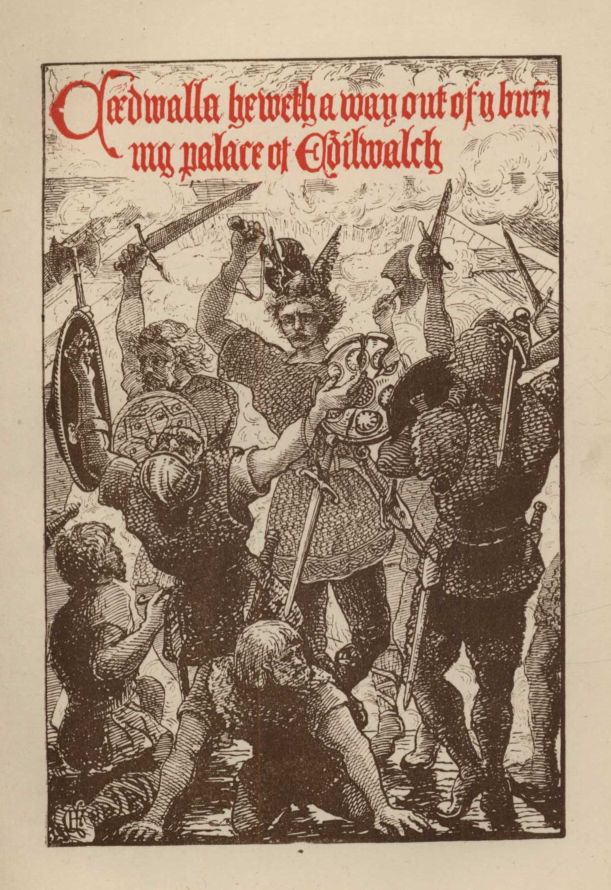
Cædwalla heweth a way out of a burning palace of Edilwalch
When the men of Cissanceaster saw the companies of Cædwalla now all united, they drew off, and stood sullenly looking at the carnage they had made, or else went off to put out the fires which were blazing around them, or to see that no more houses took fire.
Then Cædwalla, seeing that none had any longer a mind for the fight, stepped forward, and, addressing the inhabitants, said:
"Men of Cissanceaster, and all good South Saxon folk, I came not to war with ye. Ye are all my kith and kin, and I would rule ye as well as my ancestors did; but Edilwalch, who lies here dead, revolted, as ye all know, from the kindly sway of my kinsmen, and joined the enemies of my race and yours, the tyrannous Mercians. Would ye prefer Mercia to Wessex? the wicked Penda[2] and his son, with their many deeds of bloodshed, to the wise Ceawlin and his noble descendants? If ye prefer war, here am I, and my faithful followers; our arms are not yet weary, nor is our soul yet low; let us decide the issue now. If any claim the crown for Edilwalch or his descendants, either I will fight any man single-handed, or we will choose man for man and fight it out, and Woden shall choose the victor. Shall we be friends or foes?"
[2] Penda died in the flight from Winwidfield A.D. 655, but the memory of his power and ruthlessness remained long after him.
A low murmur of applause greeted this speech, and Cædwalla went on:
"If, my friends, ye prefer peace, and think enough hail has fallen to Woden, and the Valkyrior should rest appeased, let us then ratify our friendship and our rule by feasting. Bring us here such food as ye have, and we will sup together, and drink to the brave slain who are now entering Valhalla."
The leading men who were left of the followers of Edilwalch talked apart, and the rest of the people went off to look after their property. Cædwalla seeing no one inclined to answer him, again spoke.
"Come, my men, let us be friends, and bring us what we want, that all may end in peace and pleasure. We care not to await much longer."
One of the oldest of the South Saxons stepped forward, and said that if Cædwalla would give Edilwalch a funeral becoming his rank, and would treat all men as well as Edilwalch had done, they would accept him for their king.
Cædwalla having accepted these conditions all hostilities were laid aside, the new king's followers helped to put the fires out, and, the bodies being carried away and torches brought, preparations were made for feasting the conquerors. The carcasses of some oxen were found ready roasted in the burnt stalls, and beer and milk were brought out from the stores belonging to Edilwalch, and which now belonged to his conqueror; all sat down on rough benches quickly improvised from the ruins of some of the cottages, and tables were made in the same rough-and-ready way.
Soon all was laughter and merriment: gaily the jugs of ale went round, and the half-roasted flesh was devoured with avidity. Coarse jest and practical joke accompanied the feast, and when all were satisfied the warriors slept round the remains of the repast. Only Cædwalla and his two lieutenants, Wulf and Athelhune, retired to a room in the half-burnt palace; a few of the more responsible of their soldiers were left to guard the door in turns, with orders to rouse every one if any cause for alarm should arise.
CHAPTER V.
ST. WILFRID.
The next morning found Cædwalla and his followers all astir at an early hour. The scene as the sun rose was a busy one. The inhabitants were clearing away the rubbish of their burnt dwellings, an occupation that did not make them look with very favourable eyes on the authors of the destruction; while the armed men of Cædwalla's party were carrying in the dead body of Edilwalch, whose arms and shield were already stripped off him, to become the spoils of his slayer, and were picking up the weapons and arms of the rest of the body-guard and of their own comrades.
Some of the leading inhabitants, anxious to be on good terms with their future king—for most men who could forecast the future augured from his success in the past night, and from the courage and ability he had shown, that it would not be long before he recovered the throne of Wessex, now occupied by his distant relative Centwine—were sending food for the young prince and his followers.
Cædwalla himself, as he came from the palace, was thanking these men, and inviting them to stop and share their own hospitality. The wound he had received was slight, and the arm was bound round with a bandage. His helmet was no longer the small steel cap he wore yesterday, but was one of Edilwalch's that had been discovered in the palace; it was encircled by a small wreath of oak leaves, which one of his followers had made for him in token of his victory. The shirt of mail that he had worn the night before was changed for another and more gorgeous one, the rings of which were gilt. A new battle-axe hung in a gold chain across his left shoulder, and his sword was suspended in a broad leather belt that crossed his right; his muscular arms were bare from the elbows, and two gold bangles adorned each wrist, inscribed with Runic characters. A young and handsome henchman carried a new shield, Wulf and Athelhune were on each side, and Ceolwulf came close behind him.
The moment of his appearance was the signal for all his followers to raise a shout of triumph, clashing their weapons together. Two of the men, who laid claim to being skalds, or poets, and whose business it was to celebrate every great occasion by extempore verse, and who had therefore been racking their brains all the night before to think of what they should say on the spur of the moment, now came forward, and the eldest of the two began in a loud voice to shout the following verses:—
"See as the sun doth rise,
Comes he to glad our eyes,
Winner of battles' prize!
Victor Cædwalla!
Who in the shock of shields,
Keen axe or broad sword wields,
Fights till his foeman yields
More than Cædwalla?
Surely the Norns[1] have said,
Through hail of Woden reel,
Crowns shall adorn his head,
Crowned be Cædwalla!
Then, O my comrades, raise,
To the All-Father praise,
Pray for him length of days,
Long live Cædwalla!"
[1] The Norns were the Scandinavian equivalent of the Latin Parcæ, or Fates, who wove the destinies of men.
At the end of each verse the assembled warriors shouted the refrain with wild excitement, and clashed their arms with frantic glee; and at the last line the frenzy became so great that the other skald had no chance of being heard; for they made a rush for Cædwalla, and, raising him on the shield which they took from his esquire or henchman, they raised him on their shoulders and bore him through the principal street of the town, shouting the last verses over and over again, and every time they reached the line "Long live Cædwalla," their enthusiasm knew no bounds; the population of Cissanceaster were quite carried away with the excitement, which is always infectious, and joined in the chorus. At last they came back to the space in front of the palace, and, order being somewhat restored, they sat down to their breakfast. The other skald was determined not to be deprived of his turn, and had only joined in the excitement of the others with a well-bred and nonchalant air, as much as to say, "It's not bad; but if this can evoke your enthusiasm, wait till you hear my verses, and then see if you can keep the hair on your heads."
But he was not destined to have his innings yet, for, directly after breakfast was finished, Cædwalla rose, and gracefully thanked all for their brave deeds, especially mentioning Ceolwulf, and said that the property of those killed should be shared among the victors, and that he would relinquish to them, in addition, the spoils of the palace, only reserving a fit proportion for the service of the gods. He then added that all the people of Cissanceaster and the neighbourhood might go about their daily avocations as usual; and that they would always find in him a jealous protector of their interests and defender of their honour. He also added that any young men who were desirous of adventure and wished to mend their fortunes might join his Huscarles, or bodyguard, after being duly inspected by his brother Wulf and Athelhune; and he would promise that it should not be long before they enjoyed the bath of blood that Woden so well loved.
Loud shouts greeted this speech, and the skald now rose to electrify the assembly, when he was destined to a fresh interruption.
A movement among the bystanders who were looking on at the banquet and listening to the speeches showed that some one of importance was approaching, and as the crowd gave way a tall and remarkable-looking man, accompanied by two other men, who also differed very considerably from the warriors and country people who crowded the open space in front of the palace, advanced quietly towards the end of the table where Cædwalla sat.
The face of the man who now interrupted the skald, in so provoking a manner would have been remarkable at all times, both from its peculiar power as well as a certain self-asserting kind of sweetness, if we may use the expression, which pervaded the whole countenance. His face was long and thin, and seamed with many furrows; his eyes were deep-set, and were very dark and piercing; a clear-cut and slightly aquiline nose; a thin, firm, and, at the same time, beautifully-formed mouth, sharply defined at each corner by deep lines; a narrow chin, but broad, wrinkled forehead, above which rose a loose and peculiarly-shaped dome-like cap, embroidered in front with a Latin cross, worked elaborately with gold thread. Such was the head of this celebrated man.
His dress was rich for those times, and Ceolwulf certainly had never seen anything like it before. A large, loose, and comfortable hood surmounted a long and handsomely adorned cloak, which was fastened below his neck and across his chest by a large, jewelled buckle, or clasp. This ample cloak reached down almost to his feet, and concealed a white linen robe which he wore beneath, and which was fastened round his waist by a silken cord. His shoes were of scarlet leather, and marked with a black and peculiarly shaped cross. The cloak was made of a gorgeously-coloured purple cloth, and bordered with gold thread. On his hand he wore a large and valuable ring, and some beads, with a cross, hung down from his girdle. A few grey hairs peeped out from under his mitre, made of the same coloured cloth as his cloak.
Such was the celebrated St. Wilfrid, Bishop of York, and now an exile from his see owing to the animosity of the King and Queen of Northumbria.
Such a man in such a community was sure either to command great respect or provoke great animosity. Driven from one kingdom to another, he at last found refuge in the only part of England that was not yet Christian, impelled, perhaps, by a desire to do good to his enemies; for he had been shipwrecked on the coast of Sussex many years before, and had nearly lost his life through the barbarity of the savage inhabitants, whom he now came to win to the fold of the Church; but also, perhaps, because there was really no other safe place for him in England, seeing that the Queen of Mercia was sister to the King of Northumbria, and the Queen of Wessex sister to the Queen of Northumbria, while, for some reason, Theodorus, the Archbishop of Canterbury and Metropolitan, was opposed to him, and had already helped to depose him from the See of York. To a man of Wilfrid's disposition it was better to be loved by Pagans than treated as an equal by Christians. His great fault seems to have been his dislike to all authority, except the authority of the Bishop of Rome. Whenever he found a difficulty at home he appealed to Rome, and this may explain the opposition which he met with from Theodorus, Archbishop of Canterbury.
The early Church in England was very nearly in the position of a missionary establishment in a newly opened up country in our own day. As clergymen sent out from England naturally look to the parent church as their authority for all they do, so the missionaries sent by Gregory the Great looked to Rome for guidance in all points of doubt; and this natural habit the astute churchmen at Rome soon saw how to turn to their own profit, and canons were framed which made it indispensable that every higher functionary in the church should proceed to Rome for the symbol of his authority. When once the simple barbarian, accustomed to the squalor and rude manners of his own country, saw the magnificence of the buildings, the refinement of life, and the order of the Roman ritual existing in the everlasting city, he was soon won to its grandeur, and henceforth believed that whatever was done at Rome ought to be done elsewhere. This force of early habit was not easily lost; indeed, it was only when the corruptions, the pretentions, and the extortions of the Roman curia became unbearable, that men began to consider whether they were not paying too high a price for an antiquated idea, and too great a respect to the doubtful authority of the self-styled successors of St. Peter.
It was this very claim—early recognised even by legal authority, as expressed in Imperial edicts—to be the successors of St. Peter, that gave them so much power; for if it was to St. Peter that our Lord gave the keys of the Kingdom of Heaven, and if He had delegated this power to his successors, it was difficult for the superstitious and simple mind of a barbarian to refuse him obedience when once he had accepted this fact.[2]
[2] For the effect of this argument, as brought forward by St. Wilfrid in his discussion with Colman, before King Oswy, at Streaneshalch (now Witby), A.D. 664, see Bede, book iii., c. 25.
At this period the arrogance of the Roman Pontificate had assumed scarcely any of its objectionable features, and the tone of equality with which St. Columban[3] addressed Boniface IV. upon the subjects in dispute, reminding him of the peaceful intercourse of Anicetus and Polycarp, although they could not agree upon the disputed points, shows that men were not yet crushed into the lifeless mass of religious formality which they subsequently became, until roused by the trumpet call of indignation, sounded by Wickliffe, by Huss, by Savonarola, and by Luther.
[3] St. Columban, founder of the Monastery of Bobbio, in the Apennines, who lived from 543 to 615, must not be confounded with St. Columba, founder of Icolmkill, who was born 521 and died 597.
Wilfrid had been early captivated by the glamour of the Roman name. With an intense love of art, religion, and discipline, he had been flattered and caressed at the fountain-head of all. Returning to his native land, he had received the admiration due to his character for holiness; and a churchman who had been held in such favour by the foreign bishops seemed to all the most suitable to fill an English see. Accordingly he was elected Bishop of York; but, convinced as he was that the Irish or Scottish missionaries who had converted Northumbria were stubborn sectaries, he refused to be ordained by them, and, crossing to France, received a perfect ovation from the bishops there, who saw in him a determined asserter of the rights of Rome. Returning, he was shipwrecked on the Sussex shore, and at length reaching his own land, he found his see occupied by one of the Scottish missionaries, the holy Ceadda; and he retired to a monastery until called from it by Theodore, who annulled the appointment of Ceadda, and invested Wilfrid with the see of York, while Ceadda was consoled by the see of Lichfield. The grandeur of Wilfrid's ideas is shown in his magnificent buildings and the pomp of his ceremonial. It is true, it is an enemy that accuses him of the splendour of his dress and the number of his attendants, "adorned as they were with royal robes and weapons"; but the accusation seems accepted by the men of his own time, and certainly Archbishop Theodore is found subsequently among his opponents. Once more he went to Rome, and returning with a Papal decree confirming his election to York, he was thrown into prison, and only escaped through the superstition of his persecutress, Queen Ercemburga, of Northumbria. And now he had taken refuge in heathen Sussex, where all his virtues were displayed and little of his faults. His personal life appears to have been blameless, and his labours for the conversion and material well-being of the heathen most unremitting. To find this great Church dignitary, the forerunner of Dunstan, of Becket, and of Wolsey, teaching the miserable natives to fish, himself going out with them and letting down the nets with his own hands, contrasts refreshingly with his polemical disputes with Colman and the Scottish monks, or his later apology before the Synod of Æastanfeld, from whose decisions he once more appealed to Rome. As a missionary bishop—freeing his slaves, cultivating and improving the land, teaching useful arts, and social order, and all the time winning souls to God—he stands as an admirable type, and as such the thinking laymen of his own times admired and loved him. No man received such prodigal grants of land. Edilwalch gave him all the Isle of Selsea, and Cædwalla would have given him all the Isle of Wight, had he not refused to accept more than the fourth part of it; truly, he might be called the Bishop of the Isles!
As Wilfrid approached Cædwalla, the latter rose to receive him; for although Cædwalla was a heathen, yet he was far too politic not to recognise the great importance of securing the support of such a man as Wilfrid. Not only was there the moral support of his great reputation for sanctity which would react upon Cædwalla, but there was the direct assistance to be got from Wilfrid as a landowner, and the wielder of supernatural powers, which had already proved superior to the magic of the local priests or sorcerers—a fact known to all in those parts at the time of his shipwreck; for while a sorcerer was singing incantations for the success of the attack of the wreckers, and Wilfrid was praying for deliverance from them, a stone had killed the sorcerer, but Wilfrid's ship had floated off, and he had sailed away in safety.
"Welcome, noble Wilfrid, welcome to our feast—make room there for the Holy Bishop and his wise men," cried Cædwalla, and places were instantly vacated, not without a sort of superstitious dread of contact with such distinguished and powerful beings.
"My son, the Lord has been merciful to thee, and I pray that thou mayest be guided aright; it is a great duty thou hast taken upon thee, and thou wilt need much wisdom, but mayest thou be led to the Wisdom from on high without which earthly wisdom is but dross."
"I thank thee, father, for all thy kind wishes, and doubtless since I can have more open intercourse with thee now, I shall learn many things I know not; but to what am I to attribute the honour of a visit so soon? for I can hardly venture to think that it was to grace my first banquet as successor to Edilwalch that the all-learned Wilfrid has come."
"Thou art right, my son, I came not to rejoice that Edilwalch is dead. He has gone to God, and must give an account of his works; whether they be good or whether they be evil, peace be with him. I come not to condemn or to approve; he did me good, and received the cross of Christ; how far the faith entered into his heart I know not—if his faith was to be shown by his works, I fear not far; but in that he is dead, I trust he is dead in the Lord. I came to ask for his body, that I may bear it off for Christian burial."
"My father, happy am I that I can so readily and happily grant thy first request to me as prince of this land. May it be a fair omen of our future relations. I will see that it is duly performed, and the body carried whithersoever thou mayest appoint."
"I thank thee, my son. I felt sure I should find in thee a generous foe and a noble heart; such soil ought to be watered by the fount of the spirit of the Almighty. But my presence longer now would only hinder the merriment of these young men, and thou must have need of much rest, after thy fatigues of the past night."
"Not so, my father; many cares I have, it is true, but I shall feel them much lightened if I might have thy powerful and wise advice. If, therefore, thou couldest spare the time, I would fain talk with thee in private. And the young men can in the meanwhile amuse themselves."
"Such aid as I can give, which I feel thou prizest more than at its just worth, is freely thine, my son. What is done cannot be undone, and if thy right to the crown was better than that of Edilwalch—about which I am not capable of forming an opinion, seeing I am only a stranger and a sojourner in the land—the God of battles will uphold thy right; but if I can in any way help to make this land happy, such services as I can offer are thine. And I would, my son, that thou wouldest give heed to my words, and learn of Him who was meek and lowly in heart, that thou mightest find rest for thy soul."
"At present, my father, I have not leisure to go into such deep questions, but when all is at peace here, then I trust I may be favoured with thy instruction. Shall we go into the palace?"
The bishop assenting, he and Cædwalla, accompanied by the other two churchmen, retired from the banquet, and their departure was the signal for the free flow of merriment. The skald eyed the departing Wilfrid with a fiery eye, but satisfaction got the better of his revengeful feelings; for now the long-wished-for time had come, and he knew he should win endless praise. Rising therefore to his feet, he rapped loudly on the boards that formed the temporary table, and having procured silence, he began, in an affected, sing-song voice, to chant the following verses:—
"What said the God of war
He who lost arm in maw,
Wolf's maw that bit him sore,
Tyr the stouted-hearted?
What thought the mighty Thor
When he from Asgard saw
How we did yell and roar,
When we——"
but he was not destined to meet with the success he deserved, for the last word was lost in a most unmelodious braying set up by a donkey near. Whether it were that he was attracted by the similarity of the tones and words of the skald to his own discordant language, or whether he simply wished to express his approval, history knoweth not; the fact remains, however, that the donkey continued to bray "He-haw, He-haw," in a most pertinacious and obstinate way, and the skald, at last losing all patience, hurled his axe, with a wild malediction on the whole race of donkeys, at the misguided brute's head; but the axe unfortunately missed the donkey, and buried itself in a muddy ditch, near which the donkey was standing. This abortive attempt at revenge was greeted by loud laughter, and one of the young men, jumping up, said he didn't see why he shouldn't try his hand at verses, since the donkey and the skald had been having their innings.
"Once I knew a fine skald
And he sang a lay,
But a donkey near stall'd,
Beat him with his bray.
Now which is greater poet—
The skald or donkey, tell?
When the first began the song
The latter sang as well.
Loud applause followed this doggerel outburst, which had, at least, the merit of being impromptu, which is more than could be said for the skald's untimely production. The skald, however, was very angry, and shouted to the young man to sit down, for he had not finished; but the latter was now also fired with poetical ardour; he had no idea of his latent talent until he found how well his doggerel was received, and attributing this to the success of his wit, and not to the amusement caused by the discomfiture of his rival, he felt he had as much right to be heard as the skald, and having once got on his feet he felt all the delight of a young orator who has made a successful début, and, unfortunately for himself, does not know when to sit down. He refused, therefore, to give way, and proceeded to string some epithets together more forcible than elegant, the poetry of which chiefly consisted in vigorous metaphor, but whose charms were completely lost on the skald, who thundered back rhymes of a more classical kind, but breathing none the less bitter scorn for this miserable upstart who dared to pollute the pure regions of poesy, and contaminate the rich drink of Woden with his ditch-water doggerel. The wordy war waxed fast and furious, and the other competitor for poetical honours, the donkey, added to it from time to time by giving vent to a self-asserting bray, which for the moment silenced the other two completely.
"Look here," shouted Athelhune, "I am getting tired of this; if ye can't settle it to your satisfaction this way I'll show ye another and a better method; ye have bothered us long enough. It is only fair ye should afford us some fun now; catch that donkey one of ye, he's the author of all this. Now drive a stake into the centre of that clear place there, and do ye, old skald and young skald, come out here."
All were now eager to know what Athelhune was going to do, and the two men were inclined to refuse to come out; but the jeers of the others, who accused them of cowardice, at last overcame their disinclinations, and they both came up to Athelhune.
"Give me a couple of bandages," he cried; and when these were soon brought from a neighbouring cottage, he proceeded to tie the bandages tightly round their eyes, thus blindfolding them; he was not able to do this, however, without assuring them that no harm would happen to them. When they were completely blindfolded they were led up to the stake, and each was fastened to it by one ankle with a strong cord about ten yards long. The donkey was also made fast in the same way, and its two hind legs were hobbled. When all these arrangements were completed, two stout sticks were given to the rival poets, and they were told to punish the donkey for its utterly uncalled for interruption. The one who kept on beating longest was to have the right of finishing his improvisation.[4]
[4] This blindfolded encounter was suggested by the account of a contest that took place in Paris, in 1425, between four blindfolded men. Indeed, all through the middle ages such contests were very frequent, horse-play being greatly admired at all times.
A large crowd had by this time assembled, and Cædwalla's followers had all risen from their feast and stood round, and with the sporting instincts of their race were backing the three competitors: for the donkey was to have his share in the contest, and he had been muzzled to prevent his taking an unfair advantage of his vocal powers.
"Is all ready?" called Athelhune. "Then in the name of Woden begin." At this order the two poets cautiously approached the spot where they supposed the donkey was.
The younger man, whose name was Oswald, was not so anxious to hit the donkey as to get a blow at the skald, for this he knew would amuse the bystanders; so after he had gone a few paces he stopped and listened, in order to judge where the others were. The skald, who was a prudent fellow, fearing he might come upon the donkey, and so fall over it, or get tripped over its rope, put his stick in the manner of a feeler in front of him, and came gently groping his way towards the animal. This latter, after a series of violent plunges and kicks, when he found himself first made fast, had since stood perfectly still, gazing upon the crowd in a stupid way, and was suddenly roused from his reverie by feeling the skald's stick poke him in the ribs. Giving a squeal of surprise he jumped to one side, and in so doing came violently against Oswald, who, not expecting this, was instantly thrown down. The skald, thinking the donkey was where he had poked it, rained a storm of blows upon the empty air, and as there was no object for his blows to fall upon, he overbalanced himself, and fell forward on his face.
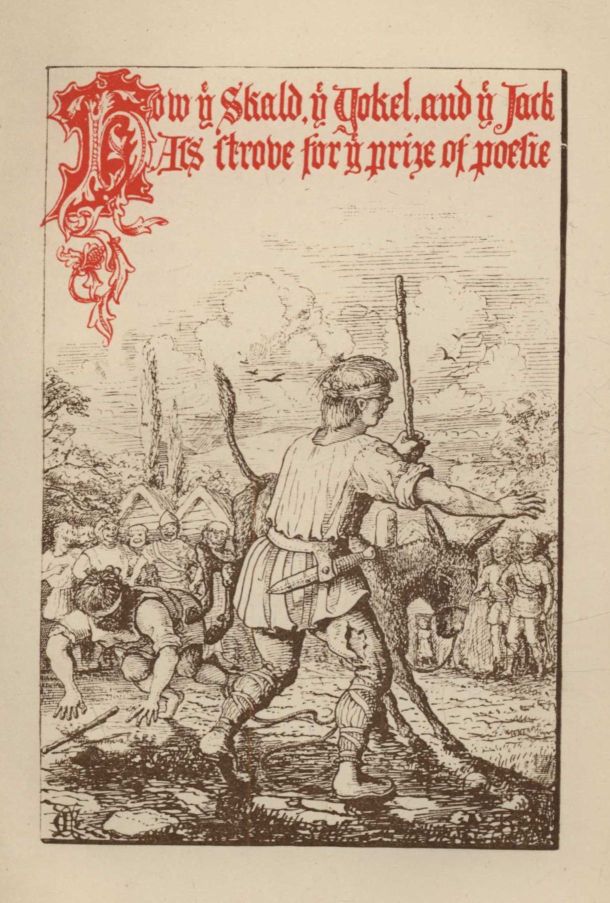
How ye Skald, ye Yokel, and Ye Jackass strove for a prize of poesie
Loud shouts of "The donkey for ever; give it him, Ikey!" rose from the crowd, who were convulsed with laughter at the ludicrous scene. Oswald had now picked himself up, and hearing a scuffling near him, supposed it was the donkey, and belaboured the spot where the noise came from with hearty good will. A roar of rage greeted this manoeuvre, for Oswald's stick fell on the miserable skald, who, burning with mortified pride and desire for revenge, rolled over out of reach of the stick, which Oswald continued to ply, unconscious that his victim had gone, until he was suddenly propelled violently forward by the donkey's heels, which caught him behind.
Vowing revenge upon the author of their misfortunes and smarting with pain, the two luckless poets rose to their feet and groped about for the donkey, which was lazily rubbing its head against the post. Oswald was the first to find out where it was, and raising his stick in the air, brought it down with tremendous force on the poor animal. Squealing at the blow, the donkey gave a violent plunge forward and pulled the stick out of the ground, and instantly upset both the competitors; for their legs were made fast to it, and the sudden and unexpected jerk threw both to the ground. Such was the terror of the animal that it dragged the poor skalds among the crowd, overturning many of the bystanders, and throwing the whole place into a perfect uproar. The captured skalds, dragged in the train of their victor, clutched at the legs of the nearest bystanders, and thus brought them down too, who, in their turn, caught at whatever was nearest to them, until at last the excessive strain upon the rope fortunately caused it to break, and the donkey went off with the honours of war.
The uproar and confusion caused by this event brought Cædwalla hastily from the palace, fearing that some cause of difference had arisen between his men and the townspeople. It was, therefore, with relief he saw the real state of the case; but, in order to prevent merriment from degenerating into strife, he directed Wulf and Athelhune to call the men together for the purpose of distributing the spoils they had won. At Wilfrid's suggestion also, he set the idle hands among the townspeople to clear away the wreck of the palace and to commence rebuilding it, promising all who would take part in this work remuneration in proportion to their services; for Wilfrid, foreseeing the advantage it would be to the cause of Christianity to gain over this young and noble nature, for whom there was every prospect of a bright future, had told him that if he were in want of ready means to fit him for his position, he would advance him the necessary funds, thus preventing the extortion which would otherwise follow if Cædwalla had to take it by violence, and the unpopularity which would consequently ensue. He well knew that the warmhearted youth would never forget this assistance.
When order had been once more restored, Cædwalla gave directions to have the funeral of Edilwalch conducted with suitable splendour, and a procession set out in the afternoon to carry the body to the stone church that was now rising in Selsea under the direction and from the plans of Wilfrid, whose taste for building had already been exhibited in the churches of Hexham and Ripon.
CHAPTER VI.
EXTREMES MEET.
A few days after the events narrated in the last chapter, Ceolwulf, or, as Ædric and Wulfstan loved to call him, Biggun, having obtained leave from Cædwalla, with whom he had become a great favourite, to return to look after his young "eorls," was engaged in overhauling the boat that had brought them to Boseham, and which had been the means of introducing them to such stirring events.
With the inhabitants of the little settlement, Ceolwulf had become an important personage. Cædwalla had for some time rendered his name respected; for being at the head of a formidable band of outlaws, all intrepid and well-disciplined men, accustomed to act together, and sure to revenge an injury suffered by any one of their number, the population on each side of the Andredesweald were very careful not to give any cause for offence to so troublesome an enemy. Cædwalla, with the true policy of all outlawed aspirants to regal dignity in semi-organised societies, had carefully directed his followers to molest only the immediate adherents of Edilwalch or Centwine, and as far as possible to treat the other inhabitants bordering on the forest with courtesy. Any man, therefore, who was in favour with Cædwalla was sure of a certain amount of respect from the people in the immediate vicinity of the Andredesweald.
The reputation which Ceolwulf had won on the night of the surprise of Cissanceaster had already spread round the district, and the poor thralls of Boseham, as well as the few ceorls or yeomen of the neighbourhood, were eager to stand well with one who was likely to be influential when Cædwalla established his power more firmly.
Beornwulf's wound was nearly healed, but he was still somewhat sullen with Ceolwulf, and had not entirely given up the idea of taking revenge on him when he was quite strong again. The conversation of the worthy monks was not at all interesting to him, and, except when they went out fishing, or told him stories from the Old Testament of the fights of the Israelites and the Canaanites, life was very dull; and he was all the more disgusted with Ceolwulf because it was owing to him that he had been deprived of his share in the booty and the glory of the night attack upon Cissanceaster, and he was now for the twentieth time grumbling over this grievance. However, there was a novelty about a boat that caused him to forget his wrongs for a short time. Born in the neighbourhood of Deorham[1], he had never seen the sea, excepting a distant glimpse of the Bristol Channel, until, joining the band of discontented and landless men under Cædwalla, he had made occasional visits to the seashore near Selsea, or to the land of the Meanwaras. Curiously enough, the art of boat or shipbuilding appears to have fallen into disuse very soon after the arrival of the first Angle and Saxon invaders, arising, no doubt, from the fact that, as they had plenty to do in conquering the Britons, the sons of the first conquerors never learnt how to build boats, and very rapidly changed from a seafaring to a partly agricultural, partly warlike people. One great merit of the early monks was that they did all they could to improve the condition of the people. They taught them gardening, building, fishing, and agriculture, as well as imbuing them with the softening and intellectual light of the Gospel, and by their gentle ways and purity of life they shed a halo of refinement round them, whose brightness, from the contrast it afforded with that dark and gross age, can scarcely be too highly estimated.
[1] Now Derham, in Gloucestershire, where Ceawlin, the west Saxon king, slew three British princes, "Commeail, Condidan and Fariemeiol."
"Biggun, why dost thou put so many places for oars?" asked Wulfstan.
"Because she's a heavy boat to row."
"Art thou going out in her then? And if thou art, who are going with thee?"
"Maybe I am and maybe I am not, Wulf."
"Thou never wilt go without my going too, Biggun?"
"That is as may be," cautiously replied old Ceolwulf.
"Why, Biggun, what's the matter with thee this morning? Thou'rt as difficult to make out as old Mother Deva was on a washing morning. Ah! I should like to see old Deva again. What thinkest thou has become of her?"
"That I cannot say; but I don't suppose that Arwald would do her any harm—leastways if she kept a civil tongue in her head. No, not that way, Beornwulf, thou art fixing that "knee" the wrong way up, seest thou?" added Ceolwulf, testily, as Beornwulf, who really was not to blame, seeing he had never seen a boat before this one in his life, was fixing a three-cornered piece of wood which was intended to strengthen the gunwale, or side of the boat, by being nailed both to it, and also to the thwart or seat. Not understanding the object of it, he was about to nail it on flat with the seat instead of on end and edgeways. Brother Corman was assisting also, and gave a very intelligent hand and eye to the work.
Ædric was lying on the bank above, stretched on a board covered with a wolf skin, and brother Malachi and Father Dicoll were looking on; as usual, a few children were playing around, and one or two untidy-looking women were sitting at the doors of their cottages spinning flax and talking gossip. The tide was nearly low, and a flock of oxy birds were settled on the mud-banks, occasionally rising and wheeling round in flickering flight, uttering their shrill cry, only to settle a few yards farther on; while a solemn heron sat motionless on the edge of the water, and from time to time stretched out its long neck and dipped its beak in the sludge; some wild ducks were skimming the surface of the glassy water, and the distant cry of the curlew and the bittern dreamily piped across the creek.
At times a dull and heavy thud, followed by a distant roar, boomed upon the silence as the ground swell of the sea outside rolled upon the shallow beach telling of some far-off storm away down channel.
In that sequestered nook and sheltered creek all was still save for the birds and the children, the chatter of the women, or the occasional remarks of the men.
It was a lovely autumn day, and the warmth of the sun was considerable on that southerly sloping bank. The golden shadows of the oak trees were mirrored in the glass-like water, and the distorted shadow of the heron came wavering across the channel in the eddies caused by its own beak. No sound could be heard from the far-reaching forest behind. There all was silent, mysterious, and profound.
There is no mystery so profound as the depth of a vast forest. The occasional rustle of a leaf flickering to the ground, the absolute silence, the dim glories of the misty blue vistas, athwart which a ray of sunlight falls upon some gnarled and twisted branch. That which is seen as well as that which is not seen alike serve to enhance the awe.
"There is one thing the Saxons can't do," said brother Corman, as he neatly fitted a new plank into the bilge of the boat, which had become leaky and was cracked from her heavy bumping on the Pole sand at the entrance to the harbour.
"What's that?" said Beornwulf.
"Why, they can't make those light fishing boats which the Wealas, as thou callest them, make. What sayest thou to a boat that one can fish from with ease, then paddle ashore, and on getting out can put upon one's back and carry home?"
"Oh, I wish I had a boat like that!" cried Wulfstan; "how are they made so light? What are they made of?"
"Thou couldest make one if thou mindest to, Wulf; only patience is needful."
"Could I? Dost really think I could? Then I could go out fishing without asking any one!" cried Wulfstan, delighted, who already in his imagination saw endless lines of fish coming ashore. "When shall we make it, Corman?"
"The first thing to do is to cut down a great many withies, then wattle them into the form of a large basket, and then thou must get a large skin, dress it well with fat, and stretch it all over the basket-work. Thou must make the basket rather longer than it is wide, and more pointed at one end. Then put a stick across the middle, and thou canst either sit in the bottom of the boat and lean back against this stick, or thou mayst sit upon the stick itself; and then if thou needst to carry the boat, thou must put thy head inside the basket, between the stick and the inside, and rest the stick against the chest. In this way it can be carried some distance without feeling much weight."
"That does sound well; let's begin making it at once; there are some withy trees, come along, Corman," cried Wulfstan, rushing off.
But brother Corman shouted after him that he had plenty to do, and when he had cut as many of the longest withies as he could carry, he had better come back with them and then go and get some more. However, several of the children of the village, with whom Wulfstan had become a great favourite, rushed off after him, and a great cutting down of withies instantly took place.
Ædric, who was watching all the proceedings with an amused and interested eye, uttered a sigh of regret that he could not go with the others, whose merry babble harmonised with the still melody of the other peaceful sounds. Ædric had been learning a good many things during the many hours he lay upon his couch; the kind monks seldom left him alone, unless he were asleep, and he was gradually beginning to understand the beauty of a life that cared nothing for itself, but gave up its whole existence for others.
He was a very affectionate boy, and as he thought over his lost home, and his noble father, almost certainly killed, he could not help crying sadly to himself. If Father Dicoll were by at such times, or came in while the sad fit was on, he would lead the conversation to the delightful assurance of ever-lasting life which those who believed on our Saviour had to console them. And as he talked on these solemn but comforting subjects, Ædric would listen with wondering curiosity, and gradually feel comforted in spite of himself.
"And after all," the worthy monk would say, "what are affections? If we loved our Lord as He loved us, our whole thoughts would be so full of Him, and the desire to do His work, that we should have no room to think of earthly affections, or earthly sufferings."
"Must not I then love my father, or my brother? My mother died before I could remember her, so I could not love her, thou knowest; but I liked old Deva, when she was not cross, which, by the way, she was often enough."
"Certainly, my son, thou shouldest love thy relations; and, indeed, it is difficult enough not to do so," added Father Dicoll, with a sigh, as he thought of his own father and mother, away in the lovely, sunny home, near the beautiful Vale of Avoca, where he had been brought up; and the bright eyes, and winsome smile of his sister. "But what I mean is, we should attain to the heavenly calm which allows us to love all mankind as brothers in the Lord, being sons of God, and heirs of the kingdom of heaven. Sorrowing when our nearest and dearest go, or we go from them; but not sorrowing overmuch, for we know it is but a little time and we shall be with them. Some day I will tell thee the story of my own life, and thou wilt then see how hard it is to die to the world when once thou hast known its evil passions and wild affections. But, thanks be to the Lord who giveth us the victory, even these are overcome by prayer and fasting, and that faith without which all else is profitless.
"Who knows, my son, but that the Almighty, in His mercy, has so ordered matters that thine accident was sent that thou mightest be plucked as a brand from the burning, and in thy boyhood might turn to Him, and, like the blessed Timothy, 'follow after righteousness, godliness, faith, love, patience, meekness,' and being led by the Spirit to this wilderness, that thou mightest learn to 'flee youthful lusts which war against the soul.' Does the life of one who from youth devotes himself to the Lord seem to thee, with thy roving northern instincts, devoid of adventure? Many, far too many for thy weak strength, are the dangers thou wilt have to encounter. Dost thou enjoy the wild pleasure of a fierce wolf hunt? The devil goeth about as a roaring lion, seeking whom he may devour. Attack and kill him if thou canst. Wishest thou for weapons in the combat? The King we serve will give thee the best, and such as have never been known to fail; there is the sword of the Spirit, which is the word of God, the shield of Faith, the helmet of Salvation, and the hawberk of Righteousness. Dost thou wish for a reward for thy toilsome fight? When the day's work is over, and thou art wearied with thy strife, a clarion call will sound, and thou wilt hear a gentle Voice say, 'Well done, thou good and faithful servant, enter thou into the joy of thy Lord.' 'Be thou faithful unto death, and thou shalt receive the crown of life.'"
Ædric used to listen, charmed by the flow of words, as well as by the earnestness of the speaker; for, after all, earnestness and manifest conviction go far more to persuade than many subtle arguments that appeal merely to reason, and are delivered only as the cold syllogisms of a faultless logic. Instinctively the youngest intelligence that deserves such a name feels there is so much that can never be explained, that facts which would stagger a mind accustomed to approach all subjects from the standpoint of human reason are accepted without demur, just as they know the sun gives heat and the countless stars are hung in the firmament; but who can explain the one or know anything about the other?
Ædric loved to hear the wonderful stories out of the Bible, all quite new to him: the glimpses he got of other lands; the marvellous deeds of Samson, of David, and of Gideon; the magnificence of Solomon; the weird awfulness of the wonders of the Red Sea, and that strange land of Ham—all came to him with the interest of novelty, and many times he could not understand what the monks were telling him.
It took him a long time to grasp the beauty of such a sacrifice as that of our Lord; the voluntary offering of Himself to such keen physical and mental suffering for the sake of those who in countless numbers would reject Him, astonished him. He could understand that no man hath greater love than to lay down his life for his friend; but it was incomprehensible that he should do so for an enemy.
But gradually, as the beauty of forgiveness dawned upon him, he came to see that if one really forgives, there comes with the sense of forgiveness a desire to benefit the forgiven one, and, the crowning triumph of all, to make him feel one in thought and action with Him who forgives. Slowly but surely the "Beauty of Holiness" was entering his soul; and as the monk talked to him of the objects and duties of life, and of how little worth was earthly wealth or station, or pleasure, compared to the eternity of existence, and the necessity of our fitting ourselves for it, Ædric, with the ardour of youthful impressions, longed to consecrate his life to God, and to renounce the world, the flesh, and the devil, in the only really earnest way that seemed possible to the most religious minds of that age—by vowing himself solemnly to God from his youth.
But Dicoll, to whom he one day timidly ventured to talk upon the subject, very wisely told him he must first prove himself; he could not tell yet whether the wish for a holy life were merely the passing sentiment of an imaginative temperament, intensified by the physical exhaustion of a serious wound and acted upon by the beauty of an entirely new set of ideas; for there would be great danger to his lasting happiness if, after solemnly dedicating himself to God, he was then to cast longing looks at the world and sigh after its pleasures and its vanities.
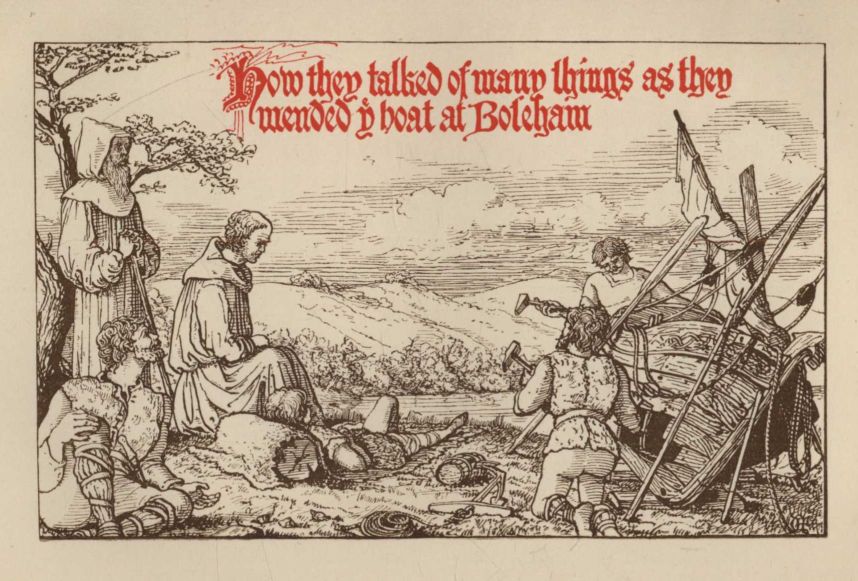
How they talked of many things as they mended a boat at Boseham
Such thoughts as these were passing through Ædric's mind as he lay on the wolf-skin and watched the boat being mended, or listened to Wulfstan as he chattered to the children, who were helping him carry the cut withies to a place near brother Corman, who was going to show him how to make his boat, or coracle as he called it.
Corman was improving the occasion, as he helped Ceolwulf and Beornwulf to mend the boat, by telling them the story of the making of the ark, in which his hearers were much interested.
"Why, that reminds me of what our gleeman used to tell us of Bergelmir the giant, who, when the sons of Bor slew Ymir, and his blood drowned all the race of Frost Giants, went on board his boat with his wife, and so floated away when everyone else was drowned," said Ceolwulf; "but I have heard of two larger boats than that. One was Skidbladnir, which was built for the gods by the dwarfs, the sons of Ivaldi, and it was so big that it could take all of them on board at once with their war stores and weapons; and it was a very useful boat, for when it was not wanted, Frey, for whom it was made, could fold it up like a piece of cloth and put it in her pocket."
"That must have been a wonderful boat, truly," said Beornwulf, "and must have had many spells and enchantments used over her, doubtless. But what was the other boat thou saidest thou knewest of that was larger than Bergelmir's!"
"I can't say I know much about that boat, but they call it Naglfar, and it is made of dead men's nails; and thus if men's nails are short when they die, the ship will take a long time to be finished, and so I was told we always ought to keep our nails short, for we cannot tell when we may die."
"And that's true enough, Ceolwulf," said Corman, "and the sooner thou ceasest to believe all those old wives' tales the better thou wilt be. 'Cease to do evil, learn to do good;' make preparation with the heart for the hour that all must pass through, and think not of the body, excepting in so far as it may be presented faultless before its Maker, which could never be by our means," added brother Corman.
At this moment Wulfstan ran up with a large bundle of withies, saying, "See here, brother Corman, we have surely got enough now, haven't we?"
"Well, yes, I think thou hast, to make a beginning with, anyhow. Thou must have a great deal of patience, or else success will not come. Now lay the longest and stoutest withies on the ground, at about a hand's breadth apart. That's right. A little closer those on the left; you have not got the spaces quite regular. Now peg them all down on the ground in the middle. Aye, that will do. But, Beate Columba! whatever is that noise about?" broke off Corman in astonishment, as a distant roar of men's voices, mingled with the clash of metal, was borne over the forest from the direction of Cissanceaster.
All stopped to listen. The noise and tumult went on for some minutes, and then gradually died away.
"Quare fremuerunt gentes!" murmured Father Dicoll.
"What thinkest thou it is, Ceolwulf?" asked Wulfstan.
"That I can't say, rightly speaking, but I should say that there was something going on," oracularly replied Biggun. "But, anyhow, we had better get on with this boat; so, Beornwulf, just help me to lift her a bit more over on her bilge, and then I can drive in these plugs a bit better. There, that will do."
"Look!" said Ædric, "there's brother Malachi coming round the point. I wonder if he's caught many fish?"
"He doesn't come very fast," said Wulfstan.
"How can three logs pushed by a monk get along fast?" said Biggun contemptuously, who, ever since the first time of their meeting, had formed a very poor opinion of brother Malachi. He did not think much of any of the monks, whom he regarded as poor-spirited fellows. He thought Corman had the makings of a good sort of man in him, for he seemed to know a few practical things, but Malachi he looked upon as not being "all there," he appeared so dreamy and abstracted.
However, brother Malachi approached, slowly but surely carried by the tide, which was now rising rapidly. A few fish could be seen lying on the board in front of him, which caused Beornwulf to take much more interest in him.
"There now, Corman, I do believe she's quite fit for sea again," said Biggun, complacently viewing the result of their shipbuilding efforts. "The next thing is to overhaul her gear and see if we can't get that sail to set a bit stiffer."
Certainly the poor old tattered sail did look as if it wanted a little attention as it lay upon the grassy slope. However, Ceolwulf, by dint of hard bargaining induced one of the women who appeared most handy with the needle to patch it up with various scraps of home-spun cloth, and at last it looked as though it really would hold the wind fairly well.
By this time Malachi had come ashore, and all the children had crowded down to the raft to see his catch. He had got a few eels, two or three of a very good size, a few whiting, and one good-sized bass. As soon as the success of his fishing was known, it was obvious how very much he went up in the estimation of the bystanders, even Ceolwulf condescending to say in a patronising way that he really hadn't done badly for a monk.
Ædric was always irritated at old Ceolwulf for his treatment of the good monks, whom he knew to be infinitely cleverer and a very great deal better than poor ignorant old Biggun; and even supposing they had not been, they had so hospitably taken care of them, at the risk of possibly making enemies, when they came to them in the most absolute need and helplessness, that it seemed a very great absence of courtesy, to say the least of it, to show the slightest want of respect to them.
But courteous manners were not a characteristic of the early English settlers, with whom the main idea was the "simple rule, the good old plan, that he shall take who has the power, and he shall keep who can."
However, none of the worthy monks showed the least resentment at Ceolwulf's manner; indeed, Ædric could not tell that they saw it.
In the excitement caused by the arrival of the fish no one had heard the hurried steps of three men who were rapidly approaching, and it was not until Ceolwulf heard himself called by name that he was aware of their presence.
"Why, Athelhune," he cried in astonishment, "what brings thee here? Thou seemest, truly, as though matters were pressing thee somewhat."
The eyes of all were now turned upon the new comers, who certainly did look as though they had come fast. They were fully armed, but their armour bore traces of rough and recent usage. Athelhune's shield was cleft nearly through, his axe was notched and stained, and he was in a violent state of heat. His two companions were in much the same condition, and one was badly wounded, for blood was slowly welling from a deep cut in the neck.
As soon as Corman saw the condition he was in he led him to his hut and staunched the wound, applying healing herbs and a bandage.
"Ceolwulf, we have been surprised in our turn at Cissanceaster by the two eorls, Berchthune and Andhune, who returned suddenly from Kent. We have been driven out of the town, and Cædwalla is once more a wanderer. He sent me to thee because he remembered the expedition thou wast to undertake, and he was afraid thou mightest wait here until thou mightest fall into the hands of the South Saxon eorls. Thou art to start to-night, and I and as many others as we can collect, or the boat will hold, are to go with thee. Thou wilt take the direction of the expedition, as thou knowest the country. The two boys are to go to Wilfrid, with whom they will be safe. Cædwalla does not in the least despair of recovering his rights, and hopes to be able to follow us himself before long."
So said Athelhune, and the astonishing nature of the news produced a profound silence, broken by Father Dicoll saying:
"See, my children, the mutability of earthly affairs. Vanitas vanitatum," saith the Preacher, "omnia est vanitas."
"I don't know what that means," said Athelhune. "but if it means I am very hungry, that's quite true. I could eat some of those fish, I think."
CHAPTER VII.
"HO! WATCHMAN; WHAT OF THE NIGHT!"
"Well, there's plenty to be done, anyway," growled old Biggun, as he gradually took in the full extent of the news Athelhune had brought, "and the worst of it is there's not many of us to do it. Well, well, we shall see. The tide don't cease flowing till a little before dusk; if we can get away somewhere before that we shall have daylight to take us over that bar, and when once we are outside we shall be all right then. Let me see, how's the wind? Why, there is not much, but what little draught of air there is comes from the right quarter. It's about north-east to easterly, I'm thinking, and that's why we heard all that to do at Cissanceaster so clearly."
So saying, the old man, putting a few articles into the boat, went off to join the others, who were all busy cleaning the fish and cooking them on an iron plate placed over the fire, which had been hastily lighted outside Father Dicoll's hut.
There was a great deal to be done before Ceolwulf could start on the expedition, which was a very dangerous one. While he was with Cædwalla he had obtained that prince's consent to the despatching of some of his followers with Ceolwulf to see what had become of Ælfhere, and how matters were going on in Wihtea, and if he found that there were many who were discontented with the way Arwald was conducting affairs, Cædwalla promised to come over and help him; and if Ælfhere were alive, he would reinstate him in his possessions and authority, or, if he were dead, he would appoint someone to look after matters in his interest, and until Ædric and Wulfstan were old enough to look after themselves. Now that matters had taken this unhappy turn for Cædwalla, Ceolwulf thought it would have been more prudent if he had gone to join the prince and had sent the boys to St. Wilfrid; but he did not like to act contrary to Cædwalla's orders, especially as he depended upon him for supporting them all later on. "After all," he thought, "I can but go across and see how the land lies, and then come back again. The boys will be quite safe meanwhile with Wilfrid, for they will go there, anyhow."
After they had had their dinner, Ceolwulf and Athelhune walked apart and decided what was to be done. The boat would take eight persons easily: could they muster eight? There were only Beornwulf and the other man, whose name was Osborn, for the wounded man was too badly hurt to be of any use; that only made four. "Would any of the people of Boseham go?" said Athelhune. "By the way, I forgot to give thee this gold which Cædwalla bid me give thee. It might be useful to induce some of them to go."
"Well, we can try," said Ceolwulf. "But thou wilt get on better with them than I shall; do thou go and have a talk with a few while I get Beornwulf and Osborn to get down what we want for the undertaking."
Under Ceolwulf's directions, all the arms were put into the boat. The shields and linked mail shirts were carefully stowed out of the way of any sea water, and then such pieces of pork and bread as Ceolwulf was able to obtain by hard bargaining from the richer ceorls' wives were put in, and, finally, a tub, or beaker, of water completed the preparations. Everything was put very securely in its place, and every care taken against damage by the movement of the sea.
Meanwhile, Athelhune had induced three fairly stalwart young men to accompany them, promising them some weapons and a small sum of money as a recompense.
It was now nearly high water, and the boat was floating alongside of the quay. She looked in very much better condition than when she arrived, and Wulfstan was helping Biggun to hoist the sail.
"I say, Biggun, where art thou going to?"
"Well, Wulfstan, I am going over to Wihtea."
"Oh! art thou truly? And, of course, I am going too?"
"Why, no, Wulf. Thou seest it is a little dangerous, and there would be no use in thy going. We shan't be long gone; only I know that thou and Ædric would like to know what's going on over there, and so we shall go out with the tide this evening, and return, maybe, the day after to-morrow."
"Oh, Biggun, do let me go! I will be quite good and do all thou tellest me; I promise I will."
"No, Wulf, no; it's no good asking me. There, we've got the sail well set, and the sooner we get off the better. Now, let's see where are our crew? Athelhune, let's have a look at them altogether."
The five men were accordingly called up, and Athelhune briefly told them that Cædwalla, whose generosity they all knew, and whose vengeance also it was as well to avoid, had decided to find out how matters were going on in Wihtea, and for this purpose had determined to send Ceolwulf and himself as eorldomen to explore the east end of the island, and having found out the state of affairs to come back and report to him; that he had chosen those five men for this honourable occupation, and that all would be well remembered and suitably rewarded when Cædwalla's power was firmly established; and the more they contributed to this end the sooner would their own position be secured. There was little or no danger, for which, no doubt, as brave fellows, they would be sorry; for in Ceolwulf they had a first-rate guide, and one who knew every inch of the ground, and was well known by all the inhabitants; he would show them a good harbour, and they were sure of a good welcome.
To this speech Wulfstan listened open-eared, and when it was over he ran up to Ceolwulf and said:
"Thou heardest what he said? He said there was no danger, and that thou wouldest have a sure welcome; well, then, why can't I go? Do let me go, Biggun?"
"No, Wulfstan, I can't! Who is to take care of Ædric?"
"Oh, he won't mind; and, besides, we are to be away such a short time."
"No, no, don't bother me so. Seest thou not how busy I am?" and to avoid further entreat, Ceolwulf walked off to talk to Father Dicoll, whom he found in earnest converse with brother Malachi.
"I trust, Father Dicoll, thou wilt have the boys sent over to Wilfrid if there is any danger from the South Saxon eorls," said Ceolwulf.
"We will do what we can, my son, and I was talking to brother Malachi about it as thou camest up. Our best way will be to let Wilfrid know, and then, no doubt, as he has men, to whom he can say 'come' and they come, and to others 'go' and they go, he will send over and have them taken under safe conduct to his house at Selsea. This we will have done. But there is another matter brother Malachi here wants to speak to thee about. He is urgent with me to let him go with thee to Wihtea; he says he has been urged by the Spirit to carry the Gospel of good tidings to that benighted spot. When I urged him that the Lord had work enough for him here, he said that here were many instruments of God. That there was brother Corman and myself, and Wilfrid and all his clergy; and that he had seen in a vision of the night, like the blessed Paul, a man of Wihtea standing by, and saying, 'Come over and help us.' I told him of the dangers, but I am glad to say that, like a true follower of our Lord, these only made him all the more earnest to be gone——"
"There, Father Dicoll, thou hast said enough; if the poor creature wants to get killed it is not for me to prevent him. Ye have been good and hospitable men to us, and taken care of Ædric and Wulfstan right manfully, and if I can do anything to help thee or thine, I'm only too glad to have the opportunity. Let him come."
Brother Malachi had been listening to all that was said, and going up to Father Dicoll he knelt down and asked his blessing, much to the astonishment of the Saxons, who all began to laugh; and they laughed still more when he rose up and kissed Dicoll and Corman, who returned the salutation, saying as they did so, "I, frater, in pace et Dominus tecum."
"These be odd men," said Athelhune, who, not quite so utterly uncultivated as the other Saxons standing by, was yet amused at their singular habits; for to the Teutonic mind outward and practical evidence of affection always appeared effeminate.
Malachi now turned to Eddie and Wulfstan, and took a kind farewell of both of them, especially of Ædric, who returned his affectionate greeting, and struggled hard to restrain his emotion, which he would not for the world have shown before all those men; but he longed for his home and news of his father, and it seemed hard that a stranger could go and he could not. "My son, our home is not here, nor there, but our home is in heaven," whispered Malachi, as Ædric murmured his regret in his ear.
As for Wulfstan, he was very sulky; he was particularly angry to find that a monk was allowed to go and he was not.
"Why, isn't he in the way far more than I am? He doesn't know how to row, and I do; and he can't fight nearly so well as I can. What's the good of him if he can't fight? I call it a shame, Ædric. I used to like old Biggun, but now I hate him. He's got so proud since Cissanceaster, and forgets he was our father's herdsman. I hate him, I do!"
"Hush, Wulfstan, thou oughtest not to be so ungrateful. Thou forgettest he lost everything just as much as we did, and he might have saved it all, by making friends with Arwald. And think how he has taken care of us, and what trouble he took in bringing us over here, and he only fought so well—and thou oughtest to be proud of him for it—in order to get Cædwalla to take an interest in us, and send us some men to help us. What good couldest thou do? and, of course, thou wouldest be very much in the way."
"Oh, Ædric, thou art as bad as the monks! Thou only sayest all this because thou art not able to go too. Thou knowest if thou wert well enough to go thou wouldest only be too ready to talk evil of Ceolwulf. Oh, I hate it all—but I will go! Thou shalt see!" added Wulfstan, with a determined look.
The preparations for departure were nearly all ready; the men were carrying down a few last articles that might be necessary, and Ceolwulf and Athelhune were bidding good-bye to Father Dicoll and brother Corman. Most of the women and children of the place had gathered round, and there was much confusion of noise and bustle. Such an event as the departure of a boat full of eight men all armed, and one an eorldoman and another a distinguished warrior, for so Ceolwulf was now regarded, was too important not to create considerable excitement. Brother Malachi too going! How would the poor monks get on for fish? how would the poor man fare amid those rough men of war?
"Well, good-bye, Ædric; keep up thy spirits till I come back, and get well as quickly as thou canst. Why, where's Wulfstan? I wanted to say good-bye to him; but perhaps I had better not; he'll only bother me over again to take him, and that I won't do. So do thou say that I looked for him, but couldn't see him; that will do quite as well."
So saying, Ceolwulf went down to the boat, and then found that he really had plenty to do, for only the three Boseham men had any idea of rowing. Fortunately, there was a little wind, and by setting one of the Boseham men to pull each oar, and one of the others to push, they were likely in this way to get into the swing of the art.
He had also to explain the use of the ropes; but this did not take long, only Ædric was convulsed with laughter at the sail coming down quite suddenly on Ceolwulf's head, as he was showing one of the men how to make fast the sheet or rope which pulls in the sail. In order to see if the man quite knew where it was and what he ought to do, he had told him to let the rope go, with the result that the sail came down with a run. The man had already confused it with the main-halyard or rope that pulled the sail—which was a lug-sail—up to the top of the mast.
As nearly all the men were in the boat, the sudden descent of the sail caused considerable confusion, and some angry exclamations; however, at last all was ready, and Ceolwulf, who was getting impatient to be off, gave the order to cast her off from her moorings, and taking an oar, put it into a deep notch in the boat's stern, and prepared to steer her.
The children all began to shout. Ædric waved his hand. Father Dicoll and brother Corman stood by him, and called a farewell to brother Malachi, who stood near the mast in the bow of the boat. Athelhune stood near Ceolwulf, and the others rowed as they were placed. The boat glided gently away, and long soft ripples from her stern caused all the shadows of the trees and the clouds to tremble in wavering patterns as they rolled to the shore.
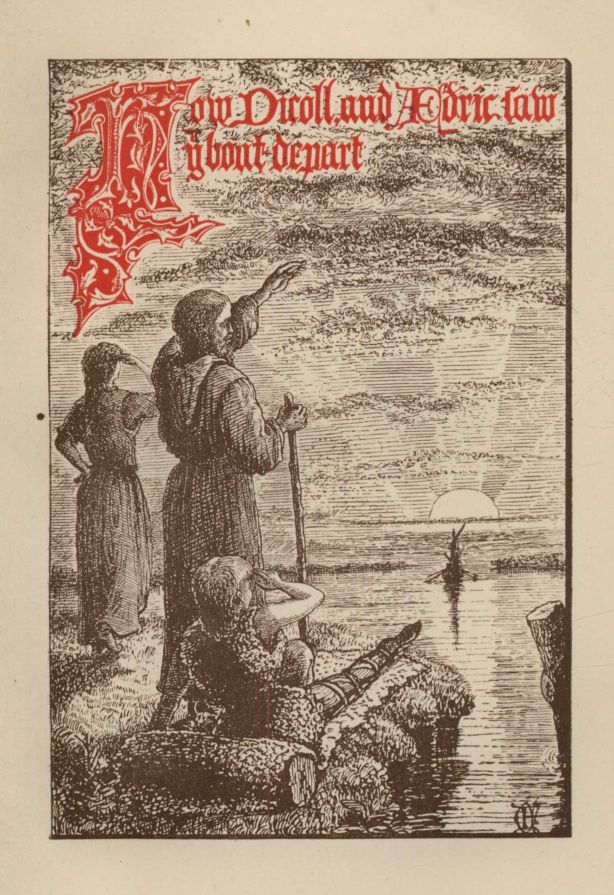
How Dicoll and Ædric saw ye boat depart
"There, they are off," said Father Dicoll to Ædric; "and may the blessing of the Almighty go with brother Malachi, for he goeth as a lamb among wolves. My soul yearneth for his safety."
"Doesn't the boat look pretty as she sails away?" said brother Corman.
"Ah! it reminds me of our sails in the old days at home, when we used to go out on the lough to fish."
It was a pretty scene: the sun was slowly sinking in the west, a grey mist rose over the western horizon, hiding the slushy banks and sedges of the shore; the red light of the sun came in a long flood up the creek, against it the black sail and dark heads of the men stood out in contrast.
"They go up a path of blood," sighed Dicoll. "May it be an omen of a path that leads to glory."
Behind, the clouds were working up in great black masses, that stretched across from north-west to south-east, and the breeze became colder.
The tide had begun to turn, and the boat was disappearing round a distant bend in the creek.
"There! they are gone, and it's time we went to vespers. Let us carry in Ædric, and make ready for the night. It looks black away to the east and north. I trust we are not going to have snow."
"I wonder where Wulfstan is," said Corman. "I didn't see him when the boat went off, and I should have thought he would have been the last to look at them."
"I expect he has gone off after some more withies," said Ædric.
"Well, I daresay he will come in when he's tired; but boys ought to learn discipline while they are young, for it is a harder matter afterwards," said Father Dicoll.
Meanwhile the boat was getting on very well; the novices in the art of rowing were quickly becoming used to the swing and management of the oar; so much so, that Ceolwulf had told the Boseham men to rest and leave the others to go on, as their services might be wanted later. Only one man had caught a crab, and being swung by the violence of the shock against poor brother Malachi, coming in painful contact with the monk's body, causing him to ejaculate with more than usual fervour, "Ah! quare tristis es venter meus! et quare conturbas me?" Beyond this little catastrophe, which, by the way, did not increase the good feeling of the man who had caused the monk's discomfort for his victim—for he did not understand the meaning of his ejaculations, and mistook them for condemnatory remarks—nothing else occurred.
A little more breeze had now got up, not sufficient, however, to create any ripple on the water, but just enough to keep the sail full.
They were fast approaching the entrance, and could hear the dull thud of the sea as it broke on the shingle outside.
"We shall have light enough, brother Malachi, I doubt not, to pass out by?" called Ceolwulf.
"The Lord helping us, we shall not run aground," answered Malachi.
The sail was beginning to do its work famously, and Ceolwulf bid the men put their oars in, and suggested to Athelhune that some food would be a good thing. Accordingly, search was made in the boat, when suddenly a man called out:
"Why, in the name of Asgard, whom have we here?"
All looked round, and there, under a skin that sheltered the provisions in the bow of the boat, was Wulfstan.
"Ah! Biggun," the boy shouted, "I told thee I should come, and thou canst not put me out now."
Ceolwulf saw it was no use being angry; so, giving the boy a sharp rating for not doing what he was told, he made up his mind to the inevitable.
And now the sun disappeared behind the low bank of what is at present known as Hayling Island, and the breeze came up fresher behind them.
"It's getting cold," said Athelhune. "We shall have snow, I fear——"
"We shan't be long getting over with this breeze, however. It's dead aft and a smooth sea," replied Ceolwulf.
The boat was just beginning to feel the motion of the sea, and was passing between the narrow entrance where Ceolwulf and the boys had struck when coming in for the first time.
"Look out for the sail as she comes over!" shouted Biggun, as the boat was altering its course to thread the intricate channel.
"There! I knew somebody's cap would be knocked off," added the old man, as Beornwulf's cap was carried over into the sea by the sail.
"Now, look alive, and shift over the sheet, someone. No! not that rope. Here, someone with a head upon his shoulders—that's right, Wulfstan, thou understandest it, and can teach them something."
This was an admission on the part of Ceolwulf which Wulfstan did not allow to pass over without notice.
"Ah, Biggun, thou findest that out now; it's lucky for ye all I shipped myself aboard. Thou seest, Biggun, thou dost not know what's for thine own good."
To this remark Biggun only grunted.
It was now getting too dark to make out objects more than a hundred yards off, and it required a watchful eye in the bows to see where the waves were breaking. The tide was rushing out through the narrow entrance with a swirl and an eddy that caused many small white crested waves, which it was necessary to distinguish from the real breakers on the sand banks. Brother Malachi was standing in the bows keeping a sharp look-out with one of the Boseham men, and Ceolwulf was steering, the rest were having some food.
"Here comes a long wave; keep her head up to it," called the Boseham man, as a long wall of water rose out of the darkness and seemed to stand right up above the bows of the boat; but Ceolwulf put her head at it, and she rose gently over and plunged down on the other side, while the wave rolled on and thundered behind them on the shore.
"There, we are clear of all banks now, and have nothing but the open sea before us," called Malachi, as he sat down under the lee of the boat's gunwale.
"Thou hadst better come aft, brother Malachi," called Wulfstan, who, now that he had accomplished his object, was glad the good monk was coming too; he always felt comfortable when the kind monk was near, because he never scolded him, or laughed at him, but quietly pointed out where he was wrong very patiently.
Darkness had by this time become complete, and there was nothing for Ceolwulf to steer by except a vague kind of instinct that told him to keep the sail as full as it was when they last saw land; he had then put the head of the boat pointing directly for the spot he wished to make for, and he argued that if he did not draw the wind either too much on her starboard beam, or, on the other hand, let it jibe the sail over, he must make land where he wanted in about three hours' time. He had not calculated that it was possible for the wind to shift.
The men were curling themselves up to go to sleep, and Malachi was murmuring some words to himself.
"What sayest thou, brother Malachi?" asked Wulfstan.
"I was asking the Almighty to preserve us through the dangers of the night, Wulfstan."
"But there are no dangers."
"There are always dangers on the sea."
"Not if thou takest care and keepest a good look-out."
"But thou mayest not know thy way, storms may rise, the boat may spring a leak, or she may strike on a rock."
"How can she spring a leak if she has just been mended? and how can she strike on a rock when she is ever so far from shore? I believe thou art frightened, brother Malachi; but there's no need, there is nothing to be afraid of. Come and sit by me; I will take care of thee."
The rushing, gurgling sound under the bows of the boat showed she was going through the water very fast. As they got further out from the land, the sea got up rather more, and from time to time the boat gave wild rushes ahead, and then sank down in the trough of the waves, only to rise again, lifting her stern up and careering madly forward until her head rose in the air, and the wave curled over in front. It took all Ceolwulf's steering with the oar to keep her from broaching-to, as it is called when the boat in running before the breeze turns broadside to the wind on the top of a rolling wave, a situation which, it is needless to say, is a very dangerous one.
"Why, the spray is coming in astern, Ceolwulf."
"No, it's not the sea, it's snow, and it's coming on thick, I'm thinking."
"Wilt thou be able to make out the land?" said Athelhune.
"We are not there yet," growled Ceolwulf, who was not in a very good humour, for he was getting cold, and was beginning to be a little doubtful of their whereabouts.
They had now sailed for about two hours, and they ought to be getting near land; it was very thick, however, and the snow was coming on faster than ever. The sea was getting much heavier, and from time to time Ceolwulf had the greatest difficulty in keeping his oar in the notch.
Wulfstan had coiled himself up, and had now gone to sleep. The others were mostly asleep or dozing, but Malachi and Athelhune felt the uncertainty of their position, and shared Ceolwulf's anxiety.
"We ought to be near land now, ought we not?" asked Malachi.
"We are not far off, I'm thinking," said Ceolwulf. "Lend me a hand with this oar, Athelhune," he added, as a more than ordinarily large wave rose up astern, and sent the boat staggering along with a wild lurch and headlong plunge that took the wind out of the sail, and called for all Ceolwulf's knowledge of steering. He and Athelhune, however, managed it cleverly, and the sea passed under the boat with a seething rush, raising her head high in air.
"The difficulty is in this snow, we can't see breakers ahead," grumbled Ceolwulf. "Go forward, Malachi, and keep a sharp look-out. Sing out the moment thou seest any land."
Malachi did as he was told, and peered anxiously into the grey veil ahead; but he could see nothing, only tumbling waves rising and falling, leaping up like grey shadows, and disappearing in the misty gloom.
Suddenly Malachi felt the boat give a violent lurch, followed by a dizzy rush, and he found himself in water nearly up to his waist. What was it? What had happened?
The oar had broken, and the boat had come round into the trough of the sea, and was in imminent danger of being rolled over or swamped.
All were now aroused, for most were lying in the water, which half filled the boat. However, Ceolwulf had seized another oar the moment the catastrophe happened, and with great quickness had brought her round to the course she was running, and then directed the men to bail the water out.
Once more they rushed wildly on; while poor brother Malachi, murmuring "De profundis clamavi ad te, Domine," drenched to the skin, gazed out into the darkness.
For the next quarter of an hour or so nothing disturbed the monotony of the rushing waters, the creaking mast, the occasionally flapping sail as the boat sank into the trough of the sea, or the whistling of the wind; everything in the boat was getting covered with a white pall, and the discomfort of all was great.
Suddenly Malachi shouted out:
"Land! land! right ahead. I see——"
But his words were lost in a wild crash, that hurled Ceolwulf and Athelhune into the bottom of the boat, and pitched poor Malachi head over heels overboard.
CHAPTER VIII.
NOTHING VENTURE, NOTHING HAVE.
The shock that produced the catastrophe which hurled brother Malachi overboard was caused by the boat striking on a reef of rocks, which lay some little distance out from the land, and, in the blinding snow and darkness, was utterly invisible, although as each wave receded the rocks were uncovered for a few minutes, only to be washed from end to end as a new wave dashed over them.
The boat was lifted by the first wave right on to the top of the reef, and consequently when the reflux of the wave took place, she fell over on her side, and remained exactly as she would have done on a hard beach. The next wave, however, broke right into her, and filled her from end to end, besides smashing the mast and knocking a hole in her as she came down with a tremendous thump. All the men had now jumped overboard, and, under the direction of Ceolwulf, who took in the situation at a glance, scrambled over the rocks before another large wave came, and found on the other side that there was a shallow, sandy pool, where the water came up to their waists, but where they were protected from the extreme violence of the waves by the reef of rocks outside. Ceolwulf had taken the precaution to keep hold of the rope, or warp, which was used for mooring the boat, and, shouting to the others to hold on to this, he watched for another large wave, then, bidding the others haul altogether, they dragged the boat over the rocks into the part where they were, and where they would be able to get the cargo out of the boat before she should break up, which she must inevitably do if the tide were rising.
In the darkness and confusion nobody had thought of seeing whether anyone was missing, but now that all immediate danger was over Ceolwulf began to think he had not seen Malachi.
"Malachi! Malachi!" he shouted, "where art thou?"
A very feeble answer came from behind them:
"Here, Ceolwulf, here."
"Art hurt, man?"
"Miserere mei, but I have no whole soundness in my body, all my bones are out of joint, and the floods have gone over my soul."
"Where art thou?"
"I am on dry ground—at least, if that may be called dry which is all wet with snow—but where I am, I know not."
"He's all right," said Ceolwulf, who was holding the rope with one hand and Wulfstan with the other. "He's got ashore, and the sooner we get there the better, it is only a little way off."
"Hadn't we better get our arms out of the boat first? she may be smashed all to pieces before we can get back to her again," suggested Athelhune.
"Right, quite right," answered Ceolwulf. "Let every one take as much as he can carry ashore with him, and follow me." So saying, taking Wulfstan's hand, he waded ashore to where the voice of brother Malachi guided them. The others followed, carrying the armour, shields, spears, and other weapons.
When they were all ashore, they found they were on a steep shingle beach with a low cliff behind, as far as they could make out in the darkness. Malachi was seated, shivering with cold, on a boulder of rock, and Wulfstan ran up to him, and slapping him on the back, said:
"Hullo! brother Malachi, I am very glad thou art not drowned."
"Oh, don't do that! I am very glad too, but don't touch me, I ache all over. Oh!" groaned brother Malachi, shivering, so that his teeth chattered in his head.
"Well, run about then, and thou wilt soon get warm."
But the poor monk was too cold and dispirited for that, and only sat still and shivered. It certainly was a dreary outlook, as far as anything could be seen. A group of half-drowned men, a patch of snow-covered beach, the dim outline of foaming waves, and all else indistinguishable blackness.
"How much longer have we got to wait for daylight thinkest thou?" asked Athelhune.
"It is not midnight yet," answered Ceolwulf gloomily.
"Dost thou know where we are?"
"On the Foreland, I doubt, and we've narrowly missed going out to sea down the channel; but I can't rightly say where we are until I have gone a bit further in-shore."
"We had better all of us get into some shelter if we can. We can't pull the boat up, and turn her over and get under her, can we?"
"No, we haven't got strength enough for that. We had better get up this cliff, and go inland; we shan't find the wind so keen then."
They all, therefore, clambered over the shingle, and, scrambling up the low cliff, found themselves among a thick growth of brushwood.