Chapter XXIV
Reading edition
THE MOSAICS IN S. SAVIOUR IN THE CHORA
As stated already, the mosaics on the vaults and lunettes of the arches in the outer narthex of the church portray scenes from the life of Christ, as recorded in the canonical and the apocryphal Gospels, while on the faces and soffits of the arches are depicted the figures of saints 'who desired to look into these things.' Scenes from the Saviour's life are also portrayed in the two bays to the west of the parecclesion, and in the domes and southern bay of the inner narthex. Inscriptions on the mosaics explain the subjects depicted. The scenes will be described according to the groups they form in the compartments of the narthex.
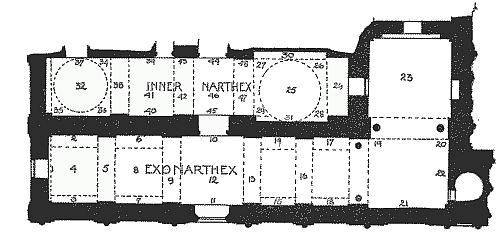
Fig. 114.—Plan of the Narthexes of the Church, indicating Position of their mosaics.
PLATE XC.
Sebah and Joaillier. S. Saviour in the Chora. Sebah and Joaillier. S. Saviour in the Chora.
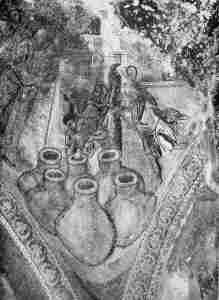
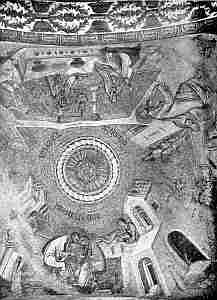
Mosaic Representing the Miracle of Water turned into Wine. The Date 6811 (a.D. 1303), in Arabic Numerals, is above the last figure on the right. Mosaic Representing the Caressing of Mary by her Parents, and the Blessing of Mary by Priests at a Banquet.
To face page 322.
Outer Narthex
First Bay (at the north end).
1. In the northern lunette.—The angel announcing to Joseph, in a dream, the birth of Jesus. To the right, journey of Joseph and Mary from Nazareth to Bethlehem. Simon the son of Joseph walks ahead, carrying a bundle. In the background, meeting of Mary and Elizabeth.
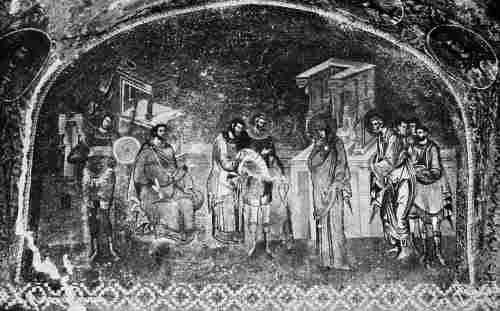
2. In the eastern lunette.—The registration of Joseph and Mary at Bethlehem before Cyrenius. (Said to be unique in the East. 542)
On the arch over the eastern lunette.—Busts (in medallions) of SS. Mardarius, Auxentius (only one letter of the name remains), SS. Eustratius, Orestes.
3. On the western lunette.—The Holy Family on the way to the first passover of Jesus at Jerusalem.
On the arch over the western lunette.—The busts (in medallions) of SS. Anempodistus, Elpidephorus, Akindynus, Aphthonius, Pegasius.
4. In the vault.—The scene has disappeared. Possibly it represented Jesus among the doctors in the temple.
5. On the soffit of the transverse arch, between the first and second bays.—To the east, S. Andronicus; to the west, S. Tarachus.
Second Bay
6. In the eastern lunette.—The birth of Jesus. In the background, to left, the angel appearing to the shepherds; to right, the magi beholding the star shining over the manger in which lies the Holy Child, while an ox and an ass feed in it. In the centre, Mary on a couch. In the foreground, to left, two women bathing the Holy Child; to the right, Joseph seated on the ground and gazing at the Holy Child.
On the arch above the eastern lunette.—The busts (in medallions) of SS. Philemon, Leukius, Kallinikus, Thyrsus, Apollonius.
7. In the western lunette.—Return of the Holy Family from Egypt to Nazareth.
In the arch above the western lunette.—The busts (in medallions) of SS. Engraphus (?), Menas, Hermogenes, Laurus, Florus, Menas, Victor, Vikentius.
8. In the vault.—The baptism of Jesus; the scenes in the temptation of Jesus.
9. On the second transverse arch.—To the east, S. George; to the west, S. Demetrius.
The Third or Central Bay
10. In the eastern lunette, over the door leading to the inner narthex.—Christ in the act of benediction.
11. In the western lunette.—The Theotokos, in the attitude of prayer, with the Holy Child, in a nimbus, on her breast; the legend (the country of the Infinite); on the right and left, an angel.


12. In the vault.—In the north-eastern corner, the miracle of water turned into wine. The date 1303, in Arabic numerals, is on this mosaic. In the south-eastern corner, the miracle of the loaves. These mosaics, placed on either side of the figure of Christ, are emblems of His character as the Giver of Life.
In the north-western corner.—The sacrifice of a white bullock.
In the south-eastern corner.—The second miracle of the loaves.
13. On the third transverse arch.—Two saints, not named.
The Fourth Bay
14. In the eastern lunette.—To the left, the magi, on horseback, guided by a star, on their way to Jerusalem; to the right, the magi before Herod.
On the arch above.—The busts (in medallions) of SS. Abibus, Ghourias, Samonas.
15. In the western lunette.—Elizabeth fleeing with her child John from a soldier who pursues her with a drawn sword in his hand. The scenes in the vault have disappeared.
16. On the fourth transverse arch.—Two saints, not named.
The Fifth Bay
17. In the eastern lunette.—Herod inquiring of the priests where the Christ should be born. The busts of three saints on the arch above have disappeared.
18. In the western lunette.—Mothers at Bethlehem seated on the ground, and mourning the death of their infant children. The mosaics in other parts of this bay have disappeared.
The Outer Bay fronting the parecclesion
In the eastern pendentive.—To the left (19) the healing of a paralytic; to the right (20) the healing of the man sick of the dropsy.
21. In the western pendentive.—To the left, the healing of another paralytic; to the right, Christ with the Samaritan woman at the well of Sychar; in the lunette, the massacre of the Innocents at Bethlehem.
22. In the southern lunette.—To the left, Herod orders the massacre of the Innocents at Bethlehem; to the right, the massacre of the Innocents. The other mosaics in this bay have disappeared.
The Inner Bay fronting the parecclesion
23. In the vault.—In the south-western corner. Uncertain. Possibly, the fall of the idols in Egypt at the presence of the Holy Child; to the south of that scene, Zacchaeus on the sycamore tree.
Inner Narthex
First Bay (at the south end of the narthex)
24. On the soffit of the first transverse arch.—To the east, the healing of the man with a withered arm; to the west, the healing of a leper.
South Dome
25. In the crown.—Christ the Pantokrator.
In the flutings, thirty-nine figures, arranged in two tiers, representing the ancestors of Christ from Adam to Esrom, Japhet, and the eleven sons of Jacob not in the line of ancestry.
26. On the south-eastern pendentive.—The healing of the woman with a bloody issue.
27. On the north-eastern pendentive.—The healing of Peter's mother-in-law.
28. On the south-western pendentive.—The healing of a deaf and dumb man.
29. On the north-western pendentive.—The healing of two blind men at Jericho.
30. On the eastern wall below the dome, colossal figures of Mary and Christ, technically named the Deësis.
31. On the opposite wall.—Christ healing divers diseases. The mosaics in the three other bays of this narthex depict scenes in the life of Mary as described in the apocryphal Protoevangelium of S. James and other apocryphal Gospels. 543
First Bay (at northern end).—The North Dome
32. In the centre.—The Theodokos; in the flutings, twenty-seven figures arranged in two tiers representing sixten royal ancestors of Christ, from David to Salathiel, and Melchisedec, Ananias, Azarias, Misael, Daniel, Joshua, Moses, Aaron, Ur, Samuel, Job.
33. In the north-eastern pendentive.—The scene has disappeared.
34. In the south-eastern pendentive.—S. Joachim (Mary's father) with his sheep in the desert, praying and mourning that his offerings have been rejected because he was childless.
35. In the north-western pendentive.—The High Priest judging Mary.
36. In the south-western pendentive.—The Annunciation to Mary.
37. In the eastern lunette below the dome.—The Annunciation to S. Anna, the mother of Mary.
38. On the soffit of the transverse arch between the first and second bays.—To the east, the meeting of S. Anna and S. Joachim; to the west, Joseph taking leave of Mary before his home, and proceeding to his work in another part of the country, accompanied by a servant.
Second Bay
39. In the eastern lunette.—The birth of Mary.
40. In the western lunette.—Joseph receiving the rod which marks him the successful suitor for Mary's hand, and taking her as his bride-elect.
41. In the vault.—To the east, Mary held in the arms of S. Joachim, receiving the blessing of three priests seated at a banquet; to the west, the child Mary caressed by her parents. This scene shows much feeling.
42. On the soffit of the transverse arch.—To the east, Mary taking her first seven steps ἡ ἑπταβηματίζουσα; to the west, the high priest praying before the rods, one of which, by blossoming, will designate the future husband of Mary.
43. On the eastern wall, to the north of the main entrance into the church.—The Apostle Peter with the keys in his hand.
The Third Bay
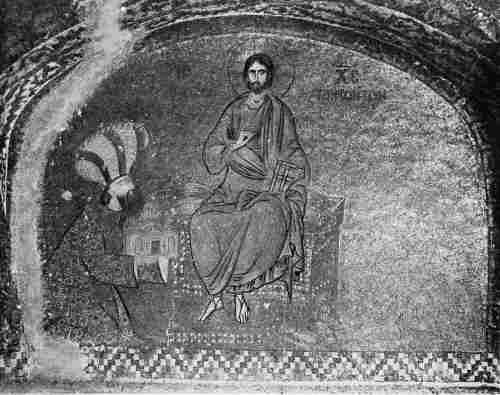
44. In the lunette over the main entrance to the church.—Theodore Metochites on his knees offering the church to Christ seated on a throne. The legend ὁ κτήτωρ λογοθέτης τοῦ γεννικοῦ Θεόδωρος ὁ Μετοχίτης, 544
PLATE XCI.
Sebah and Joaillier.
S. Saviour in the Chora. Mosaic Representing the Registration of Joseph and Mary at Bethlehem.
Sebah and Joaillier.
S. Saviour in the Chora. Mosaic Representing Theodore Metochites Offering the Church To Christ.
To face page 326.
45. In the western lunette.—Mary receiving purple and scarlet wool to weave in the veil of the temple.
46. In the vault.—On the east, Mary admitted to the Holy of Holies when three years of age, lest she should go back to the world; on the west, the procession of maidens escorting Mary to the temple.
47. The third transverse arch.—To the east, Mary in the temple receiving bread from the archangel Gabriel; to the west, Mary in the temple receiving instruction.
48. On the eastern wall, to the south side of the main entrance to the church.—The Apostle Paul.
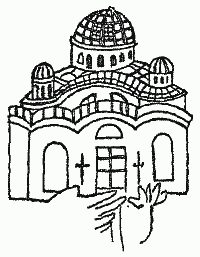
Fig. 115.—Model of The Church of S. Saviour in the Chora.
The scenes represented on these mosaics are not peculiar to this church, but are a selection from cycles of subjects which from the eleventh century became favourite themes for pictorial treatment on the walls of important churches in the Byzantine world. Several of these scenes are found portrayed also at Daphni, Mistra, S. Sophia at Kiev, in the churches of Mt. Athos, on diptychs and manuscripts, 545 as well as in the chapel of the arena at Padua. The cycle of subjects taken from the life of Mary was developed mainly in Syria, and Schmitt 546 goes so far as to maintain that the mosaics of the Chora are copies of Syrian mosaics executed by a Syrian artist, when the church was restored in the ninth century by Michael Syncellus, who, it will be remembered, came from Syria.
Kondakoff assigns most of the mosaics to the Comnenian restoration of the church by Maria Ducaena in the eleventh or twelfth century. One of them at least, the Deësis, has survived; and there may be others of that period, for, as that mosaic proves, the narthex of the church was decorated when the church was restored by that benefactress of the Chora. But the testimony of Nicephorus Gregoras, 547 of Theodore Metochites, 548 and the date marked on the scene representing the miracle of the wine at Cana, on the right of the figure of Christ over the door leading from the outer to the inner narthex, prove these mosaics to be as a whole the production of the fourteenth century. And this conclusion is confirmed by their unlikeness to mosaic work in the twelfth century, and by their affinity to other work of the same character done in the fourteenth century. 549
In fact, the mosaics in the Chora represent a remarkable revival in the history of Byzantine art. They are characterised by a comparative freedom from tradition, by closer approximation to reality and nature, by a charm and a sympathetic quality, and by a scheme of colour that indicate the coming of a new age and spirit. Curiously enough, they are contemporary with the frescoes of Giotto at Padua (1303-1306). But whatever points of similarity may be detected between them and the work of the Italian artist, or between them and the Italian school before Giotto, should be explained as due to a common stock of traditions and to the simultaneous awakening of a new intellectual and artistic life in the East and the West, rather than to any direct influence of one school of art upon another. The mosaics of the Chora are thoroughly Byzantine. 550
The Frescoes in the Parecclesion:—
1. Round the apse: Six Fathers of the Church (only one figure remains, and that badly damaged. No names are inscribed).
2. In the vault of the apse: a full-length figure of Christ in a vesica dotted with stars. On either side are groups of figures.
3. In the crown of the apse-arch: an angel in a medallion.
4. In the northern wall, next the apse: Christ with two attendants; in the background a walled city. The Eastern bay.
On the northern wall:
5. Above the arched recess: two medallion heads of SS. Sergius and Bacchus.
6. Portions of the figure of a warrior.
7. In the arch above Nos. 5 and 6: the Gate of Paradise.
8. In the centre, one of the cherubims on a pillar. On the left hand, a multitude, painted on black background outside Paradise; on the right, Paradise, a garden full of trees on a white background. Here also are John the Baptist and a figure, probably the Virgin and Child, on a throne, attended by two angels.
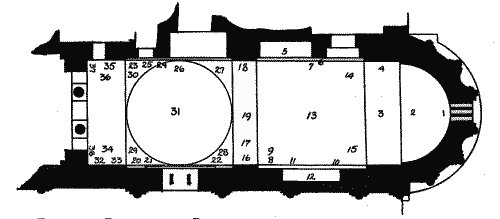
Fig. 116.—Plan of the Parecclesion, indicating positions of its Frescoes.
On the southern wall:
8. A portion of the figure of an armed angel. Above No. 8 and at the side of the window:
9. Two men carrying a bier or platform. In front of them a third person giving directions.
10. In the arched recess: full-length figures of Andronicus II. and his family. In the soffit of the arch, the head of Christ in a medallion, with rays issuing from behind the aureola.
11. and 12. In the spandrils above the recess: two heads in medallions.
13. In the dome vault: the Last Judgment. Christ in judgment fills the centre; behind Him are the twenty-four elders seated on a long throne; farther back is gathered the heavenly host.
PLATE XCII.
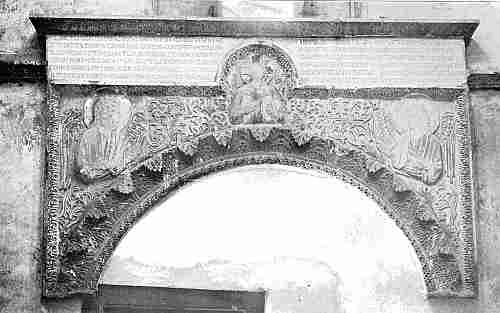
Archivolt on the South Wall of the Parecclesion, with the Epitaph in honour of Tornikes
To face page 330.
On the southern wall:
14. On the north-eastern pendentive: the Virgin and Child in a Paradise, with trees on a white background.
15. On the south-eastern pendentive: the Mouth of Hell.
16. On the south pilaster of the dome: an armed angel.
17. Above that angel, on the arch: a man bearing the Seven-Branched Candlestick, and beside him another man bearing with both hands some object above his head, perhaps the Table of Shew Bread.
18. On the northern pilaster: a warrior.
19. In the centre of the arch: the Head of Christ in a medallion. The Western Bay.
20. At the south-western corner where the wall is much damaged, a saint.
21. Above No. 20, to the west of the window: Christ appearing to His disciples.
22. To the east of the window, an indistinct scene, perhaps the Entombment.
23. At the north-western corner: S. Samona.
24. A saint, not named.
25. Over the door two saints, one of whom holds a cross.
26. The northern archway: In the centre is the door to the narrow passage between the parecclesion and the church. To the left, Jacob's Ladder; to the right, Moses at the Burning Bush. In the bush is a medallion of the Virgin and Child, and from the bush an angel addresses Moses, who holds his veil in his hand.
27, 28, 29, 30. In the pendentives of the dome: the Four Evangelists sitting at desks.
31. The dome is divided into twelve segments by ribs, and is pierced by twelve windows. Above each window is an angel holding a spear, and below him is the legend 'Holy.' In the crown are the Virgin and Child in a medallion.
32. A saint holding a small cross; below, in the south wall, the archivolt with the epitaph to Tornikes above it.
33. A warrior saint with his sword and shield.
34. Above Nos. 32 and 33 on the arch, a figure, clad in a white mantle and blue robe with a scroll in his hand, points to an angel, who holds his drawn sword in the right hand and the scabbard in the left hand, and seems to be attacking several persons in the right-hand corner. Behind him is a walled and fortified city, probably Jericho.
35. On the north wall: S. Eutadius.
36. The Adoration by the magi.
37, 38. On the west wall: the figures of two saints, not named.
Epitaph in honour of Tornikes:—
ὅσους ἂν ἁθροίζοι τις ἐνθάδε κρότους νεκροὺς ὁ ταφεὶς ἐξελέγξει Τορνίκης, ὁ τρὶς ἀριστεὺς ἢ κονσταῦλος μέγας, ὥσπερ μίμους, βέλτιστε, πιθήκους λέων. 5ὅς, βασιλικῶν ἀποτεχθεὶς αἱμάτων, παρέσχεν αὐτοῖς προσφυῆ καὶ τὸν τρόπον. ποῖον γὰρ οὐκ ἦν ἀρετῆς εἶδος φέρων, ὡς ὁ πρέπων ἕκαστον ἐζήτει χρόνος; βουληφόρος δ' οὖν, καὶ πρὸ τῆς ἡλικίας 10καὶ δημαγωγός, καὶ κριτὴς ἦν ἀγχίνους. καὶ πρὸς μὲν ἐχθροὺς τακτικὴν ἔπνει φλόγα, κεραυνὸς ὢν ἄφυκτος αὐτοῖς ἀθρόοις, τῇ δὲ στρατιᾷ πατρικῶς ἐπεστάτει, φρουρῶν τὰ κοινά, μὴ κλαπῇ τὸ συμφέρον. 15 κήδους δὲ τυχὼν εὐγενοῦς καὶ κοσμίου καὶ βασιλικὸν προσλαβὼν αὖθις γένος καὶ λαμπρὸν ὑπόδειγμα παρεὶς τὸν βίον, κεῖται μοναστὴς εὐτελὴς ἐν ὀστέοις. ἥλιε καὶ γῆ καὶ τελευταῖοι κρότοι. 20 πενθεῖ δὲ μικροῦ πᾶν τὸ Ῥωμαίων γένος, ὅσον περ αὐτὸν ἀγνοοῦν οὐ τυγχάνει. ἀλλ' ὦ μόνε, ζῶν καὶ μεθιστῶν τὰς φύσεις, εἴ πού τι καὶ πέπραχεν αὐτῷ μὴ πρέπον λύσιν παρασχὼν τὴν Ἐδὲν κλῆρον δίδου.
In line 7 the inscription reads φcρωN instead of φέρων; in line 23 IIρcποN for πρέπον.
Good Friend! However many dead applauses (celebrities) One may collect here, The entombed Tornikes, who was thrice a foremost man or Grand Constable, Will put them to shame as a lion will put to shame mimicking apes. He who was by birth of royal blood, Presented also a manner of life conformed to that descent. For what form of virtue did he not possess Such as the fitting occasion demanded each? Therefore he was a councillor before the usual age, And a popular leader and an acute judge, And upon enemies he breathed a strategic flame (such as military rules required), And was an irresistible thunderbolt upon their serried ranks. He presided over the army like a father, Guarding the commonweal lest any advantage to it should be stolen. Contracting a highly-born and seemly marriage connection, And securing thus again royal affinity, 551 And leaving his life as a splendid example, He lies a poor monk among bones! O sun, O earth, O final applauses! Well-nigh the whole Roman race laments him, As much of it as is not ignorant of him. But O only living One and transformer of natures, If perchance he did aught that was not fitting for him, Granting him pardon, give him Eden as his inheritance. 554