Part I. (continued 2)
Reading edition
We owned a gondola,—for a week. We lived in it, and I, sometimes, slept in it while we were being wafted from one place to another.
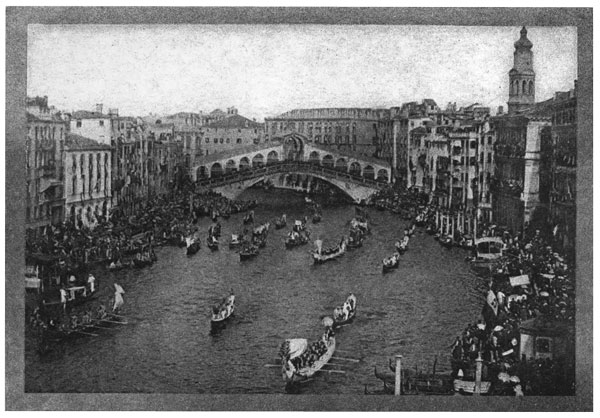
THE GRAND CANAL, VENICE
There is the usual—oh, no! there is nothing usual in Venice—cathedral, as in all cities, but St. Mark's stands out first and forever as The Church of all churches. My first glimpse of this pile of precious stones was unexpected and most dramatic to me.
There were no letters that morning, and I was just walking—I did not care where or on what. What's beauty and loveliness compared to One letter? An arcade blocked the way, and not knowing—not caring—where it led, I passed in and through it. Chancing to look up, I found myself in the light of day, and straight before me, ablaze with the sunlight full on its façade, was a structure of lavish Oriental magnificence.
"What is that?" I cried aloud.
"San Marco!" answered a number of soft, musical voices in unison; and there stood by my side a little crowd of Italians, their dark eyes sparkling and white teeth showing, evidently pleased at my adoration.
"San M-ahr-co, San M-ahr-co!" they drawled in delight. For once their pleasure was real; they did not break the spell upon me by holding out the hand for a pourboire.
St. Mark's is Moorish in design, and has a coloring both gorgeous and subdued. The richness of jewels and costly stones does not seem out of place here as in many Roman churches. Nothing could be too precious, too sumptuous, too rare, for this temple magnificent.
The piazza of St. Mark's is a square paved with trachyte and marble. It has the church on one side, and on the other sides, old white marble palaces, in the arcades of which are now found shops of world-wide renown. The piazzetta leads one, between the Doge's palace and Libreria Vecchia, to the Grand Canal.
Every evening a military band plays in the square, and it is like a vast, open-air drawing-room with a huge masquerade ball in full tilt.
We climbed the Campanile and saw, besides a beautiful sunset, the Alps, the Adriatic, and in the dim distance the Istrian Mountain rising out of the sea.
With but a day to give to Venice, or with a year at your disposal, there is only one thing to do—dream! Whether you rest in a gondola on the Lagune, drifting past the Bridge of Sighs, the Rialto, the Ghetto, or the Lido, listening to the gondolier calling out the names of the palaces as the boat glides by, or whether you stroll idly through the miles of churches and galleries containing the paintings, or sit in wondering awe before the vast area of mosaics in St. Mark's—it matters little—dream!
In truth, one cannot well avoid it, amid the "subtle, variable, inexpressible coloring of transparent alabaster, of polished Oriental marbles and of lusterless gold," as Ruskin puts it.
AU BORD DU LAC COMO:
Heavens! Just think of me writing "Como" at the top of my letters! I have pinched myself to see if I am really here. The unreality of it all recalls what Mr. Howells said after reading Ruskin: "Just after reading his description of St. Mark's, I, who had seen it every day for three years, began to doubt its existence." So I am beginning to doubt my own existence.
The morning we left Venice I was nearly arrested by a man in a cocked hat, all on account of two other men in sailor hats. In short, I overstepped the etiquette of the gondolier most woefully. Our train left at the fetching hour of six, so I made an appointment with our trustworthy Pietro to come for us in time. I think I have told you that the word "haste" is an unknown quantity here, and when Pietro was not at the door ten minutes before the time to start, I had the clerk call another gondola. As we were about to step into the boat, Pietro was seen drifting idly toward our hotel.
He wasn't very indolent when he saw what was going on, and those two "sunsets" (I think that is my own, for in a sunset, do you not see the day-go?) danced several kinds of jigs up and down and sidewise before me. Several others came to their assistance, among them the aforesaid cocked-hatted individual.
I told the clerk to tell them that I wished to conform to the rules, and to settle it their way. A summer breeze could not have been calmer than all became in the twinkling of an eye, but the cause of the calm was apparent when I settled the bill. Their understanding of "settling it their own way" was to pay each of them, including the cocked-hat, but that was better than languishing in a dungeon for ever so little a time, n'est-ce-pas, mon cher?
Since then Milan has been visited—Milan, with its mammoth marble cathedral, done in Irish-point pattern and with a papier-mâché interior—but beautiful withal. Several days were spent at Menaggio on this lovely lake; another at Villa Carlotta, where Canova's original and divinely beautiful marble, "Cupid and Psyche," stands in all its purity; many more, sailing up and down these enchanting waters, made green by the reflection of the forest on the mountains surrounding, and by the grounds of the wealthy Milanese, whose summer villas line its banks.
Vineyards are scattered along the mountainside in terraces, and the brilliant green of the chestnut and walnut trees is blended with the dull grayish green of the olive and laurel.
Lake Lugano and Lake Maggiore are beautiful sheets of water, but they lack the romantic atmosphere of Como. I can recall no other description so pleasing to the heart as well as to the fancy as the eulogy to these lakes in Mrs. Ward's "Lady Rose's Daughter."
DOMODOSSOLA:
Rural Italy, to be appreciated, must be seen by tram, by boat, by steam, by old-fashioned diligence, and on foot. Its lakes and mountains, its valleys and vineyards, have been a source of continual surprise to me, and it is with a feeling of keenest regret that our last place in Italy is reached. I feel with Browning as I say farewell to—
"Italy, my Italy! * * * * * Open my heart and you will see Graven inside of it, 'Italy'."
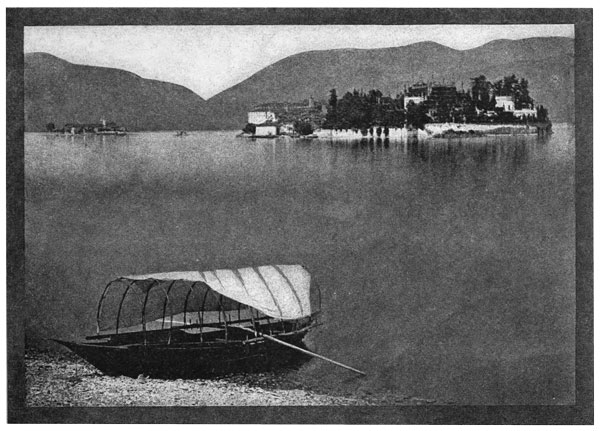
LAKE MAGGIORE, ISOLA BELLA, ITALY
SWITZERLAND
Fair Switzerland, thou art my theme, Thy praise by day, by night my dream. My swelling heart with rapture speaks; I love thy lakes and snow-capped peaks. Thy wooded glens my thought recalls, Thy mountain paths and waterfalls. With praises I my verse adorn Of Jungfrau and the Matterhorn. Thy moon-lit nights and sun-lit days, For thee in song, my voice I raise. Thy name for right and freedom stand— I love thee, dear old Switzerland. Roland Phelps Marks.
LUCERNE:
Ah, Kate! dear old friend of my childhood! How little I thought that night in June, when you stood up and told the audience, "Beyond the Alps lies Italy," that some day those same Alps would lie between us. We have not only been "beyond," but over them.
The soft pink glow of the early dawn hung over the village of Domodossola as the start was made for Switzerland.
Our caravan consisted of four diligences, two luggage vans, and a mounted guide, who knew every inch of the pass. He galloped from coach to coach, hurling his instructions to occupants and drivers.
Above the blowing of horns, the ringing of bells, and the answering shouts from the coaches, this guide's last command rang out loud and clear: "Keep close together! Follow me! Come!"
It was all as uncertain as life itself. How blindly and with what enthusiasm we enter the race, knowing nothing of what the day may bring!
The creaking diligences started away with their freight of human souls, to follow—follow to what? God only knows.
Again, as in life—up and up, on and on, higher and higher—until the summit is reached at noon-day, and as the shadows lengthened in the waning of the day, we began the descent.
That morning as the purple village was left behind, the road grew narrow and clung close to the mountainside. So close it was, did we but stretch the hand ever so little, we would touch its ruggedness. Sometimes the road widened into a mountain village, but ever and always on the other side was the deep, dark abyss. It varied in depth and blackness, or was filled with some mountain torrent, but the gloom was always there.
The mountains themselves often smiled down on us, or laughed outright, as some sparkling, bubbling cascade could no longer keep within the channel time had worn for it in the rocky slope; yet the same rippling waterfall that had danced right merrily down from its snowy source, became stern and cruel after it had crossed the road under us and joined the somberness of the cavern.
If the glare of the sun partially dispelled the glamour the moon had cast over Venice, how vastly more does close proximity to the Alpine village of song and story dissipate its charm. As every gleam of sunshine must cast a shadow somewhere, so the splendor of the Alps must needs be balanced by the materiality of its inhabitants.
Of the forty miles from Domodossola, Italy, to Brigue, Switzerland, the first ten perhaps are inhabited. These people live on the road, their huts snuggling close to the mountain. The little patches of ground that are tilled lie straight up the mountainside, and upon these sides, too, their sheep graze. One of the witcheries of the region is the tinkling of the tiny bells tied around the necks of the sheep.
Before reaching Iselle, where the Customs are paid, the longest of the Simplon tunnels is passed through, and a block of granite marks the boundary line between the two countries.
Along the route the drivers had often to call out, that the women and children might make way for the coaches. The children, offering fruit or flowers, would run along with the vehicles and call out the little English that had been picked up: "Good-a-bye!" "Kiss-a-me!" "Hur-rah-up!" But the smiles soon turned to tears if no pennies were thrown to them.
Sometimes in the distance there seemed to be a mammoth pile of rock or debris obstructing the roadway, which, on being approached, was found to be part of an avalanche tunneled out for the passageway. These are termed "galleries" to distinguish them from the usual tunnels.
Away up on a high point is an old hospice which can be reached only by pedestrians,—a refuge for the mountain climbers.
Far up among the clouds is a bridge resembling a tiny toy. Long hours afterwards, when the summit of the peak is reached, and when the road seems to end abruptly, the bridge comes into view again spanning some yawning gulf.
Once while crossing from one peak to another, the gorge below seemed filled with white smoke. It was the clouds. Some thousands of feet below, these same clouds had been above us—we were now above them.
The sensation was awful. "Look! Look!" cried the guide, pointing down into the moraine. The clouds had separated, and the rain could be seen pouring on a little village far below, while the sun shone bright on us.
The sunshine is not warm among these snow-clad peaks. It was bitterly cold. The crunching of the snow under the iron hoofs of the horses was the only sound to be heard.
At the village of Simplon where luncheon was served, and where the horses were changed, the luggage vans were raided for warm wraps and rugs.
Half a mile from the village of Simplon the remains of a big avalanche were encountered. Men were at work clearing the roadway, and the guide ordered every one to dismount and walk across, the drivers leading the horses.
When "the road grew wider," it should not make a mental picture of a broad roadway. It is wide only in comparison with the narrow mountain pass, cut out of the side of the cliff, making a sort of ridge of sufficient width to permit but one vehicle at a time. There are places cut deeper into the rock so that two may pass. A stone parapet runs along the ledge next to the precipice to prevent accidents should the wheels come too near the edge.
At the highest point this parapet was broken. The workmen who were repairing the wall had been called to assist in clearing the lower road of the avalanche over which we had been obliged to walk.
It was at this point that one of our horses balked. The road, so narrow that it scarcely permitted the passage of the diligence,—the parapet entirely gone for a distance of many feet—the gorge, deep and black, with a roaring torrent, too far down to be seen—the very heavens weeping at our misery,—here it was the horse chose to become unmanageable.
The two in the box seat behind the driver did not realize what was happening until a shriek from some one in the body of the coach caused the entire party to turn. The driver yelled, "Jump! Jump toward the mountainside!"
God grant that rarely on human sight may dawn such a scene, horrible only to those who had occupied the coach a second before. The back wheels were over that fearful ledge, the diligence just tottering. One moment more, made heavy by its human load, one quiver of the now terrified beasts, and the whole would have been engulfed in the depths of that seething torrent.
We had jumped at the first word of command—jumped as one body. One second and it would have been too late. And the old coach, relieved of its burden, had balanced itself in an almost human manner, as if it, too, clung to life.
We stood crouching away from the gorge against the wet side of the rock, the driver unnerved, one horse unruly and the leader balky. The entire cavalcade had begun the descent, and there was no stopping when once under way until a valley was reached some seven miles below. There was nothing to do but wait, and pray that the guide would miss us and send help.
The awesomeness of that scene had time to imprint itself on my very soul, for the hours spent on that Alpine peak I count as the most stirring years of my life.
Help came, or I should not be writing this. But, grateful and overjoyed as we were to see a fresh horse and two men on its back coming to our aid, the result was even more terrifying than the past experience.
The guide had missed us when, as was his wont, at the first stop, he galloped back from coach to coach. Fortunately it was near a hospice, where he procured two men and a powerful horse, and sent them after us. Surely God had—
"One arm 'round thee, And one 'round me, To keep us near."
The driver and his helper had hardly dismounted from the back of the new horse when the wild creature reared around, and started on a mad gallop down the slope. He tripped, thank heavens, on a strap that had become loosened from his trappings, and was caught.
That the new driver was a fiend was apparent from the cruel manner in which he treated the runaway. I am still uncertain what his excuse was for living. He was so hideous he was unique. After he had pounded the horses he turned his attention to the passengers.
Ruth and I were ordered out of the box seat into the coach. It was impossible to crowd us all inside, and he was obliged to submit to our remaining above. The hood was closed, the boot drawn up, and we were strapped securely to our seats. The doors were locked on those inside. These were his instructions from the guide.
The three drivers mounted in front of us, and, while we were thankful to be in the open air and to be able to view the wonderful scenery around us, we were also compelled to witness the inhuman treatment of the animals.
In this manner we began the descent.
The fiend had the reins and the long whip, the others had prods, and used them on the horses. The fresh horse took the lead, dragging the others after him. On, and on, and on we flew, now under wild-roaring cataracts, whose waters thundered down on the rocky roof of the tunnels under them—now over frail bridges, which trembled with our speed—now down slippery, ice-covered stretches. They did not stop at the first plateau, fearing, I suppose, they would never get the horses started again.
The fiendish shouts of the drivers, the cries of the occupants locked inside the coach, the swaying and groaning of the old diligence, and the almost human moans of the horses blended with the warning cries of the natives, who stood aside, aghast at our mad speed.
Down, down, down! The white peaks grow fainter and fainter, until they are lost in the blue mist. The incline becomes less steep. The little farms look like window-panes set up in air, and the sun sinks behind the purple mountains. The beautiful valley of the Rhone spreads out below, like a celestial vision.
Suddenly, after a long curve has been rounded, the Rhone, bathed in a flood of golden fire, comes into view. Across the yawning gulf the mountains, on the other side, take on the same glorious hue.
It is the Alpine glow!
Yet on and down we go, never stopping the wild pace until the horses dash into the courtyard of the inn at Brigue!
We had crossed the Alps!
We were in Switzerland!
Switzerland is one of the places whose charm is enhanced by the glare of the sun. But Switzerland does not have many opportunities to endure glare of anything, for it rains almost continually. The "weeping skies of Ireland" cannot compare with it.
Lake Geneva, as it winds around Lausanne, is extremely pretty, and Lake Lucerne has quite the most picturesque surroundings possible. It nestles down among the Alps, with Rigi on one side and the beautiful town on the other. And Lucerne is a beautiful town, built in a curve in the Alps, with towers and battlements on its walls. Sailing away from it, it presents a picture altogether different from anything else I have seen.
It took some days for me to recover from that mad ride down the mountains. After the effects of it had passed, I could but think how very near the ludicrous is the sublime.
Death by climbing up or falling down these Alpine heights would be, perhaps, romantic; but to be backed over a precipice by a common balky horse could not be otherwise than ignominious.
Now, too, I recall some of those senseless questions women ask. One woman cried, "Oh, where will we go if that harness breaks?"
"We will go right on from the heights to which our thoughts have risen", answered a beautiful voice from within the diligence. It was Mrs. F.'s friend, she who had first told her how foolish it was to live a lie. Now I know why the old coach had kept up.
HOLLAND AND BELGIUM
Holland, and Belgium Are countries quite funny; Their Art is a joy, But a bête noire their money.
AMSTERDAM:
I have actually found some places that I do not like, and it is well, for I have used up all my adjectives and exclamations. I did not care for Zurich, and many of the Rhine towns found no favor in my eyes. I saw most of them only from the river about which we have heard so much that, naturally, it failed in the realization of my anticipations,—besides, it rained much of the time.
I overheard a conversation between two American girls on the boat up—or down—the Rhine. Every time I say "up" the other person says, "Down, wasn't it?" and when I change it to "down," I am asked, "Up, wasn't it?"
The first girl was saying, in a strenuous manner, "I saw EVERY church in Rome!"
"Ah, indeed! How long a time did you spend in Rome? You know, do you not, that there are over four hundred churches there?" sarcastically asked the other.
"Four hundred!" shouted the first girl, never noticing the sarcasm, "four hundred! I'll bet I tramped through a thousand!"
I can sympathize with that first girl.
The cathedral at Cologne is very fine. It is built in two distinct styles of architecture. The legend runs that the first architect sold his soul to the devil for plans unlike any other church in the world. When he had it half finished he disappeared, and the plans with him.
I suppose he and the devil became too well acquainted with each other, and perhaps he ran in to see him every day—which is enough to tire even the devil himself—so he put the architect out of the way. Be that the case or not, the church was commenced in 1248, and finished only recently in a modern fashion.
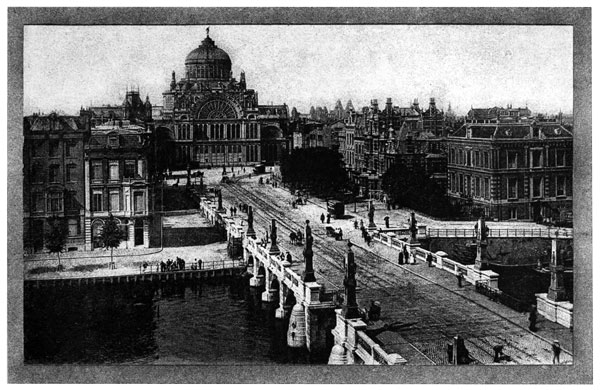
AMSTERDAM
What a difference it makes to have a friend residing in a foreign city! I posted a letter to Marie from Cologne, and as I was breakfasting the morning of my arrival here her visiting-card was brought to me. She has made our stay in this quaint city a bright green spot in the oasis of hotel life and hustling for oneself.
She has driven us over this picturesque old town and taken us to the palaces, and to the Royal Rijks Museum. We have walked with her through her favorite haunts in the parks. She has made a martyr of herself and shown us through the shops,—and have you ever heard of the lovely shops of Amsterdam? But, best of all, we have had a bit of home life, and Marie, bless her heart! has given us the first cup of real coffee we have had since we left home.
I cannot tell you much in detail about the splendid school of art here, for—let me whisper it to you—I did not get a guide-book of Holland. Marie and her good husband left little for us to glean. But this I do know, that, in all our travels, no more comprehensive and beautiful collection of art treasures have we found.
The building itself is magnificent, and the masterpieces are all Flemish. Rubens' "Helena Fourment," Rembrandt's "The Night Watch," and a portrait by Van Dyke are among those which I recall.
Holland is a quaintly picturesque country. Everything that Mr. F. Hopkinson Smith, that exquisite word-etcher as well as painter, has said of it is true.
But the language! And the money! Oh, the money is impossible.
Now, I call Ruth a brilliant woman, and one vastly above the average intellectually; and you know that, while I'm not an expert accountant, I can do "sums" once in a while. Well, neither of us has learned to pronounce, nor do we yet know, the value of the thing which takes the place of the franc. It is spelled g-u-l-d-e-n—most Americans call it gilder, but it is no more like that than it is like "horse." In fact, it is not unlike the last word, when a native gets his tongue around it.
As to its value! I have taken goods for it to the value of a penny and of a half-dollar. I simply take the change given me and go. The other, like Thoreau's friend, has both the first word and the last. How awful! A woman can never talk back in this language.
BRUSSELS:
Elbert Hubbard tells, in one of his "Little Journeys," how, when his ship landed in Antwerp at eleven o'clock in the morning, he walked to the hotel and awakened the landlord from his early morning nap in order to get some breakfast. I cannot speak from experience as to what hour they arise, but I do know, from very close association with the people, that they do not know what sort of money they use.
At the door of the cathedral, where we went to see Rubens' chef-d'œuvre, "The Descent from the Cross," the woman at the door refused to take one of those coins of which I do not know the value; but when I tried a little dramatic action, and turned to go, she took it very readily, and permitted us to enter. The same scene was enacted at the door of the really exquisite museum; but it did not work at the station.
We were using all our Belgian coins before going into France, and had saved enough for the porters at the station where we had left our hand luggage. The porter who brought our luggage from the train into the station had accepted the coin we gave him. The one we secured to carry them out to the train had reached our compartment, and demanded his money.
I counted out the coins. He refused them. We had no other money. I tendered him a book, and finally my watch. He still refused, and would not permit us to put the things in the compartment. There was no woman in sight, and foreign men are so different from our countrymen that we could not bring ourselves to ask aid from them; besides, we did not speak Flemish.
It was absolutely necessary for us to reach Brussels that night, and had we gone back to get the money changed, it would have necessitated our remaining over Sunday in Antwerp, where we had exhausted everything of interest. We were becoming desperate, when good fortune smiled on us in the form of a pair of girlish black eyes.
I asked her if she spoke English. She shook her head.
"Parlez vous Français?" and, oh, joy, "Mais un peu," she replied.
I made known our dilemma, and she very sweetly settled with the facteur for about half the amount he had demanded of me.
Who shall say there is not a free masonry among women? There, in a strange country, with not a cent of that country's coinage in my pocket, knowing no word of its language, came to my assistance a woman of yet another country, speaking nor understanding no word of my mother tongue, and, in yet another language, which we both spoke indifferently, I asked and she gave aid with that same grave politeness which marks the noblesse oblige everywhere.
The next morning, dressed in our bravest, we had the concierge call the shiniest cab he could find, with the tallest-hatted cocher, and with the loveliest basket of roses that could be procured, we drove in state to the address she had given us. We had a cordial greeting, but somehow I fancy she had been in doubt as to whether or not she would ever see those few francs again.
You may rest assured that we have had sufficient money changed here, and that we have found numerous ways in which to spend it. Next to Venice, the lace shops are the finest in the world.