"By Canoe and Dog-Train" (continued 4)
Reading edition
One day an Indian came into my house and threw down a fine haunch of venison upon the table. As we were poorly off for food, I was very much pleased, and said to him, “What shall I give you for this meat?”
“Nothing,” he replied; “it belongs to you.”
“You must be mistaken,” I said. “I never had any dealings with you.”
“But I had with you,” he answered. “And so this meat is yours.”
Being unacquainted with the man, I asked him to tell me who he was, and how he made it out that this meat belonged to me.
Said he, “Did you not go to Nelson River with dogs and Indians about two moons ago?”
“Yes,” I replied, “I did.”
“Well, I was out hunting deer, but I did not have much luck. The snow was deep, the deer were very shy, and I had no success. One day, when very hungry, for I had only taken a little dried rabbit meat with me from my wigwam, I came across your trail, and I found where your Indians had made a cache, that is, a big bundle of provisions and other things had been tied up in a blanket, and then a small tree had been bent down by your men, and the bundle fastened on the top, and let spring up again to keep it from the wolves. I saw your bundle hanging there, and as I was very hungry I thought, ‘Now if the kind-hearted Missionary only knew the poor Indian hunter was here looking at his bundle of food, he would say, “Help yourself;”’ and that was what I did. I bent down the tree, and found the large piece of pemmican. I cut off a piece big enough to make me a good dinner, then I tied up the bundle again, and let it swing up as you had it. And now I have brought you this venison in place of what I took.”
I was pleased with his honesty, and had in the incident another example of the Indian quickness to read much where the white man sees nothing.
The reason why we had made the cache which the Indian had discovered was, that we had taken a large quantity of pemmican for our food, as the people we wore going to see were poor, and we did not wish to be a burden to them; but we had been caught in a terrible storm, and as the snow was very deep, making the travelling heavy, we were obliged to lighten our loads as soon as possible. So we left a portion, as the Indian has described, on the way.
When we returned to the cache, and my men pulled it down and opened the bundle, one of them quickly cried out, “Somebody has been at our cache.”
“Nonsense,” I replied; “nobody would disturb it. And then there were no tracks around when we reached here to-night.”
Looking at the largest piece of pemmican, the Indians said, “Missionary, somebody has taken down our bundle and cut off a piece just here. That there are no tracks, is because there have been so many snow-storms lately. All tracks made a few days ago are covered up.”
As I knew they were so much quicker along these lines of education than white men, I did not argue any more with them. The coming of the old hunter with the venison was the proof of the cleverness of my men, and also a very honourable act on his part. I kept the old man to dinner, and among other things I asked him how he knew it was the Missionary’s party that passed that way. He quickly replied, “By your tracks in the snow. Indians’ toes turn in when they walk, white men’s toes turn out.”
Chapter Thirteen.
An Indian Lovefeast—Many witnesses—Sweet songs of Zion—The Lord’s Supper—Memoir of William Memotas, the devoted Christian.
Our Lovefeasts and sacramental services were always well attended, if it were within the range of possibility for the Indians to be present. To come in on Saturday from their distant hunting grounds sixty miles away, that they might enjoy the services of the Lord’s house on His own day, was no unusual thing. Then on Monday morning we have seen them again strap on their snowshoes, and with glad hearts and renewed zeal start off to return to their lonely hunting camps in the distant forests.
They are able to express themselves clearly, and often quite eloquently. When their hearts are full of the love of God, and they are rejoicing in the blessed assurance of the Divine favour, they are willing to speak about it.
“What they have felt and seen With confidence they tell.”
Here are some of their testimonies. Those are the living words of men and women who were once the slaves of a debasing paganism. But on their hearts the blessed Spirit shone, and to His pleading voice they responded, and now, happy in the consciousness that they are the children of God, they love to talk about what wonderful things have been done for them and wrought in them. Timothy Bear said:
“It is such a joy to me, that I can tell you of great things done for me. Great is the joy I have in my heart to-day. I rest in the consciousness that He is my own reconciled Heavenly Father, and so I feel it good to be here in the Lord’s house, and with those that love Him. The good Spirit gives me to see how good and kind my heavenly Father is; and so I can say that the greatest anxiety of my heart and life is to serve God better and better as I grow older. To do this I have found out that I must have Divine help. But He is my Helper for everything, and so I need not fail. So I am encouraged that I shall love God more and more, and, with that, I want to love His cause and people, and those who have not yet become His people, that they may soon do so, more and more. For the conversion of the unsaved, let us, who feel that Jesus saves us, pray more earnestly than ever, and may God help us to live our religion, that the heathen around us may see in our lives what a wonderful thing it is.”
Timothy’s burning words produced a deep impression, and some one began to sing:
“Ayume-oo-we-nah,” “The praying Spirit breathe.”
Half a dozen were on their feet when the verses were sung, but Thomas Walker spoke first. He said:
“When I first heard the Gospel long winters ago, as brought to us by Mr Evans, I was soon convinced that I was a sinner and needed forgiveness. I found I could not of myself get rid of my sins, so I believed in Christ, and found that He had power to forgive. I was very wretched before I was forgiven. I was afraid I should be lost for ever. I mourned and wept before God on account of my sins. In the woods alone, I cried in my troubles, and was in deep distress. But I heard of the love and power, and willingness to save, of this Jesus of the great Book, and so I exercised a living faith in Him; and as I believed, God’s voice was heard, saying, ‘My son, I have forgiven your sins; I have blotted them out. Go in peace.’ I am sure I was not mistaken; I felt filled with peace and joy. I felt that I, Thomas Walker, was cleansed from my many sins, and clothed with the garments of salvation. That was a blessed day when the Spirit of God shone into my heart and drove out the darkness. Since then, my way in Him has been like the sunlight on the waters. The more waves, the more sunshine. I am happy in His love to-day. I am confident that, because He aids me, I am growing in grace.
“I rejoice at being spared to come to another celebration of the Lord’s Supper; and in view of partaking of the emblems of the dying, loving Jesus, I feel that my soul is feeding on Christ, the true Bread of Life.”
Earnest yet suppressed words of praise and adoration quietly dropped from many lips as Thomas ended. Then dear old Henry Budd succeeded in getting a hearing. Henry was Mr Evans’ marvellous dog-driver over twenty-five years before the date of this blessed lovefeast. He had had many wonderful adventures and some narrow escapes. Once, when running ahead on a treacherous river, where in places the current was very rapid, and consequently the ice was thin, he broke through into the current underneath. He quickly caught hold of the edge of the ice, but it was so weak it would not hold him up. His only comrade could not get very near him as the ice was so bad, and so had to run about a mile for a rope. When he returned, so intense was the cold that both of Henry’s hands, with which he had been holding on to the ice, were frozen. He was utterly unable to close them on the rope. George shouted to him to open his mouth. The rope was then thrown, lasso-like, so skilfully, that the poor half-frozen man seized it in his teeth, and was thus dragged out, and rushed off to the nearest wigwam. He was literally saved by the “skin of his teeth.”
Thus Henry Budd had, like many others, much for which to praise God. He spoke on this occasion as follows:
“I rejoice in God my Saviour, Who has done such wonderful things for me. I feel very happy. I am His child. He is my reconciled Father. How can I help being happy?
“When I first began to get my poor blind eyes opened, and there came to me a desire to seek God, and to obtain salvation for my soul, I was troubled on account of my sins. My many transgressions rose up before me like a cloud. I was ignorant, and so my mind was full of doubts and fears. Yet with all my doubts there was the anxious desire to be saved. But the victory came at last. I was enabled to hear enough about the Almighty Friend, and so, as I had confidence in His power and love, and believed in Him, I was at last enabled to rejoice in the knowledge of sins forgiven through faith in the Lord Jesus Christ. From those sad doubts and fears I am now happily delivered. I feel I love God, and that God loves me. I am growing in grace, and in the knowledge of God my Saviour. My hopes are brightening all the time. I am getting old, but not unhappy, for I am cheered with the blessed assurance of one day meeting, in my Father’s house in heaven, with many who are safely there, and many more who, like me, will soon enter in. That this may be a blessed certainty, I desire to be faithful unto the end, that no man take my crown.”
When Henry sat down, before another one could be heard, the large congregation were singing:—
“Pe teh-na-mah-me cha-te yak Ke ehe ne-ka-mo-yak,” etc. “O for a thousand tongues to sing My great Redeemer’s praise.”
The next to get the floor was one of the sweetest, purest Christians it was ever my lot to become acquainted with in any land. His name was William Memotas. He was a very happy Christian. As he was a Local Preacher and a Class Leader, I was much in his society, and I can say, as many others have said, that William, since the day of his conversion, was never heard to utter an unkind word about any one, or do anything that could give the enemies of the Lord Jesus an opportunity to scoff at his profession of loving the Lord with all his heart. He was never a very strong man physically while we knew him, and so was unable to go on the long tripping or hunting expeditions with him more vigorous comrades. He suffered much from inward pain, but was ever bright and hopeful. When he stood up to add his testimony, the sick, pallid face caused a wave of sympathy to pass over the audience, but his cheery words quickly lifted the cloud, and we seemed to look through the open door into the celestial city, into which he was so soon to enter. His obituary, which I wrote at the time of his death, is added at the close of this chapter. He said:—
“For many years I have now been walking in this way, and proving this great salvation. It is a blessed way, and it is getting more delightful all the time. Every day on it is a day’s walk nearer Jesus. It is not like the trails in our country, sometimes rocks, and then more often muskegs and quaking bogs; but it is the solid rock all the time, and on it we may always be sure of our footing, and it leads us up to Him Who is the Rock of Ages. I am not now a strong man, as you know I once was. This poor weak body is like the old wigwam. It is breaking up. As each storm tears fresh rents in the old wigwam, so each attack of disease seems to tear me, and bring me nearer the time when what is immortal of me shall slip away from the worn body into the everlasting brightness of that land where the happy people never say, ‘I am sick.’ I am very glad and happy in the service of this Jesus, and will serve Him as long as He lends me health. But I do want to go home. I cannot do much more here. Our Missionary, Mr Young, said to me, ‘William, don’t talk so much about leaving us. How can we spare you?’ I thank him for his love and friendship, but there is another Friend I am getting such a longing in my heart to see, and that is Jesus, my Saviour, my Redeemer. I am praying for patience, but by-and-by I shall be with Him, with him for evermore. There I shall have no pain, and I will praise my Jesus for evermore. So, while waiting, I ask God to be with me here, and to let me serve Him in some way every day.”
With suppressed emotion, for many eyes were full of tears, the people sang—
“Tapwa meyoo ootaskewuk, Ispemik ayahchik,” etc. “There is a land of pure delight, Where saints immortal reign.”
William was a sweet singer, and joined heartily with the rest in singing several verses of that grand old hymn. We had a presentiment that the end was not far off, but we little thought, as we looked into his radiant face, and heard his clear scriptural testimony, and his longings for rest and heaven, that this was to be the last Lovefeast in which our dear brother was to be with us. Ere another similar service was held, William Memotas had gone sweeping through the gates, washed in the blood of the Lamb.
James Cochrane, a Class Leader, said,—
“I have great reason to bless God for the privileges and mercies I have had from him. I am so glad to be with you to-day in his house. I try to arrange all my huntings and journeys so as to be present at all of these love-feasts and sacraments. Since I decided, many years ago, to give up paganism and become a Christian, I have never missed one of these meetings, though sometimes I have had to take several days and travel hundreds of miles to get here. I only had to travel sixty miles on my snow-shoes to be here to-day. It has paid me well to come. I rejoice that God has enabled me to be faithful all these years since I started in His service. When I first began, I had a great many doubts and fears. The way seemed very long ahead of me. I felt so weak and so prone to sin. It seemed impossible that such a weak, unworthy creature as I could stand true and faithful; but trusting in God, and constantly endeavouring to exercise a living faith in Christ, I have been kept to this day, and I can say I realise a daily growth in grace. I ask God to give me His Holy Spirit to help me to follow Christ’s example and to keep all of God’s commandments. May I, too, prove faithful.”
Mary Cook, a very old woman, who has had to endure persecution for Christ’s sake, spoke next. She said:
“I am very glad to be here once more. I have many pagan relatives who have no feeling of friendship towards me, because I am a follower of Jesus. But He is my Friend, so it is all right. I have been very sick, and thought that God was going to take me home to heaven. That thought made me very happy in my sickness. My poor little room often seemed light with the presence of my Lord. I love to dwell with God’s people. It is my chief joy. I refused to go and live with my relatives in the woods, even though I should be better off, because I love the house of God, and because I so love to worship with God’s people.”
Mary Oig said:
“Very happy do I feel in my heart to-day. My heart is filled with his love. I knew I love Him and his people; and His service is to me a great delight. Once, like many others, I was in the great darkness, wandering in sin; but God sought me by His Holy Spirit, and convinced me of my lost condition, and shewed me Himself as my only Hope, and enabled me to rejoice in his pardoning mercy through faith in the Atonement. May God keep me faithful, that with you I may join around the Throne above.”
Thomas Mamanowatum, generally known as “Big Tom,” on account of his almost gigantic size, was the next to speak. He is one of the best of men. I have used him to help me a good deal, and have ever found him one of the worthiest and truest assistants. His people all love and trust him. He is perhaps the most influential Indian in the village. Tom said:
“I, too, desire to express my gratitude to God for His great blessings and mercies to me. I am like David, who said, ‘Come, all ye who fear the Lord, and I will tell you what He hath done for my soul.’ He has taken me out of the pit of sin, and set me on the rock. So I rejoice, for I have felt and tasted of His love. When I think of what he has done for me, and then think of what I have been, I feel that I am not worthy even to stand up in such a place as this. But He is worthy, and so I must praise Him. I have a comfortable assurance that He, my good Father, is contented with me. But it is only because the grace of God is sufficient to keep me. I am growing in grace, and I desire more than ever to glorify God in all I think, or speak, or do. I have been helping our Missionary at Beren’s River in the good work among the people there. I often felt happy while endeavouring to point my heathen brethren to Jesus Christ, Who takes away the sins of the world. My first consecration was of myself, when converted to Christ. My second was of my family to Him. My third is of my class. I am often very happy while trying to lead them on in the way to heaven. To-day I renew my vows of consecration. I offer the sacrifice of thanksgiving, for He is my God and my portion for ever. As He is the Source of Love and Light and Safety, I want to be continually drawing nearer to Him.”
Very appropriate was the hymn which was next sung,—
“Ke-se-wog-ne-man-toom Ke-nah-te-tin,” etcetera, “Nearer, my God, to Thee.”
After three verses of this beautiful hymn were sung, we had a large number of short testimonies. Some of the people beautifully expressed themselves by quoting passages from their Indian Bibles. For example, one said: “The joy of the Lord is my portion.” Another: “The Lord is my Shepherd; I shall not want.” Another: “Beloved, now are we the sons of God, and it doth not yet appear what we shall be: but we know that, when He shall appear, we shall be like Him; for we shall see him as He is.”
Thus delightfully passed away two hours. Perhaps fifty or sixty gave their testimonies, or quoted passages of Scripture. The speaking was up to the average of a similar gathering among white people, as these examples we have given would indicate. They were faithfully translated by two of our best interpreters, and then compared. And yet many of the beautiful Indian images are lost in the translation into English.
The best of all has also to be left out. The Divine power, the holy emotions, the shining faces, the atmosphere of heaven, cannot be put down on paper. Many of my readers know what I mean as thus I write, for they have been in those hallowed gatherings where “they that feared the Lord spake often one to another.”
Then followed the Sacrament of the Lord’s Supper. To the Christian Indians this service is, as it ever should be, the most solemn and impressive in the Church. Our custom was to hold four Communion services during the year. In addition, we sometimes gave a dying devoted member this sacrament, if so desired. Here there were a few other very important occasions, when we celebrated in this way the dying of the Lord Jesus. As, for example, when several scores of our people were going off on a dangerous trip in a plague-infected district with but very poor prospects of all returning home again.
William Memotas.
William Memotas was converted from the darkness of paganism to the light of the Gospel soon after the introduction of the glad tidings of salvation among the Cree Indians by that most useful and godly man, the Reverend James Evans. William’s conversion was so clear and positive that he never had any doubts about it. His progress in the Divine life was marked and intelligent, and soon he became a useful and acceptable worker in the Church. He was a Class Leader and Local Preacher of great power and acceptability.
He was pre-eminently a happy Christian. His face seemed full of sunshine. There was a genial sweetness about him that caused his very presence to act as a charm. His coming into our Mission home was like the sunshine, in which even our little ones basked with great delight. He was an every-day Christian. Although I was often in his company, and was thrown in contact with him on some occasions calculated to severely test him, yet I never heard from him an improper word, or heard of his having in any way gone contrary to his Christian profession during the thirty years that he had professed to be a follower of the Lord Jesus.
His greatest aim in life seemed to be to get to heaven; and next to that he strove to induce others to follow in the same course.
When some of the Indians were getting excited about their lands, and the treaties which were soon to be made with the Government, William, in writing to a friend, said: “I care for none of these things; they will all come right. My only desire is to love Jesus more and more, so as to see Him by-and-by.”
He was a useful Christian, possessing a good knowledge of the roots and herbs of his native forests, and also having had some instruction given him in reference to some of the simpler medicines of the whites, he was often styled our “village doctor.” Although seldom remunerated for his services, he was always ready to listen to the calls of the afflicted, and, with Heaven’s blessing, was instrumental in accomplishing some marvellous cures. He believed in using a good deal of prayer with his medicines. His skill in dressing and curing gun-shot wounds could not be excelled.
Yet, while doing all he could to cure others, his own health was very poor for several years. He suffered frequently from violent headaches that caused intense pain. Yet he was never heard to murmur or complain, but would say to us, when we tried to sympathise with him, “Never mind, by-and-by I shall get home, and when I see Jesus I shall have no more pain.” About nine days before his departure he caught a severe cold that settled upon his lungs, which seemed to have been diseased for a long time. He had from the beginning a presentiment that his sickness was “unto death,” and never did a weary toiler welcome his bed of rest with greater delight than did William the grave. The prospect of getting to heaven seemed so fully to absorb his thoughts that he appeared dead to everything earthly. In life he had been a most loving and affectionate husband and father, but now, with a strong belief in God’s promises of protection and care over the widow and fatherless, he resigned his family into the Lord’s hands, and then seemed almost to banish them from his thoughts.
Being very poor on account of his long-continued ill health, which had incapacitated him for work, he had, when his severe illness began, nothing to eat but fish. We cheerfully supplied him with what things our limited means would allow, to alleviate his sorrows and poverty. One day, when my beloved Brother Semmens and I had visited him, we had prayer and a blessed talk with him. As we were leaving him, after giving him some tangible evidences of our love, Brother Semmens said, “Now, Brother William, can we do anything else for you? Do you want anything more?” The poor sick man turned his radiant face towards us and said, “O no, I want nothing now, but more of Christ.”
He often conversed with us about his glorious prospects and the joy and happiness he felt as the pearly gates of the Golden City seemed to be opening before him. Here are some of his dying words whispered either to my beloved colleague or to myself. Would that we could portray the scene, or describe the happy, shining face of the dying man, lying there on a bed of blankets and rabbit skins in his little dwelling!
He said, “While my body is getting weaker, my faith is getting stronger, and I am very happy in Jesus’ love. Very glad am I that I responded to Mr Evans’ invitations, and gave my heart to Him Who has saved me and kept me so happy in His love. I am so glad I was permitted to do some little work for Jesus. He used to help me when I tried to talk about His love and recommend Him to others. I used to get very happy in my own soul when thus working for Him. I am happier now than ever before. I am resting in His love.”
Thus would the happy man talk on as long as his strength permitted. It was ever a blessing to visit him. It wonderfully encouraged and strengthened us in our work. One day, as we came from one of these blessed visits, Brother Semmens burst out in almost ecstatic delight,—
“O may I triumph so When all my warfare’s past!”
When we administered to him the emblems of the broken body and spilt blood of the Redeemer, he was much affected, and exclaimed, “My precious Saviour! I shall soon see Him. ‘That will be joy for evermore.’”
Once, when conversing with him, I happened to say, “I hope you will not leave us. We want you to remain with us. We need you to help us to preach. We need you in the Sunday School and in the Prayer Meetings. Your sixty class members are full of sorrow at your sickness. They think they cannot spare you. Do not be in a hurry to leave us, William. We want your presence, your example, your prayers.”
He listened patiently while I talked, and then he looked up at me so chidingly, like a weary, home-sick child, and exclaimed, in a voice that showed that earth had lost all its charms, “Why do you wish to detain me? You know I want to go home.”
Shortly after, his heart’s desire was his in actual possession. Triumphantly he went home. While we felt that our Mission was much the loser by his departure, we knew it was better for him, and an accession to heaven’s glorious company of one who was worthy to mingle with the white-robed throng around the throne of God.
There is nothing that more roots and grounds us in this blessed Gospel, and more stimulates us to labour on, even amidst hardships and sufferings, than the consistent lives and triumphant deaths of our Indian converts.
Ignorant as many of them are of the non-essentials of our religion, yet possessing by the Spirit’s influence a vivid knowledge of their state by nature, and of the Saviour’s love for them, they cling to Him with a faith so strong and abiding, that the blessed assurance of His favour abides with them as a conscious reality through life; and when the end draws near, sustained by His presence, even the Valley of the Shadow of Death is entered with delight.
The Missions among the Indians of North America have not been failures. The thousands converted from different tribes, and now before the throne of God, and the many true and steadfast ones following after, tell us that although many of the toilers among them, as they went with the seed, literally went forth weeping, yet the harvest has been an abundant one, and has more than compensated for the tears and toils of the sewers.
Chapter Fourteen.
Varied duties—Christianity must precede civilisation—Illustrations—Experimental farming—Ploughing with dogs—Abundance of fish—Visits from far-off Indians—Some come to disturb—Many sincere inquirers after the truth—“Where is the Missionary?”—Beren’s River Mission begun—Timothy Bear—Perils on the ice.
Very diversified were our duties among these Indians. Not only were there those that in all places are associated with ministerial or pastoral work, but there were also many others, peculiar to this kind of missionary toil. Following closely on the acceptance of the spiritual blessings of the Gospel came the desire for temporal progress and development. Christianity must ever precede a real and genuine civilisation. To reverse this order of proceedings has always resulted in humiliating failure among the North American Indians.
Sir Francis Bond Head, one of the early Governors of Canada, took a great interest in the Indians. He zealously endeavoured to improve them, and honestly worked for their advancement. He gathered together a large number of them at one of their settlements, and held a great council with them. Oxen were killed, and flour and tea and tobacco were provided in large quantities. The Indians feasted and smoked, and listened attentively to this great man who represented the Queen, and who, having also supplied them with food for the great feast, was worthy of all attention.
The Governor told them that the great object of his coming to see them, and thus feasting them, was to show his kindness to them, and interest in their welfare. Then, with much emphasis he told them how the game was disappearing, and the fish also would soon not be so plentiful, and, unless they settled down and cultivated the soil, they would suffer from hunger, and perhaps starve to death. He got them to promise that they would begin this new way of life. As they were feeling very comfortable while feasting on his bounties, they were in the humour of promising everything he desired. Very much delighted at their docility, he said he would send them axes to clear more of their land, and oxen and ploughs to prepare it for seed; and when all was ready he would send them seed grain. Great were their rejoicings at these words, and with stately ceremony the council broke up.
In a few days along came the ploughs, oxen, and axes. It was in the pleasant springtime, but instead of going to work and ploughing up what land there was cleared in their village, and beginning with their axes to get more ready, they held a council among themselves. These were their conclusions: “These axes are bright and shine like glass. If we use them to cut down trees, they will lose their fine appearance. Let us keep them as ornaments. These oxen now are fat and good. If we fasten them up to these heavy ploughs, and make them drag them through the ground, they will soon get poor and not fit for food. Let us make a great feast.” So they killed the oxen, and invited all of the surrounding Indians to join them, and as long as a piece of meat was left the pots were kept boiling.
Thus ended, just as many other efforts of the kind have ended, this effort to civilise the Indians before Christianising them.
We found that almost in proportion to the genuineness of the Indian’s acceptance of the Gospel was his desire to improve his temporal circumstances. Of course there were some places where the Indians could not cultivate the land. We were four hundred miles north of the fertile prairies of the great western part of the Dominion of Canada, where perhaps a hundred millions of people will yet find happy times. From these wondrously fertile regions my Nelson River Indians were at least six hundred miles north. As hunters and fishermen these men, and those at Oxford Mission, and indeed nearly all in those high latitudes, must live. But where there was land to cultivate the Indians had their gardens and little fields.
I carried out with me four potatoes. I did not get them in the ground until the 6th of August. Yet in the short season left I succeeded in raising a few little ones. These I carefully packed in cotton wool and kept safe from the frost. The next year I got from them a pailful. The yield the third year was six bushels, and the fourth year one hundred and twenty-five bushels; and before I left the Indians were raising thousands of bushels from those four potatoes. They had had some before, but there had been some neglect, and they had run out.
One summer I carried out, in a little open boat from Red River, a good Scotch iron beam plough. The next winter, when I came in to the District Meeting, I bought a bag of wheat containing two bushels and a half; and I got also thirty-two iron harrow teeth. I dragged these things, with many others, including quite an assortment of garden seeds, on my dog-trains, all the way to Norway House. I harnessed eight dogs to my plough, and ploughed up my little fields; and, after making a harrow, I harrowed in my wheat with the dogs. The first year I had thirty bushels of beautiful wheat. This I cut with a sickle, and then thrashed it with a flail. Mrs Young sewed several sheets together, and one day, when there was a steady, gentle breeze blowing, we winnowed the chaff from the wheat in the wind. There were no mills within hundreds of miles of us; so we merely cracked the wheat in a hand coffee-mill, and used some of it for porridge, and gave the rest to the Indians, who made use of it in their soups.
Thus we laboured with them and for them, and were more and more encouraged, as the years rolled on, at seeing how resolved they were to improve their temporal circumstances, which at the best were not to be envied.
The principal article of food was fish. The nets were in the water from the time the ice disappeared in May until it returned in October; and often were holes cut in the ice, and nets placed under it, for this staple article of food.
The great fall fisheries were times of activity and anxiety, as the winter’s supply of food depended very much upon the numbers caught. So steady and severe is the frost at Norway House, and at all the Missions north of it, that the fish caught in October and the early part of November, keep frozen solid until April. The principal fish is the white fish, although many other varieties abound.
Each Indian family endeavoured to secure from three to five thousand fish, each fall, for the winter’s supply. For my own family use, and more especially for my numerous dogs, which were required for my long winter trips to the out Mission appointments, I used to endeavour to secure not less than ten thousand fish. It is fortunate that those lakes and rivers so abound in splendid varieties of fish. If it were not so, the Indians could not exist. But, providentially,—
“The teeming sea supplies The food the niggard soil denies.”
Deer of several varieties abound, and also other animals, the flesh of which furnishes nutritious food. But all supplies of food thus obtained are insignificant in comparison with the fish, which the Indians are able to obtain except in the severest weather.
As with the natives, so it was with the Missionaries; the principal article of food upon their tables was fish. During the first Riel Rebellion, when all communication with the interior was cut off, and our supplies could not as usual be sent out to us from Red River, my good wife and I lived on fish twenty-one times a week, for nearly six months. Of course there were times when we had on the table, in addition to the fish, a cooked rabbit, or it may be a piece of venison or bear’s meat. However, the great “stand-by,” as they say out in that land, was the fish.
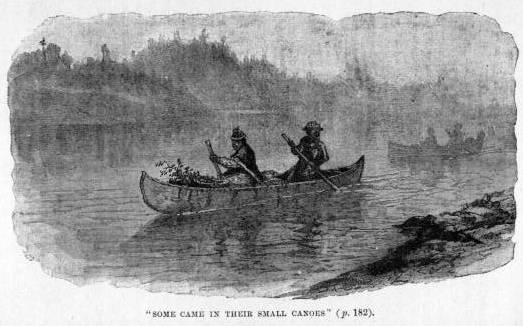
Every summer hundreds of Indians from other places visited us. Some came in their small canoes, and others with the Brigades, which in those days travelled vast distances with their loads of rich furs, which were sent down to York Factory on the Hudson Bay, to be shipped thence to England. Sometimes they remained several weeks between the trading post and the Mission. Very frequent were the conversations we had with these wandering red men about the Great Spirit and the Great Book.
Some, full of mischief, and at times unfortunately full of rum, used to come to annoy and disturb us. One summer a band of Athabasca Indians so attacked our Mission House that for three days and nights we were as in a state of siege. Unfortunately for us our own loyal able-bodied Indian men were all away as trip men, and the few at the Mission village were powerless to help. Our lives were in jeopardy, and they came very near burning down the premises.
Shortly after these Athabasca Indians had left us I saw a large boatload of men coming across the lake towards our village. Imagining them to be some of these same disturbers, I hastily rallied all the old men I could, and went down to the shore, to keep them, if possible, from landing. Very agreeable indeed was my surprise to find that they were a band of earnest seekers after the Great Light, who had come a long distance to see and talk with me. Gladly did I lead them to the Mission House, and until midnight I endeavoured to preach to them Jesus. They came a distance of over three hundred miles; but in that far-off district had met in their wanderings some of our Christian Indians from Norway House, who, always carrying their Bibles with them, had, by reading to them and praying with them, under the good Spirit’s influence, implanted in their hearts longing desires after the great salvation. They were literally hungering and thirsting after salvation. Before they left for their homes, they were all baptized. Their importunate request to me on leaving was the same as that of many others:
“Do come and visit us in our own land, and tell us and our families more of these blessed truths.”
From God’s Lake, which is sixty miles from Oxford Lake, a deputation of eleven Indians came to see me. They had travelled the whole distance of two hundred and sixty miles in order that they might hear the Gospel, and get from me a supply of Bibles, Hymn-books, and Catechisms. One of them had been baptized and taught years ago by the Reverend H. Brooking. His life and teachings had made the others eager for this blessed way, and so he brought these hungry sheep in the wilderness that long distance that they might have the truth explained to them more perfectly, and be baptised. As it had been with the others who came from a different direction, so it was with these. Their earnest, oft-repeated entreaty was, “Come and visit us and ours in our far-away homes.”
A few weeks after, another boatload of men called to have a talk with me. They seated themselves on the grass in front of the Mission House, and at first acted as though they expected me to begin the conversation. I found out very soon that they were Saulteaux, and had come from Beren’s River, about a hundred and fifty miles away. After a few words as to their health and families had passed between us, an old man, who seemed to be the spokesman of the party, said, “Well, Ayumeaookemou” (“praying master,” the Missionary’s name), “do you remember your words of three summers ago?”
“What were my words of three summers ago?” I asked.
“Why,” he replied, “your words were that you would write to the Keche-ayumeaookemou” (the great praying masters, the Missionary Secretaries) “for a Missionary for us.”
When I first passed through their country, they with tears in their eyes had begged for a Missionary. I had been much moved by their appeals, and had written to the Mission House about them and for them, but all in vain. None had come to labour among them.
For my answer to this old man’s words I translated a copy of my letter, which had been published, and in which I had strongly urged their claims for a Missionary. They all listened attentively to the end, and then the old man sprang up and said, “We all thank you for sending that word, but where is the Missionary?” I was lost for an answer, for I felt that I was being asked by this hungering soul the most important question that can be heard by the Christian Church, to whom God has committed the great work of the world’s evangelisation.
“Where is the Missionary?” The question thrilled me, and I went down before it like the reed before the storm. I could only weep and say, “Lord, have mercy upon me and on the apathetic Christian world.”
That was the hardest question a human being ever asked me. To tell him of a want of men, or a lack of money, to carry the glad tidings of salvation to him and his people, would only have filled his mind with doubts as to the genuineness of the religion enjoyed by a people so numerous and rich as he knew the whites were. So I tried to give them some idea of the world’s population, and the vast number yet unconverted to Christianity. I told him the Churches were at work in many places and among many nations, but that many years would pass away before all the world would be supplied with Missionaries.
“How many winters will pass by before that time comes?” he asked.
“A great many, I fear,” was my answer.
He put his hands through his long hair, once as black as a raven’s wing, but now becoming silvered, and replied: “These white hairs show that I have lived many winters, and am getting old. My countrymen at Red River on the south of us, and here at Norway House on the north of us, have Missionaries, and churches, and schools; and we have none. I do not wish to die until we have a church and a school.”
The story of this old man’s appeal woke up the good people of the Churches, and something was soon done for these Indians. I visited them twice a year by canoe and dog-train, and found them anxious for religious instruction and progress.
At first I sent to live among them my faithful interpreter, Timothy Bear. He worked faithfully and did good service. He was not a strong man physically, and could not stand much exposure. To live in, he had my large leather tent, which was made of the prepared skins of the buffalo. One night a great tornado swept over the country, and Timothy’s tent was carried away, and then the drenching rains fell upon him and his. A severe cold resulted, and when word reached me several weeks after at Norway House, it was that my trusted friend was hopelessly ill, but was still endeavouring to keep at his duties.
So great was my anxiety to go and comfort him that I started out with my dog-trains so soon after the winter set in that that trip very nearly proved to be my last. The greater part of that journey was performed upon Lake Winnipeg. Very frequently on the northern end of that lake the ice, which there forms first, is broken up by the fierce winds from the southern end, which, being three hundred miles further south, remains open several days longer. I had with me two Indians,—one was an old experienced man, named William Cochran; the other a splendid specimen of physical manhood, named Felix.
When we reached Lake Winnipeg, as far as we could judge by the appearance of the ice, it must have formed three times, and then have been broken up by the storms. The broken masses were piled up in picturesque ridges along the shore, or frozen together in vast fields extending for many miles. Over these rough ice-fields, where great pieces of ice, from five to twenty feet high, were thrown at every angle, and then frozen solid, we travelled for two days. Both men and dogs suffered a great deal from falls and bruises. Our feet at times were bruised and bleeding. Just about daybreak, on our third day, as we pushed out from our camp in the woods where we had passed the night, when we had got a considerable distance from the shore, Felix was delighted to find smooth ice. He was guiding at the time. He put on his skates and bounded off quickly, and was soon followed by the dogs, who seemed as delighted as he that the rough ice had all been passed, and now there was a possibility of getting on with speed and comfort.
Just as I was congratulating myself on the fact of our having reached good ice, and that now there was a prospect of soon reaching my sick Indian brother, a cry of terror came from William, the experienced Indian who was driving our provision sled behind mine.
“This ice is bad, and we are sinking,” he shouted.
Thinking the best way for me was to stop I checked my dogs, and at once began to sink.
“Keep moving, but make for the shore,” was the instant cry of the man behind.
I shouted to my splendid, well-trained dogs, and they at once responded to the command given, and bounded towards the shore. Fortunately the ice was strong enough to hold the dogs up, although under the sled it bent and cracked, and in some places broke through.
Very grateful were we when we got back to the rough strong ice near the shore. In quiet tones we spoke a few words of congratulation to each other, and lifted up our hearts in gratitude to our great Preserver, and then hurried on. If we had broken in, we could have received no earthly aid, as there was not even a wigwam within a day’s journey of us.
That night at the camp-fire I overheard William saying to Felix, “I am ashamed of ourselves for not having taken better care of our Missionary.”
We found Timothy very sick indeed. We ministered to his comfort, and had it then in our power so to arrange that, while the work should not suffer, he could have rest and quiet. His success had been very marked, and the old Saulteaux rejoiced that he and the rest of them were to be neglected no longer. He had made such diligent progress himself in spiritual things that I gladly baptized him and his household.
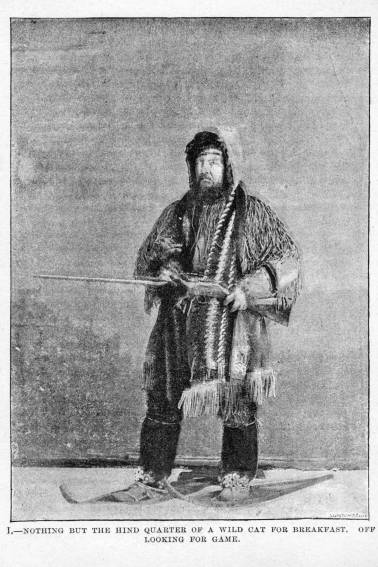
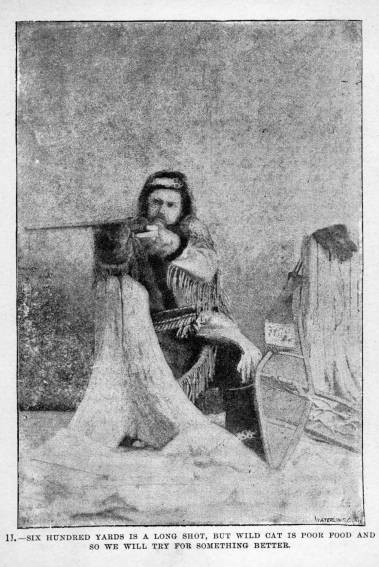
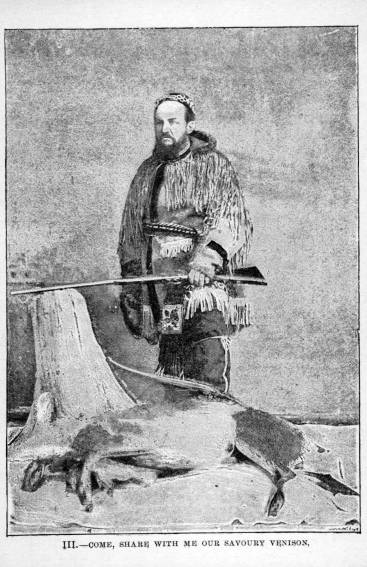
There were times when our supplies ran very short, and hunger and suffering had to be endured. During the first Riel Rebellion, when we were cut off from access to the outside world, we were entirely dependent upon our nets and guns for a long time. Our artist has tried to tell a story in three pictures.
At the breakfast table we had nothing to eat but the hind-quarter of a wild cat. It was very tough and tasteless; and while we were trying to make our breakfast from it, Mrs Young said, “My dear, unless you shoot something for dinner, I am afraid there will be none.”
So I took down my rifle, and tied on my snow-shoes, and started off looking for game. See Picture I. Pictures II and III tell the rest of the story.
Chapter Fifteen.
Small-pox pestilence—Heroic conduct of Christian Indians—Whites supplied with provisions by Red men—The guide Samuel Papanekis—His triumphant death—Nancy, the happy widow—In poverty, yet rejoicing.
We were very much shocked, during the early spring, to hear that that terrible disease, the small-pox, had broken out among the Indians on the great plains of the Saskatchewan.
It seems to have been brought into the country by some white traders coming up from the State of Montana. When once it had got amongst them, it spread with amazing rapidity and fatality. To make matters worse, one of the tribes of Indians, being at war with another, secretly carried some of the infected clothing, which had been worn by their own dead friends, into the territory of those with whom they were at war, and left it where it could be easily found and carried off. In this way the disease was communicated to this second tribe, and thousands of them died from it.
Every possible precaution against the spread of this terrible destroyer was taken by the Missionaries, Messrs McDougall and Campbell, aided by their Christian people. But, in spite of all their efforts, it continued cutting down both whites and Indians. To save some of his people Mr McDougall got the Indians of his Victoria Mission to leave their homes and scatter themselves over the great prairies, where, he hoped, they would, by being isolated, escape the contagion. The pagan Indians, rendered desperate under the terrible scourge which was so rapidly cutting them off, and being powerless to check it, resolved to wreak their vengeance upon the defenceless whites. So they sent a band of warriors to destroy every white person in the country. The first place they reached, where dwelt any of the pale-faces, was the Victoria Mission on the Saskatchewan River. Indian-like, they did not openly attack, but, leaving the greater number of their warriors in ambush in the long grass, a few of them sauntered into the Mission House. Here, to their surprise, they found that the small-pox had entered, and some of the inmates of the home had died. Quickly and quietly they glided away, and told their comrades what they had seen. A hasty consultation was held, and they decided that it could not have been the Missionary who had control of the disease; for, if he had, he would not have allowed it to have killed his own. They then decided it must have been the fur-traders, and so they started for the trading post. Here they pursued the same tactics, and found to their surprise that a Mr Clarke, the gentleman in charge of that place, had fallen a victim. Another hasty council made them think that they had been mistaken, and so they quickly returned to their own country without having injured any one.
But the Missionary and his family were surrounded by perils. The Indians were excited and unsettled, and their old pagan conjurers were ever ready to incite them to deeds of violence. The restraining power of God alone saved them from massacre. Once the Missionary’s wife and some of the family were at work in the garden, while secreted in the long grass not a hundred yards from them lay eleven Blackfeet, who had come to murder and pillage the place, but, as they afterwards acknowledged, were strangely restrained from firing. At another time some of the fierce warriors of this same bloodthirsty tribe crawled through a field of barley, and for a long time watched the movements of the family, and then noiselessly retired, doing no harm to any one. To hear the ping of a bullet as it passed in close proximity to the head was no very rare event in the lives of several of the early Missionaries among the excited pagans.
While the small-pox was raging in the Great Saskatchewan country, strenuous efforts were made to prevent it spreading to other districts. Manitoba had now been formed into a province, and was filling up with white settlers. The old name, Fort Garry, had been changed to Winnipeg, and this place was rapidly growing into a prosperous town. From Fort Garry long trains of Red River carts had been in the habit of going for years with the supplies needed in the far-off Saskatchewan country. These carts were made without having in their construction a single piece of iron. The Half-breeds or Indian drivers never oiled or greased them, and the result was they could be heard about as far as seen, even on the level prairies. Each cart was drawn by one ox, and was supposed to carry from eight to twelve hundred pounds of supplies, in addition to the food and outfit of the driver, who was always expected to walk. This freighting by carts on the prairies is the counterpart of transporting goods by open boats or canoes in the northern rivers, to which we have elsewhere referred. The arrival of the brigade of carts with the supplies, and the news from the outside world, was the great event of the year in the early times at those lonely prairie settlements.
But stern measures had to be adopted in this year of the small-pox plague. A proclamation was issued by the Governor of the Province of Manitoba, absolutely prohibiting any trade or communication in any way with the infected district. Not a single cart or traveller was permitted to go on the trail. This meant a good deal of suffering and many privations for the isolated Missionaries and traders and other whites who, for purposes of settlement or adventure, had gone into that remote interior country.
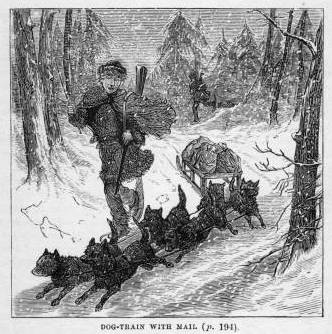
As it was, only twice a year in many places did the lonely Missionaries hear from the outside world. Then the mail-carrier was very welcome, whether he came by canoe or dog-train.
Although there were still plenty of buffalo on the plains, it was well known that the ammunition was about exhausted, as well as all other supplies, including medicines, now so much needed. Some interested parties vainly urged the Governor to relent and allow some supplies to be sent in. But, conscious of the risks that would be run of the pestilence reaching the province over which he governed, he remained firm, while he felt for those who necessarily must suffer.
“What can be done to aid those unfortunate ones, who, in addition to their sorrows and troubles incident to the ravages of the small-pox among them, are now to be exposed to pinching famine and want?” was the question that sympathising friends were asking each other. As a last resort it was decided to appeal to the Norway House Christian Indians, and ask them to form a brigade of boats, and take the much-needed supplies up the mighty Saskatchewan River, where they could be reached by those needing them.
To me, as Missionary of these Indians, Mr Stewart, the highest official of the Hudson’s Bay Company, came; and we talked the matter over, and the risks which the Indians, not one of whom had been vaccinated, must run in going on such a perilous journey. They would have to go hundreds of miles through the disease-stricken land where hundreds had died. But it seemed essential that something must be done, and there were possibilities that the Indians, by acting very wisely, could escape infection: so we decided to call them together, and see what they would do in this emergency.
When the church bell was rung, and the people had assembled together in their Council house, wondering what was the matter, I described the sad circumstances to them, and then presented the request, that one hundred and sixty of them should take twenty boats loaded with supplies, and go up the Saskatchewan, to save these white people from starving. I said to these converted Indians, my own people:
“I know your race on this continent has not always been fairly treated; but never mind that. Here is a grand opportunity for you to do a glorious act, and to show to the world and to the good Lord, Whose children you are, that you can make sacrifices and run risks when duty calls, as well as the whites can.”
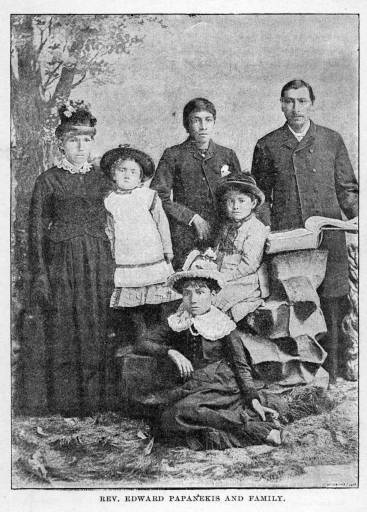
We told them that there was a possibility that they, by keeping in the middle of the great river all the time, and never going ashore, might all escape. They would be provided with abundance of food; so they need not go ashore to hunt. Then we asked, “Are you willing to run the risk, and avail yourselves of this chance to do a glorious act?” Turning to one of the most trusted guides in the country, one of my best Class-Leaders, I said: “Samuel Papanekis, you are to be the guide and leader of this party.” He was a son of the old centenarian, and brother of the Reverend Edward Papanekis, now our Missionary at Oxford House Mission.
He seemed at first a little startled by the responsibility of the position, and after a moment’s thought quietly said: “Will you give us a little time to talk it over?” So we left them to discuss the matter among themselves. When they sent us word that they had their answer ready, we returned, and he said: “Missionary, we have talked it over, and have decided to go to take the supplies to our suffering white brothers and their families. But will you let us have one more Sunday at the church, and will you give us the Sacrament of the Lord’s Supper, ere we start upon the dangerous journey?”
“Yes,” I said, “it will take several days to get your loads and boats ready, and so we will have another blessed day of rest and hallowed worship together.”
It was a memorable Sabbath. Every man, woman, and child who could come to church, seemed to be there. Some of the women wept as they thought of the risks their husbands, or brothers, or sons were running. Others of them seemed to catch the spirit of the men, and felt proud that those they loved were willing to undertake so brave and noble a work.
At the close of the morning service we had the Sacrament of the Lord’s Supper. It was very solemn and impressive. As they came forward and partook of the emblems of their dear Lord’s dying love, the recollection of His self-sacrifice and disinterested kindness seemed to come very vividly before us all, and there was in many hearts a kind of exultant joy that they were counted worthy to run some risks for the sake of doing good.
No foolish boastfulness, or desire to seek for sympathy, characterised their utterances at the afternoon service, at which we met again in a Testimony or Fellowship Meeting. Some made no reference at all to the work before them; others asked for our prayers for them; and others, well taught in the Word of God, with the hallowed influences of the morning sacramental service still resting upon them, thought that they ought to rejoice when there were chances for getting into this spirit, so as to be partakers of Christ’s sufferings, or companions in tribulation with such a Friend, so that when His glory should be revealed, they also might rejoice, as He has taught us: “If we suffer with Him,” we shall “also be glorified together.”
Two or three days after this they started on their long, dangerous journey. They had twenty boats well loaded with supplies, each manned by eight Indians, and all under the guidance of Samuel Papanekis, whom they were expected to implicitly obey. They went up the fine river that passes by Norway House, until they entered into Lake Winnipeg. From this place they skirted around the north-western shore of this great lake, until they reached the mouth of the Saskatchewan River. Up this great river they had to row their beats against the current for many hundreds of miles. That summer was an exceedingly hot one, yet for weeks together these gallant fellows tugged away at their heavy oars. For a few short hours of rest during the night they anchored their boats in mid-stream, and then at first blush of morning they continued their journey. Wild beasts were sometimes seen walking on the shores or quenching their thirst in the river. The hunting instincts of the younger Indian boatmen were so strong that they begged to be allowed to fire; but Samuel, ever on the alert, and seeing the danger, always positively refused.
When the Sabbaths came they anchored their boats as close together as possible near the middle of the river on some shoal or shallow spot, such as abound in this great river of shifting sand bars. Here they spent their quiet, restful days, having prayers and a couple of religious services each Sunday.
Ere they reached the place where they were to deliver their precious cargoes, the river passed through many miles of the plague-stricken country. They could see on the shores the deserted wigwams, in which all the inmates had fallen victims to the fell destroyer, or had, panic-stricken, fled away.
Very long seemed that summer, and great indeed was our solicitude, and many were our prayers for these noble men, from whom we did not hear a single word during the whole time of their absence. After being away for about ten weeks, they came back amidst a doxology of thanksgiving and gratitude. All of them were happy and in vigorous health, with the exception of the guide. The strain and anxiety upon him had been too much, and he was never the same man after. The others said, “Samuel seemed to be everywhere, and to watch every movement with almost sleepless vigilance.” Realising how great the responsibilities were upon him, he determined, if untiring devotion to his work would enable him to rescue those suffering whites, and then return with his large brigade uncontaminated by the disease, it should be done.
He succeeded, but at the price of his own life, for he only came home to linger a while and then to die. His indomitable will-power kept him up until he saw the last boat safely moored in our quiet harbour, and witnessed the loving greetings between his stalwart crews and their happy families. He joined with us all in the blessed thanksgiving service in our overflowing sanctuary, where with glad hearts we sang together:
“And are we yet alive, And see each other’s face? Glory and praise to Jesus give For His redeeming grace: Preserved by power Divine To full salvation here, Again in Jesu’s praise we join, And in His sight appear.”
Then he began to droop and wither, and in spite of all that we, or the kind Hudson’s Bay officials, who were very much attached to him, could do for him, he seemed almost visibly to slip away from us.
By-and-by the end drew near. It was a beautiful day, and as he had some difficulty in breathing, at his own request a wigwam was prepared, and he was well wrapped up and gently lifted out of his house and placed upon a bed of balsam boughs covered with robes. He seemed grateful for the change, and appeared a little easier for a time. We talked of Jesus, and heaven, and “the abundant entrance,” and “the exceeding great and precious promises.” Then he dropped off in a quiet slumber. Soon after, he awoke with a consciousness that the time of his departure had come, and laid himself out to die. Bending over him, I said, “Samuel, this is death that has come for you! Tell me how it is with you.” His hearing had partly left him, and so he did not understand me. Speaking more loudly I said, “Samuel, my brother, you are in the Valley of the Shadow of Death; how is it with you?”
His eye brightened, and his look told me he had understood my question. He lifted up his thin, emaciated arm, and, seeming to clasp hold of something, he said, “Missionary, I am holding on to God; He is my all of joy and hope and happiness.” Then the arm fell nerveless, and my triumphant Indian brother was in the Better Land.
Perhaps I cannot find a better place than here to refer to Samuel’s widow and children, and an interview I had with them.
They moved away, shortly after his death, from his house in the Mission village, and took up their abode with several other families up the river beyond the Fort, several miles from the village. We had visited them and substantially aided them up to the time of their moving away, but for a while I had not met them, except at the services, and so did not know how they were prospering. When the cold winter set in, I arranged with my good Brother Semmens that we would take our dog-trains and go and make pastoral visits among all the Indian families on the outskirts, and find out how they were prospering, temporally and spiritually. It was ever a great joy to them when we visited them, and by our inquiries about their fishing and hunting, and other simple affairs, showed we were interested in these things, and rejoiced with them when they could tell of success, and sympathised with them when they had met with loss or disaster. Then they listened reverently when we read from the blessed Word, and prayed with them in their humble homes.
One bitterly cold day towards evening we drove up to a very poor little house. We knocked at the door, and in answer to a cheery “Astum,”—the Indian for “Come in,”—we entered the little abode. Our hearts sank within us at the evidences of the poverty of the inmates. The little building was made of poplar logs, the interstices of which were filled up with moss and clay. The floor was of the native earth, and there was not a piece of furniture in the abode, not a table, chair, or bedstead. In one corner of the room was an earthen fireplace, and, huddled around a poor fire in it, there sat a widow with a large family of children, one of whom was a cripple.
We said a few words of kindly greeting to the family, and then, looking round on the destitute home, I said sorrowfully, “Nancy, you seem to be very poor; you don’t seem to have anything to make you happy and comfortable.” Very quickly came the response,—and it was in a very much more cheery strain than my words had been,—
“I have not got much, but I am not unhappy, Missionary.”
“You poor creature,” I replied, “you don’t seem to have anything to make you comfortable.”
“I have but little,” she said quietly.
“Have you any venison?”
“No!”
“Have you any flour?”
“No!”
“Have you any tea?”
“Have you any potatoes?”
When this last question of mine was uttered, the poor woman looked up at me, for she was the widow of Samuel Papanekis, and this was her answer: “I have no potatoes, for, don’t you remember, at the time of potato planting Samuel took charge of the brigade that went up with provisions to save the poor white people? And Samuel is not here to shoot deer, that I may have venison; and Samuel is not here to catch mink and marten and beaver and other things to exchange for flour and tea.”
“What have you got, poor woman?” I said with my heart full of sorrow.
She replied, “I have got a couple of fish-nets.”
“What did you do when it was too stormy to visit the nets?”
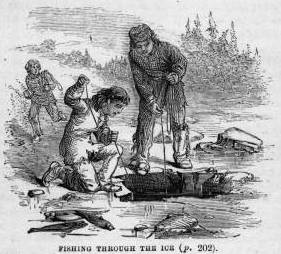
“Sometimes some of the men from the other houses visited them for me, and would bring me the fish. Then we sometimes get some by fishing through the ice.”
“What about when it was too stormy for any one to go?”
She quietly said, “If nothing were left, we go without anything.”
As I looked at her and her large family of fatherless children, and then thought of her husband’s triumphant death, and his glorious transfer to that blest abode, where “they shall hunger no more, neither thirst any more,” and where “God shall wipe away all tears from their eyes,” the contrast between the husband and father in his felicity, and the sorrow of the widow and children in their poverty, so affected me that, to hide my emotion and keep back my tears, I hurried out of the room, following my loving Brother Semmens, who was, if possible, more deeply moved than I was. We had gone into that house to pray, but we could not. There must be tangible sympathy given ere we could look to a higher source.
My brother had reached the cariole, which was a few yards away, and I was not far behind, when the word, “Ayumeaookemou,” (“Praying master,”) arrested my hurrying steps. I turned back, and there, just outside of the door, was Nancy. With a woman’s quick intuition to read the feelings of the heart from the face and voice, she had followed me out, and her words, as nearly as I can recall them, were these:
“Missionary, I do not want you to feel so badly for me; it is true I am very poor; it is true, since Samuel died, we have often been hungry and have often suffered from the bitter cold; but, Missionary,” and her face had no trace of sorrow upon it, “you have heard me say that as Samuel gave his heart to God, so have I given God my heart, and He Who comforted Samuel and helped him, so that he died so happily, is my Saviour; and where Samuel has gone, by-and-by I am going too; and that thought makes me happy all the day long.”
There came a blessed exultation into my soul, but I could find no answer then. So I hurried on and joined my weeping brother, and shouting, “Marchez!” to our dogs, we were soon rapidly speeding over the icy trail to our Mission home.
That night our bed was a blanket thinner, and on our limited supplies there was a heavy drain. I told the Indians who were better off about her straitened condition, and she and hers were made more comfortable. Many of them gave very generously indeed to help her. The grace of liberality abounds largely among these poor Christian Indians, and they will give to the necessities of those who are poorer than themselves until it seems at times as though they had about reached the same level.
The triumphant death of Samuel, and then Nancy’s brave words, very much encouraged us in our work. We could not but more than rejoice at the Gospel’s power, still so consciously manifested to save in the Valley of the Shadow of Death, and also to make a humble log-cabin a little heaven below. We pitied her in her poverty, and yet soon after, when we had thought it all over in the light of eternity, we could only rejoice with her, and in our spirits say, “Happy woman! Better live in a log hut without a chair or table or bedstead, without flour or tea or potatoes, entirely dependent upon the nets in the lake for food, if the Lord Jesus is a constant Guest, than in a mansion of a millionaire, surrounded by every luxury, but destitute of His presence.”
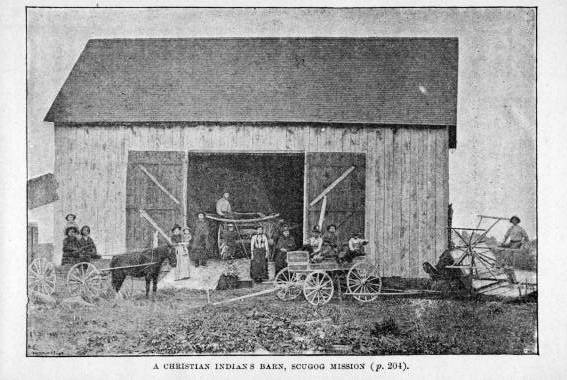
It is a matter of great thankfulness that not only spiritually but temporally thousands of the Indians in different parts of Canada are improving grandly. The accompanying picture (page 209) is from a photograph taken at the Scugog Lake Indian Mission. The fine barn, well filled with wheat, as well as all the surrounding vehicles and agricultural implements, belong to one of the Christian Indians.
Chapter Sixteen.
A race for life in a blizzard storm—Saved by the marvellous intelligence of Jack—“Where is the old man, whose head was like the snow-drift?”
Blizzard storms sometimes assailed us, as on the long winter trails, with our gallant dogs and faithful companions, we wandered over those regions of magnificent distances.
To persons who have not actually made the acquaintance of the blizzard storms of the North-Western Territories, or Wild North Land, it is almost impossible to give a satisfactory description. One peculiarity about them, causing them to differ from other storms, is that the wind seems to be ever coming in little whirls or eddies, which keep the air full of snow, and make it almost impossible to tell the direction from which the wind really comes. With it apparently striking you in the face, you turn your back to it, and are amazed at finding that it still faces you. Once, when on Lake Winnipeg, we saw one coming down upon us. Its appearance was that of a dense fog blowing in from the sea. Very few indeed are they who can steer their course correctly in a blizzard storm. Most people, when so unfortunate as to be caught in one, soon get bewildered, and almost blinded by the fine, dry, hard particles of snow which so pitilessly beat upon them, filling eyes, nose, and even ears and mouth, if at all exposed.
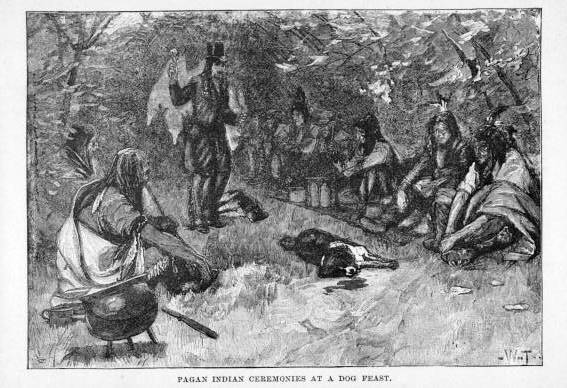
Once, when crossing Lake Winnipeg, to visit some wild Indians, whom we found on our arrival in the midst of the hideous ceremonies of a dog feast, I got caught in a terrible storm. My men had gone on ahead with all the dogs, to have dinner ready in the camp on the distant shore, leaving me miles behind, tramping along on snow-shoes. Down from the north, with terrific fury, came the gale. I tramped on as rapidly as possible, until I got bewildered. Then I took off one of my snow-shoes, and, fastening it in a hole cut in the ice, I got ready to tramp in a small circle around it to keep from freezing to death, when fortunately I heard the welcome whooping of my Indians, who, seeing my danger, had quickly turned round, and risking their own lives for mine, for they could have reached the woods and shelter, aided by the dogs, had fortunately reached me. There we stopped for hours, until the blizzard had spent its fury, and then on we went.
I had a remarkable experience in a blizzard, which I will more fully describe, as our escape was under Providence so much indebted to my wonderful dog Jack.
I had started on one of my long winter trips to visit the few little bands of Indians who were struggling for an existence on the Eastern coast of Lake Winnipeg, and who were always glad to welcome the Missionary, and to hear from him of the love of the Great Spirit, and of His Son Jesus Christ. Their country is very wild and rough, very different from the beautiful prairie regions of the North-West. To keep down expenses, which in those Northern Missions are very heavy, I had started out on this long trip with only this young Indian lad as my companion. But as he was good and true, I thought we could succeed, since I had been several years in the country, and had faced many a wintry storm, and slept many nights in the snow.
We had with us two splendid trains of dogs. My leader was a lively, cunning Esquimaux dog, as white as snow. His name was Koona, which is the Indian word for “snow”; and he was well named. The other three dogs of my train were my favourites from Ontario. Two of them were gifts from Senator Sanford, of Hamilton; the other was kindly sent to me by Dr Mark, of Ottawa. The other train, driven by Alec, was composed of some sagacious St. Bernards obtained for me by the kindness of Mr Ferrier, of Montreal. The largest and most enduring of the eight was Jack from Hamilton, whose place was second in my train, and who is to be the hero of this adventure.
We had left our camp-fire in the woods early in the morning, and, turning our faces towards the north, had hoped that ere the shadows of night had fallen around us, at least sixty miles of the frozen surface of Lake Winnipeg would have been travelled over. For a time we were able to push on very rapidly, keeping the distant points of headlands well in view for our guidance. Lake Winnipeg is very much indented with bays, and in travelling we do not follow the coast line, but strike directly across these bays from point to point. Some of them run back for many miles into the land, and several of them are from ten to thirty miles wide. The dogs get so accustomed to these long trips and to their work, that they require no guide to run on ahead, but will, with wonderful intelligence, push on from point to point with great exactness.
On and on we had travelled for hours; the cold was very great, but we could easily jump off from our dog-sleds and run until we felt the glow and warmth of such vigorous exercise. After a while, we noticed that the strong wind which had arisen was filling the air with fine dry snow, and making travelling very difficult and unpleasant. Soon it increased to a gale, and we found ourselves in a real North-West blizzard on stormy Lake Winnipeg, many miles from shore.
Perhaps our wisest plan would have been, at the commencement of the storm, to have turned sharply to the east, and got into the shelter of the forest as quickly as possible. But the bay we were crossing was a very deep one, and the headland before us seemed as near as the other end of the bay; and so we thought it best to run the risk and push on. That we might not get separated from each other, I fastened what we call the tail rope of my sled to the collar of the head dog of Alec’s train.
After Alec and I had travelled on for several hours, no sign of any land appearing, we began to think that the fickle blizzard was playing us one of its tricks, and that we had wandered far out into the lake. We stopped our dogs out there in the blinding, bewildering storm.
“Alec!” I shouted, “I am afraid we are lost.”
“Yes, Missionary,” he replied, “we are surely lost.”
We talked about our position, and both had to confess that we did not really know where we were or which way we ought to go.
The result of our deliberation was that we could do no better than trust in the good Providence above us, and in our dogs before us.
As it was now after midday, and the vigorous exercise of the last few hours had made us very hungry, we opened our provision bag, and, taking out some frozen food, made a fairly good attempt to satisfy the keen demands of appetite. We missed very much the good cup of hot black tea we should have had if we had been fortunate enough to reach the shore, and find some wood with which to make a fire.
After our hasty meal we held a short consultation, in which the fact became more and more evident to us, that our position was a very perilous one, as we were becoming blinded by the driving particles of fine snow that stung our eyeballs and added much to our bewilderment. We found that we did not know east from west, or north from south, and would have to leave the dogs to decide on their own course, and let them go in any direction they pleased.
I had a good deal of confidence in my dogs, as I had proved their sagacity. To Jack, the noblest of them all, I looked to lead us out of our difficulty; and he did not disappoint our expectations. I suppose I acted and talked to my dog in a way that some folks would have considered very foolish. When travelling regularly, the dogs are only fed once a day, and that when the day’s work is done. However, it was different that day, as in the blinding gale Alec and I tried to eat our dinner. As Jack and the others crowded around us, they were not neglected, and with them we shared the food we had, as there was a great uncertainty whether another meal would ever be required by any one of us.
As usual in such emergencies, Jack had come up close to me, and so, while he and Alec and I, and the rest of us, men and dogs, were eating our dinners, I had a talk with him.
“Jack, my noble fellow,” I said, “do you know that we are lost, and that it is very doubtful whether we shall ever see the Mission House again? The prospect is that the snow will soon be our winding sheet, and that loving eyes will look in vain for our return. The chances are against your ever having the opportunity of stretching yourself out on the wolf rug before the study fire. Rouse up yourself, old dog, for in your intelligence we are going to trust to lead us to a place of safety.”
The few arrangements necessary for the race were soon made. Alec wrapped himself up as comfortably as possible in his rabbit-skin robe, and I helped him to ensconce himself securely on his dog-sled. I tied a rope from the end of my sled to the collar of his leader dog, so that our trains might not get separated. Then I straightened out the trains, and, wrapping myself up as well as I could on my sled, I shouted “Marchez!” to the dogs.
I had as leader dog the intelligent white Esquimaux, “Koona.” As I shouted the word for “Go,” Koona turned his head and looked at me, as though bewildered, and seemed to be waiting for “Chaw” or “Yee,” the words for “right” and “left.” As I did not know myself, I shouted to Jack, who was second in the train, “Go on, Jack, whichever way you like, and do the best you can, for I do not know anything about it.” As Koona still hesitated, Jack, with all the confidence imaginable, dashed off in a certain direction, and Koona with slackened traces ran beside him, very willing in such an emergency to give him all the honour of leadership.
For hours the dogs kept bravely to their work. The storm raged and howled around us, but not for one moment did Jack hesitate or seem to be at fault. Koona had nothing to do but run beside him; but the other two splendid dogs in the traces behind Jack seemed to catch his spirit, and nobly aided him by their untiring efforts and courage. The cold was so intense that I had grave fears that we should freeze to death. We were obliged so to wrap ourselves up that it was impossible with so much on us to run with any comfort, or to keep up with the dogs whilst going at such a rapid rate. Frequently would I shout back to my comrade, “Alec! don’t go to sleep. Alec, if you do, you may never wake up until the Judgment morning.” Back would come his response, “All right, sir; then I’ll try to keep awake.”
Thus on we travelled through that wintry storm. How cold, how relentless, how bitter were the continuous blasts of the north wind! After a while the shadows of night fell upon us, and we were enshrouded in the darkness. Not a pleasant position was that in which we were situated; but there was no help for it, nor any use in giving way to despondency or despair. A sweet peace filled my soul, and in a blessed restfulness of spirit my heart was kept stayed upon God. While there is life there is hope; and so, with an occasional shout of warning to Alec to keep awake, and a cheering call to the dogs, who required no special urging, so gallantly were they doing their work, we patiently hung on to our sleds and awaited the result. We were now in the gloom of night, dashing along I knew not where, and not even able at times to see the dogs before us.
About three hours after dark the dogs quickened their pace into a gallop, and showed by their excitement that they had detected evidences of nearness to the shore and safety, of which as yet I knew nothing. Soon after they dragged us over a large pile of broken ice and snow, the accumulations of ice cut out of the holes in the lake, where the Indian families had for months obtained their supply of water for cooking and other purposes. Turning sharply on the trail towards the shore, our dogs dashed along for a couple of hundred yards more; then they dragged us up a steep bank into the forest, and, after a few minutes more of rapid travelling, we found ourselves in the midst of a little collection of wigwams, and among a band of friendly Indians, who gave us a cordial welcome, and rejoiced with us at our escape from the storm, which was the severest of the year.
We had three days of religious services with them, and then went on our way from encampment to encampment. Very glad were the poor people to see us, and with avidity did they receive the word preached.
I felt that it was very slow work. My Circuit or Mission-field was larger than all England. I was the only Missionary of any Church in this large field. By canoe or dog-train I could only get around to all my appointments or out-stations twice a year. Six months the poor souls had to wait for the messenger and the message.
At one of these Indian encampments on one of these visits I had the following sad experience. Before I closed the first service I asked, “Where is the old man whose head was like the snow-drift?” for I had missed a white-haired old man, who had ever been at all the services, and had from the time of his conversion manifested the greatest anxiety to hear and learn all he could about this great salvation. At first he had opposed me, and was annoyed at my coming among his people. Ultimately, however, he became convinced of the error of his ways, and was an earnest, decided Christian. When I arrived at his village, whether by canoe in summer, or dog-train in winter, I was always received by this venerable old man with great delight. Not satisfied with attending all the services held, and being at hand whenever I taught the Syllabic Characters, that the Indians might be able to read the blessed Word, he used to follow me like my shadow, and listen very attentively to all I had to say. It was rather startling, indeed, when one night, after a hard day of preaching and teaching and counselling, I kneeled down to pray, ere I wrapped myself up in my camp-bed to get a little rest, to hear whispered in quiet tones beside me, “Missionary, pray in Indian, and so loud that I can hear you.” In the morning he was there again, and as I bowed to say my quiet morning prayers there came into my ears from this old man the pleading words again, “Missionary, please pray in Indian, and pray out loud, so that I may hear what you say.”
Is it any wonder that I became very much attached to my old friend with the snow-white hair, who was so hungering and thirsting for the teachings of the Word? Only twice a year could I then visit him and his people. I used to remain a few days at each of these visits, and very busy ones indeed they were. For six months these poor sheep in the wilderness had been without the Gospel, and as soon as I left they would have to get along as well as they could on what they had heard. Now that they had, under the good Spirit’s influence, a longing desire to receive the truth, can any one wonder at their anxiety to learn all they could from the Missionary during his short stay among them? This intense desire on their part filled my heart with thankfulness, and amply compensated for all the sufferings and hardships of the long, cold, dangerous journeys.
On my arrival at this place, as usual, the Indians had crowded around to welcome me. I was disappointed at not seeing my old friend. So it was that at our first meeting, held as soon as possible after my arrival, I asked the question, “Where is the old man whose head was like the snow-drift?”
To my question there was no response, but every head was bowed as in grief and sorrow.
Again I asked: “Tell me, what have you done with the old man with the snow-white hair?”
Then there was a little whispering among them, and one of them, speaking out softly, said in the Cree language, “Non pimmatissit;” the English of which is, “He is not among the living.”
The poor Indians, who have not as yet come to understand that death is a conquered foe, never like to use the word; and so, when speaking of those who have gone, they say they are “not among the living.”
When in this expressive way I learned that my old friend was dead, my heart was filled with sorrow, as I saw also were theirs. After a little pause I said, “Tell me how he died.”
At first there was a great deal of reluctance to answer this question; but when they saw I was not only anxious but resolved to know all about it, they took me into a wigwam where most of his relatives were, and there a young man, a grandson, got up and told me this pathetic story.
He said: “Missionary, you had not been long gone with your canoe last summer before Mismis,” (the Indian word for “grandfather”), “got very sick, and after some weeks he seemed to know that he was going to leave us. So he called us all around him, and said a great many things to us. I cannot remember them all, as he spoke many times; but I do remember that he said, ‘how I wish the Missionary would soon come again to talk to me and comfort me! But he is far away, and my memory is bad, and I have forgotten what he used to say to me. My body is breaking up, and so also is my memory getting bad. Tell him his coming was like the sunlight on the waters; but it was so seldom that he came that all in my mind has got so dark, and my memory is so bad, that I have forgotten all he used to say to me. The good things he used to tell us about the Good Spirit and His Son, and what we ought to do, have slipped away from me. O that he were here to help me! Tell him, as long as I was able; I used to go up to the point of land that runs out into the lake, and watch if I could see his canoe returning. But it came not. Tell him I have, since the winter set in, listened for the sound of the bells on his dog-trains. But I have not heard them. O that he were here to help me! He is far away; so get me my old drum and medicine bag, and let me die as did my fathers. But you, young people, with good memories, who can remember all the Missionary has said to you, listen to his words, and worship the Great Spirit and His Son, as he tells you, and do not do as I am doing!’
“Then, as we saw his mind was weak, or he would not have asked for his old things, we got him the old drum, and put it before him where he was sitting upon the ground. We also hung up a medicine bag before him in the wigwam, and he drummed. As he drummed he fell, and as he fell he died. But his last words were to the young people with good memories to be sure and listen to the Missionary, and to give up all their old Indian sinful paganism.”
When the young man ceased and sat down again, a deep silence fell upon us all, as there we were huddled that cold, stormy day in that little bark tent. An occasional sob from some sorrowing relative was the only sound heard for several minutes.
My own heart was deeply affected when they told me these and other things, which I cannot now call up, about the old Indian’s death. After a while I broke the silence by saying, “Where have you buried him?”