Chapter I · EGYPT AND THE BIBLE.
Reading edition
I. The Rosetta Stone: Decipherment of the Egyptian Hieroglyphs.
To all who are interested in the ancient history of mankind, the decipherment of the Egyptian hieroglyphs is a fact of the highest importance. As early as the fourth dynasty, and probably as early as the first, the Egyptians possessed the art of writing; but for thousands of years before the present century the hieroglyphs had become a dead language, which nobody could read. Temples and tombs in the valley of the Nile contained records which might be of surpassing interest; but the clue to them was lost, and the riddle remained unguessed. At length a discovery was made which began to open the way, and has proved to be one of the most remarkable events in the intellectual history of Europe.
In the year 1799, when Napoleon’s army was in Egypt, a French artillery officer, by name Boussard, while engaged in certain works on the redoubt of St Julian, at Rosetta, discovered a large slab of black granite, bearing a triple inscription. The first or upper part was in hieroglyphs, the middle one was in the enchorial or popular character, and the lower one in Greek. The hieroglyphic text was partly broken away and lost, but the other two were nearly complete. The Greek text showed that the monument was designed by the priests of Memphis, in honour of the Pharaohs, and particularly of Ptolemy Epiphanes, who was reigning at the time when the decree was made (198 B.C.). The monument stood originally in the temple of Tum, the god of the setting sun; and there were to be copies of it in other places.
Among other things, the priests say of Ptolemy that “he was pious towards the gods, he ameliorated the life of man, he was full of generous piety, he showed forth with all his might his sentiments of humanity.” He lightened taxation, so that the people might have plenty; he released prisoners and the defendants in law suits; he ordered that the revenues of the temples, whether in provisions or money, should remain what they had been. As to the priests, he commanded that they should pay no new promotion fees, that those who had been obliged to make an annual voyage to Alexandria should be free from the obligation; and that what had been neglected in temple services should be re-established. Naturally the priests were grateful, and they ordered this testimonial of recognition to be engraved upon stone, in the sacred characters of Egypt, in the vernacular, and in Greek.
All this was speedily made out from the Greek text, and it was thus clear that the other two forms of the inscription must be of the same purport. Here then at last was a key to the long-lost language of the hieroglyphs. The value of the monument was at once perceived, and after having been copied it was set apart and packed up. The victory of the English at Alexandria, and the surrender of the city in 1801, placed the Rosetta Stone in the hands of Mr W. R. Hamilton, the British Commissioner, one of the most distinguished and zealous scholars of the day. The treasure was despatched to England, and has found a fitting resting-place in the British Museum.
This seemingly insignificant stone (says Baron Bunsen) shares, with the great and splendid work, “La Description de l’Egypte,” the honour of being the only result of vital importance to universal history, accruing from a vast expedition, a brilliant conquest, and a bloody combat for the possession of Egypt. The men of science and letters who accompanied Napoleon’s army in Egypt, employed themselves actively in collecting the precious materials for that great work on the antiquities, the topography, natural history, &c., of that wonderful country. When the work appeared, the monuments that it contained, and the learned commentaries by which they were accompanied, aroused the general attention of the European public to Egyptian research, which had been previously all but abandoned. This collection comprised not only the most important monuments of Egypt, but also the great funereal papyrus, and other Egyptian records of the highest value. But the monuments were mute, the hieroglyphics could not be read, and the riddle of the sphinx still remained unsolved. Attempts had been made, but without much success, and it was the Rosetta Stone which, in reality, unloosed the tongue of both monuments and records, and rendered them accessible to historical investigation. This stone was the mighty agency which, by the light it shed on the mysteries of the Egyptian language and writing, was to enable science to penetrate through the darkness of thousands of years, extend the limits of history, and even open up a possibility of unfolding the primeval secrets of the human race.
As engraved copies of the Rosetta Stone became common in Europe—for which object the English scholars had provided without delay—confidence was entertained that the hieroglyphs would be deciphered. One of the earliest workers was Dr Thomas Young.
However (says Mariette), we must not imagine that the deciphering of hieroglyphs by means of the Rosetta Stone was accomplished at the first trial, and without groping in the dark. On the contrary, the savants tried for twenty years without much success. At last Champollion appeared. Prior to him people thought each of the letters that compose hieroglyphic writing was a symbol; that is, that in every single one of these letters a complete idea was expressed. The merit of Champollion consisted in proving that Egyptian writing contains signs which express sounds; in other words, that it is alphabetic. He noticed that wherever in the Greek text the proper name Ptolemy is met with, there may be found, at a corresponding place of the Egyptian text, a certain number of signs enclosed within an elliptic ring. From this he concluded (1) that the names of kings were indicated, in the hieroglyphic system, in a sort of escutcheon, which he styled a cartouche; (2) that the signs contained in the cartouche must be letter for letter the name of Ptolemy (Ptolemaios).
Even supposing the vowels omitted, Champollion was already in possession of five letters—P.T.L.M.S. Again, Champollion knew, according to a second Greek inscription, engraved on an obelisk of Philae, that on this obelisk a hieroglyphic cartouche is visible which must be that of Cleopatra. If his first reading was correct, the P, the L, and the T of Ptolemy must be found again in the second proper name; while, at the same time, this second proper name would furnish K and R. Although very imperfect as yet, the alphabet thus revealed to Champollion, when applied to other cartouches, put him in possession of nearly all the other consonants.
Thenceforth he had no need to hesitate concerning the pronunciation of signs; for, from the day this proof was furnished, he could certify that he possessed the Egyptian alphabet. But now remained the language; for pronouncing words is nothing, if we know not what they mean. Here Champollion’s genius could soar. He perceived that his alphabet, drawn from proper names and applied to words of the language, simply furnished Coptic. Now Coptic, in its turn, is a language which, without being so well explored as Greek, had for a long time been not less accessible. (It was a spoken language until the sixteenth century, and three spoken dialects remained, sufficiently resembling the old Egyptian to enable all the grammatical forms and structure to be examined.) Therefore the veil was completely removed. The Egyptian language was only Coptic written in hieroglyphs; or, to speak more correctly, Coptic is only the language of the ancient Pharaohs, written in Greek letters. The rest may be inferred. From sign to sign Champollion really proceeded from the known to the unknown, and soon the illustrious father of Egyptology could lay the foundations of this beautiful science, which has for its object the interpretation of the hieroglyphs.
Further, as remarked by Dr Birch, Egyptologists have patiently traced word after word, through several thousands of texts and inscriptions, until they have found its correct meaning. It was ascertained at length that almost every word consists of two portions—hieroglyphs to represent the sound, followed by hieroglyphs expressing its general or specific meaning. Provided with these materials the enquiry advanced. The result is that we are gradually recovering a knowledge of the history of Egypt and the religion of its people, from a time long anterior to the birth of Moses down to the latest period of the empire. The hieroglyphs reveal a rich literature, including not only the annals of the empire, but books on ethics, romances, works on mathematics, medicine, morals, legal and other reports; while the great religious work is the Book of the Dead.
[Authorities and Sources:—“Egypt’s Place in Universal History.” By Christian C. J. Bunsen. “The Monuments of Upper Egypt.” By Auguste Mariette-Bey. “The Monumental History of Egypt.” Rede Lecture. By S. Birch, LL.D.]
2. Kings and Dynasties of Egypt.
It will be useful to give here a table of Egyptian Dynasties, so that when we come to speak of Israel in Egypt the reader may have some idea of the long antecedent history of the Empire, and the political circumstances of the time. Unfortunately we must be content at present with approximate dates, for the records of the Egyptians are not dated, and the chronology is but very imperfectly known.
Table of the Egyptian Dynasties.[1]
Dynasty. Capital. Modern Name. Approximate Date, according to Mariette. Approximate Date, according to Wiedemann.
The Old Empire.
I. Thinite This Girgeh 5004 5650
II. Thinite This Girgeh 4751 5400
III. Memphite Memphis Mitrahenny 4449 5100
IV. Memphite Memphis Mitrahenny 4235 4875
V. Memphite Memphis Mitrahenny 3951 4600
VI. Elephantine Elephantinê Geziret-Assouan 3703 4450
VII. Memphite Memphis Mitrahenny 3500 4250
VIII. Memphite Memphis Mitrahenny 3500 4250
IX. Heracleopolite Heracleopolis Ahnas el-Medineh 3358 4000
X. Heracleopolite Heracleopolis Ahnas el-Medineh 3249 3700
XI. Diospolitan Thebes Luxor, &c. 3064 3510
The Middle Empire.
XII. Diospolitan Thebes Luxor, &c. 2851 3450
XIII. Diospolitan Thebes Luxor, &c. — 3250
XIV. Xoite Xois Sakha 2398 2800
The Shepherd Kings.
XV. Hyksos Tanis (Zoan) San 2214 2325
XVI. Hyksos Tanis San — 2050
Diospolitan Thebes Luxor, &c. — —
XVII. Hyksos Tanis San — 1800
Diospolitan Thebes Luxor, &c. — —
The New Empire.
XVIII. Diospolitan Thebes Luxor, &c. 1700 1750
XIX. Diospolitan Thebes Luxor, &c. 1400 1490
XX. Diospolitan Thebes Luxor, &c. 1200 1280
XXI. Tanite Tanis San 1100 1100
XXII. Bubastite Bubastis Tel Bast 960 975
XXIII. Tanite Tanis San 766 810
XXIV. Saite Sais Sa el-Hagar 753 720
XXV. Ethiopian Napata Mount Barkal 700 715
XXVI. Saite Sais Sa el-Hagar 666 664
XXVII. Persian Persepolis — 527 525
XXVIII. Saite Sais Sa el-Hagar — 415
XXIX. Mendesian Mendes Eshmun er-Român 399 408
XXX. Sebennyte Sebennytos Semenhûd 378 387
In the time of Moses the Egyptian power had already passed its zenith and begun to decay. There had been an Old Empire, with the City of This for its first capital and Menes as its first king. Dynasty had succeeded dynasty, during perhaps two thousand years, and the capital had been changed several times, when the Middle Empire came in, and the kings ruled from Thebes and afterwards from Xois. There had now been fourteen dynasties altogether; and the power of the kingdom was so far weakened that it was unable to keep out the invader. The Shepherd Kings, coming from Midian, or perhaps from Mesopotamia, established themselves in the Delta, and held possession for several centuries. Their conquest, however, did not extend to Upper Egypt, and so the native dynasties reigned contemporaneously, enthroned at Thebes, while the Hyksos kings were seated at Zoan.
It was probably towards the close of the Hyksos period that Joseph was made governor of Egypt, under the latest of the Shepherd Kings. The seventeenth dynasty saw the last of these foreigners, and after their expulsion the New Empire began, near the end of the eighteenth century before Christ. The eighteenth and nineteenth dynasties included several monarchs of great renown; and as the Israelitish sojourn falls chiefly within this period, it will be useful to give here a chronological list.
Monarchs of the Eighteenth and Nineteenth Dynasties, with approximate dates, according to Brugsch.
Eighteenth Dynasty. B.C.
Aahmes, Amosis; its founder 1700
Amenhotep I. (Amenophis) 1666
Thothmes I. (Thotmosis) 1633
Thothmes II. and his sister-wife Hatshepsu 1600
Thothmes III.
Amenhotep II., Son of Thothmes III. 1566
Thothmes IV. 1533
Amenhotep III., Son of Queen Mutemna 1500
Amenhotep IV., afterwards called Khuenaten 1466
Nineteenth Dynasty.
Rameses I. 1400
Seti I. (Sethos) Menephtah 1366
Rameses II. (Sesostris) Miamun 1333
Menephtah II. (Menepthes) 1300
Seti II. Menephtah III., son of Menephtah II. 1266
Setnakht-Merer-Miamun II. 1233
Rameses II. was the Pharaoh of the Oppression; and the Israelites left Egypt in the reign of his successor, Menephtah.
3. The Finding of the Mummies.
In 1878 the Khedive Said Pasha authorised Professor Maspero to found a Museum at Boulak (a suburb of Cairo), for the reception of all the antiquities found in the country and calculated to throw light on Egyptian history. Under the successive direction of Professor Maspero and Professor Grébaut the collection has become one of the most valuable and most instructive in the world.
In 1881 the museum was enriched by the most important archæological discovery of modern times. On the 5th of July of that year a cave in the plain of Deir el-Bahari, near Thebes, was explored, and its rich contents were bodily removed to Boulak. They consisted of mummies of kings, queens, and princesses, and other persons of distinction, with numerous articles of clothing, papyri, vases, &c. Hieratic inscriptions on the coffins of several of the kings gave the date of the transfer of the bodies from their original sepulchres in the valley of Bab el Malook, near Luxor, to this pit or tomb, and also of the periodical inspection to which the depôt was subjected. The cave is proved to be the tomb of the Priest-Kings of Amen, the usurpers of the throne of the Ramessides, from Her-Hor to Pinotem III.
The reason for bringing so many kings of different dynasties into this tomb is not accurately known; but the following circumstances afford ground for reasonable conjecture.
“After Rameses II., the last great warrior of Egypt, had laid aside his javelin and bow, in the fourteenth century before Christ, luxury and indolence were followed by their usual concomitants, poverty and discontent. The artizans and labourers, instead of joining in one common effort to improve the condition of the country, had recourse to violence and robbery. The pillage of the tombs for the sake of their precious contents became a common practice, and in the reign of Rameses IX., of the twentieth dynasty, about the eleventh century before the birth of Christ, an inquiry was instituted to ascertain the extent of the depredations. The robbers were arrested and arraigned, and several of them were condemned to die by their own hands—a common mode of punishment in ancient Egypt. It was discovered likewise that the tombs of the Pharaohs, which had hitherto been respected, were, like the rest, subjected to danger.”
The preservers, however, were at work as well as the robbers; the priests of the Egyptian Church appear to have shielded the remains of many of the great kings, by hiding them so effectually that they were never found again until the third quarter of the present century.
“It was an extraordinary discovery, not only for Egyptian archæology, but likewise for Egyptian history, and the fortunate discoverer was Professor Maspero, chief conservator of the Egyptian Museum at Boulak. The discovery came about in the following manner. For some years past, so far back as the time of Mariette, it had been observed that objects of value and interest, tablets, papyri, &c., had found their way into the museums of Europe, and some into private hands. There exists a law in Egypt, that tombs and cemeteries are not to be explored except by direct permission of the Khedive, and all traffic in objects of archaic interest is strictly forbidden. Nevertheless a kind of contraband was in existence, the actual source of which was unknown. Another observation had also been made, namely, that the large majority of the objects were of about the same period, and seemed to have a common origin. When His Royal Highness, the Prince of Wales, was in Egypt, he was presented by a certain Mustapha Aga of Thebes, with a valuable papyrus, which the Prince has very generously deposited in the British Museum. It was subsequently ascertained that the document in question is only half a papyrus (this curious discovery is due to the acute research of Miss Amelia B. Edwards, one of the Honorary Secretaries of the Egypt Exploration Fund), the other, the hinder half, being in the possession of the Museum of the Louvre at Paris. The Prince of Wales’ papyrus was written for a queen, Notem Maut, related to the great priest-king of the twenty-first dynasty, Her-Hor—possibly his wife, but more probably his mother. Another, and a remarkably fine papyrus, was bought by Colonel Campbell in 1876, for the large sum of £400. The latter had evidently been obtained from the mummy of the High Priest Pinotem, descendant of Her-Hor. The coincidence was striking, and led Professor Maspero to the conclusion that a tomb of the priest-kings was in the possession of the Arabs of the district of Thebes, a class of persons who live in the tombs, and gain a living out of the produce of their search. Suspicion quickly pointed to the parties implicated. The chief, Ahmed Ab-der-Rassoul, one of five brothers engaged in the traffic of antikas (antiques), was arrested, and shortly afterwards another of the brothers made a confession and conducted the authorities to the hiding-place in which all these treasures were concealed.
“Near the site of an old temple, known as Deir el-Bahari, at the foot of a rugged mass of precipitous rock, so hidden from view that it might be passed by a hundred times without being seen, was a perpendicular shaft, 35 feet deep, and 6 feet in diameter. At the bottom of the shaft, in its western corner, was an opening a little more than 2 feet high and 5 feet wide, the entrance of a narrow passage tunnelled in the rock. This passage or tunnel led due west for 25 feet, and then turned abruptly to the north for 200 feet, ending in an oblong chamber 260 feet long, the entire length of the tunnel being nearly 500 feet. Throughout the whole of this extensive area the floor was encumbered with coffins and funereal gear, packed together so closely that for some distance it was necessary to crawl upon hands and feet to make any progress. The collection within this strange hiding-place consisted of sarcophagi, coffins, mummies, funereal furniture, and funereal ornaments, the gathered fragments of four or five dynasties, more particularly the seventeenth, eighteenth, nineteenth and twenty-first, comprehending a period of more than five hundred years, and ranging between the eighteenth and twelfth centuries before Christ....
“It was a hot forty-eight hours’ work, under the burning sun of Egypt, to bring all those objects to the surface, and a toilsome labour, enlisting the services of three hundred Arabs, to convey them to Luxor, and subsequently to pile them on the deck of the Museum steamer which had journeyed up the river to receive them. The passage down the river partook of the character of a funeral ovation: women with dishevelled hair ran along the banks uttering shrieks and funereal chants, others threw dust upon their heads, men discharged guns, and the funeral of a defunct monarch of to-day could not have excited more apparent emotion.”
The coffins and mummies included the following:—
Raskenen, king of Upper Egypt, a descendant of the old Theban royal race, but at this time tributary to the Hyksos or Shepherd kings. According to the Sallier papyrus in the British Museum, he quarrelled with the Hyksos monarch Apopi, in reference to the cession of an important well. This brought about the overthrow and expulsion of the Hyksos, who had ruled the country for five centuries. According to the same authority, Joseph arrived in Egypt during the reign of the Pharaoh Nub (B.C. 1730), and rose to honour under Apopi.
Aahmes I., founder of the eighteenth dynasty.
Amenhotep I. (Amenophis), coffin and mummy.
Thothmes I.—The coffin was occupied by the mummy of a priest-king, Pinotem, of the twenty-first dynasty. The mummy of Thothmes was not found.
The first known representation of a horse occurs on a monument of this reign; and it is supposed that the horse was introduced into Egypt from Asia about this time.
Thothmes II.—The coffin and mummy were both found. Thothmes II. reigned but a short time.
Thothmes III., one of the most famous of Egyptian kings. He continued his predecessors’ offensive movements against the Hyksos and their allies, and extended his conquests as far as the Tigris. In his reign Egypt was at the pinnacle of its greatness. The walls of his magnificent temple at Karnak are covered with inscriptions recounting his triumphs, and giving a list of the countries and peoples conquered by him. A stela of black granite found at Karnac, and now in the Egyptian National Museum, contains a poem in celebration of the victories of this king. The coffin and mummy found were broken.
Hatshepsu, the great woman-king, sister and wife of Thothmes II. Becoming regent for her younger brother, Thothmes III., she assumed a king’s dress and masculine style. Neither the coffin nor the mummy were found. But it was the practice of the Egyptians in embalming to take out the intestines and preserve them separately; and the liver of Hatshepsu was discovered enclosed in a cabinet of wood, inlaid with ivory, which was marked with her name.
Rameses I., founder of the nineteenth dynasty, was found placed in a coffin of the fashion of the twenty-first dynasty, from which the name of the original owner had been carefully scraped off.
Seti I., his successor (coffin and mummy). The superb alabaster sarcophagus of this monarch was already in the Soane Museum, in Lincoln’s Inn Fields. When Belzoni discovered it in 1817, in the original sepulchre in the valley of the kings at Thebes, he was astonished to find the mummy and coffin gone. When the mummy of this Pharaoh was unrolled it was found that the body was long, fleshless, of a yellow-black colour, and had the arms crossed upon the breast. The head was covered with a mask of fine linen, blackened with bitumen, which it was necessary to remove with scissors. This operation brought to view the most beautiful mummy-head ever seen in the museum. The sculptors of Thebes and Abydos did not flatter this Pharaoh when they gave him that delicate, sweet, smiling profile which is known to travellers. After a lapse of thirty-two centuries the mummy retains the same expression which characterised the features of the living man. Seti I. must have died at an advanced age. The head is shaven, the eyebrows are white, the condition of the body points to more than three-score years of life; thus confirming the opinion of the learned, who have attributed a long reign to this king. Seti I. built the Hall of Columns in the Great Temple of Ammon, at Karnac. There exist numerous remains also at Koorneh, Abydos, and elsewhere, of the extensive and magnificent buildings which he erected with the aid of the conquered Semites, among whom the Israelites must probably be included. During his reign a great canal, the first of its kind, was completed, connecting the Nile with the Red Sea.
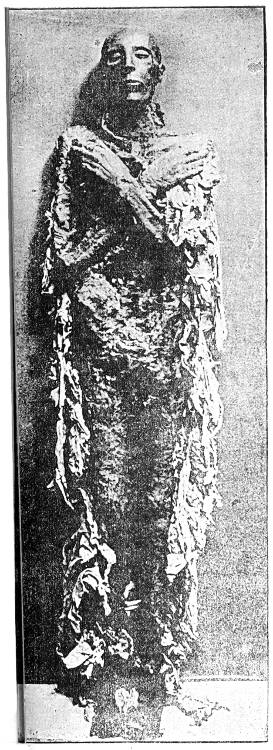
SETI I.
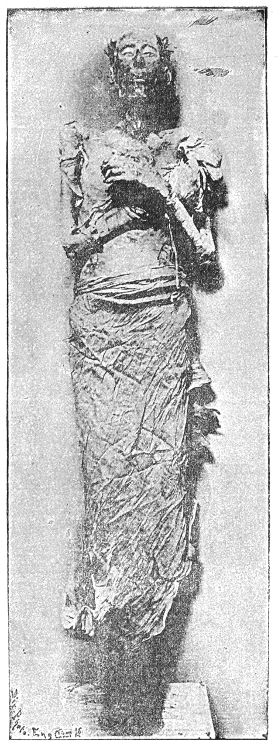
RAMESES II.
Rameses II., the renowned soldier, son of Seti I., known to the Greeks as Sesostris. The oppression of the Israelites, probably begun by Seti I., was continued under Rameses II. In the sixth year of his reign, however, Moses was born. The mummy of Rameses II. was found deposited in a coffin of the twenty-first dynasty, like that of Rameses I. This gave rise to doubts as to which particular Rameses was enclosed, but on unwrapping the mummy an inscription was found, explaining that the original coffin had been accidentally broken, and leaving no doubt that this was Rameses II. Most striking, when compared with the mummy of Seti I., is the astonishing resemblance between father and son. The nose, mouth, chin, all the features are the same, but in the father they are more refined than in the son. Rameses II. was over six feet in height, and we see by the breadth of his chest and the squareness of his shoulders that he must have been a man of great bodily strength. Professor Maspero, in his official report, describes the body as that of a vigorous and robust old man, with white and well-preserved teeth, white hair and eyebrows, long and slender hands and feet, stained with henna, and ears pierced for the reception of ear-rings. Rameses II. reigned sixty-six years, and was nearly a hundred years old at the time of his death. He exhibited great zeal as a builder, and was a patron of science and art. It was he who built the Ramesseum at Thebes, and presented it with a library. He also built the Pylons and Hall of Columns of the Temple of Luxor, and a score of minor temples in Egypt and Nubia, and made the marvellous rock-cut temples at Abousimbel.
Rameses II. was succeeded by his thirteenth son, Meneptah II., who continued the oppression of the Israelites, and pursued them when they were escaping.
Besides all these monarchs, there were found in the strange repository at Deir el-Bahari, coffins and mummies of Rameses III. (of the twentieth dynasty), the last of the great warrior kings of Egypt, Pinotem I., and Pinotem II., priest-kings of the twenty-first dynasty, and several queens, princes, and notabilities of the same periods. An affecting story, which brings home to us very vividly the universal kinship of humanity, is revealed by the contents of the coffin of Makara, wife of King Pinotem, of the priest-king dynasty. A little coiled-up bundle lay at the feet of the Queen, her infant daughter, in giving birth to whom she gave likewise her life. Thus, and so touchingly, are we led to participate in the affliction of the sick chamber of three thousand years ago. Already had the still-born babe of a queen received a name, Mautemhat, the firstling of the goddess Maut, wife of Amen; and not a name alone, for she is born to a title strange to our ears, namely, “principal royal spouse.”
[Sources and Authorities:—The Times newspaper, 4th August 1881. The Times newspaper, 25th June 1886. “Egyptian Mummies,” lecture by Sir Erasmus Wilson; Kegan Paul, Trench & Co., 1883.]
4. Egyptians in Palestine before the Exodus.
When the tribes of Israel were preparing to pass over Jordan, they were told that they were going to possess nations greater and mightier than themselves, a people great and tall, whose cities were fenced up to heaven (Deut. ix. 1; i. 28). Of these early inhabitants of Palestine, the spies had reported that Amalek dwelt in the land of the South; the Hittite, the Jebusite, and the Amorite dwelt in the mountains, and the Canaanite dwelt by the sea and along by the side of Jordan (Num. xiii. 29). We have indeed an enumeration of seven nations dwelling in Palestine at this time, and a testimony to their might:—“The Hittite, the Girgashite, the Amorite, and the Canaanite, the Perizzite, the Hivite, and the Jebusite, seven nations greater and mightier than thou.” (Deut. vii. 1). In these passages it is plainly implied that the peoples who occupied Palestine before the Israelitish invasion were in an advanced state of civilisation. Until lately we have known little or nothing about them, beyond the information which these Scripture passages afforded; but now at last the veil is beginning to lift.
The Hittites.
As there were seven “nations” in Canaan, and the land itself is no larger than Wales, it was long supposed that each of the “nations” was but a small tribe, and was too insignificant to make any figure in history. But we have lately learned that if this was the rule, the Hittites were an exception to it. They were a great people, or perhaps a great confederacy or empire, spread over a vast region in northern Syria and some of the adjacent countries. Their dominion extended more or less over Asia Minor, and the influence of their art and culture reached even into Greece. Their capital was Carchemish, on the Euphrates, the site of which city was discovered a few years ago by Mr Skene, English Consul at Aleppo, and again, two years later, by Mr George Smith, as he was returning from Assyria. The place is now called Jerablus. Another centre of Hittite power was Kadesh, on the Orontes, a city which appears to be referred to in the Bible, for it has been maintained that where Joab and the captains “came to the land of Tahtim-hodshi” (2 Sam. xxiv. 6), it should be rendered “the land of Kadesh of the Hittites,” this being the northern border of David’s kingdom at that time. A list of places in Palestine conquered by Thothmes III., and engraved on the walls of his temple at Karnac, includes the name of Kadesh. It is situated where the Orontes flows into the lake of Homs (still called the lake of Kadesh) and had been a sacred city of the Amorites before it was conquered by the Hittites about 1400 B.C. [Rev. H. G. Tomkins, in “Records of the Past.” New Series, vol. v.] The Hittites were thus seated in a region north of Palestine proper; but they appear to have had colonies in the country, and it is these isolated settlements which are classed with the small nations of Canaan by the Bible writer. When Abraham, at Hebron, required a parcel of earth in which to bury his wife Sarah, he bought it of Ephron the Hittite; whence it is clear that there were Hittites owning land in the south. From the mention of Hebron in association with Zoan in Numbers xiii. 22, it is even suspected that the Shepherd Kings who reigned in Zoan were a dynasty of Hittites. At any rate the Hittites were a powerful people, able to hold their own both against the Egyptians and against the Assyrians, and did so in the region of Carchemish for a thousand years.
Thothmes III., “the Egyptian Alexander,” who accomplished thirteen campaigns in twenty years, and made Egypt the centre of history, invaded Palestine and gained a victory at Megiddo over the king of Kadesh and his allies. “They fled, head over heels, to Megiddo, with terror in their countenances, and left behind their horses and their gold and silver chariots, and were drawn up, with ropes to their clothes, into this town, since the people had closed the gates of the said town on account of the deeds of the king.” “The miserable king of Kadesh” and the miserable king of Megiddo would not have escaped in this way, only that the Egyptian warriors relaxed the pursuit and engaged in plunder. The Pharaoh was beside himself. However, the warriors captured the tent of the miserable king, in which his son was found. Then they raised a shout of joy and gave honour to Amon, the lord of Thebes, who had given to his son Thothmes the victory. After this the neighbouring kings came together to worship before Pharaoh, “and to implore breath for their nostrils.” And then came the children of the kings and presented gifts of silver, gold, blue-stone, and green-stone; they brought also wheat, and wine in skins, and fruits for the warriors of the king, since each of the Kitti [Hittites] had taken care to have such provisions for his return home. Then the king pardoned the foreign princes.
A catalogue of the booty includes 3401 living prisoners, 83 hands, 2041 mares, 191 foals, 6 bulls, one chariot, covered with plates of gold, of the king of ..., 892 chariots of his miserable warriors, one beautiful iron armour of the hostile king, one beautiful iron armour of the king of Megiddo, 200 accoutrements of his miserable warriors, 602 bows, 7 tent-poles covered with plates of gold from the tent of the hostile king. Pharaoh’s warriors had also taken as booty ... bulls, ... cows, 2000 kids, and 20,500 white goats.
A catalogue is also given of persons and things which Pharaoh afterwards carried off as his property, including 39 noble persons, 87 children of the hostile king and the kings allied with him, 5 marina (lords), 1596 men and maid-servants, 105 persons who gave themselves up because of famine. Besides these prisoners there were taken precious stones, golden dishes, and many utensils of this sort, a large jug with a double handle, 97 swords, 1784 lbs. of gold rings which were found in the hands of the artists, 969 lbs. of silver rings, one statue with head of gold, 6 chairs and footstools of ivory and cedar wood, 6 large tables of cedar wood inlaid with gold and precious stones, one staff of the king worked as a kind of sceptre entirely of gold, one plough inlaid with gold, many garments of the enemy, &c., &c.
These catalogues enable us to form some estimate of the degree of perfection in art and refinement which had been arrived at in Northern Palestine and Syria before the Israelitish invasion. Lists are also given of the towns conquered and the peoples made to submit. Remarking upon these, Brugsch justly says that what gives the highest importance to the catalogue is the undisputed fact that more than three hundred years before the entrance of the Jews into the land of Canaan, a great league of peoples of the same race existed in Palestine under little kings, who dwelt in the same towns and fortresses as we find stated on the monuments, and who for the greater part fell by conquest into the hands of the Jewish immigrants. Among these the King of Kadesh, on the Orontes, in the land of the Amorites—as the inscriptions expressly state—played the first part, since there obeyed him, as their chief leader, all the kings and their peoples from the water of Egypt (which is the same as the Biblical brook which flowed as the boundary of Egypt) to the rivers of Naharain, afterwards called Mesopotamia.
After the death of Thothmes III. the Hittites recovered their independence, and their importance grew from year to year, in such a way that even the Egyptian inscriptions mention the names of their kings in a conspicuous manner, and speak of their gods with reverence. Seti I. came to the throne of Egypt about two centuries after the death of Thothmes, and with him the martial spirit of Egypt revived. Seti drove back the Syrians who had invaded his frontier, and pursued them as far as Phœnicia, where he overthrew with great slaughter “the kings of the land of Phœnicia.” He probably suspected the Hittites of abetting his enemies, for, from the overthrow of the Phœnicians, he advanced against Kadesh, professedly as “the avenger of broken treaties.” The battle scene is represented on the north side of the great temple of Karnak, where Pharaoh is shown as having thrown to the ground the Hittites, and slain their princes.
Rameses II. was first associated with his father on the throne, and afterwards succeeded him. The great battle of his reign was fought against the Hittites at Kadesh, and was an event of first-class importance. The King of the Hittites had brought together his forces from the remotest parts of his empire, and was aided by allies and satraps from Mesopotamia to Mysia, and from Arvad in the sea. The Egyptian advance followed the coast line, through Joppa, Tyre, Sidon, and Beyrout. On the cliff by the Dog River, Rameses cut his bas-reliefs, and then appears to have advanced up the valley of the Eleutherus. Bringing his army before Kadesh, a great battle was fought, in which the Egyptians claim to be the victors; but at one point of the struggle the Pharaoh was surrounded and in the greatest danger, and at the close of the fighting a treaty was signed as between equals.
On the great temple at Ibsamboul there is a picture of the battle of Kadesh, nineteen yards long by more than eight yards deep. In this great battle scene there are eleven hundred figures, and among these there is no difficulty in recognizing the slim Egyptians and their Sardonian allies, with horned and crested helmets, and long swords, shields, and spears. “The hosts also of the Hittites and of their allies are represented” (says Brugsch) “with a lively pictorial expression, for the artist has been guided by the intention of bringing before the eyes of the beholder the orderly masses of the Hittite warriors, and the less regular and warlike troops of the allied peoples, according to their costume and arms. The Canaanites are distinguished in the most striking manner from the allies, of races unknown to us, who are attired with turban-like coverings for the head, or with high caps, such as are worn at the present day by the Persians.” Conder also remarks that the one race is bearded, the other beardless, and that this battle picture gives us most lively portraits of the Hittite warriors in their chariots, and of their walled and tower-crowned city, with its name written over it, and its bridges over the Orontes. The Hittites have long pigtails, and their Chinese-like appearance is very remarkable.
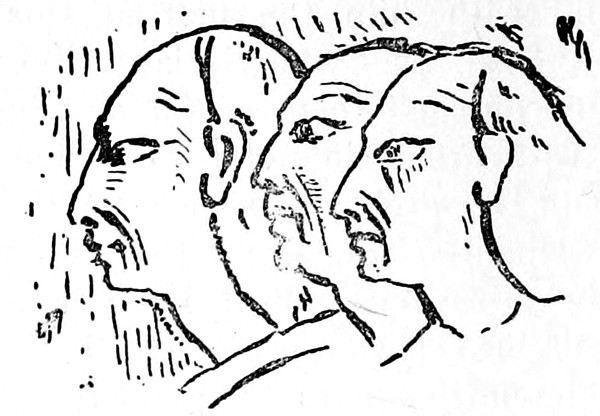
Hittites (Abou-simbel).
(By permission of Messrs C. Philip & Son.)
Pentaur of Thebes, the poet-laureate of Egypt, had accompanied Rameses in this expedition, and he celebrated the achievements of the day in a poem which has come down to us in several editions. It is found on a papyrus roll, and again in conjunction with splendid battle scenes, on the walls of temples at Abydos, Luxor, Karnak, and Ibsamboul.
This prize poem of Pentaur’s was written three thousand two hundred years ago, and is the oldest heroic poem in the world. “It may be relied upon,” says Dr Wright, “as the earliest specimen of special war correspondence.” Besides this narration there is a simple prose account of the same battle, and this is followed by a copy of the treaty of peace which established an offensive and defensive alliance between the empire of the Hittites and Egypt.
I here insert a few incidents from the prize poem of Pentaur, written two years after the battle of Kadesh. Reading between the lines of the boastful hieroglyphs, it is clear that the Hittites must have maintained their ground in the battle, for their king, who, at the beginning of the fight, is “the vile king of the Hittites,” and “the miserable king of the Hittites,” towards the close of the battle becomes “the great king of the Hittites.”
According to Pentaur, the Hittites and their allies covered mountains and valleys like grasshoppers, and no such multitude had ever been seen before.... Pharaoh was young and bold, he seized his arms, he armed his people and his chariots, and marched towards the land of the Hittites.... Arab spies were caught, who told Pharaoh that the Hittite army was in the neighbourhood of Aleppo; but “the miserable king of the Hittites” was all the time lying in ambush with his allies north-west of Kadesh. They rose up and surprised the Egyptians. Pharaoh’s retreat was cut off. In this crisis he prayed to his god and father, Amon, and was assisted to perform prodigies of valour. He hurled darts with his right hand and fought with his left; the two thousand three hundred horses were dashed to pieces, and the hearts of the Hittites sank within them. The King of the Hittites sent eight of his brother kings with armed chariots against Pharaoh; but six times he charged the unclean wretches, who did not acknowledge his god; he killed them, none escaped. Pharaoh upbraided his worthless warriors, who had left him to fight the battle single-handed, and promised that on his return to Egypt he would see the fodder given to his pair of horses which did not leave him in the lurch.
The battle was renewed the following morning and went sore against the Hittites. Then the hostile king sent a messenger to ask for peace, and to say that the Egyptians and the Hittites ought to be brothers. Pharaoh assembled his warriors to hear the message of “the great king of the Hittites,” and by their advice he made peace, and returned to Egypt in serene humour.
On the outer wall of the temple of Karnak we find inscribed the treaty of peace which was made on this or a later occasion, and the terms of the offensive and defensive alliance entered into. It is related that Kheta-sira, King of the Hittites, sent two heralds, bearing a plate of silver, upon which the treaty was engraved. The treaty is between the Grand-Duke of Kheta, Kheta-sira, the puissant, and Rameses, the great ruler of Egypt, the puissant. The arrangement is sanctioned by the Sun and by Sutekh, the chief gods respectively of Egypt and Kheta. There is to be peace and good brotherhood for ever—he shall fraternize with me and I will fraternize with him. The Grand-Duke of Kheta shall not invade the land of Egypt for ever, to carry away anything from it, nor shall Ramessu-Meriamen, the great ruler of Egypt, invade the land of Kheta for ever, to carry away anything from it. If Egypt is invaded by some other enemy, and Pharaoh sends to Kheta for help, the Grand-Duke is to go, or at least to send his infantry and cavalry; and he is, of course, to look for reciprocal aid. If emigrants or fugitives pass from one country to the other they are not to find service and favour, but to be given up; nevertheless, when taken back, they are not to be punished as criminals. In support of the provisions of the treaty the parties thereunto invoke “the thousand gods of the land of Kheta, in concert with the thousand gods of the land of Egypt.” Whosoever shall not observe the provisions of the treaty, the gods shall be against his house and family and servants; but to whomsoever shall observe them the gods shall give health and life—to his family, himself, and his servants.
“In such a form,” says Brugsch, “were peace and friendship made at Ramses, the city in Lower Egypt, between the two most powerful nations of the world at that time—Kheta in the east, and Kemi (Egypt) in the west.”
Following upon the conclusion of this treaty we have a happy dynastic alliance. Kheta-sira, the great king of the Hittites, appeared in Egypt in Hittite costume, accompanied by his beautiful daughter, and Pharaoh made this princess his queen. A memorial tablet at Ibsamboul speaks of this as a great, inconceivable wonder—“she herself knew not the impression which her beauty made on thy heart”—and we may fairly infer that her influence contributed to the international friendship which lasted as long as Rameses lived. We do not know the native name of the Hittite princess, but the name given her on her marriage was Ur-Maa-Noferu Ra.
Since it has become evident that the Hittites were a great people, and not a petty local tribe like the Hivites or the Perizzites, scholars have naturally turned again to the Bible references to see what they really imply. On careful examination the Bible passages are seen to be all consistent with the idea that the Hebrew writers were well acquainted with the power and greatness of the Hittites. Their greatness is nowhere denied; on the contrary there are some passages which seem plainly to imply it. When Solomon imported horses and chariots from Egypt, he sold them to the kings of Syria and to “all the kings of the Hittites” (2 Chron. i. 16). Again, when Ben-hadad, king of Syria, was besieging Samaria, and the Syrians were smitten with panic, believing that they heard “a noise of chariots, and a noise of horses, even the noise of a great host,” what nations did they suppose were alone able to send great hosts into the field with horses and chariots? They said one to another, “Lo, the King of Israel has hired against us the kings of the Hittites and the kings of the Egyptians” (2 Kings vii. 6). Further—to take an instance nearer to the age of Rameses II.—when the future wide inheritance of Israel is promised to Moses and to Joshua, the description runs thus:—“From the wilderness and this Lebanon, even unto the great river, the river Euphrates, all the land of the Hittites, and unto the great sea toward the going down of the sun”—words which had been regarded as a pictorial exaggeration, but which may now be looked upon as literally accurate (Deut. xi. 24; Josh. i. 4).
Exploration and research are now making us acquainted with Hittite works of art and with inscriptions in the Hittite character and language; while, as already stated, we have Egyptian portraits of their soldiers on the Temple wall at Ibsamboul.
Burckhardt the traveller was perhaps the first to discover and describe a Hittite inscription. He gives an account of a stone which he saw in a wall in the city of Hamath, which was covered with hieroglyphs differing from those of Egypt. The discovery was without result at the time; but when the stone had been seen again, with four others, in 1870, by the American visitor, Mr J. A. Johnson, interest began to be aroused. Similar stones have been found at Carchemish, at Aleppo, and in various parts of Asia Minor. Some have been removed to the Museum at Constantinople, some are in the British Museum, and some inscriptions remain on rock faces irremovable. A very good collection of illustrative plates will be found appended to Dr Wm. Wright’s “Empire of the Hittites.” The Hittite hieroglyphs cannot yet be deciphered, although Dr A. H. Sayce and Major Conder may be said to have made a promising beginning. The inquiry has been aided a little by a short inscription in Hittite and Cuneiform characters, engraved on a convex silver plate, which looked like the knob of a staff or dagger, and is known as the boss of Tarkondêmos. We shall probably have to wait for the discovery of some longer bi-lingual inscription before much progress can be made. Meanwhile Major Conder finds much reason to think that the affinities of the Hittites and their language were Mongolian. The inscriptions of course are quite a mystery to the Asiatic folk in whose districts they are found, and they attribute magical virtues to some of them. The particular stone figured above was very efficacious in cases of lumbago: a man had only to lean his back against it and he was effectually cured.
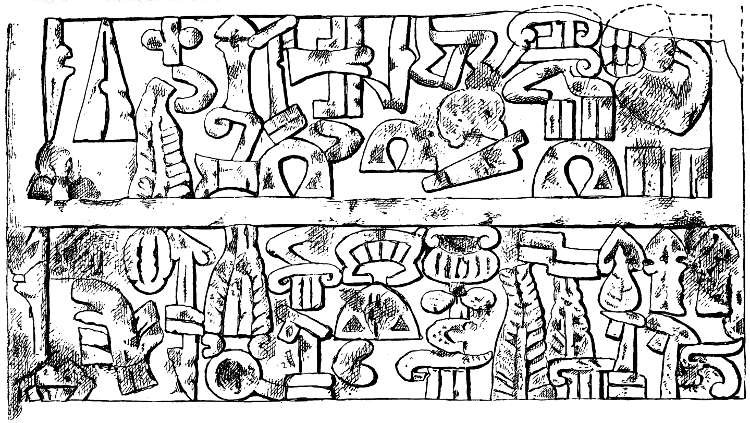
Hamath Inscription (Hittite).
(Specially drawn by W. Harry Rylands, F.S.A.)
We know something of the religion of the Hittites from their invocation of the gods in their treaty with Rameses II. They adored the sun and moon, the mountains, rivers, clouds, and the sea. But their chief deity was Sutekh, “king of heaven, protector of this treaty,” supposed by Brugsch to be a form of Baal, but who is more likely to have been allied to Set or to Dagon. We cannot suppose that their worship was purer than that of the nations round about them; but it may not have been less pure, nor their life less moral. The appeal to the King of Heaven to protect a treaty is admirable so far as it goes. To what height they could sometimes rise in their conceptions of duty is pleasantly shown if, as seems possible, that beautiful passage in Micah vi. 8 is to be attributed to them—“What doth the Lord require of thee but to do justly, to love mercy, and to walk humbly with thy God.” The prophet quotes the sentiment from Balaam, and gives it as Balaam’s answer to the question of Balak, king of Moab, who had sent for him to curse Israel. A conversation took place which may be set forth as follows:—
King—Wherewithal shall I come before the Lord, and bow myself before the high God? Shall I come before him with burnt offerings, with calves of a year old?
Prophet—Will the Lord be pleased with thousands of rams, or with ten thousands of rivers of oil?
King—Shall I give my first-born for my transgression, the fruit of my body for the sin of my soul?
Prophet—He hath shewed thee, O man, what is good; and what doth the Lord require of thee, but to do justly, and to love mercy, and to walk humbly with thy God?[2]
In the Book of Numbers we find that Balaam had been sent for from another country, and came from the city of Pethor. Now, in the temple of Karnak, Thothmes III. gives a list of two hundred and eighteen towns in Syria and Aram, which he claims to have conquered, and among them we find Pethor. It was a city on the Upper Euphrates, not far from Carchemish, and so was well within the circle of the Hittite dominion. Balaam, then, may be regarded as a Hittite, or as belonging to the Hittite confederacy,[3] and since the text quoted shows his idea of the Divine requirements, it indicates the standard of duty which had been arrived at by some among that people.
The rock inscriptions prove that the Hittites possessed a written language, and this is further shown by their engraved treaty sent to Rameses II. They appear even to have possessed a literature, for the Egyptian records mention a certain Khilp-sira as a writer of books among the Hittites. One of their cities in the south of Palestine was called Kirjath-Sepher, or Book-Town, so that the place must have been noted for writings of some kind.
The fact that the copy of the treaty sent to Rameses was engraved upon a silver plate, with a figure of the god Sutekh in the middle, shows that the Hittites were an artistic people also. In fact their civilisation was far advanced. “They had walled towns, chased metal work, chariots and horses, skilled artificers. They could carve in stone, and could write in hieroglyphic character. All this wonderful cultivation they possessed while Israel as yet was hardly a nation. Thus the Bible account of the Canaan overrun by Joshua is fully confirmed by monumental evidence.”[4]
[Authorities and Sources:—“A History of Egypt under the Pharaohs.” By Henry Brugsch-Bey. “The Empire of the Hittites.” By William Wright, D.D. “The Hittites: the Story of a forgotten Empire.” By A. H. Sayce, LL.D. “Transactions of the Society of Biblical Archæology.”]
5. Semites in Egypt before the Oppression.
If, as seems probable, the Pharaoh of Joseph was Apepi, the last of the Shepherd Kings, and the Pharaoh of the Oppression was Rameses II., the third king of the nineteenth dynasty, we have a period of nearly three centuries between Joseph and the “new king who knew not Joseph.” The period appears to be much too long to make the expression “new king” seem natural, while at the same time a shorter period would hardly leave room for the descendants of Jacob to multiply and become a danger to Egypt. This perplexity is removed by the recent discovery of ancient writings under the extensive ruins existing at Tell-el-Amarna in Upper Egypt—a site about midway between Minieh and Siout, and on the eastern bank of the Nile. From these documents it appears that Semites were in great favour with Amenhotep IV. (Amenôphis), the last king of the eighteenth dynasty, whereas the new dynasty that succeeded abominated this foreign influence.
In the latter part of the eighteenth dynasty friendly relations prevailed between Egypt and Mitanni or Nahrina (Aram Naharaim, Judges iii. 8), a Mesopotamian district which lay opposite to the Hittite city of Carchemish. Amenôphis III. married a wife from the royal house of Mitanni; and the offspring of this marriage—Amenôphis IV.—in his turn married Tadukhepa, daughter of Duisratta, the Mitannian king. He was thus doubly drawn to look favourably upon the Mitannian form of faith, which, like that of the Semites, included the adoration of the winged solar disk. Meantime the Egyptian conquest of Palestine, whose petty kings and governors now ruled as satraps for the Egyptian monarch, had paved the way for strangers from Canaan and Syria to rise into favour at Pharaoh’s court. Amenôphis IV. surrounded himself with Semitic officers and courtiers, thus offending the nobles of Egypt; and by forsaking the ancient religion of his country, brought about a rupture with the powerful priesthood of Thebes. Forced to go forth, the “heretic king” built a new capital on the edge of the desert to the north. Here he assumed the name of Khu-en-Aten, “the glory of the solar disk,” while his architects and sculptors consecrated a new and peculiar style of art to the new religion, and even the potters decorated the vases they modelled with new colours and patterns.
“The archives of the empire were transferred from Thebes to the new residence of the king, and there stored in the royal palace, which stood among its gardens at the northern extremity of the city. But the existence and prosperity of Khu-en-Aten’s capital were of short duration. When the king died he left only daughters behind him, whose husbands assumed in succession the royal power. Their reigns lasted but a short time, and it is even possible that more than one of them had to share his power with another prince. At any rate it was not long before rulers and people alike returned to the old paths. The faith which Khu-en-Aten had endeavoured to introduce was left without worshippers, the Asiatic strangers whom he and his father had promoted to high offices of State were driven from power, and the new capital was deserted never to be inhabited again. The great temple of the solar disk fell into decay, like the royal palace, and the archives of Khu-en-Aten were buried under the ruins of the chamber wherein they had been kept.”
It is these archives which have now come to light, and which furnish such extraordinary information concerning the state of Egypt and Palestine in the century before the Oppression. In the winter of 1887 the fellahin of Egypt, searching for nitrous earth with which to manure their fields, discovered some three hundred ancient tablets inscribed with Babylonian cuneiform writing. The tablets are copies of letters and despatches from the kings and governors of Babylonia and Assyria, of Syria, Mesopotamia, and Eastern Cappadocia, of Phœnicia and Palestine, exchanging information with the Pharaoh of Egypt, or making reports as to the state of the country they governed. Among the correspondents of the Egyptian sovereigns were Assurynballidh of Assyria and Burnaburyas of Babylonia, which thus fix the date of Khu-en-Aten to about 1430 B.C. This shows incidentally that the Egyptologists have been quite right in not assigning the Exodus to an earlier period than 1320 B.C., that is to say, the reign of Menephtah, the son and successor of Rameses II.
At the date of the despatches Palestine and Phœnicia were garrisoned by Egyptian troops, and their affairs were more or less directed by Egyptian governors. But in some cases the native prince was allowed to retain his title and a portion of his power. Thus Jerusalem (which was then called Uru-’Salim—the seat or oracle of the god Salim, it is supposed, whose temple stood on the mountain of Moriah)—was ruled over by Ebed-tob. He appears to have been a priest rather than a king, since he tells us that he was appointed by an oracle of the god; and in that case the state over which he presided would be a Theocracy. Dr Sayce considers that an unexpected light is thus thrown on the person and position of Melchizedek. He was priest of El-Elyon, the “Most High God,” and king only in virtue of his priestly office. His father therefore is not named. [“Records of the Past.” New Series, vol. v.] There were as yet no signs of the Israelites coming into the land. But the Canaanite population was already threatened by an enemy from the north. These were the Hittites, to whom references are made in several of the despatches from Syria and Phœnicia. After the weakening of the Egyptian power, in consequence of the religious troubles which followed the death of Khu-en-Aten, the Hittites were enabled to complete their conquests in the south, and to drive a wedge between the Semites of the East and the West. With the revival of the Egyptian empire under the rulers of the nineteenth dynasty the southward course of Hittite conquest was checked; but the wars of Rameses II. against the Hittites of Kadesh on Orontes desolated and exhausted Canaan and prepared the way for the Israelitish invasion. Phœnicia seems to have been the furthest point to the north to which the direct government of Egypt extended. At any rate the letters which came to the Egyptian monarch from Syria and Mesopotamia were sent to him by princes who called themselves his “brothers,” and not by officials who were the “servants” of the king.
It is wonderful to find that in the fifteenth century before our era, active literary intercourse was carried on throughout the civilised world of Western Asia, between Babylonia and Egypt and the smaller states of Palestine, of Syria, of Mesopotamia, and even of Eastern Cappadocia. And this intercourse was carried on by means of the Babylonian language and the complicated Babylonian script. It implies that all over the civilised East there were libraries and schools, where the Babylonian language and literature were taught and learned. Babylonian in fact was as much the language of diplomacy and cultivated society as French has been in modern times, with the difference that whereas it does not take long to read French, the cuneiform syllabary required years of hard labour and attention before it could be acquired. There must surely have been a Babylonian conquest. In fact, Mr Theo. G. Pinches now finds, from a text of about B.C. 2115 to 2090, that Animisutana, king of Babylon at that time, was also king of Phœnicia among other places. [“Records of the Past” New Series, vol. v.]
One of the facts which result most clearly from a study of the tablets is that, not only was a Semitic language the medium of literary intercourse between the Pharaoh of Egypt and his officers abroad, but that Semites held high and responsible posts in the Egyptian Court itself. Thus we find Dudu, or David, addressed by his son as “my lord,” and ranking apparently next to the monarch; and there are in the Egyptian National Collection not only letters written by officials with Egyptian names, like Khapi or Hapi (Apis), but with such Semitic names as Rib-Addu, Samu-Addu, Bu-Dadu (the Biblical Bedad) and Milkili (the Biblical Malchiel). A flood of light is thus poured upon a period of Egyptian history which is of high interest for the student of the Old Testament. In spite of the reticence of the Egyptian monuments, we can now see what was the meaning of the attempt of Amenophis IV. to supersede the ancestral religion of Egypt. The king was in all respects an Asiatic. His mother, who seems to have been a woman of strong character,—able to govern not only her son, but even her less pliable husband,—came from the region of the Euphrates, and brought with her Asiatic followers, Asiatic ideas, and an Asiatic form of faith. The court became Semitised. The favourites and officials of the Pharaoh, his officers in the field, his correspondents abroad, bore names which showed them to be of Canaanite and even of Israelitish origin. If Joseph and his brethren had found favour among the Hyksos princes of an earlier day, their descendants were likely to find equal favour at the court of “the heretic king.”
We need not wonder, therefore, if Amenophis IV. found himself compelled to quit Thebes. The old aristocracy might have condoned his religious heresy, but they could not condone his supplanting them with foreign favourites. The rise of the nineteenth dynasty marks the successful reaction of the native Egyptian against the predominance of the Semite in the closing days of the eighteenth dynasty. It was not the founder of the eighteenth dynasty (Aahmes, who drove out the Hyksos) but the founder of the nineteenth dynasty that was “the new king who knew not Joseph.” Ever since the progress of Egyptology had made it clear that Rameses II. was the Pharaoh of the Oppression, it was difficult to understand how so long an interval of time as the whole period of the eighteenth dynasty could lie between him and that “new king,” whose rise seems to have been followed almost immediately by the servitude and oppression of the Hebrews. If Aahmes began the Oppression, how was it that a whole dynasty passed away before the Israelites cried out? The tablets of Tell-el-Amarna now show that the difficulty does not exist. Up to the death of Khu-en-Aten the Semite had greater influence than the native in the land of Mizraim.
How highly educated this old world was we are but just beginning to learn. But we have already learned enough to discover how important a bearing it has on the criticism of the Old Testament. It has long been tacitly assumed by the critical school that the art of writing was practically unknown in Palestine before the age of David. Little historical credence, it has been urged, can be placed in the earlier records of the Hebrew people, because they could not have been committed to writing until a period when the history of the past had become traditional and mythical. But this assumption can no longer be maintained. Long before the Exodus Canaan had its libraries and its scribes, its schools and literary men. The annals of the country, it is true, were not inscribed in the letters of the Phœnician alphabet on perishable papyrus; the writing material was imperishable clay, the characters were those of the cuneiform syllabary. Though Kirjath-Sepher (i.e., Book-Town) was destroyed by the Israelites, other cities mentioned in the Tell-el-Amarna tablets, like Gaza, or Gath, or Tyre, remained independent, and we cannot imagine that the old traditions of culture and writing were forgotten in any of them. In what is asserted by the critical school to be the oldest relic of Hebrew literature, the Song of Deborah, reference is made to the scribes of Zebulon “that handle the pen of the writer” (Judges v. 14); and we have now no longer any reason to interpret the words in a non-natural sense, and transform the scribe into a military commander (an officer who arranges men in a row instead of arranging letters and words). Only it is probable that the scribes still made use of the cuneiform syllabary, and not yet of the Phœnician alphabet. At all events the Tell-el-Amarna tablets have overthrown the primary foundation on which much of this criticism was built, and have proved that the populations of Palestine, among whom the Israelites settled, and whose culture they inherited, were as literary as the inhabitants of Egypt or Babylonia.
But apart from such side-lights as these upon ancient history, the discovery of the Tell-el-Amarna tablets has a lesson for us of momentous interest. The collection cannot be the only one of its kind. Elsewhere, in Palestine and Syria as well as in Egypt, similar collections must still be lying under the soil. Burnt clay is not injured by rain and moisture, and even the climate of Palestine will have preserved uninjured its libraries of clay. Such libraries must still be awaiting the spade of the excavator on the sites of places like Gaza, or others whose remains are buried under the lofty mounds of Southern Judea. Kirjath-Sepher must have been the seat of a famous library, consisting mainly, if not altogether, of clay tablets inscribed with cuneiform characters. As the city also bore the name of Debir, or “Sanctuary,” we may conclude that the tablets were stored in its chief temple, like the libraries of Assyria and Babylonia. When such relics of the past have been disinterred—as they will be if they are properly searched for—we shall know how the people of Canaan lived in the days of the Patriarchs, and how their Hebrew conquerors established themselves among them in the days when, as yet, there was no king in Israel.
[The information contained in this section is derived almost exclusively from the writings of Dr A. H. Sayce, who has taken a chief part in England in the decipherment of the Tell-el-Amarna inscriptions. See “Proc. Soc. Bib. Arch.” “Records of the Past.” New Series, vols, ii., iii., iv., and v.; “Victoria Institute Annual Address, 1889.” See additional facts in the Contemporary Review, Dec. 1890, and opinions in Naville’s Bubastis. For later excavations at Tell-el-Amarna, by Mr Flinders Petrie, see the Academy, 9th April 1892. For a suggestion by Conder that the tablets are in the Phœnician or Amorite language and writing of that time, see Quarterly Statement, July 1891.]
6. Israel in Egypt.
We have seen how well the general political circumstances in Egypt and Palestine, in the centuries before the Exodus, supplement the Bible narrative, explaining on the one hand why the Israelites were oppressed, and showing on the other how Canaan was prepared for their easy conquest. But while the fact that Rameses II. was the Pharaoh for whom Israel built “treasure cities” is demonstrated beyond reasonable contradiction, it is remarkable that the inscriptions do not say anything about the Israelites. We must suppose, with Brugsch, that the captives were included in the general name of foreigners, of whom the documents make very frequent mention. It would be satisfactory, no doubt, to find upon some contemporary Egyptian monument, a record of the arrival of Jacob, or the tasks imposed upon the Israelites, or the destruction of Pharaoh’s host in the Red Sea. But the Egyptians were not accustomed to record their defeats, and as to the labours imposed upon the Israelites, they were but a matter of course in the case of captives.
But short of direct mention, the Egyptian monuments and records afford ample confirmation to the Biblical account of the Sojourn. The Scripture references to Egyptian manners and customs are, in all respects, accurate; and this absolute accuracy could only result from actual contact and intimate acquaintance.
The Bible history of Abraham implies that when he visited Egypt, driven thither by famine, that country was already under a settled government, having a king, and princes who acted as the king’s subordinates. It requires us to believe that the king was called Pharaoh, or by some name or title which conveyed that sound to Hebrew ears. And further, it assumes that Egypt was so fruitful and so prosperous, as to be a granary for surrounding nations in years of famine. On all these points the Bible is in harmony with what we learn from other sources.
Again, according to Genesis xii. 12, Abram feared for Sarai his wife, lest the Egyptians should take her from him, and should kill him in order to make the proceeding safer. The possibility of such a thing being done by a people so civilised and cultured as the Egyptians has sometimes been doubted: but M. Chabas has called attention to a papyrus which actually states that the wife and children of a foreigner are by right the lawful property of the king. In the “Tale of the Two Brothers” also—an Egyptian romance of the days of Seti II.—we are told that the king of Egypt sent two armies to bring a beautiful woman to him, and to murder her husband.
In this same tale of The Two Brothers the wife of the elder solicits the love of the younger in almost exactly the same way that the wife of Potiphar tempts Joseph. The whole story of Joseph agrees minutely with what we learn of Egypt from her own records. The outward details of life, the officers of the court, the traffic in slaves, the visits for corn, are all pictured on temple walls and stone slabs. No feature in the Bible narrative is out of harmony with what we know of the country from other sources. “Potiphar” appears to be a good Egyptian name, and Egyptologists have pointed out that its probable equivalent in hieroglyphs signifies “Devoted to the Sun-god.” Joseph’s new name, Zaphnath-paaneah, means “Storehouse of the house of Life,” and was given to him when he entered Pharaoh’s service, just as a new name was given to the Hittite princess when she became Pharaoh’s wife. The king’s absolute authority appears abundantly from Herodotus, Diodorus and others. He enacted laws, imposed taxes, administered justice, executed and pardoned offenders at his pleasure. He had a bodyguard, which is constantly seen on the sculptures, in close attendance on his person. He was assisted in the management of state affairs by the advice of a council, consisting of the most able and distinguished members of the priestly order. His court was magnificent and comprised various grand functionaries, whose tombs are among the most splendid of the early remains of Egyptian art. When he left his palace for any purpose, he invariably rode in a chariot. His subjects, wherever he appeared, bowed down or prostrated themselves.[5] The civilisation of the Egyptians, even at a period long before the Israelitish Sojourn, comprised the practice of writing, the distinction into classes or castes, the peculiar dignity of the priests, the practice of embalming and of burying in wooden coffins or mummy cases, the manufacture and use of linen garments, the wearing of gold chains, and almost all the other points which may be noted in the Bible description.
In Genesis xl. 20, Pharaoh held a feast on his birthday, and the chief butler being restored to favour, gave the cup into Pharaoh’s hand. We know from the Rosetta Stone that as late as the reign of Ptolemy Epiphanes it was customary to make great rejoicing on the king’s birthday, to consider it holy, and to do no work on it. That it should be a day on which pardons were granted as an act of grace, is more than probable. Cups such as the king would have taken his wine from are portrayed on the monuments; baskets such as the baker would have carried his bakemeats in are used even unto this day, and may be seen in the British Museum. Before Joseph entered the royal presence he shaved himself and changed his raiment: and here, again, the monuments and profane history offer us illustrations. The Egyptians only allowed their hair to grow during the times of mourning, and to neglect the hair was considered very slovenly and dirty. When a man of low station had to be represented, the artist always drew him with a beard. The British Museum possesses Egyptian razors of various shapes; and in a tomb at Beni-Hassan the act of shaving is actually represented.
With regard to the seven years of famine, it is true that Egypt was less likely to suffer in this way than the countries round about; yet still, when the inundation of the Nile fell below the average, it was liable to this scourge. History tells of numerous cases in which the inhabitants have suffered terribly from want, and several famines are even mentioned on the monuments. Professor Rawlinson refers us to a case which furnishes a near parallel to the famine of Joseph. In A.D. 1064 a famine began in Egypt which lasted seven years, and was so severe that dogs and cats, and even human flesh, were eaten; nearly all the horses of the Caliph perished, and his family had to fly into Syria.
When Jacob goes down into Egypt, he is advised to tell Pharaoh that he and his sons are keepers of cattle, so that the land of Goshen may be assigned to them, shepherds being an abomination unto the Egyptians. The Egyptian contempt for herdsmen appears plainly on the monuments, where they are commonly represented as dirty and unshaven, and are sometimes even caricatured as a deformed and unseemly race. When Jacob dies, his body is embalmed by the physicians, forty days being taken up with the processes, and seventy days being spent in mourning. The methods of embalming are described by Herodotus and Diodorus, and it is stated that in preparing the body according to the first method the operators commenced by extracting the brain and pouring in certain drugs. Then they made an incision in the side of the body with a sharp Ethiopian stone, and drew out the intestines, filling the cavity with powder of pure myrrh, cassia, and other fragrant substances, and sewing up the aperture. This being done, they salted the body, “keeping it in natron during seventy days,” after which they washed it and wrapped it up in bands of fine linen smeared on their inner side with gum. Remarking upon the number of days, seventy or seventy-two, mentioned by the two historians, Sir Gardner Wilkinson says there is reason to believe it comprehended the whole period of the mourning, and that the embalming process only occupied a portion of it.
Subsequently to the burial of his father, Joseph himself died, and his body also was embalmed. At some later period there arose a king who knew not Joseph. This monarch is generally supposed to be Rameses II., and if the identification were correct, the indications of his character afforded by the Book of Exodus agree exactly with what the monuments reveal concerning that haughty oppressor; but, as already stated, the reference is probably to Rameses I. The slavery of the Israelites was of a kind to which all hostile or conquered people were reduced by the Egyptians. Thothmes III., during his many campaigns, brought to Egypt unnumbered prisoners of every race, and made them labour like convicts on the public works, under the superintendence of architects and overseers. On the walls of a chamber in a tomb at Thebes there is a very instructive pictorial representation of such forced labour, and the Asiatic countenances of the workers strongly resemble those of the Hebrew race. The date is too early, and we may suppose them to belong to some other nation of the Semitic family; but the picture none the less shows the method of working under taskmasters. Some carry water in jugs from the tank hard by; others knead and cut up the loamy earth; others, again, by the help of a wooden form, make the bricks, or place them carefully in long rows to dry; while the more intelligent among them carry out the work of building the walls. The hieroglyphic explanations inform as that the labourers are captives whom Thothmes III. has carried away to build the temple of his father Amon. They explain that the baking of the bricks is a work for the new building of the provision house of the god Amon of Apet (the east side of Thebes), and they finally declare the strict superintendence of the steward over the foreigners. The words are—(Here are seen) the prisoners which have been carried away as living prisoners in very great numbers; they work at the building with active fingers; their overseers show themselves in sight, these insist with vehemence, obeying the orders of the great skilled lord [the head architect] who prescribes to them the works, and gives directions to the masters; (they are rewarded), with wine and all kinds of good dishes; they perform their service with a mind full of love for the king; they build for Thothmes III. a holy of holies for (the gods), may it be rewarded to him through a range of many years.
The overseer speaks thus to the labourers at the building: “The stick is in my hand, be not idle.”
Some of the captives thus set to labour by Thothmes belonged to a people called the Aperiu; and in the days of Rameses II. they are mentioned as still in a condition of servitude, quarrying and transporting stone for the great fortress of the city of Paramessu or Tanis.
Diodorus tells us that Rameses II. put up an inscription in each of his buildings, saying that it had been erected by captives, and that not a single native Egyptian was employed on the work. Again, this king manufactured bricks for sale, and, by employing the labour of captives, was enabled to under-sell other makers. The use of crude bricks baked in the sun was universal throughout the country for private and for many public buildings, and the dry climate of Egypt was peculiarly suited to those simple materials. They had the recommendation of cheapness, and those made three thousand years ago, whether with or without straw, are even now as firm and fit for use as when first put up. When made of the Nile mud or alluvial deposit they required straw to prevent their cracking; but those formed of clay taken from the torrent beds on the edge of the desert held together without straw; and crude brick walls frequently had the additional security of a layer of reeds or sticks placed at intervals to act as binders.
[Authorities and Sources:—Brugsch’s “Egypt under the Pharaohs.” Wilkinson’s “Ancient Egyptians.” Birch’s “Egypt” (Series, Ancient History from the Monuments). G. Rawlinson’s “Historical Illustrations of the Old Testament.” E. A. Wallis Budge, “Dwellers on the Nile.” M. E. Harkness, “Egyptian Life and History.”]
7. Buried Cities of the East—Preliminary.
If the buried cities of the East had been altogether destroyed and lost, and we possessed only a brief record of their disappearance, the subject might not possess much interest for us, and there would be no material for writing a book. But we are now witnessing a resurrection of some of them, and are recovering a story of the past, such as revived Egyptian mummies might be able to tell. Nay, not only Egyptians who walked about—
“In Thebes’s streets three thousand years ago, When the Memnonium was in all its glory,”
but Chaldean shepherds who watched the stars and were perhaps the first to give names to the signs of the Zodiac. The ancient relics and records which are now being recovered from Egypt, Palestine, Assyria, and Babylonia, revive forgotten stories of human struggle, and furnish material for new chapters in the history of Art, Science, Laws, and Language, of Mythology, Morals, and Religion. They also throw frequent side lights upon the Bible narrative, and enable us to compare the Israelites more fairly with their contemporaries and predecessors.
The catastrophes which led to the partial destruction, and the eventual burial of the cities of the East must have seemed nothing less than pure calamities at the time; but one of the results has been the providential preservation of the remains for the enlightenment of the present generation. When a buried city is unearthed, it serves to confute the scepticism which had been growing up, and to rectify the errors which had found their place in books of history. We are familiar with the fact that the cities of Herculaneum and Pompeii were overwhelmed—the former by streams of lava, the latter by showers of ashes, pumice, and stones, from the crater of Vesuvius, in A.D. 79. The existence of those cities had come to be doubted, and for ages they were spoken of as “the fabulous cities;” nevertheless, after sixteen centuries, they were brought to light, and they present us with a picture of Roman life, such as history by itself could never have supplied. The site of Pompeii had always borne the name of Civita, or the city; and in 1748, a Spanish colonel of engineers, having heard that the remains of a house had been discovered, with ancient statues and other objects, obtained leave to excavate. In a few days his labours met with encouraging reward, and eventually about one third of the ancient city was uncovered. We may now walk about in Pompeii, observing how its houses were built, and how its streets were paved. We see the ruts worn by the wheels of chariots, we note the public fountains, the temples, the theatre, which would seat 10,000 people. We notice the corn-mills in the bakers’ shops, the vats in the dyers’ shops, and in private houses we observe with interest the many articles of domestic use. Excepting that the upper stories of the houses have been destroyed—either burnt by the red-hot stones, or broken down by the weight of matter which fell upon them—“we see a flourishing city in the very state in which it existed nearly eighteen centuries ago—the buildings as they were originally designed, not altered and patched to meet the exigencies of newer fashions; the paintings undimmed by the leaden touch of time; household furniture left in the confusion of use; articles, even of intrinsic value, abandoned in the hurry of escape, yet safe from the robber, or scattered about as they fell from the trembling hand, which could not pause or stoop for its most valuable possessions: and in some instances, the bones of the inhabitants, bearing sad testimony to the suddenness and completeness of the calamity which overwhelmed them.”[6]
Remains of Roman London are found 16 or 17 feet underground, in the neighbourhood of the Bank of England and the Mansion House, although London has not been buried in volcanic ashes. Rome itself is a buried city, for the capital of modern Italy stands upon the ruins of the city of the Cæsars. In Eastern countries the site of an ancient city is sometimes occupied by a squalid village, which is its degenerate successor; in other instances the site is quite deserted, and only a tell or mound remains to call attention to it. Ancient sites have also occasionally become submerged beneath the waters of seas or lakes. Thus the Lake of Aboukir in Egypt was drained lately, in order to reclaim the area for cultivation, and when the floor was laid bare from the water, there appeared everywhere traces of streets, of stone-covered ways, and of fields for tillage marked out by lines of shells.
Professor Maspero describes the process by which Egyptian temples become buried. “Just as in Europe during the Middle Ages the population crowded most densely round about the churches and abbeys, so in Egypt they swarmed around the temples, profiting by that security which the terror of his name and the solidity of his ramparts ensured to the local deity. A clear space was at first reserved round the pylons and the walls; but in course of time the houses encroached upon this ground, and were even built up against the boundary wall. Destroyed and rebuilt, century after century, upon the self-same spot, the débris of these surrounding dwellings so raised the level of the soil that the temples ended for the most part by being gradually buried in a hollow, formed by the artificial elevation of the surrounding city. Herodotus mentions this of Bubastis, and on examination it is seen to have been the same in many other localities. At last, when the temple had been thrown down and was forsaken, the rubbish covered it up, and so the ruins have been preserved to reward the modern explorer.”
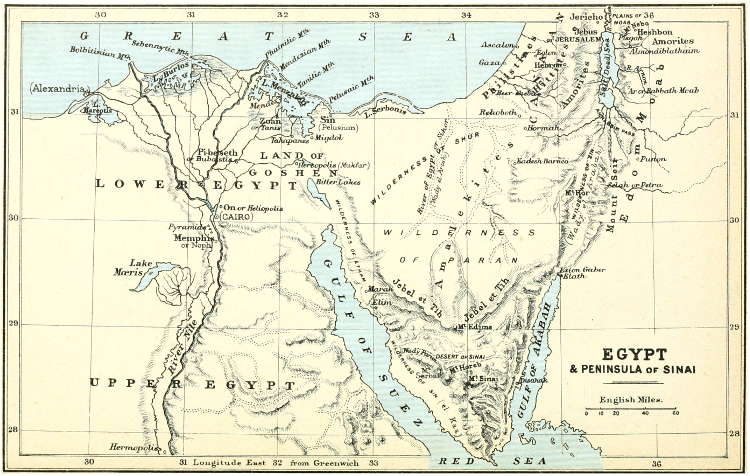
EGYPT & PENINSULA OF SINAI
London; Kegan Paul, Trench, Trübner & Co. F. S. Weller, F.R.G.S.
8. Biblical Sites in Egypt.
It is justly remarked by Rev. Greville J. Chester that there is scarcely a better or more striking commentary upon the prophets of Israel than the present condition of the ancient Biblical cities of Lower Egypt. For information regarding these cities—or what remains of them, buried in the soil—we are largely indebted to the Egypt Exploration Fund, which was founded in 1883, for the purpose of promoting historical investigation in Egypt, by means of systematically conducted explorations. Particular attention is given to sites which may be expected to throw light upon obscure questions of history and topography, such as those connected with the mysterious Hyksos period (the period of the Shepherd Kings), the district of the Hebrew Sojourn, the route of the Exodus, and the early sources of Greek art. Explorers have been sent out every season, and each year has been fruitful in discoveries. The objects of antiquity discovered are first submitted to the Director and Conservators of the National Egyptian Museum; and those which can be spared are divided between the British Museum and the Museum of Fine Arts, Boston, U.S.A.
Excavations at San.—San, in the north-eastern part of the Delta, is the Tanis of the Septuagint and the Greek historians, and the Zoan of the Bible. At the time of the Exodus Zoan was the capital of Egypt, and the Pharaoh resided there. The wonders wrought by Moses and Aaron are referred to by the Psalmist as having been manifested in the field of Zoan (Psalm lxxviii. 43). We are told that Hebron was built only seven years before Zoan (Num. xiii. 22), and therefore, since Hebron was flourishing in Abraham’s time, Zoan also must have been a very ancient city.
The modern village of San is a small collection of mud hovels, situated on the banks of a canal, which was once the Tanitic branch of the Nile. Near the village there are huge mounds which contain a ruined temple and other ancient remains. The place has been to a large extent explored by Mr W. M. Flinders Petrie, and the Memoir containing his interesting results is published by the Egypt Exploration Fund.
Rameses II., the Pharaoh of the Oppression, seems to have fixed upon Zoan and made it a new capital, because by its position it commanded the northern route to Syria and placed the king, after the conquest of that country, in easy communication with all his dominions. It was also close to the very centre of the Hyksos rule, which was only lately ended.
The Hyksos were the so-called Shepherd Kings, who appear to have come from the Arabian desert, or perhaps beyond, and established themselves in Lower Egypt at a period when native rule was weak. “The monuments of the Hyksos are among the most curious in Egypt; and it is to San that we owe the greater number of those brought to light. They are all distinguished by an entirely different type of face from any that can be found on other Egyptian monuments, a type which cannot be attributed to any other known period; and it is therefore all the more certain that they belong to the foreign race. Another peculiarity is that they are without exception executed in black or grey granite. The Hyksos only held the Delta, and occasionally more or less of Middle Egypt, and so they had no command of the red granite quarries of Assouan, which remained in the power of the native rulers. Whether the black granite came from Sinai or from the Hammamat district is not certain.” Mr F. Ll. Griffith, the coadjutor of Mr Flinders Petrie, mentions several interesting monuments of a kind peculiar to this people. One is a group of two men, with bushy plaited hair and long beards: they stand with a tray of offerings in front of them, on which lie fishes, with papyrus plants hanging round. The details are beautifully worked, the flowers and buds being most delicately wrought. The black granite sphinxes made by the Hyksos have been often described. They have the flat, massive, muscular, lowering face, with short whiskers and beard around it, the lips being shaven; and the hair is in a mat of thick, short locks descending over the whole chest, a style copied from the great sphinxes of the twelfth dynasty. It is a curious fact that the inscriptions on Hyksos sphinxes, &c., are always in a line down the right shoulder, never on the left. Mr Petrie suggests that this honouring of the right shoulder by this Semitic people is analogous to the particular offering of the right shoulder continually enjoined in the Jewish law.[7] The Egyptians missed this idea, and inscribed either side indifferently, showing no preference for the left, although that was their side of honour.
Here at San, or Tanis, was discovered the famous Stone of San or Decree of Canopus, which is now preserved in the National Museum of Egypt. It bears the text of a decree made by the priests of Egypt, assembled at Canopus (which was at that time the religious capital of the country) in the ninth year of Ptolemy Euergetes (B.C. 254). It ordains the deification of Berenice, a daughter of Ptolemy’s just dead, and creates a fifth order of priests, to be called Euergetæ, for the better paying of divine honours to the king and queen. The chief value of the monument consists in the circumstance that the inscription is tri-lingual, the characters being hieroglyphic (sacred), demotic (those of everyday business), and Greek (the chief language of foreigners in Egypt); so that, like the Rosetta Stone, it is of great use in helping scholars to decipher the Egyptian monuments. There is a plaster cast of this stone in the British Museum.
Mr Griffith finds that the early monuments of Tanis are suggestive of having been brought by Rameses II. to adorn his new capital. The truth about the age of Tanis can only be ascertained when deep excavations are made in the mound itself, or a sufficient examination of the extensive cemeteries has been carried out. But while the explorer is waiting, the cemeteries are in danger of being worked out by the Arabs, and the tombs are being destroyed for the sake of amulets to sell to dealers and travellers.
Tell Nebesheh—About eight miles S.E. of Tanis (modern San) is the low mound of Tell Nebesheh, originally known as Tell Farun—i.e., the mound of Pharaoh, because of the great monolith shrine called Ras Farun, or Pharaoh’s Head. Here Mr Petrie found, among other things, the remains of a temple, the altar of which contained important inscriptions. They were engraved by a certain “chief of the chancellors and royal seal-bearer,” whose name and further titles are effaced. This person was one of a series of officials whose titles were singularly parallel to the English Lord High Chancellor and Lord Privy Seal. The altar appears to belong to the Hyksos period, and it is suggested by Mr Petrie that these officials—who were so powerful that one of them actually appropriated for his inscriptions the royal monuments in a public temple—were native Egyptians, the Hyksos conquerors being only a military horde, without much civil organization, or organizing capacity, and taking over as they found it the native bureaucracy, who managed all the details of the needful administration of the country. So there appears to have been a series of viziers, men who acted for the king over the treasury and taxes, and over the royal decrees and public documents, bearing the king’s seal.
After some further discussion of the position and importance of these viziers, Mr Petrie says that yet one further document may be quoted as giving and receiving light on this question: the account of Joseph in the Book of Genesis undoubtedly refers to the Hyksos period, and there we read, “Let Pharaoh look out a man discreet and wise, and set him over the land of Egypt”—not, let Pharaoh give orders to his own officers. “And Pharaoh said unto Joseph.... Thou shalt be over my house, and according unto thy word shall all my people be ruled: only in the throne will I be greater than thou. And Pharaoh said unto Joseph, See, I have set thee over all the land of Egypt. And Pharaoh took off his signet-ring from his hand, and put it upon Joseph’s hand, and arrayed him in vestures of fine linen, and put a gold chain about his neck; and he made him to ride in the second chariot which he had; and they cried before him, ‘Abrech;’ and he set him over all the land of Egypt.” Here we read of the investiture of a vizier under the Hyksos, creating him royal seal-bearer, and giving him the honour of the second chariot. This we now see was not an extraordinary act of an autocrat, but the filling up of a regular office of the head of the native administration.
Excavations at Tell Basta, the ancient Bubastis. A little to the south of Zagazig, Mr Naville and Mr Griffith have made important discoveries. Bubastis was the seat of the worship of Bast or Pasht, the cat-headed goddess, whose temple is described by Herodotus as the most beautiful in Egypt. It was surrounded, he tells us, by a low wall, having figures engraved upon it. Here, accordingly, in April 1887, our explorers began their work, in the rectangular depression surrounded on all sides by the mounds of houses, which must have been higher than the temple. In a short time they disclosed the site of a grand hypostyle hall, strewn with fallen monolithic columns of twelfth dynasty workmanship, and a hall without columns, but lined, as it should seem, with elaborate bas-relief sculptures representing a great religious ceremony, and containing tens of thousands of minutely-executed hieroglyphic inscriptions. The columns and the architraves of the hypostyle hall, though of an earlier period, are emblazoned with the ovals of Rameses II. (nineteenth dynasty). The inscriptions of the festival hall commemorate Osorkon II., of the twenty-second dynasty, and his Queen Karoama. Besides the two historical landmarks thus determined, various blocks bearing the names of Usertesen III. and Pepi Merira testified to the existence of the edifice not only in the days of the first great Theban Empire, but in the very remote age of the Pyramid kings of the sixth dynasty. At the same time a small tentative excavation at the western extremity of the site yielded the name and titles of Nectanebo I., of the thirtieth and last native dynasty. Such being the outcome of but four weeks’ labour at the close of the season, it seemed reasonable to hope for important results when the excavations should be resumed. This hope was more than fulfilled in 1888. As the work in this instance was not carried on in the desert, but quite near to a busy railway station, many travellers visited the place. The scene was curiously picturesque. “Here, grouped together on the verge of the great cemetery of Sacred Cats, are the tents of the officers of the Fund; yonder, swarming like bees at the bottom of the huge crater-like depression which marks the area of the temple, are seen some three to four hundred labourers—diggers in the trenches and pits, basket-carriers clearing away the soil as it is thrown out, overseers to keep the diggers at work, ‘pathway-men’ to keep the paths open and the carriers moving, gangs of brawny ‘Shayalîn,’ or native porters, harnessed together by stout ropes, and hauling or turning sculptured blocks which have not seen the light for many centuries; girls with bowls of water and sponges, to wash down the carved surfaces preparatory to the process of taking paper ‘squeezes;’ and small boys to run errands, help with the measuring tapes, and keep guard over the tents and baggage. With so many hands at work and so many overseers to keep them going, it is not wonderful that the excavations make rapid progress. The two large pits which were opened last season are now thrown into one, and are being enlarged from east to west, following the axis of the structure. The sides are also being cleared, and before another month shall have expired the whole temple—of which, apparently, not one stone remains upon another—will be visible from end to end. Its entire length is probably about 700 or 800 feet; but measurements, of course, are as yet purely conjectural.”