INTRODUCTION (continued 2)
Reading edition
The paloodle is ubiquitous; at the baseball game, he explains each play; at the pool-table, he tells you what you ought to do, or should have done. He is proficient in the knowledge of how to run other people’s business. (See Drillig.)
Old maids paloodle you with advice on how to train your children, or how to manage a husband. (See Lallify.)
A horse falls on the slippery pavement. Immediately it is surrounded with paloodles, suggesting blankets, and straps and buckles, and “Sit on its head.” It’s the paloodle’s head that should be sat upon.
The stage manager paloodles the actor: “You cross here,” he says; and, “You want to cry all through that scene.” No wonder the dramatic critic also paloodles the actor on the opening night. (See Yowf and Edicle.)
Paloodling the baby is the favorite occupation of the second year of married life. “How to cure a cold,” a paloodlum in six parts.
Each base was full, the score was tied, The strikes they numbered two; Still that paloodle at my side Paloodled me and you! The inning was the ninth, alas, But the end I did not see— For I was murdering the ass Who’d been paloodling me!
Paw´dle, n. 1. One who is vicariously famous, rich or influential. 2. A person of mediocre ability, raised to undeserved prominence.
Paw´dle, v. To wear another’s clothes.
You all know him, the pawdle, or her, who pawdles in unpaid-for prosperity.
The husband of the famous wife, or the wife of a Star.
The child of a celebrity; the daughter of a president. (See Yowf.)
The editor of an Anthology, or a translator. An adopted child. A woman with dyed hair. An officer of the militia. An American countess. The author of a privately printed book. (See Edicle.)
To pawdle is to go to the theatre on passes; to ride in other people’s automobiles, to use hotel or club stationery.
To pawdle is the poor husband of the rich wife; also the husband of the industrious vaudeville artiste, or the farmer, who lets Florrie do all the work, while he talks politics at the village store. (See Hyprijimp.)
Behold Brother Pawdle, the Past Grand Worthy Superior Thingamajig, of the Glorified Order of Pawdles, in his transcendental uniform and gold sword! He is really the book-keeper of a fish-shop.
Only a pawdle—don’t tell her so, For she thinks, as pawdles do, She is sought because of herself, you know; But you know that that isn’t true. Only a pawdle—but never mind, For she’ll die in due season, when Her proper place she will really find— Not even a pawdle, then!
Per´so-tude, n. Social warmth, personal magnetism, charm.
Per´so-mag, n. The unit of social favor.
A man charged to the highest voltage of persotude could borrow any amount of money. The charge fluctuates in the same person. After a good dinner, one vibrates sometimes up to 7,000 persomags. Cocktails, compliments and social success make one buzz with persotude. (See Gubble.)
Anyone troubled with negative persotude should take a rest cure and test his recovery by trying to sell life insurance, which requires the greatest sparking charge. (See Spuzz.)
Persotude is independent of beauty, though it is hard to make a woman believe it. Getting rich adds to one’s persotude,—but not always. Rockefeller’s persotude is less than 6-1/2 persomags. (See Yowf.)
Nicknames are prime evidence of rich persotude.
The highest persomags in America are Roosevelt, Christie Matthewson and Maude Adams.
When Walter, at his Sunday School Declaimed “The Old Front Gate,” They flattered so the little fool His persotude was great. He went upon the stage and planned To be a tragic hero, He never even got a “hand”— His persotude was zero.
Pooje, n. 1. An embarrassing situation; a sense of guilt; a regrettable discovery. 2. One who is caught in the act.
Pooje, v. To make a painful discovery; unwittingly to create a scene.
Poojed, p.p. Disconcerted, mortified, aghast.
A pooje is a sudden desire to become invisible; as when, entertaining company, the neat housewife sees a cockroach crawl along the floor.
John was kissing Mary, when Eliza opened the door. It was a pooje. John and Mary were poojed good. But even this wasn’t as bad as when John tried to kiss Eliza. She poojed him. “Sir!” she said, “how dare you?”
Last night I dreamed that I was standing on the corner of Forty-second Street and Broadway at 10-45 P.M. just as the theatre crowd swept by. Yes, of course you know the sensation well—I was in my night-gown, with bare feet! Was I poojed? Rath-er! (See Agowilt.)
Also, you can get poojed merely by trying to step up a top stair which doesn’t happen to be there, or by being caught putting one cent in the contribution-plate.
Never listen at the keyhole when a man and his wife are quarreling inside; he may suddenly open the door and pooje you. (See Bimp.)
Said Parks to his stenographer, “All ready? Well, take this!” And then Parks gave the girl a hug, And then gave her a kiss. Just then the door was opened wide, And his surprise was huge— ’Twas Parks’s wife; he nearly died, For Parks was in a pooje!
Quink, n. 1. An expression or mood of anxious expectancy; absorbed determination.
Quinked, p.p. Haggardly resolute, with the excitement of suspense.
Quink´y, a. Tense, uncertain, fearful.
A quink is the Welch rarebit face, the expression of one serving at tennis, or playing a difficult pool shot,—lifting the ball out of a bad golf hazard.
Women are quinked when they open a telegram; a boy, as he lights a fire-cracker. A girl, when in front of the glass, as she turns around to see if her underskirt is hanging down behind. A man, when he reads the ticker tape, during a panic, or is buttoning up the back of his wife’s dress.
A waiter is quinked when his customer takes the change from the plate—how much will be the tip? The cook, when she is trying the candy in a cup of cold water. The mother, as she waits for the fever to turn. (See Squinch.)
A quink is that expression you have on your face just before the tooth is pulled; the minute before the flashlight goes off; when she pulls the trigger of the gun.
You are quinked when you wait for someone who is late, or when you hurry to catch the last train, with only four seconds to spare.
The fat man’s face is quinked, when he tries to tie his own shoes. It is the face of the man, swimming under water, or of the playwright, on his opening night. (See Snosh.)
On Henry’s face the lines were set, Distraught, he frowned and blinked; Why? He was all alone, and yet He was severely quinked. He heard the bell, but to the door He dared not go, to-day; For he was quinked until that bore At last had walked away.
Quis´ty, a. Useful and reliable but not ornamental.
Quis´ter, n. A person or thing that is beloved for its efficiency, character or worth, rather than for decorative value.
She was not beautiful, but she was business-like; she knew how to spell “its” and “it’s” and “there” and “their” and “they’re.” Her employer did not propose to her or take her out to dinner, but he would not have parted with her for a fortune. She was quisty. (See Splooch.)
The little tin motor-car your sporting friends call a “road-louse” will go as far as his gas-drinking, tire-burning, oil-consuming “Complex” and for one-tenth the money. It isn’t pretty, and it isn’t expensive, but it’s quisty.
Your jimmy-pipe is quisty, and so is that old mangy dressing-gown and that comfortable, worn pair of corsets, and those shabby shoes you hate to throw away. (See Gefoojet.)
Awful were the ugly apartments of the 80’s, but the rooms were large and airy; no such quisty flats nowadays.
Do you use an old-fashioned barber-style razor? Why? Because it’s quisty. That’s why you use that prehistoric stylographic pen, instead of a fountain, with a stiff, scratchy nib. (See Wijjicle.)
Is your faithful, sympathetic wife a quister? Remember, it’s always the best-looking women who go through the divorce courts.
A pretty maid had Mrs. Slade, And Mr. Slade admired her; He used to glance at her askance So much the Mrs. fired her. A quisty maid now cooks for Slade, She’s uglier and thinner, But Mrs. Slade is much dismayed; Slade won’t come home to dinner.
Quoob, n. 1. A misfit, an incompetent person. 2. A person or thing obviously out of place. 3. One not worldly wise.
Quoob, v. To act differently than the rest; to commit a solecism; to be in the wrong place.
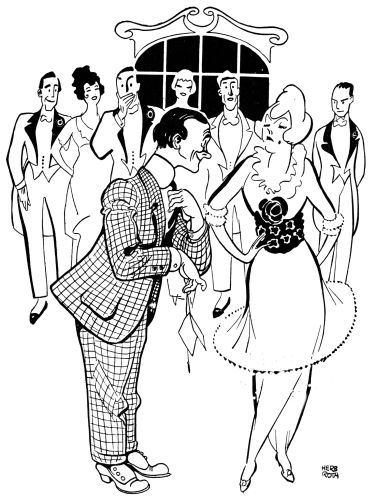
As you stand on the doorstep arrayed in your best, a sudden pang smites you. The door is opened. There is a look of blank astonishment, as you are ushered in. No hostess comes to greet you, no gay appareled guests are there. You are a quoob. The dinner is next Thursday, not to-night. (See Zobzib.)
Which is worse, to be the only one in evening dress, when all the rest are modestly clad, or to be yourself in street-clothes, surrounded by low-necks and jewelry? In either case, you are a quoob.
If you are a natural born quoob, you are the only one of all the audience to applaud, or cheer. At that sudden lull in the conversation, you are the one to speak aloud. “No, I must say, I prefer the old-fashioned night-gowns.”
Sadly the quoob waits in the drug-store for the girl who never comes. (See Quink.) He goes to a party thought to be smart, to find he is the only one of importance.
A woman who is too tall is a quoob, or a man who is too short. So are you, when in rain coat and rubbers, after the sun has come out, or returning home in the morning, in your last night’s dress suit.
I dreamed that I went out to walk In but my nightshirt clad! I was a Quoob; I could not talk; Oh, what a time I had! But that was nothing to my plight When dining with Miss Lee— They all wore evening clothes that night Except one Quoob—’twas me!
QUOOB
Rawp, n. 1. A reliably-unreliable person. 2. One who means well. 3. A kind of husband.
Raw´pus, a. 1. Dilatory. 2. Semi-efficient.
The rawp can be absolutely depended upon to forget to bring “that book” he borrowed and that now you need.
Unreliable? Oh, you can depend upon him never to keep any engagement promptly; you would so much rather that he would fail utterly—then you could properly scorn and suppress him. (See Zobzib.)
But he does answer his letters—after a while. He does mail letters—after they are sufficiently smooched and crumpled in his coat pocket. The rawp, like the zobzib, is almost always late for the train, late enough at any time to give you a hygog.
Rawpus is the clerk who makes errors in his additions; the typewriter who spells “to” in three ways—all wrong, is also rawpus. (See Splooch.)
“Did you get me that spool of red silk I asked you to this morning?” said Mrs. Smith. No, he forgot it. Mr. Smith is a rawp.
“Did you ring up Green and tell him to send a man to mow the lawn?” asked Mr. Smith. No, she didn’t; Mrs. Smith is a rawp.
And little Sammie Smith, who never goes to bed until he’s been told seven times—what then is he? A rawpet?
When Mr. Rawp arrived, the boat Was sailing from the pier, And Mrs. Rawp was there, afloat— So far, and yet so near! No wonder Mrs. Rawp was vexed, For she returned, to find He took the steamer sailing next, And she was left behind!
Riz´gid-get, n. 1. A state of mental inertia or indecision; an inability to make up one’s mind; a case of rival possibilities. 2. One who is lazily undecided.
You get the commonest, the most usual rizgidget in the restaurant: “What shall we have to eat?” But in seeking a gown, a hat or a wedding present, the rizgidget is always lying in wait for you, ready to infect you with mental sleeping sickness. It can catch you in the park and prevent your being able to decide even which side of the fountain to pass.
“Where shall we go on our vacation—to the mountains or the seashore?” This is the rizgidget which blooms perennially on June 1st. (See Uglet.)
“How much ought I to ask for it?” This is the rizgidget that has prevented many a sale.
“Which man shall I accept?” So the popular maiden is rizgidgeted.
“It looks like rain; shall we go or stay?” “Shall we sell our stocks, or hang on?” We cannot make up our minds; we are the victims of a rizgidget.
Why, every time you have a dinner party, you have the rizgidgets over whom to invite. (See Cowcat.)
A donkey with two bales of hay, So does the fable run, Rizgidgeted the livelong day, Deciding on “which one?” So, with a stupid brain that’s stirred By sluggish fuss and fidget, Deciding what to name this word Do I delay—rizgidget!
Rowtch, n. One who has elaborate gastronomic technique.
Rowtch, v. 1. To accomplish strange maneuvers over food by means of a knife and fork. 2. To eat audibly or with excessive unction.
For the “Kansas City” or “banjo grip,” the rowtch, taking the fork in his left hand, places his thumb and little finger below, while the first, second and third fingers, as if touching the strings, press down upon the top of the instrument. (See Wog.)
The “Texan” grip is still more desperate; the fork is gripped as if about to stab—indeed it does stab, too!
Rowtching, however, can be done with a knife, as in the well known operation upon the tonsils, incidental to meals among our lower classes; the knife may be used to rowtch peas, or as a tool in that form of food-modeling which children affect.
More delicate and refined, more dainty and feminine is that form of rowtching which consists in jabbing a piece of meat upon the fork and adding dabs of potato, turnip and gravy until the utensil is heaped with its heterogeneous burden. Mashing and smoothing down of potato and smearing it with butter affords the rowtch opportunity for his plastic skill, or you may swirl your soda water glass.
Vegecide, the cutting of cooked potatoes and garden truck with a knife, is the only rowtch that obtains in high life.
A conscientious eater was My mother’s Uncle Bill; We liked to see him eat, because He liked to eat his fill. And when he’d rowtched the meat and bread And things all out of sight, He pushed away his plate and said “Lord, where’s my appetite!”
Skinje, v. To feel shudderingly; to annoy your fingers; to shrink from; to set your teeth on edge.
Skinjed, p.p. To have one’s tactile nerves outraged.
Skin´jid, a. Harsh, rough or gritty.
Did you ever skinje a broken finger-nail on satin? “Alias, Jimmy Valentine” can rub his finger-tips on sandpaper, but it’s too skinjid for poor little Me.
My Aunt Eliza’s hands are skinjid; no wonder, she will wash them in soft-soap. And every time I kiss her chapped lips, I am horribly skinjed. (See Vorge.)
James Whitcomb Riley, in a pathetic little verse, tells of a sensitive, delicate young lady who loved to draw her finger-nails in long, sweet scratches down the plastered walls, skinjing them pathetically. You and I prefer to scratch bricks or blackboards—they are more skinjid. Do new towels skinje you? Do you skinje at wet velvet? Can you bite a skinjid file? Your collar—has it a skinjid edge?
“Put more starch in them lace curtains before you iron ’em,” says Mrs. O’Hatchet to the hired girl. “Mr. Masters always likes to feel of ’em before he goes to bed.” (See Kripsle.)
As skinjid as a plaster wall, As skinjid as a file, So is the world when I am broke; I cannot laugh or smile. But when my purse is full and fat I know no teasing twinge; I meet so much to giggle at Nothing can make me skinje!
Sky´scrim-ble, v. 1. To go off at a tangent; to fly into space. 2. To make a wild flight from an untenable intellectual position.
The acrobat on the flying trapeze skyscrimbles in a thrilling arc from perch to perch. So skyscrimbles the philosopher into words of seven syllables, when you ask him about the Deity. (See Gubble and Edicle.)
A woman caught in an inconsistency skyscrimbles through an hour of fantastic argument.
When Wilson won, red Republicans skyscrimbled up into the Democratic fold. (See Eegot.)
Tell a Socialist that “You can’t change human nature,”—he skyscrimbles in Marxian metaphysics.
So, when you complain of your laundry, or your telephone service, or the railroad company’s neglect, men skyscrimble, passing the blame from one to another.
Ask one actress about another’s age.... “Why, she was in the Murray Hill Stock Company when Dustin Farnum used to” ... etc., etc., etc.... A skyscrimble.
I asked a Suffragette one day, Whose wits were neat and nimble, Why she had rouged her cheeks that way— She did a quick skyscrimble. I told a man ’twas funny that His overcoat was new While wifey wore her last year’s hat— And he skyscrimbled, too!
Slub, n. 1. A mild illness, that does not really incapacitate. 2. A “headache.” 3. An indisposition, manufactured for an especial occasion.
Slub´by, a. Feeling the necessity of a good excuse.
A slub is a cold, a headache, a boil or any affection in the disreputable underworld of disease. There’s nothing of the aristocracy of pain in the slub. It is, so to speak, a mere working illness.
Men’s slubs, however, are more intense than women’s. A man when he has a slub, says, “Oh pshaw! it’s nothing.” But he expects, all the same, to be assiduously attended. Every woman in the household must minister to his misery. (See Varm.)
Women have slubs innumerable, and for the most part say nothing about them, unless they want an excuse for staying away from a party. When the society woman has a slub, she sends for a good looking doctor. (See Alibosh.)
Children, however, are oftener slubby—when they don’t want to go to school or to church the slub works overtime. (See Uglet and Moosoo.)
Shop-girls are not allowed to have slubs.
“I have a slub!” the maiden said, “I cannot go with you. “You’ll have to go without me, Fred!” And Fred felt slubby, too. But when, at ten o’clock, or so, He found his girl disdainful Maxixing with his hated foe Fred’s slub grew really painful!
Snosh, n. 1. Vain talk; 1000 words to the square idea. 2. A talker from whom no results are expected; one who cannot be taken seriously. 3. A project or enterprise that is born dead.
Wall Street is where the snosh abounds. Advertise, circularize, collect and disappear—that’s how they work the gold-mine snosh. (See Alibosh.)
Queer, isn’t it—a man who’s always “full of schemes” is always a snosh, while a crank with one idea may succeed. Why? A snosh is always imitating something. He is the theatrical manager who follows up a successful play with a third-rate duplicate.
But, talking about plays, did you ever talk to a society woman who was writing one? It’s a snosh. In the first place, she won’t finish it until the year 1977 and then it will take her a double-lifetime to find a big enough fool to produce it. Broadway is lined with snoshes—but the word isn’t necessarily theatrical. The smart restaurant that insists on evening dress is a snosh—and so is an actress who says she loves you.
In Reno dwells the married snosh. Any wedding performed upon a bride and groom under the age of 25 is a snosh. So is a marriage with a Count. (See Pawdle.)
Miss Pittsburgh swore that she would wed A title, and by Gosh, Miss Pittsburgh did; her father paid A million for a snosh. And now, although he swears at her, It is a Count that swears, And over eyes he’s black-and-blued A coronet she wears!
Spigg, n. 1. Any decoration of overt vanity. 2. Extrinsic charms. 3. Things worn obviously to attract notice.
Spig´get-y, a. Prinked, elaborately adorned.
Paint, powder, dyed hair, court plaster patches, artificial dimples, highly manicured and rouged nails, blacking under the eyes, whiting under the chin, rouged ears, lead-penciled eyebrows, loaded eye-lashes are spigg. (See Wowze.)
Jewelry is spigg; spigg is the treasure-chest of would-be beauty, the ammunition of the bogus Cupid.
In some latitudes, ladies are spigged with tattoo marks and nose-rings; in others, with marceled hair and low-necked gowns. (See Varm.)
Men spigg themselves with fancy socks and curled moustaches. In the cart-horse parade, Old Dobbin spiggs his braided tail with ribbons.
For spigg is nothing but a vanity that is not ashamed to advertise itself; but advertising is one of the most difficult of arts, wherefore now its appeal is as grotesque as the three fat seasick plumes in the dowager’s hair, and now it is as delicate as the violets in a debutante’s bosom.
So spiggety was cousin Grace, When I was there last night, I could not even see her face; She was a shocking sight! “Why all this flour and whitewash, dear? Why so much black-and-red?” “Because I’d feel so nude, this year, Without my spigg,” she said.
Spil´lix, n. 1. Undeserved good luck; accidental success. 2. A lucky stroke, beyond one’s normal ability.
Spil´lix-y, a. Exceptional, lucky, uncharacteristic. Untrue to “form.”
At pool, tennis or golf, the spillix aids the amateur with proverbial luck. A spillix is winning a prize in the lottery; is the business deal, that unexpectedly goes through; is meeting an influential friend when you are in your best clothes. Getting a position by inadvertently happening to be right on the spot.
A bargain is a spillix; an exciting conversation overheard on the telephone. (See Frowk.)
Thousands of people, intending to cross on the Titanic, took the next boat following—and boasted of the spillix.
It’s a spillix, to find money in the street; also to discover that the chaperon is more charming than the girl herself. Through a spillix, you blunder into success. (See Zobzib.)
Every young May that weds a rich old December, prays for a spillix, but he seldom dies to leave her a fascinating widow in becoming robes of black.
A spillix is a lucid interval, or the bright remark of a fool.
His first shot to the bull’s eye flew— He would not shoot—for then It was a spillix, and he knew He would not score again. So, when he wed the girl he sought, We thought ’twas rather funny— It was a spillix; for she thought, Alas, that he had money!
Splooch, n. 1. A failure, a ruin. 2. One who doesn’t know his business; a bad amateur. 3. Exorbitantly overpaid service.
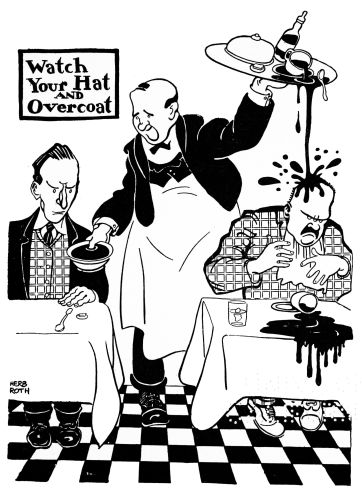
One thinks at first naturally of a restaurant; there are more splooch waiters than anything else in the world. Next, come servant girls, the splooch that burns the soup and leaves the salt out of the bread. A cake with an ingrowing stomach is a splooch. A suit of clothes that looks anxious about the shoulderblades—wet hay—bug-eaten potato plants and pears with worms inside—splooches all.
Most musical comedies are splooches, most stories in the magazines, most janitors. (See Jurp.)
What then, of the dentist who pulls out the sound tooth by mistake, or the surgeon who takes out your appendix but leaves his eye-glasses inside? He’s a medico-splooch.
Then there’s the vaudeville juggler who splooches the balls and the singer who’s off the key. (See Snosh.)
Every day on Wall Street ten thousand lambs make splooch investments, hoping to become captains of finance.
I’ll never dine at Mack’s again; The splooch that slings the eats He makes me wait an hour, and then He serves me corn, for beets! Last night I ordered Irish stew, And there my wife’s old brooch That she had lost a year or two Was hidden in the splooch!
SPLOOCH
Spuzz, n. 1. Mental energy, an aggressive intellect. 2. Stamina, force, spice.
Spuz´zard, n. 1. An active, forceful thinker. 2. A cocktail with a “kick” in it.
Spuz´zy, a. 1. Highly seasoned. Charged with brain-electricity.
Theodore Roosevelt and Kaiser Wilhelm have spuzz. Demiourgos, maker of men, gave them an extra dash of the tabasco. (See Persotude.)
Spuzz in acting, in writing, or in business is what brings in the money.
Spuzz welcomes competition; it is always ready for the fray.
You can’t down the spuzzard; he is elastic, and bounces up after every failure.
The spuzzard is the girl who could “just die dancing.” She answers her letters the day they are received.
The farmer with no spuzz to him can never lift the mortgage; but the spuzzy intensive Italian down the road is educating his sons to be doctors and lawyers.
Spuzz is that getaheadative zip, tang, and racehorse enthusiasm that has for its motto, “Do it now.”
A good Welch rarebit has spuzz; so has a dry Martini—but it’s the wrong kind. (See Looblum.)
How I admire a Suffragette! No matter what she does, She has red corpuscles, you bet! She has a lot of spuzz! And yet—I would not marry her; But some shy, timid elf, Some clinging flower shall be my bride; I’ll find the spuzz, myself!
Squinch, n. A nervous, anxious state of mind; a palpitating desire to succeed beyond one’s deserts.
Squinch, v. To watch and wait, hoping things will turn one’s own way; to anticipate.
No squinch like the sailor’s, sniffing the weather from the catheads, or wherever he sniffs it from—unless it is the farmer, squinching for sun or rain that will bring a harvest of crops enough to pay the interest on the mortgage.
You squinch the stock market for a rise or fall; but no matter how you squinch U. S. Steel Common, there’s always someone squinching it the other way.
Then there’s the lottery squinch—or there used to be, wondering if the winning number will end in 6.
The candidate is on the squinch before election with his ear to the ground. President Wilson squinches Mexico as anxiously as a village girl squinches her beau for a proposal. (See Quink.)
See the House Manager of a theatre in the box office squinching the crowd coming in for the evening performance! So I squinch this word, hoping that it will become popular.
Behind his geography, little Willie squinches his teacher, as he reads, “The White Slaver’s Revenge,” or, “Saved by Eugenics.” (See Kipe.)
I knew that I was squinched, because When e’er I spoke of rings, Or wedding bells, or marriage laws, She looked unuttered things. But still I flirted, standing pat, And did not yield an inch; I told her I was married—that Was how I fooled her squinch!
TASHIVATE
Tash-i-va´tion, n. The art of replying by means of reciprocal tones.
Tash´i-vate, v. To reply without attention; to speak aimlessly, or without interest, as to a child.
Tash´i-vat-ed, p.p. Absorbed in more interesting things; inattentive; answered perfunctorily.
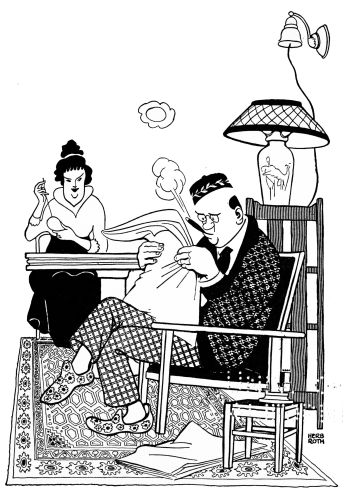
Have you acquired the art of tashivation? Can you read the newspaper right along through your wife’s gossip, or your little daughter’s prattle? This is the secret of true domesticity; it is the science of being a husband.
The actress has an ear trained to distinguish emotions, and a tongue trained to answer them without the conscious use of her brain. A friend tells her a long, dull story, and her mind wanders through the Elysian Fields of her own experiences, unheeding. Suddenly the tale ends—“And there she was, right in the room with him!” What was it all about? Never mind, the answer is easy: “Well, what do you think of that?” (See Drillig.)
Tashivation is answering without listening, as one speaks to a beggar—as one talks at a crowded reception, as one answers the man who asks for a loan.
When a man explains machinery to a woman, she tashivates, her mind on pleasanter things; and so, when a woman explains fashions to a man. (See Varm.)
Why do I tashivate, and say “Oh, yes,” and “Really?”—“Yes?” Because although she talks, I try To read my book, I guess. I nod and smile, and speak, sedate; My wife keeps on her chatter. So long as I can tashivate Her questions do not matter.
Thusk, n. 1. Something that has quickly passed away. 2. A precocious memory; an unnatural feeling of remoteness.
Thusk´y, a. So near, and yet so far.
Thusky are the sounds in the street, as you lie ill in bed in summer. Thusky are your old love letters, tied in blue ribbons, the last one postmarked fully a week ago. (See Iobink.)
Yesterday’s newspaper is thusky, and last year’s popular song. Thusky are the novels that six months since were talked about and read. Thusky are last winter’s styles. (See Gowyop.)
While you are abroad, the American newspapers are thusky; when you are returning, all Europe is a thusk.
Thusky is the house you once lived in; your old sweetheart of college days.
Which is the thuskiest,—a dead actor, an ex-president, or a popular hero, now laid on the shelf?
I met a thusk the other day; Three times I had to look Before I recognised him—say, ’Twas only Doctor Cook! How thusky, now, his polar jest! As thusky as the way A joke would sound, if ’twere expressed In slang of yesterday!
Tin´tid-dle, n. 1. An imaginary conversation. 2. A witty retort, thought of too late, a mental postscript.
Tin-tid-di-la´tion, n. Optimistic day-dreaming.
Oh, the bright reply you thought of, after you had gone—the crushing answer that you might have given! Who does not know the tardy tintiddle? The questions you forgot to ask, the terms you forgot to make, the repairs you did not ask. Was there any closet in that corner room? Now, did that include water, or not? Tintiddling comes with tantalizing thought. (See Iobink.)
When you rehearsed your speech the night before, the chorus of applause came tintiddling to your ears. And when tintiddling you proposed to the girl, she fell gratefully into your arms.
When in tintiddilation, you applied for that position, how noble was your pose—how convincing were your words! But they were only tintiddles, and tintiddles never come out as you expect. (See Bimp.)
Chastely tintiddling are the wedding anticipations of the bride! (See Jujasm.)
Tintiddling vainly, I proposed To Kate—and was accepted. Next day (as you might have supposed), I was with scorn rejected. How oft, tintiddling all alone, I’m witty, wise, defiant— But in real life, no one has known That I’m a mental giant!
Ud´ney, n. 1. A beloved bore; one who loves you but does not understand you; a fond, but stupid relative. 2. An old friend whom you have outgrown.
Your mother, your doting aunt, your dull, but affectionate husband, your favorite brother’s wife; or the man your sister is engaged to—udneys all. You hate to hurt their feelings; would they not do anything in the world for you? You go to them in your troubles and you forget them in your pleasures. You hate to write to them, but manage to scrawl hasty and vapid notes. (See Uglet.)
The udney gives you gifts of clothing you can’t possibly wear, and expects you to rave over them.
Or, the udney is someone who likes you more than you like him. He is like an affectionate dog, always under foot or licking your hand.
In the pathetic slavery that women endure, not the slavery of women to men—but that of women to women—the udney has the master hand. The blindly doting parent, whose daughter “has no secrets from her,” rules with a rod of sugar. Though her daughter may be old enough to have to “touch up” her hair—yet so long as she has a “Miss” before her name will it be her doom to be the willing slave and pet of an unconscious udney. (See Varm.)
Jane’s mother nothing did forbid; She was an udney, though— Because, whatever Janey did Her mother had to know. “Of course he’ll marry you,” one day, She said to guilty Jane, “Or else why should he kiss you, pray?” How could the girl explain!
Ug´let, n. 1. An unpleasant duty. 2. Something one puts off too long.
Ug´gle, v. 1. To procrastinate respecting the inevitable. 2. To do something one dislikes.
Having to have your teeth filled is an uglet; you wait and wait, trying to find the time—and the courage.
Getting up early in the morning is an uglet; inquiring regularly about convalescents; and getting a spring hat, or a new fall suit—delaying until you are the last one in town. (See Vorge.)
It’s an uglet to clean your top bureau drawer; and calling on the Wilsons—darning your stockings—or buying a wedding present, or having your picture taken. (See Digmix.)
“Oh, I’ve simply got to do that!” But—how long you delay in inviting the Ransoms to dinner! It’s an uglet.
Paying the doctor’s bill is the universal uglet. (See Igmoil.) But answering letters from people you haven’t seen for a long time is worse.
It was an uglet that I feared; It grew, and grew, and grew, And long I had to dree my weird— That deed I dared not do; And yet it must be done! In fear, Unto my wife, I said: “Your hat is NOT becoming, dear— You never should wear red!”
Unk, n. 1. An unwelcome present, an inappropriate, undesirable or distasteful gift. 2. A duplicate wedding present. 3. A souvenir, or picture postcard.
These are the classic unks that women give to men—unwearable neckties, hand-embroidered suspenders, smokeless cigars—“La Flor de Chinatown!” They give them sleeve-button unks, unks made of shiny black leather. “It’s so hard to find gifts for a man!” (See Gefoojet.)
Men give in return, feminine unks—flowers that don’t match a girl’s gown; perfumery in fancy bottles; a dozen pairs of gloves of an off color; souvenir jewelry boxes with pictures of the State Capitol on top; impossible paper cutters; ivory handled nail files elaborately carved, that will not file. (See Quisty and Diabob.)
Women of uncertain age receive unks in the form of bed-shoes, with an old-maid implication; linen collars, with stiff tabby-cat bows in front, disgustingly neat—“so nice for business!” There they are, in back of the bureau drawer, yellowing with age.
When you were married, you received thirty-four wedding unks; nine pie knives and forty-five pickle forks.
A gold pencil that won’t write is an unk; so is that padded seal volume of Tennyson on the shelf beneath the center table. (See Gorgule.)
What is an unk? That thing that lies Upon your bureau, there! You have outlived your first surprise; You do not even care. Its faint and foolish life is done, It is a mere negation;— An unused souvenir of one Without imagination!
Varm, n. 1. The quintessence of sex. 2. One who is characteristically womanish or man-like.
Var´mic, a. Monosexually psychologic. 2. Provoking intersexual antipathy.
A man in love thinks himself attracted to a woman because she is feminine, and different from him; in reality, it is because he thinks she is different from other women. He does not discover her varm. Other girls are vain, tricky, deceitful and illogical—she is a creature unique.
But, when he is married, she becomes unexpectedly varmic. He watches her egoistic poses before the mirror, and the first time their “togetherness” is broken by her confidential delights with another woman, he sees her varm.
To a man, there is something he hates in woman, if not in women. It’s the subtle antipathy of sex—the things women tell each other—the things they do—it’s the varm.
But so women secretly hate men—hate their childishness, their superiority, their insanity and their blindness.
“Just like a woman!” So do men voice their varm.
Your wife’s bureau drawers are varmic. So is a tea-room, or a woman’s club, or a co-educational college, or the ladies’ dressing room of a fashionable restaurant. (See Spigg.)
Smoking tobacco is no longer varmic. (See Ovotch.)
How would you like to see your husband at a prize fight? There varm is violent.
I hate a girl—but my Hortense Is not the average woman; She has more brains, she has more sense— In fact, she’s almost human. Or, so I thought, until, one day, She lost that previous charm, I overheard her talk with May— Hortense was but a varm!
Vilp, n. 1. A bad loser, an unsportsmanlike player. 2. A gloating victor, or one who is intoxicated by success.
Vil´pous, a. Unscrupulous, cheating in games.
The vilp is always explaining why he lost the game and usually blaming the fault upon someone else—he “usually plays a much better game” than the one you see. This time, it is only because he has the rheumatism, or didn’t get any sleep last night. (See Slub.)
The vilp plays to win—plays for the stakes or the prize. Women vilps have even been known to cheat at cards to gain a half-pound box of candy tied with yellow ribbon.
The vilp takes advantage of all his opponent’s slips, calls all fouls, but does not notice his own. He crows over his victim when he wins, and sulks when he loses. He bullies his opponent, and whines when he comes out last. (See Igmoil.)
There is no sex to the vilp; the women at the bridge and the men at the poker table are alike vilpous. (See Gorm.)
There is no sport like Love, and he Or she who plays the game Must play to win; and so, maybe, The vilp is not to blame. “All’s fair in love and war,” they say, So women cheat and fight, And men compete the vilpous way. But does that make it right?
Voip, n. Food that gives no gastronomic pleasure; any provender that is filling, but tasteless.
Voip, v. To eat hurriedly, without tasting.
Every morning, millions of Americans go forth sustained for work, but cheated out of the pleasures of a real repast—they have merely fed on voip.
Pop corn was the original voip, discovered by the Pilgrim Fathers. Next came crackers, ham-sandwiches-without-butter and the sawdusty provender of railroad lunch counters. (See Mooble.)
Ginger snaps are voip; so are buns and doughnuts. Lastly came the reign of glorified voip in decorated pasteboard packages—breakfast foods of all degrees from birdseed up to dried peas.
New York has discovered the art of transforming any food into voip, by the simple expedient of making you eat it standing. (See Uglet.)
At breakfast, when on voip I feed, Mechanically chewing, My listless palate does not heed, Or know what it is doing. I oft forget, when I am through, And wonder if I’ve fed! I have to feel my stomach to Be sure I’ve breakfasted!
Vorge, n. 1. Voluntary suffering; unnecessary agony. 2. The lure of the uncertain.
Vor´gid, a. Morbidly fascinating; interested in horrors.
Peary was a vorgid man; twenty years of freezing half to death did not conquer his appetite. When he had found the North Pole, he didn’t know what to do with it. To him, life was just one vorge after another, pulling sledges, eating shoes and candles, sleeping in a bearskin bag. (See Yab.)
Whence comes the vogue of the vorge? As a child, you could not help putting your tongue to frozen iron, although you knew the skin would stick to it; the deed was vorgid. You put beans up your nose, and wheat up your stocking. You tattooed your arms; and that attractive sore compelled your touch. Vorgid was castor oil, and bitter medicines. All these things were horrid, but you did them and boasted of the vorge. It is vorgid to pull out your own tooth.
But how about him who escorts his homely cousin to a dance, and gets her partners? Is this less vorgid?
Oh, very vorgid is he who makes a speech, but vorgider far the groom at a fashionable wedding.
Are you vorgid? Do you enjoy doing palestric exercises in the Gym, or a cold bath on winter mornings? (See Gloogo.) Do you look forward, vorgidly, to the happy Xmastide?
Vorgid is women’s talk about their “operations.”
Oh, vorgid ’tis to pant and strain And tug, the athlete thinks; And it is vorgid, in the rain, To golf o’er soggy links. But it is vorgider, by far, Than such palestric feat, To give that lady in the car Your Oh-so-longed-for seat!
Vo´ri-an-der, n. 1. A woman who chases after men, instead of being chased. 2. A woman who telephones to men, or invites herself to dinners at his expense.
Vo´ri-an-der, v. 1. To act as above described; to inflict oneself upon an unwilling entertainer. Women’s overt competition for men.
To most men the voriander is anathema. He would prefer to ask the dullest girl in the world to dinner than to entertain the prettiest, who has invited herself.
Sly and patent are the tricks of the voriander. She may telephone you: “Have you got your car out of storage yet?” Or she may say, point-blank: “Say, isn’t there a dinner coming to me along about now?” (See Eegot.)
The voriander is sometimes pretty, but never attractive. Her attempts are usually dodged, but she still persists. “Confound it, I just will get that man!” she says, and proceeds to voriander.
Never introduce a friend to a voriander. There are other kinder ways of getting rid of her. A cat can be kissed to death, or smothered in fresh butter; not the voriander. You have simply to leave town.
The voriander is “crazy” over you, and your purse. She writes you perfumed notes, she telephones you during business hours. (See Drillig.)
Many vorianders are over thirty years of age.
Beware the voriander, boy, With mouth that kisses and torments. She only loves you to enjoy Expensive foods at your expense. Beware the voriander, let Her scented notes unanswered be; She’s after just what she can get; And when you’re broke, she’ll let you be!
Whin´kle, n. 1. Graciousness, with ulterior intent; a hypocritical politeness. 2. A glow of vanity.
Whin´kle, v. To appear over-cordial or suspiciously amiable; to act snobbishly.
Some beam with a merely personal vanity; they whinkle from sheer self-satisfaction. But when Jones saw me, he whinkled till I thought his front teeth would spill out of his face. Why? I was talking to a millionaire. (See Eegot.)
So the match-making Mamma whinkles at that desirable young man, who is calling upon Bessie.
So the book-agent whinkles as he shows you his samples; and the insurance agent, just before you kick him out.
Whinkles the floor-walker, like the girls at a seashore resort, beckoning the only nice young man; but the floor-walker whinkles not when you return a “thirty-six” waist for a “thirty-eight.” (See Jurp.)
The mother whinkles when you praise the baby, and the proud undertaker when he first displays the corpse.
Mark the whinkling landlady, showing the third floor front to the prospective lodger. “You’ll find it a very comfortable home here; everyone has always been happy here—very! Nice and sunny ... plenty of towels ... closet ... nice, soft bed—no bugs in my house. Lovely bureau, plenty of room for all your things. I am sure you couldn’t do better.”
How whinkles the pallid clerk at his employer’s jokes.
When first my motor-car I bought, The salesman wagged his tail— He whinkled till I almost thought He’d kiss me, for the sale. But when the poppet-valves were strained, And had to be repaired— No whinkling then, when I complained;— The salesman merely glared!
Wij´ji-cle, n. A perverse or contradictory article of furniture; any household contrivance that is always out of order.
“You’ll find no wijjicles in this house,” said the agent as he unlocked the front door. “It’s in perfect order.” And yet, before I had left I had found:
Eight window-screens that wouldn’t go up or down; loose boards in the dining-room and three on the stairs that squeaked; a leak in the roof, a smoky fireplace, three cupboard doors that wouldn’t shut, four closet doors that would swing open, and a long, phlegmatic bath-tub that it took three-quarters of an hour to fill, through its reluctant faucet. (See Quisty.)
But I must confess I brought in my own wijjicles, too. Reader, you know them well—
The folding camp-chairs that can’t be unfolded, the three-legged tables that tip over, the rocking-chairs that bite you on the shins in the dark and patent spring-rockers that squeak; the unoiled door, the mirrors with wavy glass, the bureau drawers that stick and the step-ladders that won’t stay open; the baby-carriages that are always in the way; plush furniture that sticks, and painted chairs that come off on your back; screen doors that bang, and rugs on slippery floors, the table that balances unsteadily.
But the worst of all, is the pencil with its lead broken far up inside the wood. (See Moosoo.)
I bought a rubber fountain pen; “Non-leakable,” the clerk Assured me confidently, when He showed me how ’twould work. But now that wijjicle and I Into the bath-tub go When I must write my letters. Why? Well, things are safer, so!
Wog, n. An attached foreign body, an unornament.
Wog, v. To daub fantastically; to decorate an unconscious victim.
Wogged, p.p. To have any intrinsic defect or visible superfluity.
Wog´gy, a. Unpleasantly adorned.
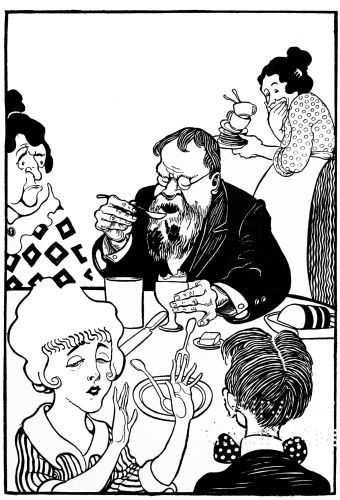
Have you ever seen the gentleman with the Niagara-Falls moustache? Pretty woggy, what? When beautiful Bessie drinks buttermilk and forgets her napkin, what can you say? Such things must not be told. Think of Bessie—with a wog! You must turn away your head and blush—or else Bessie must. Wogs embarrass. (See Pooje.)
But facial stalactites are not the only wogs, alas! Millicent’s hair is wogged—prithee catch the hairpin before it falls. As you pick a thread that wogs your wife’s grey gown, she discovers a blonde hair on your coat-collar, the most embarrassing of all wogs.
Pittsburgh wogs its women with spots of smut, black as court-plaster patches. You really ought to get a new dress suit, for yours is seven years old and wildly wogged with grease-spots—where you spilled the pink-and-green ice cream into your lap and where the Swedish waiter bathed your shoulders with cauliflower soup. There is a wog of ragged braid on the bottom of your torn skirt, a running wog in your silk stocking. (See Splooch.)
Don’t get wogged! (See Zobzib.)
I never care for onion soup— For onion soup, and hash, And scrambled eggs remind me of My uncle’s red moustache; For that was what we had to eat When Uncle Silas, togged In Sunday raiment, came to dine, And got his whiskers wogged!
WOG
Wowze, n. 1. A woman who is making a fool of herself and doesn’t know it. 2. Any ridiculous and undignified object. 3. A spectacular exhibition of unconscious humor.
Wowze, v. To act with a misguided belief in one’s charm; to cavort hopelessly.
Have you ever seen a painfully conscientious amateur tangoist counting her steps? “One-two-three—hold!” She’s a wowze! Have you ever been to church on Easter Sunday in the country? There are wowzes galore.
An elderly maiden being kittenish—a perfect wowze! An elderly aunt, talking baby-talk to her infant niece—the wowze pathetic. A female art-student—the wowze aesthetic.
A wowze is a female poem-reciter in a hot parlor; a fat woman in swimming; an overgrown girl in short skirts; an angry landlady; a miss in curl-papers. A shirt waist of plaid silk is a wowze, and a cook, learning to skate. (See Frowk.)
A literary lady, trying to look “artistic”—she’s a wowze and her gown is wowzier.
The wowze-social:—A woman who doesn’t like it, trying to smoke. (See Ovotch.)
Miss Henderson was meek and mild, But, through her black silk veil, She drank a glass or two of milk— (She had been drinking ale.) Then, answering our wild applause, She rose with smiles and bows. She’d proved that she was clever, but She was a perfect wowse!
Wox, n. A state of placid enjoyment; sluggish satisfaction.
Wox´y, a. Contented; ruminant; at peace with the world.
As the glutted anaconda, after swallowing a sheep alive, rests for a benign month or two underneath the tum-tum tree, thinking of home and mother, while the gross lump in his stomach gradually declines and lessens—so is the wox of the woman well and appropriately gowned, especially if that dress of hers has been successfully made over beyond all recognition.
Woxy is the broker, as stocks go up. Woxy is the fisherman, when the fish begin to bite. Woxy is the legatee, when the lawsuit is over and his inheritance is paid.
After your long tramp in the rain, after your bath and hot dinner, you sit by the open fire in a wox.
There is no joy but calm, say the Buddhists; it’s better to be woxy than excited with rapture. (See Jujasm.)
The author is in a wox; his story has been accepted. Woxy is the actor in a good hotel at last, after three weeks of one-night stands; when he pushes the bell, something delightful is sure to happen. There can be no wox, alas, without a previous annoyance. (See Fud.) But is not all the maddening bustle and trouble of moving worth—when you are finally settled and at ease, with every carpet down and every picture hung—the homelike, comfortable wox that follows?
I ploughed my way through wind and storm To call on Fanny White; And in her parlor I was warm And woxy with delight. ’Twas not because I loved her though— For I was fairly foxy; I’d sold her Life Insurance, so That’s why I felt so woxy!
Wum´gush, n. 1. An insincere affectation of cordiality; hypocritical compliments. 2. Women’s flattery of women; pretended friendship. 3. A feminine fib.
Do women criticise each other to their faces? Do they find fault with their chocolates, their looks, their clothes, their jests? No, not until the front door is closed; till then, they slobber wumgush. (See Varm.)
And yet, if one man offers another a cigarette, the tobacco may be called “rotten!” without peril or anger.
Men have small use for wumgush; their compliments are profane ridicule and simulated enmity.
A man calls his best friend a “damned fool”; a woman calls her worst enemy, “My dear!” (See Alibosh.)
How women must fear each other! They smooth their rival’s hair; lovingly, they readjust her jabot and pat her hands lingeringly.
“How well you’re looking, my dear!” ... and yards and yards of wumgush.
“Oh, I’ve had such a wonderful time! How charming of you to have asked me. Now, you must come to see us.”—Wumgush. (See Gubble.)
Wumgush is the frothy foam of society chatter.
Wumgush is the sunshine through which fly the wasps of sarcasm. (See Flooijab.)
The wumgush Clara spills on Lou, Whene’er they meet, and kiss, Would seem to prove a friendship true, But it amounts to this,— “Your waist is soiled; and, oh, that hat! Trimmed it yourself, I know! You never ought to grin like that, It makes your crow’s feet show!”
Xen´o-gore, n. 1. An interloper; one who is de trop, or keeps you from things or persons of greater interest. 2. A self-invited guest, who stays too long.
The xenogore is a person who doesn’t belong, but doesn’t know it. It is the shopper who paws over goods, and prevents customers from buying; an extra woman, who drops in when you want to play whist; or the creature who appears at dinner-time, when you have just enough for the family and no more; who invites himself into your motor-car, crowding you miserably. He annoys you when you are talking business, and spoils the sale.
Children in the room, when you are calling, are xenogores. (See Kidloid.)
Someone talking to you, when you want to listen to that interesting conversation opposite, is a xenogore.
A xenogore is likely to be anyone of your wife’s relations or friends; but it’s sure to be that girl you have to escort home, and don’t want to. (See Uglet.)
A girl who accompanies a couple in love is a xenogore. (See Vorge.)
I longed to see her Paris gowns, And hear about my aunts, And all those queer cathedral towns— She’d just returned from France. I’d scarcely welcomed her—before I’d told her she was thinner, There came a ring—a xenogore! Of course he stayed to dinner.
Yab, n. 1. A monomaniac or fanatic, interested in one thing. 2. A favorite topic of discussion, or conversation.
Yab´by, a. Talking continually on a single topic.
Yabs, a. Foolishly interested or absorbed.
People used to be yabs on religion, but you seldom see a gospel yab, now that Dowie has passed from sight. Still, there’s a pretty pronounced Christian Science yab on in idealistic circles. Business yabs, yes; but your wife won’t stand for it at the supper-table, unless your guest is a good, heavy buyer. (See Eegot.)
The musician lives in a yab-world of his own. He doesn’t understand ordinary English.
Some men are yabs over women, some have a horrible baseball yab that will last over way into February; but the worst of all is a yabby actor, telling you how good he is. (See Leolump.)
Polonius, had he lived, would have said to Hamlet, “Still yabs about my daughter!”
The White Slave yab is almost over and the Sex yab is mute in the magazines; the Bigyab is Tango with a capital Q.
The egoist is yabs about himself; the Englishman is yabby over sport, the Hebrew over money. Me, my yab is “Burgess Unabridged.” (See Gloogo.)
Once a little girl in Phœnix Arizona wrote to me; She was yabs about eugenics, And was healthy as a flea. Put although my Jane was poorly, And was half the time in bed, I was yabs about her, surely, So I married her, instead.
Yam´noy, n. 1. A bulky, unmanageable object; an unwieldy or slippery parcel. 2. Something you don’t know how to carry.
Yam´noy, v. 1. To inflict with much luggage. 2. To carry many parcels at once.
Did you ever see a woman trying to move a Morris chair—or carry a rocker through a screen door? (See Wijjicle.) She is struggling with a yamnoy. She can carry a baby with ease and skill, but it’s a yamnoy to a bachelor.
The yamnoy is a sheet of window glass carried on a windy day; a dripping umbrella that you don’t know where to place; a bird-cage or a bowl of fish, that you don’t dare trust in the moving van. (See Uglet.)
To yamnoy is to move a ladder, or place it upright, or to carry a lawn mower home from the city.
A patient husband ’twas, who bore A yamnoy, huge and bulky; It weighed a dozen pounds or more— No wonder he was sulky. And as he ran to catch the car, More and still more disgusted, His yamnoy fell—and, with the jar, Two watermelons busted!
Yod, n. 1. A ban, or restriction; a rule forbidding pleasant things. 2. A place where one must conform to the proprieties.
Yod, v. To behave circumspectly, or with conventional deportment.
Yod´der-y, a. Stiff, proper, formal; respectable.
Yes, you have to mind your p’s and q’s in a Christian Endeavor yod, or in the house of your best girl. Why, in some places, there is even a yod on the tango! (See Ovotch.)
Don’t you love to get into a place where there’s a yod on smoking? A temperance yod is not so bad—except that you can never get good food where they sell soft drinks.
Remember that restaurant they started a couple of years ago where evening dress was required? That business-suit yod killed it.
Poor little slangy Lulu, with the henna hair! When she was introduced to Millionaire Willie’s mother, she had so many yods on her that she didn’t dare squeak!
Remember that low-necked yod your aunt used to have? Why, nowadays, she wears double-décolleté in a trolley-car. No, those sanctimonious old yoddery days of yore are well gone by. Your wife smokes cigarettes now—your daughter’s skirts are slit up to the knee. However, there’s still a yod on woman suffrage, and we may hold ’em down. (See Varm.)
There was a yod on swearing at The home of Mr. Badd, So this was how he had to spat, When he was good and mad:— “Cognominate that blastoderm! You jacitating void, You go to Heligoland and squirm, You lepidopteroid!”
Yowf, n. 1. One whose importance exceeds his merit. A rich, or influential fool. 2. Stupidness, combined with authority.
You find the yowf sitting at the Captain’s table on shipboard; and at the speakers’ dais at banquets. He is top-heavy with importance, and soggy with self-esteem.
Among the yowfs present were: The Mayor of the Small Town; a state senator; the Dock Commissioner; a bank president, two consuls, the Commandant of the Navy Yard, a police judge, and the Treasurer of the Wild Cat Club. (See Edicle.)
The yowf is long on dignity, and short on charm; but he has to be waited on first. The female yowf has a 46 bust measure, and is important mainly on account of her clothes.
It is always a yowf who gives the reception to visiting celebrities. He travels all over the world, and somehow, is able to mingle constantly with people with real brains. (See Machizzle.)
The yowf was traveling on a pass— And he was grand and fat. A Fourth Vice Presidential ass, Or something big like that. I could not bear him; so, one noon, I pricked him with a pin. He shrivelled, a collapsed balloon— Naught but an empty skin!
Zeech, n. 1. A person of too strong individuality. One whose personality dominates. 2. A monologuist or violent talker.
Zeech´ous, a. Lively, but tiresome; exhaustingly original.
The zeech is usually a good talker and a bad conversationalist; he colors the party, you have to take his tone. He may bring in the sunshine but he destroys those subtler half-lights which give atmosphere.
Curiously, the zeech is a great mixer and yet he will not mix; things must go his way. He is dynamic but has nothing in reserve. (See Spuzz.)
There are no surprises in the zeech—you know what he is going to do and say. You will laugh, but in the end be bored. He makes the party “go,” but prevents its being an occasion.
The zeech is conspicuous, brilliant—but exhausting.
You invite the zeech to dinner, and the first time you are enthusiastic about him. By the third, however, your wife ventures to say, “Oh, let’s not have him this time!” (See Cowcat.)
The zeech told stories without end, The life of all the party. He made no joke that could offend, He made us laugh so hearty! But when at last the door was shut, She said, and hid a yawn, “Oh, he was so amusing, but I’m very glad he’s gone!”
Zob´zib, n. An amiable fool, a blunderer. One who is kind, but brainless.
Zob´zib, v. To act with misguided zeal.
The zobzib “means well”—but deliver us from our friends! He comes too early and he stays too late. He is always in the way. He calls just before dinner, but he will not sit down and dine with you. He is always “just going.” He is fond of picking out a tune on the piano with one finger.
When a zobzib enters, you just know he is going to break or tip over something, or spill claret on the table cloth. He will surely slip on the rug. He is a bull in a china shop, he is as hilarious as a wet Newfoundland dog. (See Splooch.)
The female zobzib gives you advice, “for your own good.” She asks you to buy tickets for church fairs and charity concerts.
A zobzib cannot help missing the train, he cannot help forgetting the theatre tickets. That’s why he’s a zobzib. (See Rawp.)
I’ve often thought I’d like to be a drunkard, so some nice, sweet zobzib would marry me, to reform me.
A zobzib, with a rag and broom And dust-pan, came today; She came to tidy up my room, While I was far away. She left, and everything I need Was zobzibbed out of sight— I can find nothing, but, indeed, That Zobzib “meant all right!”