CHAPTER 4 Defense: Our Kind of Football
Reading edition
We believe defense is one of the most important phases of football. As a matter of fact, we work on defense more than we do on offense. We feel if we do not permit the opposition to score, we will not lose the football game. While in reality most teams actually score on us, we still try to sell our players on the idea that if the opposition does not score we will not lose.
If you expect to have a good defensive team, you must sell your players on the importance of defensive football. Our players are enthusiastic about defensive football. I believe we do a good job of teaching defensive football because the staff and players are sold on what we are trying to do. Defense is our kind of football.
DEFENSIVE OBJECTIVES
The primary objective of defensive football is to keep the opposition from scoring. We want our players to feel their ultimate objective is to keep the opposition from crossing our goal line.
A more functional facet of the primary object is to keep the opposition from scoring the “easy” touchdown, which is the cheap one, the long pass or the long run for six points. While a singular long run or a long completed pass may not actually defeat us, it is very likely if either play breaks for the “easy” touchdown we will be defeated.
Secondly, our kicking game must be sound, which I shall discuss fully in Chapter 6. We must be able to kick the ball safely out of dangerous territory. Providing we do this, and eliminate the “easy” touchdown, we believe our opposition’s own offense will stop itself 65% of the time through a broken signal, a penalty, or some other offensive mistake. Therefore, if my boys are aggressive while on defense, we’ll probably keep our opposition from scoring about 25% of the time they have the ball. The remaining 10% will be a dog fight. Therefore, we must instill in our defensive men a fierce competitive pride that each player is personally responsible for keeping the opposition from scoring.
The Offensive-Minded Defense
Our next objective is to sell the players on the idea our defensive unit can and will score for us. There are more ways to score while on defense than on offense; consequently, the odds favor the defense. If statistics are kept on the defensive team’s performance, and the defensive team is given credit for all scores made by running back a punt, recovering a fumble or any other defensive maneuver where they either score or get the ball for their offense inside of the opposition’s 25-yard line, which results in a score, the players can be sold on the idea of the offensive-minded defense.
Previously I mentioned the importance of good morale in building a winner. In order to sell a boy on defense you must create good morale. Therefore, we sell our boys on the idea that playing defense is the toughest assignment in football. We try to see that our defensive players get most of the recognition and favorable publicity. If our defense makes a goal line stand, and we win the game, we try to give most of the credit to our defensive players.
Sell Them On Defensive Football
We want to make our defensive players believe that when the opposing team has the ball inside our 3-yard line they aren’t going to score—they can’t score—they must not score! If a team believes this, it’s almost impossible for the offense to score. In 1950 our defensive unit prevented opposing teams from scoring on 19 occasions from the 3-yard line. The morale of the defensive players was outstanding. They thought it was impossible for another team to score on them even though they had only three yards to defend. I recall in our game with Oklahoma University in the Sugar Bowl, the Sooners got down to our 3-yard line. We were caught with three or four of our best players on the bench, and I was trying to get them back into the game quickly. As Jim McKenzie, who had been replaced, came off the field, he said, “Don’t worry, Coach, they will never score on us.” And they did not score! When I see such evidence as this, I know our players believe what we tell them, and “we are in business!”
I do not believe you can teach defensive football successfully unless you are able to present a clear picture to your players of what you are trying to accomplish. Our objective is to limit the offense to as small an area as possible. By limiting their attack, we can hem them in and catch them. We attempt to build a fence around the ball, and around the offensive operation. I want my players to have a good picture of exactly how we are going to build this fence, and what we hope to accomplish, both of which will be explained later.
Defense Is a Personal Challenge
Defense is a phase of football I have always considered very interesting because every play is a personal challenge. When a team is on defense, the players are challenging the offensive players in relating to an area of ground or field. Every man on defense should believe, “I am not going to let the offense score.” If you expect to be a winner, either as a player or a coach, you must believe in this philosophy 100%. Your play must be sound, and you must believe in it.
Offensive football is assignment football, while defense is reaction football. One mistake on defense can cost a team a football game. Consequently there cannot be errors on defense. By being sound, and in order to eliminate errors, I mean you must always have the strength of your defense against the strength of the offense. The defensive players must be positioned in such a way that the team as a whole can handle any situation that might arise.
DEFENSIVE AXIOMS
There are numerous defensive alignments, just as there are different points-of-view or theories toward how defense should be played. Regardless of the differences and a coach’s particular plan, the following “musts” are considered basic axioms if a defense is to be sound:
1. The defense must not allow the opponent to complete a long pass for an “easy” touchdown.
2. The defense must not allow the opponent to make a long run for an “easy” touchdown.
3. The defense must not allow the opposition to score by running from within your 5-yard line.
4. The defense must not allow the opposition to return a kick-off for a touchdown.
5. The defense must not allow the opposition to average more than 20 yards per kick-off return.
6. The defense must intercept two passes out of every 13 passes attempted.
7. The defense must average 20 yards per return on each interception.
8. The defense must return three interceptions for touchdowns per season.
9. The defense must force the opposition to fumble the ball on an average of three and one-half times per game.
10. The defense must recover an average of two and one-half fumbles per game.
These 10 basic axioms are extremely important, and must be applied if a team is to be sound defensively.
Defense—A Team Proposition
A good sound defense is one that has every player on defense carrying out his assignment. Then it is impossible for the offense to score. Note that I said every player, which makes defense a team proposition and eliminates the individual defensive play. By this I mean every defense is coordinated and a player just doesn’t do what he wants to do. I do not mean suppressing an individual’s initiative or desire to excel while on defense, as long as the entire defense is a coordinated unit. We try to instill in every boy that he is personally responsible to see that our opposition does not score. When individual players and a team accept this responsibility, I feel we are making progress and beginning to build a winner.
Gang Tackling—A Defensive Must
During all phases of our defensive work we elaborate frequently on the importance of gang tackling. We like to see six or seven of our boys in on every tackle. Such tactics are not only demoralizing to ball carriers and wear them down physically, but represent sound football. It is difficult for the ball carrier to break loose and score when half a dozen men are fighting to get a piece of him.
We want the first tackler to get a good shot at the ball carrier, making certain he does not miss him. We want the other defenders to “tackle the ball,” and make the ball carrier fumble it so we can get possession of the football. We are trying to get possession of the football any way we can. Frankly we want the first man to the ball carrier merely to hold him up, and not let him get away, so we can unload on him. You can punish a ball carrier when one man has him “dangling,” and the others gang tackle him hard. I am not implying we want our boys to pile on and play dirty football merely to get a ball carrier out of the game. First, we do not teach this type of football as it is a violation of the rules and spirit of the game. Second, piling on brings a 15-yard penalty. We cannot win when we get penalized in clutch situations.
OUR DEFENSIVE NUMBERING SYSTEM AND TERMINOLOGY
After coaching for a number of years, and always trying to find something that would make football easier to understand for the average player, I came upon a system of defensive numbering that has proven very valuable to me since then. In the past I have used many different defenses. I always employed the technique of giving each defense a name. Most of the time the name had little in common with the defense, and this confused, rather than helped, the players. After discussing the possibility of the numbering system with my own and other college and high school coaches, while at Texas A & M in 1956 I finally come across a feasible plan for numbering defensive alignments. I must give credit to O. A. “Bum” Phillips, a Texas high school coach, for helping work out the solution as he experimented with the numbering system with his high school football team.
In the numbering of our defense now, we give each offensive man a number, as well as the gaps between the offensive linemen. Figure 1 is an example of our defensive numbering system.
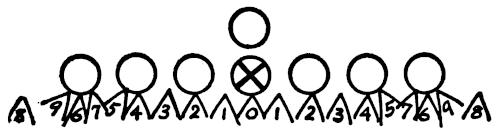
Figure 1
Accompanying each number is a particular “technique,” which will be explained shortly. If a defensive player lines up in a 2 position, he will play what we call a “2 technique”; a 3 position plays a “3 technique,” etc. Therefore, from end to end of the offensive line we can line-up our defensive men and each position has a particular technique.
Who calls the defense? How is it called and what does it mean? Who is included in the call? Each linebacker calls the defense for his particular side of the line. He controls his guard, tackle and himself, but he does not control the end on his side of the line. The latter is controlled by the defensive signal caller in the secondary who gives a call for the 4- or 5-spoke defensive alignment.
Each linebacker calls two numbers. The first number tells his guard where to line up and his accompanying defensive technique. The second number gives the same information to the defensive tackle.
As an example, if the linebacker calls, “26,” the guard will play a 2 technique and the tackle a 6 technique. If the caller said, “59,” the guard would play a 5 technique and the tackle a 9 technique. When the linebacker tells the guard and tackle which techniques to play through his oral call, then he lines up in a position to cover the remaining gaps. As an example, Figure 2 illustrates a 26 call, and the linebacker must take a position between his guard and tackle so he can fill the gap(s) not covered by the other front defenders. You can see by this example the linebacker is in a position to help out over the offensive tackle position, and also on a wide play to his side of the line.
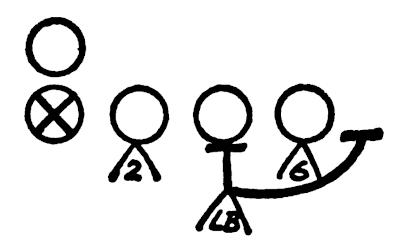
Figure 2
Figure 3 illustrates the position of the defensive right guard, tackle and linebacker when the call is 59. The linebacker is now in a position to help out on a play that is in the middle of the line.
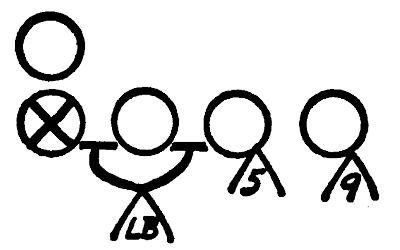
Figure 3
One point I failed to mention, if we are playing a 4-spoke defense, which will be explained and illustrated shortly, we assign one defender to play “head on” the offensive center, and he does not figure in any of the calls. He lines up the same every time, as is illustrated in Figure 4.
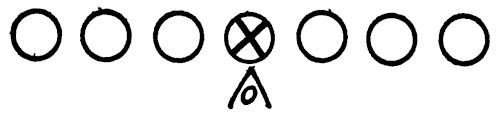
Figure 4
When we play a 5-spoke defense, which will also be explained shortly, the two linebackers assign one player to the area inside the offensive guards. As an example, if we are playing a 5-spoke defense and the call on the right side is 59, the call on the left side must be a one as the first digit, such as, 17, 16, 15. Figure 5 illustrates a 59 call on the right, and a 17 call on the left, with one man playing a 1 technique in order to keep from having a large gap between the two guards.
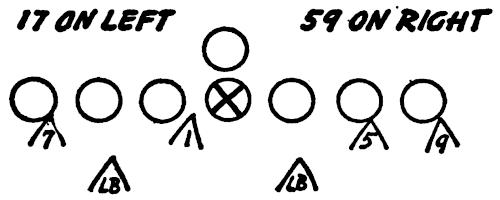
Figure 5
You can quickly observe that by having our players learn only a few numbers and their accompanying techniques, we can line up in numerous defensive alignments merely by calling two numbers. Figures 6 and 7 are examples of 59 and 39 defensive calls, which are 4-spoke defenses with a man in a 0 technique, and are commonly referred to as the Oklahoma and Eagle defenses, respectively.
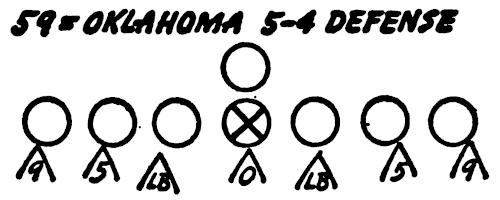
Figure 6
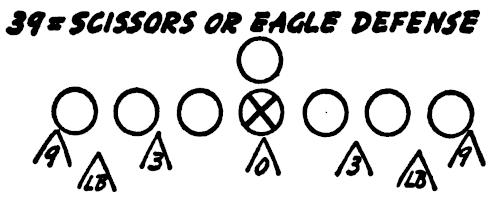
Figure 7
Figure 8 illustrates a 25 call, with a 0 technique, and is a 9-man front defensive alignment.
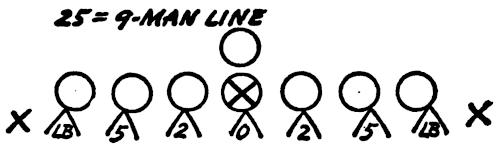
Figure 8
Figures 9-11 are 5-spoke defenses representing 26, 37, and 13 calls, which are commonly referred to as a wide tackle 6, a split 6, and a gap 8 alignment, respectively.
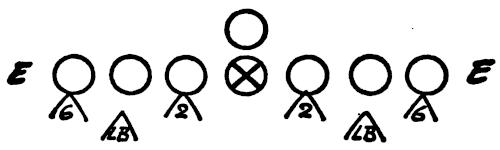
Figure 9
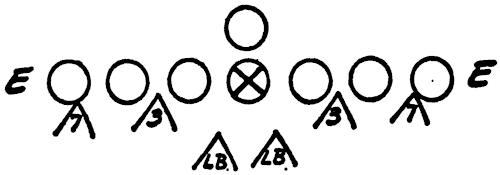
Figure 10
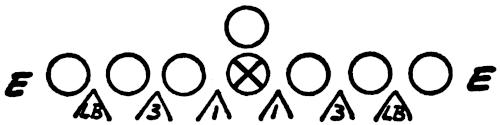
Figure 11
These defenses, Figures 6-11, have the same call to each side. Each side is actually independent of the other as far as the calls are concerned. To eliminate any confusion, merely designate which side (left) is to call first, and the other linebacker (right) can adjust on his call accordingly so there is not a large gap in the middle of the defensive line. The linebackers must be especially aware of this if we are employing a 5-spoke defensive alignment.
The signal caller should never call a defense involving two successive numbers, such as 2-3, 7-6, as this will leave too much territory for him to try to cover (see Figure 1). The caller is always responsible for having a man in, or capable of covering, every gap.
It is very simple for the defensive signal caller to change the guard and tackle assignments even after he has given them a position to line up in and its accompanying technique. The caller merely adds a zero (0) or a one (1) to the end of the number he has called. As an example, if he gives the call 37 and he wants the players in the 3 technique to charge one-half a man toward the inside, he will say, “30.” If he wants this defender to charge one-half a man to the outside, he would say, “31.” This second call is given to only one player at a time, but he can change both of their techniques by saying, “31—71,” or “30—70,” etc.
Advantages of a Defensive Numbering System
Our present method is the simplest one I know of for getting players into various defenses quickly with a minimum amount of talking. We feel it eliminates much confusion. We have found the players take a great deal of pride in learning only a few techniques, which they are able to execute well. We know it makes our job easier as coaches, and we can do a better job of coaching the boys. As a coaching point, when a coach talks to a tackle, as an example, he talks in terms of a particular technique (6, 7, etc.), and the player understands him immediately. When the coaches are discussing plays, or in a staff meeting, we identify the particular technique immediately, and everyone understands each other. We have also found the method useful when making out the practice schedule as I merely specify, “Tackle coach work on 6 technique,” etc.
Employing a defensive numbering system requires the defensive signal callers to be alert. They do not merely call several numbers. They must be aware of the tactical situation at all times, and call a sound defense according to a tactical and strategical planning. As an illustration, a good short yardage call would be 13, and sound passing situation calls would be 36, 37, 39, 59 (see Figures 1, 3, 6, 7, 10, 11). I spend at least several minutes every day with my defensive signal callers. It is the linebackers’ responsibility to see that we line up in a sound alignment every time.
PLAYING OUR DEFENSIVE TECHNIQUES
As illustrated in Figure 1, and mentioned earlier, our techniques and defensive positions are numbered from 0-9 on both sides of the defensive line, numbering from inside-out (with certain exceptions noted, Figure 1). I now wish to explain in detail each particular technique, although there is only a slight difference between several of them. As an example, when playing the 2 technique, a defender lines up head on the offensive guard, and when playing a 4 technique he is head up on the offensive tackle. Consequently these techniques are similar.
The 0 Technique
As illustrated in Figure 12, the defender lines up head on the offensive center. Depending upon the situation, the distance he lines up off the football will vary. On a short yardage situation, he will line up close to the center’s head. On a long yardage situation, normally he will be about one yard off the ball. He will use either a three- or a four-point stance, with one foot staggered. His technique is to play the center’s head with a quick hand shiver on the snap of the ball. When he makes contact with the center, he brings his back foot up so his feet are even with each other. If the quarterback goes straight back to pass, the 0 technique man is responsible for the draw play, and then he rushes the passer. If it is a run instead of a pass play, he will keep the center away from his blocking surface, not permitting himself to be tied up in the middle of the line, and he will pursue the ball taking his proper angle depending on the type of running play.
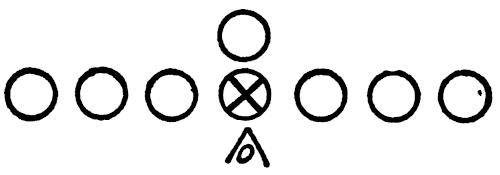
Figure 12
The 1 Technique
The main job of the player(s) employing the 1 technique is to control the offensive splits, forcing the guards to keep their splits to a minimum, as illustrated in Figure 13. He is also responsible for keeping the center off of the defensive linebacker. If both guards are playing in this technique, as illustrated in Figure 13, only one will “slam” the center, and the other will take a long step toward his guard, playing him from inside-out. He must always be aware of the trap coming from the inside, however. If the play is a back-up pass, he is responsible for the draw first, and rushing the passer second. If it is a running play, he will slam the center or guard and then pursue the football.
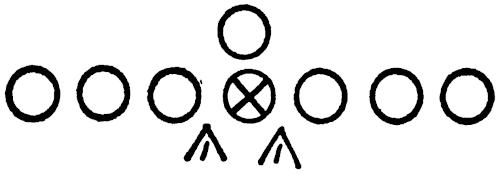
Figure 13
The 2 Technique
The 2 technique is similar to the 0 technique, and is illustrated in Figure 14. One difference is the guard is head on the offensive guard, instead of on the offensive center. The distance he lines up off the ball in a staggered stance will be determined by the tactical situation. On the snap of the ball he plays the guard with a hand shiver, and immediately locates the football. If it is a back-up pass and there is no man in a 0 or 1 technique, he will look for the draw play first, and then rush the passer. If it is a running play, he will look first toward the inside for a trap, and then pursue the football.
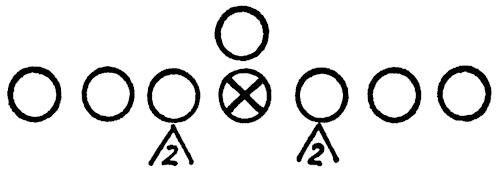
Figure 14
The 3 Technique
The 3 technique is similar to the 1 technique, and is illustrated in Figure 15. The 3 man is responsible for keeping the offensive tackle’s split cut down, and on occasion to keep the offensive guard or tackle from blocking the defensive linebacker. He, too, lines up with the feet slightly staggered, and about one foot off the ball. Depending upon the defense, when the ball is snapped, he will play either the guard or tackle with a quick flipper or shiver, preferably with the hands. He is to watch for the trap at all times. If the play is a straight drop back pass, he will rush the passer from the inside. If it is a running play, he will pursue the football.
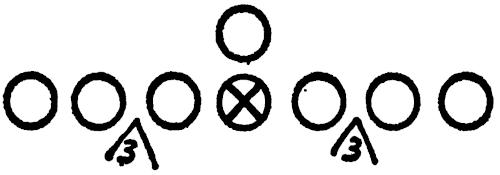
Figure 15
The 4 Technique
The 4 technique man lines up head on the offensive tackle and about one to one and one-half feet off the ball, and is illustrated in Figure 16. He will have his feet slightly staggered, and on the snap of the ball he is to play the offensive tackle with a quick hand or forearm flipper. If it is a running play toward him, he must whip the offensive tackle, be ready to stop the hand-off, and help out on the off-tackle play. If it is a straight back pass, he will rush the passer from the inside. If the play goes away or to the far-side, he will control the offensive tackle and pursue the football. On his angle of pursuit he should never go around the offensive tackle, but pursue the football going through the tackle’s head.
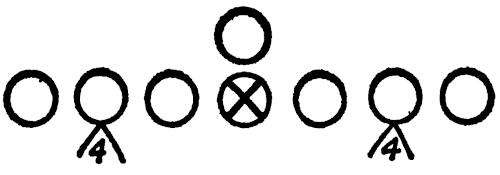
Figure 16
The 5 Technique
The 5 technique man lines up on the outside eye of the offensive tackle, as illustrated in Figure 17, with the feet staggered (outside foot back in most cases). On the snap of the ball he employs a forearm flip charge into the tackle. As he makes contact, his back foot is brought up even with his front foot. He has 75% off-tackle responsibility, and he should never be blocked in by only one man. If it is a straight back pass, he should rush the passer from inside-out. If the play comes toward him, he should whip the tackle and make the play. He must be certain to keep the offensive blocker in front of him at all times as the 5 man will be eliminated from the play very easily if he tries to go around his blocker. If the play goes away from him, he must pursue the football. He is instructed not to cross the offensive line of scrimmage when employing a 5 technique.
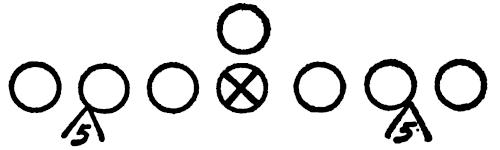
Figure 17
The 6 Technique
The 6 technique player lines up head on the offensive end, as illustrated in Figure 18. If the end splits too far, the 6 man is to “shoot the gap.” He is primarily responsible for keeping the offensive end from releasing quickly on passes, and he must keep the end from blocking the linebacker. He is responsible for the off-tackle play. Consequently he must not be blocked in or out. The game situation will determine how far he lines up off the ball, but it will usually vary from one to three yards. If the play is a straight back pass, he is responsible for rushing the passer from the outside-in. If the passer runs out of the pocket, the 6 man must not permit him to get to the outside. He must either tackle the passer or force him to throw the football. If the play comes toward the 6 man, he whips the end with a flip or shiver charge, and helps out both inside and outside. He never crosses the line of scrimmage unless it is a back-up pass. If it is an option play toward him, he must make the quarterback pitch the ball or he must tackle the quarterback. If the flow goes away from him, he trails the play. He should be as deep as the deepest man in the offensive backfield so he can contain the reverse play back to his side, not permitting the ball carrier to get outside of him.
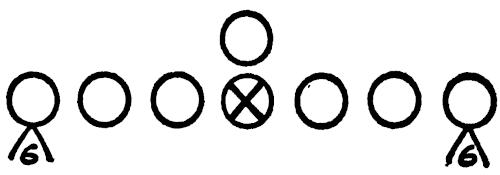
Figure 18
The 7 Technique
The 7 technique player lines up splitting the inside foot of the offensive end, as illustrated in Figure 19. He is responsible for forcing the end to reduce his offensive split. We want him to line up with his outside foot staggered, and he must never be blocked out by the offensive end. He has 75% inside responsibility and 25% outside responsibility. When the ball is snapped, he uses a hand or forearm flipper charge on the offensive end and brings his back foot up even with his front foot. His main responsibility is to whip the offensive end, and to close the off-tackle play. If the play is a straight drop back pass, he is the outside rusher and he must not permit the quarterback to get outside of him. If the play goes away from him, he is to trail the ball carrier. He plays just like the trail or chase man on the 6 technique. He should be as deep as the deepest offensive backfield man so he can contain any reverse play coming back to his side of the line. He should not let such a play get outside of his position.
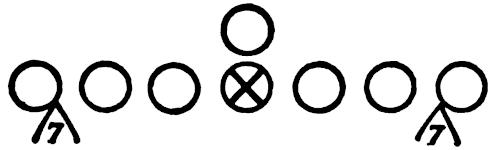
Figure 19
The 8 Technique
When we speak of a man playing an 8 technique, as illustrated in Figure 20, we are speaking of a “true end,” or a defensive end who lines up outside of the offensive end. The 8 man will be from one and one-half to three yards outside of the offensive end’s normal position, with his inside foot forward, and his shoulders parallel with the line of scrimmage. If it is a straight back pass, the defensive end, without taking his eyes off the passer, will turn to his outside, and using a cross-over step will sprint to his outside trying to get width and depth to play the ball to his side. His depth should be 8-10 yards deep, similar to a linebacker’s position covering the flat. He stops running when the quarterback stops to set up. When the ball is thrown, he sprints for the ball.
If the play comes toward the 8 man, we want him to cross the line of scrimmage about two yards, getting set with his inside foot forward, shoulders parallel with the line of scrimmage, and playing the outside blocker. He is the outside contain man, and he must not permit the ball to get outside of him. He never makes the quarterback pitch on option plays. If it is a running pass toward him, he is the outside contain and rush man. If the flow goes away from him, he must make sure it is not a reverse play back to his side before he takes his proper angle of pursuit, which is through the area where the defensive safety man lined up originally.
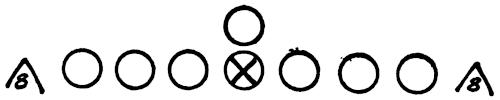
Figure 20
The 9 Technique
Figure 21 illustrates where the defensive men line up when playing a 9 technique, splitting the outside foot of the offensive end. He should line up 14 inches off the line of scrimmage, with most of the weight on his outside foot which is back. When the ball is snapped, the 9 technique man will take a short step with his inside foot toward the offensive end, and at the same time he will deliver a hand or forearm shiver to the head of the offensive end. If the offensive end blocks in and the play comes toward him, the 9 man immediately looks for the near halfback or the trapper expecting to be blocked by either offensive man.
If a running play comes toward him and the quarterback is going to option the football, he must make the quarterback pitch the ball. If the quarterback is faking the ball to the fullback, the 9 man must “search” the fullback for the ball first. The 9 technique man never crosses the line of scrimmage. If the offensive play is a straight back pass, the 9 man delivers a blow to the end, and drops back two or three yards looking for the screen or short pass. He is in a position to come up and make the tackle if the quarterback gets outside of your outside rusher and the quarterback decides to run with the football. If the flow goes away, he is the trail man and has the same responsibilities as the 6 and 7 technique men, which I explained previously. The most important coaching point is that the man playing the 9 technique must deliver a good blow to the offensive end on every play.
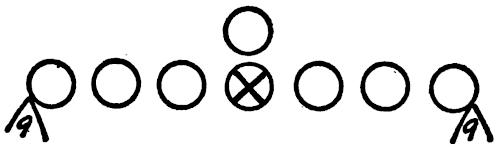
Figure 21
OUR DEFENSIVE STANCE
We are not too particular about the stance our defensive players employ, but on the other hand we are not so indifferent that we ignore how they line up defensively. We want them to be comfortable, but at the same time the linemen must be in a position so they can uncoil, make good contact, and be in a good position so they can move quickly. We never permit a man to take a stance in which he gets too extended and loses most of his hitting power. There are a few basic techniques we insist our defensive players use. These techniques vary to some extent from position to position. The defensive stance for linemen, linebackers, and the secondary is as follows:
Guards—The defensive stance our guards take is very similar to the stance we use offensively. We like them to be in a four-point stance with their feet even and spread about three inches wider than their shoulders. The weight must be slightly forward, and their tail slightly higher than their shoulders. Their back is straight, and their shoulders are square. Their hands are slightly outside of their feet, elbows relaxed, with thumbs turned in and forward of the shoulders slightly.
Tackles—The defensive stance our tackles take is very similar to the stance we use offensively. We want our tackles to use a four-point stance, having their inside foot staggered back slightly. Their feet should be a little wider than their shoulders. The weight must be forward slightly, and the tail should be slightly higher than the head. Just like the guards’ stance, we want their back straight and their shoulders square. Their neck must be relaxed, but their eyes must be focused on the man opposite or on the ball. The hands are slightly outside of the feet, elbows relaxed, and the thumbs turned in and forward of the shoulders slightly.
Ends—The defensive ends line up with their inside foot forward and perpendicular to the line of scrimmage. We want our ends standing up in a good football position. The knees are slightly bent, as is their body bent forward slightly at the waist. They must have their eyes on the quarterback, but still be able to see the offensive halfback and end closest to them on their side. When the action starts toward an end, we want him to come across the line and make contact with the outside blocker. The shoulders should remain parallel with the line of scrimmage upon contact with an offensive back.
Linebackers—We want our linebackers to be standing with their feet even and parallel with each other. They should be in a good football position—tail down, back straight, slight bend at the waist, weight on the balls of the feet, knees bent, and coiled to the extent that when a guard or tackle fires out on the linebacker the defensive man can whip him. Our linebacker takes a step forward with the inside foot toward the blocker who is firing out at him. We want him to drop his tail and hit on the rise when making contact. He then brings his back foot up even with his forward foot so that he will be in a position to move laterally.
Halfbacks—Our defensive halfbacks line up in their regular position which is three yards outside of the offensive end in a 3-deep defense, and on the inside shoulder of the offensive end in a 4-spoke defense. We want our halfbacks to have their outside foot back with the inside foot pointing perpendicular to the line of scrimmage. The outside foot is about 14″ behind the front foot, and pointing out at a 45 degree angle. The halfback’s knees should be flexed slightly, and he must be in a good football position. His arms should be in a cocked position. He must face the quarterback. His first step is backward and outward.
Corner man—The corner man lines up in his regular position about four yards wide and two and one-half yards deep, with his feet parallel and even about 18″ apart pointing directly toward the offensive quarterback. He should be in a good football position, weight on the balls of the feet, arms cocked, etc. He should not rest his hands on his knees. From a good football position he can rotate quickly and properly, or he can come forward and meet the play if it comes toward him.
Safety—The safety man lines up a little deeper than the other backs. He should face slightly the wide side of the field or the strong side of the offensive backfield. He has his outside foot back, and he is permitted to stand a little straighter than the other deep backs. He, too, is in a good football position watching the quarterback. His first step is backward and outward, and he must be able to cover a pass from sideline to sideline.
OUR SURPRISE DEFENSE
We never send our boys into a football game without trying to prepare them for every conceivable situation that might arise during the contest. We must try to anticipate every situation, and counteract with a sound defense. A situation might be very unusual, and we cannot actually defense it properly until the coach in the press box tells us exactly what the opposition is doing. Then we can work out the proper defense on the sideline and send it in. In the meantime the boys must have something they can counteract with immediately or the opposition is likely to score with its surprise offense. Consequently our signal caller will yell, “Surprise Defense,” when he sees an unusual offensive formation, and the boys will react accordingly. Our rules for covering a spread or unusual offensive alignment are as follows:
1. If one man flanks, our halfback will cover him.
2. If two men go out, our halfback and end will move out and cover them.
3. If three men go out, our halfback, tackle and end move out and cover them.
4. If four offensive men go out, we put out the halfback, end and tackle, and our linebacker goes out half-way. The alignment for the linebacker would be a yard deeper and a yard wider than he usually lines up.
5. If five men go out on the offensive team, we put out our halfback, end, tackle, linebacker half-way, and the defensive guard. If they put more than five men out, we do not change our alignment.
6. If there is any doubt about how to meet strength with strength, we start with the outside man and put a defender on every other offensive man.
7. The safety man will always play in the middle of the field or in the middle of the eligible receivers.
8. A defensive end must never be flanked by one offensive man unless he can beat the flanker through the gap and into the offensive backfield.
9. A tackle should never be flanked by two offensive men unless he can beat the nearest opponent.
10. The initial charge of the players who are left on defense is to the outside, unless there is a concentration of offensive backs. Should the latter be the case, then the defensive charge will be normal.
11. The greater the offensive team splits its line, the farther off the line of scrimmage the defenders must play.
Figures 22-23 illustrate two examples of spread formations, and the application of our surprise defense coverage rules.
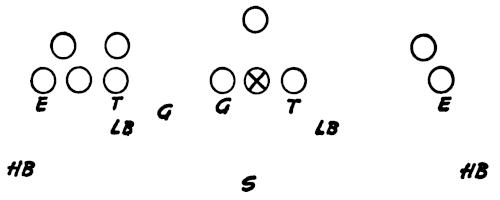
Figure 22
The first offensive man who flanks to our right (Figure 22), will be covered by our defensive right halfback. The second to our right will be covered by our right end. The first man flanked to our left will be covered by our offensive left halfback; the second man out, by our left end; the third flanker, by our left tackle; the fourth flanker will be covered by our left linebacker, who will move out half-way. The fifth man flanked to our left will be covered by our left guard. The remaining players will meet strength with strength. Our right guard will play on the outside shoulder of the offensive right guard, and the defensive right tackle will play on the outside shoulder of the offensive left guard, as illustrated in Figure 22.
We instruct our defensive players to force the offensive players to come to them. We do not want our men off the line of scrimmage to penetrate, leaving gaps in the defense. We want our men to be in a good football position so they can pursue the ball quickly.
Figure 23 illustrates another example of the application of our surprised defense rules in covering a spread offense.
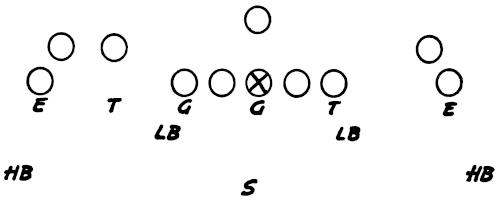
Figure 23
OUR VICTORY DEFENSE
I think it is very important for a team to be able to go into a “Victory Defense” when the occasion warrants its use; for example, when you have a slim lead with little time remaining before the termination of the first half or the game. We will go into a 5-man line if we have the game won and our opponents are not close to our goal line. Under such circumstances we can afford to permit the opposition to get a first down or two, but we cannot afford to let them complete the long pass or the long run for a touchdown. We believe our victory defense is sound, and we are playing sound defensive football when we employ it. Figure 24 illustrates the victory defense we used eight times in one year, and we intercepted our opposition’s intended forward pass on seven of the eight occasions.
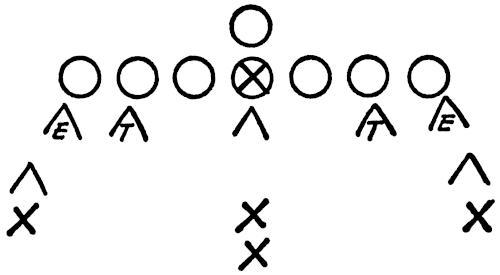
Figure 24
The individual and team duties and responsibilities when we employ our Victory Defense are as follows:
Middle Lineman—Sole responsibility is to look for the screen pass and/or for the draw play.
Ends and Tackles—Line up on the outside shoulder of the offensive ends and tackles. If the offensive end(s) splits, we will adjust on them with our three deep backs. We want our defensive ends to shove the offensive ends to the inside, holding them up if possible, and then look to the inside for a trap block or for a screen pass. Should neither of these occur, the ends are to contain the passer, not permitting the ball to get outside either of their respective positions. They should play loose and proceed with caution, rather than rushing hard into the offensive backfield.
The defensive tackles should play back off the line of scrimmage with their feet even and parallel. Each tackle must keep his man in front of him, not permitting the offensive tackles to block them in or out. When a pass develops, the tackles must rush the passer, making certain to stay in front of the football.
Linebackers—Line up about six yards deep and at a spot opposite where the defensive end ordinarily would line up. By lining up wide, we hope to funnel the offense toward the middle of our formation. By this I mean we want them to direct their attack toward the inside and we don’t want them to turn the corner, to get outside or to kill the clock by running out-of-bounds.
Halfbacks and Safety—We want our halfbacks to be at least 12 yards deep and well outside the offensive formation. We want our safety man at least 12 yards deep and in the middle of our defensive alignment. The three backs will play their regular defense.
Best Defensive Player—The next step in setting up our Victory Defense is to station our very best defensive football player 10 yards behind the middle safety man. His sole responsibility is to keep the offensive team from scoring. He must always stay between the ball and the goal line. We do not want him to come forward and break up a pass. Nor do we want him coming up to make the tackle. We want him to fight off blockers and make certain the ball carrier does not score should our defense break down and the opposition move downfield toward the goal line with a long run or a completed pass. When the ball is thrown, we want every man on the team to go for the ball except our deepest man, our best defensive football player. He remains 10 yards behind the ball at all times in case there is a tip and the opponent might catch it and score. His sole responsibility is to keep the opposition from scoring when we are using our Victory Defense.
OUR GOAL LINE DEFENSE
Our goal line defense is very simple, and I am certain many other coaches use the same goal line defense, as illustrated in Figure 25. Perhaps there are a number of goal line defenses that are better than ours, but we have faith and believe in our goal line defense, and I believe this is 50% of the battle. When we go into our goal line defense, we want our boys to be so sold on what they are doing that they are not going to let the opposition score. Each man is going to take it upon himself to see that they do not score over his particular defensive area. Playing goal line defense is a terrific challenge. There is not much territory remaining, and the big questions are, “Who is going to come out on top?” and “Who will end up with the ball when the dust settles?” If we give our team a sound plan and teach it to them well, and they believe in it and in us, we will do all right.
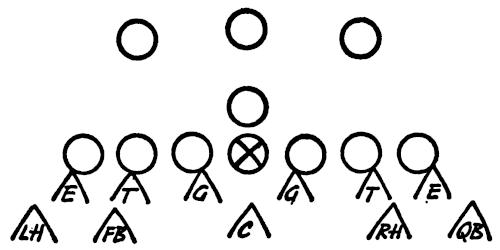
Figure 25
Figure 25 illustrates our goal line defense, and the individual and team duties and responsibilities are as follows:
Ends—The defensive ends line up in a four-point stance as close to the line of scrimmage as they can get, just shading the outside eye of the offensive ends. On the snap of the ball the defensive ends will charge low and hard through the tail of their offensive ends, trying to get approximately one yard deep into the offensive backfield. If the flow comes toward his side and the quarterback has the football, the defensive end tries to force the quarterback to pitch back to the off-halfback.
Tackles—The defensive tackles line up on the outside eye of the offensive tackles, and they aim for a spot one yard deep in the offensive backfield behind the inside foot of the offensive tackles. Each tackle is responsible for the hand-off play to his side, making the tackle or forcing the dive play to the inside so our middle linebacker can make the tackle.
Guards—The defensive guards get their spacing by lining up on each other, but theoretically they will line up on the inside eye of the offensive guards. They are responsible for sealing-off the middle of the line, and for keeping the offensive center from blocking the middle linebacker. They aim for a spot about one yard behind the offensive center’s position. They must get to this spot using a low, hard submarine charge.
As illustrated in Figure 26, if our six linemen carry out their defensive assignments using a low, hard charge and get to their predetermined spots, we will form a wall.
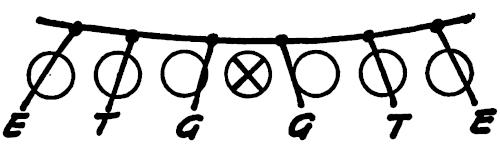
Figure 26
Middle Linebacker or Defensive Center (see Figure 25)—He is responsible for making any play that occurs between the offensive tackles. He should make the tackle on a hand-off, on a play up the middle, and help on the off-tackle play. On a back-up pass, he will drop off covering a short zone. If the play starts wide, the middle linebacker will pursue the football. He should be one of the best defensive football players. Figure 27 illustrates the defensive position and responsibilities of the middle linebacker on our goal line defense.
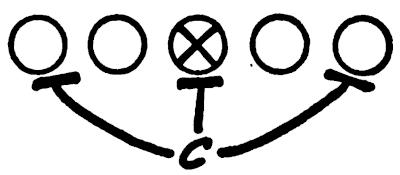
Figure 27
Inside Linebackers or Fullback and Right Halfback (see Figure 25)—They are responsible for the off-tackle play and the quick containing of the quarterback on the option play (Figure 28a). If the flow goes away, they check for the counter play before they pursue the football. On a running pass toward one side or the other, as illustrated in Figure 28b, one linebacker will cover the flat and the other his hook spot. On a back-up pass they will cover the short one-quarter zones or areas.
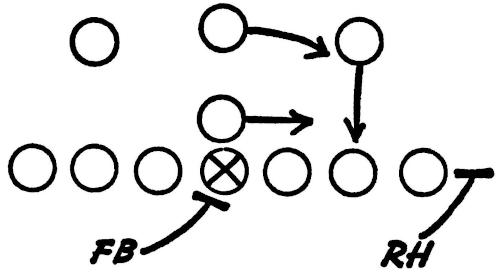
Figure 28a
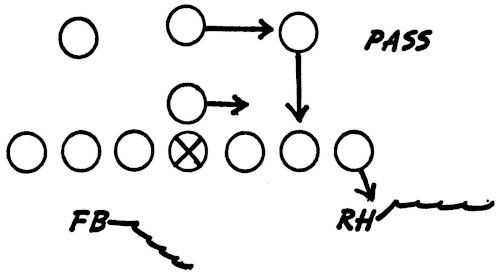
Figure 28b
Outside Linebackers or the Left Halfback and the Quarterback (see Figure 25)—They are responsible for the wide play. They must not permit the play to get outside of them on their particular side of the defensive alignment. When the offensive play starts, both outside linebackers will “read” the offensive end closest to them, and the flow of the offensive backs. It is important they diagnose a running pass correctly, because the offensive end to the on-side must be covered correctly if his route is deep. (The outside linebacker must cover the deep man whether it’s an end or a back.) If the play is away, the backs will revolve toward it.
The two inside and two outside linebackers (Figure 25) play 4-spoke pass coverage on all passes, which will be explained in greater detail in Chapter 5, “Pass Defense.” Our automatic “Thunder,” which is very good versus this particular situation, will also be explained later.
A SPLIT-T DEFENSE
There are a number of good defenses versus a T team with a straight-up T backfield. I will go over several of the defenses we have used more frequently than others. Figure 29 illustrates our 59 call or the Oklahoma 5-4 defense versus the T formation. The individual and team duties and responsibilities are as follows:
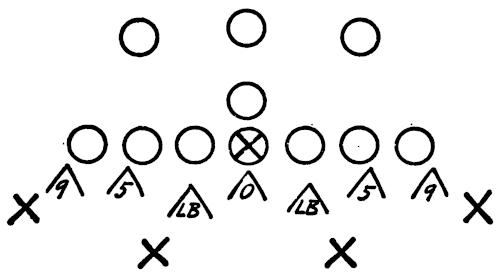
Figure 29
Ends—The defensive ends play a 9 technique, and on this particular defense both ends’ assignments and techniques will be identical. They will not penetrate beyond the line of scrimmage unless the flow is away. When the flow goes away, the off-side defensive end becomes the trail man.
Tackles—The defensive tackles play a 5 technique, which I discussed in detail earlier in the chapter. They will never cross the line except on a straight drop back pass, and then both tackles will rush the passer. Otherwise the tackles whip their respective opponents (tackles) and pursue the football.
Middle Guard—The middle guard plays a 0 technique, always alert for the screen pass or the draw play. On the snap of the ball, the middle guard should whip the offensive center and then go to the ball.
Linebackers—The inside linebackers will line up on the outside eye of their respective offensive guards, and “read” through them into the offensive backfield. If the offensive guards or tackles fire out, the linebackers whip them and go to the football. If the flow goes away, the off-side linebacker will check the counter play, and then pursue the football. On a drop back pass each linebacker will cover his short one-quarter pass zone or area.
The defensive secondary will play its regular 4-spoke defense, and revolve on the plays after the offense shows what they are going to do (or from a predetermined call, which will be explained shortly). The 4-spoke secondary will be discussed and illustrated in Chapter 5, “Pass Defense.”
Figure 30 illustrates our 27 call or a wide tackle 6 defensive alignment versus the T formation.
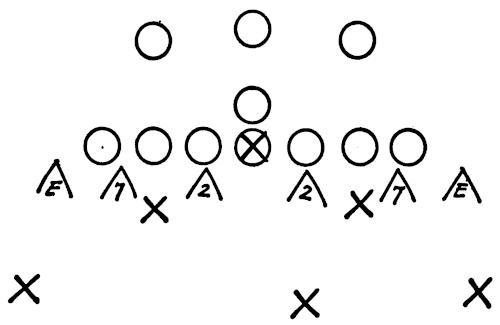
Figure 30
We use a 6-2 alignment frequently because we can stunt easily or we can play it straight versus a long yardage situation, and we can jump from it into another defensive alignment without too much difficulty. The linebackers control their particular units, as I explained earlier. The individual and team duties and responsibilities are as follows:
Guards—The guards will play a tough 2 technique, then pursue the football. On a drop back pass they are responsible for the screen pass in the middle, the draw play, and rushing the passer.
Tackles—The tackles will play a tough 7 technique. They are responsible for the off-tackle play to their respective side. If the play goes away, the tackle is the trail man. On back-up passes, the tackles rush the passer from the outside.
Ends—The defensive ends play an 8 technique, and they are the contain men if the flow comes their way. If the ball goes away, the off-end drops back and pursues through the area where the safety lined up originally. On back-up passes they will cover the short one-quarter pass areas or zones.
Linebackers—The linebackers line up on the inside eye of the offensive tackles, and play their regular positions. If the play comes toward them, the linebacker whips the blocker with a flipper and plays the ball carrier. When flow is away, he checks the counter play and then pursues the football. On pass plays they will cover their short one-quarter pass zones.
Secondary—The defensive secondary will play their regular 3-deep coverage, which will be explained in the next chapter. On wide-running plays the halfback must come up to the outside and turn the play back inside. The safety man comes up to the inside, playing inside-out, and the off- or far halfback revolves and becomes the last safety man.
Figures 31-34 illustrate several of our defensive stunts from a 6-2 alignment which we have employed with success in the past.
In Figure 31 the linemen pinch, sealing-off the inside, and the linebackers cover outside.
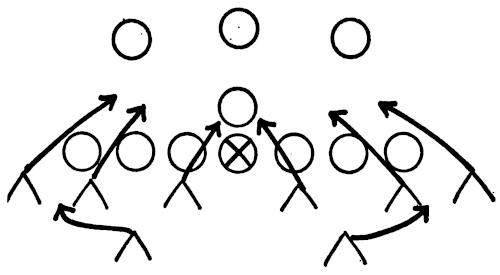
Figure 31
In Figure 32 the guards loop to the outside over the offensive tackles, and the linebackers fill inside the offensive guard splits.
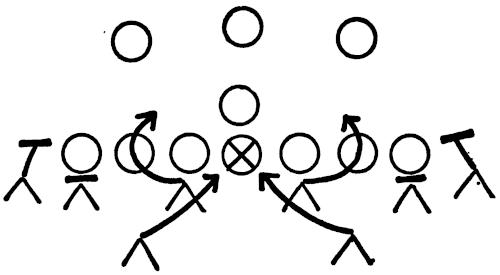
Figure 32
Figure 33 illustrates a simple X-pattern between the defensive ends and tackles.
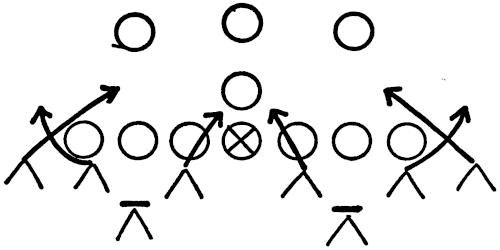
Figure 33
Figure 34 illustrates the tackles pinching, and the linebackers replacing them at the line of scrimmage over the offensive ends.
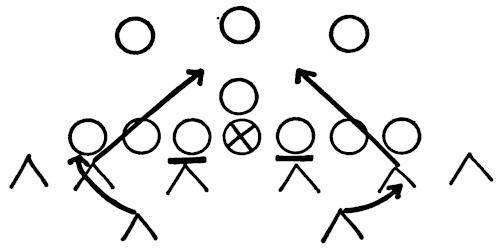
Figure 34
OUR DEFENSE VERSUS AN UNBALANCED LINE
We do not adjust a great deal to an unbalanced line, and our adjustments are relatively simple. We merely move our defensive line over one whole man, and then revolve the secondary toward the weak side, as illustrated in Figure 35.
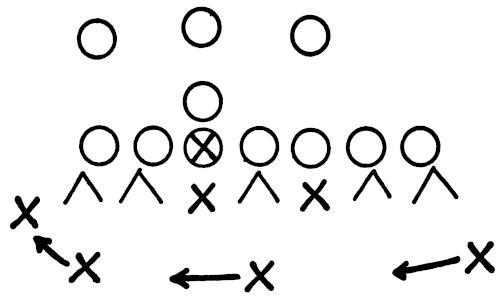
Figure 35
When we do this, we carry out our same assignments, which I have explained already. The only difference is that our middle guard lines up on the offensive strong side guard, instead of on the center. If we are playing a 3-deep defense, we would adjust with our linemen. Then we consider the strong guard as the middle of the offensive line (the center), and we play our regular defense.
ADJUSTMENTS VERSUS BACKS AND ENDS FLANKED
When we have a defense called and the opposition comes out and lines up with a back or an end out, we can play it one of two ways. If it is a floater out or an end split, we will adjust slightly with our secondary, and we will drop the defensive end off the line a little. The remainder of the defensive linemen will play the defense that has been called. If a flanker is put out to one side or the other, we will revolve our 4-spoke secondary toward him and leave the linemen in their regular positions, or we will shift our line toward the flanker one whole man. These adjustments will be explained and illustrated more fully in Chapter 5, “Pass Defense.”
In making our game plans, which will be discussed in Chapter 10, “Planning For a Game,” we will always have a definite call that our signal caller will use in the situations discussed above relating to our adjustments versus backs and/or ends flanked out. As an example, we may tell our signal caller to shift our defense away from ends out and floaters, but shift toward flankers and an unbalanced line. These calls will depend upon the information we secure from scouting our opponents.
OUR DEFENSES VERSUS THE SINGLE WING OFFENSE
Defensing the single wing offense has always created problems for us because we feel we must meet strength with strength, and then we get hurt to the weak side. Figures 36-37 illustrate two defenses which we believe are sound, and we have used them successfully against the single wing offense. Of course, personnel makes the defense as we all know, and a linebacker like Jack Pardee whom I had at Texas A & M made all of our defenses sound.
Figure 36 is a defense which I feel is especially good versus the single wing offense. The duties of the defenders are as follows:
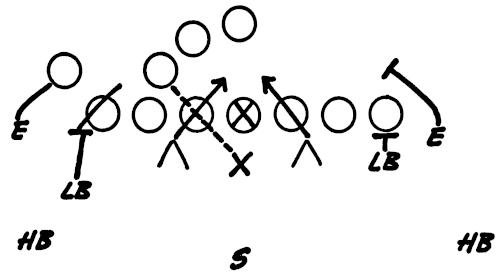
Figure 36
Strong Side End—The end lines up one to three yards outside of the wingback, “reading” him and the offensive end. If the flow comes toward him, the strong side end comes across hard about three yards into the offensive backfield, and he turns everything in, as he is the contain man. When he makes contact with the outside blocker, the defensive end’s shoulders must be parallel to the line of scrimmage. If the flow goes away from him, he drops back and pursues the ball carrier. On a straight drop back pass, he will cover the short one-quarter area.
Strong Side Tackle—He lines up on the outside eye of the offensive end, and on the snap of the ball he charges through the head of his man. He is to penetrate the offense about one yard. If the flow goes away, he trails the play. On a straight drop back pass he rushes from the outside.
Strong Side Guard—He lines up on the outside eye of the offensive guard and on the snap of the ball he tries to penetrate through the head of the guard, trying to seal-off the middle. If the flow goes away, he will pursue the ball. On a straight drop back pass he rushes from the inside.
Weak Side Guard—He has the same alignment and assignment as his strong side guard, only he is on the other side of the defensive line.
Weak Side Linebacker—He plays in front of the offensive weak side end and keeps him from getting out quickly on a pass play. If the flow comes toward him, the weak side linebacker whips the end and then “plays football.” If the flow is away, he will pursue the ball. On a straight drop back pass he will cover the short flat one-quarter pass zone or area.
Weak Side End—He lines up about two yards outside of the offensive weak side end. If the flow comes toward him, he will come across the line playing his 8 technique, which I have explained before. He cannot permit the play to get outside of his position. When he makes contact with the blocker, his shoulders must be parallel with the line of scrimmage. He will trail the play if the flow goes away from him. He rushes the passer on a drop back pass action.
Middle Linebacker—He lines up in front of the center. He varies his position as at times he will be close, and other times off the offensive center’s position. He keys the blocking back, who is the offensive quarterback, and the middle linebacker goes to the football. He drops back and covers the short one-quarter area on drop back passes.
Strong Side Linebacker—He lines up approximately behind the strong side tackle, and he reads the wingback, end and quarterback. When the flow comes toward him, he comes up and plays it tough. When the flow goes away from him he pursues the football. He covers a short one-quarter area versus the straight drop back pass.
3-Deep Secondary—They play their regular 3-deep coverage, which will be discussed in detail in the next chapter.
Figure 37 illustrates another of our 6-2 defensive alignments versus the single wing offense. The individual assignments are the same as those just described, except that the guards play slowly.
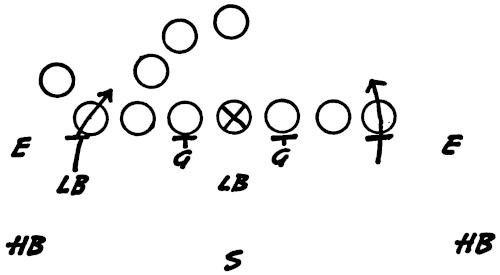
Figure 37
We employ a number of defensive stunts when we play against a single wing team. We have been quite successful in the past with the stunts illustrated in Figures 38-41. There are other stunts which may be used, of course, but we have found the four stunts illustrated (Figures 38-41) satisfactory and adequate.
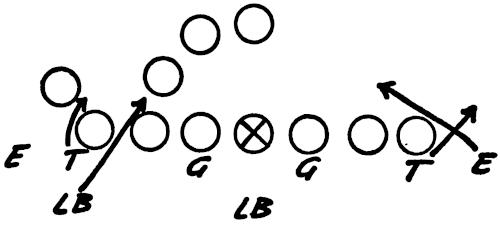
Figure 38
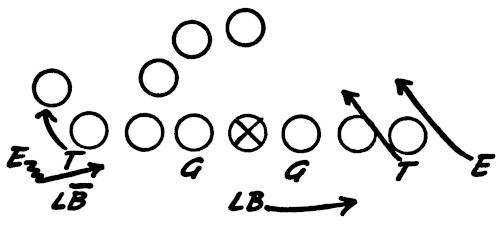
Figure 39
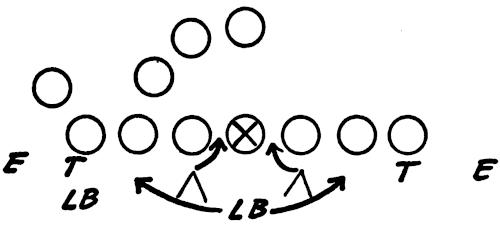
Figure 40
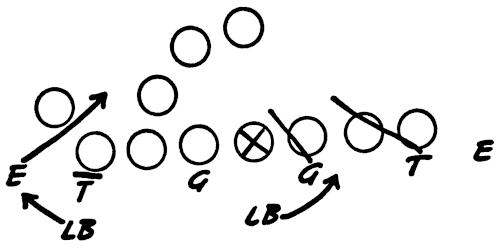
Figure 41
CONCLUSION
There are many defenses that are good versus various offensive formations. The important point is to have a defense you and your players believe in, and which is sound in all respects. Each player must take pride in himself and his defensive ability. He must personally feel he is not going to permit the opposition to score. He must accept it as a personal challenge to himself. He must eliminate the long run and/or the long pass for the “easy” touchdown, pursue relentlessly and tackle viciously in order to be sound both individually and as a team while on defense.
Other phases of defensive football, such as defending against the on-side kick and the field goal attempt, will be discussed in detail in Chapter 6, “Our Kicking Game.” The drills which we use for our defensive ends, interior linemen, linebackers, the secondary, and for the team will be illustrated in Chapter 11. Pass defense will be discussed in its entirety in Chapter 5.