Front matter (continued 2)
Reading edition
The arms of men but very little resemble the fore legs of quadrupeds, and much less the wings of birds. The ape is the only animal that is possessed of hands and arms; and they are fashioned more rudely, and with less exact proportion, than in men. The shoulders are also much larger in man than in any other animal, and of a form widely distinct.
The form of the back differs not much from that of many quadrupeds, only that the reins are more muscular and strong. The buttock, however, in man is different from that of all animals whatsoever. What goes by that name in other creatures is only the upper part of the thigh, and by no means similar: man being the only animal that can support himself perfectly erect, the peculiar hardness of this part enables him to sustain that position.
The human feet are also different from those of all animals, even apes not excepted. The foot of the ape is rather a kind of aukward hand; its toes, or rather fingers, are long, and that in the middle longest of all; the foot also wants the heel. In man the sole of the foot is broader and more adapted to maintain the equilibrium of the body in walking, dancing, or running.
The nails are smaller in man than those of any animal. If they were much longer than the extremities of the fingers, they would obstruct the management of the hand. Such savages as suffer them to grow long, make use of them in flaying and tearing animals, but though their nails are considerably larger than ours, they are yet by no means to be compared to the hoofs or the claws of other animals.
There is little known exactly with regard to the proportion of the human figure, for the same parts do not bear similar proportions in any two individuals; nor even in the same, for seldom is it that the right leg or arm is of equal dimensions with the left. It is not by taking an exact resemblance that we can determine on the best proportion of the human figure; we must seek for it in taste and sentiment, which have exceeded the laws of mechanism in the imitation of Nature; and in which imitation we recognize her perfections more conspicuously than in her own productions; and by the same rule the beauty of the best statues is much better conceived by observation than by measurement. The ancients executed statues in so high a degree of perfection, that they have ever been considered as exact representations of the most perfect human figures. These statues, which were at first copied after the human form, are now considered as the most perfect models of it; and for this plain reason, that they were not formed after any one individual, but from a diligent observation of the perfect symmetry that was to be collected, as it were, from the whole species. In doing this, these artists also considered each part of the human frame should be of certain dimensions to become the standard of perfection; for instance, that the body should be ten times the length of the face; and that the face should also be divisible into three equal parts, the first form the hair on the forehead to the nose, the second the nose, and the third from the nose to the end of the chin. In measuring the body they use the term nose as the third of the face, one of which they reckon in height, from the top of the forehead to the crown of the head, therefore from the top of the head to the bottom of the chin is a face and one third, and from the chin to the upper part of the breasts two thirds more, which of course makes two tenths of the whole body; to the bottom of the paps another, to the navel a fourth, and from thence to the division of the lower extremities a fifth, or half the body; two more faces are assigned to the thighs, half a one to the knee, two from the knee to the top of the foot, and the other half from thence to the sole, which completes the ten. This division does not hold good in men of a more than ordinary size, in whom about half a face is allowed between the paps and the commencement of the thighs, which in them is not the middle of the body. The arms being stretched out, measure from the ends of the middle fingers ten faces, or exactly the length of the body. The hand is the length of the face, the thumb that of the nose, as is also the longest toe, and the bottom of the foot, is one sixth part of the length of the body. The space between the eyes is the breadth of the eye: the breadth of the thickest part of the thigh is double that of the thickest part of the leg, and treble the smallest. Were any individual measured by these rules, those we consider as the most perfect would be found highly deficient.
These correspondences are, however, extremely arbitrary. In infants the upper parts of the body are larger than the lower; the legs and thighs do not constitute any thing like half the length of the body; as the child increases in age the inferior parts increase more than in proportion, so that the body is not equally divided till it has acquired its full growth. In women the anterior part of the chest is more prominent than in men; but as in the former the chest is more thick, so in the latter it is more broad. In women too the hips are considerably more bulky, and so different is the conformation of those two parts, that it is sufficient to distinguish the skeleton of a woman from that of a man.
The total height of the human figure varies considerably. Men are said to be tall who are from five feet eight or nine inches to six feet. The middle stature is from five feet two to five feet seven inches; and such as fall under these measures are said to be of small stature. Women in general are two or three inches shorter than men. As for giants and dwarfs, of them we shall have occasion to speak in another place.
Though the body of a man is more externally delicate than that of any animal, it is exceedingly muscular, and for its size perhaps more strong. Were we to compare the strength of a lion with that of a man, we ought to consider that the former is armed with teeth and talons, which give a false idea of its power. The arms which man has received from Nature are not offensive; and happy were it if Art had never furnished him with weapons more terrible than those which arm the paws of the lion.
But there is another, and perhaps a more just manner of comparing the strength of man with that of animals, namely by the weights which either can carry. We are assured that the porters of Constantinople carry burthens 900 pounds weight; and M. Desaguliers tells us of a man in an upright posture, who, by distributing a certain number of weights, in such a manner that every part of his body bore its share, was able to support a weight of 2000 pounds. By the same expedient a horse, which is at least six or seven times our bulk, ought to be enabled to carry a load, of 12 or 14,000 pounds; an enormous weight in comparison of what that animal can support, even when the weight is distributed with every possible advantage.
The strength of a man may be still further estimated by agility and the continuance of his labour. Men accustomed to running outstrip horses, or at least continue their speed for a greater length of time. A man will walk down a horse if they continue together, and perform a long journey much sooner, and with less fatigue. The royal messengers of Ispahan, who are runners by profession, go 36 leagues in 14 or 15 hours. Travellers assure us, that the Hottentots out-run lions in the chace, and that the savages, who live by hunting, pursue the elk and other animals with such speed as to take them. Many other surprising things are told of the nimbleness of savages, and of the long journeys they accomplish on foot, over the most craggy mountains, and the most unfavourable roads, where there is no path to direct, and every obstacle to oppose. A thousand leagues are these people said to travel in less than six weeks, or two months. Birds excepted, whose muscles are indeed stronger in proportion than those of any other animal, no other creature could support such a continuance of fatigue. The civilized man is ignorant of his own strength; nor is he sensible how much he loses of it by effeminacy, and how he might add to it by the habit of vigorous exercise.
Sometimes we find men of extraordinary strength; but this gift of Nature, which would be valuable to them in a primitive state, is of very trifling service with the polished part of mankind, among whom mental perfections are held in higher estimation than bodily, and manual exertions are confined to persons of the lowest classes.
Men are much stronger than women; and this superiority they have too often employed, by tyrannically enslaving a sex, which was formed to partake with them the pleasures as well as the pains of life. Savage nations subject their women to a continued series of labour. On them is imposed every office of drudgery, while the husband indolently reclines in his hammock. From this inactive situation he is seldom roused but by the calls of hunger, when he is obliged to seek food by fishing or hunting. A savage has no idea of taking pleasure in exercise; and nothing surprises him more than to see an European walk backwards and forward, merely for his amusement or recreation. All men have a tendency to laziness; but the savages of hot countries are not only lazy to an extreme, but tyrannical to their women, beyond any other classes of men. In civilized countries men dictate laws to women, which are the more severe, as their manners are rough and untaught, and it is only among nations highly polished that women are raised to that equality of condition which is naturally their due, and so necessary to the true enjoyment of society. These refinements flow from themselves; and to strength they oppose arms more sure to conquer, when by modesty they teach us to pay homage to the empire of beauty; a natural advantage, superior to strength. But much skill is requisite to manage and increase its influence, as is evident from the different ideas which different nations entertain of beauty. These indeed are so widely opposite, so palpably contradictory, that there is every reason to suppose the sex have gained more by rendering themselves amiable, than even by this gift of Nature, about which men are so much divided. As from the difficulty of obtaining it, the value of a thing still increases, so beauty has always had its admirers, and its votaries, respect necessarily encreased as soon as the possessors of it maintained a becoming dignity, and turned a deaf ear to every address of which virtue was not the positive basis; this naturally introduced a delicacy of sentiment, and polished manners followed of course.
So widely did the ancients disagree with us in respect of beauty, that, with them, a small forehead, and eye-brows joined, were accounted ornaments in the female countenance; and even to this day, in Persia, the union of the eye-brows is held in high estimation. In several parts of the Indies, it is necessary that the teeth should be black, and the hair white, to form a beauty; and, in the Marian islands, it is a principal occupation of the women, to blacken the teeth with herbs, and to whiten the hair by certain lotions. In China and Japan, the essential ingredients of beauty are, a large visage, small eyes, and almost concealed, a nose flat and bulky, little feet, and a belly enormously big. Some of the Indians of America and Asia, in order to enlarge the countenance, compress the heads of their children between two planks, others flatten them from the crown only, and others exert every effort to render them round. Every nation, and every individual, has a peculiar prejudice, or taste, with respect to beauty, which probably originates from some pleasing impression received in infancy, and therefore depends more, perhaps, on habit and chance than on the disposition of our organs.
When we come to treat of the different senses, we shall perhaps be able to determine what stress is to be laid on the ideas of beauty which we receive from the eyes. In the mean time let us examine the human countenance as it appears when agitated by the passions. In grief, joy, love, shame, and compassion, the eyes swell, and overflow with tears. The effusion of these is always accompanied with a tension of the muscles of the face, which opens the month. The natural moisture in the nose becomes increased by the tears flowing through the lachrymal ducts; they do not, however, flow uniformly, but burst out by intervals.
In sorrow the corners of the mouth are lowered, the under lip raised, the eye-lids nearly closed, the pupil elevated, and almost covered with the eye-lid; the other muscles of the face are relaxed, so that the space between the mouth and the eyes is larger than ordinary, and of consequence the .countenance appears lengthened. [See fig. 13.]
In fear, terror, or horror, the forehead is wrinkled, the eye-brow raised, the eye-lids are extended as much as possible, and discover a part of the white over the pupil, which is lowered, and somewhat concealed by the lower eye-lid: the mouth, at the same time, is widely opened, and the lips separating, both the upper and under teeth are seen. [See fig. 14.]
In contempt and derision the upper lip is raised on one side, and on the other there is a little motion, resembling a supercilious smile; the nose is shrivelled on the same side that the lip is raised, and the corner, of the mouth is extended; the eye on the same side is almost shut, while the other is open as usual, but the pupils of both are lowered as when looking from a height. [See fig. 15.]
In jealousy, envy, and malice, the eye-brows fall down, and are wrinkled; the eye-lid is raised and the pupil lowered; the upper lip is raised on each side, while the corners of the mouth are rather lowered; and the middle of the under lip is raised, in order to join the middle of the upper lip. [See fig. 16.]
In laughter the two corners of the mouth are drawn back and somewhat raised; the upper part of the cheeks is raised; and the eyes are more or less closed; the upper lip is raised, while the under one is lowered; and in immoderate laughter the mouth is opened, and the skin of the nose is shrivelled. [See fig. 17.]
The arms, the hands, and the body in general, likewise assist the countenance by different gestures, in the expression of the emotions of the soul. In joy, for example, the eyes, the head, the arms, and the whole body, are agitated by quick and varied movements. In languor and melancholy the eyes are sunk, the head is reclined, and the whole body is motionless. In admiration, surprize, and astonishment, all motion is suspended, and we remain in one and the same attitude. These expressions of the passions are independent on the will; but there is another sort of expression, which seems to be produced by a reflection of the mind, by a command of the will, and by which the eyes, the head, the arms, and the whole body, are put in action. They appear to be so many efforts of the mind to defend the body, or at least so many secondary signs sufficient to express particular passions. In love, desire, and hope, we raise the head and eyes towards heaven, as if to implore the good we wish for; we bend the head forward, as if to hasten, by this approach, the possession of the desired object; and we extend the arms, and open the hands, in order to embrace and seize it. On the contrary, in fear, hatred, and horror, we advance the arms with precipitation, as if to repel the object of our aversion; and in order to shun it we turn aside the eyes and head, and shrink back. These movements are so quick that they appear involuntary: but it is by habit we are deceived, for they are motions which depend on reflection, and which mark the perfection of the springs of the human body, by the readiness with which each member obeys the dictates of the will.
As the passions are agitations of the mind, and as most of them have an affinity to the impressions of the senses, they may be expressed by the movements of the body, and especially by those of the visage. Of what passes within we may form a judgment from the external motions of the body, and can know the actual situation of the soul by inspecting the changes of the countenance. But as the soul has no form which can have any relation to that of matter we cannot judge of it by the figure of the body, or by the features of the countenance. An ill-formed body may contain an amiable mind; nor is the good or bad disposition of a person to be determined by the features of the face, these features having no analogy with the nature of the soul on which any reasonable conjectures may be founded.
To this kind of prejudice, nevertheless, the ancients were strongly attached; and in all ages there have been men who have attempted to form into a science of divination their pretended skill in physiognomy; but it is evident that this divination can only extend to the situation of the mind when expressed by the motion of the eyes, visage, and other parts of the body, and that the form of the nose, the mouth, and other features, are no more connected with the natural disposition of the person, than is the largeness or the thickness of the limbs to that of thought. Shall a man have more genius because he has a better-shaped nose? Shall he have less wisdom because his eyes are little, and his mouth is large? It must be acknowledged, therefore, that the divination of physiognomists is without foundation, and that nothing can be more chimerical than their pretended observations.
FIG. 14 FIG. 13
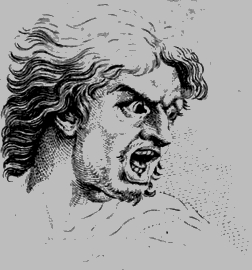
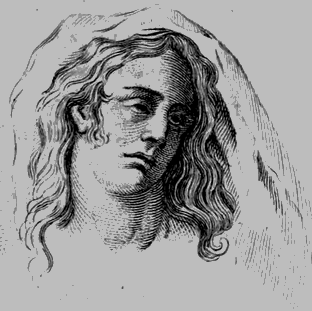
FIG. 15
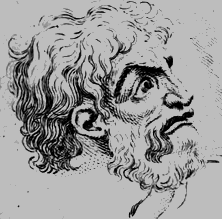
FIG. 17 FIG. 16
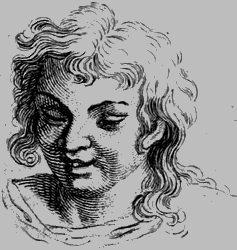
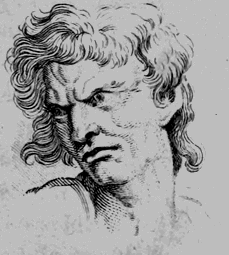
Click on image to view larger version.
CHAPTER V.
OF OLD AGE AND DEATH.
Every object in Nature has its improvement and its decay. No sooner does the human form arrive at its limited perfection, than it begins to decline. The alteration is at first insensible, and even several years elapse before it becomes perceptible. Yet we ought to feel the weight of our years better than other people can estimate the number of them; and, as those are rarely deceived who judge of our age from external appearances, we would be still less so, as to the internal effect, if we did but observe ourselves more, and flatter ourselves less with false and idle hopes.
When the body has attained its full length, by the final expansion of all its parts, it begins to receive an additional bulk, which rather incommodes than assists it, and may be considered as the first step towards decay. This is formed from a superfluous substance termed fat, and generally appears about the age of thirty-five, or forty, and by which, in proportion to its encrease, the body becomes less nimble, active, and unconstrained in its motions.
The bones also, and the other solid parts of the body, encrease in solidity. The membranes become cartilaginous, or gristly, the cartilages become bony, the fibres become more hard, the skin dries up, wrinkles are gradually formed in it, the hair grows grey, the teeth fall out, the visage becomes haggard, and the body stoops. The first approach of these alterations is perceived before the age of forty; by slow degrees they advance till that of sixty, and by rapid ones till that of seventy: after which period, decrepitude soon follows, and continues to augment to the age of ninety, or a hundred, when the life of man is generally terminated.
Having already traced the causes of the formation, growth, and expansion of the human frame, we shall now proceed to consider those of its decay.
At first the bones of the fœtus are only small threads, of a ductile matter, and of little more substance than the flesh; by degrees they acquire solidity, and may be considered as a kind of small tubes, lined both within and without by a thin membrane which supplies the osseous matter. A pretty exact idea might be formed of the growth of bones, by comparing them with the manner in which the wood and solid parts of vegetables are produced. These bones, or, as we have said, tubes, are covered at both ends by a soft substance, and in proportion as they receive nutritious juices, the extremities extend from the middle point which always preserves its original station. The ossification begins at the middle and gradually follows the extension until the whole is converted into bone. Having acquired their full growth, and the nutritious juices no longer being necessary for their augmentation, they serve the purpose of increasing their solidity; in time the bones become so solid as not to admit the circulation of these juices which are highly essential to their nourishment; and this being stopped, they undergo a change like that perceived in old trees; and this change is the first cause that renders the decay of the human body inevitable.
The cartilages, which may be considered as soft and imperfect bones, grow also more rigid as we increase in years; and as they are generally placed near the joints, the motion of these must of consequence become more difficult. Thus, in old age, every action of the body is performed with labour; and the cartilages, which in youth were elastic, and in manhood pliant, will now sooner break than bend, and may be considered as the second cause of our dissolution.
The membranes become likewise as we grow old more dense and more dry. Those, for example, which surround the bones cease to be ductile, and are incapable of extension so early as the age of 18 or 20. It is also the same with the muscular fibres, and though to the external touch the body seems, as we advance in years, to grow more soft, yet in reality it is increasing in hardness. On such occasions it is the skin, and not the flesh, that communicates this perception. The fat which increases when the body is arrived at maturity, being interspersed between the skin and muscles, gives an appearance of softness which the flesh is far from possessing in reality; an undeniable proof of which is to be found in comparing the flesh of young and old animals; the former is tender and delicate; the latter hard, dry, and unfit for eating.
While the body increases, the skin will stretch to any degree of tension; but when the former diminishes, the latter never contracts; and hence the source of wrinkles, which cannot be prevented. Those of the face proceed from this cause, though as to shape they depend in a greater measure on its form, features, and habitual movements. By examining the countenance of a man at the age of 25 or 30, we may discover in it the origin of all the wrinkles it will have in old age; particularly when the features are in a state of agitation by laughing, weepings or any strong grimace. All the little furrows formed by these agitations will one day become wrinkles, which no art shall be able to remove.
In proportion then as we advance in years, the bones, the cartilages, the membranes, the flesh, the skin, and all the fibres of the body grow more solid, hard, and dry. Every part shrinks, and every motion becomes more slow; the circulation of the fluids is performed with less freedom, the perspiration diminishes, the secretions alter, the digestion becomes slow and laborious, the nutritive juices become less plentiful, and no longer serving to convey their accustomed nourishment, are wholly useless, as if they did not exist. Thus the body dies by little and little, all its functions diminish by degrees, and death only at last seizes upon that little which is left.
As the bones, the cartilages, the muscles, and all the other parts of the body, are naturally softer in women than in men, they do not acquire so soon that hardness which hastens death. Women, therefore, ought to live longer than men. This is actually the case; for by consulting the tables which have been formed respecting the duration of human life, we shall find that, after a certain age, women have a greater chance for long life than men of the same number of years. From this it may also be inferred, that such men as are weak in appearance, and whose constitution rather resembles that of women, have a probability of living longer than those who seem to be more strong and robust; as likewise, that in either sex such persons as have been slow in their advances to maturity, will be slow in their advances to the infirmities of old age, because in both cases, the bones, the cartilages, and all the fibres, require a longer time to arrive at that degree of solidity, which must be the foundation of their destruction. This natural cause of death is common to all animals, and even to vegetables. An oak only perishes because its more ancient parts, which are in the centre, become so hard and so compact, that they can no longer receive any nourishment; and the moisture they contain, being deprived of circulation, becomes corrupted, and gradually alters the fibres of the wood, which become red, and at length crumble into dust.
The duration of life may be determined, in some measure, by the time that was employed in the attainment of maturity. A tree, or an animal, which takes but a short time to finish its growth, perishes much sooner than those which are longer in coming to maturity. Neither animals nor plants begin to spread in bulk till they have acquired their summit of height. Man grows in stature till the age of 17 or 18; but his body is not completely unfolded in all its parts till that of 30; while a dog is at its full length in one year, and at its full thickness in another. The man whose growth is so tedious, lives for 90 or an 100 years; whereas the dog seldom survives its 10 or 12th year. To the generality of other animals this observation is equally applicable. Fishes, whose growth continues for a number of years, live for centuries; and this from no other known certain cause, but the particular constitution of their bones, which do not admit of the same solidity as the bones of terrestrial animals.
Whether there are any exceptions to this kind of rule, which Nature seems to have adopted in proportioning the duration of life to that of the bodily growth, we shall enquire when we come to the particular history of animals, as also whether crows and stags live for such a number of years as is commonly pretended. In the mean while, as a general truth, let it be remarked, that large animals live longer than small ones, and this because they require a longer time to come to maturity.
The causes of our decay then are inevitable; nor can we avoid the fatal arrow of death, or even avert it, without changing the laws of Nature. The ideas which a few visionaries have formed of perpetuating life by some particular panacea, as that of the transfusion of the blood of one living creature into the body of another, must have died with themselves, did not self-love constantly cherish our credulity, even to the persuasion of some things which are in themselves impossible, and to the doubt of others, of which every day there are demonstrative proofs.
When the constitution of the body is sound, it is perhaps possible, by moderation in the passions, by temperance and sobriety, to lengthen life for a few years. But even of this there seems to be an uncertainty, for if it is necessary that the body should employ its whole strength, that it should consume all its powers by labour and exercise, whence could any benefit accrue from regimen and abstinence? Men no doubt there are who have surpassed the usual period of human existence, and not to mention Par, who lived to the age of 144, and Jenkins to that of 165, as recorded in the Philosophical Transactions, we have many instances of the prolongation of life to 110, and even to 120 years; yet this longevity was occasioned by no peculiar art or management; on the contrary, it appears that the generality of them were peasants, huntsmen, or labourers, men who had employed their whole bodily strength, and even abused it, if to abuse it is possible, otherwise than by continual idleness and debauchery.
Besides, if we reflect that the European, the Negro, the Chinese, and the American, the civilized man and the savage, the rich and the poor, the inhabitant of the city, and the inhabitant of the country, however different in other respects, are yet entirely similar as to the period allotted for their existence; if we reflect that the difference of race, of climate, of nourishment of accommodation, makes no difference in the term of life; that men who feed on raw flesh, or on dried fish, on sago, or on rice, on cassava, or on roots, live as long as those who feed on bread and prepared meats, we must be still more strongly convinced that the duration of life depends not either on habits, customs, or on the qualities of particular food, and that nothing can change the laws of that mechanism, by which the number of our years are regulated, but excesses of luxury or intemperance.
If in the duration of life there is any difference, it ought seemingly to be ascribed to the quality of the air. In elevated countries there are commonly found more old people than in low. The mountains in Scotland and Wales, of Auvergne and Switzerland, have furnished more instances of extreme longevity than the plains of Holland, Flanders, Germany, or Poland. In general, however, the period of human existence may be said to be the same in every country. If not cut off by accidental diseases man is found to live to the years of 90 or an 100. Beyond that date our ancestors did not live, nor has it, in any degree varied since the time of David.
Should it be asked, why, in the early ages, men lived to 900, 930, and even 960 years? it may, with great probability of reason, be answered, that the productions of the earth might then be of a different nature; as, at the creation, the surface of the globe must have been far less solid and compact than it afterwards became, so it is possible that the productions of Nature, and even the human body itself, being more ductile and more susceptible of extension, their growth was not so soon accomplished as at present. Every kind of nourishment being in itself more soft and more ductile, the bones, the muscles, &c. necessarily retained their primitive softness and ductility longer. As the body, therefore, did not attain its complete expansion, nor its generative powers, for 120 or 130 years, the duration of life would be proportioned to that time, required for the growth, as it is to this day. In the supposition, for example, that the age of puberty was originally at the years of 130, as it is now at the age of 14, it will appear, that the period of human existence has always been proportionally the same as it is at present, since by multiplying those two numbers by seven, for instance, we shall find that the age of the present race will be 98 years, as those in the first age 910. It is probable, then, that the duration of human life decreased in proportion as the solidity of the surface of the earth increased, and that the ages from the creation, to the time of David, having been sufficient to communicate to terrestrial substances all the consistency which they are capable of acquiring by the pression of gravity, the surface of the earth has ever since remained in the same condition, and the limits of the growth of its different productions have been fixed, as well as those of the duration of life.
Independent of accidental maladies which happen at every age, but become more dangerous and more frequent at the latter periods of life, all men are subject to natural infirmities, that originate solely from a decay of the different parts of the body. The muscular powers lose their firmness, the head shakes, the hands tremble, the legs totter, and the sensibility of the nerves decreasing, every sense becomes blunted. But the most striking infirmity is, that men very aged, are unequal to the office of generation. Of this inability two causes may be assigned, a defect of tension in the external organs, and a decay of the seminal fluid.[B] The latter defect, however, may be supplied by a young woman; and thus it is that we sometimes see men at an advanced period of life become fathers, but then they have a much less share in their children than young ones; and thence it happens, that young persons, when married to old men, decrepid and deformed, often bring forth monsters, and children more defective still than their fathers.
The scurvy, dropsy, and such diseases as proceed from a vitiated state of the blood and other fluids, are the most fatal to mankind; but these fluids depend upon the solids, which are the real organic parts. As we become advanced in life the vessels contract, the muscles lose their strength, and the secretory organs are obstructed; from which causes the blood, and other fluids, become viscid, and occasion those diseases which are generally supposed to arise from vitiated humours. The natural decay of the solids are, therefore, the original causes of those disorders; nevertheless, if the fluids become stagnated, or are obstructed in their circulation, by a contraction of the vessels, they produce alarming symptoms, and soon corrupt and corrode the weakest parts of the solids. Thus do the causes of dissolution continually multiply until they put a period to our existence.
All these causes of decay act continually upon our material existence, and contribute to its dissolution. Nature, however, approaches to this much-dreaded period by slow and imperceptible degrees. Day after day is life consuming, and every hour is some one or other of our faculties, or vital principles, perishing before the rest. Death, therefore, is only the last shade in the picture; and it is probable that man suffers a greater change in passing from youth to age, than from age into the grave. In the instant of the formation of the fœtus life is as yet nothing, or next to nothing. It extends and acquires consistence and force as the body increases, and as soon as the latter begins to decrease the former decreases also, till its final extinction. As our life begins by degrees, so by degrees it is terminated.
Why, then, be afraid of death, if our lives have been such as not to make us apprehend the consequences of futurity? Why be afraid of that moment which is preceded by an infinity of others of the same kind? Death is as natural as life, and both happen to us in the same manner, without our having the smallest sense or perception of them. If we enquire of those whose office it is to attend the sick and the dying, we shall find, that, except in a very few acute cases, attended with convulsions, people expire quietly, and without the smallest indication of pain. Even when dreadful agonies seem so attend the afflicted, the spectators are rather terrified than the patients tormented; who, having recovered, after the most violent convulsions, possess not the smallest idea of what had passed, or even what they had suffered.
The greatest number of mankind die, therefore, without feeling the fatal stroke; and of the few who retain their senses to the last, there is hardly one, perhaps, who does not entertain the hope of recovery. Nature, for the happiness of man, has rendered this principle more powerful than reason. A person dying of a disorder which he already knows to be incurable, by repeated instances in others, and is now assured that it is so by the tears of his friends, and by the countenance or departure of the physician, is still buoyed up with the idea of getting over it; the opinion of others he considers as a groundless alarm; the hour of dissolution comes; and while every thing else is, as it were dead, hope is still alive and vigorous.
A sick man will say that he feels himself dying; that he is convinced he cannot recover; but if any person, from zeal, or indiscretion, shall tell him that his end is actually at hand, his countenance instantly changes, and betrays all the marks of surprize and uneasiness. He now seems not to believe, what he had been endeavouring to impress upon others; he had only some doubt, some uneasiness, about his situation; but his hopes were far greater than his fears; and but for the gloomy assiduity, the parade of woe, which generally surrounds a death-bed, and too often embitters the last moments, he would be insensible of his approaching dissolution.
By no means is death so dreadful, therefore, as we suppose it to be. It is a spectre which terrifies us at a distance, but disappears when we approach it more closely. Our conceptions of it are formed by prejudice, and dressed up by fancy. We consider it not only as a misfortune greater than any other, but as one accompanied by the most excruciating anguish. Death, it is said, must be terrible, since it is sufficient to separate the soul from the body; the pain must also be of considerable duration, since time is measured by the succession of our ideas; one minute of pain, in which these ideas succeed each other with a rapidity proportioned to the agony we suffer, must appear longer than a whole age, in which they flow in their usual gentleness and tranquillity. In such philosophy, what an abuse of reason! But for the consequences of it, hardly would it deserve to have its futility exposed. As by such arguments, however, weak minds are deceived, and the aspect of death rendered a thousand times more hideous than it possibly can be; to point out the erroneous principles may be of advantage.
When the soul is originally united to our body, do we experience any extraordinary joy, which delights and transports us? Most certainly not. What reason then can we have to suppose that the separation of the soul from that body may not be effected without pain? From what cause should such pain arise? Shall we fix its residence in the soul, or in the body? Pain of the mind can only be produced by thought, and that of the body is proportioned to its strength or weakness. In the instant of death, the body must be in its weakest state, and therefore if it does experience pain, it must be in a very trifling degree.
Let us now suppose a violent death; that for example, of a man whose head is carried off by a cannon-ball. Can the pain he suffers last longer than a moment? Has he, in the interval of that moment, a succession of ideas so rapid, that he can imagine the pangs he feels are equal to an hour, a day, an age? These points we shall endeavour to discuss.
I own the succession of our ideas is, in reality, the only natural measure of time; and that, in proportion as they flow with more or less uniformity, they appear of longer or shorter duration. But in this measure there is an unit, or fixed point, which is neither arbitrary nor indefinite, but determined by Nature, and correspondent to our organization. Between two ideas which succeed each other, there must be an interval that separates them; however quick one thought may be, a little time is required before it can be followed by another, no succession being possible in an indivisible instant. The same observation holds with respect to the sensations of the body. A transition from pain to pleasure, or even from one pain to another, requires a certain interval. This interval, by which our thoughts and sensations are necessarily separated, is the unit I mention; and it can neither be extremely long, nor extremely short; it must even be nearly upon an equality in its duration, as it depends upon the nature of the mind, and the organization of the body, whose movements can have but one certain degree of celerity. In the same individual, therefore, there can be no succession of ideas so rapid, or so slow, as to produce that enormous difference of duration, by which the pain of a minute is converted into that of an hour, a day, or a century.
A very acute pain, of however short continuance, tends to produce either a swoon, or death. As our organs have only a certain degree of strength, they cannot resist above a certain degree of pain. If that becomes excessive, it ceases, because the body being incapable of supporting it, is still less capable to transmit it to the mind, with which it can hold no correspondence, but by the action of these organs. Here this action ceases, and therefore, all internal sensation must necessarily cease also.
What has already been advanced, is perhaps amply sufficient to evince, that, at the instant of death, the pain is neither excessive nor of long duration; but in order to dispel all fear from the bosom of timidity itself, we shall add a few words more upon the subject. Though excessive pains admit of no reflection, yet signs, at least, of it have been observed in the very moment of a violent death. When Charles XII. received, at Frederickshall, the blow which terminated his exploits and existence, he clapped his hand upon his sword. Since it excluded not reflection, this mortal pang could not, therefore, be excessive. The brave warrior found himself attacked; he reflected that he ought to defend himself; and thence, it is evident, he felt no more than what he might have suffered from an ordinary blow. That this action was nothing more than the result of a mechanical impulse it would be absurd to assert, as it has been evidently shewn, in our description of man, that the most precipitate movements of the passions depend upon reflection, and are nothing more than effects of an habitual exertion of the mind.
If I have rather enlarged on this topic it is only that I might destroy a prejudice so repugnant to the happiness of man. To this prejudice many have fallen victims; and I have myself known several, of the female sex in particular, who, from the very dread of death, have died in reality. Such terrible alarms seem, indeed, to be particular to those whom Nature or education have endowed with superior sensibility, as the gross of mankind look forward to death, if not with indifference at least without terror.
In viewing things as they are consists the spirit of true philosophy. With this philosophy our internal sensations would always correspond, were they not perverted by the illusions of imagination, and by the unfortunate habit of fabricating phantoms of excessive pains and of pleasure. Nothing appears terrible nor charming but what is at distance. To obtain a certain knowledge of either we must have the resolution, or the wisdom, to take a close and particular view of them, and all their extraordinary circumstances will disappear.
If there be any thing necessary to confirm what has been said concerning the gradual cessation of life, we might find it in the uncertainty of the signs of death. By consulting the writers on this subject, and particularly Winslow and Bruhier, we shall be convinced, that between life and death the shade is often so undistinguishable that all the powers of medical art are insufficient to determine upon it. According to them, “the colour of the face, the warmth of the body, the suppleness of the joints, are but equivocal signs of life; and that the paleness of the complexion, the coldness of the body, the stiffness of the extremities, the cessation of all motion, and the total insensibility of the parts, are signs to the full as equivocal of death.” It is also the same with regard to the cessation of the pulse, and of respiration, which are sometimes so effectually kept under, that it is impossible to obtain the smallest perception of either. By carrying a mirror, or candle, to the mouth of a person supposed to be dead, people expect to find whether he breathes or not; but in this experiment there is little certainty; the mirror is often sullied after death has taken place, and remains unclouded while the person is still alive. Neither do burning nor scarifying, noises in the ears, nor pungent spirits applied to the nostrils, give indubitable proofs of the discontinuance of life; many are the instances of persons who have undergone all such trials without shewing any signs of life, and yet, to the astonishment of the spectators, recovered afterwards, without the smallest assistance.
Nothing can be more evident than that life, in some cases, has a near resemblance to death, and therefore that we ought to be extremely cautious of renouncing, and committing too hastily to the grave, the bodies of our fellow-creatures. Neither ten, twenty, nor twenty-four hours are sufficient to distinguish real from apparent death; and there are instances of persons who have been alive in the grave at the end of the second, and even the third day. Why suffer to be interred with precipitation those persons whose lives we ardently wished to prolong? Why, though all men are equally interested in the abolition of it, does the practice still subsist? On the authority of the most able physicians, it incontestably appears, “that the body, though living, is sometimes so far deprived of all vital function, as to have every external appearance of death; that, if in the space of three days, or seventy two hours, no sign of life appears, and on the contrary the body exhales a cadaverous smell, there is an infallible proof of actual death; and that then, though on no account till then, the interment can with safety take place.”
Hereafter we shall have occasion to speak of the usages of different nations with respect to obsequies, interments, and embalments. The greatest part, even of the most savage people, pay more attention than we to their deceased friends. What with us is nothing more than a ceremony, they consider as an essential duty. Far superior is the respect which they pay to their dead: they clothe them, they speak to them, they recite their exploits, they extol their virtues; while we, who pique ourselves on our sensibility, with hardly an appearance of humanity, forsake and fly from them, we neither desire to see, nor have courage nor inclination to speak to them, and even avoid every place which may recall their idea to our minds. Than savages themselves, then, do we, in this respect, discover either more indifference or more weakness.
Having thus given a history of life, and of death, as they relate to the individual, let us now consider them both, as they affect the whole species. Man dies at every age; and though in general the duration of his life is longer than that of most animals, yet it is more uncertain and more variable.
Of late years attempts have been made to ascertain the degrees of such variations, and to establish, by different observations, some certainty as to the mortality of men at different ages. Were such observations sufficiently exact and numerous they would be admirably calculated to give a knowledge of the number of people, their increase, the consumption of provisions, and of a number of other important objects. Many writers of distinguished abilities, and, among others, Halley and Simpson, have given tables of the mortality of the human species; but as their labours have been confined to an examination of the bills of mortality in a few parishes of London, and other large cities, their researches, however accurate, seem, in my opinion, to give a very imperfect idea of the mortality of mankind in general.
In order to give a complete table of this nature it is necessary to scrutinise not only the parish-registers of such towns as London and Paris, where there is a perpetual ingress of strangers and egress of natives, but also those of different country places; that, by comparing the deaths which happen in the one with the deaths which happen in the other, a general conclusion may be formed. M. Dupré, of St. Maur, a member of the French academy, executed this project upon twelve different parishes in the country of France, and, three in Paris. Having obtained his permission to publish the tables he has drawn up on this occasion, I do it with the greater pleasure, as they are the only ones from which the probabilities of human life in general can with any certainty be established.
YEARS OF LIFE.
PARISHES. deaths. 1 2 3 4
Clemont 1391 578 73 36 29
Brinon 1141 441 75 31 27
Jouy 588 231 43 11 13
Lestiou 223 89 16 9 7
Vandeuvre 672 156 58 18 19
St. Agil 954 359 64 30 21
Thury 262 103 31 8 4
St. Amant 748 170 61 24 11
Montigny 833 346 57 19 25
Vieleneuve 131 14 3 5 1
Goussainville 1615 565 184 63 38
Ivry 2247 686 298 96 61
Total Deaths 10805
Division of 10805 deaths into the years they happened } 3738 963 350 256
Deaths before the end of the 1st, 2d, 3d, &c. years. } 3738 4701 5051 5307
Number of persons entered into their 1st, 2d, 3d, &c. years. } 10805 7067 6104 5754
St. Andre, Paris, 1728 201 122 94 82
St. Hippolytus, 2516 754 361 127 64
St. Nicolas, 8945 1761 932 414 298
Total Deaths 13189
Division of the 13189 deaths into the years they happened.> } 2716 1415 635 444
Deaths before the end of the 1st, 2d, 3d, &c. years. } 2716 4131 4766 5210
Number of persons who entered into the 1st, 2d, &c. years. } 13189 10473 9058 8423
Division of the 23994 deaths in the 3 parishes of Paris and the 12 villages. } 6454 2378 985 700
Deaths before the end of the 1st, 2d, years, &c. out of the 23994 } 6454 8832 9817 10517
Number of persons entered into their 1st and 2d years, &c. } 23994 17540 15162 14177
YEARS OF LIFE.
5 6 7 8 9 10 11 12
16 16 14 10 8 4 6 5
10 16 9 9 8 5 2 12
5 8 4 6 1 0 3 0
1 4 3 1 1 1 0 1
10 11 8 10 3 2 1 3
20 11 4 7 2 7 3 3
3 2 2 2 1 2 0 0
12 15 3 6 8 6 4 4
16 21 9 7 5 5 2 4
1 0 0 0 0 0 0 1
34 21 17 15 12 8 5 5
50 29 34 26 13 19 9 6
178 154 107 99 62 59 35 44
5485 5639 5746 5845 5907 5966 6001 6045
5498 5320 5166 5059 4960 4898 4839 4804
50 35 28 14 8 7 3 9
60 55 25 16 20 8 9 9
221 162 147 111 64 40 34 38
331 252 200 141 92 55 46 56
5541 5793 5993 6134 6226 6281 6327 6383
7979 7648 7396 7196 7055 6963 6908 6862
509 406 307 240 154 114 8 100
11026 11432 11639 11979 12133 12247 12328 12428
12477 12968 12562 12255 12015 11861 11747 11666
YEARS OF LIFE.
13 14 15 16 17 18 19 20
6 5 5 6 6 10 3 13
2 6 4 5 9 4 5 14
3 3 1 6 4 4 3 5
0 1 1 1 1 0 0 0
3 4 5 9 3 3 4 7
3 3 5 2 7 8 5 6
0 0 1 0 1 1 1 1
2 5 1 5 3 6 1 4
4 2 4 2 2 3 3 5
0 0 1 0 2 4 0 1
9 5 5 2 5 10 9 10
4 4 8 7 4 14 10 12
36 38 41 42 47 67 44 78
6081 6119 6160 6202 6249 6316 6360 6438
4760 4724 4686 4645 4603 4556 4480 4445
6 7 10 13 13 11 10 7
6 7 6 5 7 9 7 3
25 21 33 37 37 28 44 53
37 35 49 55 57 487 61 63
6420 6455 6504 6559 6616 6664 6725 6788
6806 6769 6734 6685 6630 6573 6525 6464
73 73 90 97 104 115 105 141
12501 12574 12664 12761 12865 12980 13085 13226
11566 11493 11420 11330 11233 11129 11014 19009
YEARS OF LIFE.
21 22 23 24 25 26 27 28
8 9 10 7 22 9 13 10
8 14 7 11 24 9 7 13
2 4 4 4 5 2 2 3
0 0 3 0 1 1 1 3
4 6 8 6 22 3 5 10
6 4 6 3 11 10 4 9
1 3 1 1 2 2 0 5
7 6 6 4 5 4 4 3
4 3 10 8 7 3 3 3
1 4 1 0 1 0 2 1
6 10 5 6 11 9 9 8
6 15 10 9 10 14 5 9
51 80 68 62 121 66 55 77
6480 6569 6637 6699 6820 6886 6941 7018
4367 4316 4236 4168 4106 3985 3919 3864
9 17 11 9 9 8 17 13
2 8 7 9 10 13 10 10
31 56 48 41 59 47 53 51
42 81 66 59 78 68 80 74
6830 6911 6977 7036 7114 7182 7262 7336
6401 6359 6278 6212 6153 6075 6007 5927
93 161 134 121 199 134 135 151
13319 13480 13614 13735 13934 14068 14203 14354
10768 10675 10514 10380 10259 10060 9926 9793
YEARS OF LIFE.
29 30 31 32 33 34 35 36
7 24 4 13 14 8 17 12
6 28 6 15 3 4 20 8
4 8 2 5 4 3 13 6
1 1 4 4 3 1 6 4
1 28 2 9 1 3 17 5
2 16 8 7 2 5 18 9
2 2 0 3 1 0 7 0
3 8 2 8 6 5 7 4
0 6 1 10 3 4 8 4
1 2 1 2 1 0 6 5
10 10 4 14 6 7 8 8
5 13 8 11 18 10 19 12
42 146 42 101 62 50 146 77
7060 7206 7248 7349 7411 7461 7607 7684
3787 3745 3599 3557 3456 3394 3344 3198
11 21 6 10 17 15 21 14
9 7 9 12 13 13 16 21
34 63 25 57 41 54 82 75
54 91 40 79 71 82 119 110
7390 7481 7521 7600 7671 7753 7872 7982
5853 5799 5708 5668 5589 5518 5436 5317
96 237 82 180 153 132 205 187
14450 14687 14769 14949 15082 15214 15479 15666
9640 9544 9307 9245 9045 8912 8770 8515
YEARS OF LIFE.
37 38 39 40 41 42 43 44
16 15 3 41 4 10 10 6
8 8 6 37 6 8 3 6
7 4 1 20 0 3 0 4
4 1 1 4 0 2 2 0
5 4 0 41 1 3 2 2
4 5 1 22 2 8 7 3
1 2 2 4 1 3 1 4
5 5 3 20 1 6 2 4
1 2 0 8 3 6 5 4
0 5 0 7 0 3 1 0
5 2 7 14 10 11 4 5
13 23 3 27 7 19 7 14
71 76 27 245 35 82 44 52
7755 7831 7858 8103 8138 8220 8264 8316
3121 3050 2974 2947 2702 2667 2585 2541
8 12 4 26 5 19 12 10
15 13 10 24 4 18 14 9
58 59 46 109 37 73 58 45
81 84 60 159 46 110 84 64
8063 8147 8207 8366 8412 8522 8606 8670
5207 5126 5042 4982 4823 4777 4667 4583
158 160 87 404 81 192 128 116
15818 15978 16065 16469 16550 16742 16870 16986
8328 8176 8016 7929 7525 7444 7252 7124
YEARS OF LIFE.
45 46 47 48 49 50 51 52
20 5 8 5 6 31 0 5
11 5 6 9 0 23 1 3
13 3 4 2 0 20 2 3
3 3 0 3 3 5 1 1
14 5 3 1 0 31 0 2
14 1 3 3 0 24 3 9
3 0 0 0 0 3 0 0
13 3 4 6 0 23 1 4
13 6 1 6 1 10 2 5
2 1 2 3 0 7 2 1
11 9 5 12 6 15 4 9
22 10 7 12 6 24 6 14
139 51 43 62 22 216 22 56
8455 8506 8549 8611 8633 8849 8871 8927
2489 2350 2299 2256 2194 2172 1956 1934
24 21 9 13 10 24 7 18
33 14 13 15 21 20 10 19
111 54 47 68 50 120 40 59
168 89 69 96 72 164 57 96
8838 8927 8996 9092 9164 9328 9385 9481
4519 4351 4262 4193 4097 4025 3861 3804
307 140 112 158 94 380 79 152
17293 17433 17545 17703 17797 18177 18256 19408
7008 6701 6561 6449 6291 6197 5817 5738
YEARS OF LIFE.
53 54 55 56 57 58 59 60
5 5 14 5 5 4 4 52
3 2 10 6 2 3 0 24
2 5 7 4 5 2 0 20
0 0 2 2 0 3 0 2
1 1 13 1 1 2 0 35
2 2 14 3 5 3 3 22
1 1 4 0 1 3 1 6
4 4 6 5 4 7 2 27
2 5 10 3 4 9 2 13
0 1 0 3 3 2 1 4
5 9 6 10 10 10 3 24
13 9 29 12 13 13 3 40
38 41 111 54 51 61 19 269
8365 9009 9120 9174 9225 9286 9305 9574
1878 1840 1796 1685 1631 1580 1519 1500
8 10 19 11 15 17 11 46
6 10 25 9 15 18 12 35
49 46 125 56 48 86 48 184
63 66 169 76 78 121 71 265
9544 9610 9779 9855 9933 10054 10125 10390
3708 3645 3579 3410 3334 3256 3135 3064
101 110 280 130 129 182 90 534
18509 18619 18899 19029 19158 19340 19430 19964
5586 5485 5375 5095 4965 4836 4654 4564
YEARS OF LIFE.
61 62 63 64 65 66 67 68
2 6 5 2 5 5 3 4
1 3 4 7 7 6 3 6
0 5 2 4 5 2 1 1
0 0 1 0 3 1 1 0
0 0 1 1 5 3 0 2
3 2 7 5 7 3 6 5
0 3 2 2 2 1 3 1
0 4 3 4 12 7 5 6
3 7 5 5 7 6 2 5
3 0 1 1 2 3 0 1
6 9 7 6 13 17 13 15
3 12 12 11 14 21 5 23
21 51 50 48 82 75 42 69
9595 9646 9696 9744 9826 9401 9943 10012
1231 1210 1159 1109 1061 979 904 862
11 21 19 17 20 27 21 25
7 28 21 23 25 19 12 20
42 77 71 73 95 95 67 115
60 126 111 113 140 141 100 160
20450 10576 10687 10800 10940 11081 11181 11341
2799 2739 2613 2501 4389 2249 2108 2008
81 177 161 161 122 216 142 229
20045 20222 20383 20544 20766 20982 21124 21353
4030 3949 3772 3611 3450 3228 3012 2870
YEARS OF LIFE.
69 70 71 72 73 74 75 76
1 11 1 3 1 3 5 1
0 6 2 12 2 0 4 2
1 3 1 2 0 1 1 0
1 0 0 2 0 0 0 0
1 9 1 4 0 0 3 0
2 19 1 11 5 5 8 0
0 7 0 2 1 0 0 0
6 18 3 10 2 2 18 2
1 9 2 8 3 2 9 1
0 4 0 3 0 0 0 0
5 16 8 22 12 12 16 6
7 31 6 21 11 19 24 12
25 133 25 100 37 44 88 24
10037 10170 10195 10295 10332 10376 10464 10488
793 768 935 610 510 473 429 341
9 36 9 25 14 19 20 16
15 35 10 28 5 15 23 11
50 177 64 118 53 90 127 63
72 248 83 171 72 124 170 90
11413 11661 11744 11915 11987 12111 12281 12371
1848 1776 1528 1445 1274 1202 1078 908
97 381 108 271 109 168 258 114
21450 21831 21939 22210 22319 22487 22745 22859
2641 2544 2160 2155 1784 1675 1507 1249
YEARS OF LIFE.
77 78 79 80 81 82 83 84
1 2 2 6 0 0 0 3
0 3 0 3 1 0 0 0
0 0 0 2 0 0 0 0
0 0 0 1 0 0 0 0
1 0 0 7 0 0 0 0
3 4 0 6 0 0 0 0
1 0 0 3 0 0 0 0
4 4 2 17 1 3 1 3
4 2 0 5 1 4 1 1
2 1 1 1 3 0 0 0
6 8 1 17 6 9 5 7
11 14 9 19 7 14 4 7
33 38 15 89 16 30 11 21
10521 10559 10574 10663 10679 10709 10720 10741
317 284 246 231 142 126 96 85
10 25 8 17 4 10 8 7
18 15 8 18 4 5 16 4
59 69 80 121 32 41 37 25
87 109 46 156 40 56 61 36
12458 12567 12613 12769 12809 12865 12962 12962
818 731 622 576 420 380 324 263
120 147 61 245 50 86 72 57
22979 23126 23187 23432 23488 23574 23646 23703
1835 1015 868 807 562 506 426 348
YEARS OF LIFE.
85 86 87 88 89 90 91 92
0 1 0 0 1 0 0 0
0 0 0 0 0 0 0 0
0 0 0 1 0 0 0 0
1 0 0 0 0 0 0 0
0 0 1 1 0 0 0 0
0 0 0 0 0 2 0 0
0 0 0 0 0 0 0 0
4 0 1 2 0 4 1 1
0 0 0 0 0 1 0 0
0 0 0 0 1 0 0 0
2 4 4 2 2 0 0 0
5 4 4 3 1 2 0 2
12 9 8 9 5 9 1 3
10753 10762 10770 10779 10784 10793 10794 10797
64 52 43 35 26 21 12 11
3 7 4 5 2 4 0 2
10 4 1 4 2 2 2 2
35 19 20 25 24 17 5 9
48 30 25 34 8 23 7 13
13010 15040 13065 13099 16017 13130 13137 13150
227 179 149 124 90 82 59 52
50 39 33 43 13 32 8 16
23763 23802 22835 22878 23891 23923 23931 23947
291 231 192 159 116 103 71 63
YEARS OF LIFE.
93 94 95 96 97 98 99 100
0 0 0 0 0 0 0 0
0 0 0 0 0 0 0 0
0 8 0 0 0 0 0 0
0 0 0 0 0 0 0 0
0 0 0 0 0 0 0 0
0 0 0 0 0 0 0 1
0 0 0 0 0 0 0 0
0 0 2 1 0 3 0 0
0 0 0 0 0 0 0 0
0 0 0 0 0 0 0 0
0 0 0 0 0 0 0 0
0 0 1 0 0 0 0 0
0 0 3 1 0 3 0 1
10797 10797 10800 10801 10801 10804 10804 10805
8 8 8 4 4 4 1 1
1 2 0 1 1 0 0 0
1 1 2 1 0 1 0 0
5 4 5 2 1 4 1 4
7 7 7 4 2 5 1 4
13157 13164 13171 13175 13177 13182 13183 13187
39 32 25 18 14 12 7 6
7 7 10 5 2 8 1 5
23954 23961 23971 23976 23978 23986 23987 23992
47 40 33 23 18 16 8 7
From these tables many useful conclusions might be drawn. But I shall only consider those which respect the probabilities of the duration of life. It is observable, that in the columns opposite the years 10, 20, 30, 40, 50, 60, 70, and other round numbers as 25, 35, &c. the deaths in the country parishes are more numerous than in in the preceding or subsequent columns. The cause of this seeming inconsistency arises from the generality of country people being ignorant of their exact age, and therefore if they die at 58 or 59 in the parish register it is entered 60; and so of other round numbers. From this irregularity the inconvenience is not great, as it may easily be corrected by the manner in which the numbers succeed each other in the Tables.
By the tables in the country parishes it appears, that almost one half of the children die before the age of four years, and by the Paris table not before 16; which great difference; certainly arises from the children being sent into the country to nurse, and consequently increases the number of deaths there in infancy. As likely to come at the truth, I have blended the two tables, and from thence calculated the probabilities of the duration of life as follows:
TABLE of the PROBABILITIES of the DURATION of HUMAN LIFE.
Age Duration of Life. Age Duration of Life. Age Duration of Life.
Yrs. Yrs. Mths. Yrs. Yrs. Mths. Yrs. Yrs. Mths.
0 8 0 29 28 6 58 12 3
1 33 0 30 28 0 59 11 8
2 38 0 31 27 6 60 11 1
3 40 0 32 26 11 61 10 6
4 41 0 33 26 3 62 10 0
5 41 6 34 25 7 63 9 6
6 42 0 35 25 0 64 9 0
7 42 3 36 24 5 65 8 6
8 41 6 37 23 10 66 8 0
9 40 10 38 23 3 67 7 6
10 40 2 39 22 8 68 7 0
11 39 6 40 22 1 69 6 7
12 38 9 41 21 6 70 6 2
13 38 1 42 20 11 71 5 3
14 37 5 43 20 4 72 5 4
15 36 9 44 19 9 73 5 0
16 36 0 45 19 3 74 4 9
17 35 4 46 18 9 75 4 6
18 34 8 47 18 2 76 4 3
19 34 0 48 17 8 77 4 1
20 33 5 49 17 2 73 3 11
21 32 11 50 16 7 79 3 9
22 32 4 51 16 0 80 3 7
23 31 10 52 15 6 81 3 5
24 31 3 53 15 0 82 3 3
25 30 9 54 14 6 83 3 2
26 30 2 55 14 0 84 3 1
27 29 7 56 13 5 85 3 0
28 29 0 57 12 10
By this table it appears, that an infant newly born has an equal chance of living eight years; that an infant of one will live 33 years longer; that a child of two will live 38 years longer; that a man of 20 will live 33 years and five months longer; that a man of 30 will live 28 years longer; and so proportionally of every other age.
It is also to be observed, first, that seven years is the age at which the longest duration of life is to be expected, since there is then an equal chance of living 42 years and three months longer; secondly that at the age of 12 one fourth of our existence is gone, as we cannot in reason expect above 38 or 39 years more; thirdly, that we have enjoyed one half of our existence at the age of 28, as we can reckon upon only 28 years more; and lastly, that by the age of 50 three fourths of life are passed, the remaining probability being only for 16 or 17 years.
But these physical truths, however mortifying, may be compensated by moral considerations. A man ought to consider as nothing the first fifteen years of his life. Every thing that happens in that long interval of time is effaced from the memory, or has at least so little connection with the views and objects Which afterwards occupy our thoughts that it gives us no concern. Neither, indeed, have we the game succession of ideas, nor, it maybe said, the same existence. In a moral sense we do not begin to live till we have begun to regulate our thoughts, to direct them towards futurity, and to assume to ourselves a kind of consistency of character conformable to that state which has some relation to what we shall afterwards become. By considering the duration of life in this, the only real point of view, we shall find, that at the age of 25 we have passed but one fourth part of our life; at the age of 38 one half; and that, at the age of 56, there is one fourth of life still remains.
CHAPTER VI.
OF THE SENSE OF SEEING.
Having described the parts of which the human body consists, let us now proceed to examine its principal organs; the expansion of the senses, and their several functions; and at the same time, point out the errors to which, through them, we are in some measure subjected by Nature.
The eyes seem to be formed very early in the human embryo. In the chicken also, of all the double organs they are the soonest produced. I have observed in the eggs of several sorts of birds, and in those of lizards, that the eyes were more large, and early in their expansion, than any other parts of a two-fold growth. Though, in viviparous animals, and particularly in man, they are, at first, by no means so large in proportion as in the oviparous, yet they obtain their due formation sooner than any other parts of the body. It is the same with the organ of hearing; the small bones of the ear are entirely formed before any of the other bones have acquired any part of their growth or solidity. Hence it is evident, that the parts of the body, which are furnished with the greatest quantity of nerves, as the ears and eyes, are those which first appear, and which are the soonest brought to perfection.
If we examine the eyes of an infant, a few hours after its birth, we shall discern that it cannot make the smallest use of them; the organ not having acquired a sufficient consistency, the rays of light strike but confusedly upon the retina. Before the sixth week, children turn their eyes indiscriminately upon every object, without appearing to be affected by any, but at about this time they begin to fix them upon the most brilliant colours, and seem peculiarly desirous of turning them towards the light; this exercise does not give any exact notion of objects, but strengthens the eye, and qualifies it for future vision.
The first great error in the sense of seeing, is the inverted representation of objects upon the retina, and, till the sense of feeling has served to undeceive it, the child actually beholds every thing upside down. The second error in early vision is, that every object appears double; from the same object being formed distinctly upon each eye. This illusion like the other, can only be corrected by children from their being in the practice of handling different objects, and from which practice alone it is that they learn things are neither inverted nor double, and custom induces them to believe they see objects in the position the touch represents them to the mind; and therefore, were we denied the sense of feeling, that of seeing would not only deceive us as to the situation, but as to the number of every object around us.
We may easily be convinced that objects appear inverted, (which arises from the structure of the eye) by admitting the light to pass into a darkened room through a small aperture, when the images of the objects without will be represented upon the wall in an inverted position; for, as all the rays which issue from their different points cannot enter the hole in the same extent and position which they had in leaving the object, unless the aperture was as large as the object itself; as every part of the object sends forth its image on all sides; as the rays which from those images flow from all points of the object, as from so many centres, those only can pass through the small aperture which come in opposite directions. Thus the hole becomes a centre for the entire object, through which the rays from the upper, as well as from the lower parts of it, pass in converging directions; and, of consequence, they must cross each other at this centre, and thus represent the objects upon the wall, in an inverted position.
That we, in reality, see all objects double, is also evident; for example, if we hold up a finger, and look with the right eye at an object, it will appear against one particular part of the room, shutting that and looking with the left, it will seem to be on a different part, and if we open both eyes, the object will appear to be placed between the two extremes. But the truth is, the image of the object is formed in both eyes, one of which appears to the right, and the other to the left; and it is from the habit of touching that we suppose we see but one image placed between them both. From which it is clear that we see all objects double, although our imagination forms them single; and that, in fact, we see things where they are not, notwithstanding we have a pretty exact idea of their situation and position; and thus it is that till the sense of feeling has corrected the errors of sight, if instead of two eyes, we had an hundred, we should still fancy the objects single, although they were multiplied an hundred times.
In each eye, therefore, is formed a separate image of every object; and when the two images strike the correspondent parts of the retina, that is, the parts which are always affected at the same time, the object appears single: but, when the images strike the parts of the retina, which are not usually affected together, then it appears double, because we are not habitual to this unusual sensation, and are then somewhat in the situation of infants just beginning to exert the faculty of vision.
M. Chesselden relates the case of a man, who, in consequence of a blow on the head, became squint-eyed, and saw objects double for a long time: but who was at length enabled, by slow and gradual steps, to see them singly as he had formerly done, notwithstanding the squinting remained. Is not this a proof, still more evident, that in reality we see things double, and that it is by habit alone we conceive them to be single? Should it be asked why children require less time, in order to see things single, than persons more advanced in years, whose eyes may have been affected by accident? it might be answered, that the sensations of children, being unopposed by any contradictory habit, these errors are rectified with ease; but that persons who have for many years seen objects single, because they affected the two correspondent parts of the retina, and who now see them double, labour under the disadvantage of having a contrary habit to oppose, and must therefore be a considerable time before it is entirely obliterated.
By the sense of seeing we can form no idea of distances; without aided by the touch, every object would appear to be within our eyes; and an infant, that is as yet a stranger to the sense of feeling, must conceive that every thing it sees exists within itself. The objects only appear to be more or less bulky as they approach to, or recede from the eye; insomuch, that a a fly near the eye will appear larger than an ox at a distance. It is experience alone that can rectify this mistake; and it is by constantly measuring with the hand, and removing from one place to another, that children obtain ideas of distance and magnitude. They have no conception of size but from the extreme rays reflected from the object, of course every thing near appears large, and those at a distance small. The last man in a file of soldiers appears much more diminutive than the one who is nearest to us. We do not, however, perceive this difference, but continue to think him of equal stature; for the number of objects we have seen thus lessened by distance, and found by repeated experience to be of the natural size when we come closer, instantly correct the sense, and therefore we perceive every object nearly in its natural proportion, unless when we observe them in such situations as have not allowed us sufficient experience to correct the illusions of the eye. If, for example, we view men upon the ground, from a lofty tower, or look up to any object upon the top of a steeple, as we have not been in the habit of correcting the sense in that position, they appear to us exceedingly diminished, much more so than if we saw them at the same distance in an horizontal direction.
Though a small degree of reflection may serve to convince us of the truth of these positions, yet it may not be amiss to corroborate them by facts which cannot be disputed. M. Chesselden, having couched for a cataract a lad of thirteen years of age, who had from his birth been blind, and thus communicated to him the sense of seeing, was at great pains to mark the progress of his visual powers; his observations were afterwards published in the Philosophical Transactions. This youth was not absolutely and entirely blind: Like every other person, whose vision is obstructed by a cataract, he could distinguish day from night and even black from white, but of the figure of bodies he had no idea. At first the operation was performed only upon one of his eyes, and when he saw for the first time, so far was he from judging of distances, that he supposed (as he himself expressed it) every thing he saw touched his eyes, in the same manner as every thing he felt touched his skin. The objects that pleased him most were those whose surfaces were plain and the figures regular, though he could in no degree judge of their different forms, or assign why some were more agreeable to him than others. His ideas of colours during his former dark state were so imperfect, that when he saw them in reality he could hardly be persuaded they were the same. When such objects were shewn him as he had been formerly familiar with by the touch, he beheld them with earnestness, in order to know them again, but as he had too many to retain at once the greatest number were forgotten, and for one thing which he knew, after seeing it, there were a thousand, according to his own declaration, of which he no longer possessed the smallest remembrance. He was very much surprised to find that those persons, and those things, which he had loved best, were not the most pleasing to his sight; nor could he help testifying his disappointment in finding his parents less handsome than he had conceived them to be. Before he could distinguish that pictures resembled solid bodies above two months elapsed; till then he only considered them as surfaces diversified by a variety of colours; but when he began to perceive that these shadings actually represented human beings, he expected also to find their inequalities; and great was his surprise to find smooth and even what he had supposed a very unequal surface; and he inquired whether the deception existed in feeling or seeing. He was then shewn a miniature portrait of his father, which was contained in his mother’s watch-case, and though he readily perceived the resemblance, yet he expressed his amazement how so large a face could be comprised in so small a compass; to him it appeared as strange as that a pint vessel should contain a bushel. At first he could bear but a very small quantity of light, and every object appeared larger than the life; but in proportion as he observed objects that were in reality large, he conceived the others to be equally diminished. Beyond the limits of what he saw he had no conception of any thing. He knew that the apartment he occupied was only a part of the house, and yet he could not imagine how the latter should be larger than the former. Before the operation he formed no great expectations of the pleasure he should receive from the new sense he was promised, excepting that thereby he might be enabled to read and write. He said among other things, that he could enjoy no greater delight from walking in the garden, because there he already walked at his ease, and was acquainted with every part of it. He also remarked that his blindness gave him one advantage over the rest of mankind, namely, that of being able to walk in the night with more confidence and security. No sooner, however, had he began to enjoy his new sense than he was transported beyond measure; he declared that every new object was a new source of delight, and that his pleasure was so great he had not language to express it. About a year after, he was carried to Epsom, where there is a beautiful and extensive prospect; with this he seemed greatly charmed; and the landscape before him he called a new method of seeing. He was couched in the other eye a year after the former, and the success was equally great. Every object appeared larger when he looked at it with the second eye to what it did with the other; and when he looked at any thing with both eyes it appeared twice as large as when he saw but with one, though he did not see double, or at least he shewed no marks from which any such conclusion might be drawn.
Mr. Chesselden instances several other persons who were in the same situation with this lad, and on whom he performed the same operation; and he assures us, that on first obtaining the use of their eyes they expressed their perceptions in the same manner, though less minutely; and that he particularly observed of them all, that as they had never had any occasion to move their eyes while deprived of sight, they were exceedingly embarrassed in learning how to direct them to the objects they wished to observe.
As from particular circumstances we cannot from a just idea of distance, and as we cannot judge of the magnitude of objects but by the largeness of the angle, or rather the image, which they form in our eyes, we are necessarily deceived as to the size of such objects. Every man knows how liable we are, in travelling by night, to mistake a bush which is at hand for a tree at a distance, or a tree at a distance for a bush which is at hand. In like manner, if we cannot distinguish objects by their figure we cannot judge of distance or size. In this case a fly, passing with rapidity before our eyes, will appear to be a bird at a considerable distance; and an horse standing in the middle of a plain will appear no bigger than a sheep till we have discovered that it is a horse, and then we shall recognize it to be as large as life.
Whenever, therefore, we find ourselves benighted in an unknown place, where upon account of the darkness no judgment is to be formed of distance, or figures of the objects that may present themselves, we are every moment in danger of being misled with respect to our ideas of such objects. Hence proceeds that internal fear and dread which most men experience from the obscurity of night, and of those strange and hideous spectres and gigantic figures which so many persons tell us they have seen. Though such figures, it is commonly asserted, exist solely in the imagination, yet they may appear literally to the eye, and be in every respect seen as described to us; for when we reflect that whenever we cannot judge of an unknown object but by the angle which it forms in the eye, this object is magnified in proportion to its propinquity; and that if it appears at the distance of twenty or thirty paces to be only a few feet high, when advanced within a short space of it, it will seem to be of considerable magnitude. At this the spectator must naturally be astonished and terrified, till he approaches and knows it by feeling; for in the very instant that he has an actual perception of what it is, the tremendous form it assumed to the eye will diminish, and it will appear in no other than its real and absolute form. If, on the other hand, he is afraid to approach it, and flies from the spot with precipitation, the only idea he can have of it will be that of the image which had been formed in his eye; the image of a figure he had seen, gigantic in its size, and horrible in its form. The prejudice with respect to spectres, therefore, originates from Nature, and depend not, as some philosophers have supposed, solely upon the imagination.
When we cannot form an idea of distance, by the knowledge of the intermediate space between us and any particular object, we endeavour to distinguish the form of that object, in order to judge of its size; but when we cannot perfectly distinguish the figures, and at the same time behold a number of objects, whose forms are correspondent, we conceive those which are most brilliant are most proximate, and those most obscure are most remote; a notion which is not unoften the source of very singular mistakes. In a multitude of objects disposed in a right line, as the lamps upon the road from Versailles to Paris, of which, as we cannot judge of the proximity or remoteness but by the quantity of light they transmit to the eye, it often happens that when examined at the distance of the eighth of a league, we see all the lamps situated on the right hand instead of the left, on which they are in reality situated. This fallacious appearance is produced from the above-mentioned cause, for as the spectator has no evidence of the distance he is from the lamps, but by the quantity of light they emit, so he conceives that the most brilliant lamps are those which are the first and the nearest to him. Now if some of the first lamps happen to be dull and obscure, and any one of the others particularly bright, that one would appear to be first and the rest behind, whatever was their real situation; and this seeming transposition would be solely owing to the supposed change of their situation from the left hand to the right; for to conceive to be before what is actually behind in a long file, is to see on the right what is situated on the left, or on the left what is situated on the right.
We may fairly consider sight as a species of touching, though very different from what we commonly understand by that sense; for in order to exercise the latter we must be near the object, whereas we can touch with the eye as far as the light the object contains will make an impression, or its figure form an angle therein. This angle, when the object is viewed at the greatest distance, is about the 3436th part of its diameter, therefore an object of a foot square is not visible beyond 3436 feet, or a man of five feet high at a greater distance than 17180 feet. But the extent of vision is in some measure influenced by the light which surrounds us, and we should be enabled to see any object in the night at 100 times greater distance than in the day, provided it was equally illuminated; thus, for instance, we can perceive a lighted candle at full two leagues in the night, supposing the diameter of the luminary to be one inch, whereas in the day we should not be able to discern it beyond the proportion of the above ratio; and as this is a circumstance which attends all objects when viewed at those different periods, we may conclude that one principal reason for our not being able to discern things at a greater distance, is the brilliancy of the light which fills up the intermediate space, and so destroys the reflected rays from those still more distant objects. When we are surrounded with strength of light the objects near make a forcible impression on the retina of the eye, and obliterate those far off, which are weak and faint; and, on the contrary, if we view a luminous body in the night, even at a considerable distance, that becomes perfectly visible, while those which are near are scarcely discernible. From these reasons it is, that a man at the bottom of a deep pit can see the stars, or, by employing a long tube in a dark room, may obtain some effects from the telescope in the middle of the day. From this it is evident, that if bodies were furnished with more strength of light they would be visible at greater distances, although the angle was not increased, for a small candle, which burns bright, is seen much farther off than a flambeau that is dim. Of these facts, relative to the influence of light, we have a still stronger proof in the variation between a microscope and telescope, both of them instruments of the same kind, increasing the visible angles of objects, whether they be really minute or rendered so by distance, and yet the latter does not magnify beyond a thousand times, whereas the former will exceed a million, and this difference plainly arises solely from the degree of light, for could the distant object be additionally illuminated, telescopes would have the same effect upon distant objects as microscopes have upon small bodies. But it is only by comparing the size of the angle formed in the retina of the eye, the degree of light which illuminates the adjacent and intermediate objects, and the strength of light which proceeds from, or is reflected by the object itself, that we can conclude upon the distance at which any particular body will be visible.
The power of seeing objects at a distance is very rarely equal in both eyes. When this inequality is great, the person so circumstanced generally shuts that eye with which he sees the least, and employs the other with all its power, and which is one cause of squinting. The object does not appear doubly distinct, by both eyes being placed upon it although they are equally strong, but has frequently been proved not to exceed a 13th part more than if beheld with one; and this is supposed to arise from the two optic nerves uniting near the place they came out of the skull and then separating by an obtuse angle before they enter the eyes; but as the motion made by the impression of objects cannot pass to the brain without passing this united part, the two motions must therefore be combined, and, consequently, cannot act with that force as though they were distinct; but from repeated experiments seem to bear the proportion above stated.
There are many reasons to suppose that short-sighted persons see objects larger than others; and it is a certain truth that they see them less. I am myself short-sighted, and my left-eye is stronger than my right. A thousand times have I experienced, upon looking at any object, as the letters of a book, that they appear least to the weakest eye; and that, when I place the book so that the letters appear double, the images of the left-eye, are greater than those of the right. Several others, I have examined, who were in similar circumstances, and I have always found, that the eye which saw every object best, saw it also largest. This may be ascribed to particular habits; for near-sighted people being accustomed to approach close to the object, and to view but a small part of it at a time, they acquire a small standard for magnitude, and when the whole of the object is seen, it necessarily appears smaller to them than to others, whose vision is more enlarged.