Front matter (continued 2)
Reading edition
A famous experiment, in favour of the egg system, is supplied by De Nuck; he opened a bitch three days after copulation; he drew out one of the horns of the matrix, and made a ligature in the middle, so that the upper part of the passage could have no communication with the lower; after which he replaced this horn, and closed up the wound, with which the bitch seemed but little incommoded. At the end of twenty-one days he opened it again, and found two fœtuses in the upper part, that is between the testicles and the ligature; but in the lower part there was no fœtus. In the other horn of the matrix, which had not been tied by a ligature, he found three fœtuses, which were regularly disposed, which proves, he says, that the fœtus does not proceed from the seed of the male, but exists in the female egg. Supposing this experiment, which has only been made once, was always followed with the same effect, we should not then be right in concluding that fecundation is made in the ovary, and that eggs are detached therefrom which contain the fœtus completely formed. It would only prove that the fœtus may be formed in the upper parts of the horns of the matrix as well as in the lower; and it seems very natural to imagine that the ligature, compressing the middle of the horns of the matrix, impelled the seminal liquors, which are in the lower parts, to issue out, and thus destroy the business of generation in them.
Thus we have gone through the opinions of anatomists and physicians on the subject of generation; and it now only remains for me to recount what I have been enabled to draw from my own researches and experiments, and it will then be seen whether my system is not infinitely more agreeable to Nature than any of those I have given an account of.
CHAPTER VI.
EXPERIMENTS ON THE METHOD OF GENERATION.
I often reflected on the above system, and was every day more and more convinced that my theory was infinitely the most probable. I then began to suppose that, by a microscope, I might be able to attain a discovery of the living organic particles, from which I thought every animal and vegetable drew their origin. My first supposition was, that the spermatic animalcules seen in the seed of every male, might possibly be these organic particles; on which I reasoned as follows:
If every animal and vegetable contain a quantity of living organic particles, these particles would be found in their seed, and in a greater quantity than in any other substance, because the seed is an extract of what is most analogous to the individual, and the most organic; and the animalcule we see in the seed of males are, perhaps, only these same living organic molecules, or at least the first union, or assemblage of them. But if this is so, the seed of the female must also contain similar living organic molecules, and, consequently, we ought to find moving bodies there as well as in the male: and since the living organic particles are common both to animals and vegetables, we should also find them in the seeds of plants, in the nectarium, and in the stamina, which are the most essential parts of vegetables, and which contain the organic molecules necessary for reproduction. I then seriously thought of examining the seminal liquors of both sexes, and the germs of plants, with a microscope. I thought, likewise, that the reservoirs of the female seed might possibly be the cavities of the glandular bodies, in which Valisnieri and others had uselessly sought for the egg; and at length determined to undertake a course of observations and experiments. I first communicated my ideas to Mr. Needham, a gentleman well known for his microscopical observations, and read to him the first part of this work; he seemed to approve of these ideas, and did me the favour to lend me his microscope which was infinitely superior to my own. At the same time I communicated my system and project of experiments to Messrs. Daubenton, Gueneau, and Dalibard, all of whom encouraged me to persevere in my determination, and from whom, in the course of making those experiments, I received much assistance, particularly from Mr. Daubenton.
Persons not experienced in the use of the microscope will not be displeased that I here insert some remarks which will be useful to them, if they repeat the following experiments, or make new ones. We should give the preference to double microscopes, in which we see objects perpendicularly, from their having a plain or concave mirror, which shews the objects clear; the concave mirror is the most preferable when the observations are made with the strongest lens. Leeuwenhoek, who undoubtedly has been the greatest and most indefatigable of all microscopical observators, is said to have only made use of simple microscopes, with which he viewed objects horizontally. If this is true, it is necessary to remark, that most of the plates given by Leeuwenhoek of microscopical objects, especially spermatic animals, represents them much thicker and longer than he really saw them, which renders the microscopes we speak of preferable to the horizontal, as they are more stable; the motion of the hand, with which the microscope is held, producing a little trembling, which causes the object to appear wavering, and never presents the same part for any time. Besides, there is always a motion in the liquors caused by the agitation of the external air, at least, if we do not put the liquor between two plates of glass, or even fine talc, which diminishes somewhat of its transparency, and greatly lengthens the experiment; but the horizontal microscope, whose tables are vertical, has the still greater inconvenience, that the most ponderous parts of the drop of liquor fall to the bottom; consequently there are three motions, that of the trembling of the hand, the agitation of the fluid by the action of the air, and also that of the parts of the liquor falling to the bottom: from the combination of which, certain small globules, which we see in these liquors, may appear to move by their own motion and powers, while they only obey the compounded power of those three causes.
When we put a drop of liquor on the table of the double microscope, although horizontally placed, and in the most advantageous situation, we still see one common motion in the liquor, which forces all what it contains to one side. We must wait till the fluid is in an equilibrium and at rest, before we make our observations; for it often occurs, that this motion of the fluid hurries away many globules, and forms a kind of whirling motion, which returns one of these globules in a very different direction to the others. The eye is then fixed on the globules, and seeing one take a different course from the rest, supposes it an animal, or at least a body, which moves of itself, whereas its motion is only owing to that of the fluid; and as the liquor is apt to dry and thicken in the circumference of the drop, endeavours must be made to fix the lens on the centre of it. The drop should also be as large as possible, and contain as much liquor as will permit a sufficient transparency, to see perfectly what it contains.
Before we begin to make observations, we should have a perfect knowledge of our microscope. There is no glass whatsoever but in which there are some spots, bubbles, threads, and other defects, which should be nicely inspected, in order that such appearances should not be represented as real and unknown objects: we must also endeavour to learn what effect the imperceptible dust has which adheres to the glasses of the microscope; a perfect knowledge of which may be acquired by observing the microscope several times.
To make proper observations, the sight, or focus, of the microscope must not precisely fall on the surface of the liquor, but a little above it; as not so much reliance should be placed on what passes upon the surface, as what is seen in the body of the liquor. There are often bubbles on the surface which have irregular motions produced by the contact of the air.
We can see much better with the light of two short candles, than in the brightest day, provided this light is not agitated, which is avoided by putting a small shade on the table, inclosing the three sides of the lights and the microscope.
It will often appear as though dark and opaque bodies become transparent, and even take different colours, or form concentrical and coloured rings, or a kind of rainbow on the surface; and other matters, which are seen at first sight transparent and clouded, become black and obscure; these changes are not real, but only depend on the obliquity the sight falls on the body with, and the height of the plain in which they are found.
When there are bodies in a liquor which seem to move with great swiftness, especially when they are on the surface, they form a furrowed motion in the liquor, which appears to follow the moving body, and which we might be inclined to mistake for a tail. This appearance deceived me at first, but I clearly perceived my error, when these little bodies met others which stopped them; for there was no longer any appearance of tails. These are the remarks which occurred during my experiments, and which I submit to those who would make use of the microscope for the observation of liquors.
PLATE I.
Fig. 1 Fig. 2
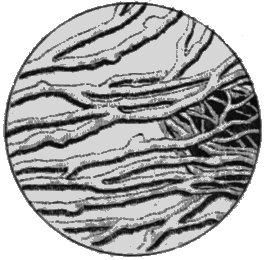
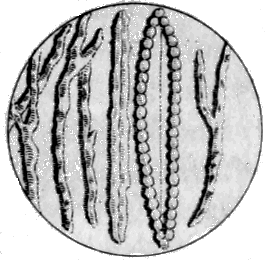
Fig. 3 Fig. 4
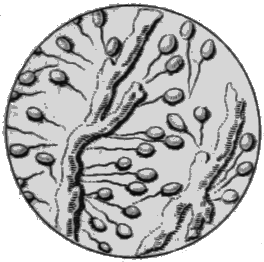
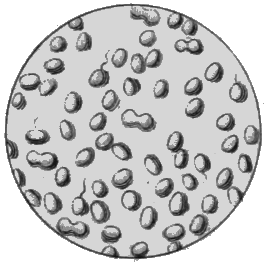
Fig. 5 Fig. 6
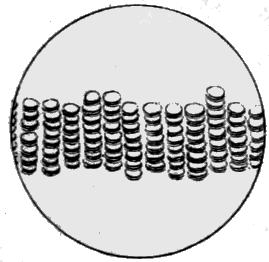
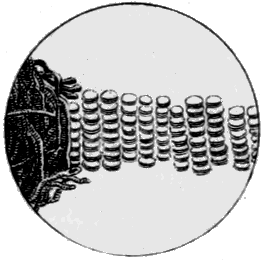
EXPERIMENTS.
I. I took from the seminal vessels of a man, who died a violent death, and whose body was still warm, all the liquor therein contained, and put it into a small bottle; of this I put a drop on the table of the microscope, without the addition of water or any other liquor. The first thing which presented, was a vapour which steamed from the liquor towards the lens, and obscured it. These vapours being dissipated, I perceived large filaments, (fig. 1.) which in some places seemed to extend into different branches, and in others to intermingle together. These filaments clearly appeared to be internally agitated by an undulating motion, and looked like hollow tubes which contained some moving substance. I distinctly saw two of these filaments (fig. 2.) were joined together, and had a vibration nearly like that of two extended strings, which are tied at the two extremities, and pulled asunder in the middle. These filaments were composed of globules which touched each other, and resembled beads. I afterwards saw filaments which swelled in certain parts, and I observed, that on the side so swelled small globules came out, which had a distinct motion like that of a pendulum; these small bodies were fastened to the filaments by a small thread, (fig. 3.) which lengthened gradually as the little body moved; and at last I saw these little bodies entirely separated from the large filament, carrying after them the small thread which connected them. As this liquor was very thick, and the filaments too near each other, I dilated another drop with rain water, in which I was assured there were no animals. I then saw the filaments much separated, and very distinctly perceived the motion of these little bodies, which was now more free, and they swam much quicker; and if I had not seen them separate from the filaments, and carry along with them their thread, I should have taken the moving body in this second observation for an animal, and the thread for its tail. I then attentively observed one of these filaments, that was much thicker than these small bodies, and I had the satisfaction of seeing two of those bodies which separated with difficulty, drag along with them a long and small thread, which obstructed their motion.
This seminal liquor was at first very thick, but by degrees it became more fluid; in less than an hour it was almost transparent; and in proportion as this fluidity increased, the phenomena changed, as I shall relate.
II. When the seminal liquor attained more fluidity, the filaments were no longer to be seen, but the little bodies appeared in great numbers; they have for the most part a motion like that of a pendulum, and they draw after them a long thread, which it may clearly be perceived they want to get rid of; their motion forwards is very slow, vibrating to the right and left. The motion of a boat fastened in the midst of a rapid stream to one fixed point, pretty well represents the motion of these bodies, excepting that the boat remains in the same place, whereas they advance by degrees; but they do not always keep the same parts in the same direction; but at each vibration they take a considerable rolling motion; so that, besides their horizontal motion, they have one of a vertical balance, which proves that these bodies are of a globular figure, or, at least, that their lowest part is not sufficiently extended to maintain them in the same position.
III. At the end of two or three hours, when the liquor was more fluid, we saw a greater quantity of these moving bodies. They seemed to be more free; the threads were shorter; their progressive motion was more direct, and their horizontal motion was greatly diminished; for the longer the threads are, the greater is the angle of their vibration; and in proportion as these threads diminish in length, the vibratory motion lessens, and the progressive motion increases. The vertical balance still subsisted, and was always plainly perceptible.
IV. In five or six hours the liquor attained its utmost fluidity. Most of these moving substances were entirely disengaged from their threads; they were of an oval figure, (fig. 4.) and moved progressively with great swiftness, and by their various motions had a stronger resemblance than ever to real animals. Those who had their threads still adhering, were not so brisk as the others; and among these that had not threads, some seemed to change their shape and size, some were round, some oval, and others thicker at their extremities than in the middle; the balancing and rolling motion was still observable.
V. At the end of twelve hours a kind of gelatinous matter was settled at the bottom of the bottle: it was of an ash-colour, and of a tolerable consistency; the liquor that swam above was almost as clear as water, with a kind of bluish tint, resembling water in which a little soap had been dissolved; nevertheless it still preserved its viscidity. The moving bodies had then a great activity, were loosened from their threads, and moved in all directions. I saw some of them change their form, and from oval become round; and others separate, and from one oval form two. As they became smaller, their activity increased.
VI. In twenty-four hours the liquor had deposited a greater quantity of gelatinous matter. I diluted it with water, but it did not readily mix, and required a considerable time to dissolve. It then appeared composed of an infinite number of opaque tubes that formed a kind of net-work, in which no regular disposition nor the least motion could be seen: in the clear liquor some few small bodies were still moving. The next morning there were also a very few; but after that time I saw no more in this liquor than in the globules, without any appearance of motion.
These experiments were repeated several times with the most possible exactness; and I am persuaded that those threads above mentioned are not tails, nor do they make any part of the individual body; for these threads have no proportion with the rest of the body; they are of different sizes, although the moving bodies are always nearly of the same, at the same time. The globule appears embarrassed in its motion, as its tail is longer or shorter; sometimes it cannot advance, but move only from right to left, or from left to right, when the tail is very long; and it is clearly seen that they use great efforts to get rid of them.
VII. Having taken the seminal liquor from another man but just dead, and still warm, I put a drop of it on the table of the microscope, and it immediately liquified; it had at first a condensed appearance, and seemed to form a compact web, composed of long and thick filaments, which grew from the thickest part of the liquor. These filaments separated in proportion as the liquor became more fluid, and at length they divided into globules, which at first seemed not to have sufficient power to set themselves in motion, but this power increased as they separated from the filament, from which they made many efforts to disengage themselves. Each of them in this struggle drew out tails from the filaments of different sizes, some of which were so thin and so long as to have no proportion with the bodies, which were all so much the more embarrassed as these threads or tails increased in length. The angle of their vibratory motion was also much greater as those filaments were longer: and their progressive motion so much the more remarkable as these tails were shorter.
VIII. Having continued these observations for fourteen hours, I perceived that these threads, or tails, were continually lessening, and became so fine, that at last their extremities were no longer visible, and at length the whole entirely disappeared. At this time the globules absolutely ceased their horizontal vibrations; their progressive motion was direct, although they had always the vertical balancing motion, like the rolling of a ship. When disencumbered of these threads, the bodies were oval, transparent, and perfectly like those pretended animals seen in the liquor of an oyster on the seventh day, and still more to those found in the jelly of roast veal at the end of the fourth day.
IX. Between the tenth and eleventh hour the liquor became extremely fluid, and all the globules appeared to proceed in ranks from one and the same side; (fig. 5.) they passed over the table of the microscope in less than four seconds; they were ranged seven or eight in front, and moved on successively, as troops march in files. I observed this singular instance for more than five minutes; and as their course did not finish, I was desirous of finding the source: and, having gently moved my glass, I perceived that all these moving globules came from a kind of mucilage, (fig. 6.) where the filamentary net-work continually produced them more abundant and much quicker than the filaments had ten hours before. There was still a remarkable difference between these moving bodies produced in the thick liquor, and those produced when the liquor became more fluid; these last had no thread behind them, their motion was quicker, and they went in flocks like sheep. I observed the mucilage from whence they issued for some time, and perceived it diminished, and was successively converted into moving globules, till the diminution of more than half the bulk; after which, the liquor being too dry, this mucilage became obscure in its middle, and all the environs were divided by the small threads which appeared to be formed from the bodies of these moving globules which were destroyed as it dried up, not in one single mass, but in long threads, regularly disposed, with quadrangular intervals, forming a net-work, very like to a cobweb, on which the moisture hung in an infinite number of globules.
X. I perceived by the first experiment, that these little moving bodies change their form, and I thought they in general diminished, but of that I was not certain. In this last observation, at the twelfth and thirteenth hour I observed it more distinctly; at the same time remarking that though diminished considerably in size, yet they increased in specific gravity; especially when their motion was nearly finished, which generally happened all at once and they sunk to the bottom, forming a sediment of an ash-colour, plainly perceptible to the naked eye, and which appeared through the microscope to be composed of globules adherent to on another, sometimes by threads, and at others in knots, but always in a regular manner.
XI. Having procured the seed of a dog, emitted naturally, I observed that this liquor was clear, and had but little tenacity. I put it in a phial, and having examined it with a microscope, without diluting it with water, I perceived moving bodies entirely like those I had observed in the human semen; they had threads, or tails, perfectly the same; they were also nearly of the same size; in a word, they resembled, as perfectly as possible, those I saw in the human liquor, liquified during two or three hours. I then sought for the filaments which I had seen in the human liquor, but it was useless; I perceived only some long threads entirely like those which served as tails to the globules. These threads were not attached to any globules, nor had they any motion. Those globules which were in motion, and had tails, appeared to me to move quicker than those in the human semen: they had scarcely any horizontal vibrations, but a rolling motion. They were not in a great number; and, although their progressive motion was stronger, they took more time to cross the microscope than those I had before remarked. I observed this liquor for three hours, but perceived no change: after which I examined it at another time for four hours, and remarked, that the number of moving bodies diminished by degrees; the fourth day there was still some, though they were very few, and often I only found one or two in a drop of liquor. The second day most of them were deprived of their tails; the third day very few retained them, yet, at the last day, there still remained some which had them; the liquor had then deposited a whitish sediment, which appeared to be composed of immoveable globules, and many threads, that seemed to be tails separated from the globules. There were also some attached to the globules, which appeared to be the dead bodies of these little animals, but whose forms were different from those that moved, for they appeared larger than the moving globules, or the rest, which remained without motion at the bottom of the liquor, and appeared to have a fissure or opening.
XII. Another time, having taken the seminal liquor of the same dog, I again perceived the fore-mentioned phenomena; and I saw, besides, in one of the drops of this liquor, a mucilaginous part, which produced moving globules, as in the ninth experiment, (fig. 6.) and these globules formed a current, and went in ranks like troops. This mucilage appeared to me animated with an internal inflated motion, which produced small bloated appearances in different parts, and from whence issued these bloated forms, or moving globules, with a nearly-equal swiftness, and in the same direction. The bodies of these globules were not different from the rest, excepting they had no tails. I observed that many of them changed their shape, and lengthened considerably, till they became little cylinders, after which the two extremities of the cylinders were bloated, and divided into two globules, both moving and following the same direction as that before they were united.
XIII. The phial, which contained this liquor, having been broke by accident, I, a third time, took the liquor of the same dog, but whether the animal was wearied by too reiterated emissions, or by other causes, the seminal liquor contained none of the above bodies, but was transparent and viscous, like the serum of blood; I examined it then, and at one, two, three, and even twenty-four hours afterwards, but it presented nothing new: there was not a single moving body to be seen, nor any mucilage; in a word, nothing that I had seen before.
XIV. I then opened a dog, and separated the testicles and the adherent vessels, but I perceived no seminal vesicles, and apparently the seed in those animals passes directly from the testicles into the urethra. I found but a small quantity of liquor in the testicles, although the dog was adult and vigorous. In the small quantity I could collect I could not discover any bodies that were in motion. I only perceived a great quantity of very small globules, most of which were motionless, and some of the smallest had some trifling approximating motion, which I could not follow, because the drops I gathered were so exceedingly minute that they dried in two or three minutes after they were placed in the microscope.
XV. Having cut the testicles of this dog into two parts, I infused it in water, and closely sealed up the vessel. Three days after I examined this infusion, which I made with the design of discovering whether the flesh did not contain moving bodies, and I saw a great quantity of moving bodies of a globular and oval form, like those I had seen in the seminal liquor of the dog, excepting they had not any threads. They moved in all manner of directions with great swiftness. I observed these bodies, which appeared animated for some time, and saw many change their form; I perceived some to lengthen, and others to contract, while some swelled at both extremities: there were numbers that were smaller and thicker than the rest; but they were all in motion, and were about the size and figure of those I have described in the fourth experiment.
XVI. The next morning the number of these globules were increased, but they appeared smaller; their motion was more rapid and irregular; they had also another appearance with respect to their form and manner of moving, which seemed confused; the next and several days after, till the fifteenth day, there were moving bodies in the water, whose size gradually diminished till they were no Longer visible. The last, which I perceived with great difficulty, was on the nineteenth and twentieth days, and they moved with greater rapidity than ever. Upon the water a kind of pellicle was formed, which appeared to be composed of the coverings of those moving bodies, small threads, scales, &c. but entirely motionless; this pellicle, and the moving bodies could not come into the liquor by means of external air, since the bottle had been kept carefully sealed.
XVII. I then successively opened ten rabbits, on different days, to examine their seminal liquors; the first had not a drop, either in the testicles or seminal vessels. In the second I was no more successful, although I was assured he was the father of a very numerous progeny. I succeeded no better in the third. I then imagined that the presence of the female might be requisite; I therefore put males and females into cages so contrived that it was impossible for them to copulate. At first these endeavours did not succeed; for, on opening two, not a drop of seminal liquor was to be found; however, in the sixth that I opened, a large white rabbit, I found, in the seminal vesicles, as much liquor as could be contained in a teaspoon; this matter resembled calves' jelly, was nearly transparent, and of a citron colour. Having examined it with the microscope, I perceived it to resolve, by slow degrees, into filaments and thick globules, many of which appeared fastened to each other; but I did not remark any distinct motion in them, only as the matter liquefied, it formed a kind of current by which these filaments and globules seemed to be drawn all to one side. I expected to find this matter take a greater degree of fluidity, but that did not happen, for, after it was a little liquefied, it dried, and I could perceive nothing further than what is above mentioned. When this matter was mixed with water, the latter did not appear to have power to dilute it.
XVIII. Having opened another rabbit, I only found a very small quantity of seminal matter, which was of a colour and consistency entirely different from the former; it was scarcely tinctured of a yellow hue, and was much more fluid. As there was but very little, I feared it would dry too hastily, and therefore mixed it with water: from the first observation, I did not perceive the filaments I had seen in the other, but I discovered three globules, all in a trembling and restless motion; they had also a progressive motion, but it was very slow; some moved round the others, and most appeared to turn upon their centres. I could not pursue this observation because the liquor so soon got dry.
XIX. I opened another of these rabbits, but could not discover any of this matter; in the seminal vessels of another, I found almost as much congealed liquor as in XVIIth Experiment: I examined it in the same manner as the rest, but it afforded me no greater discovery. I infused the whole I had collected, in almost double the quantity of water, and after briskly shaking them together, I suffered them to settle for ten minutes; after which, on inspecting this infusion, I saw the same large globules as before; there were but few and those very distant from each other. They had approximating motions with respect to each other, but they were so slow, as to be scarcely discernable; two or three hours after, these globules seemed to be diminished, their motion was become more distinct, and they appeared to turn upon their centres. Although this trembling motion was more than their progressive, nevertheless they were clearly seen to change their situation irregularly with respect to each other. Six or seven hours after the globules were become still less, and their action was increased: they appeared to me to be in much greater numbers, and all their motions distinct. The next morning, there was a prodigious multitude of globules in motion, which were at least three times smaller than those that at first appeared. I observed these globules for eight days, and observed that many of them seemed to join together, after which their motion ceased; this union, however, appeared to me only superficial and accidental. Some were larger than others; most were round and spherical, and some of them were oval. The largest were most transparent, and the smallest were almost black. This difference did not proceed from the light, for in whatever situation these small globules were in, they were always of the same appearance; the motions of the small were much more rapid than the large ones, and what I remarked most clearly and most generally in all, was their diminution of size, so that at the eighth day they were so exceedingly small as to be hardly perceptible, and at last absolutely disappeared.
XX. At length having obtained, with no small difficulty, the seminal liquor of another rabbit, as it would have been conveyed to the female, I remarked it to be more fluid than that which had been taken from the seminal vesicles, and the phenomena which it offered were also very indifferent; for in this liquor there were moving globules and filaments without motion; and also a kind of globules with threads or tails, resembling those of a dog or a man, but only appearing smaller and brisker (fig. 7.) They passed over the microscope in an instant, their tails appeared shorter than those of other spermatic animals, and I own I am not certain whether some of those tails were not false appearances, produced by the furrows which these moving globules formed in the liquor, as they moved with too great a rapidity to admit of my clearly observing them; besides, the liquor, though sufficiently fluid at first, very speedily dried away.
XXI. After this I resolved to examine the seminal liquor of a ram; I applied to a butcher, who supplied me with the necessary parts of at least twelve or thirteen, directly after they were killed, but I could not find liquor sufficient for any experiment, either in the epididymis or seminal vesicles. In the little drops I was able to collect, I only perceived globules which had no motion. As I made these experiments in March, I supposed by repeating them in October, the season of female attachments, I should discover more seminal liquor in these vessels. I cut many of these testicles in two longitudinally, and collected a small quantity of liquor, but found nothing more in them.
PLATE. II.
Fig. 7 Fig. 8
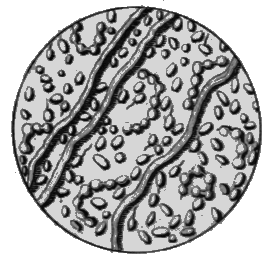
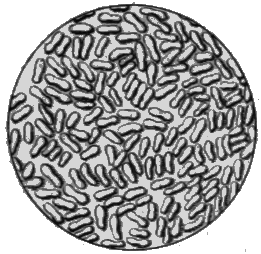
Fig. 9 Fig. 10
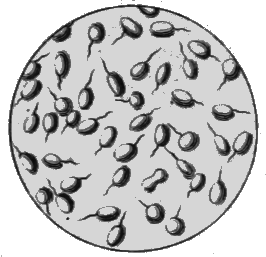
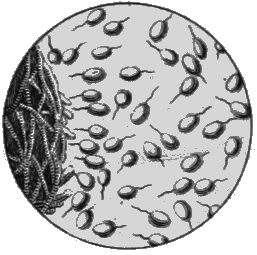
Fig. 11 Fig. 12
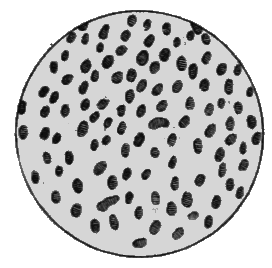
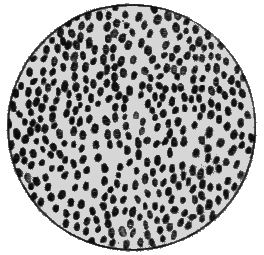
XXII. I took three of these testicles, of three different rams, cut each of them into four parts, and put them into separate bottles, with as much water as was sufficient for them. Securing these bottles from the admission of air I suffered the infusion to remain for four days, after which I examined the liquor of each by the microscope, and found them all replete with an infinity of moving bodies, most part of which were oval, and the rest globular; they were pretty thick, and resembled those described in the VIIIth experiment; their motion was neither brisk, uncertain, nor very rapid, but equal, uniform, and in all directions. These moving bodies were nearly of the same size in each liquor, but differed one bottle with the other. They had no tails, nor were there any filaments or threads in this liquor; during the fifteen or sixteen days they were retained, they often changed their form, and seemed successively to throw off their external coverings; they also became every day smaller, and on the sixteenth day, they were no longer perceptible.
XXIII. In the month of October I opened a ram, and found a great quantity of seminal liquor in the epididymis; having examined it with the microscope, I perceived an innumerable multitude of moving bodies, so numerous, that all the liquor seemed to be entirely composed of them; as it was too thick, I diluted it with water, but I was surprised to see the motion of these bodies suddenly stop, though I perceived them very distinctly; having many times repeated the same observation, I perceived that the water which diluted the seminal liquors of a man, a dog, &c. seemed to coagulate that of a ram.
XXIV. I then opened another ram, and in order to prevent the seminal liquor from coagulating, I permitted the parts of generation to remain in the body of the animal, and covered it over with warm clothes. By these precautions I observed the seminal liquor in its fluid state; it was replete with an infinity of oblong moving bodies, (fig. 8.) traversing in various directions; but as soon as the liquor grew cold, the motion of all these bodies immediately ceased. I diluted the liquor with warm water, when the motion of the small bodies remained for three or four minutes. The quantity of these moving bodies was so great in this liquor, that although diluted, they nearly touched each other. They were all of the same size and form, but none of them had tails. Their motion was not very quick, and when it stopped by the coagulation of the liquor, they did not change their form.
XXV. As I was persuaded, not only by my own theory, but also by the observations of all those who had made experiments before me, that the female, as well as the male, has a seminal and prolific liquor; and, as I had no doubt, but the reservoir of this liquor was the glandular body of the testicle, where prejudiced anatomists attempted to find the egg, I purchased several dogs and bitches, and some male and female rabbits, which I kept separate from each other; and in order to have a comparative object with the liquor of the female, I again observed the seminal liquor of a dog, and discovered there the same moving bodies as described in the XIth experiment.
XXVI. While I was thus occupied, a bitch was dissected which had been four or five days in heat, and had not received the dog. The testicles were readily found, and on one of them I discovered a red, glandular, prominent body, about the size of a pea, which perfectly resembled a little nipple; on the outside was a visible orifice formed by two lips; one of which jutted out more than the other. Having introduced a small instrument into this orifice, a liquor dropped from it, which we carefully caught to examine with the microscope. The surgeon replaced the testicles in the body of the animal, which was yet alive, in order to keep them warm. I then examined this liquor with a microscope, and, at the first glance, had the satisfaction to see moving bodies with tails, exactly like those I just before saw in the seminal liquor of the dog. (fig. 9.) Messrs. Needham and Daubenton, who observed them with me, were so surprized at this resemblance, that they could scarcely believe but that these spermatic animals were the same, and thought I had forgotten to change the table of the microscope, or that the instrument with which we had gathered the liquor of the female, might before have been used for the dog. Mr. Needham then took different instruments, and having obtained some fresh liquor, he examined it first, and saw there the same kind of animals, and was convinced, not only of the existence of spermatic animals in the seminal liquor of the female, but likewise of their resemblance to those of the semen of the male. We repeated it ten times at least, in different drops of the same liquor, without perceiving the smallest variation in the phenomena.
XXVII. Having afterwards examined the other testicle, I found a glandular body in its growing state; it had not any external orifice, was much smaller, and not so red as the first. Having opened it, I found no liquor; but only a small fold in the internal part, which I judged to be the origin of the cavity that was to contain the liquor. This second vesicle had some very small lymphatic vesicles externally. I pierced one of them with a lancet, and a clear and limpid liquor flowed out, which I examined with the microscope; it contained nothing similar to that of the glandular body; it was a clear matter, composed of small globules, which were motionless. Having often repeated this observation, I was assured, that this liquor in the vesicles was only a kind of lymph, which contains nothing animated, or similar to that seen in the female seed, which is formed and perfected in the glandular bodies.
XXVIII. Fifteen days after I opened another bitch that had been in heat seven or eight days, but had not received the dog. I found the testicles contiguous to the extremities of the horns of the matrix; these horns were very long, their external tunic surrounded the testicles, and they appeared covered with that membrane like a cowl. In each testicle I found a glandular body in its full maturity. The first was half open, and there was a passage which penetrated into the testicle, and which was replete with seminal liquor; the second was somewhat more large and prominent, and the orifice, or canal, which contained the liquor was below the nipple. I took these two liquors, and having compared them, found them perfectly alike. The seminal liquor of the female is at least as liquid as that of the male. Having afterwards examined the two liquors with the microscope, I perceived the like moving bodies, (fig. 10.) and the same phenomena, as in the seminal liquor of the other. I saw besides many globules which moved very briskly, and endeavoured to disengage themselves from the mucilage that surrounded them: there was a great quantity of them as in the seed of the female.
XXIX. From these glandular bodies I pressed out all the liquor, and having collected it, I found enough to last for four or five hours observations. I remarked that it deposited somewhat to the bottom, or at least began to thicken. I took one drop of this, which was thicker than the rest, and having put it on the microscope, perceived that the mucilaginous part of the seed was condensed, and formed a continued net-work. On the external border of this net-work, there was a torrent, or current, composed of globules, which moved with rapidity. These globules were lively, active, and appeared to be disengaged from their mucilaginous covering, and their tails. This stream perfectly resembled the course of the blood in small transparent veins; for they appeared not only to be animated by their own powers, but also to be impelled by a common force, and constrained to follow in a herd. From this experiment, and the XIth and XIIth, I concluded, that when the fluid begins to coagulate and thicken, these active globules break and tear their mucilaginous coverings, and escape by that side where the liquor remains most fluid. These moving bodies had then neither threads nor tails; they were for the most part oval, and appeared to be flat at the bottom, for they had no rolling motion.
XXX. The horns of the matrix were externally soft; I opened them longitudinally, and only found a very small quantity of liquor, which, upon examination, appeared to contain the same as that pressed from the glandular substance of the testicle. These glandular bodies are placed so as easily to sprinkle this liquor on the horns of the matrix; and I am persuaded that, as long as the amorous season remains, there is a continual dropping of this liquor from the glandular substance into the horns of the matrix; that this dropping remains till the glandular substance has emptied the vesicles; it then becomes fluid by degrees, is effaced, and only leaves a little reddish cicatrice on the external part of the testicle.
XXXI. I took this seminal liquor of the female, with the same quantity of that just emitted from the male, and mixed them together, and having examined this mixture with the microscope, I perceived nothing new, the liquor remaining the same, and the moving bodies were so similar, that it was impossible to distinguish those of the male from those of the female; I only thought their motion appeared a little slackened.
XXXII. Having dissected a young bitch that had never been in heat, I only discovered a small protuberance on one of the testicles, which I supposed to be the origin of a glandular body. The surface of the testicles was smooth and even, and the lymphatic vessels could scarcely be seen externally, until the tunic, which covered the testicles, was separated; but these vesicles were not considerable, and contained but a small quantity of liquor, in which I could only perceive some little globules without any motion.
XXXIII. In another bitch, which was younger, and only three or four months old, there was no appearance of glandular bodies on the testicles; they were white, smooth, and covered with a cowl like the rest. There were some little vesicles which contained little or no liquor; and it was with great difficulty we could perceive any vesicles externally. I compared one of these testicles with that of a young dog of nearly the same age, and they appeared internally of a fleshy nature, and perfectly similar. I do not mean to contradict what some anatomists have said concerning the testicles of dogs, but only that the appearance of the internal substance of the female testicles is like that of the males, when the glandular substances are not yet grown.
XXXIV. The genital parts of a cow, which had been just killed, was sent to me, covered over with hot cloths, and put into a basket with a live rabbit, which likewise squatted on a cloth at the bottom, so that I received them almost as warm as when taken out of the body. I immediately inspected the testicles, and found them of the size of a hen's, or, at least, a pigeon's egg. One of these testicles had a glandular body, about the size of a pea, protuberating outwardly like a small nipple, but it was not pierced, nor had any external orifice: it was close and hard. I pressed it with my fingers, but no liquor issued from it. I observed, before this testicle was dissected, there were two other glandular substances at a distance from the other; but these were just begun to grow; their colour was a whitish yellow, whereas that which seemed to have pierced the membrane of the testicle was of a rose colour. I opened this last, and examined it with the greatest attention, but could not discover that it contained any liquor, I therefore judged that it was far distant from its maturity.
XXXV. The other testicle had no glandular body which had pierced the common membrane that covered the testicle, there were only two small ones, which began to form a little protuberance below this membrane. I opened both of them but no liquor issued therefrom: they were hard, whitish, and with a little yellow tint; each of them had four or five lymphatic vesicles, very easily distinguishable on their surface, and appearing transparent. I judged they contained a quantity of liquor, and having pierced them with a lancet, the liquor issued out to some inches distance. I collected a sufficient quantity of this liquor to observe it easily; I only saw some very minute immoveable globules; and although I continued my examination for two days, I neither discovered alteration, change, nor motion, therein.
XXXVI. Eight days after, two more genital parts were brought to me in the same mode as the last. I was assured that one was taken from a young cow that had never calved, and the other from one that had had several, but was not old. I first examined the testicles of the latter, and on one of them I found a glandular substance, as large and as red as a cherry, which appeared a little soft towards the nipple. I distinguished three small holes, in which a hair might be introduced. Having pressed this substance with my fingers a small quantify of liquor issued, which I placed on the table of a microscope, and had the satisfaction to see some moving globules there, but quite different from those which I had seen in other seminal liquors (fig. 11.). These globules were obscure and little; their progressive motion, although distinct, was, nevertheless, very slow. The liquor was not thick; the little globules had no appearance of threads, or tails, and they were not all in motion. This is all I was able to perceive in the liquor this glandular substance afforded me, for although I pressed it again, it only afforded a less quantity, mixed with blood. I again discovered it in the small moving globules, but they seemed to be at least four times smaller than the sanguinary globules.
XXXVII. This glandular body was situate at one of the extremities by the side of the horn of the matrix, and the liquor, which it prepares, must fall upon this horn; nevertheless, on opening this horn I found no material quantity of liquor. This glandular body penetrated very forward in the testicle, and occupied more than a third of its internal substance. I opened them longitudinally, and found a pretty large cavity, but entirely void of any liquor. At some distance from this glandular body there was a small one of the same kind, about the size of a lentil. There were also two small cicatrices, about the same size, which formed two small indentations, of a deep red colour: they were the remains of obliterated glandular bodies. Having afterwards examined the other testicle, I counted four cicatrices and three glandular bodies; the foremost of which had pierced the membrane, was of a flesh colour, and the size of a pea. It was solid, and without any orifice or liquor: the two others were smaller, harder, and of a deep orange colour. On the first testicle only two or three apparent lymphatic vesicles remained. I counted eight on the external part, and having examined the liquor of these vesicles I perceived only a transparent matter, without any moving bodies.
XXXVIII. I then examined the testicles of the young cow which had not calved, which, notwithstanding, were something larger than the other, but it is true there were no cicatrices on either of them; the one was smooth and very white, and a number of lymphatic vesicles were sprinkled about it, but there was not the least mark of a glandular body. On the other testicle I perceived the marks of two glandular substances, the one had just began to grow, and the other was the size of a pea; there was also a great number of lymphatic vesicles, which I pierced with a lancet, but the liquor did not contain any thing; having pierced the two small glandular bodies some blood alone issued thereout.
XXXIX. I divided each testicle of both cows into four parts, and, having put them into separate phials, I poured as much water on as would cover them, and after having closely corked them up, I suffered to infuse for six days; I then examined these infusions, and discovered an innumerable quantity of living moving bodies (fig. 12.); they were all, in these infusions, extremely small, moved with a surprising rapidity in all directions. I observed them for three days, and they always appeared to diminish, till at last, on the third day, they entirely disappeared.
XL. The following day they brought to me the genital parts of three more cows. I immediately searched the testicles to find one where the glandular substance was in perfect maturity; but in two of them I only discovered some growing glandular substances on the testicles. I could not learn whether these cows had calved or not, but there was a great appearance they had all been in season, for there were a great number of cicatrices on all these testicles. In the third I found a testicle, on which was a glandular substance, as thick and as red as a cherry; it was inflamed, and seemed to be in full maturity. Its extremity was a nipple, with a small hole; I pressed it a little between my fingers, and a quantity of liquor issued out. I found in this liquor moving globules, exactly like those in the liquor pressed from the glandular body of the other cow, I have before spoken of in experiment XXXVI. They appeared to be more numerous, their progressive motions were not so slow, and their size larger. Having observed them for some time I perceived some to lengthen and change their form. I then introduced a very fine instrument into the little hole of the glandular substance, and having opened it I found the internal cavity replete with liquor; this liquor offered me the same phenomena, and the same moving globules, as I before observed in experiment XXXVI. with either filaments, threads, or tails attached to them. The liquor of the vesicle presented me with nothing more than nearly a transparent matter, which did not contain one moving thing.
XLI. At different times they brought me the genitals of several other cows. In some I found the testicles loaded with an almost mature glandular substance; in others they were of different growths, and I remarked nothing new, excepting that in the two testicles of two different cows I perceived the glandular substance in a decayed state; the base of one was as broad as the circumference of a cherry; the extremity of the nipple was soft, wrinkled, and shrivelled; the two small holes were very perceptible, from whence the liquor had flowed. With some difficulty I introduced a small hair, but there was no liquor in the canal, nor in the internal cavity, which was still to be seen. The flaccidity of these glandular substances begins, therefore, at the most external part, or extremity of the nipple. They diminish at first in height, and afterwards in breadth, as I observed in another testicle, where this glandular substance had diminished more than three fourths.
XLII. As the testicles of doe rabbits, as well as the glandular bodies formed there, are very small, I could observe nothing very exactly with respect to their seminal liquor. I only discovered, that the testicles of doe rabbits are different, and that none of those I saw resembled what De Graaf represents in his engravings; for the glandular substances did not enclose the lymphatic vesicles; and I never saw a pointed end, as he has depicted them.
XLIII. I found on the testicles of some cows a kind of bladders, replete with transparent liquor. I remarked they were of different sizes, the largest about that of a pea; they were fastened to the external membrane of the testicle by a strong membraneous pedicle, as was also another, still smaller; and a third, nearly of the same size as the second, appeared to be only a lymphatic vesicle, much more apparent than the rest. I imagined these bladders, which the anatomists have called hydatides, might possibly be of the same nature as the lymphatic vesicles of the testicles, for having examined the liquor they contained I found it to be perfectly similar; it was a transparent and homogeneous liquor, which did not contain one moving substance.
XLIV. At the same time I made observations on the liquor in an oyster; on the water in which pepper had been boiled; on the water wherein pepper had been only infused; and on the water wherein I had put some vegetable seed; the bottles which contained these waters were firmly closed, and in two days I perceived in the oyster liquor a great quantity of oval and globular substances, which seemed to swim like fish in a pond, and had all the appearance of being animals; however they had no limbs nor tails, but were very large, transparent, and visible. I perceived them change their forms, and become smaller for seven or eight days successively; and at length I and Mr. Needham observed animals similar to those in an infusion of jelly of roast veal, which had been also very exactly corked; so that I am persuaded they are not real animals, at least according to the received acceptation of the words, as we shall hereafter explain.
The infusion of the seed presented an innumerable multitude of moving globules which appeared animated like those of the seminal liquors, and in the infusions of the flesh of animals: these were also large, and in violent motion during the first days, but they diminished by degrees, and disappeared only from their minuteness.
I perceived the same thing, but later, in the liquor wherein pepper had been boiled, and the like, though still later, in that which had not boiled; from hence I supposed that what is called fermentation may possibly be only the effect of the motion of these organical parts of animals and vegetables; and in order to see what difference there was between this kind of fermentation and that of minerals, I placed a little powdered stone on the microscope, and sprinkled thereon a drop of aquafortis, which however produced a different phenomena, consisting of great balls, which ascended to the surface, and almost instantaneously obscured the focus of the microscope: this was a dissolution of the grosser parts, which being completed it became motionless, and had not the smallest resemblance to the other infusions I had observed.
XLV. I examined the seminal liquor in the roes of different fish; such as carp, tench, barbel, &c. which I took out while they were living, and having observed three different liquors with great attention, I perceived a great quantity of obscure globules, all in motion. I took several more of these fish alive, and with my fingers gently compressed that part of the belly where this liquor is emitted; and in that which I obtained, I perceived an infinity of moving globules therein, very black and very small.
XLVI. Before I finish this chapter I shall relate the experiments of Mr. Needham on the seed of a kind of cuttle fish, called calmar. This able naturalist having sought for spermatic animals in the milts of many different fish, found them in the roe of a calmar, apparent to the naked eye. During the summer he dissected calmars at Lisbon, but found no appearance of any roe, nor any reservoir which appeared to be destined for the reception of the seminal liquor; and it was in the middle of December that he began to discern the first traces of a new vessel replete with a milky juice. This reservoir increased, and the seed which it contained was diffused very abundantly. By examining this liquor with the microscope, he perceived only small opaque globules, which floated in a kind of serous matter, without the least appearance of life. But some time after, in the milt of another calmar, he found these organic parts completely formed; they seemed like spiral springs shut up in a kind of transparent case. They appeared as perfect at first as they did at last, excepting that by degrees they contracted and formed a kind of screw. The lid of the case was a species of valve that opened outwardly, and by which all the contents might issue; it contained another valve, a barrel, and a spongy substance; therefore the whole machine consisted in an external, transparent, and cartilaginous case, whose upper extremity is terminated by a round head, formed by the case itself, and which performs the office of a valve. In this external case is contained a transparent tube, which encloses the spring, piston, or valve, barrel, or spongy substance. The screw occupies the upper part of the tube and case, the piston and barrel are placed in the middle, and the spongy substance occupies the lower part. These machines pump up the lacteal liquor, of which the spongy substance is full; and before the animal spawns, the whole milt is no more than a composition of these organic parts, which have absolutely pumped up the lacteal liquor. As soon as these little machines are taken from the body of the animal, and deposited either in water, or held in the air, they begin to act; the spring ascends, followed by the piston, the barrel, and the spongy substance which contains the liquor; and as soon as the spring and the tube which contain it begin to quit the case, the spring folds up; and all that remains within begins to move, till the spring, the sucker, &c. are entirely come out: as soon as that is done, the remainder immediately follow, and the lacteal liquor, which has been pumped out, and which was contained in the spongy substance flows out by the barrel.
As this observation is very singular, and incontestibly proves that the moving bodies found in the milt of the calmar are not animals, but simple machines, a kind of pumps, I have deemed it necessary to give Mr. Needham's own words.[Q]
"When the small machines, he says, are arrived to their perfect maturity, many of them act the moment they are in the open air; nevertheless most of them may be commodiously placed, so as to be seen with a microscope, before their action begins; and even to make them act, the upper extremity of the external case must be moistened with a drop of water which then begins to expand, while the two small ligaments which issue from the case twist and turn in different manners: at the same time, the screw ascends slowly, the volutes, which are at its upper end, approach and act against the top of the case: those at the bottom also advance, and seem to be continually followed by others which come from the piston. I say, they seem to be followed, because I do not think they are so effectually, but only a deception produced by the nature and motion of the screw. The piston and barrel also follow the same direction, extend lengthways, and at the same time move towards the top of the case, which is perceived by the vacuum at the bottom. As soon as the screw, with the tube in which it is enclosed, begins to appear externally from the case, it folds, because it is retained by its two ligaments: nevertheless, all the internal contents continue to move gently and gradually, until the screw, piston, and bladder, are entirely come out. When that is done, the rest follow directly after. The piston separates from the barrel, and the apparent ligament, which is below the latter, swells and acquires a diameter equal to that of the spongy substance which follows it. This, although much larger than when in the case, becomes still five times longer than before. The tube which incloses it all is straightened in its middle, and forms two kinds of knots, about a third of its length distant from each extremity: the semen then flows through, and is composed of small opaque globules, which float in a serous matter, without shewing any signs of life, and which are precisely such as I have said to have seen them when they were diffused in the reservoir of the milt. In the figure, the part between the two knots seems to be broken: when it is examined attentively, we find that what causes it to appear as such, is, that the spongy substance with in the tube is broken in nearly equal pieces, which the following phenomena will clearly prove. Sometimes it happens, that the screw and the tube break by the piston, which remains in the barrel; then the tube closes in a moment, and takes a conical figure, by contracting, as much as it is possible, above the end of the screw, which demonstrates its great elasticity in that part: and the manner in which it accommodates itself with the figure of the substance it incloses, when it receives the least change, proves, that it is equal in every other respect."
Mr. Needham from this conceives that we might imagine the actions of all this machine were owing to the spring of the screw, but he proves, by many experiments, that the screw, on the contrary, only obeys a power which resides in the spongy part. As soon as the screw is separated from the rest, it ceases its action, and loses all its activity. The author afterwards makes this reflection on this singular machine:
"If, says he, I had seen the animalcule pretended to be in the semen of living animals, perhaps I might be in a condition to determine whether they are really living creatures, or simple machines prodigiously minute, and which are in miniature, what the vessels of the calmar are in the great."
By this, and some other analogies, Mr. Needham concludes, there is a great appearance that the spermatic worms of other animals are only organized bodies and machines, like to those of the calmar, whose actions are made at different times; "for, says he, let us suppose, that in the prodigious number of spermatic worms seen on the table of a microscope, there are some thousands which act at the same time, that will be sufficient to shew us, they are all alive. Let us also conceive, adds he, that the motion of these spermatic worms remains, like that of the machines of the calmar, about half a minute; then the succession of action of these small machines, will remain a long time, and the pretended animals will appear to decrease successively. Besides why should the calmar alone have machines in its seed, whereas every other animal has spermatic worms, and real animals? Analogy is here of such great weight, that it does not appear possible to refuse it." Mr. Needham likewise very justly remarks, that even the observations of Leeuwenhoek, seems to indicate that the spermatic worms have a great resemblance with the organized bodies in the seed of the calmar. "I have, says Leeuwenhoek, speaking of the cod, taken those real substances for hollow and extended animalcule, because they were four times as large as the living animalcule." And in another part, "I have remarked, he says, speaking of the seed of a dog, that the animalcules often change their form, especially when the liquor in which they float evaporates. The progressive motion does not extend above the diameter of a hair."[R]
After considering all these circumstances Mr. Needham conjectures, that the supposed spermatic animals might possibly be only natural machines, substances much more simply organized than the bodies of animals. I have seen with the microscope, these machines in the calmar, and the description he gives of them, is very faithful and exact. His observations then shew us, that the seminal liquor is composed of parts which seek to be organized; that it, in fact, produces organized substances, but that they are not as yet, either animals or organized substances, like the individual which produced them. We might suppose, that these substances are only instruments which serve to perfect the seminal liquor, and strongly impel it; and that it is by their brisk and internal action, that it most intimately penetrates the seminal liquor of the female.
CHAPTER VII.
COMPARISON OF MY OBSERVATIONS WITH THOSE OF LEEUWENHOEK.
Although I made the preceding experiments with all the circumspection possible; and although I repeated them a number of times, I am persuaded that many things escaped my notice; I have only related what I saw, and what all the world may see, with a little art and much practice. In order to be free from prejudices, I endeavoured to forget what other naturalists asserted to have seen, conceiving that by so doing, I should be more certain of only seeing in fact what really appeared; and it was not till after I had digested my observations, that I compared them with those of Leeuwenhoek, &c. I by no means pretend to have greater abilities in microscopical observations than that great naturalist, who passed more than sixty years in making various experiments.
Notwithstanding the authority his observations may justly claim, it is surely permitted to examine and compare others with them. Truth can only be gained by such examinations, and errors discovered, particularly as we do it without any partiality, and in the sole view of establishing something fixed and certain on the nature of those moving bodies seen in the seminal liquors.
In November 1677, Leeuwenhoek, who had already communicated to the Royal Society of London many microscopical observations on the optic nerve, the blood, the juice of the plants, the texture of trees, rain-water, &c. addressed to Lord Brouncker, President of the Society, in the following words: "Postquam Exc.[S] &c. Dominus Professor Cranen me visitatione sua sæpius honorarat, litteris rogavis, Domino Ham concrato suo, quasdam observationum mearum, videndas darem. Hic dominus Ham me secundo invisens, secum in laguncula, vitrea semen viri, gonorrhæa laborantis, sponte destillatum, attulit, dicens, se post paucissimas temporis minutias (cum materia ilia jam in tantum esset resoluta ut fistulæ vitreæ immitti posset) animalcula viva in eo observasse, quæ caudam & ultra 24 horas non viventia judicabat; idem referebat se animalcula observasse mortua post sumptam ab ægroto therebintinam. Materiam prædicatam fistulæ vitreæ immissam, præsente Domino Ham, observavi, quasdamque in ea creaturas viventes, at post decursum 2 aut 3 horarum eamdem solus materiam observans, mortuas vidi.
"Eamdem materiam (semen virile) non ægroti alicujus, non diuturna conservatione corruptam, vel post aliquot momenta fluidiorem factam, sed sani viri statim post ejectionem, ne interlabentibus quidem sex arteriæ pulsibus, sæpiuscule observavi, tantamque in ea viventium animalculorum multitudinem vidi, ut interdum plura quam 1000 in magnitudine arenæ sese moverent; non in toto semine, sed in materia fluida crassiori adhærente, ingentem illam animalculorum multitudinem observavi; in crassiori vero seminis materia quasi sine motu jacebant, quod inde provenire mihi imaginabar, quod materia illa crassa ex tam variis cohæreat partibus, ut animalcula in ea se movere nequirent; minora globulis sanguini ruborem adferentibus hæc animalcula erant, ut judicem, millena millia arenam grandiorem magnitudine non æquatura. Corpora corum rotunda, anteriora obtusa, posteriora ferme in aculeum desinentia habebant; cauda tenui longitudine corpus quinquies sexiesve excedente, & pellucida crassitiem vero ad 25 partem corporis habente prædita erant, adeo ut ea quoad figuram cum cyclaminis minoribus, longam caudam habentibus, optime, comparare queam; motu caudæ serpentino, aut ut anguillæ in aqua natantis progrediebantur; in materia vero aliquantulum crassiori caudam octies deciesve quidem evibrabant antequam latitudinem capilli procedebant. Interdum mihi imaginabar me internoscere posse adhuc varias in corpore horum animalculorum partes, quia vero continuo eas videre nequibam, de iis tacebo. His animalculis minora adhuc animalcula, quibus non nisi globuli figuram attribuere possum, permissa erant.
"Memini me ante tres aut quatuor annos, rogatu Domini Oldenburg, B. M. semen virile observasse, & prædicta animalia pro globulis habuisse; sed quia fastidiebam ab ulteriori inquisitione, & magis quidem a descriptione, tunc temporis eam omisi. Jam quoad partes ipsas, ex quibus crassam seminis materiam, quoad majorem sui partem consistere sæpius cum admiratione observavi, ea sunt tam varia ac multa vasa, imo in tanta multitudine hæc vasa vidi, ut credam me in unica seminis gutta plura observasse quam anatomico per integrum diem subjectum aliquod secanti occurrant. Quibus visis, firmiter credebam nulla in corpore humano jam formato esse vasa, quæ in semine virili bene constituto non reperiantur. Cum materia hæc per momenta quædam aëri fuisset exposita, prædicta vasorum multitudo in aquosam magnis oleaginosis globulis permistam materiam mutabatur, &c."
The Secretary of the Royal Society, in answer to this letter, says, that it would be proper to make the like experiments on the seed of other animals, as dogs, horses, &c. not only to form a better judgment on the first discovery, but to know the differences which might be found in the number, and the figure of those animalcules. And with relation to the vessels of the thickest part of the seminal liquors, he greatly doubts they were only filaments without any organization, "quæ tibi videbatur vasorum congeries, fortassis seminis sunt quædam filamenta, haud organice constructa, sed dum permearunt vasa generationi inservientia in istiusmodi figuram elongata. Non dissimili modo ac sæpius notatus sum salivam crassiorem ex glandularum faucium foraminibus editam quasi e convolutis fibrilis constantem."[T]
Leeuwenhoek answered him on the 18th of March, 1678, in the following words: "Si quando canes coeunt marem a fœmina statim seponas materia quædam tenuis & aquosa (lympha scilicet spermatica) e pene solet paulatim exstillare; hanc materiam numerosissimis animalculis repletam aliquoties vidi, eorum magnitudine quæ in semine virili conspiciuntur, quibus particulæ globulares aliquot quinquagies majores permiscebantur.
"Quod ad vasorem in crassiori seminis virilis portione spectabilium observationem attinet, denuo non semel iteratam, saltem mihimetipsi comprobasse videor; meque omnino persuasum habeo, cuniculi, canis, felis, arterias venasve fuisse a peritissimo anatomico haud unquam magis perspicue observatas, quam mihi rasa in semine virili, ope perspicilli, in confectum venere.
"Cum mihi prædicta vasa primum innotuere, statim etiam pituitam, tum & salivam perspicillo applicavi; verum his minime existentia animalia frustra quæsivi.
"A cuniculorum coitu lymphæ spermaticæ guttulam, unam et alteram, e femella exstillantem, examini subjeci, ubi animalia prædictorum similia, sed longe pauciora, comparuere. Globuli item quam plurimi, plerique magnitudine animalium, iisdem permisti sunt.
"Horum animalium aliquot etiam delineationes transmisi, figura a (plate 3.) exprimit corum aliquot vivum (in semine cuniculi arbitror) eaque forma qua videbatur, dum aspicientem me versus tendit. A B C, capitulum cum trunco indicant; C D, ejusdem caudam, quam pariter ut suam anguilla inter natandum vibrat. Horum millena millia, quantum conjectare est, arenulæ majoris molem vix superant, (fig. b, c, d,) sunt ejusdem generis animalia, sed jam mortua.
PLATE. III.
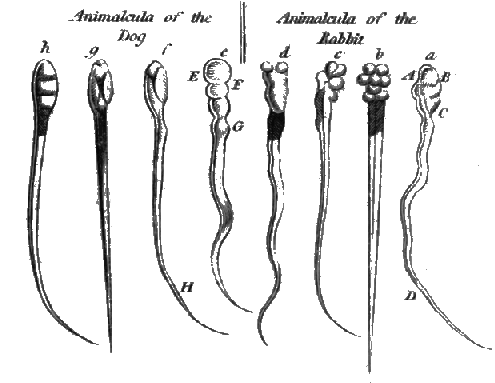
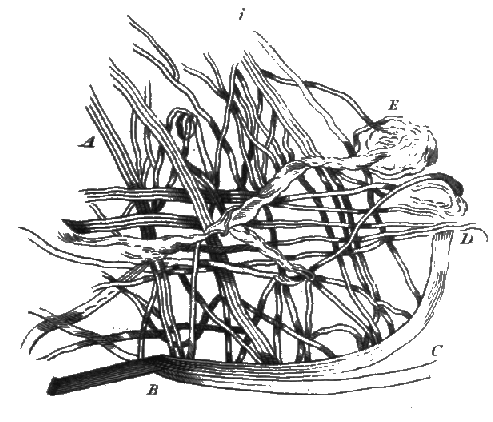
"(Fig. e.) Delineatur vivum animalculum, quemadmodum in semine canino sese aliquoties mihi attentius intuenti exhibuit. E F G, caput cum trunco indigitant, G H ejusdem caudam, (fig. f, g, h,) alia sunt in semine canino quæ motu & vita privantur, qualium etiam vivorum numerum adeo ingentem vidi, ut judicarem portionem lymphæ spermaticæ arenulæ mediocri respondentem, eorum ut minimum decena millia continere."
By another letter written to the Royal Society, the 31st of May, 1678, Leeuwenhoek adds, "Seminis canini tantillum microscopio applicatum iterum contemplatus sum, in eoque antea descripta animalia numerosissime conspexi. Aqua pluvialis pari quantitate adjecta, iisdem confestim mortem accersit. Ejusdem seminis canini portiuncula in vitreo tubulo unciæ partem duodecimalem crasso servata, sex & triginta horarum spatio contenta animalia vita destitua pleraque, reliqua moribunda videbantur.
"Quo de vasorum in semine genitali existentia magis constaret, delineationem eorum aliqualem mitto, ut in figura ABCDE, (fig. i.) quibus literis circumscriptum spatium arenulam mediocrem vix superat."
I have copied these first remarks of Leeuwenhoek from the Philosophical Transactions, because, in matters of this kind, observations made without any systematical view are those which are the most faithfully described, and even this able naturalist no sooner formed a system on spermatic animals, than he began to vary in essential points.
It is evident by the above dales, that Hartsoeker is not the first who published, if he was the first who discovered spermatic animals. In the Journal de Sçavans, in the year 1774, there is a letter from Mr. Huguens, on the subject of a microscope, made by one small ball of glass, with which he asserts he perceived animals in the water, wherein pepper had been infused for two or three days, as Leeuwenhoek before had observed with the like microscopes, but whose balls were not so minute. "There are also other seeds, he continues, which engender such animals, as coriander seeds, &c. and I have seen the same thing in the pith of the birch tree, after having kept it for four or five days; and some have observed them in the water where nutmegs and cinnamon have been soaked. These animals may be said to engender from some corruption or fermentation: but there are others which must have a different origin; as those in the seed of animals, which seem in such great numbers, as to be almost composed of them; they are all transparent, have a quick motion, and their figures are like the tadpole."
Huguens does not mention the author of this discovery; but in the Journal of the 29th of August in the same year, there is an extract of a letter of M. Hartsoeker, in which he gives the method of forming these glass balls by means of the flame of a lamp; and the author of the Journal says, "By this method he has discovered that little animals are engendered in urine which has been kept for some days, and have the figure of little eels: he found some in the seed of a cock, which appeared of the same form, but quite different from those found in the seed of other animals, which resemble tadpoles, or young frogs, before their legs are formed." The author seems to attribute the invention to Hartsoeker; but if we reflect on the uncertain manner in which it is there represented, and on the particular manner in which Leeuwenhoek speaks in his letter, written and published above a year before, we must allow him to be the first who made this observation; but between them a contest took place as to the discovery which has never been decided. Be this as it will, Leeuwenhoek was undoubtedly the first inventor of the microscope, whose focuses are balls of glass formed by the flame of a lamp. But to return to his observations.
I shall first remark, that what he says of the number and motion of these pretended animals is true; but the figure of the body is not always the same as he describes it: sometimes the part which precedes the tail is round and at others long; often flat, and frequently broader than it is long, &c. and with respect to the tail, it is often much larger and shorter than he asserts. The motion of vibrations which he gives to the tail, and by means of which he pretends that the animalcules advance progressively in this fluid, has never appeared to me as he has described it. I have seen these moving substances make eight or ten oscillations from the right to the left, or vice versa, without advancing the breadth of a hair; and I have even seen many more which could not advance at all; because this tail, instead of being of any assistance to them was, on the contrary, a thread attached either in the filaments or mucilaginous parts of the liquor, and rather retained the moving substance like as a thread fastened to the point retains the ball of a pendulum; and when this tail had any motion, it only resembled a thread which forms a curve at the end of an oscillation. I have seen these threads, or tails, fastened to the filaments which Leeuwenhoek stiles vessels; I have seen them separate after many reiterated efforts of the moving bodies; I have seen them at first lengthen, then diminish, and at last totally disappear. I therefore think these tails should be considered as accidental parts, and not as essential to the bodies of these pretended animals. But what is most remarkable, Leeuwenhoek precisely says, in his letter to Lord Brouncker, that, besides these animals that had tails, there were also smaller animals in this liquor, which had no other form than that of a globule. "His animalculis (caudatis scilicet) minora adhuc animalcula, quibus non nisi globuli figuram attribuere possum, permista erant." This is the truth; but after Leeuwenhoek had advanced that these animals were the only efficient principle of generation, and that they were transformed into human figures, he has only regarded those as animals which had tails; and as it was consistent for animals that were transformed into human figures, to have a constant form, he never afterwards mentions those smaller animalcules without tails; and I was greatly surprised, on comparing the copy of this letter with that he published twenty years after, in his 3d volume, where, instead of the above words, the following are found: "Animalculis hisce permistæ jacebant aliæ minutiores particulæ, quibus non aliam quam globulorum seu sphæricam figuram assignare queo;" which is quite different. A particle of matter to which he attributes no motion, is very different from an animalcule: and it is astonishing that Leeuwenhoek, in copying his own works, has altered this essential article. What he adds immediately after likewise merits attention: he says, that by the desire of Mr. Oldenburg he had examined this liquor three or four years before, when he took these animalcules for globules; that is, there are times when these pretended animalcules are no more than globules, without any remarkable motion, and others when they move with great activity; sometimes they have tails, and at others they have none. Speaking in general of spermatic animals he says, "Ex hisce meis observationibus cogitare cœpi, quamvis antehac de animalculis in seminibus masculinis agens, scripserim, me in illis caudas non detexisse, fieri tamen posse ut illa animalcula æque caudis fuerint instructa ac nunc comperi de animalculis in gallorum gallinaceorum semine masculino;" another proof that he has often seen spermatic animals of all kinds without tails.
In the second place we must remark, that the filaments which are seen in the seminal liquor before it is liquefied were discovered by Leeuwenhoek, and that in his first observations, before he had made any hypothesis on spermatic animals, he considered these filaments as veins, nerves, and arteries; and firmly believed all the parts and vessels of the human body might clearly be seen in the seminal liquor. This opinion he persisted in, in defiance of the representations which Oldenburg made to him on this subject from the Royal Society: but as soon as he thought of transforming these pretended spermatic animals into men, he no longer mentioned these vessels; and instead of looking on them as nerves, arteries, and veins, of the human body already formed in the seed; he did not even attribute to them the functions they really possess, the producing of these moving bodies: and he says, vol. I. p. 7, "Quid fiet de omnibus illis particulis seu corpusculis præter illa animalcula semini virili hominum inhærentibus? Olim & priusquam hæc scriberem, in ea sententia fui, prædictas strias vel vasa ex testiculis principium secum ducere, &c." And in another part he says, that if he had formerly written any thing on the subject of these vessels found in the seed, we must pay no attention to it.
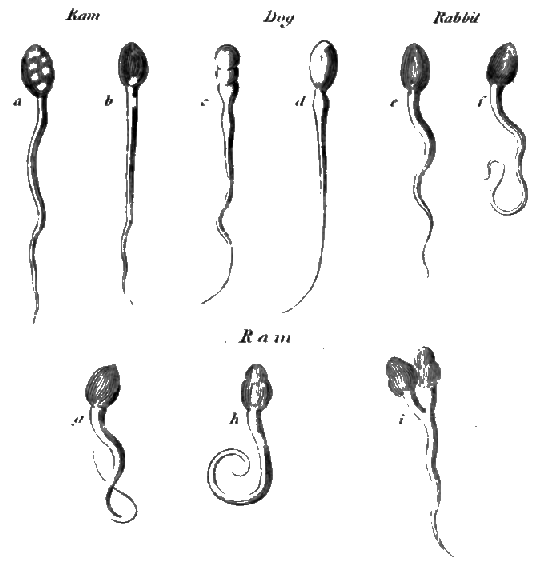
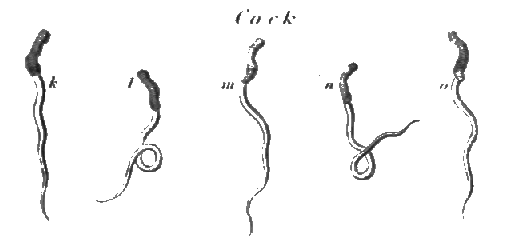
We shall observe in the third place, that if we compare the figures a, b, c, d, (PLATE III.) copied from the Philosophical Transactions, with those which Leeuwenhoek had engraved many years after, (PLATE IV.) we shall find considerable difference, especially in the figures of the dead animals, of a rabbit and in those of a dog, (which plate we have also copied for the satisfaction of our readers) from all which we may conclude, that Leeuwenhoek has not always observed objects entirely alive: that the moving bodies, which he looked upon as animals, appeared to him under different forms; and that he has varied in his assertions, with a view of making the species of men and animals perfectly consistent; he has not only varied in the basis of these experiments, but even in the manner of making them, for he expressly says, that he always diluted the liquor with water, in order to separate, and to give more motion to these animalcules: nevertheless, in his letter to Lord Brouncker, he says, that having mingled an equal quantity of rain water with the seminal liquor of a dog, in which he had before perceived an infinity of living animalcules, yet the mixing of this water killed them. The first experiment of Leeuwenhoek's therefore was made, like mine, without any mixture; and it even seems, that he was not of opinion to mix any water with the liquor till a long time after; because he thought he had discovered, by his first essay, that water caused the death of the animalculæ; which however is not the fact. I think that the mixture of the water only dissolves the filaments very suddenly; for I have seen but very few filaments in all the experiments I have made after mixing the water with the seminal liquor.
As soon as Leeuwenhoek was persuaded that spermatic animals were transformed into men, and other animals, he imagined he saw two sorts in the seminal liquor of every animal, the one male, and the other female; and this difference, according to him, served not only for the generation of themselves, but for the production of males and females, which was very difficult to conceive by a simple transformation. He speaks of the male and female animalcule, in his letter printed in the Philosophical Transactions, No. 145, and in many parts of his works,[U] but he does not describe the difference of these male and female animalcules, and which in fact never existed but in his own imagination.
The famous Boerhaave having asked Leeuwenhoek, if he had not observed in spermatic animals different degrees of growth and size? Leeuwenhoek answered, that having dissected a rabbit, he observed in the semen an infinite number of living animals. "Incredibilem, says he, viventium animalculorum, numerum conspexerunt, cum hæc animalcula scypho imposita vitreo & illic emortua, in rariores ordines disparassent, & per continuos aliquot dies sæpius visu examinassem, quædam ad justam magnitudinem nondum excrevisse adverti. Ad hæc quasdam observavi particulas perexiles & oblongas, alias aliis majores, &, quantum oculis apparebat, cauda destitutas; quas quidem particulas non nisi animalcula esse credidi, quæ ad justam magnitudinem non excrevissent."[V] Here then are animalcules of different sizes, some with tails and others without, which much better agrees with my experiments, than with Leeuwenhoek's own system. We differ only in one particular; he says, that those without tails were young animalculæ, which were not arrived at their full growth; while I, on the contrary, have seen these pretended animals quit the filaments with tails or threads, and afterwards lose them by degrees.
In the same letter to Boerhaave, he says, in the semen of a ram, he perceived animalcules following each other in swarms like a flock of sheep. "A tribus circiter annis testes arietis, adhuc calentes, ad ædes meas deferri curaveram, cum igitur materiam ex epididymibus eductam, ope microscopii contemplarer, non sine ingenti voluptate advertebam animalcula omnia, quotquot innatabant semini masculino, eundem natando cursum tenere, ita nimirum ut quo itinere priora prinatarent eodem posteriora subsequerentur, adeo ut hisce animalculis quasis sit ingenitum, quod oves factitare vidimus, scilicet ut precedentium vestigiis grex universus incedat." This observation, which Leeuwenhoek made in 1713, and which he looks upon as singular and novel, proves to me, that he had never examined the seminal liquors of animals with attention, at least sufficient to give very exact descriptions of them. Leeuwenhoek was sixty-one years old in 1713, had made microscopical observations for more than forty-five years, had published the discovery of spermatic animals for about thirty-six years, and then, for the first time, saw in the seminal liquor of a ram, what is seen in all seminal liquors, and what I have described in Experiment IX in the seed of a man; Experiment XII in the seed of a dog; and in Experiment XXIX in that of a bitch. It is not necessary to suppose the spermatic animals of the ram are endowed with instinct, to explain the floating of these animals, in flocks like sheep, since those of a man, dog, or bitch, does the same; and which motion depends solely on particular circumstances, whose principle is, that all the fluid matter of the seed is on one side, while the thick matter is on the other; for then all the bodies in motion will be disengaged from the mucilage, and follow the same road into the most fluid part of the liquor.
In another letter, written the same year, to Boerhaave, he relates some further observations he made on rams, and says, that he has seen, in the vasa deferentia, flocks of animals which float all on one side, and others which go in a contrary direction; and he adds, "Neque illud in unica epididymum parte, sed & in aliis quas præcideram partibus, observavi. Ad hæc, in quadam parastatarum resecta portione complura vidi animalcula, quæ necdum in justam magnitudinem adoleverant, nam et corpuscula illis exiliora & caudæ triplo breviores erant quam adultis. Ad hæc, caudas non habebant desinentes in mucronem, quales tamen adultis esse passim comperio. Præterea in quandam parastatarum portionem incidi, animalculis quantum discernere potui, destitutam, tantum illi quædam perexiguæ inerant particulæ, partim longiores, partim breviores, sed altera sui extremitate crassiunculæ; istas particulas in animalcula transituras esse non dubitabam." It is easy to see, by this passage, that Leeuwenhoek had seen, in this seminal liquor, what I found in all; that is to say, moving bodies of different sizes, figures, and motions; and which agrees much better with the idea of organic particles in motion than of that with real animals.
It appears, therefore, that Leeuwenhoek's observations are not contrary to mine, although he has drawn very different conclusions from them. I am persuaded that if any person would take the trouble of making the like experiments they would not have any difficulty in discovering from whence these differences proceed, and would find that I have advanced nothing which is not conformable to truth; and to enable the reader to decide thereon, I shall subjoin a few remarks.
The filaments I have spoken of are not always to be perceived in the seminal liquor of a man. To discover them it must be examined the moment it is taken from the body, and even then it will sometimes happen that there is not one to be seen. Sometimes the seminal liquor presents, especially when it is very thick, only large globules, which may be even distinguished with a common lens. By inspecting them with the microscope they appear like young oranges; they are very opaque, and a single one often fills up the whole table of the microscope. The first time I saw these globules I thought they were some foreign matters fallen into the liquor, but having examined different drops I discovered that the whole was composed of these thick globules. I selected one of the roundest, and whose size was such that, its centre being in the middle of the table of the microscope, I could at the same time observe the whole circumference; at first it was absolutely opaque; a short time afterwards I perceived a bright luminous ring to form on its surface, which remained about half an hour, and then approached by degrees towards the centre, which became clear, and of different colours, while the remainder of the globule continued opaque. This light, which brightened in the centre of the globule, resembled those seen in the great air bubbles. The globule then began to get a little flat, and acquire a small degree of transparency. Having examined it more than three hours I perceived no more alteration, nor any appearance of motion, either internally or externally. I then imagined, that by mixing this liquor with water, these globules might be changed; in fact they did change, but they presented only a transparent and homogeneous liquor, wherein was nothing remarkable. I suffered the seminal liquor to liquefy of itself, and examined it at the end of six, twelve, and twenty-four hours, but saw nothing more than a fluid; without the smallest resemblance of life or motion. I only relate this observation to shew that there are times when the common phenomena are not to be seen in the seminal liquor.
At times all the moving bodies appear to have tails, especially in the semen of a man and a dog; the motion is then the least brisk, and performed with difficulty. If this liquor is suffered to dry, the tails or threads are deprived of motion the first; the anterior extremity continues to vibrate for some time, and then all motion entirely ceases. These substances may be preserved in this state of dryness for a long time: if a small drop of water is mixed therewith, their figure changes, they are reduced into many globules, which sometimes appear to be in motion, as well by their approximation to each other, as by the trepidation and twirling round their centres.
These moving bodies in the seminal liquor of a man, dog, or bitch, so nearly resemble each other, as to admit of mistaking one for the other, especially if they are examined the moment the liquor is drawn from the animal. Those of the rabbit appear smaller and brisker; but these differences proceed more from the different states in which the liquor is at the time of observation, than from the nature of the liquor itself, which ought to be different in different kinds of animals; for example, in that of a man I have seen streaks of thick filaments, (fig. 3.) and have perceived the moving bodies separate themselves from these filaments from whence they appeared to proceed; but I have never seen any thing like it in the semen of a dog; where, instead of filaments, or separated streaks, it is commonly a mucilage whose texture is more compact, and in which we with difficulty discern any filamentary parts; yet this mucilage gives birth to moving bodies like those in the semen of men.
The motions of these bodies remain a longer time in the liquor of a dog, than in that of a man; from which it is more easy to be certain of the alteration of form above mentioned. The moment the liquor issues from the body of the animal we perceive the animalcules to have tails; in twelve, twenty-four, or thirty-six hours after, we shall find they have lost those tails, and are then no more than ovals in motion, often much brisker than at first.
The moving bodies are always a little below the surface of the liquor. On the surface some large transparent air bubbles, which have no motion, generally appear, though sometimes these bubbles stir and seem to have a progressive motion, but which is nothing more than the agitation of the air. Below the moving substances we often see others much smaller, and which only appear like globules, having no tails, but the greatest number of which are oftentimes in motion. I have also generally remarked, that in the infinite number of globules, in all those liquors, those which are very small, are commonly black, or darker than the rest; and that those which are extremely minute and transparent, have but little or no motion; they appear also to weigh specifically heavier, for they are always the deepest in the liquor.
CHAPTER XIII.
REFLECTIONS ON THE PRECEDING EXPERIMENTS.
By the experiments we have just described, I was assured that females, as well as males, have a seminal liquor which contains moving substances; that these substances were not real animals, but only living organic particles; and that those particles exist, not only in the seminal liquors of the two sexes, but even in the flesh of animals, and in the germs of vegetables. To discover whether all the parts of animals, and all the germs of vegetables, contained living organic particles, I caused infusions of the flesh of different animals to be made, and of more than twenty kinds of seeds of different plants; and after they had infused four or five days, in phials closely stopt up, I had the satisfaction to see moving organic parts in them all; some appeared sooner, and others later; some preserved their motion for months together, while others were soon deprived of it; some directly produced large moving globules, that had the appearance of real animals, which changed their figures, separated, and became successively smaller: others produced only small globules, whose motions were very brisk; others produced filaments which lengthened and seemed to vegetate, swelled, and afterwards thousands of moving globules issued therefrom; but it is useless to detail my observations on the infusion of plants, since Mr. Needham has published so excellent a treatise on the subject. I read the preceding treatise to that able naturalist, and often reasoned with him on the subject, particularly on the probability that the germs of vegetables contained similar moving bodies to those in the seed of male and female animals. He thought those views sufficiently founded to deserve to be pursued; and therefore began to make experiments on all parts of vegetables; and I must own that the ideas I gave him on this subject have reaped greater profit under his hands than they would have done from me. I could quote many examples, but shall confine myself to one, because I indicated the circumstance I am going to relate.
To determine whether the moving substances seen in the infusions of flesh were true animals, or only, as I supposed, moving organic particles, Mr. Needham imagined that he had only to examine some roasted meat, because if they were animals the fire must destroy them; and if not animals, they might still be found there as well as when the meat was raw; having therefore taken the jelly of veal, and other roasted meat, he infused them for several days in water, closely corked up in phials, and upon examination he found in every one of them a great quantity of moving substances. He shewed me some of these infusions, and among the rest that of the jelly of veal, in which there were moving substances, perfectly like those in the seminal liquor of a man, a dog, and a bitch, when they have no threads, or tails; and although we perceived them to change their figures, their motions so perfectly resembled those of an animal which swims, that whoever saw them, without being acquainted with what has been already mentioned, might certainly have taken them for real animals. I shall only add, that Mr. Needham assured himself, by a multiplicity of experiments, that all parts of vegetables contain moving organic particles, which confirms what I have said, and extends my theory on the composition of organized beings, and their reproduction.