ALLAN PINKERTON, (continued 4)
Reading edition
"NAMELESS."
It was printed in capitals and purposely misspelled, in order to convey the impression that the writer was a foreigner, and perhaps a tramp—many of which had infested that neighborhood.
This letter pleased Bucholz immensely. It was, in his opinion, a wonderful production, and must certainly result in deceiving the State's attorney.
Mr. Bollman had now returned from Germany, and his errand had been entirely successful. He had seen the relatives of Bucholz, and they had promised to aid him financially in his trouble. Further than this, they seemed to take no great interest in his welfare. Shortly after his arrival a draft was received, which, upon being cashed, placed in the hands of the prisoner sufficient moneys to enable him to secure the services of the additional counsel who had been loath to act energetically in the matter, until the question of remuneration had been definitely and satisfactorily settled.
In order to recover the amount loaned to Bucholz for Mr. Bollman's expenses, Sommers suggested that in order to avoid any suspicion, he would demand of him the return of the same, and which he would inform Mr. Bollman his friend was greatly in need of.
Mr. Bollman thereupon repaid two hundred and fifty dollars of the amount loaned, and Bucholz executed another due-bill for the sum of one hundred dollars, payable to Edward Sommers.
Shortly after this occurrence Bucholz informed Sommers on the occasion of one of his visits that on the day previous he had been visited by two of his attorneys.
They had labored assiduously to induce him to confess as to the relations existing between himself and Sommers. They told him that if he had made any revelations to him it might not yet be too late to counteract it, but if he refused to tell them the truth in regard to the matter they could not and would not be answerable for the consequences. General Smith graphically portrayed to him the effects which would follow a failure to confide entirely in his counsel, and Bucholz's frame shook perceptibly as he pictured the doom which would certainly follow if his attorneys had been deceived.
But all their arguments were of no avail. He remained firm, and protested to the last that Sommers knew nothing about his case. The iron will upheld him during this ordeal, and the influence which the detective had gained over him had been of such a character as to outweigh the solicitations of those to whom he ought to look for relief on the trial that was now fast approaching.
How far again the question of self-interest may have induced this action cannot be ascertained. Bucholz had been led to believe that if he communicated the existence of the money which he had secured, to his lawyers, and if they should succeed in obtaining control of it, his portion would be very small indeed, after they had paid themselves therefrom.
This idea may have been of sufficient weight to compel his silence, but the result—whatever the cause—proved that the detective had achieved a victory over the attorneys, and that he wielded an influence over their guilty client which they could never hope to possess.
CHAPTER XXIX.
Bucholz grows Skeptical and Doubtful.—A Fruitless Search.—The Murderer Involuntarily Reveals Himself.
The days sped on, and the trial of William Bucholz, for the murder of Henry Schulte, his employer, was fast approaching. Regularly Edward Sommers had visited the imprisoned man, and upon the occasion of each visit had endeavored to assure him of the possibility of escaping from the charge against him.
The mind of Bucholz was in a chaotic state of worriment and unrest. Between his confidences to Edward Sommers and the repeated warnings of his counsel he scarcely knew what to do or what to say. At times he would bitterly regret having informed Sommers of anything about himself, and at others he would hug him to his breast as the only human being upon whom he could rely.
To Sommers this experience had been a trying one indeed. He had been compelled to endure the various moods of Bucholz with patience and equanimity and to endeavor to disabuse his mind of frequent-recurring doubts. Many times during his visits he would be vexed beyond endurance at the doubtful questionings of his companion, which he frequently found very difficult to parry or explain. Then, too, he became extravagant in his demands, and required the choicest delicacies that could be procured. He wanted new clothing, and even expressed a desire that Sommers should procure for him a uniform dress of the regiment of hussars of which he was formerly a member—in fact, became so importunate in his demands and so ridiculous in his fancied wants, that Sommers, fearful of affording grounds for suspicion in the minds both of the inmates of the prison and of the counsel for Bucholz, was compelled to emphatically refuse to gratify his wishes.
These denials of course were productive of differences of opinion and angry altercations. Fresh doubts would be engendered, which would require the exercise of all the ingenuity of the detective to allay. Bucholz seemed to have no idea that a liberal expenditure of money at this time would be very injurious to his case, and that as Mr. Bollman had sole charge of the money received from Germany, he would naturally become suspicious of his client should he discover that Sommers was supplying his wants from a source which his counsel was ignorant of.
He thirsted also for a glance at the money which had been found, especially the gold-piece with a hole in it, and besought Sommers to bring it with him, so that he might feast his eyes upon the wealth that was soon to be his. So frequent and imperious became these demands that Sommers had the greatest difficulty in convincing him of the danger to both of them which would be attendant upon any such proceeding.
He had informed Bucholz that the money had been securely placed in the vaults of a safe deposit company in New York City, but he did not tell him that the German Consul carried the key.
Upon the occasion of almost every visit he would be compelled to wrestle with this doubtfulness of his companion before he could induce him to converse upon the matters that would naturally be considered of the utmost importance to him, but after long and arduous labor, he usually left him more cheerful and hopeful than he found him.
The time drew near for the anonymous letters to arrive from San Francisco, and Sommers went to South Norwalk, and, locating the spot mentioned in the letter, he dug up the solid earth in such a manner as to convince whoever came to look for the hidden articles mentioned in the communication, that some one else had anticipated them, and that the articles had been removed.
The letters were duly received, and Mr. Olmstead, who, of course, had been informed of their manufacture, upon receiving his paid no attention to the important information it was supposed to convey. The attorneys for Bucholz, however, visited the spot, and to their dismay and disappointment they found the earth broken, and every indication that the articles, if any existed, had been removed in advance of their arrival.
When Bucholz heard of the disappointment of his counsel, he was much chagrined, and accused Sommers of having arranged it so that Mr. Olmstead received his before the other was delivered. This, however, was proven to the contrary, and the fact was that even had there been anything hidden under the ground, Bucholz's defenders were too dilatory in going in search of them.
It was at the visit after the information had reached them of this fruitless search for important testimony, that Bucholz related to Sommers another dream, in which his former prison companion was said to have appeared to him as a detective, and as he finished the recital, he turned to his companion, and said:
"If you are a detective, and if you do take the stand against me, it is all over. I will tell my lawyers to stop the trial—that will be the end of it—and me."
Sommers laughed at this and turned the drift of the conversation to the question of the approaching trial and the evidence that would soon be produced against him.
He asked him in a quiet manner, if he had thrown the two old pistols where they had been found on the night of the murder, and Bucholz, with a smile, answered him:
"Oh, my dear fellow, you make a mistake; the murderers threw them there."
Sommers looked incredulously at him for a moment, and then replied:
"I did not ask you whether you killed the old man or not; but you must not think me such a fool as not to know it."
Bucholz laughed, a hard, bitter laugh, and the glitter of the serpent's came into the wicked blue eyes, but he made no denial.
"I never thought when I first became acquainted with you," continued Sommers, "that you knew anything about this murder, but rather thought you an innocent, harmless-looking fellow. Indeed I never imagined that you had nerve enough to do anything like that."
Again that diabolical laugh, and Bucholz, holding out his right arm without a tremor of the muscles, replied, ironically:
"Oh, no; I have got no nerve at all."
The next day they referred again to the finding of the articles hidden in the ground, and Sommers informed his companion that Mr. Olmstead had secured the axe that was in the barn, and regretted very much that he had not taken it when he was there.
Bucholz looked troubled at this information, but, rousing himself, he inquired:
"What kind of an axe did you get?"
"Why, I got one as nearly like that in the barn as I could—about as thick as the iron bars on the door of the cell there."
"Yes, that is right," said Bucholz, eagerly, while a glow of satisfaction dashed across his face.
"I don't know about that," replied Sommers. "How large were the wounds upon the head of Mr. Schulte?"
"One was about three inches long."
"Was that the wound that was made by the sharp edge of the axe?"
"Yes! yes!" replied Bucholz, eagerly.
"Well, how large was the other wound?"
"Well," said Bucholz, musingly, and making a circle of his thumb and forefinger, he held it up before the detective; "I should think it was a hole about this large."
No tremor of the voice, no shaking of the hand, as he held it up, but, with a cold, unfeeling look, he made this explanation.
"I am afraid that the axe I bought was too large, because the back of it was as broad as the bar upon this door—about two inches."
"That is right enough," quickly replied Bucholz, "because if you would take the axe and strike the blow upwards behind the ear, where that wound was, you would strike the head with the edge of the back, and that would crush in the bones of the skull and produce just such a hole as that was in Schulte's head."
He illustrated this by starting to his feet and raising his hands as if he was about to strike the blow himself. The murderous glitter came again into those flashing eyes. His words came thick and fast—the demon smile was upon his lips. He was acting again the scene of that dreadful night, and, oblivious of his listener, or the impressions he was creating, he lived again that frightful moment when he had inflicted the blows that laid the old man dead at his feet.
There was a realism about his manner that was awfully impressive, and the detective involuntarily shuddered as he looked into those gleaming eyes, in which murder was clearly reflected. All doubts were removed from his mind—the murderer of Henry Schulte stood before him—and if the judges and the jury that were to hear his case in a few days could have witnessed this scene, conviction would have been carried to the minds of the most skeptical.
No confession seemed necessary now. If ever murder was depicted upon a human face it was expressed in every lineament of the face of the man who stood before the detective in that prison cell.
The wicked gleam had not died out from his eyes, as, unconscious of the effect his manner had produced, he resumed his position, and added, in a tone of entire satisfaction:
"Yes, yes, that axe is all right!"
Edward Sommers shuddered as he gazed at the man before him—the man who had become as putty in his hands, and yet who possessed a heart so black as to be capable of the damning deed for which he was so soon to be tried for committing.
He thought of the tears this man had shed in the darkness of the lonely nights; of the accusing voices that had rung in his ears during his uneasy slumbers; of the conscience that would not down at the command of the resolute will—and then of the incidents of this afternoon, when the murderer stood revealed before him in all the hideous deformity of his brutal passion and his self confessed crime.
Of a truth events and not men are alone worthy of consideration in the life of a detective.
THE JUDGMENT.
CHAPTER XXX.
The Trial.—An unexpected Witness.—A convincing Story.—An able, but fruitless Defense.—A verdict of Guilty.—The triumph of Justice.
The trial of William Bucholz for the murder of Henry Schulte began in the old Court House at Bridgeport on the ninth day of September, and a ripple of excitement pervaded the city. The interest attaching to this case had extended beyond the locality in which it had occurred, and the reporter's table was crowded with representatives of the various metropolitan journals who designed giving publicity to the proceedings of the trial.
The judges, solemn and dignified, were upon the bench. The lawyers, bustling among their books and papers, were actively engaged in preparing for the scenes that were to follow, while the State's attorney, quiet and calm, but with a confident look of determination upon his face, awaited the production of the prisoner and the formal opening of the case.
Bucholz had engaged the services of three lawyers—General Smith, who had acquired considerable fame as an attorney; Mr. Bollman, who had been connected with the case from its inception, and Mr. Alfred E. Austin, a young member of the bar, who resided at Norwalk.
The sheriff entered with his prisoner, and placed him in the dock, to plead to the indictment that was to be read to him, and upon which he was to be placed upon trial for his life.
He entered with the same careless, jaunty air which had marked his first appearance at South Norwalk, and except for a certain nervousness in his manner and a restless wandering of the eager glance which he cast around him, no one would have imagined that he stood upon the eve of a trying ordeal that was to result either in sending him to the gallows or in striking from his wrists the shackles that encircled them, and sending him out into the world a free man.
He was dressed with scrupulous neatness, and had evidently taken great care in preparing himself for the trial. He wore a new suit of clothes, of neat pattern and of modern style, and his linen was of spotless whiteness and carefully arranged. As he entered and took his seat a suppressed murmur of surprise, not unmixed with sympathy, pervaded the court-room.
The hall was crowded, and a large number of ladies, attracted, perhaps, by that element of curiosity which is inherent in the sex, and perhaps by that quality of sympathy for which they are remarkable, were present, and Bucholz at once became the focus of all eyes and the subject of universal comment and conversation.
From the nature of the charge against him many had expected to see some ferocious-looking ruffian, whose countenance would portray the evidence of his crime, and whose appearance would indicate the certainty of his guilt. Their surprise was therefore unbounded, when, instead of the monster their imaginations had conjured up, they beheld the young, well-dressed and good-looking German who appeared before them, and a strong feeling of sympathy for the unfortunate man was manifested by a majority of those present.
Considerable difficulty was experienced in securing a jury, but at length the requisite number were obtained, and Bucholz was directed to stand up and listen to the charge that had been preferred against him.
A profound silence pervaded the court-room as the indictment was being read. The prisoner paid the strictest attention as the words were pronounced:—
"How say you, prisoner at the bar; are you guilty or not guilty?" and he answered in a firm voice: "Not guilty!"
The attorneys eagerly scanned the faces of the "twelve good men and true," into whose hands was soon to be confided the fate of the man who stood before them; but their impassive countenances gave no indication of the thoughts which occupied their minds. They had been chosen for the performance of a solemn duty, and were evidently prepared to perform it without fear or favor.
Who can fathom the mind of the prisoner or conceive the myriad of vexing thoughts with which his brain is teeming? He exhibits no fear—he displays no excitement—but calmly and quietly and with watchful eyes he gazes around upon the scene before him—a scene in which he is an important actor, and in which his fate is being determined.
Without the formality of an opening address, the State's attorney calls the first witness—Mrs. Waring. This lady details the occurrences of the afternoon and evening of the murder—the facts of which are already known to the reader. She also testified to the friendly relations existing between the murdered man and the prisoner, except upon one occasion, when, shortly before the death of Mr. Schulte, she had heard angry words in their apartments. No importance was attached to this, as the disagreement was of short duration, and their pleasant intercourse was speedily resumed.
The evidence of the two daughters and the son of Mrs. Waring was taken, but they simply confirmed the story as related by the mother. The various persons who were present at the finding of the body—the physicians who had made the post mortem examination, were examined as to their knowledge of the murder, and the circumstances incident thereto.
The officers who had charge of Bucholz testified to his extravagances during the time that intervened between the murder and the formal arrest of the prisoner, and to the fact of the money which he had expended bearing the peculiar marks which had been noticed upon it.
Frank Bruner had been found by my operatives, and he identified the watch that had been found as belonging to Henry Schulte. He also testified to the conversations which took place between himself and Bucholz before he had left the service of Mr. Schulte, and also that the old gentleman had called upon him on the morning of that fatal day, and had informed him of his intention to dispense with the services of Bucholz on the 15th day of the succeeding month, and requested Frank to again enter his service; which he had promised to consider before deciding finally upon.
The examination of these various witnesses had occupied two days, and nothing very serious or convincing, except of a circumstantial nature, had been proven. Bucholz appeared jubilant and hopeful—his counsel were sanguine of acquittal, and even the jurors looked less sternly as their eyes fell upon the prisoner.
The countenance of the State's attorney was an enigma to the lawyers for the defense. Confident and self-reliant, he had marshaled his array of witnesses, and their testimony was a consistent recital of the events relating to the murder and the various circumstances relating thereto. Nothing definite or convincing had as yet been proven, and the attorneys wondered at the undismayed demeanor of the prosecuting officer.
On the afternoon of the third day, after the examination of two unimportant witnesses, Mr. Olmstead arose, and, addressing the sheriff, said:
"Call Ernest Stark."
There was nothing unusual in the name, and but little attention was paid to the order thus given. The prisoner and the attorneys had never heard the name before, and no uneasiness was manifested upon their faces, but when, in answer to that call, Edward Sommers entered from the ante-room, and stepping upon the witness stand, confronted the court, a change came over the faces of the accused and his counsel, wonderful to behold.
Bucholz staggered to his feet with a smothered expression of physical agony and stood for an instant pressing his hand convulsively upon his brow, his eyes, full of savage but impotent fury, were fixed upon the detective; but this emotion soon passed away and yielded to a vague, bewildered expression, as he sank back into his seat, overcome by the feelings which oppressed him.
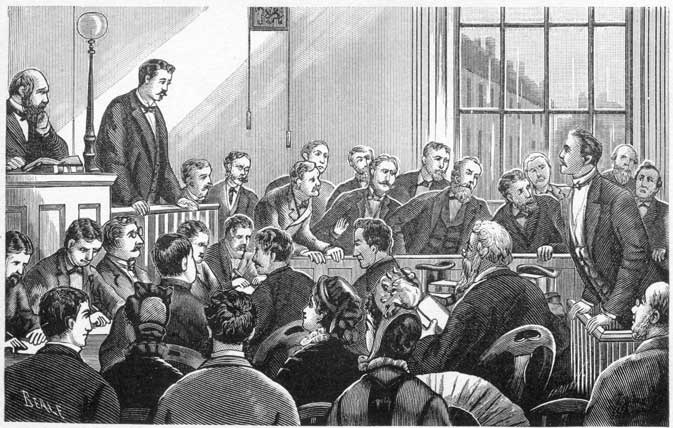
"His eyes full of savage but impotent fury were fixed upon the detective."
The attorneys, stolid and immovable, gazed at this unexpected apparition, but long practice in their profession had enabled them to conceal their emotions, however powerful the influence, and, except the first start of surprise, no outward indication was given of their astonishment at the appearance of the detective or their chagrin at the duplicity of their client.
The detective, calm and imperturbable, and apparently unconscious of the important part he was playing in this sad drama, stood there immovable, the perfect immobility of his face undisturbed by the consternation of counsel or the confusion of the prisoner.
Under the examination of the State's attorney, he told his story in a firm, deliberate manner, that carried conviction to the minds of all. He detailed the various experiences of his prison life and of his intercourse with the prisoner. He related the admissions which Bucholz had made to him, and testified to the influence which he had gradually acquired over the mind of the accused man.
He graphically described their several interviews, and finally he detailed at length the finding of the money of the murdered man, hidden in the places to which Bucholz had directed him.
The silence in the court-room was most impressive. The crowded audience who had at first been amazed at the appearance of the detective, now leaned eagerly forward in their intense desire to hear each word that was spoken. The judges listened intently as the well-chosen sentences, fraught with so much importance to the cause of justice, fell from his lips.
The eager, exulting ring of the voice of the State's attorney as he conducted the examination, and the low, modulated tones of the witness as he gave the damaging answers, seemed to affect all present, and, with their eyes riveted alternately upon the witness and the prisoner, they listened breathlessly as he related his convincing story.
William Bucholz, after the first exhibition of his emotions, sat silent and apparently stunned during the whole of the rendering of this testimony. His eyes were fastened upon the detective witness, but no movement of the muscles of his face betrayed the despairing thoughts within. Silently he sat there—his arms folded across his chest, with cheeks blanched and eyes staring straight forward toward the witness-stand.
Already he sees the hand of impending fate, and as this unexpected web of circumstantial and positive evidence is being slowly and systematically woven about him, the shadow of the gallows falls upon him, and yet he makes no sign. The resolute will and inflexible nature sustain him firmly under this trying ordeal.
As Ernest Stark related the finding of the hidden wealth of the murdered man which he had secured, an involuntary exclamation of surprise burst from the assembled listeners, and when he had finished his story a sigh of apparent relief escaped them.
The testimony of the detective had occupied a day and a half in its rendition, and upon the opening of the court upon the succeeding day, the haggard look of the prisoner told unmistakably of the sleepless vigil of the night before. His lips remained sealed, however, and no one knew of the agony of his mind.
Upon the conclusion of the detective's testimony, the money which had been found in the old barn was exhibited in evidence, and, as the earth-soiled pocket-books and the great roll of notes were displayed, eager eyes watched their production. It was the price of a human life, and another life hung trembling in the balance because of it.
Robert A. Pinkerton was called, and confirmed the statement of Ernest Stark with regard to the midnight visit to the barn and the finding of the money.
Paul Schmoeck and another attache of the German Consulate identified the notes produced, and also testified as to its safe-keeping since it had been so miraculously unearthed.
Two important witnesses were now introduced, who proved beyond a doubt that this money was upon the person of Henry Schulte upon the night of the murder. This evidence was necessary, because the sagacious attorneys for the prisoner had already invented a plan of defense, at once ingenious and able. There had existed hitherto no proof that this money which had been found in the barn was in the possession of the murdered man at the time of the tragedy, and Bucholz might only be the thief who had robbed his master during his absence, and not the criminal who had imbrued his hands in his blood.
Henry Bischoff and his son, prominent German bankers, and dealers in foreign exchange, distinctly remembered the visit of Henry Schulte to their banking house upon the day on which the murder was committed. The father identified some of the notes which had been found in the first package as those which had been given him in exchange for mark bills, and the son identified the gold pieces which had been unearthed with the second package as those which he had given to Mr. Schulte upon that day. Both pocket-books must therefore have been upon the person of Henry Schulte as he walked home upon that winter's night accompanied by his trusted servant who had robbed and murdered him.
The clothing of the accused man, which he had worn upon that night, and which had been secured immediately after the occurrence of the tragedy and legally retained, were also introduced and identified. The shirt contained spots of blood, and the pantaloons also displayed evidences of the same crimson fluid.
The prosecution then closed their case, and the defense began.
Undismayed by the convincing character of the testimony which had been given, the attorneys for Bucholz labored diligently and ably to explain away the damaging proofs which had been adduced.
Their cross-examination of the witness who had been known to them as Edward Sommers had been very light; they had not attempted to impeach his veracity or to question the truthfulness of his relations, and while this was a matter of surprise to many at the time, the wisdom of such a course soon became evident.
The principal witness for the State was to be used as a reliable instrument in the hands of the defense, and the testimony of Edward Sommers was to be relied upon to substantiate the theory by which the attorneys for Bucholz hoped to delude the jury and to save their client.
The finding of the money was admitted as the result of revelations made by Bucholz to the detective, but they endeavored to prove that though he might have robbed the old man, it was impossible for him to have killed him.
It was contended upon the part of Bucholz, that the money was taken from the pockets of the murdered man while Bucholz was assisting in carrying the body to the house, and that he was enabled to do this the more easily, because he alone knew where the old gentleman placed the money which he carried about his person.
This theory was ingeniously suggested and ably argued, and several minor points of evidence were adduced in support of it. The blood-stains upon the clothing were also sought to be explained. Those upon the shirt were alleged to have been produced from the bleeding of the face of the prisoner who was wounded upon the same evening, and the pantaloons, it was claimed, had received the stains upon them from the blood which had dropped while Bucholz was assisting the bearers to carry the corpse to the house after the preliminary investigation by the coroner.
With rare skill were these theories presented, and with desperate energy these able attorneys led the forlorn hope against the strong fortress of conviction which seemed to enclose their unfortunate client. The audience, the judges and the jury were profoundly impressed, but they were not convinced.
The judge charged the jury, and before the force of his sound, legal utterances, the airy castles which had been so ingeniously builded fell to the ground, and the hopes of the prisoner and his friends were buried in their ruins.
The case was handed to the twelve men, and many scrutinizing glances were directed toward them as they slowly retired to deliberate upon their verdict. Faint hopes were entertained of a disagreement, but all felt that conviction would be but a natural result.
Slowly the crowd of spectators dispersed, as it became apparent that no report would be received that evening, and many ladies, moved by that latent sympathy which is usually manifested for great criminals, approached the prisoner, and, together with their condolences, bestowed upon him their offerings of flowers and fruits.
At twelve o'clock the next day—during a recess of the court—a loud knock was heard upon the door which led to the jury-room. Instantly every voice was hushed and every eye was strained to watch the countenances of these arbiters of fate who slowly entered and took their seats.
Bucholz was laughing gayly with some acquaintances, but he became instantly serious—the smile died away from his lips, and he anxiously awaited the announcement that was to convey to him the blessing of life or the doom of death.
Slowly the jurors arose and faced the court.
"Gentlemen of the jury, have you determined upon your verdict?"
Breathlessly they all listened.
"We have."
These words fell like a thunderbolt upon the assembly. The prisoner's face grew pale; he grasped the railing in front of him and gazed wistfully at the jurors who stood beside him.
"Prisoner at the bar, stand up," said the clerk; and Bucholz arose immediately, turning his pallid face toward the jury-box.
The gray-haired foreman, whose elbow almost touched the prisoner, looked at him with a glance in which was depicted a sympathy, which, while it was heartfelt and sincere, was not of sufficient force to outweigh a conscientious discharge of duty.
"Gentlemen of the jury, how say you? Is the prisoner at the bar guilty or not guilty?"
With trembling voice the venerable foreman said, slowly:
"Guilty of murder in the first degree!"
The guilty man fell back in his seat, as though he had been struck a heavy blow, and bowing his head upon the railing, he sobbed wildly.
The trial was over. Justice had triumphed, and this crime-stained man, who was now the object of so much attention, was decreed to pay the penalty of his misdeeds.
The mystery of the murder of Henry Schulte had been judiciously solved, and the detective had triumphed over the assassin.
CHAPTER XXXI.
Another Chance for Life.—A Third Trial.—A Final Verdict.—and a Just Punishment.
Immediately upon the rendering of the verdict, the attorneys for Bucholz moved for an arrest of judgment and filed their reasons for a new trial.
After a delay of some weeks, an argument was had thereon. It was contended among other things that one of the jurymen, during the trial, and while they had not been confined, had spoken of the case upon which he was engaged, and had expressed an opinion in regard to the matter which he had been selected to determine.
Upon this fact being shown to the satisfaction of the judges, a new trial was ordered, and the month of the succeeding February was fixed as the time for the hearing of the same.
The second trial was had, and although the evidence adduced was the same as upon the preceding occasion, or if anything stronger and more convincing, the jury disagreed and were finally discharged.
A remarkable feature of this disagreement was the fact that upon the final polling of the jury that was taken, the vote given was: For murder in the first degree, nine; for murder in the second degree, two; and for absolute acquittal, one.
Grave doubts were entertained of the influence which induced that single vote, but in the absence of any proof to the contrary it must be regarded as an honest opinion conscientiously given.
Another respite was thus afforded the unhappy prisoner, and the third trial—now just completed—was fixed for the thirteenth day of April in the present year.
Again the court has been convened, and the formality of a trial has been gone through with. The jury have been sworn, the witnesses have been examined and arguments have been made. Still, despite the vigorous and persistent attacks that have been attempted, truth prevails in the courts of law, and justice is triumphant.
After a laborious trial, lasting over three weeks, the jury have rendered a verdict of "Guilty of murder in the second degree," and the prisoner, standing tremblingly before the bar of justice, has been condemned to "imprisonment for life."
After exhausting all the technicalities that could be devised, the murderer of Henry Schulte will suffer the penalties of the law.
Again we will visit the prison and look within the narrow cell where William Bucholz is confined. After a long struggle, fate has overtaken him. The dark shadows of night have gathered over the gloomy walls of the structure, and William Bucholz is now alone—the pale, thin face and the sunken eyes tell the agonizing story of unending anxiety and those sleepless vigils attendant upon the terrible state of uncertainty through which he has passed, and the doom which he is now to suffer.
His hair is disordered and he wildly pushes it away from his temples, as though its trifling weight added to the burden already resting upon his brain. The veins stand out upon his temples—now almost bursting with the intensity of the thoughts that have been crowding upon him—and still they come, vivid and terrible.
Vainly he tries to seek that rest that will bring Nepenthe to his dreams, but the specter of that murdered old man will arise before his vision, and rest is impossible. Ah, how many long, weary days and nights, fraught with terror and remorse, will come to this unfortunate man ere he finds a final release and a bed of earth!
The miser of Hagen is avenged—and the murderer will suffer for his crime.
THE END.