Chapter IX · —Rectification of Cerebral Science, Correcting the Organology of Gall and Spurzheim.
Reading edition
Approximate correctness and incompleteness of Gall and Spurzheim—Grand anatomical discoveries of Gall—-Reception of his doctrines—His successors—Omission of Pneumatology and Physiology by Gall and Spurzheim—Organs and faculties overlooked—True locations of the faculties they recognized, Amativeness, Philoprogenitiveness, Adhesiveness, Inhabitiveness, Destructiveness, Combativeness, Secretiveness, Acquisitiveness, Constructiveness, Cautiousness, Approbativeness, Self-Esteem, Firmness, Religion, Benevolence, Hope, Marvellousness, Poetry, Ideality, Imitation, Wit or Mirthfulness, Eventuality, Individuality, Perceptive Organs, Time, Comparative Sagacity, Causality, Tune, Constructiveness, Language—Comments on the Organology of Gall.
The first question that occurs to the enlightened enquirer, when he learns that the functions of the brain have been positively determined by experiment, is whether the cranioscopy of Gall and Spurzheim was successful in locating the cerebral functions, and how nearly their inferences from development correspond with the revelations of experiment.
It is with great pleasure that I am able to say that the system of Gall and Spurzheim was a wonderful approximation to the truth. Dr. Gall was pre-eminently the scientific pioneer of the nineteenth century. No single individual ever did so much to enlarge the sphere of human knowledge, and to establish the permanent foundations of philosophy. Up to his time, the brain of man was at once the greatest mystery of anatomy and the repository of a greater amount of wisdom and truth than all other realms of science which had previously been explored. But so limited was the knowledge, and so narrow the understanding of the learned, that the grandeur of cerebral science was not even suspected, and, even at the present time, it is so remote from the speculations of the learned that, like a distant star, it has few practical relations to their life; nor will its magnitude be realized until an ample literature shall have made its scientific record.
Into this field of mystery, Dr. Gall advanced with a courage unknown to his predecessors, and his success was equal to his courage. The entire plan and constitution of the brain were revealed by his anatomical genius, and his successors have but carried further and perfected his anatomical system. His anatomical exposition of the brain, addressed to the French Institute in 1808, is one of the great landmarks of the progress of science—the commencement of a new era; and his exposition of its functions was the solution of a problem which had defied the genius and learning of all his predecessors. His discoveries in anatomy were so great that Reil (himself a brain anatomist of the highest rank, whose name is permanently associated with anatomy by the name “Island of Reil,” which belongs to the location in which Gall made his first discovery of the faculty and organ of language), Reil, I say, declared that Dr. Gall had shown him more in his dissections of the brain than he thought it possible for any one man to have discovered in his lifetime; and, in fact, some of the old anatomists, not having been personally instructed by Gall, professed to find it difficult, if not impossible, to unfold the brain after his manner.
These discoveries gave Dr. Gall at once a very eminent rank among the learned, for anatomy being a physical science, there never has been any opposition, jealousy, or scepticism against its cultivation among the educated, nor was there anything marvellous in his revelation of cerebral functions, for he studied only the common familiar faculties of men and animals, and never looked into the mysterious and marvellous powers which a more thorough investigation has revealed.
Indeed, his reception at first was quite triumphant, and it was not until the death of Gall and Spurzheim, leaving no able and competent representative to carry on their labors, that the drift of medical scepticism and ignorance arrested the progress of his doctrines. I say ignorance, for the aversion to the doctrines of Gall was due far more to the ignorance of the profession and their entire neglect of the craniological method than to any other causes.
Gall had good reason to be satisfied with his first reception, except as to the hostility of the Austrian government, which suppressed his lectures and compelled him to go abroad, settling finally in Paris, where he again encountered governmental hostility in the unfriendliness of Bonaparte, whose rejection alike of Gall and of Fulton, who wished to introduce steam navigation, demonstrated that great military and political ability may co-exist with great shallowness of mind in reference to all things new, original, and philanthropic. So it has always been, and so it continues.
In his travels in Germany, from 1805 to 1807, accompanied by Dr. Spurzheim, “I experienced everywhere (said Gall) the most flattering reception. Sovereigns, ministers, philosophers, legislators, artists seconded my design on all occasions, augmenting my collection, and furnishing me everywhere with new observations. The circumstances were too favorable to permit me to resist the invitations which came to me from most of the universities.” Thirty-four of the leading cities and seats of learning enjoyed the visits of Gall and Spurzheim before they settled in Paris, where, although French jealousy arose against this German invasion, and the influence of Napoleon prevented their cordial reception, they nevertheless commanded and retained the respect of scientists and had many devoted friends, including Broussais and Andral, who then stood at the head of the medical profession, and of Corvisart, Napoleon’s physician, who could not overcome his master’s prejudice.
In speaking of the great void left by the decease of Gall and Spurzheim, I do not forget that for a few years George Combe, Dr. Elliotson, and Dr. Macartney, of England, and Dr. Caldwell, of America, survived, but these eminent gentlemen were not so identified with the science, or so competent to sustain it as to wear the mantle of its founders. My own labors beginning after the death of the founders were those of investigation and discovery, and never to any great extent those of propagation. Indeed, for twenty years I entirely abandoned the scientific rostrum, and almost ended my labors, feeling that my duty had been done in the way of development and demonstration. But in accordance with the great law of periodicity, I resumed my labors in 1877-78.
When we look at the doctrines of Gall and Spurzheim in the light of positive science and philosophy, our first observation is that they fell very far short of revealing the entire functions of the brain, and discovering in it all the important spiritual and physical faculties and energies of life. They did not attempt to explore the brain as a physiological organ, and determine how or in what special organs it controls the physiological functions. These may be regarded as one half, though the lower half, of its capacities, out of which arises a vast amount of medical philosophy.
As to the psychic half of the cerebral functions, they omitted entirely that portion which relates to pneumatology. They thought nothing of the soul as an object of science, and made no attempt to trace its connection with the brain, and the vast number of phenomena which lie along the border line between the physical and spiritual, and which are conspicuous in the phenomena of somnambulism, sleep, dreaming, hypnotism, spiritualism, clairvoyance, trance, ecstasy, and religious marvels.
Overlooking these things, they sought the seats of from twenty-seven faculties (as with Gall) to thirty-five (as with Spurzheim), and did not appear to realize how many had been entirely omitted. When all they attempted to locate are located by positive experiment and assigned their proper localities and limits, we find fully one half of the cerebral surface vacant for organs of other functions. Indeed, the first large publication of Gall and Spurzheim, in four volumes folio, with an atlas of 100 plates, begun in 1809 and finished in 1819, did not in the cranial map of organs profess to be a complete development of the functions of the brain. It located organs, but did not determine the functions intermediate between their boundaries. This was the map of Gall. In that of Spurzheim the intermediate spaces were occupied and the entire exterior surface of the brain devoted to organology, yet still the basilar and interior surface of the brain remained unknown to Spurzheim, and the exterior regions which he supposed entirely occupied by his organs were but half occupied by them. Thus when we consider the unexplored basilar and interior regions, and that half of its exterior surface which was erroneously appropriated to the thirty-five organs, as well as the erroneous location of several, we perceive that more than half of the organs and functions of the brain remained for investigation.
Turning away from the anatomy to contemplate the psychology, we perceive that more than half of human nature had been omitted from the German scheme,—that half of the mental functions which belongs to the organs of the vacant spaces on the corrected map, and in addition to these the higher psychic functions, and the lower physiological functions, neither of which Gall and Spurzheim explored, because they did not attempt to study the brain as a physiological organ, and they did not bring the soul and the higher functions of the mind within the scope of their science.
Gall was a bold, original naturalist and anatomist but not a psychologist; and the incorrectness of his psychology hindered his investigations, and prevented him from carrying out a proper subdivision of faculties and organs. He says in the last volume: “Each fundamental power, essentially distinct, includes sensation, perception, memory and recollection, judgment and imagination,”—disregarding the truth that these are distinct intellectual powers, belonging to different organs, and therefore bearing no proportion to each other. One may have an immense memory without imagination, or a brilliant imagination without much memory. These, and many other psychological errors, are apparent in the writings of Gall, and still more in those of Spurzheim.
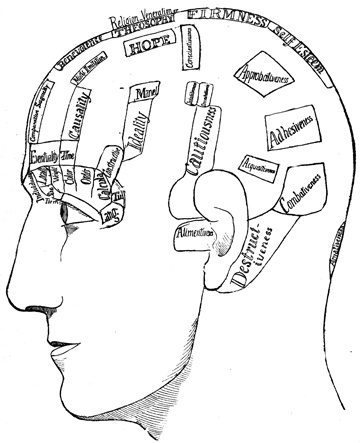
In the drawing herewith presented, the thirty-five organs of Spurzheim are assigned their proper locations and dimensions. The first organ, Amativeness (made second by Spurzheim), was assumed to occupy the entire cerebellum. It really occupies only its median and superior portion, and a small section of the anterior surface of the spinal cord, adjacent to the encephalon. This error of Gall and Spurzheim did a great deal to discredit their system. It manifested on their part a fallibility of judgment, and a dogmatic adherence to first impressions in the face of evidence to the contrary; for the experiments of Rolando and Flourens demonstrated a connection between the cerebellum and the general vital force and muscular action. The relation may not have been clearly understood, but the facts were decisive, and the researches of Majendie, with the more recent ones of Ferrier, have made more clear the relations of the cerebellum to the muscular system and vital force.
The doctrine of Gall has been abandoned by physiologists because refuted by many facts, the most decisive of which is that the cerebellum of castrated horses is larger than that of stallions, which could not be possible if the cerebellum had only sexual functions. Moreover, the doctrine of Gall was essentially unreasonable in itself. To suppose that so large a portion of the brain which is continually active, being well supplied with blood, could have a function which is but occasionally active, and which, through the greater part of human life, is unnoticed or inactive, is extremely unreasonable; and to suppose that the serious disturbances of animal life and muscular motion, caused by ablations of the cerebellum, were due to the disturbance of an organ having only sexual functions, was thoroughly absurd. The parrot-like repetition of these exploded errors by the followers of the phrenological system contributed to its discredit in the medical profession.
The 2d organ of Gall (3d of Spurzheim), Philoprogenitiveness, was regarded as one of the best known phrenological organs, but my unprejudiced study of heads soon assured me of its inaccuracy. The organ was small in Spurzheim, who was remarkably fond of children, and I have found it small in ladies who showed no lack of parental love, but generally well developed and active in criminal skulls. One which I obtained in Arkansas, of a man named Richmond, had this region large and active, although he was the one of a group of murderers by whom the children, or, rather, boys, were killed. This region is extremely defective in the brains of birds, which are certainly very devoted to their young. The attachment to children belongs really to an interior region of the occiput, where the occipital lobes face the median line. Hence it is that a large occipital development very often coincides with the love of children; but the true position of the organ renders it difficult to determine its development in life.
Adhesiveness (3d) is located by Spurzheim farther back and lower than it should be; also, too far back in Gall’s map. It belongs to the vacant space in front of Gall’s location.
Inhabitiveness (5th) is an imaginary definition of the function located behind Self-esteem. Equally imaginary is the doctrine of the Edinburgh phrenologists, who call it Concentrativeness. The observations of Gall led him to regard it as a portion of the organ of Pride, and as giving to animals a love of lofty locations. Gall was nearer right than Spurzheim or Combe. The only function I find in this spot is Self-confidence. The tendencies to a quiet love of home, and the ability to tranquillize and concentrate the mind, are located, virtually, above the ear on the temporal arch, the ridge which separates the lateral from the superior surface of the head.
Destructiveness, the 5th organ of Gall and 1st of Spurzheim, was located much too high and too far forward by Gall. I am surprised at this, since it differs so widely from the indications of comparative anatomy that it is difficult to imagine how Gall was misled. Any one comparing the skull of a dog with that of a sheep may discover the error. He called it Murder, or the wish to destroy. Spurzheim, who does not describe its location, says, “At the beginning Gall placed the seat of this organ too far behind the ear, but a great number of observations convinced us that its seat is immediately above the ear.” The truth is that the convolutions which terminate on the temporal bone over the ear are only on the border of Destructiveness, and produce only an irritable and impulsive temper. The true Destructiveness extends fully an inch under the surface of the middle lobe, along the petrous ridge of the temporal bone, and is manifested externally just behind the ear by the prominence of the mastoid process.
Combativeness (the 6th of Spurzheim, or Courage and Self-defence, the 4th of Gall) is located with tolerable correctness by each and properly described.
Secretiveness, which is but a modification of Cautiousness, occupying its middle region, is much too large on the maps, and on that of Gall it is quite out of place—too far forward and too high up, occupying a region which produces modesty and refinement.
Acquisitiveness (7th of Gall, 8th of Spurzheim) is still farther mislocated on the map of Gall, occupying a region of intellectual, inventive and literary capacity. This is the most outre and absurd of all Gall’s locations. Placing this selfish and grasping propensity in the front lobe which belongs to intellect, when it really belongs to the selfish, adhesive, and combative elements of the occiput, is an error of so extravagant a character as to show that Gall had no correct psychology in his mind, and no capacity or desire to construct a harmonious system. Spurzheim’s location, much farther back, is somewhat less erroneous, but both are thoroughly false, and a few months of my first observations fifty-two years ago satisfied me as to this error. That it should have flourished unchallenged by Phrenologists for eighty years, seems to show that when a dominant idea is once established in the mind, all facts are made to conform to it. Is is remarkable, too, that the very great difference between the locations given by Gall and by Spurzheim has not attracted notice. But in fact the map of Gall has never had any popular currency. Spurzheim and Combe have been the accepted authors. The true location of acquisitiveness is anterior to combativeness, and lower than adhesiveness. Gall was misled by studying the young pickpockets and thieves of Vienna. The organ that he found suits a low cunning and dextrous character when the head lacks elevation.
Constructiveness, Spurzheim’s 9th (Bausinn, or aptitude for mechanical arts, of Gall No. 19), is decidedly mislocated by Spurzheim. Instead of being placed in the purely intellectual region adjacent to calculation, order, and system, it is carried back and down into the region of somnolence and sensitive impressibility. Gall’s location is a little worse because lower, being carried out of the intellectual region into the middle lobe according to his published map. It is very easy to detect this error in examining a number of heads, and it was quite apparent to me in my first year’s observations. In impressible persons the touch upon this locality produces nothing but a dreamy influence, and a disposition to close the eyes. Carried farther, it produces the mesmeric sleep.
Cautiousness (the 10th of both Spurzheim and Gall) was too far back in Spurzheim’s map, occupying space that belongs to adhesiveness. It runs downward along the course of the lateral convolutions, and its more timid and gloomy functions are developed near the ear, differing widely from the functions of its upper portion.
Approbativeness (the 11th of Spurzheim, and 9th of Gall) is located with substantial correctness, covering, however, more functions than that term expresses. Gall’s location and definition are also substantially correct.
Self-Esteem (the 12th of Spurzheim, 8th of Gall) is well located and described with approximative correctness.
Firmness, Religion (Veneration or Theosophy), and Benevolence are so well located and described by both Gall and Spurzheim as to need but little comment at present. The four superior organs on the median line, and the organ of Conscientiousness were more correctly located and described than any other large portion of the brain.
Hope is not adjacent to Conscientiousness, but parallel to Religion.
Marvellousness has a preposterously large space assigned it, being really a small organ at the summit of Ideality, which exercises a more intellectual and less superstitious function than has been given it. Marvellousness, Hope, Conscientiousness, Time, Order, Weight, Size, and Individuality are the eight organs discovered and added by Spurzheim, not having been recognized by Gall. The exterior portion of Spurzheim’s Marvellousness occupies the space devoted by Gall to Poetry.
Poetry, recognized by Gall, is brought lower by Spurzheim and called Ideality. Both locations are substantially correct. The location of Gall is the seat of Marvellousness, Imagination, and Spirituality; that of Spurzheim is well expressed by the term Ideality, and the description given, but the word Poetry is rather too limited as the definition of Gall’s organ. It gives brilliance to prose and to oratory, or even conversation, as well as to poetry.
Imitation, adjacent to Benevolence, is somewhat better located by Gall than by Spurzheim, who gives it too much breadth anteriorly.
Wit or Mirthfulness is a confused and erroneous statement. The two faculties are distinct, Wit being intellectual and occupying a small space adjacent to Causality or Reason, while Mirthfulness, or the sentiment of the ludicrous, is just above it, and should properly be called Humor. The mirthful or playful faculty is in the posterior region adjacent to Approbativeness, and may be quite conspicuous when there is neither wit nor humor in the mirth. Imitation, Mirth or Humor, and Wit follow each other in a line. The so-called organ of Wit (Gall) or Mirthfulness (Spurzheim) is the seat of the most profound reasoning faculty, while the Causality of Spurzheim, the Metaphysical Depth of thought of Gall, though it gives a clear analytical intelligence has really less profundity and ability in reasoning than the organ which they have misnamed Wit and Mirthfulness, which is pre-eminently the organ of profound reasoning.
Eventuality and Individuality are confounded as one organ by Gall, calling it Educability, or Memory of Things but rightly separated by Spurzheim, as the observation and memory of events are distinct from the observation of things. Though I do not use the word Individuality, it is not an objectionable expression, as it suggests the fine perceptive power of its location. Both Gall and Spurzheim had a practically good idea of the region of Eventuality, which Gall first called the memory of things. Spurzheim’s description is good; but when the organ is analyzed, it yields consciousness and observation on the median line, memory more exterior, extending to Time.
Perceptive Organs—The most marvellous feature of the old phrenological system, is the accuracy with which the smallest organs of the brain have been discovered, located, and described. The organs of Form, Size, Weight, Color, Order, and Number, or Calculation, were so accurately located and described by Spurzheim, that little remains to be said about them. Gall discovered only Form, Color, and Number, and the latter he located in the position which belongs to Order. These organs were but little developed in Gall, whose great success was due to his philosophic originality and independence. He was not a close observer, and there was a sternness in his nature which prevented him from accepting readily the suggestions of Spurzheim, who with less boldness of character and greater accuracy of perception, was better fitted for minute observation and anatomical analysis. His own cranium has been preserved, in which I found these perceptive organs distinctly marked by their digital impressions on the superorbital plate over the eye. It is a remarkable fact that the intellectual faculties have been most easily understood and located, while their antagonists in the occipital region have proved the greatest puzzle in psychic and cerebral investigations. Gall failed, and left a vacant space in the occiput. Spurzheim failed, but covered the ground incorrectly, and it was many years after I discovered cerebral impressibility before I attained a satisfactory view of the psychology of this region. The location and definition of Locality are substantially correct.
The organ of Time, another of Spurzheim’s discoveries, was very correctly located and defined by him. It lies just above the organ of Color.
Comparative Sagacity, or Perspicacity, as Gall called it, was a better term than Comparison, which was introduced by Spurzheim. Direct perception of truth is its leading character. Illustration by comparison belongs to the breadth of the forehead, to the Ideal and Inventive region, and is the characteristic of poetry. Spurzheim’s description, however, is substantially correct. It qualifies for clear statement, but not for comprehensive or ingenious reasoning. The portion on the median line has still more penetration, in consequence of which it perceives the nature and tendencies of everything, and is enabled to exercise foresight. Still farther in on the median line are located the powers which are more intuitive, and transcending ordinary foresight are entitled to be called prophecy.
The Causality of Spurzheim, or Metaphysical Depth of thought of Gall, was defined with approximate correctness. The immediate perception of causation lies just above the organ of Time, and the special organ of Reason extends therefrom upwards. If the reflective organs of one side of the forehead are divided into an interior and exterior group by a vertical line from the pupil of the eye, the interior group would represent a comprehensive understanding possessing sagacity and judgment, while the exterior would represent profound ingenious thought and originality, a capacity for discovering truth by reason and meditation, by analysis and synthesis, while the interior would discover it only by direct perception. In the exterior group would be included the misnamed organ of Wit or Mirthfulness, which is really a source of philosophy and originality.
Tune and Constructiveness have really reversed their positions in the maps of Spurzheim and Gall. The inventive faculty of musical composers was what Gall discovered as Music. The sense of Melody and Tune lies behind the brow in connection with the sense of hearing, at the anterior portion of Sensibility, which forty years after my discovery is beginning to be recognized in consequence of the experiments of Ferrier on animals. The organ of hearing which he demonstrated in the monkey, occupies the same position in the superior temporal convolution, behind the eye, which I have given it in man, which brings it into close connection with the organs of Language and Tune. Its close connection with the region of impressibility called Somnolence explains its supreme control over our emotions.
The organ of Language, the first discovery of Gall, has been the first to receive its demonstration from pathology and vivisection. But the pioneer teacher to whom contemporaries are unjust has to wait very long for an honorable recognition. The existence of an organ of Language at the junction of the front and middle lobes, at the back of the eye-sockets, has become established in our physiology from the developments of disease and autopsies, without mentioning in connection that it was the discovery of Gall. Perhaps the authors of the text-books may not even know the location of Gall’s discovery in the brain, and think only of the external sign, the prominence of the eyes, produced by the convolution at the back of their orbits.
Dr. Spurzheim simply located the external sign of the prominence of the organ at the eye, while Gall recognized the talent for languages as lying further back than that for verbal memory, and consequently being manifested lower at the eye. Nevertheless Gall made a correct observation, as he noticed that a full development was indicated when the temples were broad behind the eye. The true location of the organ externally is just behind the outer angle of the eye, a position central to Gall’s observations, and corresponding in the brain to that junction of the front and middle lobes in which the organ has been demonstrated by pathology, though not so accurately defined as in my experiments.
Perhaps in twenty or thirty years more my demonstrations having been brought before the public may attract the attention of the laborious vivisectors in Europe, who have done so much to verify them, and who will find that their labors do not refute but do confirm what I have discovered by methods so much simpler, easier and more pleasant.
In the second volume I propose to show in detail how much the pathologists and vivisectors have done to illustrate and corroborate the new Anthropology.
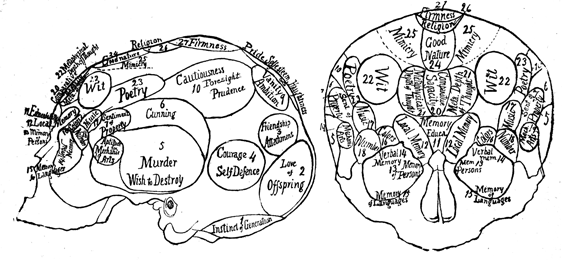
Organology of Gall, 1809.
Instinct of Generation.
Love of Offspring.
Friendship, Attachment.
Courage, Self-Defence.
Murder, Wish to Destroy.
Cunning.
Sentiment of Property.
Pride, Self-Esteem, Haughtiness.
Vanity, Ambition.
Cautiousness, Foresight, Prudence.
Memory of Things, Educability.
Local Memory.
Memory of Persons.
Verbal Memory.
Memory for Languages.
Colors.
Music.
Number.
Aptitude for Mechanical Arts.
Comparative Aptitude for Drawing Comparisons.
Metaphysical Depth of Thought, Aptitude for Drawing Conclusions.
Wit.
Poetry.
Good Nature.
Mimicry.
Theosophy, Religion.
Firmness of Character.