Miscellaneous Intelligence.
Reading edition
Erratum.—In the April number, the view of the upper surface of the brain, by mistake of the printer, was turned upside down—see page 29. The engraving on page 31 must be referred to, to illustrate the description in this number.
Co-operation is making great progress. A colony similar to that at Topolobampo is to be established on 3,000 acres at Puget Sound. Manufacturers are beginning to adopt the principle of giving a share of profits to their employees, but space forbids details. Topolobampo has 400 busy colonists, and is not ready yet for any more.
Emancipation.—Brazil has about a million of slaves. Emancipation is proceeding slowly. It may be thirty years before slavery shall be entirely extinguished.
Inventors.—A correspondent remarks very justly that “Inventors have rescued the race from primitive barbarism. They have transformed the primeval curse into a blessing. True saviors they, whose every gift has multiplied itself a thousand-fold by opening new fields of industry, and scattering luxuries even among the poorest. To the inventor, and not to the statesman, politician, or warrior, do we owe our present prosperity.”
Important Discovery.—“Tests were recently made at Louisville of a new and not expensive process for hardening and tempering steel, by which hardness and elasticity are carried forward in combination. A drill made of the new steel penetrated in forty minutes a steel safe-plate warranted to resist any burglar drill for twelve hours. A penknife tempered by the process cut the stem of a steel key readily, and with the same blade the inventor shaved the hairs on his arm. The inventor is a young blacksmith. He has also a new process for converting iron into steel.”
Saccharine.—This new substance said to be 200 times as sweet as sugar is manufactured from coal tar. It was discovered about six years ago in the laboratory of the Johns Hopkins University in Baltimore, by Prof. Remsen and a student named Fahlberg, who has since taken out patents upon it. It is greatly superior to sugar, as it is free from fermentation and decomposition. A small quantity added to starch or glucose will make a compound equal to sugar in sweetness. It is a valuable antiseptic and has valuable medical properties.
Sugar has been discovered to have great value as an addition to mortar, as it has a solvent action on lime. An English builder wrote an important letter to the authorities of Charleston, S. C., on this subject, after that city had suffered from the earthquake.
Artificial Ivory.—We shall no longer need the elephant for ivory. Compounds of a celluloid character, made from cotton waste, can now be made hard as ivory, or flexible or soft as we wish. White and transparent, or brilliantly colored, it can be handled like wood cut and carved, or applied as a varnish. An artificial ivory of creamy whiteness and great hardness is now made from good potatoes washed in diluted sulphuric acid, and then boiled in the same solution until they become solid and dense. They are then washed free of the acid and slowly dried. This ivory can be dyed and turned, and made useful in many ways.
Paper Pianos.—Pianos have lately been made from paper in Germany, instead of wood, with great improvement in the tone.
Social Degeneracy of the Wealthy.—The Boston Herald says: “The spirit of the age is censorious. There is no doubt of that, or that with every new day the tendency toward pessimism increases. But even taking these facts into consideration, there is no denying that the young man about town of the nineteenth century is a blot upon our boasted modern civilization. His is not a pleasant figure to contemplate, though it is one that we all see very often and know very well—clothed irreproachably in the most expensive raiment that London tailors and unlimited credit can supply. He lives lazily and luxuriously on his father’s money and his wife’s, and, being after his natural term of days laid away in a tomb at Mt. Auburn, ends his existence without making any more impression upon the world’s history than a falling rose leaf, or an August cricket’s faintest chirp.”
Prevention of Cruelty.—In Congress, Feb. 14, Mr. Collins, for the judiciary committee, has given a favorable report on the bill and memorial of the Massachusetts Society for the Prevention of Cruelty to Animals, asking the passage of a law to protect dumb animals in the various territories from unnecessary cruelty. In the report Mr. Collins says: “This body occupies the foremost place among the organizations of men and women who in our time have done so much to repress and punish human cruelty, abuse, and neglect in dealing with dumb animals. In all the States, we believe, laws now exist to prevent and punish unnecessary exposure, neglect, or cruel treatment of beasts of burden and other animals. To bring the federal legislation into co-operation and harmony with the laws of the States on the subject, and provide a uniform rule for the District of Columbia and the Territories, your committee recommend the passage of the bill.”
Value of Birds.—Maurice Thompson contends that the failure of orchards in this country is largely or mainly due to the war upon birds. The mocking bird he considers the most valuable of all. “No Scuppernong vine,” he says, “should be without its mocking bird to defend it.” Let ladies think of this who patronize cruelty by wearing birds’ plumage on their bonnets.
House Plants.—Dr. J. M. Anders has decided after eight years’ investigation that house plants are very sanitary agents, and even thinks that they help to ward off consumption and other diseases.
The Largest Tunnel in the World has been completed at Schemnitz in Hungary. It was begun in 1782, and is ten and a quarter miles long, nine feet ten inches high, and five feet three inches wide, costing nearly $5,000,000. Its purpose is to drain the water of the Schemnitz mines, which is worth $75,000 a year.
“Westward the Star of Empire,” etc.—“The Fall River (Mass.,) iron works, which have been in operation for fifty years, have shut down permanently and all the hands have been discharged. It was found impossible to compete with western works that are situated near the base of natural gas and iron supplies.”
Structure of the Brain.
(Continued from page 32.)
Nevertheless, in men and animals killed in full health there is very little serum in any part of the brain, the blood requiring all the space there is for fluids; and as the blood distends one part of the brain more than another in consequence of local excitement, the other portions of the brain, which are in a passive state, are compressed and deprived of their full supply of blood, so that they are of less nourished and their development declines.
Thus do we hold our destiny in our own hands. If we will cultivate the faculties which are most in need of cultivation, their organs, receiving more blood, will grow faster than any other portions of the brain, while the organs that are kept in check and deprived of activity will gradually decline in power and size, so that the character will become essentially changed. It is in the power of every individual who has the necessary determination to change essentially his own nature for better or worse, as well as to modify and enlarge his capacities, changing the structure of his brain; and this should encourage every young man and woman to make for themselves a noble destiny. Moreover, it is still more practicable to accomplish this by means of education, with all proper appliances for the young; and this should encourage philanthropists to struggle for that social regeneration which is so clearly possible for all the world, as I have shown in “The New Education.” The study of the anatomy of the brain and the innumerable experiments I have made on the brain, showing how completely the brain of the impressible can be revolutionized in its action in a few minutes, make it very apparent that society as a whole is responsible for the continued existence of criminals, paupers, and lunatics; for there should not be one, and would not be, if mankind could be aroused from their criminal apathy and ignorance to the performance of our duty in education. But alas! “the light shineth in darkness and the darkness comprehendeth it not.”
The study of the brain continually leads us into grand philanthropic conceptions by showing the splendid possibilities of humanity,—showing how near we are to a nobler social state from which we are debarred by ignorance, by moral apathy, by ignorant self sufficiency, by intolerant bigotry, and by selfish animality,—qualities which, alas! pervade all ranks to-day.
But returning from this digression to our study of the interior of the brain: the great ventricles of which we have considered the position, and which are called lateral ventricles, are interesting for another reason, that they are the central region around which the cerebrum is developed, as it folds over upon itself in its early growth, and consequently must be borne in mind as its centre when we are studying its comparative development in different heads. The basilar organs lie below the ventricles and the coronal organs above.
If we have inserted a finger under the corpus callosum, the fibres of which are above our finger, we may feel below, the structure which may be called the bottom of the ventricle, and which is likewise the base or trunk of the superincumbent parts from which they spring, as a tree from its stump.
This structure is one mass, called anteriorly the corpus striatum, or striated body, and posteriorly the optic thalamus or bed of the optic nerve, though the optic nerve has its principal origin in another part, called the optic lobes. The thalamus and corpus striatum are called together, the great inferior ganglion of the brain. They are masses of gray substance, with white fibres from below passing through them, and white fibres originating in them to ascend and spread, so that their entire masses of fibres, ascending and spreading out like a fan, constitute an extensive structure which folds together toward the median line somewhat like a nervous sac, inclosing the cavity of the ventricle and sending its representative fibres across the median line,—which are called the corpus callosum. This will be more fully explained when we consider the genesis of the brain as it grows in the unborn infant.
As the reader now understands the principal parts around the ventricles, let him look lower down to complete the survey and understand the plan of the brain, though not its anatomical minutiæ. The optic thalamus is indicated in the engraving, but the corpus striatum, being more exterior and anterior, does not appear. Practically they may be regarded as one body.
Where the thalami come together and touch or unite on the median line, the junction is called a commissure (commiss. med.) and the space between them where they do not touch is called the third ventricle (ventric. III), which, like the lateral ventricles, may also hold a little serum. It is unnecessary to consider the small parts above the thalami, the choroid plexus of blood vessels, the fornix or strip of nerve membrane, and the septum lucidum or delicate fibres under the corpus callosum.
Beginning at the bottom of the figure, we observe the medulla oblongata rising from the spinal cord to reach the cerebrum. Behind this we see the cerebellum divided on the median line, and thus presenting where it is divided the appearance called arbor vitæ, from its resemblance to the leaf of that evergreen.
As the fibres of the medulla oblongata ascend they pass between the cerebellum and the pons Varolii (bridge of Varolius) mingling with its substance. The pons or bridge (for if the brain were laid on its upper surface the pons would appear like a bridge over the river represented by the medulla oblongata) is the commissure or connecting body of the cerebellum, as the corpus callosum is of the cerebrum. When the head is held erect the fibres of the pons arch forward from the interior of the cerebellum on one side across the median line to the other side, so that a straight line through from the right to the left ear would pierce its lower portion. It looks toward the front, corresponding with the upper jaw, just below the nostrils, through which region it may be reached for experiment.
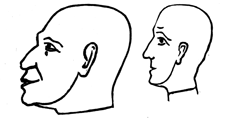
My experiments upon the brain of man show that the pons on each side of the median line is the commanding head of the respiratory impulse, and in marking the organ of respiration on my busts, it is located around the mouth from the nose to the chin. When this region (especially its lower portion) is prominent it indicates active respiration and a forcible voice. Hence there is a great contrast in the vocal power of two such heads as are shown in the adjoining figure. This discovery has been verified by the pathological researches of Dr. J. B. Coste, published at Paris, 1857.
Following the line of the ascending fibres, after passing through the pons they continue expanding and plunge into the thalamus and corpus striatum. Their first appearance above the pons (marked in the engraving by the word Pedunc.) is usually called the crura or thighs of the brain. The right crus, running through the thalamus, expands by successive additions into the right hemisphere, and the left crus into the left hemisphere, of the cerebrum, and the two hemispheres unite together on the median line by the corpus callosum.
There is very little space for the crura (plural of crus) between the pons and the thalamus, but if we look at the posterior surface of the ascending fibres or crura we see a larger surface, on which we find a quadruple elevation called the corpora quadrigemina (the four twins). This is an important intermediate structure between the cerebrum and the cerebellum, and in fishes is the largest part of the brain, but in man is the smallest portion, as will be explained hereafter, and is the origin of the optic nerve, as well as a commanding head for the spinal system, from which convulsions may be produced.
The quadrigemina are distinguished also as the location of the pineal gland, which rests upon them, to which we may ascribe important psychic functions. The engraving shows the fibres connecting the quadrigemina with the cerebellum, and a channel under them (aqueduct of Sylvius) connecting the ventricles of the cerebrum with those of the spinal cord. What is called the fourth ventricle is the small space between the medulla oblongata and the cerebellum. At this spot the posterior surface of the medulla oblongata, as it gives origin to the pneumogastric nerve, which conveys the sensations of the lungs, becomes the immediate source of the respiratory impulse on which breathing depends, and hence is of the greatest importance to life. A very slight injury at this spot with a lancet or point of a knife would be fatal. It is recognized by converging fibres which look like a pen, and are therefore called the calamus scriptorius, or writer’s pen.
If the reader has not fully mastered the intricacy of the brain structure, he will find his difficulties removed by studying two more skilful dissections. The following engraving presents the appearances when we cut through the middle of the brain horizontally and reveal the bottom of the ventricles, in which we see the great ganglion, or optic thalamus and corpus striatum, and the three localities at which the hemispheres are connected by fibres on the median line, called anterior, middle, and posterior commissures. These commissures are of no importance in our study; they assist the corpus callosum in maintaining a close connection between the right and left hemispheres.
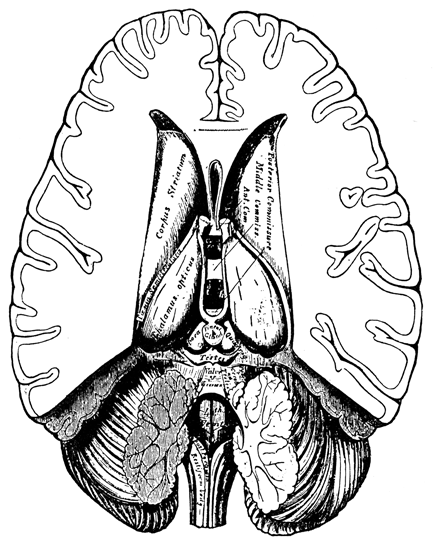
Behind the thalami we see the quadrigemina, the posterior pair of which is labelled testes, and resting upon them we have the pineal gland, a centre of spiritual influx. Behind the thalami, the posterior lobes are cut away that we may look down to the cerebellum, and the middle of the cerebellum is also removed so that we may see the back of the medulla oblongata and its fibres, called restiform bodies, which give origin to the cerebellum. The fibres from the cerebellum to the quadrigemina are shown, and the space at the back of the medulla, called the fourth ventricle.
As the fibres of the medulla pass up through the pons to the great inferior ganglion, and the fibres of the corpus striatum pass outward and upward to form the cerebrum, this procession of the fibres is shown in the annexed engraving, in which we see the restiform bodies passing up to form the cerebellum, and the remainder of the medulla fibres passing through the pons, and then, under the name crus cerebri or thigh of the cerebrum, passing through the thalamus and striatum to expand in the left hemisphere of the cerebrum. We see the quadrigemina on the back of the ascending fibres and their connection by fibres with the cerebellum behind, as they connect with the thalami in front. This is as complete a statement of the structure of the brain as is necessary, and further anatomical details would only embarrass the memory.
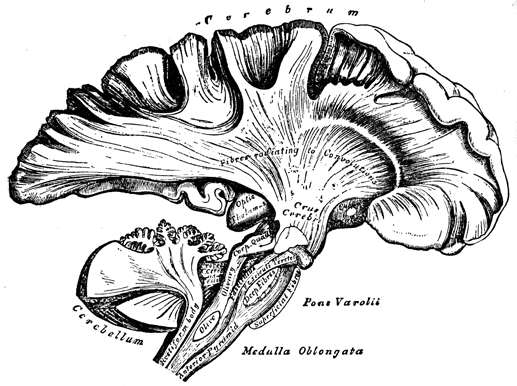
The engraving above represents not an actual dissection, but the plan of the fibres as understood by the anatomist. The intricacy of the cerebral structure is so great that it would require a vast number of skilful dissections and engravings to make a correct portrait. Fortunately, this is not necessary for the general reader, who requires only to understand the position of the organs in the head, and the direction of their growth, which is in all cases directly outward from the central region or ventricles, so as to cause a prominence of the cranium—not a “bump,” but a general fulness of contour. Bumps belong to the growth of bone—not that of the brain.
Let us next consider the genesis of the brain, which will give us a more perfect understanding of its structure, by showing its origin, the correct method of estimating its development.