Chapter I · GENERAL PLAN OF THE BRAIN.
Reading edition
The brain the centre of life—Its organs not distinctly separated—Its double functions and degrees of energy—Difficulty of nomenclature, chiefly basilar—The pathognomic law—Its application to the brain—The four cardinal directions and four divisions, the coronal, basilar, anterior, and occipital—Their effects on the character and constitution—The method of locating organs—The four groups—The law of antagonism—Its certainty and necessity—Difficulty of expressing it—Correspondence of the English language and the brain—Its limits—Radiating groups of organs—Contrasts of development.
The details of cerebral science will be much more easily understood if we begin with a comprehensive view of the entire plan of the functions and structure.
The brain is distinguished from all other organs by being the source of commands which all other organs obey, and being the immediate seat of the soul, which has no knowledge of anything occurring in the body, until a message or impression has reached it through nervous channels. The compression of all the nerves before they enter the cranium and connect with the brain would deprive us of all knowledge of the body, and of all sensations or perceptions; and the compression of the brain itself would render us totally unconscious, as if dead,—incapable of either thought or action. Manifestly, therefore, all the powers of the soul are lodged in and exercised through the brain; and as all distinct nerve structures have essentially different functions, and every different function requires a different structure, it is obvious that the vast variety of our psychic faculties, intellectual, emotional, sensitive, passional, and physiological, requires a corresponding multiplicity in the nervous apparatus; and this incalculably great multiplicity we find in the brain.
The crude, mechanical idea that all the organs of the brain should be distinctly marked and separated by membranous walls or obvious changes of structure, is very unscientific; for even in the spinal cord, which is more easily studied, we do not find such separation between the widely distinct functions of sensibility and motility. Their nerve fibres run together undistinguished, and it is only by the study of pathological changes that we have been able to distinguish the course of the motor fibres, which to the most careful inspection are indistinguishable from the sensitive.
Moreover, the functions of the brain are not like those of the spinal cord, of a widely distinct and opposite character in adjacent fibres, but exhibit a gradual variation, like the blending colors of the rainbow. The sensitive or psychic individual who touches any part of the head and feels an impression of the emotional, intellectual, or impulsive function in the subjacent convolution of the brain, will find the impression gradually changing as he moves his finger along the surface, until, after passing half around the cerebrum, he will feel an influence exactly opposite to that with which he started.
As there are many millions of sensitive persons who are capable of receiving these impressions from the brain, we cannot but wonder at the unanimous indifference (which some may hereafter call stupidity) which hinders the medical profession and scientists generally from becoming acquainted with such facts, which I have proclaimed and demonstrated until I have grown weary of attempting to instruct wilful ignorance. Not only does the nervaura, direct from the brain convey such impressions of organic action, but almost any substance held for a few moments in contact with any part of the head will absorb enough of the local nervaura to convey a distinct impression to a sensitive, similar to that derived directly from the head.
Although the organs of the brain are thus distinct, they are not distinct like the spokes of a wheel, each totally independent of the other and fixed or invariable in its own simple character; for all organs have double functions, and a great variety in their degree of manifestation.
The double function is psychic and physiological, or physical. When the action of the brain is confined within the cranium, its action is purely psychic; but when its influence passes into the body, it produces physiological effects. As the brain is the seat of the soul, its action is essentially and primarily psychic; but as it is the commander of the body, and the source of its spiritual vitality, all its conditions or actions affect the body; and hence every organ has its dual action, psychic and physiological. Cerebral physiology and sarcognomy explain in detail how the brain and the mental conditions affect the body; cerebral psychology shows how the brain and soul are correlated. The purpose of this treatise is to show how the brain is correlated with both soul and body, giving the principal attention to the former.
If cerebral organs all have this double function, it is manifestly exceedingly difficult, if not impossible, to find any words competent to express the double functions, and it will be necessary to adapt our nomenclature to expressing the psychic function, leaving the physiological to be expressed otherwise. As the basilar organs act more directly upon the body, their nomenclature will be more suggestive of physiological effects. The organ, for example, of alimentiveness or appetite will suggest by its name its relation to the stomach.
The difficulty of arranging a satisfactory nomenclature for a certain portion of the brain, in consequence of the varying energy of organic action, is very great, and must be met by using the word which will express in a general manner the organic tendency, leaving to the intelligence of the reader to imagine the variations of intensity. In the greatest energy of organic action the opposite faculty is entirely overcome, and the conduct becomes abnormal, for normal action implies the harmonious co-operation of all parts of the brain. Nevertheless, it is in this abnormal or excessive action that we get the true, isolated tendency or function in its naked expression.
For example, if we refer to that portion of the brain near the mastoid process, which in its excessive action produces murder, we perceive that as murder is an abnormal action, such a term is not a suitable name for an organ, as it would convey the impression that every human being has a constant murderous impulse, and that the faculty is kept inactive when murder is not committed; from which we might infer that the human constitution is badly planned.
Still, it is not to be concealed that murderous violence is the ultimate result of this organ when unrestrained,—that it is the most conspicuous faculty in carnivorous animals, and alas! that it has a terrible and at times predominant action in the masculine portion of the human race. Throughout the greater part of ancient history the murderous violence of this faculty has been as conspicuous in the human race as in the wild beasts. Even to-day, after centuries of so-called civilization and religion, no man’s life would be safe if not protected by policemen; and the civilized nations, with a skilful ferocity, devote the major part of their governmental revenues to preparations for international homicide as a defence against the murderous impulse in their neighbors, and to watching or controlling the murderers within their own limits; whose homicidal propensities, however, are not restrained from mutual homicide, by agreement, in the warlike form of the duel, which is considered a proper institution to cultivate a martial spirit and promote the efficiency of the army,—ay, and even tolerated in the German system of education, provided that life is not actually sacrificed.
Murder is therefore not an improper term to express the consummate energy of this basilar organ, if we at the same time understand its gentler manifestations; and Dr. Gall was a faithful student of nature when he called this faculty the “carnivorous instinct, or disposition to murder,” for that is the way that it exhibits in animals, and, unfortunately, in mankind also.
Yet as an element of character, and an organ in the brain, this faculty needs a more general and comprehensive term than murder to express its ordinary action. It operates as an impelling and modifying influence in our daily life, giving a certain kind of energy to physical and mental action, as our fruits have a certain degree of sweetness in their juices which is not due to crystals of sugar, though if the sweetening element were extracted it would appear in that solid form. Thus the violent impulsive energy which appears in our vigorous language, emphatic gestures, ultra sentiments, and threatening expressions, if it could be isolated from its psychic combination, would appear in its isolated purity as an impulse to the destruction of life and everything else that stands before us.
Hence the term Destructiveness has been very properly applied to this organ by Spurzheim. Yet even this term expresses too much for its average daily action, and Violence, Impulsiveness, or Vehemence would come nearer to expressing its ordinary manifestation.
The reader will now perceive that the psychic functions of certain organs can seldom be adequately expressed by one word, and that three words are required to express fully the moderate, the active, and the abnormal manifestations. Fortunately, however, this difficulty of nomenclature applies only to that portion of the brain which tends to the abnormal. Man’s nobler faculties belonging to the upper region of the brain are essentially good and normal. The abnormal difficulty does not come into their description.
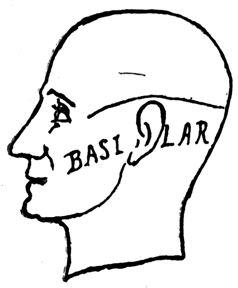
Its operation is limited to the region lying around the ears, the basilar region, the tendency of which is to exhaust the spiritual vitality of the brain in ministering to the body. This will be clearly understood when we understand the fundamental law of all cerebral action, the law of direction, or
PATHOGNOMIC LAW.
This law is the grandest generalization of science that was ever conceived. It is the fundamental law of the relations of the two worlds, the psychic and the physical. The spiritual and material worlds unite in man, in whom the eternal spirit is combined with a transitory material body, and the law of their interaction is the law of the universe.
In its application to man, the law is simply this, that all organs of the brain act in accordance with their position,—in accordance with their pathognomic line, or line of action, which is the line of their central fibres, the tendency of which is toward the surface of the brain, where they reach the interior of the cranium. It will be a sufficient approximation to the mathematical truth if for the present we say that the pathognomic line may be indicated by a perpendicular to the surface of the cranium where the organ is located.
When we establish the pathognomic line, we establish a perfect criterion of the organic action, for the action is always in accordance with the line; and this fundamental law gives a key to all psychology, and gives it a geometrical simplicity.
In accordance with this law, the frontal or intellectual organs act toward the front, and maintain our relations with that which is before us. Acting in that manner, they throw out or expend the vital forces, and exhaust the energies which belong to the posterior part of the brain and posterior part of the body. The posterior half of the brain acts in the opposite direction, and thus draws in, acquires, and energizes. The posterior action impels the body to advance, as the anterior portion checks our progress and causes us to yield. Hence if we erect a perpendicular from the ear, we shall find all the energetic impelling faculties behind it, and all that moderates, checks, and enlightens before it. Thus the occipital development makes a powerful, domineering, conquering character, as the frontal makes a passive, unselfish, yielding one.
Hence all organs in proportion to their energy are located nearer to the posterior region of the brain, and in proportion to their delicacy or weakness have a more anterior location.
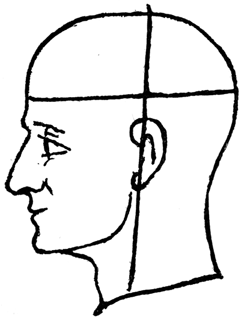
There are four classes of pathognomic lines, as there are four aspects of the brain, which may be represented on a plane surface, and which are sufficient for this incomplete introductory statement—the anterior and posterior—the superior or upward, and the inferior or downward. The anterior and posterior tendencies may be separated by the vertical line through the ear. The superior and inferior, or upward and downward, may be separated by a nearly horizontal line from the forehead backward, which nearly coincides with the lateral ventricles that separate the superior and inferior convolutions. The lateral ventricles (cavities the walls of which are in contact,) are the central region of the brain around which the convolutions are formed. Dividing the brain thus into superior and inferior halves, we find that the major portion of the superior has an upward line which is fully expressed at the upper surface of the brain, while the lower half has downward lines which are most fully expressed on the basilar surface of the brain, which is covered by the face and neck.
Intermediate between these coronal and basilar surfaces are lateral organs which participate in the upward or downward tendency as they approach the highest and lowest surfaces.
The tendency of the coronal region is upward, that of the basilar downward. The latter operates downward upon the body, rousing the muscles and viscera to activity, but exhausting the brain and the spiritual life. Hence, while they vitalize the body, they are the source of all that is sensual, violent, beastly, and criminal,—all that degrades human nature,—when they become the controlling power, which is an abnormal condition.
The coronal organs tend upward; they withdraw excitement from the body, quiet the muscles, and diminish the energy of the appetites and passions, while they originate all noble and lofty impulses. Their tendency is toward heaven, toward the highest possible condition of humanity, the performance of every duty, the enjoyment of happiness and health, the perfection of love and fidelity. They make the life on earth resemble the life in heaven, and consequently bring us into sympathy with all holy influences. They make religion a reality, and produce a character which we cannot but admire and love. Their tendency is to draw life upward from the body to the head and the upper part of the chest, and thereby to energize the soul, which has its home in the brain, and which is the essential seat and source of life, and is in interior connection with the infinite source of life. Hence the coronal half of the brain is the home of spiritual life, the antagonist of disease, the promoter of longevity, by which the harmonious love of the upper world is realized on earth, and that divine quality of the soul which frees it from disease and death is to a limited extent imparted to the human body.
The excessive action of the basilar region exhausts the brain, degrades the soul, and thereby impairing the fountain of life and health, introduces disease and death. Gluttony, drunkenness, sensuality, passion, and violent exertion are the processes that exhaust the soul power. Excessive and prolonged muscular exertion without rest exhausts the brain. But the normal action of the basilar organs is essential to all the processes of life, and maintains the union of soul and body. Hence their good development is necessary to longevity.
On the other hand, excessive predominance of the coronal region, although it heightens the spiritual nature, withdraws life from the body, and culminates in trance, ending in death by the ascension of the soul from the body. But so long as the basilar organs have sufficient energy to maintain the connection of the soul with the body, the most powerful action of the coronal region increases the power of the brain, the brilliance of the mind, the perfection of the health, and the moral greatness and power of the person.
These statements are essentially different from the physiological and phrenological ideas heretofore current, but they are sustained by universal experience, which recognizes the power of heroism, hope, religion, and love to exalt our powers of endurance and achievement, whether intellectual or physical; and they are sustained by the records of pathology, which show that softening or ulceration of the superior regions of the brain impairs, paralyzes, or destroys all our powers. Moreover, all that I teach on these subjects is but an expression of the formulated results of many thousand experiments during the last forty-five years.
The simplicity and applicability of these pathognomic laws which pervade all psychic phenomena are such that they are easily mastered, and a single evening devoted to the subject enables my students to locate with approximate correctness nearly all the organs of the brain. The multiplicity of the cerebral organs is somewhat discouraging to a student at first, but all embarrassment is removed when the simplicity of the Divine plan is shown.
In illustrating these principles, we take up a number of faculties successively, and determine by their nature what should be their latitude and longitude upon the map. Thus, for example, if Modesty is mentioned, students would say it should be above the horizontal line, but not so high as the virtues, and that it should be not among the energies, but among the moderating faculties of the front half of the head. Hence they usually ascertain its true location. If Avarice or Acquisitiveness should be considered, they would recognize it as entitled to a place below the horizontal line, and also behind the vertical line, but neither the lowest nor the most posterior. If Firmness is mentioned, they recognize it as entitled to a high place, but behind the vertical line; and thus they seldom make any great error in determining the location of an organ.
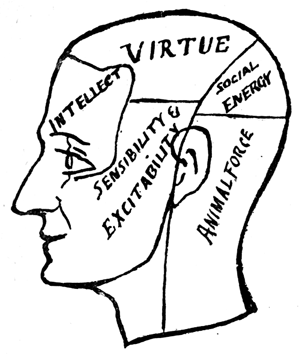
If we thus go through the catalogue of psychic powers or qualities, we observe finally that the organs are grouped as follows; and this grouping should be impressed upon the memory, as it is easily learned, and serves as a basis for the further study of organology. The organs in this drawing are not arranged to show their antagonism, but antagonism is the most important fundamental principle of cerebral psychology.
THE LAW OF ANTAGONISM.
Antagonism or opposition is the universal condition of all that we know. Up suggests down; inward, outward; forward, backward; advance, recession; motion, rest; elevation, degradation; abundance, deficiency; heat, cold; light, darkness; strength, weakness. The same antagonism exists in the psychic nature, as in love, hate; hope, despair; courage, cowardice; pride, humility, etc.; and equally in the physiological, as we see in the action of flexor and extensor muscles, their antagonism being a necessity. If we had only flexor muscles, one motion would exhaust the muscular capacity; when the limb is flexed it can do nothing more; but when the extensor muscle moves it back, flexion can be again performed. Thus all vital voluntary action is a play of opposing forces,—the existence of one force rendering possible the existence of its opposite. The coronal organs, carrying the soul above the body, would bring the end of terrestrial life, and the basilar organs exhausting the brain would bring to a more disastrous end; but the joint action of the two, like that of flexor and extensor muscles, produces the infinite variety of life, which moves on like pendulums, in continual alternation.
Man would be utterly unfit for the sphere that he occupies, if he had not the opposite capacities required by innumerable opposite conditions. Physiologically, he requires calorific powers to fit him for cold climates, and cooling capacities to fit him for the torrid zone. Morally, he requires warlike powers to meet enemies and dangers, as well as affections for the sphere of domestic love. He requires the conscious intellect to call forth and guide his powers in exertion, and a faculty for repose and recuperation in sleep. He requires self respect to sustain him in elevated positions, and humility to fit him for humble duties and positions. We can conceive no faculty which has not its opposite,—no faculty which would not terminate its own operation, like a flexor muscle, if there were no antagonist. Benevolence would exhaust the purse and be unable to give, if Acquisitiveness did not replenish it; and Avarice unrestrained would lose all financial capacity in the sordid stupidity of the miser. Each faculty alone, without its antagonist, carries us to a helpless extreme.
The antagonism of faculties is so self evident a law of nature that if Dr. Gall had pre-arranged a psychic philosophy in his mind, instead of being a simple observer of facts, he might have given a very different aspect to the science. But he arranged no psychic philosophy, and he did not carry his observations far enough to lead him into the law of antagonism, and hence left a rude system, lacking in the symmetry and completeness necessary to give it the position of a complete philosophy.
But while the law of antagonism should control our psychic studies, it is not always convenient to express this antagonism in our nomenclature, or to group the functions of all regions of the brain in such a manner that each group or organ shall exactly correspond to an antagonism in another organ; for in expressing the functions of parts of the brain we are limited by the structure of the English language, and have to make such groups as will be conveniently expressed by familiar English words,—the words of a language that has grown up in a confused manner, and was not organized to express the faculties of sub-divisions of the brain. Hence, for want of a pre-arranged language, with words of accurate definition and exact antagonism, we can only approximate a perfect nomenclature, and must rely more upon description than upon classification and technical terms.
Technicality, however, is to be avoided as far as possible. Anthropology may need, like other new sciences, new terms for its new ideas, but the old words of plain English express all the very important elements of human nature. To the master of anthropology it is easy to take any word expressive of an element of human character or capacity and show from what convolution, what group of convolutions, or what part of a convolution the quality or faculty arises which that word expresses. An evening might be profitably spent with a class of students in tracing English words to their cerebral source.
In expressing the functions of the brain by nomenclature, we are entering upon an illimitable science, and must hold back to keep within the limits of the practicable and useful. The innumerable millions of fibres and ganglion globules in the brain are beyond calculation, and their varieties of function are beyond all descriptive power. Geography does not attempt to describe every square mile of the earth’s surface, nor does astronomy presume to know all the stars. In reference to the brain, psychic students will hereafter send forth ponderous volumes of descriptive detail, for which there is no demand at present. I willingly resign that task to my successors. A description which portrays the general character of an inch of convolution, or of a half inch square of the finer intellectual organs, is sufficiently minute for the purposes of a student. Acting upon these views, the following catalogue of psychic functions has been prepared, which is offered now not for the reader’s study, as the multiplicity of detail would be embarrassing, but merely to give a general conception of the scope of cerebral psychology, and to show how extensive and apparently intricate a system may, by proper explanation of its principles, be made intelligible to all.
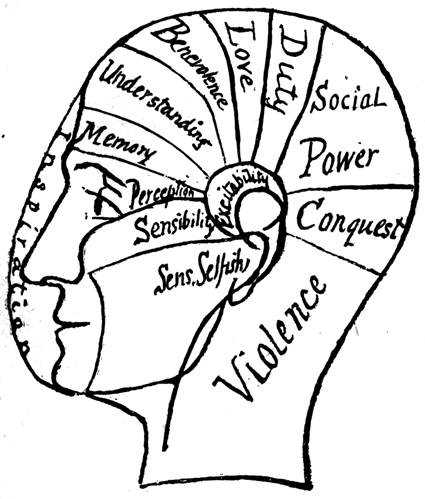
Instead of attempting to master this catalogue and the psychic busts which are to be shown hereafter, the reader should approach the subject by familiarizing himself with the profile grouping here presented, leaving the catalogue and busts for future exposition.
If radiating lines are drawn outward from the ear, the general character of the groups thus formed is indicated in the drawing. The department marked Inspiration extends from the median line as shown to the interior of the hemispheres on the median line. The region of the appetites is marked as Sensual Selfishness, the tendency of which is antagonistic to that of the region marked Duty.
CATALOGUE OF CEREBRAL ORGANS.
1. Intellectual.
Understanding.—Intuition, Consciousness, Foresight, Sagacity, Judgment, Wit, Reason, Ingenuity, Scheming, Imagination, Invention, Composition, Calculation, Somnolence.
Recollection.—Memory (recent and remote), Time, System.
Perception.—Clairvoyance, Phenomena, Form, Size, Distance, Weight, Color, Light, Shade, Order, Tune, Language, Sense of Force, Sensibility.
Semi-Intellectual.—Liberality, Sympathy, Expression, Sincerity, Humor, Pliability, Imitation, Admiration, Spirituality, Marvelousness, Ideality.
2. Ethical or Moral Organs.
Benevolence, Devotion, Faith, Politeness, Friendship, Love, Hope, Kindness or Philanthropy, Religion, Patience or Serenity, Integrity or Conscientiousness, Patriotism or Love of Country, Cheerfulness, Energy, Fortitude, Heroism, Health, Sanity, Caution, Sublimity, Reverence, Modesty.
3. Social Energy.
Self-respect or Dignity, Self-confidence, Love of Power, Ostentation, Ambition, Business Energy, Adhesiveness, Self-sufficiency, Playfulness, Approbativeness, Oratory, Honor, Magnanimity, Repose, Chastity, Coolness.
4. Selfish Forces.
Arrogance, Familiarity, Fascination, Command, Dogmatism, Combativeness, Aggressiveness, Secretiveness, Avarice, Stolidity, Force, Rivalry, Profligacy, or Lawless Impulse, Irritability, Baseness, Destructiveness, Hatred, Disgust, Animalism, Turbulence, Virility.
5. Sensitive and Enfeebling Elements.
Interior Sensibility or Disease, Appetite, Relaxation, Melancholy or Sullenness, Insanity, Idiocy, Rashness and Carelessness, Expression.
The reader should be careful not to attach too much importance to classification or nomenclature. The special descriptions of organs are necessary to a correct understanding.
CONTRASTS OF DEVELOPMENT
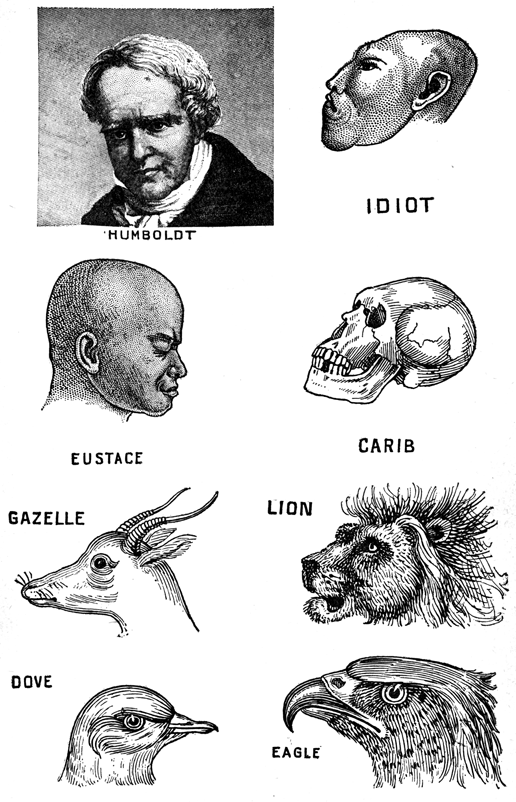
The contrast of intellectual development is seen in comparing the world-renowned philosopher Humboldt and the idiot figured by Spurzheim. The contrast of coronal and basilar development is seen in comparing the benevolent negro Eustace, who received the Monthyon prize for virtue in France with the skull of the cannibal Carib, as figured by Lawrence. As to the coronal or upward development of the brain, there is always a great contrast between untamable wild animals, such as the lion and the eagle, and those of gentle and lovely nature, such as the gazelle and the dove.