XIII David Porter United States Navy
Reading edition

HILE this country and the world are yet enthralled by the magical victories won by the American navy over the fleets of Spain, it is instructive to recall how the exploits of Uncle Sam’s boys, on the seas, have always bordered on the marvellous. The doings of Paul Jones in the Revolutionary War, and of Truxtun in the war with France; of Decatur and of Preble in the war with Tripoli; of Bainbridge and of Stewart, and of Hull and of Perry, in the second war with England; and of Farragut and of Jouett and of Cushing in the war between the States, seem, each one, too incredible to have a like successor, yet nothing heretofore in naval warfare has approached the victories of Dewey and of Sampson. With all these glittering names, we have still another name the peer of the best, possessing in addition the spur of naval heredity—the name of Porter.

There have been three officers of high rank in the United States navy bearing the name of David Porter. The first served the Continental Congress; his son, born in 1780, gave the best years of his life to his country on the sea; and his grandson, after having four times received the thanks of Congress for his services during the Civil War, died at the head of the navy, with the rank of Admiral, in 1891. David Porter, second of the name, began his naval career in action, having been, at the age of eighteen, appointed a midshipman on board the frigate Constellation, and with her, soon after, participated in the fight where the French frigate L’Insurgente was captured by Truxtun with the loss of one man killed and two men wounded. Porter subsequently distinguished himself in the war with Tripoli, was promoted to a captaincy, and early in the war of 1812 sailed from New York, in command of the Essex, on one of the most eventful cruises ever had by a man-of-war. His first feat was to capture the Alert, in an engagement of eight minutes, without any loss or damage to his ship; and so well directed was the fire of the Essex, that the Alert had seven feet of water in her hold when she surrendered. This was the first British war vessel taken in the conflict. Porter then turned his attention to the destruction of the
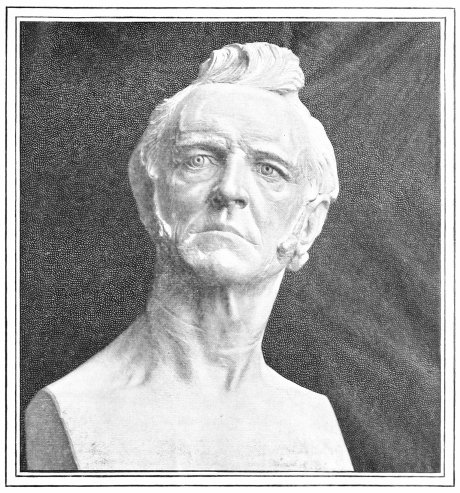
COMMODORE DAVID PORTER Age 45
English whale-fishery in the Pacific Ocean, and sailed on this errand, around the Horn, for Valparaiso. He made such havoc with the British shipping that the loss footed up to two million and a half of dollars and four hundred men prisoners.
The British sent two vessels, with picked crews of five hundred men and a combined armament of eighty-one guns, to search for the Essex (mounting only thirty-two guns and with a crew of two hundred and fifty-five men), with instructions that neither ship should engage her singly. They found her in the neutral harbor of Valparaiso, where she was attacked, in defiance of all neutrality laws; and after one of the most desperate engagements in naval history, lasting two hours and a half, the Essex was forced to surrender. Upon his return home, Captain Porter was received with distinction and given the thanks of Congress and of several of the States. He retired from the navy, in 1826, to take command of the Mexican navy, from which he withdrew three years later, was subsequently appointed consul-general to the Barbary States, then chargé d’affaires at Constantinople, and later minister resident, which office he held at the time of his death.
It was but a short time before Porter’s retirement from the navy that Browere took his life mask, and the toss of the head and the determined mouth show the qualities that made up David Porter’s character. The spirited pose of this bust is quite remarkable in a life mask, and would seem to indicate that Browere’s material must have been, at least in some degree, flexible. Porter was very enthusiastic over Browere’s work, as may be seen from the following letter to Major Noah:
Meridian Hill, 18th Sept. 1825.
Dear Sir:
By means of epistolary introduction I have had the pleasure of becoming acquainted with John H. I. Browere, Esq., a young and deserving artist of your city. Agreeably to your and my friends’ requests, I consented to sit for my portrait bust, which has been executed by him according to his novel and perfect mode. Mr. Browere has succeeded to admiration. Nothing can be more accurate and expressive; in fact, it was impossible that it could be otherwise than a perfect facsimile of my person, owing to the peculiar neatness and dexterity which guide his scientific operation. The knowledge and dexterity of Mr. Browere in this branch of the Fine Arts is surprising, and were I to express my opinion on the subject, I should recommend every one who wished to possess a perfect likeness of himself or friends to resort to Mr. Browere in preference to any other man. His portrait busts are chef d’œuvres in the plastic art, unequalled for beauty and correct delineation of the human form. To those to whom a saving of time is important, Mr. Browere’s method must receive the preference, were it solely on that ground. As to the effect of the operation, none need apprehend the least danger or inconvenience; it is perfectly safe and not disagreeable, for while the plastic material is applying to the skin, a sensation both harmless and agreeable produces a pleasant glow or heat somewhat similar to that which is felt on entering a warm bath; neither does the composition affect the eyes, which are covered with it. Too much commendation of Mr. Browere’s rare and invaluable invention cannot be made. May he derive benefits from his art equal to his merit. Hoping to have the pleasure of seeing my friends in New York during the course of a few weeks, I remain, Dear Sir,
Your obt. servant David Porter.
