EDITED BY G. PHILLIPS BEVAN, F.G.S. (continued 3)
Reading edition
Receipts for Fluxes.
1.
Flint glass (powdered) 10 parts. } moderately hard.
White Arsenic 1 " }
Nitre 1 " }
2.
Red Lead 1 " } soft.
Flint glass (powdered) 3 " }
3.
Flint glass 6 "
Red Lead 8 "
(Mixed with four parts of the first flux, soft.)
The use of very soft fluxes is attended with this inconvenience, that the boracic acid contained in them is generally acted upon by moisture and becomes hydrated, and in this condition often causes the painting to peel away. Harder fluxes, although they have the disadvantage of necessitating the glass to be submitted to a much higher temperature for a longer time in the kiln or muffle, are the best, and, with judicious management, can be used without any injurious consequences to the work on which they are employed. Lead fluxes, containing oxide of lead, are sufficiently fusible for all ordinary purposes, and are not liable to the same objection as fluxes containing borax. Suppose, then, it is desired to paint the outlines of a face, the glass is cut to the shape of the face in the cartoon; it is then laid upon it, and the painter, seeing the lines through the glass, is able to trace them with his brown paint upon its surface. He generally uses gum water as his vehicle, and puts on the shading also with the same mixture, though sometimes it is found necessary to use a substance which is not affected by moisture, as for instance, tar-oil. It is impossible, in the short space of this article, to indicate those occasions on which one should be used in place of the other; a knowledge of this can only be obtained by consulting authorities in which details are more minutely given, or by watching the operations of the glass painter in his workshop. When the face is finished, it is removed, and another portion of the figure, say a piece of the drapery, is proceeded with in exactly the same way; and so, by a repetition of this process in all parts of the figure, it is completed, and looks very much like a puzzle, the parts being put together on the cartoon before the work is finished, in order to see that the whole is harmoniously treated. In shading the face, hands, and those parts of the drapery which require it, a glass easel is used, on which the figure is put together, and the parts made to adhere by wax, so that the artist is able, while painting, to form an idea by transmitted light of the effect which will be produced when the window is finished. The ornament is painted in a similar manner, but usually not with the same care in the details of its execution.
When all the glass is painted, it is fired in a muffle, upon the proper construction of which a great deal depends. It is usually made of iron, and should not be more than 15 inches from its bottom to the top, though its width may vary. It is never well to have muffles for firing glass for painted windows larger than about 2 feet wide, by 2 feet 6 inches deep. The top of the muffle is usually slightly arched from side to side, and it is placed in the furnace on a tolerably thick stone floor, so that the bottom may not get too hot. The fire, which is lighted below, is allowed to play up its sides and over its top, the flue being so built as to draw the flames in that direction, for a top heat is the best heat for firing glass regularly. The muffle is arranged with ridges in its sides, passing from front to back parallel to one another on one side, and exactly opposite to corresponding ridges parallel to one another on the opposite side. These metal ridges are intended to receive iron plates, and there is generally about an inch or rather less between the top of one plate and the bottom of another, when the muffle is perfectly filled. The plates are covered over with perfectly dry powdered chalk or whiting, and the pieces of glass are laid upon them with their painted sides uppermost. When the plates are charged, they are put into a muffle with an iron door, in the centre of which is a hole, and a conical tube with the base attached round it. It is larger than the opening at the other end, which projects some 6 or 7 inches from the surface of the muffle-door at right angles to it. A second door is then placed at a short distance from the first, the tube passing through a hole made for the purpose in it. The orifice is usually stopped by a piece of fire-clay, which can be removed at pleasure. The use of the tube is, to enable the manager of the kiln to look into the muffle, from time to time, to see that the glass does not get too much heated. When the firing is completed, the fire is raked out and the muffle is allowed to cool very slowly, and by this process the glass becomes annealed.
When it is desired to apply to any portion of white glass some yellow silver stain, this can be done either in the first firing, by floating it on to the places to be stained, and allowing it to run in a sort of stream from the brush, so that it will evenly cover the surface and cause the heavier portions of the stain, namely, the mixed metallic silver and antimony, to sink regularly to the bottom, and come fairly in contact with the glass. Not very long ago, it was mentioned to me by a glass painter of note, that the workmen much prefer using the old stain made with silver and antimony, to that which is produced by using nitrate of silver. This really is a mistake on their part, for, when properly managed (and the knowledge of how to manage this stain can be acquired with very little trouble), the nitrate of silver stain is by far the best, and produces much better tints, with less chance of what the men call sulphuring when the glass is fired. This sulphuring is simply the result of opacity, obtained by heating the glass to too high a temperature. If the staining is to be performed in the same firing as that by which the painting is to be fixed, it is quite clear that the outlines of the part to be stained must be painted in, with tar-oil, or with some such substance which is not affected by the moisture of the stain. However, in general, the staining operation is performed after the first firing, that is to say, those pieces of glass to which the silver is to be applied are stained in the method above described after the first firing, and are then fired again, because the heat required to produce a good stain from silver is of a somewhat different character from that which is required simply to fuse the flux that binds the pigment to the glass. A longer and less intense heat, technically called a "soaking," is the best for producing an even and pure yellow tint. If the temperature be allowed to rise too high, the oxide of silver, which alone can stain the glass, gets reduced wholly or in part, and when this happens to only a slight extent, it destroys the transparency of the stain; and when it happens to a great extent, it destroys its colour altogether, making the glass opaque.
It is a matter of astonishment to me that glass painters do not use a ruby stain, which, with a little practice, can be managed quite as successfully as the yellow silver one. It is true that it would be impossible to fire the ruby and the silver stains together, and it would not be at all convenient to fire the ruby stain at the first firing of the painted glass. The method of staining ruby is as follows: grind up carefully some black oxide of copper, mix it with water (or with a small quantity of gum added), float it on the parts to be coloured, place it in a kiln and heat it. Black oxide of copper, when mixed with glass and melted in a glass-pot, makes the glass green; suboxide of copper, which contains less oxygen than the black oxide, when treated in the same way, makes it red. Now, if it can be reduced to the lower oxide of copper, while the black oxide of copper on the surface of the glass is heated, it will then colour the glass red. The best way of reducing the black oxide, is to connect the muffle with a gas-supply pipe, and allow coal gas to pass during the whole time that the heating process goes on. The action of the gas, which contains hydrogen and carbon, is to take away oxygen from the black oxide of copper, when it is at a high temperature; and, as soon as sufficient is taken away by the hydrogen to reduce the black oxide to the state of suboxide, it stains the glass red. It does not matter if the reducing action be continued longer, so that the oxide of copper be reduced to the metallic state; for at that temperature, the stain produced by the red oxide of copper is not removed by the continued action of hydrogen gas. The employment of this process would certainly enable artists who paint in the later styles of glass painting, to very much enrich their draperies, and to produce, more easily, effects which now can only be obtained by a complicated system of lead-work.
When the pieces of glass which have been fired are perfectly cold, the next process is to unite them altogether by peculiarly shaped strips of lead, which are of various kinds, according to the character of the subject required. The lead has a thick part or core, and at right angles to the top and bottom of this are thin plates called the "leaves." The core is milled with little ridges running at right angles to them, so as to enable the workman to bend the lead about with facility. The edges of the piece of glass to be leaded are placed between the leaves and resting upon the core, and the lead is thus arranged all round the glass, and is then laid in its proper situation upon another cartoon, prepared from the one from which the figure was painted, and indicating simply, by lines, where the lead-work is to come. The first piece is fixed by means of nails temporarily placed through the lead. Those pieces which touch it in the design are put in their proper positions, so that the edge touching the next piece will be underneath the opposite leaves to those which confine the first. This operation is repeated, till all the parts of the design are surrounded by lead, and by it united to one another; the joints being secured by solder, generally applied by gas. Nothing now remains but to fill in the interstices between the lead and the glass, so as to make the window firm, solid, and water-tight; and this is done by rubbing into them with a scrubbing brush a cement, usually made of white lead, oil, and plaster of Paris. This composition varies in different stained glass works, nor is it material, provided that the substance hardens, does not crack, and is waterproof.
From this description it will be seen, that the various colours in the different parts of the window are put in as pieces, and that no colours, properly so called, are applied by the brush to the surface. There are, however, certain tints of the "tracing brown," which can be obtained by the addition of black oxide of manganese, or by a different method of preparation of the oxide of iron, to give it its body. Sulphate of iron, when heated, loses its sulphuric acid, and the oxide, which was, as sulphate, in the state of protoxide, becomes, by heating, the red or peroxide of iron; its tint, when made in this way, being generally lighter than the tint of that form of oxide which is employed as ordinary tracing brown. It is sometimes called flesh tint, though this is decidedly an objectionable name for it.
It has been suggested to me, that I should give some receipts for the manufacture of the enamel colours used in mediæval glass painting; I have therefore added a few which are easily prepared. Others of a more complicated nature had much better be obtained from the makers of the enamel used in porcelain painting. And here again, let me remark, that in ordering fluxes from these manufacturers, it should be stated especially that a flux is required which does not contain borax, nor should the painters in any establishment be allowed to use these softer fluxes, which they are almost certain to do, unless forbidden; for though they are easier to work with, they will infallibly lead to calamitous results.
Yellow.
Oxide of tin 2 parts.
Oxide of antimony 2 "
Red Lead 16 "
Orange.
Red Lead 12 "
Oxide of antimony 4 "
Persulphate of iron 1 "
Flint powder 3 "
Brown.
Black oxide of manganese 2·25 "
Flint slate (powdered) 4·0 "
Red lead 8·5 "
Brown Red.
Crocus (oxide of iron) 3 "
Green sulphate of iron (calcined) mixed with six parts of these No. 2. 1 "
Light Red for Flesh Tints.
Carbonate of lead 1·5 "
Persulphate of iron (calcined) 1 "
Flint glass 3 "
The use of enamels—that is, substances which impart various colours to the glass, when placed on its surface by their fusion—is not admissible in windows which pretend to belong to any of the earlier styles of glass painting; though enamel painting is used for the decoration of houses, and sometimes, as I consider very improperly, for the decoration of church windows. One sheet of glass, colourless and transparent, or it may have its surface ground, is usually employed. A subject is painted on it with enamel colours, much as subjects are painted upon porcelain. When the work is completed, the glass plate is fired, and thus the colours become semi-transparent, and perfectly adherent to the plate; but they are not clear and bright, and transparent, as are the colours of glass which is coloured in the pot, and therefore have not the same brilliancy, nor do they allow of the same bold and effective treatment.
It is much to be desired that amateurs who can draw, and who have a feeling for this particular style of art, should devote a portion of their time to its execution. They will find it to be extremely agreeable and pleasant, and the few difficulties which they meet with in their first attempts will be readily overcome by perseverance, or by applying for assistance and advice to gentlemen engaged in the pursuit of this interesting profession.
Moulded and Cut Glass.—Flint glass is now very commonly blown in moulds, and this art has been brought to such perfection that moulded decanters and tumblers have an appearance very similar to that of cut glass. The moulds are always made of metal, and so constructed, that they open out into two or more pieces, which are generally hinged to the bottom of the mould. The workman places it on the ground, and fixes it by standing on projections from its side. He then gathers a suitable quantity of glass on the end of his blowpipe, which he places in the mould, and the side of the glass touching it will thus have impressed upon it whatever form is engraved on it. After the glass has become hard, the mould is opened, and the glass vessel is removed and annealed.
When it is desired to cut a design on the outside of a tumbler or wine-glass, the vessel is, in the first instance, blown of a thicker substance than if it is to be left uncut. The necessary shapes, which are usually in facets, are cut upon it by the action of sand and water, a lathe of a very simple construction being used to give a rotary motion to cutting discs, made of stone and kept continually moist by water dripping on them, so that when the glass is pressed against them, the required portion of its surface is worn away. The usual diameter of these stones is about 10 inches. After the rougher stone has been used, a finer kind of sandstone disc is employed, or a disc of slate, upon which sand and water are allowed to drop, and the already roughly cut surface is, by their action, partly polished. Copper discs with flattened circumference are used for polishing the glass, and for this purpose, emery mixed with oil, is applied to the edges of their circumference.
Ground Glass is made by rubbing the surface of glass with sand and water, just as in the first operation of plate glass polishing. But a very ingenious method is now generally adopted for grinding glass, by placing it in a cradle, so that it can swing from side to side; sand and water are placed upon the glass, and it grinds itself, so to speak, by this operation.
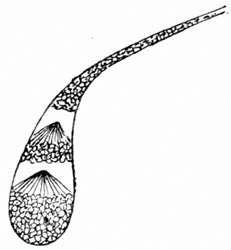
Annealing and Devitrification.—As the word "annealing" has been often used in this article, it will be well to explain what is its action. If a piece of molten glass be dropped into water, it will assume an oblong shape, the lower end of which will be round, while the other will taper off into a fine point. These drops, which have received the name of Prince Rupert's drops, look like pieces of ordinary glass, and if the small end of one of them be broken off, a sort of explosion takes place, and the whole mass flies into a thousand minute pieces, some of which will be found to have been driven to a considerable distance. Here then it appears, that when the skin, which is perfect and entire in the Rupert drop, is broken, the bond which held together the constituent particles is broken also, and so they are acted on by a repellent force, and fly away from one another. If hot water be poured into a thick common tumbler, it very generally cracks it: but if the tumbler be thin and of better manufacture, it will bear almost boiling water without cracking. In the first case it has been badly annealed; and besides this, glass being a bad conductor of heat, from its thickness, the heat imparted by the hot water expands the inner surface, while the outer coating, not being warmed, does not expand, and, retaining its original form, is burst. If, however, a tumbler be thick and properly annealed, there is not so much danger of its breaking, when a portion of it is exposed to a considerable rise of temperature. In the case of the Rupert drops, they are not annealed at all, and so there is no cohesive bond between the particles, such as there would be if they were properly annealed, that is, if, instead of being cooled suddenly from the molten state, they were allowed to cool in a heated chamber very slowly. After glass has been heated, the particles of which it is composed take a long time to rearrange themselves, so that in the manufacture of thermometers, it is necessary, after sealing up the bulb and tube which contain the mercury, to allow them to remain for a long time; otherwise the pressure of the air on the outside of the bulb, not being supported by any air on the inside, causes the particles of glass to become more compact, and thus renders the capacity of the thermometer bulb and tube smaller than it was, when the thermometer was first sealed. It seems that the process of annealing glass gives time for the particles to arrange themselves in such a way, that when the glass is cold, it will not be so liable to fracture from sudden changes of temperature.
Considerable curiosity has been excited of late by a new invention, which has resulted from the investigations of a Frenchman. We have been told that tumblers and wine-glasses, and other glass utensils, could be so treated that they would never break; and experiments performed upon many samples of these glasses led one to suppose, that the object had been attained. There is no doubt whatever, that some who have had experience of what is termed toughened glass know, that in many cases very uncertain results are obtained in the resisting power of the glass to the action of a violent blow. Before, however, entering into some researches which I have made on the subject, it will be well to state what is the nature of the change which the toughening process produces in the glass, and this seems to be a fit place for this consideration, as the method of making, and the behaviour, of Prince Rupert's drops, have just been discussed.
The physical properties of these Rupert's drops have been examined with great care by M. Victor de Luynes, and the results of his experiments have been communicated to the Société de Secours des Amis des Sciences. For the purposes of this article, many of his experiments have been repeated, confirming in general his observations, and others have also been instituted. The toughness and hardness of these drops are remarkable; the thick pear-shaped portion will bear a sharp stroke with a hammer without breaking; nor can it be scratched with a diamond. To break the tapering thread or tail, as it may be conveniently called, requires considerable force. To find out what weight was required to do this, a series of experiments was performed, the results of which are given in the table following. The tail of a drop was placed over a small hole bored in the top of a table; a hook was then adjusted round a part of the tail which measured 19 on a Birmingham wire gauge; below the table and attached to this hook, a scale-pan was hung. This pan was then carefully loaded, all shock being avoided, until the thread was ruptured and the weight required to effect this was then noted:
White Glass Rupert's Drops.
Gauge. Strain.
19 16 lb. 0 oz.
19 15 ½ " 0 "
19 16 " 0 "
19 (poor) 9 ¼ " 0 "
Green Glass.
Gauge. Strain.
19 18 ¾ " 0 "
19 (poor) 9 " 0 "
19 28 " 6 "
16 26 ¼ " 0 "
It will be observed that the drops made from green bottle glass withstood a greater strain than those made from crown glass; the latter, in fact, did not break throughout their mass, but left a portion of the bulb unbroken, showing some fault in the tempering. It was with difficulty that the workmen could be induced to make drops out of this kind of glass, as they knew by experience that they usually failed to break perfectly, and they stated that it was quite impossible to make them with lead glass. To ascertain what force was required to fracture a thread of like dimensions that had not been tempered, one of the drops was heated to redness, and annealed by allowing it to cool very gradually. When subjected to the same trial, it was fractured by a weight of 12 ozs., and the drop did not break into small fragments, but behaved exactly like ordinary glass, thus showing that the glass had been untempered by the heating process. A piece of glass rod, drawn out into a thread in a gas flame, when subjected to the same conditions, bore a strain of 10 oz. A sewing-needle of the same thickness was broken by a weight of 3 lb. 14 oz., thus showing that the tail of the Rupert's drop was very much manner as to allow the tail to dip into hydrofluoric acid, it is found, that when the surface or skin is eaten away to a certain depth, broken. In whatever way fractured, the particles, when examined by the microscope, show a crystalline structure, and do not at all resemble pieces of ordinary glass; when rubbed between the palms of the hands, they do not cut, nor scratch, nor penetrate the cuticle. If a drop be enclosed in plaster of Paris so as to leave a portion of the tail exposed, it may then be broken and all the particles will remain in situ. On removing the plaster, it will be found that the drop has been broken up into thousands of minute needle-shaped particles arranged in cones, the apices being in the direction of the tail. It would appear then from these experiments, and from observations with polarized light, that the glass in the interior of a Rupert's drop exists under enormous tension, and that it is only prevented from bursting into fragments by the outer skin; on its being broken in any part, the bond which holds together the constituent particles is broken also, and so, being acted upon by a repellent force, they fly away from one another. There is another kind of toy resembling in some respects the Rupert's drop, known as the Bologna bottle or philosopher's flask. It has the form of a soda-water bottle with the neck cut off, the bottom being rounded off and very much thicker than the walls. These flasks are sometimes formed accidentally in glass-works by the workman, who, in order to examine the quality of the glass, takes out a portion from the pot on the end of his blowpipe, and blows a small quantity of air into the mass, manipulating it in the usual manner. Whilst still at a very high temperature, it is detached from the blowpipe, and is probably allowed to fall on the ground in a place where there is a current of cold air, the exterior thus becoming suddenly chilled. When cold, these flasks will bear very rough handling, and will withstand the blow of a hammer on the outside, it being almost impossible to break them by striking the bottom; the interior will also bear the blow of a leaden bullet falling into it from a considerable height, but if a few grains of sand be allowed to fall into it, or if the inside skin be slightly scratched, the mass splits into fragments in the same manner as a Rupert's drop. The examination of these curious phenomena leads us to the subject of "toughened glass," as it has been termed. The invention of rendering articles of glass less fragile, which has given rise to so much public attention during the last year, is due to M. Alfred de la Bastie, a French engineer. His process consists in heating the glass to be toughened to a temperature close upon its softening point, and then plunging it into a bath of oil, or into a mixture of oleaginous substances kept at a much lower temperature. When this operation is successfully performed, the glass acquires properties very similar to those of Rupert's drops; it becomes much less fragile than ordinary glass, but when sufficient force is employed to fracture it, the whole flies into small pieces. It cannot be cut with a diamond, but is immediately disintegrated when the outer skin is scratched to a certain depth.
It is to be observed, however, that in particular cases it is possible both to saw and pierce the toughened glass. M. de Luynes reports, that when a square of St. Gobain plate glass that had been submitted to the process of tempering was examined by polarized light, it showed the appearance of a black cross, the arms of which were parallel to the sides of the square. The glass was sawed in two, along the line of the stem of the cross, without causing fracture. On examining the divided glass with polarized light, black bands and fringes of colour were observed, which, by their position, proved that the molecular condition of the glass had changed; on placing one half of the divided glass on the other half, the fringes and black bands disappeared—on folding one half on to the other, the black bands presented the appearance that would have been produced by glass of double the thickness. These facts show, that the molecular forces on the glass were arranged symmetrically in reference to the line of parting: and we may conclude that toughened glass being in a state of tension, similar to that of the Rupert drop, may be divided or pierced, provided that the molecules of the pieces produced are able to rearrange themselves into a stable equilibrium. Polarized light shows the directions on which the division can be made with safety.
M. de Luynes, in his communication referred to above, gives an account of some experiments performed on plates of glass of the same quality, tempered by this process, and untempered; one or two examples will suffice. A tempered plate measuring about [1] 6½ inches by 5 inches, and 2/10 inch thick, was placed between two wooden frames, and a weight of over 3½ ounces (100 grammes [2]) was allowed to drop upon it from a height of more than 13 feet (4 mètres [3]) without breaking it. It only broke, when double the weight was employed from the same height. A piece of ordinary glass under the same conditions broke, with the weight of 3½ oz. dropped upon it from a height 16 inches (0·40 mètre). Plates of toughened glass were allowed to fall on the floor from a height, or were thrown to a distance, without breaking. A rectangular piece of ordinary window glass, about 1/10 inch in thickness, was bent into the form of a bridge, and then subjected to the tempering process; placed upon the ground; it bore the weight of a man easily without breaking. A commission, instituted by the French naval authorities, to inquire into this process of M. de la Bastie, has reported at some length on the subject. The following series of experiments were tried with a view of ascertaining the comparative power of resistance of tempered and ordinary glass. The plates experimented upon were placed loosely in wooden frames constructed for the purpose.
Rectangular plates about 21 inches (0·525 m.) by 10 inches (0·248 m.) and 1/6 inch (0·004 m.) thick.
The frame with the glass inserted was laid on the ground, and in the middle of the plate a weight of more than 10 lbs. (5 kilogrammes [4]) was placed, and upon it as a base, other weights were placed, care being taken to avoid all shock.
1º Ordinary glass, broke with a weight of about 70 lb. (35 kilos.) having resisted weights of from 30 to 50 lb.
2º Toughened glass resisted fracture until a weight of more than 510 lb. (255 kilos.) had been added, and then was not broken. The experiment was not carried to its limit for want of weights.
Rectangular plates, about 13 inches (0·325 m.) by 10 inches (0·248 m.) and 1/5 inch (0·005 m.) thick.
These plates were allowed to fall flat on to a floor of wood or thrown to a distance and allowed to fall.
1º Ordinary glass allowed to fall flat from a height of 1-2/10 inch (0·03 m.) was broken at the first trial.
2º Toughened glass. Thrown to a height 6 feet 6 inches (2 mètres) and to a distance of 13 feet (4 mètres) was also broken at the first trial. The piece, however, which had sustained the weight of 510 lb. did not break till the fourth trial.
Rectangular plates, about 10 inches (0·245 m.) by 6 inches (0·157 m.) and ¼ inch (0·007 m.) thick.
These plates were subjected to the same kind of tests as the foregoing. After raising them to a given height they were allowed to fall flat upon a wooden floor.
1º Ordinary glass raised to a height of 20 inches (0·50 m.) was broken on falling.
2º Toughened glass resisted successive falls of from 20 inches (0·50 m.), 32 inches (0·80 m.), 5 feet (1·50 m.), and 5 feet 7 inches (1·70 m.), but was broken when dropped from a height of 6 feet 6 inches (2·0 m.).
Rectangular plates about 10 inches (0·245 m.) by 6 inches (0·157 m.) and 1/5 inch (0·006 m.) thick.
Placed in the frames, they were held in position in the rabbets by laths nailed to the sides so as to prevent any play. The frames were raised to different heights and allowed to fall in such a manner as to cause as much vibration as possible.
1º Ordinary glass was broken with a fall of about 2 feet (0·60 m.).
2º Toughened glass resisted falls from heights of 3 feet 3 inches (1 mètre), 6 feet 6 inches (2 mètres), 8 feet (2·50 m.), 9 feet 9 inches (3 mètres), and 14 feet 6 inches (4·50 m.). It was only broken by a fall of 19 feet 6 inches (6 mètres).
Rectangular plates 6 inches (0·158 m.) by 4¾ inches (0·120 m.) and 1/5 inch (0·006 m.) thick.
These plates were placed in the frame on the ground, as has been previously explained. Known weights falling from known heights were made to strike the plates exactly in the centre. The weights consisted of bronze spheres, one weighing 3½ oz. (100 grammes) and another of twice that weight.
1st. Ordinary glass resisted the weight of 3½ oz., falling from heights of 8 inches (0·20 m.), 12 inches (0·30 m.), 16 inches (0·40 m.), but was broken by a fall of 20 inches (0·50 m.).
2nd. Toughened glass resisted the blow of the 3½ oz. weight falling from heights of 20 inches (0·50 m.), 40 inches (1 mètre), 60 inches (1·50 m.), and 6 feet 6 inches (2 mètres). The 7 oz. weight (200 grammes) being substituted, the plate was broken by it, falling from a height of 60 inches (1·50 m.).
Rectangular plates, 6 inches (0·158 m.) by 4¾ inches (0·120 m.) and 1/6 inch (0·004 m.) thick.
The same conditions were maintained as in the previous trial.
1st. Ordinary glass. The 3½ oz. weight was allowed to fall from heights of 1 foot (0·30), and 16 inches (0·40 m). It was broken by the second blow.
2nd. Toughened glass. This resisted the 7 oz. weight falling from heights of 2 feet 4 inches (0·70 m.), and 2 feet 8 inches (0·80 m.), but broke when the weight fell from 39 inches (1 mètre).
It appears then from these experiments, that toughened glass will resist a blow five times as great as ordinary glass, and will bear seven times as great a weight.
I have now detailed most of the useful experiments which have been made by competent observers upon toughened glass, as well as some which have been conducted in my own laboratory. The result of my own personal investigations I will now lay before the reader. I was consulted some time ago by a gentleman interested in the introduction of toughened glass into this country, as to whether this kind would become untoughened in time. I feel no hesitation in stating that when the process has been perfectly done, the glass will remain in the same state for any length of time, provided it be not treated in any way which is calculated to rupture the external hard bond that holds together the inner particles of the glass. I feel quite sure, that no fear of this kind need interfere with the benefits, whatever they may be, which are to be derived from submitting glass articles to the toughening process.
A tumbler which had been toughened in Monsieur de la Bastie's works, was, in my presence, thrown upon the ground, yet it did not break. It was a large soda water glass. I kept it for some time, and after considering the matter carefully, I felt, that if it were thrown down in such a way that the whole of its side, from base to rim, came in contact with the ground at once, and it then stood this test, it would prove that the whole of the glass was in the condition of the Rupert's Drops, and would therefore bear the concussion without fracture. I held the glass and let it fall, so that it actually reached the hard floor on its side. It immediately broke all to pieces. Now on the first occasion when this glass was thrown down, it was tossed somewhat upwards into the air, and the bottom being heavier reached the ground first, and it did not break. I have also seen in glass-houses, where the tempering process is carried on, tumblers thrown down in a similar manner, and I noticed, that whenever they fell upon their bottoms, they were uninjured, as also in cases where they fell upon their rims in such a manner, that the curve of the rim acted as an arch, as in the old trick of turning a wine-glass off the table so as not to break; but in other cases where the tumblers fell flat upon their sides, fracture followed. I carefully gathered together the pieces of the large tumbler which I broke myself in this manner, and examined them, and found that the solid bottom was broken in the same manner as the Prince Rupert's drops break, viz., into a large number of small pieces, having in all respects similar properties. The glass for an inch or two above the bottom broke into small pieces, but larger than those into which the bottom itself broke, and the upper portion of the tumbler was fractured just as an ordinary tumbler would be. On careful examination, microscopic and otherwise, the small pieces were found to have the character of Prince Rupert's, whereas the larger from the upper part of the glass had none of these characteristics in the slightest degree.
These observations led me to perform an experiment. A toughened tumbler was filled with plaster of Paris, which was allowed to set. Its outside was then encased in plaster of Paris, and when the whole was hardened, a pair of pincers were applied to a portion of the tumbler's rim, and with a violent wrench the tumbler was broken. A rather smart shock was communicated to the arm of the operator, very much resembling, as he said, the shock of an electrifying machine. On removing the plaster of Paris, it was found that the whole of the tumbler was fractured, and, as will be seen by the accompanying illustration, in a manner similar to that which has already been described.
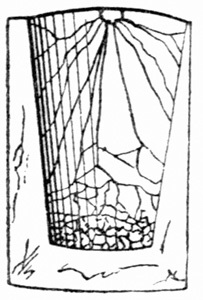
From this and other similar experiments, I was led to the conclusion that none of the toughened articles which have cavities in them, have thoroughly undergone the toughening process.
Having been requested to attend a series of experiments performed by a glass manufacturer in London, which consisted in the manufacture of a number of toughened glass tumblers, I noticed certain facts which led me to form conclusions as to how it was that the tumblers, the fracture of which I already explained, break in this peculiar manner. I will first describe the way in which these tumblers were made and toughened. By the side of the glass blower there stood a metal vessel, about three feet six inches high, and, perhaps, from two to two feet six inches in diameter. This was filled with melted fat or oil of some kind at a temperature of about 80° Fahr. Inside this vessel, which was open at the top, there was a wire cage, with a trap door at the bottom about one foot in diameter, and of about the same depth. The glass blower, after finishing his tumbler on the pontil, held the pontil in a horizontal position over this metal vessel, struck it a smart tap, and the glass tumbled off into the wire cage. The glass was at a very high temperature. In almost every instance the glass fell into the melted fat, as a glass thrown in a similar manner will fall into water. It sank gradually bottom downwards, and the liquid guggled into it as it sank. Here, then, it is clear that every portion of the hot tumbler did not come in contact with the oil at the same moment, in fact there was an appreciable lapse of time before the tumbler disappeared beneath the surface of the liquid. Now there must be a limit as to the temperature of the article to be tempered and of the liquid by which it is to be tempered, that is to say, if at a certain temperature glass can be tempered by being plunged into the liquid of a certain temperature, if these temperatures are varied similar results will not follow. The upper portions of the glass coming in contact with the tempering liquid at a lower temperature, as they must have done, were not properly tempered, and this I have clearly proved by the facts I have already stated. From these remarks it seems tolerably clear that, until some method is devised of bringing all the parts of the heated glass in contact with the cooling liquid simultaneously, the tempering of the article cannot be perfect throughout its whole surface. As I desire, and very sincerely, that these processes should be brought to perfection so as to render them useful, I willingly give this result of somewhat lengthened investigations to those whom it may commercially concern, and I hope that they will find, on investigating the matter, that my observations have been tolerably correct, and that they will be able to devise a method which will remedy in many cases manifest imperfections of their present system. All the accidents which have happened to tempered glass, which have been recorded in the newspapers, can be accounted for on the principle which I have just endeavoured to explain, for there must be instability, where the bonding material of the internal particles of the glass is in different states of hardness; so that there is no difficulty in conceiving how a gas globe could break apparently spontaneously, for a portion of it which was not fairly toughened might be exposed to a somewhat sudden rise of temperature, produced, it may be, from a draught blowing the flame upon that particular spot. Articles such as saucers, made of glass, which, being flat, or nearly so, can be plunged into the tempering liquid with great rapidity, are usually tempered all over, and these, when toughened, can be thrown about and allowed to fall on hard floors with impunity, thus proving the facts which I have endeavoured to establish. I hope to be able to continue my investigations, and should they be worth anything, will give the results of them to the public. Before quitting this subject, I shall make a few remarks upon the process for toughening glass, which is said to have been purchased by the Prussian Government.
This process is described as consisting in the application of superheated steam to the glass, brought up to a temperature near to its melting point. Having facilities for making experiments of this kind, I have had them tried with great care, but in no case have I met with a satisfactory result. This probably is owing to the fact, that I did not comply strictly with the condition of the experiments performed by the German chemist who is said to have made the invention, nor do I see from analogy how this process is likely to effect a change in the glass similar to that arising from M. de la Bastie's dipping process.
If glass, instead of being taken from the annealing kiln at the proper time, be left exposed in the hot part of it, at a temperature just below that at which it softens, it will be found to become gradually opaque on its surface. Some experiments were performed many years ago by Réaumur, who exposed pieces of glass, packed in plaster of Paris, to a red heat, which became gradually opaque, and lost altogether the character of glass, the texture of their material becoming crystalline, and also effected by sudden changes of temperature. Glass treated in this way was called Réaumur's porcelain. All glasses do not undergo this change with equal rapidity, and some do not experience it at all; but the commoner kinds, such as bottle glass, are the best to experiment upon, for the more alumina that it contains—and it is known that bottle glass contains a considerable quantity—the more readily does it undergo this change, which is called devitrification. In what it consists, is not at present well understood, but it offers a field for investigation, which may produce results of very considerable benefit to manufacturers of glass.
Soluble Silicates.—An article on glass in a modern scientific work like the present would not be complete without a notice of the manufacture of soluble glass and the uses to which it has been and may be applied. It has already been mentioned that when silica or sand is fused with an excess of alkali, the resulting glass is soluble in water.
Soluble glass is made on a large scale in three different ways. First of all, if flints, that is, black flints, which are found in chalk, be heated to a white heat, they lose their black colour and their hardness, and are easily crushed to small pieces; and if flint in this condition be placed in a wire cage and put into a jacketed iron digester, that is, an iron digester which has an inner and an outer skin, with a free space between the two, so that steam may be forced into it from a boiler under pressure; and if the digester be screwed down tightly with an iron cover, and steam then be allowed to pass into the space between the two, the temperature can be raised at pleasure, according to the pressure under which the steam is introduced. If the valve of the boiler be loaded with a 60-lb. weight, the temperature of the water warmed by the steam will rise considerably higher than that of ordinary boiling water; and if this water be saturated with caustic soda, it will dissolve the flints slowly, forming silicate of soda, that is to say, the silicic acid of the flint will unite directly with the soda of the solution, and silicate of soda will thus be obtained. For certain applications, the silicate so formed is not sufficiently pure, because the soda used often contains a certain amount of sulphate, which will remain with it in the solution of silicate that is drawn off from the digester. This sulphate is very objectionable for certain applications of silicates, because it crystallizes out, and so destroys the substance, which the silicate is intended to preserve.
Another and a much better method is to heat together the silica in the form of sand with alkali, either potash or soda, in a reverberatory furnace, and as the glass becomes formed, to rake it out into water, and then gradually to dissolve it by boiling in suitable vessels. Here the sulphate, if it existed in the alkali, is decomposed by the silicic acid, and the sulphuric acid passes off through the flues of the reverberatory furnace.
There is also a very ingenious way of making silicate of soda, discovered by Mr. Gossage, and performed as follows: common salt is heated to a high temperature and volatilized, and in this condition is brought into contact with steam also at a high temperature, when a double decomposition takes place. Steam is composed of oxygen and hydrogen; common salt, of sodium and chlorine. The chlorine of the common salt unites with the hydrogen of the steam, and the oxygen of the steam with the sodium, so that hydrochloric acid and oxide of sodium are formed. Now, if these two substances at this high temperature were allowed to cool together, the action would be reversed, and the re-formation of steam and chloride of sodium would be the result; but in the strong chamber lined with fire-clay, in which these vapours are brought into contact, silica is placed in the form of sand made up into masses, and when the oxide of sodium is formed, it unites with the sand to make silicate of soda, and thus is removed from the action of the hydrochloric acid, not entirely, but sufficiently to produce a large yield of silicate of soda.
The properties of silicate of soda, as applied to the arts, are somewhat different from those of silicate of potash, so that one cannot always be substituted for the other. Both these substances are, when in solution and concentrated, thick and viscid, and have the property of causing paper, wood, &c., to adhere when applied as a gum or glue, and hence have been called "mineral glue." In a dilute state they can be used for coating stone, brick, or cement, and have the power of rendering them for a time waterproof, or nearly so, and of preventing the action of atmospheric influences, which too often produce the decay of some of the softer stones used for building as well as for cement. It has already been stated, that when carbonic acid is passed through a solution of silicate of soda, silica will be precipitated. Now, inasmuch as there is carbonic acid in atmospheric air, when these solutions are applied to the surfaces of a building, they will be acted upon slowly by the acid, and silica will be precipitated in the pores of the material to which the silicates are applied. But this operation is extremely slow, and, before it can be thoroughly completed, the silicates, being soluble, will get in part dissolved out by rain and moisture, and it is therefore advisable to use with them some material which will, by a double decomposition, form a silicate insoluble in water. The silicate, however, which is formed, should have cohesion amongst its particles, so that it will not only adhere to the stone itself, but its own particles will adhere to one another when it gets dry. Various methods have been tried to cause this insoluble substance to be formed upon the surface of stones, so as to fill up its pores and to make a protecting cover for it; but most of them have signally failed, because the new silicate produced by double decomposition has not had the necessary coherence amongst its particles. If a solution of chloride of calcium be added to one of silicate of soda, a silicate of calcium will be precipitated, and it was therefore thought, that by applying to a stone successive washes of silicate of soda and chloride of calcium, an insoluble silicate of calcium would be produced in the pores and on its surface. It is true that such a silicate is precipitated, and that, if the silicate employed be in excess of the chloride of calcium, the particles will be glued together by the adhesive powers of this silicate when it dries; but then the action of moisture upon it is to cause it to run down the surface of the building, and set free the particles of silicate of calcium which it held in combination. Other processes of the same kind have been tried, and with similar results; one great difficulty in the way of the success of this method of applying silicates being that, from the peculiar colloidal or gluey nature of the silicate, it does not penetrate to any considerable depth into the stone, and, if laid on first, prevents the penetration, as far even as it has itself gone, of the solution of chloride of calcium. If the chloride of calcium be used before the silicate, it will penetrate farther than the solution of silicate is able to reach, so that it is impossible to obtain, even supposing the substance to be used in equivalent proportions, a complete decomposition of the one by the other.
The great object to be attained in the preservation of stone by any silicious process, is to use one solution possessing the substances which, when the water has evaporated, will form a perfectly coherent mass for the protection of the stone surface. The depth of penetration, if it is sufficient to protect the outside of the stone from the disintegrating action of the atmosphere, need not be carried much more than one-sixteenth of an inch below the surface, for when old stones which have long been in positions in buildings, and which have not decayed at all, are examined, it will be found that they are covered with an extremely thin film of a hard substance, not thicker than a sheet of writing paper, which has for ages protected and preserved them from decay. This film is produced by a determination from the inside to the outside of the stone of a silicious water, which existed in it in the quarry, and which, when the stone was placed in the building, gradually came to the surface, the water evaporating and leaving behind it a thin film of silica, or of a nitrate—most likely the latter.
If alumina be fused with potash, aluminate of potash, soluble in water, is made; if, however the solution is too concentrated, a certain quantity of the alumina will be precipitated; but if it be dilute, the whole of the alumina will remain in solution. When aluminate of potash of specific gravity 1·12 is mixed with a solution of silicate of potash of specific gravity 1·2, no precipitate or gelatinization will take place for some hours; the more dilute the solution, the longer will it remain without gelatinization, and of course the thinner it will be, and the greater power of penetration it will have when applied to a porous surface. When solutions of aluminate of potash and of silicate of potash of greater density are mixed together, a jelly-like substance is almost immediately formed, and sometimes even the whole mass gelatinizes. If this jelly be allowed to dry slowly, it will contract, and at last a substance will be left behind sufficiently hard to mark glass, though the time for this hardening may be from one to two years; and on examination it is found that this substance has very nearly the same chemical composition as felspar, and is perfectly insoluble in ordinary mineral acids. Now, suppose a dilute solution of this mixture to be applied to the surface of stone, the silicate and aluminate of potash will gradually harden and fill up the interstices of the stone; and as both the substances entering into combination are contained in the same solution, they will both penetrate to the same depth. Inasmuch as the artificial felspar is not acted upon by destructive agents which would disintegrate the stone, it becomes a bonding material for its loosened particles, and at the same time gives a case-hardening to the stone, which no doubt will as effectually protect it against atmospheric influences as in the case of the hardening of the natural one. We have a tolerable guarantee that this will be so, if we consider the number of enduring minerals into the composition of which silica, alumina, and potash enter, and also of the almost imperishable character of granite, which is so largely composed of felspar. Many experiments have been performed on an exhaustive scale with these materials, and in every case it has been found that they have answered the expectation of those who have thus tested them. It is, however, necessary to state, that in making these experiments, great care must be used to employ the mixed substance in solution before gelatinization has set in, for if this has occurred, even to the slightest extent, a surface coating is formed on the stone, which, not having formed a bond with it, easily rubs off.
Another application of soluble silicates in this or other forms is to render walls of buildings which are porous, waterproof. A colourless, transparent material which can effect this object is doubtless desirable, as anything like an opaque wash, if applied to brick-work, would destroy the colour of the bricks, and therefore the character of the building constructed with them. The silico-aluminate of potash may be used for this purpose, as above directed; and even silicate of potash alone, provided it be in sufficient quantities, will answer well, if from year to year, for two or three years, the application be renewed, so as to fill in spaces, wherever the silicate may have been in part dissolved out. When the silicate of potash alone is used, the action of the carbonic acid of the air in precipitating the silica is depended on, and while this action is going on, portions of the silicate not acted on will be dissolved out.
Many years ago, an effort was made in Germany to revive the ancient art of fresco painting, and with very considerable success. It was found, however, that our climate is not suited to the permanence of this method of decoration, nor indeed is any climate absolutely suitable, because in fresco painting, the surface only of the lime is coloured with pigments laid on, so that any influence which would destroy the lime surface would cause the removal of the pigments; and from the porous nature of the surface of the work after it is completed, absorption of moisture will from time to time take place, causing the adhesion of dirt and other foreign substances which may fall upon it, and which it is almost impossible to remove without detriment to the picture. Dr. Fuchs, of Munich, discovered a method of painting with soluble silicates, which has been tried with considerable success in Berlin by the late Professor Kaulbach. On a properly prepared ground, the painting was executed in colours mixed with water, which, when dry and the painting finished, were fixed to the wall by the application of soluble silicates. For the preservation of the work, Dr. Fuchs mainly relied upon the action of atmospheric carbonic acid. Now, when carbonic acid acts upon silicate of soda or silicate of potash, we have already seen that the silicic acid is precipitated in the hydrated form, and that the carbonic acid has united with the soda or potash to form carbonate of soda or carbonate of potash. These substances being left in the painting and penetrating to a certain depth beneath its surface, must find their way out, and in almost every instance have done so in the form of an efflorescent substance, which has caused the picture to have the appearance of being mildewed over its surface. Sometimes, however, sulphates occur in the ground, and then sulphates of soda and of potash have been formed, injurious to the permanence of the surface of the picture, because they crystallize and force off portions of the lime and sand of which the surface is composed. The effect of the efflorescence of the carbonates on the surface of a silicious painting may be seen in the famous picture of the meeting of Wellington and Blucher, in the House of Lords, painted by the late Mr. Maclise, R.A. When, however, the solution of aluminate and silicate of potash is used with the pigments on a properly prepared ground, there is no fear of this efflorescence taking place, and paintings executed with it have stood for many years, without giving any signs whatever of decay.
To those interested in this subject, it is desirable that they should perform a series of experiments themselves, and ascertain the best methods of practically applying this vehicle in the execution of large mural paintings. They will find that, although at first they may meet with some difficulties, yet after a while these difficulties will vanish, and they will have a material to work with, which will meet all their requirements.
In an article so brief as the present, it is impossible to enter fully into all the details of the manipulation of this particular process of painting; it is, however, most desirable to give a short account of the method of preparing the ground and of applying the colours, leaving the rest to be learned from practical experience.
Angular fresh-water river sand, well washed, should be mixed with sufficient lime to cause it to adhere to the wall on which it is placed, and this in all cases should be freshly plastered in the ordinary way. No plaster of Paris (which is sulphate of lime) should be used in the preparation of the groundwork. The coating of fine sand and lime is laid on to a depth of about an eighth of an inch, and when dry, an application of dilute silicate of potash should be made, in order to bond together the particles of sand which, owing to the employment of so small a quantity of lime, can be readily brushed off. As soon as these particles are well fixed together and do not come off when the hand is passed over the surface of the wall, the ground is in a fit state for the commencement of the painting. The colour should be used with zinc white, and not with lead white, and, of course, they must be in the state of fine powder, and not ground up with oil or any such material. The artist can use his mixture of silicate of alumina and aluminate of potash of the strength already described; he may, when desirable, dilute it to a certain extent with water, but he should not do so too much. He can then paint with it just as he would with water in water-colour painting; and if he finds that any portion of his colours, after they are dry, are not sufficiently fixed upon the wall, he can then with a brush pass over them a coating of the clear liquid, used a little stronger. When the whole work is finished, it will perhaps be desirable to give it one or two coats of a very dilute solution of silicate of alumina and aluminate of potash. After a time, owing to the contraction in drying of this material, it would be advisable—say, after the lapse of two or three months—to again apply a coat of it somewhat stronger; and again, if after a year, or more than a year, it should appear that any portions of the surface were becoming loose, another application of the mixed silicate of alumina and aluminate of potash to these loosened parts alone will be desirable. This repetition may appear to some to be an objection to the process, but it is not so, however; for in the formation of those natural substances, such as flints, which we find so hard, no doubt a very great lapse of time occurred in the induration of the gelatinous silica which formed them. Neither do we object from time to time, at intervals of years to renew the coats of varnish on oil paintings, in order to preserve them or to bring out afresh the brilliancy of their colours.
The soluble silicates are frequently used as bonding materials in the manufacture of artificial stone and cement, very good results having been attained. The objection, however, to their employment for these purposes is the expense of the material of which they form a constituent part, and it seems almost impossible ever to bring it into competition with dressed natural stone. But for ornamental purposes, from the plastic nature of the substance when in the wet state, it can be pressed into moulds, and wherever plaster mouldings are admissible, no doubt this material would be useful for certain kinds of ornamentation. Some years ago, Mr. Ransome, of Ipswich, after having made his artificial stone with sand and silicate of soda, heated it in ovens, so as to produce a hard and semi-vitrified mass. A church, the mouldings of which are made of this stone, may be seen at the bottom of Pentonville Hill, London; and certainly as to durability, there is no doubt that the substance has answered very well. But from difficulties in manipulation and other reasons, that gentleman gave up this method of making artificial stone, and is now working another process which yields far better results. Silicate of soda is mixed with sand (generally Aylesford sand), and after the mixture is moulded and dried, it is exposed to the action in vacuo of chloride of calcium in solution. Whether the whole mass is placed in a vacuum chamber and then charged with chloride of calcium; or whether a vacuum is formed on the under side of the substance, and the chloride of calcium solution caused by suction to filter through it, is uncertain. However, whatever be the manipulative processes, the result is the same, and appears to be extremely satisfactory.
Soluble silicates produce very remarkable results when mixed with certain substances. If silicate of soda or potash be mixed with white lead, in a very short time it sets into a hard substance, just as does plaster of Paris when mixed with water. If powdered pumice-stone or sand, in the proportion of eight parts to one of carbonate of lead, be mixed together with soluble silicate, a very hard and coherent mass is obtained, and there seems no reason why a mixture of this kind, in which pumice-stone is used, should not be employed for the purpose to which pumice-stone is usually applied. It would have the advantage of being easily moulded into forms, so as to suit mouldings, which might by it be much more accurately and expeditiously smoothed down (as in the case especially of picture-frame mouldings), than they can be by the ordinary pumice-stone.
Another very important application of soluble silicates is the rendering of wood incombustible. Many experiments have been performed which show that when wood is thoroughly impregnated to a depth of a quarter of an inch or more with silicate of soda, it will not flame, but will only char. Now, supposing that the constructive timbers of a house were worked, and then placed in suitable vessels and saturated with silicate of soda, they would then be rendered practically fireproof, or at least it would take a very prolonged exposure to heat to cause them to smoulder away, while at no period of this time would they burst into flame. From the peculiarly gluey nature of these soluble silicates, they do not penetrate readily into porous substances; it has therefore been suggested that the impregnation of the wood should take place in vacuum chambers, just in the manner that the creosoting process for preserving railway sleepers is at present performed. It is most certainly advisable that the wood should be worked before being exposed to the silicating process, for that would render it so hard, that it would considerably increase the cost of labour in cutting and planing it.
At the commencement of this article, it was stated that silicic acid, or silica, could be made soluble in water. Some very interesting experiments were performed by the late Dr. Graham, Master of the Mint, which gave rise to the discovery of the process of dialysis. If some silicate of soda be mixed with water, so that not more than 5 per cent. of silica be in the solution (rather less is better), and if some hydrochloric acid be then added in sufficient quantity to make the liquid distinctly acid, and the mixture be placed in a dialyzing apparatus, the chloride of sodium formed by the union of the chlorine of the hydrochloric acid with the sodium of the silicate of soda will pass out through this dialyzing membrane, leaving hydrated silica behind, which will remain in solution in the water with which the silicate was mixed. The dialyzing apparatus is constructed in the following manner; a sort of tambourine ring is made with gutta percha, in place of wood, from 8 to 10 inches or even more in diameter, the depth, being about 2 inches. Another ring of gutta percha, of about an inch deep or even less, is made so as to fit tightly outside the tambourine; a piece of vegetable parchment is then moistened and placed over the tambourine, and the thinner ring is pressed over it, so as to secure it tightly. This is the dialyzing vessel, and it is into this that the mixture of silicate and hydrochloric acid must be put. The solution should not be more than an inch deep in the dialyzing vessel, which is then made to float upon distilled water in a larger vessel of suitable size. The distilled water should be changed every day, until no precipitate can be obtained in it with nitrate of silver, and when this point is arrived at, all the chloride of sodium will have passed through the vegetable parchment into the larger vessel of water, and nothing but silicic hydrate will remain behind in solution. If this liquid be allowed to stand for some time, it will gelatinize, and later on the jelly will contract, becoming extremely hard, so that lumps of it, when broken, will in their fracture resemble that of flint. No doubt, at some future period, some one will discover a method of rendering this condition of silica useful in the arts.
Soluble silicates are very useful as detergents. A small quantity of silicate of soda mixed with hard water renders it valuable for washing purposes. Silicate of soda is also used in the manufacture of the cheaper kinds of soap. We can hardly speak of it as an adulteration, because it renders the soap with which it is combined much more powerful in its cleansing action. I suggest to those interested in the application of science to the arts, that this subject will no doubt well repay experimental investigations.
It is much to be wished that those engaged in this branch of art and manufacture, and who have some knowledge of chemistry, would turn their attention to getting a better and more perfect method of making coloured pot-metal glass. I have been engaged for some time, and still am engaged, in experiments to effect this object. But inasmuch as my engagements are very numerous, and I cannot give the proper time to it I desire, I therefore take the liberty of suggesting to others the ways in which I am working, that they may be able to arrive at good results more speedily probably than I shall be able to do. If sulphate of copper be mixed with silicate of potash, silicate of copper will be precipitated. Now, if this be carefully washed and dried, it will be a silicate of a definite composition, and I propose to use such silicates as these with ordinary glass mixtures, in order to impart the particular colour which the oxide employed has been already described as giving to the glass. Silicate of manganese is prepared in a similar way to the silicate of copper; silicate of cobalt, and other silicates, can be used as staining materials for colouring glass. These mixed in due proportion would give tints, and would, I do not feel the slightest doubt, produce colours with much greater certainty than they are now produced, and tints hitherto unknown could be made to the great benefit of the glass-painter.
FURNITURE AND WOODWORK.
By J. H. Pollen, M.A., South Kensington Museum.
I propose in the following pages to give some account of the materials used in making furniture, and of the arts applied to its decoration. From the earliest ages of society, when men moved about in tribes, they had in their tents of camels' hair simple necessaries, such as their wants required. Before people were gathered into distinct nations, or cities built with walls and gates, there were still certain human wants that must needs be supplied; and the objects that were needed to enable mankind to live with convenience and decency were found in their furniture. To this very day we may see Arab tribes wandering over sunny deserts, seeking pasturage, sowing here and there an acre of wheat or barley, or gathering dates. Their camels and dromedaries are their waggons, their horses are their friends, their families and those of others that make up their tribe are their only nationality. Yet they furnish in some sort the temporary homes which they shift from one spring of water to another, as the patches of grass or grain grow up and ripen. Their chief wants are, a cloth strained over three staves to make a house, mats or carpets to lie on, a few bowls to cook in, saddles of wood, and a few baskets or chests, made of light sticks fastened together.
In later periods of history and in more conventional states of society, we shall find this primitive type of furnishing carried out with growing splendour. In the West and in the East, in ancient and mediæval times, great rulers, though constantly in the saddle, have been followed by enormous trains of camp followers, by whom costly furniture, hangings, vessels of plate, and other luxuries, have been carried for the convenience of the leaders and warriors of moving hosts; and of course this splendour was the measure of the state and magnificence kept at home. The wealth or feudal state, shown in the furniture of old castles and palaces, extended not only to halls and rooms, but to dresses, and armour, weapons, the furniture of horses, tents, and other objects that could be carried on distant expeditions.
Ancient nations have been as well, and more splendidly, if less conveniently, provided with furniture for their houses than modern ones. It happens that there are distinct records of many kinds, showing what wealth and elaborate decoration some of the oldest races, such as the Assyrians, the Egyptians, the Persians, and the Greeks, bestowed on their thrones, beds, chairs, and chariots. Beds of silver and gold are mentioned in Esther i., and the curtains of the bed of Holofernes were covered with a canopy of purple and gold, with emeralds and precious stones (Judith x. 19; Esther i.). Modern princes in India continue to devote their jewels and gold to similar uses. It must be borne in mind also, that this kind of splendour is an investment of property in times and countries in which banks, insurance offices, government funds, and other organized means of investing money are unknown.
Silver, if not gold, has been used occasionally, not only in the East, but in Europe, for seats, tables, even the frames of pictures and mirrors. The royal apartments in Whitehall were completely mounted with hammered and filagree silver furniture in the seventeenth century. Carlyle records of Frederick the Great, that silver ornaments were kept in his palace, and turned to account under the exigencies of war. But of furniture generally, wood is the readiest and most proper material. It is handy, easily worked, light to carry about, and may be manufactured with or without decorations of carved work, or of any other kind. Hence, in giving an account, whether historical or mechanical, of furniture, I class it under the more general head of woodwork. Any other materials, either for the framing or ornamentation of furniture, are exceptional. The remarks now to be submitted to the reader will refer to wood that is manufactured, though I shall not enter on the interesting subject of wood structure, which has been applied to such noble and elaborate uses, and of which such splendid monuments of many periods still remain for us to study.
Most of the methods used for decorating woodwork made up into furniture are still in regular use, and the processes of putting it together are the same as they have always been. The reader may satisfy himself on this point any day by a walk in the Egyptian rooms and in the Nineveh galleries of the British Museum. In both these sections of that wonderful collection, there are remains of woodwork and of furniture, made of wood three or four thousand years old, such as stools, chairs, tables, head-rests or pillows, workmen's benches of Egyptian manufacture, fragments less complete of Nineveh make that have been portions of various utensils, and precious articles of sculptured and inlaid ivory that have been inserted into thrones and chariots. These pieces of furniture have been mortised together, or joined by dowels, dovetailed at the angles, glued, nailed, or, in short, made up by the use of several of these methods of junction at the same time. And no great changes have been introduced in the various ways of ornamenting furniture. The Egyptian woodwork was painted in tempera, and carefully varnished with resinous gums. It was inlaid with ebony and other woods, carved, gilt and, perhaps, sparingly decorated with metal ornaments. The Greeks inlaid chests and tables with carved ivory and gold, sometimes relieved with colour. The Romans, who made much furniture of bronze, cast, inlaid, damascened and gilt, made much more in wood, which they stained, polished, carved, and inlaid. Mediæval furniture was put together with mortises, tenons and glue, and was gilt and painted; the painting and gilding being laid on a ground prepared with the utmost care, and tooled and ornamented in the same way that bookbinders ornament leather. At a later period, a beautiful manufacture was carried on in various parts of Italy; a sort of mosaic in very hard stone, such as agate, lapis lazuli, and other precious materials. The Italians also used these beautiful stones inlaid in ebony. But the furniture most valued in modern times has been that which owes its name to Boulle, a French artist of the seventeenth century; and the marquetry, or wood mosaic surface decoration, which reached so high a standard of excellence during the last thirty years of the eighteenth century in France.
The former of these two classes of manufacture made, if not originated, by Boulle (and I am inclined to think that he was not the first maker), was a marquetry, or surface decoration, not composed of various woods, but of tortoiseshell and brass, with the occasional introduction of other metal, and with metal enamelled in blue and other colours. The materials principally in use, however, in Boulle marquetry are tortoiseshell and brass. In the older work, viz. that of the seventeenth century, the tortoiseshell is dark, and left in its natural hue. In later Boulle, called new Boulle, the tortoiseshell is reddened by colour, or by gilding laid under it. There is much grace and variety in the delicate arabesque designs in which one material is inlaid in the other. Parts of the surfaces are sometimes diapered, as a contrast to the free lines and curves of other parts. The inlaid surface of Boulle work is framed in by borders, cornices, or handles of brass or gilt bronze, giving a massive architectural character to the whole.
Thus if we look back to the history of furniture, not only will every kind of splendid material be found devoted to the manufacture or decoration of it, but the best art too of many different periods that money could command. It is in the late times of antiquity, and since the period of the Renaissance in modern times, that works of art have been kept on shelves or gathered into galleries. Many works of great masters, such as the chest of Cypselus, and the chairs of the great statues of ivory and gold, were prepared for celebrated shrines and temples in the cities of Greece. It was but the excessive wealth of great patricians in Rome and Constantinople that led to their becoming collectors, whether of sculpture, painting, or sumptuous silver plate. The chief object of rich and accomplished men in most ages of luxury and refinement has been, to make the house, its walls, ceilings, floors, and necessary or useful furniture, costly and beautiful. It was the same in the days of Donatello, Raphael, Cellini, and Holbein. Chests and trays were painted, together with gems, dies, brooches; table plate was modelled and chiselled; while chairs of wrought steel, or tables, cabinets, and other pieces of rich furniture, were either designed or carried into execution by these masters with their pupils and followers. In some instances, as, e.g., in that of the famous Pomeranian cabinet, in the Kunst Kammer in Berlin, a long list has been preserved of artists and craftsmen of note in their day, who combined to produce monumental examples of actual room furniture.
It cannot be denied that though great pains are taken and much expense is incurred in modern furnishing, the habits of the day lead rather to the search for comfort than for grace or beauty; and convenience rather than intrinsic value or artistic excellence. Nevertheless, a certain amount of decency and splendour is indispensable in both receiving and sleeping rooms; and though a house really well, that is beautifully, furnished is of rare occurrence, this is not for want of serious efforts, nor altogether to be laid to the account of unwillingness to spend money for such a purpose. Whether the "art of furnishing" or the desire to have what people require for use in their houses more becoming and beautiful, be a rising influence or not, it is certain that the "fancy" or ornamental furniture trade is of large and increasing importance, corresponding to the increased size and cost of modern London and country houses, compared with those built during the reigns of William III. and George IV. Every tradesman who has the pretension to repair chimney-pots, to whitewash, or paint house-fronts, ceilings, or offices, writes up the word "decorator," on his shop-front.
The Qualities required in Furniture.
We may consider furniture under two broad divisions, that which is made to be handled and moved about, and that which is for use but not meant to be handled or moved. We may add a third division in the actual fixtures of the house, made by the joiner and meant to be ornamental fittings or completions to the builder's and carpenter's work.
Under the first head will be included light tables, chairs, couches, and other movable objects; under the second, cabinets, book-shelves, frames, mirrors, and so on; under the third head come flooring, panelling, window shutters, door-frames, stair-rails, &c.
1. Chairs, Tables, etc.
The essential points in a well-made chair are comfort, lightness, and strength. Of course, as men and women are pretty much of the same proportion all over the world, chairs, of which the seat is about the height of the lower process of the human knee-joints, must be of the same height, or but slightly varied, in every country. From the habit that so many persons have of throwing their whole weight back and, as we are told, in some countries, of balancing their persons on the back legs of their chairs and inclining their legs in the direction of the chimneypiece, there is often an immense strain on the back joints of chairs. Whether we lean back or swing on them, the junction of the seats of chairs with the backs is always subject to severe trials; and on no article of furniture in common use is such good joinery required. It is worth while to look at the old wall paintings of the Egyptians, as they are given in Rossellini and the great French book of the 'Description de l'Egypte,' to see what capital workmanship those most ancient carpenters bestowed on their chairs. Those of the best and oldest periods are without connecting bars to the legs before or behind, all the strength of the construction being centred in the excellence of the joints of the seat with the back and legs; and in modern workshops, the highest skill is applied to ensure strength in these points of junction. If the wood is thoroughly dry, the mortises and tenons fitting perfectly, and the glue good, the different parts are so wedded together that the whole structure becomes one piece, as if nature had made a vegetable growth in that fashion, all the fibres of which have continuous and perfect contact with each other. If, however, there is a deficiency in any of these conditions, these joints fail. If the wood shrinks, or the tenons do not fit the mortises all through, or the glue is deficient, these various portions speedily come to pieces. Sofas, couches, and stuffed chairs are so much more massive in construction that there need be no risk of such a kind of disintegration.
The members of which a chair is made up may be either turned in the lathe, or left massive enough to allow of carving on the legs, backs, or round the framework of the seat. Turned work can be lightly inlaid with ivory, as that of ancient Egypt, painted, gilt, or mounted (lightly also) with metal.
The subjects of the carving may be either figures of men, horses, lions, or the heads and legs of such animals, acanthus leaves, and arabesques. Many of these ornaments have been used from ancient times, and revived at various historical periods. For modern rooms the lightest construction is most in place, and therefore carving should be compact in composition and delicate in execution, without prominences or undercutting that would interfere with comfort or be liable to breakage.
A certain architectural character is given to chairs by cutting flutings down the legs, or by borrowing other slight details from architecture. The upholstery of chairs will always be their most noticeable decoration, and this applies still more to lounging chairs and couches of all shapes and sizes, as the framework of them is so much less observable in proportion to their upholstered surfaces.
Tables, lampstands, &c., being generally, though not always, meant to be moved about, require as light a construction as is consistent with strength. The surface of all but small tables is beyond the dimensions of a single plank of wood. The outer and inner portions of a log or plank are of different fineness of grain, contain varying proportions of sap, and shrink in different degrees. Single planks of wood, therefore, can only be exceptionally used for table tops. Generally, they are made up of portions of planks selected with great care, grooved on the edges, with a tongue or slice of wood cut the cross way of the grain, uniting the planks about the middle of their thickness; the edges are then firmly glued together. If the surface is to be of wood which can be procured in large pieces of straight or continuous grain, such as mahogany, the wood is solid throughout; if of some rare wood or rare figured graining, such as the roots or wens of oak, this ornamental surface is laid on in thin slices with glue and heavy pressure. This is known as veneering. The surface is sometimes inlaid with ivory, metal, mother-of-pearl, slices of agate and other substances, as in the Boulle or marquetry work already alluded to.
The frame of the table is either a deep rail not far within the edge, or a thick pillar or leg or several legs collected, mortised into a broad expanding foot and supporting a spreading framework above, to which the top itself can be fastened, and stretching far enough all round in the direction of the edges to give a firm support.
The decoration of the top can only be superficial if the table is for use, and any decoration by carving, piercing, and so on, must be confined to the framework and the supports. These parts can be, and have been at all times decorated as the framework of chairs, and by very much the same kinds of ornament.
To tables of more modern periods, little galleries of pierced work or of tiny balustrades are sometimes added. They belong to the age of porcelain collectors, hoops, broad coat-skirts, and tea-parties, and are intended to save delicate wares from being swept to the ground. Side tables, and such as are made to support heavy objects, can be treated with more massive frame work and supports, and the carving and decorations will be bolder and larger accordingly.
2. Cabinets, etc.
I will proceed to the second division of furniture, cabinets, bookcases, and other standing objects, which are more or less immovable. But shelves and china trays must be placed in secure parts of the room, if they are not actually fastened to the wall. The former must be strong to support the great weights laid upon them, and the supports or framework, which is all that would be seen, may be carved or decorated with surface or applied metal ornament. On a large scale, fittings of this kind belong rather to architectural woodwork. China holders, whether placed on the ground or fixed against a wall, are properly treated with shelves quaintly shaped on plain and light, pierced galleries or gilt decorations corresponding with the apparent lightness of pieces of porcelain. The wood and lac work cabinets of the Chinese; and the complicated, but not ungraceful, gilt mirror frames and flourishing acanthus work of the Italians, French, and Germans, of the last century, seem specially suited for showing off this gay and fragile material. The collector proper will probably place his treasures under glass, and with little regard to the framework of his cases. Here china and china stands are treated only as decorations.
As to cabinets, they are the most precious, if not the most useful of all pieces of furniture. They have generally been intended to hold family treasures, are not required to be moved, and have therefore been the richest and most decorated objects in the room. Cabinets are the legitimate descendants of the chests of former days containing bridal outfits and trinkets, or plate, jewellery, and other valuables. They were carried from town to country, from grange to castle. About the beginning of the sixteenth century, the personal habits of great men became less nomad, and their chests were no longer liable to be packed and moved away. These receptacles were mounted on stands at which height the lids could not be lifted, and doors were substituted. Drawers took the place of shelves or compartments, and every sort of ingenuity was applied to make these pieces of furniture quaint and splendid inside and out.
As to shape, it is contrary to their purpose of convenience and interior capacity, to make cabinets, cupboards, or other receptacles, with showy and spreading architectural details, such as cornices, architraves, columns, pediments, and the like. All these parts, which are laborious and costly in construction, are so many additions to its size, and make no more room inside to compensate for this expenditure. Cabinets should, in propriety, be as big and convenient inside as their size would lead us to expect.
On the other hand, the many fine examples made in the sixteenth and seventeenth centuries in this country, Holland, Germany, France or elsewhere, have been generally intended for rooms larger, higher, and with fewer pieces of furniture in them than those of our modern houses, not to speak of the massiveness of fireplaces and fittings with which they were in character. It is their age, and the connection, which we cannot help tracing, with old houses and bygone generations which give architectural cabinets an interest now.
In construction, the skill of the cabinet maker will be shown in the neat and convenient arrangement of drawers of various depths and sizes, shelves or repositories, so contrived as to turn the entire internal space to account. The most curious contrivances are often found in old German, English, and French cabinets, bureaux, secrétaires, and other varieties of this kind of furniture. Pediments, capitals of columns, and other parts of architectural fronts are made to open, and secret drawers stowed away with an ingenuity almost humorous. It is upon the fronts and stands that the skill of great masters of the craft has been bestowed. The large wardrobes, or "armoires," of Boulle are examples of great inventive and designing power, as well as the marquetry of Riesener and David, and the chiselled metal-work of Berain, Gouthière, and that of many English artists.
As in past times, and so in our own, it is on cabinets that the real triumphs of the cabinet maker's art are displayed.
3. Fixed Woodwork.
Thirdly, the joiner's and cabinet maker's art plays an important part in the fixed furniture of the house, and the woodwork, such as flooring, doors and door-frames, panelling, chimneypieces, with the complementary decorations of hangings, whether tapestry, silk, or the more humble material of paper.
In this last division of furniture the work is that of joinery. There is no great demand for constructive strength, as the work is fixed to walls; but as doors and shutters are swung to and fro continually, and subject to jars and strains, their stiles and rails, upright and cross-framing members, as well as the panelling that fills them, require well-seasoned timber and the most accurate workmanship: without these conditions the joints open, the panels shrink from the grooves in which the edges are held, and split, while the frame itself, if of unseasoned material, 'buckles' or twists, so that the door or shutter will no longer shut flat in its frame.
Panelling and fireplaces are, however, opportunities for the display of carving, inlaying, and gilding. The reader has seen carved room panelling, probably, in many old houses. In some of the municipal 'palaces' in Flanders, e.g. in Bruges, and in the old rooms of the Louvre in Paris, carved panelling of the utmost grace and perfection, some of it in groups of life-sized portrait figures, may be studied by the tourist.
Of work so rich and costly as this wood sculpture, it is perhaps hopeless to speak with reference to our modern houses, and in connection with the manufacture of furniture in this country, at least on any large or general scale of application. Still as such work, confined to the composition of fireplaces or sideboard backs, is still sculptured by Italian and French carvers, and has been sent to Universal Exhibitions of recent years, it must be considered a possible effort for our great employers of skilled labour.
The panelling of wall surfaces will be divided into larger or smaller reticulations or framework, with some reference to the size of the room, that is to say, that very large and lofty rooms will not bear the smaller subdivision of space and delicate moulding lines which are so general in panelling of mediæval or very early Tudor houses, and which are in keeping on walls of moderate size. Any inlaying or variety of woods should be used on walls with great discretion.
So far, then, on the general consideration of the work, which it is the business of the furniture maker to produce. In theory, it is his object to satisfy daily wants and necessities in the most convenient, useful, and agreeable way.
The difference between rudeness and refinement in daily habits consists in putting first order and propriety, then comeliness and cheerfulness into our homes and habits. There is so much to be borne and to be done merely that we may live, so many contradictions to natural inclination meet us on all sides, that we look for repose, and some moderate satisfaction to the natural desire of the eye, in that which meets it, and must meet it, so constantly. This satisfaction is beauty, or some measure of it, or what we have grown to take for beauty. As the eye is more exercised, the mind more informed, and becomes a better monitor or corrective to the eye, so we get less satisfied with much that passes for beauty, and so, on the other hand, we find it out in objects in which it is commonly or often passed over.