Volume 4 — VOL. IV. BOOK XII. CHAPTER XII
Reading edition
1794.
While the Allies in the Netherlands were thus giving way on all sides during the months of June and July, the British Government naturally bethought itself of the sixty thousand men which it had agreed to hire from Prussia for operations in that quarter. The Ministers had reckoned that these troops would be ready by the end of May; and accordingly, as has been told, Lord Cornwallis was sent from England to arrange with Marshal Möllendorf as to the part to be taken by the Prussians in the campaign. Visiting the Duke of York on the way, Cornwallis agreed with him that the protection of West Flanders, and, if possible, the siege of Lille, were the matters of most urgent importance; and he formulated his request to Möllendorf June 20. accordingly. He soon discovered that he had been sent upon a fool’s errand. Möllendorf, instead of sixty thousand, had but forty thousand men, deficient in stores and supplies and absolutely wanting in transport, which he declared himself unable to furnish without ready money from England. The real difficulty was that the Allies were all at variance as to the use that should be made of the Prussian troops. England wanted them to aid in recovering West Flanders. Holland would at first have preferred them to remain upon the Rhine, but presently yielded to the demands of England. The Emperor of Austria not only raised strong objections to the march of Prussian troops to Belgium, but claimed thirty thousand of the sixty thousand men for the protection of the Empire, declaring that their removal from the Rhine would expose all Germany to the ravages of the French. Between these conflicting claims Möllendorf found little difficulty in sitting still and doing nothing, which was precisely what the advisers of King Frederick William most desired. By the 18th of June Cornwallis had made up his mind that scanty help was to be expected from Prussia, at any rate during the present campaign; and neither he nor Lord Malmesbury was slow to express very decided opinions as to the ill-faith of the Prussian Court.[261]
This was the situation when the failure of the Austrian attack at Fleurus determined the Emperor to evacuate the Low Countries. That potentate thereupon reversed his language as to the Prussian contingent, and urged that Möllendorf should advance into Belgium; nor did he hesitate, on the 15th of July, to order Coburg still to defend the Austrian Netherlands, though he said nothing about sending reinforcements to enable him to do so. This despicable lying and trickery had, of course, but one object, that of drawing more money from England under false pretences. The English Government, however, though it had learned that no reliance was to be placed on Thugut’s statements or promises, decided in the July 19. middle of July to send Lord Spencer and Thomas Grenville to Vienna, to urge once more the renewal of the offensive in Belgium. So far, therefore, the Emperor seemed likely to gain his point; and since the King of Prussia had shown remarkable weakness in dealing with the insurrection in Poland, Francis had every reason to hope that decisive action in that country would be delayed, until his own and the Russian armies could appear there in sufficient force to dictate the final settlement according to their own desires. The Prussian Ministers, on the other hand, when they learned of the despatch of Spencer and Grenville to Vienna, became nervous lest England should transfer the promised subsidy from her to Austria; and they began to turn their thoughts to the negotiations of a separate peace with France.[262]
Meanwhile, through the energy of Carnot, reinforcements had been found for the French army of July 2–13. the Rhine, which, after a fortnight’s hard fighting on the heights about Kaiserslautern, forced Möllendorf to retire under the cannon of Mainz with a loss of two thousand men and sixteen guns. The Austrian troops on the Rhine thereupon withdrew from the left bank of the river; and the miscarriage of a plan, concerted a fortnight later for recovery of the lost ground, set the Generals of the two nations quarrelling July 28. more bitterly than ever. The end of July brought yet another stroke of good luck to France in the overthrow of Robespierre and the execution of himself, St. Just, and other of his principal colleagues. Robespierre’s latest achievement as a military administrator had been to decree that no quarter should be shown to British or Hanoverians in the field, an order which was disobeyed by the French troops and laughed at by the British. The supreme imbecility, apart from all other faults, of his rule had brought France to the last stage of exhaustion; and, indeed, if the Allies had succeeded in keeping the French armies out of Belgium, the latter must have perished of starvation.[263] July. Robespierre’s death marked the close of the Terror and the beginning of a return to common sense in the matter of administration. The man, however, had lived long enough to waste the energies of the armies of the North in the recovery of the four captured fortresses in the frontier, when they should have been scattering the Allies to the four winds; and thus it came about that the Duke of York enjoyed a few weeks’ respite for the formation of new plans.
It was fortunate for him that it was so, for he now found himself in serious trouble with his army. This was the result of the insane system, allowed by Dundas, of raising men for rank. The regiments despatched to Holland contained only a very few old soldiers mixed with great numbers of recruits, who were utterly without training and discipline. “Many of them do not know one end of a fire-lock from the other,” wrote Craig, “and will never know it.” Six of the battalions had been deprived of their flank-companies, that is to say, of their best men, to make up General Grey’s force in the West Indies; and no sooner did the new levies find themselves released from the crimping-house and the gaol for active service, than they fell to plundering in all directions. The Duke was obliged to issue a very severe order on the 27th of July[264] to call the army to its senses; but, with such officers as had been obtained under Dundas’s scheme, it was impossible to expect the slightest obedience. In the first place the army was lamentably deficient in Brigadiers and Generals of division. Moira had only accepted the command of his force on the condition that he should not serve in Flanders; and though, in view of the perilous condition of the Allies when he landed, he had waived his objections for the time, yet there was another obstacle not so easily to be overcome. Albeit enjoying an independent command of eight thousand men, Moira was almost the junior Major-general of the army. Major-general Crosbie, who was with him, also held a more important command than his seniors, such as Ralph Abercromby and David Dundas, the latter of whom joined the Duke of York at the end of July. Both Moira and Crosbie, therefore, went home, from delicacy towards the feelings of their superiors; and the loss of Moira was bitterly regretted as that of a very able officer who was idolised by his men.
The British troops now consisted of four brigades of cavalry and seven of infantry,[265] making altogether some twenty-five thousand men; but for all these there were, after the departure of Moira and Crosbie, only four Generals—David Dundas, Stewart, Abercromby, and Fox, the last of whom was fully employed as Quartermaster-general. This was the more serious because the commanders of the new battalions, who had been juggled into seniority by the Government and the army-brokers, were not fit to command a company, much less a brigade. Some of them were boys of twenty-one who knew nothing of their simplest duties. Though they went cheerfully into action, they looked upon the whole campaign as an elaborate picnic, for which they did not fail to provide themselves with abundance of comforts; and thus the baggage-columns were filled with private waggons under the charge of insubordinate drivers. The junior officers, who were so scarce that few regiments had as many subalterns as companies, appear in many cases to have been worse than the senior, as is always to be expected when commissions are to be obtained for the asking; nor with bad examples before them were they likely to improve. Thrust into the Army to satisfy the claims of dependents, constituents, importunate creditors, and discarded concubines, many of these young men were at once a disgrace and an encumbrance to the force. Hard drinking, which was the fashion then in all classes from highest to lowest, was, of course, sedulously cultivated by these aspirants to the rank of gentleman; and it was no uncommon thing for regiments to start on the march under charge of the Adjutant and Sergeant-major only, while the officers stayed behind, to come galloping up several hours later, full of wine, careless where they rode, careless of the confusion into which they threw the columns, careless of everything but the place appointed for the end of the march, if by chance they were sober enough to have remembered it. These evils, too, were extremely difficult to check, for in 1794, as in 1744, political interest rather than meritorious service was the road to promotion. While the shameful traffic of the army-brokers and the raising of endless new regiments continued, every officer who could command money or interest was sure of obtaining advancement at home without the knowledge of his chief in the field, and had, therefore, not only no encouragement to do his duty, but an actual reason for avoiding it. Thus the men were very imperfectly disciplined; there were no efficient company-officers to look after them; no efficient Colonels to look after the company-officers; no Generals to look after the Colonels. Craig sought a remedy in begging for more Generals. “We cannot get on,” he wrote, on the 5th of August, “without a good supply and a supply of good. The evil to the discipline of the army increases every day, and is likely to become very serious.”[267]
But the Duke’s difficulties did not end with the defects of his officers and men. It had lately become the practice in time of peace to issue to each regiment the materials for its clothing, to be made up by the regiment itself, a system which had probably been designed to obtain for the Colonels the largest possible profit. Nor must the Colonels be blamed herein, for they were expected to make that profit, which in those days was practically the only emolument open to general officers. It was, of course, impossible for troops in the field to spend three or four months in making up their clothes; and the result was that; the Duke’s army was left almost naked. Moreover, in the hurry of raising innumerable new corps, the responsibility for such details as clothing, accounts, musters, and so forth had been overlooked; the new officers knew nothing of the extremely complex methods of military finance;[268] and the sudden vast increase of business thrown upon agents and officials was greater than they could immediately bear. Finally, quite apart from these failings in respect of the raiment of entire battalions, no effort whatever was made to clothe the recruits who were sent out to fill up the gaps in the various corps. These unfortunate men, on being drafted into the depots in England, received what was called slop-clothing, which signified a linen jacket and trousers; and it is an actual fact that many of them were sent on active service in this dress, without waistcoat, drawers, or stockings. The result was that the Duke of York’s corps was in a worse state in respect of clothing than had been hitherto recorded of any British army.[269]
Another great difficulty, of which Craig had complained again and again, was the want of drivers for the artillery. Lord Moira had brought with him guns but no drivers; and there were but two captains (not enough, as Craig said, to do a fortieth part of the work) at disposal for the superintendence of a huge mass of horses. Thus a new train of artillery, which had been sent out to replace the cannon lost at Tourcoing, became a positive embarrassment. The Commissariat also, as used so often to happen with British armies, was in a very bad state. The men of the new corps of Royal Waggoners had been recruited in London, and were the worst refuse of the population. They were known, in fact, as the “Newgate Blues.” “A greater set of scoundrels never disgraced an army,” wrote Craig, in his usual pithy style. “I believe it to be true that half of them, if not taken from the hulks, have at times visited them.... They have committed every species of villainy, and treat their horses badly.” But the very worst department of all was that of the hospitals, wherein the abuses were so terrible that men hardly liked to speak of them. In December 1793 the inhabitants of one of the English ports had been stupefied by the arrival of one hundred invalid soldiers from Ostend in indescribable distress. They had been on board ship for a week in the bitter wintry weather, without so much as straw to lie upon. Some of them were dead; others died on being carried ashore. No provision had been made for their comfort on landing, and, but for the compassion of the gentry who subscribed money for their relief, the poor fellows might well have perished.[270] Nothing was done to amend this state of things. Dundas’s idea of putting an army in the field was to land raw men on a foreign shore, and to expect discipline, arms, ammunition, clothing, victuals, medical stores, and medical treatment to descend on them from Heaven. Some kind of a medical staff was improvised out of drunken apothecaries, broken-down practitioners, and rogues of every description, who were provided under some cheap contract; the charges of respectable members of the medical profession being deemed exorbitant. “The dreadful mismanagement of the hospital is beyond description,” wrote Craig, “and the remedy beyond my power. Every branch and every fibre of every branch draws a contrary way. I really doubt if there will be any way to get any good from this department but by tying them all together and sending them to you to be changed for a new set.”[271]
Such was the composition of the force with which the Duke of York now undertook, in concert with the Dutch, to protect Holland, or, in other words, to conduct that most delicate and trying of operations—manœuvring with inferior numbers over a wide front to hold a superior force in check. The first difficulty arose with the Dutch, for the Prince of Orange, apparently enamoured of the Austrian methods, was eager to scatter the troops over a multitude of different points; but this the Duke, with Craig at his back, steadily refused to do. The Prince then urged that the Dutch fortresses should be garrisoned by British troops; but the said fortresses were all in bad condition, and were repairing only with that incredible slowness which was peculiar to the Dutch Government. The Duke, therefore, refused this also; feeling tolerably sure that, if he consented, his battalions would be sacrificed piecemeal for the defence of Holland, while the Dutch looked on without raising a man to help them. The two gates of Holland on the south were Bergen-op-Zoom and Breda, and on the east Grave and Nimeguen, with the fortress of Bois-le-Duc midway between Breda and Nimeguen. The two eastern gates were safe so long as the Austrians retained Maastricht and their position on the Meuse; but the Austrians were not to be trusted. Accordingly, the Duke resolved to garrison Breda, Bergen-op-Zoom, and, if possible, Bois-le-Duc with Dutch troops; himself taking up a position on the north bank of the river Aa, with his right resting on Bois-le-Duc and his left on the great morass called the Peel. From this central point he judged that he could move to the help of any of the Dutch fortresses to southward, cover the province of Gelderland, and keep Grave and Nimeguen within reach in case of mishap on that side.
He was about to march thither from Rozendahl when the news came that Moreau, who was advancing northward along the coast after the capture of Nieuport, had driven back the Dutch posts and had besieged Sluys. The Prince of Orange thereupon besought the Duke to stand fast, producing a letter from Coburg which contained not only an assurance of his ability to hold the passage of the Meuse, but even a hint of possible offensive movements. After some hesitation the Duke consented to a compromise by moving to Osterhout, a little to the north-east of Breda, so as to give some countenance both to Breda and Bergen-op-Zoom. He July 31. marched, accordingly, on the 31st of July, unmolested by the enemy, who were in force around Antwerp; and the Prince of Orange then came to the wise but rather belated decision to evacuate all the Dutch fortresses to the south of the Scheldt. The Duke, therefore, Aug. 8. lent him a strong detachment of his men to hold the communications between Breda and Bergen-op-Zoom, so as to release Dutch troops to cover the retreat of these garrisons and to relieve Sluys.[272]
Just at this moment Henry Dundas, hearing of Moreau’s advance, and having by chance a few troops unemployed, decided to send a naval armament to Flushing, together with five battalions under Lord Mulgrave, for the defence of the Dutch territories in that quarter. As was his rule in such cases, Dundas kept Mulgrave under his own immediate command, but withal instructed him not to go against any order of the Duke of York,—an arrangement admirably calculated to paralyse the force and to raise discord between the commanders. Mulgrave, who had started Aug. 17. apart from his troops, reached Flushing on the 17th, and finding that none of them had arrived, occupied himself in examining the situation. He was soon satisfied that the French had no further designs for the campaign than to take Sluys and Flushing, as ports from which to ship the harvest of the Austrian Netherlands to France. Meanwhile, the Dutch no sooner heard of his coming than they suspended their operations for the relief of Sluys, in the hope that Mulgrave would do the work for them; and the French, having also full intelligence of everything, increased their force at Sluys to twenty-five thousand men, which made the relief practically impossible. Dundas, meanwhile, wrote with the greatest confidence of the success of that operation, which his own interference had condemned to failure; announcing also that Mulgrave’s force, which had not yet even arrived at Flushing, would be required elsewhere in a month. At length the five battalions sailed into Flushing on the Aug. 26. 26th, nominally thirty-two hundred strong, and actually with the following qualifications for immediate service in the field. The Thirty-first[273] was composed chiefly of recruits, of whom two hundred and forty were unarmed. The Seventy-ninth had but one officer to each company, and but eight rounds of ball-ammunition a man. The Eighty-fourth had twenty rounds a man, but, the regiment having never ceased marching from quarter to quarter ever since it had been raised, the men were wholly untrained. The Eighty-fifth had thirty rounds a man, but half of the soldiers had never had arms in their hands. The Thirty-fourth alone appears to have been fit and ready for work. Fortunately there was no work for them to do, for Sluys surrendered on the very day of their arrival; and Mulgrave, after landing them at Flushing to learn the elements of their business, suggested that at least two of the battalions had better remain there and be made into soldiers, instead of sailing to certain annihilation in the West Indies. To this Dundas agreed, for he purposed to take from the Duke of York ten of Moira’s battalions, and was well content to leave him inferior troops in their place. Meanwhile, as a specimen of utter imbecility, this despatch of Mulgrave’s detachment has few equals even in English military annals. The mere promise of help was sufficient to relax the exertions of the Dutch. The troops were embarked so late as to miss the object of the expedition, and, even if they had been embarked in time, they were of quality too poor to have accomplished it. In brief, the whole enterprise bears the unmistakable mark of Henry Dundas.[274]
Meanwhile Spencer and Grenville had throughout August pursued their negotiations at Vienna with very indifferent success. One point Thugut was ready to concede, namely, the recall of Coburg, who indeed resigned on the 9th of August, being worn down in body and mind, and thoroughly disgusted with his command. But Thugut absolutely refused to order troops from the Rhine to Belgium, and demanded the guarantee of a loan of three millions for the present campaign besides a new subsidy for the next. It was necessary to refer these pretensions to the Cabinet in London; and long before the reference had even been made, the Aug. 12, 14. Austrian Council of War ordered Clerfaye, who was to succeed Coburg, to devote all his efforts to the defence not of Belgium but of Luxemburg, Mainz, and Mannheim. But though the Allies were idle, the French were not; and, thanks in part to a threat of the Committee of Public Safety to massacre the garrisons unless the fortresses were delivered, they had recovered both Quesnoy and Landrecies by the 15th of August. The fall of Sluys, and the recall of the troops detached to Walcheren also enabled Pichegru to begin a forward Aug. 27. movement, and on the 27th he advanced from Antwerp north-eastward to Hoogstraeten, driving in all the Dutch posts, and seeming to threaten the turning of the Duke of York’s left. The Duke, thereupon, on Aug. 30. the advice of a Council of War, retired on the 30th to his chosen position between Bois-le-Duc and the Peel, while Pichegru sent a strong detachment eastward to occupy Einhoven in force.[275]
Meanwhile a message had reached the Duke of York from Clerfaye, suggesting a general forward movement to save the beleaguered cities of Valenciennes and Condé; and on the 1st of September a conference was Sept. 1. held between the Allied commanders at Bois-le-Duc to consider the proposal. It was not yet known to them, apparently, that Valenciennes had already surrendered to the French on the 29th of August, and that Condé was at the last gasp; and there was some talk among them of an advance of the British to recapture Antwerp, while the Austrians on the Meuse protected their rear. The news that both fortresses had fallen, and that the French forces thus liberated for the field were hastening to the front, naturally deranged this plan; and though the Duke was anxious still to make the attempt, Craig perceived little hope of success, chiefly because he could not trust the Austrians to give hearty co-operation. In truth, the Allies had let slip the favourable moment through their own dissensions, and the opportunity was not Sept. 4. to recur again. On the 4th of September Pichegru marched northward from Hoogstraeten to Meerle, as if to threaten Breda, but on the 10th turned eastward, after leaving a detachment before that place, and on the 12th reached Oosterwyk. On the following day Sept. 13. he attacked the Duke’s advanced posts at Bokstel, and on the 14th captured them, making two battalions of Darmstadt-Hessians prisoners. This was an unpleasant mishap, for these troops had hitherto always behaved admirably; but, though they complained of the Duke for not supporting them, the Duke in his secret report declared them to have been panic-stricken. Alive, however, to the importance of regaining this post and the line of the Dommel, the Duke ordered Sept. 15. Abercromby forward next day with ten battalions and as many squadrons of British, to recover the lost ground. The movement was very nearly disastrous, for Abercromby only just missed falling into the midst of Pichegru’s main army, which was on march to the eastward; but quickly apprehending the situation, he withdrew his troops in excellent order with the loss of about ninety men, two-thirds of them prisoners. This skirmish is notable both because it brought Colonel Arthur Wellesley of the Thirty-third under fire for the first time, and because it led to the trial of four officers, three of them belonging to a most distinguished regiment, for cowardice. This was a healthy sign, for it showed that the older officers were bent on ridding the Army at the earliest possible moment of the worthless comrades imposed on them by Dundas.[276]
On the same day the Duke received information that this demonstration against Bokstel was but a feint, the main force of the enemy, reported to be eighty thousand strong, being in motion to turn his left. His intelligence seems to have been extremely vague and imperfect at this time; but being dissatisfied with his position, to which, owing to dry weather, neither the Peel nor the Aa afforded adequate protection, he decided that the retention of it was not worth the risk of being cut off from his retreat to the Maas. He therefore retired Sept. 16. on the next day to that river, crossed it at Grave and took up a position on the north bank, with his headquarters at Wychen, a few miles to the north of Grave. It then remained for him to make his dispositions to defend the line of the river, the unprotected portion of which extended for some seventy-five miles from Fort Loevestein, at the western end of the Bommeler Waert[277] on to the west, to Venloo on the east. Any effective defence with the forces at his disposal was impossible, and the Duke therefore arranged that all troops in British pay should be sent to him from West Flanders, and that the Dutch, who were sitting inactive behind their fortresses, should send men to repair and to defend Crevecoeur and Bommel.
The Duke’s next effort was to concert offensive operations with Clerfaye, who lay on his left; and he had the greater hopes of a favourable issue, since the new Secretary at War, William Windham, was already on his way to that officer on a mission from London. But the Austrian Commander also had been unfortunate. Sept. 17–18. On the 17th and 18th General Latour’s corps of seven thousand men, which guarded his left on the Ourthe, was driven back by a greatly superior force of Jourdan’s right wing under General Schérer; whereupon Clerfaye, who had watched the whole process without moving one soldier of his forty thousand to save Latour, immediately retired behind the Roer, leaving eight thousand men as a garrison for Maastricht. The Austrian General therefore rejected all idea of the offensive as impossible, but consented to maintain communication with the Duke if he would extend his left to Venloo, which, like all the Dutch fortresses, was in miserable repair and without a sufficient garrison. The Duke agreed, and so the matter was arranged; Clerfaye, however, giving the Duke clearly to understand that if his right were turned he should cross the Rhine.[278]
The Duke thereupon made his plans for protecting a line of from seventy-five to ninety-five miles of river with a force of thirty thousand soldiers of all ranks, the sick list having by this time claimed close upon seven thousand men of his army. His right from the Bommeler Waert to Grave was held by about five thousand Hessians, their main body being stationed at Alfen, a little to the east of the island; Grave was held by two Dutch battalions; east of Grave four brigades of infantry and two of cavalry lay about Mook; Abercromby, with two more brigades of infantry and one of cavalry, stood higher up the river at Gennep; and six thousand Hanoverians under Walmoden prolonged the line from Gennep to Venloo, with their main body at Well. Craig, however, did not deceive himself as to the inevitable issue, being firmly convinced that there was an understanding between the Austrians and French; wherein he appears to have been correct.[279] “We shall have to fall back behind the Waal,” he wrote; “depend on it, this will happen in a few days ... and in a fortnight the Austrians will be behind the Rhine.” Jourdan followed up the Austrians, leaving Kléber to invest Maastricht; whereupon Clerfaye, who had sixty thousand men behind the Roer, forthwith called loudly on the Duke of York to relieve that fortress. Grenville at the Foreign Office, anticipating something of the kind, had already despatched urgent representations to Vienna requiring the concurrence of the Austrians in this operation, but of course to no purpose. The Duke, by advice of Abercromby and Walmoden, sent Craig to stir up Clerfaye, and, that the Austrians might have no pretext for complaint, moved sixteen thousand men at great Oct. 2. risk towards Venloo. But all was perfectly useless, for Clerfaye declined to budge. An attack of the French on his position on the 2nd of October gave him the excuse that he wanted; and he immediately retreated across the Rhine.[280]
Sept. 22.
Pichegru meanwhile, on the 22nd of September, had completely invested Bois-le-Duc, and sent two divisions forward to line the Maas over against the Duke of York’s position. The French were now in the greatest distress from want of provisions, which had to be brought from Antwerp in waggons, and that by long detours in order to circumvent the Dutch fortresses. It was therefore imperative for Pichegru to possess Bois-le-Duc as an advanced base; and the place was the more difficult for him to master since he had no siege-artillery. Unfortunately the cowardice of the Dutch delivered to him all that he wanted. On the Sept. 24. Sept. 28. 24th he opened a feeble bombardment with his fieldpieces upon Fort Crevecoeur, which guarded the passage into the Isle of Bommel from the south; and on the 28th, the place, though amply provisioned and in a good state of defence, was yielded up by the Dutch Commandant. Thereby Pichegru gained not only forty-two heavy guns, but the command of the sluices whereby the inundation of Bois-le-Duc could be let flow or drawn off. The loss of Crevecoeur did not improve the good feeling of the British towards the Dutch, who, from the first entry of the Duke of York into their country, had showed the bitterest animosity against his men. Intelligence now reached the Duke Sept. 30. Oct. 3. that a general insurrection of the French party in the United Provinces was imminent; and three days later the retreat of Clerfaye compelled him to retire northward across the Waal, over which he had already thrown a bridge of boats. The movement was conducted with some confusion owing to the mismanagement of the Duke’s Staff; but Pichegru suffered the Allies to shuffle themselves without the slightest molestation into their appointed positions. The Hessians held the Bommeler Waert on the south bank of the Waal, and the line of the Linge over against it on the north bank. At the village of Geldermalsen on the Linge the right of the British joined the left of the Hessians, extending from thence eastward along the Waal to the road from Nimeguen to Arnheim; where the Hanoverians carried the line to its end at the parting of the Waal and the Leek, maintaining communication with Clerfaye’s Austrians at Emmerick. Nimeguen, though ill fortified and provided for, was also held on the southern bank of the Waal.
By this time even the long-suffering Cabinet in England was growing weary of paying subsidies to Austria and Prussia for service which they never Oct. 4. rendered. On the 4th of October Dundas advised the Duke of York that the Government had resolved to give them no more money, and ordered him to cut off the allowance hitherto paid to Clerfaye unless he agreed to active concert of operations. Thugut, however, had in many respects gained his point. The British Government, thinking that a bad ally was better than none, had consented on the 14th of September to guarantee to Austria a loan of three millions in consideration of her services during the first campaign; at the same time renouncing a project which had been put forward for placing Clerfaye’s force, together with the Duke of York’s, under the supreme command of Cornwallis. Thugut was jubilant; for everything was going as he wished. In Poland, Suvorof was rapidly putting down the insurrection, in stemming which the Prussian Generals had shown the greatest feebleness; Belgium was already abandoned, as he had desired; and the Cabinet of London had rewarded Austria for her treachery by financial assistance. In the circumstances he could not do less than give promises of effectual help in the defence of Holland, though of course without the slightest intention to fulfil them.
Meanwhile the behaviour of the Dutch grew more and more suspicious. Bois-le-Duc was disgracefully Oct. 10. surrendered on the 10th of October by the Commandant; and a regiment of French emigrants, which formed part of the garrison, having been denied permission to cut its way through the besiegers, was massacred in cold blood. On the same day, by a curious coincidence, the British Government warned the Dutch that, unless they exerted themselves, the British army should be withdrawn; at the same time proposing to put the Duke of Brunswick in command of the British and Dutch forces in order to keep them Oct. 18. together. Then a week later, as if to bribe the Stadtholder to compliance, Dundas authorised the payment of one hundred thousand pounds to the Dutch, which was simply so much money wasted; for the Prince of Orange would do nothing for the defence of the country, and wished to employ the British for the repression of his own rebellious subjects. How, in the face of the Duke of York’s letters, the British Ministers in London hesitated to order the immediate withdrawal of the army is incomprehensible, except on the supposition that they still trusted to the proved ill-faith of the Emperor Francis.[281]
The French, meanwhile, continued to follow up their advantages. Jourdan, on the east, after leaving detachments to besiege Venloo and Maastricht, had Oct. 6. occupied Cologne on the 6th of October, and drawn up his army in face of Clerfaye’s main body, which was extended along the Rhine from Duisburg to Bonn and beyond. Moreau, who had taken over the command owing to Pichegru’s illness, also pushed forward seven thousand men in front of Grave, posted thirty thousand between Ravestein (a little to west of Grave) and Bois-le-Duc, and ten thousand men opposite the Oct. 18. Bommeler Waert. On the 18th he began to lay a bridge of boats over the Meuse at Alfen, and, being allowed by scandalous carelessness on the part of the Allies to complete it, passed a considerable force Oct. 19. over the river. On the 19th he attacked the posts at Apeltern and Druten, to east and north-east of Alfen, carried them after a very obstinate resistance from the Thirty-seventh and Rohan’s Emigrants, and succeeded in capturing the greater number of the Thirty-seventh,[282] who had mistaken a party of French Hussars for the Emigrant cavalry in the British service. At the same time intelligence came that a strong French detachment had passed the Meuse between Roermond and Venloo, and was heading for Cleve, thus threatening to turn the Duke’s left. Accordingly, in his public despatch, the Duke announced that he was about to draw the whole army to the north of the Waal; but privately he reported that he could not do so, since the Dutch, in spite of many promises, had made no effort to put Nimeguen Oct. 20. in a state of defence. On the 20th the French threw a permanent bridge across the Meuse a little to the north-west of Ravestein at Batenburg, and two days later began a new series of attacks upon the advanced posts, at the same time making demonstrations about Oct. 27. St. Andries on the Bommeler Waert. By the 27th the troops round Nimeguen had been driven into the outskirts of the town, and the Duke, who had transferred his headquarters to Arnheim, called all of them except fourteen battalions to the north bank of the Waal. The French main body then took up a position between Grave and Nimeguen, threatening to seize the two eastern keys of Holland.
Oct. 28.
At this critical moment Clerfaye paid a visit to the Duke at Arnheim, and promised that by the 3rd of November a corps of some seven thousand Austrians under General Werneck should arrive to assist in an offensive movement from Nimeguen. At the same time some effort was made to persuade Möllendorf to move to the Rhine about Bonn, and to support Clerfaye’s left. But the British Government had recently, though none too soon, cut off the subsidy to the Prussians; and Möllendorf’s answer was that his orders were to send twenty thousand of his men to South Prussia and fifteen thousand men to Westphalia, so that evidently nothing was to be expected from that Nov. 1. quarter. On the 1st of November the French broke ground before Nimeguen, and on the same day Werneck announced that his corps could not arrive before the 7th. Meanwhile the French erected batteries a little above Nimeguen at Ooi, which, though silenced for a time by the guns of the Allies on the opposite bank, so seriously damaged the bridge of boats that General Walmoden, who was in command, thought it prudent to withdraw the greater part of the garrison to the Nov. 4. northern bank. On the 4th, however, he made a sortie with the troops that remained, including six British battalions, supported by seventeen squadrons of British and Hanoverian cavalry.[283] The British, advancing under a very heavy fire, swept the enemy out of their trenches without drawing a trigger, and the cavalry pursuing the fugitives inflicted on them heavy loss. The casualties of the Allies in this affair were over three hundred killed and wounded; but, though the sortie checked the progress of the French for the time, yet by the 7th they had not only repaired the batteries destroyed by the Allies, but had erected another which brought a cross fire to bear on the bridge of boats. Moreover, a letter arrived from Werneck that his arrival at Nimeguen, which he had fixed for the 7th, would be impossible until the 16th—a message which the Duke rightly interpreted to signify that he would not come at all.
Nov. 7.
On the night of the 7th, therefore, the bridge was repaired sufficiently to enable the garrison to evacuate the place; and the troops filed across the river. Two Dutch battalions were the last to leave the place under the Dutch General Haak, who, most improperly, was the first man of his nation to set foot on the bridge. As he did so, a shot struck one of the pontoons with some effect, whereupon he immediately ran across the bridge crying out that all was lost, and reported with shameless mendacity that all his troops had passed over except the rear-guard. Upon this the pontoon-bridge was immediately fired, since a flying bridge had already been prepared for the passage of the rear-guard. As luck would have it, however, a shot from the French batteries cut the hawser; the flying bridge began to swing round; and, to save it from running foul of the kindled boats, the sailors dropped the anchor and so brought it up. When the burning pontoons had floated away, some British seamen, who were employed on the bridge, were for cutting it adrift, but the Dutchmen would not allow them to do so, preferring certain capture to the risk of a few cannon-shot. Thus eleven hundred of them were taken, either through their own cowardice or through that of Haak—a lamentable occurrence in an army which in the past had approved itself to be of incomparable steadfastness and valour.[284]
The Duke, therefore, now held the line of the Waal including the Bommeler Waert, and might well hope to hold it, if the Dutch did their duty, until the army went into winter quarters. He had already put most of his cavalry into cantonments across the Yssel, but the Dutch threw every possible obstacle in the way of providing for the comfort of the troops. The weather too grew wintry, and the men, miserably clothed and housed in open barns, began to fall down very fast from cold and typhus fever. None of them had greatcoats except some of the Guards, Fourteenth, Thirty-seventh, and Fifty-third, who had received those which had been provided by public subscription in 1793, and which were now worn out. Flannel waistcoats had been supplied to the rest by their officers, who had subscribed over a thousand pounds for the purpose; and it appears that, without exaggeration, they had little other clothing. Sheer nakedness, in fact, had been the cause of much, though not of all, of the plundering that had disgraced the army; and this evil had been aggravated by the bitter hostility of the inhabitants towards the British. Not content with resenting real outrages, which were far too abundant, they never ceased flying to the Duke with frivolous and groundless complaints; and so disobliging were the authorities that Lord St. Helens, Ambassador at the Hague, tried for two months in vain to find places where the British might be allowed to establish additional hospitals. On Nov. 27. the 27th of November the infantry in British pay numbered twenty-one thousand and the sick nearly eleven thousand; and when a man was ordered to hospital his comrades would exclaim, “Ah, poor fellow, we shall see thee no more, for thou art under orders for the shambles.” On one occasion five hundred invalids were embarked from Arnheim in barges under charge of a single surgeon’s mate, without sufficient provisions, without even sufficient straw, and brought to Rhenen, where they were left on board for want of sufficient space to admit them to the hospital. A Dutch gentleman counted at one time the bodies of forty-two men who had thus perished of neglect in the barges and had been thrown out dead on to the bank. Meanwhile the rascals who bore the name of surgeon’s mates charged forty thousand pounds for wine for the sick, and, not content with robbing the State by themselves drinking what was supplied, actually plundered the helpless patients committed to their care. Such was the economy of Dundas’s military administration—to obtain recruits by the offer of lavish bounties, to break down their health by giving them insufficient clothing, and to contract with scoundrels so to maltreat them, medically, that they should not recover.[285]
Fortunately for himself the Duke of York was summoned home on the 27th of November to hold personal communication[286] with Ministers; and indeed it seemed as if the campaign were ended. Upon his departure he placed the British troops under Lieutenant-general Harcourt, and the foreign troops in British pay under Lieutenant-general Walmoden, apparently dividing the supreme command between the two. This arrangement was evidently due to the Duke’s unwillingness to subject the British to the Hanoverian Walmoden, who was senior to Harcourt; but, even so, it seems to be absolutely indefensible. The French, being exhausted by the campaign, went into temporary cantonments, Moreau’s division on the west bank of the Rhine over against the line from Wesel to Emmerick, Souham’s in and about Nimeguen, Bonnaud’s between the Meuse and the Waal, and the remainder about Bois-le-Duc and Grave. The Allies were distributed along the north bank of the Waal from Tiel eastward to the Pannarden Canal, which connects the Waal with the Leck (as the Rhine from Arnheim downward is called), the Dutch taking charge of the Bommeler Waert. Eastward from the Pannarden Canal to Wesel the Allied left was to be covered by thirty thousand Austrians under General Alvintzy, which Clerfaye, on the instance of Henry Dundas, agreed to furnish for a payment of one hundred thousand pounds a month.
The Allies’ line of defence seems to have been wrongly chosen, for, owing to the Pannarden Canal, the mass of the waters of the Waal was returned into the Leck, from which cause the Leck was less liable to be frozen. Harcourt had endeavoured to establish a second bridge over the Rhine besides that of the Arnheim, but the Dutch, from malice or negligence, obstructed the forwarding of the materials, as indeed they obstructed everything that might help the British. Altogether the situation was not a happy one, for, though rain had fallen continuously from the beginning of November, there was no saying when a frost might set in and turn the rivers into stable ice. Moreover, Moreau, roused by orders from Paris, Dec. 11. became active again. On the 11th of December the French crossed the Waal in boats at several different points to the attack of the Allied posts, and, though beaten back, left behind them an unpleasant sense of insecurity.[287]
Dec. 18.
On the 16th Pichegru returned and resumed the command, and on the 18th the weather changed from rain to a severe frost. In a very few days the Maas and Waal were full of floating ice, which began to pack together, threatening to cover the whole breadth of their streams; while on the Leck the rapidity of the current swept away the bridge of boats at Arnheim. Harcourt, foreseeing that before long the ice on the Waal would become passable by the enemy, prepared to retreat northward. Just at this most critical moment, moreover, there arrived orders from Dundas that seven British battalions of his army were required for service elsewhere; that of these seven the Fortieth, Forty-fourth, and Sixty-third must march to Helvoetsluys at once; and that Alvintzy, who so far had thrown every possible difficulty in the way of co-operation with the Allies, must find troops to take their place. Further, it was now ascertained that the Dutch had gone far in negotiation with the French, and there were strong rumours that an armistice had been concluded between them. Meanwhile the cold increased; sentries were frozen at their posts; and the ice on the Waal, in front of the Allies, became strong enough to give passage to the French, while that on the Leck in their rear, though thick enough to prevent the passage of boats, was too thin to bear cavalry or artillery. Harcourt’s anxiety was extreme; and he begged Dundas urgently for some further instructions as to the duty expected of him, since the order to weaken the force by sending home seven battalions was not in itself of any great assistance.
Dec. 27.
Affairs were in this condition when, on the 27th, the French crossed the Meuse on the ice to the Bommeler Waert, surprised the Dutch posts there, and pushed on by Bommel over the frozen Waal to Tuil. The Dutch at this place fled instantly without firing a shot, some of the fugitives running on even to Utrecht. At Meteren, a few miles north of Tuil, the French were checked by the Hessians; but, with their right flank exposed by the flight of the Dutch, it was doubtful whether these could maintain their position. Their commander, however, General Dalwig, decided to stand fast, and ascertained by reconnaissance next Dec. 28. day that the French did not exceed two thousand men; whereupon Walmoden ordered ten battalions and six squadrons of British and Emigrants under David Dundas to Geldermalsen, a short distance north of Meteren, in the hope of annihilating this foolhardy French detachment. Accordingly, at one o’clock on Dec. 30. the morning of the 30th, the force moved out from Meteren in three columns, two of them to move direct upon Tuil from the north and north-east, while the third, under Lord Cathcart, fetched a compass to close in upon the enemy from the west. Cathcart’s column unfortunately found the roads impassable and never came into action; but Dundas nevertheless attacked without him, and drove the French, after a sharp fight, from their entrenchments and across the Waal, with the loss of four guns and many killed and wounded, while his own casualties did not exceed fifty. This checked the ardour of the enemy for the moment, and during a few days there was peace upon the Waal.[288]
1795.
Walmoden now reinforced his right about Tuil, for the news had reached him that the fortresses of Gertruydenburg and Heusden, on the extreme right of the Allied line, were in serious danger; and on the 3rd of Jan. 3. January 1795 he shifted his quarters to Amerongen, due north of Tiel, and on the north bank of the Leck. Grave at this same time capitulated, and released a large number of French troops for the field. Moreau’s division therefore took up cantonments over against Alvintzy’s corps from Xanten down the Rhine to the Pannarden Canal. Souham’s division, now transferred to Macdonald, occupied the space between the Meuse and Waal as far as the point opposite to Tiel; two more divisions were in the Bommeler Waert, and yet two more about Gertruydenburg and Breda. On the 3rd of January the weather again became intensely Jan. 4. cold, and at noon on the 4th two French detachments from the Bommeler Waert marched over the ice, drove in the posts before Tuil and at Hesselt, a little to the east of it, after hard fighting, and thus gained a passage by which they could move westward on the north bank of the Waal. On the following day the French Jan. 5. attacked Tuil itself, whereupon the Dutch gunners at once fled from their batteries on the river; but, advancing from thence against Geldermalsen, the enemy was repulsed with some loss by the Thirty-third, Forty-second, and Seventy-eighth, under the direction of General David Dundas. It was, however, plain that these posts could not be held against a strong attack so long as frost practically neutralised their natural defences; and Walmoden recalled Dundas and all the troops in that quarter to the north side of the Leck, in order to take up a new line of cantonments extending from Arnheim on the east by Wageningen, Reenen, Amerongen, and Wyk-by-Duurstede to Honswyk.
Jan. 6.
A sudden thaw on the 6th offered hopes of re-establishing the old position on the Waal, and orders were issued on the 7th for a reconnaissance in force of the whole line of the French posts on the following Jan. 8. day; but on the morning of the 8th the frost abruptly set in again, though not before the troops were already in motion beyond power of recall. On the right, Dundas succeeded in driving the enemy from their posts on the Linge to the Waal, and in recovering Buren and Tiel. The brunt of the work fell upon the Fourteenth, Twenty-seventh, and Twenty-eighth under Lord Cathcart; and these drove the enemy in succession from the villages of Buurmalsen and Geldermalsen and captured a gun, not, however, without a loss of one hundred and thirty men to themselves. On the left the orders seem to have miscarried, probably through the confusion due to divided command. Before the operation could be carried any further, Pichegru, finding that the ice on the Waal was stronger than ever, Jan. 10. on the 10th fell upon the Allied line in great force at three different points between the Pannarden Canal and Tiel. The attack was repulsed upon the right, but the Austrians were forced back on the left flank, and Walmoden ordered the whole force to withdraw once more behind the Leck. This was effected with little loss; Colonel Coote’s brigade of the Fortieth, Fiftieth, and Seventy-ninth being the only British forces severely engaged. Walmoden had fully intended to continue the retreat eastward across the Yssel; but Lord St. Helens, at the Hague, unfortunately protested against this, and another thaw enabled Walmoden to acquiesce. On the night of the 12th frost again set in more severely than ever, and on the 14th the French attacked along the whole line from Jan. 15. Arnheim to Reenen. They were beaten back with heavy loss; but Walmoden, feeling that he was unable to hold his ground, on the following morning gave the order for a further retreat.
The days that followed are amongst the most tragical in the history of the Army. During November and December the discipline of the troops in Holland had greatly improved, but with the coming of the frost and the hardships that attended the constant alarms and marches on the Waal, it had once more broken down completely. Certain regiments of French emigrants, which had joined the army late in the year, were the worst offenders; but it seems certain that some of the British were not far behind them. The country to the north of Arnheim is at the best of times an inhospitable waste, and there were few dwellings and few trees to give shelter or fuel after a dreary march through dense and chilling mist over snow twice thawed and refrozen. Marauders from the regiments of every nationality swarmed round the columns; the drivers of the waggons freed themselves from all control, and the line of march was disorderly beyond description. When the day was ended, the troops of different nations fought for such scanty comforts as were to be found; and once there was a pitched battle between the Guards and the Hessians, who had been on bad terms with each other from the beginning of the campaign. Day after day the cold steadily increased; and those of the army that woke on the morning of the 17th of January saw about them such a sight as they never forgot. Far as the eye could reach over the whitened plain were scattered gun-limbers, waggons full of baggage, of stores, or of sick men, sutlers’ carts and private carriages. Beside them lay the horses, dead; around them scores and hundreds of soldiers, dead; here a straggler who had staggered on to the bivouac and dropped to sleep in the arms of the frost; there a group of British and Germans round an empty rum-cask; here forty English Guardsmen huddled together about a plundered waggon; there a pack-horse with a woman lying alongside it, and a baby, swathed in rags, peeping out of the pack, with its mother’s milk turned to ice upon its lips,—one and all stark, frozen, dead. Had the retreat lasted but three or four days longer, not a man would have escaped; and the catastrophe would have found a place in history side by side with the destruction of the host of Sennacherib and with the still more terrible disaster of the retreat from Moscow.[289]
Jan. 19.
By the 19th the surviving fragments of the battalions reached their destination on the Yssel, where they were cantoned on the west side of the river from Zutphen to the sea. But there was no hope of long repose for them there. Harcourt perceived clearly that the re-embarkation of his force was now the only resource left to him, and that the place of embarkation must be on the Weser, since the lack of supplies and the incapacity of his commissariat-officers would inevitably forbid him to remain long on the Ems. Within a week, want of victuals and the hostility of the inhabitants compelled him to continue his retreat from the Yssel; and Jan. 27–29. on the 27th the march eastward was resumed, the main body of the British retiring towards Osnabrück, the Germans upon Münster. One detachment of British,[290] however, was sent northward under Lord Cathcart’s command to fetch a compass through West Friesland and along the borders of Groningen, in order to ascertain whether the people of these provinces were as ill-affected as their fellows towards the House of Orange. By whose orders this isolated force was despatched upon such an errand is uncertain; it is only known that the column was followed up and incessantly harassed by the enemy, and that it was not very successful in discovering friendly sentiments among the Dutch. Upon reaching the Ems, the army halted, and on the 5th February took up cantonments on the western bank of the river, Cathcart on the extreme north guarding the passes of the Bourtanger Moor from the Dollart southward, while Abercromby fixed his headquarters further to south and west of the river at Bentheim, and the Hanoverians retired to Münster.
The state of the troops by this time was worse than ever, for thousands of sick had perforce been left behind on the Yssel. “Your army is destroyed,” wrote Walmoden to the Duke of York; “the officers, their carriages, and a large train are safe, but the men are destroyed. The army has now no more than six thousand fighting men, but it has all the drawbacks of thirty-three battalions, and consumes a vast quantity of forage.” A more terrible reproach was never yet levelled against any force; nevertheless it was rather the politicians than the military commanders who had made such a reproach possible, by flinging commissions broadcast to any man or even child who could afford to satisfy the crimps. Upon entering German territory the men met with kindlier treatment from the inhabitants; but the infamous conduct of the French Emigrant Corps threatened to turn the Germans also into enemies. It now became abundantly clear that most of these regiments were simply frauds, imposed upon the English Ministers by a band of unscrupulous adventurers. But the English army, of course, had to bear the burden of their sins; and the Hanoverians and Hessians, naturally espousing the cause of their countrymen, turned upon the British with a bitterness which destroyed all cohesion between the nations of the Allies.[291]
Meanwhile the French, after leaving their opponents to retreat unmolested from the Leck, resumed their advance, and at the end of January occupied Kampen and Zwolle on the Yssel. They made, however, no attempt to hinder the further retirement of the Allies; and their movements for the next fortnight were of the most leisurely description. Then arrived rumours of a French understanding with Prussia, of the neutralisation of North Germany, and of a line of demarcation to be drawn according to the actual territory occupied by the opposing armies. The French at once woke to the importance of gaining immediate possession of Groningen and East Friesland, and General Macdonald’s corps was detached to invade Groningen, while those of Moreau and Vandamme remained in observation on the Yssel. On the 19th of February Macdonald occupied the town of Groningen, and thence turning eastward he, on the 27th, attacked Cathcart’s fortified posts at Winschoten. He was repulsed; but two days Feb. 27. March 1. March 3. later the attack was renewed with success by General Reynier, and Cathcart was forced to retreat, which he did with great dexterity, crossing the Ems upon the 3rd. The entire British force then fell back to the east bank of the Ems to hold the line from Emden to Rheine, headquarters being fixed at Osnabrück.
Five days later the British Cabinet at last decided to withdraw its troops from the Continent, and on the March 11. 11th Harcourt, to his infinite relief, received intimation that transports for twenty-three thousand men were on their way to him. The Hanoverians were in consternation over the danger to which Hanover was exposed by this measure, but there was no help for it. A few March 16. days later Prussian troops arrived to hold the line of the Ems, and on the 22nd the British began their march to Bremen for embarkation. The Prussians did their utmost by obstruction, discourtesy, and insolence to disoblige them on their passage through the country; but this was natural, for they had always professed contempt for the British as a nation of traders, and a tradesman is never so despicable to a dishonest customer as when he refuses to grant him April 14. further credit. Finally, on the 14th of April, the infantry and part of the artillery took ship for England, leaving the remainder of the artillery and the whole of the cavalry behind them under Lord Cathcart and David Dundas. The number embarked was nearly fifteen thousand, some proportion of the sick having been recovered; so that the losses after the retreat from the Leck must have amounted to about six thousand men, of which not a tithe were killed or wounded in action. Thus disgracefully ended the first expedition of Pitt and Dundas to the Low Countries.
Authorities.—The British despatches relating to the expeditions to Flanders will be found in W.O. Orig. Corresp. 46–48, and in Entry Book No. 11. The number of private letters included in this collection makes it of unusual value. For the campaigns at large the best accounts known to me are in Ditfurth’s Die Hessen in den Feldzügen, 1793, 1794, und 1795 (Kassel, 1839), and in Witzleben’s Prinz Friedrich Josias von Coburg-Saalfeld (Berlin, 1859), which is not a little built upon Ditfurth, but contains much that is valuable of its own and a superb atlas of maps. On the French side the short memoir of David and the life of Pichegru are of little worth compared with the narrative of Jomini. Marshal Macdonald’s Mémoires are disappointing at this period. Of English printed accounts the most important is Jones’s Historical Journal of the British Campaign in 1794. The Journal of Corporal James Brown of the Coldstream Guards supplies a few interesting details. Sir H. Calvert’s Journal and Correspondence is often of value; and there is a great deal of most useful information in the foot-notes to the miserable doggerel called the Narrative of an Officer of the Guards. Unfortunately the author, like Brown and Calvert, was a Coldstreamer, for which reason all three confine themselves chiefly to the doings of the brigade of Guards. The regimental histories of the 14th Foot and 15th Hussars have occasionally interesting material, but, taken altogether, the regimental records are disappointing.
THE END
Printed by R. & R. Clark, Limited, Edinburgh.
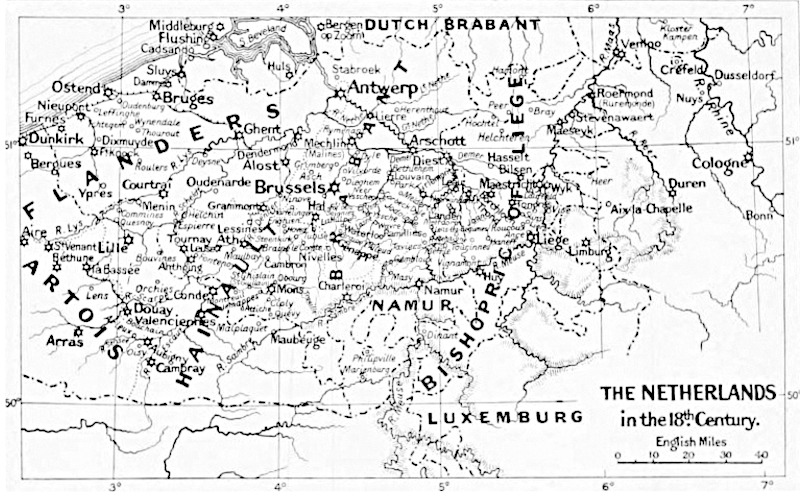
Stanford’s Geogl. Estabt., London.
THE NETHERLANDS in the 18th Century.
[Pg 1]
By the Hon. J. W. FORTESCUE
A
HISTORY OF THE BRITISH ARMY
With numerous Maps and Plans. 8 vo.
Vols I. and II. To the Close of the Seven Years’ War. 18s. net each.
Vol. III. To the Second Peace of Paris. 18s. net.
Vol. IV. From the Fall of the Bastille to the Peace of Amiens.
In Two Parts and a separate volume of Maps. 42s. net.
Vol. V. From the Renewal of the War to the Evacuation of Rio de la Plata (1803–1807). 18s. net.
Vol. VI. From the Expedition to Egypt, 1807, to the Battle of Coruña, Jan. 1809. 18s. net.
Vol. VII. 1809–1810. With a separate volume of Maps. 21s. net.
Vol. VIII. 1811–1812. With a separate volume of Maps. 30s. net.
SOME PRESS OPINIONS
VOLUMES I. and II.
ENGLISH HISTORICAL REVIEW.—“Mr. Fortescue has been the first to construct a scholarly and connected story of the growth of our military institutions and of the development of tactics as revealed in a continuous series of wars. His style is lucid, and his descriptions of battles are easy to follow. But his chief merit is a well-balanced judgment.”
VOLUME III.
TIMES.—“Whatever Mr. Fortescue may do in the future, he has already, in his first three volumes, produced one of the most important military works in the English language. It is sincerely to be hoped that they will be read as widely as they deserve to be.”
VOLUME IV.
TIMES.—“We are witnessing the birth of a military classic which is, and will be for some generations to come, without a peer in the subject to which it relates. The debt which the British Army owes to the writer of this moving chronicle of its great achievements, its grandeurs, and its miseries can only be repaid if every member of the Army endeavours to assimilate for himself, and for the profit of his country, Mr. Fortescue’s admirable and most instructive pages.”
VOLUMES V. and VI.
SPECTATOR.—“The new volumes of A History of the British Army are of the same high quality as those which have gone before. We can give no higher praise, for Mr. Fortescue can only be compared with himself. He has no rivals as a student of military history, and we question whether he has any living superior as an historian.”
VOLUME VII.
BROAD ARROW.—“This is a worthy successor to the volumes which have preceded it, and the whole forms a great work by a great, an impartial, and a bold writer.”
MACMILLAN AND CO., Ltd., LONDON.
[Pg 2]
By the Hon. J. W. FORTESCUE
HISTORY OF THE 17TH LANCERS. Royal 8vo. 25s. net.
PALL MALL GAZETTE.—“It is an admirable piece of work. For the most part a regimental record is the driest kind of reading, but the author has succeeded in illuminating the history of the 17th Lancers with humour, with anecdote, and with restrained but appropriate pathos.”
THE COUNTY LIEUTENANCIES AND THE ARMY, 1803–1814. 8vo. 10s. net.
TIMES.—“Mr. Fortescue has produced a volume which is not only a valuable contribution to the military history of the first years of the nineteenth century, but also an indispensable guide to those whose duty it will be hereafter to build upon the foundations which Mr. Haldane has laid.”
THE BRITISH ARMY, 1783–1802. Four Lectures. 8vo. 4s. 6d. net.
UNITED SERVICE MAGAZINE.—“The author of the History of the British Army writes always up to a standard so high that few other military writers can compete with him, either in excellence of the literary style, or in the professional value of what is written.... No praise ... could exaggerate its real merits.”
NARRATIVE OF THE VISIT TO INDIA OF THEIR MAJESTIES KING GEORGE V. AND QUEEN MARY AND OF THE CORONATION DURBAR. Illustrated. 8vo. 10s. 6d. net.
EVENING STANDARD.—“A fine literary achievement. It appears to omit nothing of any consequence; the painting is full of colour, without being overburdened by it; the appreciation is enthusiastic, and yet when necessary is tempered with judicious criticism.”
DUNDONALD. Crown 8vo. 2s. 6d. net.
English Men of Action Series.
BOOKS FOR YOUNG PEOPLE
THE STORY OF A RED DEER. Pott 4to. 4s. 6d. Pocket Classics. Fcap. 8vo. Cloth, 2s. 6d. net. Leather, 3s. 6d. net.
THE DRUMMER’S COAT. Illustrated. Pott 4to. 5s.
THE THREE PEARLS. Illustrated. Fcap. 4to. 6s. net.
MACMILLAN AND CO., Ltd., LONDON.