Chapter VI · (continued 2)
Reading edition
The caterpillar is black, with reddish brown legs. It is gregarious, feeding under protection of a web upon the leaves of plantain, devils-bit scabious, and some other plants.
The chrysalis is drabbish, with darker spots, and is said to suspend itself by the tail from the top of a tent-like structure made of blades of grass spun together at the top.
The butterfly appears in June (sometimes a little earlier or later), and frequents marshy meadows, moist woods, &c., but is a very local insect, abounding most in the south. The specimens, however, that I have seen from the north, are much larger, brighter, and more distinctly marked than the "southerners." The nearest localities to London are, Hornsey, and Copthall Wood at the top of Muswell Hill; West Wickham Wood, and High-Beech (Epping). It is also found near Brighton (plentifully); Carlisle; Durham; Burton-on-Trent; York; Haverfordwest, S. W.; Cardiff, S. W.; Weston-super-Mare; Bristol; and a great number of other places distributed throughout the country. In Ireland at Ardrahan, co. Galway. Rare in Scotland.
THE DUKE OF BURGUNDY FRITILLARY. (Nemeobius Lucina.)
(Plate XI. fig. 5.)
Though this little insect bears the name of Fritillary, at the end of its lengthy and important title, it really belongs to a family widely differing from that of any of the true Fritillaries previously described, and it only shared their name on account of its similarity in colour and markings.
The caterpillar (Plate I. fig. 8), instead of being long and thorny like those of the true Fritillaries, is short, thick, and wood-louse shaped. Its colour is reddish brown, with tufts of hair of the same colour. It feeds on the primrose.
The chrysalis differs from that of the true Fritillaries as much as the caterpillar does, being of the form, and suspended in the manner, shown at fig. 25, Plate I.
The butterfly is chequered on the upper surface with tawny, and dark brown or black. It appears in May and June, and again in August, being found in woods, principally in the south, and its range is often confined to a small spot hardly fifty yards in diameter, within which it may be quite plentiful. The following are among its recorded localities:—Carlisle; Lake District; West Yorkshire; Roche Abbey, Yorkshire; Peterborough; Stowmarket; Pembury; Barnwell Wold, Northants; Oxford; Blandford; Worcester; Gloucestershire; Bedfordshire; Epping; Coombe Wood; Darenth Wood; Boxhill; Dorking; Brighton; Lewes; Worthing; Lyndhurst; Teignmouth.
The males of all the members of the family to which this butterfly belongs, and of which this is the sole European representative—the Erycinidæ—have only four legs adapted for walking, whilst the females have six.
THE BROWN HAIR-STREAK. (Thecla Betulæ.)
(Plate XII. fig. 1, Male; 1 a, Female.)
The genus to which this butterfly belongs, contains five British species, elegant and interesting insects, though not gaily tinted. They are most obviously distinguished from other small butterflies by the tail-like projection on the lower edge of their hind wings (though one of their number, T. Rubi, has this very slightly developed). From each other they are best distinguished by the characters on their under surface, where they all bear a more or less distinct hair-like streak, whence their common name—Hair-streak.
The Brown Hair-streak is the largest of the genus, measuring sometimes an inch and two-thirds in expanse. The two sexes differ considerably on the upper surface, the male being of a deep brown colour, slightly paler near the middle of the front wing, while the female possesses on the front wing a large patch of clear orange. Both sexes have several orange marks upon the lower angles of the hind wings. Beneath, the general colour is tawny orange with duller bands, and marked with one white line on the front wing, and two parallel white lines on the hind wings.
The caterpillar is green, marked obliquely with white; it feeds on the birch and also on the sloe.
The butterfly appears in August, continuing into September. It is generally distributed through the south, but is by no means an abundant insect. Mr. Stainton observes that it has a habit of "flitting along in hedges just in advance of the collector;" but it is also found in oak woods in company with the Purple Hair-streak.
Forty were taken in a season in woods near Henfield, Sussex. Other localities are, Underbarrow Moss, Westmoreland; North Lancashire, common in some parts; Preston; Valley of the Dovey, Montgomeryshire; Cardiff, S. W.; Barnwell Wold; Peterborough; Colchester; Epping; Darenth Wood; Coombe Wood; Brighton; Tenterden; Winchester; Woolmer Forest, Hants; Plymouth; Dartmoor; Wallingford, Berks; Ipswich; Dorsetshire; Norfolk; Wiltshire; Monks Wood, Cambridgeshire.
THE BLACK HAIR-STREAK. (Thecla Pruni.)
(Plate XII. fig. 2.)
The upper side is very dark brown, sometimes almost black, and bearing near the hinder edge of the hind wings a few orange spots. This character will at once distinguish this from the next species (W. Album). On the under side of the hind wing is a broad band of orange, having a row of black spots on its inner edge.
The caterpillar is green, with four rows of yellow spots. It feeds on the sloe.
The butterfly comes out about the end of June or in July. It is generally a very rare insect, but is occasionally taken in great plenty in certain spots. The Rev. W. Bree, writing to the Zoologist from the neighbourhood of Polebrook, North Hants, says, "Thecla Pruni is very uncertain in its appearance. In 1837 it literally swarmed in Barnwell and Ashton Wolds; I do not scruple to say that it would have been possible to capture some hundreds of them, had one been so disposed; for the last few years it has appeared very sparingly indeed." It has also been found in the following localities:—Overton Wood; Brington, Huntingdonshire; and Monks Wood, Cambridgeshire.
THE WHITE LETTER HAIR-STREAK. (Thecla W. Album.)
(Plate XII. fig. 3.)
This is very much like the last in appearance, and has often been mistaken for it by inexperienced eyes. The points of difference are—on the upper side, the absence of the orange band at the hinder edge of the hind wings, and the presence of a bluish grey circumflex line at the inner angle; here also is sometimes a small orange dot;—beneath, the orange band forms a series of arches, bounded on the edge nearest the root of the wing by a clear black line instead of the rounded black spots seen at this part in Pruni.
The caterpillar, which feeds on the elm, is wood-louse shaped; pea-green, barred with yellow; head black. May be beaten off elm trees in May.
The butterfly appears in July, and is found in various situations, sometimes flying high up round elm trees, sometimes descending to bramble hedges, or fluttering about in weedy fields a foot or two from the ground. It was formerly a much rarer insect than at present, and now its appearance in any given locality is a matter of much uncertainty. Mr. J. F. Stephens writes as follows to the Zoologist:—
"For eighteen years I possessed four bleached specimens only of Thecla W. Album, having vainly endeavoured to procure others, when, in 1827, as elsewhere recorded, I saw the insect at Ripley, not by dozens only, but by scores of thousands! and although I frequented the same locality for thirteen years subsequently, sometimes in the season for a month together, I have not since seen a single specimen there; but in 1833 I caught one specimen at Madingley Wood, near Cambridge."
Other localities:—Near Sheffield; Roche Abbey; York; Peterborough; near Doncaster; Polebrook, Northants; Allesley, Warwickshire; Brington, Huntingdonshire; Yaxley and Monks Wood, Cambridgeshire; Needwood Forest, Staffordshire; Wolverston, near Ipswich; Chatham; Southgate, Middlesex; West Wickham Wood; Epping; Bristol.
THE PURPLE HAIR-STREAK.(Thecla Quercus.)
(Plate XII. fig. 4, Male; 4 a, Female.)
At once the commonest and the handsomest of the Hair-streaks, being found in almost every part of England where there is an oak wood, and looking like a small Purple Emperor, with its rich gloss of the imperial colour.
The male has all the wings, in certain lights, of a dark brown colour, but with a change of position they become illuminated with a deep rich purple tint, extending over the whole surface excepting a narrow border, which then appears black. The female has the purple much more vivid, but confined to a small patch extending from the root to the centre of the front wing. Beneath, the wings are shaded with greyish tints, crossed by a white line on each wing, and having two orange spots at the inner corner of the hind wing.
The caterpillar (Plate I. fig. 9), which feeds on the oak, is reddish brown, marked with black.
The chrysalis, which is sometimes attached to the leaves of the oak, and at others is found under the surface of the earth at the foot of the tree, is a brownish object, of the lumpy shape shown in Plate I. fig. 28 (a form shared by the chrysalides of all the Hair-streaks).
The butterfly is seen in July and August, flitting about in sportive groups round oak trees, and occasionally descending within reach of the net. It also affects other trees besides oaks, some thirty or forty at a time having been seen gambolling about one lime tree. It being so generally distributed, it will be needless to particularize its localities.
THE GREEN HAIR-STREAK. (Thecla Rubi.)
(Plate XII. fig. 5.)
This pretty little species is at once known from all other English butterflies by the rich bright green colour that overspreads its under surface. Above, the wings are deep, warm brown.
The caterpillar is green, spotted and striped with white, and feeds on the bramble; also on the broom, and other plants of the same order.
The butterfly appears first in May and June, and again in August, it being double-brooded. It is found flying about rough brambly hedges, and often settles on the outer leaves of low trees about a dozen feet from the ground. It seems to occur generally throughout the country, and extends into the southern parts of Scotland. It has been found in many localities close to London.
THE SMALL COPPER BUTTERFLY. (Chrysophanus Phlæas.)
(Plate XIII. fig. 1.)
We now arrive at a genus characterized by the splendid golden or burnished coppery lustre and tint of their wings; of which, however, the present little species is the only one that remains to us, should the "Large Copper" be really (as it is feared) extinct.
This little, but lively representative of the genus, is one of our commonest and most widely distributed butterflies, flashing about in the sunshine, joining in a dance with the no less lively blues, or settling on the lilac flowers of the scabious, &c., whose soft tones set off to the best advantage the metallic effulgence of this little gem.
The caterpillar feeds on sorrel leaves; is green, with three red stripes.
The chrysalis and caterpillar both resemble in shape those of the Hair-streaks.
The butterfly is supposed to be triple-brooded, coming out in April, June, and August; and is so common, that no localities need be given.
THE LARGE COPPER BUTTERFLY. (Chrysophanus Dispar.)
(Plate XIII. fig. 2.)
A few years ago, this was the pride of British entomology, for we were supposed to have the insect entirely to ourselves, it being unknown on the Continent, whilst it literally swarmed in some of the fens of Cambridgeshire and Huntingdonshire. Then, from some cause, never satisfactorily explained, it almost suddenly disappeared, and, there is reason to fear, has become quite extinct in this country. Still, hopes are entertained that it may be surviving in some unexplored districts, and that it will again "turn up."
As comparatively very few persons have ever seen this splendid creature on the wing, the following communication from one who has, quoted from the Intelligencer, will be of interest to those who have not read it in that periodical. It is from the pen of Mr. E. C. F. Jenkins, of Sleaford, Lincolnshire. He writes: "I proceed to give you some account of my own acquaintance with that most beautiful insect, which, some thirty years ago, was so abundant in the unreclaimed fens about Whittlesea Mere, that I never expected to hear of its utter extermination. Its brilliant appearance on the wing in the sunshine I shall never forget, and to watch it sitting on the flower of the Eupatorium cannabinum and show the under sides of its wings, was something ever to be remembered. I once took sixteen in about half an hour on one particular spot, where the above-mentioned plant was very plentiful; but unless the sun was very bright they were very difficult to find. In those days the larva was unknown, and I attribute the disappearance of the butterfly to the discovery of the larva, to the unceasing attacks of collectors, and to the burning of the surface-growth of the fens, which is done in dry weather when they are to be reclaimed."
The two sexes of this butterfly differ very remarkably in the appearance of the upper surface. This, in the male, is of an effulgent coppery colour, narrowly bordered with black, and having a black mark in the centre of each wing. The female is larger, has a redder tinge, with a row of black spots on the front wings, and the hind wings nearly covered with black, excepting a band of coppery red near the margin, extending also more or less distinctly along the courses of the veins. Underneath, both sexes are nearly alike, the hind wing of a general light blue tint, with a red band near the margin, and spotted with black.
The caterpillar is green, darker on the back, and paler at the sides, it feeds on the water dock.
The butterfly used to be found in July and August, being formerly especially abundant about Yaxley and Whittlesea Mere, and has been taken also at Benacre, Suffolk; and Bardolph Fen, Norfolk.
Various reports of its capture, during the last two or three years, have been published; but they all seem to require confirmation.
This butterfly is now generally considered to be a large local variety of the continental one called Hippothoë, with which it closely agrees in its markings.
THE BLUES. (Genus Polyommatus.)
We now arrive at a numerous genus of elegant and lively little insects, collectively known as the "Blues," though some of them are not blue at all. In their manners, and the localities they inhabit, there is so much in common, that one description of these will answer for nearly every one of them; so that my small available space will be in great part devoted to pointing out the marks of distinction between the various species, ten in number, several of them closely resembling others in general appearance, and requiring some care in their discrimination.
Their caterpillars, which are wood-louse shaped, or onisciform, generally feed on low plants, chiefly of the papilionaceous order; and the butterflies are found in dry meadows, on downs, and in open heathy places. The first species, P. Argiolus, is, however, an exception to the above, both in its food and haunts.
Several species of this genus are often found together. For example, in the Isle of Wight, last August, I took P. Argiolus, Corydon, Adonis, Alexis, and Agestis, all within about one hour, and a space of a few yards square in the corner of a field.
THE AZURE BLUE BUTTERFLY. (Polyommatus Argiolus.)
(Plate XIII. fig. 3, Male; 3 a, Female.)
Colouring:—Upper side, beautiful lilac blue—the male with a narrow black border (fig. 3), the female with a broad one, sometimes extending over the outer half of the wing (fig. 3 a). Under side, very delicate silvery blue, almost white, with numerous small black spots. No red spots.
Caterpillar, green, with darker line on back. Feeds on the flowers of holly, ivy, and buckthorn.
The butterfly appears in May, or sometimes in April, and again in August, frequenting woods and hedges, especially where holly and ivy abound. I noticed immense numbers about the ivied walls of Chepstow Castle.
As the name "Azure Blue" is in general use, I have retained it above, but that of "Holly Blue," sometimes applied to it, is preferable, as its colour is much less an azure blue than that of Adonis.
Localities:—Common in the south, and found as far north as Durham and the Lake District. Not known in Scotland.
THE BEDFORD BLUE, OR LITTLE BLUE. (Polyommatus Alsus.)
(Plate XIII. fig. 4, Male; 4 a, Female.)
This is the smallest of British butterflies, specimens being sometimes seen even smaller than those figured.
Colouring:—Upper side, dark brown, distinctly powdered with blue near the root of the wing in the male, without blue in the female. Under side, pale grey-drab, bluish near the base, marked with rows of black spots in pale rings. No red spots.
Caterpillar, green, orange stripe down back, and streaks of same colour on each side.
The butterfly is out in May and June, and is sometimes seen much later. It is generally met with on limestone or chalky soils; and, from a long list of localities I have looked over, it seems to be distributed over England, Scotland, Wales, and Ireland.
THE MAZARINE BLUE. (Polyommatus Acis.)
(Plate XIII. fig. 5, Male; 5 a, Female.)
Colouring:—Upper side, male, deep purple, or mazarine blue, with a border of black (fig. 5); female, dark brown (fig. 5 a). Under sides of both sexes similar, pale greyish drab, tinged at the base with greenish blue, numerous black spots in white rings. No red spots.
Though this elegant butterfly was frequently met with some years ago, it has lately become one of our rarest species, and I can give no locality where it can be now found. It has been reported as taken lately at Ventnor, Isle of Wight, and somewhere in South Wales, also in other places, but only singly.
Collectors, on visiting any new district, should net all the Blues they are not quite sure are common ones, and this may perchance turn up among them sometimes.
The caterpillar is said to feed on the flower heads of common Thrift (Armeria vulgaris).
The butterfly may be looked for in July.
THE LARGE BLUE. (Polyommatus Arion.)
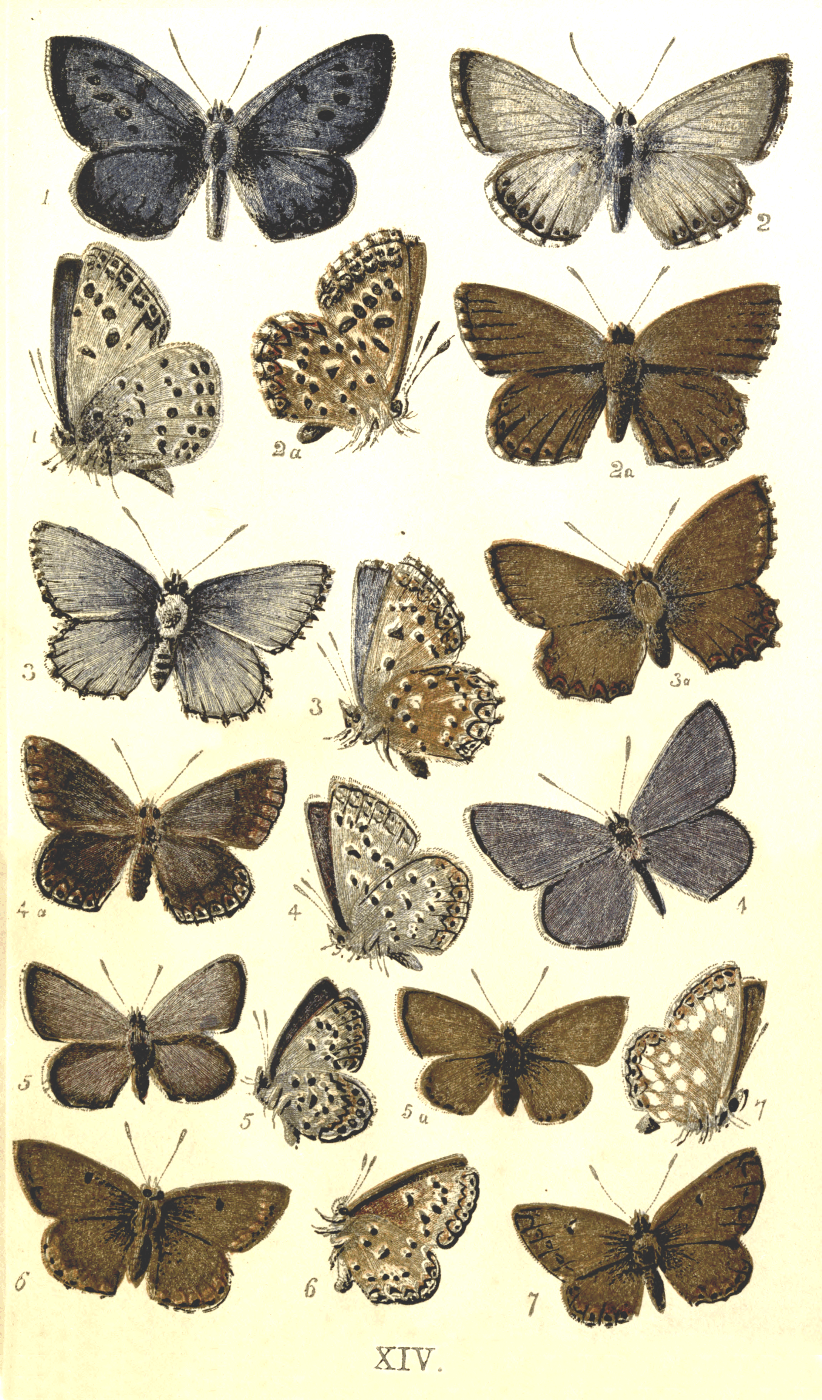
(Plate XIV. fig. 1.)
This is the largest of all our "Blues," and, next to the last, the rarest, though still taken in some numbers every year.
Colouring:—Upper side, dark blue, granulated with black scales that give it a dull aspect, having a black border, and a series of large black spots across the front wing. Under side, greyish drab, suffused with greenish blue near the body; towards centre, many black spots in indistinct light-coloured rings, and a double border of the same. No red spots.
The caterpillar is unknown.
The butterfly appears in July, frequenting rough, flowery pasture-grounds, but is exceedingly local. A famous place for it is Barnwell Wold, about a mile and a half from the village of Barnwell, near Oundle, Northamptonshire, where the insect was discovered by the Rev. W. Bree many years ago; but it is less abundant there than formerly, from the repeated attacks of collectors, who catch all they can find. Other localities, mentioned in various works, are—Brington, Huntingdonshire; Shortwood, and some other spots, near Cheltenham; Charmouth, Dorsetshire; Dover; Downs near Glastonbury, Somerset; Downs near Marlborough, Wiltshire; Broomham, Bedfordshire; near Bedford; near Winchester.
THE CHALK-HILL BLUE. (Polyommatus Corydon.)
(Plate XIV. fig. 2, Male; 2 a, Female.)
Colouring:—Upper side, male, pale silvery greenish blue, with very silky gloss, and shading off into a broad black border.
Female, dark smoky brown, with a leaden tinge, sprinkled near the body with greenish blue scales of the same colour as the males; border of orange spots, more or less visible. Under side marked as in fig. 2 a, on a brown ground, with a row of red spots near border of hind wing.
The caterpillar (Plate I. fig. 10) is green, striped with yellow on the back and sides.
The chrysalis is brownish, and of the shape shown at fig. 29, Plate I.
The butterfly is out in July and August, frequenting chalky downs, especially in the south, and where it does occur is often extremely abundant. Occasionally it is found off the chalk, having been seen in Epping Forest, decidedly not a chalk district. Other localities are—Croydon; Brighton; Lewes; Dover; Winchester; Isle of Wight; Halton, Bucks; Newmarket; Peterborough; Norfolk; Suffolk; Berkshire; Oxfordshire; Wiltshire; Gloucestershire. At Grange, North Lancashire, it is the commonest "Blue," not on chalk, but limestone.
THE ADONIS BLUE. (Polyommatus Adonis.)
(Plate XIV. fig. 3, Male; 3 a, Female.)
Colouring:—Upper side, male, brilliant sky-blue, without any lilac tinge, bordered by a distinct black line, the fringe distinctly barred with blackish. Female, dark smoky brown, sprinkled near body with pure blue scales the colour of those of male; border of orange spots, more or less visible.
Under side, male, marked as in fig. 3; border of red spots.
Female, almost exactly like that of Corydon (fig. 2 a), but usually has the black spots on the front wing smaller.
This is a most lovely little butterfly, the blue of its upper surface being quite unapproachable among native insects. Mr. Stainton, speaking of the different blues of Corydon and Adonis, happily observes that, "Corydon reminds one of the soft silvery appearance of moonlight, whilst Adonis recalls the intense blue of the sky on a hot summer's day."
Caterpillar like that of Corydon.
The butterfly is double-brooded, appearing first in May and again in August. It is found on the same soils and in most of the localities with the last, but is, I believe, more confined to the south.
THE COMMON BLUE. (Polyommatus Alexis.)
(Plate XIV. fig. 4, Male; 4 a, Female.)
Colouring:—Upper side, male, lilac blue. Female, purplish blue about the centre, brown towards the margins, but the proportions of blue and brown are very variable—sometimes all the wings have a border of orange-red spots, sometimes these are absent from one or both pairs of wings.
Fringe in both sexes white, uninterrupted by dark bars.
Under side, male, marked as in fig. 4, and hardly to be distinguished from under side of male Adonis, except by the ground colour, which is paler and greyer than in Adonis. Female, same pattern as male, but coloured with warmer tints—more like male Adonis.
This very pretty little insect is the blue butterfly one sees everywhere, abounding in meadows, on heaths and downs, and not at all confined to chalky soils, like some other "blues."
The caterpillar is green, with darker stripe on the back, and white spots on each side. It feeds on Bird's-foot Trefoil and other leguminous plants.
The butterfly is to be found almost constantly from the end of May to the end of September, being double-brooded.
THE SILVER-STUDDED BLUE. (Polyommatus Ægon.)
(Plate XIV. fig. 5, male; 5 a, Female.)
Colouring:—Upper side, male, purplish blue (rather deeper than that of Alexis), with a rather broad black margin. Female, dark brown, sometimes slightly tinged with blue, and bordered on the hind wings with dull orange spots; but these are often absent.
Fringe white, not barred with black. Under side, near the margin of the hind wings, and between that and the orange border spots, are several metallic spots, of a bluish tint, whence the insect has its name of "Silver-studded."
The caterpillar is brown, with white lines. Feeds on broom and other plants of the same order.
The butterfly appears in July and August, and is very frequently met with throughout the country on heaths, commons, and downs, both on sandy and chalky soils. In many places it is the commonest of the "Blues." It has been found at Epping; Coombe Wood; Darenth Wood; Box Hill; Ripley, Surrey; Brighton; Lewes; Deal; Lyndhurst; Blandford; Brandon, Suffolk; Holt, Norfolk; Birkenhead; Bristol; Sarum, Wiltshire; Lyme Regis; Parley Heath, Dorsetshire; Manchester; York; several places in Scotland.
THE BROWN ARGUS. (Polyommatus Agestis.)
(Plate XIV. fig. 6.)
Though this butterfly and the next are classed among the "Blues," from their possessing the same structure and habits, there is no trace of blue in the colouring of either sex, as in all the preceding species of Polyommatus.
In this species the colour of both sexes on the upper side is a warm, dark brown, having on all the wings a border of dark orange spots. The female hardly differs from the male, except in having this border broader, and more extended on the front wing; where, in the male, it is sometimes very indistinct. The under side much resembles that of the female of Alexis, the border of orange spots being even more distinct on the front wing than on the hind one. It will be observed on referring to Plate XIV. that on the under sides of all the butterflies there figured, there is an irregular black spot situated near the front edge of the upper wing and midway in its length—this is called the "discoidal spot." It will also be observed that the common Blue (fig. 4) has, on the area of the wing, between the discoidal spot and the root of the wing, two spots, which are absent in this species. This forms a very ready mark of distinction, though it requires a good many words to explain it.
The caterpillar, which feeds on Erodium Cicutarium, and perhaps on Helianthemum (Rock Cistus), is green, with pale spots on the back, and a brownish line down the middle.
The butterfly appears in May and June, and again in August, and is common in very many localities in the south, being particularly abundant on the downs of the south coast and the Isle of Wight.
THE ARTAXERXES BUTTERFLY. (Polyommatus Artaxerxes.)
(Plate XIV. fig. 7.)
Colouring, same as in the last species (Agestis); but on the upper surface, the orange border-spots are often hardly perceptible on the front wing, and there is a distinct white spot in the centre of the front wings. The under side also is precisely like that of Agestis, with the black spots removed from the centre of the white rings, which are thus changed into large white spots, as shown in the figure.
There has been a great deal of discussion among entomologists, as to whether this be a distinct species, or only a variety of Agestis. I believe it to be the latter, but do not attach much importance to the question; and as this butterfly is found under the name of Artaxerxes, in almost every cabinet, and is rather a famous little insect, I have thought it best to give it a separate heading under its usual title, and collecting readers may still label it in their cabinet either as above, or as "P. Agestis, var. Artaxerxes," and probably will be equally right either way.
The popular nature and limited extent of this work will not, however, admit of the subject being entered into scientifically, and I can only here state that I have seen specimens from various parts of the country, that include every intermediate variety between the ordinary Agestis of the south, and the Artaxerxes of Scotland. The Durham Argus, formerly called P. Salmacis, forms one of these gradations.
Against the idea of Agestis and Artaxerxes being one species, it has been objected, that the former is double, the latter single brooded. What of that? Plenty of species that are double-brooded in the south of Europe are well known to become single-brooded in a more northern situation.
The caterpillar is said to be exactly like that of Agestis. It feeds on Helianthemum vulgare (Rock Cistus).
The butterfly is found in July and August in several parts of Scotland, and the north of England. Arthur's Seat, Edinburgh, has been long noted for producing it.
THE SKIPPERS. (Family—Hesperidæ.)
These curious little butterflies form a very natural group; in many respects, both of structure and habits, approaching the moths, and therefore placed at the end of the butterflies. They are of small size, but robust appearance, and not brightly coloured. Their flight is rapid, but of short continuance, and they seem to skip from flower to flower: hence their name. They are chiefly distinguished scientifically from other butterflies by the form of the antennæ, which are more or less hooked at the tip (see one magnified on Plate II. fig. 14), by the great width of the head, and the distance between the roots of the antennæ, by their moth-like habit of rolling up leaves for their habitation when caterpillars, and by spinning a cocoon for the chrysalis. The caterpillars are shaped as in fig. 11, Plate I.; the chrysalides, as in figs. 26 and 27. There are seven British species.
THE GRIZZLED SKIPPER. (Thymele Alveolus.)
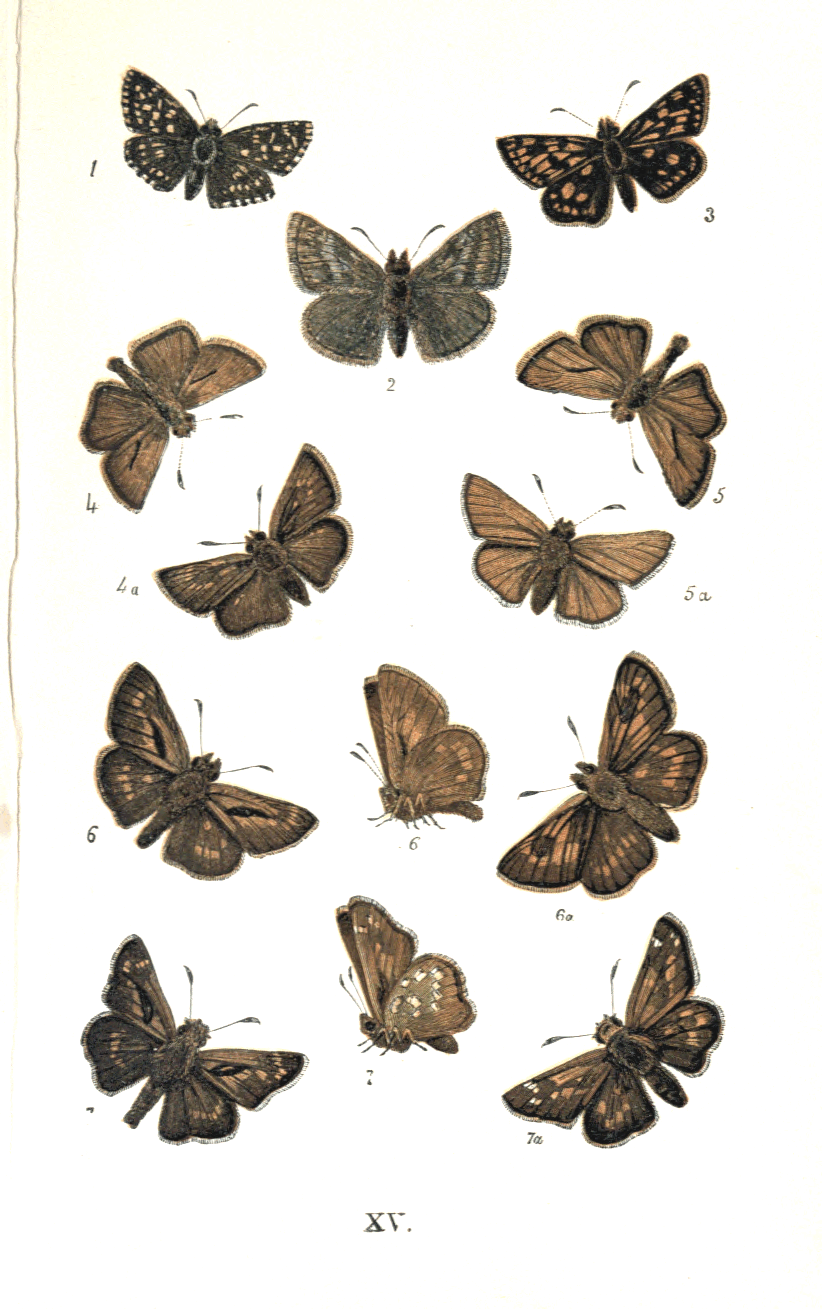
(Plate XV. fig. 1.)
The ground colour of this smart little butterfly is very dark brown, or black, with a greenish hue over it, and it is sharply marked with squarish spots of creamy white. The fringe is also chequered with the same colours. Sexes similar in appearance.
The caterpillar feeds on the wild Raspberry, also, it is said, on Potentilla alba, and P. anserina, and is greenish, with white lines.
The butterfly appears in May, and again in August, being double-brooded. It appears to be common in grassy wood-openings all over the country, extending also into the south of Scotland.
THE DINGY SKIPPER. (Thanaos Tages.)
(Plate XV. fig. 2.)
Certainly a rather "dingy" butterfly, its colour being dull grey brown, with confused bands of darker brown; near the border a row of whitish dots. Sexes similar.
The caterpillar (fig. 11, Plate I.) feeds on Bird's-foot Trefoil, and is pale green, with four yellow lines and rows of black dots.
The chrysalis is shown at fig. 27, Plate I.
The butterfly comes out in May and August, being double-brooded, and is found on hill-sides, dry banks, old chalk pits, &c. generally throughout the country, though it is less common than the last. It is also met with frequently in Scotland.
THE CHEQUERED SKIPPER. (Steropes Paniscus.)
(Plate XV. fig. 3.)
Sexes similar. Wings chequered with brownish black, and tawny orange above; beneath, in addition to the above colours, there are on the hind wing several bright spots of pale buff distinctly outlined with dark brown—having a much more ornamental effect than we generally meet with on the under surface in this family—the colouring on that side being usually faint and blurred so as to give a washed-out or wrong-sided appearance.
The caterpillar is brown, striped and "collared" with yellow; head black. It feeds on the Plantain, also on Dog's-tail Grass (Cynosurus cristatus).
The butterfly appears in June, but is very local—being either found plentifully in a place or not at all. It has occurred at Barnwell, and Ashton Wold, Northants; Kettering; Sywell Wood, near Northampton; near Peterborough; Clapham Park Wood, and Luton, Bedfordshire; Bourne, Lincolnshire; Monks Wood, Hunts; White Wood; Gamlingay, Cambridgeshire; Stowmarket; Milton; Rockingham Forest; Dartmoor; Netley Abbey; Charlbury, near Enstone, Oxon.
THE LULWORTH SKIPPER. (Pamphila Actæon.)
(Plate XV. fig. 4, Male; 4 a, Female.)
This plainly-coloured little butterfly, prized by collectors for its rarity, has, in the male sex, great general resemblance to that of the next species—the common P. Linea—but Actæon may be distinguished by having the wings clouded over nearly the whole surface with dull brown, having something of a greenish cast. The female is, however, very different from that of Linea, having all the wings of uniform dingy brown, excepting a crescent-shaped row of tawny spots near the tip of the front wing, and a more or less distinct streak of the same colour near the centre.
The male Actæon is further distinguished from the female by the possession of a blackish streak near the centre of his front wing.
Beneath, the wings are clouded obscurely with tawny yellow and a dingy brownish tint, the yellow tinge predominating in the male.
The caterpillar is unknown.
The butterfly appears in July and August, but is so extremely limited in its local range that it is only to be met with, so far as is known, in three spots—all on the same line of coast—viz. Lulworth Cove, Dorsetshire; the "Burning Cliff," about five miles nearer Weymouth along the coast; and at Sidmouth, Devonshire. At the present time I believe the "Burning Cliff" is the locality where the insect is found in the greatest plenty. It is to be looked for on the rough broken ground covered with weeds that slopes down to the shore on this coast.
Mr. Humphreys states that in 1835 he saw it in great abundance at Shenstone, near Lichfield.
THE SMALL SKIPPER. (Pamphila Linea.)
(Plate XV. fig. 5, Male; 5 a, Female.)
Upper side, uniform orange tawny colour, shaded into brown at the borders. The male (fig. 5) has an oblique blackish line near the centre of the front wing; this is absent in the female (fig. 5 a). The males of this butterfly very much resemble those of the last rare species (Actæon), but they may be distinguished by the middle part of the upper wing not being clouded with brown, as it is in Actæon. Under side, two shades of tawny colour, but not spotted.
The caterpillar is green, with four white lines, and feeds on grasses.
The butterfly appears in July, and is very common and widely distributed.
THE LARGE SKIPPER. (Pamphila Sylvanus.)
(Plate XV. fig. 6, Male; 6 a, Female.)
Upper side, dark rich brown, shaded and spotted with tawny or fulvous tint. The male is known by a dark-brown, burnt-looking streak near the centre of the front wings; the female being without this mark. Under side, greenish, with indistinct yellowish spots.
The caterpillar is green (darker on the back), and dotted with black; spotted with white underneath. It feeds on various grasses.
The butterfly appears in May, and again in August or the end of July; and is very common in almost every locality, frequenting grassy places in and near woods, road-sides, &c.
THE SILVER-SPOTTED SKIPPER. (Pamphila Comma.)
(Plate XV. fig. 7, Male; 7 a, Female.)
This butterfly closely resembles the last, especially on the upper side; which is, however, more brightly and clearly marked. But the chief distinction is to be found on the under side, which is marked, on a greenish ground, with clear-cut, square white spots. The male, as in the last species, is distinguished by the thin blackish bar placed obliquely on the front wing. The outline of this species also differs somewhat from that of the last, especially in the males. This difference will be better understood by comparing figs. 6 and 7 on the plate, than by description.
The caterpillar is dull-green and reddish, with a white collar, and spotted with white near the tail-end. It feeds on leguminous plants.
The butterfly appears in July and August, but is only found in a limited number of localities, and these chiefly in the southern counties; but where found at all, it is generally abundant. Among its localities are the following:—Croydon; Brighton; Lewes; Dover; Lyndhurst; Blandford; Plymouth; Old Sarum, Wiltshire; Barnwell and Ashton Wolds, Northamptonshire; Halton, Bucks; Newmarket; Gogmagog Park, Cambridge; Hull; Scarborough.
REPUTED BRITISH SPECIES.
On Plate XVI. are grouped together figures of six species of butterflies which are not admitted into our regular British lists, on account of the extreme rarity of their capture, or the fact of their not having been observed at all for several years past. They are all common species in various parts of the Continent, and some of them will probably occur again in this country.
Papilio Podalirius.—The SCARCE SWALLOW-TAILED Butterfly (fig. 1).—There is no reasonable doubt that several individuals of this elegant butterfly were formerly taken in various parts of the country, but no captures have occurred for many years past. The caterpillar, also, was more than once found in the New Forest District, Hampshire. Generally a common insect on the Continent.
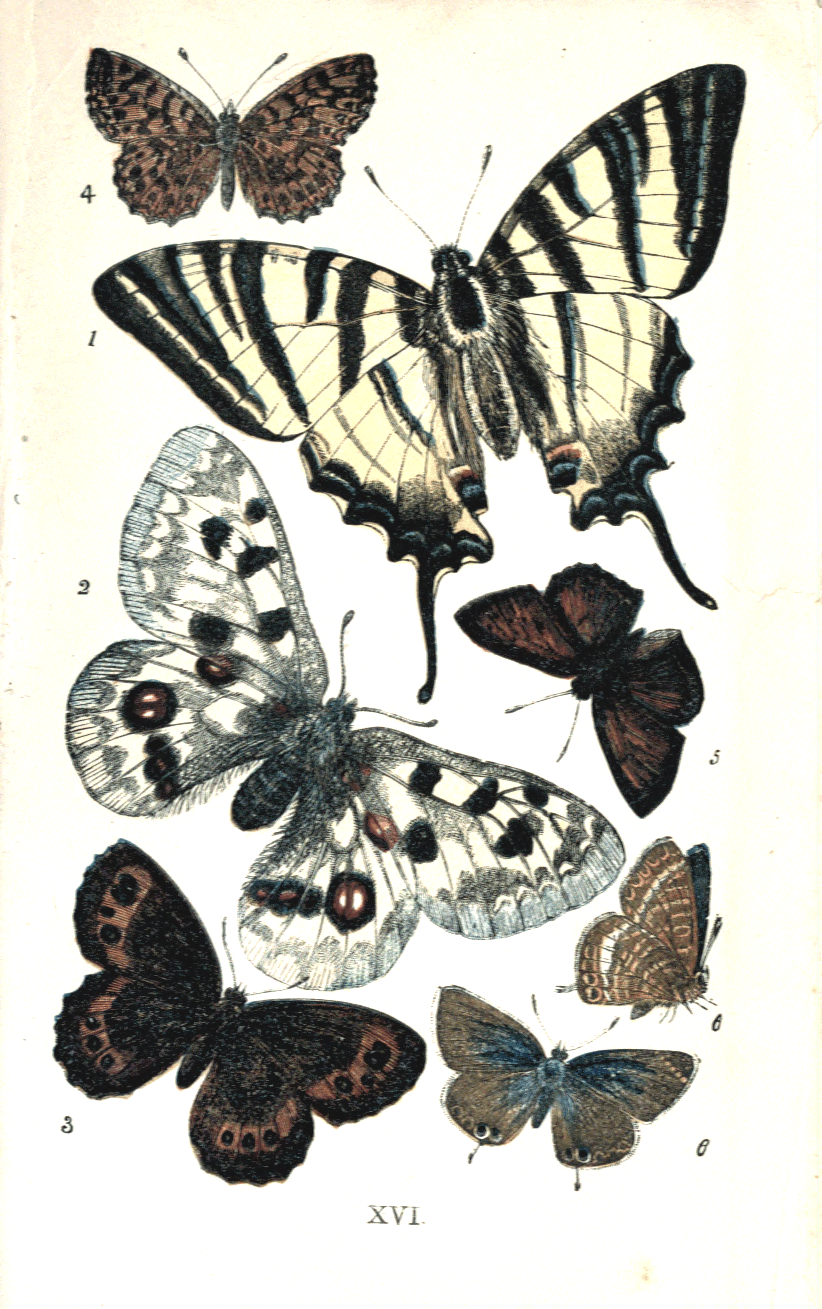
Parnassius Apollo.—The APOLLO Butterfly (fig. 2).—I have good reason for believing that a specimen of this splendid Alpine butterfly was captured in this country very lately, and it is not at all impossible that it may be some day found on our north country mountains, or those of the Lake District. It is a most beautiful insect, with its singular semi-transparent and partially glazed wings; the lower of which bear large eye-spots of crimson-scarlet.
Erebia Ligea.—The ARRAN BROWN Butterfly (fig. 3).—Of this species, greatly resembling our E. Blandina, several specimens were formerly taken by some entomologists in the Isle of Arran, where, as also in other mountain districts, it may probably still exist; but its haunts have to be re-discovered by some enterprising butterfly-hunter.
From Blandina, which it almost exactly resembles on the upper surface, it may be distinguished by the marking of the under side of the hind wing, on which is an irregular, broken band of pure white, and between this and the margin a row of three distinct black eye-spots.
Argynnis Dia.—WEAVER'S FRITILLARY.—This species is so nearly like Euphrosyne or Selene, on the upper surface, that it readily might be, and perhaps sometimes is, passed by as one of those common insects. Underneath it is chiefly recognised by the beautiful blush of silvery purple that extends in a band across the middle of the hind wings, and more faintly tinges the front wings near the tip.
There is little reason to doubt that this insect was really taken by Mr. Richard Weaver at Sutton Park, near Tamworth; also by Mr. Stanley, near Alderley, in Cheshire.
Chrysophanus Chryseis.—The PURPLE-EDGED COPPER Butterfly.—As this species has been admitted by that very careful and accurate entomologist, Mr. Stainton, into his "Manual," I cannot refuse it a place here, though, from all the information I can gain, its only claim to the name of "British" rests on a tradition of its having been taken a long time ago in Ashdown Forest, Sussex; and since then, by a dealer, in Epping Forest. It is a beautiful insect, coppery red, bordered with changeable purple, and I should be glad to see it fairly established in our lists.
Polyommatus Bæticus.—The LONG-TAILED BLUE.—This Butterfly has been long known, as a southern insect, with a very wide range of distribution, abounding in the south of Europe and thence extending into India, Java, &c. Then last year it was seen in Guernsey, and in August of the same year an individual was actually captured in this country, the scene of the event being somewhere on the chalk downs in the neighbourhood of Brighton, and the fortunate captor being Mr. McArthur, of that town. My friend and neighbour, Dr. Allchin, of Bayswater, was on the spot at the time, and saw the insect shortly after its capture.
The butterfly, which on the upper side has somewhat of the aspect of a female "Common Blue," will be at once recognised by its long tail-like appendages to the hind wings. Beneath, its plan of colouring is totally distinct from that of any of our native "Blues" (Polyommati), being destitute of the numerous little eye-like spots, which are replaced by bands of fawn colour and white; but at the lower angle of the hind wings are two spots of glittering metallic green, reminding one, on a small scale, of the "eye" of a peacock's feather.
The habits of the insect are those of our Common Blues—skipping about over grassy places, and for a Common Blue it would on the wing be readily mistaken.
Collectors will in the coming season doubtless search the south coast district thoroughly, and many a Common Blue will be apprehended on suspicion.
Should our little friend Bæticus continue his northward progress (as we have some reason to hope he may), we may find him regularly enrolled on the native lists, and gracing the ranks of that select little company entitled "Our British Butterflies."
REFERENCES TO PLATES.
PREPARATORY STATES AND DETAILS.
PLATE I. Fig. Caterpillars of— 1. Swallow-tailed Butterfly. 2. Brimstone B. 3. Meadow-brown B. 4. White Admiral. 5. Purple Emperor. 6. Peacock B. 7. Silver-washed Fritillary. 8. Duke of Burgundy Fritillary. 9. Purple Hair-streak. 10. Chalk-hill Blue B. 11. Dingy Skipper. Chrysalides of— 12. Swallow-tailed B. 13. Brimstone B. 14. Black-veined White B. 15. Large Garden White B. 16. Silver-washed Fritillary. 17. Orange-tip B. 18. Wood-white B. 19. Marbled-white B. 20. Meadow-brown B. 21. White Admiral. 22. Purple Emperor. 23. Large Tortoiseshell B. 24. Comma B. 25. Duke of Burgundy Fritillary. 26. Small Skipper B. 27. Dingy Skipper B. 28. Purple Hair-streak B. 29. Chalk-hill Blue B. PLATE II. 1. Egg of Garden White B. 2. — Queen of Spain Fritillary. 3. — Large Heath B. 4. — Peacock B. 5. — Large Tortoiseshell B. 6. — Meadow-brown B. 7. — Wood Argus. 8. Head of Red Admiral B. magnified. 9. Section of sucker of ditto, magnified. 10. Papillæ on end of do. magnified. 11. Portion of Eye of Butterfly, magnified. 12. Antenna of Fritillary, magnified. 13. — Swallow-tailed B. magnified. 14. — Skipper B. magnified. 15. Base of Antenna, magnified. 16. Arrangement of Scales on Wing, magnified. 17. Plumed Scale, magnified. 18. Long form of ditto, magnified. 19. Another form of ditto, magnified. 20. — from Small White B. magnified. 21. — from Orange-tip B. magnified. 22. Battledore Scale from Blue B. magnified. 23. Ordinary Scale from Garden White B. magnified. 24. Ordinary Scale from Wood White, magnified. 25. Ditto. 26. Ordinary Scale from Brimstone B. magnified. 27. Ditto. 28. Ditto. 29. Ordinary Scale from Common Blue B. magnified. 30. Ditto. 31. Ditto. 32. Ordinary Scale from Small Tortoiseshell B. magnified. 33. Ditto. 34. Ditto. 35. Ditto. 36. Ordinary Scale from Chalk hill Blue B. magnified. 37. Ordinary Scale from Apollo B. magnified. 38. Form common to Vanessa genus magnified. BUTTERFLIES. PLATE III. Fig. 1. Swallow-tail. 2. Brimstone. 3. Clouded Yellow, 3 a, female. 4. Pale Clouded Yellow. PLATE IV. 1. Black-veined White. 2. Large Garden White. 3. Small Garden White. 4. Green-veined White. 5. Bath White. PLATE V. 1. Orange Tip, 1 a, female. 2. Wood White. 3. Marbled White. 4. Wood Argus. 5. Wall. 6. Grayling. PLATE VI. 1. Meadow Brown, 1 a, female. 2. Large Heath. 3. Ringlet. 4. Scotch Argus. 5. Mountain Ringlet. 6. Small Ringlet. 7. Small Heath. PLATE VII. 1. White Admiral. 2. Purple Emperor. 3. Painted Lady. PLATE VIII. 1. Red Admiral. 2. Peacock. 3. Camberwell Beauty. PLATE IX. 1. Large Tortoiseshell. 2. Small Tortoiseshell. 3. Comma. 4. Silver-washed Fritillary, 4 a, fem. PLATE X. 1. Dark Green Fritillary. 2. High-brown Fritillary. 3. Queen of Spain Fritillary. 4. Pearl-bordered Fritillary. PLATE XI. 1. Small Pearl-bordered Fritillary. 2. Glanville Fritillary. 3. Pearl-bordered Likeness Fritillary. 4. Greasy Fritillary. 5. Duke of Burgundy Fritillary. PLATE XII. 1. Brown Hair streak, 1 a, female. 2. Black Hair-streak. 3. White Letter Hair-streak. 4. Purple Hair-streak, 4 a, female. 5. Green Hair streak. PLATE XIII. 1. Small Copper. 2. Large Copper, 2 a, female. 3. Holly, or Azure Blue, 3 a, female. 4. Bedford Blue, 4 a, female. 5. Mazarine Blue, 5 a, female. PLATE XIV. 1. Large Blue. 2. Chalk-hill Blue, 2 a, female. 3. Adonis Blue, 3 a, female. 4. Common Blue, 4 a, female. 5. Silver-studded Blue, 5 a, female. 6. Brown Argus. 7. Artaxerxes Butterfly. PLATE XV. 1. Grizzled Skipper. 2. Dingy Skipper. 3. Chequered Skipper. 4. Lulworth Skipper, 4 a, female. 5. Small Skipper, 5 a, female. 6. Large Skipper, 6 a, female. 7. Silver-spotted Skipper, 7 a, fem. PLATE XVI. 1. Scarce Swallow-tail. 2. Apollo. 3. Arran Brown. 4. Weaver's Fritillary. 5. Purple-edged Copper. 6. Tailed-Blue (P. Bœticus).
INDEX.
PAGE
Antennæ, 27
Apollo Butterfly, 171
Apparatus, 39
Arran Brown B., 171
Artaxerxes B., 161
Artist and Butterfly, 37
Bath White B., 88
Black-veined White B., 77
Blues, The (Genus Polyommatus), 150
Blue B., Adonis, 156
Azure, 151
Bedford, 152
Chalk-hill, 155
Common, 157
Holly, 151
Large, 154
Mazarine, 153
Silver-studded, 158
Tailed (Bœticus), 172
Boxes, 43
Brimstone B., 67
Brown Argus B., 159
Butterfly Emblems, 34
hunting, 39
Cabinets, 55
Camberwell Beauty B., 121
Caterpillar, 7
Chrysalis, 12
Classification, 58
Clouded Sulphur B., 75
Yellow B., 71
Comma B., 126
Copper B., Large, 148
Purple-edged, 172
Small, 147
Eggs of B., 3
Eye of B., 27
Fritillary B., Dark Green, 129
Duke of Burgundy, 139
Glanville, 135
Greasy, 137
High-brown, 130
Pearl-bordered, 133
Pearl-border. Likeness, 136
Queen of Spain, 131
Silver-washed, 128
Small Pearl-bordered, 134
Weaver's (Dia), 171
Garden White B., Large, 80
Small, 84
Grayling, 99
Green-veined White, 86
Heath B., Large, 102
Small, 111
Hair-streak B., Black, 142
Brown, 140
Green, 146
Purple, 145
White-letter, 143
Ichneumon, 18
Imago, 19
Larva, 7
Latin names, 60
Legs of B., 31
Marbled White B., 95
Meadow Brown B., 101
Nets, 40
Orange Tip B., 91
Pain in Insects, 50
Painted Lady B., 117
Pale Clouded Yellow B., 75
Peacock B., 120
Purple Emperor B., 113
Red Admiral B., 118
Reputed British Species, 170
Ringlet B., Common, 103
Mountain, 107
Small, 109
Scotch Argus B., 105
Skippers (Family Hesperidæ), 163
Skipper B., Chequered, 165
Dingy, 164
Grizzled, 163
Large, 167
Lulworth, 165
Small, 167
Silver-spotted, 168
Speckled Wood B., 97
Swallow-tail B., 65
Scarce, 170
Tongue of B., 25
Tortoiseshell B., Large, 123
Small, 124
Wall B., 98
White Admiral B., 112
Wings of B., 20
Wood Argus B., 97
Wood White B., 94
LONDON: PRINTED BY WOODFALL AND KINDER, 70 TO 76, LONG ACRE, W.C.