Front matter (continued 2)
Reading edition
Then all the Knights of the Round Table arose and set forth in search of the Holy Grail, and through the world they wandered doing deeds of might and valour as they passed. But the Holy Grail never came back to the earth again, for not all the Knights were pure. Then King Arthur grew old and weary and was wounded unto death in battle. "Therefore, said Arthur unto Sir Bedivere, take thou Excalibur, my good sword, and go with it to yonder water side, and when thou comest there I charge thee throw my sword in that water and come again and tell me what thou there seest. My lord, said Bedivere, your commandment shall be done, and lightly bring you word again. So Sir Bedivere departed and by the way he beheld that noble sword, that the pommel and the haft was all of precious stones; and then he said to himself: if I throw this rich sword in the water, thereof shall never come good but harm and loss. And then Sir Bedivere hid Excalibur under a tree. And so, as soon as might, he came again unto the King and said he had been at the water and had thrown the sword in the water. What saw thou there? said the King. Sir, he said, I saw nothing but waves and winds. That is untruly said of thee, said the King, therefore go thou lightly again and do my commandment, as thou art to me dear, spare not, but throw it in. Then Sir Bedivere returned again and took the sword in his hand, and then him thought sin and shame to throw away that noble sword and so again he hid the sword and returned again and told to the King that he had been in at the water and done his commandment. What saw thou there? said the King. Sir, he said, I saw nothing but the waters wappe (lap) and waves wanne (ebb). Ah traitor untrue, said King Arthur, now hast thou betrayed me twice. Who would have weened that, thou that hast been to me so dear? and thou that art named a noble Knight would betray me for the richness of the sword. But now go again lightly, for thy long tarrying putteth me in great jeopardy of my life, for I have taken cold. And but if thou do now as I bid thee, if ever I may see thee, I shall slay thee with mine own hands; for thou wouldst for my rich sword see me dead. Then Sir Bedivere departed, and went to the sword and lightly took it up and went to the water side; and there he bound the girdle about the hilts and then threw the sword as far into the water, as he might; and there came an arm and an hand above the water and met it and caught it and so shook it thrice and brandished and then vanished away the hand with the sword in the water. So Bedivere came again to the King and told him what he saw."
Then came the three Queens and took Arthur in their hands and bore him to the barge. They floated out across the seas towards the west and there was the sound as of a city rejoicing at the return of a hero.
CHAPTER XIV
THE CONQUEST OF IRELAND
Away to the west lay the beautiful country of Ireland. It was known in all the world for its riches, and the ships of many lands were seen in its havens. For the rivers and seas were full of fish, the pastures gave abundant food to the flocks and herds. "Dark was the shadow of the corn in their fields" of which "great plenty was sent over-seas," and rich was the harvest of their orchards. Merchants came laden with spices, figs, pepper and ginger, with wine and carpets and many things from the east to offer in exchange for their wealth.
It was the home of craftsmen, skilful in all manner of handiwork. They made the beautiful book of Kells, "the great Gospel of Columkill, the chief relic of the western world on account of its unequalled cover." So wonderful was their work in illuminating and lettering that an English writer who saw one of their books in 1185 said that it must have been done by angels, not men.
Gold and silver were found in the land, and of these their goldsmiths wrought delicate ornaments. Their blacksmiths too were famed for fine armour and good weapons.
They were weavers, and their cloth was sold in England; "white and green, and russet and red," for they had the secret of making lovely dyes. Of the reign of a good King it was said, "In his time, there was abundance of dye-stuff." Kings and Queens in far-off lands were anxious to buy their cloth for trimming mantles and gowns. The Irish made linen too, both fine and coarse, and leather gloves, shoes and belts.
The people of Ireland were given to hospitality and were courteous in their ways. They loved rich clothes and beautiful things, and in their stories and songs you may still read of the fine golden goblets and beakers of horn from which they quaffed their ale, of the dress of cloth of gold that the lady donned when she entertained the poets, of the crimson velvet mantle bordered with black velvet that the chieftain wore on feast-days. Of their wide hanging linen sleeves, an Englishman wrote "30 yards are little enough for one of them."
They were singers and makers of song like the Saxon people. They loved the harp and delighted in the old stories, such as you may still read, of the hero Cuculain and Deirdri of the Sorrows, of Patrick and the saints.
William Rufus looking towards this rich country had said: "For the conquest of that land, I will gather together all the ships of my kingdom and will make them a bridge to cross over." But the King had no leisure to set sail for Ireland.
In the days of Henry II, it befell that Dermot, King of Leinster, carried off the wife of O'Ruarc, the one-eyed, Prince of Meath, who was "heart-struck both by his shame and by his loss." Then he gathered his men together and marched against Dermot, "a man tall of stature and stout of frame, a soldier whose heart was in the fray and held valiant among his own nation. From often shouting his battle-cry, his voice had become hoarse. A man who liked better to be feared by all than loved by any." So his followers left him and Dermot sought refuge in Bristol.
One of his men, who was sorry at his departure, wrote in the margin of the Book of Leinster, where you may still see them, these words: "O Mary! It is a great deed that has been done in Erin on this day; Dermot, King of Leinster and of the Foreigners, to have been banished by the men of Erin over the sea East-wards! Uch, Uch, O Lord! What shall I do?"
Now Dermot asked help of the Normans in England, saying:
Whoever shall wish for land or pence, Horses, trappings or chargers, Gold or silver, I shall give them A very ample pay. Whoever may wish for soil or sod Richly shall I enfeoff them.
The Normans were glad of the promises of gold and of land and willingly set sail for Ireland. Strongbow, Earl of Pembroke, was their leader, "a man with reddish hair, freckled skin, grey eyes and tall of stature," strong in battle and of much wisdom.
The King of Leinster gave him Eva, his daughter, in marriage. Then did the Kings submit to Dermot, for there was much bloodshed and he "made Ireland a trembling sod." When the King died, Strongbow succeeded him, and Henry II, when he heard the news, was not willing that his barons should be lords in a new land. Therefore, he too set sail for Ireland that they might do him homage. And all the lords and chiefs came, for they feared him.
Then the Norman barons built castles and married Irish ladies, and they no more desired to return to England, for Ireland was a country abounding in treasure.
"The old chieftains of Erin prospered under these princely English lords, who were the chief rulers and who had given up their surliness for good manners, their stubbornness for sweet-mildness and their perverseness for hospitality."
So Ireland prospered, but it is not easy to find out its ancient history, for many of the old books have been lost or burnt and some have been used as though they were of no account. "By long lying shut and unused," says one writer, hundreds of years ago, "I could hardly read," and "by taylors being suffered to cut the leaves of the books in long pieces to make their measure" many pages are missing.
CHAPTER XV
THE COMING OF THE FRIARS
About this time, Francis, the son of a merchant, was born in Italy in the town of Assisi. When he grew up his parents were very proud of him and gave him much money, for he dressed gaily, feasted often and led the young men of fashion.
Then it chanced that he fell ill and, as he lay upon his bed, he thought of the sick and the poor, of the rich monks and the idle priests, and he made up his mind when he grew well to live as Christ lived among men.
He left his father and mother, to their great sorrow. He gave all he had to the poor and dwelt near a ruined chapel beyond the city gates. There he busied himself in rebuilding the chapel, and when he came amongst men it was with a cheerful countenance and a merry heart to do them service.
Though many laughed at him, some desired to become his followers, "and those who took upon themselves that life gave away to the poor all that they chanced to have. And they were content with one tunic patched as they required, within and without, together with a girdle and breeches."
In the heat of the day, on the dusty roads, S. Francis and his companions trudged along, singing songs of joy and cheering those whom they chanced to meet. At night, they sometimes lay out-of-doors, singing praises all the while of "Sister moon and the stars bright and precious and comely" and watching for the rising of the sun, "that doth illumine us with the dawning of day."
For food, they laboured or begged, and of that which was left they gave to the poor. One day, when they had done their begging, they met together to eat in a place without the city, where was a fine fountain and hard by a fine broad stone, upon which each set the alms that he had begged.
And S. Francis, seeing that Brother Masseo's pieces of bread were more and finer and larger than his own, rejoiced with great joy and said, "Brother Masseo, we are not worthy of such vast treasures," and when he repeated many times these words, Brother Masseo made answer,
"Father, how can one speak of treasure, where is such poverty and lack of all things whereof we are in need? Here is not cloth, nor knife, nor plate, nor porringer, nor house, nor table, nor man-servant nor maid-servant."
Quoth S. Francis, "And this it is that I account vast treasure, wherein is no thing at all prepared by human hands but whatsoever we have is given by God, as doth appear in the bread that we have broken, in the table of stone so fine and in the fount so clear; wherefore I will that we pray unto God that He make us love with all our heart the treasure of holy poverty, which is so noble that thereunto did God Himself become a servitor."
Of his courtesy and love towards all creatures on the earth, many stories are told. "And as with great fervour, he was going on the way, he lifted up his eyes and beheld some trees hard by the road, whereon sat a great company of birds well-nigh without number, whereat S. Francis marvelled and said to his companions, 'Ye shall wait for me here upon the way and I will go to preach unto my little sisters the birds.'"
"And he went into the field and began to preach unto the birds that were on the ground and immediately those that were on the trees flew down to him and they all of them remained still and quiet together until S. Francis made an end of preaching."
It was a great surprise even to his followers that so many should seek him. Quoth Brother Masseo, "I say, why doth all the world come after thee and why is it seen that all men long to see thee and hear thee and obey thee? Thou art not a man comely of form, thou art not of much wisdom, thou art not noble of birth, whence comes it then that it is after thee the whole world doth run?"
And as his companions increased in number, he made a journey to Rome to desire the Pope to bless their Order. There is a story which may not be true that when the Pope saw his untrimmed hair and beard and read the rules, which seemed too hard for any man to keep, he made answer, "Go, brother, go to the pigs, for you are more like them than men, and read to them the rules you have drawn up."
Then Francis humbly bowed his head and went away and coming to a field where there were pigs, he rolled in the mud with them. Then he returned to the Pope and said, "My lord, I have done as you commanded, grant me now, I beseech you, my petition." The Pope was astonished at his humility and, repenting of his own harshness, he granted the prayer.
Thus was the order of the Grey Brothers or Friars [3] founded. Soon the little Brothers of S. Francis were scattered over the world and many joined them in England. They had no possessions, and they travelled from place to place preaching to the people and tending the sick and the lepers, of whom there were many in sore need.
CHAPTER XVI
THE THIRD CRUSADE
In the time of William Rufus, Peter the Hermit travelled from country to country calling all Christian men to follow him to Palestine; for the holy places where Christ and His disciples had lived had fallen into the hands of fierce men, the Mohammedans. The pilgrims had been tortured and forbidden to enter Jerusalem, and their number was great, for men of all nations went sometimes in sorrow and carrying rich gifts to make their prayers at the tomb of Christ where, it was said, many wonders were done. Those who had sinned much sought forgiveness, those who were sick desired health and others came to pray for friends and patrons.
Therefore the preacher asked of the rich that they should give all that they had, and of the strong and valiant that they should fight for the banner of the Cross.
And many set out for the war—peasants and princes, French, Italian, English and Austrian—to rescue the land that some held dearer than their own. In that great company was Robert of Normandy, who had sold his dominions to his brother that he might go.
The way was long and perilous, through forests, over mountains, by strange towns and across the treacherous sea, and many died of hunger or of fever on the journey. Twice did the Christian armies march to Jerusalem, yet though they took the city, they could not keep it. Then Richard of the Lion-heart, son of Henry II, planned to join the Third Crusade, for he was a great soldier and loved war.
The King begged money from everyone for his journey. He invited his barons to join him and bring their best men, and from those who would not come he asked large sums of money, promising to pray for them when he reached Jerusalem.
He seized the treasure of the Jews, for they were a people who worked hard and spent little. The Jews were much hated, and when the news went abroad that the King had taken their money, the English thought to do him service by killing them; but the King was angry, for he had only wanted their money.
Then Richard sold the chief offices in his court to those who could pay well, caring little how they ruled while he was away. When he had gathered treasure enough, he set out with the boldest of his barons, and John, his brother, was left to govern England.
After many adventures, he arrived at Acre, and there he found the French King and the Austrians and others surrounding the city. Then Richard besieged it and took it and the great army made him their leader, for they admired his prowess. The French King was much angered and returned home, and the Austrian Duke was envious and led his troops back to their own land. But Richard marched towards Jerusalem. Over the burning desert went the soldiers in their armour, so heavy that if a man fell from his horse, he would be stifled to death unless a comrade were near to raise him; and the horses found it heavy work in the shifting sand. At the rear of the army rode the Knights Hospitallers, who had made vows to succour the wounded and those who fell by the way, and for this service they were held in high esteem.
The enemy watched in hiding to cut off the stragglers by the way. Mounted on swift Arab steeds and clothed in light garments, they moved rapidly, and the poisoned arrow was a deadly weapon. When the tired soldiers came in sight of Jaffa, it was the season of oranges and the time of vintage was at hand, so there they made a camp.
Much refreshed they marched within twelve miles of Jerusalem, but the weather was bad and their tents were torn up and whirled away. The horses perished of cold and the stores were spoiled and their armour grew rusty and many fell ill from long sojourn in this land. There, too, Richard received a letter telling him that his brother John was plotting to take away his inheritance and that the King of France intended to make war on Normandy.
Reluctantly he turned his back upon the Holy City, for he had desired above measure to take it. When one of the knights would have pointed it out to him in the camp, he snapped the switch he held in his hand and cast his surcoat over his head, praying with tears, "O Lord God, suffer not mine eyes to behold Thy Holy City, since Thou wilt not suffer me to deliver it out of the hands of Thine enemies."
Now the Mohammedans held Richard in great awe. When the officers returned to their master after a battle, he asked them mockingly whether they were bringing Richard in chains and they answered, "Know, O King, for a surety that this Richard of whom you inquire is not like other men. In all time, no such soldier has been seen or heard of; no warrior so stout, so valiant or so skilled; his onset is terrible, it is death to encounter him, his deeds are more than human."
Then Richard made a truce with the valiant Saladin, the ruler of the Mohammedans, and this was to last three years and three months and three days and three hours, and once again pilgrims were allowed to visit the tomb of Christ. Now the King dared not return through France for fear of the French monarch, therefore he pretended he was a rich merchant, and hiring two ships he sailed for Austria, hoping to make his way through that land in disguise. But the Duke of Austria hated him almost as much as did the French King.
One evening, Richard sent his page into a city for food, and by mistake he carried the King's gloves in his belt and on them was embroidered the golden lion of England. And the lord of the castle happening to be in the market place saw these and gave orders to follow. Then Richard was captured and cast into a donjon to await the Duke's pleasure. The Duke demanded a ransom for the King so large that he thought the English could not pay it. But Eleanor, the King's mother, rested not till she had raised the money, and the English paid gladly.
When the Crusaders returned to their own lands they spoke of the strange things they had seen and of the courage of Christian soldiers of many nations. Then also the people began to desire spices and silks from the East more than ever before, and they must often have longed for oranges, figs, grapes and dates, such as these adventurers described.
CHAPTER XVII
THE LOSS OF NORMANDY. THE SIGNING OF THE CHARTER
By the river Seine, on a high rock, Richard built a fine castle to guard Normandy. When the King of France heard of its building, he said, "If its walls were of iron I would take it," and Richard replied, "If its walls were of butter I would hold it," and he named it Château Gaillard, Saucy Castle. When Richard died, his brother John did not trouble to keep many soldiers there, and the King of France was glad, for he desired it greatly.
Eleanor, the King's mother, gathered soldiers for her son, and though she was very old she did her best to save Normandy. Yet Saucy Castle fell and the Norman barons would not fight for John. So Normandy was lost and the barons had to choose between their French lands and their English lands. Many, who were fierce and turbulent, went to live in Normandy, and those who had learned to love their new country stayed in England. Though they still spoke French they served England well and tried to make the King rule more justly.
Now the people of England had been proud of Normandy and they were angry with John because he had lost it. In his days, too, there was a great quarrel between the King and the Pope, and the priests were forbidden to hold any services in England, and for five years the churches and monasteries were closed, the dead were buried without prayer in the ditches and highways, and no one could marry in church.
"The images of saints were taken down and veiled; the frequent tinkle of the convent bell no longer told the serf at the plough how the weary hours were passing or guided the traveller through the forest to a shelter for the night." The people grew afraid, and they hated the King, who was the cause of much evil.
Yet John did not care, and he would not receive the new Archbishop whom the Pope had sent. Then the Pope banished the King from the Church and declared him an outlaw, whose life any man might take, and still the King had no fear. At last, the Pope offered the English crown to the French King and John knew that the French King was a dangerous enemy, therefore he promised to do whatever the Pope wished.
So the new Archbishop, Stephen Langton, was received by the King. Soon he began to talk with the barons of the wrongs that the King did daily in the land, and they searched for the old charter that Henry I had given his people. Then they drew up the Great Charter, asking the King to grant them justice.
John met the barons and the Archbishop in a meadow near Windsor, called Runnymede. When he saw the charter he said, "These articles are pure foolishness! Why do they not ask me for the Kingdom at once? I will never give them such freedom as would make me a slave." But looking round at the fierce barons there, unwillingly he set his seal to it.
Thus the King promised that no freeman should be imprisoned without a trial by his equals, that no one should be fined so heavily that he could not pay or that he had to give up the tools by which he earned his daily bread. He promised too that he would not take money from his people without asking the advice of his council and that he would let the merchants come and go freely in the land.
In London, you may still see the old charter signed by the barons who were present, and bearing the King's seal, and when you are able to read it, you can find out what other promises the King made that day.
CHAPTER XVIII
THE LAWS OF EDWARD I AND THE FIRST PARLIAMENT
IN the days of Henry III, the barons had become powerful, and his son Edward I remembered the days of Stephen and how the great lords had destroyed "the good peace" of the realm, and he wisely framed the laws against them.
Now the King had grown poor and the barons had grown rich. They did not care to pay their taxes, so they pretended to give their lands to the Church. These lands were then "in the dead hand" because the Church held them for ever and owed nothing to the King. Yet all the time, the priests took their share and the lands were still held by the barons, free of all dues to the King. So the King forbade any man to give lands to the Church without his permission.
Again, many had taken lands which did not belong to them and seized the King's dues in the courts and no one had made inquiries since Domesday Book was written. The King sent round his messengers to ask by what right they held their lands and courts, and the barons were angry. One man drew out his sword and defied the King, saying, "My ancestors came over with William and won the lands with their sword, and with the sword I will keep them." The King made other laws and the barons feared him.
Edward desired that the people in the towns should prosper, for he hoped to get money from the traders. Much complaint was made that the roads were in danger from lurking bands of robbers and the cities too were unguarded. The merchants suffered most, for their mule packs, carrying merchandise, had to be strongly guarded. So the King gave orders concerning the watch and ward and bade the townsmen search out the evil doers or pay heavy fines for every crime done in their boundaries.
The gates of the towns were to be shut from sunset to sunrise and the trees and undergrowth were to be cut down for a distance of 200 feet on either side of the highway, lest they gave shelter to men with evil intent.
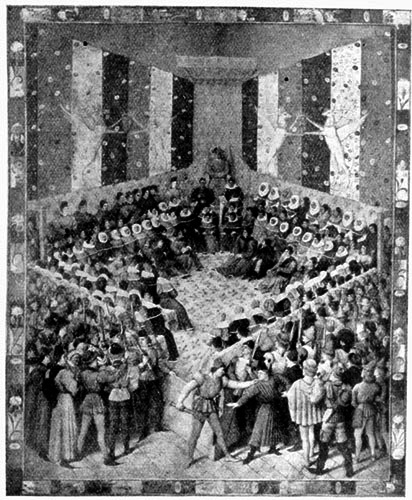
A COURT OF JUSTICE IN THE 15TH CENTURY Duke of Alençon condemned for treason by Charles VII, King of France, 1458 The figure of the artist is to be seen inside the barrier, turning from the scene as though he were not interested
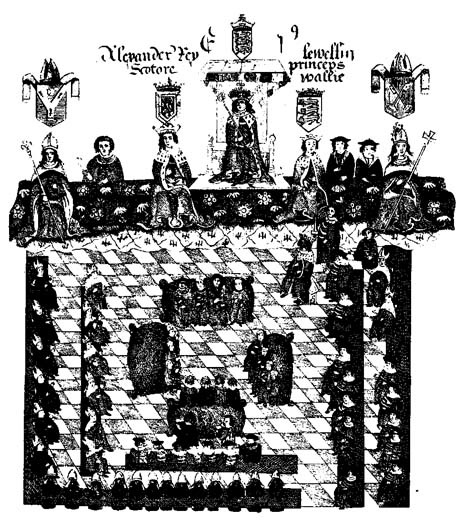
THE PARLIAMENT OF EDWARD I This picture probably dates from the 16th century
Then the King planned to take not only from the richest of the nobles and the priests but also from the treasure chests of the citizens. When he was about to make war and desired money, he sent out a letter asking not only the bishops and barons to meet him but two knights from every shire and two citizens from every city and two burgesses from every borough.
The new comers were at first flattered to sit with the great barons, but soon they found it very troublesome, for the King asked for much money, the journey to the meeting place was often long and dangerous and the King would take no excuses for absence. Then the members began to find fault with the King and to ask how he spent the money, and they made even the strong man Edward sign again the Great Charter.
There is an old picture of one of these parliaments and in it the artist has drawn, not only the two Archbishops seated on either side of the King but also the King of Scotland and the Prince of Wales, but this no doubt he did to show the power of Edward I over these princes, for they never really were in Parliament. The judges sat on the four woolsacks which faced one another. On the right of the King sat the Archbishops, Bishops and Abbots; on the left, the great lords; and opposite him the Commons stood.
CHAPTER XIX
THE CONQUEST OF WALES
In the old days, the Britons had fled before the Northmen, who came conquering from the east-ward; but those who dwelt in the mountain fastnesses of the west had been secure from Saxon and Norman foes. Their country was called Wales or the land of the foreigner, by all who heard of it. Between England and Wales lay the borderland or Marches as the Normans named it, and there the troublesome Norman barons had been given lands by the King to keep them far from the court and busy with their wild neighbours.
When Edward ruled in England, Llewelyn, "towering above the rest of men, with his long red lance, and red helmet of battle, crested with a fierce wolf," was Prince of Snowdon. The bards sang of his fame and prophesied that he should rule from sea to sea. "Men spoke of the return of King Arthur, they whispered that the Northmen should be driven back to their fatherland" and the nation waited in expectation.
Llewelyn desired to marry the daughter of one of the Lords of the Marches and to find friends among those barons. Edward, fearing this, captured the bride on her way to Wales and summoned the prince to London to do homage for his lands; but he would not come.
"We dare not submit to Edward," said the Welsh, "nor will we suffer our prince to do so, nor do homage to strangers whose tongue, ways and laws we know nought of."
So the King raised an army and marched into their country by way of the old Roman road along the north coast. His army marched untroubled with heavy stores and baggage, for Edward was a great soldier and had planned that his fleet should attend him, sailing in sight of the coast, till they reached the island of Anglesey, the granary of the Welsh.
As he marched, he gave orders to build strong castles. Builders and architects were as busy as soldiers and there was great rivalry amongst them. Some boasted of the number of towers, some of their size, some of the speed at which they were able to build. The fine castle of Conway was made from the stones of a stronghold close by. Carnarvon and Beaumaris were built to guard the island of Anglesey, and Caerphilly looked towards the lands of the South Welsh.
Llewelyn, hidden in the wilds of Snowdon, hoped ever that the King would risk a march into these unknown paths, but he waited in vain. Then Llewelyn fought on the coast road, but with dismay he saw himself cut off on all sides but one, and, looking towards the south, he knew it to be his only way of escape, and that was the land of his enemies. There, it is said, he died, by the treachery of the South Welsh, as he stood upon the bank of a river, but the South Welsh say that he was slain in battle by his enemies, the English.
Then Edward summoned the Welsh to meet him at Carnarvon Castle, where he promised they should do homage to a new Welsh Prince, whom he would choose. When the day came, he showed to them his eldest son, who had just been born at Carnarvon, and they paid homage.
Among the laws which he made, he bade the Welsh speak English, but to this day they can speak in their own tongue. "My people," said the Welsh chieftain, "may be weakened by your might and even in great part destroyed, but unless the wrath of God be on the side of its foe it will not perish utterly, nor deem I that other race or other tongue will answer for this corner of the world before the Judge of all at the last day save this people and the tongue of Wales."
CHAPTER XX
THE WAR WITH SCOTLAND
The old King of Scotland, dying, left his kingdom to his little granddaughter, the Maid of Norway, who was only seven years old. Edward planned to marry her to his son the Prince of Wales and so make England and Scotland one kingdom. He sent a ship to bring her from Norway in the winter and he stored it with good things, with toys and sweetmeats for the voyage.
The weather was stormy and Margaret died on the voyage. There was much woe in Scotland and trouble in the English King's mind. Many Scottish nobles claimed the crown and they asked Edward to choose amongst them. It was a difficult matter but Edward was trusted, for all men praised him as the Lion of Justice.
He chose Balliol to rule over them, but this man proved himself of no wisdom and little counsel and his rivals Bruce and the Red Comyn were more powerful than he.
Balliol thought to win favour of the Scots by defying the English King. Edward then harried the land and carried off the Stone of Destiny from Scone. This stone was said to be Jacob's Pillow and had been brought to Ireland long ago and thence into Scotland. On it, all the Kings of Scotland had sat to be crowned and it was put in Westminster Abbey, where it still lies underneath the coronation chair. English barons were sent to rule Scotland but they were not so wise as Edward and there was bitterness among the people.
In their distress, they found a leader in William Wallace, who drilled them to fight on foot against the foreigner, for they were too poor to buy horses and ride into battle in costly armour. On the field, they stood close together, shoulder to shoulder, awaiting the onslaught of the knights, and then they fought with spear and battle-axe.
The English soldiers were taken by surprise, for they had never heard of such a strange army nor seen such steady ranks of men. Edward, however, was a thoughtful general, and he soon learned to use his Welsh archers to trouble the Scots and break their lines. Yet when they were driven from the field, he found he could not rule in Scotland as he had done in Wales, for it was a barren land and the Scots were a hardy people.
Now there was a great feud between Bruce and the Red Comyn. One day when the two met, they entered a church to talk and Bruce killed his foe on the steps of the high altar and, rushing out, he cried to his men, "I doubt I have slain the Red Comyn." "Ye doubt? I make certain," cried one of his followers as he pushed his way into the church.
The people of Scotland were angry for this sin in their hero, but they could not do without him, for Wallace had been caught and hanged as a traitor. So they crowned the Bruce in the old city of Scone, and the golden circlet was placed upon his head by the Countess of Buchan, whose husband was with the invader.
Many stories are told of these times and of the high courage of the Scots, for there were great perils in this strife and there was hunger and cold and faithlessness.
Hearing of the deeds of this man, who had once paid vows to him, Edward, now an old man, led his armies northward again. There on the Borderland he died, leaving this charge to his son, that he should rest neither day nor night till he was prince of Scotland also.
Yet the young King turned his face towards London to make ready for his coronation and wedding. Then the Bruce became indeed King of Scotland, and seven years afterwards, when it was too late, the English King marched with his men to the field of Bannockburn. There he was defeated and from the shame of that day he could never escape.
The Scots harried the north of England for many a year. They rode on swift ponies, carrying only a tin platter and a bag of oatmeal for food, drinking from the streams and eating flesh when they could catch wild deer or mountain sheep or the fat oxen in the pastures. It was a hard matter to find this army, for they rode hither and thither silently, surely and swiftly. Thus was Scotland separated from England for many a generation.
CHAPTER XXI
THE WAR WITH FRANCE
In the days of "the courteous knight" and King, Edward III, a great war was waged with France, for the English merchants complained bitterly that the French had troubled them as they passed bearing wool to the great markets. So bold had the French become that they had harried the Isle of Wight and burned many villages along the southern shore.
As the King passed over seas to make war, he came in sight of the harbour of Sluys, "and when he saw so great a number of ships that their masts seemed to be like a great wood, he demanded of the master of his ship what people he thought they were."
He answered and said, "Sir, I think they be men laid here by the French King, and they have done great displeasure in England, burnt your town of South Hampton and taken your great ship, Christopher." "Ah," quoth the King, "I have long desired to fight with the Frenchmen, and now shall I fight with some of them by the grace of God and S. George."
The battle began with the sound of trumpets and drums and other kinds of music and "it endured from the morning till noon, for their enemies were four to one and all good men of the sea." But the English fought so valiantly that they obtained the victory and Edward received the title of Lord of the Seas.
Some years later, Edward led his men into France to take Paris, but he found that a great army was drawn up to defend the city and that the bridges over the rivers had been destroyed. Many of his soldiers fell sick, so he hastened towards Calais. Then the French King gave chase.
On the hill of Crécy, Edward III drew up his men to await the enemy. While they were waiting, a great thunderstorm burst over the land, and the King gave orders that the archers should cover their bows with their cloaks lest the heavy rain should spoil them. But the French King, in his haste, urged his men forward, and, wet and weary, they came in sight of their foe.
When the French King saw the hosts on the hill, "he hated them" and bade the Italian crossbowmen, whom he had hired, begin the attack. They said their strings were slack and they could not fight that day, but he called them cowards and bade them fall on.
As they advanced into battle, the sun shone in their faces, and when they drew near "the Italians made a great leap and cry to abash the English but they stood still and stirred not for all that. And a second time, they made another leap and a dreadful cry and stepped forward a little but the Englishmen removed not one foot. Again they leapt and cried and went forward till they came within shot, then the English archers stepped forward one pace and let fly their arrows so hotly and so thick that it seemed snow. When the Italians felt the arrows piercing through their heads, arms and breasts, many of them cast down their cross-bows and cut their strings and ran back discomfited."
When the French King saw them fleeing, he said, "Slay those rascals, for they will hinder us and block up our path for nothing." Then the men-at-arms dashed in among them and killed a great number and still "the English kept shooting wherever they saw the thickest press and the sharp arrows ran into the men-at-arms and into their horses and many fell among the Italians and when they were down they could not get up again, for the press was so thick that one overthrew the other."
It was in this battle that gunpowder was first used, but the cannon was only fired once an hour, and then it frightened those who stood by more than the enemy.
The Prince of Wales, who was but sixteen years old, was hard-pressed by the horsemen of France, and the Knights under his banner sent a messenger to his father, the King, who was watching the battle from a windmill on the hill.
"Is my son dead or hurt or felled to the ground?" asked Edward.
"No sir, but hardly pressed."
"Then go back to them that sent you and tell them to send to me no more whatever betide as long as my son is alive, and bid them let him win his spurs, for, please God, I wish this day and the honour thereof to be his and those that are with him." And they that heard it were greatly encouraged.
The old King of Bohemia, fighting for the French, was led into battle by four of his comrades, for he was dim of sight. There he fell fighting, and his crest of three black feathers, with the motto, "Ich Dien," "I serve," was taken by the Prince and has been worn by his successors ever since.
The French King was wounded and his soldiers scattered in dismay. Then the English made great fires and lighted up torches and candles, for it was very dark. And the King came down to the field and said to his son:
"Fair son, God give you good perseverance, ye are my good son, thus ye have acquitted you nobly; ye are worthy to keep a realm." The prince inclined himself to the earth, honouring his father.
CHAPTER XXII
THE WAR WITH FRANCE (continued)
Calais was the great port of Northern France. It was a strong town and the King besieged it. For eleven months it held out against him. The King was sore displeased that he should tarry so long before its gates, and when the citizens desired to make peace he demanded that six burgesses, bare headed, bare footed, in their shirts, with halters about their necks and with the keys of the castle and town in their hands, should give themselves as a ransom for the inhabitants.
The bell in the market place was sounded and the people assembled. When they heard this "they began to weep and make much sorrow." At last the richest burgess of all the town, called Eustace of Saint Pierre, rose up and said openly, "Sirs, great and small, great mischief it should be to suffer such people as be in this town to die by famine or otherwise, wherefore to save them, I will be the first to put my life in jeopardy."
Then another honest burgess rose and said: "I will keep company with my gossip Eustace," and so the six offered themselves and went and apparelled them as the King desired.
When they were brought into the camp, they begged for mercy, "then all the earls and barons and others that were there wept for pity. The King looked felly (cruelly) on them, for greatly he hated the people of Calais for the great damages and displeasures they had done him on the sea before."
Then he commanded their heads to be stricken off. Every man requested the King for mercy but he would hear no one on their behalf.
"They of Calais have caused many of my men to be slain, wherefore shall they die like-wise."
Then the Queen kneeled down and sore weeping said, "Ah, gentle sir, since I passed the sea in great peril, I have desired nothing of you, therefore now I humbly require you in honour of the Son of the Virgin Mary, and for the love of me, that ye will take mercy on these six burgesses."
The King beheld the Queen and stood still in a study a space and then said: "Ah dame, I would ye had been now in some other place, ye make such request to me that I cannot deny you. Wherefore I give them to you and do your pleasure with them."
"Then the Queen caused them to be brought into her chamber and made their halters to be taken from their necks and caused them to be new clothed and gave them dinner at their leisure and then gave them each some gold and made them to be brought out of the host in safeguard and set at their liberty."
This is the story told by Froissart, who attended on the Queen, and thus did Calais fall into the hands of the English, and over its portals the conquerors inscribed the proud boast,
Then shall the Frenchmen Calais win When iron and lead like cork shall swim.
CHAPTER XXIII
THE BLACK DEATH, AND THE PEASANTS' REVOLT
In those days, the great men of the land were rich and they dressed gaily in silk and fur, gorgeous were their jewels, and their scabbards were decked with beauteous workmanship. From their bridles jangled the merry bells, as they followed their hounds to the hunt.
The court too was magnificent. The King gave bounteous feasts and there were many dishes set before the guests.
"There came in at the first course, before the King's self,
Boars' heads on broad dishes of burnished silver, Flesh of fat harts with noble furmenty, And peacocks and plovers on platters of gold, Herons and swans in chargers of silver, And tarts of Turkey full pleasant to taste. Next hams of wild-boar with brawn beglazed, Barnacle-geese and bitterns in embossed dishes, Venison in pasties, so comely to view, Jellies that glittered and gladdened the eye. Then cranes and curlews craftily roasted, Conies in clear sauce coloured so bright, Pheasants in their feathers on the flashing silver, With gay galantines and dainties galore. There were claret and Crete wine in clear silver fountains Rhenish wine and Rochelle and wine from Mount Rose All in flagons of fine gold; and on the fair cupboard Stood store of gilt goblets glorious of hue, Sixty of one set, with jewels on their sides.
When the banquet was over the guests washed their hands in rosewater and partook of wine and spices in another chamber.
But the poor were much oppressed. Their fare was very simple, a loaf of beans and bran, an oaten cake with cheese or curds and cream, and sometimes perhaps parsley and leeks or cherries and apples in their season.
Of the poor ploughman, the poet sang,
His coat of the cloth that is named carry-marry, His hood full of holes, with the hair sticking through them; His clumsy knobbed shoes cobbled over so thickly, Though his toes started out as he trod on the ground, His hose hanging over each side of his hoggers, All plashed in the puddles as he followed the plough; Two miserable mittens made out of old rags, The fingers worn out and the filth clotted on them, He, wading in mud, almost up to his ankles, And before him four oxen, so weary and feeble, One could reckon their ribs, so rueful were they. His wife walked beside him, with a long ox goad, In a clouted coat cut short to the knee, Wrapped in a winnowing sheet to keep out the weather, Her bare feet on the bleak ice bled as she went. At one end of the acre, in a crumb-bowl so small, A little babe lay, lapped up in rags, And twins two years old tumbled beside it, All singing one song that was sorrowful hearing, For they all cried one cry, a sad note of care.
A year after the siege of Calais, a great sorrow befell all men, for a little ship coming out of the east brought a terrible plague, called the Black Death. And the wind blew the plague from the south to the north, and as it passed, the towns were left desolate, for the rich escaped into the woods and many of the poor died. In Bristol, "the living were scarce able to bury the dead and the grass grew several inches high in Broad Street and High Street."
When the wind reached the border of Scotland, it changed and blew from the north-west and down the eastern coast of England it sped, slaying thousands by the way. When it was gone, the lords could find but few to gather in the harvest and those that were left demanded high wages. Many landowners turned their fields into pastureland. For one shepherd and his dog could look after many sheep and there were merchants in Calais ready to buy English wool.
In vain did the lords beg the King to forbid the labourer to ask for hire. If a man fled from his lord's land, whereon he was born, he should be branded with the letter F for fugitive, but still the peasants got away and offered themselves for hire in other places and those for whom they laboured were glad to have them.
The peasants had many grievances. The wars with France had cost much money and the taxes were heavy. There were few who gave thought to the labourer and his troubles, for the monks had become idle and rich, and the friars had forgotten their vows and the priests their duties.
Among the people, there was a band of sturdy men, who had learned to read and who took ideas of freedom from the Bible. They preached that the peasants should take up arms against the King and his lords, for they said, "they are clothed in velvet and warm in their furs and their ermine, while we are covered with rags. They have wine and spices and fine bread and we oat cake and straw and water to drink. They have leisure and fine houses, we have pain and labour, the wind and the rain in the fields. Yet it is of us and our toil that these men hold their state," and the people said
When Adam delved and Eve span Who was then the gentleman?
So the peasants planned to march to London to seek the new King, the boy Richard II, who was but fifteen years old, and "armed with clubs, rusty swords and axes, with old bows, reddened by the smoke of the chimney corner and old arrows with only one feather," they came to the city, only to find that the gates were shut.
Then they threatened to burn and slay, and the citizens in their fear said, "Why do we not let these good people enter into the city? They are our fellows and what they do is for us." So the gates of the city were opened and the peasants sat down in the houses to eat and drink and afterwards they burned the dwellings of foreigners and great lords and slew many.
The King was left alone in the Tower, for the courtiers had fled, and desiring to speak with the rebels, he rode out to an open space beyond the city where they were gathered, and there he entered in among them and said to them sweetly, "Ah, ye good people, I am your King. What lack ye? What will ye say?"
Such as understood him answered, "We will that ye make us free for ever, ourselves, our heirs and our lands."
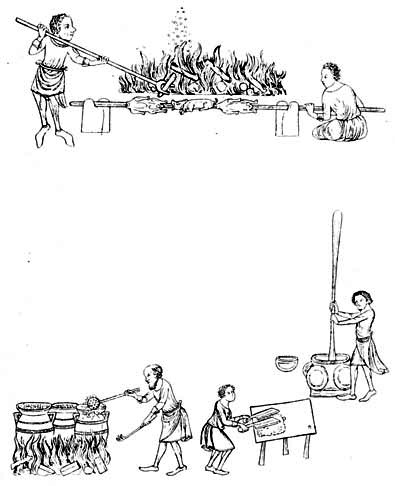
PREPARING THE FEAST
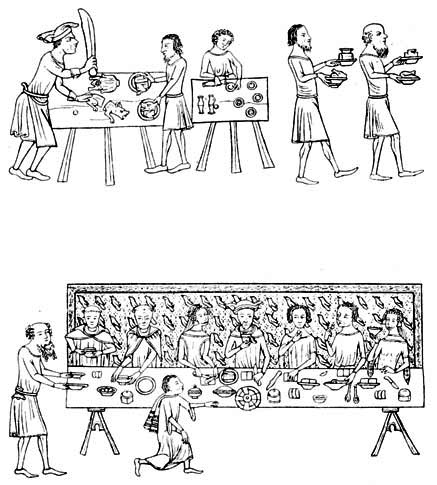
THE FEAST
"Sirs," said the King, "I am well agreed thereto; withdraw you home into your houses and into such villages as ye came from and leave behind you of every village two or three and I shall cause writings to be made and seal them with my seal, the which they shall have with them, containing everything that ye demand." They said, "It is well said, we desire no better," and so they returned to their own homes.
The King could not keep his promise to the peasants, for the lords were stronger than he, yet not long after this time we find the peasants more free and labouring for hire.
CHAPTER XXIV
THE WAR WITH FRANCE (continued)
When Henry V was crowned King, he desired much to revive the glories of Crécy and so he summoned his nobles to war. Then he built a great fleet to carry them to France, cutting down the oak trees in the Forest of Epping for that purpose.
He was much loved by all his soldiers, "for in wrestling, leaping and running, no man could compare with him. In casting of great iron bars and heavy stones, he excelled all men, never shrinking at cold, nor slothful for heat; and when he most laboured, his head commonly uncovered; no more weariness of light armour than a light coat, very valiantly abiding at need both hunger and thirst, so manful of mind as never to seem to quinch at a wound or to smart at the pain."
When he came into the realm of France, he laid siege to the strong city of Harfleur. It was summer time and many of the soldiers fell sick. Though the town was captured, Henry could but turn his back on Paris and march homeward on the old road to Calais, as his great-grandfather Edward III had done in like case.
"The English were brought into some distress in this journey, by reason of their victuals in manner spent and no hope to get more: for the enemies had destroyed all the corn before they came. Rest could they none take, for their enemies with alarms did ever so infest them; daily it rained and nightly it freezed; of fuel there was great scarcity; money enough, but wares for their relief to bestow it on had they none. Yet, in this great necessity, the poor people of the country were not spoiled nor anything taken of them without payment, nor any offence done by Englishmen."
In the French camp, there was much strife and discontent, yet when the news of the English King's distress reached them, and they sent after him their herald to demand ransom, the King answered with scorn. So Mountjoy, King-at-arms, was sent to the King of England to defy him as the enemy of France and to tell him that he should shortly have battle. King Henry advisedly answered, "Mine intent is to do as it pleaseth God. I will not seek your master at this time, but if he or his seek me I will meet them, God willing." When he had thus answered the herald, he gave him a princely reward and licence to depart.
Then the French, coming to the field of Agincourt, and seeing how small an army stood before them, sent the herald once again to seek a ransom. Henry answered that he would never pay such ransom. "When the messenger was come back to the French host, the men of war put on their helmets and caused their trumpets to blow to the battle."
As the English soldiers looked at the great host before them, there were some who sighed for the thousands lying idle in England. Henry, hearing them, answered, "I would not have a single man more. If God give us the victory it will be plain that we owe it to His grace. If not, the fewer we are, the less the loss for England." "What time is it now?" he asked. "The bells are ringing prime [six o'clock], my lord," answered the Bishop. "Now it is good time," said the King. "England prayeth for us, let us be of good cheer. Banners advance!"
Then these Frenchmen came pricking down, as they would have over-ridden all our company. But God and our archers made them soon to stumble, for our archers shot never arrow amiss that did not pierce and bring to ground horse and man. And our King fought like a man, with his own hands. So were the French put to rout, though they indeed had been strong in their pride.
Then the King passed into England and "in this passage the seas were so rough and troublous" that two ships were driven ashore, and the French prisoners said they would rather fight in another battle than cross the seas again. As they came in sight of the shore, the townsmen of Dover came out to meet them, wading waist-deep in the water, so great was their joy at the news. Bonfires were lit and bells were rung and money was freely given to the soldier King.
"The mayor of London and aldermen, apparelled in orient grained scarlet, and four hundred commoners, clad in beautiful mulberry cloth, well-mounted and trimly horsed, with rich collars and great chains met the King on Blackheath, rejoicing at his return, and the clergy of London, with rich crosses, sumptuous copes and massy censors, received him at S. Thomas of Waterways [on the Old Kent Road] with solemn procession."
It was not long before he set out again to win back Normandy, lost by John long ago. He laid siege to its chief city, where there was much suffering, of which the King had pity.
Of the people to tell the truth It was a sight of mickle ruth; Much of the folk that was therein They were but bones and the bare skin With hollow eyes and face a-peak, They scarce had strength to breathe or speak.
When the city surrendered, the King, "clothed in black damask, mounted on a black horse, with a squire behind him, bearing a fox-brush on a spear, for a banner, rode to the minster to give thanks for his victory."
Then Henry marched on towards Paris, for "he had such knowledge in ordering and guiding an army with such a gift to encourage his people that the Frenchmen had constant opinion he would never be vanquished in battle." The Dauphin of France was idle and the old French King ill, so it befell that Henry married the French Princess and ruled Northern France.
To the sorrow of all men he died soon after, and his son when he grew up had many troubles; for in those days, a soldier was held more in honour than a poet and a dreamer.
Some years after Henry's death, Joan of Arc appeared to rescue her land from the enemy, for there was no hope either in the Dauphin who should have been its King or among the French lords who had lost their honour.
Joan described how it happened to her in these words, "At the age of thirteen, I had a voice from God to guide me, and the first time I was very frightened; this voice came at the hour of noon in summer time, in my father's garden; it was on a fast day, I heard the voice on the right side where the church is. I saw at the time a great light."
Then the Archangel Michael addressed her desiring that she should "have pity on the fair realm of France." She answered him, "Messire, I am but a poor maiden; I know not how to ride to the wars or to lead men-at-arms." But the voices were ever in her ear.
When her friends desired her not to go, she answered them, "I had far rather rest and spin by my mother's side; for this is no work of my choosing, but I must go and do it, for my Lord wills it." "And who is your Lord?" they asked. "He is God," she said.
When she had come with much danger and trouble to the place where the Dauphin lay, she desired to see him, but those that stood round mocked her.
Coming into the presence, she said, "Gentle Dauphin, my name is Jeanne the Maid. The Heavenly King sends me to tell you that you shall be anointed and crowned in the town of Reims and you shall be lieutenant of the Heavenly King, who is the King of France."
After many weary days, the Dauphin considered her message and he gave to her some of his armed men that she might prove that God was on her side. He bade her go to get back the good city of Orleans, which was in dire need by reason of the great armies of the English encamped round about it.
Then was the might of the maid proved, for no sooner had her standard touched the walls of the city than the town was saved. Soldiers, who had scoffed or stood aside, now joined her. Thus was she able to march through the land in triumph to the city of Reims, where it was the custom to crown the Kings of France, and in the host there marched the Dauphin.
In that city, she crowned the King, and the English fell back at the terror of her name. Then kneeling before the King, she said, "O gentle King, the pleasure of God is done, would it were His pleasure that I might go and keep sheep once more with my sisters and my brothers. They would be rejoiced to see me again."
The King dared not let her go, yet she had many enemies, for the lords of France did not care to think that she had led their armies. To their bitter shame, they made little effort to save her from the English and she was burnt as a witch. From that day, the English gradually lost all France save Calais.
So the victories of Henry V were of no avail and there was much poverty in England and murmuring against the rulers.
CHAPTER XXV
NEW WORLDS
The barons came back from France. They were practised in the art of war and they turned their homes into strong forts and their servants into soldiers. Of these, they found many who were well versed in arms and ready to fight. They gave them food and lodging for their services and liveries to distinguish them from the followers of their neighbours and they no longer fought for the King but each for his own gain.
The squires in the manors and the merchants in the towns stood in awe of these unruly subjects of the realm, but against them there was no remedy, and every man was forced to choose out a lord to protect him.
Of the long wars which these men waged, fighting for the rival princes of York and Lancaster, for the white and the red rose, and of the havoc that they wrought in the land, there are many stories.
Though the barons made war on one another, the citizens held their markets and fairs and worked with skill in their trades. Foreigners desired to buy, and they were anxious for peace with a country that could give them the finest wool. More ships were built to cross the narrow seas, and they were free to come and go, since England watched them from her two eyes, Calais and Dover.
The merchants began to use more of their own good wool and many skilled craftsmen were needed for cloth making. First the wool was sorted and the coarse taken from the fine, then it was dyed, orange, red, green, russet made from madder, or blue from woad, a flower, which grew abundantly in France. The carder came next and the spinster spun it into long threads on her distaff.
The weaver next doth warp and weave the chain, Whilst Puss, his cat, stands mewing for a skein.
The cloth was cleaned and thickened by the walkers, who trampled it in a trough of water and stretched it upon tenters to dry. Then came the rower who beat it with teazles to find out all the loose fibres and the shearman stood by with shears to cut off the knots and ends when they appeared. Before it was sold, the drawer must mend any holes or bad places in it:
The drawer last that many faults doth hide, (Whom merchant nor the weaver can abide) Yet is he one in most clothes, stops more holes Than there be stairs to the top of S. Paul's.
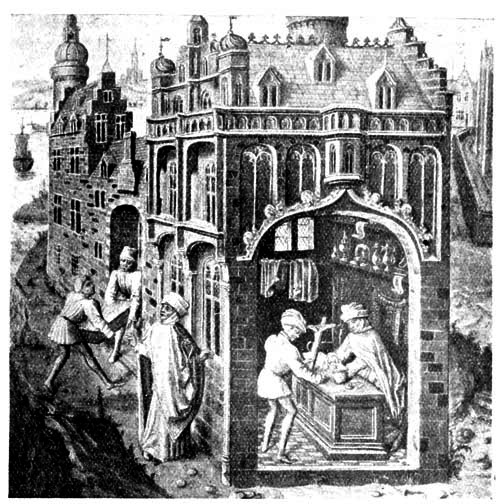
A CHRISTIAN OF CONSTANTINOPLE BORROWING MONEY FROM A JEW AND PLEDGING HIS CRUCIFIX
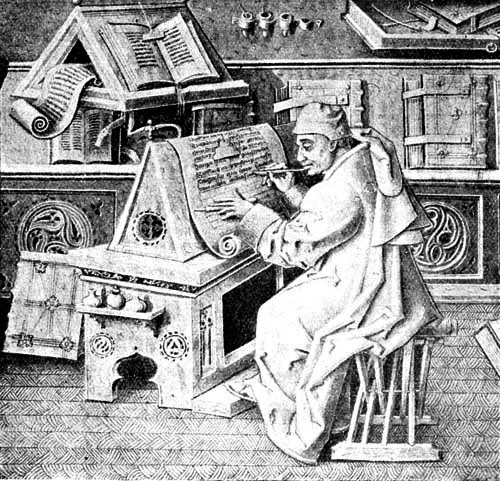
MIÉLOT IN HIS STUDY
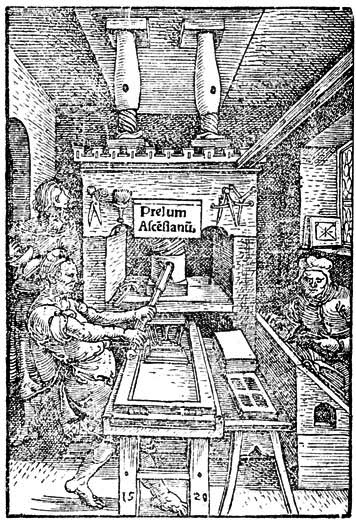
A PRINTING PRESS
They worked as a rule from five in the morning till seven at night in summer and from dawn till dusk in winter, with half an hour for breakfast, and an hour and a half for dinner and a sleep on hot days. There was a holiday for every festival of the Church.
Of Jack of Newbury's workshop we read,
Within one room being large and long There stood two hundred looms full strong; Two hundred men, the truth is so, Wrought in these looms all in a row. By every one a pretty boy Sate making quils with mickle joy, And in another place hard by An hundred women merrily Were carding hard, with joyful cheer, Who singing sate with voices clear. And in a chamber close beside Two hundred maidens did abide, In petticoats of stammel red, And milk-white kerchers on their head.
Those who worked in one trade bound themselves together into a gild, and often lived in one quarter of the city to protect one another; those who desired to become members must serve seven years' apprenticeship. To guard their honour, the masters made a strict rule that no work should be sent to market until it had been inspected and found well done.
If a man fell ill, he received help from the gild. When the feast days came round and all made holiday, the elders of the gild provided a banquet and pastimes, and sometimes they welcomed the players who acted stories from the Bible and old legends. There was dancing and feasting and much merriment.
So the citizens became more important than great barons and soldiers, for they brought trade to the country and riches to the King's Exchequer.
A new world, too, was opening to the people, the world of books. With care the monks had copied down the old stories and histories, but there were few who could procure them to read.
The printing press was brought to England by Caxton. He was an English merchant, trading in the city of Bruges. It was his custom to spend his spare time in reading Latin and French stories. He translated the story of Troy into English, and the Duchess of Burgundy and her courtiers liked it so much that they asked him to write several copies. He says that his pen was so much worn, his hand so weary and his eyes so dim that he thought it worth while to learn the art of printing from those who could teach him.
Then he brought a press to London, and out of his shop he hung a sign "Books bought here good cheap." Only the rich could buy, for books were very dear. He printed the stories of King Arthur and also the Golden Legend, or Lives of the Saints, Reynard the Fox and many another tale. That the poorer folk might also read, he printed a few sheets of poems and fables. Among them was a book of good teachings for children. In this he bade them,
Arise early Serve God devoutly The world busily Go thy way sadly [seriously] Answer demurely Go to thy meat appetently And arise temperately. And to thy soup [suppers] soberly And to thy bed merrily And be there jocundly And sleep soundly.
It was at this time that scholars were beginning to read the old writings of the Greeks, and there were many other books, too, that they desired to have printed.
Then also men were moved to seek what lay beyond the ocean in the far west. They were in search of a new way to India, for India seemed to them the treasure house of the world. Out of the east came gold and silver and spices and silk, but the way was by mountain and desert and many a dangerous place. Few had ventured far across the uncharted seas that stretched away towards the setting sun, for their ships were small and much at the mercy of the winds. It was necessary, too, to put into shore to get fresh stores of water when rain failed. A sailor wrote of their sufferings from thirst on one of these voyages, "The hail-stones we gathered up and ate more pleasantly than if they had been the sweetest comfits in the world. The rain-drops were so carefully saved, that, as near as we could manage it, not one was lost in all our ship. Some hung up sheets, tied with cords by the four corners and a weight in the middle, that the water might run down thither, and so be received into some vessel set or hung underneath…. Some lapped with their tongues the boards under their feet, the sides, rails and masts of the ship. He who obtained a can of water by these means was spoken of, sued to, and envied as a rich man."
It was with a good compass and stout heart that Columbus and his men set sail to find India, and to their great joy they saw, after many months, "a little stick loaded with dog roses" floating in the sea, a sign that they were near land.
The natives, pointing to the setting sun, told them to seek gold in the great lands that lay beyond. Columbus thought he had found India, but it was America. To these lands adventurers came to seek for treasure and soon to find a new home.
SUGGESTIONS FOR STUDY
1. Find out from the pictures in the Saxon Calendar:
(a) the occupations of the Saxons,
(b) the instruments they used in farming,
(c) the kind of dress they wore.
(See Traill and Mann, Social England.)
2. Plan and build a Saxon village (in a sand tray or with clay, etc.).
3. Write down what you think the miller and the goose boy would say in the dialogue.
4. Describe a Saxon Hall. (Read descriptions in Beowulf and Ivanhoe.)
5. Look at some old manuscripts, if you can, and make some illuminated letters.
6. Build a monastery in cardboard, paper or clay.
7. Cut out in paper some figures of Saxons and make a procession on their way to Church to keep a festival.
8. Write the story of Alfred's messenger arriving at the monastery to borrow the chronicle for the King's use.
9. Make a piece of tapestry showing a scene from the history of the Normans.
10. What can you discover about the Normans from the pictures of the Bayeux Tapestry?
11. Find out about Hereward the Wake.
12. Build a castle and defend it.
13. Find out some more stories of S. Francis of Assisi.
14. Find out as many Norman French words in English as you can.
15. Read the tales of Robin Hood.
16. Cut out of paper some figures of soldiers and make a picture by pasting them on a large sheet, showing them landing in England after the victory at Crécy.
17. Find out about a tournament and make the lists. (See Scott's Ivanhoe.)
18. If there are any old buildings where you live, find out when they were built and who used them.
19. Make a subject-index to the book and arrange it in alphabetical order.
20. Make a date chart and illustrate it with pictures.
BIBLIOGRAPHY
Social England (illustrated). Vols. I. and II. Ed. Traill and Mann (Cassell).
Anglo-Saxon Chronicle. (Everyman's Library. Dent.)
The Chronicles of Froissart. (Globe Edition. Macmillan.)
Grandes Chroniques de France. Foucquet. Bibliothèque Nationale, Berthaud Frères. 5 fr.
Alfred the Great. B. A. Lees. (Heroes of the Nations. Putnam.)
St Anselm. R. W. Church. (Macmillan.)
English Monasteries. A. H. Thompson. (Cambridge Manuals.)
English Monastic Life. F. A. Gasquet. (Antiquary's Books. Methuen.)
The Chronicle of Jocelind of Brakelond. (King's Classics. Chatto and Windus.)
Chivalry. F. W. Cornish. (Fisher Unwin.)
The Making of Ireland and its Undoing, 1200-1600. Mrs J. R. Green. (Macmillan.)
Mediaeval Art. W. R. Lethaby. (Duckworth.)
Wayfaring Life in the Middle Ages. J. J. Jusserand. (Fisher Unwin.)
Mediaeval England. M. Bateson. (The Story of the Nations. Fisher Unwin.)
Social Life in England from the Conquest to the Reformation. G. G. Coulton. (Cambridge University Press.)
Bibliography of Mediaeval History, 400-1500. Leaflet 44. Historical Association.
* A Picture Book of British History. Vol. I, to 1485. 190 illustrations. Ed. S. C. Roberts. (Cambridge University Press.)
* Guide to Bayeux Tapestry. Victoria and Albert Museum. Department of Textiles. 6d.
* Oxford Supplementary Histories. (Source books. Henry Frowde and Hodder & Stoughton.)
* Old Stories from British History. York Powell. (Longmans.)
* Heroes of Asgard. Keary. (Everyman's Library.)
* Beowulf. C. Thomson. (Marshall.)
*The little flowers of S. Francis. (Everyman's Library.)
* The Knights of the Round Table. Malory. (Blackie.)
* Stories of Robin Hood. (Told to the Children Series. Jack.)
* A History of Everyday Things in England. Vol. I. M. and C. H. B. Quennell. (Batsford.)
* Suitable for Children.
DATES
B.C. 55 The Romans first landed in Britain.
A.D. 410 Saxons began to settle in Britain.
410 Romans left Britain.
597 S. Augustine landed.
787 Danes invaded England.
871-901 Alfred reigned.
1017-1035 Cnut reigned.
1066 Battle of Hastings.
1070 Lanfranc became Archbishop of Canterbury.
1086 Domesday Book.
1093 Anselm became Archbishop of Canterbury.
1096 The First Crusade.
1107 The Exchequer was founded.
1162 Becket became Archbishop of Canterbury.
1169 Strongbow landed in Ireland.
1147 The Second Crusade.
1189 The Third Crusade.
1204 The Loss of Normandy.
1215 The Great Charter.
1283 Conquest of Wales.
1295 The Model Parliament.
1295 War with Scotland began.
1346 Battle of Crécy.
1346 The Siege of Calais.
1347 The Black Death.
1381 The Peasants' Revolt.
1415 The Battle of Agincourt.
1429 Joan of Arc took Orleans.
1476 Caxton set up a printing-press.
1455-1485 The Wars of the Roses.
1492 Columbus discovered America.
Time Chart
B.C. B.C.
4000 Egyptian Calendar fixed 1000 (as below)
— —
— 900
— —
— 800
— —
— 700
— —
— 600
— —
— 500
— —
— 400
— —
— 300
— —
— 200
— —
— 100
— — Romans landed in Britain
3000 Babylon founded ….. BIRTH OF CHRIST
— A.D.
— 100
— —
— 200
— —
— 300
— —
— 400
— — Saxons invaded Britain
— Hebrews enter Palestine 500
— — Augustine landed in Britain
— 600
— —
— 700
— —
— 800
— —
— 900
— —
2000 1000
— — William the Norman invaded Britain
— 1100
— —
— 1200
— —
— 1300
— —
— 1400
— — Columbus discovered America
— 1500
— —
— —
— —
— —
— —
— —
— —
— 1900
— —
1000 —
[Scale 1 inch to 500 years]
THE TWELVE MONTHS
In the following pages twelve pictures are reproduced from a Book of Hours of the 15th century. All except "Feeding pigs in November" were painted by Pol de Limbourg for the Duke of Berri.
Each of them shows a typical occupation of the season and most of them have a famous castle in the background.
A FEAST IN JANUARY
A FARM IN FEBRUARY
PLOUGHING AND VINE-LOPPING IN MARCH
A BETROTHAL IN APRIL
THE FIRST OF MAY
HAYMAKING IN JUNE
HARVESTING AND SHEEP-SHEARING IN JULY
HAWKING AND SWIMMING IN AUGUST
THE VINTAGE IN SEPTEMBER
SOWING SEEDS IN OCTOBER
FEEDING PIGS IN NOVEMBER
HUNTING BOAR IN DECEMBER
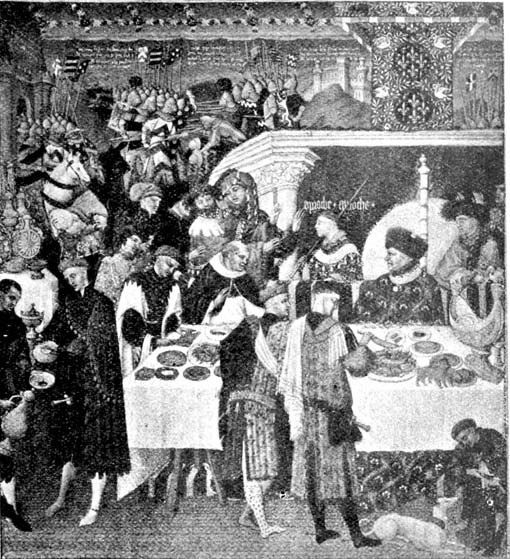
A FEAST IN JANUARY Showing the Duke of Berri seated at table, with a tapestry in the background
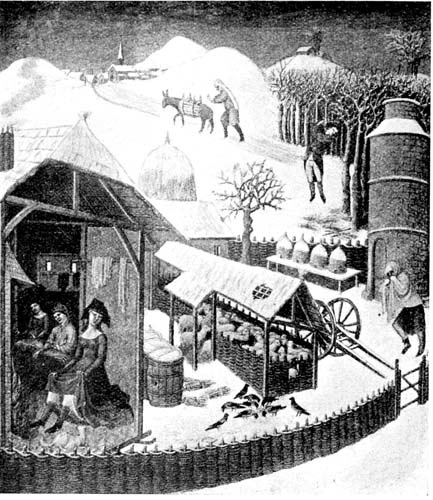
A FARM IN FEBRUARY
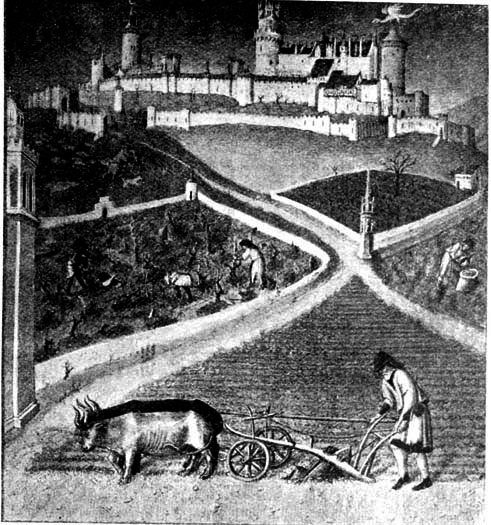
PLOUGHING AND VINE-LOPPING IN MARCH In the background, the castle of Lusignan on the Vienne, the favourite residence of the Duke of Berri
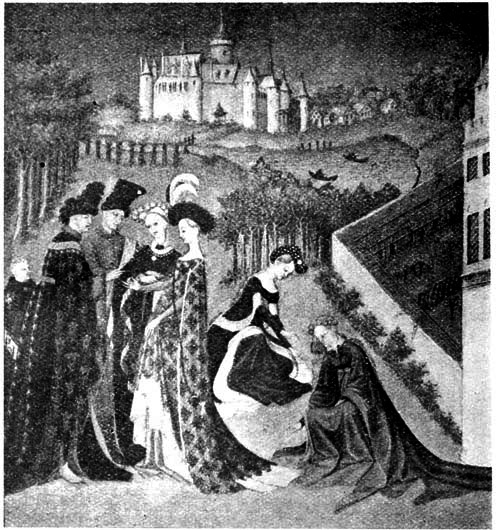
A BETROTHAL IN APRIL In the background, the Castle of Dourdan, belonging to the Duke of Berri
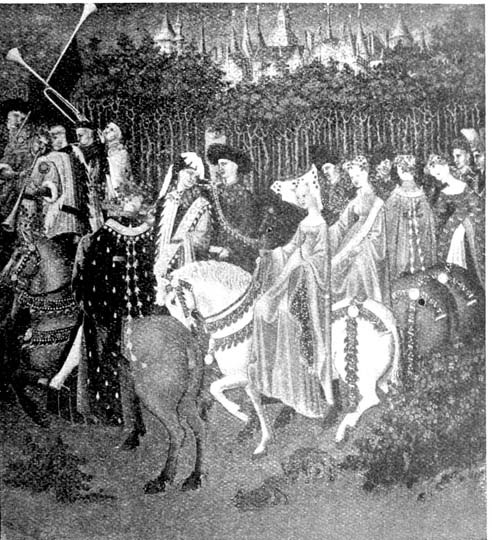
THE FIRST OF MAY In the background, the Towers of Riom, the capital of the Duchy of Auvergne, belonging to the Duke of Berri
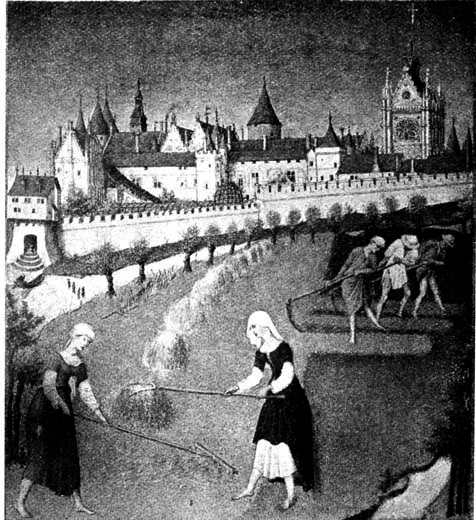
HAYMAKING IN JUNE In the background, the Towers of Paris, showing the Sainte Chapelle, the Conciergerie and the postern gate on the Seine
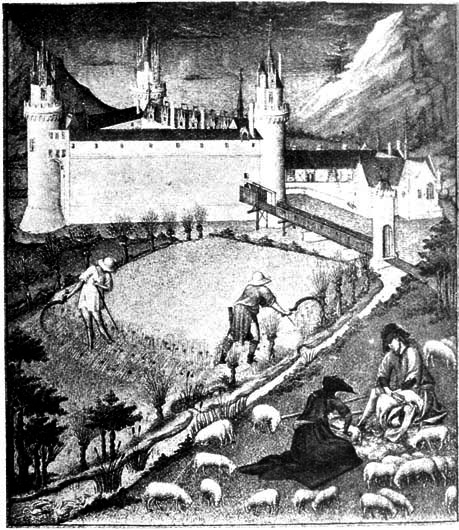
HARVESTING AND SHEEP-SHEARING IN JULY In the background, the Castle of Poitiers, rebuilt by the Duke of Berri
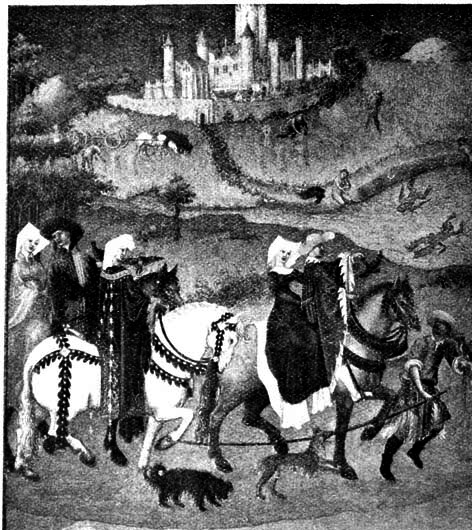
HAWKING AND SWIMMING IN AUGUST In the background, the Castle of Étampes, acquired by the Duke of Berri
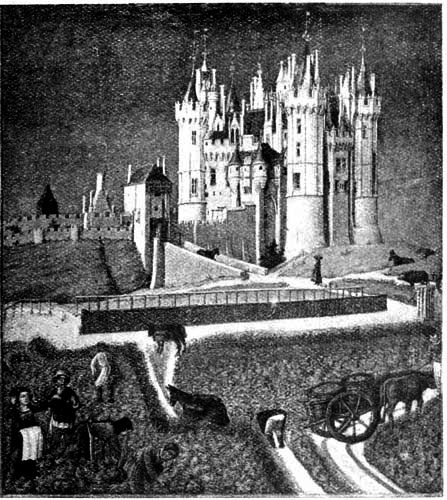
THE VINTAGE IN SEPTEMBER In the background, the Castle of Saumur, in a district noted for its vineyards
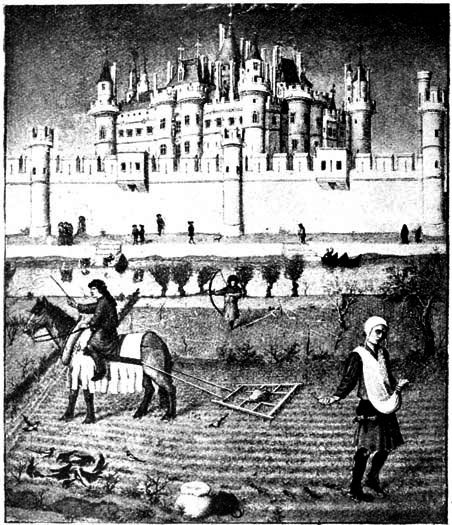
SOWING SEEDS IN OCTOBER In the background, the River Seine and the old Louvre Note the scarecrow with a bow in his hands
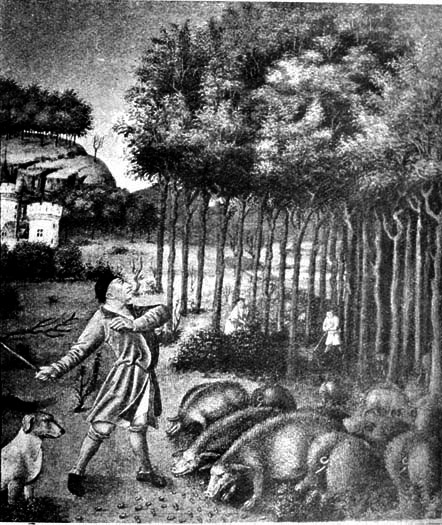
FEEDING PIGS IN NOVEMBER This picture is by another artist at the end of the 15th century
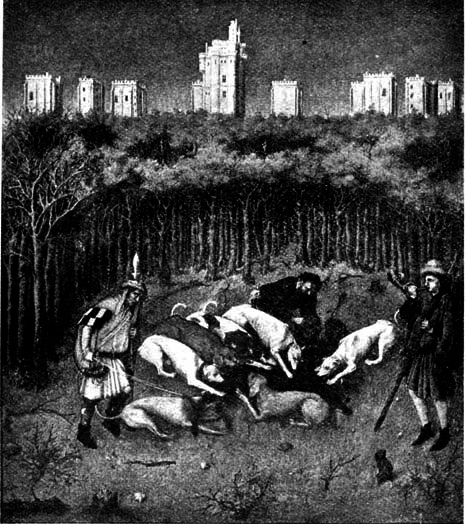
HUNTING BOARS IN DECEMBER In the background, the Castle of Vincennes This picture was borrowed from an Italian artist
CAMBRIDGE: PRINTED BY J.B. PEACE, M.A., AT THE UNIVERSITY PRESS