The Boy Who Had Never Seen An Indian
Reading edition
The Boy Who Had Never Seen An Indian
“I saw Painted Feathers this morning,” the boy said as he threw himself down on the rude log settle in front of the fire and stretched out his hands to feel the blaze. “He seemed angry about something,” he went on, “but he and the young braves were glad to see me. They like us, mother. Painted Feathers remembers how you took care of his little daughter, Laughing Eyes, when she strayed away from the camp up in the Blue Ridge, and he still wears the beads you gave him around his neck. Heap big chief, Painted Feathers, but I guess we’ve made him our friend.”
The woman in homespun, who bent over a savory stew brewing in a kettle that hung from the crane, smiled as she looked down at the boy’s manly face. He was the counterpart of his father, who had gone over the Blue Ridge hunting, and had never returned—lost in the trackless wilderness of the woods, they feared. He wore the same kind of rough suit of tanned skins, hide boots, and fur cap. His eyes were just as deep and fearless as his father’s had been. He was his mother’s mainstay now in the little cabin set so far from any other habitation in the depth of the wilderness. There were Indians near, but, so far, they had been friendly to the two settlers.
“I tried to understand what Painted Feathers was angry about,” the lad continued.
“What was it, Eli; nothing that we have done, I trust?” the boy’s mother asked, her voice trembling a little as she peered out through the window at the gathering dusk and the gloomy forest that surrounded them.
“Oh, no, mother,” Eli hastened to assure her. “As nearly as I could make out, Painted Feathers and the tribe are afraid of losing their land. They pointed toward the direction the Shenandoah takes, beyond the Blue Ridge as it flows into the Potomac. They say that the land in that valley is being measured off with strange instruments and by white men who are going to bring their own tribes and build their own camps there. You can’t blame Painted Feathers, mother, for his tribe settled here first. I thought as I came home what a pity it would be to take the land away from the Indians; such lofty trees, and the silver river, and the buds of the wild flowers opening everywhere. I never saw the mountains look so blue as they did in the sunshine this morning, and Painted Feathers has lived here for years and years,” he said, his clear, boyish voice full of sympathy.
“I know, too, how Painted Feathers feels about this valley,” Eli’s mother said. “He knows every deer track and every spring and partridge call for miles around. But I think this is all talk about surveyors being near, son. No one has marked out the lands in all this time, and they would scarcely begin now. How much longer the days are!” she added, turning toward the door to open it and let in the earth-soaked wind of the evening. It was early spring and the twilight was long and mellow.
To her surprise, she found a boy standing outside. His hand which he had raised to knock with went like a flash to his cap. He pulled it off and stood, bareheaded, as he bowed like a young cavalier and smiled up at her. He was about Eli’s age, she thought, between fifteen and sixteen, but a different sort of lad from her sturdy son. His long, pale face had the lines of an aristocrat. Even his slender fingers showed his gentle heritage.
“May I ask shelter of you for the night,” he begged courteously. As he spoke, Eli’s mother noticed that he carried surveying instruments, and his clothing was weather-stained and worn.
“I have come all the way up the Shenandoah and over the mountains, measuring and marking the land, and making maps of its important features,” he said. “I have not slept more than three or four nights in a bed, but after tramping through your wild forests all day, have lain down before a fire on a little straw or fodder or a bearskin like some beast of the wood. And my cooking has been done on sticks over the same fire with chips of wood for plates.” He smiled as he told of the hardships. “I have strayed away from my companions,” he said, “and do not know where to spend the night.”
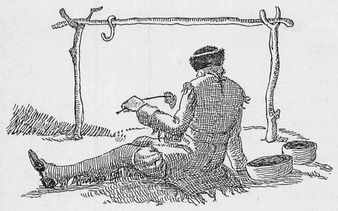
“MY COOKING HAS BEEN DONE ON STICKS OVER THE FIRE’”
Eli, crowding close to his mother in the doorway, had been listening to the tale of the stranger lad with the greatest interest. He pushed open the door now.
“Come in,” he said.
“Yes, you must come in and share our supper, and stop with us in the cabin as long as you like,” Eli’s mother added. And in a few minutes the three were gathered around the rough deal table before the fire, eating bowlfuls of the steaming broth.
“My name is Eli. What is yours?” Eli asked, between mouthfuls.
“George,” said the other lad. “I live at Mount Vernon. Our neighbor, Lord Fairfax, has an estate that is so large it extends way over the Blue Ridge Mountains. Ever since I was a little lad I have ridden and walked with Lord Fairfax, and when he decided to have his estate surveyed, even as far as this distant boundary, I gladly undertook the work. I like this wild life and the adventure of making new paths in the wilderness.”
“Tell me about some of your adventures, George,” Eli begged, leaning across the table, his eyes bright with excitement.
“The narrowest escape we had,” George replied, “was when we made our straw beds on the ground a few nights since and were awakened by smelling something scorched. The straw was on fire, and we were almost burned ourselves.”
“Have you seen any Indians?” Eli asked.
“Not an Indian,” the young surveyor replied. “Indeed, I wish that I might, for I never have seen an Indian in my life. They were long ago driven out of Virginia, you know, by the Colonists. Once, though,” he added, “and not so many days ago, if I remember rightly, we were setting up our stakes about a tract of land near here and we heard a sudden crackling in the bushes. There was a bit of bright color showing among the branches as we looked, like the bright feathers of a chief’s headdress, but it was gone in a moment. It may have been only a scarlet tanager, or a red-headed woodpecker,” he said carelessly.
The words had scarcely escaped his lips, though, when a sudden light flashed against the window of the cabin, lighting like day the scene outside. As scarlet and yellow leaves are whirled in a moment by a sudden gust of wind from a forest, so the thirty or more Indians who surrounded the cabin seemed to have flashed out of the woods—as swiftly and as silently. Painted Feathers led them, decked in fresh war paint, as were all the other braves, and a scalp dangled menacingly from his belt to show that he was bent on warfare. With fierce gestures toward the cabin and the three white faces that peered in terror from the window, the Indians made their preparations. One of the younger braves drummed loudly on a deerskin that he had stretched over an iron pot; another rattled a huge, dried gourd filled with shot and decorated with a horse’s tail. The others built a great fire directly in front of the cabin, pulled blazing brands from it, and danced in a circle with wild yells and whoops.
Eli whispered his frightened explanation to the other lad. “It’s Painted Feathers and his band of braves, and they’re dancing the death dance. When they finish they’ll set fire to our cabin, I’m afraid. He used to be our friend, but this morning he seemed in a great rage about his land and hunting ground being taken away from the tribe by settlers.” Eli’s voice was trembling as he finished. “It wasn’t a wild bird that you heard and saw in the woods when you were surveying, George. It was Painted Feathers watching you, and now he has followed you to our cabin.”
The other lad’s heart beat with terror, but his voice did not falter, as he spoke: “Then I am going out to give myself up to the Indians, Eli. I won’t have your life and that of your mother endangered when you have been so kind to take me, a stranger, into your house, and feed, and shelter me.” He made a quick movement toward the door, but Eli intercepted him.
“Wait, George! It would only satisfy their rage without doing any good. Let me think a moment.”
But as the three waited and watched, the cabin lighted by the fire outside, the seconds seemed hours. The shouting, excited Indians piled more logs upon the fire and fed it with pine knots until the sparks darted in a crimson cloud as high as the tops of the trees. As they danced, they circled nearer and nearer the cabin, their shrieks growing each moment more shrill and menacing. It was time to act if the cabin and its occupants were to be saved. Before either his mother or the boy surveyor could stop him, Eli stepped out in front of the cabin, alone, and unprotected. He stood there, one hand held out in welcome to the terrible Indian chief.
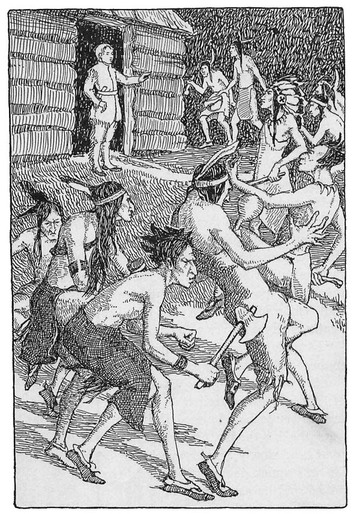
“ELI STEPPED OUT ... ALONE AND UNPROTECTED”
The sudden apparition of the boy was a surprise to the Indians. They were silent for a moment, spellbound by the boy’s bravery, and interested, as well, in something that he drew from his coat and held out in supplication toward Painted Feathers. He had grasped the object from its place on the shelf over the fireplace before he left the cabin. It was a tiny moccasin made of the softest of deerskin and embroidered with bright beads. Painted Feathers drew nearer to look, and Eli spoke to him.
“Laughing Eyes left her moccasin in the wigwam of her paleface friends. We kept the moccasin because we love Laughing Eyes. We found her when she strayed away from the tribe and we gave her back to her father, Painted Feathers, the big chief.”
As the boy spoke, Painted Feathers nodded his great head slowly, and his cruel face softened a little. Eli was quick to see the advantage that he had gained and he acted upon it.
“A strange pale face has come to the cabin. He measures the land in the valley, but he is the friend of the Indians. He will protect their hunting grounds and keep away strange tribes from the west. Will Painted Feathers say ‘how’ to the stranger?” Eli asked, his voice trembling a little at what might be the outcome of his bold request.
Painted Feathers held the little moccasin in his hand now, the touch of it warming and softening his stony heart. Then he slowly nodded his head in assent, stalking nearer the cabin door.
“Come, George,” cried Eli breathlessly. “Come out and meet your friend, Painted Feathers, the big chief.”
In the flaring light of the torches, the great Indian solemnly shook hands with the boy surveyor. Then, as the two boys stood in the doorway, the chief went back to the fire and gave a quick order to the braves. In a second their fearful death dance was changed to the slow, stately steps of a dance of welcome. At its end they put out the fire, and filed silently back into the forest.
Snuggled under bearskins in front of the warm hearth, the two boys slept but little that night, and talked a great deal about their wonderful adventure.
“You needn’t be afraid to go in the morning, George,” Eli assured the boy surveyor. “Painted Feathers’ tribe is the only band of Indians anywhere around here, and now that he knows you are his friend, he won’t harm you.”
“I shall never forget you, Eli,” said George. “You have taught me how to be brave.”
His companions found the lad in the morning and, with many thanks and assurances of his friendship, the young surveyor left the settler’s cabin and started to finish his work and his trip.
More than a score of years passed. Where the trees had grown there was a town now, and the cabin itself was replaced by a comfortable frame dwelling. Eli’s mother was an old lady and he, a man grown. It was a time of much stress for America, the period of the Revolution.
“Great news, mother!” Eli exclaimed as he came in one day. “They say that General George Washington has taken Lord Cornwallis and all his army as prisoners. Yorktown has surrendered, and the war is over.”
“General George Washington?” repeated his mother, her mind going back through the years. Then a thought came to her. “Eli,” she said, “do you remember the lad surveyor who stayed with us for a night when you were a boy? He told me his full name as he was leaving and, all these years, I have never thought to speak of it to you. George Washington, he said he was.”
The man’s eyes flashed. “One and the same,” he said. “The great general, and our guest, George, who had never seen an Indian.”