MATERIALS (continued 2)
Reading edition
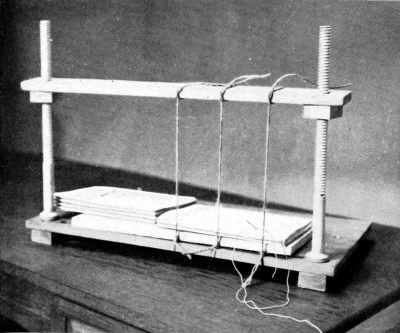
Plate LVI. A sewing-frame in use.
After sewing across the second signature, tie the thread to the loose end as in a book sewed on tapes. When the third signature has been sewed, make loop stitch as already illustrated, (forming a part of the “kettle stitch”) and repeat this stitch at the end of each signature. When the sewing is finished, grasp the book firmly and slide it up on the cords about 1½ inches; then cut the twine from the frame, leaving about 1¼ inches projecting beyond the book on both sides. Pull the twine with both hands to straighten it. Put in fly-leaves and “super” and bind as before. The ends of the twine should be frayed out, and, after the fly-leaves are in, pasted in fan-shape to the outside leaf. Put on the case as shown in Problem XIV.
Additional Points
(A). The binding may be made stronger by “whip-stitching” the fly-leaves after they are pasted in. For this purpose, take an ordinary sewing needle (about No. 2) and linen thread (No. 35). Begin at the right and, with “over-and-over” stitches about ¼ of an inch apart, sew through the outside signature and the fly-leaves. A knot should be made at each end to fasten the threads. Turn the book over and repeat the operation on the opposite side.
(B). If heavy paper is used for the fly-leaves, the outside leaf should be torn or cut off carefully before putting on the case. Leave just a narrow margin at the fold to hold the other half from coming out. This being done, there is but one thickness with which to line the cover, but two free leaves are left as before.
(C). Head-bands may be used on a book sewed on a frame. Cut pieces to fit across the back of the book and paste one at each end after the “super” has been pasted on.
(D). Any book is made more attractive by using colored “end papers” or fly-leaves. These may be of the same material as the cover or of contrasting material. A small surface pattern worked out in crayon or water color for this purpose makes an excellent problem in applied design and at the same time adds much to the appearance of the book. When using any paper for fly-leaves which has a right and wrong side, the sheets should be folded wrong side out. Note that only two folios of colored paper should be used while the other two are white—that is at each end of the “book” there will be one white folio with a colored one inside it. When stacking the sheets to apply the paste, place a colored sheet at the bottom, then a white sheet, then a colored sheet, and a white sheet on top. When pasting these to the book, this brings a white sheet first and a colored sheet inside, so that when pasted to the “case” one-half forms its lining and the other half is free.
Problem XVI
REBINDING A PAPER-COVERED BOOK
Time and Materials: As for Problem XIV or XV except the “book.”
Signatures for sewing may be obtained by taking apart some good paper covered book. Foreign books frequently come in this shape, and are much less expensive than in any other binding.
Carefully remove the cover and the sewing threads, if any, and scrape the glue from the back. Then proceed with the sewing and binding as already described.
It may be desired to have fly-leaves of lithographed or lining paper. In this case have two rather heavy sheets of such paper folded once with the plain side out, and two folded sheets of white paper. When pasting these onto the book, place a white sheet first, and then place a figured sheet inside it. When completed, each cover will have a lining of figured paper faced by a fly-leaf of the same, and a plain second fly-leaf next to the printed pages.
Problem XVII
BINDING NEW PRINTED SHEETS
Time and Materials: As for Problem XIV or XV except the “book.”
Unsewed but printed signatures may sometimes be obtained from a printer or publisher. Fold and assemble the sheets, using great care to observe the correct order. Sew and bind by one of the methods already given.
Problem XVIII
REBINDING AN OLD BOOK
Time and Materials: As for Problem XIV or XV except the “book.”
A school book whose leaves are still in good condition, but with broken cover or loose binding, may often be preserved for much longer service by rebinding. Sometimes one has a worn book which has personal value, and a new cover is desired.
First remove the old covers, being careful not to injure the leaves, pull out the sewing threads and remove glue, “super,” and fly-leaves.
Some repairing may also be necessary. Torn edges may be pasted together or faced with gummed tissue, or, if the tears are not to deep, the edges may be trimmed off.
Broken places in the folds may be mended if necessary by using strips of paper about 1 inch in width and as long as the leaves. If many strips are pasted onto the folds, the back of the book will be thick and bulky. For this reason, a thin tough paper should be used. Paste the fold of two adjoining leaves lengthwise on the center of one of these strips, so placed that, however badly torn, the leaves will assume their proper position, and the extra piece will be on the outside of the fold.
Illustrations are usually printed on a single sheet, often of paper different from the leaves of the book. To insert these, cover the back with a piece of waste paper, leaving a margin along one edge as in the case of the fly-leaf. Cover this margin with paste and insert the leaf in its proper place, pasting it down to the adjacent leaf. The illustration should usually be on the right of the book.
When all repairing has been done, re-assemble the signatures and bind as a new book.
ORIGINAL PROBLEMS
A final test of the pupil’s efficiency lies in his ability to plan and carry to completion an original project. Originality does not consist in making an article never heard of before, but in adapting to one’s specific needs, principles and processes already learned through class instruction.
A fitting close to a course in elementary book-binding is such a problem. If pupils choose to make articles such as the memorandum pad or the hinged covers which have already been taught, they should be accepted as original work, provided that each pupil selects the size and proportions himself, and does not depend on the teacher to repeat the instruction in detail. Yet more credit should be given one whose originality extends further as in the case of a boy who made for his father’s use a holder for conductor’s checks, or the one who made a mount for telephone numbers.
All articles constructed should be such as are appropriately made of the materials used. Models, such as are sometimes made of cardboard, to be constructed later of different materials should be excluded from this course.
It is by no means essential or desirable that originality be held in abeyance until the end of the course but rather, it should be fostered during each succeeding lesson. The pupils who work more rapidly than the average of the class may always have on hand an extra piece of work to be done when the regular assignment has been completed.
The adaptation of any problem to a specific purpose should always be considered an opportunity for the development of class originality. For example, a principal may want several portfolios in which to keep a particular kind of papers; or a set of hinged covers to hold a “Course of Study” may be desired for each teacher’s desk. These should be considered class problems and worked out as such.
It should be continually borne in mind that the object of the course is the development of the child. When he is conscious of the ability to make an article of intrinsic value a long step has been taken. “To help the pupil to help himself” is the highest aim of education.
TEAM WORK
Some of these problems may be given, especially in older classes as “team work.” The class may be divided into sections doing specific parts of the work under a foreman.
This method is a good one when the aim is the output or when an insight into the construction of articles in large quantities is desired.
AFTERWORD
The border-line between educational handwork and technical bookbinding has now been reached, and it is not the writer’s purpose to cross it. If this book of problems assists others in solving the quest for interesting and educational handwork, its mission will have been accomplished.