Chapter II · THE INSECT WORLD
Reading edition
STRAIGHT-WINGED INSECTS
(Orthoptera)
When children play with pebbles on the beach, they often put the red ones in one group, the white ones in another. It is much the same with men, they try to put the things that are alike together, and in the bewildering multitude of shapes and forms and habits with which the insect specialists have had to deal, they catch at any similarity, and put together in one group a lot of creatures which are only alike in a few particulars.
In the straight-winged order of orthoptera they have put the creatures which have four wings, the front pair being leather-like and smaller than the other pair, which latter fold up like a fan. They are also all equipped with strong biting jaws. Bugs often look like them, but bugs have beaks and never jaws.
It is in this order that are found nearly all of the true song insects, at least so far as human ears can tell. The grasshoppers, the katydids and crickets are the great music makers of the insect world, although it is true that there is one, perhaps the loudest, shrillest singer of them all which is classified among the bugs, the lyreman, or cicada, one of the species of which is known as the seventeen-year locust.
When we talk of the hum of insects we do not often stop to think that it is quite a different thing in general from their song. Most insects in their flight, providing that their wings move fast enough, make some kind of a noise. The humming of the bee, the buzzing of the house fly and mosquito and the whirring of the clumsy beetle’s wings are quite a different thing from the conscious song of the katydid to its mate, or the singing of the cricket on the hearth.
Of course it is impossible for us to be quite sure that there is not a host of insects who have means of making some kind of a noise which is so high up in the scale of noises as to be too faint for us to hear.
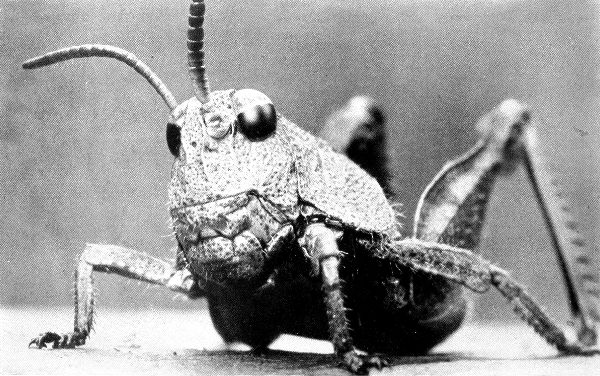
THE KING GRASSHOPPER
(Hippiscus sp.)
As this young king grasshopper stands looking so inquiringly at one with his varicolored eyes, each of which is composed of hundreds of facets, I cannot help thinking that he represents a creature quite as fascinating and actually more dangerous than the East African monsters of our school geographies.
Perhaps it is perfectly natural, but it does not seem right, that so little emphasis should be laid in our histories upon the terrible struggles of man with his insect enemies. The time will come when we shall recognize this warfare, when we shall realize how much of human happiness lies buried on the battlefields of our struggle against the insect hordes.
The members of one species of this great family can sail for a thousand miles before the wind, and they go in such numbers that they make a cloud 2,000 square miles in extent.
They multiply in such numbers as to baffle all calculation, and every living green thing for thousands of square miles disappears down their throats, leaving the country they infest desolate. The great famine of Egypt, mentioned in the book of Exodus, the grasshopper years of Kansas, which ruined thousands of families on our plains, and more recent devastations in Argentina and South Africa are examples of the tremendous effects which the migratory locusts have had upon the happiness of mankind.
The famines which have followed in their wake have cost the lives of hundreds of thousands of human beings and ruined the lives of millions of others. We have become so accustomed to the idea that the farmer must expect to lose his crop every few years from the devastations of these beasts, that we have not yet realized that it would be profitable to spend vast sums of money in learning how to fight them.
In the evolution of the race, this change will come about, and I feel that no honor is too great to bestow upon the American entomologists who have led the world in its fight with these enemies of the human race. Some day these quiet, resourceful, far-sighted men of knowledge will take their places beside the organizers of industry and the warriors of mankind in the hero worship of our boys and girls.
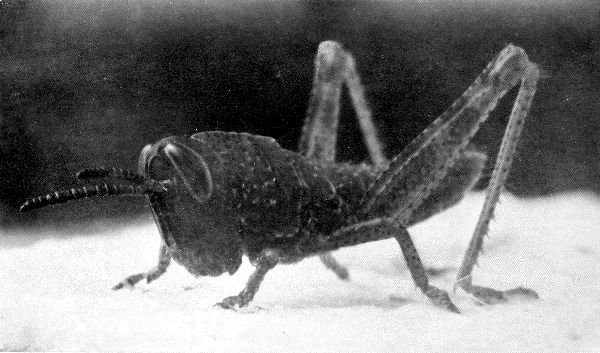
A BABY GRASSHOPPER
A baby creature, scarcely two weeks since it issued from a grasshopper egg, and yet with two moults behind it—two bright green baby skins cast off!
Imagine looking forward, as this baby creature does, to the day when its internal air sacs shall be filled with air and the pads on its back have grown so long and parchment-like that it can leave its hopping, terrestrial existence and sail away across the fields. Until that time, however, it must be content with its six spiny legs, pushing its way among the blades of grass, tasting everything green and eating what it likes, and hiding from its enemies when moulting time comes round.
A young chick finds itself shut inside the eggshell and must work its way out alone, but the young grasshoppers when they hatch out find themselves—the whole nestful—shut in a hardened case in the ground made by their mother, and it takes half a dozen of them working together to dislodge the lid which shuts them in.
Unlike the beetles and the butterflies, which spring full-fledged from the metamorphosis of a caterpillar, the grasshopper comes to be a winged creature by slow stages, each one a little more advanced than the former, with wings a little better developed. The baby grasshopper is essentially a small, wingless adult, and not a grub or larva in the ordinary sense.
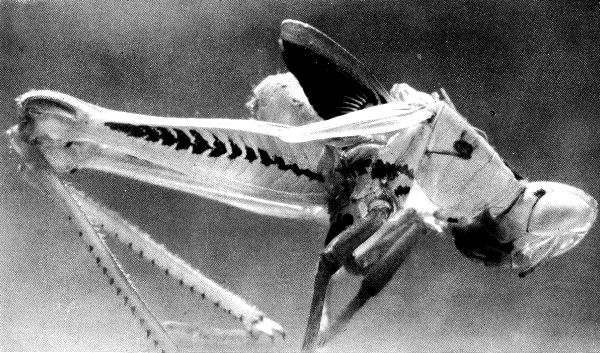
A YOUNG GRASSHOPPER’S SKELETON
When the young grasshopper emerges from the egg, it is very small indeed—a wingless, helpless little creature, all legs and mouth.
It passes through successive ages, or stages, as they are called, each one of which is separated from the other by a moult or casting of its outer shell.
These moults take place at fixed periods, and as the insect finds itself restrained by its firm, inelastic skeleton, a longitudinal rent occurs along the back, and the insect, soft and dangerously helpless, struggles out of the old skin, inclosed in a new but delicate cuticle, which takes some time to harden and color up.
Some people go to great trouble and expense to keep the baby portraits and even the baby shoes, and I cannot help wondering whether a full-grown grasshopper, leading a life in the open air, is ever interested in observing the baby skeletons which show its five stages of terrestrial life.
What an interesting collection could be made of these insects’ skeletons, photographed large enough so that we could see and study them!
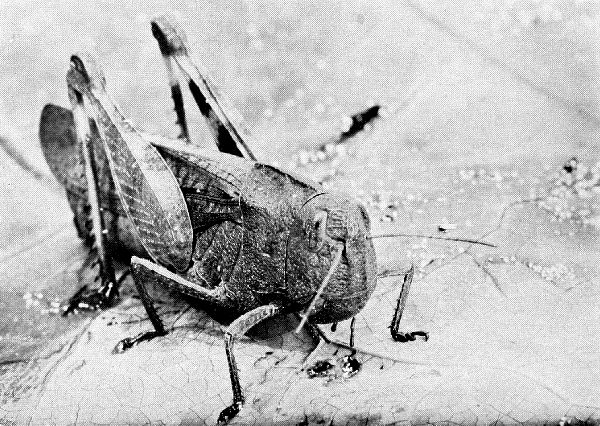
THE GRASSHOPPER IS GOOD TO EAT
How much mere prejudice controls us! Whence came our aversion to the spotless, winged grasshopper as food and our fondness for the flesh of the wallowing swine? We thoughtlessly pass on to our children the idea that certain things are not good to eat while others are, and so, although the grasshopper has been eaten for centuries by millions of people, even by the ancient Assyrians, and is today one of the candied delicacies of Japan, our American boys, hungry as they always are, have not yet caught them to cook over their campfires.
The spiny legs deter us, perhaps, and yet, when one thinks that we eat up all of the soft-shelled crabs, sardines, reed birds and some other delicacies, that seems to be no argument at all against the pasture fed and fattened locust of our summer time.
In Barbary, according to Miss Margaret Morley, the recipe in common use is to boil them for half an hour, remove the heads and wings and legs, sprinkle with salt and then fry them and season with vinegar to taste.
The Maoris of New Zealand, it is said, prefer them to the pigeons which they raise.
The Bedouins bake then in a heated pit in the ground, much as a woodsman cooks his beans, and later dries them in the sun, then grinds them to powder and makes a kind of gruel, or else he eats them without grinding, simply removing the legs and wings with his fingers as one would the shell of a shrimp.
Some people say they taste like the yolk of a hard-boiled egg, while others compare them in flavor to prawns.
Now, whether all the different kinds are good or not, and which are best to eat are questions which the American boys most find out for themselves—the girls, it is assumed, will take no part in this new field of cookery!
Should any boy desire to dip into this vast subject and become an acridophagus it would take him back in his study to the hieroglyphics on some of the oldest monuments of the human race and be a most fascinating subject.
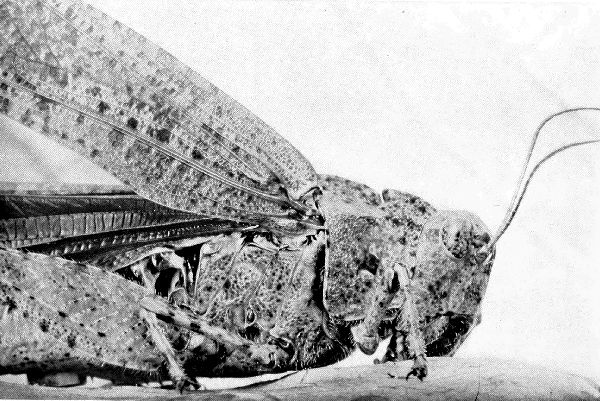
A GRASSHOPPER’S EAR IS UNDER ITS WING
(Dissosteira carolina, Linn.)
If you raise the wing of a full-grown grasshopper and look behind its big fat thigh, you will see a strange hole into its body. This is supposed to be its ear, but what it hears and what it does not hear, who can tell?
When on a warm summer day you hear a male grasshopper chirping, for the males alone can sing, you can think that somewhere nearby, perhaps with wings lifted to hear the song better, sits some attentive female whose ears are tuned to catch the plaintiveness of this courting song.
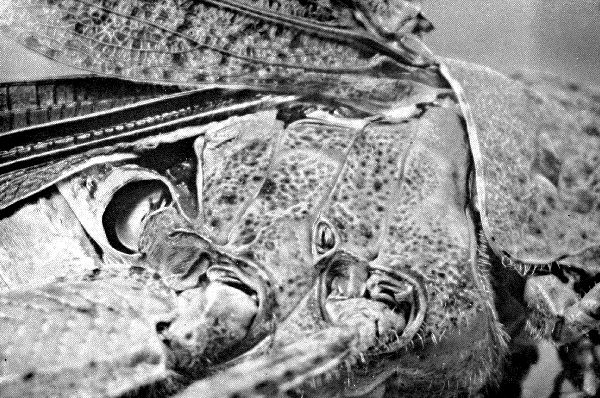
THE GRASSHOPPER’S HEARING ORGAN
(Dissosteira carolina, Linn.)
As we grow older and certain sounds which we heard in childhood with the greatest ease become harder for us to hear and are finally lost to as altogether, we begin to appreciate the relative character of sound. Some boys can hear the faintest twitter of the shyest song bird in the tree tops, while others strain their ears in vain to catch its note.
Is it any wonder then that men should be puzzled to know just what the true grasshopper hears? They know there are males of certain species which sing so loud they make our ears ache, but there are others whose noises, if they make any, have never yet been heard by human ears, and yet they all have these ears. They believe, too, that there are certain sounds the grasshopper can hear without the use of these special ears.
So whether this strange organ furnishes a special means by which the males and females find each other or not, and what part it has played throughout the centuries in the development of this marvelous form of living matter, are things that man may be a long time yet in finding out.
In the photograph it lies to the left, a dark kidney-shaped opening with the ear drum membrane at an angle just inside its rim. It has a well-formed tympanum, and nerves and muscles of a complex nature.
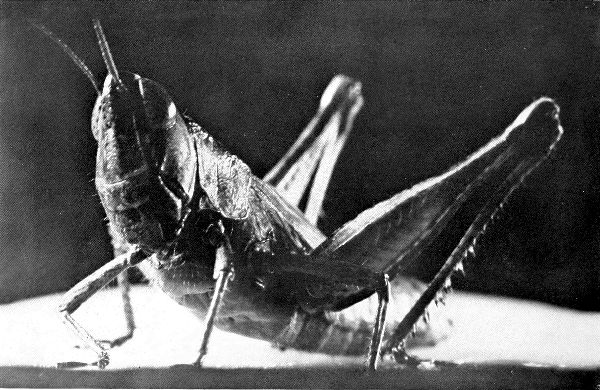
THE SHORT-WINGED GREEN LOCUST
(Dicromorpha viridis, Scudd.)
Whether this creature has a personality or not may be forever extremely difficult for humans to decide. Its eyes that look like cows’ eyes really cast hundreds of images on a special kind of brain, so different from our own that we cannot understand it, and then, besides these great big eyes, it has three others scarcely visible in the picture. Its short-ringed horns are not horns at all, but sense organs of so complicated a nature that we do not yet know certainly whether they are organs of smell or not, and it is supposed that they may be the seat of sense organs that we humans do not have.
The jumping legs of the creature are filled with powerful muscles, which, when they expand, can hurl it through the air and enable it to escape from its enemies. On the inner side of the femur is a musical instrument, a row of hard, bead-like projections, which are very highly developed in the males, but not at all in the females. When one of the veins of the upper wing, which is prominent and has a sharp knife edge, is scraped over these projections, a musical sound is made by the vibration of the whole wing. It would seem to be the case, as with so many of the birds, that only the male can sing, the female being mute.
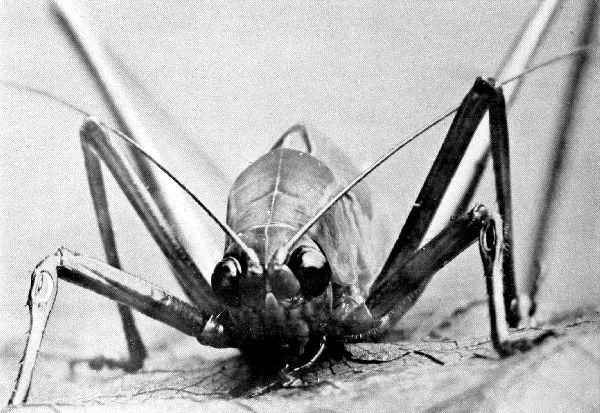
THE KATYDID
(Scudderia sp.)
How marvelously equipped such a creature as this is to live! The great eyes, with many facets, enable it to see by night as well as by day. Its long, slender antennæ catch the faintest odor, and probably are sensitive to a host of perfumes that we do not know. In the front of each fore leg, just below the knee, is a dark, sunken area, the ear, with which it can probably hear sounds too faint for our ears, and by moving them can tell from which direction the sounds come. Its long muscular legs enable it to jump a hundred times its length whereas man can scarcely cover three times his length at a leap. Its wings not only enable it to fly well, but in the males are provided with an apparatus near their base for making a musical sound.
This sound is made by half opening the long green wings and closing them again rapidly.
The left wing bears a file on its inner surface near the base, while the other, the right wing, has a sharp knife edge on the outside just below the file on the left wing. In closing the wings together the knife edge scrapes across the file and makes at least one of the wings vibrate. While the wings are opening no sound is produced; as they close the characteristic sounds so like the words “Katy did” are made.
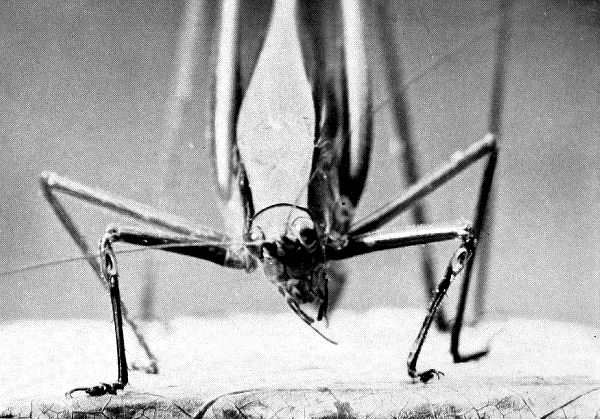
THE NARROW-WINGED KATYDID
(Scudderia sp.)
If it is any comfort for sleepless ones to know it, the katydid is one of the noisiest creatures of its size in the world. It is only the males which call their “Katy-did, Katy-didn’t, she did, she didn’t,” and they are calling to their mates.
There are people who prefer the noises of the street-cars to the noises of Nature, and who complain that the buzz of insect life on a summer evening makes them feel lonesome and unhappy, but to me half the mystery and charm of tropical life lies in the music of the night insects. Our southern states, with their tropical summers, have a wealth of insect life quite comparable to that of the tropics and vastly more varied than that of northern Europe.
The katydid is the greatest songster of this night choir and is a truly American species—as truly a thing to be proud of as the mocking-bird.
Lafcadio Hearn in his “Kusa Hibari” has put us in touch with the soul of a Japanese katydid, and if ours did not have quite so shrill a voice we too might domesticate him, but the idea of caging an American katydid as the Japanese do their tiny-voiced creatures will not, I fear, appeal to the average American citizen.
The male of this species sings sometimes by day as well as by night and has different calls for day and night.
The female lays her eggs in the edges of leaves, thrusting them in between the lower and upper cuticle, and from these hatch out the wingless, long-legged green creatures which are hopping everywhere about the grass in early summer.
They are borne for the summer season only, and with the frosts of winter they all die off. Nature seems to make just as complicated a being whether it is to last a score of minutes or a hundred years—one season or a hundred is all the same to her.
Just why the katydid should want to hear its own song some city people may wonder, but it is evident that he does, for just below each knee, on his foremost legs, is to be found a well-developed ear with a tympanum which probably vibrates much as ours do.
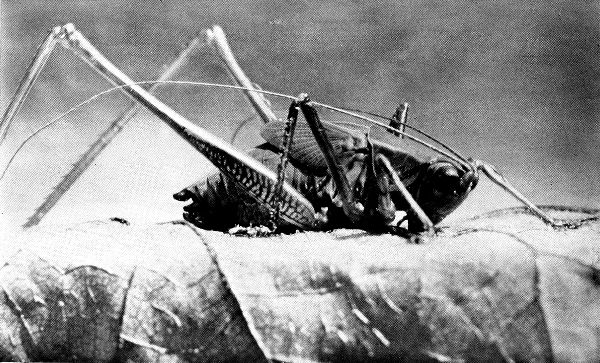
A YOUNG KATYDID
(Scudderia sp.)
It is doubtful if there are any animals so largely legs as the young katydid. It cannot fly yet, for the wings upon its back are still too small to carry it through the air, but it can escape from its enemies by jumps which put those of a gazelle or a kangaroo to shame. The muscles in its legs are like our own muscles so far as can be determined, except that they are attached to projections on the inside of a skeleton which encases them all, instead of being attached to the outside of a skeleton which they themselves encase, so when a katydid jumps one cannot see the muscles move as one can those of a horse.
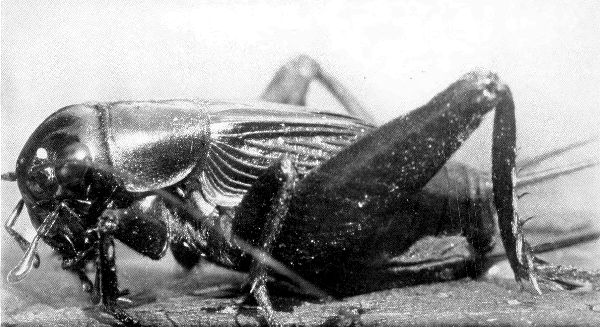
THE CRICKET ON THE HEARTH
(Gryllus pennsylvanicus, Burm.)
Through the ages, who knows if not from the times of the cave-dwellers, this friendly visitor of the fireside has rubbed his rough wings together over his head and sung man to sleep. The European form seems quite as domesticated as the cat or dog, leading nowhere a truly wild life, and it may be questioned whether any living creature has become more a part of human life than the cricket on the hearth.
The carrying power of their song is extraordinary; there are species whose strident notes can be heard for a mile, although their little bodies are scarcely more than an inch in length. The males alone are musical, and it is reasonable to suppose, since the females have ears in their fore legs, that they are singing to their mates and not to mankind.
As one listens to their friendly song it is hard to appreciate what fighters they are among themselves, the larger ones even turning cannibals when food is scarce, although a glance at the photograph shows how well equipped they are for battle. Their great black eyes, only shinier black than their coal-black armored necks, their jointed palpi with which they feed themselves, their thick, leathery wings pressed against their sides like a box cover, and their strong, muscular, spiny hind legs, with which they jump a hundred times their own length, do none of them contribute to beauty, though quite in keeping with their armored war-horse appearance.
Two long, flexible circi protrude like tails behind, but the task of finding out what they are for has been too difficult for man. Perhaps the strange nerve-ending hairs which they bristle with may be sensitive to vibrations of the air, of which we yet know nothing.
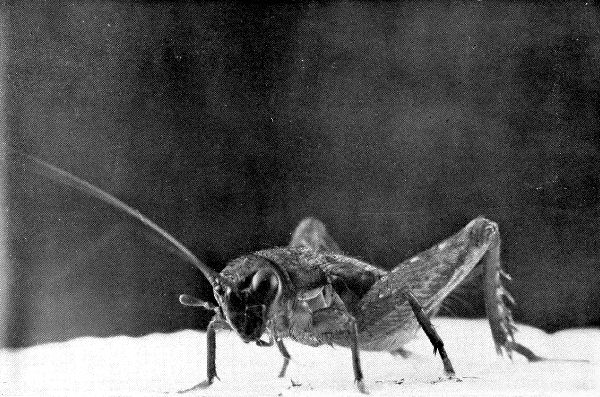
THE GROUND CRICKET
Unlike its jet black relative of the fireside, the striped ground cricket forages by day on grassy slopes. It is a more omnivorous scavenger than the hyena, for it eats decaying plants as well as animals.
Its big brown eyes, which cover half its head, see, doubtless, many ways at once, and its long, whiplike antennæ, which it waves constantly as it springs through the grass, are believed to scent odors which are inconceivably faint, such as the odor of a blade of grass, a pebble, or a decaying leaf.
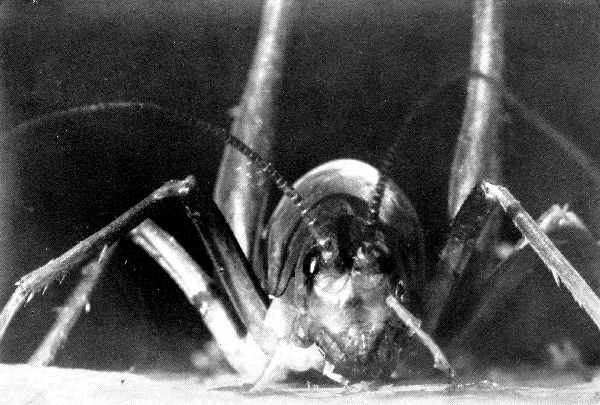
THE STONE OR CAMEL CRICKET
(Ceuthophilus uhleri, Scudd.)
It would not be a good idea to let the children think that creatures such as this were prowling round the house at night—that is, unless you assure them that it is only a harmless, tawny yellow stone-cricket from the shady woods, where it generally hides under stones and damp, decaying logs.
It seems strangely equipped for its night life, for it has antennæ as long as its body. I cannot help wondering if these help it to jump in the dark. Fabre, the great French entomologist, has tried, as others have, to find out just how the insects use their antennæ and what they are really for. He says at last, “our senses do not represent all the ways by which the animal puts himself in touch with that which is not himself; there are other ways of doing it, perhaps many, not even remotely analogous to those which we ourselves possess.”
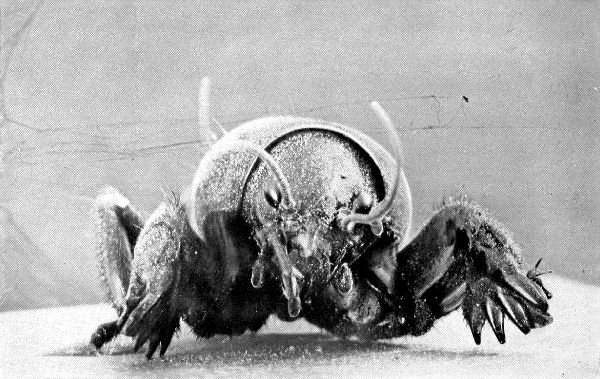
A MONSTER OF THE UNDERWORLD: THE MOLE CRICKET
(Gryllotalpa borealis, Burm.)
The creatures of the air which hide away their eggs that their larvæ may hatch out underneath the ground must reckon with this burrowing beast.
All his life long he tunnels beneath the ground from place to place. When you think of how long it would take you, even with the best tools, to dig a hole in the ground big enough to crawl into, you will get some idea of the power which these two front legs, four-pointed like a spading fork, must have, to enable such a creature to disappear into the ground in a few seconds as he does. These paws, proportionately many times more powerful than bears’ paws, are snippers too, for moving back and forth behind them is a sharp-edged instrument which, like the shuttle-bar on a mowing machine, shears off the grass roots which interfere with the mole cricket’s progress through the ground. The poor defenseless angleworms must fall an easy prey to such a foe as this!
Upon the first joint of each clumsy front leg, it has a narrow slit-like ear which is but faintly visible in the photograph. Can you imagine a male and female calling to each other through the long and winding passageways beneath the ground? Possibly they call to each other only in the night-time, on the rare occasions when they venture out above the ground.
He is a curious creature with eyes that are only rudimentary and a noxious smell that he emits if he is touched.
The female excavates a chamber near the surface of the ground and lays her eggs in it to be incubated by the sun’s heat, as are most insects’ eggs.
For some time it was supposed that both parents devoured their progeny, as many as 90 per cent being eaten up, but a French observer, Monsieur Decaux, has found that the male alone is the cannibal and the mother, far from doing this, watches over them and when they hatch she feeds the little ones with bits of plant roots, earthworms and the larvæ of various insects.
The discovery of one of these mole crickets is really an event. Most people see but one or two in all their lives. In Porto Rico, however, there is a form with longer wings which eats the roots of sugar cane, tobacco and other crops so that the “changa,” as it is called, is considered the most serious insect pest in the island.
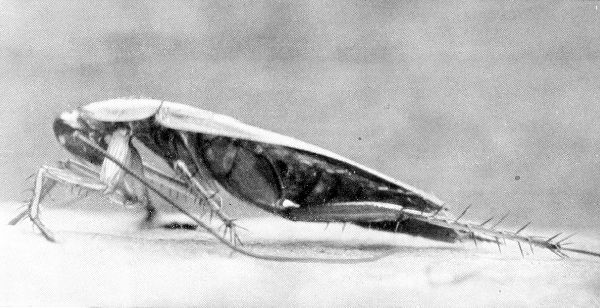
THE COCKROACH
(Blatella germanica, Linn.)
In carboniferous times this was a dominant creature, crawling over the giant club mosses and tree ferns which composed the marshy vegetation of the young world. Today it crawls over the cracker-box and makes its way through every crevice in the kitchen and is, of all the creatures of our houses, the most detested. This is the German cockroach, an importation from Europe, which has spread around the world, and which New Yorkers know as the croton bug.
Its long, spiny legs are built for the scurrying for which it is noted, while its slippery body enables it to squeeze through crevices and holes. It carries its head tucked under its body, as if looking for food, and its whiplike antennæ, always in motion, detect at long range the presence of anything edible which can be crammed into its capacious crop.
Housewives may be surprised to learn that a cockroach can live five years, and that it takes a year to develop to maturity from the egg. The female lays her eggs in a horny capsule, like a spectacle case, which she carries about with her until she is ready to deposit it in some suitable place. Later she returns to help her cockroach babies out of their shells.
Like the cricket, cockroaches love the night and shun the daylight. They cannot tolerate cold weather, and though there are 5,000 species they mostly inhabit the tropics, where they are the plague of domestic and ship life. It is said that “ships come into San Francisco from their long half-year voyages around the Horn with the sailors wearing gloves on their hands when asleep in their bunks in a desperate effort to save their fingernails from being gnawed off by the hordes of roaches which infest the whole ship.” (Kellogg.)
And now a rumor comes to us that the cockroach carries cancer.
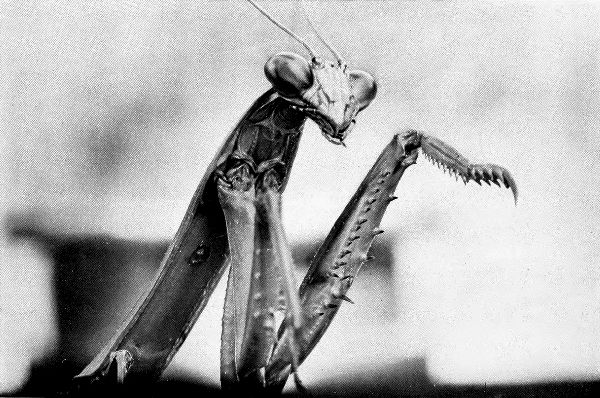
A DEMON FLY KILLER: THE PRAYING MANTIS
(Paratenodera sinensis, Sauss.)
Its spiny fore legs are built to hold the struggling flies, while, with its sharp jaws, it tears them to pieces much as a hawk or eagle holds its prey with its talons and tears it to shreds with its beak. It is wasteful, too, of its food, as wasteful as the sea lion, or the seal, throwing away the half-consumed carcass before it is finished and pursuing another victim.
So voracious is its appetite and so successful is it as a hunter that Doctor Slingerland of Cornell has introduced the eggs of a species of this mantis from Europe and distributed them among his friends in the Northern states as a beneficial insect.
To kill a praying mantis has been in Mohammedan countries almost as great a crime as it is to kill an albatross at sea, but this was not because it kills the swarms of flies so common in those lands, but rather because of the prayerful attitude made necessary by its fiercely spined and powerful front legs.
Its head is so loosely set on its long neck, or thorax, that it can move it from side to side with the greatest ease. Fabre declares that “the mantis is alone among all the insects in directing its attention to inanimate things. It inspects, it examines, it has almost a physiognomy.”
Perhaps one is warranted in having a feeling of repugnance toward the mantis, for no other living creature has more horrible habits. There has always been something horrible about the cannibalism of human beings who ate their enemies killed in battle, but this has never seemed so revolting as the practice of the Fijians who killed members of their own tribe in cold blood for purposes of the cannibal feast. The female mantis goes a step farther than this, for she begins eating her lover even before the courtship is over.
There is nothing about the spiders, terrifying though they must appear to their defenseless prey, to indicate that they try consciously to frighten their victims, but the mantis, by spreading out its wings and curling up its abdomen, and raising its talon-tipped, spiny legs, seems to deliberately petrify with terror the cricket or grasshopper which comes within its reach.
THE ORDER OF THE BUGS
(Hemiptera)
How blind mankind must seem to the insect world! To look at beetles with their massive jaws and armor-plated bodies, or flies with their gauzy wings, or grasshoppers with their long jumping legs and then class them all as bugs, must seem to them incomprehensible, for to be a bug, an insect must have a sharp pointed beak, whatever else it has. It may or may not have wings, it may have a larval stage or it may not, but if it hasn’t a beak and can’t suck then it can’t be classed as a true bug.
These sucking insects of many shapes, although directly connected with the welfare of the human race, have been, until recently, the least known of the great orders of insects.
To this order belong the chinch bugs, the cause of an estimated loss to the grain growers of twenty million dollars a year; the great Phylloxera, which destroyed the vines on three million acres of French vineyards, and the San José scale, which has spread during the past ten years through every state and territory in the United States and become a menace to the fruit-growing industry.
It is of this order of the insect world that David Sharp remarks “... if any thing were to exterminate the enemies of Hemiptera we ourselves would probably be starved in a few months.” It does seem strange in face of all these statements of authority that our best friends, the insectivorous birds, are being killed out for lack of forest refuge. We spend millions to fight the pests when once they get the upper hand, but pay little or no attention to the comforts of those tireless workers, the birds, which would keep them down.
I am ashamed of such a fragmentary picture showing of this most important order, and hope someone will follow on with a bug book which will do the subject justice.
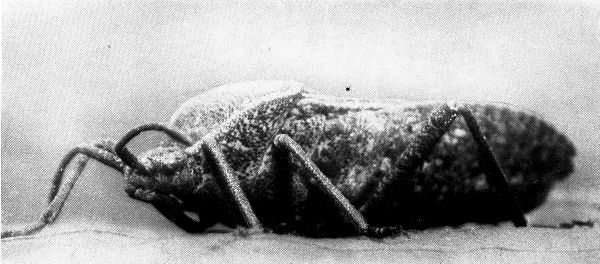
THE SQUASH BUG
(Anasa tristis, De G.)
The smell of the squash bug is known to every country boy. The odor is emitted through openings in the abdomen from special stink glands, which vary with each species.
The tough external skeleton explains, perhaps, why no spray is strong enough to kill the fully grown insects without also injuring the young squash and pumpkin vines, and why the best method of prevention consists in screening the young plants with a wire screen until they have grown large enough to be immune from attack. If you can find the young insects which are not yet encased in such a hardened shell, spraying with a 10 per cent kerosene emulsion will stop up their breathing pores and asphyxiate them.
The one in the picture is an old specimen, preparing to go into winter quarters under the leaves and wait for the tender squash and pumpkin vines to appear above the ground next spring.
It is surprising how quickly they find these juicy shoots, which they pierce with their sucking beaks and upon which they lay the eggs which in a few days hatch out into a brood of small but voracious squash bugs.
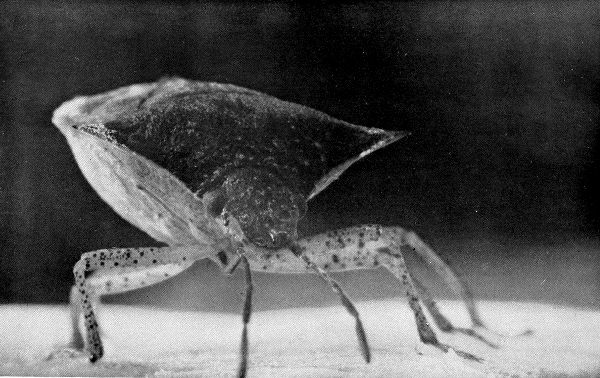
A STRANGE-SHAPED BUG
(Euschistus tristigmus, Say)
A strange-shaped bug walked into the laboratory to have his picture taken, not willing, evidently, that he should be left out of the collection. The handbooks on entomology which I possess seem not to have heard of him. He is just a common, ordinary bug, but he, doubtless, has an interesting life for all our scorning of his acquaintance.
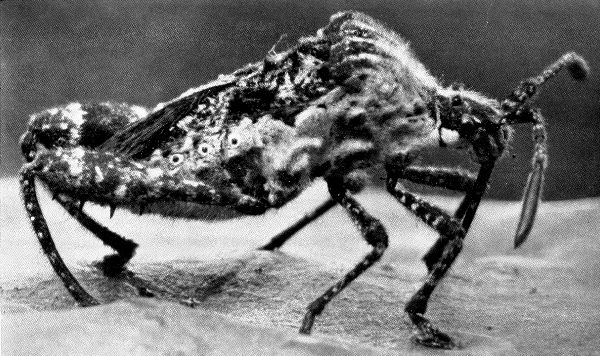
A QUEER, UNWORLDLY MONSTER
(Corynocoris distinctus, Dallas)
Could anything be more antediluvian and unworldly than this old, broken-down creature, with six crooked legs, a pair of popping-out eyes, two shining ocelli which look straight up into the air, and a long, stout beak that is partly hidden behind one of the fore legs?
A discussion of how such a fright of a thing came into existence leads one into the realms of evolutionary science, and there we should perhaps find it suggested that it is so ugly and looks so much like the bark of the trees on which it roosts that birds have passed its ancient forefather by, and through the weird workings of that little-understood law of heredity this thorny, spotted creature has waddled along year after year, keeping up in the race for hundreds, perhaps thousands, of centuries. I cannot help exhibiting a little of the showman’s pride in it; for, as Barnum would say, this is positively the first real appearance of this century-hidden, hoary monster before the everyday public.
According to the books, this species belongs to a strange family, in which are even more remarkable-looking creatures. They are all, however, characterized by having the femora of their back legs covered with knobs or spines. One of the species is so spiny all over its back that the male makes use of it to carry around the freshly laid eggs of the female.
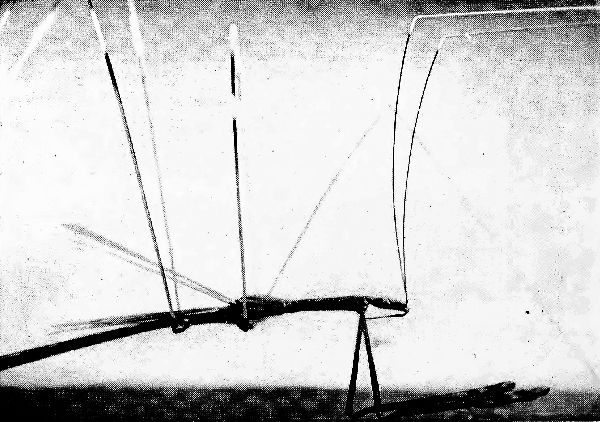
THE THREAD-LEGGED BUG
(Emesa longipes, De G.)
When you consider how slight a jar of a spider’s web will bring its maker running swiftly across the web, it is interesting to be told that this thread-legged bug has the temerity to pick off insects from a spider’s web. It is plain that he stands on stilts, and with his powerful tong-like front legs, which end in spiny gripping hands, he must, I imagine, reach out across the web and pick the smaller insects from it, for he is much too small and weak and incredibly fragile to fight a spider on its own web.
Even to someone fairly familiar with the insect world he might easily be mistaken for a mantis, but his short, sharp beak, bent backwards under his chin, puts him among the bugs, where he takes his place beside the assassin bugs.
In one form of thread-legged bug in South America, it is said that the young larva is so long and slender that it curls itself around the mother’s body and is carried about with her, papoose-like, on her back.
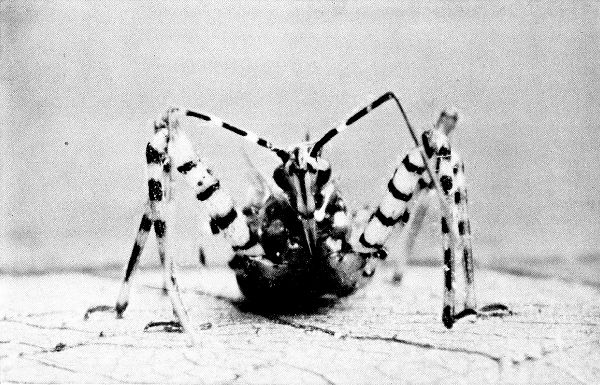
THE ASSASSIN BUG
(Pselliopus cinctus, Fab.)
The human species puts its assassins into striped clothing and it is a rather curious coincidence to find in the insect world an assassin bug in convict’s stripes.
I think no visitor to our portrait gallery has seen a more fantastic being than this little bow-legged beast. Until I found out what he was, I could not understand his rank impertinence, for he stalked leisurely about as though afraid of nothing.
I wonder if he has a nasty flavor and advertises the fact by his curious coat.
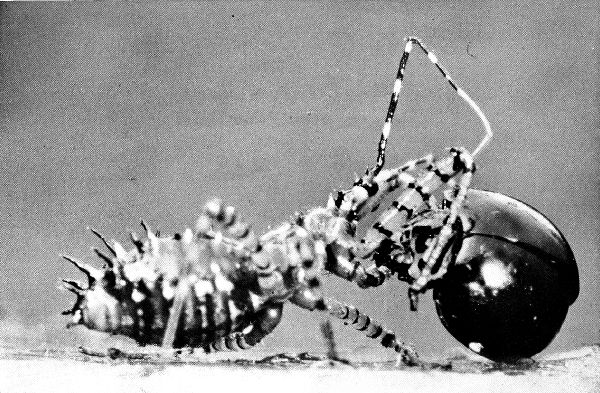
AN ASSASSINATION
(Pselliopus cinctus, Fab.)
I once took a photograph, without realizing it, of some Arab women at the gates of Bagdad, trying to assassinate an old man; and I cannot pass the picture in my album without shuddering.
This photograph affects me in the same way, for it, too, is of a real tragedy and portrays the death of a ladybird, one of the few friends man has in the whole order of beetles, and that, too, at the hands of a member of the order of bugs, the most destructive order of our insect pests.
It must be admitted that, as things go in Nature, the ladybird has met her just fate, for she has spent her life devouring bugs, the sucking aphids and scale insects of our rose bushes and cherry trees. Somehow the old nursery rhyme of
“Ladybird, ladybird, fly away home, Your house is on fire, your children will burn,”
seems to have endeared to us all this beneficent little beetle which wanders everywhere, cutting short the lives of the sap-sucking insects that deform and injure our plants, and it does not seem to matter that this particular assassin bug preys upon our enemies as well as on our friends. To find this convict striped, spiny bug, with its beak buried to the base in the vitals of the ladybird, and realize that it had first poisoned its victim with poison saliva and was now sucking its blood, rouses a peculiar feeling of hatred towards this hideously ugly creature. Perhaps this is heightened by the contrast between the pretty, trim form of the ladybird and the ugliness of the assassin bug.
I was puzzled to know how a creature so nearly armor-clad could be successfully attacked by a soft-bodied bug of such deliberate habits of movement. How the start is made I do not know, but it is evident that between the base of the wing covers of the ladybird and her neck or thorax is a weak spot in her armor and the assassin thrusts his beak into this crack.
There are members of this assassin bug class which do not hesitate to attack little children in the South, and produce nasty wounds with their poisoned beaks.
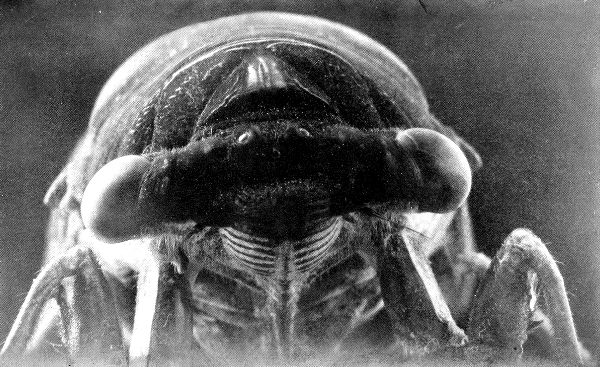
THE CICADA
(Cicada sayi, Grossb.)
The coming of the swallow is scarcely more significant to Americans of the Southern states than the arrival of the cicada. Its song is the noisiest song in the insect world, and is made in a curious way, by the stretching and relaxing of a corrugated drum-like membrane in the side of the abdomen by means of specially strong muscles. The sound is controlled in rhythmic cadences by means of semicircular discs or covers to the drums, which can be closed and opened at the will of the insect.
This noisy song, which the male alone can sing, he doubtless sings for his mate and not for us, although entomologists are not agreed as to how his partner hears his song, as she seems to have no ears. Although this is the photograph of a two-year cicada the story can be told here of that weirdest of all the insects,—the Rip Van Winkle of the insect world, as David Sharp has called it,—the seventeen-year cicada.
From a tiny egg laid by its mother in a twig of your back-yard shrubbery there issues a creature which is as unlike this monster as it can be, with soft, white body and mole-like front legs. It hurries to the ground and disappears beneath its surface sometimes to a depth of a hundred times its length—twenty feet it is said. For seventeen years it digs its way around in the absolute darkness of this underworld, and then, as though by some prearranged agreement, it comes to the surface to join in a marriage revelry of a few brief weeks in summer with its kinsmen of the same generation who disappeared as it did into the darkness seventeen years before.
Most insects live for a few months only, and one, indeed, the male at least, for only fifteen or twenty minutes; but the seventeen-year cicada, the oldest of the insect world, lives as long as a cat or dog. But what a life! Seventeen years of it in the dark and a few weeks in the sunlight. And yet, compared to the life of an angleworm, condemned to the darkness forever, what an interesting career!
When the cicada’s shrill song disturbs you, then remember how brief is the pleasure of its existence.
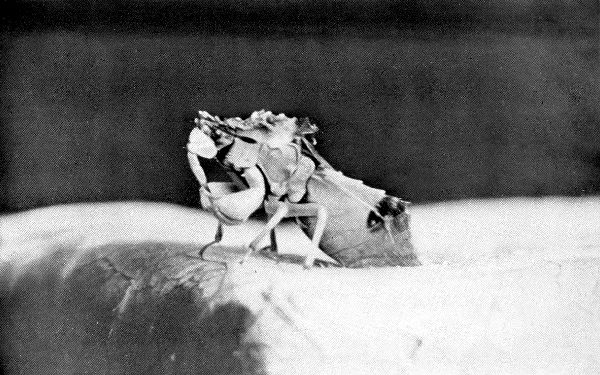
THE AMBUSH BUG
(Phymata pennsylvanica, Handl.)
We are personally so afraid of a bee’s sting that it is hard for us to believe that any mere bug exists which is strong enough to overcome and kill a wasp or honey bee. A look at the thick armor of this creature and its powerful, black pointed beak will go a long way towards convincing one that this may be such a bug; it has a close relative, anyway, which does so. Its front legs have been developed into enormously strong claws with which to catch and hold its prey.
It lurks in flowers and preys on honey-sucking insects, and one can easily imagine the unequal struggle between it and a butterfly, or realize that it might come off victor in a fight with bees or wasps.
There are such romantic scenes and bloodcurdling spectacles to be observed in this world of insects that I cannot understand why there are so few who, having ample time, have not the patience to sit and watch them as Fabre and others less well known have done.
No schoolroom training in observation can compare in value with the outdoor observations of living insects. To look and wait and think and try to understand; what habits of observation, perseverance and reflection these actions cultivate!
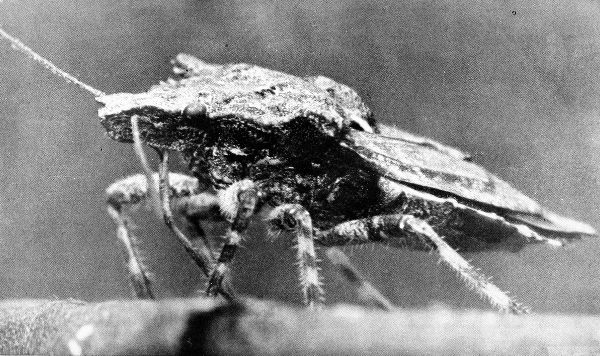
A BUG THAT IS ALWAYS WALKING AROUND
(Brochymena arborea, Say)
No photograph in the collection illustrates better the marvelous variety of form which abounds in the jungle of our back yards. To the naked eye all the interesting details are invisible and one’s hand instinctively brushes the intruder from the table where it has crawled in to take a look at a human being.
The spotted, crablike legs, covered with bristles, the beadlike facet eyes, the oyster shell shaped body, the moving antennæ all covered with white scales, the curious trunk or sucking pipe descending from the chin, give to the creature a personality which combines something of the wistful with the curious. And yet this is, as my friend Dr. Schwartz says, “just one of those bugs that is always walking around on our plants and nobody seems to know just what it is doing.”
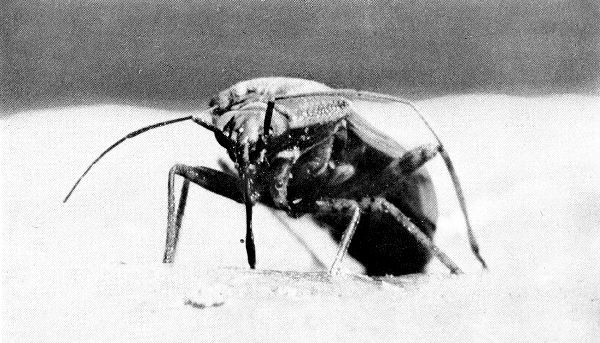
THE TARNISHED PLANT BUG
(Lygus pratensis, Linn.)
If you have ever carefully tended young vegetable plants, set them out by hand and watched over them, you will certainly have made the acquaintance of this vicious little creature a quarter of an inch long. At least you will have found where he drove his proboscis and sucked the juices from your tender plant, leaving his irritating fluids behind to distort the tissues of the leaf or bud. He lives in the rubbish which was left littering up the garden and is waiting now for spring to come when he will make his appearance and do whatever damage is necessary for his existence. You cannot spray him with kerosene for he is too agile, skipping away from you in the sunlight, but when his mate lays her eggs, and the young nymphs with wingless bodies crawl about, you can kill them with a dose of kerosene oil emulsion which will close their breathing pores and suffocate them.
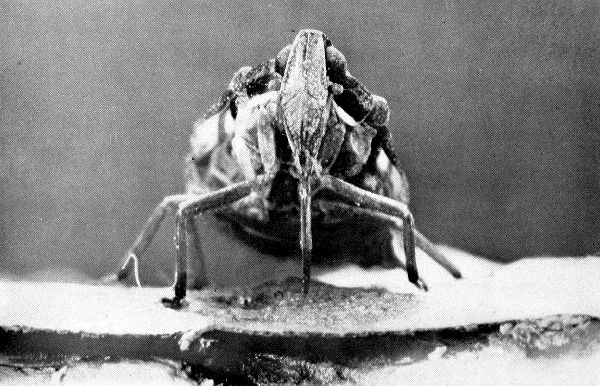
THE LANTERN FLY BUG
(Helicoptera variegata, Van D.)
This creature belongs to the family of lantern flies and is also related to the little leaf hoppers which one startles from the grass by the hundred in walking across a lawn or meadow.
It is a small, grey bug, not a quarter of an inch long, and quite insignificant when looked at with the naked eye, yet it is quite as strange in form as any of the prehistoric monsters.
Its powerful beak is made up, as are the beaks of all the great order of sucking insects, of four hairlike bodies, four fine, flexible, closely connected rods enclosed in a narrow groove and sharp enough to puncture the skin of a succulent young plant. Not only are these hairlike rods as sharp as needles, but the outer pair are usually barbed so that, once introduced, a hold is easily maintained.
Under the throat is an organ of the nature of a force pump which injects an irritating fluid into the plant. It is supposed that this gives rise to an irritation or congestion of the plant tissue, and thus keeps up a supply of liquid food for the bug at the point operated upon, which, rising by capillary attraction along the grooved rods, finds its way into the stomach of the insect.
That these leaf-sucking insects inject a poison is shown by the way in which the punctured leaves curl up, turn brown and die.
THE BEETLES
(Coleoptera)
Beetles are distinguished from the other orders of flying creatures by having the first pair of wings changed into shells under which the other pair can be safely folded and laid away. You can usually recognize them when they spread their wings to fly, for they have to raise their wing covers in order to do so. Also they generally have prominent jaws, as they are biting creatures and do not suck the juices of plants and animals as the bugs do.
Beetles are almost everywhere. You cannot turn over a stone or break down a stump or roll over a log without disturbing some of them, and yet perhaps less is known about the lives of beetles than about those of any other of the great orders of insects.
They lead two lives, distinct as two lives can be: one in the form of a grub, the other as a full-grown beetle. To make the transformation, they burrow into the ground or into the wood of trees and but rarely make for themselves silken cocoons such as the butterfly larvæ spin.
They do not lead so aerial an existence as some other orders, but, nevertheless, they are today, perhaps because of their closely fitting outer shells, the predominant order of insects of the present epoch and already there are known the bewildering number of 150,000 species. In North America alone (Mexico excepted) 12,000 species have been described and these have been grouped into eighty families and 2,000 genera. The general public is beginning to realize that not everyone can be an entomologist, and that the quality of brains and training required before one can travel safely among this maze of forms and distinguish between the friends and foes of our agriculture is a quality of the greatest value to mankind.
So far as man is concerned, this gigantic class of creatures is among the most destructive with which we divide life on this planet, and though there are beetle friends which help us by preying on other beetles and by making humus out of leaves and twigs, and by feeding millions of our song birds, yet, as a whole, they represent a restless, armored multitude which perhaps we should be just as well without.
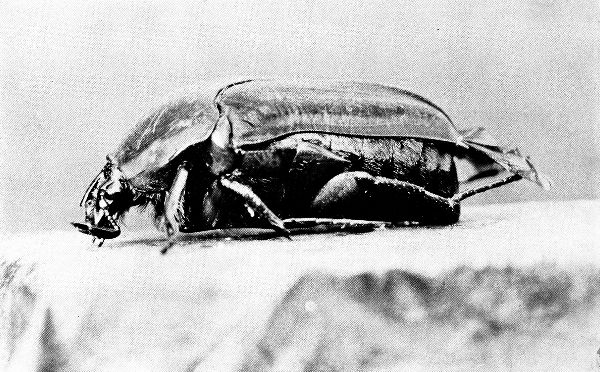
THE JUNE BEETLE
(Allorhina nitida, Linn.)
In looking at these two strange beings (this picture and the next), we cannot feel confident that science has gone very far in giving us the reasons for the things we see. They seem no more alike than fish and tortoise or bird and quadruped and yet, before our very eyes, in one brief year, the one turns into the other.
This beetle dies, and leaves behind a hundred little cells, parts of its own body and the body of its mate. These paired cells, the fertilized eggs, grow rapidly into the form of the clumsy, helpless grub which feeds upon the leaves, only to break up and form themselves again into this armor-plated creature of the beetle world.
There must be something as radically wrong with our individualistic ideas of today as there was with the conception of a flat world which prevailed before the time of Columbus. Perhaps if we stop trying to think of these manifestations of beetle life as individuals and think of them as parts of one great organism scattered over the surface of the earth, these striking differences will seem no stranger to us than do the differences in the various stages of a flower’s life. The beetle forms inside the grub and the tulip flower bud forms inside the bulb. If tulip flowers could fly, we should then have the strange spectacle of the opening of the scale-covered tulip bulb and the coming forth of the gorgeous colored flower which sailed away to shed its seeds in someone else’s garden. I think that this is the way we must look at it if we would get a clear idea of this strangest of phenomena,—metamorphosis.
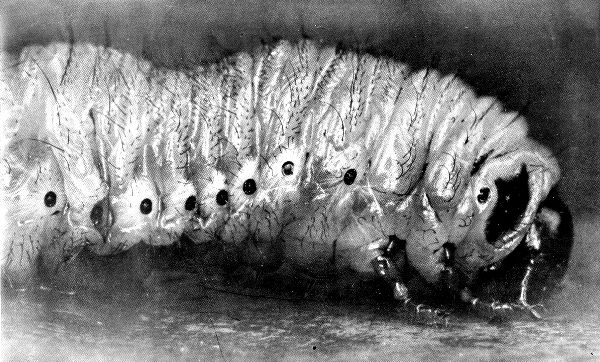
THE JUNE BEETLE LARVA
(Allorhina nitida, Linn.)
How is it possible that this fat creature, with eye-like breathing pores along its body, whose legs are worthless, and which is so helpless that it has to turn over on its back to wriggle over the ground, can change into the emerald-green June beetle which wings its way like an aerodrome across the meadow? This is the apparent miracle of metamorphosis which it has well-nigh baffled the intellect of man to explain.
Though the reasons for it are still unknown, modern research has shown us how this incredible change has taken place.
When this creature, which has grown a hundred times its size since it was born, has reached the age for this great change, it doubtless feels the impending transformation coming, and instinct tells it to crawl away into some protected nook or corner and pupate underneath the protection of a silken coverlid of its own spinning.
The change begins; each organ goes to pieces, disintegrates, becomes a mass of disconnected cells, so that the body filled with these, becomes, as it were, a bag of mush. This mushy fluid has been likened by entomologists to the disintegrated tissues which inflammation causes in our own bodies. If, then, you should slit it open at this stage, you would find no alimentary canal, no salivary glands, no muscles, simply a thick fluid, with here and there a thicker lump, that is attached at certain places to the inside of the sac wall. These lumps are formed of groups of active cells which were not disintegrated in the general breakdown of the muscle tissue, and these form the nuclei around which the new creature is to be built. These groups of cells grow rapidly, feeding on the fluid mass of broken-down tissue much as a young chick inside the egg feeds on the yolk, and builds up the whole complicated structure of the winged beetle, which seems to have no possible relations to the white grub out of whose body it was made.
It is as though the insect hatched twice, first from the almost microscopic egg its mother laid and from which it emerged as a tiny little creature in the image of this grub, growing and manufacturing from the leaves it eats enough nitrogenous matter so that when it emerges again from the yolk-like substance of its cocoon it will be a full-grown beetle, for it must be remembered that once made the beetle never grows.
This wonderful process is the same which is gone through by every flying insect that has a grub or caterpillar stage.
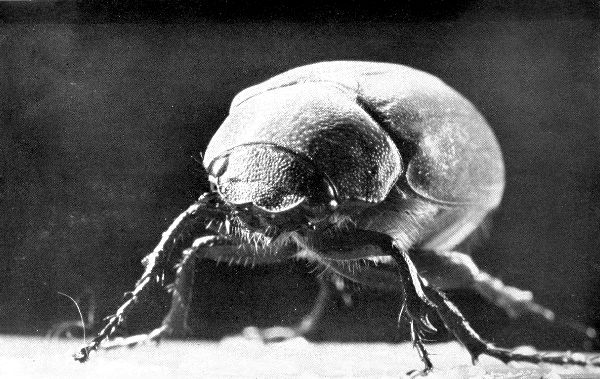
ONE OF THE JUNE BUGS OR MAY BEETLES
(Lachnosterna quercus, Knoch)
Of the wild creatures of our back yards, none is better known than this hard-shelled buzzing creature, which whirs into the circle of light around your lamp and commits suicide, if you will let it, by flying into the flame.
It is one of the so-called June bugs, or May beetles, which every boy and girl knows, and is not the June beetle of which the larva was shown previously.
Its hard, pitted skeleton covers it completely, and it is most interesting to watch it open its wing covers with great deliberation, unfold the wings which are carefully stowed away beneath them, and holding its wing covers elevated so they will not interfere, start the transparent wings into motion and fly away with the whir of a miniature aerodrome. Indeed, it was this resemblance which caused the members of the Aerial Experiment Association to name one of their first aerodromes after it, and the first trophy ever given for an aerodrome flight was won by Curtis’s “June Bug.”
This creature’s first life is spent beneath the sod of your lawn, where it curls up around the roots of the grasses and clover and other plants which you do not want it to eat, and the first year of its subterranean existence it is the white grub, with the brown head, which everybody knows. At the end of the second summer of its life it changes to a soft brown beetle, which throughout the winter is hardening its shell preparatory to coming out in late spring as a winged creature to feed upon the leaves of trees. The beetle which is walking toward you lives upon the oak.
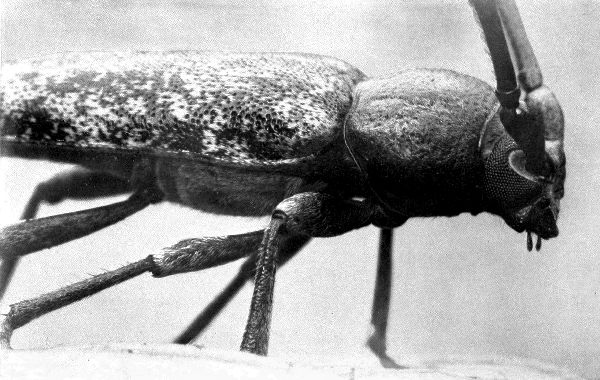
ONE OF THE TWIG-PRUNERS
(Elaphidion atomaricum, Dru.)
The long-horned beetles, as they are called, are remarkable for the length of their antennæ and for their eyes of many facets, which almost encircle the antennæ at their base. They have, like other beetles, two lives, so to speak, and their grub-life is spent inside some twig or branch, burrowing and living on the juices which their stomachs extract from the sawdust made by their jaws. They kill the twig they burrow in, so that the wind blows it to the ground, and they go through their transformation on the ground. The story is told of a long-horned beetle, belonging to a different species, that lived for years in its larval stage, burrowing patiently into the dry wood of a boot-last or shoe-stretcher, trying vainly to get enough nourishment out of it to make a beetle of itself.
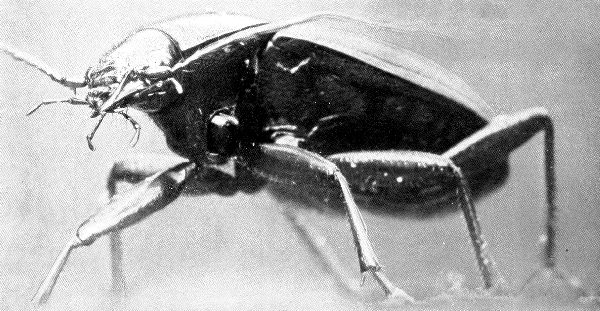
THE PREDACEOUS GROUND BEETLE
(Chlænius æstivus, Say)
This creature almost anyone will recognize as a beetle. It is built for running, and its jaws are made for fighting. You have only to catch one and watch it open and shut its jaws to realize that it would bite you if it could. But for all that it is a great friend, for it is what the entomologists call predaceous, and at night or at twilight it hunts everywhere for the larvæ of insects which attack the plants we live on. In its larval state, in which it looks for all the world like a centiped without the “ped,” it burrows in the ground in search of the plant destroyers, which think to escape notice by getting under the cover of the soil. It is by nature, then, opposed to the vegetarians, the herbivores, and hunts them wherever they are likely to occur.
When you see a black or dark-brown beetle running swiftly from under some stone or log whirls you have just turned over and which makes faces with its jaws as though it would chew your fingers when you pick it up, you can be quite sure in eight times out of ten that it is one of these carabidæ or predaceous ground beetles, and if you let it drop from your fingers you may be saving the life of a friend, because some day it may eat the worm which, lying close to some pet flower of yours, had planned to cut it off beneath the ground.
It is one of the hardest things in all the world to understand how balanced is this scale of foe and friend. One year there is a wiping out of our insect friends through frost or floods or microscopic disease, and, freed thus from the check which kept their numbers down, the foes to our plants can multiply to such an extent that nothing we can do will save our crops from total failure. Next year, perhaps, the parasitic beetle, finding such a wealth of food to live upon, increases and holds well in check the pest which last year ate up all our plants. Each wave of insect pests could be explained, no doubt, if all the facts were known, and nowadays no one who knows what modern agriculture means will fail to reckon on the risks from losses caused by these pests.
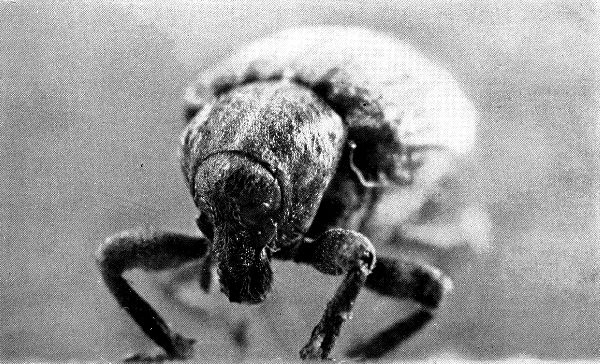
THE CLOVER LEAF WEEVIL
(Phytonomus punctatus, Fab.)
Could anyone suspect this modest antediluvian creature coming toward you out of the gloom, hanging his head, as it were, of any designs against anyone? He has them, however, and if you will examine your clover leaves in June you will find them scalloped with irregular patches eaten out of them. It would be easy for him to prove an alibi, since it is his other self, his larval existence, which does it and does it at night, too, coming up out of the base of the clover plant where it hides during the daytime. Occasionally in August he can himself be seen feeding on the clover leaves. In his two existences he manages to do a good deal of damage to the clover fields of the farmer, necessitating the plowing up of old fields when he becomes too numerous.
But let us look at the company he keeps. He is in the same class with the alfalfa weevil which came over from central Asia recently and spread through the alfalfa fields of Utah, threatened the alfalfa growers with ruin and set the Entomological Bureau of the Government out on the trail of some parasite, some enemy of his which they were sure must have held him in check in his native land. If you could have heard the conferences which were held and the drastic measures relating to traffic which were proposed you would realize that it is no child’s play to fight the Asiatic relative of this modest-looking creature.
But it has in this country worse relatives even than the alfalfa weevil. It is related to the cotton boll weevil, which has brought thousands of families in the South to the point of starvation and drawn millions of dollars from the federal treasury of the country in an effort to fight it and lessen its ravages throughout the cotton belt of the Southern states. Thousands of lectures are being given to tell the farmers what its habits are and how it can be prevented.
It has other more distant relatives which live in the forest trees and make wonderful burrows which look like hieroglyphics. As that remarkable entomologist, Hubbard, discovered, they are cultivators of microscopic mushrooms as wonderful as those of the mushroom nests of the atta ants or the termites of the tropics. Incidentally, and this is the important point, they kill the trees, fires start in the dead trees, and it is estimated roughly by Dr. Hopkins, the Forest Entomologist, that they destroy over a hundred million dollars’ worth of timber annually or, at least, are one of the principal causes of this gigantic loss.
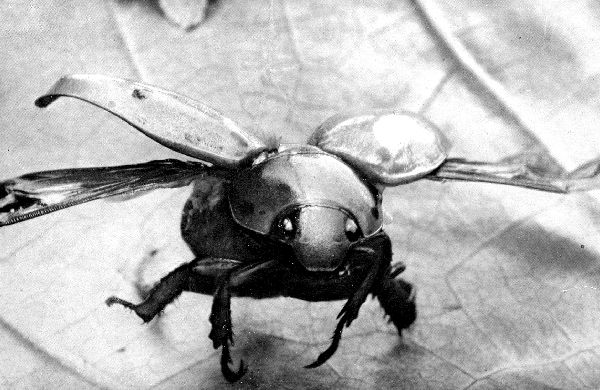
THE SPOTTED VINE CHAFER IN FLIGHT
(Pelidnota punctata, Linn.)
How often one sees lame butterflies limping along in their flight, because their wings have been injured by the rose bushes or by striking against the pine needles or have been nipped by some hungry bird. The beetles, when they alight, carefully fold up each delicate wing, close down over them polished covers as hard almost as steel and fitting as closely as the engine covers of an automobile. Whether these wing covers act as aeroplanes or as rudders for the beetles when in flight is as yet unknown. There are strange, almost microscopic, markings over the surface of these wing covers and in some species there are glands inside them which secrete a fluid which reaches the surface through minute pores, but the use of this fluid we are still unable to discover.
It seems likely that the discovery, if we may so term it, of these wing-protecting shells, has been of tremendous advantage to the class of organisms where it first appeared. At any rate, among the insects the order of beetles (Coleoptera) is the predominating one of this epoch.
When one thinks that man has just begun to fly, whereas the beetles flew perhaps a hundred million years or more ago, these wings and their most perfect chitinized wing covers are deserving of our wonder and of our admiration, too.
This light, yellowish brown and black spotted beetle prefers the leaves of the grape vine to those of any other plant, and in its grub life it burrows in rotten wood, especially in decaying roots of apple, pear and hickory trees.
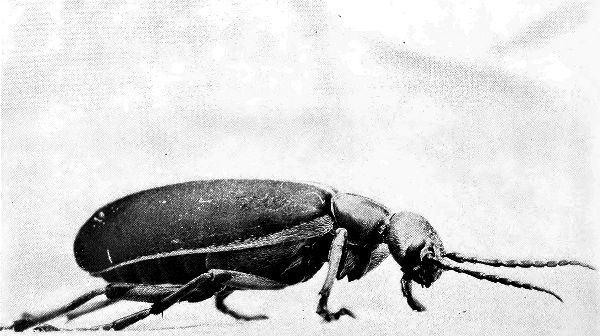
ONE OF THE BLISTER OR CANTHARIDES BEETLES
(Epicanta marginata, Fab.)
I can never look at this beetle without a feeling of emotion, for in a desperate struggle to escape from the fate predestined by a bald-headed ancestry, I once submitted to the treatment of a noted hair specialist and allowed him to apply to my scalp the acrid oil of the blister beetle. And the melancholy part is that it did no good.
Fabre has described how the female European blister beetle lays a thousand or two eggs in the ground in close proximity to the nest of the solitary bee whose eggs form the only food of the blister beetle larva. From the beetles’ eggs hatch out strong-jawed, six-legged spiny larvæ called triangulins. Although born close to the nests of the bees, which in this case are in the ground, these triangulins do not enter the nests, but attempt to attach themselves to any hairy object which may come near, much as burrs attach themselves to the wool of sheep.
A certain number of them by merest chance, apparently, succeed in getting onto the bodies of the bees and are carried by them to their nests. As the male bees, in this particular species, appear a month before the female, it seems probable, Fabre thinks, that the vast majority of triangulins attach themselves at first to the males and later, when a chance occurs, discovering their mistake, transfer themselves onto the females and so get carried to the underground cells, and are present when the mother bee fills the cell with honey and then lays an egg which floats around on top.
There is something ghastly in the picture of the mother bee laying her single egg, with the blister beetle larva on her back waiting till the last moment in order to slip unexpectedly from her body to the egg, on which it floats in the honey as on a raft. When the unsuspecting bee has closed in her unborn child, the hideous monster which is perched on top of it eats it up. This takes eight days, and when it has eaten up its raft, the triangulin moults and becomes, as it were, an aquatic creature with breathing pores so placed that it can float on the honey, and with a stomach so changed that it can be nourished by it. In about eight more days the honey is consumed and the final moult takes place.
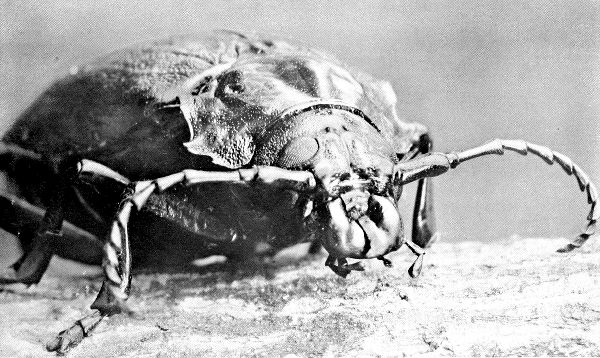
A HIPPOPOTAMUS AMONG THE INSECTS
(Prionus sp.)
Why beetles as large as elephants never came into existence on this planet, or have they developed on some other of the countless worlds of space, are questions too hard for us to answer.
This wonderfully protected creature with long horn-like antennæ and hippopotamus-like jaws is a relative of the largest of the beetles, those which live in the great forests along the Amazon or in the tropical jungles of the Fijian Islands, and whose grubs are good to eat. Some years ago, in a clearing in a New Zealand forest, a Maori dug out several handfuls of the white wriggling creatures for me and a settler’s wife fried them with butter over the fire in her kitchen stove, and I can testify that they were as crisp and delicate as fried oysters.
Like the other giant creatures of the forest, these Prionids, as they are called, are growing rarer with the destruction of the forest trees on which they live, and some day their skeletons in museum cases may be all that remain of them.
These long-horned wood borers do not themselves bore into the wood; how could they with their long antennæ? It is their other selves, their grubs, that live deep in the solid heart wood of some oak or hickory tree. There is something strange in their solitary hermit-cell life. Think of living for two years or more in a narrow hole which shuts you in on all sides and having for a steady diet the walls of your cell to feed upon. Prisoners have burrowed under prison stockades to escape, but these larvæ deliberately leave the outer, softer sapwood in which they hatch, and start for the interior of the trunk, packing behind them with sawdust and excrement the tunnel which they eat out.
The fact that the grubs of some species of these Prionids choose to live in the roots and trunks of trees which we choose to cultivate makes them our enemies, and every good orchardist knows that the only way to stop them is to dig them out or stab them with a wire run through them in their burrows.
This fellow bit savagely at a pencil, and when he finally caught hold, I lifted him up as one does a bull dog, and he hung there almost as long.
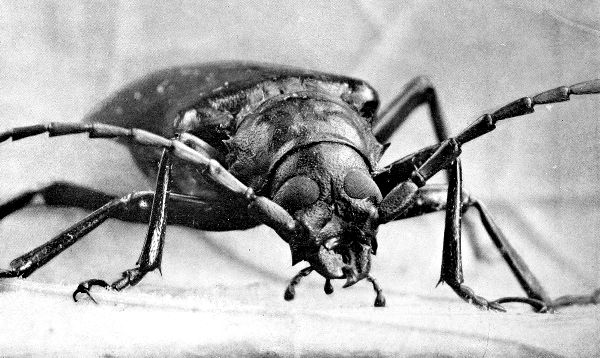
ONE OF THE LONGICORN BEETLES
(Orthosoma brunneum, Forst.)
At first glance this longhorn might pass for a Prionus, but its antennæ are very different and the shape of its broad collar or prothorax is not the same. To a trained eye they could never be confused, which cannot be said of all beetles! In fact there is perhaps no group of living organisms which scientific men have more difficulty in classifying than the beetles, unless it be the lichens on the stones and trees. Their differences are so minute and their grub lives so obscure that they have sometimes to be bred in order to determine their relationships.
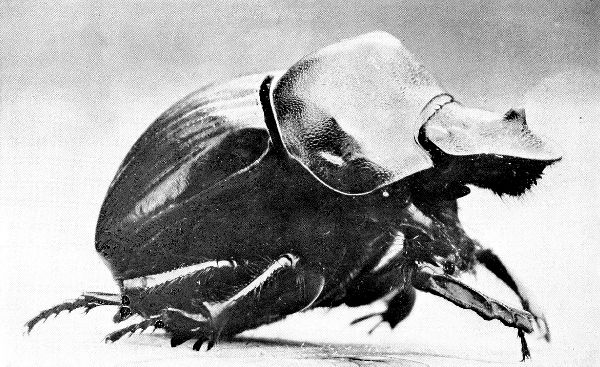
AN AMERICAN SCARAB
(Copris carolina, Linn.)
I cannot help wondering what one of the priests of ancient Egypt would think of this picture of a New World relative of his sacred scarab. To me there has always been something strangely beautiful in the veneration which the great Egyptian race has shown for thousands of years towards the humble, industrious beetle which spends its life in the droppings from Egyptian cattle.
Go to Gizeh, and look at the images of the scarab beetle carved from the rarest stories the lapidary could find, mounted in the loveliest gold settings he could fashion, and reflect that the ladies of the court wore these dung beetles around their necks and were buried with them on.
Was this veneration of the scarab as old, almost, as the race, and did it come with the race into its civilization, or did it arise as the whim of some great Pharaoh?
It is said that somewhere with this veneration there was included a symbolism. The living scarab is a tumble bug, the female makes a ball of dung much larger than herself and either with her shovel pointed nose, or else standing on her head with her hind legs on the ball, she either pushes or pulls the ball along until she finds some suitable place in which to dig a hole and bury this ball so that later she may consume it at her ease. It has been suggested that some Egyptian astronomer, watching the rolling ball, may have suggested an analogy with the movement of the heavenly bodies—with the traveling of the moon around the earth. For we must not forget that in those days the wonder of the heavens was fresh and new and the idea of world-balls of matter was a subject of intense intellectual excitement.
But there was yet another reason for the veneration of the Egyptians. The fact that these beetles suddenly disappeared into the ground and that later they appeared again was taken as proof of a future life.
It seems to me that we can take a lesson from the ancient Egyptians and see in things as insignificant as the beetles of manure the greatness of the world of change and really feel the wonder of it all.
It is a pity, but I have to admit that this American species is not a “tumble bug,” but contents herself with digging holes, filling them with manure and laying her eggs on it, instead of rolling a well-made ball to some special place as her Egyptian cousin does.
The mother scarab, unlike every other beetle, lives to see her children grow up, indeed she produces two families of little scarabs.
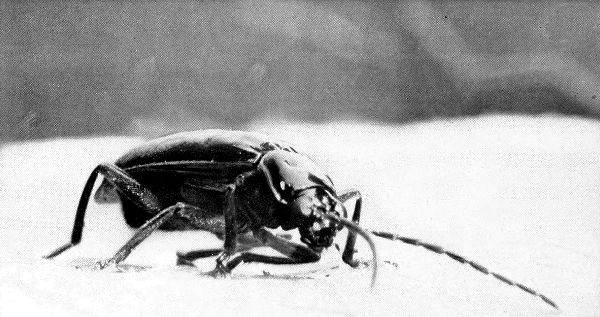
THE TWELVE-SPOTTED CUCUMBER BEETLE
(Diabrotica duodecim punctata, Oliv.)
There are few of our insect enemies which do their destructive work more rapidly than do the cucumber beetles. Every child in the South who has left his cucumber hills unscreened knows this, for he has found them some morning literally eaten up over night by the spotted or striped yellow-green cucumber beetles.
The puzzle is, where do they come from so suddenly? It is as though they were waiting for cucumbers to come up, and this is pretty nearly true, for the adults have wintered in the leaves and rubbish of the garden and are all ready to concentrate on the plantlets in the spring.
Unlike so many pests, which are content to trouble us only during a part of their existence, this twelve-spotted cucumber beetle is our enemy all its life long, for it spends its larval life eating the roots of corn and other field crops.
It is a wide-spread pest, with many relatives quite as bad as it is, and not only does it eat up the young and defenseless cucumbers and the roots of the corn, but it is the carrier of a germ infection of a serious nature to the cucumber. My friend, Dr. Erwin F. Smith, informs me that its kind has infested large areas in the South with this disease and dashed the hopes of thousands of boys who, instead of feasting on the melons they have planted with such care, must stand helplessly by and watch the leaves and flowers wilt and the vines decay. It must be remembered that this is a winged carrier of disease and anyone who still fails to understand the speed of travel of an epidemic had better watch the cucumber beetles busy spreading this destructive germ disease. A single beetle feeding on a diseased leaf can carry on its jaws enough germs to infect every melon or cucumber plant in a neighboring field, and that, too, in a single day.
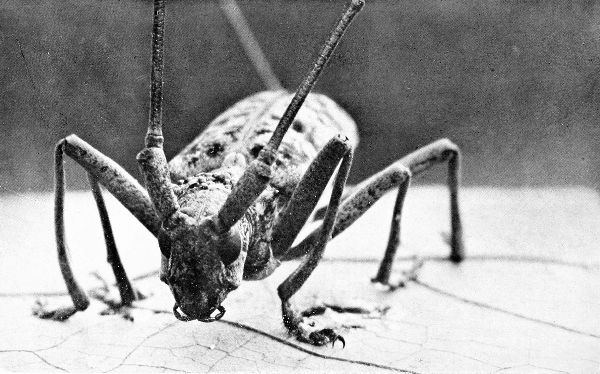
ONE OF THE SAWYERS
(Monohammus titilator, Fab.)
While standing on a street corner waiting for a street-car one day last summer my attention was attracted to this beautiful squirrel-gray creature at my feet. It was so evidently ill that, as I picked it up, I began to examine it to find out what was the matter. Clustered on its neck, out of reach of its feet or jaws were whitish bodies which evidently did not belong to its external skeleton but were probably the eggs of what I took to be some parasite whose growth within the body of the beast had brought about its pitiable condition. These are just visible between the creature’s “horns” in the photograph. It was, in other words, a sick insect.
It is because biologists see these parasites so plainly all down through the scale of living things that they are so sceptical of accepting any other cause of human disease until all possibility has been excluded of its being caused by some parasite or other, too small to be seen even by using the best microscopes.
My sympathy for this long-horned beetle would be keener did I not read that its larval self is spent inside the wood of the pines and firs of our forests, doing great damage to them.
When one is puzzled to know why any living thing should be burdened by such antler-like antennæ, let him remember the peacock’s tail and the bird of paradise’s plumage and be content to know that the laws of evolution are not yet fully known, and that, given time and growth, almost any form can be evolved.
TWO-WINGED INSECTS
(Diptera)
Years ago in Berlin, my German landlady called me in as an expert to decide a controversy between her children and herself as to whether a frog had four legs or six. It seemed strange to me then that a grown-up woman should not know the number of a frog’s legs. Yet there will be many who read these pages who do not know how many wings a fly has. And flies are much more important than frogs.
In fact the mosquito and the house fly, both included in the order of the flies, probably cause more deaths and are more dangerous to human life than any other creatures in the world.
These portraits are of a few only of the vast myriads of forms of two-winged insects which haunt the world. Were I to photograph just one individual of each different species which inhabit the globe, I would have to spend a lifetime doing it, and when it was finished it would make five hundred volumes about the size of this one.
There should never be the slightest difficulty in telling a fly from other insects for there are no other two-winged forms.
Although the flies are sucking insects, their beaks lap up liquid food and are not at all like the beaks of the bugs. In the great majority of flies, the beaks resemble a trunk with curious fleshy folds or lips. It is true some species, like the mosquito, have long, sharp-pointed stylets which, working up and down, puncture the skin of plants and animals.
The larval forms of many flies are maggots, those squirming, often almost headless creatures that abound in rotting carcasses or decaying matter of all kinds, and this is one of the reasons why less is known about the flies than about some others of the insect world which have selected less revolting birthplaces.
Of course, in such a gigantic family no general rules apply, and still, a maggot, whether in an orange or a dead horse, is most likely to be the larva of a diptera or two-winged insect.
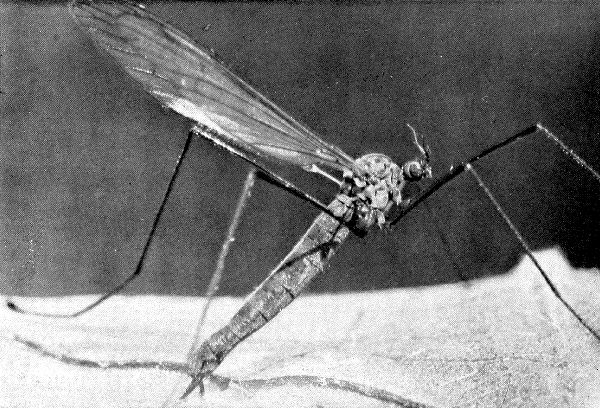
THE CRANE FLY
(Limnobia sp.)
Every lover of the autumn woods must have noticed on some still October day, in the little clearings in the woods, these awkward, long-legged flies which, frightened by the approach of a human being, gather their ungainly hind legs together behind and their forelegs in front of them and slowly and laboriously flutter upward into the sunlight. They are well-named, these creatures, “the crane flies,” for their legs are as long and apparently much more useless than those of the crane. In fact some entomologists have expressed themselves as wondering why they have such legs at all for they are so fragile that they break at the slightest touch.
They belong to a family with a thousand species in it and perhaps the most peculiar thing about them is that some forms of the family live and fly about when there is snow on the ground. This is a very rare exception in the insect world.
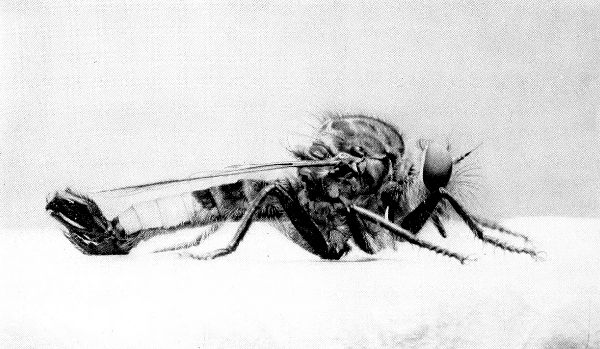
AN INSECT HAWK: ONE OF THE ROBBER FLIES
(Erax æstuans, Linn.)
Her strong, spiny legs, her powerful body filled with strong wing muscles, and her sharp beak, make this robber fly one of the most dreaded enemies of the other winged insects for, like the hawk among the birds, she pounces on them in their flight and tears them to pieces with her beak, sucking the blood from them as she carries them in the air. A single one of these insect hawks, or robber flies, as they are called, has been known to catch and devour as many as eight moths in twenty minutes.
These robber flies are fearless creatures, for they attack and kill bumble bees and wasps and even, it is said, that monster demon, the dragon-fly. Tiger beetles, too, are said to fall a prey to this insect hawk.
Its other or larval self is also predaceous, boring into beetle larvæ in the ground.
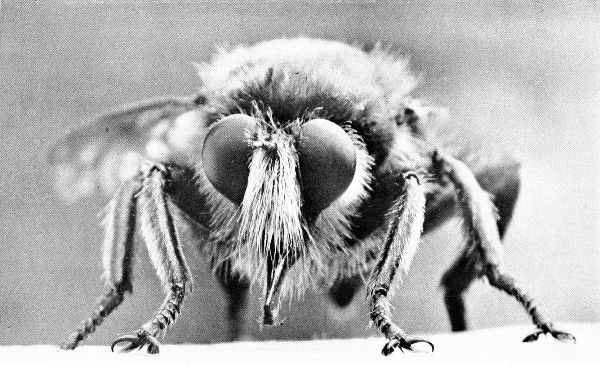
A ROBBER FLY
(Dasyllis grossa, Fab.)
When I learned that this powerfully winged, hairy fly tears beetles’ wings from off their backs with that wedge-shaped beak of hers, and sucks the blood of bees and wasps, it gave me a different idea of the great fly family, which hitherto I had thought was made up of defenseless creatures like the house fly.
Of all the insects we have photographed, few have seemed to be more thoroughly fearless or more ugly than the robber flies. I have never seen one capture and devour a creature larger than itself, but it must be as thrilling an adventure as to see a dragon-fly devour a gnat, or a spider pounce upon the prey entangled in its net.
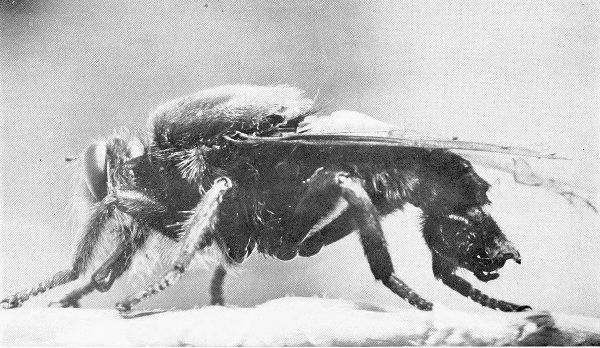
ANOTHER VIEW OF THE ROBBER FLY
(Dasyllis grossa, Fab.)
At first it looked as though this creature had two heads, one at each end of its body, but the great facet eyes, of which only one can be seen in the photograph, make it clear which is the head and which the egg-laying end of this strange, fearless robber of the air.
Just why it is called a robber fly when it really doesn’t rob at all, but kills, is a mystery to me.
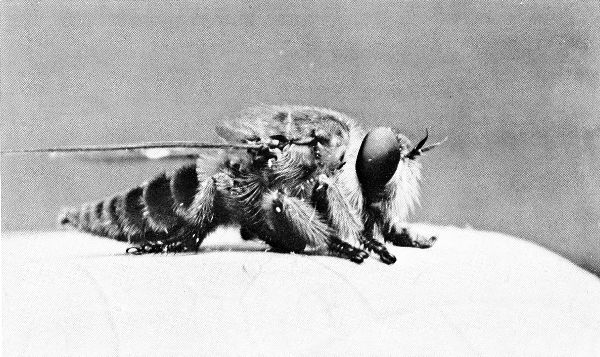
ONE OF THE LARGE ROBBER FLIES
(Mallophora sp.)
This robber fly is not so quick nor so savage as many of its family. It waits for some slow moving insect to come along then pounces upon it.
It probably breeds in decaying wood, although this is not certainly known, and it is very difficult to breed them artificially.
To the economic entomologist the ability to breed these monsters in captivity is one of the most important factors in studying out their life histories, as they are called, their various stages, the plants they feed on, their habits of moulting, of breeding and of feeding their young.
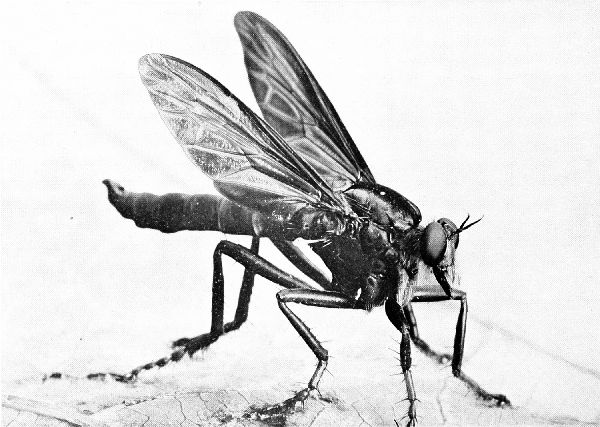
ONE OF THE WORST OF THE ROBBER FLIES
(Deromyia)
This creature is very savage and pounces upon even large sized insects, paralyzing them instantly by a sting of its poisoned beak.
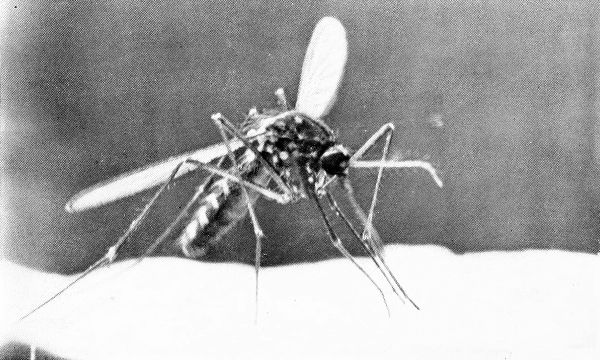
THE CULEX MOSQUITO
(Culex sp.)
The flat white wings of this long-legged creature, vibrating rapidly in the air, make what everyone will agree is the most annoying sound in the world. They make the mosquitos’ hum. The cigar-shaped abdomen is striped like a convict’s jacket. As a boy there was to me a peculiar fascination in watching that abdomen pinken and turn red along its sides as it filled with blood sucked from my hand.
The large eyes compose almost the entire head of a mosquito and in some species they are of an emerald green hue. Straight out in front, close together, curved downward at the tip, are two antennæ furnished with delicate hairs arranged like a bottle brush. With these the creature hears the love hum of its mate and probably scents also the neighborhood of any warm-blooded animal.
Were this a male, instead of a female, these hairs would be much longer and there would be many more of them—they are the smelling organs of the creature and the hearing organs, too, being set into vibration by sound waves of a certain rate. It is important to remember this, for only the females are bloodthirsty. The long, slender proboscis projecting from the head, downward, is furnished with sharp, piercing stylets which, by working up and down, cut their way through the skin. Ordinarily the males and females both are content with sap of plants and fruits as their food, and blood does not seem to be a necessary part of their diet. It is curious that what is supposed to be merely an acquired habit of the female only, of an insignificant little fly, should mean so much to mankind.
Just why a mosquito bite is poisonous is still a matter of question—the suggestion has been made that since both male and female really live on plants, the fluid which the female injects is for the purpose of preventing the plant juice from coagulating during the process of sucking and merely happens to be irritating to warm-blooded animals.
There are three hundred different species of these creatures already described and fortunately this one, a species of culex, is not responsible, so far as known, for the carrying of any human disease.
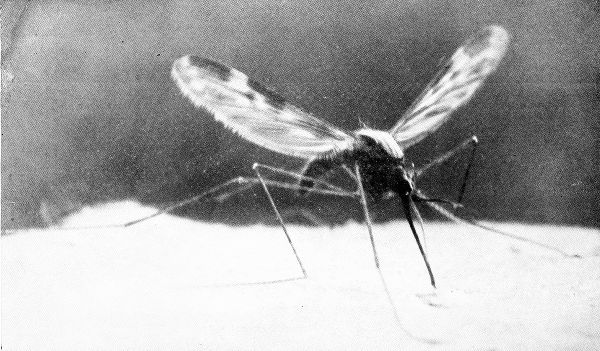
ONE OF THE HARMLESS ANOPHELES MOSQUITOS
(Anopheles punctipennis, Say)
The malarial mosquito, so called, has spotted wings, but otherwise it looks quite like this harmless form from Maryland. This whole tribe of Anopheles differs from the Culex in the length of its mouth feelers, which project from the base of the proboscis and appear in the photograph almost as long as the proboscis itself, whereas in a photograph of the Culex it would appear so short as to seem merely a thickening of the base of the proboscis.
The wildest fancy of the Arabian story-teller is lacking in imagination compared with the story which the facts of modern science have woven about these tiny representatives of the fly family.
Who could imagine that just because the lady mosquitos, tiring of their usual meal of ripe bananas and plant juices, acquired the habit of sucking blood, vast regions would be devastated and beings millions of times their size would die by thousands. And this, too, not through any real fault of the tiny creatures themselves, but just because some of the persons whose blood they sucked had microscopic wiggling things living in their blood corpuscles, which crawled into the soft throat glands of the mosquito and waited there for a chance to get out into the blood channels of some other human beings.
When one pictures the grief of desolated homes, death-bed agonies of tossing fever patients, the quarantined vessels at anchor in tropical harbors, yellow flagged, with crews dead or dying, the streets of deserted houses from which all life has gone forever through yellow fever and malaria, there is something ghastly in the picture of the winged lady mosquitos flitting airily from pale-faced patients to ruddy-cheeked happy people, unwitting carriers of death.
No conquest of science seems more wonderful in its simplicity and more remarkable in its importance than the discovery that the glands at the base of the mosquito’s bill can become diseased and harbor a microscopic parasite, and transform this merely buzzing, annoying insect into one of the most dangerous creatures alive. To Dr. L. O. Howard, the pioneer of economic entomology, is due the great credit for first showing how this creature can be killed by the use of kerosene on the stagnant waters where the females lay their eggs.
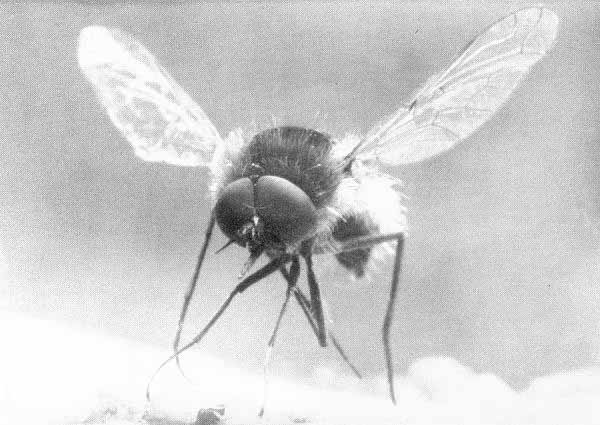
ONE OF THE BEE FLIES
(Sparnopolius fulvus, Wied.)
No butterfly or any other creature of the air could be more beautiful than this dream of early summer. The black velvet body, into which the sunlight sank and disappeared, the fringe of golden hairs along its sides, the steel gray, myriad-facet eyes of which its head was made, and the delicately formed wings, so thin that the light in passing through them was refracted into rainbow tints, made it seem to me more beautiful than almost any of those gorgeous forms of insect life which sometimes fill the clearings in Brazilian forests.
It does seem strange that such a thing as this should live its other life a parasitic grub within the larva of some caterpillar, or in the egg-case of some grasshopper; but so it seems to do. It spends its childhood as a disease, and its mating days as a dainty fly among the nectar-bearing flowers.
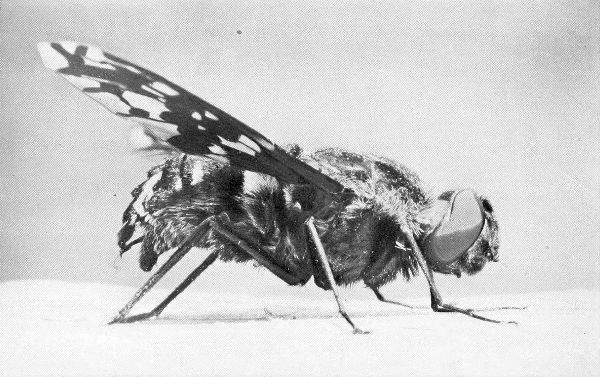
ANOTHER OF THE BEE FLIES
(Spogostylum simson, Fab.)
Where you see the carpenter bee you always see these bee flies waiting for the bee to go away from home. When the mother bee is out the female fly goes into the cell of the bee and lays her egg, and when her larva hatches out it eats up the bee’s larva.
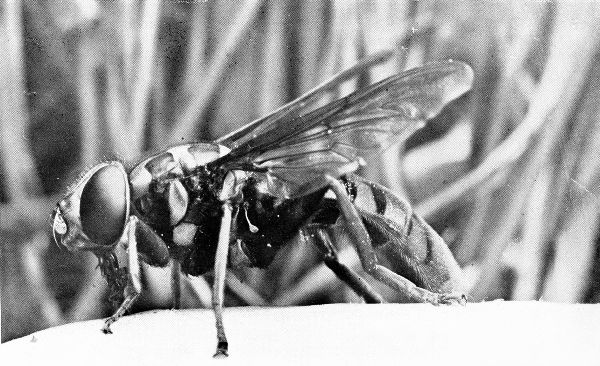
LARGE SYRPHID FLY
(Melesia virginiensis, Dru.)
This is a very bright-colored syrphid fly often seen soaring in shadowy places, but what he is doing we do not know. He stays poised in the air and is one of the most beautiful flies we have.
The larvæ of some of the smaller syrphid flies feed upon the larvæ of other insects, aphids in particular; but the larva of this one has never been seen, at least it has never been recognized.
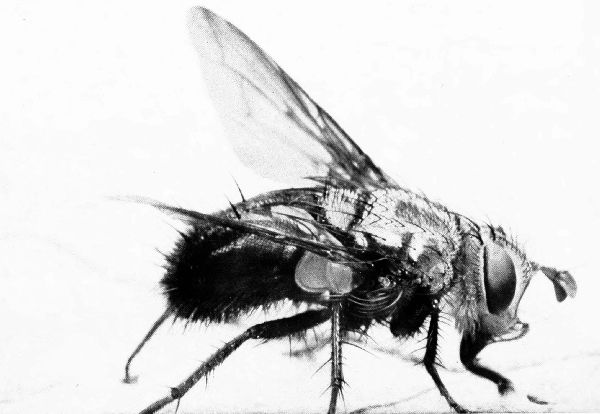
NOT A HOUSE FLY
(Archytas aterrima, Des.)
This portrait of one of the many species of fly, not a house fly, however, is as different as it is possible to be from the maggot from which it grew. The eggs of the mother fly, deposited in some decaying animal matter, hatch in a few days, and out of these eggs come maggots with rudimentary legs and looking like beasts from another world entirely. In a few days more they reach the limit of their growth, and stop, the tissues break down to a mush and out of this mush-like substance are formed flies with wings and sucking, trunklike mouths just like their mothers. The maggots have no sexual organs, and yet, out of the creamy mass of cells, the sexual organs of the flies are formed as though directed by a force as certain in its effects as the law of gravitation.
We have been so intent on killing the fly and so afraid of it as the great carrier of human diseases that we have lost sight of one phase of its character, so to speak. Think of having under our eyes animals like these dipteras from which you can breed a new generation in twelve days! And would it not be strange if, from studying the fly, we should learn the meaning of heredity and sexuality, for this is one of the places where the scientists of the day are at work on the problem of inheritance, that problem which, when elucidated, is likely to make more changes in the world of humankind than almost anything which has so far been discovered. The bearing of the fly on the welfare of the world is one of the most spectacular developments of modern times and a tribute to the value of knowing the minutest details of the world in which we live.
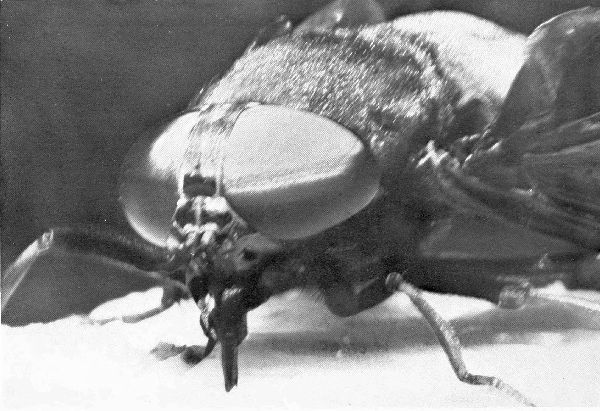
THE HORSE FLY
(Tabanus atratus, Forst.)
The head of the horse fly appears to be all eyes, and it is no wonder that we can so seldom take it by surprise.
Below the oblong, compound eyes are the sharp mouthparts, which in the female are provided with lancets, which enable her to puncture the skin of warm-blooded animals and suck their blood. It is curious that the female should have such habits, while the males are content to lap up nectar from the flowers.
This jet black, loud-buzzing creature flew into my laboratory and made so much noise that I was forced to kill her. This photograph of her is nine times her real diameter.
She belongs to a large and important family of flies, whose females make the lives of men and animals miserable in many parts of the world by their bites, which form most annoying wounds.
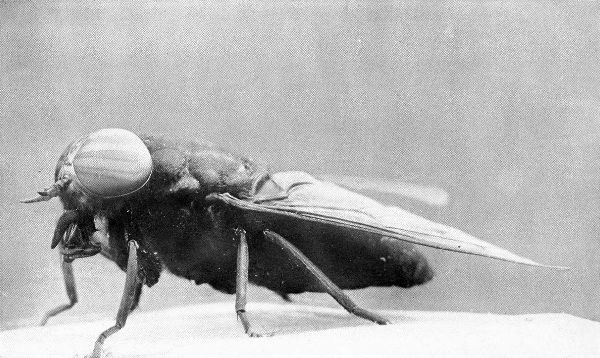
A GREEN-HEADED HORSE FLY
(Tabanus punctifer, O. S.)
There are nearly two hundred species of horse flies in North America, and this creature represents one of the commonest forms. It doubtless hatched out somewhere on the edge of the brook which flows through my place in Maryland, and its larval self fed upon other insect larvæ or on the snails and slugs it found itself among.
The bands of iridescent green and copper and purple across its enormous eyes made it a beautiful creature to look upon.
We never used to think the bite of flies was anything worse than annoying, but recently, since we have discovered the danger of letting the germs of disease into the blood streams of our bodies, we have come to see the ghastly possibilities which lie in the piercing mouthparts of these flies. They suck the blood of animals whose blood streams may be swarming with disease germs, and then fly directly to our houses and puncture our skins with a beak covered with these germs which slip off into our veins.
Until we know that the diseases of the birds, and field mice, the coons and ’possums, and all other warm-blooded beasts of a locality are harmless to us, or that it is impossible to transmit them to human beings, it is best to look upon these blood-sucking creatures as winged hypodermic syringes laden with disease.
It has been suggested that the horse flies carry anthrax, and their bites sometimes cause malignant pustules. They are also under suspicion as carriers of infantile paralysis.
FEATHERED INSECTS
(Lepidoptera)
These are peculiarly the feathered fliers of the insect world, for their wings and their bodies, too, are covered with most remarkable one-celled feathers or scales of gorgeous colors which make of some of them the most brilliant of all living things.
Just what these scales are for is not entirely clear, and will not be, perhaps, until we understand the purpose of the gorgeous coloring itself. There is a theory that these scales help to grip the air in flying.
It is a curious coincidence that one of these gorgeously colored creatures should furnish mankind with the material for his own most gaily colored raiment. The silkworm is one of the very few domesticated insects, so to speak, of all the hundreds of thousands of insect species in existence, and a hundred millions of dollars is paid every year for the delicate silk threads unraveled from countless millions of cocoons which the silkworm larvæ have laboriously fashioned around themselves.
To many people, moths are known by what they leave behind—holes in the winter woolens; and butterflies are to them, somehow, things of the sunlight and the summertime. It is worth while to know that these great families of butterflies and moths are not by any means divided equally, that for every family of butterflies there are at least nine of the moths and that the butterflies form but a small proportion of the gaily colored insects of the fields.
Perhaps it makes but little difference to the public, who call them all alike, but it is as easy to tell a butterfly from a moth as it is to tell a lizard from a snake, for all the butterflies have club-shaped feelers, or antennæ, whereas the moths do not, and any child of six can learn to tell the two apart.
No butterfly or moth in its winged state can harm us or our plants. It has no jaws, but keeps itself alive by sucking nectar from the flowers or juices from the fruits or other parts. Its other self, its larva, however, can cause no end of damage. One inconspicuous, brownish form, the codling-moth, no larger than my thumb nail, costs apple growers about ten million dollars every year, while the cabbage moth, the clothes moth, the cutworm and the dreaded gipsy-moth are only a few examples of a gigantic army of voracious larvæ against which man has been struggling ever since he first began to plant seeds in the ground or set out trees for fruit.
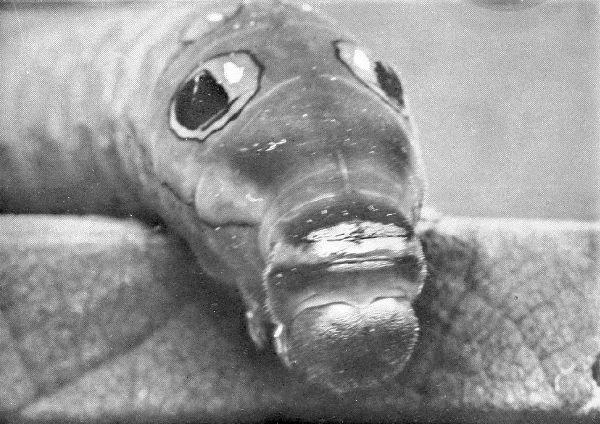
LARVA OF THE SWALLOW-TAIL BUTTERFLY OF THE SPICE-BUSH
(Papilio troilus, Linn.)
Is this, I wonder, an insect make-believe, a caterpillar mask, as it were, to frighten away enemies? The black and white eye-spots are not real eyes, but to a bird they doubtless seem so. Its real eyes are inconspicuous points at each side of the head, too small to appear in the photograph.
Few of as stop to think, as the beautiful swallow-tail butterfly, gorgeous in its black and yellow painted wings, flits by us, that it is made of sassafras and spice-bush leaves gathered together and ground up. This monster is a leaf-eating creature, its purpose being the accumulation of food material out of which is made inside of it the gorgeous swallow-tail butterfly. It feeds on sassafras and spice-bush leaves, and when the time arrives makes a nest for itself by fastening the edges of a leaf together. In this nest it passes the winter. When spring comes it breaks open the gray shell of the chrysalis, unfolds a pair of black and gold wings with long tails to them, and flies away in the sunshine in search of flowers and a mate. It is then no more like this monster than an eagle is like a hippopotamus, yet after it has flown about, sucking nectar through its long beak, it mates and lays a mass of eggs, out of which hatch again these strange, weird beings.
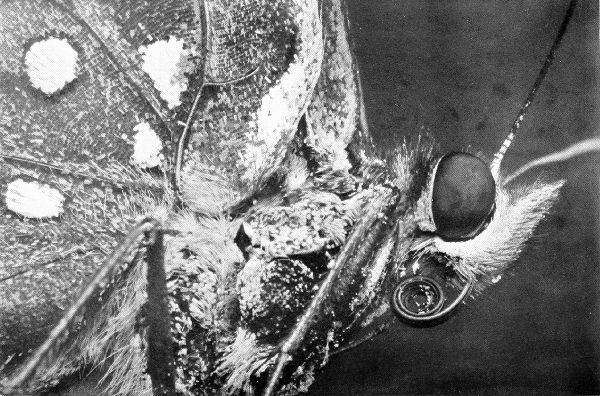
FORE PART OF A BROWN BUTTERFLY
(Agrynnis cybele, Fab.)
It is hard to realize that this is the portrait of the head and fore part of a beautiful brown butterfly.
Its head is almost all taken up with the gigantic eyes, which are composed of thousands of tiny facets. The long, trunklike mouth with which it sucks the nectar from the flowers is coiled up like a watch spring. Like shingles on a roof, the scales are fastened in tiers over the broad surface of the wings stretched over the stiff ribs or framework.
The white spots are made by hundreds of white scales and the brown blotches by brown scales, and what these scales are for nobody seems to know. Perhaps they help to grip the wind, for they have running lengthwise of them deep and parallel corrugations so small and fine that were a single scale as large as a lady’s opened fan these corrugations would represent its sticks.
The caterpillar from which this splendid creature came is black, with branching spines, and feeds at night on violets and other plants.
The graceful beauty of the butterfly, its seemingly happy existence, its life among the flowers, where it sips the nectar that the flowers provide, are all a part of common knowledge.
The real life of the butterfly, however, is not so pleasant as we think. Have you ever found a butterfly hanging beneath a leaf on a cold summer morning drenched with dew and stiff with cold? Have you ever seen one trying to cross a field in a rain-storm and observed it vainly attempting to navigate the conflicting air currents? Where do they roost at night and on rainy days? Where do they come from and what becomes of them? These are matters which it has often taken men years to find out, and even now there are many thousands of species of butterflies which are known only by a preserved specimen caught in its flight by the net of some collector.
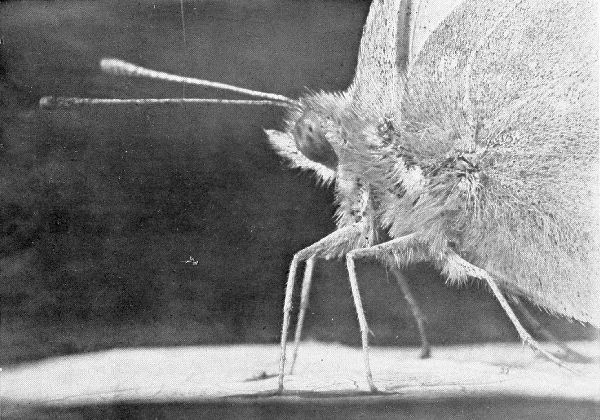
YELLOW BUTTERFLY
(Colias philodice, Gdt.)
The Doctor Jekyll and Mr. Hyde is so complete between the butterfly which flits over the cabbage patch and the velvety green worm that eats holes in the leaves of the cabbages that it is no wonder that for centuries no connection between the two careers of these creatures, seemingly so far apart, was suspected. In general it is true that no moth or butterfly is injurious to plants except in its larval stage, and herein has lain the clever deception which has doubtless protected these gay mating creatures of the air from the systematic attacks of man until quite recent times.
This picture shows what every boy and girl should know, that every butterfly has club-shaped feelers or antennæ.
It is said of certain species of yellow butterflies that the males give off a pleasing, aromatic odor which is exhaled from the front wings through hundreds of minute, slender scales—scales quite different from those with which the wings and body are covered. This scent, which is so strong that it can be detected by even our blunted olfactory organs if we rub the wings between thumb and forefinger, is supposed to attract the females in some way that is little understood. As among these particular butterflies the male seeks out its mate, it is difficult to understand why it should be the male which has the perfume, since it does not serve to tell the female where her mate is to be found. The inference is that in some way the perfume charms the female.
In some species it is the females which give off an odor, and in either case the distances over which these odors extend and are detected by the males or females respectively are analogous to the inconceivable reach of wireless telegraphy. And who knows but the mechanism of these creatures is set to respond to the swiftly traveling ions which make wireless telegraphy possible?
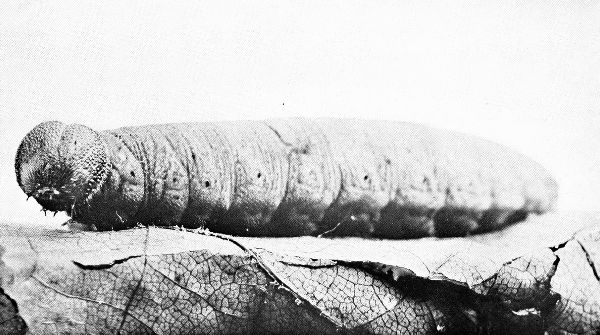
A BABY OF THE SKIPPER BUTTERFLY
(Eudamus tityrus, Fab.)
There is something fascinatingly strange to me in the babies of the winged butterflies, and I wonder why so many people have an aversion for them? Can there be an instinctive fear of anything that crawls, or is not this fear taught us by unthinking persons? The child is not afraid of the wide-mouthed naked little birds in the nest, or the little blind pink mice, and certainly they are no more innocent looking than the brilliant colored larva of the butterflies or moths.
What helpless things these babies are! They cannot fly, they cannot fight, they can barely see, and even their gait is a hobbled one.
Their business is to eat, and their jaws must keep busy pretty constantly to fill their stomachs with leaf fragments, for the greater part of the soft, flabby bodies is stomach. They are males and females but which they are you cannot tell until they turn into butterflies.