BLOODLETTING INSTRUMENTS (continued 2)
Reading edition
The two other patent scarificators in the Smithsonian collection were both invented by Frederick M. Leypoldt of Philadelphia. The first, patented in 1847, was similar in external appearance to the common scarificator. The novelty consisted of a new arrangement of the cocking lever and cantilever spring that allowed use of a lighter and cheaper casing. Although the patent model was made of brass, Leypoldt claimed that with his improvements in the internal mechanism, the case could, with safety, be made of tin.[151]
Leypoldt’s second patent, issued in 1851, was for a scarificator with a greatly simplified inner mechanism allowing for a substantially smaller and lighter case. The cocking lever was placed horizontally in the casing and engaged the blade rods through a rack and pinion mechanism. According to Leypoldt, this scarificator was more convenient, more portable, cheaper, safer, and more reliable than the common scarificator.[152] Leypoldt probably marketed his scarificators, there being in the Smithsonian collection other bloodletting instruments with his name, but he did not form a major surgical supply company as did George Tiemann.
Larger Image
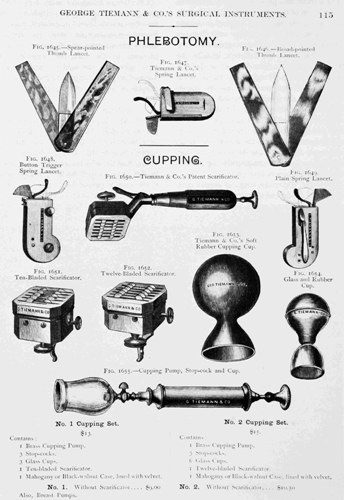
Figure 16.—Advertisement for phlebotomy and cupping instruments. Note the rubber cups. (From George Tiemann & Co., American Armamentarium Chirurgicum, New York, 1889. SI photo 76-13542.)
After 1860, interest in inventing new scarificators declined as wet cupping decreased in popularity. The improved cups and scarificators, while they had achieved a limited success, had still failed to supplant the common octagonal scarificator and the plain glass cup. As interest in wet cupping declined, medical attention shifted to the therapeutic virtues of dry cupping. Dry cupping offered even greater opportunities for inventors, who sought means to bring the effects of the vacuum to more areas of the body for greater lengths of time.
Dry Cupping
Dry cupping, in its simplest form, was said to act as a “revulsive” or “derivant.” By the nineteenth century these once hotly debated terms had become nearly interchangeable in discussions of cupping. In cupping for revulsive purposes, one cupped on a distant part to relieve excess of blood in the affected part. In applying cupping as a “derivant,” one cupped closer to the affected part. In either case, the source of pain was presumed to be somewhere below the skin, and the pain was relieved by bringing blood away from the affected part to the surface of the body. Thus, one nineteenth-century cupper concluded, revulsion was only derivation at a distant point.[153]
If dry cupping was applied for ten minutes or longer so that the capillaries burst, the action of the cups was said to be that of a counter-irritant. According to ancient medical theory, the counter-irritant was a means of relieving an affected part by deliberately setting up a secondary inflammation or a running sore in another part. Counter-irritations were traditionally produced in a number of ways, among them, blisters, cautery, setons, moxa, and dry cupping.[154]
One of the most popular counter-irritation devices commonly associated with cupping instruments in catalogs of surgical goods, was Baunscheidt’s Lebenswecker, sold by most American surgical supply houses in the second half of the nineteenth century. The Lebenswecker, or “Awakener of Life,” was the mainstay of the mystical medical system known as Baunscheidtismus, after the founder of the device, Carl Baunscheidt of Prussia (1809-1860).[155] The system apparently gained much notoriety in Germany, England, and America, for Baunscheidt’s book went through ten German editions and several British and American editions. At least two Americans patented improvements on the Lebenswecker.[156] The device was made of ebony, about 250 mm long, and contained a coiled spring attached to a handle. At the other end of the spring was a place about 20 mm in diameter, with about thirty projecting needles. By pushing upon the handle, one sent the needles into the skin. The ability of the instrument to create blisters was enhanced by the application of Baunscheidt’s special oil to the irritation (Figure 17).
Larger Image
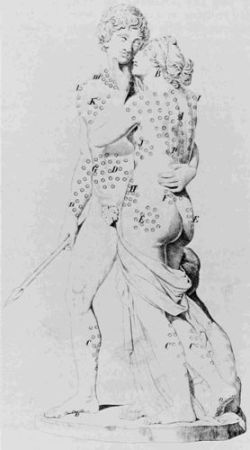
Figure 17.—Venus and Adonis with marks showing where Baunscheidt’s Lebenswecker should be applied. (From Carl Baunscheidt, Baunscheidtismus, by the Inventor of the New Curing Method, Bonn, 1859(?). Photo courtesy of NLM.)
Dry cupping stimulated much theoretical debate in the nineteenth century as well as a number of physiological experiments.[157] Although physicians generally agreed that dry cupping had curative value if employed properly, they disagreed widely on when to employ the remedy, and on the manner in which the remedy operated. Did application of cups affect only the surface vessels, or could cupping affect the entire nervous system, and through the nerves, the action of the secretory organs? Were the effects of dry cupping of only a temporary nature, or were they permanent? An interesting series of investigations in Europe and America sought to ascertain the value of dry cupping in checking the absorption of poison. An American, Dr. Casper Wistar Pennock, replying to investigations performed by Martin Barry, an Edinburgh physician residing in Paris, carried out an impressive series of physiological experiments in 1827, in which he administered strychnine and arsenic under the skin of dogs and rabbits and then cupped over the wounds. He concluded that while dry cupping prevented almost certain death from the poisons, once the cups were removed, death would ensue, unless the poisons were surgically removed.[158]
Interest in dry cupping led to attempts to apply the therapeutic effects of the operation to larger areas of the body than could be accommodated by a cup. In France, Victor-Théodore Junod (1809-1881) adapted cupping to entire limbs. Shortly after receiving his degree in medicine in 1833, Junod presented at the Academy of Sciences his apparatus, known thereafter as Junod’s boot. Junod believed that actual extraction of blood was a dangerous remedy and that the benefits of bleeding might as easily be obtained by his “derivative method,” which withdrew blood from the general circulation but allowed it to be returned at will. Junod’s boot and Junod’s arm, which sold for as much as $25.00 apiece,[159] were constructed of metal and secured against the limb by a silk, and later a rubber, cap. To the boot was attached a flexible tube, stopcock, pump, and if desired, a manometer for measuring the vacuum produced. In chronic illnesses, Junod recommended that the boot be applied for an hour. So much blood was withdrawn from the circulation by use of the apparatus that the patient might easily faint. To explain how his boot worked, Junod invented a theory that he called “hemospasia,” meaning the drawing of blood.[160] This was typical of a number of attempts to introduce sophisticated terminology into discussions of traditional remedies. Junod’s arm and boot were widely available through American surgical supply companies. As late as 1915, Heinrich Stern, previously mentioned as a latter-day proponent of bloodletting, had no doubt that application of the boot to the foot would relieve congested states of the abdominal viscera.[161] (Figure 18.)
Americans patented a number of modifications of the arm and boot, and in addition they patented a number of whole body devices called “depurators.” Junod had introduced such a device along with his boot—a metal casing in which a patient would be placed leaving only his face showing. The air inside would then be exhausted by means of a gigantic syringe. In America such “depurators” may have been regarded more as quackery than as a legitimate extension of cupping, for despite the fact that Americans patented some twenty of these devices, surgical supply houses did not sell them and little was written about them.
In the last decade of the nineteenth century, Dr. August Bier, professor at the University of Bonn, developed another sophisticated theory supporting the use of blood-suction devices, known as the theory of hyperemia, meaning “excess of blood.” According to the doctrine, lesions are always accompanied in nature by hyperemia, “the most widespread of auto-curative agents.”[162] If we, therefore, wish to imitate nature, we create an artificial hyperemia. Bier recommended several means of increasing the blood supply of an affected part, including hot-air baths, suction devices such as Junod’s boot, and dry cupping. Several American surgical suppliers sold Bier’s Hyperemic Cups in the early twentieth century. These were glass cups, of a great variety of shapes and sizes including some with curved rims, each fitted with a rubber tube and bulb for exhausting the air. A major function of these cups was to collect wound secretions from boils or furuncles.[163]
Larger Image
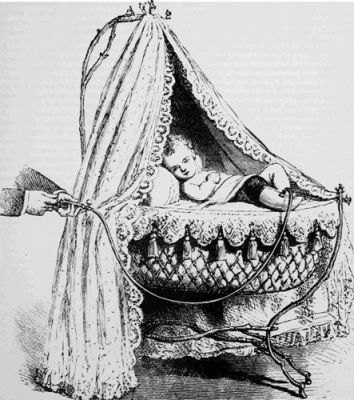
Figure 18.—Junod’s boot applied to a baby in the cradle. (From Victor Theodore Junod, A Theoretical and Practical Treatise on Maemespasia. London, 1879. Photo courtesy of NLM.)
Breast Cupping
Related to cupping by its technology is the practice of drawing milk from the breasts by means of breast pumps. Mothers with underdeveloped or inflamed breasts posed a frequent problem for the nineteenth-century physician, who treated them with either large doses of tartar emetic, a strong purgative, or with cupping.[164] Breast pumps were small glass cups with fluted edges made to accommodate the nipple. While some surgeons, as the American Samuel Gross, recommended using a bottle with a long neck in which the air had been rarified by means of hot water,[165] most breast pumps were exhausted by mechanical means. For reasons of modesty, the pumps were usually designed so that the woman could draw her breasts herself. Perhaps the simplest design of a breast pump was a glass cup having a long spout extending in such a way that the woman could perform suction herself. Such all-glass cups were illustrated in the eighteenth century.[166] A few, reputedly made centuries earlier, are found in the Wellcome Historical Medical Museum. Early in the nineteenth century, breast pumps, just as glass cups for bleeding, were attached to brass syringes, and were often included among the variety of cups in cupping sets provided with syringes. Read’s and Weiss’s patent syringe as well as Thomas Machell’s cupping device were adapted for breast pumping. With the invention of vulcanized rubber, the breast pump was frequently attached to a large rubber bulb. A glass protuberance was often added to pumps exhausted by syringes or rubber bulbs, in order to collect the milk so that it could be fed to the infant. In the 1920s some breast pumps were attached to electric motors.[167] Breast pumps have continued to be employed up to the present day. Of all instruments employing the principle of the cupping device, breast pumps were the most frequently patented. From 1834 to 1975, more than 60 breast pumps were patented, the majority in the period from 1860 to 1920.[168]
The Decline of Cupping
Cupping died out in America in the early twentieth century, but its disappearance was gradual and scarcely noticed. Some of the most complex of cupping devices were invented in a period when most physicians regarded cupping as ineffectual. Patents for cupping devices continued to be issued as late as 1916 when Joel A. Maxam of Idaho Springs, Colorado, patented a motorized pump, which by means of various sizes of cups, could subject a part of the patient’s body to either a prolonged suction or a prolonged compression.[169] One of America’s last advocates of bloodletting, Heinrich Stern, writing in 1915, also advocated the use of an electrical suction pump to evacuate cups. With an electric motor, he declared, one could prolong hyperemia for 15, 30, or more minutes.
Stern also invented a theory to account for the therapeutic effects of his inventions, namely, the theory of phlebostasis. Instead of pumping air out of a device, Stern pumped air into a device, for the same purpose of removing a portion of blood from the general circulation. His “phlebostate,” manufactured by Kny-Scheerer of New York, was quite similar to a sphygmomanometer. It consisted of a set of cuffs that fit about the thighs, rubber tubes, a manometer, and a suction bulb or an electric force pump. For stubborn cases, such as migraine headaches, Stern recommended using the cuffs for 30 minutes or more. To facilitate the application of the cuffs, Stern invented a “phlebostasis chair,” one of the most complex “cupping” devices ever made. Like an electric chair, the phlebostasis chair was supplied with cuffs for both arms and legs. Air was pumped into the cuffs by means of an electric motor. According to Stern, compression of the upper segment of both arms withheld 300 cc of blood from circulation, while compression of the thighs withheld as much as 600 cc.[170]
In addition to these sophisticated devices, simple cupping, especially dry cupping, continued well into the 1930s. Although cupping was no longer generally recommended by physicians, most surgical companies advertised cups, scarificators, and cupping sets in the 1920s and even the 1930s. The last bastions of cupping in the United States were the immigrant sections of large cities. In the lower East Side of New York, in particular, cupping was still flourishing in the 1920s. By then cupping was no longer performed by the physician, but had been relegated back to the lowly barber, who advertised in his shop window, “Cups for Colds.”[171]
Leeching
Leeches
The word “leech” derives from the Anglo-Saxon loece, “to heal.” Thus, the Anglo-Saxon physician was called a “leech” and his textbook of therapeutic methods a “leechdom.” The animal itself was already known to the ancients under its Latin name hirudino. It appears, however, that the introduction of leeches into Western medicine came somewhat later than that of phlebotomy or cupping, for Hippocrates made no mention of them. The earliest references to the use of leeches in medicine are found in Nicander of Colophon (2nd century B.C.) and in Themison (1st century B.C.). Thereafter they were mentioned by most Greek, Roman, and Arabic medical writers.[172]
The leech is a fresh-water parasitic invertebrate belonging to the Phylum Annelida. On one end of its worm-like body is a large sucker by which the animal fastens itself to the ground, and at the other end is a smaller sucker, in the middle of which is a chitinous mouth that makes a triangular puncture. As items of materia medica, leeches were described in dispensatories, or compilations of medicaments, and sold by apothecaries, both to physicians and directly to patients. The species most commonly used for bleeding was Hirudo medicinalis, indigenous to the streams and swamps of Central and Northern Europe, and known in commerce as the Swedish or German leech. It was 50-75 mm long, with a dull olive green back and four yellow longitudinal lines, the central two broken with black. Somewhat less popular was the Hungarian leech, indigenous to Southern Europe. In addition, there was an American species of leech, Hirudo decora, which was gathered principally from the lower Delaware River, but, since it drew much less blood than the Swedish leech, it was regarded as greatly inferior.[173] Most American physicians imported their leeches. In the late nineteenth century, one could buy Swedish leeches for $5.00 per hundred.[174]
Leeches were gathered in the spring of the year either by means of a pole net, or, more primitively, by wading into the water and allowing the leeches to fasten themselves onto the legs. Sometimes horses and cattle were driven into the water to serve as bait for the leeches.[175] (Figure 19.)
Larger Image
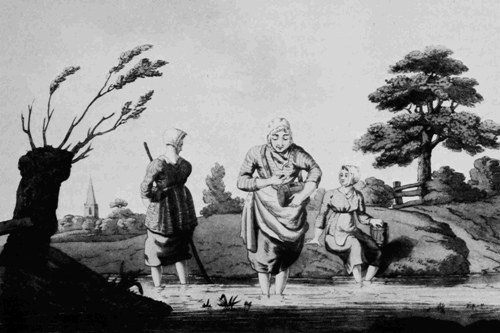
Figure 19.—Lithograph published in London in 1814 showing three women gathering leeches by a stream. (NMHT 320033.08; SI photo 76-7741.)
Leeching, like other forms of bloodletting, enjoyed a revival in the early nineteenth century, particularly in France, where the doctrines of heroic medicine preached by Broussais[176] led to an increase of leech usage from about 3 million in 1824 to 41.5 million in 1833.[177] Leechers, although not as high in status as professional cuppers, practiced in many large cities, and numerous tracts were written on the care and breeding of leeches. “Leech farms” were unable to increase the leech supply to meet the rising demand, and most leechers complained of the scarcity and great expense of the little animals.[178]
Leeching and cupping each had their advocates. The major advantage of the leech over the cup was that the leech could be employed on almost any part of the anatomy, including around the eyes, in the mouth, the anus, and the vagina. In fact, leeching the internal membranes enjoyed quite a vogue in the early nineteenth century. Leeches were applied to the larynx and the trachea for bronchitis and laryngitis and for relieving the cough of phthisis. For inflammations of the conjunctiva (the membrane lining the eyelids) they were applied to the nasal membrances of the adjacent nostril, and for inflammations of the ear they were applied to the meatus of the ear and behind the ear. The French popularized the practice of leeching the anus to treat inflammations of the mucous membranes of the bowel. To prevent leeches from getting lost in the body cavities, Jonathan Osborne, a British physician, recommended in 1833 that a thread should be passed through the leech’s tail. In addition, he invented a device, which he called a “polytome,” specifically for introducing leeches into the rectum.[179] In the mid-nineteenth century, special leech tubes were widely sold for applying leeches to internal membranes.[180]
A second advantage of leeches over cupping was that leeches could extract blood more readily. Not only was dexterity not required in order to apply a leech, but also it was soon noticed that leech bites continued to bleed even after the leech let go, while scarificator incisions often coagulated before any blood was obtained. In 1884 it was shown by John Berry Haycroft, a Birmingham chemist, that this phenomenon was due to an anti-coagulant, now called “hirudin,” that the leech injected into the blood.[181]
To apply a leech, the animal was first dried with a bit of linen, and the skin of the patient was prepared by washing with warm water and then shaving. To direct it to the right spot, the leech was often placed in a small wine glass that was inverted over the area to be bitten. Since leeches were sometimes perversely unwilling to bite, they were enticed by the placement of a bit of milk or blood on the patient’s skin. Small children were given one or two leeches, and adults 20 or more. Broussais employed up to 50 leeches at one time.[182] The leech was usually allowed to drop off of its own accord when it had satiated itself, which took about an hour. Sometimes the tail of the leech was cut off so that it would continue to suck. Once used, leeches could not be reused for several months unless they were made to disgorge their meal by dropping them in salt water or weak vinegar. A healthy leech drew one or two fluid drachms of blood, and as much would flow after the leech had dropped off. Thus a good Swedish leech could remove about an ounce of blood. This quantity could be increased by employing a cupping glass over the bite.[183]
Leeches were kept in a glass container of water covered with gauze or muslin and placed in a cool, dark room. The water had to be changed frequently, as much as every other day in summer. Pebbles or moss were placed in the bottom of the vessel to aid the leech in removing the slimy epidermis that it shed every four or five days. In the nineteenth century leeches were often sold in drug stores from large, elegant containers with perforated caps. Actually, only the day’s supply of the pharmacist’s leeches was kept in the attractive storefront jars; the rest were kept out of sight. While most leech jars were simple white crockery pieces with “leeches” lettered in black on the front, some leech jars were over two feet tall and decorated with elegant floral and scroll work. Among the most ornate leech jars were those made in Staffordshire, England.[184] (Figure 20.)
Artificial Leeches
One of the characteristics of nineteenth-century technology was the attempt to replace natural materials and processes by imitations and mechanisms. Considering the properties of the natural leech, it is no wonder that very early in the nineteenth century inventors began to seek a mechanical substitute. The disadvantages of the leech were many. Wrote one inventor of an artificial leech:
In the first place the appearance of the animal is repulsive and disgusting, and delicate and sensitive persons find it difficult to overcome their repugnance to contact with the cold and slimy reptile. This is especially the case when it is a question of their application about or within the mouth. Then again, their disposition to crawl into cavities or passages results sometimes in very annoying accidents. Another source of annoyance is that they are often unwilling to bite—the patience of all concerned being exhausted in fruitless efforts to induce them to take hold.
The expense, too, of a considerable number is by no means trifling.[185]
Larger Image
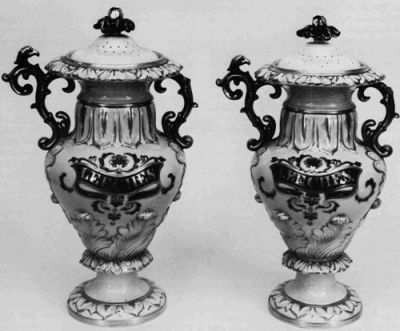
Figure 20.—Staffordshire leech jars, 19th century. (NMHT 263554 [M-11504]; SI photo 73-4231.)
In addition, leeches were often difficult to obtain, and the rural physician could not easily carry them about. Leech bites could have unfortunate consequences, for many times the bleeding could not be stopped. For these and other reasons, several inventors in Europe and America sought to create a mechanical or artificial leech.[186] Such artificial leeches are often difficult to distinguish from cupping devices, because both sorts of instruments employed some form of scarification and suction. Artificial leeches however, were usually adaptable to small areas of the anatomy, and the puncture wound generally attempted to imitate a leech bite.
Perhaps the earliest instrument offered as a substitute for leeches was Sarlandière’s “bdellometer,” from the Greek bdello, “leech.” Sarlandière, a French manufacturer, introduced his instrument in 1819 and, incidentally, had the prototype sent to New Orleans. The bdellometer consisted of a glass bell with two protruding tubes, one perpendicular for performing scarification, and the other oblique, for attaching the aspirating pump. A plug could be removed to allow air to enter the bell after the operation was completed, and a faucet allowed for drainage of blood without having to remove the apparatus from the body. A curved cannula could be attached to the bdellometer for bleeding in the nasal passages, the mouth, the vagina, and the rectum. For internal bloodletting, the disk, with lancets, normally used for scarification, was replaced by a small brush of hog bristles.[187] Sarlandière’s bdellometer attracted sufficient attention in America to be included in the numerous editions of Robley Dunglison’s medical dictionary,[188] but it was ultimately no more successful than the complicated cupping devices discussed in the previous chapter.
A second French invention, also given a pretentious name, was Damoiseau’s “terabdella” (meaning “large leech”), or pneumatic leech. This invention, introduced some time before 1862, met with skepticism at the outset on the part of the reviewers at the French Academy of Medicine. It consisted of two pistons attached to a plate to be placed on the floor and held down by the feet of the operator. Each piston was connected by a tube to a cup, and the whole apparatus was operated by means of a hand lever connected with both pistons. More a cupping device than an artificial leech, the terabdella met with little success beyond the French province where Damoiseau practiced.[189] (Figure 21.)
Perhaps the most successful of the mechanical leeches was known as Heurteloup’s leech, after its inventor, the Frenchman, Charles Louis Heurteloup (1793-1864). Sold in most late nineteenth-century surgical catalogs for as much as $15.00, the device consisted of two parts, one a spring scarificator that made a small circular incision (about 5 mm in diameter) and the other, a suction pump, holding an ounce of blood, whose piston was raised by means of a screw. For the treatment of eye ailments, one of the major purposes for which the device was invented, it was applied to the temples.[190] A similar two-part mechanical leech was sold under the name “Luer’s Leech.”
One of the most interesting leech substitutes, sold by George Teimann & Co. as its “Patent Artificial Leech,” employed ether in exhausting the glass “leeches.” Patented by F. A. Stohlmann and A. H. Smith of New York in 1870, the “leech” consisted of a glass tube, either straight or with a mouth on the side so that the tube would hang somewhat like a living leech. To expel air from the tube, a few drops of ether were placed in it, after which it was immersed to its mouth in hot water until the ether vaporized. The tube was then applied to the skin and allowed to cool, thus sucking blood from a wound made by the scarificator, a long metal tube that was rotated to make a circular incision. One of the patentees explained the advantages of the device:
In all previous attempts at an artificial leech the vacuum has been produced by the action of a piston. This renders the instrument too heavy to retain its position, and necessitates its constantly being held. This precludes the application of any number at once, even if the cost of half-a-dozen such instruments were left out of the account. But in the case of this leech, the tubes, being exceedingly light, attach themselves at once, remaining in position until filled; and as the cost of them is but a few cents, there is no limit to the number which may be applied.[191]
To take the place of leeches in the uterus, quite a number of uterine scarificators were sold. These were generally simple puncturing instruments without spring mechanisms. If insufficient blood flowed from the scarification, Thomas’s Dry Cupper, a widely available vulcanite syringe, could be inserted into the vagina to cup the cervix before puncturing.[192] At least one attempt was made to combine puncture and suction in a device for uterine application. This was Dr. William Reese’s “Uterine Leech,” introduced in 1876. It consisted of a graduated glass cylinder 190 mm long and 12 mm in diameter containing a piston and a rod with a spear point. The rod was surrounded by a spring that withdrew the blade after it punctured the cervix. Several American companies, including George Tiemann & Co., offered the device for sale.[193]
Larger Image
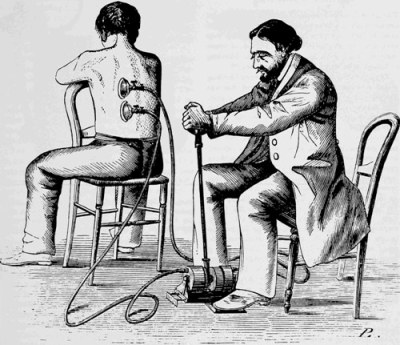
Figure 21.—Damoiseau’s terabdella. (From Damoiseau, La Terabdelle ou machine pneumatique, Paris, 1862. Photo courtesy of NLM.)
Despite all the efforts to find a suitable substitute, the use of natural leeches persisted until the practice of local bloodletting gradually disappeared in America. By the 1920s leeches were difficult to find except in pharmacies in immigrant sections of large cities like New York or Boston. One of the last ailments to be regularly treated by leeches was the common black eye. Leeches commanded rather high prices in the 1920s, if they could be found at all. One Brooklyn pharmacist, who deliberately kept an old-fashioned drugstore with the motto “No Cigars, No Candy, No Ice Cream, No Soda Water, But I Do Sell Pure Medicines,” wrote in 1923:
Here in this atmosphere free from the lunch room odor my armamentarium consists of drugs and preparations from the vegetable, mineral and animal kingdoms. Among the latter are leeches, prominently displayed in a number of glass jars in different parts of the store, including one in the show window. Anything moving, anything odd, arouses the curiosity of the public, and my reputation as a “leecher” has spread far beyond the “City of Churches.” Besides, this leech business is also profitable, as they are retailed at $1.00 per head without any trouble; in fact patients are only too glad to be able to obtain them.[194]
Veterinary Bloodletting
The same theories and practices that prevailed for human medicine were applied to the treatment of animals. Not only were horses routinely bled, they were also cupped and leeched.[195] Manuals of veterinary medicine gave instructions for the bleeding of horses, cows, sheep, pigs, dogs, and cats.[196]
There was one major difference between bleeding a man and bleeding a horse or cow, and that was the amount of strength required to open a vein. The considerable force needed to pierce the skin and the tunic of the blood vessel made the operation much more difficult to perform than human phlebotomy.[197] As in the case of cupping, the simplest instruments, those most often recommended by experts, were not easy to use by those without experience. Although a larger version of the thumb lancet was sometimes employed, most veterinarians opened the vein of a horse with a fleam, that is, an instrument in which the blade (commonly double beveled) was set at right angles to the blade stem. These are enlarged versions of the fleam employed in human bloodletting. The fleams sold in the eighteenth and nineteenth centuries consisted of one or more blades that folded out of a fitted brass shield. In the late nineteenth century fleams with horn shields were also sold. The largest blades were to be used to open the deeper veins and the smaller blades to open the more superficial veins.
To force the fleam into the vein, one employed a bloodstick, a stick 35-38 cm long and 2 cm in diameter. The blade was held against the vein and a blow was given to the back of the blade with the stick in such a way that the fleam penetrated but did not go through the vein. Immediately the fleam was removed and a jet of blood came forth that was caught and measured in a container. When enough blood had been collected, a needle would be placed in the vein to stop the bleeding.
Horses were most frequently bled from the jugular vein in the neck, but also from veins in the thigh, the fold at the junction of breast and forelegs, the spur, the foreleg, the palate, and the toe.
Since applying the bloodstick required a degree of skill, the Germans attempted to eliminate its use by adapting the spring lancet to veterinary medicine. The common veterinary spring lancet (which sometimes was also called a “fleam” or “phleme”) was nothing but an oversized version of the brass, nob end spring lancet used on humans. Sometimes the lancet was provided with a blade guard that served to regulate the amount of blade that penetrated the skin. Although the veterinary spring lancet was quite popular in some quarters, the French preferred the simple foldout fleam as a more convenient instrument.[198] (Figure 22.)
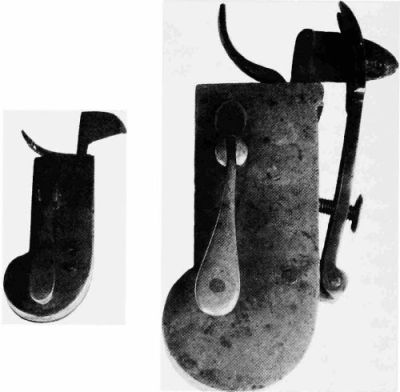
Figure 22.—Knob end spring lancet used on humans compared to a knob end lancet used on horses and cattle. Note the blade guard on the veterinary spring lancet. (NMHT 302606.09 and NMHT 218383 [M-9256]: SI photo 76-7757.)
In contrast to the few attempts made to modify the human spring lancet, there were a large number of attempts to modify the veterinary spring lancets. Veterinary spring lancets can be found with a wide assortment of shapes and a wide variety of spring mechanisms. In the enlarged knob end spring lancet, pushing upon the lever release simply sent the blade forward into the skin. By a more complex mechanism, the blade could be made to return after it was injected, or the blade could be made to sweep out a curve as do the blades of the scarificator. Perhaps one of the earliest attempts to introduce a more complex internal mechanism into the veterinary spring lancets is found in John Weiss’s “patent horse phlemes” of 1828. The first model invented by Weiss was constructed on the principle of the common fleam and bloodstick. As in the knob end spring lancet, the spring acted as a hammer to drive the blade forward. In a second improved “horse phleme,” Weiss mounted the blade on a pivot so that the blade swept out a semicircle when the spring was released.[199]
The Smithsonian collection contains a number of different types of veterinary spring lancets. Perhaps this variety can best be illustrated by looking at the two patent models in the collection. The first is an oval-shaped lancet patented in 1849 by Joseph Ives of Bristol, Connecticut.[200] By using a wheel and axle mechanism, Ives had the blade sweep out an eccentric curve. The lancet was set by a detachable key (Figure 23).
The second patent lancet was even more singular in appearance, having the shape of a gun. This instrument, patented by Hermann Reinhold and August Schreiber of Davenport, Iowa, in 1880, featured a cocking lever that extended to form a coiled spring in the handle portion of the gun. Also attached to the cocking lever was an extended blade with ratchet catches, so that by pulling on the cocking lever, the blade was brought inside the casing and the spring placed under tension. Pushing upon the trigger then shot the blade into the vein.[201] (Figure 24.)
Physical Analysis of Artifacts
The Conservation Analytical Laboratory of the Smithsonian Institution analyzed selected bloodletting instruments and one drawing from the Museum’s collection. Instruments were chosen on the basis of their unique appearance and as representative examples of the major types of instruments in the collection. Six lancets and cases, two scarificators, and one pen and ink drawing were analyzed.
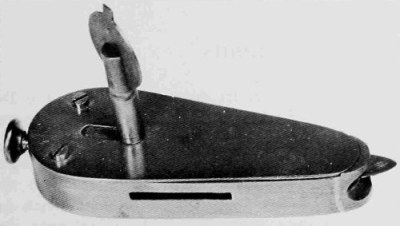
Figure 23.—Patent model, J. Ives, 1849. (NMHT 89797 [M-4292]: SI photo 73-4211.)
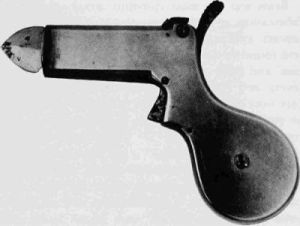
Figure 24.—Patent model, Reinhold and Schreiber, 1880. (NMHT 89797 [M-4327]; SI photo 73-4210.)
X-ray fluorescence analysis, response to a magnet, reaction to nitric acid, and the Vickers pyramid hardness test were among the methods of analysis used that involved no damage to the objects.
The instrument for X-ray fluorescence analysis has been modified to permit analysis of selected areas on the objects. This instrument produces, detects, and records the object’s X-ray fluorescence spectrum, which is characteristic of its composition. X-rays produced by a target in the instrument strike the object and cause it, in turn, to fluoresce, or emit, X-rays. This fluorescence is detected by a silicon crystal in the detector and dispersed into a spectrum, which is displayed on an oscilloscope screen. The entire spectrum—from 0 to 40 Ke V—can be displayed or portions of it can be expanded and displayed at an apparently higher resolution that permits differentiation between closely spaced fluorescent peaks, such as those from iron and manganese. The spectrum may be transferred from the oscilloscope to a computer for calculation of the percentage of composition and for comparison with spectra of other samples. During analysis the objects can be supported and masked by sheets of plexiglas or metal foils to limit the radiation to a certain area of the object. Masks also prevent scattering of radiation off other parts of the object and off the instrument itself, which otherwise might be detected and interpreted as less concentrated components in the object.
Brass was the most common metal used in the fabrication of eighteenth- and nineteenth-century lancets and scarificators. Upon analysis the brass was found to contain 70%-75% copper, 20%-30% zinc, and other trace elements. The blades, cocking levers, and button releases of lancets and scarificators were found to be made of ferrous metal (iron or steel). In addition to the typical brass pieces, a number of “white metal” pieces were analyzed. (The term “white metal” is used to designate any undetermined silver-colored metal alloy.) Those white metal pieces dating from the eighteenth century (a Swiss or Tyrolean fleam and an English veterinary spring lancet) were found to be composed entirely of ferrous metal. The hardness of the fleam metal indicated that it was carburized sufficiently to be made of steel. Two of the spring lancets, dating from the late nineteenth century, were found to be made of a silver-copper composition that was not rich enough in silver to be sterling silver. These lancets were probably typical of the lancets advertised as silver in the late nineteenth-century trade catalogs. About 1850 an alloy imitating silver began to be widely used in the making of surgical instruments. This was German silver or nickel-silver, an alloy containing no silver at all, but rather copper, zinc, and nickel. A patent model scarificator dating from 1851 was found to contain about 63% copper, 24% zinc, and 13% nickel. This alloy is presently called “nickel-silver 65-12” alloy. The French made scarificators out of their own version of nickel-silver that was called “maillechort.” The French circular scarificator was found to contain copper (55%-70%), nickel (10%-20%), zinc (20%-30%), and tin (less than 10%). The cases in which the lancets and scarificators were carried were covered with leather, despite the fact that several appeared to be covered with paper. X-ray analysis revealed that several cases contained tin, leading to the possibility that a tin salt was used in the dye-mordant for leather. The clasps on the cases were made of brass. One case was trimmed in gold leaf.
The most difficult item to analyze was the pen and ink drawing in black and red of a bloodletting man purported to be a fifteenth-century specimen (1480) from South Germany. The text is in German (Figure 25).
The watermark of the paper—a horned bull (ox) with crown—is believed to have appeared in 1310 and was used widely for two hundred years. The paper was heavily sized and no feathering of the black ink or red paint appears.
The paper fluoresced only faintly under ultraviolet light and much less brightly than new paper, leading to the conclusion that the paper is not modern. Various stains on the paper fluoresce yellow, which also indicates a considerable history for the document.
The guard strip is vellum. Red stains on this strip may have been made by blood.
The inks (brown and red) may have come from different sources or been applied at different times because of their various compositions and densities. Iron and lead were found in an area of writing on the left foot. Iron is typical of an iron gall ink. Some of the lighter lines contain graphite. The red lines contain mercury and lead suggesting a mixture of vermilion and red lead.
Analysis of the ink and paper indicates that the document has had a varied history and seems not to have been a deliberate production intended to simulate age.
Catalog of Bloodletting Instruments
Several systems of catalog numbers have been employed for instruments in the collections. The earliest instruments were originally collected by the Division of Anthropology and were given a six-digit number in the division catalog (referred to as “Anthropology”). Later objects in the collections have been given a six-digit National Museum of History and Technology (NMHT) accession number, which serves for all items obtained from one source at a given date. Before 1973, the Division of Medical Sciences used a system of numbering individual items by M numbers (e.g., “M-4151”). Since 1973, individual items have been distinguished by adding decimal numbers to the accession numbers (e.g., “308730.10”). Objects on loan have been marked as such and given a six-digit number. Other institutional abbreviations are as follows: SI = Smithsonian Institution; USNM = the former United States National Museum; NLM = National Library of Medicine.
Larger Image
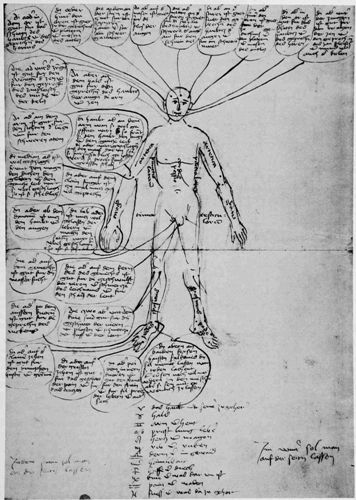
Figure 25.—Bloodletting manikin. (NMHT 243033 [M-10288]; SI photo 76-13536.)
Photograph numbers are labeled “BW” for black and white negative and “CS” for color slide. (Copies of photographs or slides may be purchased through the Office of Printing and Photographic Services, Smithsonian Institution, Washington, D.C. 20560.) Abbreviations for dimensions of objects are as follows: D = diameter; L = length; W = width; H = height.
Instruments within each group are arranged chronologically as accessioned by the museum.
Phlebotomy
Flint and Thumb Lancets
Flint lancets (4). Pieces of flint used to let blood by native doctors in Alaska in the 1880s. Donated by William J. Fisher late 19th century. L 22 mm, 35 mm, 43 mm, 50 mm. Anthropology vol. 30, catalog no. 127758. Neg. 73-4208 (BW, CS). (Figure 30.)
Thumb lancet, 19th century. Typical thumb lancet with steel blade and tortoise shell shield, engraved with a crown and “Evans/Old Change/London” (manufacturer). Purchased 1898. Shield: L 56 mm. Blade: L 50 mm. Anthropology vol. 30, catalog no. 143079.
Flint lancet. “Indian scarificator” collected by the Section of Ethnology of the Smithsonian 1902. L 44 mm. Anthropology vol. 30, catalog no. 143166.
Thumb lancets (4) with case, 19th century. Lancets are engraved “S. Maw” (manufacturer). The case is made of cardboard covered with brown leather and has four compartments. Used by the donor’s father while a missionary in Samoa in the 1830s. Donated in 1936 by the Rev. Robert G. Harbutt. Lancets: L 55 mm. Case: L 60 mm, W 28 mm, H 10 mm. Neg. 73-4230 (BW) four lancets with case; negs. 73-4226, 73-4227, 73-4228, 73-4229 (BW & CS), individual lancets. NMHT 139980 (M-4151). (Figure 38.)
Thumb lancets (2), 19th century. Lancets are typical 19th century thumb lancets. Shell shields are broken. Second lancet is engraved with a crown denoting British manufacture. Owned by S. K. Jennings of Baltimore (1771-1854). Donated by the Medical and Chirurgical Faculty of Maryland 1976. First lancet: L 54 mm; L of blade 46 mm. Second lancet: L 58 mm; L of blade 42 mm. NMHT 302606.062.
Thumb lancets (2), 19th century. Shell shields. One shell is marked “A. L. Hernstein.” Purchased 1976. First lancet: L 60 mm. Second lancet: L 70 mm. NMHT 1977.0789.
Bloodletting knife, 19th century. Handle is cylindrical and made of carved wood, which has been turned, a brass ring, and an ivory tip with a hole bored through it. Blade is double beveled and engraved “Rodgers/Cutlers to Her Majesty,” which indicates that the piece is Victorian. It could have been used for many purposes, including bloodletting. Purchased 1976. L 129 mm; L of blade 30 mm. Neg. 76-76108 (BW). NMHT 321697.39.
Thumb lancets in cases (8), 19th century. Seven of the cases have silver trimming and are closed by a hinged cap. These are similar in appearance to cigarette lighters. The first case, made of tortoise shell, contains four thumb lancets (with tortoise shell sheaths). Two blades are marked “Savigny & Co.,” two are marked with a cross on top of crown symbol. The second case is made of mother-of-pearl carved with an intricate floral design. It has space for four lancets but contains only one lancet marked “Thompson” on the inner side of the shell cover, and a silver pincers. The scroll initials “J H” appear on the side of the case. The third case is silver, decorated with a floral relief, and contains two lancets. The fourth case is made of shagreen and contains six lancets, three engraved “Savigny” and one “Morgan.” The fifth case is made of shagreen. One blade is inscribed “STODART.” Blades are rusted. The sixth case is made of shagreen. It contains one shell-covered lancet of a possible six. The blade is marked Paris. “J. P. Honard” is engraved on the silver top of the case. The seventh case is made of shagreen. It contains two lancets, one with a pearl shield and one with a shell shield. On the blade of the shell encased lancet is inscribed “B. Radford, 9 Patrick St. Conn.” The last case is made of leather, which is worn. It contains one shell-encased lancet. The blade is marked “Gouldig & Ford, N.Y.” Purchased 1976. Case one: L 70 mm, W 36 mm. Case two: L 69 mm, W 33 mm. Case three: L 65 mm, W 30 mm. Case four: L 74 mm, W 50 mm. Case five: L 71 mm, W 33 mm. Case six: L 75 mm, W 43 mm. Case seven: L 68 mm, W 32 mm. Case eight: L 75 mm, W 17 mm. Neg. 76-9116 (BW). NMHT 1977-0789. (Figure 5.)
Spring Lancets
Note: Lancets are measured to the tip of the casing rather than to the tip of the blade. The blade length depends upon the setting, and varies from an additional 8 to 13 mm.
Spring lancet, 19th century. Brass Knob end lancet with brass lever release. Purchased 1898. L 42 mm, W 20 mm. Anthropology vol. 30, catalog no. 143078.
Spring lancets (2) with case, 19th century. One lancet is plain with a brass lever release. Second lancet is brass with a steel lever release and has a floral design on the front and back panels. There are three settings for the height of the blade instead of the usual two. Blade is broken off. Case is square and made of wood covered with black leather and lined with rose plush. It is stamped “Braumiller, jun.” Wood is broken. Leather and plush are badly torn. Donated by George B. Roth 1925. Both lancets: L 44 mm, W 20 mm. Case: L 62 mm, W 64 mm, H 20 mm. NMHT 88734 (M-2099).
Spring lancet, patent model, 1857. Lancet has a cupped end instead of the usual knob end. According to analysis by the Conservation Laboratory, the lancet is made of silver-copper alloy. A screw on the back regulates the depth of cut by moving the spring mechanism back and forth inside the outer casing. Patented by James W. W. Gordon (U.S. patent 16479). Transferred from the U.S. Patent Office 1926. L 36 mm, W 25 mm, H 6 mm. Neg. 73-10318 (BW) and 73-116 (CS), front view; 73-10319 (BW) and 73-11147 (CS), back view. NMHT 89797 (M-4298). (Figures 48, 49.)
Spring lancet, 19th century. Lancet is brass and has a brass lever release. It is engraved with the initials “A. F.” Donor claimed it was a 17th-century import from Wales, but it appears to be a standard 19th century lancet. Donated by Edward Pryor 1930. L 45 mm, W 19 mm. Neg. 73-4235 (BW & CS). NMHT 112827 (M-2995). (Figure 105.)
Spring lancet, 19th century. Lancet is brass with a brass lever release. Engraved “Wiegand & Snowden/Philadelphia” (manufacturer). Donated by Dr. H. S. West 1934. L 44 mm, W 22 mm. NMHT 131386 (M-3636).
Spring lancet with case, 19th century. Standard 19th century lancet with typical case made of wood, covered with brown leather and lined with chamois. Case closes by a latch, and is stamped “Traunichtessticht,” which translates, “Do not trust, it stabs.” Many 19th century cases were stamped with this motto. Donated by Fred G. Orsinger 1937. Lancet: L 41 mm, W 20 mm. Case: L 71 mm, W 35 mm, H 18 mm. Neg. 73-4237 (BW & CS), without case. NMHT 145365 (M-4510).
Spring lancet blade with case, 19th century. The case is made of wood and covered with red paper, and has “F D” stamped on the bottom. A piece of paper with the date “1877” is affixed to the top of the case. This is the date that the donor received the blade from his mother, daughter of the owner, Dr. Joseph S. Dogan (1793-1870), who practiced as a country doctor in South Carolina. Donated by B. F. Arthur 1937. Blade: L 42 mm. Case: L 64 mm, W 20 mm, H 15 mm. NMHT 145290 (M-4513).
Note: In the Wellcome Museum there are two spring lancets in a case. (R 3689/1936) One of these is marked “F. D.” and the other “Fischer Peter,” which may indicate that this is the name of the maker of all instruments so marked. The Wellcome instruments were part of the Hamonic Collections. Dr. Hamonic listed them as 18th century instruments. Another lancet that appears to be veterinary, because of its size, is stamped “P. Fischer” (Wellcome 13516). Note that several items in this catalog are so marked.
Spring lancet with case, late 19th-early 20th century. Tiemann & Co.’s spring lancet, a modified lancet sold by George Tiemann & Co. and advertised in the Tiemann catalogs of 1879 and 1889. Lancet is made of German silver and has a domed rather than a knob end. It is stamped “Tiemann” on the back panel. Release lever is a short bar across the top. Leather case is lined in red plush and has a partition in which four extra lancet blades are contained. Lancet was one of various instruments in a medical bag used by Dr. Augustus Stabler of Brighton, Maryland, who practiced from 1889 to 1914. Donated by Sidney Snowden Stabler 1942. Lancet: L 34 mm, W 16 mm. Case: L 62 mm, W 40 mm, H 23 mm. Neg. 73-5644 (BW). NMHT 163863 (M-5141). (Figure 47.)
Spring lancet with case, 19th century. Brass lancet with brown leather case. Lancet was a part of the Squibb Ancient Pharmacy, a collection of medical and pharmaceutical objects brought by E. Squibb and Sons to the United States in 1932. On deposit from the American Pharmaceutical Association 1945. Lancet: L 40 mm, W 19 mm. Case: L 70 mm, W 38 mm, H 24 mm. NMHT 170211 (M-6385).
Spring lancets (2) with case, 19th century. Lancets are made of brass and have steel lever releases. They are engraved front and back with a floral pattern. Tip of the blade of one of the lancets is broken. Case is wood covered with red leather and is missing the top. Donated by the University of Pennsylvania 1959. First lancet: L 43 mm, W 21 mm. Second lancet: L 75 mm, W 49 mm, H 11 mm. NMHT 218383 (M-9260).
Spring lancet with case, 19th century. Brass lancet with brass lever release. Case is covered with red cloth and lined with black plush. Used by Dr. Samuel Fahnestock (1764-1836) or by his son, Dr. William Baker Fahnestock (1804-1886) of Pennsylvania. Donated by Capt. Henry Fahnestock MacComsey, U.S.N., and Dr. G. Horace Coshow 1968. Lancet: L 40 mm, W 20 mm. Case: L 74 mm, W 40 mm, H 26 mm. NMHT 280145 (M-12341).
Spring lancet with case, 19th century. Lancet has a steel lever release and is stamped “F. D.” on the back panel. Other lancets have been found with these initials but so far no manufacturer has been traced. Leather of case is damaged. Owned by Dr. Harry Friedenwald of Baltimore, Maryland (b. 1864). Donated by the Medical and Chirurgical Faculty of Maryland 1976. Lancet: L 40 mm, W 20 mm. Case: L 72 mm, W 34 mm, H 20 mm. NMHT 302606.008.
Spring lancet with case, 19th century. Brass spring lancet with a brass lever release. Case is stamped “Traunichtessticht” (see NMHT 145365 [M-4510]). Used by Dr. Wilbur Phelps, Baltimore, Maryland (1841-1922). Donated by the Medical and Chirurgical Faculty of Maryland 1976. Lancet: L 38 mm, W 34 mm. Case: L 71 mm, W 34 mm, H 17 mm. Neg. 76-7757 (BW & CS), compares lancet to a veterinary spring lancet. NMHT 302606.009. (Figure 22.)
Spring lancet with case, 19th century. Brass spring lancet with a brass release. Case is covered with navy blue leather, lined with chamois, and stamped with a small flower and leaf design. Owned by Dr. Launcelot Jackes of Hancock, Maryland (b. late 18th century). Donated by the Medical and Chirurgical Faculty of Maryland 1976. Lancet: L 40 mm, W 22 mm. Case: L 66 mm, W 34 mm, H 20 mm. NMHT 302606.039.
Spring lancet with case, 19th century. Lancet and case are very similar to NMHT 302606.039. The case is more rounded on top, is covered with black leather, and bears the same floral motif. Lancet blade is broken. Owned by Dr. George Washington Crumm of Clearspring and Jefferson, Maryland (1811-1896). Donated by the Medical and Chirurgical Faculty of Maryland 1976. Lancet: L 42 mm, W 22 mm. Case: L 66 mm, W 38 mm, H 22 mm. NMHT 302606.056.
Spring lancet, 19th century. Brass lancet with steel lever release. Owned by Dr. Joseph Tate Smith of Baltimore, Maryland (1850-1930). Donated by the Medical and Chirurgical Faculty of Maryland 1976. Lancet: L 42 mm, W 20 mm. NMHT 302606.057.
Spring lancets (2) with case, 19th century. Wood case, covered with brown leather and lined with brown velvet, has space for two rectangular lancets. One brass lancet, knob end, does not belong with the set. It has a steel lever release and three settings for blade height. The rectangular lancet, also made of brass, with an iron lever release and three settings for the height of the blade, is unusual in that it is triggered by a slide catch on the facing side rather than by a lever on top. The set was owned by Dr. Charles W. Owen of Maryland (1823-1857). Donated by the Medical and Chirurgical Faculty of Maryland 1976. Rectangular lancet: L 50 mm, W 16 mm. Knob end lancet: L 42 mm, W 18 mm. Case: L 150 mm, W 34 mm, H 22 mm. NMHT 302606.058.
Spring lancet with case, 19th century. Lancet and case are similar to NMHT 302606.039. The leather of the case is torn and the lancet blade is broken. Donated by the Medical and Chirurgical Faculty of Maryland 1976. Lancet: L 42 mm, W 22 mm. Case: L 66 mm, W 38 mm, H 24 mm. NMHT 302606.061.
Spring lancet with case, 19th century. The Conservation Analytical Laboratory found the lancet to be made of a silver-copper alloy with an iron or steel lever release. It has a border around the top and along the edge and is marked “Reinhardt & Co/Balto.” Case is covered with black leather and lined in pink plush. It is decorated by a gold border and a small scroll motif. Donated by Harry L. Schrader 1972. Lancet: L 42 mm, W 21 mm. Case: L 68 mm, W 34 mm, H 20 mm. NMHT 302607 (M-14682).
Spring lancet with case, late 19th-early 20th century. Lancet is similar to the preceding lancet. It is made of white metal[B] (probably silver-copper) and has a border decoration along the top and around the edge. Case, which is badly rotted from water damage, is a folding style case and is closed by a clasp. There is a pocket for extra blades. Donated by John and James Draper 1973. Lancet: L 42 mm, W 21 mm. Case: L 74 mm, W 40 mm, H 18 mm. NMHT 304826.067.
Spring lancet with case, late 19th-early 20th century. Brass knob end lancet with brass lever release. Case is covered with brown leather and lined with chamois. Case is stamped “Traunichtessticht” (See NMHT 145365 [M-4510]). Owned by Dr. F. L. Orsinger of Chicago (1852-1925). Donated by Dr. William Orsinger 1973. Lancet: L 43 mm, W 22 mm. Case: L 70 mm, W 30 mm, H 20 mm. Neg. 74-4088 (BW & CS); 76-13535 (BW), interior view of spring mechanism. NMHT 308730.10. (Figures 7, 39.)
Spring lancet with case, 19th century. Brass Lancet with steel lever release. Leather of case is water damaged and is stamped “Traunichtessticht.” Latch is missing. Donated by Peter H. Smith Jr., 1975 Lancet: L 50 mm, W 25 mm (w/ blade extended), H 15 mm. Case: L 75 mm, W 42 mm, H 23 mm. NMHT 316508.01.
Spring lancet with case, 18th-early 19th century. Wooden case has a hand-carved space for lancet. Lancet is brass and has an unusual boot shape. The short lever release operates a catch at the very top of the lancet casing. The large blade has a guard that is regulated by a screw on the side. Purchased 1976. Lancet: L 35 mm, W 24 mm. Case: L 68 mm, W 33 mm, H 20 mm. Neg. 76-9114 (BW). NMHT 316478. (Figure 46.)
Spring lancet, late 18th-early 19th century. Unusually shaped large brass and steel spring lancet, nicely decorated and engraved with the name “M. A. Prizzi.” Lancet is set by a slide cocking lever on the facing side and released by another lever. A brass plate at the top of the lancet can be moved back and forth by a screw in order to regulate the depth of cut of the lancet blade. Lancet comes with a spare blade. Purchased 1975. Lancet: L 86 mm. Neg. 76-7763 (BW, CS). NMHT 320033.06. (Figure 45.)
Spring lancet with case, 19th century. Lancet is brass with a steel lever release and has a zig-zag decoration on the front and back panels. Case is covered with brown leather and lined with chamois and has a small basket of flowers stamped on the top. Purchased 1976. Lancet: L 42 mm, W 19 mm. Case: L 71 mm. W 34 mm. H 19 mm. Neg. 73-4236 (BW & CS). NMHT 321636.01. (Figure 6.)
Spring lancet, 19th century. Lancet is engraved “F. D.” on back (see NMHT 302606.008). Analysis by the Conservation Laboratory shows that the lancet is made of brass composed of 70% copper and 30% zinc plated with a tin-lead alloy. Most of the plating has been rubbed away. The blade, cocking lever, and release lever are of iron or steel. Purchased 1976. Lancet: L 43 mm. W 21 mm. NMHT 321636.02.
Spring lancet with case, 19th century. Lancet is brass and has a brass lever release. Engraved “Goulding/New York” (manufacturer). Case is made of wood, covered with black leather and lined with light brown plush. It has a tab closure. Lancet and case were not originally a set; the case was designed for a larger lancet. Donated by the American Pharmaceutical Association 1970. Lancet: L 40 mm, W 20 mm. Case: L 74 mm. W 38 mm. H 12 mm. NMHT 321641 (M-13060).
Spring lancet with case, late 19th century. Silver lancet with a button release and a border decorating the top and edge. Button release lancets were sold in the late 19th century for slightly more than lever release lancets. Analysis by the Conservation Laboratory shows that the silver is not sterling but a silver-copper alloy containing twice as much copper as sterling silver. The button release is made of ferrous metal plated with silver. The blade and cocking lever are also of ferrous metal. The case is made of wood, covered with brown leather and trimmed with gold leaf. It is closed by an ornate clasp made of ferrous metal plated with brass. Donated by the American Pharmaceutical Association 1970. Lancet: L 42 mm, W 22 mm. Case: L 73 mm, W 40 mm, H 11 mm. NMHT 321641 (M-13060.1).
Spring lancet with case, 19th century. Silver lancet with lever release described by seller as dating from 1800, although it is probably of a later date. Lancet has a border decoration, and the back plate is opened by a shell-design protuberance. The case is covered with brown leather with gold leaf edging, and is stamped “A. St.” Case is lined with rose plush below and white silk above. Lancet is engraved “Cotzand.” Purchased 1976. Lancet: L 42 mm, W 17 mm. Case: L 68 mm, W 37 mm, H 20 mm. Neg. 76-7752 (BW, CS). NMHT 321687.02. (Figure 44.)
Spring lancet with case, late 19th century. Silver lancet with a button release and a border decorating the top and the edge. Mechanism is frozen. Purchased 1976. Lancet: L 40 mm. NMHT 321697.01.
Spring lancet, late 19th century. White metal including the blade, which may have been a replacement for the original. The blade is more highly polished than the case. The black case is worn so that an indistinct mark appears on its cover. It is lined with chamois. Lancet: L 41 mm, W 17 mm, blade extends 10 mm. Case: L 65 mm, W 38 mm. NMHT 1977.0789.13.
Spring lancet with case, 19th century. Brass lancet with steel lever release. Case is covered with brown leather and lined with chamois. Leather is torn and latch is missing. Owned by Dr. Launcelot Jackes of Hancock, Maryland (b. late 18th c.). Donated by the Medical and Chirurgical Faculty of Maryland 1976. Lancet: L 40 mm, W 20 mm. Case: L 72 mm, W 42 mm, H 24 mm. NMHT 302616.040.
Spring lancets (2) with case, late 18th-early 19th century. Pair of brass lancets in a hand-carved wooden case. First lancet has a steel lever release and is engraved with a zig-zag pattern and the initials “F. D.” Second lancet is shorter than usual and missing the lever release and cocking lever. Case has space cut for each lancet and an additional space for extra blades or a thumb lancet. Purchased 1976. First lancet: L 40 mm. Second lancet: L 30 mm. Case: L 84 mm, W 56 mm, H 17 mm. NMHT 321697.02.
Spring lancet, late 19th century. Brass decorated with flowers, has tulip and leaves on reverse side with iron blade and lever. Lancet: L 39 mm, W 21 mm. Case: L 65 mm, W 33 mm. NMHT 1977.0789.14.
Spring lancet, late 19th century. Brass case is unmarked. The leather case had a red lining and a top that slips off. Lancet: L 44 mm, W 18 mm. Case: L 77 mm, W 35 mm. NMHT 1977.0789.15.
Spring lancet, late 19th century. Brass case with unclear lettering “WIEGANL Phila Powten.” Leather case has red lining and closes with a hook. Lancet: L 41 mm, W 22 mm. Case: L 70 mm, W 33 mm. NMHT 1977.0789.9.
Spring lancet, late 19th century. Brass case. Leather case has a chamois lining and closed with a hook. An eagle on the cover is worn. Lancet: L 43 mm, W 19 mm. Case: L 70 mm, W 35 mm. NMHT 1977.0789.10.
Spring lancet, late 19th century. Light yellow brass case. Case is leather (worn) with a chamois lining and hook closure. Lancet: L 41 mm, W 20 mm. Case: L 71 mm, W 35 mm. NMHT 1977.0989.11.
Spring lancet, late 19th century. Brass case with small guard over blade. Cover on the back appears to be a replacement for the original. Crude wooden case is red and worn. Lancet: L 45 mm, W 33 mm. NMHT 1977.0789.12.
Spring lancet, late 19th century. Brass case with cover of the lancet missing. Leather case has a chamois lining and hook closure. Lancet: L 38 mm, W 20 mm. Case: L 70 mm, W 34 mm. NMHT 1977.0789.7.
Spring lancet, late 19th century. Lancet is of white metal including the blade. The leather case has a gold decoration around the edges. Lancet: L 41 mm, W 22 mm. Case: L 70 mm, W 36 mm. NMHT 1977.0789.8.
Note: For additional spring lancets, see “Cupping Sets” (NMHT 268719 [M-11878]) and “Related Artifacts” (NMHT 199536 [M-6689] and NMHT 285125 [M-12352]).
Bleeding Bowls
Bleeding bowl, after 1740. Pewter bowl with horizontally projecting handle. Handle is decorated with cut out tracery, a coat of arms, and the name of the London maker, John Foster. Bowl has graduated rings every 2 ounces from 2 to 16. Held by Division of Cultural History, Smithsonian Institution (Greenwood Collection). L 200 mm to tip of handle, D 132 mm, H 45 mm. Neg. 61166-C (BW). (Figure 4.)
Barber’s basin, 18th century. Blue faience basin with green, red, and blue floral decoration. Used for shaving and probably for phlebotomy as well. Bowl is indented to fit against the neck. Purchased 1959. L 260 mm, W at indentation 173 mm, H 68 mm. Neg. 73-4220 (BW, CS). NMHT 225114 (M-9399).
Bleeding bowl. Circular bleeding bowl made of pewter and typical of the bowls used to collect and measure blood in the 18th century. Such bowls were no longer generally used in the 19th century. Bowl has a plain, flat, horizontally projecting handle and graduated circles marking every 4 ounces from 4 to 24. Purchased 1976. L 233 mm to tip of handle, D 166 mm, H 55 mm. NMHT 322691.01.
Bleeding bowl. Pewter bowl with a cut out tracery handle. Bowl has graduated markings every 2 ounces from 2 to 16. Purchased 1976. D 127 mm, H 64 mm. NMHT 322691.02.
Extra Blades and Cases
Spring lancet blades (2), 18th-19th century. Used by Dr. John Cooper, Easton, Pennsylvania, great-grandfather of the donor. Donated by the Rev. J. V. Cooper 1936. Blades: L 44 mm, W 14 mm. NMHT 139877 (M-4145).
Spring lancet case, 19th century. This case is unlike other lancet cases in the collection in that the top half is a cap which slips off. The bottom half opens lengthwise and has space for a lancet and two pockets for extra blades. Case, made of cardboard and covered with black leather, is lined in tan plush. Purchased 1963. Case: L 62 mm, W 32 mm, H 22 mm. NMHT 251481 (M-10463).
Spring lancet case, 1827. Case is handmade of wood, with fabric panels covered with glass on five sides. In the top panel, a spring lancet has been hand drawn in blue. The bottom panel contains several symbolic images and the motto, “Memento Mori.” The end panel has the name of the owner, “W. M. Bonwill’s/1827.” The case opens by a hinge and has space carved out for two knob end lancets. Pasted to the lid is a leather pocket containing two lancet blades of different sizes. The Smithsonian Institution also owns a matching toilet case, given by the same donor. Donated by the University of Pennsylvania 1959. Case: L 87 mm, W 48 mm, H 18 mm. Neg. 73-5847, 73-5848, 73-5849, 73-5850 (BW, various views with toilet case)/73-7680 to 73-7693 (CS, various views with toilet case). NMHT 218383 (M-9261).
Spring lancet case, 19th century. Two part red leather case. Inner box has space for a knob end spring lancet and two spare blades. Box slides into an outer shell with a tab closure. Owned by Dr. Robert Moore (1764-1844), who served as President of the Medical and Chirurgical Faculty of Maryland from 1820 to 1826. Donated by the Medical and Chirurgical Faculty of Maryland 1976. Case: L 78 mm, W 50 mm, H 12 mm. NMHT 302606.054.
Cupping
Scarificators
Note: Height is measured to the top of the casing. The height may vary by a few millimeters because setting the depth of cut of the blades is accomplished by raising or lowering the bottom of the scarificator.
Scarificator, 12 blades, 19th century. Octagonal brass scarificator with blades arranged on two rods which cut in opposite directions. This is a standard English-American 19th c. scarificator. As is true of all scarificators, the blades and cocking lever are made of ferrous metal (iron or steel). Two small stars on one side indicate how the top and bottom of the scarificator fit together. Purchased 1898. L 46 mm, W 42 mm, H 30 mm. Anthropology vol. 30, catalog no. 143080.
Scarificator with case, 12 blades, 19th century. Standard scarificator with blades cutting in opposite directions. Case is wood covered with red leather, lined in purple plush and closed by a latch. On top of the case is an American eagle. Donated by Dr. D. H. Welling 1925. Scarificator: L 52 mm, W 46 mm, H 36 mm. Case: L 61 mm, W 56 mm, H 77 mm. NMHT 86124 (M-2087). Note: American eagles of this type were imprinted on many objects at the time of the Centennial (1876).
Scarificator, 12 blades, patent model, 1846. Patented by George Tiemann of New York (U.S. patent 4705). Engraved “Geo. Tieman[sic]/No. 63 Chatham Street/New York/March 1846.” The novel feature of the scarificator was the addition of an ebony handle in which a coiled spring was contained. See NMHT 254866 (M-10700), which is the same instrument as marketed by George Tiemann & Co. Transferred from the U.S. Patent Office 1926. Overall L 176 mm. Base: L 42 mm, W 42 mm, H 18 mm. Neg. 76-9115 (BW). NMHT 89797 (M-4289). (Figure 76.)
Scarificator, 13 blades, patent model, 1847. Patented by Frederick M. Leypoldt of Philadelphia (U.S. Patent 5111). Scarificator is brass, octagonal with three rods containing 4, 5, and 4 blades respectively. Blades turn in same direction. The innovation consisted of a new arrangement of the cocking lever and spring. Engraved “F. Leypoldt/Philada.” Transferred from the U.S. Patent Office 1926. L 44 mm, W 44 mm, H 40 mm. Neg. 73-4213 (BW & CS). NMHT 89797 (M-4290). (Figure 77.)
Scarificator, 10 blades, patent model, 1851. Patented by Frederick Leypoldt of Philadelphia (U.S. patent 8095). This is a flattened model of scarificator made of a copper-zinc-nickel alloy known as “nickel-silver,” or German silver. The innovation in this patent model was a flat lever extending from the side instead of the top, which fits into slots in two racks which move back and forth and turn the pinions of the blade rods. Blades cut in opposite directions. Transferred from the U.S. Patent Office 1926. L 42 mm, W 40 mm, H 16 mm. Neg. 76-9112 (BW). NMHT 89797 (M-4293). (Figure 78.)
Scarificator, 12 blades, 19th century. Octagonal scarificator in which blades cut in the same direction. Donated by Dr. George B. Roth 1928. L 44 mm, W 40 mm, H 38 mm. Neg. 76-7744 (BW, CS). NMHT 99749 (M-2336). (Figure 106.)
Scarificator, 12 blades, late 19th century. Octagonal scarificator; blades cut in opposite directions. Used by the donor’s father. Donated by Aida Doyle 1932. L 48 mm, W 42 mm, H 34 mm. NMHT 118000 (M-3182).
Scarificator, 10 blades, early 19th century. Octagonal scarificator with blades cutting in the same direction. Donated by H. S. West 1934. L 46 mm, W 44 mm, H 34 mm. NMHT 131386 (M-3635).
Scarificator, 16 blades, early 19th century. This scarificator is typical of Germanic manufacture during the late 18th and early 19th centuries. It is square, hand engraved, and has pointed blades. Blades are arranged on three rods that turn in the same direction. Engraved “J. T./Wien.” Vienna was the center of early scarificator manufacture. Scarificator said by donor to date from 1806. Donated by the University of Pennsylvania 1959. L 35 mm, W 34 mm, H 39 mm. Neg. 73-4212 (BW, CS). NMHT 218383 (M-9257). (Figure 60.)
Scarificator, 16 blades, 19th century. Square scarificator, made somewhat later than the previous one because the blades are no longer pointed. Donated by the University of Pennsylvania 1959. L 36 mm, W 36 mm, H 32 mm. NMHT 218383 (M-9258).
Scarificator, 16 blades, late 18th-early 19th century. Square scarificator. Donated by the University of Pennsylvania 1959. L 40 mm, W 30 mm, H 32 mm. Neg. 61130-B (BW). NMHT 218383 (M-9259).
Scarificator with case, 4 blades, 19th century. Small octagonal scarificator used for cutting the temples. Bottom of scarificator is engraved with an American eagle. Case is covered with navy blue leather, lined with purple plush, and closed by a latch. Purchased 1960. Scarificator: L 28 mm, W 26 mm, H 26 mm. Case: L 42 mm, W 40 mm, H 60 mm. Neg. 76-7745 (BW, CS). NMHT 233056 (M-9639). (Figure 107.)
Scarificator, 12 blades, 19th century. This octagonal scarificator is significant in that it bears a French patent. Turning the large wing-shaped handle on the top of the instrument cocks the blades, and turning a small key on the side regulates the depth of cut of the blades. Blades cut in opposite directions. Scarificator engraved “Breveté, S.G.D. Gouv.” Purchased 1964. L 42 mm, W 38 mm, H 32 mm. NMHT 254866 (M-10695).
Scarificator with case, 12 blades, 19th century. This is the market version of Tiemann’s patent scarificator (NMHT 89797 [M-4289]), with a bone handle. Engraved “Geo. Tiemann/Patent/August 20/1846.” This scarificator was advertised as late as 1889. Purchased 1964. Scarificator: L 172 mm, W 45 mm, H 45 mm. Neg. 73-4237-D (CS). NMHT 254866 (M-10700).
Scarificator, 13 blades, 19th century. Octagonal scarificator with unusual number of blades arranged on three rods and cutting in the same direction. Purchased 1964. L 51 mm, W 46 mm, H 34 mm. NMHT 254866 (M-10706).
Scarificator with case, 10 blades, 19th century. Used by Mary Fueurstien Kuhn, who practiced as a midwife in Ohio and also cupped and bled people during the period 1850-1890. Scarificator was brought to the United States from Germany by Mrs. Kuhn’s father, who was a doctor. Blades cut in opposite directions. Case is covered in brown leather and lined in rose plush. Donated by Mrs. Arthur Peterman 1964. Scarificator: L 45 mm, W 42 mm, H 32 mm. Case: L 58 mm, W 55 mm, H 71 mm. NMHT 255254 (M10892).
Scarificator, 16 blades, late 18th-early 19th century. Square scarificator. Top cap has a scalloped edge. Blades appear to be pointed. Mechanism is frozen. Donated by Harry L. Schrader 1972. L 34 mm, W 34 mm, H 34 mm. NMHT 302607 (H-14681).
Scarificator, 16 blades, late 18th-early 19th century. Square scarificator. Mechanism is frozen. Donated by John and James Draper 1973. L 38 mm, W 35 mm, H 32 mm. NMHT 304826.066.
Scarificator with case, 12 blades, late 19th-early 20th century. Octagonal scarificator with blades cutting in opposite directions. Two stars are engraved on the top and the bottom of one side. Case is cardboard covered with leather. Owned by Dr. F. L. Orsinger of Chicago (1852-1925). Donated by Dr. William Orsinger 1973. Scarificator L 45 mm, W 40 mm, H 35 mm. Case L 54 mm, W 48 mm, H 80 mm. Neg 74-4089 (BW, CS). NMHT 308730.11.
Scarificator with case, 12 blades, 19th century. Octagonal scarificator with blades cutting in the same direction. There are two star markings on the top and the bottom of one side. Case is made of cardboard covered with black leather. Donated by Ada and Grace Abrahamson 1975. Scarificator: L 43 mm, W 40 mm, H 34 mm. Case: L 56 mm, W 47 mm, H 73 mm. NMHT 318916.01.
Scarificator, 13 blades, 1973. Unusual hand-made brass and iron scarificator, engraved with decoration and the name “Domenico Pica” and date “1793.” Blades are set on three rods of four, five, and four blades (see NMHT 254866 [M-10706]). The scarificator is octagonal but much taller than the standard octagonal model. Unlike all other scarificators in the collection, the bottom opens by a hinge, and a key on top raises and lowers the interior mechanism so as to regulate the depth of cut. Blades are cocked by a lever on top and released by a button on the side. Purchased 1975. L 50 mm, W 42 mm, H 60 mm. Neg. 76-7742 and 76-7743 (BW, CS). NMHT 320033.01. (Figure 66.)
Note: The earliest marked scarificator known to the authors is one in the Wellcome Medical Collection (Wellcome number R 2.852/1930 C.H.M.), inscribed 1747. The case and blade are made entirely of iron or steel. L 144 mm, W 45 mm. Another one with a brass case (Wellcome number 290 or 6 7/36, in the Hamonic Collection) is inscribed Johann Darmreuther in Vendelstein 1769. A third one with a brass case and thirteen blades (Wellcome number 13555) is marked “Jo. Bat. Boeller Fece anno 1762.”
Scarificator, 16 blades, late 18th-early 19th century. Square scarificator with 16 pointed blades engraved, in script, “Joseph Plunger in Brünn.” Case is covered with brown leather. Purchased 1975. L 32 mm, W 32 mm, H 30 mm. NMHT 320033.02.
Scarificator, 12 blades, 19th century. Standard octagonal scarificator with blades cutting in opposite directions. Stamped on the bottom with an American eagle, similar to that of NMHT 233056 (M-9639). This may mean the scarificators were made around the time of the Centennial. Purchased 1975. L 48 mm, W 45 mm, H 28 mm. NMHT 320033.03.
Scarificator, 12 blades, 19th century. Standard octagonal scarificator with blades cutting in opposite directions. Engraved “H & H Hilliard/Edinburgh.” Purchased 1975. L 54 mm, W 47 mm, H 35 mm. NMHT 320033.04.
Scarificator, 16 blades, mid-late 19th century. Circular scarificator with fluted sides of the type manufactured by Maison Charrière in Paris. Seller describes instrument as French, mid-19th century. Analysis by the Conservation Laboratory shows that the instrument was made of an alloy of copper, zinc, nickel, and tin—probably the alloy that the French called “maillechort.” Winged lever on top triggers the sixteen small blades arranged on two rods and cutting in opposite directions. A round knob on the side is pushed downward to release the blades. Presumably by turning the bottom, one can regulate the depth of cut. However, the bottom is frozen. Purchased 1975. H 31 mm, D 45 mm. Neg. 76-7746. NMHT 320033.05. (Figure 74.)
Scarificator, 12 blades, 19th century. Standard octagonal scarificator with blades cutting in opposite directions. Used by Dr. G.W.M. Honberger (b. 1819). Donated by the Medical and Chirurgical Faculty of Maryland 1976. L 46 mm, W 44 mm, H 32 mm. NMHT 302606.006.
Scarificator with case, 12 blades, 19th-20th century. Standard octagonal scarificator. Mechanism is frozen. Case covered with brown leather and lined with brown plush. Used by Dr. Jesse O. Purvis (b. 1880). Donated by the Medical and Chirurgical Faculty of Maryland 1976. Scarificator: L 48 mm, W 46 mm, H 32 mm. Case: L 61 mm, W 54 mm, H 79 mm. NMHT 302606.059.
Scarificator, 10 blades, late 19th century. Standard scarificator, blades cutting in opposite directions, owned by Dr. Charles Carroll Shippen of Baltimore (b. 1856). Donated by the Medical and Chirurgical Faculty of Maryland 1976. L 48 mm, W 44 mm, H 34 mm. NMHT 302606.060.
Scarificator, 12 blades, 19th century. Donated by the Medical and Chirurgical Faculty of Maryland 1976. L 48 mm, W 44 mm, H 36 mm. NMHT 302606.217.
Scarificator, 10 blades, 19th century. Octagonal scarificator of white metal with an iron lever. Purchased 1976. L 41 mm, W 39 mm, H 31 mm. NMHT 1977.0789.40.
Scarificator, 16 blades, 19th century. Purchased 1976. L 41 mm, W 35 mm, H 32 mm. NMHT 1977.0789.41.
Note: Additional scarificators are found under “Cupping Sets” and in the “Barber-surgeon’s kit” listed under “Related Artifacts.”
Cups
Cupping cup, glass, 19th century. Large dome-shaped cup. Purchased 1898. H 82 mm, D 66 mm. Anthropology vol. 30, catalog no. 143081.
Cupping cup, glass, 18th-19th century. Hand-blown bellied cup from Hebron, Palestine. Donated by Dr. Cyrus Adler 1902. H 53 mm, diameter 31 mm. Anthropology vol. 30, catalog no. 143155. Neg. 59139-A (BW).
Cupping cup, 12th century. Cup is made of opaque greenish glass and is triangular in shape. A vacuum is created in the cup by sucking air from the cup through a tubular extension on the side. This 12th century cup was recovered in Nishapur, Persia, by Dr. Richard Ettinghausen. On loan from Dr. Ettinghausen 1955. H 68 mm, D 42 mm. Neg. 73-4205 (BW, CS). NMHT 207389 (M-6836). (Figure 108.)
Cupping cups (2), Pewter, 18th century. These cups are similar to those found in a Revolutionary War surgeon’s kit held by the Smithsonian, and may therefore be of military issue. Metal cups were often preferred to glass for military purposes because they were unbreakable. Donated by Hattie Brunner 1955. M-6829 H 42 mm, D 34 mm. M-6830 H 38 mm, D 34 mm. Neg. 76-9109 (BW), includes German brass cup. NMHT 207399 (M-6829 and M-6830).
Cupping cup, 12th century. A second Persian spouted cup (cf. NMHT 207389 [M-6836]), also made of opaque greenish glass, but more dome shaped. Purchased 1959. H 52 mm, D 50 mm. Neg. 73-4215 (BW). NMHT 224478 (M-8037).
Cupping cups (3), glass, 18th-19th centuries. Cups of smaller diameter such as these were used for cupping on the temples and other parts of the body with limited surface area. Cups are molded and slightly bellied. Purchased 1964. First cup: H 54 mm, D 36 mm. Second and third cups: H 56 mm, D 36 mm. NMHT 254866 (M-10694).
Cupping cup, horn, 20th century. A horn of a cow from Madaoua, Niger Republic, West Africa, used for drawing blood as late as the 1960s. There is a small foramen at the tip for exhausting the air by sucking. Purchased 1966. L 88 mm, D 52 mm. Neg. 73-5643 (BW, CS). NMHT 270023.01 (M-11998). (Figure 37.)
Cupping cups, glass, 19th century. Set of five dome-shaped cups ranging from 50 mm to 60 mm in diameter and 64 mm to 72 mm in height. They were dated by the seller as 1895. Purchased 1969. NMHT 287162 (M-12872).
Cupping cups (2), glass, 20th century. These two small cups were purchased about 1912 by Mr. Harry Zucker from a drug supply company on 2nd Street and Avenue B on the Lower East Side of New York City. Mr. Zucker used the cups for dry cupping only. Donated by Ruth Zucker 1972. H 54 mm, D 34 mm. NMHT 302834.1 and 302834.2.
Cupping vessels (5), glass, 19th-20th centuries. Set of five dome-shaped cups ranging from 52 mm to 56 mm in height and 44 mm to 48 mm in diameter. Owned by Dr. E. L. Orsinger of Chicago (1852-1925). Donated by Dr. William Orsinger 1973. Neg. 74-4087 (BW, CS). NMHT 308730.09.
Cupping vessels (3), glass, 18th-19th centuries. These three cups have button like protuberances on top for ease in handling. Cups were often pictured in 18th century surgical texts with such protuberances. In the 19th century most cups lacked them. Purchased 1976. NMHT 314016.236-.239. (Figure 109.)
Cupping vessel, glass, 19th century. Slightly bellied, hand-blown cup. Donated by Ada and Grace Abrahamson 1975. H 47 mm, D 43 mm. NMHT 318916.02.
Cupping vessel and bloodletting knife, 17th century. Persian brass conical cupping cup with a small hole at the tip for mouth suction. Knife has a wood and brass handle and a folding blade. Seller gives date as 17th century. Purchased 1976. Knife L 110 mm (folded). Cup L 86 mm, D 46 mm. Neg. 76-7749 (BW, CS). NMHT 320033.07. (Figure 110.)
Cupping vessel, brass, 18th century. German brass cupping vessel. Purchased 1976. H 30 mm, D 35 mm. Neg. 76-9109 (BW), includes two pewter cups. NMHT 321697.22. (Figure 111.)
Cupping vessels, glass, 19th century. Five small, hand-blown, green glass cupping cups. All are approximately the same size. Purchased 1976. Average dimensions: H 44 mm, D 35 mm. NMHT 321697.23-.27.
Cupping vessels, glass, 19th and 20th centuries. Assortment of 22 cupping cups, either dome-shaped or slightly bellied. Various sizes. Purchased 1976. NMHT 321697.28-.49.
Cupping Sets
Cupping set, 19th-20th century. Set consists of three cupping glasses, two dome-shaped and one bellied (M-4766, M-4767, M-4768), a 16 blade square scarificator (M-4771), a candle in a metal holder used to ignite the alcohol (M-4769), and a bit of sponge in a wire holder (M-4770). Presumably, the sponge would be dipped in alcohol, ignited, and inserted into the glasses. Used by Dr. Fred L. Orsinger of Chicago in the early 20th c. Donated by Fred G. Orsinger 1939. Scarificator: L 46 mm, W 37 mm, H 33 mm. Sponge and holder: L 78 mm. Neg. 61135-C (cupping glasses); 61130-B and 61130-C (scarificator), front and back views; 61164-B (candle in metal holder); 61129-D (sponge with wire holder); 76-9111 and 76-9113, internal views of scarificator. All negatives BW. NMHT 152130 (M-4766-71). (Figures 13, 43, 62.)
Cupping set, 19th century. Contained in a mahogany case with red velvet lining are two glass cups without valves, a square model 16 blade scarificator with a leather case top, a braided leather tourniquet, a standard brass spring lancet in a case with an American eagle stamped in gold, and two lancets used on the gums with tortoiseshell shields. One gum lancet is engraved “Kuemerle & Kolbe,” a Philadelphia manufacturer. Case was originally intended for a set of six brass valved cupping glasses and a pump. Owned and used by Dr. Elam Dowden Talbot of Barlow County, Virginia (1810-1881). Donated by Elam D. Talbot through Edna G. Dorr 1966. Case: L 204 mm, W 140 mm, H 110 mm. NMHT 268719 (M-11878).
Cupping set, late 19th century. Set of four cupping glasses with brass fixtures, a pump, and two octagonal scarificators. Three of the cups are identical in size, and the fourth is slightly larger. One scarificator has 13 blades arranged on three rods turning in the same direction (cf. NMHT 254866 [M-10706]). Scarificator is engraved “Schively/Philad.” (manufacturer). The other scarificator has 10 blades turning in opposite directions. Used by Dr. Robert Evans Bromwell, Port Deposit, Maryland, in the late 19th century. Donated by Dr. Bromwell’s daughter, Roberta Bromwell Craig, 1970. Case: L 203 mm, W 135 mm, H 110 mm. NMHT 290051 (M-13113).
Cupping set, 19th century. Mahogany case lined in rose plush has six compartments holding 5 valved cups of slightly varying shapes. One cup and pump are missing. Used by Dr. Launcelot Jackes, a member of the Medical and Chirurgical Faculty of Maryland. Donated by the Medical and Chirurgical Faculty of Maryland 1976. Case L 184 mm, W 143 mm, M 94 mm. NMHT 302606.005.
Cupping set, 19th century. This elegant set was manufactured by Charrière of Paris. Set includes a circular scarificator with fluted sides similar to NMHT 320033.05 but made of brass. Scarificator is engraved “Breveté S.G.D. Gouv.” Also in the set are a brass pump, tubing, and three distinctive mushroom shaped glasses provided with stopcocks. Case is made of wood and lined with fabric. All pieces except tubing and scarificator are engraved with the Charrière name. Set was said to have been purchased in Paris in 1850 by Dr. Asa Shinn Linthicum. Donated by the Medical and Chirurgical Faculty of Maryland 1976. Case: L 240 mm, W 150 mm, H 94 mm. First glass: H 110 mm, D 74 mm. Second glass: H 130 mm, D 80 mm. Third glass: H 94 mm, diameter 54 mm. Pump: L 160 mm, D 26 mm. Scarificator: H 32 mm, D 46 mm. Tube: L 450 mm. Neg. 75-090 (BW & CS), 75-4237-C (CS). NMHT 302606.007. (Figure 70.)
Cupping set, 19th century. Mahogany case lined in purple plush has compartments for eight cups and space for a pump. Seven cups with valves remain, one of them a narrow necked fluted cup for cupping the breasts. Found in the case, though not part of the set, are an envelope with a lancet blade and a packet of six lancet blades, each of slightly different shape. On the packet is handwritten “American/25 each.” Donated by the Medical and Chirurgical Faculty of Maryland 1976. Case: L 249 mm, W 130 mm, H 100 mm. NMHT 302606.035.
Cupping set, mid-19th century. Charrière cupping set with four mushroom-shaped glass cups (the largest two with round edges and the smaller two with oval edges) with brass stopcocks, a pump, and a scarificator. Two of the cups and the scarificator are engraved with the Charrière name. The scarificator is octagonal and has twelve small blades cutting in opposite directions. Internally it has two rolled springs as described in the Charrière patent of 1841. Brass wrench case is mahogany and lined with a reddish chamois above. Pasted to the chamois is a bit of leather with wording in gold which reads “Paris/Charrière/Frabricant/Des/Hopitaux/Civils/et/Mil. Rue de l’École de Méd. No. 7 (Bis).” Purchased 1976. Scarificator: L 42 mm, W 40 mm, H 34 mm. Pump: L 180.8 mm. Wrench: L 76.2 mm. Case: L 250 mm, W 133 mm, H 105 mm. Neg. 76-9117 (BW); 76-9110 (BW), scarificator showing springs. NMHT 1977.0789.44.
Cupping set, 19th century. Set may date from early to mid 19th century. Wooden case, lined with brown velvet, contains two glass cups, two scarificators, a ball handled torch stuffed with a cotton wick, and a cut glass alcohol bottle. Large scarificator has eight blades, almost pointed in shape and cutting in opposite directions. Smaller scarificator has four blades on one rod. Both scarificators are engraved, in script, “H. Johnson/31 King Street/Borough.” On top of the case is a silver plate with the name of the owner, “Mr. Sam Richards.” Purchased 1976. Torch: L 111 mm. Bottle: H 65 mm. Large scarificator: L 54 mm, W 48 mm, H 37 mm. Small scarificator: L 36 mm, W 35 mm, H 29 mm. Case: L 248 mm, W 109 mm, H 94 mm. Neg. 76-9119 (BW). NMHT 1977.0789.48. (Figure 68.)
Cupping set, 19th century. This unique set consists of a red leather case lined in purple velvet, four cups with brass fittings, a large octagonal scarificator, and a pump. The most interesting piece in the set is the pump, an oval cylinder enameled in yellow with a gold and black floral design on front and back. On top of the cylinder are both the brass pump and the attachment to the cups. The scarificator has twelve blades cutting in opposite directions and is engraved, in script, “J & W Wood/74 King Street/Manchester.” The four cups vary widely in size, the largest having a diameter of 73 mm, the smallest a diameter of 43 mm. Purchased 1976. Pump: H 170 mm, L 78 mm, W 56 mm. Case: L 300 mm, W 150 mm, H 113 mm. Neg. 76-9118 (BW). NMHT 1977.0789.47.
Cupping set, 19th century. Case is mahogany with two ivory keyholes and a brass handle. It is lined in red plush. Set includes nine glass cups of various sizes (including an oval cup), each with screw threads covered by a brass cap. Pump is brass, 142 mm long, and has a bit of leather wrapped around the outside of the screw threads. There is an extra compartment in the case that might have held a tenth cup, but now contains only the key. In a compartment lined with silver paper and covered by a red plush top with ivory handle are two octagonal scarificators. The first is a common twelve blade scarificator in which the blades cut in opposite directions. It is engraved with a crown and “Evans/London.” The second is unusual in that it has eleven blades arranged on two rods. It is also engraved “Evans/London,” and on top is engraved, in script, “W Tothill,” and in block letters, “Staines No 2.” The mechanism is frozen. Purchased 1976. Case: L 285 mm, W 210 mm, H 106 mm. Neg. 76-7747 (BW, CS), pieces in case; 76-7748 (BW, CS), pieces out of case. NMHT 321697.21. (Figure 112.)
Cupping set, 19th century. Case is mahogany, lined in red velvet, with brass bindings on the corners and is incomplete. A brass plate on the cover is blank. The key is missing. Set includes two glass cups without fittings, two brass stopcocks, one 12-blade scarificator, and a brass holder for a wick, which is missing. The scarificator bears the inscription on one side, “Salt & Son/Birmingham.” Purchased 1976. Brass wick holder: L 101.6 mm. Cups: D 53.8 mm and 52.3 mm. Case: L 223 mm, W 127 mm, H 103 mm. NMHT 1977.0789.45.
Cupping set, 19th century. Case is mahogany with brass “straps” and a brass handle that rests flush with the lid on the case. The key is missing. Set contains two glass cups, one alcohol lamp, and one octagonal bladed scarificator. One cup is shaped like the early bronze cups. Purchased 1976. Alcohol lamp: L 67 mm, D of base 45 mm, D of top 20 mm. First Cup: L 90 mm, D at opening 50 mm. Second cup: L 63 mm, D of base 45 mm. Case: L 260 mm, W 105 mm, H 98 mm. NMHT 1977.0789.46.
Cupping set, 19th century. Case is red leather and closes with two brass hooks. It contains two glass cups with fittings, a brass syringe, a small glass bottle shaped like a test tube, and a brass three-point scarifier with a spring setting and a button release. The set is unusual for its small size. Purchased 1976. Case: L 154 mm, W 108 mm, H 42 mm. Syringe: L (closed) 101 mm, D 25 mm. Cups: L 60 mm and 67 mm, D 28 mm and 23 mm. Scarificator: L 52 mm, D 20 mm. NMHT 1977.0789.49.
Cupping Apparatus
Cupping apparatus with case, patent model, 1844. Cupping set patented by Dr. R. J. Dodd. Surgeon, U.S.N. (U.S. patent 3537). Brass syringe with ivory handle is stamped “Dr. Dodd’s Improved Cupping Apparatus.” Syringe can be fitted with either a large or small plate with blades. To operate an internal part, a straight or curved glass tube is attached to the syringe along with a flexible metal lancet that runs the length of the tube. Straight glass tube is broken in two parts. Case is mahogany and lined with red velvet. On hinge is stamped “Horne Patent.” Transferred from the U.S. Patent Office 1926. Case: L 307 mm, W 178 mm, H 80 mm. Neg. 73-4237B (CS). NMHT 89797 (M-4288).
Cupping apparatus, patent model, 1856. Patented by Mr. Loyall Tillotson of Thompson, Ohio (U.S. patent 15626). Model of plunger apparatus is made of wood, though the actual instrument would have been made of metal. The body of the instrument was to be attached to a cup (not included in the model) with a spiral wire to which a battery would be attached. The novelty of the apparatus was that electricity would be employed in conjunction with dry cupping. Transferred from the U.S. Patent Office 1926. H 160 mm, D 60 mm. NMHT 89797 (M-4296).
Cupping apparatus, patent model, 1867. Patented by Mr. William D. Hooper of Liberty, Virginia (U.S. patent 68985). Model consists of a brass syringe attached to a wooden cup. In the working instrument the cup would be made of glass. Model does not contain the diaphragm and cutting blades. The novelty was that blades were to be tubular with adjustable length and that they would remain in the skin while blood was being removed. Transferred from the U.S. Patent Office 1926. Overall L 202 mm. Cup: L 47 mm, D 36 mm. Neg. 73-4214 (BW, CS). NMHT 89797 (M-4309).
Cupping apparatus with case, late 19th century. Invented by the Drs. W. S. Black and F. Black and manufactured by Wm. B. Stewart, Trenton, New Jersey, this set includes a hard rubber pump, three glass cups, the smallest for cupping the breasts, a valve, and a head for the pump. Missing are a nipple shield and rubber tubing. Case is made of wood and has a label attached to the inside top with an illustration of the set, the title, “Drs. W. S. & F. Black’s Combined Cupping Apparatus, Breast Pump, Stomach Pump, Aspirator, Atomizer, Etc., Etc.,” the name of the manufacturer, and directions for use. Donated by the Medical and Chirurgical Faculty of Maryland 1976. Case: L 250 mm, W 120 mm, H 78 mm. NMHT 302606.036.
Cupping apparatus with case, late 19th century. Another example of the previous all-purpose cupping set with the same pieces and three fragments of rubber tubing. Donated by the Medical and Chirurgical Faculty of Maryland 1976. NMHT 302606.037.
Breast Pumps
Breast pump, patent model, 1879. Patented by William Kennish of Philadelphia (U.S. patent 219738), this breast pump consists of a glass receiver with a hanging glass globe to catch the milk, and a rubber bulb to provide suction. The innovation was the addition of an internal valve and a valve at the bottom of the globe in such a way that continued compression and expansion of the large rubber bulb would cause milk to flow out of the valve at the base of the globe. Transferred from the U.S. Patent Office 1926. L 141 mm. NMHT (M-4343).
Breast pump. Glass breast cup with brass fittings and brass pump in a wooden case lined with green felt. Donated by the College of Physicians, Philadelphia, 1958. Cup: L 99 mm, W 72 mm at widest point. Pump: L 88 mm. Case: L 132 mm, W 121 mm, H 82 mm. Neg. 76-7761 (BW, CS). NMHT 220170 (M-7435). (Figure 113.)
Breast pump. Glass breast pump with tube for self-suction of the breasts. Tip is broken. Purchased from the Medizinhistorisches Institut, Universität, Zurich, 1960. L 305 mm, H 80 mm. NMHT 232067 (M-9578).
Breast pump. Glass breast cup with protuberance for holding milk, attached to a rubber bulb. Top of bulb is stamped “Union India Rubber Co/Goodyear’s Patent/New York/1844 & 48.” Part of the original cardboard carton is extant. Donated by Mr. and Mrs. Elliston P. Morris 1964. L 205 mm, W of bulb 87 mm. Neg. 76-7762 (BW, CS). NMHT 252497 (M-10510). (Figure 84.)
Breast pump. Hand blown breast pump with glass tube for self-suction. Purchased 1965. L 233 mm, W 103 mm at widest point, D 70 mm. Neg. 76-7759 (BW, CS); 76-7760 (BW, CS). NMHT 260557 (M-11467). (Figure 83.)
Breast pump, 19th century. Glass breast cup with protuberance for holding milk attached to a vulcanite pump. Purchased 1965. L 242 mm. NMHT 260557 (M-11467.1).
Breast pump. Glass cup with “white metal” syringe similar to Meig’s Piston Breast Pump that was sold through surgical and pharmaceutical catalogs towards the end of the 19th century. Handle is missing. Donated by George Watson 1968. L 200 mm. NMHT 281244 (M-12343).
Breast pump. Another example similar to the one above. Used by Dr. Robert E. Bromwell, Port Deposit, Maryland (d. 1906). Donated by Roberta Craig 1972. L 168 mm, D of bulb 79 mm, D 35 mm. NMHT 299502 (M-14703).