Front matter
Reading edition
Author of “Reputation,” “The Misdeal,” etc.
“Peace River” Parker turned from unsaddling a sweat-marked gray horse and picked up his saddle. He was a tall, gaunt-looking cowpuncher. His bat-winged chaps were polished from much usage, his thin cotton shirt indefinite of color was topped by a black muffler and atop his head rode a high-crown sombrero.
“Peace” Parker was not handsome by any manner of means. His hair was an unruly mop of almost roan color, his nose much larger than necessary and a mouth all out of proportion. But his eyes were a clear gray and set wide apart.
Now he stood in the shade of the tall, pole corral, holding the saddle by one hand, while he squinted toward the Cross L ranch-house a hundred yards away. It was a low, rambling sort of a building, with a wide veranda running across the front. It had been originally a one-room affair, painted white, with blue trimmings. But, as each addition had been built, it seemed as though the taste in decorations had changed, and each addition had a color all its own.
Behind and on the opposite side of the house grew several tall cottonwoods, while in the front yard there had been some attempt to grow a flower garden and some rose bushes, but the effort of water-bucket irrigation had been too much and the garden did not thrive.
There was a black horse tied to a corner of the veranda; a racy-looking animal, surmounted by a silver-decorated, swell-forked saddle, which flashed in the sunlight, as the black moved impatiently.
Peace Parker looked at this horse for a long time, but no hint of his thoughts was depicted on his face. He turned his head slowly and looked down at his saddle. It was as if he were trying to remember just what he was going to do with that saddle.
A slight twitch of his head, which might have been a negative answer to one of his unspoken questions, and he went slowly toward the bunk-house, a long, one-room structure, facing the same way as the ranchhouse, but farther back toward the tall barn.
As he stopped at the bunk-house door, a man came out of the kitchen, slammed the door and stood on the narrow step, looking around. He saw Peace Parker and greeted him with an upward jerk of his hand and arm as he strode down toward him.
This man was “Cross L” Marshall, owner of the ranch. He was a smaller man than Parker; a typical old-time cattleman. He was slightly bow-legged and walked with elbows bent at his sides. An enormous hunk of tobacco deformed one side of his face and caused one of his mustaches to assume a belligerent angle. His lips were slightly compressed and his blue eyes seemed to reprove Peace Parker.
“What’s achin’ yuh?” Peace smiled slightly at the older man.
Marshall did not speak for several moments. He turned and squinted toward the house, spat explosively and scratched his shoulders against the bunk-house wall. Then he shifted his tobacco and squinted at Peace.
“Achin’ me? Huh!”
He jerked his thumb toward the house.
“Whatcha think? More candy. Uh-huh. —— it, he uses vas’leen on his hair!”
“They tell me,” said Peace slowly, “that it’s good for the hair. Looks kinda slick and pretty.”
“Yeah?” A shift of the tobacco made the mustache assume a more belligerent attitude.
“Does, eh?”
“You don’t hate vaseline, do yuh?” queried Peace.
“No, but by ——!”
Cross L Marshall glared at Peace and shook his head violently.
“I don’t sabe you, Peace. Yo’re what Jim Horn used to call a en-ig-maw. Yeah, yuh are. Yo’re like some of the race horses them slickers brought here last Summer. One of ’em had a stifle, two ringbones and a broken nose.
“Couldn’t run. ’Course they couldn’t run. How in —— could that kind of a critter run, I ask yuh? Jim Horn said it was a en-ig-maw, whatever that is. I bet agin’ it and lost five hundred dollars and a span of work horses.”
Peace Parker smiled softly.
“But I ain’t got no ring-bones nor——”
“Yes, yuh have,” interrupted Marshall, “Yours are inside yore head, where they don’t show open-like. Them is the worst kind t’ have.”
Marshall spat thoughtfully and nodded his head.
“As a cow-hand, yo’re first-class, Peace. Yeah, I’d go so far as to say that you sabe the cow business, but when it comes to anythin’ else, you qualify as a first-class —— fool. What do yuh think of that?”
Marshall squinted quizzically at Peace and waited for him to speak.
“Maybe,” said Peace softly, “if I wasn’t a first-class —— fool, I might be somethin’ better than a first-class cow-hand.”
“Aw-w-w ——, I didn’t mean it that-away.”
Marshall’s tone was contrite and he grasped Peace by the arm.
“You make me so —— mad, Peace! I say things that I don’t mean, don’tcha know it? Yo’re the best danged——”
Marshall stopped and glared toward the porch.
“Peace River Parker, I—I dunno.”
Peace smiled at Marshall’s serious face.
“What do yuh reckon I better do, Marshall?”
“Do?”
The mustaches bristled again.
“By grab, if it was me, I’d go up there and—uh——”
“No, yuh wouldn’t.”
Peace shook his head.
“Now let me tell yuh about me, Cross L. Jess is of age. She can do about as she pleases. If Frank Campion comes to see her, what right have I got to object?”
Peace smiled softly and shook his head.
“He ain’t comin’ to see me.”
“My gosh, you two are engaged, ain’tcha?”
“Ye-e-es, but we ain’t married, Cross L.”
“All right, all right! None of my —— business, eh? Ain’t got nothin’ t’ say about who I git for a son-in-law, eh? This is gittin’ to be a fine country. Feller can’t have nothin’. When that Campion leaves, I’m goin’ t’ give Jess a little —— of a good talk, y’betcha.”
“You let her alone,” advised Peace coldly.
“Thasso?” Marshall squinted closely at Peace.
“Say, what in ——’s the matter with you? Don’tcha want her?”
Peace stared at Marshall for a moment and then stooped over to unbuckle one of his spurs. It took several moments to remove the two spurs, which gave him time to evade the direct question.
“That gray bronc bucked half-way to End-Gate Creek this mornin,’ Cross L. Dang near made me grab leather. Ain’t been shook up thataway for quite a while. Ought to sell him to Barney Edwards, I reckon. Barney is pickin’ up broncs for some of the Eastern rodeos, and that gray would make some of them contesters ride high and handsome, y’betcha.”
“Uh-huh,” uninterestedly. “You do it. Didja hear anythin’ new in Tarp City?”
Peace shook his head.
“No-o-o. I kinda thought I’d hear from Gus Sinks, but there wasn’t no word. Feller from Sun Prairie said that the feed was pretty good agin. They had a good lot of rain up there, he said.
“I told Gus to let me know if he got any kind of an offer for them sheep, but I don’t reckon there’s been any buyers through there lately. I’d sure like to get them off my hands.”
Cross L Marshall grunted explosively and Peace turned. Frank Campion had vaulted the porch-rail and was preparing to mount the black horse. Jess Marshall, dressed all in white, leaned across the railing and talked to him.
From his raiment, Frank Campion was either a range dandy or a “dude cowboy,” just out of college. He was dark complexioned, thin-faced and sported a tiny mustache. His hair was so sleek that it glistened in the sun like patent-leather and was of the latest approved cut.
His clothes, patterned after the range fashion, were of the finest quality, but he mounted his horse with the ease and grace of a top-hand cowpuncher.
Cross L Marshall was swearing softly to himself, as Campion galloped away toward the main road, and Peace River looked curiously at him. Jess had turned away from their sight.
“What you got against Campion?” asked Peace.
“Not a danged thing! I just hate the name, Peace. Once upon a time, I knocked —— out of a Campion. It was down in Wyoming a long time ago. I reckon it was a dirty deal, but I was kinda young and wild in them days.
“I know yuh won’t repeat it so I’ll tell yuh how it was. Me and Joe Campion was bunkies in them days. It was a lot easier to lift a bunch of cows than to work at forty a month; so we kinda helped ourselves.
“We was around the town of Searchlight, if I remember right. Anyway, me and Joe got stuck on the same girl. We had a bunch of cows tucked away on a branch of Lost Cow river, waitin’ for the right time to drift ’em across the divide.
“Then we proceeds to git stuck on this girl. I reckon we made love jist like we stole cows—kinda fast-like. If that girl had been twins, everythin’ would ’a’ been fine, but one girl ain’t enough for two gunpackin’ lovers. Anyway,” Marshall spat reflectively, “we settled it out of court and I hammered —— out of Joe.”
“Bein’ a pair of danged fools, I reckon we thought that settled which one was to get the girl. Anyway, Joe had a danged mean disposition and he goes to the sheriff and has a talk with him about me.
“’Course I don’t know this until the sheriff asks me to rattle my hocks out of town. He says that I’m suspected of covetin’ my neighbor’s property and that I’d better high-tail it out while the gate is open.
“Me and him kinda talks things over and I finds that this danged Campion is responsible. Joe decides to set the law on my trail. Then I asks the sheriff how he’d like to put the deadwood on a rustler and I finds him plumb willin’.”
Marshall laughed shortly.
“I was mad then and I’m mad yet. I told the sheriff where to find that bunch of cows, and if he watched long enough he’d find the man who put ’em there. Then I went to Joe and told him I was foggin’ out that night, ’cause the sheriff was onto me. Joe sure sympathized a heap with me and promised to split the cow money with me later on.
“And that was the last time I ever heard of the dirty pup. I never heard what happened. He sure tried to frame me into the penitentiary and beat me out of the girl I had won with m’ bare hands.”
“Didja go and tell the girl good-by?” asked Peace.
“—— no! She was the sheriff’s daughter.”
Marshall chuckled and bit off a fresh chew, while Peace leaned against the bunkhouse door and grinned at Marshall.
“I’ll bet you was a tough rooster when you was young, Cross L.”
“Dang right! Play ’em high and sleep in the street—that was me. But I had brains when it come to wimmin.’”
Peace smiled softly and shook his head.
“I don’t s’pose I have,” he admitted, “but I’ll likely tell somebody that I did have—when I get older. Lookin’ back kinda gives folks a wrong impression of what they’ve done.
“I ain’t never got the combination, Cross L. Women, to me, is a heap like a roulette wheel. I guess red and she comes black. I’ll bet on a horse, but never on a woman. I reckon that God A’mighty made ’em thataway on purpose, so that a fool man won’t get so smart that he thinks he knows it all.”
“Meanin’ that I don’t know wimmin, Peace River?”
“Yeah. And meanin’ that you know —— well yuh don’t. Want me to bring them Herefords up from the Bar X Bar tomorrow?”
“Always want to change the subject, when it’s somethin’ I know all about,” complained Cross L. “Talk cows! You don’t know nothin’ but cows, Peace River Parker. I wish t’gosh yuh knows more about wimmin. I hope that Campion gits bucked off on his vas-leen hair and skids plumb out of Chinook Valley, that’s what I wish. But—” quickly—“he sure does sabe wimmin’, y’betcha.”
The Valley of the Chinook was practically a mountain-locked stronghold of the cattlemen. It was about thirty miles in length with an average width of seven miles. At the north end of the valley several glacier-fed streams met to form the Chinook River, which wound its crooked way southward, feeding from more tributaries until it roared its formidable way out through a snake-like box cañon at the extreme south end and joined with the Fossilshell River twenty miles beyond.
Poncho Pass, a V-shaped notch in the cliffs which encircled the valley, was the only well-known entrance and exit. The road was a succession of narrow grades, climbing out of the valley to where it sloped sharply off to the shipping center, Tarp City.
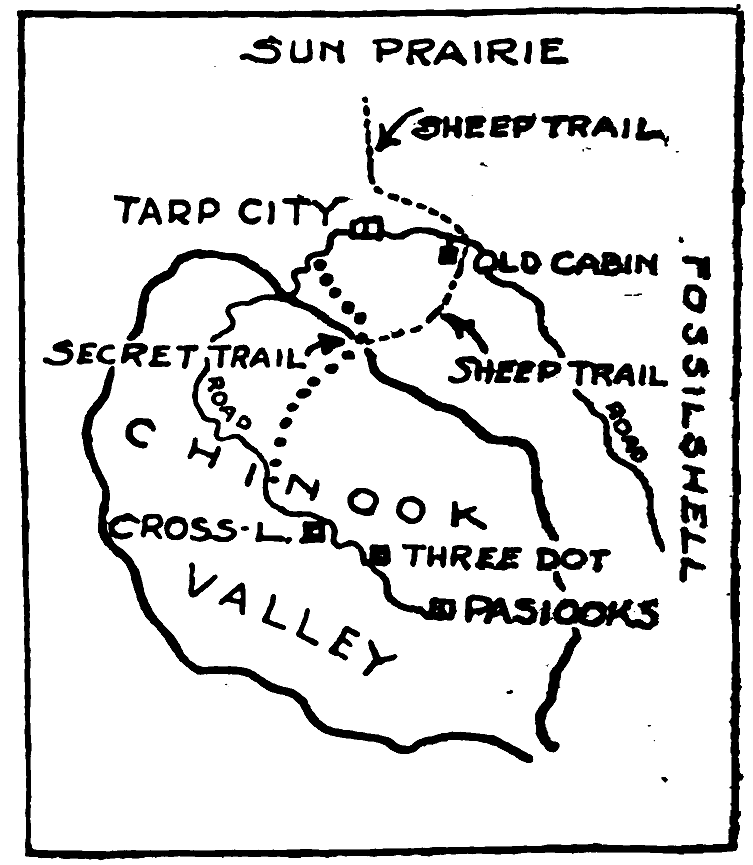
Pasiooks was the only town in the valley and was situated nearly midway. At one time it had been an old French trading post, and the Indians named it with the Chinook word which meant French. Pasiooks was about thirty miles from Tarp City, which was the county seat of that particular county.
The Chinook was a cattlemen’s paradise, and many a stock-man looked with envious eyes upon the rolling hills, the many cottonwood lined streams which furnished an abundance of water and the encircling, impassable range of mountains which precluded any chance of cattle-stealing and served to break the force of Winter storms.
With Poncho Pass as the only outlet, horse and cattle thieves left Chinook severely alone. The sheep-men grumbled at the name. Their only range, the Sun Prairie country, was sheeped out and dotted with the bones of blizzard and drouth victims. To the south of them was the Fossilshell cattle range, where cowpunchers rode the dead-line, that no sheep might stray across.
But the cattlemen of the Chinook lived secure in their own tight little valley, herded their fat cattle over Poncho Pass to the loading pens at Tarp City, banked their checks at Pasiooks and waited for the next herd to fatten on the rich bunch-grass.
Bart Severn had owned the Three Dot outfit for several years and was rated as a rich man, but he hated the narrow confines of the Chinook, and when Frank Campion offered a big price for the Three Dot, Severn sold out to him.
The price was almost prohibitive, but Campion paid it willingly. He proved himself to be a plunger; a gambler who played money instead of his cards. Instead of keeping the Three Dot cowpunchers he brought in “Tiny” Bender, a giant of a man, Gus Mehl and “Blackie” Erne.
They were all capable looking men and minded their own business. Once a month they went on a “bust” in Tarp City, and Frank Campion went with them. Bender, Mehl and Erne did not associate with any of the Chinook punchers, but seemed to hold themselves aloof.
But Frank Campion was a “mixer.” He drank hard, rode wildly and was belligerent in his cups but he also danced well, sang in a ringing baritone voice and never seemed to lack for something to say. There was no denying the fact that Frank Campion was fast becoming the most popular young bachelor in the Valley of the Chinook.
Peace River Parker had been foreman for the Cross-L for a long time, and was respected by every man and woman in the valley. A few months prior to this time, Peace had just finished a prison term although innocent of the charge.
His return had stopped a sheep invasion of the valley, and ended in the death of the invaders after Peace’s innocence of the former charge had been proven.
And Peace Parker had inherited the sheep, as a payment for the years he had lost in the prison. One of the guilty parties, a weasel-faced outlaw, Gus Sinks, whom Peace had saved from the enraged citizens of Tarp City, had been sentenced by Peace to herd that particular band of sheep.
And Gus Sinks went gladly. He would have walked through burning brimstone for Peace River Parker. Sinks was a one-idea man and that idea was to serve Peace Parker regardless of what it might entail. Thereupon he trailed the big herd of bleating sheep into a land which was cursed by all cowpunchers and became a sheepherder.
And to a cattleman or cowpuncher, “Greater love hath no man shown than to turn shepherd through friendship.”
Peace Parker was engaged to Jess Marshall, but, as Peace told Cross L Marshall, they were not married yet. Jess Marshall’s mother was dead, but she had left Jess a sweet disposition and capabilities beyond those of the average girl. Jess was not a beautiful girl, as beauty standards are measured, but she was attractive and worth looking at more than once.
Peace Parker had worshiped her for years, and she had confessed her love for him, but still he hesitated over the marriage problem.
“Yuh gotta be sure, Peace River,” he told himself time and again. “I’m sure about me, but can she look across the table three times a day at this face of mine and still keep her sweet disposition? I’d hate to think she can’t, but I’d rather find it out ahead of time.”
He did not show by word or deed that he resented the visits of Frank Campion which were becoming more frequent. He did not mention it to Jess. Jim Horn and Bert Hart, the other two cowpunchers, resented it openly. They were loyal to Peace River and agreed that Frank Campion was breeding a lot of trouble for himself.
They knew that Peace Parker would fight a buzz-saw with his bare hands and that no man in that country was as swift and deadly with a six-shooter.
“I tell yuh, Campion’s goin’ to arrive home without his top-knot some of these days,” declared Jim Horn, “and old Peace River’ll be wearin’ a vaseline-slicked scalp on his belt. Yuh can jist push the old Peace feller so far and then somethin’ rips.”
“I’ve got a danged good notion to say somethin’ to Jess,” said Bert Hart. “She ought to know that she’s smokin’ her pipe in a niter-glycerin’ fact’ry.”
“You lay off that kinda stuff,” advised Jim. “She’s plumb enamored by that slickear and if you start any argument she’ll think Peace sent yuh.”
“Yeah, I reckon that’s right, Jim. I dunno what in —— Campion wants a cowranch for. If I had his money, I’d be danged if anybody could sell me a ranch. I’d go to Helena and buy me three suits of clothes, three shirts, three pairs of socks and some neckties. Yessir, I’d go plumb hawg-wild on clothes. I’d get me a derby hat; one of them flat-topped jiggers, and some heel-yuh-trope per-fume. Mamma mine, I’d sure hang on the dog! That’s the way to do when yuh got money.”
“I wouldn’t.”
Jim stretched out in the shade of the bunk-house and began rolling a cigaret.
“I’d buy me a —— of a good bronc and I’d hit for the South Sea Islands. I’m plumb sick and tired of wearin’ flannel underclothes and buckin’ blizzards in the Winter. They say that folks don’t have to wear flannels down there in the Winter, and that’s the range I’m headin’ for when I get rich.”
“You’ve got a —— of a idea of how to spend money!” snorted Bert. “Yuh don’t need money down there.”
“Tha’s all right, Bert. Anythin’ to get rid of wearin’ them danged woolly shirts. I can go there if I want to, can’t I? You ain’t tryin’ to stop me, are yuh?”
“Go ahead,” magnanimously. “Don’t let me stop yuh, cowboy. I’ll take mine to Helena and buy out a clothing store. I’ve allus wanted one of them flat-topped derby hats.”
All of which serves to give an idea of the lofty ambitions of Bert Hart and Jim Horn. In appearance they were as unlike as their ambitions. Jim was thin, dark of features and with a crooked nose, while Bert was fleshy, blond, and his fat face was decorated with a stubby nose, almost bridgeless. His eyes were set far apart and almost Oriental in contour.
But they were both top-hands in the rangeland and had been with the Cross L for more than two years.
The visits of Frank Campion annoyed Cross L Marshall. He spluttered and ——ed everybody for everything, but did not speak about it to Jess. He knew her too well for that. She was a chip off the old block, as far as resenting interference was concerned, and Cross L knew that a word from him would not be well received.
Which accounts for the fact that Cross L did not keep his word and “give her a little —— of a good talk, y’betcha.”
Peace was in his usual good humor that evening and several times he caught Jess watching him from across the supper table. He felt that she was comparing him to Frank Campion and it made him conscious of the fact that, as far as facial and tonsorial beauty was concerned, he was hardly a match.
But he felt no anger against Campion; none against Jess. Perhaps, down deep in his big heart he felt a bitter ache against an unkind fate, but he was big enough to keep it hidden.
“It’ll all come out in the wash,” he assured himself that night. “I reckon I’m playin’ for the Double O on this old human roulette wheel and there’s a lot of odds agin’ me. Mebbe the old dealer has got the thing fixed, but I’m still hopin’ to win out. If I don’t, I’m just a homely old cowpuncher, and I’ll get along—kinda.”
The next day was Saturday and pay-day, which was the big day for the cowpuncher. Hart and Horn both decided to go to Tarp City; so Peace, needing a new pair of overalls and boots, decided to go with them. Peace decided to leave the Bar X Bar Herefords until Monday, as both of his cowpunchers were eager for a fling at the Tarp City games. Just before they saddled their horses, Frank Campion, Mehl, Erne and Bender rode past, heading toward the Pass. They did not even wave toward the Cross L boys, but swept past at a gallop, looking straight ahead.
“Them jaspers need a curryin’,” growled Hart. “You’d think they was the four kings of Calcutta.”
Hart knew nothing of kings and less of Calcutta, but no one disputed his statement.
“They sure are uppity as ——!”
Jim Horn grunted an agreement as he shook out his rope.
“Mebbe,” thoughtfully, “somebody will curry ’em.”
Peace swung his saddle off the peg and looked back at Jim.
“Keep clear of that gang, if yuh know what’s good for yuh, Jim,” he said slowly. “Bender looks like he could whip a dozen men at once, and they’re all slickers with a gun, if yuh can judge by the way they wear ’em.”
“Sa-a-ay!” drawled Jim in astonishment. “You ain’t scared of that outfit, are yuh, Peace River?”
“Well,” Peace grinned softly and unfolded a gaudy saddle-blanket, “I ain’t scared—no. You fellers might drink quite a lot tonight, and whisky kinda makes a feller cover too much territory in his remarks. Whisky sure spoils yore sense of distance, direction and discretion, and I don’t want no cripples loafin’ around here.”
“We’ll get a lunch while they’re gettin’ a feast,” said Hart meaningly, but added quickly, “we ain’t startin’ no trouble, yuh understand, but we’ll be Johnny at the rat-hole if it does start.”
Peace smiled softly and led the way out to the corral. He knew that the two cowboys, after a few drinks, would not wait for trouble to start and he hated to think that they might tangle with the Campion gang.
With practically all of the cowboys from Chinook and those from the Fossilshell in Tarp City, there was no chance that a trouble hunter would not be accommodated. He knew that Buck Houston, the sheriff, would keep order as long as possible to salve his own conscience and then go home, trusting in the Lord that nothing serious would happen.
Barney McManus, the deputy, would dog Houston’s footsteps until Houston went home, and then Barney would proceed to forget that he was the sole representative of law and order and become an ordinary cowpuncher again with a cowpuncher’s idea of things as they should be.
Tarp City was a he-man’s town on payday, and Peace Parker found the hitch-racks already filled when they rode in dusty and tired from the trip. Hart and Horn immediately stabled their horses, but Peace tied his to a hitch-rack, along with a nondescript lot of broncos from the Fossilshell.
Across the street in front of the Royal saloon he saw the four saddle-horses from the Three Dot. Campion had ridden the racy-looking black, which was salty with dried sweat and looked leg-weary. Peace frowned slightly. He loved a good horse and he knew that Campion had given the black a grueling run to Tarp City and had left it in the chill winds of the street, instead of giving it a blanket and a stall in the livery-barn.
Peace and his two men had taken the trip easy and, in range parlance, had not laid a hair, but Peace had insisted on Hart and Horn stabling their horses for the night.
Peace met Sheriff Houston at the door of Carney’s General Merchandise Store and shook hands with him. Houston was a portly man, middle-aged and serious of mien.
“Glad to see yuh, Peace,” greeted the sheriff. “How’s everythin’ in the Chinook?”
“Kinda gettin’ along,” grinned Peace. “How’s Tarp?”
“Well,” Houston indicated the filled hitch-racks, with a flirt of his hand, “yuh can see that the census is about filled t’day. There’s a few yet t’ come from Chinook, but I reckon that most of Fossilshell is here a’ready.”
“Good business for Tarp City,” observed Peace.
“Yeah,” grudgingly, “but —— bad business for the sheriff’s office. Who owns that black race horse over there at the Royal rack, Peace?”
“Campion. That’s his reg’lar mount, I reckon. Looks like a runnin’ son-of-a-gun, don’t it?”
“Uh-huh. What kind of a feller is Campion?”
“All right, I reckon.”
“Which he ain’t,” declared Houston. “No man’s all right that runs the tripe out of a blooded animal and leaves it out that-away.”
“Mebbe he’s just thoughtless,” suggested Peace.
“Um-m-m, mebbe. Know anythin’ about his gang?”
Peace shook his head.
“No. Yuh see, they don’t mix with us much. Look like a bunch of top-hands, though, and it’s their business if they want to be lonesome.”
“Don’t you never dislike anybody enough t’ say somethin’ against ’em, Peace River? You’d say somethin’ good of the ——, wouldn’t yuh?”
“Well,” grinned Peace, “it wouldn’t hurt me none and it might do him some good, don’tcha think? Yuh can’t expect old Nick to ever do any good, with everybody down on him the way they are.”
“All right, I pass,” laughed Houston.
Barney McManus came out of the store and his wrinkled face broke into a smile at sight of Peace. Barney was one of the old Chinook Valley punchers, prematurely old in appearance, and filled with the belief that anything a cowpuncher did was the right thing.
“Ah-h-h!” grunted Barney. “The meanest man in the old Valley comes to visit us, does he?”
“Hello, you old bog-trotter,” greeted Peace.
“Bog-trotter, eh? Is that all the respect ye have for the law, Peace Parker? Will ye answer me one question by yes or no?”
“Sure,” grinned Peace.
“Well,” Barney grinned expansively, “have ye quit rustlin’ cattle for the Cross L?”
Peace looked at him blankly for a moment.
“I’ll buy the drink, Barney.”
“That makes five already today,” chuckled Barney. “Nobody seems to want to incriminate themselves. Sure, it’s a elegant question, but I’ve got to quit askin’ it. When do we accept your kind offer?”
Houston nodded to Peace’s unspoken question, and the three of them crossed toward the Royal saloon. Hart and Horn were coming down the street from the livery-stable and joined them at the saloon door.
The saloon was nearly filled with men and the games were all running full-blast. There were a number of cowpunchers from the Fossilshell at the bar, acting like a lot of kids just out of school. They fell upon Houston and insisted that the drinks were on Fossilshell. The boys from the Chinook were included in the invitation, but Gus Mehl, who had been drinking heavily, moved away from the bar.
One of the Fossilshell cowboys, evidently considering this an insult to their hospitality, said to Mehl—
“Pardner, that invite went to everybody at the bar.”
Mehl laughed crookedly and shook his head. His face was flushed from liquor and his step was none too steady.
“Thasall right,” he gulped. “I don’t mind drinkin’ with you Fossilshellers, but I ain’t drinkin’ with everybody.”
“Meanin’ us?” queried Bert Hart quickly, but Peace grasped Bert by the arm.
Mehl laughed mockingly. He was all primed for trouble, but hardly drunk enough to lose sight of the fact that the odds were against him.
“Meanin’ what I mean,” he replied slowly. “I drink with who I —— please; sabe?”
“Yo’re plumb welcome,” said Horn meaningly, shoving away from the bar, but the sheriff blocked him from Mehl.
“Wait a minute,” begged the sheriff. “This ain’t worth havin’ trouble over, boys. If the gent from the Three Dot don’t want to drink, he don’t drink. But,” he added meaningly, “the gent from the Three Dot might at least decline in a gentlemanly way.”
Houston’s manner amused Peace, who grinned widely.
“Funny, ain’t it!” sneered Mehl drunkenly. “Yo’re the notorious Peace River Parker, ain’t yuh? Understand that they think yo’re a little tin god around here. Well,” Mehl braced himself carefully, “I want to tell yuh right now that us fellers from the Three Dot ain’t worshipin’ no tin gods. What do yuh think of that?”
“Well, I think yo’re wise,” grinned Peace.
“Yuh do, eh? Pullin’ in yore horns. Blah! Somebody told me that you was a fighter. Huh! Somebody lied!”
Mehl turned and lurched away toward a roulette table, swaggering drunkenly, bumping into every one who got in his way. The crowd at the bar turned back to their drinks, but Hart and Horn continued to glare at Mehl.
“Let him alone,” advised Peace. “He’s drunk and ain’t responsible.”
But Mehl was not through yet. Campion was at the poker table and Mehl caught sight of him.
“Hey, Frank!”
Mehl’s voice was pitched high enough to be heard above the roar of conversation.
“I curried the he-buzzard of Chinook. Made Peace Parker swaller his talk, y’betcha. I betcha he’ll be good, or I’ll ride him ag’in.”
Many of the crowd looked toward the bar, but Peace did not even look at Mehl. Bert Hart fidgeted around, casting imploring glances toward Peace, who continued to talk with the sheriff. Barney nudged in closer and whispered to Peace—
“Wait’ll the sheriff sneaks home, and then yuh can have plenty of room to put a sharp point on that jasper’s head.”
Peace grinned and turned away from the bar. Mehl was still crowing loud enough for every one to hear. Bender was bucking the faro game and Erne was playing roulette, but neither of them was paying any attention to Mehl.
“Well, I reckon I’ll have to leave yuh,” observed Peace, “I’ve gotta get me a pair of boots and some overalls before the store closes.”
“Aw-w, shucks!” exploded Horn. “That hombre will think he run yuh out of Tarp City, Peace.”
“Well,” grinned Peace, “it won’t hurt me none and it may do him some good. You and Bert keep half-way sober. It looks like there might be storm and strife around here before long and you’ll be danged well off if yuh ain’t mixed into it.”
“Sure, we’ll be meek like two lambs,” agreed Horn.
Peace turned and walked out of the door. Mehl saw him go and a drunken grin wreathed his lips. He thought he had run Peace Parker out of the saloon. But he was not content. His one-idea brain pictured more honors to come; so he lurched through the crowd and followed Peace, who crossed the street and went into a general store.
Bert Hart saw Mehl leave the room and motioned Horn to follow. Campion was watching Mehl, and when Hart and Horn started for the door, Campion drew out of the game and came out behind them. Mehl lurched across the wooden sidewalk and in through the open door.
The two cowpunchers stopped just outside the saloon door, as did Frank Campion. They watched him closely, but he paid them no heed.
Suddenly the door of the store banged open and out came Peace Parker with Mehl in his arms. He walked deliberately to the edge of the sidewalk and cast Mehl into the street where he rolled over and over. Then he tossed Mehl’s gun into the dust, adjusted his own belt, turned his back and walked into the store.
Mehl got to his feet, staggered a circle and looked back at the store. Twice he tried before he could pick up his gun and then he came back toward the saloon. Both of his eyes were assuming a mauve tint and he seemed rather at a loss to know what had happened.
He halted at the edge of the sidewalk, looked back and then at Campion.
“Di’zuh see it?” he demanded.
“You are a —— fool, Mehl!” declared Campion.
“Oh, tha’ was it, eh?”
Mehl blinked owlishly through his swollen eyes and began to pity himself. Whisky tears started and he became very indignant.
“Oh, shut up!” snapped Campion. “You’re partly to blame, but he had no right to hit you when you were drunk.”
“Is—that—so?” drawled Hart. “Kinda looks to me like Peace Parker held off a —— long time. If it had been me I’d ’a’ popped him ten minutes ago. He was lookin’ for it.”
“Is this any of your business?” demanded Campion.
“We kinda act thataway, don’t we?”
Campion did not seem to have a ready reply; so he herded Mehl inside the saloon, while the two cowboys grinned gleefully and slapped each other on the back.
“Let’s go back and have another snifter,” invited Hart. “It’s worth a drink to see old Peace hoodle that bad jasper out of the store. Whoo-ee! Mehl lit settin’ down and about tomorrow he’ll be ridin’ with short stirrups.”
They went back to the bar, but did not neglect to see what was going on. Campion had gone to the roulette layout and was talking earnestly to Erne. He turned from there and strolled over to the faro table where he stopped long enough to speak to Bender.
Bender listened closely, glanced around the room and nodded. Mehl had sat down near the poker table and was holding his head in his hands. The sheriff had left the saloon, and was, no doubt, on his way home, but Barney McManus had anchored himself into a poker game and proceeded to forget that he represented the law of Tarp City.
The two cowpunchers leaned back against the bar and watched developments. Bender cashed in his chips and joined Erne who also quit playing. They came over to the bar and had a drink, but neither of them even looked at the two from the Cross L.
“We better stable our broncs,” said Bender quietly. “No use leavin’ ’em out there at a hitch-rack.”
Erne nodded and they went out of the door. Campion was watching the poker game and did not look up as his two men left the place, but the Cross L boys followed them outside and watched them lead their horses down the street toward the livery-stable.
There was nothing about their actions to excite the suspicions of any one, but Jim Horn was not satisfied that everything was all right.
“I dunno,” declared Jim. “Campion never took the trouble to go around whisperin’ to them jaspers to go and put their broncs in the stable.”
“Aw, I reckon it’s all right,” replied Bert. “Mebbe they ain’t got sense enough to do it without bein’ told. Let’s go back and enjoy the fullness of the season.”
Peace Parker completed his purchases, talked a few minutes with Bill Carney and decided to go back to the Cross L. He gave little thought to his trouble with Mehl, blaming most of it to liquor, and sorry that he was forced to knock Mehl down and throw him out of the store; but Mehl was trying to draw a gun.
“I wouldn’t never monkey with them kinda people,” declared Carney. “You didn’t learn him nothin’, Peace. My motter is to hit ’em so —— hard on the head that it’ll bust the arches of their feet.”
“He was just drunk, Bill,” protested Peace.
“Thasso? Lemme tell yuh, pardner, that a man’s disposition only shows when he’s drunk. That jasper’s a trouble hunter, but when he’s sober he ain’t got the nerve. You watch him.”
“All right, Bill.” Peace laughed and picked up his bundles. “See yuh later.”
As Peace crossed the street toward the hitch-rack he saw Campion come out of the Royal and also start for the rack. He was paying no attention to Peace. His black horse was at the nearer rack, but he passed it and went on toward where Peace’s horse was tied.
Peace expected Campion to continue on up the street, but he stopped at the rack and waited for Peace to arrive. At this moment Bender and Erne came from the rear of the feed store and approached the sidewalk beyond the hitch-rack.
Peace nodded to Campion and began fastening his purchases to his saddle. Bender and Erne came in closer and stopped near Campion.
“Didja want to see me for somethin’?” asked Peace, turning his head toward Campion.
“Yeah,” Campion nodded quickly. “I just wanted to know what was the trouble between you and Gus Mehl.”
“Oh!” Peace finished tying his bundles and turned.
“Why, I dunno exactly what was the trouble, Campion.”
“That’s what I thought. I don’t suppose you stopped to think that Mehl was drunk, did you?”
“Yeah, I know he’s drunk.”
“Well, I want you to understand that I’m not drunk.”
“No-o-o, I wouldn’t say that yuh was—but yuh ain’t far from it.”
Peace grinned widely at Bender and Erne, but only received black looks for his trouble.
“Is that so?”
Campion’s face grew tense and the muscles twitched around his eyes.
“Now, let’s be reasonable,” urged Peace softly. “Yo’re all warmed up over somethin’, and I can’t see no reason for us havin’ trouble. Mehl got drunk and tried to abuse me. I got away from him, but he follered me and tried to draw his gun. I’d ’a’ been justified in pluggin’ him, but he was too slow with his gun; so I just knocked him loose from the floor and threw him out.”
“You’re so —— fast yourself, I suppose?”
“No, I don’t claim to bust no records, Campion.”
Peace turned to his horse and prepared to mount, but Campion was not through yet. He moved in closer.
“You know what I think of anybody that’ll hit a drunk man?” he asked.
Peace turned and looked closely at the three men.
“Campion,” Peace spoke softly and without a trace of nervousness. “I don’t want trouble with you. You’ve brought two of your men with you to see that yuh don’t get hurt, and that kinda puts me in a bad hole.
“I ain’t got no quarrel with you. I didn’t want to hurt yore cowboy, but he insisted on it. Now, let it go as it lays.”
Campion laughed sarcastically.
“I looked for you to say that, Parker. You’ve got a —— of a big reputation around here, but you ain’t got the guts to protect it. We’ve heard that you are a fighter, but this part of the country must be awful shy on fighting material to speak of you that way.”
“I s’pose,” nodded Peace and turned back.
He was trying his best to avoid trouble, but Campion was in no mood to be pacified. He felt that Peace was afraid of trouble, and it made him more abusive. Campion had drunk just enough to make him reckless of words.
“You suppose, do you?” sneered Campion. “You’re a four-flusher, Parker. These two men of mine have nothing to do with this, if that’s holding you back. I think you are a big-mouthed quitter, and I’ve a —— good notion to——”
“With your gun or your hands?” Peace turned quickly, a wide grin on his face, but his eyes were not smiling.
Campion jerked back slightly. He had not expected Peace to accept his challenge, and now that it was put directly up to him, he hardly knew what to say.
Peace shook his head.
“Campion, you don’t want trouble with me. You think it over for a while and you’ll see just how foolish yo’re actin’.”
For a moment Campion only stared at him and Peace turned to reach for the tie-rope, but a wave of anger flashed across Campion’s face and he stepped in closer, grasping Peace by the arm, as though to whirl him around.
And if that was Campion’s intention, the results far exceeded his expectations, because Peace turned like a flash and his right fist caught Campion square in the face. The blow struck too high for a knock-out, but it sent Campion off his feet and he went down on the back of his neck in the dust.
The action had been so sudden that Bender and Erne had no time to assist Campion, and Peace was facing them, smiling easily, his right hand swinging near the butt of his holstered gun.
Campion struggled to his feet and stood there in sort of a daze, looking at the man who had hit him, but making no further effort to continue the battle. Bert Hart and Jim Horn were hurrying from the Royal, and several men were crossing from the opposite side of the street.
There was nothing dapper looking about Campion now. The bridge of his nose was skinned badly and one eye was fast swelling shut. He was still dazed from the blow, but fully realized what had happened and his face was white with hate against the man who had knocked him down.
Suddenly his right hand flashed toward the butt of his gun. It was an unlooked for action on the part of every one, except Peace Parker, whose hand jerked upward from his side and he shot directly from his hip.
Campion jerked sideways and his gun thudded into the dust. Whether through accident or design, Peace’s bullet had smashed into the curving butt of Campion’s gun, splintering the bone handle and cutting Campion’s fingers badly.
Bender and Erne made no move, as Campion looked down at his crippled hand and cursed wickedly. Jim Horn was standing directly behind Bender and Erne, waiting for either of them to make a hostile move. Erne glanced back at him, turned on his heel and went back toward the saloon, with Bender following him.
There was an awkward silence for several moments and Campion picked up his hat, dusted it off against his knee, his face a mixture of anger and chagrin. Then he walked to the hitch-rack, mounted his horse and rode away.
Bender and Erne watched him from the saloon door, and, in a few moments, went toward the livery-stable. Campion was heading straight toward the Poncho Pass road.
Peace shook his head at the crowd, which volleyed him with questions as to the why and wherefore of this trouble.
“Just foolishness,” said Peace, but Bert and Jim led him away from the crowd.
“It was a frame-up,” declared Jim. “We seen Campion whisper to Bender and Erne, and then they took their horses to the livery-stable—or said they was goin’ to and we seen ’em go down there.
“We didn’t see Campion go out, and Bender and Erne didn’t come back. A little later I looked out back of the Royal, and there was two of them Three Dot horses tied to that old corral fence. They’d made a bluff to stable ’em, but circled back and tied to the fence. Me and Bert fogged out to the street just in time to see yuh swat Mr. Campion.”
“Well, I dunno what they want to frame up on me for,” grinned Peace. “I never done nothin’ to them.”
“Don’t make no never mind,” Jim shook his head. “It was all framed, Peace.”
“Wait a minute,” said Bert, and bow-legged his way to the rear of the feed store.
He came back in a minute and grinned wonderingly.
“Both broncs are gone. I’ll betcha that all three of them jaspers has headed for home.”
Peace grinned thoughtfully, as he walked back to his horse and swung into the saddle.
“We’ll be home by Monday mornin’,” assured Jim.
Peace nodded and rode away slowly. It was a long, hard ride to the Cross L, but Peace was in no hurry. Ahead of him was Campion, Bender and Erne, somewhere along the high grades of Poncho Pass.
“They knew I was ready to go home,” reflected Peace, “and them pullin’ out of town thataway don’t look good to me a-tall. Cowpunchers don’t leave a saloon on payday without a danged good reason. Mebbe they’re lookin’ for me.”
The sun was setting behind the V-shaped notch of Poncho Pass and the graded road was already plunged into the shadows of evening, when Peace drew rein and scanned the country about him.
To the left was a rocky, brush-covered hog-back ridge, which broke sharply against the cliffs beyond. There was little footing for a horse and no sign of a trail, but Peace urged his horse off the road and up this ridge.
Twisting in and out of the brush, he gradually climbed until the road was far below him. Then he swung to the left through a rocky swale and along the north side of a rock-bound cañon.
There he picked up what might have been an old, old trail, which led down across the cañon and angled up the other side among the barren rocks. A bevy of blue-grouse whirred up about him, came to roost in the branches of a stunted pine and craned their necks curiously at him.
A little beyond there a mule-deer crossed the ridge ahead of him, stopped and looked him over curiously. Then it whistled and bounded heavily down the hill, disappearing in the trees.
Peace was following the marks of the old trail now, paying no attention to the back trail. This was the one secret way into the Valley of the Chinook and was only known to a few men, who guarded the secret well.
He came at last to the beetling crags which marked the timber-line, and the trail led him down over the lip of another narrow cleft, where he angled his way to the slope of the valley side. It was not a difficult pass, but no one would ever look for it at that part of the range. Those who knew of it only used it at rare times and were careful not to follow exactly the same route, except through the very pass itself.
It was fast growing dark when Peace started down the rocky slope that led to the foothills of the valley. Below him the valley seemed a huge, mystic bowl, rimmed with a jagged edge which was high-lighted with the gold of sunset.
Slowly he descended into the purple shadows. About a mile further down he came to the beginning of a well-beaten trail, where the cattle had cut deeply into the ground on their way to water.
He rode beside this trail, where his horse’s tracks would not show in the dust. It was a long way from the secret pass, but Peace did not want his horse’s track even to show up there.
He drew rein beside the trail and looked back up the dim slopes behind him. He could see only a short distance, but he had a vague feeling that something was behind him. He grinned at his own foolish imagination and began to manufacture a cigaret.
He hesitated about scratching a match. Suddenly he heard a sound. It was like the click of a shod hoof on stone. Quickly he turned away from the trail and rode further back into the jack-pine thicket, where he stopped to listen. The sound was not repeated. Unluckily he had moved too far back to catch a view of the trail.
Once he thought he heard the jingle of a bit-chain, but decided that it was his imagination. He waited for perhaps ten minutes before going back to the trail. There he dismounted, lighted his cigaret and held the match close to the dusty trail.
He examined it closely for a few moments, pinched out the match and swung back into his saddle. In the trail was the well-defined track of a horse, heading down into the valley, and the track showed that the horse was shod with thin shoes—almost as light as racing-plates.
“Campion followed me through,” reflected Peace wonderingly. “He must ’a’ swung in behind me and watched me leave the road.”
Far down in the valley an owl hooted dismally, and from the timber-line a coyote seemed to answer with a wailing howl. Peace ground the lighted end of his cigaret against the leg of his chaps, settled himself in his saddle and went slowly down the trail toward the Cross L.
Sunday was a dull day at the Cross L. Peace slept late and was only awakened by the sound of a wagon leaving the ranch, as Cross L Marshall took Jess to church at Pasiooks.
It was an ordeal for Cross L, this Sunday pilgrimage to the little church; an hour or so of misery, while he listened to the denunciation of sin, which the minister seemed to point directly to him. Cross L hated to have to do anything, and hoped for the day when Jess might have a man to take her to church, and let her tired old dad sleep late and loaf around the house in his slippers, instead of going to church in a pair of creaking, palpably new Sunday boots and a suit of black, uncomfortable clothes.
He usually salved his outraged feelings thus—
“I ante a certain amount in this here church game every year and I reckon I’ve got to play out the hand.
“The preacher says that yuh can’t go to heaven unless you’re a Christian, don’t he? He sure hammers it into us and I kinda feel uplifted when I leave the church, but it don’t stay with me longer than supper-time. I’ve either got to die between noon and six o’clock on a Sunday, or I ain’t got a chance in the hereafter.”
They had often urged Peace to attend church with them, but he shook his head.
“I’m like a Injun,” he explained. “I know that there’s a Big Spirit somewhere—somethin’ that keeps us tickin’ along. Somehow I can’t look up at the sky and figure that the Big Spirit is up there any more than it’s down here, and as far as there bein’ a punishment for sin after death, I can’t see what’s the use of it.
“It’s like tryin’ to scare a kid by tellin’ him goblin stories. I reckon that the Big Spirit made us intelligent critters, and He never meant us to be scared to die. No sir! I never did believe in threatenin’ folks, and I don’t reckon that the Big Spirit ever intended for us to scare anybody into bein’ good. I don’t need no preacher to tell me right from wrong, and if I do wrong I’ll get all my hell right here, y’betcha.”
“Saleratus” Smith, the cook of the Cross L, disliked church for the simple reason that he had to get an early breakfast for Jess and her father. Saleratus was an old chuckwagon cook before he took over the culinary duties of the Cross L. But Saleratus could cook. Rheumatism had unfitted him for anything except kitchen work and had caused his soul to sour against everything and everybody. He rolled voluminous cigarets out of wrapping-paper and plugcut tobacco of great strength; cigarets that were forever coming unwrapped and spilling their contents in a smoking mass. And, in case they did burn to a successful end, they scorched his scraggly mustache and caused him to emit a flow of profanity that only a lifetime on the ranges could have acquired.
Jim and Bert did not come back to the ranch until early Monday morning, and they had little taste for breakfast. They were sadder, but no wiser than when they left on Saturday. Tarp City had their month’s salary, but that was as usual and no more than they expected.
Peace was saddling his horse at the corral, and Jim and Bert were arguing in the kitchen with Saleratus, when Blackie Erne rode in and tied his horse to a corner of the porch.
Cross L Marshall was sitting on the porch and merely grunted as Erne climbed the steps and came up to him. Jim Horn looked out of the kitchen door and watched Erne leave his horse. He motioned to Bert to come out.
The horse, a Roman-nosed buckskin, had swung around until its body was hidden from those on the porch, and Jim Horn grinned gleefully as he picked up a few feet of baling-wire and motioned frantically to Bert.
Old Cross L looked quizzically at Erne, waiting for him to make known his mission.
“Is Miss Marshall to home?” asked Erne.
“I hope she is,” grunted Marshall. “Ain’t seen her this mornin’, so I’d say she was still in bed.”
Erne reached in his pocket and drew out an envelop, which he tendered to Marshall.
“Will yuh see that she gets this here note?”
Marshall squinted at the unsealed envelop, turning it over and over in his hands.
“I reckon I will,” he nodded slowly. “Ain’t nobody been took sick nor nothin’ like that, has there?”
Erne squinted back at him and shook his head, as he said:
“Not yet. Much obliged.”
“Uh-huh.”
Erne went back to his horse and swung into the saddle. He whistled unmusically between his teeth, as if glad that his mission was over. The buckskin jerked around nervously and from its hind legs came a metallic sound.
Erne turned to look back as the horse buck-jumped quickly, and caught a flash of a large tin-can hanging to the buckskin’s tail. Came the tunk! as it struck the horse’s heels, and Mr. Erne began riding high and handsome in order not to part from his saddle.
Down past the corral and out of the gate went the buckskin, bucking and bawling in a cloud of dust, while Jim Horn hugged Saleratus hysterically and Bert Hart sat down on the ground, howling with unholy mirth.
Marshall watched the unceremonious leaving of Blackie Erne and walked to the side of the porch, where he could look back at the three at the kitchen door. Marshall did not know just what was the matter with the horse, but he did know that Jim and Bert were responsible. Peace stopped saddling long enough to watch Erne disappear in a cloud of dust, shook his head sadly over the misdeeds of his men and went back to his task.
Cross L Marshall smothered a grin and turned back, looking at the unsealed envelop. He cocked one ear toward the open door as if listening. Satisfied that Jess was nowhere in sight, he proceeded to show that he was entirely without shame.
Cautiously he perused the note several times. Then he put it carefully in his pocket, bit an enormous chew of tobacco off his plug and exploded an oath that would have galvanized a dead mule into life.
He squinted down toward the corral at Peace Parker who was looping up his lariat rope, and hesitated for a moment over just what to do, made his decision and clumped down the steps.
Peace turned to him as he approached.
“What did Erne want?” he asked.
Marshall spat explosively and handed Peace the envelop.
“Brought yuh a note,” he mumbled.
“Me? Why didn’t he bring it to me, Cross L?”
Marshall cleared his throat with difficulty, as Peace drew out the missive and scanned it.
My Dear Jessie:
In a fit of anger, caused by jealousy, I think, Peace Parker took occasion to damage me to a certain extent, which accounts for my absence. But physical wounds heal quickly and I shall count the hours until I am presentable again.
Yours
Frank.
P. S.—Please say nothing to Parker. I can appreciate his feelings in this matter. F.
Peace lifted his eyes and looked at Cross L who was still having throat trouble.
“Cross L, this note wasn’t intended for me?”
“Huh! Wasn’t intended for yuh? Then—lemme see it, Peace.”
Peace folded it slowly and put it back into the envelope.
“That note is for Jess—not me.”
“The —— it was! Well, I’ll be darned! Huh!”
Cross L squinted at the note and up at Peace.
“Well, sir, I must be gittin’ hard of hearin’, Peace. I thought I distinctly heard that jasper say that it was for you. Yuh know, I wondered why he didn’t give it to you. Huh! Well, I’ll have to give it to Jess.”
He walked swiftly back toward the house; anxious to get out of range of Peace Parker’s accusing eyes. Marshall was not a gifted liar. Peace looked after him, a queer expression in his eyes. A smile flitted across his wide lips and he shook his head slowly.
“Cross L, yo’re an awful poor liar,” he reflected, “but yuh mean mighty well.”
Jess had come out on the porch and met her father, who handed her the envelope.
“Mister Erne brought it for yuh, Jess.”
He bit off a fresh chew and scratched his shoulders against a porch-post, while Jess read the missive, a slight frown between her eyes.
“Ain’t nobody sick, are they, Jess?” he asked seriously, but avoiding her eyes.
“No, I don’t think so.”
“I was just wonderin’.”
Cross L sat down on the porch and rubbed his hands on his thighs nervously.
“I was just wonderin’ why that Erne feller come here. I don’t like him, Jess. He ain’t bringin’ yuh poetry, is he?”
“Poetry?”
Jess laughed shortly and shook her head.
“Tha’sall right then, Jess. I ain’t got a bit of use for them poets. Fellers—” He reflected a moment—“Fellers that vas-leen their hair—might write poetry.”
Jess studied the back of his head for a while, and then—
“Dad, why do you dislike Frank Campion?”
“Dislike him? I never said I did.”
“But you do dislike him?”
“No, I don’t dislike him, Jess. That word’s too soft. I hate him to beat ——!”
“Why?” softly.
“Why!”
Cross L got to his feet and tried to glare at Jess.
“Yes, why, dad?”
“’Cause I don’t like him and ’cause he’s a —— liar and—and everythin’.”
“Why do you call him a liar? Did he lie to you?”
Cross L began to have throat trouble again. He felt that Jess knew he had read that note. He walked to the corner of the porch and proceeded to cough rackingly. When he turned, his eyes were filled with tears from his efforts and his voice was husky.
“Gotta do somethin’ for my cold,” he told her. “Be in m’ grave, if I don’t. Must ’a’ set in a draft. Cough m’ fool head off once in a while.”
“Especially when you don’t want to answer a question, dad.”
“What question?” Cross L fairly bristled, but started for the steps. “What’s questions got to do with runnin’ a cattle-ranch, I’d admire t’ know. Think I’m goin’ t’ stand around and let m’ business go to rack and ruin, just ’cause a fool woman wants t’ ask questions? Huh!”
He humped his head between his shoulders and headed for the corral, where Jim and Bert were leaning on the fence, still laughing over what they had done to Erne.
“Didja see what happened to that Erne feller?” asked Jim, still chuckling.
“What did yuh do to him?” asked Cross L.
“Tied a tin-can to his bronc’s tail. Man, man, but didn’t that animal respond to treatment. Ha, ha, ha, ha!”
Cross L glared at them and masticated violently.
“That’s a —— of a thing to do! Do I have t’ muzzle you pelicans to make visitin’ safe at this ranch? That was a danged mean thing t’ do, and I don’t want t’ see yuh do it ag’in; sabe?”
“All right,” said Jim seriously, “yuh won’t. And yuh won’t have to muzzle us either, old timer. There’s other ranches where they hire cow-hands.”
“M’yah!” grunted Cross L explosively, and then to Peace—
“Tell me about that scrap yuh had with Campion.”
Peace shook his head slowly—
“No, it ain’t worth tellin’.”
“Like —— it ain’t!” snorted Jim, and proceeded to tell the whole story in detail, while old Cross L masticated thoughtfully and squinted at him.
“Shot the gun out of his hand, eh? Knocked him upside down and then busted his gun-hand.”
“Well, my gosh, he had to do it!” yowled Jim.
“Didn’t have t’ shoot him in the hand, did he?”
“Well, he had to stop him.”
“Was he runnin’ on his hands?”
“Aw, you make me sick!”
“Yeah, and you fellers make me sick,” retorted Cross L. “Shoot ’em in the hands! ——’s delight! What’s a man got a body for, if it ain’t t’ shoot at? Yuh make me sick, takin’ a chance on shootin’ at his hands!”
Cross L spat viciously and glared at Jim Horn.
“How long do yuh reckon that tin can’ll stay on that bronc’s tail, Jim?”
“Quite some period,” declared Jim. “It was put on with twisted balin’-wire.”
“That’s,” Cross L squinted down the road, “that’s what I call bein’ thorough. But if yuh ever try it on that black race horse——”
He glared wickedly for a moment and then a smile wrinkled his face.
“Be careful. I’ll betcha that bronc could kick a fly out of a gallon can of axle grease and never spot his hoof.”
Cross L grunted softly to himself, tightened up his belt and went back toward the house. The three cowpunchers looked at each other and grinned widely.
“My ——, but old Cross L is plumb human!” exclaimed Jim Horn. “He’s reg’lar home folks.”
Which was not a compliment, but a statement of fact.
Three days passed without anything happening, except the usual routine of the cattle-ranch. None of the Three Dot outfit came to the Cross L. Peace and the other two punchers were busy moving a bunch of Herefords from the Bar X Bar and throwing them back into the ranges nearer the pass, but they saw nothing of Campion nor his men.
Peace avoided the ranch-house as much as possible. He had been in the habit of spending his evenings in the living-room with Jess and her father, but now he played seven-up for mythical stakes with Jim and Bert, or listened to Jim play an everlasting Spanish fandango on his guitar.
He had not changed in any way, except this. He did not sigh over his misfortunes. On the contrary, his smile seemed wider and he plunged into the ranch work with a will. Jess said nothing to her father, but she knew he missed Peace Parker at the interval between supper and bedtime.
But Cross L would not admit it except on the second night, when Peace did not join him, he flung aside his newspaper at eight o’clock and got to his feet.
“—— any man that vas-leens his hair!” he exploded and clumped off to bed, talking in an undertone to himself.
On Thursday Gus Sinks rode in at the Cross L and met Peace at the barn. Gus was a thin, wiry, wry-necked sort of an individual with the face of a ferret. There was nothing good about Sinks. He was a gun-man, ex-horse-thief and several more things. But, for the first time in his life, he was shooting square with one man—Peace Parker.
“Hello, Gus,” greeted Peace, shaking hands with him. “I been wonderin’ when you’d come in. How’s everythin’?”
“Aw right. I’d ’a’ been in before this, but I couldn’t find a honest man to leave with the sheep. I got a Basque herder, and he sabes enough United States to know that I’ll massacree him if any of them ——ed animated underwears are missin’ when I get back.”
Peace laughed and shook his head.
“I dunno how yuh stand it out there, Gus. How’s the feed?”
“Feed’s fine. I dunno how I stand it either, Peace. The other day I got to thinkin’ about it. I says to myself:
“‘Sinks, yo’re a —— fool. Why don’t yuh sell these lousy woollies and pull yore freight with the money. Nobody would be the wiser.’
“I could do it, too, Peace. There’s buyers out there that don’t care who owns the sheep. But—” Gus hooked one leg around his saddle-horn and drew out his tobacco and papers—“but I jist shut my eyes and remembered back to that night in Tarp City, when they had the rope all ready for my neck, and you stepped in and claimed that my life belonged to you. I’ll betcha—” Gus shut his eyes tight for a moment—“I’ll betcha I don’t forget that, Peace.”
“Well,” Peace smiled softly, “mebbe they wouldn’t ’a’ hung yuh, Gus.”
“The —— they wouldn’t! I had it comin’ to me, didn’t I? Don’tcha try to fool yoreself, Peace; I know Tarp City.”
“How are yuh fixed for money, Gus?”
“That’s why I came in, Peace. I don’t need no salary, but the grub’s runnin’ low.”
“You’ve got to have some salary, too, Gus.”
“Aw, I’ll get along. You forgit the salary until yuh sell them sheep. All I need is grub money.”
“Well, go right down to Pasiooks,” declared Peace. “I’ve got money in the bank down there.”
“Pasiooks, eh? I never seen that town. Have they got a bank down there?”
“Y’betcha. Yuh didn’t think that the Chinookers packed their money to Tarp City, didja? Our bank is the richest little old bank in the state, if anybody asks yuh.”
“Yeah? Oh, I’ll betcha that’s right, too. These cattlemen sure do make money over here.”
Peace got his horse and they headed for Pasiooks which was five miles away. It could hardly be called a town. The one street was hardly a block long. There was the Pasiooks bank, general store, post-office and blacksmith shop on one side of the street, and on the other was a little restaurant, two saloons and a feed store.
On the east side of the settlement was the little frame schoolhouse and at the south end of the town was the church. The schoolhouse and the church had been painted within two years, but the rest of the buildings were unpainted, or had been painted but time had worn off the color.
There were several horses tied to the saloon hitchracks as Peace and Gus Sinks rode into the town, and as they dismounted in front of the bank, Frank Campion and Tiny Bender came out of a saloon and went out to their horses.
Sinks turned and watched them mount their horses. Frank had a little trouble with his black horse, which carried him over near the bank. He looked at Sinks and his brows drew together in a quick frown. Quickly he jerked the horse around and galloped off up the road after Bender. Sinks continued to look after him, and his face registered wonderment as he turned to Peace.
“Who’s the fussy cowpuncher, Peace?”
“Feller by the name of Campion. Bought out the Three Dot outfit over here.”
“Ye-e-eah?” Sinks seemed slightly amused. “Cow-man, eh?”
“Well, I dunno about his ability, but he owns the ranch.”
“Well, that’s kinda flossy,” remarked Sinks. “Let’s go and get the dinero.”
As they entered the bank they met Chris Sorensen, the owner of the Bar X Bar. Chris was a big Norse cow-man with a mustache that looked like a pair of inverted buffalo horns, and the voice of a bull.
“H’lo, Peace,” he boomed. “I was just goin’ to ride out and see you. The boys just brought in some more of them white-faced cows and I was wonderin’ if Cross L wanted any more of them. Look fine.”
“All right,” grinned Peace. “I’ll ride back with yuh as soon as I get through with a little business.”
Sorensen waited until Peace had drawn some money and paid it over to Sinks who seemed interested in the interior of the bank. Few strangers ever came to Pasiooks and Mark Clayton, the cashier, made a memory photograph of Gus Sinks.
They went outside and Gus mounted his horse.
“I’ll see yuh ag’in in a couple of weeks, Peace. If yuh want to sell out there’s plenty of buyers goin’ through the Sun Prairie, but they don’t offer much. If we get one more rain pretty soon we’ll be all fixed and can thumb our nose at ’em. Whatcha think?”
“Well, I dunno,” confessed Peace. “I don’t want to give ’em away, Gus. Suppose we wait and take a chance, eh? If you don’t mind stickin’ out there.”
Gus spat dryly.
“Aw, I’ll stick. S’-long, Peace, and thanks for the dinero.”
Peace waved at him and went to join Sorensen at the hitch-rack. He had had his doubts about Gus Sinks, and would not have been surprised to know that Sinks had sold out the sheep and skipped the country, but since Sinks’ confession of guilty thoughts he felt that his sheep were well protected.
Somehow he had the feeling that Gus Sinks and Frank Campion knew each other. He had seen the expression of Campion’s face when he saw Sinks, and Sinks had shown too much interest for one stranger in another. But it was none of his business, he decided. It was a small world, and there was no reason why they shouldn’t know each other.
He walked over to Sorensen, where they mounted and rode out the opposite end of town toward the Bar X Bar.
Figuratively speaking, Peace Parker exploded a bombshell under Cross L Marshall the following day. Jim and Bert had ridden toward the upper end of the valley and Peace and Cross L were sitting on the porch, looking over some figures that Peace had got on Bar X Bar yearlings.
Cross L had been arguing over the prices and swearing at Sorensen for being a pirate when he happened to notice that Peace was paying no attention. The big cowboy was staring off across the hills, his mind wandering far from the business at hand.
“When yuh come back we’ll talk some more,” said Cross L humorously.
“When I come back,” repeated Peace slowly. “Yeah, that’s it, Cross L.”
“What’s the matter with yuh, Peace?”
“Nothin’; I was just thinkin’.”
“Yeah? But yuh wasn’t thinkin’ about white-faced cows.”
“No-o-o—not about cows.”
Peace turned and put his hand on Marshall’s shoulder, a whimsical smile on his homely face.
“I’m goin’ away, Cross L—goin’ to take a trip.”
Marshall eyed him closely, while he drew out his plug of tobacco and bit off a quarter-section.
“Thasso? How long will yuh be gone, Peace?”
Peace smiled and shook his head.
“I dunno. The Injuns used to say, ‘When the wind blows out through Poncho Pass, who can say when that same wind will return?’”
“——!” exploded Marshall. “Yuh don’t mean that yo’re goin’ for good!”
“For good?”—Peace rubbed his chin thoughtfully—“Mebbe. The only trip I ever had was to the penitentiary and I’d kinda like to see somethin’ beyond the hills.”
“Uh-huh,” Cross L squinted narrowly into space. “To see somethin’ beyond the hills, Peace. Yuh know, I was thataway once. I wanted t’ see the other side of the hill. But I’m old now, and I don’t care what’s over there. Right now and right here is all that interests me.”
“You ain’t old, Cross L.”
“Mebbe not, Peace. I’m sixty. And when yo’re sixty yuh don’t climb hills just to look over the other side.”
For several minutes they sat silent, each busy with his own thoughts. Then:
“I always wished I had a son,” said Cross L slowly. “Our first baby was a girl and she died when she was a little thing. Then Jess came along. Her mother didn’t live long after that, Peace.
“I had t’raise Jess m’self, and I reckon I made a —— of a mess of it. She ain’t got the sense that the Lord gave geese in Ireland. If she was a boy I could cuss him out and hammer some sense into him—but she ain’t no boy.”
“Jess,” said Peace softly, “Jess is a wonderful girl.”
“M’yah!” Thoughtfully. “Didja tell her yuh was goin’ away, Peace?”
“No-o-o. Yuh see I just made up my mind.”
“Uh-huh. When yuh goin’, Peace?”
“Tomorrow, I reckon. I’ll go to Sun Prairie and sell out them sheep and then I reckon I’ll go down into Arizona. I ain’t made up my mind just where I’ll go.”
“Uh-huh,” Cross L got slowly to his feet and sighed deeply. “I—I hope yuh have luck, Peace Parker. We’ll be kinda thinkin’ about yuh and wonderin’—I s’pose.”
“I’ll write to yuh, Cross L.”
“Yeah, I s’pose so.”
Cross L reached for his plug of tobacco, but his hand stopped short of his pocket.
A man was riding swiftly in through the ranch gate and coming toward them, while several other men, who had been with him, kept on up the main road, heading toward the upper end of the valley.
The rider jerked to a stop near the porch and dropped to the ground. It was Perry Hazelton, the blacksmith from Pasiooks. He dropped his reins and trotted up the steps.
“The Pasiooks bank has been robbed!” he panted, as he pointed up the road, where a cloud of dust still hung.
“Some of the boys have headed for the Pass, but he’s likely got away by this time.”
“Pasiooks bank!” exclaimed Cross L. “Who done it?”
“Whew! I’m all out of wind!” puffed Hazelton, “I reckon I worked harder than the horse did. We don’t know who done the job. It was about an hour ago, I think.
“There wasn’t nobody in the bank, except Clayton, when I went in and found him. He’d been hit over the head with somethin’, and was layin’ half-in and half-out of the vault. There was loose money scattered all over the floor.
“I yelled for help and we got Clayton on to a cot. He kinda roused up long enough to tell us that he’d been robbed by one man. We turned him over to Doctor Glover and then went huntin’ for the robber. If he ain’t made his getaway straight for the Pass he’s still here in the valley.”
“How much money did he get?” asked Cross L.
“We dunno. From the looks of things he’s got a lot.”
“I’ve expected this,” said Cross L quickly. “Yuh see, this bank belongs to us cowmen. We’re a queer lot, I guess. We didn’t trust the banks at Tarp City; so we started one of our own.
“We didn’t do a regular bankin’ business—much. It was more of a place to store money. And like a lot of fools we didn’t think that anybody would bother it.”
“Must ’a’ been a lot of money in there,” observed Hazelton.
“A lot? I dunno how much, but about all the money there is in Chinook Valley, except what’s wearin’ a hide and runnin’ around on four legs.”
“It probably won’t take Clayton long to find out how much is gone,” stated Peace. “Let’s go down there.”
“One of the boys will ride to Tarp City and tell the sheriff,” said Hazelton as they went after the horses. “There was Dud Le Page, Baldy Hyatt, Jud Smith and Campion.”
“Where did you find Campion?” asked Cross L.
“At the Three Dot. There wasn’t no use of everybody goin’ to the Pass; so he sent his three punchers to town to help search the South end.”
Pasiooks was a busy little place when they rode in. Bad news travels swiftly, and the robbery of the bank was mighty bad news to the Valley of the Chinook. Several groups of cowboys had already left town, searching for a sight of the robber.
Clayton, his head swathed in bandages, was in the bank, trying to check up the extent of the loss while several cattlemen stood around and annoyed him with questions.
Peace and Cross L Marshall came in and joined the group. Clayton looked up at them. His face was very white and his eyes showed that he was suffering from a raging headache.
“H’lo, Clayton,” said Cross L. “How are yuh feelin’?”
“Not very good,” faltered Clayton. “My head is all wrong for figures right now.”
He sat down in a chair and held his head in his hands.
“Any idea how much money he got?” asked one of the men.
“About all there was in the vault,” groaned Clayton. “I’d hate to even make a guess. Of course it will all check up.”
“About how much?” queried Marshall anxiously.
“Well,” Clayton lifted his head, “there was thirty thousand in currency in one box. I don’t know how much gold there was, but it was about ten thousand dollars.”
The cattlemen looked at each other seriously. It meant that they were about cleaned out. It was their own institution—their loss.
“It was a foolish idea,” said Clayton heavily. “We should have invested this money. But—well, there’s no wisdom in hoarding money, gentlemen.”
“That’s a cinch—now,” said one of the men bitterly.
“Any idea who done it?” queried Peace.
Clayton squinted painfully at Peace and nodded slowly.
“Yes, I know who did it, Parker.”
“Yuh do?” exploded Cross L. “Who was it, Clayton?”
Clayton rubbed his aching head.
“I don’t know his name, Marshall. It was the man that came here yesterday with Peace Parker.”
Peace stared at Clayton and around at the cattlemen, who were watching him, wondering what it meant. Peace went to Clayton and put a hand on his shoulder.
“Clayton, are yuh sure of that?”
“Just as sure as the world, Parker. I noticed that he was looking the place over yesterday.”
“But he was masked, wasn’t he?” queried Cross L.
Clayton nodded.
“Yes, he was masked, but that was no disguise. He was wearing an old yellow velvet vest, a gray sombrero and a wide cartridge-belt which was studded with brass rivets. I even recognized his boots with the stitched tops.”
Peace turned away and stared across the room. He knew that it had been Gus Sinks. Gus was square with him, but he was still a thief. Peace turned and looked at Cross L.
“It was Gus Sinks. I brought him here yesterday to give him some money, Cross L. He rode North when I went to the Bar X Bar with Sorensen.”
“Does that description cover him, Peace?” asked one of the men.
Peace nodded.
“Yes, that covers him.” Then to Clayton—“Tell us how he done it, Clayton.”
Clayton squinted painfully and pointed toward the open door of the vault.
“I had the vault open and was just coming out with some papers, when I happened to look up. I didn’t hear this man come in but there he stood, just inside the railing with his gun pointed at me.
“I couldn’t hardly realize what it was all about. Then he motioned for me to turn around and go into the vault. I had to do it, gentlemen. He stepped in behind me and held a gun against my back while I unlocked the strong-boxes.
“Yes, he ordered me to do it. Then he must have hit me over the head with his gun.”
Clayton rubbed his hand tenderly over his bandages.
“I don’t know how long I was unconscious, but when I woke up he was gone.
“I was so weak I couldn’t stand up; so I crawled half out of the vault, when Hazelton discovered me. I think the robber intended to lock me in the vault, because the bolts were thrown. In his haste to escape, he accidentally threw the bolts and was unable to shut the door.”
Peace went over to the vault door. The bolts were still blocking it. He examined it closely.
One of the cattlemen laughed shortly. “Lookin’ for finger-prints, Peace?”
Peace smiled grimly and shook his head.
“Wouldn’t do us any good, Pierce.”
“You wouldn’t find any,” said Clayton. “He wore gloves.”
“Well,” observed Cross L hopefully, “if he didn’t get to the Pass ahead of the boys, he’s bottled up in the valley.”
“Plenty of places to hide,” declared Peace. “He can take his time and get away. What we’ve got to do is to curry this old valley until a chipmunk couldn’t get away.”
As they started out of the door, Hazelton met them at the door, and with him was a ten-year-old boy.
“Say, this kid seen him!” blurted Hazelton. “He seen that robber after he got the money.”
“Where was he?” asked Cross L.
“Well, I seen a man, but I dunno whether he was the one,” said the boy. “This’n had his horse tied just the other side of the schoolhouse. I seen him get on his horse and he had a big bundle in his arms.”
“What did he look like?” asked Peace.
“I don’t just remember,” confessed the boy, “but I know he had on a gray hat and a fancy belt. I seen the sun sparkle on that belt. And he had a sorrel horse that singlefooted.”
Peace nodded to the men.
“That’s the horse.”
“Was the man wearin’ a mask, Buddy?” queried Cross L.
“No. I wasn’t close enough to see his face, but he didn’t have no mask on that I could see.”
“He’d take it off right away,” said one of the men. “He likely slipped it on when he went in and slipped it off as soon as he got outside.”
“Didja notice which way he went, Buddy?” asked Peace.
“He went up the valley, but he didn’t seem to go in a hurry. Just kinda singlefooted along.”
“He’s a smart son-of-a-gun,” admitted Cross L. “Didn’t do anythin’ to attract attention. Likely went —— for-leather as soon as he got out of sight. Prob’ly twisted off the road and circled into the hills. Mebbe the boys’ll beat him to the Pass. If they don’t—we’re about half-out of money around here.”
“Half-out, ——!” snorted Billy Pierce, who owned the Crescent outfit. “If they don’t nail him, I won’t have money enough to pay my two punchers a month’s salary. I might have to sell a cow or two to make a payday.”
“You’d have a —— of a time sellin’ one to me,” said Cross L sadly. “I might be able to trade, but I couldn’t buy the hole in a doughnut.”
“I reckon that about covers us all,” said another.
“It’s a hard old world, and few of us ever get out of it alive,” observed Peace seriously. “I feel that I’m partly to blame. I brought Gus Sinks here with me. Why, he didn’t even know we had a bank here.”
The cattleman smiled grimly. Peace remembered that he had told Gus Sinks that the Pasiooks bank was the richest little bank in the state and that Sinks had seemed interested in that fact.
He and Cross L stood around awhile and listened to arguments, pro and con, which arrived at nothing. Then they got their horses and headed for the Cross L ranch. There was nothing they could do just now.
“You’ll have to hire somebody to take your sheep,” observed Cross L as they rode home, “or will yuh go out and sell ’em, like yuh intended to do?”
“I dunno, Cross L,” Peace shook his head. “It kinda hurts me to think that Gus Sinks done this job to us folks. He’s an ignorant son-of-a-gun and he don’t know any better than to do wrong most of the time, but I trusted him—kinda.”
“In God we trust,” quoted Cross L. “That’s the only safe thing to do.”
Marshall went straight to Jess with the news of the robbery, but Peace did not go up to the house with him.
“We had fifteen thousand dollars in that bank, Jess,” he added, after he had explained the robbery. “It kinda crimps us.”
“But they will catch the robber, won’t they?” she asked.
“I’m hopin’ fifteen thousand dollars worth, Jess. He had a fair start, but he might ’a’ circled far enough to let the boys beat him to the Pass.”
“Who went up there?”
“Le Page, Hyatt, Jud Smith and Frank Campion.”
Jess nodded thoughtfully.
“I reckon I forgot to tell yuh that Peace is leavin’ us, Jess,” said Marshall slowly.
She looked up quickly at him—
“Leaving us?”
Marshall nodded.
“Yeah.”
“What for, Dad?”
“Well,” Marshall squinted thoughtfully, “well, he said he kinda wanted t’ see what’s on the other side of the hill. Mebbe he’s tired of the valley, Jess.”
She walked to the door and stared across the hills.
“I don’t blame him,” continued Marshall. “Sometimes a feller does kinda itch to see the other side of the hill. Says he’s goin’ down into Arizona. He ain’t much of a hand to write letters; so we won’t likely hear from him. I’m kinda glad t’ see him go, m’self.”
Cross L picked up his hat and walked quietly out through the kitchen, leaving Jess still staring out of the door. He went out through the rear entrance, slapped his hat on his head and grinned wickedly.
“I’ll betcha that’ll hold her for a while,” he chuckled and went down to the barn to find something to swear at.
It was after dark that night when Sheriff Houston and Barney McManus stopped at the Cross L on their way to Pasiooks. They had ridden straight in from Tarp City, but had left the Pass guarded.
“Gus Sinks, eh?” grunted Houston, after Cross L had told them what he knew about the robbery. “Well that gives us one man to look for. He’s likely hid out here in the valley and will wait for a chance to get out.”
“He don’t know the valley, though,” objected Peace. “Never was in here before.”
“That helps some,” grinned Barney. “Mebbe the danged fool is tryin’ to cross the range.”
“Likely tryin’ to get back on to the Fossilshell,” observed Houston. “He knows that country like a book and he’d likely get protection over there. Mebbe he’d hit for the Sun Prairie country.”
They rode on toward Pasiooks, and it was about dark when Jim Horn and Bert Hart rode in at the ranch. They had run into one of the searchers further down the valley and had spent the rest of the day riding the hills. None of their party had even the slightest clue to where the robber had gone.
“We was with Blackie Erne,” laughed Jim, “but he never mentioned the tin can. Bender and Mehl was with two of the boys from the Crescent, but we didn’t see ’em. This is the most excitin’ day I ever seen in this old valley. Whatcha think about Gus Sinks, Peace? I’ll say that he’s a real cute little jasper. I betcha he’s got more money than he could ever count.”
“I hope he stopped to count it,” grunted Cross L angrily.
For two more days the cowboys searched out every corner of the valley. In twos and threes they combed it; making a drive of the entire country, but nothing came of it. Peace had said no more to Cross L about leaving the ranch, and Cross L was careful not to mention it.
Jess had said nothing to Peace. In fact, they had not spoken half a dozen words to each other since her father had said that Peace was going away.
But in spite of the fact that there was no trace of Gus Sinks, the cowboys still guarded the Pass and stopped every one going through. There was always the chance that Gus Sinks was hidden away, waiting the time when the cattlemen would relax their vigilance.
Then Peace Parker acted abruptly. He saddled his own horse, tied his war-bag behind the cantle and went up to the ranchhouse. Cross L had seen him tie the sack to the saddle and knew that Peace Parker was leaving the Valley of the Chinook.
Peace had already told Jim and Bert good-by. They were sitting on the bunkhouse steps waiting for him to leave. Cross L Marshall got to his feet and looked awkwardly at Peace, who put one hand on the old man’s shoulder.
“Yo’re goin’, are yuh?” asked Marshall.
Peace nodded.
“Yeah, I’m goin’, Cross L. I reckon that the other side of the hill is callin’ me.”
“I s’pose,” Marshall sighed heavily and looked keenly at Peace. “You’ve got a few days’ pay comin’, Peace.”
“Thasall right. I’ll come back and collect it some day.”
“By grab, I’d keep it if I thought yuh would, Peace.”
“Keep it and see if I do,” smiled Peace, and looked toward the door where Jess was standing. He turned to her and held out his hand.
“Are you going away?” she asked slowly.
“Yeah, I’m goin’, Jess.”
They looked steadily at each other for several moments, as they shook hands. It was an awkward situation. Cross L Marshall began to have throat trouble again and Peace grinned widely.
“’S funny,” said Peace slowly, “but folks never seem to be able to say much when they’re sayin’ good-by. I reckon I’ll be siftin’ along, folks.”
He turned on his heel and went down the steps, but stopped at the bottom and looked back at Jess.
“Be good to yoreself, Jess,” he said softly, “mebbe I’ll see yuh sometime.”
He glanced at Cross L and went toward the barn, where Jim and Bert were coming to meet him. Cross L looked at Jess, his mustache bristling belligerently, but she was looking at Peace Parker.
“Aw, ——!” exploded Cross L. “That’s what vas-leen does.” He shook a finger in the general direction of the barn and spat viciously, “Vas-leen and per-fumed notes! By ——!”
He struck the porch post with a clenched fist.
“If you think for one —— minute that you—aw, ——!”
Jess had turned and looked at him, her eyes filled with tears. They looked at each other for a minute before she turned and went into the house.
Peace Parker was riding away now, and he waved back at Cross L Marshall, who looked at him and half-waved one hand as though in doubt. He glanced back at the open door and then at Peace Parker.
“I dunno,” he told himself, “I dunno which one of yuh is the biggest darned fool, but I reckon it’s horse-and-horse. Good-by, you homely son-of-a-gun. I hope yuh don’t find nothin’ on the other side of the hill and have to come back for the rest of yore salary.”
Peace went slowly up the valley road, which wound in and out of the hollows. He had no idea of where he was going after disposing of his sheep. The Valley of the Chinook was home to him—the only real home he had ever known, and it was with a dull ache in his heart that he rode up the steep grades that led to Poncho Pass and looked back down the misty length of the finest cattle range in the world.
Below him he could see the silvery flash of sunlight on the headwaters of the Chinook river, and on each side the green, rolling hills, dotted with clumps of dark trees, faded away into the blue haze of the distance. It was good to look upon and Peace Parker feasted his eyes upon it before riding on into the tall crags of the Pass which would cut off his view.
As he rode into the narrow defile which was the Pass three men stepped into the road in front of him. It was Dud LePage, “Baldy” Hyatt and Frank Campion, and each of them was carrying a rifle.
Peace stopped and grinned at them.
“Hyah, Peace,” greeted Le Page, a big, raw-boned, grizzled cowboy, grinning back at Peace.
“Hello, Dud. Still guardin’ the Pass, eh?”
LePage nodded and grounded his rifle.
“Yeah, we’re not takin’ any chances, Peace. Are yuh travelin’ or goin’ somewhere?”
“Travelin’,” grinned Peace. “I’m leavin’ the valley.”
“Naw!”
Baldy Hyatt removed his hat and polished the shiny top of the head that gave him a nickname.
“You ain’t leavin’ us for good, are yuh?”
Peace nodded quickly.
“I reckon so, Baldy.”
Frank Campion had taken no part in the conversation, and Hyatt turned to him.
“You know Peace Parker, don’tcha, Campion?”
Campion nodded indifferently.
“Yes, I know him.”
Hyatt and LePage glanced at each other quickly, but turned back to Peace.
“She don’t seem right that yo’re leavin’ us,” said Hyatt. “Cripes, I thought yuh was personal property of the Cross L.”
The inference was plain, because every one in the valley surmised that Peace was to marry Jess Marshall. Peace only grinned and shifted in his saddle.
“Yeah,” he replied. “I been thinkin’ of takin’ a trip for quite a while.”
“Well, yo’re comin’ back, ain’tcha?” asked Hyatt.
“No-o-o, I reckon not, Baldy—not for a while; so I’ll tell yuh good-by and be on my way.”
He held out his hand and shook hands with Baldy and LePage, while Campion looked on indifferently. But when Peace started on Campion stepped in front of him.
“You know why we’re here, Parker, and you know that we’re not letting any one go out of the valley without bein’ sure about them. You’ve got a bundle behind your saddle.”
“Yeah, I have,” Peace squinted at Campion closely.
“——’s bells!” snorted Hyatt. “Why Peace Parker is——”
“That makes no difference,” retorted Campion. “We’re not here for our health.”
“No, it kinda looks like you wasn’t,” agreed LePage warmly. “Do yuh suspect Peace Parker? Ha, ha! Ha, ha!”
“What is in that bundle, Parker?” demanded Campion angrily.
“A couple of shirts, a pair of socks, some overalls and a couple of blankets. Oh, yeah, there’s a necktie, too. Do yuh want to try and search it, Campion?”
Peace was leaning forward in his saddle, his right arm crooked at the elbow. Campion had seen him in that same position before, and he knew that Peace Parker was a very sudden person with a gun.
“No,” Campion shook his head, “I don’t want to search you.”