Front matter
Reading edition
Cover
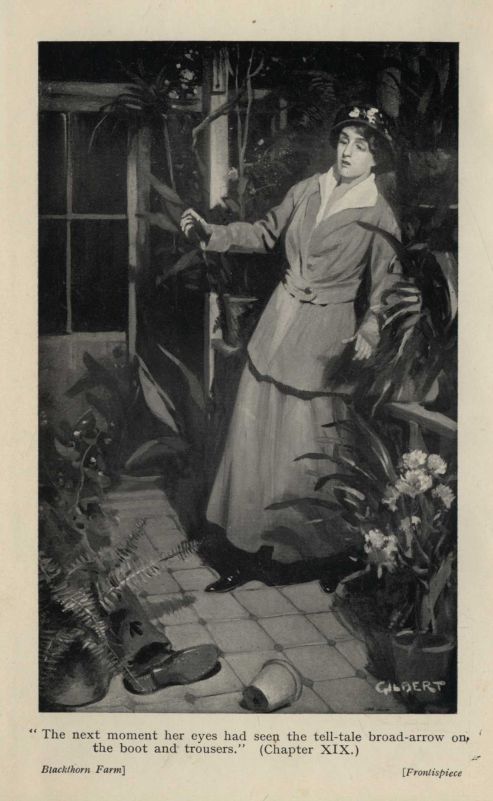
"The next moment her eyes had seen the tell-tale broad-arrow on the boot and trousers." (Chapter XIX.)
BLACKTHORN FARM
BY
ARTHUR APPLIN
Author of "Her Sacrifice," "Love Conquers All Things," "The Chorus Girl," "The Pearl Necklace," etc., etc.
WARD, LOCK& CO., LIMITED LONDON. MELBOURNE AND TORONTO
First published in 1915.
CONTENTS.
CHAPTER
I.—RUINED! II.—FIVE HUNDRED POUNDS III.—SALVATION IV.—RADIUM V.—THE ACCUSATION VI.—FORGERY VII.—THE VISITORS VIII.—ARRESTED IX.—A PROPOSAL X.—IN SUSPENSE XI.—THE TRIAL XII.—MARRIAGE IS IMPOSSIBLE XIII.—THE IRONY OF FATE XIV.—THE PARTING OF THE WAYS XV.—ESCAPE XVI.—"YOU'VE KILLED HIM" XVII.—AT POST BRIDGE HALL XVIII.—ALARMED XIX.—"YOU MUST GO BACK" XX.—PLANS FOR ESCAPE XXI.—READY FOR FLIGHT XXII.—JIM STARTS OFF XXIII.—SUCCESS XXIV.—RUBY'S DECLARATION XXV.—AN EXCITING TIME XXVI.—AN ARGUMENT XXVII.—RUBY'S HEROISM XXVIII.—FINIS
BLACKTHORN FARM.
CHAPTER I.
RUINED!
Rupert Dale sat at the writing-table before the open windows of his sitting-room in Clanton Street, Westminster. It was a glorious summer morning. The sun had torn aside the grey mantle from the face of London. The roofs and spires of the city shone. The trees rustled their leaves in the warm breeze. The roar of traffic echoed in his ears.
Rupert stretched himself, sighed, and leant back in his chair. His table was littered with papers. There were letters, bills, advertisements—principally from tipsters and bookmakers—and the examination papers which had been set him at his third attempt to pass the final examination of the School of Mining Engineers.
The result was due to-day, and Rupert had intended going down to the hall to find out whether he had passed or not.
But he was afraid. He had failed twice already. He could not afford to fail a third time. If he failed ruin faced him, and disgrace. His father had warned him that the money he had saved for his education had come to an end. Ruin for his father and his little sister!
He had no idea how deeply Rupert was in debt. Rupert himself had only just realised it. And in desperation he had gambled to save himself.
He had backed a horse on the big race to be run that day for more money than he possessed. He had staked honour and love on a horse he had never even seen. If it won he was saved. He could face his father, pay his debts, and, supposing he had failed, go up yet once again for his final examination.
If it lost——?
On the table a letter lay from his father in Devonshire enclosing a cheque—the last he would be able to send him.
There was also a letter from Ruby Strode, reminding him that he had promised to take her to see the big race that day.
Rupert picked up his father's letter and looked at the cheque. For five pounds only. It was drawn by Reginald Crichton, of Post Bridge Hall, made payable to John Allen Dale. His father had endorsed it.
Rupert smiled and fingered the cheque thoughtfully. Five pounds! Quite a lot of money—to his father; probably he did not spend as much in a month. And Rupert's conscience pricked him.
He set his teeth and swept aside the accumulation of unanswered letters and bills.
Ruin! An ugly word. He repeated it aloud—and laughed. It savoured of the melodramatic. Yet here was ruin facing him. He looked up and saw it blotting out the sunshine.
It had come upon him stealthily, like a thief in the night. And at the same time Love had come, too!
Again Rupert laughed.
He had only known Miss Strode seven months, but six weeks after their meeting outside the stage-door of the Ingenue Theatre they had been engaged to be married. As Miss Strode's income—including two matinees—was exactly the same as Rupert's, marriage was out of the question. Being young and lighthearted and having no idea of the value of time, money or life, they had taken all the gods offered them, living for the day, careless of the morrow.
But the to-morrow and the day of reckoning had unexpectedly arrived. For himself Rupert did not care. He could face poverty, failure, even disgrace. But it was of his father he was thinking, and of his sister Marjorie. His father, the old yeoman farmer who had pinched and scraped for seven years now, denying himself and even his daughter the ordinary necessities of life that he might give this only son a good education and make a man and a gentleman of him.
As he stood before the dressing-table in his bedroom and commenced to shave it was not the reflection of his own face he saw in the mirror. A vision rose before his eyes of Blackthorn Farm, his humble home in the middle of the wild moorlands, of his father, aged and worn with toil and poverty; of his sister, a girl on the eve of beautiful womanhood.
For centuries the Dales had lived at Blackthorn Farm, and when with the passage of time the homestead decayed and threatened to crumble to dust and disappear, so, in the same way, the family of Dales dwindled and decayed, too.
For there was no money in Blackthorn Farm. It was difficult enough to grow pasture to feed the few cattle. And so John Allen Dale had determined to make a gentleman of his only son. He had been studying now for over three years in London—ever since he had left Taunton Grammar School. It was two years since John Dale had even seen his first-born, and his heart thrilled with pride and expectation when he thought of the homecoming. It would make up for all the years of grinding and scraping. He had been even forced to mortgage a small part of the unproductive land in which an old tin mine was situated, unworked for many years now and valueless—though once it had promised to retrieve the fortunes of the Dales.
It had hurt his pride at the time, and he had not told Rupert. For the mortgagee was Sir Reginald Crichton, of Post Bridge Hall, who had gradually bought up all the land lying in the valley; a rich man and influential, yet a stranger to Dartmoor and therefore unwelcome.
But John Dale consoled himself with the thought that when his son was a gentleman he would have no use for the old homestead of Blackthorn. It would just sink into oblivion and disappear, and there would be nothing left but memory—and the everlasting morass and moorlands. But the grand old name of Dale would rise phoenix-like from the ashes and be handed down to future generations by his son.
Just as Rupert finished dressing there was a knock at the outer door and Ruby Strode burst into the sitting-room bringing with her the sunshine and the breath of summer. The vision that had been conjured before Rupert's eyes disappeared: he was glad enough to dismiss the thoughts and memories that it had brought.
Ruin! He looked at Ruby, and advanced to meet her with open arms.
"Be careful, you mustn't crush me," she laughed. "What do you think of my new frock?—and isn't this a duck of a hat, straight from Paris?"
Rupert stepped back and gazed at her. "By Jove, how beautiful you are," he whispered. "You look simply——" He searched for an adjective in vain.
Ruby gave a satisfied smile. She was really in love with Rupert, and she valued his opinion as much or more than she would have valued the opinion of a woman friend—or enemy.
Remarkably good-looking, of a type of beauty rather unusual, she had found the stage an excellent matrimonial market. But life had taught her that love was to be given, not sold. Unfortunately, she had given it to a penniless young man whose heritage was as unstable as the bog on which his house was built. But he was strong, he was clean, he was young. And he had won her.
"We shall have to hurry up or we shall miss the train," she cried. "I wish we could motor down, but I suppose that's impossible."
Rupert laughed light-heartedly and emptied the contents of his pockets on to the table.
"Every penny I possess in the world is on Paulus. I've backed it at 'sevens' already, you know. It'll cost a couple of pounds to get on to the stand. We shall have to train it, my dear, and walk down the course."
Ruby glanced ruefully at her long narrow shoes and silk stockings. "Right ho! I believe I'd walk through your Devonshire bogs if you asked me. But I say, Rupert, suppose Paulus doesn't win? What on earth are we going to do?"
Rupert shrugged his shoulders. "Sufficient unto the day is the evil thereof. If I pass my final—well, I suppose I shall get a job somewhere and the old man will be so pleased that he'll forgive me.... I'll manage somehow. Find tin in an old disused mine we've got on our property, and float a company."
He spoke lightly, but a shadow crossed his face. He looked at Ruby again and found himself wondering how much her clothes had cost, how much money they had managed to waste together during the happy months they had known one another. And then, again, he saw the queer eerie little farmhouse lying tucked between the granite tors: on one side of it the Dart purred to the sea; stretching away to the left a few fields surrounded by stone walls and the cattle standing in the green grass. And beyond, the vast peat bogs with the rushes flinging their white seed to the wind, and creeping up the hills the purple heather with patches of wild gorse; and little Marjorie milking the cows, scalding the cream, and making the butter.
If he had failed in his final examination? His body grew suddenly cold, he shuddered. He could not face his father then.
"What's the matter?" Ruby stepped forward and took Rupert's hand.
"I was wondering, if Paulus didn't win?" he stammered. "But, of course it will. Come along, or we shall miss the train!"
Rupert slung his race-glasses over his shoulder, put on his hat, and together they ran downstairs. At the front door the landlady of the lodgings met him. She drew Rupert aside and reminded him that his bill was three weeks overdue.
"You said you would let me have something to-day, sir. I'm sorry to trouble you, but——"
"Of course, I forgot. I'll pay you to-night without fail," he cried cheerfully.
Then, slamming the front door behind him, he slipped his arm through Ruby's. Hailing a passing taxi-cab they drove to Waterloo Station.
* * * * *
Epsom Downs looked like a vast ant-hill. The very air seemed to shake and quiver with the cries of the multitude. The great race of the day was due to start. Paulus was a hot favourite. It was difficult to get bookmakers to lay two to one against it.
"By gad, it can't lose," Rupert kept on saying. "I shall win enough, Ruby, to pay my debts, with a little to spare."
Ruby slipped her hand into his. She looked into his face a trifle uneasily: "You mean if it were to win? Would it be very serious for you if Paulus were to lose?"
Rupert forced a laugh. Again, at this moment of tense excitement, he realised what it would mean if the horse lost.
Ruin! Not just for himself, that was nothing. But disgrace! That was something his father would never face. The blasting of the old man's hopes. All that he had lived for and dreamed of. Unsteadily Rupert counted out five sovereigns.
"I'd better stick this on the brute as well, it's all or nothing," he said, forcing a smile. And he began to fight his way to the rails where the bookmakers shouted the odds.
Ruby laid her hand on his arm. "Give it to me, I'll do it. You always say I'm lucky to you—and I may get better odds."
Rupert nodded and made a passage for her. "All right. If you smile at the beggar like that he'll lay you fives, I should think."
The crowd swallowed her up. She forced her way to the rails at Tattersall's Ring. Rupert saw the long black plume of her French hat nodding in the breeze. He saw her hand the money to a bookmaker and receive a ticket in exchange.
Then a cry like a great chorus rent the air. "They're off!"
Rupert leapt to his position on the stand and putting up his glass watched the race.
A good start, though one horse was left. It was not Paulus, so he did not care. One horse out of the way!
He watched the horses climb the hill, the colours of the jockeys made brilliant blots against the blue sky. The great human ant-hill was still now, silent, too. The whole thing looked like a cinematograph picture; the horses like clockwork animals.
They neared Tattenham Corner. Rupert held his breath. The vast crowd began to murmur now. A strange sound as if emanating from the lips of one man. The sound rose and fell like distant thunder.
Presently he heard the thunder of the horses' hoofs. They had rounded the corner and were coming down the straight. He took a deep breath, and for a moment the scene was blotted from his eyes. And again he saw the black Devon moorlands, neither purple heather nor golden gorse now, just granite tors and bogland; and an old man standing at the entrance of a thatched-roofed little farmhouse staring out over the grey hills—as if waiting for one who never came.
"Nimbo wins! A monkey to a pea-nut on Nimbo!"
The storm broke now. First the name of one horse was shouted, then another. The field had strung out, but there were half a dozen horses locked together.
"Paulus wins! I'll back Paulus!"
Rupert took a deep breath, and for the moment put down his glasses. Then he heard his own voice shrieking hysterically, "Paulus! Paulus!"
A sudden silence fell, more terrifying than the thunder of ten thousand voices. The leading bunch of horses was within a hundred yards of the winning post now. Paulus led, then fell back suddenly challenged by a rank outsider, Ambuscade. Neck and neck they ran, first one, then the other, getting the advantage. Rupert was conscious of Ruby clinging to his arm. He was conscious of the great crowd on the hill, of the crowd surrounding him, swaying to and fro; of the perfume of the girl's hair—the girl he loved; the colours of the jockeys as they lay almost flat on the horses' backs.
The race was over now. The winning-post was reached. Thunder-clap after thunder-clap of human voices.
"Paulus wins! ... Paulus! Paulus! Paulus!"
Rupert was shouting at the top of his voice as he was carried by the crowd he knew not whither, Ruby clinging to his arm. He waved his hat in the air and he laughed as he shouted. He was saved, and for a moment he forgot all he had learned. He could not control himself, he just shouted with the crowd, his crowd.
Still the excitement was not over. There were a few moments more of tension until the numbers went up and they saw on the telegraph board that Paulus had won by a short head.
Rupert found himself standing alone at the bottom of the enclosure. He wiped the perspiration from his face. Ruby had disappeared—yet a moment ago she had been hanging on his arm. He heard the "All right" called and he realised she had gone to draw the money from the bookmaker. After a while he saw her hemmed in by the crowd near the rails. He fought his way to her and in answer to his queries she showed him her purse.
"Come along, let's go back," he whispered. "There's nothing else to wait for now."
Once clear of the crowd they walked up the hill to the railway station, caught the first train returning to London, and drove straight to Rupert's rooms.
A telegram was waiting for him on the table. He picked it up and gave it to Ruby.
"Open it, you always bring me luck," he laughed. "It's the result of the exam. I told one of my pals to wire me. Still, I don't care twopence now——"
He broke off as Ruby tore open the little buff envelope and looked at the message. The next moment she had dropped it and taken him in her arms, heedless now of the damage to her French toilet. Her black, sweetly-scented hair brushed his face, her soft cheek was pressed against his own. She mothered him as if he were her child instead of her lover.
He had failed.
"What does it matter?" he cried with bravado. "I'm rich now. I can pay my bills; we can have a jolly good time before I go home."
"But your father, Rupert?" she whispered. "Don't you remember—all you told me about him, his dreams, his ambitions for you? Oh! don't think I'm a prig, but he'll be disappointed, so disappointed. I think I'd rather you had passed your exam, and lost your money——"
He broke away from her angrily. "You don't know what you're saying. If Paulus hadn't won!"
The raucous cries of a newsboy from the street interrupted him. They both listened, then Rupert smiled.
"Forgive me, it's ripping of you to think of father and all that. I know it'll knock the old man sideways: he'll be awfully sick about it. But I've got one more chance, and now I can afford to take it. If I hadn't won this money I couldn't have. I should have had to go home and stop there, shut up in that crumbling hole in the midst of those beastly moors. But I'll try again and, by gad! I'll win. I swear I'll pass next 'go.' It was the worry of thinking of the beastly money which upset me this time."
Another newsboy ran shrieking down the street.
"Result of the great race. Sensational result! All the winners—Sensation——"
Rupert moved towards the door. "Let's get a paper and see the starting price."
Ruby followed him. "Wait a moment, Rupert. Tell me honestly, how much you would have owed if Paulus hadn't won?"
"Oh, I don't know. What does it matter now?" he cried carelessly. "A hundred or two, I think. What does it matter now? I can go on working until I pass. And I'll send the guv'nor that last fiver he posted me, old Crichton's cheque. Those brutes at Post Bridge Hall are absolutely rolling in money, but, by gad! they shall see we've got some, too. Come on, let's get a paper."
Smiling at his excitement Ruby followed him out of the room. From the doorstep they beckoned to a passing newsboy, who thrust a paper into Rupert's hands. Chucking him sixpence Rupert made his way upstairs again. He opened the paper in the sitting-room, and Ruby bent over his shoulder.
"Well?" she said.
Then she heard Rupert catch his breath, she saw his face change colour, grow deadly white. The paper began to shiver and tremble between his hands. She looked at the stop press news. She saw the result:
Paulus first, Ambuscade second—then in huge black type underneath: OBJECTION!
"The stewards objected to the winner for bumping and not keeping a straight course. An enquiry was held and Paulus was disqualified. The outsider, Ambuscade, is therefore the winner. The starting price is a hundred to one."
Rupert crunched the paper in his hands, and staggering forward fell into the chair in front of the writing-table. He stretched his arms out, sweeping off the litter of papers, and his head fell forward between his hands.
Ruby bent over him and tried to raise him. "Rupert—perhaps it's not true. Rupert!"
She lifted him up, but he fell back into the chair half fainting. Putting her arms around him she dragged him into the bedroom, and laying him on the bed loosened his collar. She found some brandy and forced a little between his lips. Then she sat beside him, holding his hand tightly. Presently the colour returned to his cheeks, his eyes opened. He lay quite still, staring at the ceiling.
"It'll be all right," she whispered. "It'll all come right, Rupert. I—I love you, dear, I'll help you. It'll all come right."
The muscles of his face twitched convulsively. "Leave me," he whispered. "For pity's sake leave me for a little while."
Drawing down the blind, she crept out of the room and shut the door behind her. She heard someone coming up the stairs—the landlady bringing tea. Stooping down she commenced to pick up the papers scattered on the floor. Among them she found the cheque Rupert had received that morning from his father, the cheque drawn by Reginald Crichton. She looked at it curiously, a sudden instinct telling her how much that little sum meant to the old father who had sent it.
Five pounds! Scarcely the value of the hat she wore. Folding it up she slipped it into her gloved hand, then sat down at the writing-table waiting until the landlady left the room. She had a few pounds in her purse which she had drawn over Paulus before the objection was made. A few pounds in the Post Office Savings-bank. Between them they might collect twenty or thirty pounds: and Rupert confessed to owing a hundred or two. That might mean five hundred—the price of his father's honour and happiness, his little sister, the house, everything.
And she loved Rupert Dale. Now that ruin faced him she knew how much she loved him. She would give her life to save him.
She poured herself out a cup of tea and drank it. The little sitting-room felt hot and stuffy, her brain felt numb, she wanted air. She crept downstairs and commenced to walk to and fro up and down the pavement trying to think what she would do. Twelve pounds in her purse and a cheque for five pounds in her gloved hand. How lightly Rupert had thrown aside that cheque a few hours ago. Probably he did not know what he had done with it; would think he had lost it.
Scarcely thinking what she was doing she took it out and looked at it closely. And she remembered Reginald Crichton's name. She had heard men at the theatre speak of him in connection with mining investments.
The clock struck the hour—six—and she made her way back to the lodging-house, and very quietly opened the door of the sitting-room. Then she stopped short, frozen with terror. Rupert was standing at the writing-table. The blinds were drawn down. In his hand he held a revolver. She saw him slowly turn it until the muzzle was pointing at his breast.
CHAPTER II.
FIVE HUNDRED POUNDS.
"Rupert!" Ruby's voice scarcely rose above a whisper.
Slowly Rupert turned the revolver from his breast. Very slowly his arm dropped until it hung limply by his side. His grip relaxed and the revolver fell to the floor. Ruby crossed to his side, and, stooping down, picked it up.
Extricating the cartridges, she put the revolver away in a drawer of the writing-table and locked it up. Then she drew a chair forward and sat down, facing the man whose life she had just saved, the man she loved.
It was a long time before either of them spoke. Rupert Dale had meant to kill himself. Ruby had arrived at the critical moment. Thirty seconds more and she would have been too late. The crisis had passed now, but the shock had left the woman unnerved and weak.
Rupert merely felt vaguely surprised that he was still alive. The idea of suicide was horrible to him because normally he was a healthy, sane young man, but the news of his failure for the third time in his final examination, coming upon the victory and subsequent disqualification of Paulus, had made him see the hopelessness of his position. It was a lightning flash; illuminating the horizon of Hope. The instant's flash had shown him himself, his career ruined before it had started, and his father beggared—not merely of his home and his money, but of his dreams: of all that was left him.
Ruby watching him, holding his cold hand in hers, saw what was passing, and what had passed, in his mind. Of a sudden she felt her responsibility.
She had never considered the word before in her life. She understood it now because she loved.
Rupert was the first to speak. "It's no use, old girl; it's the only way out—the only way."
She shook her head. "A coward's way."
Rupert gave a dry laugh. "I'm not afraid to live, not afraid to face the music; not afraid to take off my coat and work in the gutters, if need be. But I've ruined and disgraced my father. The shame will fall on him. I'm his only son, and he was going to turn me into a gentleman. Well, when a gentleman has done a shameful thing, a thing that prevents him from meeting his friends, his relatives, he just goes out ... as I'm going.... They'll get on better without me, father and Marjorie."
Ruby's hands tightened their grip. She had aged in an hour; changed. The little, light actress had become merged, as it were, in the woman. Mother instinct had taken the place of the lover instinct.
She was fighting for the life of some other woman's son, and for the moment he was her son.
"You can't do it!"
"My mind is made up."
Ruby closed her eyes for a moment. He spoke quietly and calmly. She knew it had not been a sudden resolve, but that his mind had been made up.
There was a long silence between them. Outside the newsboys still shouted the sensational result.
At last Ruby rose. She crossed the room and stood with her back to Rupert for a little while. When she turned she was smiling, and she looked more like her old self—as if she had not a care in the world.
"Rupert," she whispered, and her voice, though a little unsteady, had a glad ring in it.
He picked up a letter lying on the table. The ink was scarcely dry on it. It was lying on a sheet of clean white blotting-paper. It was to his father—saying good-bye.
"The old man sent me a cheque," he mumbled. "I can't find it anywhere. Must have lost it this afternoon. I suppose some beggar will cash it. Don't much matter now, but it would have been useful to the old man: five pounds——" Again he laughed.
"Rupert!"
He turned then and looked at her. Perhaps something in her voice attracted him.
"You remember giving me five pounds to put on Paulus? Well, I didn't do it."
He shook his head to and fro. "It doesn't make any difference. I owe hundreds."
"I put it on Ambuscade."
He turned right round now staring at her, frowning. He did not understand.
"Ambuscade started at a hundred to one." Ruby was laughing now. She moved toward him unsteadily.
"Don't play the fool," he said unsteadily. "It's no use trying to—hoodwink me."
"I put the five pounds on Ambuscade at a hundred to one. I didn't dare tell you, dear—in fact, when the news of the objection came I couldn't realise it. I've—I've got the ticket in my purse."
The frown on Rupert's face deepened. "I saw you draw some money—you had it in your purse."
"I put a couple of my own sovereigns on Paulus. I backed Ambuscade with Barrett. They have an office in Piccadilly, London. If I go down to-morrow morning they'll pay me five hundred pounds."
Rupert rose and tottered towards her. His legs gave way at the knees like a drunken man.
"Five hundred pounds!"
He kept muttering to himself over and over again. "Five hundred pounds!" He poured himself out a glass of water from the sideboard and tossed it down his throat. Then he seized Ruby roughly by the shoulders.
"You're not fooling me. You swear it. If it was with Barrett they'll pay up all right. They're a big firm, they'll pay up to-morrow."
She managed to assure him she was speaking the truth.
He began to laugh, then checked himself with an effort. "Why the devil didn't you tell me before?" he cried savagely. "I might have——"
He seized his hat and put it on. "I must get out of this. I must think it over. I want air. I can't realise it.... My God, five hundred pounds! I'm saved." He opened the door. "Wait until I come back. I shan't be long. Wait there until I come back."
She listened to his footsteps descending the staircase. She heard the front door bang. She stood at the window and watched him walk down the street. He held himself erect, his face turned to the sky now.
Ruby closed the window and drew down the blind. Then she sat down at the writing-table, and taking off her gloves picked up a pen.
The cheque drawn by Reginald Crichton lay just inside one of the long white gloves. Picking it up she unfolded it and laid it on the white sheet of blotting paper.
Five hundred pounds!
CHAPTER III.
SALVATION.
There was a ring at the front door bell followed by a loud double knock. But Ruby Strode did not hear. She was still seated at the writing-table bending over the large pad of white blotting-paper, in the fingers of one hand a pen. She sat very still, scarcely seeming to breathe. It looked as though she were writing: not a sound disturbed the silence of the little room. The blinds were still drawn down.
Presently, outside, footsteps could be heard ascending the staircase. Somebody knocked on the door, which was instantly opened, and the landlady put her head into the room.
"A gentleman to see you, sir."
She stopped abruptly, as, gazing round the room, she saw only Ruby Strode bending over the writing-table.
"Beg pardon, I thought Mr. Dale was here. There's a gentleman to see him."
Ruby started and jumped to her feet. She laid her pen down. In her hand she held a slip of paper which she had just blotted. She folded it up with unsteady fingers.
"Mr. Dale went out just now—for a few minutes—he won't be long."
She spoke rapidly in jerks, and turning round faced the door, her hands clasped behind her back.
"Oh, it doesn't matter! I suppose I can wait." And the visitor entered the room. "That sounds like Miss Strode's voice."
Robert Despard crossed to Ruby's side and held out his hand. He was a dark, well-set-up man, some years Ruby's senior. He was faultlessly dressed in a brown lounge suit, a light-coloured bowler placed jauntily on the back of his head, a pair of race glasses slung across his shoulders, and he wore a pair of highly-polished tan boots.
"I thought I might find you here," he continued, looking at Ruby with a familiar smile and giving a nervous twirl to his black moustache when she did not take his hand. "I saw you both at the races, but I couldn't get near you for the crowd. Thought I would look in and see how Rupert had done. I bet he came a nasty cropper over that disqualification. Can't say you're looking exactly jolly."
Ruby stepped back and forced a smile to her lips.
"Oh, we're all right!" she said unsteadily, commencing to fold up the slip of paper she had been holding in her hand behind her back. "We won."
Despard raised his eyebrows and gave a dry laugh. "I don't think! Rupert told me he plunged, on Paulus. As a matter of fact, I came round to condole with him. I knew he was pretty hard hit and all that sort of thing."
"Well, you are wrong! He doesn't want your sympathy, as it happens."
Ruby spoke almost defiantly. The colour had returned to her cheeks now. They were scarlet and her eyes were bright. There was defiance in them, too.
Despard watched her closely, and the expression on his face gradually changed. A cynical smile still played about his lips.
"You're a loyal little devil!" he said between his teeth. "By gad! I admire you for it. But let me tell you that poor old Rupert Dale is ruined. Broke to the world, and he's failed in his final, too. I'm awfully sorry for him—and all that, but there you are."
"Yes, you sound as if you were sorry," Ruby replied sarcastically. She commenced to pull on one of her gloves, then slipped the strip of folded paper underneath the glove into the palm of her hand. Despard was watching her with his small, bright eyes.
"Is that your winnings you're hiding away?" he sneered.
He threw his hat on to the table and seated himself on the arm of a chair close to Ruby.
"I wanted to see you more than I did Rupert," he said, lowering his voice. "Of course, it's all over between you two now? You wouldn't be mad enough to marry a pauper, even if he were cad enough to want you to. So don't forget that I'm just as keen on you as ever." He stretched out his arm and pulled Ruby towards him. "I knew my turn would come if I waited long enough."
Quietly but firmly Ruby released her arm, and, moving away, stood with her back to the window so that her face was in shadow. Though she despised Robert Despard, she feared him.
"You call yourself Rupert's friend, and yet you choose the very moment when you believe he is ruined to make love to the woman to whom he was engaged to be married, and under his own roof, too."
"Dash it all, it's only a lodging house!" Despard replied brutally. "But, go on, I love you when you get angry. You look as if you were a leading lady earning a hundred pounds a week instead of a show girl walking on at a couple of guineas."
"A show girl has a heart and a conscience, which is more than you've got, anyway," Ruby replied fiercely; "and Mr. Dale shall know the kind of friend he's got in you."
Despard shrugged his shoulders and suppressed a yawn. "So that's all the thanks I get. Dash it all, isn't it proof that I love you, when, directly I know your man has got the kick, I hurry down to tell you I'll take his place—look after you, pay your bills—make you my wife, anything you like in the world! I loved you long before he ever met you. I told you I didn't mean to give you up. I told you no one else should take you from me. Rupert is all right, of course; I am fond of him, but he isn't the right man for you. Now that he's come a cropper and failed in his exam., he'll have to go back to his Devonshire bog and leave me to look after you."
Ruby tried to speak, but she could not trust herself for some seconds. Despard watched her with an amused smile. Suddenly she crossed the room and opened the sitting-room door.
"I'll go out and find Rupert. You had better say to his face what you've just said to me," she cried.
She hurried downstairs out into the street. She saw Rupert coming slowly towards her and she ran to meet him.
Meanwhile, Despard left alone in the sitting-room, lit a cigarette, and rising from his chair glanced casually at the evening newspaper lying on the writing-table. Ruby had left the letter Rupert had written to his father lying on the white sheet of blotting-paper. Almost unconsciously, Despard commenced to read it. Then he picked it up and glanced hurriedly towards the door; he read it through from beginning to end. He gave a long, low whistle of astonishment, and carefully replaced the letter.
He noticed the place where the first page had been blotted on the new sheet of white blotting-paper. And just below it his quick eyes saw one small word, underneath it a couple of naughts. There was nothing particularly strange or remarkable about this. He would probably never have noticed it if the blotting-paper had not been clean. But, gradually, as he stared at the one undecipherable word with the two naughts he began to feel as if there were significance about them. They stood out on the white sheet of blotting-paper.
There was a small mirror standing on the mantel-piece. He took it up and held it over the blotting-pad. And he read reflected the single word between the two naughts. It was "hundred." A little way beyond it he noticed a single letter "s."
Replacing the mirror he stood with his back to the fireplace, his hands deep in his trousers pockets, thinking.
"Hundred," "s," and two naughts. He had seen that the slip of paper which Ruby tucked into her glove was a cheque. He was quite sure that neither she nor Rupert Dale had a hundred pounds in the world. Indeed, he knew the state of the latter's finances better than the girl did. For only a few months ago, he had lent Rupert twenty-five pounds. He stroked his black moustache thoughtfully. Before he could solve the little problem Dale himself entered the room, followed a few minutes later by Ruby.
"I came to tell you how devilish sorry I was that you had backed a loser and got plucked," Despard said; "but, hang it all, you look cheerful enough!"
"So would you," Rupert cried, slapping him on the back, "if you had had a fiver on Ambuscade at a hundred to one."
The frown deepened on Robert Despard's forehead.
"Look here, is this a joke or what?"
"It's no joke," Rupert laughed hysterically. "Ask Ruby, she did it for me! I'll tell you what we'll do. We'll all go out and have a bit of dinner together and break a bottle of wine on the strength of it."
As Rupert spoke he caught sight of the letter to his father lying on the writing-table. Picking it up quickly he tore it into a dozen fragments and threw them into the waste-paper basket.
Despard watched him, and his frown deepened. "You mean to say you backed Ambuscade at a hundred to one and got paid!"
"We didn't know the result until we left the course," Rupert replied lightly. "Luckily, Ruby kept the ticket. We're going to draw the money to-morrow. By gad, she's saved my life! I've had a narrow squeak."
"Who did you do the bet with?" Despard asked.
"I forgot the man's name. I've got the ticket safely in my pocket. We shall get the money all right to-morrow."
Ruby spoke quickly. She could not conceal her nervousness and anxiety. She, who had been so calm a little while ago when Rupert, believing that ruin had overtaken him, had been on the point of committing suicide.
He noticed that she seemed flustered and ill at ease, but he put it down to the sudden reaction. For himself he had forgotten all his troubles. They no longer existed. Death had stood at his elbow less than an hour ago. Now life was beckoning him to join in her revels. Curiously enough, he did not seem to realise the debt he owed to Ruby Strode: yet he would never have thought of backing Ambuscade himself.
As a matter of fact, he was too excited to think of anything. He only knew that he could pay his debts, go down to Devonshire for his holidays and face his father with a light heart. In due time he would have another fling at the examination, pass it, obtain an appointment somewhere, and then he would be able to marry Ruby and they would live happily ever after.
But for the moment he just wanted to enjoy his good fortune; to dance, to sing, to feast, to love.
"Come on, if you're both ready to start!" he cried excitedly. "Where shall we dine? Trocadero, Café Royal, Savoy? We'll make a night of it."
"The Savoy's good enough for me," Despard laughed over his shoulder. "Do you mind if I wash my hands and make myself look a bit presentable in your room, Rupert?"
Ruby waited until the bedroom door had closed on Despard. Then she put her arms around Rupert's neck. "Do you mind very much if I don't come with you to-night?" she whispered. "I'm feeling so tired. I think the excitement has been too much for me."
Rupert looked at her with amazement. "Why, it will be no fun without you. I don't want Despard! Rather wish he hadn't come down to see me. You'll feel as fit as a fiddle when you've had a glass of wine."
But she shook her head, and held him tightly. He felt her arms trembling. He saw tears swimming in her eyes.
"My dear, my dear, what a selfish brute I've been!" he cried with a sudden revulsion of feeling. "Good heavens, you've saved my life—you've done more than that—and I've not even thanked you."
Ruby stepped back and put her fingers over his mouth. "Not another word," she whispered. "I'm so happy, really. It's just nerves. I want to be quite alone. I want to realise our good fortune."
"Of course, if you would really not come," Rupert said; "or shall I tell Despard we don't want him? I know you're not keen on him."
Ruby longed to tell Rupert what had taken place between them a few moments ago. But fear of the man she loved and wanted sealed her lips. She knew that the two men were friends. She knew that Despard had it in his power to injure her. He had some influence with the manager of the Ingenue Theatre, and there were other reasons. So she said nothing.
Despard rejoined them and they all went out together.
"We'll drive you home first," Rupert said to Ruby.
"I would rather you dropped me at the Tube," she replied. "I have nearly two hours before I need go to the theatre. I'm not on until the second act."
Despard pretended to be bitterly disappointed that Miss Strode was deserting them. Ruby surreptitiously handed Rupert the money she had in her purse and whispered to him that she would get their winnings in the morning and bring them round to his rooms. She had no reason for secrecy, and so he asked her to give him the ticket she had received from the bookmaker when she had backed Ambuscade.
"I don't like the idea of your going round to the bookmaker's offices. It's possible they'll dispute it, or make a fuss," he said.
Despard agreed and suggested that they should meet at ten o'clock in the morning and all go round in a body. But Ruby was obstinate and refused to give up the ticket.
"I backed the horse myself. I am going to get the money and bring it round to Rupert!"
She got quickly out of the cab as it stopped at the Piccadilly Tube Station and, blowing a kiss to Rupert, she disappeared in the crowd.
The two men drove to the grillroom of the Savoy.
"You are a lucky devil," Despard said, "if there's no mistake, and Miss Strode really backed Ambuscade."
"Why should there be a mistake?" Rupert asked curtly.
"Oh, I don't know!"—Despard shrugged his shoulders—"but she seemed rather mysterious about it. Perhaps that's a woman's way. They are queer cattle."
"Ruby is one in a thousand," Rupert said quietly. "Look here, I'm off to Devonshire to-morrow evening. I don't want the old man to hear I've been plucked. I must tell him myself. I shall have to find some reason, too, for my sudden wealth."
"One of the old-fashioned sort, eh?—don't approve of betting or pretty girls. Will you keep Miss Strode dark, too?"
Rupert frowned. He did not reply at once. "I thought you knew we were engaged to be married," he said at last. "I shan't tell the guv'nor until I've passed my final, so if you come down you needn't mention her."
Rupert suddenly found himself regretting the invitation he had given to Despard some time ago to spend his holidays at Blackthorn Farm. Too late, instinct warned him that he was not quite the sort of man he would like to introduce to his sister.
"So you're really coming?" he said.
"Rather! I want to throw a fly for those trout you've spoken about, and pot the rabbits. I'm a bit fed-up with town. If it's quite convenient I'll meet you at Paddington Station to-morrow afternoon."
Rupert nodded. "The train leaves at eight-thirty. I must wire in the morning and tell the guv'nor we're coming. I expect Marjorie will meet us at Moreton with the trap."
"How old is she?" Despard asked.
Rupert did not reply, and the cab drew up outside the Savoy.
Dawn was beginning to break over the City before he returned to his rooms. He switched on the electric lights. Curiously enough, he felt wide-awake and not in the least tired. Yet the day had been a long and eventful one, every hour filled with excitement.
Lighting a pipe, Rupert sat down at the writing-table, and went through the bills and letters that lay in a heap beneath the paper-weight. Including the money he had borrowed, he owed close on three hundred pounds. He felt a shudder run through his body. In the morning when he had gaily set out to the races he had not known it was as bad as that.
But for the inspiration which had made Ruby back Ambuscade where would he have been now? And again a shiver passed through his body.
He saw himself sitting in that very chair holding a revolver to his breast, his finger on the trigger. How near he had been to disgrace and death!
A photograph of his father stood in a little silver frame near a vase of flowers. He picked it up and looked at it, a mist rising before his eyes.
"He trusted you, he believed in you," his conscience whispered. "Trusted you to bear the old name bravely and proudly; trusted you to retrieve the fallen fortunes of the family. How nearly you failed him!"
A cold sweat broke out on his forehead. If Ruby had made a mistake? Supposing she had only told him she had backed Ambuscade in order to save him from taking his life? Or, if she had backed the horse, what guarantee had they that the bookmaker would pay up?
He rose to his feet, and walking to the windows opened them wide. A cold breeze swept his face. A peculiar light grey outlined the trees and houses. The street lamps glittered dimly before the coming dawn. London was very still, and almost silent. Rupert raised his eyes to the sky. It was grey and the stars had all disappeared; half unconsciously he prayed as he had done when he was a boy. And he swore that if his prayer were answered and he was able to discharge his debts, he would remember his responsibilities in the future, and live his life according to his father's wishes.
Switching off the lights he went to bed.
When he awoke the sun was high in the sky. It was past ten o'clock. Hurriedly dressing and without waiting for breakfast, he drove to the flat Ruby shared in Baker Street with another girl. But the housekeeper told him that she had gone out nearly an hour previously. In spite of the late night, Rupert felt strangely elated and excited. The sunshine of the new day made him optimistic. He knew she had gone down to the bookmakers to draw the money they had won. He waited a little while thinking she might return. Then he remembered she had told him that she would bring him the money to his rooms. He hurried back to Westminster.
But she was not there, and he felt a thrill of apprehension. He rang for a cup of tea; when his landlady brought it she again reminded him of his bill.
"I'm just waiting for some money to come from the bank," he said with exaggerated carelessness. "I'm leaving town to-night for a week or two, but I shall keep my rooms on. I'll pay for them in advance."
He swallowed his tea and smoked a cigarette. He could not eat. Ruby had had plenty of time to draw the money and reach his rooms! Perhaps the bookmaker was away, or refused to settle until Monday.
He heard Big Ben chime the hour—twelve o'clock. He lit another cigarette and stood on the balcony outside the window waiting.
At last he saw a taxi-cab draw up outside his front door and Ruby Strode alight. He ran down the staircase to meet her.
"Is it all right, have you got it?" he cried. His only thought was the money now. The money that meant salvation.
She did not reply, but brushed past him upstairs and he followed her. He heard her breath coming in quick, hard gasps, and following her into the sitting-room he locked the door.
"Tell me, is it all right, have you got it?"
Rupert stretched out his hands imploringly.
CHAPTER IV.
RADIUM.
Ruby Stroke threw aside the heavy veil she wore and placed her bag on the table. Rupert heard the clink of coins.
"Of course, I've got it," she stammered. "Look! Five hundred pounds. I've brought fifty in gold. I thought, perhaps, it would be more useful than—than notes."
He staggered to her side and looked at the two little bags of gold she had placed on the table. She showed him a roll of notes. He pushed them aside, and pouring the gold out on the table he commenced to count it. It fascinated him. He could not speak.
Presently he began to laugh hysterically. "You are sure there's no mistake?"
"Count it again."
Again he laughed. "I didn't mean that—I mean, it's all right—I can't believe it—that this is ours—all ours." He dropped on to his knees beside her and put his arms around her waist. "Oh, my dear!" he cried, "my dear!"
Ruby smiled. She sat staring at the money with hard, dry eyes. "It was rather stupid to bring so much gold perhaps," she said in an unsteady voice. "But I thought you could pay some of your bills with it. And—you are so careless. You might lose notes just as you lost that cheque yesterday."
She picked up the crisp bundle of notes on the table. "I'm going to take charge of these, and later on pay them into your bank. So that when you return from Devonshire, you'll find quite a nice little nest-egg.... Now, give me a cup of tea, and then I'll pack for you. You've only got about three hours."
It did not take Ruby long to pack. Rupert watched her and gave instructions as to what he would take, but to which, woman like, she paid no attention.
"I've got lots of old clothes at the farm," Rupert said. "We shall spend all our time fishing and shooting. Gad! I'll take old Despard down our tin-mine. Probably, it's little better than a swimming-bath now!"
Rupert was in high spirits. Ruby encouraged him to talk, and smiled as she listened.
"Is Mr. Despard going down with you?" she asked.
Rupert nodded.
"Then you won't mind if I don't see you off at Paddington?" She glanced at the watch on her wrist. "I've got an appointment at half-past one, so it would be difficult anyway."
"You don't like Despard, do you?" Rupert said; "yet he's very fond of you."
"Yes, I know he is. I wish he wasn't."
But Rupert only pinched her cheek playfully. He did not understand. Ruby wanted to tell him that Despard had made love to her, to put him on his guard, but she was afraid to speak more clearly. She did not want to make him jealous, and she was afraid lest the two men should quarrel. So no more was said. They bade one another good-bye in the little sitting-room where so many happy hours had been spent—and where such great events had happened.
"I shall not be away more than a week or two," Rupert said as he kissed her. "I suppose you will be in town all the summer?"
"Probably," she answered evasively. "Anyway, I shall be here when you return. Enjoy yourself and don't worry."
She kissed him again and again, clinging tightly to him, unable to tear herself away now that the hour had come.
"Why, there are tears on your cheek!" Rupert whispered, brushing them away. "You mustn't be sad: our future never looked so rosy. Look here, I shall tell my father I'm engaged to be married. I didn't mean to do so until I'd passed my examination, but it's only fair to you. And we can afford to get married now! You've got those notes safely?"
She nodded, and smiled through her tears. "I can pay them into the bank to-morrow."
And then, giving him a final embrace, she hurried away. Rupert stood at the front door and watched her out of sight. He wondered why she did not turn round and wave him farewell again as she always had when they parted.
A few hours later as he was borne rapidly in the direction of Devonshire with his friend, Robert Despard, he had temporarily forgotten Ruby Strode. When the train on the branch line from Newton Abbott stopped at Moreton he saw his sister waiting for him on the platform. A wave of boyish pride swept over him as he introduced Marjorie to Robert Despard. Two years had changed her considerably. She was a woman now, and beautiful. At the same time he was conscious of the humble dress she wore, the thick cotton stockings, and rather ungainly boots. Conscience pricked him again, and he felt a touch of remorse.
The money she should have spent in pretty clothes he had been wasting in London! He felt he wanted to apologise, too, for the old-fashioned dog-cart waiting outside and the sturdy, rough-haired Dartmoor pony harnessed to the shafts. But Despard had no eyes for anything but Marjorie Dale's beauty. He was unable to take his eyes off her, and Rupert noticed the colour rushing to her cheeks as they drove along.
Despard had a certain way with women. He treated them with a queer mixture of deference and gallantry. He knew how to pay a compliment with subtlety. For the first time Rupert realised there were two distinct sides to his character. And before the long drive across the moorland was over—still blazing with yellow gorse and bloom—he again wished he had not asked Despard to stay with them.
Old John Allen Dale was waiting at the door of the queer, tumble-down, thatched-roofed building which had been the home of the Dales for generations. He took Rupert in his arms and held him closely, then, with an apology, turned to greet Robert Despard. His manner had all the old-world courtesy of the yeoman farmer.
"By Jove, you live off the map, and no mistake!" Despard cried looking round him.
He gazed at the strange, almost forbidding-looking farmhouse, at the great tors surrounding it on all sides. He listened to the river Dart as it sang its wild way to the sea, the only song among those rugged hills.
"Don't you feel jolly lonely sometimes?" he said to Marjorie.
She shook her head. "I haven't time. And I've known nothing better."
She took his kit-bag from the dog-cart, and before he could stop her she had carried it upstairs to his room.
"There is nothing better," John Dale said dreamily. And he linked his arm affectionately through Rupert's. "Well, my boy, you needn't say anything, I see by your face that you've passed your examination. The world is at your feet now to conquer. You're going to do great things, eh?"
Rupert gave a quick glance at Despard. But the latter merely winked, then, turning on his heel, entered the farm. Rupert heard him mount the stairs in search of Marjorie.
Rupert squared his shoulders and looked his father full in the face. "I'm sorry, guv'nor, but you must have the truth. I've failed again."
John Allen Dale winced as if some one had struck him a blow. The strong, determined jaws met tightly, but he said nothing.
"I'm going up again in November," Rupert continued. "And I know I shall pass. It's not an idle boast, guv'nor. I can, and I will."
The old man laid his hands on the young man's shoulders. He spoke bravely and proudly, yet there was a tremor in his voice:
"Rupert, lad, I know you've done your best, and I'm not blaming you. It's a severe blow because—well, you'd better know now—the money's come to an end! I've pinched and screwed, gladly; but the savings of the last fifty years have all gone. They were little enough. The farm doesn't raise enough to keep us in food and clothes. I've even had to raise money and mortgage the old place. I couldn't pay your fees for the examination again, much less your board and lodging in London."
"I know," Rupert replied gently, though he had not dreamed it was as bad as that. And once again remorse seized him. Once again he wondered what he would have done if it had not been for Ruby Strode.
He would have died a coward's death and left his father and sister to suffer shame and dishonour.
It was some little time before he could find his voice and tell his father that he need not worry about the money.
"I don't want you to question me, guv'nor, but I've had a bit of luck and made enough to keep myself for another year or two in London. I can let you have plenty to go on with, too."
"Not borrowed money, not made by gambling?" John Dale asked. "But I needn't ask you, Rupert. It was money honestly earned, I know."
Rupert dared not confess how he had obtained it. "It came through a friend," he said unsteadily. "I can't tell you more now, father, but I will one day. I only want you to know that you needn't worry. I shan't fail you. I promise."
Dale took his son's hand in his great, horny fist and pressed it tightly. "I know that, I know that, my boy."
The first thing Rupert did with the money Ruby had given him was to repay Despard the twenty-five pounds he owed him. The second was to hand Marjorie fifteen pounds—ten for housekeeping expenses, and five for herself. She was overwhelmed, and at first refused to take it. To her it seemed like a fortune.
"You needn't tell the guv'nor," Rupert said, "though he knows I've made a bit. But if he's in want of anything just buy it for him—say it's a present from me. Get yourself a nice frock and some pretty shoes."
Rupert felt afraid that the rough fare and humble life at Blackthorn Farm would bore or disgust his friend, but he soon found that he was wrong. Despard settled down to the new mode of life as if he had been thoroughly used to it. He was up soon after daybreak helping Marjorie to milk the cows; watching her scald the cream and make the butter, and he insisted on being taught how to do these things himself. He made himself useful about the farm, too, and quite won John Dale's heart. He proved himself nearly as good a shot at the rabbits as Rupert, though he quite failed to catch the cunning Devonshire trout, and frankly admitted that it bored him to throw a fly.
"I want to look at this old tin-mine of yours," he announced one day; and he asked Dale for particulars about it, as to how long it had been worked, why it had failed, and the state it was now in.
"It has failed because there wasn't enough tin to make it worth while working," Dale told him. "We thought we were going to make a fortune out of it, but it turned out the other way."
Despard nodded and stroked his black moustache thoughtfully. "I know something about the Cornish mines, and I've got a bit of money in one or two of them. As you know, they restarted working a year or two ago, and they're doing well now. There might still be money in yours, Mr. Dale."
"You're welcome to all you can find," the old man laughed.
Rupert and Robert Despard spent the whole of one afternoon exploring the mine. The examination was not made without danger and difficulty. To Rupert's surprise very little water had penetrated the main shaft, and Despard pointed out that the river and the surrounding bog-land probably acted as drainage. It was easy to find traces of tin in the tunnel right up to where the working had ceased.
"It ought to have paid to follow this up," Despard said thoughtfully. "A case of too much capital or too little. Or else the engineer was a duffer."
"You don't think it would pay to erect a new plant and start operations again, do you?" Rupert said eagerly.
Despard shrugged his shoulders. "The risk would be too great. If it were a gold mine, now, people would fall over one another to put money into it. Or the magic word, radium!"
Despard stopped suddenly, and raising the light he carried glanced into Rupert's face. He had been scraping and poking about in the bed of the tunnel while he talked, using a short, pick-like instrument he had commandeered from the farm.
He held out a small piece of black substance having something of the colour and consistency of tar. He told Rupert to examine it closely. The latter did so.
"Well?" Despard cried sharply. There was a trace of nervous excitement in his voice which Rupert had never heard before.
"Well?" the latter said.
"Good Lord! no wonder you've been plucked three times!" Despard cried. "Don't you know what this stuff is?"
Rupert examined it again. "Rather like pitch-blende."
"Yes—something," Despard sneered.
A sharp cry escaped Rupert's lips. He bent down and examined the black, sticky substance more carefully.
"It is pitch-blende!"
"Extinguish the light," Despard said sharply.
Rupert obeyed. A long time they stood in the darkness. Presently Despard commenced to dig and scrape the surface and sides of the tunnel. After a little while he struck a match and re-lit the lantern.
"That was expecting rather too much," he whispered.
They collected the pitch-blende they had found, and putting it into his handkerchief Despard dropped it into his pocket.
"I'll examine this and test it to-night. But don't say anything about it, not even to your father. Just because we've found pitch-blende it doesn't mean there's radium. But—they have found traces in some of the Cornish mines, you know."
Marjorie was waiting for them at the surface of the mine. She gave a shriek as she saw them, for their clothes were torn and discoloured, and they were wet through.
"Well, how much tin did you find?" she asked jokingly. "Are you going to make our fortunes?"
Despard looked at her. "Supposing I were to make a fortune for you, what reward should I get?"
"Oh, fifty per cent. of the profits," she laughed, lowering her eyes.
"I shouldn't ask that," he whispered. "I should want something money couldn't buy."
When they reached the farmhouse supper was waiting. It was growing dark, and work was over for the day. John Dale had not returned home.
"We had better wait," Marjorie suggested, "He's never late. Probably he has gone up to Post Bridge Hall to see Sir Reginald Crichton on business."
The mention of Reginald Crichton's name reminded Rupert of what his father had told him about having to mortgage the property. Supposing there was anything in their discovery that afternoon the mortgage would have to be paid off before anything else was done. He went up to Despard's room and suggested that while they were waiting for supper they should examine the sample of pitch-blende they had taken from the mine.
Despard locked the door and laid the mass of putty-like substance on the table. "To get a proper test we ought to take or send it up to town," he said. "But there's one simple method——"
He was interrupted by Marjorie calling to Rupert. "You're wanted at Post Bridge Hall at once," she told him. "Father is there, and they've sent a servant over to ask you to go up."
Rupert swore under his breath. "What on earth can the matter be? You don't think anything has happened to—the old man?"
Marjorie shook her head. "I don't think so. The message is simply that you're wanted."
Rupert put on his hat and hurried down the path which led to the main road. Crossing Post Bridge he turned to the right and soon found himself in the avenue that led to the Hall. It was situated fairly high up under the shadow of the tors and surrounded by trees. Lights shone cheerfully from all the windows. Before he could ring the front-door bell Sir Reginald Crichton stepped out and met him.
"Sorry to trouble you," he said curtly; "but the matter is rather important. Do you mind coming up to my study?"
Rupert followed, wondering what had happened. To his relief he saw his father standing with his back to the fireplace.
Sir Reginald shut the door, then sitting down an old oak bureau motioned Rupert to a seat. But the latter remained standing.
"Perhaps you will explain," said Sir Reginald, looking at John Dale.
Rupert looked from one man to the other, and he noticed that his father's face was pale, the features drawn. Before speaking Dale cleared his throat nervously.
"It's about that cheque I sent you eight days ago. Just before you left London. A cheque for five pounds which Sir Reginald drew and made payable to me. It wasn't crossed, so I endorsed it and sent it to you."
Rupert nodded. "Yes, I received it."
"And cashed it?" Sir Reginald spoke.
Rupert started. "No, I——" Again he looked from one man to the other. He felt suddenly guilty. "As a matter of fact, I'm sorry to say I lost it."
"Lost it? You never told me." Dale spoke. "Of course you wrote to the bank?"
Rupert bit his lip. "I forgot all about it—in the excitement of packing up and coming home."
John Dale was about to speak, but Crichton held up his hand. "Did the loss of five pounds mean so little to you, then?" he asked Rupert.
The latter moistened his lips. His sense of guilt increased, though he had only been guilty of gross carelessness. Yet, how could he explain the situation?
"I was fearfully rushed and worried at the time," he said, fumbling for words. "As a matter of fact, the morning I received it I went to the races, and I only discovered the loss when I got back. I must have pulled it out of my bag with some letters and papers. I hope—nothing is wrong?"
Sir Reginald leant forward and stretched out his hand. "Look at this, sir."
Rupert took the slip of paper he held out. It was a cheque. He saw written across the back of it his father's name. He looked at the face of the cheque.
"Pay John Allen Dale or bearer the sum of five hundred pounds." Then underneath in figures "£500 0s. 0d."
"Exactly," Crichton said. Rising to his feet he stood in front of Rupert and looked at him searchingly. "Your father sent you a cheque for five pounds. Since it left your possession the pounds have been changed to five hundred. That sum was paid out by my bankers. Naturally, I want an explanation. Your father sent it to you. You admit having received it, and say you lost it. I'm afraid that explanation doesn't satisfy me."
"You don't mean to say you think——"
Rupert flared up, then stopped.
Five hundred pounds! The significance of the amount suddenly struck him. The amount Ruby Strode had won for him over Ambuscade. Once again he saw himself sitting in his rooms in Westminster facing ruin; he saw himself take his revolver from the drawer and hold it to his breast. Then he felt the arms of the woman he loved round him; he heard her voice telling him it was a coward's way. And when he told her it was the only way, she confessed that she had secretly backed the outsider and won him five hundred pounds.
He began to tremble. His body became wet with perspiration. He heard his father's voice raised apprehensively.
"Rupert, my boy. Speak, for God's sake, speak! Say you know nothing about it."
Rupert raised his face and tried to look at his father. He did not see him; he only saw the face of the woman he loved. She had confessed she loved him better than life itself.
"Speak!" John Dale cried, his voice rising. "Speak!"
"Speak!" Sir Reginald Crichton echoed. "Confess that you are either guilty—or not guilty."
CHAPTER V.
THE ACCUSATION.
Rupert pulled himself together and looked at Sir Reginald. "I have nothing to say, sir."
"Nothing to say!" Clenching his fists Dale strode towards his son as if intending to strike him.
With a gesture Sir Reginald stopped the old man and waved him back. "Gently, gently! You must keep calm, Mr. Dale. I am sure, on consideration, your son will see the advisability of making a clean breast of this affair."
Old John Dale controlled himself and stood quite still, folding his arms across his chest. Until now he had scarcely taken his eyes off his son's face. He was afraid to look any longer lest instead of the boy he had loved and for whom he had worked and made so many sacrifices—he saw a thief, a criminal.
There followed a silence. To each man present it seemed interminably long, but neither father nor son dared break it. They were standing almost opposite one another. The younger man held himself very erect, his head thrown back; he was looking straight at Sir Reginald Crichton, resentment in his eyes. Sir Reginald, seated at his bureau, was obviously embarrassed and ill at ease. Judging from appearances their positions should have been reversed.
"Come, won't you speak?" the latter said in a more kindly voice. "For your father's sake, Mr. Rupert, and your sister's—as well as for your own."
"I have told you I have nothing more to say. I know nothing about it."
Sir Reginald raised his eyebrows, and picking up a pencil commenced to tap it thoughtfully on the edge of the bureau.
There was another long silence. Twice Dale tried to speak and failed. His great frame was shaken. He took a couple of steps towards his son and laid a hand on his shoulder.
"I know you didn't do it, my boy," he said in a voice that was no longer under control. "Maybe, you're ashamed of yourself for having lost it; or, more like, you had it stolen, and perhaps you have a feeling you might be able to point out the thief, only you don't like to speak for fear of making a mistake.... Unjust accusation...." His voice faltered. "I know you're innocent, Rupert, thank God, I know that."
Rupert turned his head and looked at his father for one moment. For the first time in his life he saw tears in the old man's eyes. He turned his back on him as the blood rushed to his face. It was almost more than he could bear.
Of course, he was innocent, and it was impossible to conceive anyone, least of all his father, believing him guilty of such a mean and dastardly trick. A crime worse than theft or robbery.
He experienced a revulsion of feeling. He knew if he had spoken out at once and confessed exactly what had happened the morning he had received the cheque, both Sir Reginald and his father would have believed him. But, in spite of the brave words old Dale had just spoken, and in spite of Sir Reginald's patience, Rupert knew that already they mistrusted him. At the back of the heart of one was suspicion amounting perhaps to certainty. At the back of the heart of the other was fear.
"Do you believe I altered the amount on the cheque?" he asked Sir Reginald.
"I have asked you what you know about it. Until you give me a direct reply I must naturally suspend judgment. I should certainly find it very hard to believe you guilty of such a crime."
"It was I who sent for you," Dale whispered, "directly Sir Reginald told me what had happened and showed me the cheque."
Rupert looked from one man to the other. There was fear in his heart, too. A nameless fear. He had only to say outright what he knew about the matter, tell them exactly what had occurred the day he received his father's letter containing the cheque, and they would believe him.
They would believe him, but their suspicions would naturally be shifted to another quarter. He would have to confess that he had been in debt, that he had gone to the races, that he had won a large sum of money, exactly five hundred pounds—exactly the amount to which the cheque he had just seen had been altered.
Sir Reginald was still drumming with the end of his pencil on the edge of the bureau. "I'm sure you'll answer me a few questions, Mr. Rupert. They'll be brief and to the point, and I hope your answers will be the same."
Rupert nodded. "I've already told you I've nothing to say. If you believe me to be innocent why do you want to question me?"
Sir Reginald shrugged his shoulders. Drawing forward a sheet of paper he picked up a pen and dipped it in the ink.
"On what date did you receive this cheque?"
Rupert told him. He answered sharply in a high-pitched tone of voice. He felt he was on the defensive, and he resented the feeling.
"I presume you looked at it?" Rupert nodded. "You saw the amount for which it was drawn? What was the amount?"
"Five pounds."
"What did you do with it?"
"I can't remember. I think I left it on the table with my father's letter."
"What were your movements that morning?"
"I don't see what these questions have got to do with——"
Again he felt his father's hand on his shoulder gripping it tightly. "Answer Sir Reginald, my boy, no matter what he asks you. You can have nothing to hide from him. Tell him frankly everything you did that day, no matter what it was.... We are men, we were young once; we shall understand."
Rupert stared across the dimly-lit room. The curtains had not been drawn across the windows, and outside he could see a cluster of fir-trees silhouetted against the sky, a glimpse of the white road bounded on either side by stone walls, and, beyond, the line of moorlands. The twilight had almost gone, and the stars were shining in the sky. He was conscious of a great silence surrounding the house, the silence which always brooded over the hills.
Not so many hours ago the roar of London had echoed in his ears, and he had sat in the windows of the lodging-house in Westminster and watched the river of life rushing torrent-like at his feet. Like a swimmer eager to test his strength, he had flung himself into it and been swept away.
"We are waiting," Sir Reginald Crichton said.
"I don't know that I did anything in particular," Rupert replied. "I was awaiting the result of my examination. I was out most of the day: it was when I came back that I missed the cheque."
"I suppose you had plenty of money to pay the bill at your lodgings and fare down here, or you would have cashed it immediately?" Sir Reginald suggested.
"In the last letter you wrote me, Rupert, you told me you were rather hard up. That's why I sent you the whole of Sir Reginald's cheque, though I was rather pressed for money myself."
Dale spoke under his breath, almost in a whisper. He knew he was not helping his son by what he said, but the truth was dearer to him than anything else. And only by truth could his son be cleared and the mystery surrounding the cheque solved.
"I had been lucky," Rupert stammered. "I had made a little bit—at racing."
Sir Reginald dropped his pen and moved his chair back. "Oh, so you go in for racing! Forgive me for being interfering, but I shouldn't have thought you could have afforded that. You must be aware that some time ago your father was forced to mortgage most of the land surrounding his farm, and that I am the mortgagee?"
"I told you I had been lucky."
"And that's the reason you treated the cheque your father sent you so carelessly—for, you knew in sending it that he and your sister were depriving themselves of many of the necessities of life."
Rupert lost his temper. Sir Reginald was making him feel a cur, making suggestions which he had no right to make; poisoning his father's mind against him.
"If you want to know everything, it was the day the cheque arrived that I made a bit," he blurted out. "I'd got a few pounds in my pocket, money I'd borrowed from my friend Despard. He's staying with us now. If you want corroborative evidence. I went down to the races and backed the winner. I suppose in the excitement of the moment I must have pulled the cheque out of my pocket and lost it on the racecourse."
Sir Reginald sighed. It might have been a sigh of satisfaction or of doubt. "Why couldn't you have told us this before? If, as seems very probable, you lost it at the races, it is easy to conceive that some one picked it up, saw his opportunity, and very cleverly altering the figures took it to the bank next morning." He rose to his feet. "Of course, I shall have to go up to London and put it into the hands of the police. I'm afraid I shall need your help. They are sure to want from you the time you travelled to the racecourse and back, the enclosure you patronised, and so forth. I can rely on your giving me all the help in your power, I am sure."
"I have told you I know nothing," Rupert cried, turning on his heel. "I can only tell the police the same thing." He picked up his hat. "Have you finished your examination?"
Sir Reginald bowed. "I'm sorry if it has been unpleasant. But I could not help myself. And it would hardly have been fair to you or your father if I had made enquiries behind your back."
Rupert nodded, and crossing the room unsteadily opened the door. "Are you coming, father?" he asked the old man, without looking at him.
"You can go on, Rupert, I'll follow presently," Dale replied.
Once outside Rupert walked quickly down the drive, past the dark, great clump of fir-trees and along the rough granite-made road until he turned into the main Princetown road and reached Post Bridge. A little way up the hill the lights of the inn twinkled through the darkness. The waters of the East Dart purled beneath him. As they rushed over the rocks the foam glittered in the starshine. A bat swept past his face, its wings humming faintly. He leant his arms on the stone parapet of the bridge and gazed down into the crooning waters.
He was innocent, but he knew that up at Post Bridge Hall there was one man who believed him guilty of a despicable crime, and that one man his own father, who, not knowing what to believe, doubted him. His own father, himself the soul of honour, as proud of his good name as was perhaps the greatest man in the land.
His father, a man of the soil, whose greatest ambition had been to turn his son into a man of the world, a gentleman, to give him a profession, a start in life, an independence. For that he had made many and great sacrifices, even to the mortgaging of the land he owned and which his forefathers had loved and cultivated. And his only other child being a daughter he had expected her to make many, and perhaps as great, sacrifices also.
Was this to be the end? Rupert asked himself. The family name and honour dragged through the mire, their affairs the gossip of the newspapers of the Devon towns and villages, to find himself accused and perhaps forced to defend himself.
Of course, he could prove his innocence—he heard himself laugh. For a moment it all seemed so absurd. He felt he had been behaving like a coward and a fool in not frankly confessing that he had gone the way of nearly all young men in London, got into debt, gambled, fallen in love, and saved himself by one of those strange tricks of fortune which happen once and again in a lifetime. He drew himself up and looked at the sky blazing with stars now, the million eyes of the night.
He had held his peace because he loved. Because if he spoke he would have to drag the name of the woman he loved into the affair. She would be sent for, questioned, and bullied; the police would examine her. They would find out that she had gone to the races with him and put the sum of exactly five pounds on Ambuscade at a hundred to one, winning the fatal amount for which the cheque had been altered—five hundred pounds.
Fortune had smiled on him, but it had kissed the one cheek only to smite the other. Of course, Ruby knew nothing about the missing cheque, and could not help him in any way. It would be contemptible to drag her name into it.
Even if it came to a question—his honour or hers. And his honour meant his father's and sister's.
Presently he heard footsteps approaching, and he moved farther along the bridge down the side of the hill to the water's edge. Every one for miles around knew him, and it was not the moment he wanted to be recognised or asked futile questions about his life in London—how he had enjoyed himself, or whether he had passed his examination.
The people crossed the bridge, walking very slowly. Now and then their voices rose above the sound of the river. He looked over his shoulder; a man and a woman, and as they passed he recognised his sister Marjorie and young Lieutenant James Crichton, Sir Reginald's only son, who was spending his leave at home. They were walking close together, arm in arm, and in Crichton's right hand his sister's left hand was firmly clasped.
He saw their faces for a moment in the starlight, and in that moment he knew they were lovers. He waited until they were out of sight, then he hurried back to the farm.
Sir Reginald Crichton's son was in love with his sister Marjorie. Here was a fresh complication which at first seemed to add to the tragedy which threatened him. "Jim" and he had been old friends as boys. Crichton was his senior, and when he left Woolwich and was eventually attached to the Royal Flying Corps, they lost sight of one another. Presently, Rupert's discovery suggested a loophole of escape—if matters turned out badly for him. If Jim Crichton and Marjorie were engaged to be married Sir Reginald might be persuaded not to push enquiries concerning the altered cheque too far!
There was something not quite pleasant in the thought, and he dismissed it. But before he had reached his home it had returned again. He entered the parlour; the lamp was burning on the table, the peat fire glowed in the grate.
Despard sat in the arm-chair before it, his feet stretched on to the mantelshelf, a pipe between his lips. An old-fashioned photograph album was on his knees. Rupert walked to his side and bent over his shoulders.
"What on earth are you looking at?" he asked with exaggerated carelessness.
Despard pointed to an amateur photograph of Marjorie. She was seated on a stool in one of the fields milking a cow.
"Rather good, isn't it?" Rupert said. "The local parson took it last year."
Despard nodded. "It would make a very fine picture. It's the sort of thing which, if properly done, would create a sensation in our Academy." He knocked his pipe out into the grate. "Do you know your sister's a jolly sight too pretty and too intelligent to be shut up in a wild, God-forsaken place like this? It's criminal, old man. When you go back to London, you ought to take her with you; give her a chance of mixing with decent people and seeing life, eh?"
"She's happy enough here," Rupert said uneasily.
Despard smiled and closed the book. "She would be happier in London. See if you really can't take her back with you, Rupert.... Perhaps I'd better confess at once that I've fallen in love with her! It's sudden, I know, and, of course, I shouldn't dream of breathing a word to her yet. But—one good turn deserves another, and if you get a chance put in a word for me, will you?"
CHAPTER VI.
FORGERY.
Before leaving London, Rupert, at Despard's suggestion, had applied for an order to go over the convict prisons at Princetown. It arrived the morning following the interview with Sir Reginald Crichton.
Perhaps because he had lived under the shadow of the prisons all his life, the idea of visiting them (as strangers and tourists from the cities often did) never occurred to him. The great granite building standing on the top of the hill above the West Dart, ugly, ominous, a blot on nature, man's menace to mankind, had never interested him or caused him to think for a moment of the unfortunate beings who were incarcerated there. It was just a landmark, almost part of the life of the moorlands. He knew that originally, in the days long past, French prisoners of war had been kept there, the men against whom his ancestors had fought. It was some time after the war was over and peace declared that it had been rebuilt and turned into a penal establishment.
Despard wanted to go over it for reasons Rupert could not understand; but he agreed to take him with just the same tolerance with which Despard himself might have shown the Tower of London or Madame Tussaud's to his sister Marjorie.
As a matter of fact, now that the order had come and Despard was anxious to make use of it at once, Rupert felt grateful. It served as an excuse to spend the day away from the farm—and the Crichton family. They made him feel, if not exactly guilty, at least ashamed of himself. He had passed a sleepless night, and during the long, silent hours he had examined his conscience and not found it as clean as it had been the last time he slept in that little room overlooking the valley of the Dart.
Life in London was complex: by his own actions he had made it more complicated, and by his ignorance of men and women and the ways of the world. It seemed as if he had never had time in the city to examine himself or to consider his actions, scarcely time to think.
The only rest for the worker in London is excitement. Down here on the moorlands it was good to be alone—if one had eyes to see, ears to hear, and a soul to understand nature.
In London loneliness was a terrible thing: loneliness of streets that had no end, of walls that could not be scaled, of windows through which one might gaze and find no perspective.
A lonely man in London was very like a convict in Dartmoor prison. For so many hours of the day he was let out to work; for the remainder he could eat or sleep or gaze at the great walls of his prison and listen to the footsteps of those who passed along the apparently unending corridors—the streets of his city.
Rupert had at first found relaxation in seeing London from the top of a penny omnibus, in attending football matches, and occasionally visiting the pits of theatres. And then, as he made friends music halls and card parties became the attraction, with occasionally a race meeting near London, followed, perhaps, by a "burst" at a "night club."
And the harder he studied to pass his examination the more insistently did his brain demand rest, and, failing rest, excitement. Without pausing to think he had fed it, pandered to desires sometimes unnatural, always unhealthy, and generally expensive.
The meeting with Ruby Strode had come too late. At first she appeared in the guise of another form of excitement. But slowly, as he realised her worth and his own stupidity, and discovered that he loved her, he put on the brake.
But debts had accumulated; though he gave up card parties and wine parties he found that friendship with an actress of the Ingenue Theatre was an expensive luxury. Falling in love made him reckless; and when he knew that it really was love, pride prevented him from telling Ruby the position of his affairs. He left her to find out for herself.
There was one advantage in this. It had proved the sincerity of her affection. She had not realised the seriousness of the situation until the fatal day when Rupert took her down to the races, and laughingly told her that his future life and happiness depended on the favourite winning the big race of the day.
That it meant her future life and happiness, too, perhaps had not occurred to him. Men are inclined to overlook the women's point of view in these matters. He did not think, and not until the race was over and he was back in his lodgings in Westminster did he realise the havoc he had wrought on other lives—his father's, his sister's, and the life of the woman he loved.
Then the miracle happened. He burnt his boats behind him and left London with a light heart, quite certain he would never make a fool of himself again.
And now Sir Reginald Crichton made him realise that his folly might pursue him for some little time. Rupert had made the mistake of thinking that by repentance he could wipe out the past.
The start was made for Princetown shortly after breakfast—for which meal Rupert put in a late appearance. He was afraid to face his father. At the same time a feeling of resentment had grown in his heart, quite unreasonably he knew.
He had hurt the old man, as sometimes he affectionately called him. He had disappointed him. Not one word of blame had escaped John Dale's lips. As yet he had not questioned Rupert as to the manner of his life in London or asked the reasons which had made him run into debt. But Rupert knew what he felt. It was written on the wrinkled, care-worn face. He had aged in the past twelve hours.
Rupert did his best to dismiss Ruby from his thoughts. If his father discovered that he was engaged to be married there would be further complications, and the barrier which had so suddenly risen between them would grow.
And there were other reasons why he did not want to think of her; reasons he would not admit to himself, and yet which continually intruded themselves in his brain.
Absurd fears; doubts; unwarrantable suspicions.
"To look at you, my dear fellow, one would think you were being hauled off to Princetown to do seven years penal servitude. For heaven's sake buck up and say something."
Despard spoke; they were swinging along the moorland road at a good pace, just dropping down the hill to the valley through which the little Cherry Brook rushes to join the Dart.
Marjorie laughed. She was accompanying them as far as the prison, and while they went over it she was going on into the town to do some marketing. She was wearing a short, workman-like little skirt and high lace boots. She carried her hat in her hand and the wind blew through her hair; the sunshine made it gleam like dull gold.
"I believe Rupert's bored," she said, "and he's already longing for the excitement and gaiety of London. You must find it awfully dull here, Mr. Despard. You don't look a bit like the type of man who would enjoy roughing it—for that's what I suppose you call living in a farmhouse on Dartmoor."
"I'm having the time of my life," Despard replied cheerfully. "I was wondering last night whether I could persuade you to take me as a permanent paying guest."
"Like the people who stay at the post office and the inn during the summer months? Do you know," she said, looking at him out of her beautiful grey eyes, "I always feel so sorry for those people; they look unhappy and never seem to have anything to do but to drive about in brakes or motor-cars, or, if the day's wet, wander about holding up an umbrella. If I had to choose between the two, I'd rather be a convict in the prisons than a paying guest."
Despard shrugged his shoulders. "Well, one never knows one's luck. What do you say, Rupert?"
Rupert started. He had not been listening to the conversation. "I can't imagine what pleasure you think you're going to get in looking at a lot of poor brutes, half of whom will probably never know freedom again: thieves, murderers, robbers, and heaven knows what else. The Zoological Gardens in London are depressing enough, heavens knows; this will be worse."
"Not a bit of it," Despard replied. "I believe they're awfully well looked after. Sort of glorified rest-cure. As I said just now, one never knows one's luck. You and I might find ourselves en route to Princetown one day, handcuffed between a couple of warders. I always like to be prepared for eventualities. I believe convicts are allowed to choose the work for which they are best adapted or find themselves suited, so keep your eyes open this morning, Rupert, and pick out the softest job."