Front matter
Reading edition
Thundering back they came across cold space—eyes aching for remembered vistas, nostrils flaring for sweet fresh air, feet itching to tread on precious soil. They stepped down—into a wasted lifeless horror! Eying each other in despair, they wondered. Must they—could they—colonize an alien world they once called HOME?
[Transcriber's Note: This etext was produced from Planet Stories Fall 1947. Extensive research did not uncover any evidence that the U.S. copyright on this publication was renewed.]
"Earth!" said Matthew Magoffin happily. "Good old Terra. Sounds wonderful, doesn't it?" Elbows on table, he sat listening to the specially-beamed broadcast from Earth. Half a dozen other members of the first expedition to Mars were also in the messroom of the Argus.
"What's first on your program when we land, Lynn?"
They had been out two and a half years, and it was a subject of which they never wearied.
Lynn said, "A bath—a real one. Not out of a tea cup." She was the expedition's photographer and reporter, a small blonde with a soft triangular face.
The music stopped in the middle of a bar. An announcer's voice broke in.
"We interrupt this program to bring you a news flash from the Union of South America."
Everyone stopped talking in the messroom of the spaceship.
"The plague area in the Andean region is spreading out of control. Disease characterized by minute black spots that appear all over the body from head to foot. The spots are accompanied by a high fever and followed in two to three hours by death."
"Whew!" said Matt to the company at large. "What a disagreeable way to die! Wonder what causes it?"
As if in answer to his question, the announcer on Earth said, "To date, the germ has not been isolated. And all attempts to curb the spread of the disease have proved futile.
"The Pan-American League is meeting now in Lima to consider segregating the entire Andean area where the plague is raging...."
There was an interruption. Everyone in the messroom was tense, conscious of blurred background noises in the far away studio toward which they were flashing.
"Here's a special bulletin!" The announcer's voice sounded frightened and excited. "Marseilles, Liverpool, Hong Kong and San Francisco report...."
The speaker went dead.
Matt Magoffin found himself holding his breath, waiting for the news to come back on. But it never did.
After a minute's silence, he leaped to his feet. "Damn that operator! I'm going to see what's wrong."
He started for the starboard passage, a babble of voices breaking out behind him. Matt was a stocky, powerfully built man in his thirties, the expedition's palaeobotanist. He reached the starboard ladder, ran up to the control deck and shouldered into the radio shack without knocking.
"What's up?" he demanded of the operator, a thin freckled youth who was staring at the banks of equipment in perplexity.
Sparks knit his brows.
"Nothing—that I can find."
"What!"
"There isn't a damn thing wrong at this end. The broadcast was interrupted. Power failure, maybe."
Matt Magoffin ran his hand through his short crisp black hair, alarm in his blue eyes.
"Have you tried to contact Earth?"
"No. Not yet."
The operator sat down at his instruments, threw in a switch and spoke into a microphone.
"Argus calling Earth. Argus calling Earth. Argus calling Earth. Come in Earth."
Silence!
Matt's jaw shut with a click. The operator tried again and again, but without success. He was still trying when the director of the expedition burst into the radio shack, followed closely by the captain.
"What interrupted the broadcast, Sparks?" the director burst out.
The operator shrugged. "There's nothing wrong with our instruments. But I can't raise a peep from Earth."
The captain said, "Um. Keep trying."
"Yes, sir."
"And report at once as soon as you establish contact."
"Yes, sir."
The captain turned on his heel and left. Isaac Trigg, the director, prepared to follow when Matt said: "Just a minute, Isaac. I'm coming with you."
The director paused, allowing Matt Magoffin to come abreast of him. "What do you make of it, Matt?" he asked.
"I don't know." Matt shook his head.
For two long years, between favorable oppositions with Earth, the expedition had been searching the airless, waterless wastes of Mars for any evidence of life. And had arrived at the disappointing conclusion that not only was Mars devoid of life, but that the ruddy planet never had supported life in any form.
But during the two years they had been in daily two-way communication with Earth. Not once had they lost contact. Now that they were almost returned....
The director suggested hopefully, "Perhaps they had a power breakdown."
"I don't think so." Matt shook his head. "But anyway we're only seven months out. We should be able to contact other radio stations. I don't understand it at all."
Their return to the messroom was greeted by an excited volley of questions from the others. The director held up his hands in dismay.
"The trouble is on Earth," he explained when quiet was restored. "Our instruments are functioning quite all right. There probably has been a power stoppage of some sort. We should re-establish contact any minute."
But by the beginning of the rest period seven hours later, Earth was still silent.
No one slept that night. Matt Magoffin tried, but at length he gave up and switched on the lights in his cabin. He drew on comfortable gray coveralls, which made him look even stockier than he was, and departed for the messroom.
Counting the crew, there were thirty-one members of the expedition—nine women and twenty-two men. Everyone of them, Matt realized, must be present. The tension was so apparent that he could feel a thrill of nervousness.
"No word, I suppose?" he asked, dropping into a vacant seat beside Lynn.
"No," the girl shook her head, setting her shoulder-length, yellow hair to swinging. There was generally a half-wicked, half-mischievous twinkle in her blue eyes, but it was lacking tonight. Little frown lines creased her low broad forehead. "You don't suppose the plague has anything to do with it, do you Matt?"
"Plague? How could the plague affect broadcasting?"
"I don't know." She shrugged helplessly. "Let's go up to the observation deck. This waiting is driving me off my beam."
"Sure."
Matt followed her into the passage. She was wearing coveralls like his own, but of a trimmer cut. She was unquestionably the prettiest of the nine women, he reflected. And hard as nails.
Two years on the treacherous Martian deserts had enabled Matt to arrive at a pretty accurate estimate of everyone by the way they reacted to danger, to the disappointment at failing to discover evidence of life, to their cramped quarters.
Their disappointment had been greater because Mars had been the last hope of discovering life in the Solar System besides that of Earth.
No fossil life had been reported on the moon. The Reeves' expedition to Venus two years ago had found that the Venusian clouds were composed of dust swirling about a desiccated and lifeless world. Mercury had not yet been reached, nor any of the outer planets, but there was little expectation that life could have lodged in such inhospitable environments.
No, in all the Solar System, Earth apparently was the only planet where septic conditions prevailed—and life could germinate....
They reached the observation deck in the bullet-shaped nose of the vessel. Here the hull was built up of many small plates of quartzite like the facets of a fly's eye. They had an unobstructed view of the ebony arch of the heavens with Sol flaming like a beacon a point to starboard.
"Where's Earth?" Lynn asked. "I never can find it."
He pointed it out, a bright greenish star on the port side of the ship. It was just assuming a disk-shape with its tiny moon barely visible beside it.
"It looks so far away," said the girl with a shiver. "I'm homesick, I guess. We've been gone almost three years."
Matt said, "It's a long time." He slipped his arm about her waist.
Lynn let her yellow head rest on his shoulder. "I'm tired of being tough. I'm scared. I want somebody to baby me and tell me everything's all right.
"You—you don't think anything's happened to Earth, do you Matt?"
"Nothing could happen to seven billion people that suddenly! We've got the jitters. We've been out too long." He kissed her almost roughly.
The girl clung to him half in terror. Matt could feel her taut young body pressed against him. Slowly the tension melted out of her muscles. Fool, he thought, why didn't I try this two years ago?
Matt stiffened. Over the crown of Lynn's yellow hair he caught sight of a pale drawn face in the shadows of the ladder well across the deck.
It took him a second to recognize Nesbit, the palaeontologist, a young man only a few years out of college.
"What is it?" Lynn asked, turning her head. "Oh!"
Nesbit glared at the pair silently; then his face disappeared as he withdrew down the ladder.
"What the hell's eating him?" asked Matt.
Lynn bit her lip. "He must have followed us up. He...." She paused, looking embarrassed. "He asked me to marry him when we reach Earth."
"Good Lord," ejaculated Matt. He turned the girl loose. "I wouldn't...."
Lynn's arms went around him fiercely and shook him. "Silly. He's just a kid. I tried to let him down easy, but I certainly didn't promise to marry him."
A grin spread across Matt's face. His arms tightened. From the corner of his eye, he could see the unwinking green disk of Earth, silent, cold, and unbelievably far away.
During the next three months, they tore the radio down seven times and rebuilt it with infinite care. They tested every tube and circuit. They might as well have saved their time.
Not a single message reached them from Earth.
After three months they gave up trying at last and a queer sense of dread took possession of them as the earth slowly expanded.
Sparks was a wreck. He spent incredible stretches in the radio shack listening for a signal—any signal—from his dead instruments. The cook went berserk and stabbed one of the engineers. Dr. Gwathmey, the gentle, gray-haired psychologist, picked a fight with Pendergrast, the expedition's gentle, gray-haired anthropologist over the theory that life had resulted from spores drifting to Earth on light tides. The two old men had battled it out in the messroom with their fists.
They were all, Matt realized, strained, nervous, edgy....
On the seventh of May the Argus began to drop cautiously down through a blanket of clouds that hid the surface of Earth. Everyone was at the ports, but they were descending on the night side of the planet, and the clouds were like soup.
Nothing was to be seen.
They were long since through the Heaviside layer, but still no broadcast had reached them. The ether was as silent as it must have been before the discovery of radio.
"Hell!" said Matt. "There's nothing to be seen out there." He took his nose away from the port beyond which the wet clouds were roiling in sheets of red, tinted by the flaming jets. "I'm going to wait in the messroom."
He stamped off. He had grown thinner and his face was lined. His blue eyes were haggard. The Argus lurched and dropped a dozen feet, hurling him to his knees.
Matt cursed viciously and caught his balance to stagger into the messroom. Isaac Trigg, the director, was there, and Pendergrast. They sat tense as violin strings, waiting.
"I couldn't stand it in the control room," Trigg explained to Matt. "They're guiding us down with radar. There's been no radio beam to lead us in. What the hell's wrong? You'd think Earth was a tomb!"
"Where are we?" Matt asked as he flung himself in a chair.
The director shook his head. "Some place in North America, the Ohio valley, I believe. But the clouds shut us off before the navigator could take accurate shots."
The loud speaker blared into sudden life, the first time since the Silence! The men jumped to their feet, thinking that at last contact had been established with Earth. Then they realized that it was the captain speaking over the intercommunicator.
Matt cursed again, then paused.
"Attention!" the loud speaker blared. "Attention, everyone. We are descending in very hilly country. The radar reveals an irregular surface beneath us. Please secure yourselves in your seats. Be sure to fasten the safety straps."
"Hilly country!" said Matt and buckled his safety strap. "But where?"
Most of the others straggled into their seats. There was no conversation. Their faces were strained and white.
"Four thousand feet!" came the captain's voice over the broadcaster. "Visibility zero. Check your safety belts."
Matt was conscious of a nervous rustle in the messroom. He realized that he was biting his lip.
The Argus lurched, fell another hundred feet and brought up with a stuttering roar from her tubes. The business of landing a rocket ship without a beam was nasty and uncertain. Matt could feel his heart pumping almost in his mouth.
He looked about for Lynn and found her three seats off. She gave him a wan grin, but blanched as the Argus rolled sickeningly.
"Three thousand feet!" came the voice through the loud speaker. "Clouds and rain."
An eternity went by.
At a thousand feet the suspense made Matt ill. The jets were striking the surface now, bouncing back, dispelling the clouds directly beneath them.
"Wooded hills below," said the loud speaker. "Five hundred feet!"
Again the minutes crawled away. There was a faint jar, then a settling lurch. It was almost unexpected when it came. The jets fell silent.
Earth!
Matt found himself looking around at the strained faces. Hesitantly, he threw off his straps and stood up. Others followed suit. None of them, Matt realized, was anxious to be the first out.
It was a strange homecoming—certainly nothing like the one they had all planned before the silence!
"Well," said Matt, "someone's got to be first."
He made his way to the main port. Silent, and uneasy, they all trooped after him.
"What the hell!" said Matt with a sudden grin. He spat on his hands and began to unscrew the bolts.
There was a collective sigh from those behind as he kicked open the heavy port.
Only rain and blackness met his eyes.
II
He inhaled deeply. The air was moist and sweet after the tainted stuff they'd been breathing for three years. He'd forgotten how sweet. It was almost intoxicating.
The ladder was lowered. Matt went over the side, riding it down. When it struck, he leaped off and scooped up a double-handful of the muddy earth.
There was a shout from above. Then everyone, staff and crew, came swarming down the ladder.
For a while they went a little mad, dancing and scooping up the blessed mud.
The director at last called a halt. "Hold on," he yelled above their laughing.
Matt was conscious suddenly of the cold rain. He was drenched to his hide, and he shivered. He glanced around, peering into the night.
As well as he could distinguish, they had come down in a valley. He could hear a stream purling on his left, and saw the dark slope of pines reared up behind the ship.
"It's a little after one in the morning, Earth time," the director called out. "There's nothing that we can do tonight...."
"I'd like to climb to the top of the hill and look around," Matt interrupted. "We might spot a light."
"And I!"
"Me, too." The last was Lynn's voice, Matt recognized. A dozen others echoed the wish.
"Very well," said the director. "I—I think that I, too, shall go along."
They struggled up the hill in the black and the rain. It was higher than Matt had guessed, but at length they came to the crest.
Slowly Matt turned around and around.
Blackness!
Everywhere he looked there was only impenetrable blackness. Not even a pin prick of light broke the monotony.
"We—we must be in an unsettled area," Lynn ventured in a small voice at his elbow.
He looked around at the blur that was the girl. "It's the country," he suggested. "People go to bed early in the country."
"Maybe," said the girl. "I ... let's go back to the ship, Matt. I'm cold."
Without a word, he took her arm and piloted her back down the slope. They climbed the ladder.
"What's wrong here, Matt?" asked the girl, her eyes wide and frightened.
"Wrong?" echoed Matt. They had reached the corridor to the cabins. "Nothing, so far as we know. The fact that there weren't any lights doesn't mean anything. We may be in the mountains."
He paused. "You should skin out of those clothes. You're soaked to the skin."
She shivered again. Her thin coveralls were plastered against her, revealing every swelling curve and indentation. Her hair hung limp and wringing wet. A little bead of water trickled down her tip-tilted nose.
"You look like a drowned rat," he informed her with a grin.
A sudden shrill scream burst on their ears, followed by terrified shouting.
Lynn stiffened. "What's that?"
But Matt was already plunging for the air lock.
He was met, and almost bowled over, by the tide of frightened men and women flooding up the ladder into the ship. He grabbed the nearest one.
"What is it? What's wrong out there?"
"It was a cow!"
"A cow?"
"A wild cow. It charged us—or whatever cows do."
"It was a bull," corrected Howes, the archaeologist. "I—I think it got Pendergrast."
A dead silence met Howes' words. Matt glanced over the heads in the crowded passage. "Pendergrast here?"
There wasn't any answer.
From the ground below came a snort and the sound of crashing brush.
Matt pushed to the port. He could see nothing through the blackness and the rain. "Pendergrast!" he called. "Pendergrast!"
Only the endlessly dripping rain could be heard.
He turned angrily on the others. "Get a light and the express rifle!"
"Matt!" said Lynn. She had squeezed to his side. "You're not going down there?"
"I'm going after Pendergrast."
She said, "Matt, please don't go. Let someone else." She took his hand, kissed it shamelessly and pressed it to her breast. "Wait till morning, Matt."
"He might be alive. You go on to your cabin and get out of those wet clothes."
"I'm not moving a foot until you get back." She still held onto his hand.
After a few minutes the chief engineer pushed through the press and handed Matt the rifle. "I'll take the light," he said. "We'll both go down."
"Thanks," said Matt. He made sure a cartridge was in the chamber and then began to climb down the ladder.
From over his head, the chief engineer's light flashed, probing the brush below. Matt could see no sign of a bull or of Pendergrast. He reached the soggy earth and waited until the chief joined him.
"It was over that way," said the chief, flashing his light toward a clump of brush beyond the circle that had been charred black by the jets.
They began to advance cautiously. The light picked out a wet shapeless bundle on the ground a yard or two this side of the thicket.
"That's Pendergrast, I guess," said Matt in a tight voice.
"Yes, I suppose so!" The chief sounded sick. "What's that?"
Matt had heard it, too, a crashing in the thicket. He halted and swung up his rifle.
The next instant the head of a large Jersey bull came into view. The animal stalked into the circle of light. The bull lowered his head and snorted, pawing the mud.
Matt fired. He fired for the neck. The bull's knees folded; he slumped gently to the ground.
"Got him, by God!" said the chief. There was a ragged cheer from the ship behind them.
"Well," said Matt in an unhappy voice. "We may as well get it over with. Pendergrast might be alive."
But he wasn't. Pendergrast had been an old man, and the bull had gored him cruelly. Matt doubted that he had lived more than a minute or two. They hauled his broken body up with a rope and laid it out on his bunk.
From outside there came the eerie hoot of an owl. Somewhere in the distance dogs were barking.
"There must be a farmhouse in the neighborhood after all," the director said, closing the door to Pendergrast's cabin.
But Matt, remembering the bull, said, "I wouldn't count on it, Isaac."
"Eh?" said Isaac.
"Dogs can run wild," Matt reminded him. "They're a hell of a sight less dangerous than bulls."
The next morning, it was decided that a party of five of the younger men should reconnoiter the immediate vicinity, being careful not to go so far that they couldn't make it back to the ship by dark.
"Be careful," the director admonished them. Matt, who was one of the party, noticed that Isaac Trigg's hands shook slightly. He had not shaved, and deep blue circles haunted his eyes. "The country hereabouts seems to be quite wild. We ..." the director bit his lip—"we may have come down in a plague area that has been segregated!"
The same thought had been uppermost in everyone's mind, but none of them had had the courage to express it.
"Don't," went on the director, "drink or eat anything except what you take along, and be careful about investigating deserted houses. That's all, I suppose—and good luck."
They were turning to leave when Lynn Clark presented herself. "Hold on," she said. "I'm going along."
"Nonsense!" exploded the director. "The women are staying here in the ship!"
Matt said, "Don't be obstinate, Lynn."
But the girl set her mouth. "I'm the official photographer and reporter. It's my job."
She was dressed in breeches and boots and a loose shirt. She had a holstered automatic slung about her hips, and it wasn't a woman's pearl-handled toy, but an ugly black .45 automatic pistol.
Matt said, "We don't know what we might run up against. Frankly, Lynn, we can't afford to be handicapped with looking after you."
She gave him a scathing glance. "I can take care of myself. I don't need you or anyone else to look after me!"
She walked to the open air lock, drew the automatic and fired six shots at a sapling some twenty-five yards distant.
Bark flew. The sapling quivered. All six shots, Matt realized, could have been covered by a four-inch circle.
She turned around and eyed the palaeobotanist coolly. "As for taking care of myself, Mister Magoffin, I may not be as big as a horse, but I can handle you. If you've any doubts, I'm perfectly willing to bat your ears down to prove it." And she eyed him wickedly.
Someone tittered.
Matt could feel himself getting red. His neck swelled. Then his sense of humor came to his rescue, and he roared, slapping his thighs. He couldn't have done anything that would have disconcerted Lynn more.
She flushed darkly and slung the camera about her neck. "Nevertheless, I'm going along."
Matt shrugged. "Fine, we can use you as a guard."
The director said helplessly, "Very well, Miss Clark, but don't stray from the party."
Then he shook hands all around and bade them be careful once more. It gave Matt an odd feeling. They were acting as if they were preparing to explore a strange alien planet instead of Earth.
It was a queer homecoming in more ways than one, he reflected soberly.
The little party of five men and a girl made their way cautiously down the valley. They were all armed with high powered rifles except the girl, and she had her automatic. They didn't talk much.
The rain had stopped and a warm spring sun beat down relentlessly. Matt began to sweat. He was conscious of birds among the scrub pine and oak cloaking the hillsides. They were familiar birds—robins and sparrows.
There was a drowsy hum of bees in the air. A crow flapped overhead, cawing discordantly. The brook, muddy and swollen by the rains, purled along on their left.
"Watch the wire," said Bascom. The Argus' captain was in the lead. He pointed out a rusted strand of barb wire half hidden by weeds. Ahead of them was an opening in the woods.
It might have been a pasture at one time, but it was overgrown with ironweed and sassafras shoots.
Matt said, "Isn't that a house? There." He pointed. "Straight down the valley. See? In among that clump of trees."
"Yes," Lynn said breathlessly. "We couldn't have seen any lights last night because of the foliage."
"Don't get too hopeful," said Matt.
They trooped eagerly across the pasture and climbed another rusted fence. When they were still fifty yards distant, it became apparent that the house was deserted.
It was a big frame farm house, Matt saw. The front door hung askew. Several panes of glass were gone from the windows, and the yard was overgrown with weeds.
Lynn's mouth drooped with disappointment. Then she squared her shoulders. "Maybe it's just vacant," she suggested hopefully.
Captain Bascom frowned.
Matt said, "There's no use kidding ourselves. Something's happened. We'd better be prepared for some kind of a shock. Maybe, like Isaac suggested, we've landed in a plague area that's been evacuated."
"Well," said Captain Bascom, "we'd better take a look at the house."
They started across the side yard again, when a squeal from within the building halted them. There was the clatter of sharp hoofs. A poland china boar burst out of the front door and across the porch. He was big, almost as big as a pony, and lean as a Georgia razor-back. Two wicked tusks curved upward a good seven inches from his snout. His little bloodshot eyes surveyed the intruders angrily. Then without a sound he charged.
Matt drew a bead directly between and a little above the boar's eyes and squeezed the trigger. The 30-06 kicked viciously. The boar plunged snout-on into the soft earth, squealing eerily. Blood gushed from its mouth. Its feet threshed spasmodically, and then fell still.
Matt could feel his pulse beating high and hot in his throat. He worked another cartridge into the chamber with his bolt. "Nasty-tempered brute!" he said dryly.
Nesbit mopped his forehead with his handkerchief. "That was nice shooting, Matt," he conceded in a queer voice.
Matt glanced at the palaeontologist sharply. Ever since that episode on the observation deck, Nesbit had been avoiding him as much as was possible aboard a spaceship.
Nesbit couldn't forget that he must have appeared rather silly, Matt realized. He shrugged, started for the house with a great deal of caution. The others followed. They went across the porch, peered through the front door.
The room was a mess, Matt saw. Obviously the boar had been lairing in the house. Bones were scattered helter skelter about the floor.
"Those look like human bones," said Captain Bascom.
Matt nodded grimly. "They are. Look. The skulls!" He pointed at a corner.
There were two of them, grinning at them in the morning light that streamed through the glassless windows. The bones had been gnawed, some of them splintered.
"That pig!" said Matt.
Lynn asked, "D'you mean that boar killed them and ate them?"
"I don't know whether he killed them or not. They might have been victims of the plague. But he sure ate them!"
"But pigs...."
"They'll eat a man, even domestic pigs will—and that fellow was wild."
Lynn looked as if she was going to be violently ill.
With a grimace of repugnance, Captain Bascom pushed through the front door. Matt followed him inside. His eye lit on a yellowed corner of paper on the mantel. He crossed swiftly to the fireplace.
"Look!" he said to the others, who were trooping inside. "It's a newspaper! Maybe now we'll find out what's been happening!"
With gentle hands, Matt took the brittle paper from the mantel, unfolded it as they crowded around.
SHEPHERDSVILLE GAZETTE Shepherdsville, Ky. Founded 1827
"Well," he said. "We're in Kentucky!" He glanced at the headlines.
PLAGUE PARALYZES EARTH
"What's the date?" Lynn asked.
"October 19th. Not quite seven months ago."
"Read it aloud, Matt," said Captain Bascom.
Plague paralyzes Earth as workers walk out of factories and power plants. Cities being abandoned by hordes of fear-crazed people
Washington (WP)—By yesterday at seven A.M. the plague had struck down over a hundred million people in the United States alone, it is estimated. Hysteria has gripped the world. Men and women refused to go to work for fear of catching the plague from their co-workers.
The last flash came into this office at 8:20 A.M. yesterday from the WP. Since then, all wires have been dead....
Matt's voice trailed off.
"Go on." Lynn urged in a frightened voice.
As yet, the germ virus has escaped detection. But Dr. Edward Collins, Ph. D., Sc. D., of the Palomar Observatory, who discovered Nova Centauri a week before the plague struck in the Chilean village of Puquois, has advanced the theory that the disease is caused by life spores too small to be detected in the electronic microscope.
Dr. Collins calls attention to the theory that life reached Earth as minute spores borne along on light waves. He also pointed out the coincidence of Nova Centauri. Although the star burst over two hundred years ago in a great super Galaxy in the region of Centaurus, the light of the explosion has just reached Earth. If malignant life spores were carried on the exploding light rays of Nova Centauri, then it would account, Dr. Collins maintains, for the fact that the plague struck almost simultaneously in every corner of the globe....
Again Matt's voice trailed off.
The five men and the girl eyed each other in awed consternation.
III
"Malignant life spores!"
Captain Bascom's deep set black eyes were troubled, frightened. "Here, give me the paper, Matt. We'd better take it back to the ship with us."
He turned to Sawyer. "You're the biologist, Jesse. What do you think?"
Sawyer was a fat bald man with popping green eyes. He said, "Ed, I don't like to make a snap judgment. We haven't seen much yet. But it's possible, of course.
"The theory is that life spores, propelled by light rays, lodged on Earth a few million years ago. The conditions were favorable, and they multiplied, developed.
"The result of our expedition to Mars favors the theory somewhat. The same spores must have bathed the entire solar system, but conditions were too unfavorable for life on the other planets.
"After all, life is a fermentation, a festering on the surface of a planet. The other planets were highly antiseptic. But Earth couldn't repel the parasitic growth!"
"What a horrible theory!" Lynn burst out.
Matt asked, "If that's the case, then Mars must have been smothered in the life spores this time, too. Why didn't we catch the plague?"
The biologist said, "We were sealed in the Argus or our space suits all the time. The spores couldn't get at us."
"But isn't there a chance we might catch the disease now?"
"If there is," said the biologist with a shrug, "we've already been exposed. There's nothing we can do about it."
An uneasy silence possessed them. Matt was conscious of a faint wind rustling the tree leaves outside.
"Suppose we look around," he said at length.
Almost reluctantly, they followed him back through the house. Dirty dishes were piled on the dining room table, more dirty dishes in the kitchen sink. Dirt and dust lay thick on everything.
They climbed the stairs. Matt pulled the first door open. A strong fetid stench met his nostrils. He hastily shut it.
"There's another one in there," he said. "The pigs couldn't get to the body, I suppose."
"Let's get out of here!" Lynn pleaded. "We've seen enough!"
Matt saw that they all appeared pale and sick. He wasn't feeling too robust himself. "O.K. Let's go!"
They stumbled down the steps and out the back door. There was a pump in the yard and, a hundred yards or so from the house, a large weathered barn. They advanced cautiously toward it.
A cow had died in one of the stalls, starved to death. There was also a large truck and a sedan. A cat, wild as any rabbit, shot suddenly across their path and scooted under one of the stalls.
Matt ignored it as he went to the car. "Hey!" he exclaimed. "The fuel gauge registers three-quarters full. We can cover a lot of ground in the car."
"Do you suppose it's in running order?" Captain Bascom asked.
Matt shrugged. "We can see. It's an old-type internal combustion engine." He glanced down at the wheels. "Those are foam rubber tires. They're O.K. The motor shouldn't have rusted, protected like this."
He slid behind the wheel. The key was in the ignition; he switched it on and pressed the starter button. The motor ground and then burst into noisy sputtering life.
"Get in," he said.
They all bundled into the sedan. Matt backed out of the barn, turned around and drove cautiously along the rutted drive.
They passed the house and reached a dirt road in front. "Which way?" asked Matt.
Captain Bascom said, "Left. Away from the hills."
Matt nodded and turned into the dirt road. He had to drive slowly, because in places there were wash-outs, and the road was grown up with weeds. A narrow game trail ran down the center, but that was the only evidence that the road had been used.
They passed other silent, deserted farm houses.
Once Lynn gave a low cry and pointed to the crest of a rise where a magnificent stallion with his band of mares was outlined against the bright blue May sky.
"Horses," said Matt. "They've run wild."
The dirt road wound on and on, coming at length to a black asphalt highway. A sign across the highway read:
LOUISVILLE 14 MILES
"Louisville?" said Nesbit. "That's a fair-sized city. Million and a half population."
Lynn frowned. "It's in Kentucky, isn't it?"
"Yes. On the Ohio, about a hundred and fifty miles downriver from Cincinnati."
"What time is it?" Matt asked Captain Bascom.
The captain glanced at his watch. "Twenty-three after ten. We've got time."
"Mark this road," Matt warned them. "We want to be able to find our way back."
"I've been making a map in my notebook," Lynn informed him.
"Good girl."
He turned into the highway and speeded up. There were no cars anywhere, except one in the ditch with a grinning skeleton in the front seat.
The houses were closer and after a few miles they passed through a small town. The sign at the edge of town read:
OKALONA Pop. 766 Speed limit 20 miles per hour
There was no one in the streets, no one in the houses. They passed a grocery store through whose broken glass show windows they could see shelves and shelves of canned goods. The telephone poles were festooned with wires like tangled broken cobwebs.
Matt suddenly slammed on the brakes. The car squealed to a stop before a hardware store.
"What's wrong?" Lynn cried.
"Nothing. It just occurred to me that an ax might be a handy thing to have along." He jumped out of the car and went through the gaping door.
The store inside was thick with dust and cobwebs. Leaves had eddied across the floor from a broken show window. He found the axes, selected a medium-sized, double-bitted one, scooped up three more and returned to the car.
Just before he climbed back inside, he glanced up and saw the buzzards. There must have been a hundred of them, sweeping in lazy spirals like grotesque black gliders.
"Turkey buzzards!"
Captain Bascom asked, "What did you say?"
"I said, turkey buzzards. They're thick up ahead."
"Oh," Bascom said. Then he added thoughtfully, "Maybe we'd better roll the windows up."
A half mile further on, a tree had fallen across the road, and the axes proved their worth. As soon as they had chopped the trunk free and dragged it out of the way, they went ahead.
Louisville had almost swallowed the little town of Okalona. A mile beyond the fallen tree, a large sign loomed up beside the highway.
WELCOME TO LOUISVILLE THE GATEWAY TO THE SOUTH POP. 1,567,000
The vultures, Matt noticed, were thicker than ever. They sat on the eaves of the houses peering down into the street or rose flapping into the air ahead of them.
A faint fetid odor tainted the atmosphere, and it grew stronger and stronger as they penetrated deeper into the city. It seeped through the closed windows, strangling them.
Lynn said, "I can't stand much more of this."
"Neither can I," Captain Bascom agreed.
Matt said, "Suppose we turn around and go back. I think we've seen enough for today. If we have to come into the city, we can use the space suits."
"Yes," said Captain Bascom, "Let's get back. By all means. I—I.... Please excuse me, gentlemen, I'm making an ass of myself. But I left a wife and two children in Detroit. I...." His voice choked up.
Matt saw that tears were trickling down the Captain's gaunt cheeks, and looked away in embarrassment.
Back at the ship, the director received Captain Bascom's report stoically. They were in Trigg's office aboard the Argus—the five men and the girl who had made the dash into Louisville and back.
Matt sank into a chair, watching the director's face narrowly as he read the copy of the Shepherdsville Gazette. Matt felt tired, discouraged, listless. The repeated shocks of their discoveries had been insidious. He was appalled suddenly by the catastrophe which seemed to have engulfed the whole world.
He felt a small hand slip into his. It was Lynn. She summoned a smile. The girl looked washed out and frightened. Her blue eyes were enormous.
After a while Trigg folded the paper, looking intently from face to face.
"I think," he said, "we had better call a meeting. There are some vital problems we must face. I—I have expected something like this ever since we landed last night."
Last night? Matt thought. Only last night. It seems like a year ago.
"When do you want to call the meeting?" Captain Bascom asked.
"After the evening meal. We are in a peculiar position. We may be the only human survivors!"
Matt said, "Surely—someplace—someone escaped the plague. It's inconceivable that it wiped out the entire species."
"Species have been wiped out before," Trigg reminded him grimly. "But there is a chance, of course, that isolated communities have survived. That's one thing I want to take up at the meeting. The possibility of contacting any survivors."
Matt realized the director was regarding Lynn grimly.
"Until we do establish contact with other communities," Trigg went on, "we'll have to assume that we are alone...."
"What are you driving at?"
"Survival!"
Matt's eyes narrowed, and he ran his hand through his crisp black hair. "Go on," he said.
"Survival of the race. There are nine women. But only seven are young enough to bear children."
Lynn's eyes were enormous. She said, "What do you mean, Isaac?" in a tight voice.
"I mean," rejoined the director, "that you'll be expected to bear children—lots of children—and the sooner you get about it, the better!"
IV
Matt Magoffin kept his seat after the evening meal, as the conference was scheduled to be held in the messroom right away. He had broken out a pack of cigarettes and was smoking—a long-deferred luxury.
There had been more talking than eating at the tables. Everyone, Matt realized, must have the facts pretty well assimilated. He saw the director rising and turned to face him.
"I think everyone here," Isaac Trigg's voice plunged abruptly into the meeting, "is acquainted with the disaster that has befallen Earth. Are there any questions now?"
No one said anything.
"Very well," said Trigg, tugging at his beard. "As I see it, we have four aims to consider.
"First, trying to establish contact with any survivors. Second, securing our own continued existence. Third, the survival of the race." He paused and frowned, then added, "And lastly preserving our heritage of knowledge." He came to a stop, his eyes on their tense faces. "Does anyone wish to add anything?"
No one did.
"Very well," said Trigg. "Suppose we take up the last item first. We are all specialists in some branch of science. Together we cover the extant field of knowledge rather thoroughly. Louisville is near. It has a large library and there is a fine technical school with laboratories and a library of its own. Those books should be preserved. It might even be advisable for us to move to the campus.
"Expeditions can be sent to other cities to cull the cream of their shelves. We should set ourselves to instruct the children—"
"What children?" Barb Poindexter interrupted. She was the psychiatrist, a plump brown-haired woman with ample curves.
"Your children. You aren't over thirty-three, Miss Poindexter." The director made rapid mental calculations. "You should be able to produce a minimum of seven children."
Miss Poindexter gasped, regarded the grinning men in horror and got very red.
"No occasion to be embarrassed," said Trigg. "Most natural thing in the world."
He glared about the audience. No one seemed inclined to dispute his assertion, so he went on.
"This is all very sketchy. Our plans will have to be elastic. We should, I believe, continue to live in the ship until we can thoroughly explore the neighborhood. According to Captain Bascom, there is an abundance of canned food. We won't starve.
"There is, though, the danger of contracting the plague. I am rather hazy on that subject. So I am going to turn you over to Dr. Lewis."
Cam Lewis stood up. She was a tall, raw-boned blonde, handsome, self-assured and groomed to the last degree. She said in a crisp voice: "To the best of our information, the plague struck seven months ago and wiped out civilization. There is a better than even chance that it has run its course.
"If, as Jesse Sawyer thinks"—she smiled at the fat biologist—"the plague was caused by a cloud of life spores from outer space, then the spores might have adjusted to this environment and are no longer malignant...."
Matt leaned forward and asked, "Do you mean, Cam, that these life spores may have begun to evolve into something else?"
"Why not?" came the biologist's terse answer.
Matt glanced around. Jesse Sawyer hadn't risen. He was sprawled in his chair, his bald crown gleaming.
"Evolution," he said with a wave of his pudgy hand, "isn't static. The spores could have developed in the human body into microscopic organisms. Parasitic, probably. But when the humans died they had to adapt themselves to a different environment. They might still be with us but have lost the faculty of feeding off animal tissue or whatever they attacked." He shrugged his heavy shoulders. "That's all speculative, of course."
"Anyway," said Cam brightly, "we've all been exposed. There's nothing we can do but wait and see if the black spots develop." And she sat down.
It was an unfortunate remark, Matt thought. Isaac Trigg, he noticed, was looking haggard when he rose. The director said, "Sparks is still broadcasting, trying to reach any radio station that might be in operation...."
Matt interrupted, "But it's possible, Isaac, that there are communities without a radio."
"Yes," agreed Trigg. "We're not in a position, though, to send out extended exploration parties. That'll have to wait—"
Suddenly, Barb Poindexter screamed!
She was sitting close to the starboard passage. Matt whirled around, his eyes almost starting from his head.
A gaunt, half-naked man crouched in the doorway!
For seconds an absolute silence gripped everyone in the room. The man continued to crouch there, a frightened expression in his sunken eyes. He was barefooted and clad only in the ragged remnants of a pair of trousers.
And there was an iron collar about his neck from which a short length of chain dangled!
Matt stared at it in disbelief.
Suddenly, the man seemed to hear something. His expression of fright intensified. He took a half-step into the room, clasping his bony hands before him.
"Please, sirs, please! Don't let them get me. Oh, my God, don't let them take me back!"
"Eh?" said the director.
Matt asked, "Let who get you?"
"The women! Listen! You can hear them. They're trailing me up the ravine like a pack of hounds. Oh, my God, don't let them take me...."
"Shut up!" said Matt. "How can we hear anything with you squalling?"
The man stopped talking. In the silence, Matt could hear a faint yelping. It did sound something like an excited pack of hounds. And yet there was a weird bloodcurdling overtone that was half human.
Matt could feel the hair rising on the back of his neck like the hackles of a dog.
"That's them! That's them!" The half-naked man screamed. He dropped to his knees. "Don't let them catch me. Look!" He turned around. Livid scars striped his back. Whip scars.
Matt sprang to his feet. "Get the rifles!" he cried over his shoulder, and ran from the room.
Armed with his rifle and a powerful spotlight, Matt dashed down the passage and brought up panting at the open air lock. It was night, but there was a full moon. The scrub pine and oak reared up on either hand, black and silver.
The ululating cries were closer now, ringing up the valley. He could see lights flashing back and forth in the trees as the pack cast about for the fugitive's trail in the dark.
Matt stood in the round port, the passage behind him jammed with the curious members of the expedition.
All at once, the shouting below fell silent, the lights winked off.
"What is it? Do you see anything?" Trigg called nervously.
"Nothing." Matt realized that he was silhouetted against the light in the passage. "Turn off the lights."
In an instant they blinked out. Matt found that he could see better. He could make out the black circle charred bare by the jets when they had landed, the ringing wall of pines.
"There's something moving in the trees!" he informed the others. He could feel a shudder pass over them. "Where's that man?"
Lynn answered, "Back in the messroom, gibbering. Barb's trying to get sense out of him, but he seems terrified of her."
Matt caught a flash of white from the trees below and stiffened.
Then, dainty as a wolf, a woman stepped into the bare moonlit circle surrounding the Argus. She threw back her head to stare up at the towering spaceship. She was dressed in boots and breeches, but they couldn't conceal her sex.
"Hey, you up there!" she called in clear ringing tones. "Who are you?"
"The National Cosmographic Society's Expedition to Mars," Matt replied cautiously.
There was a vague stirring from the black wood, but no other figures appeared.
"You mean you've just returned from Mars?" the woman asked.
"Yes."
"Lower a ladder. I'm coming aboard."
Matt, who had caught the dull gleam of moonlight on metal, said, "Leave your rifle at the edge of the wood."
The woman hesitated; then she leaned something against a tree. Matt gave the signal; the ladder slowly descended and came to rest. He saw the woman take hold of the rungs and begin to climb.
"Give me a hand," she said.
He extended his hand and she grasped it. He was surprised at the strength of her grip as she hoisted herself to the deck and straightened. She gave him a penetrating look from narrowed eyes and then flung her glance over the faces blocking the passage. She was as tall as he was, Matt realized, with hair cropped short about her face.
Matt said, "The lights!" and swung the port shut at the same instant, shooting the bolts.
The woman crouched like an animal. Then the lights came on. Her hair, Matt saw, was red as flame, her eyes green and oblong. She licked her lips.
"Who are you?" Matt asked bluntly. "Why were you prowling around the ship?"
The woman straightened again slowly. "Did you see anything of a man coming this way?"
"Yes. He's in there." Matt nodded toward the messroom. "What did you want with him?"
The woman looked vaguely surprised. "He's mine!" she said. "He ran away!"
Gradually Matt had become aware of a subtle difference that set the woman apart from the others. It was not so much her appearance as the way she carried herself—the set of her head, the level appraising coolness of her green eyes.
Arrogance!
He felt a bristling of hostility. "You've been through the plague?"
The woman nodded, her flame-colored hair glinting golden in the light.
The director thrust himself to the fore. "Won't you come into the messroom? There are hundreds of questions we'd like to ask, Miss ... Miss...."
"My name's Margot," she said. "Margot Drake. Where is this messroom?"
"This way," began the director.
Margot Drake glanced at a wrist watch. "But I must warn you. My girls should have brought up the rocket gun by this time. If I'm not out in half an hour, they'll shell the ship."
Isaac Trigg's jaw dropped. "But, really! That's preposterous!" he sputtered. "Why in heaven's name should they shell us?"
The red-headed woman smiled faintly. "Obviously, you've no idea of the situation today."
"Obviously," Matt agreed. "But we've hope of finding out from you. If you'll just step this way, Miss Drake...."
When the strange white man saw the red-headed woman, he cowered terrified in the opposite corner.
"So there you are, Scobbie," Margot Drake said in a cold voice. "I'll flay the hide off of you for this."
Scobbie snarled like a cornered animal. "I'm not going back!"
Margot turned to the director. "You'll return this man to me, of course."
Trigg sputtered, tugging nervously at his wispy beard. It was Matt again who answered. "If he wants to go, he can go. If he wants to stay, he stays."
"But he's mine!" Margot's green eyes flashed.
Matt said, "We don't recognize the right of anyone to own somebody else."
"You've a lot to learn!"
"That's what I'm waiting for. How did you happen to survive the plague?"
Margot Drake's eyes narrowed. She glanced again at her watch before replying. "The plague didn't kill everyone. A few escaped. In the last days, it was already beginning to wear itself out. For some reason the women were less susceptible than the men. Only a few men survived, but possibly a hundred thousand women."
"Do you mean here in Kentucky?"
"I mean in the world!"
Matt swallowed. Still it was more than he had hoped.
The red-headed woman went on, "Quite naturally, women are dominant. And what few men are left are highly prized. For instance, there are three hundred women in my band—but only two men."
"Lord!" said Matt, "what a life they must lead!" Someone snickered. "Where are you camped?"
"Farther down the creek by the farmhouse."
"How do you live?" Matt inquired.
"Off the fat of the land. We're nomadic. Cars and trailers. There's plenty of gasoline and food for the taking. When a car breaks down, we commandeer another. We're trekking north for the summer. Lake Michigan. We'll head back to Mexico in the winter."
She glanced at her watch again. "If I don't leave now, they'll begin to shell the ship. Will someone unlock the port? And take good care of that man for me. I'll be back for him."
Scobbie, crouched in the corner, growled at her words. Matt and Captain Bascom went with the red-head to open the port.
But when they got there, it was already unlocked, standing open. Moonlight flooded the passage.
Matt swore. Captain Bascom said, "Who did this?" But Margot Drake only smiled slyly.
She slipped down the ladder and paused to wave. "I'll be seeing you soon," she called and, without waiting for a reply, turned and strode lithely toward the wood.
Matt looked around for a gun emplacement. But, if there was one, it was hidden among the trees. He closed the outer and inner ports, locking and sealing them.
"We'd better count noses!" he said, frowning, as they returned to the messroom. "It's damn queer, those ports being open."
A hasty check up revealed that three of the younger men were missing—Sparks and two of the pilots.
Matt said grimly, "The fools! I suppose there's nothing to it but to set a guard at the airlock. And it'll have to be a woman!"
V
Isaac Trigg, looking badly shaken, sank into the chair behind his desk. "Matt we can't stay here!"
Matt Magoffin raised his eyebrows, but didn't say anything. Faith Hutton, the genial middle-aged nurse, comfortable, stout and jolly, sat in another chair at the end of the desk, smoothing her skirt nervously.
The pair of them, Isaac and Faith, had just returned from visiting the women's camp down the valley. Faith had gone, because as she had said with a twinkle in her gray eyes, the Amazons had no interest in women, certainly not gray-haired ones anyway. Isaac explained dryly that his gray hairs should protect him, too—not to mention certain other perfectly natural infirmities that were associated with old age. So the pair had gone off to reconnoiter the Amazons' strength and ferret out their intentions.
They had returned an hour later, frightened and upset, summoning Matt into the director's office.
Isaac said again, "It's impossible to remain here. You may wonder, Matt, why we called you in. But the past three years have given me a rather unique opportunity of judging your especial abilities."
The old man cleared his throat, combing his Van Dyke nervously with his fingers. Matt glanced in surprise from his face to Faith's pinkly healthy complexion and back again.
"What are you driving at, Isaac?"
Isaac Trigg gave him a shrewd glance. "We need someone to see that our plans are carried out—to meet emergencies. An executive, who can carry out our wishes. We think you can handle it, Matt." His eyes twinkled suddenly. "While your botany leaves a great deal to be hoped for, you do have an amazing audacity, an ability to get things done."
"Thanks," said Matt dryly.
"Don't take offense. You're young, only thirty-four. There's plenty of time to master your subject. But at the moment it's youth and courage we need.
"Your courage, Matt, although on the foolhardy side, is unquestioned. And we particularly need someone with your unscrupulous—er—temperament, who can seize opportunity by the forelock—without any qualms or moral—er—indecision."
Matt burst out laughing. "It's a damn good thing for our egos that we aren't mind readers." Still chuckling, he asked, "Have you consulted the others about this proposal? You know, there's no earthly way we can force them to stay and work, if they don't want to."
Isaac nodded. "They agree with me almost unanimously. We can't make them stay, but if they do, they'll have to obey orders."
Matt scratched his crisp black hair. "Well, I don't know. We can try it, I suppose. As I understand it, I'm not expected to formulate the policy—that's a matter of general consent—but to see that whatever plans are made are carried out. Right?"
"That's it exactly."
Matt said, "O.K. Suppose you begin by telling me what you learned at the women's camp this morning."
Isaac's brow darkened. "They're wasters! Hedonists. They're living absolutely for the moment. No care about the future. In a generation or two, they'll have reverted to barbarianism. There's no hope for them.
"They live in trailers, traveling from place to place as the whim moves them. There's plenty of clothes and food and gasoline everyplace now. They repair nothing and make no provision for the time when decay and rust and disintegration will destroy these things.
"There isn't a scientist among them. And, according to Margot Drake, they're typical of dozens of such bands of women roaming at loose ends across the Americas."
"Any children?"
"Surprisingly enough, there are quite a few. Some of them were pregnant before the plague. Also, they've adopted any children they've found. It's a strange paradox. But they manifest a very strong maternal instinct. The children, of course, are pampered and spoiled unreasonably."
"I wish we could kidnap the children," said Matt, "but I suppose that's out of the question. As I see it, Isaac, we need a site that can be easily fortified. And we need more people.
"With Sparks and the two pilots gone, there are only twenty-seven of us left and that's counting the crew and Scobbie, the runaway."
Isaac Trigg looked unhappy. "Frankly, Matt, I don't see how we're going to get either. We're under a state of siege. They've got a rocket gun hidden in the trees."
He tugged at his Van Dyke. "Margot Drake asked permission to bring a party of her girls aboard to show them about. I've a hunch there's more to it than curiosity. I think she intends to bring her most attractive cohorts in the hopes of luring more of our men to the camp. Sparks and the pilots are there now living like sultans. We're more likely to lose our men than gain any recruits."
"Hmmm," said Matt.
"As for locating a better site," Isaac went on, "we can't send out expeditions to find one, because the men'll be captured."
"I know the spot to fortify," rejoined Matt. "I was studying the charts this morning. Fort Knox is only about twenty miles from here on the Ohio where Salt River empties into it.
"There should be guns, ammunition, tanks, wire, bulldozers—everything we need. And we can fly the ship there. I know it's tricky navigating in a strong gravitational field, but we'll have to chance it."
A ray of hope gleamed in the director's face. He thumped a bony fist into his palm. "You've hit it, Matt! We'll leave immediately!"
"No," said Matt. "We'll wait until the delegates from the Amazons come aboard to parley."
An expression of consternation passed across Isaac's visage. "But, good Lord, Matt, they're dangerous! There's no telling what treachery they might be planning."
"We need women, don't we? We'll turn the tables on them!"
The director swallowed.
"But they're dangerous," he repeated vehemently. "They're wild, I tell you. They're violent, lawless wenches. Why, I'd sooner be ..." he shut his mouth, glancing at Faith in embarrassment.
The middle-aged nurse's eyes were twinkling.
Matt said imperturbably, "In that case, we'll tame 'em!"
Margot Drake appeared at the edge of the charred circle surrounding the Argus promptly at 11:30. Matt was waiting for her at the airlock.
"Hello," she called. "Lower the ladder, please."
The woman's red hair shone like molten gold in the sun, and Matt realized that she had taken considerable pains to rig herself out in as fetching a manner as possible.
She was wearing a forest green jacket that hugged her breasts as if it had been lacquered on. Her short green skirt sheathed her hips before flaring out to expose a goodly length of well-turned legs. The only incongruous note was a high powered rifle that she carried in a competent fashion.
"How many are with you?" Matt called, making no move to lower the ladder.
Margot hesitated. "Eighteen."
"Tell them to show themselves."
The red-headed leader gave a sharp command and a flock of girls appeared laughing from the woods.
Matt whistled silently. Isaac had called her shot. Margot unquestionably had culled the most attractive wenches in her band and dressed them scantily but ravishingly. They flocked about their leader, staring up curiously at the ship.
"We didn't expect so many," called Matt, "but leave your rifles at the edge of the wood before you come aboard. You'll have to be searched. We aren't taking any chances."
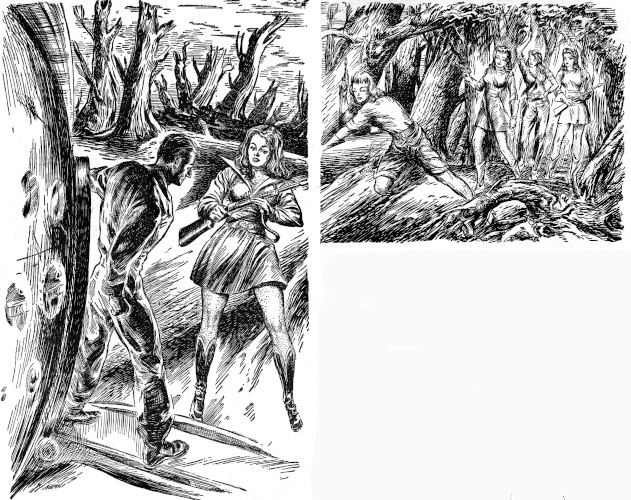
"Leave your guns before you come aboard."
Again there was a slight hesitation on Margot Drake's part. Then she leaned her gun against a tree and bade her girls to do likewise. Matt lowered the ladder.
As they swarmed up one at a time, Lynn, who was standing just behind him, ran her hands swiftly over them from neck to toes. They were carrying no concealed weapons.
"You're invited to lunch before we show you about." He glanced at his watch as a gong sounded from down the passage. "It's served now. If you'll just step this way...."
"No tricks," admonished Margot in a suspicious voice. "The rocket gun is still trained on the ship."
"No tricks." He grinned amiably. When they came to the messroom door, he stood aside for them to enter. Cloths had been laid, tables set. Food steamed on the side-board.
They trooped inside, giggling and chattering. No sooner had the last girl passed across the threshold than Matt slammed the heavy door and barred it.
A glance down the passage assured him that Lynn had the ladder up and the airlock sealed.
Dimly, he was aware of angry yells from the messroom, the thud of boots against the bulkhead. He grinned. Door and bulkheads were of heavy steel.
He stepped to the ladder well and blew shrilly on a whistle.
The deep rumble of the jets answered at once as Captain Bascom threw in the controls. Sheets of roaring flame bounced from the ground up past the ports.
From the outside, Matt realized, the Argus must present an awe inspiring sight cloaked in fire. He felt the deck shudder, then press strongly against the soles of his feet.
They were off.
He grabbed Lynn in a bear hug and whirled her precariously around the shimmying deck.
"We got 'em!" he shouted above the sullen thunder of the tubes. "We've trapped 'em! Nineteen!"
Lynn gasped, "Put me down!" and struck him a hard blow in the solar plexus.
Matt grunted, dropping her with a thump.
"I don't see why you're so elated," she said grimly.
A twinkle began to gleam in Matt's blue eyes.
Lynn saw the twinkle and said, "If you don't keep your hands off those hussies, I'm going straight to your cabin and move all my things out!"
"What?" Matt was jarred out of his complacency.
"I said," she repeated with emphasis, "that if you even look cross eyed at any of those trollops, I'm leaving you flat! I move out! Is that clear?"
"But, good Lord!" Matt burst out, "I didn't even know you'd moved in. Why ... I mean—what...."
Lynn had the grace to look confused. She said indignantly, "You know what Isaac said yesterday as well as I do."
"What Isaac said?" He stared at her blankly. Then a light broke. "Oh, you mean about childr...."
"Yes," she interrupted. "There are so few women. Not enough to go around, I mean. Obviously, we had to choose." She watched him defiantly, but not without anxiety. "Well, I've chosen. Of course, if you don't want me ... you do, don't you?"
For answer Matt swept her into his arms. This time she came without resistance. "Oh, Matt," she said, "I was so scared that maybe you wouldn't want me. I—I...." She pushed back a little so that she could look into his eyes. "But, if you make any passes at those...."
With a chuckle, Matt put his hand over her mouth. "You malign me, Lynn. I hadn't thought of such a thing. I was only thinking about the future of the colony. That was all."
"I doubt it!" she said and kissed him hard on the mouth.
The trip to Fort Knox, only twenty miles off, was a prolonged crisis. Captain Bascom had been forced to angle the ship up at a slant, until they were miles high above the fort, and then descend perpendicularly. Every moment Matt thought the Argus was going to lose momentum and plunge back to the ground.
When the jets at length fell silent, he wiped the sweat off his face with his sleeve and looked at the bloodless features of Lynn.
"Never again!" said the girl. "The next time we have to move, I walk!"
They had waited in the passage to the air lock. Now Matt pulled himself together, ran to the port and threw it open.
Fort Knox had been moved since World War II. The atom bomb had made a large army, navy or air force obsolete. The barracks of the old fort had been enlarged and modernized and, at the time of the plague, housed workers who commuted back and forth to Louisville. The gold vault had been turned into a museum and library, the parade ground into a park.
New Fort Knox was a single massive building of gray monolithic concrete. Large as a city block and thirty stories high, the frowning structure was located on a promontory overlooking the Ohio and Salt rivers. It had housed a detachment of the world police, and the laboratories and living quarters of the technicians who had come to replace the standing army in the new era of push-button warfare.
Matt, staring at the cubical gray fort, realized that it had been built to protect the lethal experiments that had been carried out in its labs. There were no windows on the first or second floors. Nothing less than an atom bomb could destroy it.
He cast a cautious glance at the silent deserted town of West Point beyond the highway and the brown slack waters of Salt River, muddied by spring rains. The Argus had landed directly behind the fort and the Ohio was at their backs.
Isaac Trigg came into the passage with Captain Bascom. Rapidly the others began to assemble.
"Well?" asked Isaac.
"Look for yourself. We could have scoured the world and not found a better place."
They crowded to the port, staring out at the silent pile of concrete.
"Splendid! Splendid!" Isaac rubbed his dry hands together. Broad grins, laughter and exultant comments broke out among the others.
Isaac gazed fondly at Matt. "You're the boss, Matt. What's to be done?"
"Strip the Argus of everything that can be moved and carry it into the fort. There should be guns in there and ammunition. It housed a detachment of the world police force, you remember. They used the obsolete weapons—never resorted to A-bombs unless necessary.
"We've crossed Salt River, but not the Ohio. That means we'd better destroy the monorail and the tube crossing and the railway bridge. We can leave the highway bridge up, but we'll have to fortify it temporarily."
"Then," broke in Captain Bascom, "you think the Amazons will follow?"
Matt nodded. "They could see us come down not too far off." He paused, pushing his hand through his short black hair. "But we were north of Salt River. Now we're south of it. They can't know that. Neither can they know whether we've crossed the Ohio or not. I imagine they'll send scout cars."
"That bridge"—he pointed to the arches spanning the Salt river—"is the only one this side of Shepherdsville.
"It should take a couple of hours for their scout cars to reach us. If we fortify the bridge so that they have to cross at Shepherdsville, their main body'll have to go over a hundred miles out of their way. We can count on from eight to ten hours."
"Not too much time!" Isaac muttered.
"No," Matt agreed, "it isn't." He turned to the palaeontologist. "Fetch the walkie-talkie and the rifles, Nesbit. You and I and Isaac had better look over the fort.
"Captain Bascom, will you see that everyone starts at once to packing? I'll leave this end of the moving up to you."
He touched the button beside the port The ladder slowly descended.
VI
There was a vivid spring greenness about the grass and foliage that Matt couldn't recall having seen outside of England. To their left, the muddy Salt emptied into the muddy Ohio behind them. The turf underfoot was soft and springy.
Flanked by Nesbit and Isaac Trigg, Matt crossed to the disused drive. Dead leaves and twigs littered it all the way to the gate, where it disappeared through heavy steel doors into the fort. The doors themselves, large enough to admit a freight car, stood open, a drift of dead leaves piled against one massive panel.
"It's bristling with guns!" Isaac Trigg pointed at a row of slots that ran across the second story. The grim snouts of fifty-calibre machine guns poked wickedly through the embrasures.
Matt shifted his rifle into a handier position. He had seen the canvas covered barrel of a 5.35 dual-purpose anti-aircraft gun on the roof.
Above the third floor, rows of windows began, narrow slits closed with heavy bulletproof glass. Higher up, he made out banks of rocket guns.
"Seven months," he said half to himself.
"Eh?"
"I was thinking that only seven months have elapsed since these guns were serviced. We should have no trouble getting them into operation."
He paused before the gaping entrance, peering into the dark cavern ahead of them. "Get out your light," he told Nesbit.
The younger man snapped on his flash, the blade of light piercing the gloom. The drive, Matt saw, led into a vaulted hall. Along one side ran freight elevators. A loading platform lined the opposite wall. At the rear, a spiral ramp led up from the basement to the floors above. An abandoned truck was still in one of the elevators.
"If we can get the truck running," suggested Nesbit, "we can move the equipment faster."
Matt nodded. "Do you smell anything?"
"Yes," agreed Isaac.
"It's not bad here, though," said Nesbit. He was still stiff with Matt and addressed his comments pointedly to the director.
Matt said, "No. I imagine the living quarters are on the top floors. Some of the men in space suits will have to clear out the rooms. But that can wait. I'm curious about the source of power for the elevators and lights. Let's try the basement."
They advanced cautiously into the hall, disturbing a bat which circled eerily around and around the light. Nesbit flinched each time it swooped close.
"Nasty beast!"
Matt didn't reply, his eyes searching out the dusty walls for a stairway. "There." He pointed with his rifle.
The door stood open. Stairs descended into blackness.
The fort proved to have not one basement, but three. The first level held trucks, tanks, half-tracks, and cars in solid ranks. The second basement was stored with ammunition, the third held furnaces, a pumping system and a power plant, the generating force being a massive atomic boiler.
Matt whistled softly. "We'll have to get the engineers down here right away."
Isaac said, "Three basements, thirty floors. It'll take us a month to explore the building."
Matt turned to Nesbit. "Go back to the ship, Hi. Tell Captain Bascom to send the chief engineer and the first assistant to put these atomic engines back in operation. The second assistant engineer is to start one of the trucks, load it with explosives and blow up all the bridges across Salt River except the highway bridge.
"Tell Sawyer to take two more men and another truck and fortify the highway bridge. Dismount some of these machine guns if necessary, and set up a pill box at this end. String barbed wire across the bridge. Got it?"
"Yes," said Nesbit. He turned to leave. "What should I do then?"
"Get another truck and start hauling our equipment into the fort. Isaac and I are going to look over the upper floors."
Nesbit nodded and strode toward the stairs. "Come along, Isaac," said Matt. "We've seen enough here."
During the next hour, Matt got a fair idea of the plan of the lower floors of the fort.
They had entered through the freight entrance in the rear, the main doors fronting the highway, on the other side of which lay the small town of West Point.
The lower levels were largely devoted to storage and offices. The fort, he realized, had been equipped to withstand a siege. There were tons of food and equipment. Above, they found forges, foundries, machine shops, laboratories and even hydroponic gardens.
It was a world to itself; a world without any inhabitants.
They were on the seventeenth floor, examining the modern, well-equipped guardhouse, when lights began to blink on.
Matt said, "That was quick work." He found an inter communication televisor, hunted for the engine-room number and buzzed it experimentally.
After a moment, the screen glowed and the square rough features of the chief engineer flashed in its depths.
"Any trouble?" Matt asked.
"Nary a bit. The engine had been shut down. That was all."
"What about the elevators?"
"Power's been cut in on all lines."
"Good," said Matt. He snapped the televisor off, just as a dull boom sounded in the distance.
"There goes one of the bridges," Isaac said nervously.
Matt cut in the walkie-talkie strapped to his back. "Captain Bascom. Captain Bascom."
"Check," came Bascom's voice through earphones.
"How is the moving coming along?"
"Fine. We have three trucks shuttling between the ship and the freight hall. Everyone's turned to." Matt glanced at his watch; they'd been at the fort two hours.
"Arm the women with rifles," he told the captain. "Put Lynn in charge. Have them bring our captives to the seventeenth floor. There's a brig here where we can lock them in. Is Lynn handy?"
"She's right here."
"Let me speak to her."
"Right."
There was a silence; then Lynn's voice came clear and small. "That you, Matt?"
"Yes," he said. "Now listen carefully. I'm putting you in charge of the women. You're to bring those Amazons we captured to the seventeenth floor of the fort. If any of them show fight, shoot them!"
He heard her gasp. "But, Matt...."
"Shoot them!" he interrupted fiercely. "We can't afford to take chances—and there's plenty more where they came from!"
There was a pause, then Lynn said, "Yes," in a strained voice.
Matt clicked off the walkie-talkie. He realized Isaac was regarding him with a queer expression.
Matt said, "Damn it, Isaac, we can't afford to take chances. There are nineteen of those Amazons locked in the messroom. They'd like nothing better than to get the upper hand. They're mean, Isaac. Mean as cats that have run wild!"
"You're right, of course," Isaac agreed. "But to order them shot down if they...."
A second dull boom interrupted him as another bridge across Salt River was blown by Barren, the third assistant engineer.
A buzzer on Matt's walkie-talkie began to whir softly. He clicked it on. The voice of Sawyer, the fat biologist whom he had sent to fortify the highway bridge, sounded in his ear.
"Sawyer reporting. Two cars coming from the direction of Louisville."
"Scouts?" Matt asked.
"I think so."
"Are you dug in yet?"
"We have one machine gun set up and barbed wire strung across the bridge. We can hold them."
"Let them get on the bridge," said Matt. "Then shoot up the cars. See if you can't put them out of commission."
"Very well. They're coming onto the bridge now—slow." There was a silence. Then Matt heard Sawyer say, "Hold your fire." Again there was a silence that stretched on and on. Matt could feel his nerves tighten like violin strings. After an interminable period, Sawyer said, "Now!" Obviously, he was turned away from the mouthpiece because his voice was faint.
Matt's fists clenched as the distant rattle of a machine gun reached his ears. There was a second burst, and a third.
"We knocked out one car," Sawyer's voice sounded suddenly in Matt's ear. "The other got away."
"Too bad," said Matt. "But that still gives us about six hours before they can bring up the main body."
There was a loud boom from the direction of the river. "What was that?" Matt snapped.
"Barren. He just blew the railroad bridge. That's the last one except the one we're guarding."
"O.K.," said Matt. "Hang on."
"Don't leave me stuck out here in case they cross at Shepherdsville and come up behind us. I don't want to be cut off."
"Don't worry," said Matt. "I'm sending a scout car up the highway toward Elizabethtown. They'll warn us in plenty of time if they come that way."
He snapped the radio off and turned to Isaac. "Well, we may as well wait here until Lynn fetches our captives," and lit a cigarette.
By dark they had all the vital stores and their personal goods transferred from the Argus to the fort. The nineteen women from Margot Drake's band were locked in the jail. The second assistant engineer had dismantled key parts of the rocket ship so that it couldn't be moved. And what was left of the bodies of the former personnel of the fort were being removed from the top floors by a special detail of space-suited men and dumped into the river.
Matt himself had seen to it that their defenses were in order. Floodlights illuminated the grounds. The machine guns were oiled and ammunition belts stacked handily.
At seven o'clock, he called in Jesse Sawyer. "Take up the machine gun," he ordered, "and let the bridge go. It isn't practical to hold it any longer. I'm calling in the scout car from Elizabethtown."
"Good," came Sawyer's relieved voice. Matt detected a note of excitement in it. "Good. I've something important that I want you to see, Matt. Is the microscope set up?"
"Not ours," said Matt, "but the fort has some of the finest-equipped laboratories I've ever seen. You can use the one here. What have you found?"
"I'll be there in a jiffy. Show you then. But it's big, Matt. It's big. I'll want you and Isaac in the laboratory. Yes, and Frazer, too." The radio clicked off.
A frown furrowed Matt's brow. What the hell had Sawyer stumbled across? He had never heard the biologist so urgent before. And Sawyer wasn't an excitable person.
He wondered why he wanted Frazer, Isaac and himself all in the laboratory?
Suddenly it struck him. Frazer was the biochemist. Isaac, besides being the director, was the expedition's zoologist, and he himself was the botanist!
It was not long before the three men were in the organic laboratory. Jesse Sawyer entered, wheezing and dabbing at his moon face with a handkerchief. Matt noticed that he was carrying a specimen jar in his other hand.
"What have you found, Jesse?" Matt began, but the fat man waved him to silence.
"Not so fast. I want a look at this under the microscope first. Then I want all of you to see it, before I say anything. Where is the microscope? Oh, here."
With trembling hands he began to prepare a slide. Matt watched him fascinated, noting the deftness of the biologist's pudgy fingers. At length, perspiring freely, Sawyer put his eye to the microscope, making several adjustments. He drew in his breath sharply.
The jar that he had been carrying, Matt saw, was filled with some liquid that radiated a pale yellow light. Was it phosphorescing? He ran his hand through his coal black hair, his blue eyes narrowed.
"I thought so!" Sawyer muttered. "I thought so. Come here, Frazer. Take a look."
The biochemist rose, looked through the microscope. "Well, I'll be damned!" he ejaculated. "Where did you get that specimen?"
"Never mind. Isaac, you and Matt come see what you think."
When it came Matt's turn to put his eye to the aperture, he could distinguish nothing at first. Then he made out dozens of minute amoeba-like organisms squirming in the specimen on the slide.
Their resemblance to amoebae, he saw, was only superficial. Each one of the minute organisms was glowing like a very small incandescent light. He glanced up in bewilderment.
"Well," said Sawyer, "What do you make of them? Are they plant or animal?"
"Where did they come from?" Matt asked.
"The river. That's a specimen of river water." The fat man pointed at the bottle. "I tell you, Salt River and the Ohio are alive with these organisms. Have you ever seen anything like them before?"
The three men shook their heads.
"What do you think, Jesse?" Matt asked the biologist.
"What do I think? I think they're the first evolutionary step of the life spores that invaded Earth!"
"The life spores?"
The fat man nodded emphatically, crinkling an extra chin. "An alien life form starting up the evolutionary ladder. I'm positive that they're neither plant nor animal...."
"Then what are they?" Matt interrupted.
Jesse Sawyer shrugged fat shoulders. "I don't know. I want Frazer to analyze them if he can."
"An alien life form!" said Matt speculatively. "Two dominant life forms on the same planet...." He broke off as the eerie wail of sirens rent the building.
"The Amazons! They're here!" he cried.
From the northeast corner of the building there came the staccato roar of a machine gun.
"The roof!" Matt cried and dashed for the elevator.
The four men ran out on the landscaped roof. They made hurriedly for a tight knot of men and women at the opposite rail.
Megaphones roared suddenly as Captain Bascom called through them: "Don't approach any closer! We've machine guns trained over the grounds!"
His voice was the voice of a giant through the electric megaphones.
Matt reached the rail and peered down. "Where are they?" he asked.
"There!" Lynn cried, pointing. Thirty stories below, Matt could see the grounds lit by the flood lights as bright as day. At the edge of illumination, he could make out tiny shadowy figures.
Suddenly, someone grasped his shoulder.
"Never mind the women," he heard Sawyer's voice grate in his ear. "Look at the river!"
Matt raised his eyes. Salt River and the mile-wide Ohio were broad glowing ribbons of light.
"The alien amoebas!" he gasped.
VII
For moments, Matt Magoffin stared silently at the luminous rivers. Then he turned to Lynn.
"Where's Captain Bascom?"
"On the second floor—in charge of the machine guns."
"Is there a telecaster up here?"
"Yes. Over there. Here, I'll show you." She led him back to the elevator house to a telecaster set just inside the door.
Matt buzzed the second floor headquarters and told Captain Bascom to fire a second burst over the women's heads.
The rattling burst of the machine guns answered. A hail of lead tore through the branches in the distance, thudding against walls in the town of West Point across the highway.
"They're sending us an emissary under a white flag," came Captain Bascom's voice.
"We won't parley!" said Matt flatly. "Not tonight. Tell them to stay clear and we'll talk to them in the morning."
In a moment, Captain Bascom's voice was relaying Matt's decision through the electronic megaphones. Matt got back to the rail in time to see the figures disappearing beyond the circle of light.
He turned away, getting a chance to survey the roof for the first time. It was not flat, but in the shape of a vast amphitheatre. Apartments were built like penthouses all around the outer edge, ringing a park-like area in the center, where a grove of trees were growing on the edge of a dry-leaf-cluttered swimming pool. There were walks, now leaf-strewn, and the ivory gleam of statuary amid the shrubbery. Broad marble stairways led up to the roofs of the penthouse where he stood.
These, too, were landscaped, except for the four corners where the anti-aircraft guns pointed their snouts skyward like sentinels. A helicopter, like a monstrous deformed gadfly, was squatting on the sward atop the opposite penthouse.
Matt stepped back into the elevator house and called Captain Bascom.
"Post sentinels," he ordered. "Four. One at each corner. And relieve them every two hours."
"Right," said Captain Bascom. "Anything else?"
"No. That's all, except that you'd better get some rest."
"The same goes for you," the captain suggested. "You look fagged out."
Matt nodded and turned away, conscious suddenly of fatigue dragging at his limbs. Hunger gnawed at his belly. He remembered that he hadn't eaten since breakfast.
He felt someone tug at his sleeve. It was Lynn beside him in the moonlight.
"Come along, Iron Man," she said. "You may not know it, but you've been going on nervous energy."
But Matt did know it. He allowed her to lead him down one of the stairs descending to the park.
"What about the bodies?" he asked.
The girl shivered. "They've been moved out of all the penthouses, and some of the apartments put in shape. I've picked us out one."
"Us?" said Matt and grinned wearily. "Oh. What about the floor below?"
"They haven't got to those yet, nor the other two floors."
They reached the park. The grass was shaggy, the shrubs beginning to send out untrimmed shoots. Dead leaves cluttered everything.
"We'll have to groom these grounds," he said. "Can't live like savages."
"Relax!" she said, urging him into one of the lavish apartments. "This is home. How do you like it?"
Matt's tired eyes took in the sea green carpet, the glowing walls, the inviting chairs and sofas—especially the sofas. With a sigh, he stretched himself full length on a rose brocaded lounge and closed his eyes.
Lynn regarded him fondly and leaned over to kiss his eyelids. "Now wait just a minute," she said. "I've made coffee and sandwiches. I'll be right back."
It was fifteen minutes before she reappeared. She was carrying a tray on which a silver coffee pot steamed, flanked by a plate of sandwiches. She had combed out her yellow hair and slipped into a wicked black negligee that did things to the slender almost girlish figure beneath it.
A gentle snore greeted her at the threshold.
Lynn stopped, regarding the sleeping Matt with a grim expression. Then very deliberately she set the tray down, seized his heels and dragged him off the couch. He hit the floor with a thump and struggled, still half-asleep, to his feet.
"If you're going to sleep, Romeo, you might as well use the bed."
"Bed?" said Matt groggily. "Where?"
"In there." She pointed toward a low doorway at the left.
And Matt went.
Matt awoke the next morning alone, but a vague smell of perfume lingered, and the pillow next his was crushed. The sound of whistling came through the doorway.
He sprang out of bed, to discover that he was clad in a pair of his pajamas, of a pale robin's-egg blue—and raised his eyebrows.
He lit a cigarette and prowled about the luxurious chamber, opening doors and drawers. His clothes were hanging in one closet, but the other was full of fluffy feminine apparel. The same condition prevailed in the chests; one holding his own shirts, ties, socks; the other crammed with lacy underthings.
He ran his hands through his rumpled hair, blue eyes gleaming with interest. At length he went into the bath and showered and shaved. There was only one thing that troubled him.
The water that poured from the shower glowed like a spray of light with the minute phosphorescent organisms!
The alien amoebas had even invaded the subterranean pools.
"My sleeping beauty!" Lynn greeted him when he entered the breakfast room.
Matt eyed her appreciatively. Her cheeks were flushed, and she was wearing a crisp blue smock. The mouth-watering smell of frying ham and eggs invaded his nostrils.
"Breakfast ready?"
"Yes, my somnolent lord. There also have been six calls for you." She ticked them off on her fingers. "Isaac Trigg; then Captain Bascom. Then Isaac Trigg again. After that Sawyer called; then Isaac Trigg. Finally, Isaac Trigg called to say he was on the way up."
He said, "Let's eat."
"Aren't you curious?"
"Yes. But I'm also hungry. Can't you tell me while we eat?"
She sat down. "Sawyer called to let you know that Frazer has analyzed the amoebas."
Matt looked at her sharply. "Well, what did he find?"
"They aren't carbon life at all. They're silicon life!"
Matt stared at her in disbelief. Theoretically, of course, it was quite possible. Silicon had the ability to form complex molecules very closely akin to carbon compounds. Somehow, though, he had never seriously considered life manifesting itself in anything but carbon-based protoplasm.
The girl went on before he could ask any questions. "Sawyer also said that although they had examined sample after sample of the water, they were unable to find a trace of the normal microscopic organisms usually present.
"Apparently the silicon life has completely destroyed all the carbon base forms!"
Matt put down his fork with a clatter. "That sounds serious!"
The girl frowned. "It struck me as ominous, but I couldn't see exactly how."
Matt said, "Minute aquatic life feeds on the microscopic forms. Small fish, minnows, and other fry, feed on the smaller aquatic creatures. The minnows in turn supply food for larger species. It's a chain. Destroy the first link and you destroy the whole chain. In weeks our waters will be devoid of carbon-based life in any form!"
Lynn said, "Oh!" in a frightened voice.
A buzzer interrupted them.
"That must be Isaac," said the girl and pressed a button releasing the front door.
Isaac Trigg, the director, came in, looking haggard and unshaven. Matt thought Isaac was beginning to appear perpetually haggard.
The director took a seat and combed his beard nervously with his fingers.
"What's on your mind, Isaac?" Matt asked.
"Those women!"
Matt frowned. "How so?"
"Frankly, Matt, they're raising hell. They demand that they be released."
"Let them demand."
"Well, what are you going to do with them?"
Matt said, "That must be decided later." He cast a sidelong glance at Lynn. "At the moment, it's more important that we get organized."
"Yes," agreed the director, "but some of the men are—er—anxious that the prisoners' fate be settled. In fact one or two were inclined to take it into their own hands. Nesbit's in back of it."
Matt's jaw set. He smashed his fist on the table so that the cups danced. "Oh, no! We're not going to have those women running loose inside the fort. They'd be worse than a Trojan horse any day.
"We've got work to do. And until we get settled, those women stay behind bars."
Isaac swallowed. "I'm in complete accord. After all, I'm beyond the age when women mean anything to me, but Nesbit—"
"Then that's settled!" said Matt emphatically and went on with his breakfast.
All at once a low buzzing began to sound. "Door?" Matt asked.
Lynn shook her head. "Televisor." She threw a switch in the wall behind her and a small inset screen glowed into life. Captain Bascom's square visage filled the screen.
"So you're finally up," he began without preamble. "You're none too soon. The delegates from the women's camp are on their way with a white flag."
"How many?" Matt asked.
"Four."
"O.K.," said Matt. "Let them in and lock them in the brig. I'll talk to them later."
Captain Bascom looked shocked. "But they're coming with a white flag to parley...."
"I don't care if they're coming with angels. The more we capture, the less are still outside opposing us. Throw them in the jail with the others."
VIII
It took the small group of survivors a week to adjust to their new surroundings. During that time they explored the fort and began taking an inventory. The laboratories were the first to be put back into use. The greatest activity centered around the organic lab where the biochemist, the biologist, and Isaac Trigg were immersed in the study of the alien amoebas.
Matt Magoffin had converted the large front room of his and Lynn's apartment into an office. He had been confronted with a thousand problems clamoring all at once to be solved. He had ended by obstinately refusing to tackle more than one at a time.
At the moment he was regarding Lynn rather balefully over his desk. "It's intolerable!" she was saying. "This being under siege by a couple of hundred women. We can't send an expedition out of the fort. We can't leave the place...."
"And they can't batter their way in," he interrupted. "It's stalemate."
"But...."
"Never mind the buts! There are other things more important to consider."
"What?" Lynn's expression was set in indignant lines. "All the specialists have made lists of the things they consider vital—books, instruments and raw materials. There's a good photographic lab here, but no means of manufacturing film, lenses or cameras. I want the material to make our own equipment. Everyone else is in the same boat. And what happens? We're under siege by a lot of paranoic women, and we can't stir a foot beyond the gates. Maybe you think other things are more important. But I'd like to know what?"
"Look out the window," he said dryly.
A puzzled expression crept across Lynn's features. She twisted in her chair and gazed out on the park-like roof garden.
The grass had been cut, shrubs trimmed, leaves and debris raked. Water sparkled in the swimming pool. A fountain gurgled.
"But what...." She paused, wrinkled her nose. "It doesn't look so green as when we first came! It's beginning to turn brown!"
"And this is May," he informed her. "It should be the greenest month."
"But I don't see...."
"I sent down a specimen of the soil to be analyzed yesterday. Sawyer said the alien infestation has spread to the earth. Not the exact same species as the organism in the water—a variation—an adaptation!"
"But I still don't see...."
He said grimly. "Do you remember how the amoebas killed all other microscopic life forms in the water? The same thing is happening in the soil.
"Plants depend to a large extent on the work of microbe like organisms that convert minerals into a form that they can assimilate. With those organisms dead, the vegetation is starving to death!"
The girl's eyes widened in horror. "But, Matt, every form of life depends directly or indirectly on vegetation—even us!"
"Even us," he echoed in a grim voice. "But maybe we can make an island out of this fort. Willie Shaw is experimenting with an aluminum oxide glass to seal us in. Silicon wouldn't do. The engineers are drawing plans for an air-conditioning unit that will destroy the alien amoebas. We are going to enclose the roof in a glass dome.
"We can't destroy the alien protozoa all over the world. But we can destroy them inside the fort."
"A hot-house culture!" The girl's shoulders slumped. "So that's to be the future of the human race. If we survive at all!"
"That's about it," he said.
Through the windows, he saw four men bearing down on his office. Hi Nesbit, the young palaeontologist, was in the lead.
"Here comes trouble," said Matt. He pushed back from his desk and stood up just as the four men entered.
Nesbit's lean jaw was thrust out; he planted himself squarely in front of Matt. Matt found himself aching to take a sock at that inviting jaw but he restrained himself.
"Well," he said, "why aren't you at work?"
Nesbit looked slightly taken aback; then he recovered himself. "Look here, Matt, we've had enough of this shilly-shallying about the women. You don't care, we know; you've got Lynn. But some of us aren't so fortunate...."