Front matter
Reading edition
She was well-named—Sin, foul witch and raving beauty, Beloved of Sasso, the Dark Power striving to capture, with her help, a lovely little world. Their only fear was a whispered legend—Elvedon, the Savior.... But this crippled idiot blundering through a shower of sparks into their time and space—he could not be Elvedon!
[Transcriber's Note: This etext was produced from Planet Stories Winter 1947. Extensive research did not uncover any evidence that the U.S. copyright on this publication was renewed.]
The pen moved clumsily in Eldon Carmichael's right hand. He had been left-handed, and the note itself was not easy to write.
Dear Margaret, he scratched. I understand ...
When after a while the proper words still would not come he crossed the shadowed laboratory and took another long swig from the flat bottle in his topcoat pocket. He understood—he remembered his first one-eyed look in a mirror after the bandages were removed—but still he felt resentful and deeply sorry for himself.
He went back and tried to continue the letter but his thoughts veered erratically. The injury had been psychological as well as physical, involving loss of ability to face up to unpleasant facts, but still he could not force aside those memories.
There had been only a glimpse as the wrench slipped from Victor Schenley's hand and fell between the sprocket and drive chain of the big new compressor in the Institute's basement. He wondered. That look on Schenley's darkly saturnine face could have been merely imagination. Or horror. But there was something about the man.... Still Eldon discounted his suspicions as the unworthy inventions of a disturbed mind.
Only the quick reflexes that had once made him a better than average halfback had saved him from instant death as the jagged end of the heavy sprocket chain lashed out with the speed of an enraged cobra. And often during the pain-wracked weeks that followed he had almost wished he had been a little slower.
The ring sparkled tauntingly under his desk lamp. Margaret had returned it by mail, and though the wording of her note had been restrained its tone had been final.
He picked up the pen again and moved the stub of his left arm, amputated just above the elbow, to hold the paper in place. But he had forgotten again how light and unmanageable the stump was. The paper skidded and the pen left a long black streak and a blot.
Eldon made a choked sound that was partly a shout of anger and partly a whimper of frustration. He crumpled the note, hurled the pen clumsily toward the far wall, and buried his disfigured face in the curve of his single arm. His body shook with sobs of self-pity.
There was only an inch or so left in the bottle. He finished it in a single gulp and for a moment stood hesitantly. Then he switched on the brilliant overhead lights. Liquor could not banish his tormenting thoughts, but perhaps work might. His letter to Margaret would have to wait.
His equipment was just as he had left it that night so many months ago when Victor Schenley had called him to see the new compressor. The setup was almost complete for another experiment with the resonance of bound charges. Bound charges were queer things, he reflected, a neglected field of investigation. They were classed as electrical phenomena more for convenience than accuracy. Eldon's completed experiments indicated they might be—something else. They disobeyed too many of the generally accepted electrical and physical laws. Occasionally individual charges behaved as though they were actually alive and responding to external stimuli, but the stimuli were non-existent or at least undetectable. And two or more bound charges placed in even imperfect resonance produced strange and inexplicable effects.
Working clumsily, he made the few remaining connections and set the special charge concentrators whining. The vacuum pumps clucked. A strain developed in the space around which the triplet charges were forming, something he could sense without seeing or hearing it. Now if only he could match the three charges for perfect resonance....
The lacquer on Margaret Mason's fingernails was finally dry. She slipped out of her robe and, without disturbing her carefully arranged pale gold hair, dropped the white evening gown over her shoulders and gently tugged it into place around slender hips. This should be the evening when Victor stopped his sly suggestions and made an outright proposal of marriage. Mrs. Victor Schenley. Margaret savored the name. She knew what she wanted.
Eldon had seemed a good idea at the time, the best she could do. Despite his youth he was already Associate Director of the Institute, seemed headed for bigger things, and a couple of patents brought him modest but steady royalties. And, best of all, his ridiculously straightforward mind made him easy to handle.
It had seemed a good idea until the afternoon Victor Schenley had sauntered into her office in the administrative wing of the Institute and she had seen that look come into his eyes. She had recognized him instantly from the pictures the newspapers had carried when he inherited the great Schenley fortune, and had handled that first meeting with subtle care.
After that he had begun to come around more and more frequently, sitting on her desk and talking, turning on his charm. She had soon seen where his questions about the Institute's affairs were leading. He was determined to recover several million dollars which the elder Schenley had intended for the research organization he had founded and endowed, the Institute of which Victor had inherited titular leadership. Victor did not need the money. He just could not bear to see it escape his direct control. He still did not suspect how much Margaret had guessed of his plans—she knew when to hide her financial acumen behind her beauty—and she was holding that information in reserve.
He had begun to take her out, at first only on the evenings Eldon was busy, but then growing steadily bolder and more insistent. She had been deliberately provocative and yet aloof, rejecting his repeated propositions. She was playing for bigger stakes, the Schenley fortune itself. But she had remained engaged to Eldon. She disliked burning bridges behind herself unless absolutely necessary and Eldon was still a sure thing.
Then one day had come Eldon's casual remark that as Associate Director he was considering calling in the auditors for a routine check of the books. That had started everything. Victor had appeared startled, just as she expected, when she repeated Eldon's statement, and the very next night Eldon had met with his disfiguring "accident."
Victor parked his sleekly expensive car in front of the Institute's main building. "You wait here, dearest," he said. "I'll only be a few minutes."
He kissed her, but seemed preoccupied. She watched him, slender and nattily dressed, as he crossed the empty lobby and pressed the button for the automatic elevator. The cage came down, he closed the door behind himself, and then Margaret was out of the car and hurrying up the walk. It was the intelligent thing to know as much as possible about Victor's movements.
The indicator stopped at three. Margaret lifted her evening gown above her knees and took the stairway at a run.
From Eldon's laboratory, the only room on the floor to show a light, she could hear voices.
"I don't like leaving loose ends, Carmichael. And it's your own gun."
"So it was deliberate. But why?" Eldon sounded incredulous.
Victor spoke again, his words indistinguishable but his tone assured and boastful.
There was a muffled splatting sound, a grunt of pain.
"Why, damn your soul!" Victor's voice again, raised in angry surprise. But no pistol shot.
Margaret peered around the door. Victor held the pistol, but Eldon had his wrist in a firm grasp and was twisting. Victor's nose was bleeding copiously and, although his free hand clawed at Eldon's one good eye, the physicist was forcing him back. Margaret felt a stab of fear. If anything happened to Victor it would cost her—millions.
She paused only to snatch up a heavy, foot-long bar of copper alloy as she crossed the room. She raised it and crashed it against the side of Eldon's skull. Sheer tenacity of purpose maintained his hold on Victor's gun hand as he staggered back, dazed, and Margaret could not step aside in time. The edge of an equipment-laden table bit into her spine as Eldon's body collided with hers, and the bar was knocked from her hand.
Eldon got one sidelong glimpse of the girl and felt a sudden thrill that she had come to help him. He did not see what she had done.
And then hell broke loose. Leaping flames in his body. The unmistakable spitting crackle of bound charges breaking loose. The sensation of hurtling immeasurable distances through alternate layers of darkness and blinding light. Grey cotton wool filling his nose and mouth and ears. Blackness.
II
A shriveled blood-red moon cast slanting beams through gigantic, weirdly distorted trees. The air was dead still where he lay, but overhead a howling wind tossed the top branches into eerie life. He was lying on moss. Moss that writhed resentfully under his weight. His stomach was heaving queasily and his head was one throbbing ache. His right leg refused to move. It seemed to be stuck in something.
He was not alone. Something was prowling nearby among the unbelievably tall trees. He sat up weakly, automatically, but somehow he did not care very deeply what happened to him. Not at first.
The prowling creature circled, trying to outline him against the slanting shafts of crimson moonlight. He heard it move, then saw its eyes blue-green and luminous in the shadows, only a foot or two from the ground.
Then his scalp gave a sudden tingle, for the eyes rose upward. Abruptly they were five feet above ground level. He held his breath, but still more wondering than afraid. A vagrant gust brought a spicy odor to his nostrils, something strongly reminiscent of sandalwood. Not an animal smell.
He moved slightly. The moss beneath him squeaked a protest and writhed unpleasantly.
The thing with the glowing eyes moved closer. Squeak-squeak, squeak-squeak, the strange moss complained. And then a human figure appeared momentarily in a slender shaft of red light.
Margaret! But even as it vanished again in the shadows he knew it wasn't. A woman, yes, but not Margaret. Too short. Too fully curved for Margaret's graceful slenderness. And the hair had glinted darkly under the crimson moon while Margaret's was pale and golden. He wanted to call out, but a sense of lurking danger restrained him.
Suddenly the stranger was at his side.
"Lackt," she whispered.
The palms of her hands glowed suddenly with a cold white fire as she cupped them together to form a reflector. She bent over, leaving herself in darkness and directing the light upon Eldon as he sat in amazed disbelief.
Although the light from her hands dazzled his single eye he caught an impression of youth, of well-tanned skin glittering with an oily lotion that smelled of sandalwood, of scanty clothing—the night was stiflingly hot—and of hair the same color as the unnatural moonlight, clinging in ringlets around a piquant but troubled face.
"El-ve-don?" she asked softly. Her throaty voice betrayed passionate excitement.
He wet his dry lips.
"Eldon," he said hoarsely, wondering how she knew his name and why she had mispronounced it by inserting an extra syllable. "Eldon Carmichael."
His answer seemed to puzzle her. Her strange eyes gleamed more brightly.
"Who are you? And how in the name of sin do you do that trick with your hands?" It was the first question to enter his confused mind.
"Sin?" She repeated the one word and drew back with a suddenly hostile air. For a moment she seemed about to turn and run. But then she looked once more at his mangled, disfigured face and gave a soft exclamation of disappointment and pity.
Eldon became irrationally furious and reached his single arm to grab her. She eluded him with a startled yet gracefully fluid motion and spat some unintelligible words that were obviously heartfelt curses. Her hand moved ominously to a pocket in her wide belt.
Then all at once she crouched again, moving her head from side to side. He opened his mouth, but she clamped one glowing hand over it while the other went up in a gesture commanding silence. Her hand was soft and cool despite its glow.
For a full minute she listened, hearing something Eldon could not. Then she placed her lips close to his ear and whispered. Her words were utterly unintelligible but her urgency communicated itself to him.
He tried to rise and discovered that his leg was deeply embedded in the dirt and moss. He wondered how it had gotten that way. The girl grasped his knee and pulled, and as soon as he saw what she wanted he put his muscles to work too. With an agonized shriek from the strange moss his leg came free and he tried to rise. The sudden movement made him dizzy.
Unhesitatingly the girl threw herself upon him, bearing him down while all the while she whispered admonitions he could not understand. She was strong in a lithe, whipcord way, and neither mentally nor physically was he in condition to resist. He allowed himself to be pushed to a reclining position.
The light from her hands went out abruptly, leaving the forest floor darker than ever. She reached into her belt, extracted a small object he could not see, touched it to his head. Eldon went rigid.
One of her hands grasped his belt. She gave a slight tug. His body rose easily into the air as though completely weightless, and when she released him he floated.
Her fingers found a firm hold on his collar. She moved, broke into a steady run, and his body, floating effortlessly at the height of her waist, followed. She ran quietly, sure-footed in the darkness, with only the sound of her breathing and the thin protests of the moss under her feet. Sometimes his collar jerked as she changed course to avoid some obstacle.
"I have no weight, but I still have mass and therefore inertia," he found himself thinking, and knew he should be afraid instead of indulging in such random observations.
He discovered he could turn his head, although the rest of his body remained locked in weightless rigidity, and gradually he became aware of something following them. From the glimpses he caught in the slanting red moonbeams it resembled a lemur. He watched it glide from tree to tree like a flying squirrel, catch the rough bark and scramble upward, glide again.
A whistle, overhead, a sound entirely distinct from that of the wind-whipped branches, brought the girl to a sudden stop. She jerked Eldon to a halt in mid-air beside her and pulled him into the deeper shadow beneath a gnarled tree just as a great torpedo-shaped thing passed above the treetops, glistening like freshly spilled blood in the moonglow. Some sort of wingless aircraft.
They waited, the girl fearful and alert. The red moon dropped below the horizon and a few stars—they were of a normal color—did little to relieve the blackness. The flying craft returned, invisible this time but still making a devilish whistle that grated on Eldon's nerves like fingernails scraped down a blackboard as it zigzagged slowly back and forth. Then gradually the noise died away in the distance.
The girl sighed with relief, made a chirruping sound, and the lemur-thing came skittering down the tree beneath which they were hiding. She spoke to it, and it gave a sailing leap that ended on Eldon's chest. Its handlike paws grasped the fabric of his shirt. He sank a few inches toward the ground, but immediately floated upward again with nightmarish buoyancy.
The girl reached to her belt again, and then she was floating in the air beside him. She grasped his collar and they were slanting upward among the branches. The lemur-thing rose confidently, perched on his chest. They moved slowly up to treetop level, where the girl paused for a searching look around. Then she rose above the trees, put on speed, and the hot wind whistled around Eldon's face as she towed him along.
It was a dream-scene where time had no meaning. It might have been minutes or hours. The throbbing of his headache diminished, leaving him drowsy.
The lemur-thing broke the spell by chattering excitedly. In the very dim starlight he could just discern that it was pointing upward with one paw, an uncannily human gesture.
The girl uttered a sharp word and dove toward the treetops, and Eldon looked up in time to see a huge leathery-winged shape swooping silently upon them. He felt the foetid breath and glimpsed hooked talons and a beak armed with incurving teeth as the thing swept by and flapped heavily upward again.
The girl released him abruptly, leaving his heart pounding in sudden terrible awareness of his utter helplessness. He felt himself brush against a branch that stood out above the others and start to drift away. But the lemur hooked its hind claws into his shirt and grasped the branch with its forepaws, anchoring him against the wind.
A long knife flashed in the girl's hand and she was shooting upward to meet the monster. She had not deserted him after all. She closed in, tiny beside the huge shape, as the monster beat its batlike wings in a furious attempt to turn and rend her. There was a brief flurry, a high-pitched cry of agony, and the ungainly body crashed downward through a nearby treetop, threshing in its death agonies.
Eldon felt the trembling reaction of relief as the girl glided downward, still breathing hard from her exertion, and it left him feeling even more helpless and useless than ever. Once more she took him in tow and the nightmare flight continued.
Over one area a ring of faintly luminous fog was rolling, spreading among the trees, contracting like a gaseous noose.
"Kauva ne Sin," the girl spat, bitter anger in her voice, and fear and unhappiness too. She made a long high detour around the fog ring and looked back uneasily even after they were past.
All at once they were diving again, down below the treetops that to Eldon looked no different from any of the others. But to the girl it was journey's end. She twisted upright and her feet touched gently as she reached to her belt and regained normal weight. Eldon still floated.
The girl pushed him through the air and into a black hole between the spreading roots of a huge tree. The hole slanted downward, twisting and turning, and became a tunnel. The lemur-thing jumped down and scampered ahead.
It was utterly dark until she made her hands glow again, after they had passed a bend. Finally the tunnel widened into a room.
She left him floating, touched one wall, and it glowed with a soft, silvery light that showed him he was in living quarters of some kind. The walls were transparent plastic, and through their glow he could see the dirt and stones and tangled tree roots behind them. Water trickled in through a hole in one wall, passed through an oval pool of brightly colored tiles recessed into the floor, and vanished through a channel in the opposite wall. There were furnishings of strange design, simple yet adequate, and archways that seemed to lead to other rooms.
The girl returned to him, pushed him over to a broad, low couch, shoving him downward. She touched him with an egg-shaped object from her belt and he sank into the soft cushions as abruptly his body went limp and recovered its normal heaviness. He stared up at her.
She was beautiful in a vital, different way. Natural and healthily normal looking, but with an indescribable trace of the exotic. Her hair, he saw—now that the light was no longer morbidly ruddy—was a lovely dark red with glints of fire. She was young and self-assured, yet oddly thoughtful, and there was about her an aura of vibrant attraction that seemed to call to all his forgotten dreams of loveliness. But Eldon Carmichael was very sick and very tired.
She looked at him speculatively, a troubled frown narrowing her strangely luminous grey-green eyes, and asked a question. He shook his head to show lack of understanding, wondering who she was and where he was.
She turned away, her shoulders sagging with disappointment. Then she noticed that she was smeared with a gooey reddish-black substance, evidently from the huge bat-thing she had fought and killed. She gave a shiver of truly feminine repugnance.
Quickly she discarded her close fitting jacket, brief skirt and the wide belt from which her sheathed dagger hung, displaying no trace of embarrassment at Eldon's presence even when she stood completely nude.
Her body was fully curved but smoothly muscular, an active body. It was a symphony of perfection—except that across the curve of one high, firm breast ran a narrow crescent-shaped scar, red as though from a wound not completely healed. Once she glanced down at it and her face took on a hunted, fearful look.
She tested the temperature of the pool with one outstretched bare toe and then plunged in, and as she bathed herself she hummed a strangely haunting tune that was full of minor harmonies and unfamiliar melodic progressions. Yet it was not entirely a sad tune, and she seemed to be enjoying her bath. Occasionally she glanced over at him, questioning and thoughtful.
Eldon tried to stay awake, but before she left the pool his one eye had closed.
Pain in the stump of his arm brought a vague remembrance of having used it to strike at someone or something. For a while he lay half awake, trying to recall that dream about a girl flying with him through a forest that certainly existed nowhere on Earth. But the sound of trickling water kept intruding.
He opened his eye and came face to face with the lemur-thing from his nightmare. Its big round eyes assumed an astounded, quizzical expression as he blinked, and then it was gone. He heard it scuttling across the floor.
He sat up and made a quick survey of his surroundings. Then the girl of the—no, it hadn't been a dream—emerged from an archway with the lemur on her shoulder. It made him think of stories he had read about witches of unearthly beauty and the uncannily intelligent animals, familiars, that served them.
"Hey, where am I?" he demanded.
She said something in her unfamiliar language.
"Who are you?" he asked, this time with gestures.
She pointed to herself. "Krasna," she said.
He pointed to himself. "Eldon. Eldon Carmichael."
"El-ve-don?" she asked just as eagerly as when she had found him, half as though correcting him.
He shook his head. "Just Eldon." Her eyes clouded and she frowned.
After a moment she spoke again, and again he shook his head. "Sorry, no savvy," he declared.
She snapped her fingers as though remembering something and hurried from the room, returning with a small globe of cloudy crystal. She motioned him to lie back, and for a minute or two rubbed the ball vigorously against the soft, smooth skin of her forearm. Then she held it a few inches above his eye and gestured that he was to look at it.
The crystal glowed, but not homogeneously. Some parts became brighter than others, and of different colors. Patterns formed and changed, and watching them made him feel drawn out of himself, into the crystal.
The strange girl started talking—talking—talking in an unhurried monotone. Gradually scattered words began to form images in his mind. Pictures, some of them crystal clear but with their significance still obscure, others foggy and amorphous. There were people and—things—and something so completely and utterly vile that even the thought made his brain cells cringe in fear of uncleansable defilement.
It must have been hours she talked to him, for when he came out of the globe and back into himself her voice was tired and there were wrinkles of strain across her forehead. She was watching him intently and he suspected he had been subjected to some form of hypnosis.
"Where am I? How did I get here?" he asked, and realized only when the words were out that he was speaking something other than English.
Krasna did not answer at once. Instead a look of unutterable sadness stole over her face. And then she was weeping bitterly and uncontrollably.
Eldon was startled and embarrassed, not understanding but wishing he could do something, anything, to help her. Crying females had always disturbed him, and she looked so completely sad and—and defeated. The lemur-thing glowered at him resentfully.
"What is it?" he asked.
"You are not El-ve-don," she sobbed.
With his new command of her language, perhaps aided by some measure of telepathy, he received an impression of El-ve-don as a shining, unconquerable champion of unspecified powers, one who was fated to bring about the downfall of—of something obscenely evil and imminently threatening. He could not recall what it was, and Krasna's wracking sobs did not help him think clearly.
"Of course I'm not El-ve-don," he declared, and felt deeply sorry for himself that he was not. "I'm just plain Eldon Carmichael, and I am—or was—a biophysicist." Once, before Victor Schenley had tried to kill him, he had been a competent and reasonably happy biophysicist.
At last she wiped her eyes.
"Well, if you don't remember, you just don't, I guess," she sighed. "You are in the world of Varda. Somehow you must have formed a Gateway and come through. I found you just by chance and thought—hoped—that you were El-ve-don."
She went on with a long explanation, only parts of which Eldon understood.
He was quite familiar with the theory of alternate worlds—his work with bound charges had given him an inkling of the actuality of other dimensions, and the fantastic idea that bound charges existed simultaneously in two or more "worlds" at once, carrying their characteristic reactions across a dimensional gap had occurred to him frequently as his experiments had progressed. He had even entertained the notion that bound charges were the basic secret of life itself—but the proof still seemed unbelievable. Varda was a world adjoining his own, separated from it by some vagary of space or time-spiral warping or some obscure phase of the Law of Alternate Probabilities. But here he was, in Varda.
He distinctly remembered hearing one of the resonant system components in his laboratory let go, not flow but break, and guessed that the sudden strain might have been sufficient to warp the very nature of matter in its vicinity.
"Your world is one of the Closed Worlds," Krasna explained. "Things from it do not come through easily. Unfortunately the one from which the Luvans came is open much of the time."
Eldon tried to think what a Luvan was, but recalled only a vaguely disquieting impression of something disgusting—and deadly.
"I hoped so much." Tears gathered in Krasna's strange eyes. "I thought perhaps when I found you that the old prophecy—the one to defeat Sasso—but perhaps I have been a fool to believe in the old prophecy at all. And Sasso—" Her expressive mouth contorted with loathing.
"How do I get back to my own world?" Eldon demanded.
Krasna stared at him until he began to fidget.
"There is but one Gateway in all Varda, the Gateway of Sasso," she declared in the tone of a person stating an obvious if unpleasant fact. "And only El-ve-don can defeat the Faith."
"Oh!" He laughed in mirthless near-hysteria at the thought of himself as the unconquerable El-ve-don. Her words left him bleakly despondent.
"What happened to the others who were near me when—this—happened?" he asked. "The man and the woman?"
Krasna straightened in surprise. "There were others? Oh! Perhaps one of them is El-ve-don!"
"I doubt it," Eldon said wryly.
But Krasna's excitement was not to be quelled. She spoke to the lemur-thing as if to another human, and the creature scuttled up the tunnel leading to the surface. Eldon thought once more of the witch-familiars of Earth legends. If he had come through to Varda, perhaps Vardans had visited Earth.
"We shall find out about them soon," she said.
"What happens to me?" Eldon wanted to know.
He had to repeat his question, for Krasna had suddenly become deeply preoccupied. At last she looked at him. There was pity in her glance, not pity for his situation but pity for a disfigured, frightened and querulous cripple. She did not understand the overwhelming longing for Earth which was mounting within him every second. Her pity grated upon his nerves. He could pity himself all he chose—and he had reason enough—but he rejected the pity of others.
"Well?" he demanded.
"Oh, you can stay with me, I guess. That is, if you dare associate with me." There was bitterness in her voice.
None of it made sense. She had saved him from the forest, brought him to her home. Why should he be afraid to associate with her? But all he wanted was to find Margaret, if she were in this strange world, and escape back to Earth. There, though he was a cripple, he was not so abysmally ignorant. He knew he should feel grateful to this red-haired girl, but deep in his brain an irrational resentment gnawed. He tried to fight it down, knowing he had to learn much more about his new environment before he could survive alone. The last shreds of his crumbling self-confidence had been stripped away.
Suddenly he realized he was ravenously hungry.
"All right," the girl said. "We will eat now."
He stared at her in discomfiture. He had not mentioned food. She laughed.
"Really," she said, "you seem to know nothing about closing your mind."
Resentment flared higher. She was a telepath, and he was not proud of his thoughts.
The passageway into which he followed her was dark, but after a few steps her hands began to light the way as they had in the forest.
"How do you do it?" he asked. To him the production of cold light in living tissues was even more astounding than her control of gravity. That still seemed too much like a familiar dream he had had many times on Earth, and it probably had some mechanical basis.
She smiled at him as though at a curious child. "That is old knowledge in the Open Worlds. Your Closed Worlds must be very strange."
"But how do you control it?"
She shrugged her lovely shoulders. "You may be fit to learn—later." But she spoke doubtfully.
The food was unfamiliar but satisfying, warmed in a matter of seconds in an oven-like box to which he could see no power connections or controls. In reply to his questions she pointed to a hexagonal red crystal set in the back of the box and looked at him as though he should understand.
One of the foods was a sort of meat, and with only one arm Eldon found himself in difficulty. Krasna noticed, took his eating utensils and cut it into bite-sized bits. She said nothing, but he finished the meal in sullen silence, resentful that he needed a woman's help even to eat.
Afterwards Krasna buckled on her heavy belt with the dagger swinging at her hip.
"I must go out now," she said. "The not-quite-men of the Faith are prowling tonight, and Luvans are with them."
"But—?"
"You could not help."
The reminder of his uselessness rankled, but still he felt a pang at the thought of a girl like her going into danger.
"But you?" he asked.
"I can take care of myself. And if not, what matter? I am Krasna."
Once more she read his thoughts.
"No. Stay here." It was not a request but an order. "If you were to fall into the hands of—her—it would add to my troubles. And my own people would kill you on sight, because you have been with me."
III
After she left he prowled restlessly around the underground rooms, looking, touching, exploring. He tried to find the controls for the illuminated walls, and there were none. Every square inch of the smooth plastic seemed exactly like every other. The other devices—even the uses of some he could not determine—were the same. There were no switches or other controls. It was all very puzzling.
He spent most of his time in the main room where Krasna had left the walls lighted, for the unfamiliar darkness of the others gave him the eerie feeling that something was watching him from behind. Some of the fittings seemed unaccountably familiar, although operating on principles he was unable to understand. The sense of familiarity amid strangeness gave him a schizophrenic sensation, as though two personalities struggled for control, two personalities with different life-patterns and experiences. A most unsettling feeling.
He thought of Margaret, longingly, and then of Victor. His fist clenched and his lips tightened. If Schenley were still alive, some day there would be a reckoning. Schenley had been sure of himself and had boasted. And now, he was sure, Margaret knew just what sort of rat Victor really was.
His thoughts turned to his anomalous position with the red-haired girl. Krasna had brought him out of the perilous forest purely because she thought he was this wonderful El-ve-don. And now he was living in her home, entirely dependent upon her sense of pity. It was galling.
He found a large rack containing scrolls mounted on cleverly designed double rollers, and after the first few minutes of puzzling out the writing letter by letter he found himself reading with growing fluency. Part of the same hypnotic and telepathic process, he reflected, through which Krasna had taught him her spoken language. At first he read mainly to escape his own unpleasant thoughts and keep occupied, but then he grew interested. Brief, undetailed references began to make pictures—the Gateway—the Fortress of Sin—the Forest People, evidently the clan to which Krasna belonged—the Luvans—Sasso. His mind squirmed away from that last impression. Gradually the disconnected pictures began to form a sequence.
He was still reading hours later when Krasna emerged from the tunnel. She gave a little sigh of fatigue, dropped her heavy weapon belt, and started to undress. But the lemur-thing interrupted. It raced down the tunnel, a furry streak that chattered for attention.
"Later, Tikta," Krasna told it, continuing to disrobe. "I'm too tired to understand."
The sight of her loveliness as she stepped into the warm pool gave Eldon no pleasure. If everything had been different.... Instead it brought rankling resentment, of her, of his condition, of everything. She looked at him just as impersonally as she did at her lemur. It was evident she did not consider him a man, a person. He was just something she had picked up by mistake and was too kind-hearted to dispose of. Under the circumstances it would have been ridiculous for him to turn away.
"Now, Tikta," she said after her bath, sinking down on one of the couches.
The little creature ran to her, leaped to her shoulder and placed its tiny handlike front paws on opposite sides of her head. Krasna closed her eyes.
To Eldon, observing closely, it was like watching someone who was seeing an emotional movie. Hate, anger, hope, surprise, puzzlement, all followed each other across her mobile, expressive features, ending in disappointment and disgust. At last Tikta removed its paws and Krasna opened her eyes.
"Your—friends—" she hesitated over the word. "They are in Varda. Both."
"Is the girl all right? Where are they? How do you know? Did you see them?" The questions tumbled from Eldon's lips.
Krasna smiled faintly. "No, I have not seen them. But Tikta can catch the thoughts of all wild things that can not guard their minds, and tell me. The wild things saw your—friends." Again she hesitated, and this time made a grimace of angry distaste.
"Where is the girl? Can you take me to her?" he demanded excitedly.
"No. They are both beyond the Mountains that Move."
"So?"
"In the land of the Faith," she snapped.
"But couldn't you—?"
Pity was almost smothered in stern contempt as she looked at him. "We do not go among the Faith except for a purpose. And that purpose is not returning you to your—friends."
"But your people?"
"They would not help you if they could. For I am Krasna."
He did not grasp the significance of her words but the firmness of her tone indicated there was no use arguing with this self-willed, red-haired person. Nevertheless he resolved to try to find Margaret, and as soon as possible.
Krasna's eyes widened with apprehension at his thought.
"You are a fool. And if you must try you had better read all the scrolls first. Only El-ve-don could survive, and the death of the Faith is not easy."
Eldon cursed silently. This damnable girl, although beautiful in her own odd way, not only insulted him with her pity but invaded his mind.
"Well, shut your mind if you don't like it," she snapped angrily. "You're odd, too, and far from beautiful."
Margaret Matson opened her eyes. A strange man stood over her, and what a man! He was huge and hard looking, with dark, wind-toughened skin. He was dressed in some sort of barbaric military uniform, colorful and heavily decorated. And he was playing with a needle pointed dagger.
Her mouth opened. "Victor!" she screamed.
Her voice reverberated hollowly from the curved walls and roof of a small metal room. The big man screwed up his face at the shrill noise.
"Victor! Help me!" she shouted again.
Victor failed to answer.
"Eldon!" she yelled.
The big warrior spun his dagger casually, the way a boy would play with a stick. His lips curled back in a wolfish grin, emphasizing two of his strong white teeth that projected beyond the others like fangs. His whole appearance was brutal.
"Where am I? What do you want with me?" she gasped. Then her glance followed the man's eyes. Her form-fitting evening gown was torn and disarrayed. She snatched it down with a show of indignant modesty, and the man grinned widely. One corner of his mouth twitched.
Margaret would have been even more frightened except that the big soldier's reaction struck a familiar note that lent her confidence. He spoke, but his words were gibberish.
Then from a wall locker he produced two helmet-like devices, metal frames with pieces of some translucent material set to touch the wearer's temples.
She started to draw away as he stooped to push one over her hair, but submitted when he frowned and fingered the point of his knife. He donned the other helmet.
"My name is Wor, merta of the Forces and torna to Great Sasso Himself." She understood him now.
"You and I might be good friends—if Sin allows," he continued. "You bear a great resemblance to Highness Sin, even though your color is faded."
Despite her position Margaret bridled angrily. Wor laughed uproariously. "Your temper is like Highness Sin's too," he declared appreciatively.
"Who—who is this Sin?"
"You will find out," Wor replied evenly. Then his face sobered and softened. "If you want a chance to be with me, take my advice and be careful what you say and even what you think. Sin is all-powerful—and jealous. She knew when you appeared in our world."
"Where is Victor?" Margaret asked. "Is he—?"
"The one-armed one, or the other?"
Margaret's face showed scorn. "Would I be interested in cripples?"
"Oh, the slender one. He too will be taken before Highness Sin."
"And Eldon?"
Wor looked annoyed. "Gone. Came through on the seaward side of the Mountains."
"But why didn't you get him, too?"
Wor was distinctly irked. "We looked. Either he came through below ground level, in which case he is dead, or the Rebels found him, in which case he is dead, too. Write him off."
Margaret let a couple of tears roll down her cheeks, but not from grief over Eldon. She knew that in this strange situation into which she had been flung she would need a friend and protector.
"What is going to happen to poor helpless me? Oh, won't you help me?" she asked plaintively. Her eyes expressed open admiration for the corded muscles rippling beneath Wor's military tunic.
It was an ancient appeal and Margaret realized it had been most obviously applied. But it worked. Men were so easily handled, even this Wor. Carefully she hid her satisfaction as he sat down beside her.
She moved a little closer to him as he talked, telling her about his land and what she could expect. After a while he sheathed his dagger.
Someone tapped on the bulkhead. Wor bellowed and the door opened. The man who entered raised his hand in a respectful salute, and Margaret would have given much to understand what he said. But Wor stretched out one enormous hand and snatched the helmet from her head. The words became meaningless but she could still see the deference with which Wor was treated.
After the man had gone and Wor had crammed the helmet back on her head she was careful by word and look to let him see she understood his importance. She could almost see his great chest swell. Men were so simple, when handled properly.
A whistle emitted a warning screech.
"We land in a few minutes," Wor told her. "Do nothing that might anger Highness Sin. Your life depends upon it."
He rose, snatched her to him in an embrace that was without tenderness and left her lips bruised. Before she could decide whether to resist or respond he was gone. A few minutes later the flying machine struck with a cushioned thump and the sibilant hiss of its engines died.
The two soldiers who escorted her out looked suspiciously at the helmet Wor had allowed her to retain, but made no attempt to remove it. The ship had landed in the courtyard of a tremendous castle. Massive, weather-streaked grey walls soared upward to end high above in incongruously stream-lined turrets from which projected the ribbed and finned snouts of strange weapons. Windows were few and small, and the whole structure looked incredibly ancient.
The two guards hustled her through a circular doorway into a large hall that formed a startling contrast to the bleak exterior. It was richly appointed, and the walls were hung with heavy tapestries that glowed softly in patterns that changed and shifted even as she watched them.
There were many people in the room, soldiers and richly gowned women with olive skins and dark hair. But again there was contrast, for standing stiffly against one wall was a rank of perhaps thirty men and women, all stark naked and all staring straight ahead with blank unseeing eyes. They did not move a muscle as Margaret was led in, though other heads turned and the low hum of conversation ceased abruptly.
Margaret's attention centered almost instantly on the woman occupying a dais at the far end of the hall, and after that she could not tear her eyes away. This was Highness Sin, of whom even Wor stood in awe. Margaret stared and Sin stared back. Except for the difference in coloring this woman could have been Margaret's twin. She was beautiful, the white skin of her face and shoulders setting off her revealingly cut jet gown and ebony hair, and her haughty face wore an expression of ruthless power. Margaret knew that under similar circumstances she would have worn the same expression.
The woman raised one exquisitely groomed hand and the guards pushed Margaret forward, her feet sinking deep into springy carpeting at each step. Every eye except those of the stiff, unseeing people against the wall turned to follow her, and Margaret was uncomfortably aware of her torn and soiled gown and her tangled, uncombed hair.
She looked up at Sin and had an uncomfortable feeling the ruler was looking into her mind, understanding her.
"So you are the woman who came through." Even her voice was remarkably like Margaret's.
Margaret said nothing.
"Why did you come to my world?" the ruler asked.
"It wasn't any of my doing," Margaret exploded petulantly. "I still don't know where I am, and I don't think I like it here, and I had nothing to do with coming. It was all on account of that Eldon's stupid experiments, and if he hadn't tried to kill Victor—"
"But you are here," Sin interrupted, tightening her sensuous full lips in a way Margaret recognized as one of her own mannerisms. "Perhaps I can find use for you."
"Can't you send me back—?"
"Why should I?"
There was no answer to that, and Margaret tried to hide her growing nervousness. Sin allowed herself a feline smile.
Wor came striding forward. "Highness Sin," he boomed. "I desire to claim my right to this captive."
Sin's eyes narrowed suspiciously, and Margaret's intuition told her the similarity between them had something to do with her hesitation.
"No. She is not of the Rebels, and therefore you have no captor's rights. You recognized her as an Outworldling yourself when you gave her a thought helmet. Thus by custom she is subject to a hearing—if I so choose."
"Then grant me, Oh Sin—"
"Go pick yourself another plaything. There are several in the slave pits who still have their minds. I must find out more about this one."
"But—"
"I have spoken."
Wor turned away, disgruntled but not daring to try the dark ruler's patience further. Sin returned her attention to Margaret.
"Follow me," she ordered. "We will talk in private."
The rooms outdid any Hollywood production for sheer sybaritic elegance. Sin chose a couch and sank down with a languidness that did not fool Margaret in the least.
"Don't you want to thank me for saving you from becoming Wor's plaything?" she asked slyly.
Margaret decided on boldness. There was too much similarity between them for any successful deception as to character.
"Wor might have made an interesting plaything himself," she retorted. "But he is yours?"
Sin put her head back against the cushions. Her high, brittle laughter contained a trace of malice.
"Oh, I must read his thoughts when I tell him that," she said. "Earth Woman, Wor likes to consider himself rough and masterful. He's a mutant savage, you know, and if it were not for the Luvans of Great Sasso he would be only—"
"But he's yours?" Margaret broke in.
Without rising Sin assumed a regal posture. "All who serve Great Sasso are mine."
Margaret raised her eyebrows but said nothing.
Sin changed the subject abruptly. "There were three of you who came through. One my Forces could not find."
"You mean Eldon?" Margaret asked.
Sin sat up, tensely alert. "Did you say El-ve-don?" she demanded harshly.
"No. Eldon."
Sin relaxed slightly. "What is he like?"
Margaret allowed herself a superior smile. "Why do you ask?"
"What is he like?" Sin's voice crackled.
Margaret held out the little finger of one hand and made winding motions around it. Evidently Sin understood the reference, for she smiled and leaned back.
"Why are you interested in him?" Margaret insisted. "He's crippled and disfigured, ugly, an honest fool. And Wor said he's probably dead."
Sin frowned. "We—myself serving Great Sasso—have almost won Varda. But the resistance of the Rebels provides an annoying delay. And there is a certain prophecy among the Rebels, a stupid story about a creature called El-ve-don, and the name was sufficiently similar.... We understand each other, Earth Woman?"
Margaret nodded emphatically.
"Just what were your relations with this—this Eldon?"
Margaret explained.
"Oh, you have a monogamous society there," Sin commented.
"Theoretically, yes."
"We did here too, in the dark ages before the Faith. Stupid, isn't it? So restricting."
Sin had regained the poise Eldon's name had disturbed, and Margaret decided to press her advantage while she was in this friendly mood.
"I'd like to see Victor now, Highness. Wor said—"
Sin's eyes hardened instantly. "Sometimes Wor talks too much. No. I must see the Earthman first."
"But—"
"Remember, my dear, I am Sin."
IV
The guards who came for Margaret looked startled at their orders.
"Not the slave pens, Highness?" one of them asked.
"This woman will perhaps become Of the Faith," Sin snapped. "Treat her accordingly."
Margaret looked up, but Sin offered no explanation.
The suite of rooms to which she was taken were all she could have desired, but the windows looked out on a sheer drop and the guards bolted the door behind her. She had just time to glance around when the door opened again.
"Your first slave," a single guard announced. "A gift to you from Highness Sin."
The slave was a girl in her teens, scrawny and underfed and completely nude. Her face wore the same blank, uncomprehending look Margaret had noticed on the naked people in the audience chamber. Across her rigidly outstretched arms lay several rich dresses.
"One of the Rebels," the guard satisfied Margaret's curiosity. "They make good durable slaves when their brains have been treated and they have received the slave-mark of Sin, though of course you must think your orders in detail. Perhaps you had better speak your orders at first, until you grow used to giving thought-commands. In the Vat these Rebels are excellent. So vital.
"Highness Sin also sends you some of her own clothing." He withdrew, and this time did not lock the door.
"Put those dresses down," Margaret told her slave. The girl complied.
"Where is the bath?"
The slave girl pointed. She seemed to have no power of speech and her face was dull and emotionless.
"Get it ready for me."
At first Margaret felt faintly uncomfortable under the girl's mindless stare, but soon grew accustomed to it. The girl obeyed perfectly, like a machine. Sin's gowns clung as though made for Margaret alone, and there was a table loaded with cosmetics. When she was finished Margaret felt more herself. Fresh clothes did wonders for her morale.
Later the guard came again, bowed respectfully, and escorted her to the audience hall. He led her directly to Sin's throne.
"You will want a man, of course," Sin began abruptly. "Which shall it be, Wor or your Victor from Earth? Or does some other catch your fancy?"
Margaret noticed for the first time that Victor was in the room, well back from Sin's dais. He looked worried and a soldier stood just behind him. Perhaps a guard. On Earth he had been an excellent catch, but here he had nothing except a certain sly venomousness to recommend him. And already she had sensed complex undercurrents of intrigue and hinted mysteries within the fortress. She must pick the one who could best help her, no longer by Earth standards but by those of Varda.
"I choose Wor," she announced.
Victor's head jerked in an angry gesture. A gleam of anticipation entered Wor's eyes as he stepped forward.
Sin's smile was definitely feline. "So be it. I believe you are a suitable candidate for the Faith, and tonight Wor will initiate you into the service of Great Sasso. Your Earth mind, my dear, has a certain potential value."
A bloody moon leered through her windows. Wor came. There was a trace of diffidence in his manner that had been lacking earlier, and she wondered what payment Sin expected for this favorable treatment. For there was no doubt payment would be demanded. She must be sure it was not overpayment.
Wor guided her to an air car on the flat roof of the fortress. It was not the huge craft in which she had been brought in, but so small they lay side by side. The control buttons looked ridiculously small under Wor's huge hands.
With a hiss they were in the air. She was very conscious of Wor beside her, of his tremendous strength and blatant maleness, and she turned to watch him as he increased their speed. He had wanted her—other men had wanted her before and she knew the signs—but now he ignored her. He was excited, but about something other than herself. She wondered, deeply annoyed, what outlandish sort of religion this Sasso-worship could be to so captivate him. She asked him, but he only grinned.
"There! Over there!" He pointed suddenly in joyful excitement. A great dead-black globe loomed ahead. The stunted foliage of the flat, sandy plain ceased abruptly in a circle around it, as though afraid to approach. Something, some intangible feeling that radiated from the huge ball, made Margaret shiver with a strangely apprehensive exhilaration.
Wor brought the ship down in a sickening vertical drop, and as it touched the sand he half-dragged her from the cushions. She had to run to match his long-legged stride as he approached the base of the globe.
"Come on, woman. Great Sasso waits!" he barked, hustling her through a portal where the globe touched the footprint-tracked sand. His eyes were blazing with hungry madness.
The globe was hollow, and inside space itself was different and alien. The exhilaration was overpowering now, yet terrifying, with its undertones of ancient and unnamable evil.
"Great Sasso is near!" Wor spoke in a hoarse whisper.
He pointed upward. "The Gateway of Sasso!"
Hanging overhead in the center of the sphere, not suspended in any way she could see, was an area of glowing greenish-yellow luminescence that hurt her eyes. She lowered them to the shimmering, scarcely visible transparent platform beneath it. Sin stood there almost as though floating, enveloped in a voluminous black robe from neck to heels. Her lips, parted in an anticipatory smile, looked black in the greenish light.
Beside and just below the platform stood a huge cylindrical vat, also made of transparent material but plainly visible because it was filled to the brim with some pale lavender fluid. Beside the vat rose a long-boomed hoist, the hook on the end of its chain now hanging empty, and attached to the wall of the vat was a complex mechanism of distorted tubes, warped helical coils and irregularly shaped boxes studded with knobs and handles. An elevated chair was provided beside the controls.
A network of glittering woven cables, branching and rebranching, lying in loops, littered the bowl-shaped floor in seeming disorder. But all led to the machine on the Vat. One cable, as thick through as a large man's arm, curved upward unsupported and vanished into the glow of the Gateway.
Several hundred people turned in silent expectancy as Wor entered. The men almost without exception wore uniforms and the women were sleek and well dressed. A quick glance showed Margaret that the more glittering decorations were gathered toward the center, nearest the Vat and the platform upon which Sin waited.
Wor guided her to the front rank, shoving roughly aside those men and women who did not clear his path rapidly enough. Stooping, he found the end of a cable and buckled the metal strap in which it ended around Margaret's wrist.
"What do I do?" she wailed in uncertainty.
"You will know, and then I will know more about you. But so will Sin, so be careful."
He left her and turned to inspect the seven naked, mindless slaves who stood in empty-eyed imbecility beside the Vat. He exchanged a few words with two soldiers who stood near. They chose a girl slave first, and at their command she meekly extended her hands. With the quick skill of much practice they linked her wrists together and slipped a loop of the binding over the hook of the hoist chain. The eyes of the watchers turned appraisingly upon the girl's lash-scarred body, their faces twisted with expectancy and hunger, as one of the guards forced the girl's head back and popped a small pellet into her mouth. She gulped and swallowed obediently.
Wor climbed to the elevated chair and took his place at the controls of the machine on the Vat. Sin looked down, nodded to him, and made a beckoning gesture toward the doorway.
From the outside came a procession of—things. The Luvans. They looked like oversized, unfinished caricatures of men, but their faces were utterly inhuman. Except for beady black eyes they were a fuzzy, pasty grey all over. Repulsive wart-like lumps sprouted all over their bodies. Ominous looking creatures, as alien to Varda as they would have been on Earth.
The leading Luvan climbed stolidly to the platform. Sin turned, unfastening and tossing aside her cloak. Her bare skin gleamed yellow-green in the Gateway's glow. Then she and the Luvan met in the middle of the platform and merged in an indescribable way that stopped the breath in Margaret's throat, became one in a kinship of alienness. The faces of the watchers writhed in ugly loathing.
"Sasso comes! Great Sasso comes!" The words began as a mutter and swelled to a concerted roar that shook the sphere. It was a cry of exultation, but mingled with it was an unspoken, questioning longing strong enough to make itself felt.
"Tonight?"
The Gateway was no longer formless light. Something was there. Margaret shuddered and had to lower her eyes.
The Sin-Luvan form on the platform leaped and flowed in wild contortions of a significance that made Margaret grow faint, yet held her enthralled. The thing in the Gateway became clearer in outline, larger, as though approaching from an immense distance. For an instant it seemed about to break the bonds of the Gateway, to enter into the world of Varda itself. An expectant, thrilled hum went up. Then the thing recoiled and the throng muttered in disappointment.
Sin spread her arms and arched her nude body backward, a living green-ivory statue as she gazed up into the Gateway. And the thing—Sasso—twisted as though communicating with her by its motions.
The priestess made a slight motion to Wor. Instantly his hands moved. Margaret had almost forgotten the cable attached to her wrist, but as Wor touched his levers force flooded her body. For a few seconds it was excruciatingly painful, as if it were liquid fire, but gradually through the pain she felt alive, fully and abnormally alive. She was acutely aware of every fiber of her body, of each separate hair, each pore of her skin, each muscle and tendon and bone.
That too changed, became an ecstasy of utterly alien vileness that overwhelmed and submerged her own consciousness. She was no longer herself alone. She was a part of Great Sasso and yet herself more than ever. She was powerful, and nothing was impossible or wrong. Only for an instant did she struggle, more startled than inherently repelled by the strange sensations. Then she surrendered herself completely and utterly—and gladly. She was floating in the exultation of an alien, unguessable obscenity. She had become Of the Faith.
And in that oneness many things became clear. She knew that Sasso the Conqueror, Sasso the Incomparable, came from afar to bring his boon to the Faith of Varda. And she knew that the machine and its cables were merely a temporary expedient, until Great Sasso should burst through the Gateway to his destined supremacy. Then They of the Faith, like Sin, the high priestess who was already old in the service of Sasso, could merge and become one more directly.
And she knew what bonds barred Great Sasso's way. The inimical thoughts of the Rebels, those ungrateful wretches who had not only rejected Sasso the Wonderful but through the concerted power of their thoughts managed to do something to prevent the passage of the Supreme One through the Gateway. The Rebels must be destroyed! They must! They must! Her only wish was that Sasso come through. She could sense the thoughts of Sasso's other worshipers, their intense desires so exactly like her own.
But oneness with Sasso was not without cost. She could feel herself weakening. Her knees sagged and her vision blurred.
Sin at last gave Wor a signal. The flooding force stopped abruptly and Margaret sank weakly to a sitting position. Around her many others did likewise.
The slave girl's thin scream of despair caught Margaret's attention as Wor touched the controls and the hoist raised her, swung her over the Vat. She was no longer a mindless automaton as she was lowered toward the seething lavender fluid, but a human fully aware of her impending doom. Margaret watched in horrified fascination.
The girl screamed again as her feet touched the surface, this time in agony, and drew her legs up in a convulsive spasm. Slowly, inexorably Wor kept lowering her. She screamed again and this time was unable to raise her legs clear.
Deeper and deeper she was plunged into the pale liquid. The slave girl seemed to dissolve as she touched, for although Margaret could see through the transparent Vat no part of her body was visible below the surface. Finally the screaming stopped. The girl had vanished utterly. Wor raised the empty hook.
The cable and wristband led a new force into Margaret's body, a force that left her refreshed, replenished. The worshipers around her straightened and their dulled eyes grew brighter. Even the nebulous image of Sasso within the Gateway glowed with a more vivid fire, as though he too had fed.
Then once more the power of Sasso flowed, bringing dreams. Alien dreams—dreams of vileness so deep it became enthrallingly beautiful—dreams of conquest, world after world—dreams of great and very precious rewards for those who were Of the Faith.
Again the form of Sasso bulged at the Gateway, and once more drew back. Angry frustration entered the projected dreams—and yet the knowledge that an eternity of ageless tomorrows lay ahead.
Through her trance Margaret sensed the grey and boneless form of a Luvan beside her. It touched her tentatively, then withdrew, and she could feel its thought.
"Not yet—but soon for this one."
Seven times in all a slave was awakened from mindlessness by a pellet of restoring drug and lowered into the lavender fluid of the Vat to feed the Sasso-entity and revive its worshipers with the very essence of life. To Margaret the slaves were not human beings at all. She was now Of the Faith.
And then the last dream faded. The Gateway dimmed to a formless yellow-green glow as Sasso retreated. Sin wrapped the cloak around her white body. The Observance of Sasso had ended. All around her there was an awakening, a stirring.
Wor left his place and pushed his way toward her. He eyed her approvingly, for he had been watching and had found her suitable. She had not resisted Great Sasso. But his brows were creased in thought.
Outside the fresh night air brought her brain to full activity, thrusting forward half-memories of things she had not consciously noticed during the Observance.
At one time, cutting through the oneness of the group, had come a thought of different, more penetrating quality than the others. A thought not of the wondrousness of Sasso but of the beauty and desirability and irresistible attraction of Sasso's priestess. And she had seen Sin half turn, even in the very presence of that she worshiped, to locate its source. Oh, Victor was a sly one. Margaret frowned uneasily. His look when she chose Wor had been laden with malice, and he could become dangerous. Sin had been pleased by his thought.
Wor was silent until they were in the air.
"Soon—as soon as I am ready—the resistance of the Rebels will be crushed. Their forests can not protect them forever from the Forces that I, Wor, command." His eyes were alert for the effect of his words.
"Why don't you wipe them out immediately then?" Margaret asked, thinking of Sasso's coming through.
"For one thing, they are clever."
Something in his words made her realize he meant more than he had said, that his motives were not as simple as they appeared.
"You mean—?"
Wor looked at her searchingly. "One person, or two of opposite sexes, will acquire supreme power when Sasso comes through. Sin thinks because she is so old in the Faith that it will be she alone. But I have labored harder, devoted myself to the Faith even more wholeheartedly than she."
"But wouldn't that be treason against Great Sasso?" The thought left Margaret aghast.
Wor shook his head. "Sasso is far too great to care who receives the Power. With my knowledge of the Gateway and the Machine of Life, with your Earth brain that can project thoughts with such powerful intensity—"
"But—"
"Do you think you are safe?" Wor broke in angrily. "You are enough like Sin herself to know that she—" He did not need to complete his sentence. Margaret understood. She was well treated now—but Sin could change her mind.
"You and I—together," she agreed. Margaret was an ambitious woman.
With casual ease Wor landed on the fortress roof. Margaret started down the ramp toward her quarters but the big man seized her elbow.
"No," he corrected. "This way."
In the morning Sin sent a messenger to Wor's rooms. The priestess of Sasso had known exactly where Margaret had spent the night. But she did not know of the things she and Wor had discussed in quiet whispers.
"Did you find Wor a satisfactory companion?" Sin greeted her.
Margaret eyed her steadily. "He's scarcely a mental giant," she replied. "A bit uncouth, but otherwise adequate."
The answer seemed to amuse Sin. "And did you like the Observance of Sasso?"
"It's—it's—" Margaret was at a loss for words but her face betrayed the tremendous hunger to wallow once more in Sasso's alien vileness. "How soon again?"
Sin smiled at her enthusiasm.
"You are one of us now, and the inherent character of your Closed World brain will help overcome the Rebels all the sooner," she declared.
A nagging worry gnawed at Margaret's mind. "How about Victor?" she asked.
Sin's face became masklike and unreadable. "He has become Of the Faith too. He may amuse me—for a while. Something new, you know."
Margaret nodded. She dared not probe too deeply.
"Just remember that I am Sin, and that in Varda my word is law."
Margaret wondered whether the ruler was suspicious or had uttered the warning on general principles.
V
For several days Krasna was out most of the time, and when home she was usually exhausted. Eldon was aware he was sharing her dwelling on sufferance only, because she pitied his maimed body and abysmal ignorance of this strange world, so in consideration he repressed most of the insistent questions pushing at his lips.
He spent many lonely, idle hours—when not indulging in orgies of self-pity—studying the scrolls he had found.
One dealt in scholarly fashion with the history of Varda, telling of a relatively small but highly civilized group, the Superiors, and a much larger number of uncivilized, barbarian Puvas. Most of the scroll dealt with the efforts of the Superiors to teach the Puvas the arts of civilization. It told of a populous, fairly happy world with a highly integrated culture of which Eldon had seen no trace, and it ended abruptly in the midst of a discussion of the economic system. The ending puzzled him. It was so—unfinished.
Whenever he tired of reading he investigated the marvelous mechanisms the girl used so casually. They left him perplexed, for they had no manual controls and he could not make them work at all. He dared not go out, for the girl had warned him that for her safety as well as his own he should remain underground. She had not explained.
The luminous walls bothered him particularly, and finally he asked her about them. She seemed surprised he did not understand.
"Just put your hand on a wall anywhere, so," she directed. "Now think of light. With your Closed World brain you should have no trouble."
Nothing happened.
"Think harder," she admonished. "Believe it will shine."
After a dozen attempts a wall suddenly flared into brilliance at his thought and touch. After that it became progressively easier.
"But why? How does it work?" he asked, still a scientist.
She frowned. "The detailed knowledge was lost many man-lives ago, when the Luvans came through and caused the Collapse." There was bitterness in her voice. "But of course it is by thought."
Eldon asked what she meant by the Collapse. She shook her head sadly and refused to discuss it, but before going out again she pointed out a small scroll he had overlooked. It was hastily written, an incomplete and fragmentary continuation of Varda's history.
The progressive civilization of the Superiors had been interrupted by alien creatures, Luvans, who had opened a Gateway from another world. They were few in number and the Superiors had not realized their danger until they had corrupted several individuals—the first of whom was a woman called Sin—to the worship of their vile deity. Then a deadly, devastating conflict had ensued, with those who refused to embrace the Faith at a terrible disadvantage.
For something in the nature of the Luvans had caused the Superiors' radiation-type power weapons to backfire whenever used near them. And with horror the Superiors had discovered that no matter how cut or bullet-punctured, the gross grey bodies of the Luvans repaired themselves within hours. They utterly refused to remain dead.
Most of the Superiors had been destroyed during the first few months. The survivors had been forced to scatter, taking to the forests.
Then the Luvans, lacking sufficient converts to establish an effective cell of their Faith and unable to corrupt more of the Superiors, had deliberately caused mutations to take place among the savage Puvas, breeding individuals more suited to their plans. The mutants were intelligent, but they lacked some of the Superiors' telepathic ability.
Eldon added up what he had read. Krasna was obviously one of the surviving Superiors, the hunted folk whose coordinated thoughts and mental powers held Varda against the Faith of Sasso. He remembered the lighted walls and the other devices without manual controls. Evidently thought was a tangible force here in Varda. Anxiously he awaited Krasna's return, one question uppermost in his mind.
He blurted it out as soon as he saw her. "Will you take me to your people? Perhaps they could return me to Earth."
Her body grew rigid and she stared at him in a silence suddenly grown hostile. Her hand hovered momentarily over the deadly radiant blast rod in her belt.
Then her eyes misted and her lips trembled. He knew he had unwittingly inflicted a deep hurt upon her, that somehow his words must have sounded like a taunt. He did not understand why, but he felt deeply apologetic and tried to tell her so. Finally the unfriendliness died from her eyes, but the hurt remained.
"My people?" she said in bitter unhappiness. "I have no people. I am an exile."
With an angry gesture she ripped her jacket aside, exposing the crescent-shaped red scar on her breast. "See this? It is the slave-mark of Sin."
Eldon stared blankly.
Jerkily, with words deliberately held to matter-of-factness, she told him. She had been captured by a raiding party of the Faith, gassed into unconsciousness, and had awakened in the slave pits beneath the Fortress of Sin. There she had been mistreated and tortured, dosed with a drug to reduce her to a mindless automaton, and in a bestial ceremony branded with the slave-mark. Her fate would have been eventual oblivion in the Vat.
But she had succeeded in poisoning herself before the drugs took full effect, and two mindless slaves under the direction of a mutant Puva guard had tossed her dying body on a rubbish heap outside the walls.
She had intended suicide, meaning to thwart the Faith, but a spying party of Rebels had found her barely breathing and rushed her to the Chamber, the only person ever to escape the clutches of the Faith.
"I went to the Thin World while the Chamber repaired the effects of the poison," she told him. "But even the Chamber could not remove this. Not so long as Sasso lurks at the Gateway."
Before Eldon could interrupt with questions she continued.
"They would have been kinder to let me die, even in the Vat."
The Forest People remembered the havoc traitorous adherents of the Faith had wrought among them, and would take no chances. Because she bore the slave-mark and was therefore suspect, Krasna had been sent into exile by the Council.
"The others can occasionally gather in small groups and fight their loneliness together," she sobbed. "But for two years they have even kept their minds closed against me. I'm completely alone, always."
Eldon felt a great longing to comfort the weeping girl. But even in her solitary exile she regarded him only as an object for pity, not as an equal and a friend. So there was nothing he could do but leave her alone with her grief. It made him feel more sorry for himself than ever.
Next day the alarm in the passageway hummed unexpectedly and Krasna leaped up as a man entered. His clothing was of the same blue-green material as hers, evidently intended to match the forest tints, and a bulging weapon belt encircled his waist. A long sword swung at his side, and he looked capable of using it well.
"Bolan!" Krasna greeted him with a happy cry and ran to his arms. He held her affectionately.
"How do you dare—?" she asked through tears of joy.
The man made a disparaging remark about the Council. "After all, you are my sister."
Eldon felt a relaxation of the tension within himself. His hostility toward the man ebbed.
But Bolan glowered at the Earthman with black dislike.
"You certainly aren't helping yourself with the Council by keeping this Outworldling here," he told the girl. "You'd be well advised to send him into the forest."
"To die? But Bolan, he's harmless," the girl protested.
The man raised his eyebrows. "You think so? The other two have not appeared in the slave pits. You know what that means. And with their Closed World minds—"
Eldon interrupted in sudden anger. "Listen here. Margaret would never join that Faith. The man, perhaps, but not the girl. If she's there it is as a prisoner."
Bolan turned on him contemptuously. "Be quiet!"
Krasna intervened. "Your loyalty is touching—but I fear sadly misplaced," she said quietly.
Furious words surged to Eldon's lips, but Krasna refused to argue. She treated him like a sickly and petulant child. Enraged self-pity filled Eldon's mind. If he had both arms he'd show that big oaf a thing or two.
"Don't be a fool, sister, even if you have made a pet of this thing," Bolan said with brutal abruptness. "Get rid of him."
Krasna's mouth set in a stubborn line and her eyes flashed. Bolan shrugged, knowing the signs.
"There's a raiding party near," he changed the subject. "I'm going to try an ambush."
At once the girl brightened. "I'm going too," she announced, gathering her weapons.
Bolan looked startled, then worried, and finally actually frightened.
"Don't worry," Krasna reassured him bitterly. "I'll go alone. I have no desire to be seen with you and make you an exile too."
"You know I don't believe—" her brother protested.
"Perhaps not. But the Council does."
Bolan went out first. Krasna followed a few minutes later with the lemur-creature riding upon her shoulder. Eldon was left alone with his own very unpleasant thoughts.
He slept, and was awakened by a skittering sound in the room. Silently he touched the nearest wall and thought light, and as the glow flashed he grabbed up the dagger he had placed near. His breath went out in a sigh of relief, for it was only Tikta, and then with a shock he knew something was wrong.
He tried to catch the agile little creature, but it eluded him easily. Then he remembered Krasna's lessons about the power of thought. He sat down again and concentrated on the idea that he meant it no harm.
At last, with desperation overcoming shyness, Tikta made a leap to his shoulder. It had never come near him before. He sat perfectly still as the handlike little paws moved to his head, remembering how he had seen it communicate with Krasna.
The room was gone. A forest glade blurred, cleared, blurred again, shifted from colors to colorblind tones of grey, widened, narrowed, as though seen through changing sets of eyes, finally settled.
Krasna was there, writhing in the grasp of a pair of lumpy grey creatures who towered above her. Luvans. One was using a device that Eldon guessed was calling an aircraft to pick up the prisoner.
He pulled Tikta's paws away and instantly was back in the underground room. Tikta glared at him reproachfully as he sat on the side of the couch. His heart was pounding and he was caught in the grip of uncertainty.
Finally he rose and fumbled in one of the wall cupboards for the extra blast rod Krasna had left behind. He knew he had to at least try, no matter what the odds, but he moved reluctantly.
Tikta pulled at his trouser leg to attract attention, and Eldon remembered with a gasp of dismay. Power weapons such as the blast rod were worse than useless against Luvans. They backfired. Slowly he picked up the heavy sword the lemur-creature had laboriously dragged to the middle of the floor.
Tikta's chattering reached a frantic pitch. It leaped to Eldon's shoulder, clinging to his collar with one paw and pointing the way with the other in a manner almost human. The naked blade felt clumsy in his unpracticed right hand. All his life he had been left-handed, and he was no swordsman, and he was frankly frightened. But he had to at least try.
Huge butterflies flitted among the gigantic trees of the forest and rainbow-hued lizards raced over the rough bark, but Eldon hardly noticed. He was haunted by the vision of Krasna.
Tikta guided him straight to the clearing. It was not far. The two Luvans, indistinguishable duplicates of each other, still held the struggling Rebel girl between them.
Tikta leaped down in shrill, gibbering rage and raced ahead of Eldon to the defense of its mistress. One of the Luvans looked up unperturbed as Eldon tensed his muscles and forced himself to charge with sword swinging. One of them brought his knife hilt crashing down on Krasna's skull, and as she dropped unconscious both turned toward the Earthman.
Eldon staggered in mid-stride as his knees went rubbery with a chilling, unearthly fear surpassing his worst nightmares. His wrist drooped and his fingers were lax on the sword hilt. For an instant he came to a complete standstill, his body swinging involuntarily to run, and he knew himself as an arrant coward.
But, as he hesitated, through his terror seeped an impression of cynical amusement.
Then Eldon knew. Rage burned away panic. And with the rage came relief. He himself was not afraid—at least not that desperately afraid. The Luvans were using a mental weapon against him, a lance of fear.
He took an unsteady step forward. Another. The third was easier, although his entire body still trembled. But now that he knew its cause the fear was less effective.
An expression that might have been amazement crossed the pasty grey features of the Luvans.
Eldon's sword slashed in a hissing arc, and as one Luvan moved sluggishly back it stumbled over Krasna's prostrate form. With a savage bellow Eldon leaped. His backswing bit deep. The Luvan's shapeless mouth opened soundlessly as blue-black fluid gushed from the wound.
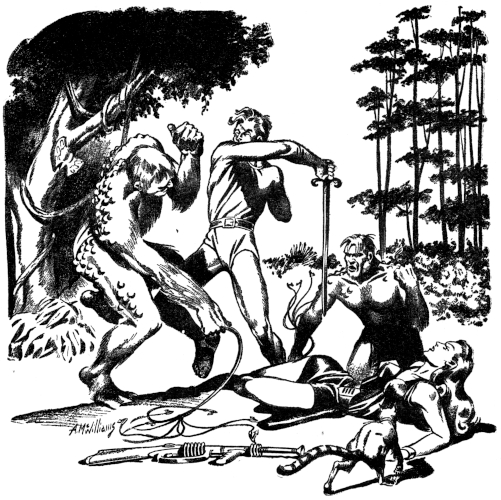
With a savage bellow Eldon leaped.
Eldon's blade flashed bright in the sunlight as he brought it down again with all the strength of his arm. Then it was no longer bright and the ugly grey body collapsed slowly.
But the second Luvan had prepared. One splayed hand held a dagger while the other grasped an evil-looking whip tipped with a cluster of hooked blades.
The Earthman almost sprawled as projected fear gave way to a momentarily successful attempt to confuse the coordination of his leg muscles. Then he screamed aloud as his body burst into flames and he had the illusion that mile upon mile of empty space lay between him and the Luvan. But with an effort of will he plunged ahead, heartened by the growing sense of consternation he could read in the monster's thoughts. Any creature of Varda would have shriveled and died under the Luvan's psychic barrage. But not the cripple from the Closed World of Earth.
The metal whip licked out faster than eye could follow. The blades of its tip grated against the bone of Eldon's forehead and a gush of blood poured into his single eye. He lowered his sword momentarily to clear his vision with the back of his single hand, and in that defenseless instant the Luvan struck.
He felt the dagger snick against a rib and plunge deep into his chest. Automatically his foot came up in a tremendous kick that sent the Luvan reeling back, unhurt but thrown off balance.
Eldon knew he was bleeding internally but as yet his shocked nerves refused to transmit the full story of pain to his mind. Minutes to live. Something clogged his throat as he panted, and he spat a gobbet of red-tinged foam onto the moss underfoot. Punctured lung.
He swung in a wide, clumsy lunge that missed by feet. And then he staggered, sagged, barely saved himself from falling. His sword point dropped weakly.
He felt the wave of triumphant, cruel gloating as the alien creature stepped in for the kill. And that had been the Earthman's last desperate hope, that the thing's inherent bestiality would not allow it to stand back and wait for him to fall. His time was short.
With a supreme, final effort he brought the sword up in a whistling uppercut. And struck. The point bit into the Luvan's chest. Into its throat. Snagged against the creature's jaw. Eldon stiffened his arm and let his body fall forward. The double-edged blade sliced through flesh and cartilage, then met with lessened resistance as the point emerged.
Eldon fell, blood from his wounds showering upon the obscene carcass, but he went down with the elation of the kill still in his mind.
Krasna moaned and opened her eyes as three men in blue-green emerged from the trees. "Bolan!" she gasped.
Her brother took one shocked look at the carnage, misunderstood, raised his sword above Eldon's bloody head.
There was no time to argue or explain. The sword was descending even as she snatched out her blast rod and fired.
Orange fire blazed. The sword went spinning away, torn from Bolan's fingers. But power weapons used near Luvans—even hacked and bleeding Luvans—invariably backfired, and where Krasna's right hand had been there was only a shapeless mass of mangled, heat-seared flesh. For an eternity everyone remained frozen by the unexpectedness of the blast rod's discharge.
"The exile!" one of the men whispered fearfully. "She is truly a Sasso-creature! Kill her!"
"Wait!" Bolan spoke as though dazed. "Why did you—?"
Krasna did not answer. Instead she seized the Luvan's dagger in her uninjured hand and carved a gaping cross-shaped gash in the chest of the carcass beside her. Through glazing eyes Eldon watched as she plunged her hand into the slimy, quivering mess and felt disgusted at her exhibition of rank savagery.
She brought her arm out, fouled and defiled to the elbow with the Luvan's evil-smelling blood. In her hand was a tiny glittering capsule. She tossed it to the ground. "Smash it!" she said weakly.
Uncomprehendingly one of the men crushed it beneath his heel. Instantly the bloated, obscene, mangled carcass vanished as though it had never existed. Even its spilled blood was gone. The men drew unsteady breaths and a look of awed understanding appeared on their faces.
"The other one!" Krasna writhed as pain from her blasted hand penetrated her consciousness. "I—can't."
Eager swords hacked at the remaining monster and eager hands pawed among the filth of its body.
"We have killed a Luvan!" One of the men shouted exultantly as the second capsule shattered under his foot and the second carcass disappeared. "We know their secret now."
Bolan had recovered from his stupefaction. "The Chamber!" he ordered. "Be quick!"
"But it is forbidden," a man objected. "She is an exile. The Council—"
"Damn the Council!" Bolan picked up his sword and brandished it. "To the Chamber!" he repeated. The man looked to where the two Luvans had been and nodded.
"Take—him." Krasna spoke with great effort. "He—must—be—El-ve-don."
"Both!" Bolan decided instantly. He whistled and three more Forest People emerged from the trees. One was a tall, rawboned woman who took charge of administering first aid while the men prepared makeshift litters.
Eldon knew he was dying, but he tried to speak.
"Be still!" the woman ordered without rancor, continuing her ministrations.
One of the men picked up a small furry bundle and deposited it tenderly beside Krasna. The lemur-thing whined softly and snuggled against her.
Eldon felt no pain as he was rolled onto a stretcher. He was too far gone for that. As everything grew dark Krasna was looking at him, and now for the first time there was no pity in her glance. Instead there was dawning admiration. Her thought reached him, bypassing his ears and entering his brain as a telepathic whisper.
"Call me. I will be near."
VI
Dead. Dead. No bodily sensations. No being. But still thought. The individuality of Eldon Carmichael looked without eyes, listened without ears. It was absolutely, utterly alone in nothingness. Nothing but terrible aloneness.
But something—someone—had said, "Call me." What? Whom? Shreds of memory began to coalesce.
"Krasna!" The individuality of Eldon Carmichael shouted without lungs or mouth. "Krasna!"
The nothingness was no longer quite so empty. A thought brushed his.
"Eldon? Where?"
"Here!"
"Think of your shape!" a thought commanded.
The individuality of Eldon Carmichael thought. Memory shreds were coagulating to remind him he had once had a body. This was not death. It was something else.
"Think of me—help me form!" The thought-appeal was urgent but unfrightened. "I can't alone."
"Krasna?" He sent out the wordless question.
"Yes!"
He remembered her as he had watched her bathing in the warm pool that flowed through her home. And then he could see her floating in nothingness beside him, tenuous at first, then solidifying. He saw her with a new three-dimensional clarity and depth, as though with two eyes. Instinctively he reached toward her—and his left hand clasped her right.
Krasna looked down at herself, at the crescent-shaped scar marring her loveliness, and winced.
"Even here I must bear that," her thought reached him. "Until Sasso is no more."
Confused memories were returning now, bringing horror of this unknown emptiness.
And then Krasna's thoughts were flowing around him protectively, soothingly—but not in pity. And her thoughts brought understanding.
They were in the Thin World, a—place—outside the more solid worlds. Here only thought had actuality. Their bodies here were nothing but thought-projections. And here they must remain until the Chamber had had its way with their torn, tortured real bodies, healing them. For such were the unique powers of the Chamber.
"But my arm? And my eye?" Eldon asked.
"You forgot you had lost them. Here you are as you think you are. And I—"
"Exactly as I have dreamed." The thought left Eldon's mind before it could be altered by his loyalty to Margaret and his desire to return to Earth.
Krasna glanced at him sharply, but she seemed not displeased. And there was gratitude in her thoughts. Gratitude and surprised admiration for the way he had come to her rescue without thought of his own safety.
"We must stay away from our actual bodies long enough but not too long," she told him. "Otherwise we could not return at all."
She read his questioning thoughts. "No. A Vardan mind can not take knowledge of the Thin World back. I can remember almost nothing of the time I was here after escaping the Faith.
"But you, with your Closed World brain, can perhaps do what I can not."
With his new knowledge Eldon understood also that those crystalline capsules in the gross grey carcasses were the real essence of the Luvans. The bodies in which they had clothed themselves to live in Varda had been purely artificial.
"I learned the secret of the Luvans in the slave pits of the Faith." Krasna's thoughts grew grim and bleak as she remembered the things to which she had been subjected there. Vardan memories could be carried into the Thin World, though not back again.
Eldon's thought-body drew hers close as they floated side by side in limbo, drew her to him comfortingly and protectingly to thrust those memories aside. He thought she should be soft and warm to touch—and she was.
She pulled away—after a time that could have been either a moment or an age—with a tinkling laugh and a change of mood.
"Time here is different and it will seem long before we can return," her mind said. "Let us build a world to our own hearts' desires and live there until—until you can destroy Sasso and the Faith."
"But—"
She ignored his protest.
"I will go back to the Chamber occasionally—it will be necessary—but if you with your tenacious Earth mind went it would be disastrous."
"Understand this once and for all," he warned her. "If ever I can return to my own Earth I shall do so. I am not your marvelous El-ve-don, and I have no intention of fighting this thing you call Sasso. Those Luvans were bad enough."
Krasna frowned. Then her look of disappointment gave place to a knowing smile.
There was a hint of a surprising idea. Just the faintest sort of hint—and then she closed her mind, half laughingly and half in seriousness. But tightly.
"Let's build our world," she said.
It was a Godlike sensation to think a world. It changed with their thoughts, part Earth, part Varda, and part the solidification of the non-existent lands of dreams. There were groves, streams, mountains, plains. There were towns too, but these could be seen only dimly, indistinct in the distance, the men and women in them tiny figures without individuality. Neither Krasna nor Eldon had formulated their ideas for an inhabited utopia concretely enough to fill in the details.
Krasna created for herself a wardrobe of wonderful gowns every fold of which draped in a perfection of beauty, and jewels of kaleidoscopic inner fires that shifted with her mood. After her hunted forest life in Varda she indulged her fancies to the fullest.
Eldon built a laboratory. He lavished concentrated attention upon it—and then it failed to give him the satisfaction he had expected. For he did not have to work to find solutions. He knew. Even the mysterious bound charges yielded up their secrets in minutest detail, and when he discovered his Earth theorizing about the close connection between interacting bound charges and life itself had been on the right track he felt no surprise. The experimental equipment he designed was worse than useless, answering so perfectly to his thoughts that he could make the needles of his meters swing by merely willing it. He gathered almost limitless knowledge.
Krasna asked about life on Earth, and occasionally Eldon created Earth scenes for her. Once he built a dream automobile, unhampered by the structural limitations of Earth materials, and any number of miles of broad highway. Everything but the traffic. Krasna was delighted at first, amused by the manually operated controls, but then she saddened as she remembered that once Varda had had its own system of roads. So Eldon erased the perfect automobile and perfect highway from existence.
Krasna looked at him peculiarly. She seemed almost afraid of him, so deep was her awe.
"You—you are most certainly El-ve-don!" she whispered. "Only El-ve-don could know how to do such a thing. My people will be grateful to you forever when you save us from Sasso."
Irrational anger stirred within him at her assumption. "No! I shall return to Earth as soon as I can—if I can. I am not El-ve-don."
Krasna was shocked. "Then some day Sasso will come to Earth."
Eldon shrugged, rejecting the thought, his mind still unwilling to believe in the very existence of Sasso.
Then it was time for her to visit the Chamber. Her thought-body thinned out, vanished.
Eldon found their private world dreary and dead without her. With the bright, vital waves of her personality missing there was no joy. He grew intolerably lonely, anxious for her return.
When she reappeared everything was right again in their self-created world. The news she brought was mixed. Their bodies were repairing satisfactorily, she reported, but outside the Chamber there was chaos and steadily deepening defeat for the Forest People. Many had been captured—she shuddered with horror—while others more fortunate had been killed.
Her eagerness to leave their dream world communicated itself to Eldon, but their reasoning was different. She was dedicated to the struggle against Sasso. He hoped with his newfound knowledge to escape the brutalities of Varda and return to old familiar Earth.
But the time was not yet.
Once more she went away and once more she returned, this time almost at once. "Eldon!" she wailed even as she materialized. "We must go back now!"
"Why?" he demanded.
"Because The Night approaches. Two Earth minds aiding the Faith have disturbed the balance. My people can not hold the Gateway much longer."
"But—?"
"If we don't we shall be lost here forever!"
Suddenly Eldon's homesick longing for Earth gave way to hesitation. Here he was whole, not a cripple. There—
But Krasna's absences had shown him that to be alone for all eternity on this self-created world would be unendurable. Even a disembodied brain could—would—go mad from loneliness. And there was Margaret, a prisoner of the Faith. He had no choice.
"All right," he agreed reluctantly.
"Now!"
Instinctively he knew the way.
"Eldon! El-ve-don! Stay near me!" He sensed Krasna's appeal even as their thought-world crumbled back into the featureless opacity of limbo, and he responded amid the nothingness.
VII
The irregular walls, roof and floor were crystals of all shapes and colors. Some glowed, shedding polychromatic light. He rolled over—his body responded with a heavy stiffness—and beside him lay the red-haired girl. This was the Chamber, a natural formation possessing strange characteristics possible only in Varda. In the Chamber they had cheated death by giving their bodies complete rest.
He moved his left arm. It moved! His breath went out in a sigh of happiness as he looked at it, his two eyes focusing with difficulty at first. It was less heavily muscled and the skin was white and tender. It looked newer. Here in the Chamber he had grown it like a—like a crawfish. And the mortal dagger wound had healed scarlessly.
Krasna opened her eyes and stretched. He looked over to see if she had fared as well.