Introductory material (continued 3)
Reading edition
"Mother went to Florida today and dad's duck-hunting in South Carolina. Aunt Mollie's too deaf to hear doorbells and believes anything I tell her."
"I am astonished that your mother left you behind to your own devices."
"I wouldn't go. She's given me up—used to my devices. Besides, I've one or two on her and she doesn't dare give me away to dad. He thinks I'm a darling spoilt child. Not that I'd mind much if he didn't, but it's more convenient."
"You little wretch! I believe you've been drinking."
"So I have! So I have! But I've got an asbestos lining and could stand another tall one. Ah!" Her eyes sparkled. "Suppose you take me to your rooms——"
"I'll take you home——"
"You'll take me to one of those all-nighters——"
"I shall not."
"Then ta! ta! I'll go home by myself. I've had too good a time tonight to bother with old fogies."
She started up the street and Clavering hesitated but a moment. Her home was on East Sixty-fifth Street. Heaven only knew what might happen to her. Moreover, although her mother was one of those women whose insatiable demand for admiration bored him, he had no more devoted friends than her father and her grandmother. Furthermore, his curiosity was roused. What had the little devil been up to?
He overtook the Oglethorpe flapper and seizing her hand drew it through his arm.
"I'll take you where you can get a sandwich," he said. "But I'll not take you to a restaurant. Too likely to meet newspaper men."
"Anything to drink?"
"Ice cream soda."
"Good Lord!"
"You needn't drink it. But you'll get nothing else. Come along or I'll pick you up and carry you to the nearest garage."
She trotted obediently beside him, a fragile dainty figure; carried limply, however, and little more distinguished than flappers of inferior origin. He led her to a rather luxurious delicatessen not far from his hotel, kept by enterprising Italians who never closed their doors. They seated themselves uncomfortably at the high counter, and the sleepy attendant served them with sandwiches, then retired to the back of the shop. He was settling himself to alert repose when Miss Oglethorpe suddenly changed her mind and ordered a chocolate ice cream soda. Then she ordered another, and she ate six sandwiches, a slice of cake and two bananas.
"Great heaven!" exclaimed Clavering. "You must have the stomach of an ostrich."
"Can eat nails and drink fire water."
"Well, you won't two years hence, and you'll look it, too."
"Oh, no I won't. I'll marry when I'm nineteen and a half and settle down."
"I should say you were heading the other way. Where have you been tonight?"
"Donny Farren gave a party in his rooms and passed out just as he was about to take me home. I loosened his collar and put a pillow under his head, but I couldn't lift him, even to the sofa. Too fat."
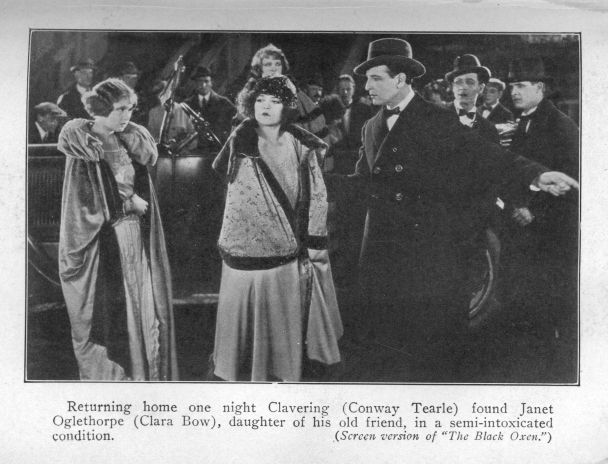
Returning home one night Clavering (Conway Tearle) found Janet Oglethorpe (Clara Bow), daughter of his old friend, in a semi-intoxicated condition. (Screen version of "The Black Oxen.")
"I suppose you pride yourself on being a good sport."
"Rather. If Donny'd been ill I'd have stayed with him all night, but he was dead to the world."
"You say he had a party. Why didn't some of the others take you home?"
"Ever hear about three being a crowd? Donny, naturally, was all for taking me home, and didn't show any signs of collapse till the last minute."
"But I should think that for decency's sake you'd all have gone down together."
"Lord! How old-fashioned you are. I was finishing a cigarette and never thought of it." She opened a little gold mesh bag, took out a cigarette and lit it. Her cheeks were flushed under the rouge and her large black eyes glittered in her fluid little face. She was one of the beauties of the season's débutantes, but scornful of nature. Her olive complexion was thickly powdered and there was a delicate smudge of black under her lower lashes and even on her eyelids. He had never seen her quite so blatantly made up before, but then he had seen little of her since the beginning of her first season. He rarely went to parties, and she was almost as rarely in her own home or her grandmother's. Her short hair curled about her face. In spite of her paint she looked like a child—a greedy child playing with life.
"Look here!" he said. "How far do you go?"
"Wouldn't you like to know?"
"I should. Not for personal reasons, for girls of your age bore me to extinction, but you've a certain sociological interest. I wonder if you are really any worse than your predecessors?"
"I guess girls have always been human enough, but we have more opportunities. We've made 'em. This is our age and we're enjoying it to the limit. God! what stupid times girls must have had—some of them do yet. They're naturally goody-goody, or their parents are too much for them. Not many, though. Parents have taken a back seat."
"I don't quite see what you get out of it—guzzling, and smoking your nerves out by the roots, and making yourselves cheap with men little older than yourselves."
"You don't see, I suppose, why girls should have their fling, or"—her voice wavered curiously—"why youth takes naturally to youth. I suppose you think that is a cruel thing for a girl to say."
"Not in the least," he answered cheerfully. "Don't mind a bit. But what do you get out of it—that's what I'm curious to know."
She tossed her head and blew a perfect ring. "Don't you know that girls never really enjoyed life before?"
"It depends upon the point of view, I should think."
"No, there's a lot more in it than you guess. The girls used to sit round waiting for men to call and wondering if they'd condescend to show up at the next dance; while the men fairly raced after the girls with whom they could have a free and easy time—no company manners, no chaperons, no prudish affectations about kisses and things. No fear of shocking if they wanted to let go—the strain must have been awful. You know what men are. They like to call a spade a spade and be damned to it. Our sort didn't have a chance. They couldn't compete. So, we made up our minds to compete in the only way possible. We leave off our corsets at dances so they can get a new thrill out of us, then sit out in an automobile and drink and have little petting parties of two. And we slip out and have an occasional lark like tonight. We're not to be worried about, either."
"Why cryptic after your really admirable frankness? But there's always a point beyond which women never will go when confessing their souls.… I suppose you think you're as hard as nails. Do you really imagine that you will ever be able to fall in love and marry and want children?"
"Don't men?"
"Ancient standards are not annihilated in one generation."
"There's got to be a beginning to everything, hasn't there? One would think the world stood still, to hear you talk. But anything new always makes the fogies sick."
"Nothing makes me as sick as your bad manners—you and all your tribe. Men, at least, don't lose their breeding if they choose to sow wild oats. But women go the whole hog or none."
"Other times, other manners. We make our own, and you have to put up with them whether you like it or not. See?"
"I see that you are even sillier than I thought. You need nothing so much as a sound spanking."
"Your own manners are none too good. You've handed me one insult after another."
"I've merely talked to you as your father would if he were not blind. Besides, it would probably make you sick to be 'respected.' Come along. We'll go round to a garage and get a taxi. Why on earth didn't you ring for a taxi from Farren's?"
"I tried to, but it's an apartment house and there was no one downstairs to make the connection. Too late. So I footed it." She yawned prodigiously. "I'm ready at last for my little bunk. Hope you've enjoyed this more than I have. You'd be a scream at a petting party."
Clavering paid his small account and they issued into the storm once more. It was impossible to talk. In the taxi she went to sleep. Thank Heaven! He had had enough of her. Odious brat. More than once he had had a sudden vision of Mary Zattiany during that astonishing conversation at the counter. The "past" she had suggested to his tormented mind was almost literary by contrast. She, herself, a queen granting favors, beside this little fashionable near-strumpet. They didn't breathe the same air, nor walk on the same plane. Who, even if this little fool were merely demi-vierge, would hesitate between them? One played the game in the grand manner, the other like a glorified gutter-snipe. But he was thankful for the diversion, and when he reached his own bed he fell asleep immediately and did not turn over for seven hours.
XXI
He had informed Madame Zattiany's butler over the telephone that he would call that evening at half-past nine, but he returned to his rooms after a day at the office with lagging steps. He dreaded another evening in that library by the fire. It was beyond his imagination to foresee how she would treat him, what rôle she would choose to play, and although he was grimly determined to play whatever rôle she assigned to him (for the present!), he hated the prospect. He was in no mood for a "game." This wooing was like nothing his imagination had ever prefigured. To be put on trial … to sit with the woman in the great solitude of the house and the very air vibrating between them … or frozen … self-conscious as a schoolboy up for inspection … afraid of making a false move.… What in God's name would they talk about? Politics? Books? Art? Banalities!… he'd half a mind to go to Florida after all … or join Jim Oglethorpe in South Carolina: he had a standing invitation … he'd return by the next train; he'd felt as if existing in a vacuum all day.…
When he reached his rooms he found his problem solved for the moment—possibly. A telephone slip informed him that Madame Zattiany would be at home, and a note from Mrs. Oglethorpe enclosed tickets for her box at the opera that night.
If she would only go!
He called the house. The butler answered and retired to summon Madame Zattiany. Her voice came clear and cool over the telephone. He invited her to go to Sherry's for dinner and to hear Farrar in Butterfly afterward. "I must tell you that we shall sit in a box," he added. "Mrs. Oglethorpe's."
"Oh!" There was a pause that seemed eternal. Then she laughed suddenly, a laugh of intense amusement that ended on a note of recklessness. "Well! Why not? Yes, I will go. Very many thanks."
"Good. It means an early dinner. I'll call for you at a quarter to seven."
"I'm promptness itself. Au 'voir."
So that was that! One night's respite. He'd leave her at her door. He wondered if his voice had been as impersonal as her own: he had almost barked into the telephone and had probably overdone it. But was any man ever in such a ghastly position before? Well, he'd lose the game before he'd make a fool of himself again.… Ass … he'd had the game in his own hands last night … could have switched off any moment. He'd let go and delivered himself into hers.
He took a cold shower, and made a meticulous toilet.
When he arrived at the house he was shown into the drawing-room. He had never seen it before and he glanced about him with some curiosity. It was a period room: Louis Quinze. The furniture looked as if made of solid gold and Madame Du Barry herself might have sat on the dainty brocades. The general effect was airy and graceful, gay, frivolous, and subtly vicious. (An emanation to which the chaste Victorian had been impervious.) He understood why Madame Zattiany did not use it. She might be subtly anything, but assuredly she was neither airy nor frivolous.
Then he realized that there was a painting of a girl over the mantel and that the girl was Mary Ogden. He stepped forward eagerly, almost holding his breath. The portrait ended at the tiny waist, and the stiff satin of the cuirass-like bodice was softened with tulle which seemed to float about the sloping shoulders. The soft ashen hair, growing in a deep point on the broad full brow, was brushed softly back and coiled low on the long white neck. The mouth was soft and pouting, with a humorous quirk at the corners, and the large dark gray eyes were full of a mocking light that seemed directed straight into the depths of his puzzled brain as he stood gazing at that presentment of a once potent and long vanished beauty.… Extraordinarily like and yet so extraordinarily unlike! But the resemblance may have well been exact when Mary Zattiany was twenty. How had Mary Ogden looked at thirty? That very lift of the strong chin, that long arch of nostril … something began to beat in the back of his brain.…
"What a beauty poor Mary must have been, no?"
He turned, and forgot the portrait. Madame Zattiany wore a gown of that subtle but unmistakable green that no light can turn blue; thin shimmering velvet to the knees, melting into satin embroidered with silver and veiled with tulle. On her head was a small diamond tiara and her breast was a blaze of emeralds and diamonds. She carried a large fan of green feathers.
He had believed he had measured the extent of her beauty, but the crown gave her a new radiance—and she looked as attainable as a queen on her throne.
He went forward and raised her hand to his lips. "I insist," he said gallantly. "Anything else would be out of the picture. I need not tell you how wonderful you look—nor that after tonight you will hardly remain obscure!"
"Why do things halfway? It has never been my method. And Mary told me once that Nile-green had been her favorite color until she lost her complexion. So—as I am to exhibit myself in a box—enfin! … Besides, I wanted to go." She smiled charmingly. "It was most kind of you to think of me."
"Would that all 'kind' acts were as graciously rewarded. I shall be insufferably conceited for the rest of my life—only it is doubtful if I shall be seen at all. Shall we go?"
When they arrived at Sherry's they found the large restaurant almost deserted. It was barely seven. After he had ordered the dinner—and he thanked his stars that he knew how to order a dinner—she said casually:
"I had a call from your friend, Miss Dwight, today."
"Yes? You did not see her, I suppose?"
"Oh, but I did. We talked for two hours. It was almost comical—the sheer delight in talking to a woman once more. I have never been what is called a woman's woman, but I always had my friends, and I suddenly realized that I had missed my own sex."
"I shouldn't fancy that you two would have much in common."
"You forget that we were both nurses. We compared experiences: methods of nursing, operations, doctors, surgeons, shell shock, plastic surgery, the various characteristics of wounded men—all the rest of it."
"It must have been an exciting conversation."
"You never could be brought to believe it, but it was. Afterward, we talked of other things. She seems to me quite a remarkable woman."
"Entirely so. What is it she lacks that prevents men from falling in love with her? Men flock there, and she is more discussed as a mind and a personality than any woman among us; but it is all above the collar. And yet those handsome-ugly women often captivate men."
"You ask one woman why another cannot fascinate men! I should say that it is for want of transmission. The heart and passions are there—I will risk guessing that she has been tragically in love at least once—but there is something wrong with the conduit that carries sexual magnetism; it has been bent upward to the brain instead of directed straight to the sex for which it was designed. Moreover, she is too coldly and obviously analytical and lacks the tact to conceal it. Men do not mind being skewered when they are out for purely intellectual enjoyment, but they do not love it."
Clavering laughed. "I fancy your own mind is quite as coldly analytical, but nature took care of your conduits and you see to the tact. You cannot teach Gora how to redistribute her magnetism, but you might give her a few points."
"They would be wasted. It is merely that I am a woman of the world, something she will never be. And in my hey-day, I can assure you, I was not analytical."
"Your hey-day?"
"I was a good many years younger before the war, remember. Heavens! How rowdy those young people are! A month ago I should have asked if they were ladies and gentlemen, but I have been quite close to their kind in the tea rooms and their accent is unmistakable; although the girls talk and act like gamines. One of them seems to know you."
Clavering had been conscious that the restaurant was filling with groups and couples, bound, no doubt, for the opera or theatre. He followed Madame Zattiany's eyes. In the middle of the room was a large table surrounded by very young men and girls; the latter as fragile and lovely as butterflies: that pathetic and swiftly passing youth of the too pampered American girl. The youth of this generation promised to be briefer than ever!
He gave them a cursory glance, and then his chair turned to pins. Janet Oglethorpe sat at the head of the table. What would the brat do? She had been fond of him as a child, but as he had found her detestable in her flapperhood, and been at no pains to conceal his attitude, she had taken a violent dislike to him. Last night he had deliberately flicked her on the raw.
He was not long in doubt. She had returned his perfunctory bow with a curt nod, and after a brief interval—during which she appeared to be making a communication that was received with joyous hilarity—she left her seat and ran across the room. She might have been in her own house for all the notice she took of the restaurant's other guests.
Clavering rose and grimly awaited the onslaught. Even the waiters were staring, but for the moment only at the flashing little figure whose cheeks matched to a shade the American Beauty rose of her wisp of a gown.
Her big black eyes were sparkling wickedly, her vivid little mouth wore a twist that can only be described as a grin. She had come for her revenge. No doubt of that.
She bore down on him, and shook his unresponsive hand heartily. "I've been telling them how dear and noble you were last night, dear Mr. Clavering, just like a real uncle, or what any one would expect of one of granny's pets. No doubt you saved my life and honor, and I want to tell the world." Her crisp clear voice was pitched in G. It carried from end to end of the silent room.
"Would that I were your uncle! Won't you sit down? I believe that you have not met Madame Zattiany."
Miss Oglethorpe had not cast a glance at her victim's companion, assuming her to be some writing person; although he did once in a while take out Anne Goodrich or Marian Lawrence: old girls—being all of twenty-four—in whom she took no interest whatever.
She half turned her head with a barely perceptible nod. The tail of her eye was arrested. She swung round and stared, her mouth open. For the moment she was abashed; whatever else she may have submerged, her caste instinct remained intact and for a second she had the unpleasant sensation of standing at the bar of her entire class. But she recovered immediately. Grandes dames were out of date. Even her mother had worn her skirts to her knees a short time since. What fun to "show this left-over." And then her spiteful naughtiness was magnified by anger. Madame Zattiany had inclined her head graciously, but made no attempt to conceal her amusement.
"Yes, I'll sit down. Thanks." She produced a cigarette and lit it. "Granny's got a lot of ancient photographs of her girlhood friends," she remarked with her insolent eyes on Madame Zattiany, "and one of them's enough like you to be you masquerading in the get-up of the eighties. Comes back to me. Just before mother left I heard her discussing you with a bunch of her friends. Isn't there some mystery or other about you?"
"Yes, indeed! Is it not so?" Madame Zattiany addressed her glowering host, her eyes twinkling. It was evident that she regarded this representative of the new order with a scientific interest, as if it were a new sort of bug and herself an entomologist. "Probably," she added indulgently, "the most mysterious woman in New York. What you would call an adventuress if you were not too young to be uncharitable. Mr. Clavering is kind enough to take me on trust."
Miss Oglethorpe's wrath waxed. This creature of an obsolete order had the temerity to laugh at her. Moreover—— She flashed a glance from Clavering's angry anxious face to the beautiful woman opposite, and a real color blazed in her cheeks. But she summoned a sneer.
"Noble again! Has he told you of our little adventure last night?"
"Last night?" A flicker crossed the serenity of Madame Zattiany's face. "But no. I do not fancy Mr. Clavering is in the habit of telling his little adventures."
"Oh, he wouldn't. Old standards. Southern chivalry. All the rest of it. That's why he's granny's model young man. Well, I'll tell you——"
"You've been drinking again," hissed Clavering.
"Of course. Cocktail party at Donny's——"
"Well, moderate your voice. It isn't necessary to take the entire room into your confidence. Better still, go back to your own table."
She raised her voice. "You see, Madame Zattiany, I was running round loose at about one o'clock A. M. when whom should I run into but dear old Uncle Lee. He looked all shot to pieces when he saw me. Girls in his day didn't stay out late unless they had a beau. Ten o'clock was the limit, anyhow. But did he take advantage of my unprotected maiden innocence? Not he. He stood there in the snow and delivered a lecture on the error of my ways, then took me to a delicatessen shop—afraid of compromising himself in a restaurant—and stuffed me with sandwiches and bananas. Even there, while we were perched on two high stools, he didn't make love to me as any human man would have done. He just ate sandwiches and lectured. God! Life must have been dull for girls in his day!"
People about them were tittering. One young man burst into a guffaw. Madame Zattiany was calmly eating her dinner. The tirade might have fallen on deaf ears.
Clavering's skin had turned almost black. His eyes looked murderous. But he did not raise his voice. "Go back to your table," he said peremptorily. "You've accomplished your revenge and I've had all I propose to stand.… By God! If you don't get out this minute I'll pick you up and carry you out and straight to your grandmother."
"Yes you would—make a scene."
"The scene could hardly be improved. Will you go?"
He half rose. Even Madame Zattiany glanced at him apprehensively.
Miss Oglethorpe laughed uncertainly. "Oh, very well. At least we never furnish material for your newspapers. That's just one thing we think beneath us." She rose and extended her hand. "Good night, Madame Zattiany," she said with a really comical assumption of the grand manner. "It has been a great pleasure to meet you."
Madame Zattiany took the proffered hand. "Good night," she said sweetly. "Your little comedy has been most amusing. Many thanks."
Miss Oglethorpe jerked her shoulders. "Well, console dear unky. He'd like the floor to open and swallow him. Ta! Ta!"
She ran back to her table, and its hilarity was shortly augmented.
Madame Zattiany looked at Clavering aghast. "But it is worse than I supposed!" she exclaimed. "It is really a tragedy. Poor Mrs. Oglethorpe." Then she laughed, silently but with intense amusement. "I wish she had been here! After all!… Nevertheless, it is a tragedy. An Oglethorpe! A mere child intoxicated … and truly atrocious manners. Why don't her people put her in a sanitarium?"
"Parents count about as much today as women counted in the cave era. But it is abominable that you should be made conspicuous."
"Oh, that! I have been conspicuous all my life. And you must admit that she had the centre of the stage! If any one is to be commiserated, it is you. But you really behaved admirably; I could only admire your restraint."
Clavering's ferment subsided, and he returned her smile. "I hope I didn't express all I felt. Murder would have been too good for her. But you are an angel. And for all her bravado you must have made her feel like the little vulgarian she is. Heavens, but the civilization varnish is thin!—and when they deliberately rub it off——"
"Tell me of this adventure."
"It was such a welcome adventure after leaving you! She told practically the whole of it. She had been to a party and her host was too drunk to take her home. She couldn't get a taxi, so started to walk. After I had fed the little pig I took her home. Of course I had no intention of mentioning it to any one, but I hardly feel that I am compromising my honor as a gentleman!"
"But will Society permit this state of things to last? New York! It seems incredible."
"Heaven knows. It might as well try to curb the lightning as these little fools. Their own children, if they have any, will probably be worse."
"I wonder. Reformed rakes are not generally indulgent to adventurous youth. There will probably be a violent revulsion to the rigors of the nineteenth century."
"Hope so. Thank Heaven we can get out of this."
They left the table. As he followed her down the long room and noted the many eyes that focussed on the regal and beautiful figure in its long wrap of white velvet and fox he set his lips grimly. Another ordeal before him. For a moment he wished that he had fallen in love with a woman incapable of focussing eyes. He hated being conspicuous as he hated poverty and ugliness and failure and death. Then he gave an impatient sigh. If he could win her he cared little if the entire town followed her every time she appeared on the street. And she had been very sweet after that odious flapper had taken herself off. He had ceased to feel at arm's length.
XXII
They entered the box during the nuptial hymn. Farrar, almost supine in the arms of the seducer, was singing with the voluptuous abandon that makes this scene the most explicit in modern opera. She had sung it a thousand times, but she was still the beautiful young creature exalted by passion, and her voice seemed to have regained its pristine freshness. She had done many things to irritate New Yorkers, but in this scene, whether they forgave her or not, they surrendered; and those to whom love and passion were lost memories felt a dim resurgence under that golden tide.
Clavering had no desire to surrender. In fact he endeavored to close his ears. He had received a cold douche and a hot one in the course of the past hour, and he felt that his equilibrium was satisfactorily established. He had forgotten to warn Madame Zattiany of the step at the front of the box, down which so many novices had stumbled, but she had taken it and settled herself with the nonchalance of custom. Odd. Once more something beat in the back of his brain. But he dismissed it impatiently. No doubt many boxes in Europe were constructed in the same fashion.
He had seated himself a little to the right and behind her. He saw her lids droop and her hands move restlessly. Then, as the curtain went down and Farrar was accepting the customary plaudits, her eyes opened and moved over the rich and beautiful auditorium with a look of hungry yearning. This was too much for Clavering and he demanded abruptly:
"Why do you look like that? Have you ever been here before?"
She turned to him with a smile. "What a question!… But opera, both the silliest and the most exalting of the arts, is the Youth of Life, its perpetual and final expression. And when the house is dark I always imagine it haunted by the ghosts of dead opera singers, or of those whose fate is sadder still. Does it never affect you in that way?"
"Can't say it does.… But … I vaguely remember—some ten years ago a young singer with a remarkable voice sang Marguerite once on that stage and then disappeared overnight … lost her voice, it was said.…"
She gave a low choking laugh. "And you think I am she? Really!"
"I think nothing, but that I am here with you—and that in another moment I shall want to sit on the floor—Oh, Lord!"
The house was a blaze of light. It looked like a vast gold and red jewel box, built to exhibit in the fullness of their splendor the most luxurious and extravagant women in the world. And it was filled tonight from coifed and jewelled orchestra to highest balcony, where plainer people with possibly jewelled souls clung like flies. Not a box was empty. Clavering's glance swept the parterre, hoping it would be occupied for the most part by the youngest set, less likely to be startled by the resemblance of his guest to the girl who had sat among their grandmothers when the opera house was new. But there were few of the very young in the boxes. They found their entertainment where traditions were in the making, and dismissed the opera as an old superstition, far too long-winded and boring for enterprising young radicals.
Against the red backgrounds he saw the austere and homely faces of women who represented all that was oldest and best in New York Society, and they wore their haughty bones unchastened by power. There were many more of the succeeding generation, of course, many more whose ancestry derived from gold not blood, and they made up in style and ritual what they lacked in pulchritude. Lack of beauty in the parterre boxes was as notorious as the "horseshoe" itself, Dame Nature and Dame Fortune, rivals always, having been at each other's throats some century and three-quarters ago, and little more friendly when the newer aristocracy of mere wealth was founded. All the New York Society Beauties were historical, the few who had survived the mere prettiness of youth entering a private Hall of Fame while still alive.
It had begun! Clavering fell back, folded his arms and set his teeth. First one pair of opera glasses in the parterre, then another, then practically all were levelled at Mrs. Oglethorpe's box. Young men and old in the omnibus box remained in their seats. Very soon white shoulders and black in the orchestra chairs began to change their angle, attracted by the stir in the boxes. That comment was flowing freely, he made no doubt. In the boxes on either side of him the occupants were staring less openly, but with frequent amazed side glances and much whispering. Madame Zattiany sat like an idol. She neither sought to relieve what embarrassment she may have felt—if she felt any! thought Clavering—by talking to her escort nor by gazing idly about the house comparing other women's gowns and crowns with her own. She might have been a masterpiece in a museum.
A diversion occurred for which Clavering at least was grateful. The door opened and Mr. Dinwiddie entered, limping and leaning on a cane. He looked pale and worried. Clavering resigned his seat and took one still further in the rear. But the low-pitched dialogue came to him distinctly.
"Is this prudent?" murmured Dinwiddie, as he sat himself heavily beside her. "There will be nothing else talked of in New York tomorrow. So far there have only been rumors. But here! You look like Mary Ogden risen from the dead. There's a rumor, by the way, that she is dead."
"She was alive the last time I heard from Vienna. But why imprudent? Mr. Clavering told me of your kind concern, but I assure you that I am neither a political nor a marital refugee."
"But you have a secret you wish to keep. Believe me, you can do so no longer. The Sophisticates are generous and casual. They take you on your face value and their curiosity is merely human and good-natured. But this! In Jane Oglethorpe's box! It is in the nature of an invasion. You hardly could have done more if you had forced yourself into a drawing-room uninvited. You must either come out tomorrow and tell them who you are, establish yourself … or … or——"
"Well?" Madame Zattiany was smiling, and, probably, the most serene person in the house.
"I—I—think you had better go back to Europe. I must be frank. Anything less would be cowardly. You interest me too much.… But I can only suppose that your secret is of the sort that if discovered—and they will discover it!—would cause you grave embarrassment."
"You mean if I am Mary Zattiany's illegitimate daughter?"
"I don't think they would have minded that if you had brought letters to them from Mary asking them to be kind to you—and if you had made a good marriage. But to have it flung in their faces like this—they will never forgive you."
"And you think I am Mary Zattiany's daughter?"
"I—yes—I think I have gone back to my original theory. But there must be something behind. She never would have let you come over here with a letter only to Trent. She knew that she could rely on many of her old friends. No people in the world are more loyal to their own than these old New Yorkers."
"And suppose she did give me letters—and that I have not been interested enough to present them?"
"I knew it! But I am afraid it's too late now. They not only will resent your indifference, but they are extremely averse to anything like sensational drama in private life. And your appearance here tonight is extremely dramatic! They'll never forgive you," he reiterated solemnly.
"Really? Well, let us enjoy the next act," she added indulgently. "I hope you will remain here."
The curtain had gone up. The audience, balked of the private drama, in which they had manifested no aversion whatever from playing their own rôle, transferred their attention to the stage, although Clavering saw more than one glance wander across the house, and those in the adjoining boxes felt themselves free to peer persistently.
Farrar had not finished bowing and kissing her hands before the next curtain when the door of the box opened once more and Mr. Osborne entered. After a few words with Madame Zattiany he went out and returned almost immediately with three other men, two of his own generation, and a tall, dark, extremely good-looking young man, whose easy negligent air was set askew by the eager expression of his eyes. Clavering, not waiting to be introduced, fled to the smoking-room and took a seat in a corner with his back to the other occupants lest some one recognize and speak to him. A hideous fear had invaded his soul. If this world, so indisputably her own, did accept her—as he had not a doubt it would if she demanded it; he made light of Dinwiddie's fears, knowing her as he did—where would he come in? Sheer luck, supplemented by his own initiative, had given him a clear field for a few weeks, but what chance would he have, not only if her house were overrun with people, but if she were pursued by men with so much more to offer, with whom she must have so much more in common? He might be the equal of the best of them in blood and the superior of many, but his life had not been of the order to equip him with those minor but essential and armorial arts, that assured ease and distinction, possessed by men not only born into the best society but bred in it, and who had lived on their background, not on their nerves. To be "born" is not enough. It is long association that counts, and the "air" may be acquired by men of inferior birth but the supreme opportunity. He had managed to interest her because he had no rival, and he was young and his mind in tune with hers. That alone, no doubt, was the secret of her imaginative flight in his direction. For the first time in his life he felt a sense of inferiority, and for the moment he made no attempt to shake it off. He was in the depths of despair. He did not even light a cigarette.… He could hear a group of young men discussing her … as one of their own kind … with no lack of respect … some new friend of Mrs. Oglethorpe's—they were too young to remember Mary Ogden.… She would have many "knights" on the morrow … he felt on the far side of a rapidly widening gulf … and he had once sought to dig a gulf! Disapproved! Questioned! Tried to forget her! He wished he had abducted her.
A bell rang. The men moved toward the foyer. In a few moments he followed. The attendant opened the Oglethorpe door and as he entered the ante-room he saw that the box was still filled with men. They had evidently taken root. He was possessed by a dull anger, and as it spread upward his sense of inferiority took flight. He'd rout them all, damn them. After all he had more brains than any man in the house and his manners could be as good and as bad as their own. Moreover, he was probably more strongly endowed in other ways than the youngest of them. The wise thing for him to do was to let her find it out the next time they were alone.
XXIII
But it was some time before he saw her alone again, and meanwhile many things happened.
She took Mr. Dinwiddie home in her car for supper, Clavering following with Osborne in a taxi, and as the abundant repast was spread in the dining-room it was patent that she had gone to the opera with the intention of bringing back willing guests. She knew that both Dinwiddie and Osborne subscribed to the omnibus box, and no doubt if they had failed to put in an appearance she would have dropped—with one of her infernally ready excuses—himself at his own door. She might as well have announced, without bothering to feed these damned old bores, that she did not intend to see him alone again until she had made up her royal mind.
He ground his teeth, but he was master of himself again and had no intention to make the mistake of sulking. The situation put him on his mettle. He led the conversation and did practically all the talking: as if the vital youth in him, stimulated by music and champagne (which the older men were forced to imbibe sparingly), must needs pour forth irresistibly—and impersonally. He was not jealous of Dinwiddie or Osborne (although the black frown on the latter's brow was sufficient evidence of a deeply personal resentment), and although he did not flash Madame Zattiany a meaning glance, might indeed have sat at her board for the first time, he knew that he had never made a better impression. Her eyes, which had been heavy and troubled as they took their seats at the table, and as old as eyes could be in that perfect setting, began to look like a gray landscape illumined by distant flashes of lightning. Before long they were full of life, and response, and laughter. And pride? There was something very like pride in those expressive orbs (not always as subject to her will as she fancied), as they dwelt on the brilliant young journalist whose mind darted hither and thither on every subject he could summon that would afford the opportunity of witty comment. He even quoted himself—skipping the past two months—and what had been evolved with much deliberation and rewriting sounded spontaneous and pertinent. But in truth he was so genuinely stimulated before the brief hour was over that when he returned to his rooms he wrote his column before turning in. He felt as if fiery swords were playing about his mind, flashing out words and phrases that would make his brother columnists, no sluggards in words and phrases themselves, green on the morrow. For the moment he was quite happy, as he always was when his mind was abnormally quickened, and he dismissed women and their infernal whims to limbo.
When he awoke at two o'clock in the afternoon his brain felt like the ashes of a bonfire and his spirits were a leaden weight. He knew what was to be expected of reaction, however, and after his punch bag and showers he felt better. He'd see her today and force some sort of understanding.
But when he opened his door and saw a letter in her handwriting, and evidently delivered by a servant, as it was unstamped, his hand shook and his half-recovered confidence fled. This time he made no attempt at the farce of self-discipline; he opened it at once. When he saw that it began without formality he drew a longer breath.
"I am not going to see you until Saturday," it read, "when I hope you will take me to Miss Dwight's party. Meanwhile I shall ask you not to see Mr. Dinwiddie nor any one else likely to discuss me. I shall not care to stay long at the party and if you will return here with me I will tell you my secret, such as it is. I shall only say here that I had no intention of making a mystery of myself, for I did not expect to exchange a word with any one in America but Judge Trent and his business associates. I came to America for one purpose only, to settle my affairs, which would have dragged on interminably if I had not been here to receive my alienated properties in person. I know many people in New York, but I had no idea of seeing any of them, although tempted on account of the money they might help me to collect for the children of Austria. But I had decided to leave that until the last minute. I not only was no longer interested in these old friends of mine, but I disliked the explanations I should be forced to give them, the comments, the curiosity, the endless questions. What I mean by this you will know on Saturday night.
"But it is not the first time in my life that I have discovered the futility of making plans. My meeting with you and the profound interest you have awakened has upset all calculations. I expected nothing less! If I had I should have told you the truth the night we met. But it never occurred to me for an instant that I could love any man again. I had done with all that years ago, and my intention was to give my life and my fortune to certain problems in Europe which I shall not bore you with here.
"Possibly if I had met you casually with Judge Trent, or if I had not chosen to avoid my old friends and met you at one of their houses, as I might easily have done, I should have made no mystery of myself; if indeed you did not know the truth already.
"But not only the curious circumstances of our meeting after your weeks of silent devotion, but your own personality, quickened to life a flicker of youthful romance so long moribund that I had forgotten it had ever been one of my lost inheritances. I was also both amused and interested, and to play a little comedy with you was irresistible. It did not occur to me for a moment that you would fall in love with me.
"It was not until the second time you came here after the theatre that I realized what was happening in those submerged cells of mine. But I could not make up my mind to tell you that night—nor the next. By that time I was frightened. I feared there could be only one result. I suppose all women are cowards when in love. But I knew that this could not last, and when you asked me to sit in Mrs. Oglethorpe's box I thought the time had come to precipitate matters. After a decisive step like that I could not retreat. But I wish to tell you myself, and for that reason I have asked you to discuss me with no one until we meet. It will probably be the last time I shall see you, but I am prepared for that.
"I shall see Jane Oglethorpe today. She has been very loyal and I think she will forgive me. It would not matter much if she did not, and possibly would save me a good deal of boredom, but after last night an explanation is due her.
"And after Saturday night, mon ami, matters will be entirely in your hands. You will realize whether you have merely been dazzled and fascinated or whether there is really between us that mysterious bond that no circumstances can alter. Such things have happened to men and women if we may believe history, but I have had too good reason to believe that it is not for me. However—at least for a brief time you have given me back something of the hopes and illusions of youth. This in itself is so astonishing that whatever the result I shall never be able to forget you.
"Until Saturday. "M."
Clavering's immediate act was to dash off a love-letter more impassioned than any he had ever dreamed himself capable of writing, vowing that he was dazzled and fascinated, God knew, but that he loved her with the love of his life and would marry her if she would have him, no matter what her revelations. And with what patience he could muster and with no grace whatever he would make no attempt to see her until Saturday night. But she must believe that he loved her and she must write at once and tell him so. He could not exist throughout that interminable interval unless she wrote him at once that she believed in the existence and the indissolubility of that bond, and that he had given her the highest and deepest and most passionate love of which man was capable, and which no woman but she could inspire, for no woman like her had ever lived.
He dared not read it over. He had never let himself go before, and he had written too much for print not to be self-conscious and critical of even a love-letter intended only for concordant eyes. Nevertheless, he was aware even in his excitement that the more reckless it was the surer its effect. No edited love-letter ever yet hit its mark. (He remembered Parnell's love-letters, however, and devoutly hoped his own would never see the light.) The waiter entered at the moment, and he gave him the missive, hastily addressed and sealed, and asked him to tell the "desk" to send it immediately and give the boy orders to wait for an answer.
He drank his coffee, but ate nothing. Nor did he open his newspapers. He strode up and down his rooms or stood at the window watching the hurrying throngs, the lumbering green busses, the thousand automobiles and taxis over on Fifth Avenue. They were as unreal as a cinema. He had the delusion, common to lovers, that Earth was inhabited by two people only—that brief extension of the soul which in its common acceptance of eternal loneliness looks out upon the world as upon a projected vision in which no reality exists, for man the dreamer is but a dream himself. Phantasmagoria!
He glanced at the clock every time he passed it. It seemed incredible that mere minutes were passing. But she was merciful. She kept him in suspense but thirty-five minutes. The messenger boy stared at the celebrated journalist, with whose appearance he was reasonably familiar, as if regarding a phase of masculine aberration with which he was even more familiar. He grinned sympathetically, and Clavering was not too distraught to detect the point of view of the young philosopher. He had been running his hands through his hair and no doubt his eyes were injected with blood. He told him to wait, and went into his bedroom. But the note was brief and required no answer. "I believe you." That was all, and it was enough. He gave the astonished philosopher a five-dollar bill: an automatic American reaction.
Then he sat down to puzzle over those parts of her letter which he had barely skimmed; faded into insignificance for the moment before the outstanding confession that she really loved him. But they loomed larger and larger, more and more puzzling and ominous, as he read and reread them. Finally he thrust the pages into his desk and went out for a tramp.
XXIV
It was a cold bright day. The ice on the trees of Central Park was a diamond iridescence. Nursemaids were leading children, bits of muffled wealth, along the alleys. Horses pounded on the bridle paths. Automobiles and taxis, that must have looked to the airman above like aimless black planes drifting in a crystal sea, were carrying people to a thousand destinies. Towering on all sides was the irregular concrete mass of New York. As dusk fell, lights in those high buildings began to appear, first intermittently, then as long necklaces of brilliants strung against the sky. Silence fell on the Park.
Clavering walked until he could walk no farther, then took a bus at One Hundred and Tenth Street for Claremont. When he reached the restaurant he could think of only three men whose companionship would be endurable, and failing to get any of them on the telephone resigned himself to a solitary dinner. But still restless, he wandered over to a window and stared out across the Hudson at the dark Palisades on the opposite shore. Battleships were at anchor, for there had been no ice in the Hudson this winter, and a steamboat with its double chain of lights swam gracefully up the river. The cold winter stars winked down indifferently upon seething human hearts.
He still refused to admit that the source of his uneasiness was that revelation set for Saturday night. Nothing but death itself could halt his marriage with this woman, for she herself had unequivocally stated that after Saturday night the future would be in his hands. His! … Her secret? Not that she had had lovers, for he had accepted that fact already, and for him the past had ceased to exist. Her husband was dead. Nothing else mattered. Nevertheless, the vague prescient chill he had experienced the night he first met her eyes, and once or twice since, accompanied as it was by a curious sense that just below his consciousness lay the key to the mystery, rattling now and again, but sinking deeper every time he made a dart at it, had defied further evasion since the receipt of her cryptic letter. He was the more uneasy as she seemed far more certain of Mrs. Oglethorpe than of himself.
Once more he heard the key rattle, but higher … almost in his consciousness … for the first time it seemed to sound a double note of warning … he had a sudden vision of a locked door—and not a door locked on a mere secret.
He swung about impatiently. The explanation of his mood was this hideous interval to be got through, Heaven alone knew how. No wonder he had felt a sensation of terror. When a man is in the unsatisfied stages of love he must expect occasional attacks of greensickness, sullen passions intensified by unreasoning fear. And he was luckier than most. He had been the confidant of men in love, with hope deferred or blasted, and although he had been sympathetic enough, and convinced that men had a far deeper capacity for suffering than women, still had his pity been tempered by a certain contempt. Those had been the times when he had flouted the idea that he was basically romantic; and that he had never made a jackass of himself over any woman had induced a feeling of superiority that had expanded his ego. Now he was convinced that his capacity for love put theirs to shame, and he was filled with pride at the thought. Still—he wished it were Saturday night.
He was crossing the room to his solitary table when he saw Jim Oglethorpe enter. His first impulse was to avoid him. The restaurant was well-filled and he could easily take a table in a corner with his back to the room. But dining alone was a melancholy business at best—and tonight! If Oglethorpe brought up Madame Zattiany's name he could change the subject or state bluntly that he had his reasons for not wishing to discuss her. As he stood hesitating, Oglethorpe caught sight of him and almost ran across the room, his face, which had looked heavy and worried, glowing with pleasure.
"Jove, this is luck!" he exclaimed. "Alone? So am I. Got in this morning and found Janet had a dinner on for those infernally noisy friends of hers. Got something to think over, so thought I'd come out here. This is really luck as I was going to hunt you up tomorrow. Let's sit here. I want to talk."
He had led the way to a table in a remote corner, secluded, so far. He beckoned the head waiter, who agreed that it should remain secluded. Then he asked Clavering to order the dinner, and, folding his arms, stared out of the window, his face sagging once more. He was still a young man, not more than forty-five, but in spite of his love of outdoor sport he showed a more consistent love of eating and drinking in flabby muscles and pouches under the eyes. It was an amiable, rather weak but stubborn face that had been handsome in youth when his eyes were bright and clear skin covered firm muscles, and it would be handsome again when years had compelled him to diet and his already faded hair had turned white; his features were regular and his figure well-knit under its premature accumulations.
He produced a flask from his pocket when the waiter had discreetly turned his back, and their ice-water might have passed for cold tea.
"Think I'll come to the point," he said. "You know me well enough not to mind anything I say."
Clavering glanced up from his oysters in alarm. "There's just one question I won't discuss," he said sharply.
Oglethorpe stared. "You don't mean to say you're interested in her? So much the better! And it strikes me you can't have any objection to discussing her with me. I'm her father, ain't I?"
"Her father—are you talking of Janet?"
"Who else? I'm worried as the devil. Have been ever since I got in this morning. I'd telegraphed I was coming, and when I got to the house Molly told me that mother wanted to see me at once and I posted down there. It was about Janet, and you know more about it than I do."
"I suppose I know what you mean. But it turned out all right. She happened to meet me, not some man who might have annoyed her. Of course she shouldn't have taken such a risk, but; what can you do with these flappers? They're all in league together and you might as well let them go their little pace. It won't last. They'll soon be older, and I don't suppose you intend to play the heavy father and lock her up."
"No, but I'd like damn well to get her married. Mother told me a pretty tale. It seems she made a row at Sherry's last night, making you and some lady you had with you as conspicuous as herself. Mrs. Vane was there and carried it straight to mother. Mother's no fool and had already got on to this younger generation business and given Janny one or two tongue lashings, but she never dreamed it had gone as far as it looks. Roaming the streets alone at one in the morning! She'd undoubtedly been drinking last night—God! I've a notion to take a switch to her. And I suppose she was pretty well lit the night you picked her up. I've never seen a hint of it. Janny's spoilt enough. Her mother never had the slightest control over her and she could always get round me. But she won't in the future. I'll get top-hand somehow. God! My daughter! Tell me your side of it, will you?"
Clavering, who was genuinely fond of Oglethorpe, and relieved, moreover, that he had not yet heard of Madame Zattiany, gave a cautious and colorless account of the adventure.
"It is possible that she had had a cocktail or two," he concluded. "But you must expect that. If the flapper should adopt a coat of arms no doubt it would be a cocktail rampant with three cigarettes argent on a field de rouge. However, it wouldn't be a bad idea if you took her in hand. That is, if you can."
"I'll do it all right. D'you mean to tell me she was at Farren's without a chaperon?"
"There may have been a chaperon to each couple for all I know."
"You know damn well there wasn't. No chaperon would have left her alone."
"But surely, Jim, you know that chaperons are practically obsolete. They don't gee with cocktails and petting parties. The New Freedom! The Reign of Youth!"
"Damn nonsense. No, I didn't know it. I supposed she was properly chaperoned, as girls of her class always have been. You know how much I care for Society, and I haven't got to the chicken stage either. Took it for granted that certain cast-iron conventions were still observed, in our set at least. Of course I've seen her drink cocktails at home and thought it rather cute, and I've rubbed the paint off her cheeks and lips once or twice. Girls are making up nowadays as if they were strumpets, but some little fool started it, and you know the old saying: 'What one monkey does the other monkey must do.' It never worried me. Of course I've heard more or less about these young idiots; they're always being discussed and written up; but somehow you never think those things can happen in your own family.… I went straight home and blew up Molly—haven't had a sight of Janet yet—and of course she bawled. Always does. When I told her that Janet had been at Farren's alone she protested that Janet had told her she was going to bed early that night. Even last night, when she had a theatre party, she understood that some young married woman was along. But Molly's a fool. What on earth am I to do with Janet? There were no such girls in my young days. Some of them were bad uns, but as discreet as you make 'em. Didn't disgrace their families. Some of them used to drink, right enough, but they were as smooth as silk in public, and went to a sanitarium to sober up when it got the best of 'em. But these girls appear to be about as discreet as street-walkers. You don't think they kick over the traces, do you?"
"I'm dead sure that Janet hasn't. She puts on the cap and bells partly because it's the fashion, partly because she thinks girls are alive and having their fun for the first time. But she's no fool. She nearly floored me once or twice. She'll take care of herself."
"Girls don't take care of themselves when they're drunk. But I've an idea there's something else the matter with her. At least mother has?"
"Something else?"
"In love."
"Well, there's your chance to marry her off. The sooner the better. But why should it drive her to drink? If she's fixed her affections on any of those chaps that dance at her beck——"
"She hasn't. She's in love with you."
"What!" Clavering dropped his fork. When the waiter had rushed to present him with another and retired, he still stared at Oglethorpe as if he had been stunned by a blow between the eyes. "Whatever—what on earth put such an idea into Mrs. Oglethorpe's head? The child can't endure me. She pretty well proved it last night, and I've always known she disliked me—since she grew up, that is. To be perfectly frank, aside from the fact that I don't care for young girls, she always irritates me like the deuce, and I've never made any secret of it. Night before last I couldn't well have made myself more disagreeable if I'd rehearsed for the part."
Oglethorpe grinned. "Lot you know about girls. Just the way to make 'em crazy about you. Like all idealists, you don't know a thing about women. Being a rank materialist myself, I know 'em like a book. The emancipated flapper is just plain female under her paint and outside her cocktails. More so for she's more stimulated. Where girls used to be merely romantic, she's romantic—callow romance of youth, perhaps, but still romantic—plus sex-instinct rampant. At least that's the way I size 'em up, and its logic. There's no virginity of mind left, mauled as they must be and half-stewed all the time, and they're wild to get rid of the other. But they're too young yet to be promiscuous, at least those of Janet's sort, and they want to fall in love and get him quick. See the point?"
"No doubt you're right. But I'm not the object of Janet's young affections. She's either led your mother to believe it for purposes of her own, or Mrs. Oglethorpe has merely jumped at that conclusion—well, Heaven only knows why."
"You know why. Because she'd like it. So would I."
"Good Lord, Jim! I'm nearly old enough to be her father. Barely ten years younger than yourself."
"You'll never be as old as I am this minute, and I'd give my eyes to see you married to her. Moreover, I'm convinced mother's right. Janny let out something—broke down, I fancy, although mother wouldn't give her away any further. And you used to be fond of her when she was a child. She's sat on your lap a hundred times."
"My dear Jim," said Clavering drily. "You've just pronounced yourself a man of consummate experience. Need I remind you that when a man has held a girl on his lap as a child, she is generally the last girl he wants on his lap later on? Man love's the shock of novelty, the spice of surprise. It's hard to get that out of a girl you have spanked—as I did Janet on two different occasions. She was a fascinating youngster, but a little devil if there ever was one."
"She's full of fascination yet. I can see that, if I am her father. A year or two from now, when she comes to her senses——"
"Oh, cut it out, Jim! I won't listen. Even it were true—and I'd stake my life it isn't—I—well——"
"D'you mean there's some other woman?"
"I don't care to talk about it—but—let it go at that."
"Sorry. I'd have liked it. You could have made a fine woman out of Janny. She has it in her."
Clavering did not express his doubts on this point aloud. He was in truth horribly embarrassed and hardly knew what to say. Not for a moment did he believe that the minx was in love with him, nor would he have taken the trouble to find out, even to please Jim Oglethorpe and his mother, had Mary Zattiany never crossed his horizon. But he felt sorry for his friend and would have liked to banish his brooding distress.
"Look here!" he exclaimed. "You'll have to buck up and take her in hand. After all, you're her father and she respects you. No girl respects her mother these days, apparently, but the father has the advantage of being male. Give her a talking to. Tell her how cut up you are. She's too young to be as hard as she likes to think. Don't preach. That would make matters worse. Appeal to her. Tell her she's making you miserable. If that doesn't work—well, your idea of taking a switch to her isn't bad. A sound spanking is what they all need, and it certainly would take the starch out of them. Make them feel so damned young they'd forget just how blasé they're trying to be."
"She might run away," rumbled Oglethorpe. "I believe I'll try it, though, if worse comes to worst. I'll have no filthy scandals in my family."
"Why not collect all the fathers and plan a regular campaign? Without their allowances they'd soon be helpless. It would be a battle royal and might make history! Might also get hold of the fathers of these young chaps. Few have independent incomes."
Oglethorpe laughed for the first time. "Not a bad idea for a bachelor, Lee. Maybe I'll try it. Let's get out of this. How about the Follies?"
XXV
When a man has cultivated a practical and methodical habit of mind and body he pursues the accustomed tenor of his way, whatever the ferment of his spirit. Clavering's spirit was mercurial, but long since subject to his will, and it would no more have occurred to him to neglect his regular work because he was in love and a state of suspense than to put on petticoats and walk up Fifth Avenue. It might be better or worse under foreign impact, but it would be done, and all else banished for the hour.
There were times when he wrote better surrounded by the stimulations of the office; when he was neither fagged nor disturbed he worked at home. During this week of incertitudes he rose late, lunched with friends at the Sign of the Indian Chief, a restaurant where the cleverest of them—and those who were so excitedly sure of their cleverness that for the moment they convinced others as well as themselves—foregathered daily. Then he went to the office and wrote or talked to other men until it was time to dine. He could always be sure of companionship for the evening. On his "day off" he took a train out into the country and walked for hours.
There was a great deal of scintillating talk in his group on the significant books and tendencies of the day, and if the talk of French youth in their clubs before the Revolution may possibly have been profounder and more far-reaching in its philosophy, more formulative in its plan of action, owing to a still deeper necessity for change in the social order, the very fact that these brilliant young Americans had no personal grievance but merely sharpened their wits on matters in which they were intelligent enough to take an interest, saved their cleverness from becoming mordant or distorted by passion. It was an excellent forcing-house for ideas and vocabulary.
But their most solemn causeries were upon the vital theme of The American Reputation in Letters. Past. Present. Future. This was the age of Youth. Should any of the old reputations be permitted to live on—save in the favor of the negligible public? If so, which? All the recent reputations they would have liked to pronounce equally great, merely on account of their commendable newness, but they were too conscientious for that. They appraised, debated, rejected, finally placed the seal of their august approval upon a favored few. Claques were arranged if the public were obtuse. The future? A few, a very few, were selected from the older group, many more from the younger, and ordained to survive and shed their undying beams for posterity. From these judicial pronouncements there was no appeal, and the pleasant spaces of the Sign of the Indian Chief, so innocuous to the uninitiated eye, was a veritable charnel house that stank in the nostrils of the rejected; but, inconsistent even as life itself, those melancholy graves were danced over by the sprightly young feet of the elect. Sometimes there was a terrifying upheaval in one of those graves. A dismal figure fought his way out, tore off his cerements, and stalked forth, muttering: "'But I stride on, austere. No hope I have, no fear,'" leaving a puzzled uneasiness behind him.
But for good or ill, it was a matter for congratulation that criticism was at last being taken seriously in the United States.
There was a jazz party at the studio of a hospitable girl artist where Clavering danced with several of the prettiest young actresses of recent Broadway fame until dawn, and drank enough to make him as wild as the rest of the party had it not been for the seasoned apparatus inherited from hard-drinking Southern ancestors. Altogether, he gave himself little time for thought, and if he felt at times an inclination to dream he thrust it from him with an almost superstitious fear. He would speculate no longer, but neither would he run the risk of invoking the laughter of cynical gods. If unimaginable disaster awaited him, at least he would not weaken his defences by a sojourn in the paradise of fools.
He avoided Oglethorpe and Dinwiddie, and although he had engaged himself to dine at the Goodriches on Thursday night he sent an excuse.
On Thursday morning, as he was turning over the pages of one of the newspapers his eye was arrested by the name Zattiany. He never read Society paragraphs, but that name would leap to his eyes anywhere. The announcement was as brief as "social notes" always are in the daily editions of the morning papers: "Mrs. Oglethorpe gives a luncheon tomorrow at her house in Gramercy Park to the Countess Zattiany of Vienna."
So! She had satisfied Mrs. Oglethorpe. That was one on Dinwiddie.
On the following night he bought himself an admission ticket to the Metropolitan Opera House and entered at the close of the second act. As he had half expected, she was in Mrs. Oglethorpe's box, and it was crowded with men. He fancied that his older friend looked both glum and amused. As for Dinwiddie, his expression was half-witted.
He went home and took a bromide. Sleep, being a function, is outside the domain of the will, and he had had little of it since Tuesday. And sleep he must if he was to be in alert command of his faculties on the following night.
XXVI
Madame Zattiany stood before the long old-fashioned pier glass in her bedroom, a large cheerful room recently done over in white chintz sprayed with violets. The bright winter sun streamed in on a scene of confusion. Gowns were thrown over every chair and hats covered the bed. They all had the air of being tossed aside impatiently, as indeed they had been, and the maid with a last comprehensive look at her mistress began to gather them up and carry them to the large wardrobes in the dressing-room.
Mary regarded herself critically. She had wished (not without malice!) to emphasize her youthful appearance, but not at the expense of dignity, and she felt that she had achieved the subtle combination in the frock of soft black velvet cut with long, sweeping lines and of an excessive simplicity; and a black velvet hat of medium size with a drooping brim that almost covered one eye. The long white gloves disappeared into her sleeves somewhere above the elbow and she wore a single string of pearls. She looked very Parisian, very elegant, as Mrs. Oglethorpe would have expressed it, and very assured. In spite of the mocking gleam in the one visible eye her face was serene and proud.
She had felt some trepidation on Tuesday when she had sought out Mrs. Oglethorpe and made her explanations, but she felt none whatever at the prospect of meeting these other twelve old friends. Whether they approved or resented, were indulgent or elevated their respectable noses and intimated, "You are no longer one of us," was a matter of profound indifference to Mary Zattiany. She would have avoided them all if it had been possible, but since she had deliberately permitted her hand to be forced she would take the situation humorously and amuse herself with whatever drama it might afford.
Elinor Goodrich. Mabel Lawrence. Polly Vane. Isabel Ruyler. Ellen de Lacey. Louise Prevost. She had been so intimate with all of them, not only in the schoolroom but when they were all in Society together. Now only her somewhat cynical sense of anticipation mitigated utter boredom at the thought of meeting them again. Of the other six she had still vaguer memories, although she recalled having heard that the beauty of her own last season, Lily Armstrong, had married one of the Tracys. She also was to be at the luncheon.
What on earth was she to talk to them about at the table? She could hardly tell them the story they expected before the servants. That would be for the later hour in the drawing-room—or would it be in that absurd old room of Jane's upstairs?
She recalled Elinor Tracy (Goodrich) and her enthusiastic admiration, which she had accepted as a matter-of-course, and given little beyond amiable tolerance in return. As she had told Clavering, she was not a woman's woman. She hoped Nelly had outgrown "gush." For some ten years after her marriage she had met her from time to time abroad, but she had not seen her for so long that she doubted if she would recognize her if they passed on the street. The only one of her old friends for whom she retained either interest or affection was Jane Oglethorpe, who, ten years older than herself, with a commanding personality unfolding rapidly at the dawn of their intimacy, had attracted deeply but subtly her own untried force of character and ruthless will. Embarrassment over, she had enjoyed their long hour together, and was glad to renew the intimacy, to find that her old friend's warm affection had lost nothing with the years. And she had found her more interesting than in her youth.
She sighed a little as she looked back on her long hours of almost unbroken solitude in this old house. She had been comparatively happy at first—a blessed interval of rest and peace in this marvellously wealthy and prosperous city where the poor were kept out of sight, at least, where all the men were whole and where one never saw a gaunt woman's appealing eyes, or emaciated ragged children. Those untroubled hours had fled for ever and astonishment, impotent fury, and dire mental conflict had followed, but nevertheless she had dreamed—dreamed—and been glad of her freedom from social and all other duties. Now, probably these women and many more would swarm here.
Her mouth twisted as her maid helped her into the soft gray coat trimmed with blue fox. Ordeal! That would come on Saturday night. No wonder she was merely amused and totally indifferent today!
When she arrived at the house in Gramercy Park, purposely late, to give her entrance the effect Mrs. Oglethorpe had commanded, she heard an excited buzz of voices in the drawing-room as she was being relieved of her wrap. As she entered it ceased abruptly and she heard several hardly perceptible gasps. But the pause, before they all crowded about her, was too brief to be noticeable, and they shook her hand heartily or kissed her warmly. If their eyes were perhaps too studiously expressionless, their words and manner might have been those of old friends welcoming back one who had been long absent and nothing more. Conflicting emotions, born of undying femininity, were not evident for the moment. Mrs. Goodrich cried out at once how wonderfully well she looked, Mrs. Lawrence asked if she had stopped in Paris for her clothes, and Mrs. Vane if she found New York much changed. Nothing could have gone off better.
Mrs. Oglethorpe, in old-pile black velvet as usual, with a front and high-boned collar of yellow rose-point lace, stood in the background watching the comedy with a frank sardonic grin. If her guests had been faithless to the traditions in which they had been bred, she would have felt angry and ashamed, but the automatic manner in which they rose to the occasion and took the blow standing (Mrs. Oglethorpe often indulged in the vernacular of her son, her Janet, and her Lee) made her rock with silent mirth. She knew exactly how they felt!
They were a fine-looking set of women and handsomely dressed, but they indisputably belonged to the old régime, and even Mrs. Tracy, the youngest of them, had something of what Mary Zattiany called that built-up look. They were fashionable but not smart. They carried themselves with a certain conscious rigidity and aloofness which even their daughters had abandoned and was a source of disrespectful amusement to their iniquitous granddaughters. Although Mrs. Goodrich, Mrs. Lawrence and Mrs. Tracy were more up to date in their general appearance, wearing slightly larger hats and fewer feathers, with narrow dog collars instead of whaleboned net, they were as disdainful as the others of every art that aims to preserve something of the effect of youth; although they were spickingly groomed. They accepted life as it was, and they had accepted it at every successive stage, serene in the knowledge that in this as in other things they were above the necessity of compromise and subterfuge. They were the fixed quantities in a world of shifting values.
In age they ranged from fifty-six to sixty-two, with the exception of Mrs. Tracy, who was a mere fifty-two. A few were stout, the others bony and gaunt. Their hair was white or gray. Only Mrs. Tracy, with her fresh complexion and soft brown hair, her plump little figure encased in modern corsets, had got on the blind side of nature, as Mrs. Oglethorpe had told Mary. The others were frankly elderly women, but of great dignity and distinction, some charm, and considerable honesty and simplicity. And their loyalty never failed them.
The luncheon was by no means easy and informal. Mary, by racking her memory, recalled the first names of most of them and never in all her varied life had she been more sweetly amiable, made so determined an effort to please. She might not care what they thought of her, but she was sorry for them, they had behaved very decently, and for Jane Oglethorpe's sake alone the occasion must be a success. She was ably seconded by Mrs. Goodrich, who stared at her in wide-eyed admiration and rattled off the gossip of New York, and by Mrs. Tracy, who had an insatiable interest in diplomatic society. When she had satisfied the latter's curiosity she led the conversation by a straight path to the sufferings of the children of Austria and begged them to join her in forming a relief committee. They received this philanthropic suggestion with no apparent fervor, but it served to relieve the stiffness and tension until they retired to the drawing-room for coffee.
They stood about for a few moments, Mary looking up at the portrait of Jane Oglethorpe in her flaming youth. But the hostess ordered them all to sit down and exclaimed peremptorily: "Now, Mary, tell them all about it or I'll have a lot of fainting hysterical women on my hands. We're still human if we are old and ugly. Go to it, as Janet would say. I believe you have met that estimable exponent of the later New York manner. You are no more extraordinary yourself than some of the changes here at home, but you're more picturesque, and that's harder to swallow. Put them out of their misery."
The ladies smiled or frowned, according to what humor the Almighty, niggardly in his bestowal of humor, had allotted them. At all events they were used to "Jane." Mrs. Goodrich, who had led Mary to a sofa and seated herself beside her, took her hand and pressed it affectionately, as if she were encouraging her on the way to the operating room. "Yes, tell us the story, darling. It is all too wonderful!"
"Do you really mean that you have never heard of this treatment?" asked Madame Zattiany, who knew quite well that they had not. "Few things are better known in Europe."
"We have never heard of it," said Mrs. Vane austerely. "We were totally unprepared."
Madame Zattiany shrugged her graceful shoulders. "I have been told that America never takes up anything new in science until it has become stale in Europe. But women as well as men have been flocking to Vienna. Russian princesses have pledged their jewels——"
"How romantic!" exclaimed Mrs. Goodrich, who was one of those women in whom a certain spurious sense of romance increases with age. But Mrs. Vane mumbled something less complimentary. She had never been romantic in her life; and she was beginning to feel the strain.
"Well," said Madame Zattiany, "I suppose I must begin at the beginning. I dislike holding forth, but if you will have it——"
"Don't leave out a word!" exclaimed Mrs. Tracy. "We want every detail. You've made us feel both as young as yourself and as old as Methuselah."
Madame Zattiany smiled amiably at the one woman in the room who had lingered in the pleasant spaces of middle age. "Very well. I'll be as little technical as possible.… As you know, I ran a hospital in Buda Pesth during the war. After the revolution broke out I was forced to leave in secret to escape being murdered. I was on Bela Kun's list——"
There was a sympathetic rustle in the group. This at least they could grasp on the wing. Mrs. de Lacey interrupted to beg for exciting details, but Mrs. Goodrich and Mrs. Tracy cried simultaneously:
"No! No! Go on—please!"
"Quite right," said Mrs. Oglethorpe, who was prepared to enjoy herself. "We can have that later."
"I naturally went to Vienna, not only because I had some money invested there, but because I could live in the Zattiany Palace. The old house was difficult to keep warm, and as I was too tired and nervous to struggle with any new problems I went at a friend's suggestion into a sanitarium.
"The doctor in charge soon began to pay me something more than perfunctory visits when he found that intelligent conversation after my long dearth did me more good than harm. Finally he told me of a method of treatment that might restore my youth, and begged me to undertake it——"
"Ah!" There were sharp indrawn breaths. Mrs. Vane drew herself up—figuratively, for she could hardly be more perpendicular, with her unyielding spine, her long neck encased in whaleboned net and her lofty head topped off with feathers. A look of hostility dawned in several pairs of eyes, while frank distaste overspread Mrs. Ruyler's mahogany visage. Madame Zattiany went on unperturbed.
"It may relieve your minds to hear that I was at first as indifferent as all of you no doubt would have been. The war—and many other things—had made me profoundly tired of life—something of course that I do not expect you to understand. And now that the war was over and my usefulness at an end, I had nothing to look forward to but the alleviation of poverty by means of my wealth when it was restored, and this could be done by trustees. Life had seemed to me to consist mainly of repetitions. I had run the gamut. But I began to be interested, at first by the fact that science might be able to accomplish a miracle where centuries of woman's wit had failed——"
"Wit?" snorted Mrs. Vane. "Ignoble vanity."
"Well, call it that if you like, but the desire to be young again or to achieve its simulacrum, in both men and women, has something of the dignity which the centuries give to all antiques. However, at the time, you will also be glad to know, I was far more interested in the prospect of reënergizing my worn out mind and body. I was so mortally tired! And if I had to live on, and no doubt with still much work to do in distracted Europe——"
"But what did they do to you?" cried Mrs. Tracy. "I'd have done it in your place—yes, I would!" she said defiantly as she met the august disgusted eye of Mrs. Vane. "I think Countess Zattiany was quite right. What is science for, anyhow?"
"Go on! Go on!" murmured Mrs. Goodrich. She was too fat and comfortable to have any desire to return to youth with its tiresome activities, but all her old romantic affection for Mary Ogden had revived and she was even more interested than curious.
"I am trying to! Well, I must tell you that the explanation of my condition, as of others of my age, was that the endocrines——"
"The what?" The demand was simultaneous.
"The ductless glands."
"Oh," said Mrs. Prevost vaguely, "I've seen something——"
"It is all Greek to me," said Mrs. Vane, who felt that unreasoning resentment common to the minor-informed for the major-informed. "You promised to avoid technical terms."
Madame Zattiany explained in the simplest language she could command the meaning and the function of the ductless glands. The more intelligent among them looked gratified, for the painless achievement of fresh knowledge is a pleasant thing. Madame Zattiany went on patiently: "These glands in my case had undergone a natural process of exhaustion. In women the slower functioning of the endocrines is coincident with the climacteric, as they have been dependent for stimulation upon certain ovarian cells. The idea involved is that the stimulation of these exhausted cells would cause the other glands to function once more at full strength and a certain rejuvenation ensue as a matter of course; unless, of course, they had withered beyond the power of science. I was a promising subject, for examination proved that my organs were healthy, my arteries soft; and I was not yet sixty. Only experimentation could reveal whether or not there was still any life left in the cells, although I responded favorably to the preliminary tests. The upshot was that I consented to the treatment——"
"Yes? Yes?" Every woman in the room now sat forward, no longer old friends or rivals, affectionate or resentful, nor the victims of convention solidified into sharp black and white by the years. They were composite female.
"It consisted of the concentration of powerful Röntgen—what you call X-Rays—on that portion of the body covering the ovaries——"
"How horrible!" "Did you feel as if you were being electrocuted?" "Are you terribly scarred?"
"Not at all. I felt nothing whatever, and there was nothing to cause scars——"
"But I thought that the X-Rays——"
"Oh, do be quiet, Louisa," exclaimed Mrs. Tracy impatiently. "Please go on, Countess Zattiany."
"As I said, the application was painless, and if no benefit results, neither will any harm be done when the Rays are administered by a conscientious expert. My final consent, as I told you, was due to the desire to regain my old will power and vitality. I was extremely skeptical about any effect on my personal appearance. During the first month I felt so heavy and dull that, in spite of assurances that these were favorable symptoms, I was secretly convinced that I had forfeited what little mental health I had retained; but was consoled by the fact that I slept all night and a part of the day: I had suffered from insomnia since my duties at the hospital had ended——"
"But surely you must have been nervous and terrified?" All of these women had seen and suffered illness, but all from time-honored visitations, even if under new and technical names, and they had suffered in common with millions of others, which, if it offended their sense of exclusiveness, at least held the safeguard of normalcy. They felt a chill of terror, in some cases of revulsion, as Madame Zattiany went on to picture this abnormal renaissance going on in the body unseen and unfelt; in the body of one who had been cast in the common mould, subject to the common fate, and whom they had visioned—when they thought about her at all—as growing old with themselves; as any natural Christian woman would. It was not only mysterious and terrifying but subtly indecent. Mrs. Vane drew back from her eager poise. Almost it seemed to the amused Mrs. Oglethorpe that she withdrew her skirts. Drama was for the stage or the movies; at all events drama in private life, among the elect, was objective, external, and, however offensive, particularly when screamed in the divorce court, it was, at least, like the old diseases, remarkably normal. But an interior drama; not to put too fine a point on it, a drama of one's insides, and especially one that dealt with the raising from the dead of that section which refined women ceased to discuss after they had got rid of it—it was positively ghoulish. Drama of any sort in this respectable old drawing-room, which might have been photographed as the sarcophagus of all the Respectabilities, was extremely offensive. And what a drama! Never had these old walls listened to such a tale. Mrs. Vane and others like her had long since outgrown the prudery of their mothers, who had alluded in the most distant manner to the most decent of their internal organs, and called a leg a limb; but the commonplace was their rock, and they had a sense of sinking foundations.
Madame Zattiany, who knew exactly what was passing in their minds, continued placidly: "Almost suddenly at the end of the fourth or fifth week, it seemed to me that an actual physical weight that had depressed my brain lifted, and I experienced a decided activity of mind and body, foreign to both for many years. Nevertheless, the complete reënergizing of both was very slow, the rejuvenation of appearance slower still. Worn-out cells do not expand rapidly. The mental change was pronounced long before the physical, except that I rarely felt fatigue, although I spent many hours a day at the relief stations."
She paused and let her cool ironic glance wander over the intent faces before her. "Not only," she went on with a slow emphasis, which made them prick up their ears, "was the renewed power manifest in mental activity, in concentration, in memory, but that distaste for new ideas, for reorientation, had entirely disappeared. People growing old are condemned for prejudice, smugness, hostility to progress, to the purposes and enthusiasms of youth; but this attitude is due to aging glands alone, all things being equal. They cannot dig up the sunken tracks from the ruts in their brain and lay them elsewhere; and they instinctively protect themselves by an affectation of calm and scornful superiority, of righteous conservatism, which deceives themselves; much as I had assumed—and learned to feel—an attitude of profound indifference to my vanished youth, and refused to attempt any transparent disguise with cosmetics."
Intentness relaxed once more. Twelve pairs of eyes expressed at least half as many sentiments. Mrs. Vane gazed at Mary Ogden, whose insolence she had never forgotten, with indignant hostility; Mrs. Poole, who always dressed as if she had a tumor, but whose remnant of a once lovely complexion indicated perfect health, maintained her slight tolerant smile; its effect somewhat abridged by the fact that the small turban of bright blue feathers topping her large face had slipped to one side. Mrs. Goodrich looked startled and gazed deprecatingly at her friends. Mrs. Lawrence's eyes snapped, and Mrs. de Lacey looked thoughtful. Only Mrs. Tracy spoke.
"Wonderful! I feel more like Methuselah than ever. But it certainly is a relief to know what is the matter with me. Do go on, Mary—I may call you Mary? I only came out the year you were married—and you cannot imagine what a satisfaction it is to know that I am younger than you—were once. I've never done any of those things one reads about to keep looking young except cold cream my face at night, but I've often felt as if I'd like to——"
"Do stop babbling, Lily Tracy!" exclaimed Mrs. Vane, who, however disgusted, was quite as curious as the others to hear the rest of the tale. And Mrs. Goodrich said softly:
"Yes, go on, Mary, darling. I am sure the most thrilling part is yet to come. You see how interested your old friends all are."
Madame Zattiany moved her cool insolent eyes to Mrs. Vane's set visage. "The time came when I knew that youth was returning to my face as well as to the hidden processes of my body; and I can assure you that it excited me far more than the renewed functioning of my brain. The treatment induces flesh, and as I had been excessively thin, my skin, as flesh accumulated, grew taut and lines disappeared. My eyes, which had long been dull, had regained something of their old brilliancy under the renaissance of brain and blood, and that was accentuated. My hair——"
"Do you mean to say that it restores hair to its natural color?" demanded Mrs. Tracy, who had been plucking out bleached hairs for the past year. "That would——"