R.M. Ballantyne (continued 5)
Reading edition
But there were two other sorts of traffickers in the bodies and souls of human beings, who were much more difficult to deal with.
There were, first the legal slave-traders, namely, the men who convey slaves by sea from one part of the Sultan of Zanzibar’s dominions to another. This kind of slavery was prosecuted under the shelter of what we have already referred to as a domestic institution! It involved, as we have said before, brutality, injustice, cruelty, theft, murder, and extermination, but, being a domestic institution of Zanzibar, it was held to be legal, and the British Government have recognised and tolerated it by treaty for a considerable portion of this century!
It is, however, but justice to ourselves to say, that our Government entered into the treaty with the view of checking, limiting, and mitigating the evils of the slave-trade. We have erred in recognising any form of slavery, no matter how humane our object was—one proof of which is that we have, by our interference, unintentionally increased the evils of slavery instead of abating them.
It is worth while remarking here, that slavery is also a domestic institution in Arabia and Persia. If it be right that we should not interfere with the Zanzibar institution, why should we interfere with that of Arabia or Persia? Our treaty appears to have been founded on the principle that we ought to respect domestic institutions. We maintain a squadron on the east coast of Africa to stop the flow of Africans to the latter countries, while we permit the flow by treaty, as well as by practice, to the former. Is this consistent? The only difference between the two cases is one of distance, not of principle.
But to return to our point—the legal traders. In consequence of the Sultan’s dominions lying partly on an island and partly on the mainland, his domestic institution necessitates boats, and in order to distinguish between his boats and the pirates, there is a particular season fixed in which he may carry his slaves by sea from one part of his dominions to another; and each boat is furnished with papers which prove it to be a “legal trader.” This is the point on which the grand fallacy of our interference hinges. The “domestic institution” would be amply supplied by about 4000 slaves a year. The so-called legal traders are simply legalised deceivers, who transport not fewer than 30,000 slaves a year! It must be borne in mind that these 30,000 represent only a portion—the Zanzibar portion—of the great African slave-trade. From the Portuguese settlements to the south, and from the north by way of Egypt, the export of negroes as slaves is larger. It is estimated that the total number of human beings enslaved on the east and north-east coast of Africa is about 70,000 a year. As all authorities agree in the statement that, at the lowest estimate, only one out of every five captured survives to go into slavery, this number represents a loss to Africa of 350,000 human beings a year. They leave Zanzibar with full cargoes continually, with far more than is required for what we may term home-consumption. Nevertheless, correct papers are furnished to them by the Sultan, which protects them from British cruisers within the prescribed limits, namely, between Cape Dalgado and Lamoo, a line of coast about 1500 miles in extent. But it is easy for them to evade the cruisers in these wide seas and extensive coasts, and the value of Black Ivory is so great that the loss of a few is but a small matter. On reaching the northern limits the legal traders become pirates. They run to the northward, and take their chance of being captured by cruisers.
The reason of all this is very obvious. The Sultan receives nearly half a sovereign a head for each slave imported into Zanzibar, and our Governments, in time past, have allowed themselves to entertain the belief, that, by treaty, the Sultan could be induced to destroy this the chief source of his revenue!
Surely it is not too much to say, that Great Britain ought to enter into no treaty whatever in regard to slavery, excepting such as shall provide for the absolute, total, and immediate extirpation thereof by whatsoever name called.
Besides these two classes of slavers,—the open, professional pirates, and the sneaking, deceiving “domestic” slavers,—there are the slave-smugglers. They are men who profess to be, and actually are, legal traders in ivory, gum, copal, and other produce of Africa. These fellows manage to smuggle two or three slaves each voyage to the Black Ivory markets, under pretence that they form part of the crew of their dhows. It is exceedingly difficult, almost impossible, for the officers of our cruisers to convict these smugglers—to distinguish between slaves and crews, consequently immense numbers of slaves are carried off to the northern ports in this manner. Sometimes these dhows carry Arab or other passengers, and when there are so many slaves on board that it would be obviously absurd to pretend that they formed part of the crew, the owner dresses the poor wretches up in the habiliments that come most readily to hand, and passes them off as the wives or servants of these passengers. Any one might see at a glance that the stupid, silent, timid-looking creatures, who have had almost every human element beaten out of them, are nothing of the sort, but there is no means of proving them other than they are represented to be. If an interpreter were to ask them they would be ready to swear anything that their owner had commanded; hence the cruisers are deceived in every way—in many ways besides those now mentioned—and our philanthropic intentions are utterly thwarted; for the rescuing and setting free of 1000 or 2000 negroes a year out of the 30,000 annually exported, is not an adequate result for our great expense in keeping a squadron on the coast, especially when we consider that hundreds, probably thousands, of slaves perish amid horrible sufferings caused by the efforts of the man-stealers to avoid our cruisers. These would probably not lose their lives, and the entire body of slaves would suffer less, if we did not interfere at all.
From this we do not argue that non-interference would be best, but that as our present system of repression does not effectively accomplish what is aimed at, it ought to be changed. What the change should be, many wise and able men have stated. Their opinion we cannot quote here, but one thing taught to us by past experience is clear, we cannot cure the slave-trade by merely limiting it. Our motto in regard to slavery ought to be—Total and immediate extinction everywhere.
Chapter Seventeen.
Strong Measures Lead to Unexpected Discoveries.
“I’m terribly worried and perplexed,” said Lieutenant Lindsay one afternoon to Midshipman Midgley, as they were creeping along the coast in the neighbourhood of Cape Dalgado.
“Why so?” inquired the middy.
“Because I can learn nothing whatever about the movements of Marizano,” replied the Lieutenant. “I have not spoken to you about this man hitherto, because—because—that is to say—the fact is, it wasn’t worth while, seeing that you know no more about him than I do, perhaps not so much. But I can’t help thinking that we might have learned something about him by this time, only our interpreter is such an unmitigated ass, he seems to understand nothing—to pick up nothing.”
“Indeed!” exclaimed the midshipman; “I’m surprised to hear you say so, because I heard Suliman whispering last night with that half-caste fellow whom we captured along with the other niggers, and I am confident that he mentioned the name of Marizano several times.”
“Did he? Well now, the rascal invariably looks quite blank when I mention Marizano’s name, and shakes his head, as if he had never heard of it before.”
“Couldn’t you intimidate him into disgorging a little of his knowledge?” suggested Midgley, with an arch look.
“I have thought of that,” replied Lindsay, with a frown. “Come, it’s not a bad idea; I’ll try! Hallo! Suliman, come aft, I want you.”
Lieutenant Lindsay was one of those men who are apt to surprise people by the precipitancy of their actions. He was not, indeed, hasty; but when his mind was made up he was not slow in proceeding to action. It was so on the present occasion, to the consternation of Suliman, who had hitherto conceived him to be rather a soft easy-going man.
“Suliman,” he said, in a low but remarkably firm tone of voice, “you know more about Marizano than you choose to tell me. Now,” he continued, gazing into the Arab’s cold grey eyes, while he pulled a revolver from his coat-pocket and cocked it, “I intend to make you tell me all you know about him, or to blow your brains out.”
He moved the pistol gently as he spoke, and placed his forefinger on the trigger.
“I not know,” began Suliman, who evidently did not believe him to be quite in earnest; but before the words had well left his lips the drum of his left ear was almost split by the report of the pistol, and a part of his turban was blown away.
“You don’t know? very well,” said Lindsay, recocking the pistol, and placing the cold muzzle of it against the Arab’s yellow nose.
This was too much for Suliman. He grew pale, and suddenly fell on his knees.
“Oh! stop! no—no! not fire! me tell you ’bout ’im.”
“Good, get up and do so,” said the Lieutenant, uncocking the revolver, and returning it to his pocket; “and be sure that you tell me all, else your life won’t be worth the value of the damaged turban on your head.”
With a good deal of trepidation the alarmed interpreter thereupon gave Lindsay all the information he possessed in regard to the slaver, which amounted to this, that he had gone to Kilwa, where he had collected a band of slaves sufficient to fill a large dhow, with which he intended, in two days more, to sail, in company with a fleet of slavers, for the north.
“Does he intend to touch at Zanzibar?” inquired Lindsay.
“Me tink no,” replied the interpreter; “got many pritty garls—go straight for Persia.”
On hearing this the Lieutenant put the cutter about, and sailed out to sea in search of the ‘Firefly,’ which he knew could not at that time be at any great distance from the shore.
He found her sooner than he had expected; and, to his immense astonishment as well as joy, one of the first persons he beheld on stepping over the side of his ship was Azinté.
“You have captured Marizano, sir, I see,” he said to Captain Romer.
“Not the scoundrel himself, but one of his dhows,” replied the Captain. “He had started for the northern ports with two heavily-laden vessels. We discovered him five days ago, and, fortunately, just beyond the protected water, so that he was a fair and lawful prize. The first of his dhows, being farthest out from shore, we captured, but the other, commanded by himself, succeeded in running ashore, and he escaped; with nearly all his slaves—only a few of the women and children being drowned in the surf. And now, as our cargo of poor wretches is pretty large, I shall run for the Seychelles. After landing them I shall return as fast as possible, to intercept a few more of these pirates.”
“To the Seychelles!” muttered the Lieutenant to himself as he went below, with an expression on his countenance something between surprise and despair.
Poor Lindsay! His mind was so taken up with, and confused by, the constant and obtrusive presence of the Senhorina Maraquita that the particular turn which affairs had taken had not occurred to him, although that turn was quite natural, and by no means improbable. Marizano, with Azinté on board of one of his piratical dhows, was proceeding to the north. Captain Romer, with his war-steamer, was on the look-out for piratical dhows. What more natural than that the Captain should fall in with the pirate? But Lieutenant Lindsay’s mind had been so filled with Maraquita that it seemed to be, for the time, incapable of holding more than one other idea—that idea was the fulfilment of Maraquita’s commands to obtain information as to her lost Azinté. To this he had of late devoted all his powers, happy in the thought that it fell in with and formed part of his duty, to his Queen and country, as well as to the “Queen of his soul.” To rescue Azinté from Marizano seemed to the bold Lieutenant an easy enough matter; but to rescue her from his own Captain, and send her back into slavery! “Ass! that I am,” he exclaimed, “not to have thought of this before. Of course she can never be returned to Maraquita, and small comfort it will be to the Senhorina to be told that her favourite is free in the Seychelles Islands, and utterly beyond her reach, unless she chooses to go there and stay with her.”
Overwhelmed with disgust at his own stupidity, and at the utter impossibility of doing anything to mend matters, the unfortunate Lieutenant sat down to think, and the result of his thinking was that he resolved at all events to look well after Azinté, and see that she should be cared for on her arrival at the Seychelles.
Among the poor creatures who had been rescued from Marizano’s dhow were nearly a hundred children, in such a deplorable condition that small hopes were entertained of their reaching the island alive. Their young lives, however, proved to be tenacious. Experienced though their hardy rescuers were in rough and tumble work, they had no conception what these poor creatures had already gone through, and, therefore, formed a mistaken estimate of their powers of endurance. Eighty-three of them reached the Seychelles alive. They were placed under the care of a warm-hearted missionary, who spared no pains for their restoration to health; but despite his utmost efforts, forty of these eventually died—their little frames had been whipped, and starved, and tried to such an extent, that recovery was impossible.
To the care of this missionary Lieutenant Lindsay committed Azinté, telling him as much of her sad story as he was acquainted with. The missionary willingly took charge of her, and placed her as a nurse in the temporary hospital which he had instituted for the little ones above referred to. Here Azinté proved herself to be a most tender, affectionate, and intelligent nurse to the poor children, for whom she appeared to entertain particular regard, and here, on the departure of the ‘Firefly’ shortly afterwards, Lindsay left her in a state of comfort, usefulness, and comparative felicity.
Chapter Eighteen.
Describes Some of the Doings of Yoosoof and His Men in Procuring Black Ivory from the Interior of Africa.
A dirty shop, in a filthy street in the unhealthy town of Zanzibar, is the point to which we now beg leave to conduct our reader—whom we also request to leap, in a free and easy way, over a few months of time!
It is not for the sake of the shop that we make this leap, but for the purpose of introducing the two men who, at the time we write of, sat over their grog in a small back-room connected with that shop. Still the shop itself is not altogether unworthy of notice. It is what the Americans call a store—a place where you can purchase almost every article that the wants of man have called into being. The prevailing smells are of oil, sugar, tea, molasses, paint, and tar, a compound which confuses the discriminating powers of the nose, and, on the principle that extremes meet, removes the feeling of surprise that ought to be aroused by discovering that these odours are in close connexion with haberdashery and hardware. There are enormous casks, puncheons, and kegs on the floor; bales on the shelves; indescribable confusion in the corners; preserved meat tins piled to the ceiling; with dust and dirt encrusting everything. The walls, beams, and rafters, appear to be held together by means of innumerable cobwebs. Hosts of flies fatten on, without diminishing, the stock, and squadrons of cockroaches career over the earthen floor.
In the little back-room of this shop sat the slave-dealer Yoosoof, in company with the captain of an English ship which lay in the harbour.
Smoke from the captain’s pipe filled the little den to such an extent that Yoosoof and his friend were not so clearly distinguishable as might have been desired.
“You’re all a set of false-hearted, wrong-headed, low-minded, scoundrels,” said the plain-spoken captain, accompanying each asseveration with a puff so violent as to suggest the idea that his remarks were round-shot and his mouth a cannon.
The Briton was evidently not in a complimentary mood. It was equally evident that Yoosoof was not in a touchy vein, for he smiled the slightest possible smile and shrugged his shoulders. He had business to transact with the captain which was likely to result very much to his advantage, and Yoosoof was not the man to let feelings stand in the way of business.
“Moreover,” pursued the captain, in a gruff voice, “the trade in slaves is illegally conducted in one sense, namely, that it is largely carried on by British subjects.”
“How you make that out?” asked Yoosoof.
“How? why, easy enough. Aren’t the richest men in Zanzibar the Banyans, and don’t these Banyans, who number about 17,000 of your population, supply you Arabs with money to carry on the accursed slave-trade? And ain’t these Banyans Indian merchants—subjects of Great Britain?”
Yoosoof shrugged his shoulders again and smiled.
“And don’t these opulent rascals,” continued the Briton, “love their ease as well as their money, and when they want to increase the latter without destroying the former, don’t they make advances to the like of you and get 100 per cent out of you for every dollar advanced?”
Yoosoof nodded his head decidedly at this, and smiled again.
“Well, then, ain’t the whole lot of you a set of mean scoundrels?” said the captain fiercely.
Yoosoof did not smile at this; he even looked for a moment as if he were going to resent it, but it was only for a moment. Self-interest came opportunely to his aid, and made him submissive.
“What can we do?” he asked after a short silence. “You knows what the Sultan say, other day, to one British officer, ‘If you stop slave-trade you will ruin Zanzibar.’ We mus’ not do that. Zanzibar mus’ not be ruin.”
“Why not?” demanded the captain, with a look of supreme contempt, “what if Zanzibar was ruined? Look here, now, Yoosoof, your dirty little island—the whole island observe—is not quite the size of my own Scotch county of Lanark. Its population is short of 250,000 all told—scarce equal to the half of the population of Lanark—composed of semi-barbarians and savages. That’s one side of the question. Here’s the other side: Africa is one of the four quarters of the earth, with millions of vigorous niggers and millions of acres of splendid land, and no end of undeveloped resources, and you have the impudence to tell me that an enormous lump of this land must be converted into a desert, and something like 150,000 of its best natives be drawn off annually—for what?—for what?” repeated the sailor, bringing his fist down on the table before him with such force that the glasses danced on it and the dust flew up; “for what? I say; for a paltry, pitiful island, ruled by a sham sultan, without army or navy, and with little money, save what he gets by slave-dealing; an island which has no influence for good on the world, morally, religiously, or socially, and with little commercially, though it has much influence for evil; an island which has helped the Portuguese to lock up the east coast of Africa for centuries; an island which would not be missed—save as a removed curse—if it were sunk this night to the bottom of the sea, and all its selfish, sensual, slave-dealing population swept entirely off the face of the earth.”
The captain had risen and dashed his pipe to atoms on the floor in his indignation as he made these observations. He now made an effort to control himself, and then, sitting down, he continued— “Just think, Yoosoof; you’re a sharp man of business, as I know to my cost. You can understand a thing in a commercial point of view. Just try to look at it thus: On the one side of the world’s account you have Zanzibar sunk with all its Banyan and Arab population; we won’t sink the niggers, poor wretches. We’ll suppose them saved, along with the consuls, missionaries, and such-like. Well, that’s a loss of somewhere about 83,000 scoundrels,—a gain we might call it, but for the sake of argument we’ll call it a loss. On the other side of the account you have 30,000 niggers—fair average specimens of humanity—saved from slavery, besides something like 150,000 more saved from death by war and starvation, the results of the slave-trade; 83,000 from 150,000 leaves 67,000! The loss, you see, would be more than wiped off, and a handsome balance left at the world’s credit the very first year! To say nothing of the opening up of legitimate commerce to one of the richest countries on earth, and the consequent introduction of Christianity.”
The captain paused to take breath. Yoosoof shrugged his shoulders, and a brief silence ensued, which was happily broken, not by a recurrence to the question of slavery, but by the entrance of a slave. He came in search of Yoosoof for the purpose of telling him that his master wished to speak with him. As the slave’s master was one of the wealthy Banyans just referred to, Yoosoof rose at once, and, apologising to the captain for quitting him so hurriedly, left that worthy son of Neptune to cool his indignation in solitude.
Passing through several dirty streets the slave led the slaver to a better sort of house in a more salubrious or, rather, less pestilential, part of the town. He was ushered into the presence of an elderly man of quiet, unobtrusive aspect.
“Yoosoof,” said the Banyan in Arabic, “I have been considering the matter about which we had some conversation yesterday, and I find that it will be convenient for me to make a small venture. I can let you have three thousand dollars.”
“On the old terms?” asked Yoosoof.
“On the old terms,” replied the merchant. “Will you be ready to start soon?”
Yoosoof said that he would, that he had already completed the greater part of his preparations, and that he hoped to start for the interior in a week or two.
“That is well; I hope you may succeed in doing a good deal of business,” said the merchant with an amiable nod and smile, which might have led an ignorant onlooker to imagine that Yoosoof’s business in the interior was work of a purely philanthropic nature!
“There is another affair, which, it has struck me, may lie in your way,” continued the merchant. “The British consul is, I am told, anxious to find some one who will undertake to make inquiries in the interior about some Englishmen, who are said to have been captured by the black fellows and made slaves of.”
“Does the consul know what tribe has captured them?” asked Yoosoof.
“I think not; but as he offers five hundred dollars for every lost white man who shall be recovered and brought to the coast alive, I thought that you might wish to aid him!”
“True,” said Yoosoof, musing, “true, I will go and see him.”
Accordingly, the slave-dealer had an interview with the consul, during which he learned that there was no absolute certainty of any Englishmen having been captured. It was only a vague rumour; nevertheless it was sufficiently probable to warrant the offer of five hundred dollars to any one who should effect a rescue; therefore Yoosoof, having occasion to travel into the interior at any rate, undertook to make inquiries.
He was also told that two Englishmen had, not long before, purchased an outfit, and started off with the intention of proceeding to the interior by way of the Zambesi river, and they, the consul said, might possibly be heard of by him near the regions to which he was bound; but these, he suggested, could not be the men who were reported as missing.
Of course Yoosoof had not the most remote idea that these were the very Englishmen whom he himself had captured on the coast, for, after parting from them abruptly, as described in a former chapter, he had ceased to care or think about them, and besides, was ignorant of the fact that they had been to Zanzibar.
Yoosoof’s own particular business required a rather imposing outfit. First of all, he purchased and packed about 600 pounds worth of beads of many colours, cloth of different kinds, thick brass wire, and a variety of cheap trinkets, such as black men and women are fond of, for Yoosoof was an “honest” trader, and paid his way when he found it suitable to do so. He likewise hired a hundred men, whom he armed with guns, powder, and ball, for Yoosoof was also a dishonest trader, and fought his way when that course seemed most desirable.
With this imposing caravan he embarked in a large dhow, sailed for the coast landed at Kilwa, and proceeded into the interior of Africa.
It was a long and toilsome journey over several hundred miles of exceedingly fertile and beautiful country, eminently suited for the happy abode of natives. But Yoosoof and his class who traded in black ivory had depopulated it to such an extent that scarce a human being was to be seen all the way. There were plenty of villages, but they were in ruins, and acres of cultivated ground with the weeds growing rank where the grain had once flourished. Further on in the journey, near the end of it, there was a change; the weeds and grain grew together and did battle, but in most places the weeds gained the victory. It was quite evident that the whole land had once been a rich garden teeming with human life—savage life, no doubt still, not so savage but that it could manage to exist in comparative enjoyment and multiply. Yoosoof—passed through a hundred and fifty miles of this land; it was a huge grave, which, appropriately enough, was profusely garnished with human bones. (See Livingstone’s Tributaries of the Zambesi, page 391.)
At last the slave-trader reached lands which were not utterly forsaken.
Entering a village one afternoon he sent a present of cloth and beads to the chief, and, after a few preliminary ceremonies, announced that he wished to purchase slaves.
The chief, who was a fine-looking young warrior, said that he had no men, women or children to sell, except a few criminals to whom he was welcome at a very low price,—about two or three yards of calico each. There were also one or two orphan children whose parents had died suddenly, and to whom no one in the village could lay claim. It was true that these poor orphans had been adopted by various families who might not wish to part with them; but no matter, the chief’s command was law. Yoosoof might have the orphans also for a very small sum,—a yard of calico perhaps. But nothing would induce the chief to compel any of his people to part with their children, and none of the people seemed desirous of doing so.
The slave-trader therefore adopted another plan. He soon managed to ascertain that the chief had an old grudge against a neighbouring chief. In the course of conversation he artfully stirred up the slumbering ill-will, and carefully fanned it into a flame without appearing to have any such end in view. When the iron was sufficiently hot he struck it—supplied the chief with guns and ammunition, and even, as a great favour, offered to lend him a few of his own men in order that he might make a vigorous attack on his old enemy.
The device succeeded to perfection. War was begun without any previous declaration; prisoners were soon brought in—not only men, but women and children. The first were coupled together with heavy slave-sticks, which were riveted to their necks; the latter were attached to each other with ropes; and thus Yoosoof, in a few days, was enabled to proceed on his journey with a goodly drove of “black cattle” behind him.
This occurred not far from Lake Nyassa, which he intended should be his headquarters for a time, while his men, under a new leader whom he expected to meet there, should push their victorious arms farther into the interior.
On reaching the shores of the noble lake, he found several birds of the same feather with himself—Arabs engaged in the same trade. He also found his old friend and trusty ally, Marizano. This gratified him much, for he was at once enabled to hand over the charge of the expedition to his lieutenant, and send him forth on his mission.
That same evening—a lovely and comparatively cool one—Yoosoof and the half-caste sauntered on the margin of the lake, listening to the sweet melody of the free and happy birds, and watching the debarkation, from a large boat, of a band of miserable slaves who had been captured or purchased on the other side.
“Now, Marizano,” said Yoosoof, addressing the half-caste in his native tongue, “I do not intend to cumber you with cloth or beads on this expedition. I have already spent a good deal in the purchase of slaves, who are now in my barracoon, and I think it will be both cheaper and easier to make up the rest of the gang by means of powder and lead.”
“It is lighter to carry, and more effectual,” remarked Marizano, with a nod of approval.
“True,” returned Yoosoof, “and quicker. Will a hundred men and guns suffice?”
“Eighty are enough to conquer any of the bow and spear tribes of this region,” replied the half-caste carelessly.
“Good!” continued Yoosoof. “Then you shall start to-morrow. The tribes beyond this lake are not yet afraid of us—thanks to the mad Englishman, Livingstone, who has opened up the country and spread the information that white men are the friends of the black, and hate slavery.” (Livingstone tells us that he found, on ascending the Shire river, that the Portuguese slave-traders had followed closely in the footsteps of his previous discoveries, and passed themselves off as his friends, by which means they were successful in gaining the confidence of the natives whom they afterwards treacherously murdered or enslaved.)
“You may try to pass yourself off as a white man, though your face is not so white as might be desired; however, you can comfort yourself with the knowledge that it is whiter than your heart!”
The Arab smiled and glanced at his lieutenant. Marizano smiled, bowed in acknowledgment of the compliment, and replied that he believed himself to be second to no one except his employer in that respect.
“Well, then,” continued Yoosoof, “you must follow up the discoveries of this Englishman; give out that you are his friend, and have come there for the same purposes; and, when you have put them quite at their ease, commence a brisk trade with them—for which purpose you may take with you just enough of cloth and beads to enable you to carry out the deception. For the rest I need not instruct; you know what to do as well as I.”
Marizano approved heartily of this plan, and assured his chief that his views should be carried out to his entire satisfaction.
“But there is still another point,” said Yoosoof, “on which I have to talk. It appears that there are some white men who have been taken prisoners by one of the interior tribes—I know not which—for the finding of whom the British consul at Zanzibar has offered me five hundred dollars. If you can obtain information about these men it will be well. If you can find and rescue them it will be still better, and you shall have a liberal share of the reward.”
While the Arab was speaking, the half-caste’s visage betrayed a slight degree of surprise.
“White men!” he said, pulling up his sleeve and showing a gun-shot wound in his arm which appeared to be not very old. “A white man inflicted that not long ago, and not very far from the spot on which we stand. I had vowed to take the life of that white man if we should ever chance to meet, but if it is worth five hundred dollars I may be tempted to spare it!”
He laughed lightly as he spoke, and then added, with a thoughtful look,—“But I don’t see how these men—there were two of them, if not more—can be prisoners, because, when I came across them, they were well-armed, well supplied, and well attended, else, you may be sure, they had not given me this wound and freed my slaves. But the scoundrels who were with me at the time were cowards.”
“You are right,” said Yoosoof. “The white men you met I heard of at Zanzibar. They cannot be the prisoners we are asked to search for. They have not yet been long enough away, I should think, to have come by any mischance, and the white men who are said to be lost have been talked about in Zanzibar for a long time. However, make diligent inquiries, because the promise is, that the five hundred dollars shall be ours if we rescue any white man, no matter who he may chance to be. And now I shall show you the cattle I have obtained on the way up.”
The barracoon, to which the Arab led his lieutenant, was a space enclosed by a strong and high stockade, in which slaves were kept under guard until a sufficient number should be secured to form a gang, wherewith to start for the coast. At the entrance stood a savage-looking Portuguese half-caste armed with a gun. Inside there was an assortment of Yoosoof’s Black Ivory. It was in comparatively good condition at that time, not having travelled far, and, as it was necessary to keep it up to a point of strength sufficient to enable it to reach the coast, it was pretty well fed except in the case of a few rebellious articles. There were, however, specimens of damaged goods even there. Several of the orphans, who had become Yoosoof’s property, although sprightly enough when first purchased, had not stood even the short journey to the lake so well as might have been expected. They had fallen off in flesh to such an extent that Yoosoof was induced to remark to Marizano, as they stood surveying them, that he feared they would never reach the coast alive.
“That one, now,” he said, pointing to a little boy who was tightly wedged in the midst of the group of slaves, and sat on the ground with his face resting on his knees, “is the most troublesome piece of goods I have had to do with since I began business; and it seems to me that I am going to lose him after all.”
“What’s the matter with him?” asked the half-caste.
“Nothing particular, only he is a delicate boy. At first I refused him, but he is so well-made, though delicate, and such a good-looking child, and so spirited, that I decided to take him; but he turns out to be too spirited. Nothing that I can do will tame him,—oh, that won’t do it,” said Yoosoof, observing that Marizano raised the switch he carried in his hand with a significant action; “I have beaten him till there is scarcely a sound inch of skin on his whole body, but it’s of no use. Ho! stand up,” called Yoosoof, letting the lash of his whip fall lightly on the boy’s shoulders.
There was, however, no response; the Arab therefore repeated the order, and laid the lash across the child’s bare back with a degree of force that would have caused the stoutest man to wince; still the boy did not move. Somewhat surprised, Yoosoof pushed his way towards him, seized him by the hair and threw back his head.
The Arab left him immediately and remarked in a quiet tone that he should have no more trouble with him—he was dead!
“What’s the matter with that fellow?” asked Marizano, pointing to a man who was employed in constantly rolling up a bit of wet clay and applying it to his left eye.
“Ah, he’s another of these unmanageable fellows,” replied Yoosoof. “I have been trying to tame him by starvation. The other morning he fell on his knees before the man who guards the barracoon and entreated him to give him food. The guard is a rough fellow, and had been put out of temper lately by a good many of the slaves. Instead of giving him food he gave him a blow in the eye which burst the ball of it, and of course has rendered him worthless; but he won’t trouble us long.”
In another place a woman crouched on the ground, having something wrapped in leaves which she pressed to her dried breast. It was the body of a child to which she had recently given birth in that place of woe.
Leaving his cringing and terrified goods to the guardian of the barracoon, the Arab returned to his tent beside the beautiful lake, and there, while enjoying the aroma of flowers and the cool breeze, and the genial sunshine, and the pleasant influences which God has scattered with bountiful hand over that luxuriant portion of the earth, calmly concerted with Marizano the best method by which he could bring inconceivable misery on thousands of its wretched inhabitants.
Chapter Nineteen.
Tells of Misfortunes that Befell Our Wanderers; of Familiar Toys Under New Aspects, Etcetera.
When Harold Seadrift and Disco Lillihammer were stopped in their journey, as related in a former chapter, by the sudden illness of the bold seaman, an event was impending over them which effectually overturned their plans. This was the sudden descent of a band of armed natives who had been recently driven from their homes by a slaving party. The slavers had taken them by surprise during the night, set their huts on fire, captured their women and children, and slaughtered all the men, excepting those who sought and found safety in flight. It was those who had thus escaped that chanced to come upon the camp of our travellers one evening about sunset.
Disco was recovering from his attack of fever at the time, though still weak. Harold was sitting by his couch of leaves in the hut which had been erected for him on the first day of the illness. Jumbo was cutting up a piece of flesh for supper, and Antonio was putting the kettle on the fire. The rest of the party were away in the woods hunting.
No guard was kept; consequently the savages came down on them like a thunderbolt, and found them quite unprepared to resist even if resistance had been of any use.
At first their captors, bitterly infuriated by their recent losses, proposed to kill their prisoners, without delay, by means of the most excruciating tortures that they could invent, but from some unknown cause, changed their minds; coupled Harold and Disco together by means of two slave-sticks; tied Antonio and Jumbo with ropes, and drove them away.
So suddenly was the thing done, and so effectually, that Disco was far from the camp before he could realise that what had occurred was a fact, and not one of the wild feverish dreams that had beset him during his illness.
The natives would not listen to the earnest explanation of Antonio that Harold and Disco were Englishmen, and haters of slavery. They scowled as they replied that the same had been said by the slavers who had attacked their village; from which remark it would seem that Yoosoof was not quite the originator of that device to throw the natives off their guard. The Portuguese of Tette on the Zambesi had also thought of and acted on it!
Fortunately it was, as we have said, near sunset when the capture was made, and before it became quite dark the band encamped, else must poor Disco have succumbed to weakness and fatigue. The very desperation of his circumstances, however, seemed to revive his strength, for next morning he resumed his journey with some hope of being able to hold out. The continued protestations and assurances of Antonio, also, had the effect of inducing their captors to remove the heavy slave-sticks from the necks of Harold and Disco, though they did not unbind their wrists. Thus were they led further into the country, they knew not whither, for several days and nights, and at last reached a large village where they were all thrust into a hut, and left to their meditations, while their captors went to palaver with the chief man of the place.
This chief proved to be a further-sighted man than the men of the tribe who had captured the Englishmen. His name was Yambo. He had heard of Dr Livingstone, and had met with men of other tribes who had seen and conversed with the great traveller. Thus, being of a thoughtful and inquiring disposition, he had come to understand enough of the good white man’s sentiments to guard him from being imposed on by pretended Christians.
Yambo’s name signified “how are you?” and was probably bestowed on him because of a strongly benevolent tendency to greet friend and stranger alike with a hearty “how d’ee do?” sort of expression of face and tone of voice.
He was a tall grave man, with a commanding firm look, and, withal, a dash of child-like humour and simplicity. On hearing his visitors’ remarks about their captives, he at once paid them a visit and a few leading questions put to Harold through Antonio convinced him that the prisoners were true men. He therefore returned to his black visitors, told them that he had perfect confidence in the good faith of the white men, and said that he meant to take charge of them. He then entertained his black brothers hospitably, gave them a few presents, and sent them on their way. This done he returned to his guests and told them that they were free, that their captors were gone, and that they might go where they pleased, but that it would gratify him much if they would consent to spend some time hunting with him in the neighbourhood of his village.
“Now,” said Disco, after Yambo left them, “this is wot I call the most uncommon fix that ever wos got into by man since Adam an’ Eve began housekeepin’ in the garden of Eden.”
“I’m not quite sure,” replied Harold, with a rueful look, “that it is absolutely the worst fix, but it is bad enough. The worst of it is that this Yambo has let these rascals off with all our fire-arms and camp-equipage, so that we are absolutely helpless—might as well be prisoners, for we can’t quit this village in such circumstances.”
“Wot’s wuss than that to my mind, sir, is, that here we are at sea, in the heart of Afriky, without chart, quadrant, compass, or rudder, an’ no more idea of our whereabouts than one o’ them spider monkeys that grins among the trees. Hows’ever, we’re in luck to fall into the hands of a friendly chief, so, like these same monkeys, we must grin an’ bear it; only I can’t help feelin’ a bit cast down at the loss of our messmates. I fear there’s no chance of their findin’ us.”
“Not the least chance in the world, I should say,” returned Harold. “They could not guess in which direction we had gone, and unless they had hit on the right road at first, every step they took afterwards would only widen the distance between us.”
“It’s lucky I was beginnin’ to mend before we was catched,” said Disco, feeling the muscles of his legs; “true, I ain’t much to boast of yet but I’m improvin’.”
“That is more than I can say for myself,” returned Harold, with a sigh, as he passed his hand across his forehead; “I feel as if this last push through the woods in the hot sun, and the weight of that terrible slave-stick had been almost too much for me.”
Disco looked earnestly and anxiously into the face of his friend.
“Wot,” asked he, “does you feel?”
“I can scarcely tell,” replied Harold, with a faint smile. “Oh, I suppose I’m a little knocked up, that’s all. A night’s rest will put me all right.”
“So I thought myself, but I wos wrong,” said Disco. “Let’s hear wot your feelin’s is, sir; I’m as good as any doctor now, I am, in regard to symptoms.”
“Well, I feel a sort of all-overishness, a kind of lassitude and sleepiness, with a slight headache, and a dull pain which appears to be creeping up my spine.”
“You’re in for it sir,” said Disco. “It’s lucky you have always carried the physic in your pockets, ’cause you’ll need it, an’ it’s lucky, too, that I am here and well enough to return tit for tat and nurse you, ’cause you’ll have that ’ere pain in your spine creep up your back and round your ribs till it lays hold of yer shoulders, where it’ll stick as if it had made up its mind to stay there for ever an’ a day. Arter that you’ll get cold an’ shivering like ice—oh! doesn’t I know it well—an’ then hot as fire, with heavy head, an’ swimming eyes, an’ twisted sight, an’ confusion of—”
“Hold! hold!” cried Harold, laughing, “if you go on in that way I shall have more than my fair share of it! Pray stop, and leave me a little to find out for myself.”
“Well, sir, take a purge, and turn in at once, that’s my advice. I’ll dose you with quinine to-morrow mornin’, first thing,” said Disco, rising and proceeding forthwith to arrange a couch in a corner of the hut, which Yambo had assigned them.
Harold knew well enough that his follower was right. He took his advice without delay, and next morning found himself little better than a child, both physically and mentally, for the disease not only prostrated his great strength—as it had that of his equally robust companion—but, at a certain stage, induced delirium, during which he talked the most ineffable nonsense that his tongue could pronounce, or his brain conceive.
Poor Disco, who, of course, had been unable to appreciate the extent of his own delirious condition, began to fear that his leader’s mind was gone for ever, and Jumbo was so depressed by the unutterably solemn expression of the mariner’s once jovial countenance, that he did not once show his teeth for a whole week, save when engaged with meals.
As for Antonio, his nature not being very sympathetic, and his health being good, he rather enjoyed the quiet life and good living which characterised the native village, and secretly hoped that Harold might remain on the sick-list for a considerable time to come.
How long this state of affairs lasted we cannot tell, for both Harold and Disco lost the correct record of time during their respective illnesses.
Up to that period they had remembered the days of the week, in consequence of their habit of refraining from going out to hunt on Sundays, except when a dearth of meat in the larder rendered hunting a necessity. Upon these Sundays Harold’s conscience sometimes reproached him for having set out on his journey into Africa without a Bible. He whispered, to himself at first, and afterwards suggested to Disco, the excuse that his Bible had been lost in the wreck of his father’s vessel, and that, perhaps, there were no Bibles to be purchased in Zanzibar, but his conscience was a troublesome one, and refused to tolerate such bad reasoning, reminding him, reproachfully, that he had made no effort whatever to obtain a Bible at Zanzibar.
As time had passed, and some of the horrors of the slave-trade had been brought under his notice, many of the words of Scripture leaped to his remembrance, and the regret that he had not carried a copy with him increased. That touch of thoughtlessness, so natural to the young and healthy—to whom life has so far been only a garden of roses—was utterly routed by the stern and dreadful realities which had been recently enacted around him, and just in proportion as he was impressed with the lies, tyranny, cruelty, and falsehood of man, so did his thoughtful regard for the truth and the love of God increase, especially those truths that were most directly opposed to the traffic in human flesh, such as—“love your enemies,” “seek peace with all men,” “be kindly affectioned one to another,” “whatsoever ye would that men should do unto you, do ye even so to them.” An absolute infidel, he thought, could not fail to perceive that a most blessed change would come over the face of Africa if such principles prevailed among its inhabitants, even in an extremely moderate degree.
But to return, the unfortunate travellers were now “at sea” altogether in regard to the Sabbath as well as the day of the month. Indeed their minds were not very clear as to the month itself!
“Hows’ever,” said Disco, when this subject afterwards came to be discussed, “it don’t matter much. Wot is it that the Scriptur’ says,—‘Six days shalt thou labour an’ do all that thou hast to do, but the seventh day is the Sabbath of the Lord thy God. In it thou shalt do no work.’ I wos used always to stick at that pint w’en my poor mother was a-teachin’ of me. Never got past it. But it’s enough for present use anyhow, for the orders is, work six days an’ don’t work the seventh. Werry good, we’ll begin to-day an’ call it Monday; we’ll work for six days, an’ w’en the seventh day comes we’ll call it Sunday. If it ain’t the right day, we can’t help it; moreover, wot’s the odds? It’s the seventh day, so that to us it’ll be the Sabbath.”
But we anticipate. Harold was still—at the beginning of this digression—in the delirium of fever, though there were symptoms of improvement about him.
One afternoon one of these symptoms was strongly manifested in a long, profound slumber. While he slept Disco sat on a low stool beside him, busily engaged with a clasp-knife on some species of manufacture, the nature of which was not apparent at a glance.
His admirer, Jumbo, was seated on a stool opposite, gazing at him open-mouthed, with a countenance that reflected every passing feeling of his dusky bosom.
Both men were so deeply absorbed in their occupation—Disco in his manufacture, and Jumbo in staring at Disco—that they failed for a considerable time to observe that Harold had wakened suddenly, though quietly, and was gazing at them with a look of lazy, easy-going surprise.
The mariner kept up a running commentary on his work, addressed to Jumbo indeed, but in a quiet interjectional manner that seemed to imply that he was merely soliloquising, and did not want or expect a reply.
“It’s the most ’stror’nary notion, Jumbo, between you and me and the post, that I ever did see. Now, then, this here bullet-head wants a pair o’ eyes an’ a nose on it; the mouth’ll do, but it’s the mouth as is most troublesome, for you niggers have got such wappin’ muzzles—it’s quite a caution, as the Yankees say,”—(a pause)—“on the whole, however, the nose is very difficult to manage on a flat surface, ’cause w’y?—if I leaves it quite flat, it don’t look like a nose, an’ if I carves it out ever so little, it’s too prominent for a nigger nose. There, ain’t that a good head, Jumbo?”
Thus directly appealed to, Jumbo nodded his own head violently, and showed his magnificent teeth from ear to ear, gums included.
Disco laid down the flat piece of board which he had carved into the form of a human head, and took up another piece, which was rudely blocked out into the form of a human leg—both leg and head being as large as life.
“Now this limb, Jumbo,” continued Disco, slowly, as he whittled away with the clasp-knife vigorously, “is much more troublesome than I would have expected; for you niggers have got such abominably ill-shaped legs below the knee. There’s such an unnat’ral bend for’ard o’ the shin-bone, an’ such a rediklous sticking out o’ the heel astarn, d’ee see, that a feller with white man notions has to make a study of it, if he sets up for a artist; in course, if he don’t set up for a artist any sort o’ shape’ll do, for it don’t affect the jumpin’. Ha! there they go,” he exclaimed, with a humorous smile at a hearty shout of laughter which was heard just outside the hut, “enjoyin’ the old ’un; but it’s nothin’ to wot the noo ’un’ll be w’en it’s finished.”
At this exhibition of amusement on the countenance of his friend, Jumbo threw back his head and again showed not only his teeth and gums but the entire inside of his mouth, and chuckled softly from the region of his breast-bone.
“I’m dreaming, of course,” thought Harold, and shut his eyes.
Poor fellow! he was very weak, and the mere act of shutting his eyes induced a half-slumber. He awoke again in a few minutes, and re-opening his eyes, beheld the two men still sitting, and occupied as before.
“It is a wonderfully pertinacious dream,” thought Harold. “I’ll try to dissipate it.”
Thinking thus, he called out aloud,—“I say, Disco!”
“Hallo! that’s uncommon like the old tones,” exclaimed the seaman, dropping his knife and the leg of wood as he looked anxiously at his friend.
“What old tones?” asked Harold.
“The tones of your voice,” said Disco.
“Have they changed so much of late?” inquired Harold in surprise.
“Have they? I should think they have, just. W’y, you haven’t spoke like that, sir, for—but, surely—are you better, or is this on’y another dodge o’ yer madness?” asked Disco with a troubled look.
“Ah! I suppose I’ve been delirious, have I?” said Harold with a faint smile.
To this Disco replied that he had not only been delirious, but stark staring mad, and expressed a very earnest hope that, now he had got his senses hauled taut again, he’d belay them an’ make all fast for, if he didn’t, it was his, Disco’s opinion, that another breeze o’ the same kind would blow ’em all to ribbons.
“Moreover,” continued Disco, firmly, “you’re not to talk. I once nursed a messmate through a fever, an’ I remember that the doctor wos werry partikler w’en he began to come round, in orderin’ him to hold his tongue an’ keep quiet.”
“You are right Disco. I will keep quiet, but you must first tell me what you are about, for it has roused my curiosity, and I can’t rest till I know.”
“Well, sir, I’ll tell you, but don’t go for to make no obsarvations on it. Just keep your mouth shut an’ yer ears open, an’ I’ll do all the jawin’. Well, you must know, soon after you wos took bad, I felt as if I’d like some sort o’ okipation w’en sittin’ here watchin’ of you—Jumbo an’ me’s bin takin’ the watch time about, for Antony isn’t able to hold a boy, much less you w’en you gits obstropolous—Well, sir, I had took a sort o’ fancy for Yambo’s youngest boy, for he’s a fine, brave little shaver, he is, an’ I thought I’d make him some sort o’ toy, an’ it struck me that the thing as ’ud please him most ’ud be a jumpin’-jack, so I set to an’ made him one about a futt high.
“You never see such a face o’ joy as that youngster put on, sir, w’en I took it to him an’ pulled the string. He give a little squeak of delight he did, tuk it in his hands, an’ ran home to show it to his mother. Well, sir, wot d’ee think, the poor boy come back soon after, blubberin’ an’ sobbin’, as nat’ral as if he’d bin an English boy, an’ says he to Tony, says he, ‘Father’s bin an’ took it away from me!’ I wos surprised at this, an’ went right off to see about it, an’ w’en I come to Yambo’s hut wot does I see but the chief pullin’ the string o’ the jumpin’-jack, an’ grinnin’ an’ sniggerin’ like a blue-faced baboon in a passion—his wife likewise standin’ by holdin’ her sides wi’ laughin’. Well, sir, the moment I goes in, up gits the chief an’ shouts for Tony, an’ tells him to tell me that I must make him a jumpin’-jack! In course I says I’d do it with all the pleasure in life; and he says that I must make it full size, as big as hisself! I opened my eyes at this, but he said he must have a thing that was fit for a man—a chief—so there was nothin’ for it but to set to work. An’ it worn’t difficult to manage neither, for they supplied me with slabs o’ timber an inch thick an’ I soon blocked out the body an’ limbs with a hatchet an’ polished ’em off with my knife, and then put ’em together. W’en the big jack wos all right Yambo took it away, for he’d watched me all the time I wos at it, an’ fixed it up to the branch of a tree an’ set to work.
“I never, no I never, did,” continued Disco, slapping his right thigh, while Jumbo grinned in sympathy, “see sitch a big baby as Yambo became w’en he got that monstrous jumpin’-jack into action—with his courtiers all round him, their faces blazin’ with surprise, or conwulsed wi’ laughter. The chief hisself was too hard at work to laugh much. He could only glare an’ grin, for, big an’ strong though he is, the jack wos so awful heavy that it took all his weight an’ muscle haulin’ on the rope which okipied the place o’ the string that we’re used to.
“‘Haul away, my hearty,’ thought I, w’en I seed him heavin’, blowin’, an’ swettin’ at the jack’s halyards, ‘you’ll not break that rope in a hurry.’
“But I was wrong, sir, for, although the halyards held on all right, I had not calkilated on such wiolent action at the joints. All of a sudden off comes a leg at the knee. It was goin’ the up’ard kick at the time, an’ went up like a rocket, slap through a troop o’ monkeys that was lookin’ on aloft, which it scattered like foam in a gale. Yambo didn’t seem to care a pinch o’ snuff. His blood was up. The sweat was runnin’ off him like rain. ‘Hi!’ cries he, givin’ another most awful tug. But it wasn’t high that time, for the other leg came off at the hip-jint on the down kick, an’ went straight into the buzzum of a black warrior an’ floored him wuss than he ever wos floored since he took to fightin’. Yambo didn’t care for that either. He gave another haul with all his might, which proved too much for jack without his legs, for it threw his arms out with such force that they jammed hard an’ fast, as if the poor critter was howlin’ for mercy!
“Yambo looked awful blank at this. Then he turned sharp round and looked at me for all the world as if he meant to say ‘wot d’ee mean by that? eh!’
“‘He shouldn’t ought to lick into him like that,’ says I to Tony, ‘the figure ain’t made to be druv by a six-horse power steam-engine! But tell him I’ll fix it up with jints that’ll stand pullin’ by an elephant, and I’ll make him another jack to the full as big as that one an’ twice as strong.’
“This,” added Disco in conclusion, taking up the head on which he had been engaged, “is the noo jack. The old un’s outside working away at this moment like a win’-mill. Listen; don’t ’ee hear ’em?”
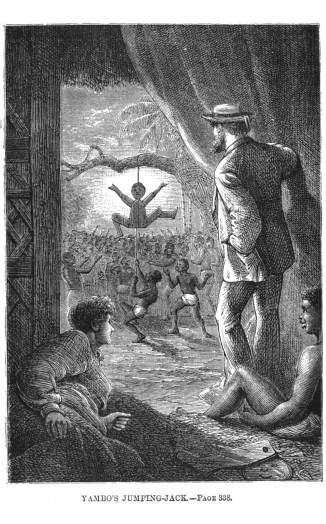
Harold listened and found no difficulty in hearing them, for peals of laughter and shrieks of delight burst forth every few minutes, apparently from a vast crowd outside the hut.
“I do believe,” said Disco, rising and going towards the door of the hut “that you can see ’em from where you lay.”
He drew aside the skin doorway as he spoke, and there, sure enough, was the gigantic jumping-jack hanging from the limb of a tree, clearly defined against the sky, and galvanically kicking about its vast limbs, with Yambo pulling fiercely at the tail, and the entire tribe looking on steeped in ecstasy and admiration.
It may easily be believed that the sight of this, coupled with Disco’s narrative, was almost too much for Harold’s nerves, and for some time he exhibited, to Disco’s horror, a tendency to repeat some antics which would have been much more appropriate to the jumping-jack, but, after a warm drink administered by his faithful though rough nurse, he became composed, and finally dropped into a pleasant sleep, which was not broken till late the following morning.
Refreshed in body, happy in mind, and thankful in spirit he rose to feel that the illness against which he had fought for many days was conquered, and that, although still very weak, he had fairly turned the corner, and had begun to regain some of his wonted health and vigour.
Chapter Twenty.
Harold Appears in a New Character, and Two Old Characters Reappear to Harold.
The mind of Yambo was a strange compound—a curious mixture of gravity and rollicking joviality; at one time displaying a phase of intense solemnity; at another exhibiting quiet pleasantry and humour, but earnestness was the prevailing trait of his character. Whether indulging his passionate fondness for the jumping-jack, or engaged in guiding the deliberations of his counsellors, the earnest chief was equally devoted to the work in hand. Being a savage—and, consequently, led entirely by feeling, which is perhaps the chief characteristic of savage, as distinguished from civilised, man,—he hated his enemies with exceeding bitterness, and loved his friends with all his heart.
Yambo was very tender to Harold during his illness, and the latter felt corresponding gratitude, so that there sprang up between the two a closer friendship than one could have supposed to be possible, considering that they were so different from each other, mentally, physically, and socially, and that their only mode of exchanging ideas was through the medium of a very incompetent interpreter.
Among other things Harold discovered that his friend the chief was extremely fond of anecdotes and stories. He, therefore, while in a convalescent state and unable for much physical exercise, amused himself, and spent much of his time, in narrating to him the adventures of Robinson Crusoe. Yambo’s appetite for mental food increased, and when Crusoe’s tale was finished he eagerly demanded more. Some of his warriors also came to hear, and at last the hut was unable to contain the audiences that wished to enter. Harold, therefore, removed to an open space under a banyan-tree, and there daily, for several hours, related all the tales and narratives with which he was acquainted, to the hundreds of open-eyed and open-mouthed negroes who squatted around him.
At first he selected such tales as he thought would be likely to amuse, but these being soon exhausted, he told them about anything that chanced to recur to his memory. Then, finding that their power to swallow the marvellous was somewhat crocodilish, he gave them Jack the Giant-killer, and Jack of Beanstalk notoriety, and Tom Thumb, Cinderella, etcetera, until his entire nursery stock was exhausted, after which he fell back on his inventive powers; but the labour of this last effort proving very considerable, and the results not being adequately great, he took to history, and told them stories about William Tell, and Wallace, and Bruce, and the Puritans of England, and the Scottish Covenanters, and the discoveries of Columbus, until the eyes and mouths of his black auditors were held so constantly and widely on the stretch, that Disco began to fear they would become gradually incapable of being shut, and he entertained a fear that poor Antonio’s tongue would, ere long, be dried up at the roots.
At last a thought occurred to our hero, which he promulgated to Disco one morning as they were seated at breakfast on the floor of their hut.
“It seems to me, Disco,” he said, after a prolonged silence, during which they had been busily engaged with their knives and wooden spoons, “that illness must be sent sometimes, to teach men that they give too little of their thoughts to the future world.”
“Werry true, sir,” replied Disco, in that quiet matter-of-course tone with which men generally receive axiomatic verities; “we is raither given to be swallered up with this world, which ain’t surprisin’ neither, seein’ that we’ve bin putt into it, and are surrounded by it, mixed up with it, steeped in it, so to speak, an’ can’t werry well help ourselves.”
“That last is just the point I’m not quite so sure about,” rejoined Harold. “Since I’ve been lying ill here, I have thought a good deal about forgetting to bring a Bible with me, and about the meaning of the term Christian, which name I bear; and yet I can’t, when I look honestly at it, see that I do much to deserve the name.”
“Well, I don’t quite see that, sir,” said Disco, with an argumentative curl of his right eyebrow; “you doesn’t swear, or drink, or steal, or commit murder, an’ a many other things o’ that sort. Ain’t that the result o’ your being a Christian.”
“It may be so, Disco, but that is only what may be styled the don’t side of the question. What troubles me is, that I don’t see much on the do side of it.”
“You says your prayers, sir, don’t you?” asked Disco, with the air of a man who had put a telling question.
“Well, yes,” replied Harold; “but what troubles me is that, while in my creed I profess to think the salvation of souls is of such vital importance, in my practice I seem to say that it is of no importance at all, for here have I been, for many weeks, amongst these black fellows, and have never so much as mentioned the name of our Saviour to them, although I have been telling them no end of stories of all kinds, both true and fanciful.”
“There’s something in that sir,” admitted Disco. Harold also thought there was so much in it that he gave the subject a great deal of earnest consideration, and finally resolved to begin to tell the negroes Bible stories. He was thus gradually led to tell them that “old, old story” of God the Saviour’s life and death, and love for man, which he found interested, affected, and influenced the savages far more powerfully than any of the tales, whether true or fanciful, with which he had previously entertained them. While doing this a new spirit seemed to actuate himself, and to influence his whole being.
While Harold was thus led, almost unconsciously, to become a sower of the blessed seed of God’s Word, Marizano was working his way through the country, setting forth, in the most extreme manner, the ultimate results of man’s sinful nature, and the devil’s lies.
One of his first deeds was to visit a village which was beautifully situated on the banks of a small but deep river. In order to avoid alarming the inhabitants, he approached it with only about thirty of his men, twenty of whom were armed. Arrived at the outskirts, he halted his armed men, and advanced with the other ten, calling out cheerfully, “We have things for sale! have you anything to sell?” The chief and his warriors, armed with their bows and arrows and shields, met him, and forbade him to pass within the hedge that encircled the village, but told him to sit down under a tree outside. A mat of split reeds was placed for Marizano to sit on; and when he had explained to the chief that the object of his visit was to trade with him for ivory—in proof of which he pointed to the bales which his men carried,—he was well received, and a great clapping of hands ensued. Presents were then exchanged, and more clapping of hands took place, for this was considered the appropriate ceremony. The chief and his warriors, on sitting down before Marizano and his men, clapped their hands together, and continued slapping on their thighs while handing their presents, or when receiving those of their visitors. It was the African “thank you.” To have omitted it would have been considered very bad manners.
Soon a brisk trade was commenced, in which the entire community became ere long deeply and eagerly absorbed.
Meanwhile Marizano’s armed men were allowed to come forward. The women prepared food for the strangers; and after they had eaten and drunk of the native beer heartily, Marizano asked the chief if he had ever seen fire-arms used.
“Yes,” replied the chief, “but only once at a great distance off. It is told to me that your guns kill very far off—much further than our bows. Is that so?”
“It is true,” replied Marizano, who was very merry by this time under the influence of the beer, as, indeed, were also his men and their entertainers. “Would you like to see what our guns can do?” asked the half-caste. “If you will permit me, I shall let you hear and see them in use.”
The unsuspecting chief at once gave his consent. His visitors rose; Marizano gave the word; a volley was poured forth which instantly killed the chief and twenty of his men. The survivors fled in horror. The young women and children were seized; the village was sacked—which means that the old and useless members of the community were murdered in cold blood, and the place was set on fire—and Marizano marched away with his band of captives considerably augmented, leaving a scene of death and horrible desolation behind him. (See Livingstone’s Zambesi and its Tributaries, pages 201, 202.)
Thus did that villain walk through the land with fire and sword procuring slaves for the supply of the “domestic institution” of the Sultan of Zanzibar.
By degrees the murderer’s drove of black “cattle” increased to such an extent that when he approached the neighbourhood of the village in which Harold and Disco sojourned, he began to think that he had obtained about as many as he could conveniently manage, and meditated turning his face eastward, little dreaming how near he was to a thousand dollars’ worth of property, in the shape of ransom for two white men!
He was on the point of turning back and missing this when he chanced to fall in with a villager who was out hunting, and who, after a hot chase, was captured. This man was made much of, and presented with some yards of cloth as well as a few beads, at the same time being assured that he had nothing to fear; that the party was merely a slave-trading one; that the number of slaves required had been made up, but that a few more would be purchased if the chief of his village had any to dispose of.
On learning from the man that his village was a large one, fully two days’ march from the spot where he stood, and filled with armed men, Marizano came to the conclusion that it would not be worth his while to proceed thither, and was about to order his informant to be added to his gang with a slave-stick round his neck, when he suddenly bethought him of inquiring as to whether any white men had been seen in these parts. As he had often made the same inquiry before without obtaining any satisfactory answer, it was with great surprise that he now heard from his captive of two white men being in the very village about which he had been conversing.
At once he changed his plan, resumed his march, and, a couple of days afterwards, presented himself before the astonished eyes of Harold Seadrift and Disco Lillihammer, while they were taking a walk about a mile from the village.
Disco recognised the slave-trader at once, and, from the troubled as well as surprised look of Marizano, it was pretty evident that he remembered the countenance of Disco.
When the recollection of Marizano’s cruelty at the time of their first meeting flashed upon him, Disco felt an almost irresistible desire to rush upon and strangle the Portuguese, but the calm deportment of that wily man, and the peaceful manner in which he had approached, partly disarmed his wrath. He could not however, quite restrain his tongue.
“Ha!” said he, “you are the blackguard that we met and pretty nigh shot when we first came to these parts, eh? Pity we missed you, you black-hearted villain!”
As Marizano did not understand English, these complimentary remarks were lost on him. He seemed, however, to comprehend the drift of them, for he returned Disco’s frown with a stare of defiance.
“Whatever he was, or whatever he is,” interposed Harold, “we must restrain ourselves just now, Disco, because we cannot punish him as he deserves, however much we may wish to, and he seems to have armed men enough to put us and our entertainers completely in his power. Keep quiet while I speak to him.”
Jumbo and Antonio, armed with bows and arrows,—for they were in search of small game wherewith to supply the pot—came up, looking very much surprised, and the latter a good deal frightened.
“Ask him, Antonio,” said Harold, “what is his object in visiting this part of the country.”
“To procure slaves,” said Marizano, curtly.
“I thought so,” returned Harold; “but he will find that the men of this tribe are not easily overcome.”
“I do not wish to overcome them,” said the half-caste. “I have procured enough of slaves, as you see,” (pointing to the gang which was halted some hundred yards or so in rear of his armed men), “but I heard that you were prisoners here, and I have come to prove to you that even a slave-trader can return good for evil. You did this,” he said, looking at Disco, and pointing to his old wound in the arm; “I now come to deliver you from slavery.”
Having suppressed part of the truth, and supplemented the rest of it with this magnificent lie, Marizano endeavoured to look magnanimous.
“I don’t believe a word of it,” said Disco, decidedly.
“I incline to doubt it too,” said Harold; “but he may have some good reason of his own for his friendly professions towards us. In any case we have no resource left but to assume that he speaks the truth.”
Turning to Marizano, he said:—
“We are not prisoners here. We are guests of the chief of this village.”
“In that case,” replied the half-caste, “I can return to the coast without you.”
As he said this a large band of the villagers, having discovered that strangers had arrived, drew near. Marizano at once advanced, making peaceful demonstrations, and, after the requisite amount of clapping of hands on both sides, stated the object for which he had come. He made no attempt to conceal the fact that he was a slave-trader, but said that, having purchased enough of slaves, he had visited their village because of certain rumours to the effect that some white men had been lost in these regions, and could not find their way back to the coast. He was anxious, he said, to help these white men to do so, but, finding that the white men then at the village were not the men he was in search of, and did not want to go to the coast, he would just stay long enough with the chief to exchange compliments, and then depart.
All this was translated to the white men in question by their faithful ally Antonio, and when they retired to consult as to what should be done, they looked at each other with half amused and half perplexed expressions of countenance.
“Werry odd,” said Disco, “how contrairy things turns up at times!”
“Very odd indeed,” assented Harold, laughing. “It is quite true that we are, in one sense, lost and utterly unable to undertake a journey through this country without men, means, or arms; and nothing could be more fortunate than that we should have the chance, thus suddenly thrown in our way, of travelling under the escort of a band of armed men; nevertheless, I cannot bear the idea of travelling with or being indebted to a slave-trader and a scoundrel like Marizano.”
“That’s w’ere it is, sir,” said Disco with emphasis, “I could stand anything a’most but that.”
“And yet,” pursued Harold, “it is our only chance. I see quite well that we may remain for years here without again having such an opportunity or such an escort thrown in our way.”
“There’s no help for it, I fear,” said Disco. “We must take it like a dose o’ nasty physic—hold our nobs, shut our daylights, an’ down with it. The only thing I ain’t sure of is your ability to travel. You ain’t strong yet.”
“Oh, I’m strong enough now, or very nearly so, and getting stronger every day. Well, then, I suppose it’s settled that we go?”
“Humph! I’m agreeable, an’ the whole business werry disagreeable,” said Disco, making a wry face.
Marizano was much pleased when the decision of the white men was made known to him, and the native chief was naturally much distressed, for, not only was he about to lose two men of whom he had become very fond, but he was on the point of being bereft of his story-teller, the opener up of his mind, the man who, above all others, had taught him to think about his Maker and a future state.
He had sense enough, however, to perceive that his guests could not choose but avail themselves of so good an opportunity, and, after the first feeling of regret was over, made up his mind to the separation.
Next day Harold and Disco, with feelings of strong revulsion, almost of shame, fell into the ranks of the slave-gang, and for many days thereafter marched through the land in company with Marizano and his band of lawless villains.
Marizano usually walked some distance ahead of the main body with a few trusty comrades. Our adventurers, with their two followers, came next in order of march, the gang of slaves in single file followed, and the armed men brought up the rear. It was necessarily a very long line, and at a distance resembled some hideous reptile crawling slowly and tortuously through the fair fields and plains of Africa.
At first there were no stragglers, for the slaves were as yet, with few exceptions, strong and vigorous. These exceptions, and the lazy, were easily kept in the line by means of rope and chain, as well as the rod and lash.
Harold and Disco studiously avoided their leader during the march. Marizano fell in with their humour and left them to themselves. At nights they made their own fire and cooked their own supper, as far removed from the slave camp as was consistent with safety, for they could not bear to witness the sufferings of the slaves, or to look upon their captors. Even the food that they were constrained to eat appeared to have a tendency to choke them, and altogether their situation became so terrible that they several times almost formed the desperate resolution of leaving the party and trying to reach the coast by themselves as they best might, but the utter madness and hopelessness of such a project soon forced itself on their minds, and insured its being finally abandoned.
One morning Marizano threw off his usual reserve, and, approaching the white men, told them that in two hours they would reach the lake where his employer was encamped.
“And who is your master?” asked Harold.
“A black-faced or yellow-faced blackguard like himself, I doubt not,” growled Disco.
Antonio put Harold’s question without Disco’s comment, and Marizano replied that his master was an Arab trader, and added that he would push on in advance of the party and inform him of their approach.
Soon afterwards the lake was reached. A large dhow was in readiness, the gang was embarked and ferried across to a place where several rude buildings and barracoons, with a few tents, indicated that it was one of the inland headquarters of the trade in Black Ivory.
The moment our travellers landed Marizano led them to one of the nearest buildings, and introduced them to his master.
“Yoosoof!” exclaimed Disco in a shout of astonishment.
It would have been a difficult question to have decided which of the three faces displayed the most extreme surprise. Perhaps Disco’s would have been awarded the palm, but Yoosoof was undoubtedly the first to regain his self-possession.
“You be surprised,” he said, in his very broken English, while his pale-yellow visage resumed its placid gravity of expression.
“Undoubtedly we are,” said Harold.
“Bu’stin’!” exclaimed Disco.
“You would be not so mush surprised,—did you know dat I comes to here every year, an’ dat Engleesh consul ask me for ’quire about you.”
“If that be so, how comes it that you were surprised to see us?” asked Harold.
“’Cause why, I only knows dat some white mans be loss theirselfs—not knows what mans—not knows it was you.”
“Well now,” cried Disco, unable to restrain himself as he turned to Harold, “did ever two unfortnits meet wi’ sitch luck? Here have we bin’ obliged for days to keep company with the greatest Portugee villian in the country, an’ now we’re needcessitated to be under a obligation to the greatest Arab scoundrel in Afriky.”
The scoundrel in question smiled and shrugged his shoulders.
“Yoosoof,” cried Disco, clenching his fist and looking full in the trader’s eyes, “when I last saw yer ugly face, I vowed that if ever I seed it again I’d leave my mark on it pretty deep, I did; and now I does see it again, but I haven’t the moral courage to touch sitch a poor, pitiful, shrivelled-up package o’ bones an’ half-tanned leather. Moreover, I’m goin’ to be indebted to ’ee! Ha! ha!” (he laughed bitterly, and with a dash of wild humour in the tone), “to travel under yer care, an’ eat yer accursed bread, and—and—oh! there ain’t no sitch thing as shame left in my corpus. I’m a low mean-spirited boastful idiot, that’s wot I am, an’ I don’t care the fag-end of a hunk o’ gingerbread who knows it.”
After this explosion the sorely tried mariner brought his right hand down on his thigh with a tremendous crack, turned about and walked away to cool himself.
Chapter Twenty One.
Progress of the Slave-Run—The Deadly Swamp, and the Unexpected Rescue.
We will now leap over a short period of time—about two or three weeks—during which the sable procession had been winding its weary way over hill and dale, plain and swamp.
During that comparatively brief period, Harold and Disco had seen so much cruelty and suffering that they both felt a strange tendency to believe that the whole must be the wild imaginings of a horrible dream. Perhaps weakness, resulting from illness, might have had something to do with this peculiar feeling of unbelief, for both had been subject to a second, though slight, attack of fever. Nevertheless, coupled with their scepticism was a contradictory and dreadful certainty that they were not dreaming, but that what they witnessed was absolute verity.
It is probable that if they had been in their ordinary health and vigour they would have made a violent attempt to rescue the slaves, even at the cost of their own lives. But severe and prolonged illness often unhinges the mind as well as the body, and renders the spirit all but impotent.
One sultry evening the sad procession came to a long stretch of swamp, and prepared to cross it. Although already thinned by death, the slave-gang was large. It numbered several hundreds, and was led by Marizano; Yoosoof having started some days in advance in charge of a similar gang.
Harold and Disco were by that time in the habit of walking together in front of the gang, chiefly for the purpose of avoiding the sight of cruelties and woes which they were powerless to prevent or assuage. On reaching the edge of the swamp, however, they felt so utterly wearied and dis-spirited that they sat down on a bank to rest, intending to let the slave-gang go into the swamp before them and then follow in rear. Antonio and Jumbo also remained with them.
“You should go on in front,” said Marizano significantly, on observing their intention.
“Tell him we’ll remain where we are,” said Disco sternly to Antonio.
Marizano shrugged his shoulders and left them.
The leading men of the slave-gang were ordered to advance, as soon as the armed guard had commenced the toilsome march over ground into which they sank knee-deep at every step.
The first man of the gang hesitated and heaved a deep sigh as though his heart failed him at the prospect—and well it might, for, although young, he was not robust, and over-driving, coupled with the weight and the chafing of the goree, had worn him to a skeleton.
It was not the policy of the slave-traders to take much care of their Black Ivory. They procured it so cheaply that it was easier and more profitable to lose or cast away some of it, than to put off time in resting and recruiting the weak.
The moment it was observed, therefore, that the leading man hesitated, one of the drivers gave him a slash across his naked back with a heavy whip which at once drew blood. Poor wretch; he could ill bear further loss of the precious stream of life, for it had already been deeply drained from him by the slave-stick. The chafing of that instrument of torture had not only worn the skin off his shoulders, but had cut into the quivering flesh, so that blood constantly dropped in small quantities from it.
No cry burst from the man’s lips on receiving the cruel blow, but he turned his eyes on his captors with a look that seemed to implore for mercy. As well might he have looked for mercy at the hands of Satan. The lash again fell on him with stinging force. He made a feeble effort to advance, staggered, and fell to the ground, dragging down the man to whom he was coupled with such violence as almost to break his neck. The lash was again about to be applied to make him rise, but Disco and Harold rose simultaneously and rushed at the driver, with what intent they scarcely knew; but four armed half-castes stepped between them and the slave.
“You had better not interfere,” said Marizano, who stood close by.
“Out of the way!” cried Harold fiercely, in the strength of his passion hurling aside the man who opposed him.
“You shan’t give him another cut,” said Disco between his teeth, as he seized the driver by the throat.
“We don’t intend to do so,” said Marizano coolly, while the driver released himself from poor Disco’s weakened grasp, “he won’t need any more.”
The Englishmen required no explanation of these words. A glance told them that the man was dying.
“Cut him out,” said Marizano.
One of his men immediately brought a saw and cut the fork of the stick which still held the living to the dying man, and which, being riveted on them, could not otherwise be removed.
Harold and Disco lifted him up as soon as he was free, and carrying him a short distance aside to a soft part of the bank, laid him gently down.
The dying slave looked as if he were surprised at such unwonted tenderness. There was even a slight smile on his lips for a few moments, but it quickly passed away with the fast ebbing tide of life.
“Go fetch some water,” said Harold. “His lips are dry.”
Disco rose and ran to fill a small cocoa-nut-shell which he carried at his girdle as a drinking-cup. Returning with it he moistened the man’s lips and poured a little of the cool water on the raw sores on each side of his neck.
They were so much engrossed with their occupation that neither of them observed that the slave-gang had commenced to pass through the swamp, until the sharp cry of a child drew their attention to it for a moment; but, knowing that they could do no good, they endeavoured to shut their eyes and ears to everything save the duty they had in hand.
By degrees the greater part of the long line had got into the swamp and were slowly toiling through it under the stimulus of the lash. Some, like the poor fellow who first fell, had sunk under their accumulated trials, and after a fruitless effort on the part of the slavers to drive them forward, had been kicked aside into the jungle, there to die, or to be torn in pieces by that ever-watchful scavenger of the wilderness, the hyena. These were chiefly women, who having become mothers not long before were unable to carry their infants and keep up with the gang. Others, under the intense dread of flagellation, made the attempt, and staggered on a short distance, only to fall and be left behind in the pestilential swamp, where rank reeds and grass closed over them and formed a ready grave.
The difficulties of the swamp were, however, felt most severely by the children, who, from little creatures of not much more than five years of age to well-grown boys and girls, were mingled with and chained to the adults along the line. Their comparatively short legs were not well adapted for such ground, and not a few of them perished there; but although the losses here were terribly numerous in one sense, they after all bore but a small proportion to those whose native vigour carried them through in safety.
Among the men there were some whose strength of frame and fierce expression indicated untameable spirits—men who might have been, probably were, heroes among their fellows. It was for men of this stamp that the goree, or slave-stick, had been invented, and most effectually did that instrument serve its purpose. Samson himself would have been a mere child in it.
There were men in the gang quite as bold, if not as strong, as Samson. One of these, a very tall and powerful negro, on drawing near to the place where Marizano stood superintending the passage, turned suddenly aside, and, although coupled by the neck to a fellow-slave, and securely bound at the wrists with a cord, which was evidently cutting into his swelled flesh, made a desperate kick at the half-caste leader.
Although the slave failed to reach him, Marizano was so enraged that he drew a hatchet from his belt and instantly dashed out the man’s brains. He fell dead without even a groan. Terrified by this, the rest passed on more rapidly, and there was no further check till a woman in the line, with an infant on her back, stumbled, and, falling down, appeared unable to rise.
“Get up!” shouted Marizano, whose rage had rather been increased than abated by the murder he had just committed.
The woman rose and attempted to advance, but seemed ready to fall again. Seeing this, Marizano plucked the infant from her back, dashed it against a tree, and flung its quivering body into the jungle, while a terrible application of the lash sent the mother shrieking into the swamp. (See Livingstone’s Zambesi and its Tributaries, page 857; and for a record of cruelties too horrible to be set down in a book like this, we refer the reader to McLeod’s Travels in Eastern Africa, volume two page 26. Also to the Appendix of Captain Sulivan’s Dhow-Chasing in Zanzibar Waters, which contains copious and interesting extracts from evidence taken before the Select Committee of the House of Commons.)
Harold and Disco did not witness this, though they heard the shriek of despair, for at the moment the negro they were tending was breathing his last. When his eyes had closed and the spirit had been set free, they rose, and, purposely refraining from looking back, hurried away from the dreadful scene, intending to plunge into the swamp at some distance from the place, and push on until they should regain the head of the column.
“Better if we’d never fallen behind, sir,” said Disco, in a deep, tremulous voice.
“True,” replied Harold. “We should have been spared these sights, and the pain of knowing that we cannot prevent this appalling misery and cruelty.”
“But surely it is to be prevented somehow,” cried Disco, almost fiercely. “Many a war that has cost mints o’ money has been carried on for causes that ain’t worth mentionin’ in the same breath with this!”
As Harold knew not what to say, and was toiling knee-deep in the swamp at the moment he made no reply.
After marching about half an hour he stopped abruptly and said, with a heavy sigh,—“I hope we haven’t missed our way?”
“Hope not sir, but it looks like as if we had.”
“I’ve bin so took up thinkin’ o’ that accursed traffic in human bein’s that I’ve lost my reckonin’. Howsever, we can’t be far out, an’, with the sun to guide us, we’ll—”
He was stopped by a loud halloo in the woods, on the belt of the swamp.
It was repeated in a few seconds, and Antonio, who, with Jumbo, had followed his master, cried in an excited tone—
“Me knows dat sound!”
“Wot may it be, Tony?” asked Disco.
There was neither time nor need for an answer, for at that moment a ringing cry, something like a bad imitation of a British cheer, was heard, and a band of men sprang out of the woods and ran at full speed towards our Englishmen.