W. H. HUDSON, (continued 3)
Reading edition
158 BIRDS IN TOWN AND VILLAGE
ing. On the other side of the hedge in which the bird sat concealed was a cottage garden, and there on a swing fastened to a pair of apple trees, a girl about eleven years old sat lazily swinging herself. Once or twice after she began singing the nightingale broke out again, and then at last he became silent altogether, his voice overpowered by hers. Girl and bird were not five yards apart. It greatly surprised me to hear her singing, for it was eleven o'clock, when all the village children were away at the National School, a time of day when, so far as human sounds were concerned, there reigned an almost unbroken silence. But very soon I recalled the fact that this was a very lazy child, and concluded that she had coaxed her mother into sending an excuse for keeping her at home, and so had kept her liberty on this beautiful morning. About two minutes' walk from the cottage, at the side of the crooked road running through the village, there was a group of ancient pollarded elm trees with huge, hollow trunks, and behind them an open space, a pleasant green slope, where some of the village children used to go every day to play on the grass. Here I used to see this girl lying in the sun, her dark
BIRDS IN A VILLAGE 159
chestnut hair loosed and scattered on the sward, her arms stretched out, her eyes nearly closed, basking in the sun, as happy as some heat-loving wild animal. No, it was not strange that she had not gone to school with the others when her disposition was remembered, but most strange to hear a voice of such quality in a spot where nature was rich and lovely, and only man was, if not vile, at all events singularly wanting in the finer human qualities.
Looking out from the open window across the low hedge-top, I could see her as she alternately rose and fell with slow, indolent motion, now waist-high above the green dividing wall, then only her brown head visible resting against the rope just where her hand had grasped it. And as she swayed herself to and fro she sang that simple melody--probably some child's hymn which she had been taught at the Sunday-school; but it was a very long hymn, or else she repeated the same few stanzas many times, and after each there was a brief pause, and then the voice that seemed to fall and rise with the motion went on as before. I could have stood there for an hour--nay, for hours--listening to it, so fresh and
160 BIRDS IN TOWN AND VILLAGE
so pure was the clear young voice, which had no earthly trouble in it, and no passion, and was in this like the melody of the birds of which I had lately heard so much; and with it all that tenderness and depth which is not theirs, but is human only and of the soul.
It struck me as a singular coincidence--and to a mind of so primitive a type as the writer's there is more in the fact that the word implies--that, just as I had quitted London, to seek for just such a spot as I so speedily found, with the passionately exclaimed words of a young London girl ringing in my ears, so now I went back with this village girl's melody sounding and following me no less clearly and insistently. For it was not merely remembered, as we remember most things, but vividly and often reproduced, together with the various melodies of the birds I had listened to; a greater and principal voice in that choir, yet in no wise lessening their first value, nor ever out of harmony with them.

EXOTIC BIRDS FOR BRITAIN
THERE are countries with a less fertile soil and a worse climate than ours, yet richer in bird life. Nevertheless, England is not poor; the species are not few in number, and some are extremely abundant. Unfortunately many of the finer kinds have been too much sought after; persecuted first for their beauty, then for their rarity, until now we are threatened with their total destruction. As these kinds become unobtainable, those which stand next in the order of beauty and rarity are persecuted in their turn; and in a country as densely populated as ours, where birds cannot hide themselves from human eyes, such persecution must eventually cause their extinction. Meanwhile the bird population does not decrease. Every place in nature, like every property in
161
162 BIRDS IN TOWN AND VILLAGE
Chancery, has more than one claimant to it--sometimes the claimants are many--and so long as the dispute lasts all live out of the estate. For there are always two or more species subsisting on the same kind of food, possessing similar habits, and frequenting the same localities. It is consequently impossible for man to exterminate any one species without indirectly benefiting some other species, which attracts him in a less degree, or not at all. This is unfortunate, for as the bright kinds, or those we esteem most, diminish in numbers the less interesting kinds multiply, and we lose much of the pleasure which bird life is fitted to give us. When we visit woods, or other places to which birds chiefly resort, in districts uninhabited by man, or where he pays little or no attention to the feathered creatures, the variety of the bird life encountered affords a new and peculiar delight. There is a constant succession of new forms and new voices; in a single day as many species may be met with as one would find in England by searching diligently for a whole year.
And yet this may happen in a district possessing no more species than England boasts; and the
EXOTIC BIRDS FOR BRITAIN 163
actual number of individuals may be even less than with us. In sparrows, for instance, of the one common species, we are exceedingly rich; but in bird life generally, in variety of birds, especially in those of graceful forms and beautiful plumage, we have been growing poorer for the last fifty years, and have now come to so low a state that it becomes us to inquire whether it is not in our power to better ourselves. It is an old familiar truth--a truism--that it is easier to destroy than to restore or build up; nevertheless, some comfort is to be got from the reflection that in this matter we have up till now been working against Nature. She loves not to bring forth food where there are none to thrive on it; and when our unconsidered action had made these gaps, when, despising her gifts or abusing them, we had destroyed or driven out her finer kinds, she fell back on her lowlier kinds--her reserve of coarser, more generalized species--and gave them increase, and bestowed the vacant places which we had created on them. What she has done she will undo, or assist us in undoing; for we should be going back to her methods, and should have her with and not against us. Much might yet be
164 BIRDS IN TOWN AND VILLAGE
done to restore the balance among our native species. Not by legislation, albeit all laws restraining the wholesale destruction of bird life are welcome. On this subject the Honourable Auberon Herbert has said, and his words are golden: "For myself, legislation or no legislation, I would turn to the friends of animals in this country, and say, 'If you wish that the friendship between man and animals should become a better and truer thing than it is at present, you must make it so by countless individual efforts, by making thousands of centres of personal influence.'"
The subject is a large one. In this paper the question of the introduction of exotic birds will be chiefly considered. Birds have been blown by the winds of chance over the whole globe, and have found rest for their feet. That a large number of species, suited to the conditions of this country, exist scattered about the world is not to be doubted, and by introducing a few of these we might accelerate the change so greatly to be desired. At present a very considerable amount of energy is spent in hunting down the small contingents of rare species that once inhabited our
EXOTIC BIRDS FOR BRITAIN 165
islands, and still resort annually to its shores, persistently endeavouring to re-establish their colonies. A less amount of labour and expense would serve to introduce a few foreign species each year, and the reward would be greater, and would not make us ashamed. We have generously given our own wild animals to other countries; and from time to time we receive cheering reports of an abundant increase in at least two of our exportations--to wit, the rabbit and the sparrow. We are surely entitled to some return. Dead animals, however rich their pelt or bright their plumage may be, are not a fair equivalent. Dead things are too much with us. London has become a mart for this kind of merchandise for the whole of Europe, and the traffic is not without a reflex effect on us; for life in the inferior animals has come or is coming to be merely a thing to be lightly taken by human hands, in order that its dropped garment may be sold for filthy lucre. There are warehouses in this city where it is possible for a person to walk ankle-deep--literally to wade--in bright-plumaged bird-skins, and see them piled shoulder-high on either side of him--a sight to make the angels weep I
166 BIRDS IN TOWN AND VILLAGE
Not the angel called woman. It is not that she is naturally more cruel than man; bleeding wounds and suffering in all its forms, even the sigh of a burdened heart, appeal to her quick sympathies, and draw the ready tears; but her imagination helps her less. The appeal must in most cases be direct and through the medium of her senses, else it is not seen and not heard. If she loves the ornament of a gay-winged bird, and is able to wear it with a light heart, it is because it calls up no mournful image to her mind; no little tragedy enacted in some far-off wilderness, of the swift child of the air fallen and bleeding out its bright life, and its callow nestlings, orphaned of the breast that warmed them, dying of hunger in the tree. We know, at all events, that out of a female population of many millions in this country, so far only ten women, possibly fifteen, have been found to raise their voices--raised so often and so loudly on other questions--to protest against the barbarous and abhorrent fashion of wearing slain birds as ornaments. The degrading business of supplying the demand for this kind of feminine adornment must doubtless continue to flourish in our midst, commerce not
EXOTIC BIRDS FOR BRITAIN 167
being compatible with morality, but the material comes from other lands, unblessed as yet with Wild Bird Protection Acts, and "individual efforts, and thousands of centres of personal influence"; it comes mainly from the tropics, where men have brutish minds and birds a brilliant plumage. This trade, therefore, does not greatly affect the question of our native bird life, and the consideration of the means, which may be within our reach, of making it more to us than it now is. Some species from warm and even hot climates have been found to thrive well in England, breeding in the open air; as, for instance, the black and the black-necked swans, the Egyptian goose, the mandarin and summer ducks, and others too numerous to mention. But these birds are semi-domestic, and are usually kept in enclosures, and that they can stand the climate and propagate when thus protected from competition is not strange; for we know that several of our hardy domestic birds--the fowl, pea-fowl, Guinea-fowl, and Muscovy duck--are tropical in their origin. Furthermore, they are all comparatively large, and if they ever become feral in England, it will not be for many years to come.
168 BIRDS IN TOWN AND VILLAGE
That these large kinds thrive so well with us is an encouraging fact; but the question that concerns us at present is the feasibility of importing birds of the grove, chiefly of the passerine order, and sending them forth to give a greater variety and richness to our bird life. To go with such an object to tropical countries would only be to court failure. Nature's highest types, surpassing all others in exquisite beauty of form, brilliant colouring, and perfect melody, can never be known to our woods and groves. These rarest avian gems may not be removed from their setting, and to those who desire to know them in their unimaginable lustre, it will always be necessary to cross oceans and penetrate into remote wildernesses. We must go rather to regions where the conditions of life are hard, where winters are long and often severe, where Nature is not generous in the matter of food, and the mouths are many, and the competition great. Nor even from such regions could we take any strictly migratory species with any prospect of success. Still, limiting ourselves to the resident, and consequently to the hardiest kinds, and to those possessing only a partial migration, it is surprising to find how
EXOTIC BIRDS FOR BRITAIN 169
many there are to choose from, how many are charming melodists, and how many have the bright tints in which our native species are so sadly lacking. The field from which the supply can be drawn is very extensive, and includes the continent of Europe, the countries of North Asia, a large portion of North America and Antarctic America, or South Chili and Patagonia. It would not be going too far to say that for every English species, inhabiting the garden, wood, field, stream, or waste, at least half a dozen resident species, with similar habits, might be obtained from the countries mentioned which would be superior to our own in melody (the nightingale and lark excepted), bright plumage, grace of form, or some other attractive quality. The question then arises; What reason is there for believing that these exotics, imported necessarily in small numbers, would succeed in winning a footing in our country, and become a permanent addition to its avifauna? For it has been admitted that our species are not few, in spite of the losses that have been suffered, and that the bird population does not diminish, however much its character may have altered and
170 BIRDS IN TOWN AND VILLAGE
deteriorated from the aesthetic point of view, and probably also from the utilitarian. There are no vacant places. Thus, the streams are fished by herons, grebes, and kingfishers, while the rushy margins are worked by coots and gallinules, and, above the surface, reed and sedge-warblers, with other kinds, inhabit the reed-beds. The decaying forest tree is the province of the woodpecker, of which there are three kinds; and the trunks and branches of all trees, healthy or decaying, are quartered by the small creeper, that leaves no crevice unexplored in its search for minute insects and their eggs. He is assisted by the nuthatch; and in summer the wryneck comes (if he still lives), and deftly picks up the little active ants that are always wildly careering over the boles. The foliage is gleaned by warblers and others; and not even the highest terminal twigs are left unexamined by tits and their fellow-seekers after little things. Thrushes seek for worms in moist grounds about the woods; starlings and rooks go to the pasture lands; the lark and his relations keep to the cultivated fields; and there also dwells the larger partridge. Waste and stony grounds are occupied by the chats, and even on the barren
EXOTIC BIRDS FOR BRITAIN 171
mountain summits the ptarmigan gets his living. Wagtails run on the clean margins of streams; and littoral birds of many kinds are in possession of the entire sea-coast. Thus, the whole ground appears to be already sufficiently occupied, the habitats of distinct species overlapping each other like the scales on a fish. And when we have enumerated all these, we find that scores of others have been left out. The important fly-catcher; the wren, Nature's diligent little housekeeper, that leaves no dusty corner uncleaned; and the pigeons, that have a purely vegetable diet. The woods and thickets are also ranged by jays, cuckoos, owls, hawks, magpies, butcher-birds--Nature's gamekeepers, with a licence to kill, which, after the manner of game-keepers, they exercise somewhat indiscriminately. Above the earth, the air is peopled by swifts and swallows in the daytime, and by goatsuckers at night. And, as if all these were not enough, the finches are found scattered everywhere, from the most secluded spot in nature to the noisy public thoroughfare, and are eaters of most things, from flinty seed to softest caterpillar. This being the state of things, one might imagine that experience and
172 BIRDS IN TOWN AND VILLAGE
observation are scarcely needed to prove to us that the exotic, strange to the conditions, and where its finest instincts would perhaps be at fault, would have no chance of surviving. Nevertheless, odd as it may seem, the small stock of facts bearing on the subject which we possess point to a contrary conclusion. It might have been assumed, for instance, that the red-legged partridge would never have established itself with us, where the ground was already fully occupied by a native species, which possessed the additional advantage of a more perfect protective colouring. Yet, in spite of being thus handicapped, the stranger has conquered a place, and has spread throughout the greater part of England. Even more remarkable is the case of the pheasant, with its rich plumage, a native of a hot region; yet our cold, wet climate and its unmodified bright colours have not been fatal to it, and practically it is one of our wild birds. The large capercailzie has also been successfully introduced from Norway. Small birds would probably become naturalized much more readily than large ones; they are volatile, and can more quickly find suitable feeding-ground, and safe
EXOTIC BIRDS FOR BRITAIN 173
roosting and nesting places; their food is also more abundant and easily found; their small size, which renders them inconspicuous, gives them safety; and, finally, they are very much more adaptive than large birds.
It is not at all probable that the red-legged partridge will ever drive out our own bird, a contingency which some have feared. That would be a misfortune, for we do not wish to change one bird for another, or to lose any species we now possess, but to have a greater variety. We are better off with two partridges than we were with one, even if the invader does not afford such good sport nor such delicate eating. They exist side by side, and compete with each other; but such competition is not necessarily destructive to either. On the contrary, it acts and re-acts healthily and to the improvement of both. It is a fact that in small islands, very far removed from the mainland, where the animals have been exempt from all foreign competition--that is, from the competition of casual colonists--when it does come it proves, in many cases, fatal to them. Fortunately, this country's large size and nearness to the mainland has prevented any such
174 BIRDS IN TOWN AND VILLAGE
fatal crystallization of its organisms as we see in islands like St. Helena. That any English species would be exterminated by foreign competition is extremely unlikely; whether we introduce exotic birds or not, the only losses we shall have to deplore in the future will, like those of the past, be directly due to our own insensate action in slaying every rare and beautiful thing with powder and shot. From the introduction of exotic species nothing is to be feared, but much to be hoped.
There is another point which should not be overlooked. It has after all become a mere fiction to say that all places are occupied. Nature's nice order has been destroyed, and her kingdom thrown into the utmost confusion; our action tends to maintain the disorderly condition, while she is perpetually working against us to re-establish order. When she multiplies some common, little-regarded species to occupy a space left vacant by an artificially exterminated kind, the species called in as a mere stop-gap, as it were, is one not specially adapted in structure and instincts to a particular mode of life, and consequently cannot fully and effectually occupy the
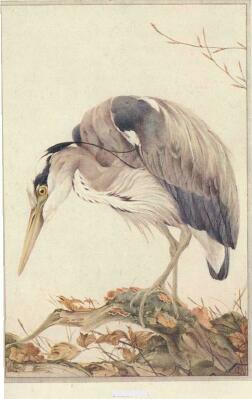
HERON.
. . . the streams are fished by herons.'
EXOTIC BIRDS FOR BRITAIN 175
ground into which it has been permitted to enter. To speak in metaphor, it enters merely as a caretaker or ignorant and improvident steward in the absence of the rightful owner. Again, some of our ornamental species, which are fast diminishing, are fitted from their peculiar structure and life habits to occupy places in nature which no other kinds, however plastic they may be, can even partially fill. The wryneck and the woodpecker may be mentioned; and a still better instance is afforded by the small, gem-like kingfisher
--the only British bird which can properly be described as gem-like. When the goldfinch goes
--and we know that he is going rapidly--other coarser fringilline birds, without the melody, brightness, and charm of the goldfinch--sparrow and bunting--come in, and in some rough fashion supply its place; but when the kingfisher disappears an important place is left absolutely vacant, for in this case there is no coarser bird of homely plumage with the fishing instinct to seize upon it. Here, then, is an excellent opportunity for an experiment. In the temperate regions of the earth there are many fine kingfishers to select from; some are resident in countries colder than
176 BIRDS IN TOWN AND VILLAGE
England, and are consequently very hardy; and in some cases the rivers and streams they frequent are exceedingly poor in fish. Some of them are very beautiful, and they vary in size from birds no larger than a sparrow to others as large as a pigeon.
Anglers might raise the cry that they require all the finny inhabitants of our waters for their own sport. It is scarcely necessary to go as deeply into the subject as mathematical-minded Mudie did to show that Nature's lavishness in the production of life would make such a contention unreasonable. He demonstrated that if all the fishes hatched were to live their full term, in twenty-four years their production power would convert into fish (two hundred to the solid foot) as much matter as there is contained in the whole solar system--sun, planets, and satellites! An "abundantly startling" result, as he says. To be well within the mark, ninety-nine out of every hundred fishes hatched must somehow perish during that stage when they are nothing but suitable morsels for the kingfisher, to be swallowed entire; and a portion of all this wasted food might very well go to sustain a few species, which would be
EXOTIC BIRDS FOR BRITAIN 177
beautiful ornaments of the waterside, and a perpetual delight to all lovers of rural nature, including anglers. It may be remarked in passing, that the waste of food, in the present disorganized state of nature, is not only in our streams.
The introduction of one or more of these lovely foreign kingfishers would not certainly have the effect of hastening the decline of our native species; but indirectly it might bring about a contrary result--a subject to be touched on at the end of this paper. Practical naturalists may say that kingfishers would be far more difficult to procure than other birds, and that it would be almost impossible to convey them to England. That is a question it would be premature to discuss now; but if the attempt should ever be made, the difficulties would not perhaps be found insuperable. In all countries one hears of certain species of birds that they invariably die in captivity; but when the matter is closely looked into, one usually finds that improper treatment and not loss of liberty is the cause of death. Unquestionably it would be much more difficult to keep a kingfisher alive and healthy during a long sea-voyage than a common seed-eating bird; but the
178 BIRDS IN TOWN AND VILLAGE
same may be said of woodpeckers, cuckoos, warblers, and, in fact, of any species that subsists in a state of nature on a particular kind of animal food. Still, when we find that even the excessively volatile humming-bird, which subsists on the minutest insects and the nectar of flowers, and seems to require unlimited space for the exercise of its energies, can be successfully kept confined for long periods and conveyed to distant countries, one would imagine that it would be hard to set a limit to what might be done in this direction. We do not want hard-billed birds only. We require, in the first place, variety; and, secondly, that every species introduced, when not of type unlike any native kind, as in the case of the pheasant, shall be superior in beauty, melody, or some other quality, to its British representative, or to the species which comes nearest to it in structure and habits. Thus, suppose that the introduction of a pigeon should be desired. We know that in all temperate regions, these birds vary as little in colour and markings as they do in form; but in the vocal powers of different species there is great diversity; and the main objects would therefore be to secure a bird which
EXOTIC BIRDS FOR BRITAIN 179
would be an improvement in this respect on the native kinds. There are doves belonging to the same genus as stock-dove and wood-pigeon, that have exceedingly good voices, in which the peculiar mournful dove-melody has reached its highest perfection--weird and passionate strains, surging and ebbing, and startling the hearer with their mysterious resemblance to human tones. Or a Zenaida might be preferred for its tender lament, so wild and exquisitely modulated, like sobs etherealized and set to music, and passing away in sigh-like sounds that seem to mimic the aerial voices of the wind.
When considering the character of our bird population with a view to its improvement, one cannot but think much, and with a feeling almost of dismay, of the excessive abundance of the sparrow. A systematic persecution of this bird would probably only serve to make matters worse, since its continued increase is not the cause but an effect of a corresponding decrease in other more useful and attractive species; and if Nature is to have her way at all there must be birds; and besides, no bird-lover has any wish at see such a thing attempted. The sparrow has
180 BIRDS IN TOWN AND VILLAGE
his good points, if we are to judge him as we find him, without allowing what the Australians and Americans say of him to prejudice our minds. Possibly in those distant countries he may be altogether bad, resembling, in this respect, some of the emigrants of our species, who, when they go abroad, leave their whole stock of morality at home. Even with us Miss Ormerod is exceedingly bitter against him, and desires nothing less than his complete extirpation; but it is possible that this lady's zeal may not be according to knowledge, that she may not know a sparrow quite so well as she knows a fly. At all events, the ornithologist finds it hard to believe that so bad an insect-catcher is really causing the extinction of any exclusively insectivorous species. On her own very high authority we know that the insect supply is not diminishing, that the injurious kinds alone are able to inflict an annual loss equal to £10,000,000 on the British farmer. To put aside this controversial matter, the sparrow with all his faults is a pleasant merry little fellow; in many towns he is the sole representative of wild bird life, and is therefore a great deal to us--especially in the metropolis, in which he most
EXOTIC BIRDS FOR BRITAIN 181
abounds, and where at every quiet interval his blithe chirruping comes to us like a sound of subdued and happy laughter. In London itself this merriment of Nature never irritates; it is so much finer and more aerial in character than the gross jarring noises of the street, that it is a relief to listen to it, and it is like melody. In the quiet suburbs it sounds much louder and without intermission. And going further afield, in woods, gardens, hedges, hamlets, towns--everywhere there is the same running, rippling sound of the omnipresent sparrow, and it becomes monotonous at last. We have too much of the sparrow. But we are to blame for that. He is the unskilled worker that Nature has called in to do the work of skilled hands, which we have foolishly turned away. He is willing enough to take it all on himself; his energy is great; he bungles away without ceasing; and being one of a joyous temperament, he whistles and sings in his tuneless fashion at his work, until, like the grasshopper of Ecclesiastes, he becomes a burden. For how tiring are the sight and sound of grasshoppers when one journeys many miles and sees them incessantly rising like a sounding cloud before his
182 BIRDS IN TOWN AND VILLAGE
horse, and hears their shrill notes all day from the wayside! Yet how pleasant to listen to their minstrelsy in the green summer foliage, where they are not too abundant! We can have too much of anything, however charming it may be in itself. Those who live where scores of humming-birds are perpetually dancing about the garden flowers find that the eye grows weary of seeing the daintiest forms and brightest colours and liveliest motions that birds exhibit. We are told that Edward the Confessor grew so sick of the incessant singing of nightingales in the forest of Havering-at-Bower that he prayed to Heaven to silence their music; whereupon the birds promptly took their departure, and returned no more to that forest until after the king's death. The sparrow is not so sensitive as the legendary nightingales, and is not to be got rid of in this easy manner. He is amenable only to a rougher kind of persuasion; and it would be impossible to devise a more effectual method of lessening his predominance than that which Nature teaches--namely to subject him to the competition of other and better species. He is well equipped for the struggle--hardy, pugnacious, numerous, and in
EXOTIC BIRDS FOR BRITAIN 183
possession. He would not be in possession and so predominant if he had not these qualities, and great pliability of instinct and readiness to seize on vacant places. Nevertheless, even with the sturdy sparrow a very small thing might turn the scale, particularly if we were standing by and putting a little artificial pressure on one side of the balance; for it must be borne in mind that the very extent and diversity of the ground he occupies is a proof that he does not occupy it effectually, and that his position is not too strong to be shaken. It is not probable that our action in assisting one side against the other would go far in its results; still, a little might be done. There are gardens and grounds in the suburbs of London where sparrows are not abundant, and are shyer than the birds of other species, and this result has been brought about by means of a little judicious persecution. Shooting is a bad plan, even with an air-gun; its effects are seen by all the birds, for they see more from their green hiding-places than we imagine, and it creates a general alarm among them. Those who wish to give the other birds a chance will only defeat their own object by shooting the sparrows. A
184 BIRDS IN TOWN AND VILLAGE
much better plan for those who are able to practise it prudently is to take their nests, which are more exposed to sight than those of other birds; but they should be taken after the full complement of eggs have been laid, and only at night, so that other birds shall not witness the robbery and fear for their own treasures. Mr. Henry George, in that book of his which has been the delight of so many millions of rational souls, advocates the destruction of all sharks and other large rapacious fishes, after which, he says, the ocean can be stocked with salmon, which would secure an unlimited supply of good wholesome food for the human race. No such high-handed measures are advocated here with regard to the sparrow. Knowledge of nature makes us conservative. It is so very easy to say, "Kill the sparrow, or shark, or magpie, or whatever it is, and then everything will be right." But there are more things in nature than are dreamt of in the philosophy of the class of reformers represented by the gamekeeper, and the gamekeeper's master, and Miss Ormerod, and Mr. Henry George. Let him by all means kill the sharks, but he will not conquer Nature in that way: she
EXOTIC BIRDS FOR BRITAIN 185
will make more sharks out of something else--possibly out of the very salmon on which he proposes to regale his hungry disciples. To go into details is not the present writer's purpose; and to finish with this part of the subject, it is sufficient to add that in the very wide and varied field occupied by the sparrow, in that rough, ineffectual manner possible to a species having no special and highly perfected feeding instincts, there is room for the introduction of scores of competitors, every one of which should be better adapted than the sparrow to find a subsistence at that point or that particular part of the field where the two would come into rivalry; and every species introduced should also possess some quality which would make it, from the aesthetic point of view, a valuable addition to our bird life. This would be no war of violence, and no contravention of Nature's ordinances, but, on the contrary, a return to her safe, healthy, and far-reaching methods.
There is one objection some may make to the scheme suggested here which must be noticed. It may be said that even if exotic species able to thrive in our country were introduced there
186 BIRDS IN TOWN AND VILLAGE
would be no result; for these strangers to our groves would all eventually meet with the same fate as our rarer species and casual visitors--that is to say, they would be shot. There is no doubt that the amateur naturalist has been a curse to this country for the last half century, that it is owing to the "cupidity of the cabinet" as old Robert Mudie has it--that many of our finer species are exceedingly rare, while others are disappearing altogether. But it is surely not too soon to look for a change for the better in this direction. Half a century ago, when the few remaining great bustards in this country were being done to death, it was suddenly remembered by naturalists that in their eagerness to possess examples of the bird (in the skin) they had neglected to make themselves acquainted with its customs when alive. Its habits were hardly better known than those of the dodo and solitaire. The reflection came too late, in so far as the habits of the bird in this country are concerned; but unhappily the lesson was not then taken to heart, and other fine species have since gone the way of the great bustard. But now that we have so clearly seen the disastrous effects of this method
EXOTIC BIRDS FOR BRITAIN 187
of "studying ornithology," which is not in harmony with our humane civilization, it is to be hoped that a better method will be adopted--that "finer way" which Thoreau found and put aside his fowling-piece to practise. There can be no doubt that the desire for such an improvement is now becoming very general, that a kindlier feeling for animal, and especially bird life is growing up among us, and there are signs that it is even beginning to have some appreciable effect. The fashion of wearing birds is regarded by most men with pain and reprobation; and it is possible that before long it will be thought that there is not much difference between the action of the woman who buys tanagers and humming-birds to adorn her person, and that of the man who kills the bittern, hoopoe, waxwing, golden oriole, and Dartford-warbler to enrich his private collection.
A few words on the latest attempt which has been made to naturalize an exotic bird in England will not seem out of place here. About eight years ago a gentleman in Essex introduced the rufous tinamou--a handsome game bird, nearly as large as a fowl--into his estate. Up till the
188 BIRDS IN TOWN AND VILLAGE
present time, or till quite recently these birds have bred every year, and at one time they had increased considerably and scattered about the neighbourhood. When it began to increase, the neighbouring proprietors and sportsmen generally were asked not to shoot it, but to give it a chance, and there is reason to believe that they have helped to protect it, and have taken a great interest in the experiment. Whatever the ultimate result may be, the partial success attained during these few years is decidedly encouraging, and that for more reasons than one. In the first place, the bird was badly chosen for such an experiment. It belongs to the pampas of La Plata, to which it is restricted, and where it enjoys a dry, bright climate, and lives concealed in the tall close-growing indigenous grasses. The conditions of its habitat are therefore widely different from those of Essex, or of any part of England; and, besides, it has a peculiar organisation, for it happens to be one of those animals of ancient types of which a few species still survive in South America. That so unpromising a subject as this large archaic tinamou should be able to maintain its existence in this country, even for a very few
EXOTIC BIRDS FOR BRITAIN 189
years, encourages one to believe that with better-chosen species, more highly organized, and with more pliant habits, such as the hazel hen of Europe for a game bird, success would be almost certain.
Another circumstance connected with the attempted introduction of this unsuitable bird, even of more promise than the mere fact of the partial success achieved, is the greatest interest the experiment has excited, not only among naturalists throughout the country, but also among landlords and sportsmen down in Essex, where the bird was not regarded merely as fair game to be bagged, or as a curiosity to be shot for the collector's cabinet, but was allowed to fight its own fight without counting man among its enemies. And it is to be expected that the same self-restraint and spirit of fairness and intelligent desire to see a favourable result would be shown everywhere if exotic species were to be largely introduced, and breeding centres established in suitable places throughout the country. When it once became known that individuals were doing this thing, giving their time and best efforts and at considerable expense not for their own selfish gratification, but for the
190 BIRDS IN TOWN AND VILLAGE
general good, and to make the country more delightful to all lovers of rural sights and sounds, there would be no opposition, but on the contrary every assistance, since all would wish success to such an enterprise. Even the most enthusiastic collector would refrain from lifting a weapon against the new feathered guests from distant lands; and if by any chance an example of one should get into his hands he would be ashamed to exhibit it.
The addition of new beautiful species to our avifauna would probably not be the only, nor even the principal benefit we should derive from the carrying out of the scheme here suggested. The indirect effect of the knowledge all would possess that such an experiment was being conducted, and that its chief object was to repair the damage that has been done, would be wholly beneficial since it would enhance the value in our eyes of our remaining native rare and beautiful species. A large number of our finer birds are annually shot by those who know that they are doing a great wrong--that if their transgression is not punishable by law it is really not less grave than that of the person who maliciously barks a
EXOTIC BIRDS FOR BRITAIN 191
shade tree in a park or public garden--but who excuse their action by saying that such birds must eventually get shot, and that those who first see them might as well have the benefit. The presence of even a small number of exotic species in our woods and groves would no doubt give rise to a better condition of things; it would attract public attention to the subject; for the birds that delight us with their beauty and melody should be for the public, and not for the few barbarians engaged in exterminating them; and the "collector" would find it best to abandon his evil practices when it once began to be generally asked, if we can spare the rare, lovely birds brought hither at great expense from China or Patagonia, can we not also spare our own kingfisher, and the golden oriole, and the hoopoe, that comes to us annually from Africa to breed, but is not permitted to breed, and many other equally beautiful and interesting species?

MOOR-HENS IN HYDE PARK
THE sparrow, like the poor, we have always with us, and on windy days even the large-sized rook is blown about the murkiness which does duty for sky over London; and on such occasions its coarse, corvine dronings seem not unmusical, nor without something of a tonic effect on our jarred nerves. And here the ordinary Londoner has got to the end of his ornithological list--that is to say, his winter list. He knows nothing about those wind-worn waifs, the "occasional visitors" to the metropolis--the pilgrims to distant Meccas and Medinas that have fallen, overcome by weariness, at the wayside; or have encountered storms in the great aerial sea, and lost compass and reckoning, and have been lured by false lights to perish miserably at the hands of their cruel
192
MOOR-HENS IN HYDE PARK 193
enemies. It may be true that gulls are seen on the Serpentine, that woodcocks are flushed in Lincoln's Inn Fields, but the citizen who goes to his office in the morning and returns after the lamps have been lighted, does not see them, and they are nothing in his life. Those who concern themselves to chronicle such incidents might just as well, for all that it matters to him, mistake their species, like that bird-loving but unornitho-logical correspondent of the Times who wrote that he had seen a flock of golden orioles in Kensington Gardens. It turned out that what he had seen were wheatears, or they might draw a little on their imaginations, and tell of sunward-sailing cranes encamped on the dome of St. Paul's Cathedral, flamingoes in the Round Pond, great snowy owls in Westminster Abbey, and an ibis--scarlet, glossy, or sacred, according to fancy--perched on Peabody's statue, at the Royal Exchange.
But his winter does not last for ever. When the bitter months are past, with March that mocks us with its crown of daffodils; when the sun shines, and the rain is soon over; and elms and limes in park and avenue, and unsightly smoke-
194 BIRDS IN TOWN AND VILLAGE
blackened brushwood in the squares, are dressed once more in tenderest heart-refreshing green, even in London we know that the birds have returned from beyond the sea. Why should they come to us here, when it would seem so much more to their advantage, and more natural for them to keep aloof from our dimmed atmosphere, and the rude sounds of traffic, and the sight of many people going to and fro? Are there no silent green retreats left where the conditions are better suited to their shy and delicate natures? Yet no sooner is the spring come again than the birds are with us. Not always apparent to the eye, but everywhere their irrepressible gladness betrays their proximity; and all London is ringed round with a mist of melody, which presses on us, ambitious of winning its way even to the central heart of our citadel, creeping in, mist-like, along gardens and tree-planted roads, clinging to the greenery of parks and squares, and floating above the dull noises of the town as clouds fleecy and ethereal float above the earth.
Among our spring visitors there is one which is neither aerial in habits, nor a melodist, yet is eminently attractive on account of its graceful
MOOR-HENS IN HYDE PARK 195
form, pretty plumage, and amusing manners; nor must it be omitted as a point in its favour that it is not afraid to make itself very much at home with us in London.* This is the little moor-hen, a bird possessing some strange customs, for which those who are curious about such matters may consult its numerous biographies. Every spring a few individuals of this species make their appearance in Hyde Park, and settle there for the season, in full sight of the fashionable world; for their breeding-place happens to be that minute transcript of nature midway between the Dell and Rotten Row, where a small bed of rushes and aquatic grasses flourishes in the stagnant pool forming the end of the Serpentine. Where they pass the winter--in what Mentone or Madeira of the ralline race--is not known. There is a pretty story, which circulated throughout Europe a little over fifty years ago, of a Polish gentleman, capturing a stork that built its nest on his roof every summer, and putting an iron collar on its neck
*Note that when this was written in 1893, the moor-hen was never known to winter in London; his habits have changed in this respect during the last two decades: he is now a permanent resident.
196 BIRDS IN TOWN AND VILLAGE
with the inscription, "Haec Ciconia ex Polonia." The following summer it reappeared with something which shone very brightly on its neck, and when the stork was taken again this was found to be a collar of gold, with which the iron collar had been replaced, and on it were graven the words, "India cum donis remittit ciconian Polonis." No person has yet put an iron collar on the moor-hen to receive gifts in return, or followed its feeble fluttering flight to discover the limits of its migration which is probably no further away than the Kentish marshes and other wet sheltered spots in the south of England; that it leaves the country when it quits the park is not to be believed. Still, it goes with the wave, and with the wave returns; and, like the migratory birds that observe times and seasons, it comes back to its own home--that circumscribed spot of earth and water which forms its little world, and is more to it than all other reedy and willow-shaded pools and streams in England. It is said to be shy in disposition, yet all may see it here, within a few feet of the Row, with so many people continually passing, and so many pausing to watch the pretty birds as they trip about their little plot
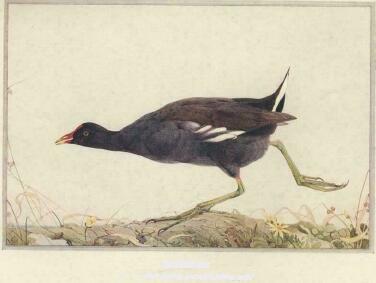
MOORHEN.
" . . . that quaint, graceful, jetting gait."
MOOR-HENS IN HYDE PARK 197
of green turf, deftly picking minute insects from the grass and not disdaining crumbs thrown by the children. A dainty thing to look at is that smooth, olive-brown little moor-hen, going about with such freedom and ease in its small dominion, lifting its green legs deliberately, turning its yellow beak and shield this way and that, and displaying the snow-white undertail at every step, as it moves with that quaint, graceful, jetting gait peculiar to the gallinules.
Such a fact as this--and numberless facts just as significant all pointing to the same conclusion, might be adduced--shows at once how utterly erroneous is that often-quoted dictum of Darwin's that birds possess an instinctive or inherited fear of man. These moor-hens fear him not at all; simply because in Hyde Park they are not shot at, and robbed of their eggs or young, nor in any way molested by him. They fear no living thing, except the irrepressible small dog that occasionally bursts into the enclosure, and hunts them with furious barkings to their reedy little refuge. And as with these moor-hens, so it is with all wild birds; they fear and fly from, and suspiciously watch from a safe distance, whatever molests
198 BIRDS IN TOWN AND VILLAGE
them, and wherever man suspends his hostility towards them they quickly outgrow the suspicion which experience has taught them, or which is traditional among them; for the young and inexperienced imitate the action of the adults they associate with, and learn the suspicious habit from them.
It is also interesting and curious to note that a bird which inhabits two countries, in summer and winter, regulates his habits in accordance with the degree of friendliness or hostility exhibited towards him by the human inhabitants of the respective areas. The bird has in fact two traditions with regard to man's attitude towards him--one for each country. Thus, the field-fare is an exceedingly shy bird in England, but when he returns to the north if his breeding place is in some inhabited district in northern Sweden or Norway he loses all his wildness and builds his nest quite close to the houses. My friend Trevor Battye saw a pair busy making their nest in a small birch within a few yards of the front door of a house he was staying at. "How strange," said he to the man of the house, "to see field-fares making a nest in such a place!"
MOOR-HENS IN HYDE PARK 199
"Why strange?" said the man in surprise. "Why strange? Because of the boys, always throwing stones at a bird. The nest is so low down, that any boy could put his hand in and take the eggs." "Take the eggs!" cried the man, more astonished than ever. "And throwing stones at a bird! Who ever heard of a boy doing such things!"
Closely related to this error is another error, which is that noise in itself is distressing to birds, and has the effect of driving them away. To all sounds and noises which are not associated with danger to them, birds are absolutely indifferent. The rumbling of vehicles, puffing and shrieking of engines, and braying of brass bands, alarm them less than the slight popping of an air gun, where that modest weapon of destruction is frequently used against them. They have no "nerves" for noise, but the apparition of a small boy silently creeping along the hedge-side, in search of nests or throwing stones, is very terrifying to them. They fear not cattle and horses, however loud the bellowing may be; and if we were to transport and set loose herds of long-necked camelopards, trumpeting elephants, and rhinoceroses of horrible aspect, the little birds
200 BIRDS IN TOWN AND VILLAGE
would soon fear them as little as they do the familiar cow. But they greatly fear the small-sized, quiet, unobtrusive, and meek-looking cat. Sparrows and starlings that fly wildly at the shout of a small boy or the bark of a fox-terrier, build their nests under every railway arch; and the incubating bird sits unalarmed amid the iron plates and girders when the express train rushes overhead, so close to her that one would imagine that the thunderous jarring noise would cause the poor thing to drop down dead with terror. To this indifference to the mere harmless racket of civilization we owe it that birds are so numerous around, and even in, London; and that in Kew Gardens, which, on account of its position on the water side, and the numerous railroads surrounding it, is almost as much tortured with noise as Willesden or Clapham Junction, birds are concentrated in thousands. Food is not more abundant there than in other places; yet it would be difficult to find a piece of ground of the same extent in the country proper, where all is silent and there are no human crowds, with so large a bird population. They are more numerous in Kew than elsewhere, in spite of the noise and the
MOOR-HENS IN HYDE PARK 201
people, because they are partially protected there from their human persecutors. It is a joy to visit the gardens in spring, as much to hear the melody of the birds as to look at the strange and lovely vegetable forms. On a June evening with a pure sunny sky, when the air is elastic after rain, how it rings and palpitates with the fine sounds that people it, and which seem infinite in variety! Has England, burdened with care and long estranged from Nature, so many sweet voices left? What aerial chimes are those wafted from the leafy turret of every tree? What clear, choral songs--so wild, so glad? What strange instruments, not made with hands, so deftly touched and soulfully breathed upon? What faint melodious murmurings that float around us, mysterious and tender as the lisping of leaves? Who could be so dull and exact as to ask the names of such choristers at such a time! Earthly names they have, the names we give them, when they visit us, and when we write about them in our dreary books; but, doubtless, in their brighter home in cloudland they are called by other more suitable appellatives. Kew is exceptionally favoured for the reason
202 BIRDS IN TOWN AND VILLAGE
mentioned, but birds are also abundant where there are no hired men with red waistcoats and brass buttons to watch over their safety. Why do they press so persistently around us; and not in London only, but in every town and village, every house and cottage in this country? Why are they always waiting, congregating as far from us as the depth of garden, lawn, or orchard will allow, yet always near as they dare to come? It is not sentiment, and to be translated into such words as these: "Oh man, why are you unfriendly towards us, or else so indifferent to our existence that you do not note that your children, dependants, and neighbours cruelly persecute us? For we are for peace, and knowing you for the lord of creation, we humbly worship you at a distance, and wish for a share in your affection." No; the small, bright soul which is in a bird is incapable of such a motive, and has only the lesser light of instinct for its guide, and to the birds' instinct we are only one of the wingless mammalians inhabiting the earth, and with the cat and weasel are labelled "dangerous," but the ox and horse and sheep have no such label. Even our larger, dimmer eyes can easily discover the
MOOR-HENS IN HYDE PARK 203
attraction. Let any one, possessing a garden in the suburbs of London, minutely examine the foliage at a point furthest removed from the house, and he will find the plants clean from insects; and as he moves back he will find them increasingly abundant until he reaches the door. Insect life is gathered thickly about us, for that birdless space which we have made is ever its refuge and safe camping ground. And the birds know. One came before we were up, when cat and dog were also sleeping, and a report is current among them. Like ants when a forager who has found a honey pot returns to the nest, they are all eager to go and see and taste for themselves. Their country is poor, for they have gathered its spoils, and now this virgin territory sorely tempts them. To those who know a bird's spirit it is plain that a mere suspension of hostile action on our part would have the effect of altering their shy habits, and bringing them in crowds about us. Not only in the orchard and grove and garden walks would they be with us, but even in our house. The robin, the little bird "with the red stomacher," would be there for the customary crumbs at meal-time, and many dainty
204 BIRDS IN TOWN AND VILLAGE
fringilline pensioners would keep him company. And the wren would be there, searching diligently in the dusty angles of cornices for a savoury morsel; for it knows, this wise little Kitty Wren, that "the spider taketh hold with her hands, and is in king's palaces"; and wandering from room to room it would pour forth many a gushing lyric--a sound of wildness and joy in our still interiors, eternal Nature's message to our hearts.
Who delights not in a bird? Yet how few among us find any pleasure in reading of them in natural history books! The living bird, viewed closely and fearless of our presence, is so much more to the mind than all that is written--so infinitely more engaging in its spontaneous gladness, its brilliant vivacity, and its motions so swift and true and yet so graceful! Even leaving out the melody, what a charm it would add to our homes if birds were permitted to take the part there for which Nature designed them--if they were the "winged wardens" of our gardens and houses as well as of our fields. Bird-biographies are always in our bookcases; and the bird-form meets our sight everywhere in decorative art Eastern and Western; for its aerial beauty is without
MOOR-HENS IN HYDE PARK 205
parallel in nature; but the living birds, with the exception of the unfortunate captives in cages, are not with us.
A robin redbreast in a cage Puts all heaven in a rage,
sings Blake prophet and poet; and for "robin redbreast" I read every feathered creature endowed with the marvellous faculty of flight. Wild, and loving their safety and liberty, they keep at a distance, at the end of the garden or in the nearest grove, where from their perches they suspiciously watch our movements, always waiting to be encouraged, waiting to feed on the crumbs that fall from our table and are wasted, and on the blighting insects that ring us round with their living multitudes.

THE EAGLE AND THE CANARY
ONE week-day morning, following a crowd of well-dressed people, I presently found myself in a large church or chapel, where I spent an hour very pleasantly, listening to a great man's pulpit eloquence. He preached about genius. The subject was not suggested by the text, nor did it have any close relation with the other parts, of his discourse; it was simply a digression, and, to my mind, a very delightful one. He began about the restrictions to which we are all more or less subject, the aspirations that are never destined to be fulfilled, but are mocked by life's brevity. And it was at this point that--probably thinking of his own case--he branched off into the subject of genius; and proceeded to show that a man possessing that divine quality finds existence a
206
THE EAGLE AND THE CANARY 207
much sadder affair than the ordinary man; the reason being that his aspirations are so much loftier than those of other minds, the difference between his ideal and reality must be correspondingly greater in his case. This was obvious--almost a truism; but the illustration by means of which he brought it home to his hearers was certainly born of poetic imagination. The life of the ordinary person he likened to that of the canary in its cage. And here, dropping his lofty didactic manner, and--if I may coin a word--smalling his deep, sonorous voice, to a thin reedy treble, in imitation of the tenuous fringilline pipe, he went on with lively language, rapid utterance, and suitable brisk movements and gestures, to describe the little lemon-coloured housekeeper in her gilded cage. Oh, he cried, what a bright, busy bustling life is hers, with so many things to occupy her time! how briskly she hops from perch to perch, then to the floor, and back from floor to perch again! how often she drops down to taste the seed in her box, or scatter it about her in a little shower! how curiously, and turning her bright eyes critically this way and that, she listens to every new sound and regards every ob-
208 BIRDS IN TOWN AND VILLAGE
ject of sight! She must chirp and sing, and hop from place to place, and eat and drink, and preen her wings, and do at least a dozen different things every minute; and her time is so fully taken up that the narrow limits confining her are almost forgotten--the wires that separate her from the great world of wind-tossed woods, and of blue fields of air, and the free, buoyant life for which her instincts and faculties fit her, and which, alas! can never more be hers.
All this sounded very pretty, as well as true, and there was a pleased smile on every face in the audience.
Then the rapid movements and gestures ceased, and the speaker was silent. A cloud came over his rough-hewn majestic visage; he drew himself up, and swayed his body from side to side, and shook his black gown, and lifted his arms, as their plumed homologues are lifted by some great bird, and let them fall again two or three times; and then said, in deep measured tones, which seemed to express rage and despair, "But did you ever see the eagle in his cage?"
The effect of the contrast was grand. He shook himself again, and lifted and dropped his
THE EAGLE AND THE CANARY 209
arms again, assuming, for the nonce, the peculiar aquiline slouch; and there before us stood the mighty bird of Jove, as we are accustomed to see it in the Zoological Gardens; its deep-set, desolate eyes looking through and beyond us; ruffling its dark plumage, and lifting its heavy wings as if about to scorn the earth, only to drop them again, and to utter one of those long dreary cries which seem to protest so eloquently against a barbarous destiny. Then he proceeded to tell us of the great raptor in its life of hopeless captivity; his stern, rugged countenance, deep bass voice, and grand mouth-filling polysllables suiting his subject well, and making his description seem to our minds a sombre magnificent picture never to be forgotten--at all events, never by an ornithologist.
Doubtless this part of his discourse proved eminently pleasing to the majority of his hearers, who, looking downwards into the depths of their own natures, would be able to discern there a glimmer, or possibly more than a glimmer of that divine quality he had spoken of, and which was, unhappily for them, not recognized by the world at large; so that, for the moment, he was ad-
210 BIRDS IN TOWN AND VILLAGE
dressing a congregation of captive eagles, all mentally ruffling their plumage and flapping their pinions, and uttering indignant screams of protest against the injustice of their lot.
The illustration pleased me for a different reason, namely, because, being a student of bird-life, his contrasted picture of the two widely different kinds, when deprived of liberty, struck me as being singularly true to nature, and certainly it could not have been more forcibly and picturesquely put. For it is unquestionably the fact that the misery we inflict by tyrannously using the power we possess over God's creatures, is great in proportion to the violence of the changes of condition to which we subject our prisoners; and while canary and eagle are both more or less aerial in their mode of life, and possessed of boundless energy, the divorce from nature is immeasurably greater in one case than in the other. The small bird, in relation to its free natural life, is less confined in its cage than the large one. Its smallness, perching structure, and restless habits, fit it for continual activity, and its flitting, active life within the bars bears some resemblance except in the great matter of flight, to its life in a
THE EAGLE AND THE CANARY 211
state of nature. Again, its lively, curious, and extremely impressible character, is in many ways an advantage in captivity; every new sound and sight, and every motion, however slight, in any object or body near it, affording it, so to speak, something to think about. It has the further advantage of a varied and highly musical language; the frequent exercise of the faculty of singing, in birds, with largely developed vocal organs, no doubt reacts on the system, and contributes not a little to keep the prisoner healthy and cheerful.
On the other hand, the eagle, on account of its structure and large size, is a prisoner indeed, and must languish with all its splendid faculties and importunate impulses unexercised. You may gorge it with gobbets of flesh until its stomach cries, "Enough"; but what of all the other organs fed by the stomach, and their correlated faculties? Every bone and muscle and fibre, every feather and scale, is instinct with an energy which you cannot satisfy, and which is like an eternal hunger. Chain it by the feet, or place it in a cage fifty feet wide--in either case it is just as miserable. The illimitable fields of thin cold air, where it outrides the winds and soars exulting be-
212 BIRDS IN TOWN AND VILLAGE
yond the clouds, alone can give free space for the display of its powers and scope to its boundless energies. Nor to the power of flight alone, but also to a vision formed for sweeping wide horizons, and perceiving objects at distances which to short-sighted man seem almost miraculous. Doubtless, eagles, like men, possess some adaptiveness, else they would perish in their enforced inactivity, swallowing without hunger and assimilating without pleasure the cold coarse flesh we give them. A human being can exist, and even be tolerably cheerful, with limbs paralyzed and hearing gone; and that, to my mind, would be a parallel case to that of the eagle deprived of its liberty and of the power to exercise its flight, vision, and predatory instincts.
As I sit writing these thoughts, with a cage containing four canaries on the table before me, I cannot help congratulating these little prisoners on their comparatively happy fate in having been born, or hatched, finches and not eagles. And yet albeit I am not responsible for the restraint which has been put upon them, and am not their owner, being only a visitor in the house, I am troubled with some uncomfortable feelings concerning their
.THE EAGLE AND THE CANARY 213
condition--feelings which have an admixture of something like a sense of shame or guilt, as if an injustice had been done, and I had stood by consenting. I did not do it, but we did it. I remember Matthew Arnold's feeling lines on his dead canary, "Poor Matthias," and quote:
Yet, poor bird, thy tiny corse Moves me, somehow, to remorse; Something haunts my conscience, brings Sad, compunctious visitings. Other favourites, dwelling here, Open lived with us, and near; Well we knew when they were glad Plain we saw if they were sad; Sympathy could feel and show Both in weal of theirs and woe. Birds, companions more unknown, Live beside us, but alone; Finding not, do all they can, Passage from their souls to man. Kindness we bestow and praise, Laud their plumage, greet their lays; Still, beneath their feathered breast
214 BIRDS IN TOWN AND VILLAGE
Stirs a history unexpressed. Wishes there, and feeling strong, Incommunicably throng; What they want we cannot guess.
This, as poetry, is good, but it does not precisely fit my case; my "compunctious visitings" being distinctly different in origin and character from the poet's. He--Matthew Arnold--is a poet, and the author of much good verse, which I appreciate and hold dear. But he was not a naturalist--all men cannot be everything. And I, a naturalist, hold that the wishes, thronging the restless little feathered breast are not altogether so incommunicable as the melodious mourner of "Poor Matthias" imagines. The days--ay, and years--which I have spent in the society of my feathered friends have not, I flatter myself, been so wasted that I cannot small my soul, just as the preacher smalled his voice, to bring it within reach of them, and establish some sort of passage.
And so, thinking that a little more knowledge of birds than most people possess, and consideration for them--for I will not be so harsh to speak of justice--and time and attention given to their
THE EAGLE AND THE CANARY 215
wants, might remove this reproach, and silence these vague suggestions of a too fastidious conscience, I have taken the trouble to add something to the seed with which these little prisoners had been supplied. For we give sweetmeats to the child that cries for the moon--an alternative which often acts beneficially--and there is nothing more to be done. Any one of us, even a philosopher, would think it hard to be restricted to dry bread only, yet such a punishment would be small compared with that which we, in our ignorance or want of consideration, inflict on our caged animals--our pets on compulsion. Small, because an almost infinite variety of flavours drawn from the whole vegetable kingdom--a hundred flavours for every one in the dietary which satisfies our heavier mammalian natures--is a condition of the little wild bird's existence and essential to its well-being and perfect happiness. And so, to remedy this defect, I went out into the garden, and with seeding grasses and pungent buds, and leaves of a dozen different kinds, I decorated the cage until it looked less like a prison than a bower. And now for an hour the little creatures have been busy with their varied green
216 BIRDS IN TOWN AND VILLAGE
fare, each one tasting half a dozen different leaves every minute, hopping here and there and changing places with his fellows, glancing their bright little eyes this way and that, and all the time uttering gratulatory notes in the canary's conversational tone. And their language is not altogether untranslatable. I listen to one, a pretty pure yellow bird, but slightly tyrannical in his treatment of the others, and he says, or seems to say: "This is good, I like it, only the old leaf is tough; the buds would be better. . . . These are certainly not so good. I tasted them out of compliment to nature, though they were scarcely palatable. . . ." No, that was not my own expression; it was said by Thoreau, perhaps the only human a little bird can quote with approval. "This is decidedly bitter--and yet--yes, it does leave a pleasant flavour on the palate. Make room for me there--or I shall make you and let me taste it again. Yes, I fancy I can remember eating something like this in a former state of existence, ages and ages ago." And so on, and so on, until I began to imagine that the whole thing had been put right, and that the uncomfortable feeling would return to trouble me no
THE EAGLE AND THE CANARY 217
more. But at the rate they are devouring their green stuff there will not be a leat, scarcely a stem left in another hour; and then? Why, then they will have the naked wires of their cage all round them to protect them from the cat and for hunger there will be seed in the box.
After all, then, what a little I have been able to do! But I flatter myself that if they were mine I should do more. I never keep captive birds, but if they were given to me, and I could not refuse, I should do a great deal more for them. All my knowledge of their ways and their requirements would teach me how to make their caged existence less unlike the old natural life, than it now is. To begin the ameliorating process, I should place them in a large cage, large enough to allow space for flight, so that they might fly to and fro, a few feet each way, and rest their little feet from continual perching. That would enable them to exercise their most important muscles and experience once more, although in a very limited degree, the old delicious sensation of gliding at will through the void air. The wires of their new cage would be of brass or of some bright metal, and the wooden parts
218 BIRDS IN TOWN AND VILLAGE
and perches green enamelled, or green variegated with brown and grey, and the roof would be hung with glass lustres, to quiver and sparkle into drops of violet, red, and yellow light, gladdening these little lovers of bright colours; for so we deem them. I should also add gay flowers and berries, crocus and buttercup and dandelion, hips and haws and mountain ash and yellow and scarlet leaves--all seasonable jewellery from woods and hedges and from the orchard and garden. Then would come the heaviest part of my task, which would be to satisfy their continual craving for new tastes in food, their delight in an endless variety. I should go to the great seed-merchants of London and buy samples of all the cultivated seeds of the earth, and not feed them in a trough, or manger, like heavy domestic brutes, but give it to them mixed and scattered in small quantities, to be searched for and gladly found in the sand and gravel and turf on the wide floor of the cage. And, higher up, the wires of their dwelling would be hung with an endless variety of seeded grasses, and sprays of all trees and plants, good, bad, and indifferent. For if the volatile bird dines on no more than twenty dishes every day he
THE EAGLE AND THE CANARY 219
loves to taste of a hundred and to have at least a thousand on the table to choose from.
Feeding the birds and keeping the cage always sweet and clean would occupy most, if not the whole of my time. But would that be too much to give if it made me tranquil in my own mind? For it must be noted that I have done all this, mentally and on paper, for my own satisfaction rather than that of the canaries. Birds are not worth much--to us. Are not five sparrows sold for three farthings? I have even shot many birds and have felt no compunction. True, they perished before their time, but they did not languish, and being dead there was an end of them; but the caged canaries continuing with us, cannot be dismissed from the mind with the same convenient ease. After all, I begin to think that my imaginary reforms, if carried out, would not quite content me. The "compunctious visitings" would continue still. I look out of the window and see a sparrow on a neighbouring tree, loudly chirruping. And as I listen, trying to find comfort by thinking of the perils which do environ him, his careless unconventional sparrow-music resolves itself into articulate speech, interspersed
320 BIRDS IN TOWN AND VILLAGE
with occasional bursts of derisive laughter. He knows, this fabulous sparrow, what I have been thinking about and have written. "How would you like it," I hear him saying, "O wise man that knows so much about the ways of birds, if you were shut up in a big cage--in Windsor Castle, let us say--with scores of menials to wait on you and anticipate your every want? That is, I must explain, every want compatible with--ahem!--the captive condition. Would you be happy in your confinement, practising with the dumb-bells, riding up and down the floors on a bicycle and gazing at pictures and filigree caskets and big malachite vases and eating dinners of many, many courses? Or would you begin to wish that you might be allowed to live on sixpence a day--and earn it; and even envy the ragged tramp who dines on a handful of half-rotten apples and sleeps in a hay-stack, but is free to come and go, and range the world at will? You have been playing at nature; but Nature mocks you, for your captives thank you not. They would rather go to her without an intermediary, and take a scantier measure of food from her hand, but flavoured as she only can flavour it. Widen your cage,
THE EAGLE AND THE CANARY 221
naturalist; replace the little twinkling lustres with sun and moon and milky way; plant forests on the floor, and let there be hills and valleys, rivers and wide spaces; and let the blue pillars of heaven be the wires of your cage, with free entrance to wind and rain; then your little captives will be happy, even happy as I am, in spite of all the perils which do environ me--guns and cats and snares, with wet and fog and hard frosts to come."
And, seeing my error, I should open the cage and let them fly away. Even to death, I should let them fly, for there would be a taste of liberty first, and life without that sweet savour, whether of aerial bird or earth-bound man, is not worth living.
CHANTICLEER
DURING the month of September I spent several days at a house standing on high ground in one of the pleasantest suburbs of London, commanding a fine view at the back of the breezy, wooded, and not very far-off Surrey hills; and all round, from every window, front and back, such a mass of greenery met the eye, almost concealing the neighbouring houses, that I could easily imagine myself far out in the country. In the garden the omnipresent sparrow, and that always pleasant companion the starling, associated with the thrush, blackbird, green linnet, chaffinch, redstart, wren, and two species of tits; and, better than all these, not fewer than half a dozen robins warbled their autumn notes from early morning until late in the evening. Domestic
222
CHANTICLEER 223
bird-life was also represented by fifteen fowls, and the wise laxity existing in the establishment made these also free of the grounds; for of eyesores and painful skeletons in London cupboards, one of the worst, to my mind, is that unwholesome coop at the back where a dozen unhappy birds are usually to be found immured for life. These, more fortunate, had ample room to run about in, and countless broad shady leaves from which to pick the green caterpillar, and red tortoise-shaped lady-bird, and parti-coloured fly, and soft warm soil in which to bathe in their own gallinaceous fashion, and to lie with outstretched wings luxuriating by the hour in the genial sunshine. And having seen their free wholesome life, I did not regard the new-laid egg on the breakfast-table with a feeling of repugnance, but ate it with a relish.
I have said that the fowls numbered fifteen; five were old birds, and ten were chickens, closely alike in size, colour and general appearance. They were not the true offspring of the hen that reared them, but hatched from eggs bought from a local poultry-breeder. As they advanced in age to their teens, or the period in chicken-life corre-
224 BIRDS IN TOWN AND VILLAGE
sponding to that in which, in the human species, boy and girl begin to diverge, their tails grew long, and they developed very fine red combs; but the lady of the house, who had been promised good layers when she bought the eggs clung tenaciously to the belief that long arching tails and stately crests were ornaments common to both sexes in this particular breed. By and by they commenced to crow, first one, then two, then all, and stood confessed cockerels. Incidents like this, which are of frequent occurrence, serve to keep alive the exceedingly ancient notion that the sex of the future chick can be foretold from the shape of the egg. As I had no personal interest in the question of the future egg-supply of the establishment, I was not sorry to see the chickens develop into cocks; what did interest me were their first attempts at crowing--those grating sounds which the young bird does not seem to emit, but to wrench out with painful effort, as a plant is wrenched out of the soil, and not without bringing away portions of the lungs clinging to its roots. The bird appears to know what is coming, like an amateur dentist about to extract one of his own double-pronged teeth, and setting his feet
CHANTICLEER 335
firmly on the ground, and throwing himself well back before an imaginary looking-glass, and with arched-neck, wide-open beak, and rolling eyes, courageously performs the horrible operation. One cannot help thinking that a cockerel brought up without any companions of his own sex and age would not often crow, but in this instance there were no fewer than ten of them to encourage each other in the laborious process of tuning their harsh throats. Heard subsequently in the quiet of the early morning, these first tuning efforts suggested some reflections to my mind, which may not prove entirely without interest to fanciers who aim at something beyond a mere increase in our food-supply in their selecting and refining processes.
To continue my narration. I woke in the morning at my usual time, between three and four o'clock, which is not my getting-up time, for, as a rule, after half an hour or so I sleep again. The waking is not voluntary as far as I know; for although it may seem a contradiction in terms to speak of coming at will out of a state of unconsciousness, we do, in cases innumerable, wake voluntarily, or at the desired time, not perhaps
226 BIRDS IN TOWN AND VILLAGE
being altogether unconscious when sleeping. If, however, this early waking were voluntary, I should probably say that it was for the pleasure of listening to the crowing of the cocks at that silent hour when the night, so near its end, is darkest, and the mysterious tide of life, prescient of coming dawn, has already turned, and is sending the red current more and more swiftly through the sleeper's veins. I have spent many a night in the desert, and when waking on the wide silent grassy plain, the first whiteness in the eastern sky, and the fluting call of the tinamou, and the perfume of the wild evening primrose, have seemed to me like a resurrection in which I had a part; and something of this feeling is always associated in my mind with the first far-heard notes of Chanticleer.
It was very dark and quiet when I woke; my window was open, with only a lace curtain before it to separate me from the open air. Presently the profound silence was broken. From a distance of fifty or sixty yards away on the left hand came the crow of a cock, soon answered by another further away on the same side, and then, further away still, by a third. Other voices took
CHANTICLEER 227
up the challenge on the right, some near, some far, until it seemed that there was scarcely a house in the neighbourhood at which Chanticleer was not a dweller. There was no other sound. Not for another hour would the sparrows burst out in a chorus of chirruping notes, lengthened or shortened at will, variously inflected, and with a ringing musical sound in some of them, which makes one wonder why this bird, so high in the scale of nature, has never acquired a set song for itself. For there is music in him, and when confined with a singing finch he will sometimes learn its song. Then the robins, then the tits, then the starlings, gurgling, jarring, clicking, whistling, chattering. Then the pigeons cooing soothingly on the roof and window-ledges, taking flight from time to time with sudden, sharp flap, flap, followed by a long, silken sound made by the wings in gliding. At four the cocks had it all to themselves; and, without counting the cockerels (not yet out of school), I could distinctly hear a dozen birds; that is to say, they were near enough for me to listen to their music critically. The variety of sounds they emitted was very great, and, if cocks were selected for their vocal qualities,
228 BIRDS IN TOWN AND VILLAGE
would have shown an astonishing difference in the musical tastes of their owners. A dozen dogs of as many different breeds, ranging from the boar-hound to the toy terrier, would not have shown greater dissimilarity in their forms than did these cocks in their voices. For the fowl, like the dog, has become an extremely variable creature in the domestic state, in voice no less than in size, form, colour, and other particulars. At one end of the scale there was the raucous bronchial strain produced by the unwieldy Cochin. What a bird is that! Nature, in obedience to man's behests, and smiling with secret satire over her work, has made it ponderous and ungraceful as any clumsy mammalian, wombat, ardvaark, manatee, or hippopotamus. The burnished red hackles, worn like a light mantle over the black doublet of the breast, the metallic dark green sickle-plumes arching over the tail, all the beautiful lines and rich colouring, have been absorbed into flesh and fat for gross feeders; and with these have gone its liveliness and vigour, its clarion voice and hostile spirit and brilliant courage; it is Gallus bankiva degenerate, with dulled brains
CHANTICLEER 229
and blunted spurs, and its hoarse crow is a barbarous chant.
And far away at the other end, startling in its suddenness and impetuosity, was a trisyllabic crow, so brief, piercing, and emphatic, that it could only have proceeded from that peppery uppish little bird, the bantam. And of the three syllables, the last, which should be the longest, was the shortest, "short and sharp like the shrill swallow's cry," or perhaps even more like the shrieky bark of an enraged little cur; not a reveille and silvern morning song in one, as a crow should be, but a challenge and a defiance, wounding the sense like a spur, and suggesting the bustle and fury of the cockpit.
If this style of crowing was known to Milton, it is perhaps accountable for the one bad couplet in the "Allegro":
While the cock with lively din Scatters the rear of darkness thin.
Someone has said that every line in that incomparable poem brings at least one distinct picture vividly before the mind's eye. The picture
230 BIRDS IN TOWN AND VILLAGE
the first line of the couplet I have quoted suggests to ray mind is not of crowing Chanticleer at all, but of a stalwart, bare-armed, blowsy-faced woman, vigorously beating on a tin pan with a stick; but for what purpose--whether to call down a passing swarm of bees, or to summon the chickens to be fed--I never know. It is only my mental picture of a "lively din." As to the second line, all attempts to see the thing described only bring before me clouds and shadows, confusedly rushing about in an impossible way; a chaos utterly unlike the serenity and imperceptible growth of morning, and not a picture at all.
By and by I found myself paying special attention to one cock, about a hundred yards away, or a little more perhaps, for by contrast all the other songs within hearing seemed strangely inferior. Its voice was singularly clear and pure, the last note greatly prolonged and with a slightly falling inflection, yet not collapsing at the finish as such long notes frequently do, ending with a little internal sound or croak, as if the singer had exhausted his breath; but it was perfect in its way, a finished performance, artistic,
CHANTICLEER 231
and, by comparison, brilliant. After once hearing this bird I paid little attention to the others, but after each resounding call I counted the seconds until its repetition. It was this bird's note, on this morning, and not the others, which seemed to bring round me that atmosphere of dreams and fancies I exist in at early cockcrow--dreams and memories, sweet or sorrowful, of old scenes and faces, and many eloquent passages in verse and prose, written by men in other and better days, who lived more with nature than we do now. Such a note as this was, perhaps, in Thoreau's mind when he regretted that there were no cocks to cheer him in the solitude of Walden. "I thought," he says, "that it might be worth while keeping a cockerel for his music merely, as a singing bird. The note of this once wild Indian pheasant is certainly the most remarkable of any bird's, and if they could be naturalized without being domesticated it would soon become the most famous sound in our woods. . . . To walk in a winter morning in a wood where these birds abounded, their native woods, and hear the wild cockerels crow on the trees, clear and shrill for miles over the surrounding coun-
232 BIRDS IN TOWN AND VILLAGE
try--think of it! It would put nations on the alert. Who would not be early to rise, and rise earlier and earlier on each successive morning of his life, till he became unspeakably healthy, wealthy, and wise?"
Soon I fell into thinking of one in some ways greater than Thoreau, so unlike the skyey-minded New England prophet and solitary, so much more genial and tolerant, more mundane and lovable; and yet like Thoreau in his nearness to nature. Not only a lover of generous wines--"That mark upon his lip is wine"--and books "clothed in black and red," all natural sights and sounds also "filled his herte with pleasure and solass," and the early crowing of the cock was a part of the minstrelsy he loved. Perhaps when lying awake during the dark quiet hours, and listening to just such a note as this, he conceived and composed that wonderful tale of the "Nun's Priest," in which the whole character of Chanticleer, his glory and his foibles, together with the homely virtues of Dame Partlett, are so admirably set forth.
And longer ago it was perhaps such a note as this, heard in imagination by the cock-loving
CHANTICLEER 233
Athenians, which all at once made them feel so unutterably weary of endless fighting with the Lacedaemonians, and inspired their hearts with such a passionate desire for the long untasted sweets of security and repose. Is it one of my morning fancies merely--for fact and fancy mingle strangely at this still, mysterious hour, and are scarcely distinguishable--or is it related in history that this strange thing happened when all the people of the violet-crowned city were gathered to witness a solemn tragedy, in which certain verses were spoken that had a strange meaning to their war-weary souls? "Those who sleep in the morning in the arms of peace do not start from them at the sound of the trumpet, and nothing interrupts their slumbers but the peaceful crowing of the cock." And at these words the whole concourse was electrified, and rose up like one man, and from thousands of lips went forth a great cry of "Peace! Peace! Let us make peace with Sparta!"
Hark! once more that long clarion call: it is the last time--the very last; for all the others have sung a dozen times apiece and have gone to sleep again. So would this one have done,
234 BIRDS IN TOWN AND VILLAGE
but cocks, like minstrels among men, are vain creatures, and some kind officious fairy whispered in his ear that there was an appreciative listener hard by, and so to please me he sang, just one stave more.
Lying and listening in the dark, it seemed to me that there were two opposite qualities commingled in the sound, with an effect analogous to that of shadow mingling with and chastening light at eventide. First, it was strong and clear, full of assurance and freedom, qualities admirably suited to the song of a bird of Chanticleer's disposition; a lusty, ringing strain, not sung in the clouds or from a lofty perch midway between earth and heaven, but with feet firmly planted on the soil, and earthly; and compared with the notes of the grove like a versified utterance of Walt Whitman compared with the poems of the true inspired children of song--Blake, Shelley, Poe. Earthly, but not hostile and eager; on the contrary, leisurely, peaceful even dreamy, with a touch of tenderness which brings it into relationship with the more aerial tones of the true singers; and this is the second quality I spoke of, which gave a charm to this note and made it
CHANTICLEER 235
seem better than the others. This is partly the effect of distance, which clarifies and softens sound, just as distance gives indistinctness of outline and ethereal blueness to things that meet the sight. To objects beautiful in themselves, in graceful lines and harmonious proportions and colouring, the haziness imparts an additional grace; but it does not make beautiful the objects which are ugly in themselves, as, for instance, an ugly square house. So in the etherealizing effect of distance on sound, when so loud a sound as the crowing of a strong-lunged cock becomes dreamy and tender at a distance of one hundred yards, there must be good musical elements in it to begin with. I do not remark this dreaminess in the notes of other birds, some crowing at an equal distance, others still further away. All natural music is heard best at a distance; like the chiming of bells, and the music of the flute, and the wild confused strains of the bagpipes, for among artificial sounds these come the nearest to those made by nature. The "shrill sharps" of the thrush must be softened by distance to charm; and the skylark, when close at hand, has both shrill and harsh sounds scarcely pleasing. He must mount
336 BIRDS IN TOWN AND VILLAGE
high before you can appreciate his merit. I do not recommend any one to keep a caged cock in his study for the sake of its music, crow it never so well.
To return to the ten cockerels; they did not crow very much, and at first I paid little attention to them. After a few days I remarked that one individual among them was rapidly acquiring the clear vigorous strain of the adult bird. Compared with that fine note which I have described, it was still weak and shaky, but in shape it was similar, and the change had come while its brethren were still uttering brief and harsh screeches as at the beginning. Probably, where there is a great mixture of varieties, it is the same with the fowl as with man in the diversity of the young, different ancestral characters appearing in different members of the same family. This cockerel was apparently the musical member, and promised in a short time to rival his neighbour. Having heard that it was intended to keep one of the cockerels to be the parent of future broods, I began to wonder whether the prize in the lottery--to wit, life and a modest harem--would fall to this fine singer or not. The odds were that