THE GREEN-CRESTED FLYCATCHER. (Empidonax virescens.)
Reading edition
The Green-crested or Acadian Flycatcher is a frequent summer resident in the eastern United States, and through the valley of the Mississippi river it migrates as far northward as Manitoba, where it is said to be quite common.
This bird exhibits no haste in its northward spring journey, for it is one of the latest species to arrive on its breeding grounds in the higher latitudes and as winter approaches, it leaves the United States entirely and winters in Mexico, Central America and northern South America.
If we would make the acquaintance of the Green-crested Flycatcher, we must seek it in woodlands in the vicinity of some stream or other body of water. Its favorite haunts are “deep, shady, second-growth hardwood forests, on rather elevated ground, especially beech woods with little undergrowth, or bottom lands not subject to periodical overflow.” It is not an over shy bird, yet it is rather difficult to find, for its colors are in perfect harmony with its surroundings as it passes from tree to tree through the dark foliage of the lower limbs. So perfect is this color-harmony that Major Charles Bendire said, “I have several times failed to detect the bird when I was perfectly certain it was within twenty feet of me,” and Neltje Blanchan likens its movements to “a leaf that is being blown about, touched by the sunshine flittering through the trees, and partly shaded by the young foliage casting its first shadows.”
Like its sister flycatchers the Green-crested is not a good natured bird and will even quarrel with individuals of its own species. Even its voice is fretful, especially when from its perch it is waiting for an insect to pass by. It seldom perches higher than from fifteen to twenty feet from the ground, and while standing constantly twitches its tail and frequently utters a note that Mr. Chapman describes as a single spee or peet.
It is a beneficial bird, for its food consists of insects except in the fall when it feeds to a limited extent on wild berries. It will occasionally visit orchards where it has learned there may be found a plentiful supply of food to its liking. When an insect is sighted, like the other flycatchers, except that it chooses a low rather than a high perch from which to watch, it flies outward and with an upward sweep seldom fails to catch its prey in its open bill, which is suddenly closed with a notably loud click that seems like an expression of satisfaction over the result of its efforts.
The drooping branches of several kinds of trees and shrubs are selected by the Green-crested Flycatchers as suitable sites for their unpretentious homes. The nests are semipensil, being attached by the rim to the fork of a small limb or to two parallel limbs. They are shallow and so loosely constructed that frequently the eggs may be seen from the underside. As this Flycatcher breeds nearly throughout its range, the materials used in the construction of the nests varies greatly. In southern states where Spanish moss is common it is one of the chief constituents of the nest. In more northern district, stems of plants, small roots and fibrous materials are used. These are loosely woven with blades of grass, dry flowers and the catkins of the willow. Not infrequently the hanging catkins, decayed fibres and the loose ends of stems and blades of grass give an untidy appearance to the home of this useful and interesting bird.
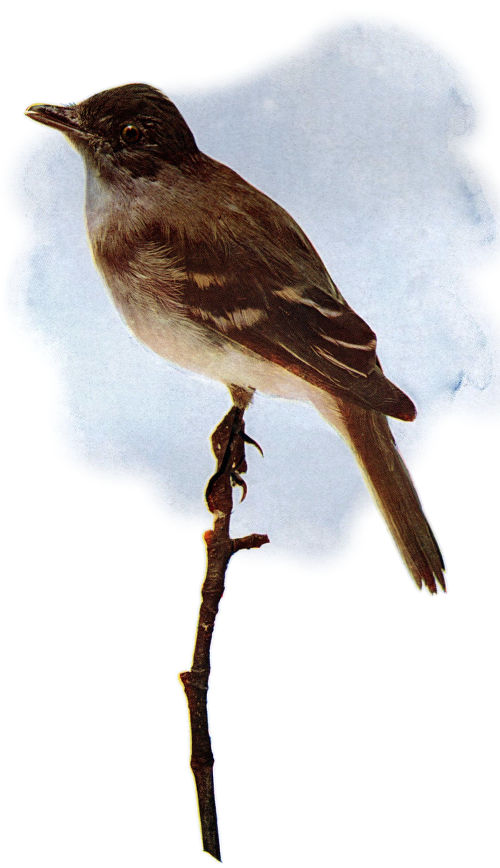
GREEN-CRESTED FLYCATCHER. (Empidonax virescens). Life-size.
113