Part 2 — THE EVERGLADE KITE. (Rostrhamus sociabilis.)
Reading edition
High in mid-air the sailing hawk is pois’d. —Isaac McLellan, “Nature’s Invitation.”
The Everglade Kite or Snail Hawk, as it is sometimes called, has a very small range within the borders of the United States, where it is limited to the swamps and marshes of Southern Florida. It also frequents Eastern Mexico, Central America, Cuba and the eastern portion of South America as far southward as the Argentine Republic.
Its habits are very interesting. Peaceable and sociable at all times, other birds do not fear them. “The name of the Sociable Marsh Hawk is very appropriate, for they invariably live in flocks of from twenty to a hundred individuals and migrate and even breed in company. In Buenos Ayres they appear in September and resort to marshes and streams abounding in large water snails, on which they feed exclusively.” They spend much of the time flying, and when soaring will frequently remain poised in the air for a considerable time without apparent motion, except that the tail is constantly and nervously moved in nearly every direction.
An authority, writing of these birds in Florida, says, “Their favorite nesting sites are swamps overgrown with low willow bushes, the nests usually being placed about four feet from the ground. They frequent the borders of open ponds and feed their young entirely on snails. According to my observations the female does not assist in the building of the nest. I have watched these birds for hours. She sits in the immediate vicinity of the nest and watches while the male builds it. The male will bring a few twigs and alternate this work at the same time by supplying his mate with snails, until the structure is completed. They feed and care for their young longer than any other birds I know of, until you can scarcely distinguish them from the adults.”
The nest is a flat structure, the cavity being rarely more than two or three inches in depth, and the whole structure is about twelve or sixteen inches in diameter and about one-half as high. It is usually placed in low shrubs or fastened to the rank growth of saw grass sufficiently low to be secure from observation. The materials used in its construction are generally dry twigs and sticks loosely woven together. The cavity may be bare or lined with small vines, leaves or dry saw grass.
Dr. A. K. Fisher says, “Its food, as far as known, consists exclusively of fresh-water univalve mollusks, which it finds among the water plants at the edges of shallow lakes and rivers or the overflowed portions of the everglades. When the bird has captured one of these mollusks it flies to the nearest perch and removes the meat from the shell with apparent ease and without injuring the latter. While collecting food it will often secure five or six before returning to the nest, keeping in its gullet the parts it has extracted for the young.”
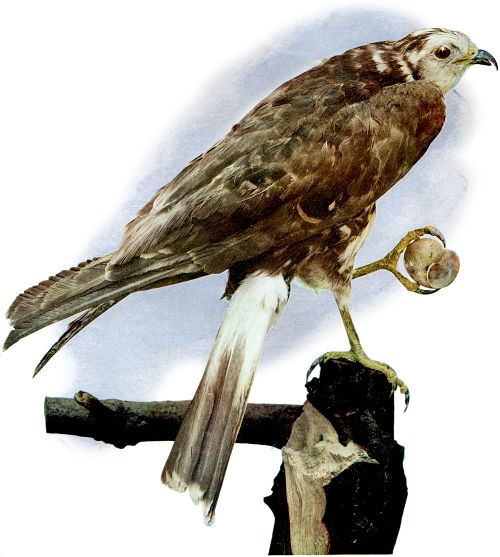
EVERGLADE KITE. (Rostrhamus sociabilis). ⅖ Life-size. FROM COL. CHI. ACAD. SCIENCES.
65