THE BLUE SPRING DAISY. (Erigeron pulchellus.)
Reading edition
Daisy-like and modest, is not the name the Blue Spring Daisy much more appropriate for this hardy little plant than Robin’s or Poor Robin’s Plantain, by which it is often known? What has it to do with the robin? To be sure it sends forth its stems and blossoms in April when the birds are happiest, yet the robins appear much earlier. Then, too, the robins are not poor, for they are the best cared for among birds. Its flowers are often of a bluish cast, though they may be violet or even nearly white; they appear in the spring and are daisy-like.
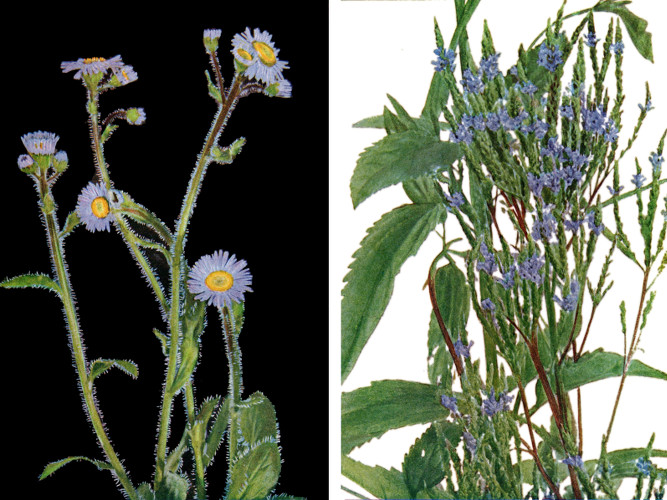
ROBIN’S PLANTAIN OR BLUE SPRING DAISY. (Erigeron pulchellus.) BLUE VERVAIN OR WILD HYSSOP. (Verbena hastata.) FROM “NATURE’S GARDEN” COPYRIGHT 1900, BY DOUBLEDAY, PAGE & COMPANY
231
The botanist knows this plant of the hills and banks as one of the species of the genus Erigeron. This name is indicative of one of its characteristics. It is from two Greek words meaning spring and old man. Old man in the springs or early old is an appropriate name, for the young plants are quite hoary and this hairiness remains throughout its life.
The Blue Spring Daisy is not alone, for it has about one hundred and thirty sister species widely distributed throughout the world, but they are more abundant in the Americas, nearly seventy of these occurring in North America.
This unassuming plant frequently grows in large patches, yet does not crowd its fellows; often it grows in localities which the more delicate and brilliant of the early flowers are wont to shun. This may have been the theme which inspired these lines of the poet:
I love the lowly children of the earth! I linger ’mid their artless ways To feel their kinship and their fragile worth, And catch their speechless praise.
Though the species of Erigeron are coarse growing and unpretentious plants, they lend themselves readily to garden cultivation. They are easily propagated and make good borders, for they are much more beautiful when massed than when allowed to develop as single plants. The forms vary greatly in color—orange, creamy, white, rose, violet, purple and bluish illustrate the range of color. The yellow centers heighten the color effect.
The flowers resemble those of the asters and the Blue Spring Daisy might be mistaken for an Aster. But few of the Asters, however, blossom earlier than the month of August and none before July, and the Spring Daisy does not blossom, as a rule, later than in June.
Miss Lounsberry says: “What strange idea filled the pretty head of Robin’s Plantain when it decked itself out to look like an Aster we do not know, but its deception is very transparent and we readily discover that it is not one of the Asters.” May we not look upon it as the harbinger of the true Astors?