SONG BIRDS OF THE SOUTHWEST.
Reading edition
“A pleasing land of drowsy-head it was, Of dreams that wave before the half-shut eye.”
“New birds, new flowers, new pleasures,” I murmur as my vision widens upon the, to me, new world of Arizona. A new delight indeed, notwithstanding the often impressed fact that the old footpath-ways of Ohio are, after many years, still but half discovered countries. But ’tis human, this desire for novelty, and I am not at all in advance of my fellow kindred in arriving at that stage of blessed content which we see expressed upon every side of us in the lives of the lesser (?) creatures who abide without unrest until compelled by the necessities of necessity to “move on.” But I echo Richard Jefferies: “a fresh flower, a fresh path-way, a fresh delight,” and am so far content; and, truly, coming from the east of living greens, ’tis a new kingdom of somber mountains and sandy desert at which I have arrived. To an imaginative person it is a land filled with the echoes of a distant past, even now but half heard and in my mind the golden glow of a day that is dead enfolds the silent hills, a silence of grandeur, not of nature which is here alive and keen to the fullest extent. With many other naturalists, I agree that if one desires to learn the secrets of the field and forest, one must go about singly and alone. There is something strange about it too, while one person alone is allowed to see many of the inner movements of wild life, when two or three are gathered together, they seem to intimidate the wood folk to an unlimited extent.
But bird life in this far away territory, notwithstanding Dr. Charles Abbott’s experience to the contrary, seems to me to be much more companionable and less timid than in the more thickly populated east, and also, bird curiosity is more noticeable than in those states where generations of experience has obviated all desire for any close scrutiny or investigation of that queer biped without feathers. One has only to sit silent and quiet for a few moments to have his ornithological interest aroused by numerous visitors, who, with impatient “chips” and “twits” question his presence among them. While Gila county makes up her quota of song birds in quantity, she lacks something in decorative quality, at least so far as coloring of plumage is concerned. There is no question but what the very arid atmosphere of this section is not without its marked effect upon feather coloring, and on account of this dullness of plumage, I was at first unable to classify numbers of birds who were perfectly familiar to me in Ohio. Birds like the blue jay lose much of the metallic gorgeousness of their plumage and are under a veil as it were, showing a dull, bluish gray. The blackbirds also are decidedly rusty in appearance, hardly holding their own with the great glossy ravens (Corvus principalis) who have so adapted themselves to civilization as to have become almost a necessity as purveyors of edible refuse and debris which accumulates in such abundance about the abodes of mankind, who are supposedly the most hygienic and cleanly of all creatures, but whose abiding places ‘au natural’ present an unsightly spectacle in comparison with the nests of birds, but of course it is because our requirements are so much greater, and education has developed a love of “accumulations” among us, herein must lie all blame. But we “progress” or so we have determined.
However, I never see these dignified crows of stately motion moving about without remembering Virgil’s:
“The crow with clamorous cries the shower demands, And single stalks along the desert sands.”
But in Arizona his demand for showers is vain, for the absence of the “rain maker” is her greatest deficit.
To return to the atmospheric or arid effect upon color, I fail to understand why the bleaching process is so observable in feathers, yet the most brilliant and tropical coloring predominates in the flora. Does the plant world absorb all of the richest coloring matter of the sunlight, or do they possess an antidote to the alkaline properties of the air? Is atmospheric 128 moisture that is not obtainable necessary in feather coloring? Some of the plants here are sufficient unto themselves, brewing their own sustenance as it were, as I have seen the Bisnaga, sometimes called “Well of the Desert” in which a deep hole had been cut, produce in a short time at least a cup full of watery liquid, which is very invigorating to the thirsty traveler, and growing, too, in a sand as dry as powder, there not having been a drop of rain near it in months, if not years, and dew an unknown quantity. This liquor seems necessary for the full fruition of the rich, yellow flower, so carefully guarded by immense fish-hook spines or barbs that is such efficient protection to this species of cacti. As effectual is this protection as is the venomous reputation of that much maligned saurian, the Gila monster (Heloderma suspectum), which is not one-half so bad as his looks would imply, but he is formidable in appearance when he puffs forth his breath like a miniature steam engine and at the same time emits a greenish saliva from his mouth, which is to say the least a forbidding performance, but I really believe him to be comparatively harmless, for after considerable acquaintance with his habits, I have only learned of one person being bitten by this reptile, and that was a man who was drunk and insisted upon tickling the Gila monster on the mouth and was bitten for his pains. The reptile had to be killed before its teeth could be unlocked. As an antidote an attempt was made to fill the man with whisky, but as he was already full but little could be accomplished in that line; when he got sober he was all right save that his hand was somewhat paralyzed.
There is a marked gregariousness among the song birds of Arizona or else the present abundance of all species gives one that impression, for the numbers are almost countless, though human depredators are fast depopulating the songsters for the sake of their own pleasure or bird plumage for profit. While women anathematize men for their inordinate desire to kill something, they take an equivocal stand as critics, yet wearing a hat adorned with one or more dead bodies of birds. It is truly the old question of mote and beam re-enacted.
I do not remember of meeting with but one bird which I have been entirely unable to classify or even learn its common name if it has one. It darts in and out of a thorn bush after the manner of a thresher or cat bird, and about equals them in size; is of a dull canary yellow in color save for a rich red cap slightly tufted and worn jauntily on top of his head. I have never heard any note from him save a startled chip, and have been unable to learn anything about him from the various bird histories.
Dr. Abbott has remarked on the lack of vocal powers among the birds of Arizona, and says:
“I listened hour after hour to these cheerful birds, fancying there was melody in their attempts at song, and wondering why, when their lines had been cast in such forbidding places, the gift of sweet song had not been vouchsafed them. Does the extremely dry atmosphere have to do with it? Not a sound that I heard had that fulness of tone common to the allied utterances at home. At the limit of my longest stroll I heard a mountain mocking bird, as it is misnamed in the books, and his was a disappointed song. It was the twanging of a harp of a single string, and that a loose one.”
This absence of note richness is a feature that I have not observed, and never have I heard a more musical chorus from bird throats as one after another of the many sorts and conditions awoke at sunrise. Many a time have I listened while camping on a lone mountaintop, where our only canopy was the pine-fretted blue heavens, and heard the rich burst of song in which not a note lacked flavor; mocking birds, thrushes, orioles, wrens, finches, vireos, grosbeaks, robins (and their distinguishable note is likely to make one homesick) thrashers, blue birds, tanagers, etc., all filling in the score, as each was awakened and filled in the line of song, to say nothing of whip-poor-wills, owls and other night singers who have had “their day.” I feel sure if Dr. Abbott had given a little more time to the study of bird song in this territory he would have had no cause to complain of or discredit the vocal powers of these western songsters.
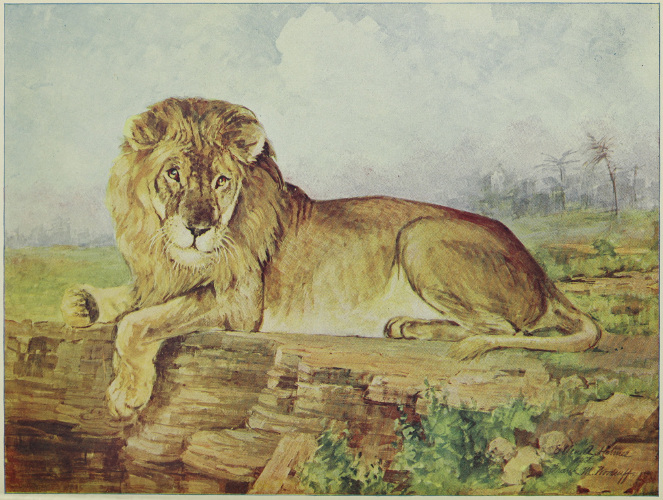
AFRICAN LION. (Felis leo).
131