THE AMERICAN WHITE PELICAN. (Pelecanus erythrorhynchos.)
Reading edition
In the year 1758 the naturalist Linnaeus gave to the birds called Pelicans the generic name Pelecanus. In this genus he also placed the cormorants and the gannets. These with the snake-birds, the frigate-birds and the tropic-birds were for a long time grouped together under the family name Pelecanidae. This name, however, is now restricted to the various species of the Pelicans which are included in a single genus.
The generic name Pelecanus and the common name Pelican are derived from pelekan, the Greek name for these birds. They were well known to the ancients by whom they were called Ornacrotalus. There is a legend of great antiquity for which there is no foundation in fact, which states that the pelican feeds to her young blood drawn from her own breast, in which she herself has made the incision.
There are about ten species of pelicans distributed throughout the world, mostly confined to those countries having warm climates. Two or three species, however, extend their range into the colder regions during the summer months. Three of the species inhabit North America and two of these are seldom seen except on the sea coasts; the brown pelican (Pelecanus fuscus) on the Atlantic coast and the California brown pelican (Pelecanus californicus) on the Pacific coast. The other species is the bird of our illustration, and is common in the interior as well as on the seaboard of California.
The pelicans are notably social in their habits, a large number nesting together. The flight of a large flock is an attractive sight. Their wings move in unison and apparently without much effort. After a few strokes of the wings they frequently sail, forming graceful circles, often at great elevations.
The most remarkable characteristic of these birds, however, is the large pouch formed by an elastic skin depending from the two sides of the lower mandible and extending nearly the whole length of the bill. This pouch may be greatly distended and will hold a large quantity of either solid or liquid matter. The bills are depressed and strongly hooked.
The American White Pelican ranges throughout the whole of North America as far north, in the interior, as the 61° north latitude, and as far to the southward in winter as Central America. Northward from Florida, along the Atlantic coast, it is now rare.
In the year 1838 Audubon gave this species the specific name Americanus, in view of his discovery that it differed in essential characteristics from the European form, called Ornacrotalus. The most marked difference that he noticed was the crest upon the upper mandible which he supposed was permanent and not, as we now know, a characteristic of this species only during the breeding season. In writing of the naming of this species he uses the following beautiful language: “In consequence of this discovery, I have honored it with the name of my beloved country, over the mighty streams of which may this splendid bird wander free and unmolested to the most distant times, as it has already done in the misty ages of unknown antiquity.”
Much as we desire to honor Audubon, who has given us so much of interest concerning the life histories of the birds, yet we are restrained by the rules of scientific naming, which require under ordinary circumstances, the use of the earliest name. Audubon’s name was antedated by that of Gmelin, a German Naturalist, who in 1788 noticing the peculiar characteristics of the American White Pelican and that it differed from the European form, gave it the name erythrorhynchos, which is now used by ornithologists. This name has its origin in two Greek words, meaning red and bill.
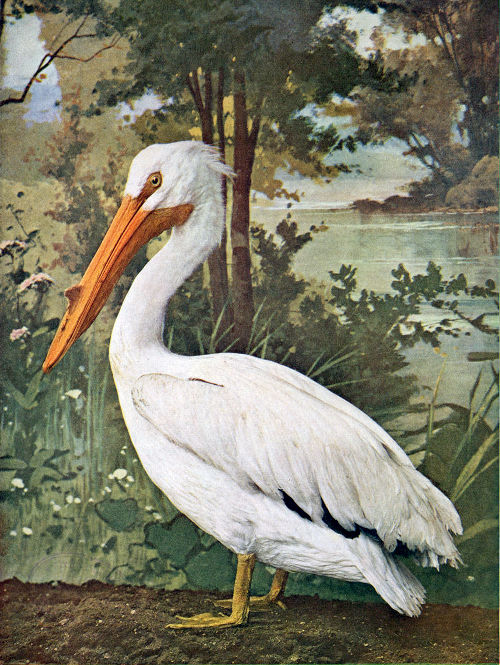
AMERICAN WHITE PELICAN. (Pelecanus erythrorhynchos.) About ⅕ Life-size. FROM COL. CHI. ACAD. SCIENCES. CHICAGO COLORTYPE CO.
113
The peculiar growth or crest on the bill which disappears soon after the breeding season, varies greatly both in size and shape. Dr. Ridgway says: “Frequently it consists of a single piece, nearly as high as long, its vertical outlines almost parallel, and the upper outline quite regularly convex, the largest specimen seen being about three inches high, by as many in length. More frequently, however, it is very irregular in shape, usually less elevated, and not infrequently with ragged anterior, or even posterior continuations.” At this time the bill is also more or less orange-red in color.
An excellent narrative of the habits of the White Pelican is given in the Ornithology of Illinois, where Dr. Ridgway quotes the words of Col. N. S. Goss regarding those who “have not seen the White Pelicans upon their feeding grounds, but may have read Audubon’s interesting description of the manner in which the birds unite and drive the fishes into shallow water, where they can catch them, which they cannot well do in deep water, as their skins are honey-combed with air cells that buoy them up like cork, and prevent their diving, and they do not plunge for their food when upon the wing, like their cousins, the Brown Pelicans, and therefore have to adopt fishing habits suited to shallow waters. I have often noticed the birds in flocks, in pairs, or alone, swimming on the water with partially opened wings, and head drawn down and back, the bill just clearing the water, ready to strike and gobble up the prey within their reach; when so fishing, if they ran into a shoal of minnows, they would stretch out their necks, drop their heads upon the water, and with open mouths and extended pouches, scoop up the tiny fry. Their favorite time for fishing on the seashore is during the incoming tide, as with it come the small fishes to feed upon the insects caught in the rise, and upon the low form of life in the drift, as it washes shoreward, the larger fishes following in their wake, each, from the smallest to the largest, eagerly engaged in taking life in order to sustain life. All sea-birds know this, and the time of its coming well. The White Pelicans, that have been patiently waiting in line along the beach, quietly move into the water and glide smoothly out so as not to frighten the life beneath. At a suitable distance from the shore they form into line in accordance with the sinuosities of the beach, each facing shoreward and awaiting their leader’s signal to start. When this is given, all is commotion; the birds, rapidly striking the water with their wings, throwing it high above them and plunging their heads in and out, fairly make the water foam as they move in an almost unbroken line, filling their pouches as they go. When satisfied with their catch, they wade and waddle into line again upon the beach, where they remain to rest, standing or sitting as suits them best, until they have leisurely swallowed the fishes in their nets; then, if undisturbed, they generally rise in a flock and circle for a long time high in air.”
The White Pelicans will consume a large amount of food; in fact, they are gluttonous. It is said that the remains of several hundred minnows have been taken from the stomach of a single pelican. Usually they are the most active in the pursuit of their prey for a short time after sunrise and also before sunset.
The chief breeding grounds of the White Pelican are from Minnesota northwards to the limit of its range. It nests also in isolated and greatly separated localities to the westward. It is said that several thousand permanently breed on the islands of the great Salt Lake. There are reasons for believing that it also breeds in Florida and westward along the Gulf of Mexico as far as Texas.
The White Pelican builds its nest on the ground using small sticks and twigs. They usually select a clump of sage or some other plant that will afford the nest some protection. Frequently sand is heaped around the nest to the depth of about six inches. The nests are about one foot in diameter. The color of the two to four eggs is a chalky white and the surface is quite rough, due to the irregular thickness of the outer coating. The average size of the eggs is about three and one-half by two and one-third inches.
114
The White Pelican as it calmly floats on the surface of the water, some distance from the shore, has been mistaken for the sail of a boat as the moist white feathers glisten in the sunshine.
Longfellow has beautifully woven this fact into the “Song of Hiawatha.”
“O’er the water floating, flying, Something in the hazy distance, Something in the mists of morning, Loomed and lifted from the water, Now seemed floating, now seemed flying, Coming nearer, nearer, nearer. Was it Shingebis the diver? Or the pelican, the Shada? Or the heron, the Shuh-shuh-gah? Or the white-goose, Waw-be-wawa, With the water dripping, flashing From its glossy neck and feathers? It was neither goose nor diver, Neither pelican nor heron O’er the water floating, flying, Through the shining mist of morning, But a birch canoe with paddles, Rising, sinking on the water.” Seth Mindwell.