SNAILS OF THE FOREST AND FIELD.
Reading edition
The forest is the home of the snail, where these interesting little animals may be found by any one desiring a closer acquaintance. They are not generally easy to find, being mostly nocturnal in habits and remaining hidden away under leaves, stones and old logs during the daytime. On rainy days, however, they may be seen crawling about, enjoying the delicious moisture.
In our last article we reviewed a few of the most interesting families of bivalve shells, and in the present paper we desire to draw the attention of the reader to the order Pulmonata, which includes those snails breathing air by means of a modified lung. The snails differ from the clams in having the body generally protected by a spiral shell which is capable of containing the entire animal. The former have a more or less expanded creeping disk which we call a foot, a head generally separated from the body by a neck (the reader will remember that the clams are headless), and also a pair of rather long eye peduncles protruding from the top of the head, which bear at their tips the round, black eyes, and a pair of short tactile organs, or tentacles, extending from the lower part of the head. The eye-peduncles are peculiar in being invertible in the same manner that a kid glove finger is pulled inside out.
The mouth is placed in the lower plane of the head and is recognized externally as a simple slit. Inside of the mouth is placed one of the most wonderful dental apparatuses known to science. This is called the radula, odontophore or tooth-bearer, and is a belt of chitinous, transparent, yellowish or colorless material, its upper surface being armed with numerous siliceous teeth arranged in longitudinal and parallel rows. The radula is placed in an organ called the buccal sac and occupies a position in the sac analogous to that of the tongue in a cat or dog, viz., on the floor of the mouth. It is formed from a layer of cells in the posterior part of the buccal sac, called the radula sac, and new teeth are constantly forming here to take the place of those which have become worn by use. The whole radula rests upon a cartilage, is strongly fastened at the anterior end, and is brought down between the two fleshy lips of the mouth where it performs a backward and forward movement, thus rasping off with the sharp teeth particles of food which have been cut into small pieces by the horny jaw. During this process the morsel of food is pressed against the top or roof of the mouth. The jaw is placed in the upper part of the mouth in front of the radula, and is frequently armed with ribs to aid in cutting or biting off pieces of food, as leaves or vegetables.
As before remarked, the radula is made up of parallel rows of teeth, the whole area being usually divided into five longitudinal rows, each row differing from the one next to it. We have first a central row, on each side of this a lateral row and finally a marginal row. Each tooth in each row is made up of different parts, a basal part attached to the radula belt and an upper part which is turned over or reflexed and bent backward so as to tear off food particles by a backward movement of the whole apparatus. This diversity of form in the teeth has led conchologists to adopt a tooth formula similar to that adopted for vertebrate animals, so that the teeth of different species can be compared and the animals classified thereby. Thus each tooth has certain prominences called cusps, which vary in size, number and position, and serve admirably to describe the different groups of snails. All the mollusca, except the bivalves, are provided with this radula.
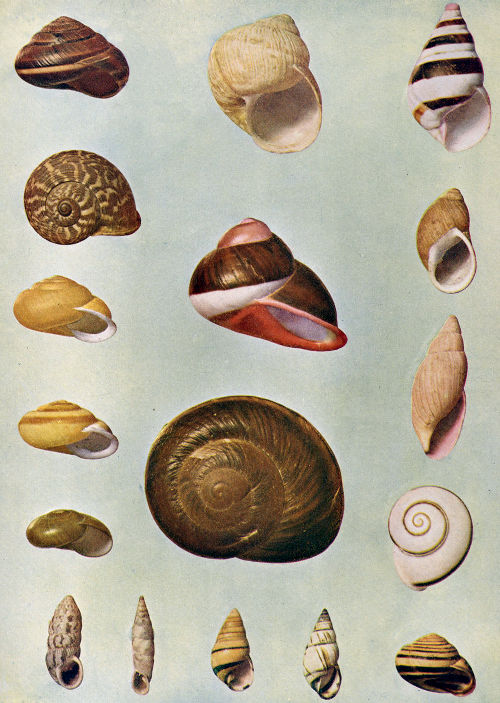
LAND SHELLS. FROM COL. CHI. ACAD. SCIENCES.
First row:
Helix fidelis (California)
Helix pomatia (Europe)
Liguus fasciatus (Florida)
Second row:
Cyclophorus appendiculatus (Philippines)
Bulimus chiliensis (South America)
Third row:
Helix albolabris (U. S.)
Helix haemastoma (India)
Fourth row:
Helix profunda (U. S.)
Nanina lamarkiana (Philippines)
Glandina truncata (Florida)
Fifth row:
Zonites fuliginosus (U. S.)
Achatinella (Sandwich Islands)
Helix intorta (Philippines)
Bottom row:
Cerion microstoma (Cuba)
Clausilia macarana (Dalmatia)
Bulimulus multilineatus (Florida)
Helix nemoralis (Europe)
77
One of the most wonderful and interesting facts connected with the radula is the large number of teeth on each membrane. Thus in some species of our common snails there are seventy-one teeth in a single row, and the whole radula is made up of a hundred rows of teeth, making a grand total of seventy-one hundred teeth in the mouth of a single snail!
Land snails are found almost everywhere, in valleys, high up on mountains, and even in deserts. They may be found in the cold climate of Alaska or in the tropical zone under the equator. As a rule, they prefer moist localities, where there is an abundance of vegetation and where the ground is strewn with rotting logs, beds of decaying leaves or moss-covered rocks. Open woodlands may be said to be their best habitat in the northern part of the United States.
The shells of the Pulmonata vary to a wonderful degree in size, shape and coloration. Some are so small that they can scarcely be seen with the unaided eye, while others attain a length of six inches; some have the aperture of the shell armed with numerous folds or teeth, while others are smooth and the colors vary from whitish or horn-colored to the gorgeously colored helices of the tropics with their bands and blotches of red, brown, white or green. With all this diversity the land shells or helices may always be distinguished from their salt or fresh-water relatives. The land snails breathe by means of a so-called lung which is a sac lined with a network of blood vessels and occupying the last turn or whorl of the shell. The air taken into this lung purifies the blood.
Much is written at the present time upon our new possessions, the Philippine Islands, but few people are aware that these islands are tenanted by the most interesting and beautiful group of all the land shells, the Cochlostylas, or tree snails. The animals live for the most part in the trees and bushes of the islands, the island of Luzon having, probably, the best known fauna. The animals are large and quite bold and the shells are of surpassing beauty, with their colors of white, green, brown, etc. Now that these islands have come into the possession of the United States it is to be hoped that these handsome creatures will receive the study they deserve.
The land shells of the United States, while numerous in species, are not as conspicuous in color-pattern as those of Europe, South America or the islands of the Indian and Pacific Oceans, although California produces some highly-colored species, as will be seen by consulting the figure of Helix fidelis, on our plate. The majority of our species are uncolored, like the figure of Polygyra albolabris.
One of the largest and most interesting of American shells is the Bulimus, found in South America. The shell of Bulimus ovatus attains a length of six inches and the animal is correspondingly large. In the markets of Rio Janeiro this mollusk is sold as food and is eagerly sought by the poorer people, among whom it is considered a great delicacy. Another interesting fact in connection with this species (as well as others of the genus) is the size of the eggs which it deposits, they being as large as pigeons’ eggs. These are also eaten with avidity by the negroes of Brazil.
One of the most beautiful of the land shells found in the United States is the Liguus fasciatus, found in Florida and Cuba. The shell is about two inches long and is encircled by bands of white, brown and green. This species lives in great numbers at Key West, associated with many small shells of the Bulimus group. Closely related to the last-mentioned shell (Liguus) is the agate shell (Achatina), which attains a length of seven inches and is the largest of the land shells. Like the Bulimus mentioned above it lays eggs of large size with a calcareous shell, some being over an inch in length. Both the animal and the egg are eaten by the natives of Africa. The shells are very attractive, being variegated with different colors, like agate, from which they receive their common name.
Another of our new political possessions, the Hawaiian Islands, has a molluscan fauna peculiar to itself. This is the family Achatinellidae which is confined solely to the Sandwich Islands. There are no shells which can compare in beauty with the Achatinella with their encircled bands of black, yellow, white, red, etc. They live on the bushes, generally rather low and near the ground, and recently they have been threatened with 78 extinction because of the cattle which have been introduced into the islands. In feeding on the bushes, they also consume large quantities of these snails. A bush inhabited by these little creatures must be a beautiful sight, with the green foliage set off by the handsomely colored shells, like jewels on a costly dress.
Among the edible snails none excel in public favor the common edible snail of Europe (Helix pomatia). The cultivation of this animal has become an established business, like our oyster fisheries, and thousands are consumed annually. The early Romans considered this animal a dainty dish, and the inhabitants of France, Spain and Italy have inherited or cultivated a liking for the succulent “Shell-fish.” This species has been introduced into New Orleans where it is eaten by the French inhabitants. Helix nemoralis, an edible snail of England, with a beautifully banded shell, is sold in the streets of London and eaten much as we eat walnuts, by picking out the animal with a pin! The edible snails, as well as many others, make good and interesting pets in captivity, the Helix pomatia being of such a size that it may be easily studied. It is interesting to watch one of these snails feeding upon a piece of lettuce. First the jaw is seen to protrude and to cut off a small piece of the leaf, which is drawn into the mouth and reduced to still smaller pieces by the rasp-like radula. A large piece of lettuce, after this snail has made a meal upon it, looks as if an army of worms had been at work. The pomatia is also of an inquisitive disposition and will wander about the snailery (or even the whole house if he can get out), examining everything in a very curious manner. No more interesting object can be placed in a library or study than a snailery with several species of snails. They are far superior in interest to goldfish or canaries.
The most interesting snails are by no means the largest. Frequently the small snail shells with their animals have habits or shell structures of absorbing interest. Among these are the Pupas, whose tiny shells frequently reach the astounding size of one-sixteenth of an inch in length! It is not until we place these mites under the microscope that their interesting characters are seen and appreciated. By such an examination we find that the little apertures are armed with many teeth and folds, and sometimes we wonder how it is that the animal ever gets in and out through such a labyrinth of apparent obstructions. These teeth serve in a manner to protect the little animal from its enemies. These tiny shells are always to be found plentifully under starting bark and under chips, stones and debris, in more or less moist localities.
In another genus of Pupidae, Clausilia, nature has provided the aperture of the shell with a little valve called a “clausilium,” which acts as a spring door to close the shell against all its enemies. This door is an additional safeguard as the aperture is already provided with numerous teeth and folds. In this manner does Mother Nature look after her children.
It is a curious fact that in all the larger groups of animals there are one or more genera which have the cruel and bloodthirsty propensities of the shark. The Mollusca are no exception to this rule, and we find in the genus Testacella an animal having all the ferocious propensities of the terrible man-eating tiger. This mollusk has a long, worm-like body, the shell being very small and rudimentary, ear shaped, and placed on the extreme posterior end of the animal. Its principal food consists of earth-worms, although it will attack other mollusks and even its own species. It has been likened to the tiger and the shark in its cunning while pursuing its prey and in its ferocity when attacking it. The poor earth-worm stands but a slight chance of escape when Testacella scents it and starts in pursuit. The worm tries to escape by retreating into its underground galleries, but this is of no avail because the mollusk has a long, narrow body and can go wherever the worm does. If the worm, perchance, has the opportunity of retreating far into its galleries, the mollusk will dig tunnels to intercept it. Frequently the mollusk will make a sudden spring upon its victim, taking it by surprise. This slug-like snail will frequently devour a snail much larger than itself, but if the victim is too large for one meal it will be broken in the middle and one half eaten and digested 79 and then the meal completed with the other half.
The Testacella also resembles the tiger and the shark in the possession of long, fang-like teeth upon its radula. These teeth are recurved and aid the mollusk in getting a firm hold upon its victim, and also assist in the operation of swallowing. It is a curious fact that this animal will not feed upon other dead animals nor upon fresh meat, nor freshly-killed worms. Like the snake, which it greatly resembles in habits, it must hunt and kill its own food. Its wanderings are nocturnal and during the day it remains concealed, buried in the earth. Testacella is quite long lived, as snails go, its duration of life being about six years.
A genus allied to Testacella, and having the same predaceous habits, but being protected by a large shell into which the whole animal can withdraw, is the Oleacina or Glandina. The shell is long, with a narrow aperture and a dome-shaped spire; the animal is long and narrow and the head near the mouth is furnished with a pair of elongated lips which may be used as tentacles. The South American species feed on the larger mollusks, as the Bulimus before spoken of, and the aperture of each intended victim’s shell is carefully examined before any attempt is made to enter. When our “tiger” is satisfied that its victim is really within, it will enter the aperture and devour the animal. Sometimes it will make a hole for itself in the shell of its victim and will eat the contents through this aperture instead of the natural one. In Florida these animals prey upon the large pulmonates like Lignus and Orthalicus.
Before closing this brief sketch of the Land Mollusks we must not neglect to mention their wonderful protection against the cold of winter and the heat of summer. This is a tough, leathery secretion, which completely covers the aperture, and its formation is thus described by Mr. W. G. Binney in his “Manual of American Land Shells.”
“Withdrawing into the shell, it forms over the aperture a membraneous covering, consisting of a thin, semi-transparent mixture of lime, mucus or gelatine, secreted from the collar of the animal. This membrane is called the epiphragm. It is formed in this manner: The animal being withdrawn into the shell, the collar is brought to a level with the aperture, and a quantity of mucus is poured out from it and covers it. A small quantity of air is then emitted from the respiratory foramen, which detaches the mucus from the surface of the collar, and projects it in a convex form, like a bubble. At the same moment the animal retreats farther into the shell, leaving a vacuum between itself and the membrane, which is consequently pressed back by the external air to a level with the aperture, or even farther, so as to form a concave surface, where, having become desiccated and hard, it remains fixed. These operations are nearly simultaneous and occupy but an instant. As the weather becomes colder the animal retires farther into the shell, and makes another septum, and so on, until there are sometimes as many as six of these partitions.”
The air-breathing snails which we have so briefly discussed in this article, are but a very limited number of the many thousand species of this very interesting group of animals. Their shells are easily gathered and require but little trouble to prepare for the cabinet and for study. The writer, therefore, trusts that what has been written may act as a stimulus and induce many to take up the collection and study of these beautiful objects.
Frank Collins Baker.
80