GEOGRAPHIC DISTRIBUTION OF SEED-BEARING PLANTS.
Reading edition
This is one of the most difficult and important subjects connected with the study of plants. Before it can be well organized it will be necessary to bring together very many more observations of plants in all parts of the world than is possible now. However, a few facts are known which are both interesting and suggestive. In order to make their presentation as definite as possible, this paper will be restricted to a brief account of the geographic distribution of seed plants.
One of the two great groups of seed plants is known as the Gymnosperms, a group which in our region is represented by pines, spruces, hemlocks, cedars, etc. In the tropics the group is represented by a very different type of trees, known as the Cycads. They resemble in general habit tree-ferns, or palms. The group of Gymnosperms with which we are acquainted have been called Conifers on account of the very characteristic cones which they bear. Several principles connected with geographic distribution may be illustrated by considering briefly these two groups of Gymnosperms.
The Cycads are absolutely restricted to the tropics, a few forms reaching into semi-tropical conditions, as in southern Florida. If a comparison be made between the eastern and western tropics, it will be discovered that the Cycads are almost equally divided between the two regions. For an unknown time, but certainly a very long one, these eastern and western Cycads have been separated from one another. As a consequence they have become so unlike that one kind of Cycad is never found in both hemispheres. Their long separation from one another, and their somewhat different conditions of living, have resulted in working out differences of structures which botanists recognize as species, genera, etc.
The Conifers, on the other hand, are characteristic of temperate regions. If the distribution of Conifers were indicated upon a world map, there would be shown a heavy massing of them in the northern region and a lighter massing in the southern region, the two being separated from one another by a broad tropical belt. This tropical belt is traversed in just two places; one is by means of the East Indian bridge, across which certain Australasian forms reach China and Japan; the other is the chain of the Andes mountains, along which a single northern type has worked its way into the southern part of South America. The two great masses of Conifers, therefore, lie in the northern and southern hemispheres, rather than in the eastern and western hemispheres, as is the case with the Cycads. This long separation has resulted just as it did with the Cycads; that is, the northern and southern Conifers are not any longer alike, but differ so widely from one another that botanists cannot discover any form which is common to both the northern and southern hemispheres, excepting the single one already mentioned, which has succeeded in crossing the tropics by means of the Andes bridge.
Another interesting fact in connection with the distribution of the Conifers is that their great centers of display are in regions which border the Pacific Ocean, and they have often been spoken of as a Pacific group. There are three special centers of display; one is the China-Japan region, a second is the general Australasian region, and the third is western North America. Just why this border region of the Pacific is especially favorable for this sort of plant life is a question which we do not as yet pretend to answer. Another fact which illustrates this persistent distribution in connection with 43 the Pacific is that in the case of the Conifers which belong to the southern hemisphere, the continental masses which pair in the display of similar forms are Australia and South America.
Another fact, which is true of all large groups, is that certain forms have a very extensive distribution, and others are very much restricted in their occurrence. For example, the greatest genus of Conifers is the genus made up by the pines, at least seventy kinds of which are recognized. This great genus sweeps throughout all the north temperate regions of the globe. There is a similar extensive distribution of the different kinds of spruce, larch, juniper, etc. On the other hand, the giant redwood, known as Sequoia, is restricted to certain comparatively small areas in California. In China and Japan, and also in Australia, there are numerous illustrations of forms very much restricted in their occurrence.
The other great group of seed plants is known as the Angiosperms, and to it belong all those seed plants which are most commonly met in this region. The distribution of Angiosperms is a very much more difficult question than that of Gymnosperms; for while there are only about four hundred kinds of living Gymnosperms, there are more than one hundred thousand kinds of living Angiosperms. In presenting the distribution of this great group, it will be necessary to consider its two main divisions separately, for they differ from one another very much. One of the groups is known as the Monocotyledons, to which belong such forms as the grasses, lilies, palms, orchids, etc.
Some prominent facts in reference to the geographical distribution of these Monocotyledons are as follows: They contain four great families, which include almost one-half of their number, and which have become world-wide in their distribution. These families are the grasses, the sedges, the lilies, and the irises. This world-wide distribution means that these families have succeeded in adapting themselves to every condition of soil and climate. In this world-distribution the grasses easily lead, not only among Monocotyledons, but among all seed plants.
Another fact in reference to the Monocotyledons is that they include an unusual number of families which are entirely aquatic in their habit. These aquatic families are also world-wide in their distribution, so far as fresh and brackish waters can be called world-wide. It is important to notice that while the world-families which belong to the land have worked out about ten thousand different forms, the world-families which belong to the water have worked out considerably less than two hundred different forms. This seems to indicate that the great number in the one case is due to the very diverse conditions of the land, while the small number in the latter case is due to the very uniform conditions of water life.
A third fact of importance is that the Monocotyledons are mainly massed in the tropics, and in this sense are almost an exact contrast to the Conifers we have been considering above. The same effect of separation in working out diversity in structure is shown by the Monocotyledons as was shown by the eastern and western Cycads, and the northern and southern Conifers. For example, the palms represent the great tree group of Monocotyledons, and are restricted to the tropics as rigidly as are the Cycads. They are found in about equal numbers in the eastern and western tropics, but there are no forms in common. The eastern and western forms have become so different that they might almost be regarded as different families.
The Monocotyledons are also somewhat famous for the number of air plants which they contain—that is, plants which have sometimes been called “perchers,” because they fasten themselves upon trunks and branches and supports of various kinds, and absorb what they need directly from the air. It is a notable fact that these so-called “perchers” are very much more abundant in the western tropics than in the eastern. An explanation for this is to be found in the fact that the western tropics have a very much greater rainfall; in fact, in the rainy woods of the Amazon region the air is saturated with water, and everything is dripping.
One of the facts in connection with the distribution of Monocotyledons is quite puzzling, and that is the very poor representation of the whole group in the southern 44 hemisphere. In examining the distribution of other groups in the southern hemisphere, it is found that Australia and its general vicinity is prolific in peculiar forms. In the case of the Monocotyledons, however, the Australasian region is the most poverty-stricken one in all the southern hemisphere. Just why the southern hemisphere in general, and the Australasian region in particular, are unfavorable for Monocotyledons, it is hard to say. Of course in these cases the world-families already mentioned are represented.
The other great division of Angiosperms is known as Dicotyledons, which include such forms as our common forest trees, buttercups, roses, peas, mints, sunflowers, etc. As there are about eighty thousand of these Dicotyledons, it is impossible to state anything very definite in reference to the distribution of the group as a whole. Taking the higher forms, however, as representing the general tendency of the group, some of the facts of distribution are as follows:
It has been noticed that the Monocotyledons are massed in the tropics, and that the temperate and boreal regions have been left comparatively free by previous groups, with the exception of the Conifers, which only develop tree types. With the coming of the Dicotyledons, therefore, the vast temperate and boreal regions presented a particularly favorable field, which they have entered and taken possession of. This vast group is prominently adapted to living in the unoccupied temperate and boreal regions. This does not mean that they are not found in the tropics for they hold their own there with the other groups.
Dicotyledons, however, succeeded in working out but three world-families: Composites, to which the sunflowers, dandelions, etc., belong; the Mints; and the Plantains. There are other large families which characterize certain great areas, but they are not world-wide in their distribution.
Another fact, which might indicate that the Dicotyledons have taken possession of comparatively unoccupied regions only, is that they are very poorly represented, so far as higher groups are concerned, in aquatic conditions. It would seem as though the conditions of life in the water had been fairly well taken up by other groups. In looking over the display of Dicotyledons in the tropics of the eastern and western hemispheres, it becomes evident that there is no such difference between the forms of the two regions as in the groups previously mentioned. It will be remembered, however, that in the case of the Cycads and palms, which were used as illustrations, they are restricted to the tropics, and their eastern and western forms are separated from one another, not merely by oceans, but by temperate and boreal lands. In the case of Dicotyledons this is different, for while they are found in the tropics, they are found in the other regions as well, and have better chances for intermingling than the other groups.
This tropical display of Dicotyledons further shows the great prominence of America in the display of forms. This appears not merely in the greater number of peculiar forms and often families which appear in tropical America; but whenever the continents are paired in the display of forms, America is always one of the pair, Asia or Africa being the other member.
It will be recognized from what has been said that the whole subject of geographic distribution is a very extensive one, and that it will be a long time before the important facts are recorded. The importance of the subject rests not so much upon the mere presence of certain plants in certain regions, but it has to do with explaining just why the conditions are suited to the plants, and also just how the plants have come to be what they are and where they are.
John Merle Coulter.
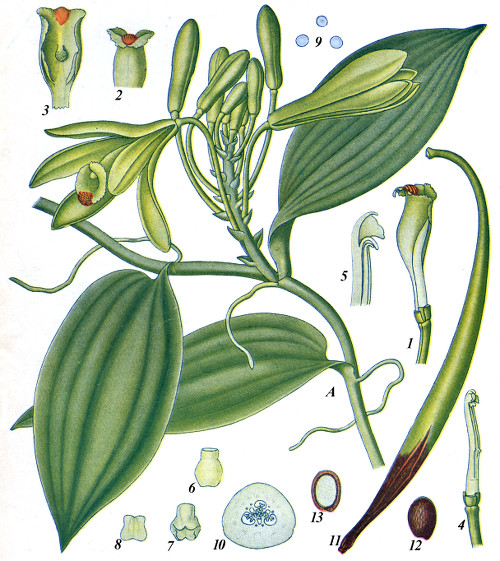
VANILLA. FROM KŒHLER’S MEDICINAL-PFLANZEN.
Description of Plate—A, flowering twig; 1, 2, 3, corolla; 4, 5, pistil; 6, 7, stamen; 9, pollen; 10, 11, fruit; 12, 13, seed.
47