Front matter
Reading edition
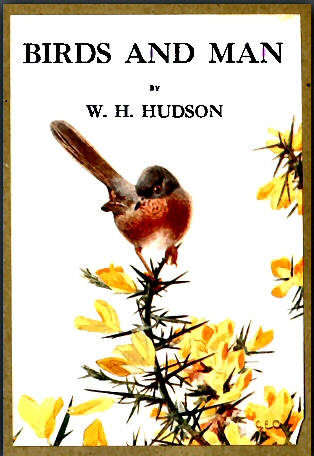
BIRDS AND MAN
BY THE SAME AUTHOR Birds in a Village Adventures among Birds Nature in Downland Hampshire Days The Land's End A Shepherd's Life Afoot in England The Purple Land Green Mansions A Crystal Age South American Sketches The Naturalist in La Plata A Little Boy Lost
BIRDS AND MAN
BY
W. H. HUDSON
LONDON DUCKWORTH & CO. 3 HENRIETTA STREET, COVENT GARDEN, W.C.
New Edition published by Duckworth & Co. 1915 Re-issued 1920
This book has been out of print for several years and has been somewhat altered for this new edition. The order in which the chapters originally appeared is changed. One chapter dealing mainly with bird life in the Metropolis, a subject treated fully in another work, has been omitted; two new chapters are added, and some fresh matter introduced throughout the work.
CONTENTS
CHAP. PAGE
I. Birds at their Best 1
II. Birds and Man 37
III. Daws in the West Country 58
IV. Early Spring in Savernake Forest 79
V. A Wood Wren at Wells 101
VI. The Secret of the Willow Wren 117
VII. Secret of the Charm of Flowers 133
VIII. Ravens in Somerset 159
IX. Owls in a Village 173
X. The Strange and Beautiful Sheldrake 187
XI. Geese: an Appreciation and a Memory 199
XII. The Dartford Warbler 222
XIII. Vert—Vert; or Parrot Gossip 249
XIV. Something Pretty in a Glass Case 269
XV. Selborne 283
Index 303
BIRDS AND MAN
CHAPTER I
BIRDS AT THEIR BEST
By Way of Introduction
Years ago, in a chapter concerning eyes in a book of Patagonian memories, I spoke of the unpleasant sensations produced in me by the sight of stuffed birds. Not bird skins in the drawers of a cabinet, it will be understood, these being indispensable to the ornithologist, and very useful to the larger class of persons who without being ornithologists yet take an intelligent interest in birds. The unpleasantness was at the sight of skins stuffed with wool and set up on their legs in imitation of the living bird, sometimes (oh, mockery!) in their "natural surroundings." These "surroundings" are as a rule constructed or composed of a few handfuls of earth to form the floor of the glass case—sand, rock, clay, chalk, or gravel; whatever the material may be it invariably has, like all "matter out of place," a grimy and depressing appearance. On the floor are planted grasses, sedges, and miniature bushes, made of tin or zinc and then dipped in a bucket of green paint. In the chapter referred to it was said, "When the eye closes in death, the bird, except to the naturalist, becomes a mere bundle of dead feathers; crystal globes may be put into the empty sockets, and a bold life-imitating attitude given to the stuffed specimen, but the vitreous orbs shoot forth no life-like glances: the 'passion and the life whose fountains are within' have vanished, and the best work of the taxidermist, who has given a life to his bastard art, produces in the mind only sensations of irritation and disgust."
That, in the last clause, was wrongly writ. It should have been my mind, and the minds of those who, knowing living birds intimately as I do, have the same feeling about them.
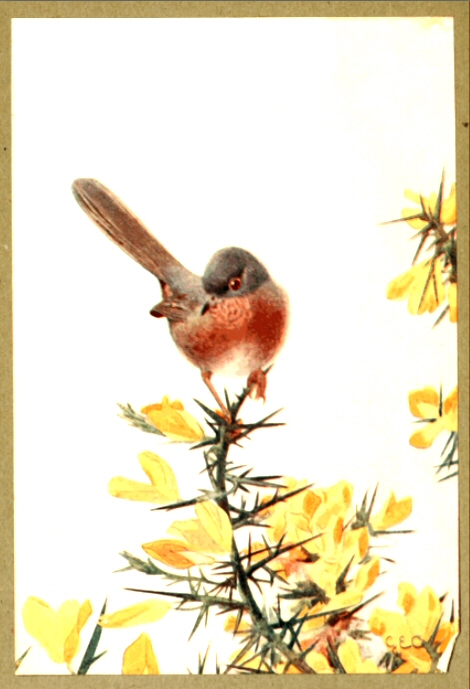
This, then, being my feeling about stuffed birds, set up in their "natural surroundings," I very naturally avoid the places where they are exhibited. At Brighton, for instance, on many occasions when I have visited and stayed in that town, there was no inclination to see the Booth Collection, which is supposed to be an ideal collection of British birds; and we know it was the life-work of a zealous ornithologist who was also a wealthy man, and who spared no pains to make it perfect of its kind. About eighteen months ago I passed a night in the house of a friend close to the Dyke Road, and next morning, having a couple of hours to get rid of, I strolled into the museum. It was painfully disappointing, for though no actual pleasure had been expected, the distress experienced was more than I had bargained for. It happened that a short time before, I had been watching the living Dartford warbler, at a time when the sight of this small elusive creature is loveliest, for not only was the bird in his brightest feathers, but his surroundings were then most perfect—
The whin was frankincense and flame.
His appearance, as I saw him then and on many other occasions in the furze-flowering season, is fully described in a chapter in this book; but on this particular occasion while watching my bird I saw it in a new and unexpected aspect, and in my surprise and delight I exclaimed mentally, "Now I have seen the furze wren at his very best!"
It was perhaps a very rare thing—one of those effects of light on plumage which we are accustomed to see in birds that have glossed metallic feathers, and, more rarely, in other kinds. Thus the turtle-dove when flying from the spectator with a strong sunlight on its upper plumage, sometimes at a distance of two to three hundred yards, appears of a shining whiteness.
I had been watching the birds for a couple of hours, sitting quite still on a tuft of heather among the furze-bushes, and at intervals they came to me, impelled by curiosity and solicitude, their nests being near, but, ever restless, they would never remain more than a few seconds at a time in sight. The prettiest and the boldest was a male, and it was this bird that in the end flew to a bush within twelve yards of where I sat, and perching on a spray about on a level with my eyes exhibited himself to me in his characteristic manner, the long tail raised, crest erect, crimson eye sparkling, and throat puffed out with his little scolding notes. But his colour was no longer that of the furze wren: seen at a distance the upper plumage always appears slaty-black; near at hand it is of a deep slaty-brown; now it was dark, sprinkled or frosted over with a delicate greyish-white, the white of oxidised silver; and this rare and beautiful appearance continued for a space of about twenty seconds; but no sooner did he flit to another spray than it vanished, and he was once more the slaty-brown little bird with a chestnut-red breast.
It is unlikely that I shall ever again see the furze wren in this aspect, with a curious splendour wrought by the sunlight in the dark but semi-translucent delicate feathers of his mantle; but its image is in the mind, and, with a thousand others equally beautiful, remains to me a permanent possession.
As I went in to see the famous Booth Collection, a thought of the bird I have just described came into my mind; and glancing round the big long room with shelves crowded with stuffed birds, like the crowded shelves of a shop, to see where the Dartford warblers were, I went straight to the case and saw a group of them fastened to a furze-bush, the specimens twisted by the stuffer into a variety of attitudes—ancient, dusty, dead little birds, painful to look at—a libel on nature and an insult to a man's intelligence.
It was a relief to go from this case to the others, which were not of the same degree of badness, but all, like the furze wrens, were in their natural surroundings—the pebbles, bit of turf, painted leaves, and what not, and, finally, a view of the wide world beyond, the green earth and the blue sky, all painted on the little square of deal or canvas which formed the back of the glass case.
Listening to the talk of other visitors who were making the round of the room, I heard many sincere expressions of admiration: they were really pleased and thought it all very wonderful. That is, in fact, the common feeling which most persons express in such places, and, assuming that it is sincere, the obvious explanation is that they know no better. They have never properly seen anything in nature, but have looked always with mind and the inner vision preoccupied with other and familiar things—indoor scenes and objects, and scenes described in books. If they had ever looked at wild birds properly—that is to say, emotionally—the images of such sights would have remained in their minds; and, with such a standard for comparison, these dreary remnants of dead things set before them as restorations and as semblances of life would have only produced a profoundly depressing effect.
We hear of the educational value of such exhibitions, and it may be conceded that they might be made useful to young students of zoology, by distributing the specimens over a large area, arranged in scattered groups so as to give a rough idea of the relationship existing among its members, and of all together to other neighbouring groups, and to others still further removed. The one advantage of such a plan to the young student would be, that it would help him to get rid of the false notion, which classification studied in books invariably produces, that nature marshals her species in a line or row, or her genera in a chain. But no such plan is ever attempted, probably because it would only be for the benefit of about one person in five hundred visitors, and the expense would be too great.
As things are, these collections help no one, and their effect is confusing and in many ways injurious to the mind, especially to the young. A multitude of specimens are brought before the sight, each and every one a falsification and degradation of nature, and the impression left is of an assemblage, or mob, of incongruous forms, and of a confusion of colours. The one comfort is that nature, wiser than our masters, sets herself against this rude system of overloading the brain. She is kind to her wild children in their intemperance, and is able to relieve the congested mind, too, from this burden. These objects in a museum are not and cannot be viewed emotionally, as we view living forms and all nature; hence they do not, and we being what we are, cannot, register lasting impressions.
It needed a long walk on the downs to get myself once more in tune with the outdoor world after that distuning experience; but just before quitting the house in the Dyke Road an old memory came to me and gave me some relief, inasmuch as it caused me to smile. It was a memory of a tale of the Age of Fools, which I heard long years ago in the days of my youth.
I was at a small riverine port of the Plata river, called Ensenada de Barragán, assisting a friend to ship a number of sheep which he had purchased in Buenos Ayres and was sending to the Banda Oriental—the little republic on the east side of the great sea-like river. The sheep, numbering about six thousand, were penned at the side of the creek where the small sailing ships were lying close to the bank, and a gang of eight men were engaged in carrying the animals on board, taking them one by one on their backs over a narrow plank, while I stood by keeping count. The men were gauchos, all but one—a short, rather grotesque-looking Portuguese with one eye. This fellow was the life and soul of the gang, and with his jokes and antics kept the others in a merry humour. It was an excessively hot day, and at intervals of about an hour the men would knock off work, and, squatting on the muddy bank, rest and smoke their cigarettes; and on each occasion the funny one-eyed Portuguese would relate some entertaining history. One of these histories was about the Age of Fools, and amused me so much that I remember it to this day. It was the history of a man of that remote age, who was born out of his time, and who grew tired of the monotony of his life, even of the society of his wife, who was no whit wiser than the other inhabitants of the village they lived in. And at last he resolved to go forth and see the world, and bidding his wife and friends farewell he set out on his travels. He travelled far and met with many strange and entertaining adventures, which I must be pardoned for not relating, as this is not a story-book. In the end he returned safe and sound to his home, a much richer man than when he started; and opening his pack he spread out before his wife an immense number of gold coins, with scores of precious stones, and trinkets of the greatest value. At the sight of this glittering treasure she uttered a great scream of joy and jumping up rushed from the room. Seeing that she did not return, he went to look for her, and after some searching discovered that she had rushed down to the wine-cellar and knocking open a large cask of wine had jumped into it and drowned herself for pure joy.
"Thus happily ended his adventures," concluded the one-eyed cynic, and they all got up and resumed their work of carrying sheep to the boat.
It was one of the adventures met with by the man of the tale in his travels that came into my mind when I was in the Booth Museum, and caused me to smile. In his wanderings in a thinly settled district, he arrived at a village where, passing by the church, his attention was attracted by a curious spectacle. The church was a big building with a rounded roof, and great blank windowless walls, and the only door he could see was no larger than the door of a cottage. From this door as he looked a small old man came out with a large empty sack in his hands. He was very old, bowed and bent with infirmities, and his long hair and beard were white as snow. Toddling out to the middle of the churchyard he stood still, and grasping the empty sack by its top, held it open between his outstretched arms for a space of about five minutes; then with a sudden movement of his hands he closed the sack's mouth, and still grasping it tightly, hurried back to the church as fast as his stiff joints would let him, and disappeared within the door. By and by he came forth again and repeated the performance, and then again, until the traveller approached and asked him what he was doing. "I am lighting the church," said the old man; and he then went on to explain that it was a large and a fine church, full of rich ornaments, but very dark inside—so dark that when people came to service the greatest confusion prevailed, and they could not see each other or the priest, nor the priest them. It had always been so, he continued, and it was a great mystery; he had been engaged by the fathers of the village a long time back, when he was a young man, to carry sunlight in to light the interior; but though he had grown old at his task, and had carried in many, many thousands of sackfuls of sunlight every year, it still remained dark, and no one could say why it was so.
It is not necessary to relate the sequel: the reader knows by now that in the end the dark church was filled with light, that the traveller was feasted and honoured by all the people of the village, and that he left them loaded with gifts.
Parables of this kind as a rule can have no moral or hidden meaning in an age so enlightened as this; yet oddly enough we do find among us a delusion resembling that of the villagers who thought they could convey sunshine in a sack to light their dark church. It is one of a group or family of indoor delusions and illusions, which Mr Sully has not mentioned in his book on that fascinating subject. One example of the particular delusion I have been speaking of, in which it is seen in its crudest form, may be given here.
A man walking by the water-side sees by chance a kingfisher fly past, its colour a wonderful blue, far surpassing in beauty and brilliancy any blue he has ever seen in sky or water, or in flower or stone, or any other thing. No sooner has he seen than he wishes to become the possessor of that rare loveliness, that shining object which, he fondly imagines, will be a continual delight to him and to all in his house,—an ornament comparable to that splendid stone which the poor fisherman found in a fish's belly, which was his children's plaything by day and his candle by night. Forthwith he gets his gun and shoots it, and has it stuffed and put in a glass case. But it is no longer the same thing: the image of the living sunlit bird flashing past him is in his mind and creates a kind of illusion when he looks at his feathered mummy, but the lustre is not visible to others.
It is because of the commonness of this delusion that stuffed kingfishers, and other brilliant species, are to be seen in the parlours of tens of thousands of cottages all over the land. Nor is it only those who live in cottages that make this mistake; those who care to look for it will find that it exists in some degree in most minds—the curious delusion that the lustre which we see and admire is in the case, the coil, the substance which may be grasped, and not in the spirit of life which is within and the atmosphere and miracle-working sunlight which are without.
To return to my own taste and feelings, since in the present chapter I must be allowed to write on Man (myself to wit) and Birds, the other chapters being occupied with the subject of Birds and Man. It has always, or since I can remember, been my ambition and principal delight to see and hear every bird at its best. This is here a comparative term, and simply means an unusually attractive aspect of the bird, or a very much better than the ordinary one. This may result from a fortunate conjunction of circumstances, or may be due to a peculiar harmony between the creature and its surroundings; or in some instances, as in that given above of the Dartford warbler, to a rare effect of the sun. In still other cases, motions and antics, rarely seen, singularly graceful, or even grotesque, may give the best impression. After one such impression has been received, another equally excellent may follow at a later date: in that case the second impression does not obliterate, or is not superimposed upon the former one; both remain as permanent possessions of the mind, and we may thus have several mental pictures of the same species.
It is the same with all minds with regard to the objects and scenes which happen to be of special interest. The following illustration will serve to make the matter clearer to readers who are not accustomed to pay attention to their own mental processes. When any common object, such as a chair, or spade, or apple, is thought of or spoken of, an image of a picture of it instantly comes before the mind's eye; not of a particular spade or apple, but of a type representing the object which exists in the mind ready for use on all occasions. With the question of the origin of this type, this spade or apple of the mind, we need not concern ourselves here. If the object thought or spoken of be an animal—a horse let us say, the image seen in the mind will in most cases be as in the foregoing case a type existing in the mind and not of an individual. But if a person is keenly interested in horses generally, and is a rider and has owned and loved many horses, the image of some particular one which he has known or has looked at with appreciative eyes will come to mind; and he will also be able to call up the images of dozens or of scores of horses he has known or seen in the same way. If on the other hand we think of a rat, we see not any individual but a type, because we have no interest in or no special feeling with regard to such a creature, and all the successive images we receive of it become merged in one—the type which already existed in the mind and was probably formed very early in life. With the dog for subject the case is different: dogs are more with us—we know them intimately and have perhaps regarded many individuals with affection; hence the image that rises in the mind is as a rule of some dog we have known.
The important point to be noted is, that while each and everything we see registers an impression in the brain, and may be recalled several minutes, or hours, or even days afterwards, the only permanent impressions are of the sights which we have viewed emotionally. We may remember that we have seen a thousand things in which at some later period an interest has been born in the mind, when it would be greatly to our pleasure and even profit to recover their images, and we strive and ransack our brains to do so, but all in vain: they have been lost for ever because we happened not to be interested in the originals, but viewed them with indifference, or unemotionally.
With regard to birds, I see them mentally in two ways: each species which I have known and observed in its wild state has its type in the mind—an image which I invariably see when I think of the species; and, in addition, one or two or several, in some cases as many as fifty, images of the same species of bird as it appeared at some exceptionally favourable moment and was viewed with peculiar interest and pleasure.
Of hundreds of such enduring images of our commonest species I will here describe one before concluding with this part of the subject.
The long-tailed or bottle-tit is one of the most delicately pretty of our small woodland birds, and among my treasures, in my invisible and intangible album, there were several pictures of him which I had thought unsurpassable, until on a day two years ago when a new and better one was garnered. I was walking a few miles from Bath by the Avon where it is not more than thirty or forty yards wide, on a cold, windy, very bright day in February. The opposite bank was lined with bushes growing close to the water, the roots and lower trunks of many of them being submerged, as the river was very full; and behind this low growth the ground rose abruptly, forming a long green hill crowned with tall beeches. I stopped to admire one of the bushes across the stream, and I wish I could now say what its species was: it was low with widespread branches close to the surface of the water, and its leafless twigs were adorned with catkins resembling those of the black poplar, as long as a man's little finger, of a rich dark-red or maroon colour. A party of about a dozen long-tailed tits were travelling, or drifting, in their usual desultory way, through the line of bushes towards this point, and in due time they arrived, one by one, at the bush I was watching, and finding it sheltered from the wind they elected to remain at that spot. For a space of fifteen minutes I looked on with delight, rejoicing at the rare chance which had brought that exquisite bird- and plant-scene before me. The long deep-red pendent catkins and the little pale birdlings among them in their grey and rose-coloured plumage, with long graceful tails and minute round, parroty heads; some quietly perched just above the water, others moving about here and there, occasionally suspending themselves back downwards from the slender terminal twigs—the whole mirrored below. That magical effect of water and sunlight gave to the scene a somewhat fairy-like, an almost illusory, character.
Such scenes live in their loveliness only for him who has seen and harvested them: they cannot be pictured forth to another by words, nor with the painter's brush, though it be charged with tintas orientales; least of all by photography, which brings all things down to one flat, monotonous, colourless shadow of things, weary to look at.
From sights we pass to the consideration of sounds, and it is unfortunate that the two subjects have to be treated consecutively instead of together, since with birds they are more intimately joined than in any other order of beings; and in images of bird life at its best they sometimes cannot be dissociated;—the aërial form of the creature, its harmonious, delicate tints, and its grace of motion; and the voice, which, loud or low, is aërial too, in harmony with the form.
We know that as with sights so it is with sounds: those to which we listen attentively, appreciatively, or in any way emotionally, live in the mind, to be recalled and reheard at will. There is no doubt that in a large majority of persons this retentive power is far less strong with regard to sounds than sights, but we are all supposed to have it in some degree. So far, I have met with but one person, a lady, who is without it: sounds, in her case, do not register an impression in the brain, so that with regard to this sense she is in the condition of civilised man generally with regard to smells. I say of civilised man, being convinced that this power has become obsolete in us, although it appears to exist in savages and in the lower animals. The most common sounds, natural or artificial, the most familiar bird-notes, the lowing of a cow, the voices of her nearest and dearest friends, and simplest melodies sung or played, cannot be reproduced in her brain: she remembers them as agreeable sounds, just as we all remember that certain flowers and herbs have agreeable odours; but she does not hear them. Probably there are not many persons in the same case; but in such matters it is hard to know what the real condition of another's mind may be. Our acquaintances refuse to analyse or turn themselves inside out merely to gratify a curiosity which they may think idle. In some cases they perhaps have a kind of superstition about such things: the secret processes of their mind are their secret, or "business," and, like the secret and real name of a person among some savage tribes, not to be revealed but at the risk of giving to another a mysterious power over their lives and fortunes. Even worse than the reticent, the superstitious, and the simply unintelligent, is the highly imaginative person who is only too ready to answer all inquiries, who catches at what you say in explanation, divines what you want, and instantly (and unconsciously) invents something to tell you.
But we may, I think, take it for granted that the faculty of retaining sounds is as universal as that of retaining sights, although, speaking generally, the impressions of sounds are less perfect and lasting than those which relate to the higher, more intellectual sense of vision; also that this power varies greatly in different persons. Furthermore, we see in the case of musical composers, and probably of most musicians who are devoted to their art, that this faculty is capable of being trained and developed to an extraordinary degree of efficiency. The composer sitting pen in hand to write his score in his silent room hears the voices and the various instruments, the solos and orchestral sounds, which are in his thoughts. It is true that he is a creator, and listens mentally to compositions that have never been previously heard; but he cannot imagine, or cannot hear mentally, any note or combination of notes which he has never heard with his physical sense. In creating he selects from the infinite variety of sounds whose images exist in his mind, and, rearranging them, produces new effects.
The difference in the brains, with regard to their sound-storing power, of the accomplished musician and the ordinary person who does not know one tune from another and has but fleeting impressions of sounds in general, is no doubt enormous; probably it is as great as that which exists in the logical faculty between a professor of that science in one of the Universities and a native of the Andaman Islands or of Tierra del Fuego. It is, we see, a question of training: any person with a normal brain who is accustomed to listen appreciatively to certain sounds, natural or artificial, must store his mind with the images of such sounds. And the open-air naturalist, who is keenly interested in the language of birds, and has listened with delight to a great variety of species, should be as rich in such impressions as the musician is with regard to musical sounds. Unconsciously he has all his life been training the faculty.
With regard to the durability of the images, it may be thought by some that, speaking of birds, only those which are revived and restored, so to speak, from time to time by fresh sense-impressions remain permanently distinct. That would naturally be the first conclusion most persons would arrive at, considering that the sound-images which exist in their minds are of the species found in their own country, which they are able to hear occasionally, even if at very long intervals in some cases. My own experience proves that it is not so; that a man may cut himself off from the bird life he knows, to make his home in another region of the globe thousands of miles away, and after a period exceeding a quarter of a century, during which he has become intimate with a wholly different bird life, to find that the old sound-images, which have never been refreshed with new sense-impressions, are as distinct as they ever were, and seem indeed imperishable.
I confess that, when I think of it, I am astonished myself at such an experience, and to some it must seem almost incredible. It will be said, perhaps, that in the infinite variety of bird-sounds heard anywhere there must be innumerable notes which closely resemble, or are similar to, those of other species in other lands, and, although heard in a different order, the old images of cries and calls and songs are thus indirectly refreshed and kept alive. I do not think that has been any real help to me. Thus, I think of some species which has not been thought of for years, and its language comes back at call to my mind. I listen mentally to its various notes, and there is not one in the least like the notes of any British species. These images have therefore never received refreshment. Again, where there is a resemblance, as in the trisyllabic cry of the common sandpiper and another species, I listen mentally to one, then to the other, heard so long ago, and hear both distinctly, and comparing the two, find a considerable difference, one being a thinner, shriller, and less musical sound than the other. Still again, in the case of the blackbird, which has a considerable variety in its language, there is one little chirp familiar to every one—a small round drop of sound of a musical, bell-like character. Now it happens that one of the true thrushes of South America, a bird resembling our song-thrush, has an almost identical bell-like chirp, and so far as that small drop of sound is concerned the old image may be refreshed by new sense-impressions. Or I might even say that the original image has been covered by the later one, as in the case of the laughter-like cries of the Dominican and the black-backed gulls. But with regard to the thrushes, excepting that small drop of sound, the language of the two species is utterly different. Each has a melody perfect of its kind: the song of the foreign bird is not fluty nor mellow nor placid like that of the blackbird, but has in a high degree that quality of plaintiveness and gladness commingled which we admire in some fresh and very beautiful human voices, like that described in Lowell's lines "To Perdita Singing":—
It hath caught a touch of sadness, Yet it is not sad; It hath tones of clearest gladness, Yet it is not glad.
Again, that foreign song is composed of many notes, and is poured out in a stream, as a skylark sings; and it is also singular on account of the contrast between these notes which suggest human feeling and a purely metallic, bell-like sound, which, coming in at intervals, has the effect of the triangle in a band of wind instruments. The image of this beautiful song is as distinct in my mind as that of the blackbird which I heard every day last summer from every green place.
Doubtless there are some and perhaps a good many ornithologists among us who have been abroad to observe the bird life of distant countries, and who when at home find that the sound-impressions they have received are not persistent, or, if not wholly lost, that they grow faint and indistinct, and become increasingly difficult to recall. They can no longer listen to those over-sea notes and songs as they can, mentally, to the cuckoo's call in spring, the wood-owl's hoot, to the song of the skylark and of the tree-pipit, the reeling of the night-jar and the startling scream of the woodland jay, the deep human-like tones of the raven, the inflected wild cry of the curlew, and the beautiful wild whistle of the widgeon, heard in the silence of the night on some lonely mere.
The reason is that these, and numberless more, are the sounds of the bird life of their own home and country; the living voices to which they listened when they were young and the senses keener than now, and their enthusiasm greater; they were in fact heard with an emotion which the foreign species never inspired in them, and thus heard, the images of the sounds were made imperishable.
In my case the foreign were the home birds, and on that account alone more to me than all others; yet I escaped that prejudice which the British naturalist is never wholly without—the notion that the home bird is, intrinsically, better worth listening to than the bird abroad. Finally, on coming to this country, I could not listen to the birds coldly, as an English naturalist would to those of, let us say, Queensland, or Burma, or Canada, or Patagonia, but with an intense interest; for these were the birds which my forbears had known and listened to all their lives long; and my imagination was fired by all that had been said of their charm, not indeed by frigid ornithologists, but by a long succession of great poets, from Chaucer down to those of our own time. Hearing them thus emotionally their notes became permanently impressed on my mind, and I found myself the happy possessor of a large number of sound-images representing the bird language of two widely separated regions.
To return to the main point—the durability of the impressions both of sight and sound.
In order to get a more satisfactory idea of the number and comparative strength or vividness of the images of twenty-six years ago remaining to me after so long a time than I could by merely thinking about the subject, I drew up a list of the species of birds observed by me in the two adjoining districts of La Plata and Patagonia. Against the name of each species the surviving sight- and sound-impressions were set down; but on going over this first list and analysis, fresh details came to mind, and some images which had become dimmed all at once grew bright again, and to bring these in, the work had to be redone; then it was put away and the subject left for a few days to the "subliminal consciousness," after which I took it up once more and rewrote it all—list and analysis; and I think it now gives a fairly accurate account of the state of these old impressions as they exist in memory.
This has not been done solely for my own gratification. I confess to a very strong feeling of curiosity as to the mental experience on this point of other field naturalists; and as these, or some of them, may have the same wish to look into their neighbours' minds that I have, it may be that the example given here will be followed.
My list comprises 226 species—a large number to remember when we consider that it exceeds by about 16 or 18 the number of British species; that is to say, those which may truly be described as belonging to these islands, without including the waifs and strays and rare visitants which by a fiction are described as British birds. Of the 226, the sight-impressions of 10 have become indistinct, and one has been completely forgotten. The sight of a specimen might perhaps revive an image of this lost one as it was seen, a living wild bird; but I do not know. This leaves 215, every one of which I can mentally see as distinctly as I see in my mind the common species I am accustomed to look at every day in England—thrush, starling, robin, etc.
A different story has to be told with regard to the language. To begin with, there are no fewer than 34 species of which no sound-impressions were received. These include the habitually silent kinds—the stork, which rattles its beak but makes no vocal sound, the painted snipe, the wood ibis, and a few more; species which were rarely seen and emitted no sound—condor, Muscovy duck, harpy eagle, and others; species which were known only as winter visitants, or seen on migration, and which at such seasons were invariably silent.
Thus, those which were heard number 192. Of these the language of 7 species has been completely forgotten, and of 31 the sound-impressions have now become indistinct in varying degrees. Deducting those whose notes have become silent and are not clearly heard in the mind, there remain 154 species which are distinctly remembered. That is to say, when I think of them and their language, the cries, calls, songs, and other sounds are reproduced in the mind.
Studying the list, in which the species are ranged in order according to their affinities, it is easy to see why the language of some, although not many, has been lost or has become more or less indistinct. In some cases it is because there was nothing distinctive or in any way attractive in the notes; in other cases because the images have been covered and obliterated by others—the stronger images of closely-allied species. In the two American families of tyrant-birds and woodhewers, neither of which are songsters, there is in some of the closely-related species a remarkable family resemblance in their voices. Listening to their various cries and calls, the trained ear of the ornithologist can easily distinguish them and identify the species; but after years the image of the more powerful or the better voices of, say, two or three species in a group of four or five absorb and overcome the others. I cannot find a similar case among British species to illustrate this point, unless it be that of the meadow- and rock-pipit. Strongly as the mind is impressed by the measured tinkling notes of these two songs, emitted as the birds descend to earth, it is not probable that any person who had not heard them for a number of years would be able to distinguish or keep them separate in his mind—to hear them in their images as two distinct songs.
In the case of the good singers in that distant region, I find the voices continue remarkably dis tinct, and as an example will give the two melodious families of the finches and the troupials (Icteridae), the last an American family, related to the finches, but starling-like in appearance, many of them brilliantly coloured. Of the first I am acquainted with 12 and of the second with 14 species.
Here then are 26 highly vocal species, of which the songs, calls, chirps, and various other notes, are distinctly remembered in 23. Of the other three one was silent—a small rare migratory finch resembling the bearded-tit in its reed-loving habits, its long tail and slender shape, and partly too in its colouring. I listened in vain for this bird's singing notes. Of the remaining two one is a finch, the other a troupial; the first a pretty bird, in appearance a small hawfinch with its whole plumage a lovely glaucous blue; a poor singer with a low rambling song: the second a bird of the size of a starling, coloured like a golden oriole, but more brilliant; and this one has a short impetuous song composed of mixed guttural and clear notes.
Why is this rather peculiar song, of a species which on account of its colouring and pleasing social habits strongly impresses the mind, less distinct in memory than the songs of other troupials? I believe it is because it is a rare thing to hear a single song. They perch in a tree in company, like birds of paradise, and no sooner does one open his beak than all burst out together, and their singing strikes on the sense in a rising and falling tempest of confused sound. But it may be added that though these two songs are marked "indistinct" in the list, they are not very indistinct, and become less so when I listen mentally with closed eyes.
In conclusion, it is worthy of remark that the good voices, as to quality, and the powerful ones, are not more enduring in their images than those which were listened to appreciatively for other reasons. Voices which have the quality of ventriloquism, or are in any way mysterious, or are suggestive of human tones, are extremely persistent; and such voices are found in owls, pigeons, snipe, rails, grebes, night-jars, tinamous, rheas, and in some passerine birds. Again, the swallows are not remarkable as singers compared with thrushes, finches, and other melodists; but on account of their intrinsic charm and beauty, their interesting habits, and the sentiment they inspire, we listen to them emotionally; and I accordingly find that the language of the five species of swallows I was formerly accustomed to see and hear continues as distinct in my mind as that of the chimney swallow, which I listen to every summer in England.
• • • • •
I had meant in this chapter to give three or four or half a dozen instances of birds seen at their best, instead of the one I have given—that of the long-tailed tit; and as many more images in which a rare, unforgettable effect was produced by melody. For as with sights so it is with sounds: for these too there are "special moments," which have "special grace." But this chapter is already longer than it was ever meant to be, and something on another subject yet remains to be said.
The question is sometimes asked, What is the charm which you find, or say you find, in nature? Is it real, or do these words so often repeated have a merely conventional meaning, like so many other words and phrases which men use with regard to other things? Birds, for instance: apart from the interest which the ornithologists must take in his subject, what substantial happiness can be got out of these shy creatures, mostly small and not too well seen, that fly from us when approached, and utter sounds which at their best are so poor, so thin, so trivial, compared with our soul-stirring human music?
That, briefly, is the indoor view of the subject—the view of those who, to begin with, were perhaps town-born and town-bred; who have existed amid conditions, occupied with work and pleasures, the reflex effect of which, taken altogether and in the long-run, is to dim and even deaden some of the brain's many faculties, and chiefly this best faculty of preserving impressions of nature for long years or to the end of life in all their original freshness.
Some five or six years ago I heard a speech about birds delivered by Sir Edward Grey, in which he said that the love and appreciation and study of birds was something fresher and brighter than the second-hand interests and conventional amusements in which so many in this day try to live; that the pleasure of seeing and listening to them was purer and more lasting than any pleasures of excitement, and, in the long-run, "happier than personal success." That was a saying to stick in the mind, and it is probable that some who listened failed to understand. Let us imagine that in addition to this miraculous faculty of the brain of storing innumerable brilliant images of things seen and heard, to be reproduced at call to the inner sense, there existed in a few gifted persons a correlated faculty by means of which these treasured images could be thrown at will into the mind of another; let us further imagine that some one in the audience who had wondered at that saying, finding it both dark and hard, had asked me to explain it; and that in response I had shown him, as by a swift succession of lightning flashes a score or a hundred images of birds at their best—the unimaginable loveliness, the sunlit colour, the grace of form and of motion, and the melody—how great the effect of even that brief glance into a new unknown world would have been! And if I had then said: All that you have seen—the pictures in one small room in a house of many rooms—is not after all the main thing; that it would be idle to speak of, since you cannot know what you do not feel, though it should be told you many times; this only can be told—the enduring images are but an incidental result of a feeling which existed already; they were never looked for, and are a free gift from nature to her worshipper;—if I had said this to him, the words of the speech which has seemed almost sheer insanity a little while before would have acquired a meaning and an appearance of truth.
• • • • •
It has curiously happened that while writing these concluding sentences some old long-forgotten lines which I read in my youth came suddenly into my mind, as if some person sitting invisible at my side and thinking them apposite to the subject had whispered them into my ear. They are lines addressed to the Merrimac River by an American poet—whether a major or minor I do not know, having forgotten his name. In one stanza he mentions the fact that "young Brissot" looked upon this stream in its bright flow—
And bore its image o'er the deep To soothe a martyr's sadness, And fresco in his troubled sleep His prison walls with gladness.
Brissot is not generally looked upon as a "martyr" on this side of the Atlantic, nor was he allowed to enjoy his "troubled sleep" too long after his fellow-citizens (especially the great and sea-green Incorruptible) had begun in their fraternal fashion to thirst for his blood; but we can easily believe that during those dark days in the Bastille the image and vision of the beautiful river thousands of miles away was more to him than all his varied stores of knowledge, all his schemes for the benefit of suffering humanity, and perhaps even a better consolation than his philosophy.
It is indeed this "gladness" of old sunshine stored within us—if we have had the habit of seeing beauty everywhere and of viewing all beautiful things with appreciation—this incalculable wealth of images of vanished scenes, which is one of our best and dearest possessions, and a joy for ever.
"What asketh man to have?" cried Chaucer, and goes on to say in bitterest words that "now with his love" he must soon lie in "the coldë grave—alone, withouten any companie."
What he asketh to have, I suppose, is a blue diamond—some unattainable good; and in the meantime, just to go on with, certain pleasant things which perish in the using.
These same pleasant things are not to be despised, but they leave nothing for the mind in hungry days to feed upon, and can be of no comfort to one who is shut up within himself by age and bodily infirmities and the decay of the senses; on the contrary, the recollection of them at such times, as has been said, can but serve to make a present misery more poignantly felt.
It was the nobly expressed consolation of an American poet, now dead, when standing in the summer sunshine amid a fine prospect of woods and hills, to think, when he remembered the darkness of decay and the grave, that he had beheld in nature, though but for a moment,
The brightness of the skirts of God.
CHAPTER II
BIRDS AND MAN
To most of our wild birds man must appear as a being eccentric and contradictory in his actions. By turns he is hostile, indifferent, friendly towards them, so that they never quite know what to expect. Take the case of a blackbird who has gradually acquired trustful habits, and builds its nest in the garden or shrubbery in sight of the friends that have fed it in frosty weather; so little does it fear that it allows them to come a dozen times a day, put the branches aside and look upon it, and even stroke its back as it sits on its eggs. By and by a neighbour's egg-hunting boy creeps in, discovers the nest, and pulls it down. The bird finds itself betrayed by its confidence; had it suspected the boy's evil intentions it would have made an outcry at his approach, as at the appearance of a cat, and the nest would perhaps have been saved. The result of such an accident would probably be the unsettling of an acquired habit, the return to the usual suspicious attitude.
Birds are able sometimes to discriminate between protectors and persecutors, but seldom very well I should imagine; they do not view the face only, but the whole form, and our frequent change of dress must make it difficult for them to distinguish the individuals they know and trust from strangers. Even a dog is occasionally at fault when his master, last seen in black and grey suit, reappears in straw hat and flannels.
Nevertheless, if birds once come to know those who habitually protect them and form a trustful habit, this will not be abandoned on account of a little rough treatment on occasions. A lady at Worthing told me of her blackbirds breeding in her garden that they refused to be kept from the strawberries when she netted the ripening fruit. One or more of the birds would always manage to get under the net; and when she would capture the robber and carry him, screaming, struggling and pecking at her fingers, to the end of the garden and release him, he would immediately follow her back to the bed and set himself to get at the fruit again.
In a bird's relations with other mammals there is no room for doubt or confusion; each consistently acts after its kind; once hostile, always hostile; and if once seen to be harmless, then to be trusted for ever. The fox must always be feared and detested; his disposition, like his sharp nose and red coat, is unchangeable; so, too, with the cat, stoat, weasel, etc. On the other hand, in the presence of herbivorous mammals, birds show no sign of suspicion; they know that all these various creatures are absolutely harmless, from the big formidable-looking bull and roaring stag, to the mild-eyed, timorous hare and rabbit. It is common to see wagtails and other species attending cattle in the pastures, and keeping close to their noses, on the look-out for the small insects driven from hiding in the grass. Daws and starlings search the backs of cattle and sheep for ticks and other parasites, and it is plain that their visits are welcome. Here a joint interest unites bird and beast; it is the nearest approach to symbiosis among the higher vertebrates of this country, but is far less advanced than the partnership which exists between the rhinoceros bird and the rhinoceros or buffalo, and between the spur-winged plover and crocodile in Africa.
One day I was walking by a meadow, adjoining the Bishop's palace at Wells, where several cows were grazing, and noticed a little beyond them a number of rooks and starlings scattered about. Presently a flock of about forty of the cathedral jackdaws flew over me and slanted down to join the other birds, when all at once two daws dropped out of the flock on to the back of the cow standing nearest to me. Immediately five more daws followed, and the crowd of seven birds began eagerly pecking at the animal's hide. But there was not room enough for them to move freely; they pushed and struggled for a footing, throwing their wings out to keep their balance, looking like a number of hungry vultures fighting for places on a carcase; and soon two of the seven were thrown off and flew away. The remaining five, although much straitened for room, continued for some time scrambling over the cow's back, busy with their beaks and apparently very much excited over the treasure they had discovered. It was amusing to see how the cow took their visit; sinking her body as if about to lie down and broadening her back, and dropping her head until her nose touched the ground, she stood perfectly motionless, her tail stuck out behind like a pump-handle. At length the daws finished their feeding and quarrelling and flew away; but for some minutes the cow remained immovable in the same attitude, as if the rare and delightful sensation of so many beaks prodding and so many sharp claws scratching her hide had not yet worn off.
Deer, too, like cows, are very grateful to the daw for its services. In Savernake Forest I once witnessed a very pretty little scene. I noticed a hind lying down by herself in a grassy hollow, and as I passed her at a distance of about fifty yards it struck me as singular that she kept her head so low down that I could only see the top of it on a level with her back. Walking round to get a better sight, I saw a jackdaw standing on the turf before her, very busily pecking at her face. With my glass I was able to watch his movements very closely; he pecked round her eyes, then her nostrils, her throat, and in fact every part of her face; and just as a man when being shaved turns his face this way and that under the gentle guiding touch of the barber's fingers, and lifts up his chin to allow the razor to pass beneath it, so did the hind raise and lower and turn her face about to enable the bird to examine and reach every part with his bill. Finally the daw left the face, and, moving round, jumped on to the deer's shoulders and began a minute search in that part; having finished this he jumped on to the head and pecked at the forehead and round the bases of the ears. The pecking done, he remained for some seconds sitting perfectly still, looking very pretty with the graceful red head for a stand, the hind's long ears thrust out on either side of him. From his living perch he sprang into the air and flew away, going close to the surface; then slowly the deer raised her head and gazed after her black friend—gratefully, and regretting his departure, I could not but think.
Some birds when breeding exhibit great anxiety at the approach of any animal to the nest; but even when most excited they behave very differently towards herbivorous mammals and those which they know to be at all times the enemies of their kind. The nest of a ground-breeding species may be endangered by the proximity of a goat, sheep, deer, or any grazing animal, but the birds do not winnow the air above it, scream, make threatening dashes at its head, and try to lead it away as they would do in the case of a dog or fox. When small birds dash at and violently attack large animals and man in defence of their nest, even though the nest may not have been touched, the action appears to be purely instinctive and involuntary, almost unconscious, in fact. Acts of this kind are more often seen in humming-birds than in birds of other families; and humming-birds do not appear to discriminate between rapacious and herbivorous mammals. When they see a large animal moving about they fly close to and examine it for a few moments, then dart away; if it comes too near the nest they will attack it, or threaten an attack. When examining their nests I have had humming-birds dash into my face. The action is similar to that of a stingless, solitary carpenter bee, common in La Plata: a round burly insect with a shining steel-blue body: when the tree or bush in which this bee has its nest is approached by a man it darts about in an eccentric manner, humming loudly, and at intervals remains suspended motionless for ten or fifteen seconds at a height of seven or eight yards above his head; suddenly it dashes quick as lightning into his face, inflicting a sharp blow. The bee falls, as if stunned, a space of a couple of feet, then rises again to repeat the action.
There is certainly a wide difference between so simple an instinctive action as this, which cannot be regarded as intelligent or conscious, and the actions of most birds in the presence of danger to their eggs or young. In species that breed on the ground in open situations the dangers to which bird and nest are exposed are of different kinds, and, leaving out the case of that anomalous creature, man, we see that as a rule the bird's judgment is not at fault. In one case it is necessary that he should guard himself while trying to save his nest; in another case the danger is to the nest only, and he then shows that he has no fear for himself. The most striking instance I have met with, bearing on this last point, relates to the action of a spur-winged lapwing observed on the Pampas. The bird's loud excited cries attracted my attention; a sheep was lying down with its nose directly over the nest, containing three eggs, and the plover was trying to make it get up and go away. It was a hot day and the sheep refused to stir; possibly the fanning of the bird's wings was grateful to her. After beating the sheep's face for some time it began pecking sharply at the nose; then the sheep raised her head, but soon grew tired of holding it up, and no sooner was it lowered than the blows and peckings began again. Again the head was raised, and lowered again with the same result, and this continued for about twelve or fourteen minutes, until the annoyance became intolerable; then the sheep raised her head and refused to lower it any more, and in that very uncomfortable position, with her nose high in the air, she appeared determined to stay. In vain the lapwing waited, and at last began to make little jumps at the face. The nose was out of reach, but by and by, in one of its jumps, it caught the sheep's ear in its beak and remained hanging with drooping wings and dangling legs. The sheep shook her head several times and at last shook the bird off; but no sooner was it down than it jumped up and caught the ear again; then at last the sheep, fairly beaten, struggled up to her feet, throwing the bird off, and lazily walked away, shaking her head repeatedly.
How great the confidence of the plover must have been to allow it to act in such a manner!
This perfect confidence which birds have in the mammals they have been taught by experience and tradition to regard as harmless must be familiar to any one who has observed partridges associating with rabbits. The manners of the rabbit, one would imagine, must be exceedingly "upsetting" to birds of so timorous a disposition. He has a way, after a quiet interval, of leaping into activity with startling suddenness, darting violently away as if scared out of his senses; but his eccentric movements do not in the least alarm his feathered companions. One evening early in the month of March I witnessed an amusing scene near Ockley, in Surrey. I was walking towards the village about half an hour after sunset, when, hearing the loud call of a partridge, I turned my eyes in the direction of the sound and saw five birds on a slight eminence nearly in the centre of a small green field, surrounded by a low thorn hedge. They had come to that spot to roost; the calling bird was standing erect, and for some time he continued to call at intervals after the others had settled down at a distance of one or two yards apart. All at once, while I stood watching the birds there was a rustling sound in the hedge, and out of it burst two buck rabbits engaged in a frantic running fight. For some time they kept near the hedge, but fighting rabbits seldom continue long on one spot; they are incessantly on the move, although their movements are chiefly round and round now one way—flight and pursuit—then, like lightning, the foremost rabbit doubles back and there is a collision, bitings, and rolling over and over together, and in an instant they are up again, wide apart, racing like mad. Gradually they went farther and farther from the hedge; and at length chance took them to the very spot on which the partridges had settled, and there for three or four minutes the duel went on. But the birds refused to be turned out of their quarters. The bird that had called still remained standing, expectant, with raised head, as if watching for the appearance of some loiterer, while the others all kept their places. Their quietude in the midst of that whirlwind of battle was wonderful to see. Their only movement was when one of the birds was in a direct line with a flying rabbit, when, if it stayed still, in another moment it would be struck and perhaps killed by the shock; then it would leap a few inches aside and immediately settle down again. In this way every one of the birds had been forced to move several times before the battle passed on towards the opposite side of the field and left the covey in peace.
Social animals, Herbert Spencer truly says, "take pleasure in the consciousness of one another's company;" but he appears to limit the feeling to those of the same herd, or flock, or species. Speaking of the mental processes of the cow, he tells us just how that large mammal is impressed by the sight of birds that come near it and pass across its field of vision; they are regarded in a vague way as mere shadows, or shadowy objects, flitting or blown about hither and thither over the grass or through the air. He didn't know a cow's mind. My conviction is that all animals distinctly see in those of other species, living, sentient, intelligent beings like themselves; and that, when birds and mammals meet together, they take pleasure in the consciousness of one another's presence, in spite of the enormous difference in size, voice, habits, etc. I believe that this sympathy exists and is just as strong between a cow and its small volatile companion, the wagtail, as between a bird and mammal that more nearly resemble each other in size; for instance, the partridge, or pheasant, and rabbit.
The only bird with us that appears to have some such feeling of pleasure in the company of man is the robin. It is not universal, not even very common, and Macgillivray, in speaking of the confidence in men of that bird during severe weather, very truly says, "In ordinary times he is not perfectly disposed to trust in man." Any person can prove this for himself by going into a garden or shrubbery and approaching a robin. We see, too, that the bird shows intense anxiety when its nest is approached by a man; this point, however, need not be made much of, since all visitors, even its best friends, are unwelcome to the breeding bird. Still, there is no doubt that the robin is less distrustful of man than other species, but not surely because this bird is regarded by most persons with kindly feelings. The curious point is that the young birds find something in man to attract them. This is usually seen at the end of summer, when the old birds have gone into hiding, and it is then surprising to find how many of the young robins left in possession of the ground appear to take pleasure in the company of human beings. Often before a person has been many minutes in a garden strolling about, he will discover that the quiet little spotted bird is with him, hopping and flying from twig to twig and occasionally alighting on the ground, keeping company with him, sometimes sitting quite still a yard from his hand. The gardener is usually attended by a friendly robin, and when he turns up the soil the bird will come down close to his feet to pick up the small grubs and worms. Is it not probable that the tameness of the tame young robin so frequently met with is, like that of the robin who keeps company with the gardener or woodman, an acquired habit; that the young bird has made the discovery that when a person is moving about among the plants, picking fruit perhaps, lurking insects are disturbed at the roots and small spiders and caterpillars shaken from the leaves? We are to the robin what the cow is to the wagtail and the sheep to the starling—a food finder.
Among the birds of the homestead the swallow is another somewhat exceptional species in his way of regarding man. He is too much a creature of the air to take any pleasure in the company of heavy animals, bound to earth; the distance is too great for sympathy to exist. When we consider how closely he is bound and how much he is to us, it is hard to believe that he is wholly unconscious of our benefits, that when he returns in spring, overflowing with gladness, to twitter his delightful airy music round the house, he is not singing to us, glad to see us again after a long absence, to be once more our welcome guest as in past years. But so it is. When there were no houses in the land he built his nest in some rocky cavern, where a she-wolf had her lair, and his life and music were just as joyous as they are now, and the wolf suckling her cubs on the stony floor beneath was nothing to him. But if by chance she climbed a little way up or put her nose too near his nest, his lively twittering quickly changed to shrill cries of alarm and anger. And we are no more than the vanished wolf to the swallow, and so long as we refrain from peeping into his nest and handling his eggs or young, he does not know us, and is hardly conscious of our existence. All the social feelings and sympathy of the swallow are for creatures as aërial and swift-winged as itself—its playmates in the wide fields of air.
Swallows hawking after flies in a village street, where people are walking about, is a familiar sight, Swifts are just as confident. A short time ago, while standing in the churchyard at Farnham, in Surrey, watching a bunch of ten or twelve swifts racing through the air, I noticed that on each return to the church they followed the same line, doubling round the tower on the same side, then sweeping down close to the surface, and mounting again. Going to the spot I put myself directly in their way—on their race-course as it were, at that point where it touched the earth; but they did not on that account vary their route; each time they came back they streamed screaming past my head so near as almost to brush my face with their wings. But I was never more struck by the unconcern at the presence of man shown by these birds—swallows, martins, and swifts—as on one occasion at Frensham, when the birds were very numerous. This was in the month of May, about five weeks after I had witnessed the fight between two rabbits, and the wonderful composure exhibited by a covey of partridges through it all. It was on a close hot morning, after a night of rain, when, walking down to Frensham Great Pond, I saw the birds hawking about near the water. The may-flies were just out, and in some mysterious way the news had been swiftly carried all over the surrounding country. So great was the number of birds that the entire population of swallows, house- and sand-martins, and swifts, must have been gathered at that spot from the villages, farms, and sand-banks for several miles around. At the side of the pond I was approaching there is a green strip about a hundred and twenty or a hundred and thirty yards in length and forty or fifty yards wide, and over this ground from end to end the birds were smoothly and swiftly gliding backwards and forwards. The whole place seemed alive with them. Hurrying to the spot I met with a little adventure which it may not be inapt to relate. Walking on through some scattered furze-bushes, gazing intently ahead at the swallows, I almost knocked my foot against a hen pheasant covering her young chicks on the bare ground beside a dwarf bush. Catching sight of her just in time I started back; then, with my feet about a yard from the bird, I stood and regarded her for some time. Not the slightest movement did she make; she was like a bird carved out of some beautifully variegated and highly-polished stone, but her bright round eyes had a wonderfully alert and wild expression. With all her stillness the poor bird must have been in an agony of terror and suspense, and I wondered how long she would endure the tension. She stood it for about fifty seconds, then burst screaming away with such violence that her seven or eight chicks were flung in all directions to a distance of two or three feet like little balls of fluff; and going twenty yards away she dropped to the ground and began beating her wings, calling loudly.
I then walked on, and in three or four minutes was on the green ground in the thick of the swallows. They were in hundreds, flying at various heights, but mostly low, so that I looked down on them, and they certainly formed a curious and beautiful spectacle. So thick were they, and so straight and rapid their flight, that they formed in appearance a current, or rather many currents, flowing side by side in opposite directions; and when viewed with nearly closed eyes the birds were like black lines on the green surface. They were silent except for the occasional weak note of the sand-martin; and through it all they were perfectly regardless of me, whether I stood still or walked about among them; only when I happened to be directly in the way of a bird coming towards me he would swerve aside just far enough to avoid touching me.
In the evening of that very day the behaviour of a number of gold-crests, disturbed at my presence, surprised and puzzled me not a little; their action had a peculiar interest just then, as the encounter with the pheasant, and the sight of the multitude of swallows and their indifference towards me were still very fresh in memory. The incident has only an indirect bearing on the subject discussed here, but I think it is worth relating.
About two miles from Frensham ponds there is a plantation of fir-trees with a good deal of gorse growing scattered about among the trees; in walking through this wood on previous occasions I had noticed that gold-crests were abundant in it. Soon after sunset on the evening in question I went through this wood, and after going about eighty to a hundred yards became conscious of a commotion of a novel kind in the branches above my head—conscious too that it had been going on for some time, and that absorbed in thought I had not remarked it. A considerable number of gold-crests were flitting through the branches and passing from tree to tree, keeping over and near me, all together uttering their most vehement cries of alarm. I stopped and listened to the little chorus of shrill squeaking sounds, and watched the birds as well as I could in the obscurity of the branches, flitting about in the greatest agitation. It was perfectly clear that I was the cause of the excitement, as the birds increased in number as long as I stood at that spot, until there could not have been less than forty or fifty, and when I again walked on they followed. One expects to be mobbed and screamed at by gulls, terns, lapwings, and some other species, when approaching their nesting-places, but a hostile demonstration of this kind from such minute creatures as gold-crests, usually indifferent to man, struck me as very unusual and somewhat ridiculous. What, I asked myself, could be the reason of their sudden alarm, when my previous visits to the wood had not excited them in the least? I could only suppose that I had, without knowing it, brushed against a nest, and the alarm note of the parent birds had excited the others and caused them to gather near me, and that in the obscure light they had mistaken me for some rapacious animal. The right explanation (I think it the right one) was found by chance three months later.
In August I was in Ireland, staying at a country house among the Wicklow hills. There were several swallows' nests in the stable, one or two so low that they could be reached by the hand, and the birds went in and out regardless of the presence of any person. In a few days the young were out, sitting in rows on the roof of the house or on a low fence near it, where their parents fed them for a short time. After these young birds were able to take care of themselves they still kept about the house, and were joined by more swallows and martins from the neighbourhood. One bright sunny morning, when not fewer than two or three score of these birds were flying about the house, gaily twittering, I went into the garden to get some fruit. All at once a swallow uttered his loud shrill alarm cry overhead and at the same time darted down at me, almost grazing my hat, then mounting up he continued making swoops, screaming all the time. Immediately all the other swallows and martins came to the spot, joining in the cry, and continued flying about over my head, but not darting at me like the first bird. For some moments I was very much astonished at the attack; then I looked round for the cat—it must be the cat, I thought. This animal had a habit of hiding among the gooseberry bushes, and, when I stooped to pick the fruit, springing very suddenly upon my back. But pussy was nowhere near, and as the swallow continued to make dashes at me, I thought that there must be something to alarm it on my head, and at once pulled off my hat and began to examine it. In a moment the alarm cries ceased and the whole gathering of swallows dispersed in all directions. There was no doubt that my hat had caused the excitement; it was of tweed, of an obscure grey colour, striped or barred with dark brown. Throwing it down on the ground among the bushes it struck me that its colour and markings were like those of a grey striped cat. Any one seeing it lying there would, at the first moment, have mistaken it for a cat lying curled up asleep among the bushes. Then I remembered that I had been wearing the same delusive, dangerous-looking round tweed fishing-hat on the occasion of being mobbed by the gold-crests at Frensham. Of course the illusion could only have been produced in a bird looking down upon the top of the hat from above.
CHAPTER III
DAWS IN THE WEST COUNTRY
Daws are more abundant in the west and south-west of England generally than in any other part of the kingdom; and they abound most in Somerset, or so it has seemed to me. It is true that the largest congregations of daws in the entire country are to be seen at Savernake in Wiltshire, where the ancient hollow beeches and oaks in the central parts of the forest supply them with all the nesting holes they require. There is no such wood of old decaying trees in Somerset to attract them to one spot in such numbers, but the country generally is singularly favourable to them. It is mainly a pastoral country with large areas of rich, low grass land, and ranges of high hills, where there are many rocky precipices such as the daw loves. For very good reasons he prefers the inland to the sea-cliff as a breeding site. It is, to begin with, in the midst of his feeding ground, whereas the sea-wall is a boundary to a feeding ground beyond which the bird cannot go. Better still, the inland bird has an immense advantage over the other in travelling to and from his nest in bad weather. When the wind blows strong from the sea the seaside bird must perpetually fight against it and win his home by sheer muscular exertion. The other bird, able to go foraging to this side or that, according to the way the wind blows, can always have the wind as a help instead of a hindrance.
Somerset also possesses a long coast-line and some miles of sea-cliffs, but the colonies of jackdaws found here are small compared with those of the Mendip range. The inland-cliff breeding daws that inhabit the valley of the Somerset Axe alone probably greatly outnumber all the daws in Middlesex, or Surrey, or Essex.
Finally, besides the cliffs and woods, there are the old towns and villages—small towns and villages with churches that are almost like cathedrals. No county in England is richer in noble churches, and no kind of building seems more attractive to the "ecclesiastical daw" than the great Perpendicular tower of the Glastonbury type, which is so common here.
Of the old towns which the bird loves and inhabits in numbers, Wells comes first. If Wells had no birds it would still be a city one could not but delight in. There are not more than half a dozen towns in all the country where (if I were compelled to live in towns) life would not seem something of a burden; and of these, two are in Somerset—Bath and Wells. Of the former something will be said further on: Wells has the first place in my affections, and is the one town in England the sight of which in April and early May, from a neighbouring hill, has caused me to sigh with pleasure. Its cathedral is assuredly the loveliest work of man in this land, supremely beautiful, even without the multitude of daws that make it their house, and may be seen every day in scores, looking like black doves perched on the stony heads and hands and shoulders of that great company of angels and saints, apostles, kings, queens, and bishops, that decorate the wonderful west front. For in this building—not viewed as in a photograph or picture, nor through the eye of the mere architect or archaeologist, who sees the gem but not the setting—nature and man appear to have worked together more harmoniously than in others.
But it is hard to imagine a birdless Wells. The hills, beautiful with trees and grass and flowers, come down to it; cattle graze on their slopes; the peewit has its nest in their stony places, and the kestrel with quick-beating wings hangs motionless overhead. Nature is round it, breathing upon and touching it caressingly on every side; flowing through it like the waters that gave it its name in olden days, that still gush with noise and foam from the everlasting rock, to send their crystal currents along the streets. And with nature, in and around the rustic village-like city, live the birds. The green woodpecker laughs aloud from the group of old cedars and pines, hard by the cathedral close—you will not hear that woodland sound in any other city in the kingdom; and the rooks caw all day from the rookery in the old elms that grow at the side of the palace moat. But the cathedral daws, on account of their numbers, are the most important of the feathered inhabitants of Wells. These city birds are familiarly called "Bishop's Jacks," to distinguish them from the "Ebor Jacks," the daws that in large numbers have their home and breeding-place in the neighbouring cliffs, called the Ebor Rocks.
The Ebor daws are but the first of a succession of colonies extending along the side of the Cheddar valley. A curious belief exists among the people of Wells and the district, that the Ebor Jacks make better pets than the Bishop's Jacks. If you want a young bird you have to pay more for one from the rocks than from the cathedral. I was assured that the cliff bird makes a livelier, more intelligent and amusing pet than the other. A similar notion exists, or existed, at Hastings, where there was a saying among the fisher folks and other natives that "a Grainger daa is worth a ha'penny more than a castle daa." The Grainger rock, once a favourite breeding-place of the daws at that point, has long since fallen into the sea, and the saying has perhaps died out.
At Wells most of the cathedral birds—a hundred couples at least—breed in the cavities behind the stone statues, standing, each in its niche, in rows, tier above tier, on the west front. In April, when the daws are busiest at their nest-building, I have amused myself early every morning watching them flying to the front in a constant procession, every bird bringing his stick. This work is all done in the early morning, and about half-past eight o'clock a man comes with a barrow to gather up the fallen sticks—there is always a big barrowful, heaped high, of them; and if not thus removed the accumulated material would in a few days form a rampart or zareba, which would prevent access to the cathedral on that side.
It has often been observed that the daw, albeit so clever a bird, shows a curious deficiency of judg ment when building, in his persistent efforts to carry in sticks too big for the cavity. Here, for instance, each morning in turning over the litter of fallen material I picked up sticks measuring from four or five to seven feet in length. These very long sticks were so slender and dry that the bird was able to lift and to fly with them; therefore, to his corvine mind, they were suitable for his purpose. It comes to this: the daw knows a stick when he sees one, but the only way of testing its usefulness to him is to pick it up in his beak, then to try to fly with it. If the stick is six feet long and the cavity will only admit one of not more than eighteen inches, he discovers his mistake only on getting home. The question arises: Does he continue all his life long repeating this egregious blunder? One can hardly believe that an old, experienced bird can go on from day to day and year to year wasting his energies in gathering and carrying building materials that will have to be thrown away in the end—that he is, in fact, mentally on a level with the great mass of meaner beings who forget nothing and learn nothing. It is not to be doubted that the daw was once a builder in trees, like all his relations, with the exception of the cliff-breeding chough. He is even capable of reverting to the original habit, as I know from an instance which has quite recently come to my knowledge. In this case a small colony of daws have been noticed for several years past breeding in stick nests placed among the clustering foliage of a group of Scotch firs. This colony may have sprung from a bird hatched and reared in the nest of a carrion crow or magpie. Still, the habit of breeding in holes must be very ancient, and considering that the jackdaw is one of the most intelligent of our birds, one cannot but be astonished at the rude, primitive, blundering way in which the nest-building work is generally performed. The most we can see by carefully watching a number of birds at work is that there appears to be some difference with regard to intelligence between bird and bird. Some individuals blunder less than others; it is possible that these have learned something from experience; but if that be so, their better way is theirs only, and their young will not inherit it.
One morning at Wells as I stood on the cathedral green watching the birds at their work, I witnessed a rare and curious scene—one amazing to an ornithologist. A bird dropped a stick—an incident that occurred a dozen times or oftener any minute at that busy time; but in this instance the bird had no sooner let the stick fall than he rushed down after it to attempt its recovery, just as one may see a sparrow drop a feather or straw, and then dart down after it and often recover it before it touches the ground. The heavy stick fell straight and fast on to the pile of sticks already lying on the pavement, and instantly the daw was down and had it in his beak, and thereupon laboriously flew up to his nesting-place, which was forty to fifty feet high. At the moment that he rushed down after the falling stick two other daws that happened to be standing on ledges above dropped down after him, and copied his action by each picking up a stick and flying with it to their nests. Other daws followed suit, and in a few minutes there was a stream of descending and ascending daws at that spot, every ascending bird with a stick in his beak. It was curious to see that although sticks were lying in hundreds on the pavement along the entire breadth of the west front, the daws continued coming down only at that spot where the first bird had picked up the stick he had dropped. By and by, to my regret, the birds suddenly took alarm at something and rose up, and from that moment not one descended.
Presently the man came round with his rake and broom and barrow to tidy up the place. Before beginning his work he solemnly made the following remark: "Is it not curious, sir, considering the distance the birds go to get their sticks, and the work of carrying them, that they never, by any chance, think to come down and pick up what they have dropped!" I replied that I had heard the same thing said before, and that it was in all the books; and then I told him of the scene I had just witnessed. He was very much surprised, and said that such a thing had never been witnessed before at that place. It had a disturbing effect on him, and he appeared to me to resent this departure from their old ancient conservative ways on the part of the cathedral birds.
For many mornings after I continued to watch the daws until the nest-building was finished, without witnessing any fresh outbreak of intelligence in the colony: they had once more shaken down into the old inconvenient traditional groove, to the manifest relief of the man with the broom and barrow.
Bath, like Wells, is a city that has a considerable amount of nature in its composition, and is set down in a country of hills, woods, rocks and streams, and is therefore, like the other, a city loved by daws and by many other wild birds. It is a town built of white stone in the hollow of an oblong basin, with the river Avon flowing through it; and though perhaps too large for perfect beauty, it is exceedingly pleasant. Its "stone walls do not a prison make," since they do not shut you out from rural sights and sounds: walking in almost any street, even in the lowest part, in the busiest, noisiest centre of the town, you have but to lift your eyes to see a green hill not far away; and viewed from the top of one of these hills that encircle it, Bath, in certain favourable states of the atmosphere, wears a beautiful look. One afternoon, a couple of miles out, I was on the top of Barrow Hill in a sudden, violent storm of rain and wind; when the rain ceased, the sun burst out behind me, and the town, rain-wet and sun-flushed, shone white as a city built of whitest marble against the green hills and black cloud on the farther side. Then on the slaty blackness appeared a complete and most brilliant rainbow, on one side streaming athwart the green hill and resting on the centre of the town, so that the high, old, richly-decorated Abbey Church was seen through a band of green and violet mist. That storm and that rainbow, seen by chance, gave a peculiar grace and glory to Bath, and the bright, unfading picture it left in memory has perhaps become too much associated in my mind with the thought of Bath, and has given me an exaggerated idea of its charm.
When staying in Bath in the winter of 1898-9 I saw a good deal of bird life even in the heart of the town. At the back of the house I lodged in, in New King Street, within four minutes' walk of the Pump Room, there was a strip of ground called a garden, but with no plants except a few dead stalks and stumps and two small leafless trees. Clothes-lines were hung there, and the ground was littered with old bricks and rubbish, and at the far end of the strip there was a fowl-house with fowls in it, a small shed, and a wood-pile. Yet to this unpromising-looking spot came a considerable variety of birds. Starlings, sparrows, and chaffinches were the most numerous, while the blackbird, thrush, robin, hedge-sparrow and wren were each represented by a pair. The wrens lived in the wood-pile, and were the only members of the little feathered community that did not join the others at table when crumbs and scraps were thrown out.
It was surprising to find all or most of these birds evidently wintering on that small plot of ground in the middle of the town, solely for the sake of the warmth and shelter it afforded them, and the chance crumbs that came in their way. It is true that I fed them regularly, but they were all there before I came. Yet it was not an absolutely safe place for them, being much infested by cats, especially by a big black one who was always on the prowl, and who had a peculiarly murderous gleam in his luminous yellow orbs when he crouched down to watch or attempted to stalk them. One could not but imagine that the very sight of such eyes in that black, devilish face would have been enough to freeze their blood with sudden terror, and make them powerless to fly from him. But it was not so: he could neither fascinate nor take them by surprise. No sooner would he begin to practise his wiles than all the population would be up in arms—the loud, sharp summons of the blackbird sounding first; then the starlings would chatter angrily, the thrush scream, the chaffinches begin to pink-pink with all their might, and the others would join in, even the small hideling wrens coming out of their fortress of faggots to take part in the demonstration. Then puss would give it up and go away, or coil himself up and go to sleep on the sloping roof of the tiny shed or in some other sheltered spot; peace and quiet would once more settle on the little republic, and the birds would be content to dwell with their enemy in their midst in full sight of them, so long as he slept or did not watch them too narrowly.
Finding that blue tits were among the visitors at the back, I hung up some lumps of suet and a cocoa-nut to the twigs of the bushes. The suet was immediately attacked, but judging from the suspicious way in which they regarded the round brown object swinging in the wind, the Bath tits had never before been treated to a cocoa-nut. But though suspicious, it was plain that the singular object greatly excited their curiosity. On the second day they made the discovery that it was a new and delightful dish invented for the benefit of the blue tits, and from that time they were at it at all hours, coming and going from morning till night. There were six of them, and occasionally they were all there at once, each one anxious to secure a place, and never able when he got one to keep it longer than three or four seconds at a time. Looking upon them from an upper window, as they perched against and flitted round and round the suspended cocoa-nut, they looked like a gathering of very large pale-blue flies flitting round and feeding on medlar.