Front matter (continued 2)
Reading edition
The common names applied to several birds come in for criticism in Notes from Field and Study. Henderson defends the term ‘House Finch,’ and condemns the two synonyms by which the bird is often known. The term ‘Linnet’ he considers not distinctive and ‘California Linnet’ as indefensible. Dawson proposes Auburn Canyon Wren as a preferable name for the Dotted Canyon Wren and Coues’ Petrel instead of Ashy Petrel for the bird which ‘simply isn’t ashy.’—T. S. P.
The Auk.—Readers of the January issue will find therein a good deal about bird song as it is viewed from different angles by several contributors. Mr. H. Oldys discusses the ‘Rhythmical Singing of Veeries’ from a musician’s standpoint, and Mr. A. A. Saunders, in a letter at page 103, upholds the scientist’s belief in the use of a graphic method while, casually, in no less than three other articles, the writers make use of conventional human syllables in an effort to express bird-notes. After all, a person must hear a bird-song to know anything about it, and the crudest symbols, musical notes or words that he may employ to awaken his memory of the song mean more to him than any system that has yet been invented. It is his notation alone that will arouse his memory, for the science of musical sounds cannot go far in explaining what his ear has never heard. Mr. H. J. Fry offers ‘A Study of the Seasonal Decline of Bird Song,’ painstaking so far as it goes, but limited to a single season.
Mr. F. C. Lincoln records ‘The Discovery of the Nest and Eggs of Leucosticte australis,’ the Brown-capped Rosy Finch, in the Colorado mountains and shows us a half-tone of the site and one of the nest and eggs, the latter pure white. Messrs. B. S. Bowdish and P. B. Philipp record the finding of several nests of ‘The Tennessee Warbler in New Brunswick,’ and also show us half-tones of the rare nest and eggs.
A pleasing study of the courtship of several species of ducks is presented by Dr. C. W. Townsend, who uses binoculars to good advantage, and Mr. J. C. Phillips raises ‘Two Problems in the Migration of Water Fowl,’ one, regarding the occurrence of certain North American Ducks in the Marshall Islands, the other dealing with the behavior of Canada Geese when migrating.
Mr. W. A. Bryan declares that there is ‘An Undescribed Species of Drepanididæ on Nihoa, Hawaiian Group,’ but wisely refrains from preliminarily tagging it with a name (as has sometimes been done in similar cases) because no specimens have been obtained. Messrs. J. E. Thayer and O. Bangs list ‘A Collection of Birds from Saghalin Island,’ Mr. F. H. Allen describes ‘A Nesting of the Rose-breasted Grosbeak,’ and Mr. H. Mousley contributes the first part of ‘Five Years’ Personal Notes and Observations on the Birds of Hatley, Stanstead Co., Quebec, 1911-1915.’ There is much of interest in Mr. Mousley’s well annotated list which is to be continued.—J. D.
A Bi-Monthly Magazine Devoted to the Study and Protection of Birds OFFICIAL ORGAN OF THE AUDUBON SOCIETIES Edited by FRANK M. CHAPMAN Contributing Editor, MABEL OSGOOD WRIGHT Published by D. APPLETON & CO.

Vol. XVIII Published April 1, 1916 No. 2
SUBSCRIPTION RATES
Price in the United States, Canada and Mexico, twenty cents a number, one dollar a year, postage paid.
COPYRIGHTED, 1916, BY FRANK M. CHAPMAN
Bird-Lore’s Motto:
A Bird in the Bush Is Worth Two in the Hand
It is a long time since Bird-Lore has published a more valuable and significant article than the one contributed by Mr. Gilbert H. Grosvenor to this issue. Its chief value does not lie in its important bearing on what may be termed avian sociology or on its surprising demonstration of the close connection existing between available nesting-sites and bird-population. Rather is it to be found in the relations which it reveals between human-life and bird-life as the result of the best type of what we have before called ‘bird gardening.’
The birds which Mr. Grosvenor has brought about him are unquestionably more his birds than if he had shot them and placed their skins in a cabinet. With their death his responsibility for their welfare would cease. But a living bird, to which we feel we owe protection, is exposed to so many dangers that our fears for its safety are correspondingly aroused. These birds of our garden are our guests. Through the erection of bird-houses and by other means we have invited them to live with us and when they accept as readily as they have with Mr. Grosvenor, they make us realize not only our responsibility but they awaken the strongest sense of hospitality.
In a former number of Bird-Lore we had something to say about what we believe to be the difference between ornithologists and bird-lovers. That is, between the bird student eager to devote his life to research work some of which may be so dry and technical that it would repel anyone but a born enthusiast; and the person whose interest in birds, while keen and genuine, does not beget that hunger for knowledge concerning them which is the birthright of the true naturalist.
The first type of interest we feel distinguishes the born ornithologists, the second is an almost universal heritage of mankind. Usually, however, it is dormant. We may be in possession of this priceless gift and still be unaware of its existence. Herein lies the value of nature-study, and particularly of the kind of educational work the National Association of Audubon Societies accomplishes through its Junior Classes. It is not to be expected that the one hundred and fifty odd thousand children included in these classes during the past year will become ornithologists. But if their inherent love of birds is quickened and they become acquainted with the more common species and are taught to realize the beauty and value of bird-life we shall have added immeasurably to their resources.
Mr. Grosvenor tells us that in April, 1913, when he moved to his country home near Washington, neither he nor any member of his family could name more than three species of birds. Opportunity so quickly added to this number that within two years, as his statistics show, he had succeeded in inducing to nest on his home acre more than twice as many birds as had been before reported from the same area and under similar conditions.
So much we learn from the figures given. But no figures can express the pleasure derived from the friendships which have been established between landlord and tenant, and between landlord’s family and tenants’ families. Mr. Grosvenor may regret that his own childhood lacked that association with the commoner birds which gives them an enduring place in our affection. But his pictures show that he does not propose to have his children denied this privilege.

SCHOOL DEPARTMENT
Edited by ALICE HALL WALTER
Address all communications relative to the work of this department to the Editor, 67 Oriole Avenue, Providence, R. I.
“Nature has no human inhabitant who appreciates her. The birds with their plumage and their notes are in harmony with the flowers, but what youth or maiden conspires with the wild, luxuriant beauty of nature? She flourishes most alone, far from the towns where they reside. Talk of heaven! ye disgrace earth.
“Sometimes I rambled to pine groves, standing like temples, or like fleets at sea, full-rigged, with wavy boughs, and rippling with light, so soft and green and shady that the Druids would have forsaken their oaks to worship in them; or to the cedar wood beyond Flint’s Pond, where the trees, covered with hoary blue berries, spiring higher and higher, are fit to stand before Valhalla, and the creeping juniper covers the ground with wreaths full of fruit; or to swamps where the usnea lichen hangs in festoons from the white-spruce trees, and toadstools, round tables of the swamp gods, cover the ground, and more beautiful fungi adorn the stumps, like butterflies or shells, vegetable winkles; where the swamp-pink and dogwood grow, the red alder-berry glows like eyes of imps, the waxwork grooves and crushes the hardest woods in its folds, and the wild-holly berries make the beholder forget his home with their beauty, and he is dazzled and tempted by nameless other wild forbidden fruits, too fair for mortal taste.
“Instead of calling on some scholar, I paid many a visit to particular trees, of kinds which are rare in this neighborhood, standing far away in the middle of some pasture, or in the depths of a wood or swamp, or on a hill top: such as the black-birch of which we have some handsome specimens two feet in diameter; its cousin the yellow-birch, with its loose golden vest, perfumed like the first; the beech, which has so neat a bole and beautifully lichen-painted, perfect in all its details, of which, excepting scattered specimens, I know but one small grove of sizable trees left in the township, supposed by some to have been planted by the pigeons that were once baited with beech nuts near by; it is worth the while to see the silver grain sparkle when you split this wood; the bass; the hornbeam; the celtis occidentalis, or false elm, of which we have but one well-grown; some taller mast of a pine, a shingle tree, or a more perfect hemlock than usual, standing like a pagoda in the midst of the woods; and many others I could mention. These were the shrines I visited both summer and winter.”—Excerpt from Walden, Henry D. Thoreau.
“He saw with a clear and kindred eye, he understood with his heart, the life of field and wood and water about him. The open sky, the solitudes of the windy hill-top, the sweep of the storm, the spacious changes of dark and dawn, these, it seems to me, spoke to him more clearly than to others.”—C. G. D. Roberts, in Introduction to Walden.
BIRD AND ARBOR DAY
AN AWAKENING
In most of the talks we listen to on Bird and Arbor Day, in most of the poems and prose selections we recite or read to celebrate this occasion, we hear about the awakening of spring, when birds return and trees and early plants blossom, and insects and hibernating animals emerge from a winter’s sleep. All Nature is pictured as rousing from the lethargy of cold December and colder January and February, under the influence of the sun, now early with its morning greeting, and of soft breezes which begin to take the place of chilling gales. But what part has man in all of this glad festival of activity and growth! Does he awaken too, and take his part in the general re-creation of Nature?
No, man is glad when spring comes, he welcomes birds and flowers and budding trees, but he has learned to build shelters for himself against storms, to fight the uneven cold with steady fire, and to raise and store food to nourish his body throughout the season when the ground is frozen and vegetation dead. He does not come to life and activity again with the changing seasons, and, much as he may enjoy spring with its multiform beauties, he seldom rouses out of the routine of his ordinary life, except now and then, perhaps, for a fitful instant. Well-fed, well-clothed and well-housed, he still fears the elements and dreads exposure and hunger. He is not a part of nature, but the ambitious master of nature. Only now and then does a man partly awaken from his civilized life and turn to Nature as to a mother. But when he does, when his eyes are fairly open, when his hand can write or his lips speak the truth, what a revelation comes not only to him but to those who understand his message!
It is of man’s awakening that I wish to tell you this lovely Bird and Arbor Day season, an awakening which you must try to feel if you are not so choked and stifled in towns and cities by ideas of things to wear and eat and amuse yourself with that you cannot understand the truth.
In all ages, a few men have awakened to the touch of Nature. It would be worth our while to know even their names, but, better yet, to know their message. Some have lived as you and I live, others have lived only in books, through the imagination of other men. There was once a lad who was afraid, afraid of the dark, afraid of horses, afraid of many things. As he grew older, he began to feel that there was much he did not enjoy because of fear, and he resolved to conquer fear. He ran through a pasture where a bull was loose, and outwitted the charging creature, escaping to a place of safety. This was rash. He attempted to drive a horse of some spirit through crowded city streets, with no knowledge of driving or sympathy with horses. This was rash, too. He left his companions and guides asleep at night on the edge of the jungle, and wandered alone into the forest, unarmed and almost breathless with fear. It was a rash thing to do, but as he wandered or stood rooted to the ground, while deer, monkeys, frogs, owls, flying squirrels, and at last a tiger, crossed his path, he began to feel a new sense of security and serenity. He found it very wonderful and beautiful. "A warm, faintly-scented breeze just stirred the dead grass and leaves. The trees and bushes stood in pools of darkness, and beyond were pale stretches of misty moonshine and big rocks shining with an unearthly luster. Ahead was darkness, but not so dense, when he came to it, that the track was invisible ... the moon was like a great shield of light spread out above him. All the world seemed swimming in its radiance.... He wished he could walk as a spirit walks—." ... “Of course, the day jungle is the jungle asleep. This was its waking hour. Now the deer were arising from their forms, the tigers and panthers and jungle cats stalking noiselessly from their lairs in the grass. Countless creatures that had hidden from the heat and pitiless exposure of the day stood now awake and alertly intent upon their purposes, grazed or sought water, flitting delicately through the moonlight and shadows. The jungle was awakening. This was the real life of the jungle, this night life, into which man did not go. Here he was on the verge of a world that, for all the stuffed trophies of the sportsman and the specimens of the naturalist, is still almost as unknown as if it were upon another planet.”
“He became less and less timorous as beast and bird evaded him or fled at his approach, and when the moon sank suddenly, and darkness settled down, ‘a great stillness came over the world, a velvet silence that wrapped about him, as the velvet shadows wrapped about him. The corncrakes had ceased, all the sounds and stir of animal life had died away, the breeze had fallen,’ and thus, calm and full of placid joy, he waited for the dawn, for he had conquered fear.”
This is an imaginary picture, based no doubt on some actual experience. It is worth reading because it puts one into sympathy with Nature, even with one of its wildest and most uninhabitable parts. There are girls, and boys too, living in secure houses in village or town, who are afraid, afraid of the dark, afraid of the deep woods, afraid of wild, lonely places where snakes may be lurking, or some imagined beast. There are many grown-up people who are more fearful than children, to whom a storm is terrifying, who see little beauty in rough places, who take no enjoyment in fog, rain or snow. It is natural to be afraid, but it is not wholesome, and it betrays ignorance. This kind of fear deprives most people of much that makes up the very best of life. One need not be rash or daring to conquer fear. It is only needful to awaken, to get into sympathy with Nature, to see the world as it really is, and not as our shrinking bodies lead us to imagine.
A man died not long ago who for many years had lived perhaps as close to Nature as anyone in this generation. His name was John Muir. He loved the mountains with their vast silences and wide outlooks; the storms and winds, searching every hidden corner and ruling all Nature in their passing; the giant trees of his home country, majestic sentinels of tranquillity, and age-long growth; he loved the clouds and stars, birds, beasts and flowers; he loved mighty waters, whose power man’s hand might never check. This man wrote at times modestly and reverently of what he saw and felt. You can learn truth from him. Many other men have seen deeply into Nature, and written with sincerity, pages which we do well to study. There comes to mind the poet Lanier, who, struck by the fatal hand of disease, sought to prolong his life by living with Nature in the open. How delicately and clearly he translated beauty into terms of music and rhythm! How intimately he sensed the world about him! He wrote,
“I am not overbold. I hold Full powers from Nature manifold. I speak for each no-tonguéd tree That, spring by spring, doth nobler be, And dumbly and most wistfully His mighty prayerful arms outspreads Above men’s oft-unheeding heads, And his big blessing downward sheds. I speak for all-shaped blooms and leaves, Lichens on stones and moss on eaves, Grasses and grains in ranks and sheaves; Broad-fronded ferns and keen-leaved canes, And briery mazes bounding lanes, And marsh-plants, thirsty-cupped for rains, And milky stems and sugary veins; . . . . . . “All purities of shady springs, All shynesses of film-winged things That fly from tree-trunks and bark-rings; All modesties of mountain-fawns, That leap to covert from wild lawns, And tremble if the day but dawns; All sparklings of small beady eyes Of birds, and sidelong glances wise Wherewith the jay hints tragedies; All piquancies of prickly burs, And smoothnesses of downs and furs Of eiders and of minevers; All limpid honeys that do lie At stamen-bases, nor deny The hummingbirds’ fine roguery, Bee-thighs, nor any butterfly; All gracious curves of slender wings, Bark-mottlings, fiber-spiralings, Fern-wavings and leaf-flickerings; Each dial-marked leaf and flower-bell, Wherewith in every lonesome dell Time to himself his hours doth tell; All tree-sounds, rustlings of pine-cones, Wind-sighings, doves’ melodious moans, And night’s unearthly under-tones; All placid lakes and waveless deeps, All cool reposing mountain-steeps, Vale-calms and tranquil lotos-sleeps;— Yea, all fair forms, and sounds, and lights, And warmths, and mysteries, and nights, Of Nature’s utmost depths and heights, —These doth my timid tongue present, Their mouthpiece and leal instrument And servant, all love-eloquent. I heard, when ‘All for love’ the violins cried; So, Nature calls through all her system wide, ‘Give me thy love, O man, so long denied.’”
—From The Symphony, Sidney Lanier.
No message could be more beautiful or more welcome than this. Not poets and artists, but birds, streams, and the pure encircling air should call us into the open. We may not have the opportunity to wander in the jungle by night, or to climb lonely mountains or penetrate into the glooms of giant forests, but we can get outdoors by day into parks or country, and we can learn to sleep outdoors and feel the health-giving air with every breath we draw, and to awaken every morning with gladness that we are looking out upon the sky and rising sun, with no barriers of blinds and storm-windows between us and Nature. When we realize every day that to live, to simply be alive, is joy, then work will never mean drudgery or idleness and luxury seem things worth while.
If Bird and Arbor Day can make you understand and feel this message, it will be the happiest day of the year for you.—A. H. W.
JUNIOR AUDUBON WORK
For Teachers and Pupils
Exercise XXVI. Correlated Studies: School Gardening and Reading
In view of the fact that valuable suggestions are being received from time to time, as to practical methods of conducting and encouraging bird- and nature-study, it is perhaps a wise and timely interruption of the ordinary Junior Audubon exercise to submit the following five methods for the consideration of teachers and pupils. Each of these methods contains at least one idea which can be worked out along local lines by any teacher with the aid of willing pupils. Some of these methods are particularly applicable to Bird and Arbor Day, for we have now somewhat outgrown the necessity of simply having “exercises” to mark that day. When all days are Bird and Arbor Days, we shall have gained a strong point in bird- and nature-study, and let it be hoped no school will omit some sincere recognition of the day, this spring.
Ways of Keeping Up Interest in Bird-Study
I. A BIRD-GAME FOR THE SCHOOLROOM
During the years of 1914 and 1915, I have learned a great deal about birds. We have an Audubon Society in our room which I think is very interesting. We have about sixteen members, and we watch and study the birds very carefully. Our teacher read us a story out of Bird-Lore that one of her pupils wrote last year for the magazine. It certainly is interesting.
One day we went into Miss W——’s room, to have our society together. After we finished the program, we played a game called ‘Guessing Birds.’ Some one would go to the front of the room with a bird pinned on her back and one of the teachers would ask some one in the room a question about the bird. Then they would have to guess the name of the bird. We had lots of fun playing this game. Some of the children could not guess the bird that they had on their backs. Then the teacher would take if off and put her hand over the name of the bird and ask if they knew what it was.
There has not been much snow in Herndon, so the birds can find a good deal of food without anyone feeding them. With our fines we bought some wire and suet. One day we went to the woods not far from the schoolhouse to feed the birds. We tacked the wire on the trees and then put the suet under the wire. It will soon be time to go and put more suet under the wire for the birds.—Geraldine Sager (Aged 11), Herndon, Va.
[Very often the best way of fostering and keeping up interest in bird-study has to be considered, especially in Junior Audubon Societies or bird clubs. The idea suggested above seems to be an attractive one, for anything in the nature of a game usually appeals to young people. Several bird-games similar to “Avelude” are for sale, but these are played with cards, and are not suitable for use in the schoolroom. They make agreeable recreations for the home, however, and their use may well be encouraged.—A. H. W.]
II. A BIRD CONTEST FOR BIRD CLUBS
Place............ Time........ Date............ 1. A crowned head (answer) Kingbird 2. An unsteady light (answer) Flicker 3. An Eastern city visitor (answer) Baltimore Oriole 4. A yellow conversationalist (answer) Yellow-breasted Chat 5. The pride of the farm (answer) Quail 6. A peace mourner (answer) Mourning Dove ------------------------------------------------------------------ 21. Ruler of the fisheries (answer) Kingfisher Name of contestant........................
[Space is too limited to print this contest in full, but enough has been given to show how it was carried out. The Nature-Study Club of Indiana engaged in the contest, which was gotten up by one of its leaders, “to afford some amusement for the members while they were enjoying the beauties of nature. It was given under a large, spreading beech, and during the time the members were racking their brains to find the proper name of each feathered creature listed, the calls and notes of many of the birds could be heard all around, seemingly trying to assist the members to recall their names. The trip was a most successful one from a nature-study point of view, as the club traversed beautiful streams, lowlands and hills, and found a variety of trees and plants and many beautiful birds.”
The approximate age of those taking part in the contest was about thirteen (ten to sixteen years). A prize was offered, and a little girl aged twelve who had thirteen correct answers out of the twenty-one puzzles given, won it.
This form of diversion in connection with bird-study has considerable to commend it as an occasional method to use to stimulate interest and start competition.—A. H. W.]
III. METHOD OF STUDY
Miss Mc—— has read your interesting letter to her class. And as I am one of the twenty-eight, or twenty-nine girls in her class I have decided to write, and give you an idea of what we are doing. I think that we (that is the class) are all interested in the Audubon Society for the protection of birds. On April 7 the class had their picture taken to send to you. On Friday afternoon we always try to read at least one of the leaflets of the lives of the birds. Each girl reads a paragraph, and as we read the teacher explains it to us. This summer we are going to have some bird-houses in the playgrounds of the school.
I live out in the suburbs of the city, and generally there are a great many birds that come to our door in the morning. Hoping to hear from your Society quite often; I remain one of the interested pupils.—Isabel Acorn.
Miss Mc—— read your letter to the class the other day, and we were very much interested in it. I like the Society, and every Friday in school we read a leaflet. The birds often come into the yard in summer, and we scatter crumbs.
We are making bird-boxes, and when the leaves come on the trees we are going to have shelves put up and put crumbs on them. It is nice to paint pictures of the birds and read about them.
In the summer out in the country the Canaries used to come and build their nests in the low bushes. I used to scatter crumbs for them, but they would rather have worms. The Kingfishers came early in the morning, so that we did not see much of them.—Dorothy Davies.
[The members of the Apulia Junior Audubon Society are from eight to twelve years old. The School Department was very glad to receive pencil drawings made from the educational leaflets, together with the letters given above through the kindness of Mr. T. Gilbert Pierson. The way in which the leaflets are used by this society is excellent, and suggests a method practicable for all junior Audubon Societies.—A. H. W.]
IV. RHODE ISLAND BOYS’ AND GIRLS’ CLUB WORK. HOME PROJECTS FOR 1915
Conducted by the Extension Service, Rhode Island State College and the United States Department of Agriculture
Boys and girls from nine to eighteen years of age inclusive may enroll. There will be achievement emblems offered for all those who do successful work. Local prizes may also be offered for good work and exhibits at local shows, such as poultry, corn and flower shows, also grange exhibits. Boys and girls may take up any one or more of the following projects.
Home Garden.—Cultivation of vegetables, flowers, shrubs, etc. General care of the garden.
Market-Garden.—Cultivation of one-twentieth acre of vegetables.
School and Allotment-Gardens.—Cultivation of vegetables and flowers, etc., in a centralized garden at or near the school or on vacant lots.
Corn Clubs.—Cultivation of one-tenth acre of corn.
Potato Clubs.—Cultivation of one-twentieth acre of potatoes.
Dairy Herd Clubs.—Keeping an accurate record of all milk produced each day.
Canning Clubs.—Canning fruit and vegetables for home use or for market.
Baking Clubs.—Baking bread and cake.
Sewing Clubs.—Making garments and repairing.
Handicraft Club.—Making useful articles for use in the home or on the farm.
Bird and Tree Clubs.—The study and recognition of birds and trees.
Official enrollment cards will be sent to boys and girls who wish to enroll in one or more of the projects mentioned above. When received, their names will be sent to Washington, and Uncle Sam will correspond with them occasionally and send them bulletins of information and helpful letters. The State Leader or assistants will visit the local clubs from time to time, to help them with their work; he will also send helpful bulletins and letters as needed. Monthly reports will be required from each member enrolled in the club work, giving an account of his or her work.
The agent of the Extension Service of the Rhode Island State College writes:
“Inclosed please find a brief explanation of the boys’ and girls’ club work in agriculture, gardening, domestic science and handicraft work. This is a splendid movement for the Improvement Society to take up and encourage as a part of their constructive work in any community.
“The greatest asset in any community or state is the boys and girls who are to be the men and women of to-morrow. We should see to it that they are encouraged to be industrious and thrifty. Work of this kind will provide a very profitable as well as an interesting occupation for many idle moments after school, and through the long vacations for our boys and girls. At this time of the year clean-up campaigns are being started, and I would like to tack on to the end of that slogan the word ‘plant-up.’ I think that boys and girls should be encouraged not only to ‘clean-up’ the rubbish about their homes, but to invest a few cents in seeds which will germinate and grow and produce a picture very much more attractive than can be produced by many cans of paint and, furthermore, if the right kind of plant is selected, the effect will be perennial.”
An illustrated lecture on this subject may be secured at any time by making application to the undersigned. Bulletins and circular letters will be sent to the boys and girls who enroll in this club work from time to time. Personal visits will also be made as often as possible if desired.—Ernest K. Thomas.
[This is a kind of work every state needs.—A. H. W.]
V. MAKING A BIRD CENSUS
There are various ways of making or taking a bird-census, but all depend for their success upon certain rules.
1. Define clearly the area in which the observations are taken.
2. Study carefully the occurrence of species in adjoining localities.
3. Note the differences of occurrence between the foregoing and the area under observation.
4. Study reliable data of other observers, in order to avoid “wild guesses” and to eliminate errors in your own observations.
5. Keep records in a usable form, so that data may be easily compared from year to year.
6. Distinguish between permanent residents, transients, and summer or winter residents or visitors, and accidental visitors.
7. When in doubt as to the identity of a species, never enter it in the record, simply to swell the list. Continued study will enable you eventually to determine the most puzzling occurrences.
8. Record carefully temperature, direction and velocity of wind, and if possible, barometric pressure.
9. Chart the area studied, designating wooded places, pastures, marshy and dry places, roadside, orchards, garden, and water spaces.
10. Study the destination and point of departure of migrating species.
11. Learn both the common names and the scientific names of species if you intend to be strictly accurate. Common names of the same species frequently differ in different localities and are therefore liable to be misleading. Scientific names are easily mastered and usually have a definite meaning, which will help you to remember some distinguishing character or habit of a species.
12. Always be open to fair criticism, and to acknowledge errors in observation. The most distinguished students of any subject are those who profess to have the most to learn. A keen eye and quick brain are indispensable to any student, and calm judgment must always precede reliable conclusions.
A very practical illustration of how a bird-census may be taken is described in Dr. C. F. Hodge’s invaluable book, Nature-Study and Life. The school-children of the city of Worcester, Massachusetts, worked together under Dr. Hodge’s direction, and made a census of the nesting-species in a city block for two seasons three years apart, showing not only the number but also the increase and decrease of nesting-species during that time.
From Marion, Virginia, comes a detailed census of the birds found in the surrounding county during the spring migration. Space is not available for printing in full this census, which includes some ninety odd species, but the method followed, as explained by the following communication, is of interest, and should prove helpful to students in other localities. “The Woman’s Club of Marion has an organized Audubon Society of sixty pupils and four teachers. The three Junior classes are taught once a week from the Audubon leaflets. The Senior Class has helped take the census of Smythe County under the guidance of its teacher. In sixteen field lessons, ninety-four species and eighteen hundred and sixty-three birds of these species have been seen.”
It should be added that these Audubon classes work together with the Woman’s Club and the Conservation Committee of Marion, thus fostering a civic interest in bird-life among young and old. If more clubs would interest themselves in organizing work of this kind, a great deal might be learned about the local occurrence and movements of birds which would be of use in following their migrations.—A. H. W.
SUGGESTIONS
1. Compare the methods of observation of Thoreau, Lanier and the author of the jungle quotations.
2. Which author seems to know Nature best?
3. Do you know the trees in your neighborhood as well as Thoreau did those about Concord and Walden Pond?
4. How many separate things in Nature are enumerated by Lanier in the excerpt from “The Symphony?”
5. Are you familiar with these things?
6. What is miniver?
7. How did Thoreau learn so much about Nature?
8. Are Lanier’s allusions to Nature exact?
9. If you wished to tell a person who knew nothing about Nature, what to listen and look for, how many things could you name or describe to him?
10. Make a list of the trees, shrubs, and plants in your neighborhood.
11. Make a list of the spring migrants in your locality.
12. Make a study of what actually takes place during the transition from winter to spring.—A. H. W.
FOR AND FROM ADULT AND YOUNG OBSERVERS
SPRING
Spring has come at last, And the birds are flying fast To our great Northern skies, Where they think it’s paradise. The rustle of their little wings Tells us of the coming Spring. And their little notes of love Are like the peaceful songs of Doves.
—Virginia Stearns (Nine years old), Milwaukee, Wis.
MY BLUEBIRDS
Early in December, 1914, my brother and I cut down an old half-dead apple-tree, and on it we found a partly hollow log that the English Sparrows had evidently used for years. As I had my eye out for bird-houses, I confiscated it and finished hollowing it out. It made three log-nests, all of which have been used by bird tenants since then. On February 17, I put up two of the logs on the bank of the Ohio River, at a distance of 40 feet from our house, where they could easily be observed from nine different windows.
The site was ideal for a bird’s nest. Below, 127 feet, the Ohio rolled majestically by, flushed with the melted snow that the spring rains brought from the mountains, and dotted here and there with floating cakes of ice. The other bank of the river rose 329 feet above the level of the water. It was heavily wooded and an ideal place for all kinds of birds. As this is right in the path of the Mississippi Migration Route, one could hear the “honk, honk,” of Canada Geese, the talking notes of the Old Squaw, and once the maniacal laughter of a Loon, as it followed the Ohio to the mouth of the Beaver River, there probably resting and continuing its journey up the Beaver to its northern nesting-ground. Below, I give the dates of the important events in the Bluebirds’ history.
February 17. Nest-logs put up. February 25. First Bluebird seen. February 28. Three pairs looked at both logs, fought for them, and my pair rented it. March 21. Nest completed. March 26. First egg laid. March 27. Second egg laid. March 28. Third egg laid. March 29. Fourth egg laid. March 30. Fifth egg laid. April 13. Young hatched. April 29. Young left the nest.
Prior to March 29, the river bank had been burned over twice for the purpose of improving the grass roots, but the Bluebirds never seemed to mind it, although the nest was enveloped in clouds of thick smoke both times. The last two days of March, and the first two of April were cold, below freezing, with a driving snowstorm followed by sleet; but the Bluebirds’ activities never ceased. At this time the male passed the night in the nest with the female, ‘twinkling’ into the log at sunset. The male was very pugnacious, and seemed not to know fear. He would dash with equal courage at a Flicker or a Song Sparrow, when they approached his tree. Once I saw him actually knock a Flicker off a branch. Perhaps he would not have succeeded had the Flicker been aware of his approach, but the Bluebird came up behind and hit him below the belt. When I would go near the nest, the male would utter ‘chuckling’ notes, as if to scold and frighten me away. On several occasions he came so close that I could almost touch him.
When the young were about four days old, I set up my camera, three feet away from the nest, to obtain some pictures. The first time the shutter snapped, the female hopped down on to the branch on which the camera was placed, put her head to one side, and seemed to say, “What is this that clicks in my face,” and then she hopped all over it, pecking it.
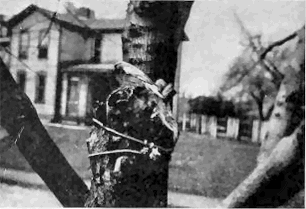
GOING HOME Photographed by W. R. Boulton, Jr.
Both parents were often seen cleaning the nest. They began to feed the young at about eight o’clock every morning, and continued it steadily at an average of every six or seven minutes until about six at night, using as food almost exclusively a certain kind of bug that was very hairy, brownish with black markings, and, except for the hair, might have been mistaken for castor beans, being about the same size. They seemed a huge mouthful for a young Bluebird. Several times a day I would climb up to the nest and whistle softly like a Bluebird before the aperture. The young would crane their necks and stretch their mouths for the supposed food, although none was forthcoming.
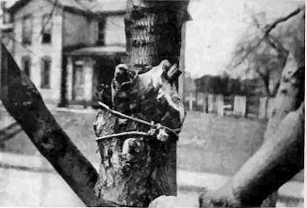
LEAVING HOME Photographed by W. R. Boulton, Jr.
When the young flew from the nest, I felt as though I had lost a family. My grief was not such that I could not capture them, however, and after counting noses, I found that one was missing. I climbed up and there I found ‘runtie’ at the bottom of the nest, pitifully squeaking at being left alone. I took out the bottom and extracted him. Finally, after half an hour or more of posing, I got several good pictures of the babies on a dead branch. When I opened the nest-log to clean it, I found a little block of grasses about three inches in diameter and one inch high. It fairly glistened with shed feather-sheaths. In the bottom were six or seven bugs, of the species mentioned before, that had evidently escaped the birds. Exactly two months after the first egg was laid, the second nest of the same pair was nearing completion in another of my boxes. Here are the dates.
May 29. First egg laid.
May 30. Second egg laid.
May 31. Third egg laid.
June 1. Fourth egg laid.
June 16. Young hatched.
June 23. Young have not flown yet.
While the female was incubating, the male still fed the young of the first brood, although not so often as when they left the nest.—Wolfrid Rudyerd Boulton, Jr. (Age 14 years), Beaver, Pa.
[Perhaps no better word of appreciation of this carefully worded description of personal observations could be given than to quote from a letter written by Mr. Herbert K. Job with reference to the data given by Master Boulton, Jr.: “His accurate information about the periods of incubation and rearing of the Bluebird came in handy to me just now, as there is a pair in a box up-state which I want to ‘film’ at just the right period, and now I can estimate when to make the trip.” The pictures illustrating this article were not only taken, but also developed and finished by the observer.—A. H. W.]
A MUSICAL WOODLAND
Riding on my pony in a thick-set wood, I heard the “Feathered Musicians” playing on their instruments.
First the trill of the Wood Thrush, then the sweet trill of the Meadowlark, the rapidly repeated ‘wickci’ of the Flicker, the sweet melody of the Robin, the charming song of the Song Sparrow, and the ‘chip’ of the Chipping Sparrow, were most delightful.
Far off in the distance I could hear the sweet Canary-like whistle of the Goldfinch and the ‘eak’ of the Purple Grackle.
The woods rang with the music of the birds, for nothing is so sweet as natural music.—Sarah W. Weaver (Age 11 years), Baltimore County, Md.
[“For nothing is so sweet as natural music.”
This naive observation brings to mind the gurgle of brooks, waving treetops, and hum of busy insects, as well as the music of feathered songsters. It has the essence of spring in it, when awakening life so quickly voices itself in melody.—A. H. W.]
INTERESTING PERFORMANCE OF A TUFTED TITMOUSE
While taking refuge from a slight April shower on the porch of an unoccupied summer cottage at Lithia Springs, Ga., twenty miles from Atlanta, I once witnessed an interesting performance by a Tufted Titmouse. Having chosen a damp brown oak leaf from the ground, it flew with it into a bare tree, and, holding the leaf with its claw firmly against a branch, it drew itself to its full height, raised its head like a Woodpecker, and with all the might of its tiny frame gave, a forcible blow to the leaf with its bill. This process was kept up nearly half an hour. The bird seemed utterly indifferent to the near presence of my two friends and myself. Once it dropped the leaf, but immediately picked it up and carried it back to the tree. A boy passed on the sidewalk below. The bird flew to a higher branch. At last its purpose seemed to be accomplished. It rested, and lifted the leaf by the petiole. We then saw that the hammering had made it into a firm brown ball nearly as large as an oak gall. The bird flew with it behind the kitchen-ell of the cottage. We hurried around, and were met by the Titmouse, empty-billed, who looked at us with an innocent, nonchalant air. Had it dropped the ball into its nest-hole?—Lucy H. Upton.
[Who can add any information which will throw light on this unusual observation?—A. H. W.]
TWILIGHT HOUR AT ASHAWAY
The western sky, soft tinted with the hues of setting sun, Lends beauty to the twilight shadows lengthening one by one, Twined mystic’lly together by the stirring April breeze That sends a message of awakening through the leafless trees. The fresh, cool air, bearing the scent of new-ploughed earth Gives promise of the future harvest soon to have its birth, When garden, field and orchard, now wearing brown and gray, Shall change these duller colors for the vernal green of May; The farmer reads the happy signs and whistles in true glee Jangling in haste his cans and milk-pails merrily; While lazy cattle straggle up the rocky barnyard way, And the impatient horses paw and whinny for their hay. A scuffle and a cackle in the hen-coop near at hand Give token where the mother hen broods o’er her fledgling band, And Spotty seeks the hay-mow, purring loudly in her pride, For there, in safety waiting her, three kittens do abide. The Robins and the Bluebirds call and answer all around, And the cheerful little peeptoads seem to crowd the air with sound,— And yet it is not noisy. Joyous peace is everywhere, And a consciousness of Heaven makes the twilight hour more fair.
—Ruth R. Hayden.
[This poem was written by a student in The Rhode Island State Normal School. It is of unusual interest since the author, although blind, undertook the course in nature-study and succeeded so well that her instructor writes: “I am tempted to say that only those are blind who won’t see. I am convinced that the subject is most valuable for classes in schools of the blind.” See Bird-Lore, Vol. XIII, No. 6, p. 316.—A. H. W.]
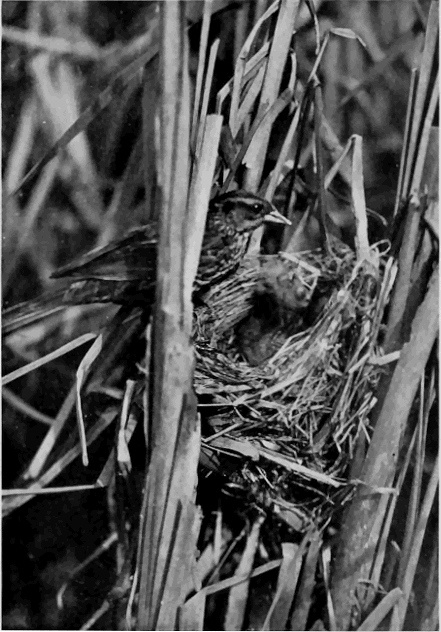
FEMALE RED-WINGED BLACKBIRD, NEST AND YOUNG Photographed by E. Jack
THE CHESTNUT-SIDED WARBLER
By T. GILBERT PEARSON

EDUCATIONAL LEAFLET NO. 85
Among the most charming birds in the world are the members of that group classified as the family of Wood Warblers. There are about one hundred and fifty-five known species, and they are found in no other country but America. Seventy-four kinds occur in North America, and fifty-five of these have been recorded in the United States.
They are small birds, the majority measuring rather less than five and one-half inches from bill-tip to tail-tip. They are birds mainly of woods and thickets, a few only venturing into open country. The Warbler’s bill is longer than that of most small birds, and is well adapted for seizing the soft-bodied insects upon which it so largely preys.
One of the most common members of the family in the Eastern States is the Chestnut-sided Warbler. The general appearance of the male is that of a particularly trim little bird with olive-green back and bright yellow crown; the under parts are lighter, and the sides are marked by deep chestnut—that is, this is the way the male looks in spring. At this season the female is quite similar, although its colors are duller. In the fall and winter the plumage presents a very different appearance. The upper parts then are yellowish olive-green, sometimes with faint streaks on the back. The deep-chestnut of the sides has given way to a few spots or patches of this color.
In seeking the Chestnut-sided Warbler, one should go to woodlands that have been cut over and grown up in bushes. There are found the conditions which this bird dearly loves, and in such a situation one may pass a whole forenoon and seldom be out of sight or hearing of one or more of them.
The nest is made of strips of bark, soft dead leaf-stems, and similar material; it is lined with tendrils and rootlets. Usually the nest is from two and a half to three and a half feet from the ground. Rarely have I found one so situated that it could not readily be reached by the spring of an agile house-cat, and there is much evidence to show that many are pulled down every year by these feline hunters.
It is commonly reported that as many as five eggs are deposited in the nest before the bird begins sitting, but fully three-fourths of those nests that I have found contained only four eggs. They are white, with numerous brown markings of various shades—some distinct, others more or less obscure, as if the inside of the shell had been painted and the color was showing through. The spots and blotches are gathered chiefly in a wreath about the larger end.
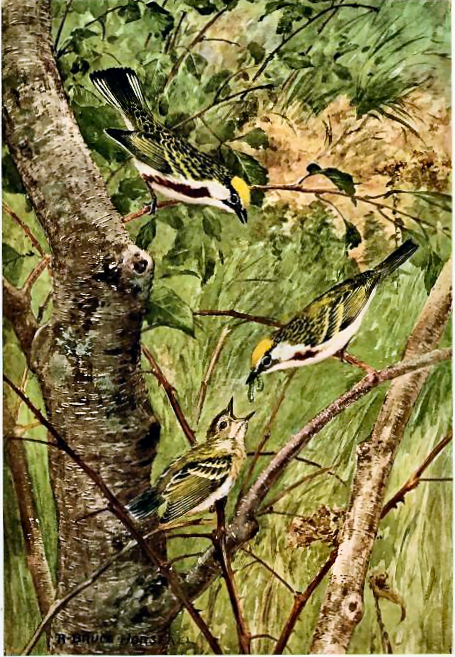
CHESTNUT-SIDED WARBLER
Order—Passeres
Genus—Dendroica
Family—Mniotiltidæ
Species—pennsylvanica
National Association of Audubon Societies
They are pretty, dainty little objects, as is the case with all Warblers’ eggs. In size, they are about two-thirds of an inch long, and half an inch in diameter at the largest place.
In the latitude of Boston, fresh eggs may usually be found late in May or in the first week of June.
The Chestnut-sided Warbler feeds almost exclusively on insects. John James Audubon wrote that once in Pennsylvania, during a snowstorm in early spring, he examined the dead bodies of several, and found that their stomachs contained only grass-seeds and a few spiders. The birds were very poor, and evidently were in a half-starved condition, which would probably account for the fact that they had been engaged in such an un-warbler-like act as eating seeds. Ordinarily this bird is highly insectivorous, and feeds very largely on leaf-eating caterpillars. It also collects plant-lice, ants, leaf-hoppers, small bark-beetles, and, in fact, is a perfect scourge to the small insect-life inhabiting the foliage of the bushes and trees where it makes its home. Sometimes the birds take short flights in the air after winged insects. It will thus be seen that the Chestnut-sided Warbler is of decided value as a guardian of trees, which is reason enough why the legislators of the various states where the bird is found were induced to enact the Audubon Law for its protection.
All birds that depend so much on insects for their livelihood as does the Chestnut-sided Warbler are necessarily highly migratory. By the middle of September nearly all have departed from their summer home, which, we may say roughly, covers the territory of the southern Canadian Provinces from Saskatchewan eastward, and extends southward as far as Ohio and New Jersey. They are also found in summer along the Alleghany Mountains in Tennessee and South Carolina. Most of the migrants go to Central America by way of the Gulf of Mexico, and only a comparatively small number travel to Florida and the Bahama Islands.
The song of the Chestnut-sided Warbler is confused in the minds of some listeners with that of the Yellow Warbler. Mathews says the song resembles the words, “I wish, I wish, I wish to see Miss Beecher.”
Mr. Clinton G. Abbott, writing in Bird-Lore in 1909, told most entertainingly of the fortunes of a pair of these Warblers and their nest, which he watched one summer. After telling of finding a nest from which all the eggs had been thrown but one, and in their place had been deposited two eggs of the Cowbird, he says:
“The nest was found at Rhinebeck, New York, on July 6, 1900, incubation having apparently just started. Four days later I discovered that one of the Cowbird’s eggs was infertile; so I removed it from the nest, disappointed that I should not, after all, enjoy the somewhat unique experience of observing two young Cowbirds growing up in the same nest. It was some time during the night of July 13-14 that the first of the remaining two eggs hatched—the Cowbird’s of course. The Warbler’s hatched between twelve and twelve-thirty o’clock on the 14th. The nicety with which matters had been so arranged that the young Cowbird would have just a convenient start in life over its unfortunate rival commanded at least my admiration if not my sympathy. Cowbirds must indeed be sharp nest-finders to be able to discover at short notice not only the nests of certain suitable kinds of birds, but even nests containing eggs at a certain stage of incubation!
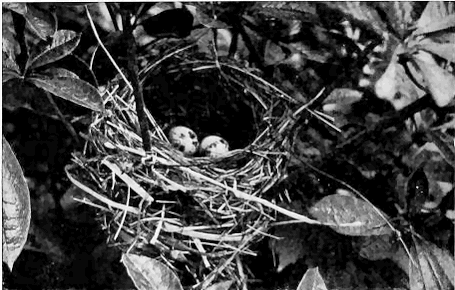
A NEST OF THE CHESTNUT-SIDED WARBLER
“After the hatching of the eggs, I spent considerable time at the nest-side, and observed with interest the many pretty little incidents of a bird’s domestic life—the constant and tender brooding of the newly hatched young by both Warblers in turn; the never-ceasing search among the neighboring trees and bushes for small caterpillars; the delivery of the food by the male to the brooding female, who, in turn, would raise herself and pass it to the young; the careful cleansing of the nest; and many other intimate details of the birds’ loving and happy lives. When I drew aside the leaves that sheltered the nest and allowed the sun to shine upon it for purposes of photography, the mother, realizing with that wonderful instinct common to all birds which nest in the shade, the fatal effect on her babies of the sun’s direct rays, would take her stand on the edge of the nest and with outstretched wings would form of her own body a living shield for the comfort and protection of her young. Although herself in evident distress from the heat, and with parted mandibles continually gasping for air, she would remain in this position as long as the sun shone upon her, only stepping aside occasionally when a well-known signal announced that her husband had arrived with a meal for the little ones. It was a beautiful picture of parental devotion.
“As the young birds began to grow, the Cowbird not only maintained, but rapidly increased its lead over its small nest-mate. At every visit of the parent bird with food, its capacious gullet could be seen violently waving aloft and almost completely hiding the feeble little mouth of the Warbler, whose owner was pathetically doing its best in a dumb appeal for food. The Cowbird’s appetite seemed never to be satiated and, unlike most nestlings, which relapse after a meal and give their brethren the next chance, he seemed ready for every fresh opportunity; and, by reason of his superior display, he usually succeeded in obtaining the coveted morsel. However, the young Warbler did manage to get an occasional portion, and I had strong hopes that he might reach maturity. For I realized that a Chestnut-sided Warbler’s usual laying is about five eggs, and that therefore some four eggs must have been made to give place to the two Cowbird’s. Hence the young Cowbird in the nest might reasonably be granted the room and food of four young Warblers. More than this I hoped he was not getting.
“On July 18, at 3.30 P. M., when the birds were about four days old, I took them from the nest to compare their sizes. I replaced them in the nest, but that was the last I saw of the poor little Warbler. When I returned at 5 P. M., the Cowbird was in sole and triumphant possession of the nest. Just what became of the Chestnut-sided Warbler will never be known, but my theory is that, weakened by lack of sufficient food, the little fellow at last became too feeble to raise himself at all, and was crushed to death by the Cowbird’s gross body. The parent birds, returning and finding the little corpse in the bottom of the nest, were no doubt impelled by their instinctive sense of cleanliness to carry it to a distance; for the most careful search over a large area beneath the nest failed to reveal any sign of the missing bird, thus proving that it had not fallen from the nest nor been forced out by the Cowbird.
“The Cowbird now had things all his own way and, there being no one to dispute his right to all the food, he grew with amazing rapidity. The dainty little cup of a nest, never built to accommodate such a monster, was soon completely forced out of shape. His body then protruded beyond the lower rim of the nest, and the ground underneath became littered with droppings, quite baffling the cleanly, sanitary instincts of the Warblers.
“The Cowbird, now almost twice as large as his devoted foster-parents, rises with hideous chitterings of delight to receive an ever-acceptable meal. I visited the nest at 7.30 A. M., on July 26. As I walked home to breakfast, I resolved that in the interests of justice I ought to put an end to that Cowbird, as a murderer and a menace to the welfare of birddom. But when I returned to the spot, about 9 A. M., he had escaped me; the nest was empty, my bird flown. No doubt, if I had searched and listened, I should have heard him shouting for food not far away; but my spirit of vengeance was only half-hearted at best, and so I left him, a criminal abroad, to be the parent, I suppose, of others as bad.”
EXECUTIVE DEPARTMENT
Edited by T. GILBERT PEARSON, Secretary
Address all correspondence, and send all remittances for dues and contributions, to the National Association of Audubon Societies, 1974 Broadway, New York City.
William Dutcher, President
Theodore S. Palmer, First Vice President
Frederic A. Lucas, Acting President
T. Gilbert Pearson, Secretary
Jonathan Dwight, Jr., Treasurer
Samuel T. Carter, Jr., Attorney
Any person, club, school or company in sympathy with the objects of this Association may become a member of it, and all are welcome.
Classes of Membership in the National Association of Audubon Societies for the Protection of Wild Birds and Animals:
$5 annually pays for a Sustaining Membership
$100 paid at one time constitutes a Life Membership
$1,000 constitutes a person a Patron
$5,000 constitutes a person a Founder
$25,000 constitutes a person a Benefactor
Form of Bequest:—I do hereby give and bequeath to The National Association of Audubon Societies for the Protection of Wild Birds and Animals (Incorporated), of the City of New York.
A CASE IN POINT
In the last issue of Bird-Lore were reproduced some photographs of a ruined White Ibis rookery, which Dr. Herbert R. Mills stated had been destroyed by “sportsmen” who had wantonly shot the birds. Such raids on the bird-life of Florida have been made frequently by northern visitors to the state. A striking example of this habit has just come to public notice.
In the February issue of Scribner’s Magazine, a writer, after referring to the pleasures he enjoyed while catching tarpon at Bocagrande, says:
“Birds were always flying around the boat; Gulls, Man-o’-wars, Pelicans, and when we weren’t fishing we were potting at them with a Winchester .22. The Big Chief was a wizard with a rifle, and even skimming Swallows were none too swift or too small for his Deadeye Dick precision of aim. After cutting down a sailing Man-o’-war, two hundred yards above the water, and surely three hundred yards away, he formed a Man-o’-war’s Club; any body who killed one flying was entitled to membership.”
All these birds are protected by the laws of Florida and at least one of them by the United States Migratory Bird Law. There is no open season for any of them. The man who wrote this is not a poor, illiterate inhabitant of the southern swamps, who killed the birds to sell their feathers for a few dollars with which to help feed his family; but is a successful writer of novels and stories, many of which you and I have bought and read with pleasure. Incidentally, by our purchase of his work, we have aided in swelling his royalties, thus enabling him to go to Bocagrande, and doubtless elsewhere, where he might amuse himself from time to time in the very delectable sport of shooting harmless non-game birds. This man is John Fox, Jr.
As a result of the work of this Association, the Pelican colonies in Charlotte Harbor near Bocagrande have been made Federal bird-reservations. While attempting to protect one of them, Columbus G. McLeod, one of our wardens, had his head chopped open and his body sunk in the harbor by persons who did not approve of his zeal. These birds—the wards of the Government, the birds that the Audubon Society’s members have been giving money to protect, and the birds for which one good man has given up his life—these birds afford targets for Mr. John Fox Jr., and his friends; and Scribner’s Magazine, doubtless greatly pleased at the privilege of being allowed to publish an article from the pen of a gentleman so distinguished, kind and altruistic, has taken these boasting sentences and printed them, regardless of the fact that the magazine will go into thousands of homes to be read by young men who may later go tarpon-fishing in the limpid waters about Bocagrande, and who might be inspired to follow the example of the noble deeds of this celebrated novelist.
We are glad to reproduce here an open letter written to him by Doctor William F. Blackman, President of the Florida State Audubon Society:
“Dear Sir: As a tarpon fisherman, holding the record in a recent year for the largest fish taken in the state, I was much interested in your article in the February Issue of Scribner’s Magazine, on ‘Tarpon Fishing at Bocagrande.’ But when you told your readers that you and your companions beguiled your leisure, on this occasion, by ‘potting with a Winchester .22’ at the Gulls, Man-o’-wars, Pelicans, and skimming Swallows which surrounded your boat, you surprised and pained and disgusted me beyond words.
“You doubtless knew that all these birds are protected by the laws of Florida, and some of them by the Federal laws also; your action was deliberately criminal; it was also unspeakably puerile, wanton, cruel, and vulgar.
“The citizens of Florida welcome tourists from other states; we are happy to share our excellent fishing and shooting with them within legal and decent limits, which, I am glad to say, the great majority of those who sojourn among us carefully and cheerfully observe; but we do not propose to allow our plumage and insectivorous birds to be slaughtered to provide fun for thoughtless and reckless gunners whether residents or visitors.
“You are too foxy to say whether you yourself succeeded in killing any of these birds, but I hereby give you notice that if you ever again set foot on our soil, and I am apprised of the fact, I shall see that you have an opportunity to tell your story in the courts. If proof can be had of your personal guilt, you will be punished to the full limit of the law, in both the state and federal jurisdictions, for a misdemeanor so unsportmanlike and inexcusable.”
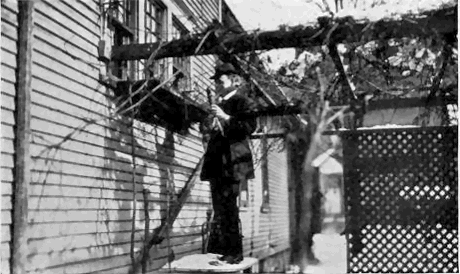
A FEEDING-SHELF FOR BIRDS ERECTED BY JUDGE HARRY L. CRESWELL, GRAND RAPIDS, MICHIGAN
PHOTOGRAPHING WATER-FOWL
To watch at close range the wildfowl accumulated on the Ward-McIlhenny reservation in the marshes of Louisiana is the privilege of a lifetime.
Mr. Herbert K. Job not only had this privilege for about six weeks during last December and the early weeks of January, but he procured a remarkable series of photographs of water-birds that make that region their winter home. From the moving pictures that he made the Association now has a thousand-foot reel, showing Pintails, Teals, and other Ducks, as well as Boat-tailed Grackles and Coots.
To ornithologists, the most interesting pictures he obtained were those of the Blue Geese. The chief summer home of these birds is supposed to be on the islands north of the American continent, and most, if not all of them, pass the winter in the marshes of Louisiana. I know of no case heretofore where they have been photographed in large numbers at close range.
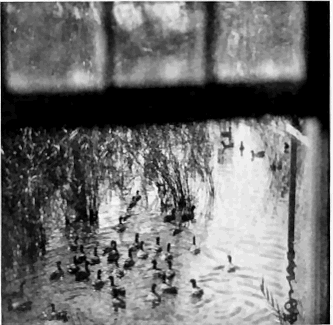
PHOTOGRAPHED FROM THE WINDOW OF A CABIN ON THE WARD-McILHENNY RESERVATION
The accompanying illustrations were all made by Mr. Job on this expedition, and will give some idea of the results of his skill and patience in the use of a moving-picture camera.
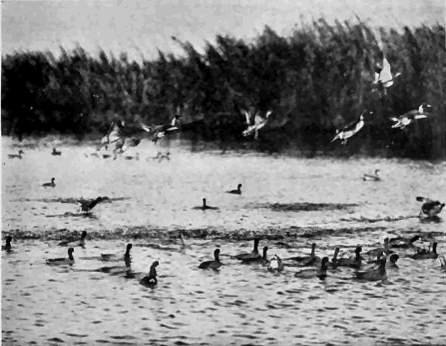
WHEN ALARMED, THE DUCKS WERE THE FIRST TO TAKE FLIGHT
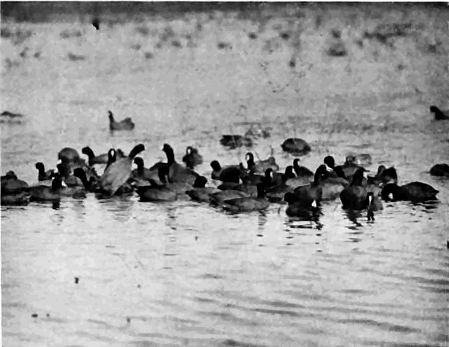
AN INTERESTING COMPANY OF COOTS
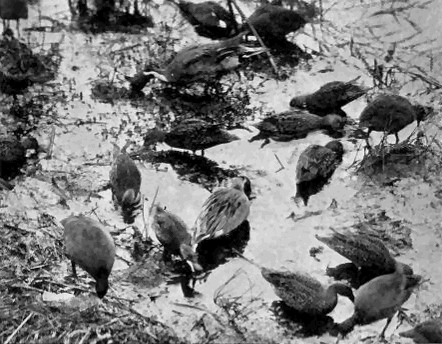
PINTAILS, TEALS, AND COOTS, PHOTOGRAPHED FROM CABIN WINDOW
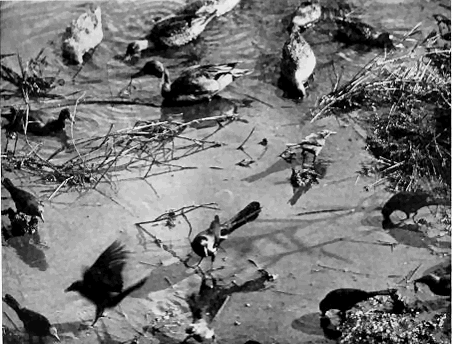
PINTAILS, TEALS, AND BOAT-TAILED GRACKLES, PHOTOGRAPHED FROM CABIN WINDOW
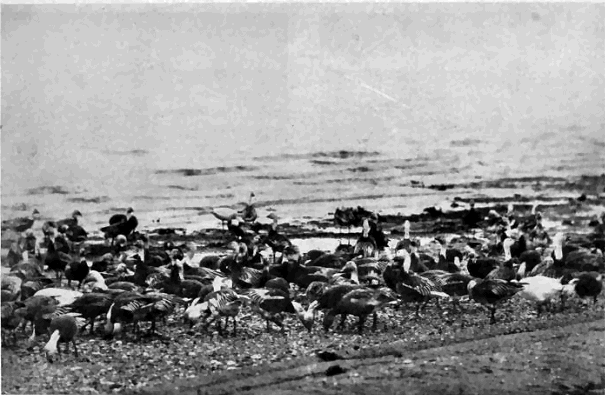
BLUE GEESE AND A FEW GREATER SNOW-GEESE "GRAVELING" AT VERMILION BAY, LOUISIANA. MR. JOB WAITED FIVE DAYS IN A BLIND TO GET THESE PICTURES OF GEESE
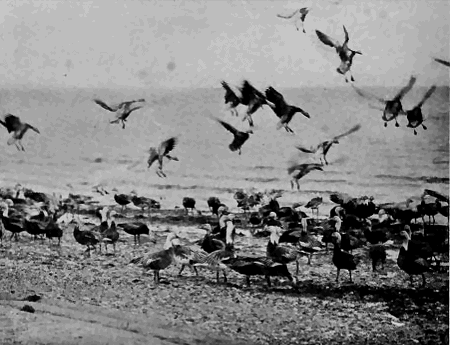
BLUE GEESE AND SNOW-GEESE ALIGHTING. VERMILION BAY, LOUISIANA, JANUARY 3, 1916
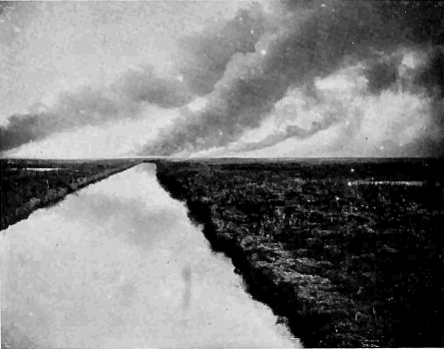
THE MARSH ON FIRE
BIRDS AND THE COLD SPELL
On the morning of February 5, 1916, there was received at the office of the National Association the following telegram:
“The State Game Warden, Topeka, Kansas, reports his state covered with three to nine inches of sleet and ice. Birds starving by wholesale. State organizing campaign for food. Can you assist? Immediate action necessary. E. W. Nelson, Acting Chief, Biological Survey.”
We immediately telegraphed to the State Game Warden of Kansas offering $200 for the purchase of grain. Shortly afterward the following telegram was received from Honorable Carlos Avery, State Game Commissioner of Minnesota:
“Conditions critical for Quail on account of unprecedented depth of snow and extreme cold. Funds insufficient to care for them adequately. Can you include Minnesota for appropriation for this purpose?”
This second call for help, together with word received from other directions, indicated that the snow and ice-cap had extended generally over a number of the northern states of the Middle West. We at once wired to the officials of some of the organizations in several of these states, and also sent telegrams to thirty-five members of the Association, telling them of the situation and asking for contributions to be used in the purchase and distribution of food for the birds. Many of the members immediately responded, and in a remarkably short time we had collected and telegraphed to the Cleveland Bird-Lovers’ Association $200, to the President of the South Dakota State College $200, and to the Minnesota Game Commission $600.
We also telegraphed the Postmaster General in Washington asking that rural mail-carriers in Minnesota, Kansas, and Nebraska be authorized to distribute grain to be supplied them for the purpose. The Third Assistant Postmaster General at once gave the instructions requested.
Mrs. Elizabeth C. T. Miller, President of the Cleveland Bird-Lovers’ Association, sent notices to all on her large membership list, called upon the people generally through the press, and set other movements in operation looking to the good of the birds.
The South Dakota State College is the largest educational institution in the State, enrolling over eleven hundred members. President E. C. Perisho, who is a lover of wild birds and, incidentally, one of the most influential and public-spirited educators of the West, called a mass meeting of his students and laid the situation before them. The following is from one of his letters, and will give some idea of what resulted.
“We are doing everything possible at this end to save the birds of South Dakota. I thought perhaps you would be interested to know that our organization for this purpose is as follows:
“1. The State College has written to four hundred or five hundred boys and girls, members of the Boys’ and Girls’ Clubs of the state, asking them to scatter grain and make some protection to save the Field Sparrows, Quails, and Prairie Chickens especially.
“2. The entire extension force of the College, including all the short-course demonstrators, district men, etc., have been written to and are coöperating with us.
“3. All the county agents of the state are interesting the school children of their counties, and a number of farmers and the rural mail carriers.
“4. The commercial clubs in all the large towns of the state, and the smaller ones where grain is most needed, have been written to, asking for their immediate coöperation.
“5. All the state institutions, five besides our own, have been asked to help in this matter.
“6. A number of high schools and township schools, etc., have been asked to help.
“7. Between one and two hundred farmers, well distributed over the state have had personal letters.
“Money in small amounts has been promised to county agents, commercial clubs, etc. I met a number of the young men of our college today and talked to them about the situation, and asked for their coöperation in writing to their homes, etc. Those most interested in the work went out, after the meeting, and had a picture taken. I will send you this photograph as soon as it is developed.”
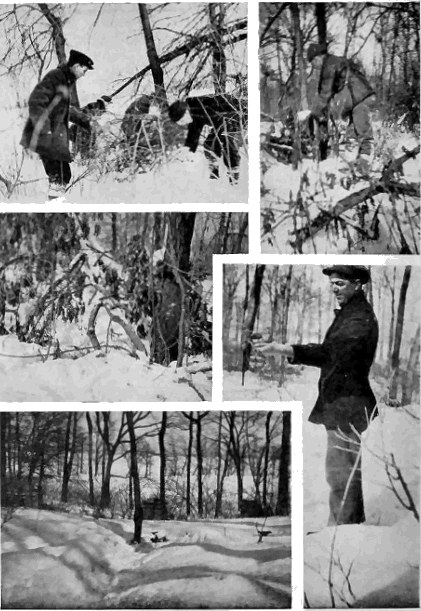
SAVING THE QUAIL IN MINNESOTA
1. Locating nesting-places of Quails under brush and broken treetops. 2. Placing grain under brush just occupied by a bunch of Quails. 3. Fifteen Quails were found here on February 13; food was left for them. 4. Some Quails become weak from lack of food, are easily caught, and sit contentedly in one's warm hand. 5. Several Quails near the foot of a tree, and one (at the right) running.
In Minnesota, the “Save the Quail Association” was immediately formed by the sportsmen of St. Paul and vicinity. Mr. Carlos Avery put the State Game Wardens to work, and the matter was given wide publicity. An immense work was done throughout the state in the way of feeding birds. Mr. Avery has sent in a large number of photographs, showing the men actually at work for the relief of the birds. The method of feeding the Quails, to locate the covies, scrape the snow away, and put out food.
The heavy snow and extreme cold prevailed over a large area of the northern United States, and more work was probably done to feed the birds this winter than ever before under similar conditions. Many of the State Game Commissions have funds for this purpose, and have been very active.
Quails and Pheasants are known to have suffered much in Oregon and Washington. A quaint little incident is reported of pheasants in Washington, sent us by a correspondent in British Columbia. He relates that the Pheasants during the time of deep snow not only came familiarly about barnyards, but were fond of perching on the backs of the hogs in order, apparently, to warm their chilled feet.
There have been some losses in New England, and even from New Jersey reports reached the office of the toll of bird-life that the heavy snow had taken.
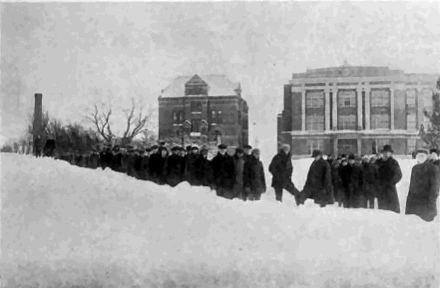
STUDENTS OF THE SOUTH DAKOTA STATE COLLEGE, AFTER LISTENING TO AN ADDRESS BY PRESIDENT E. C. PERISHO, ON THE NEED OF FEEDING BIRDS IN WINTER. NOTE THE DEPTH OF THE SNOW.
FLORENCE MERRIAM BAILEY
When George Bird Grinnell coined the term “Audubon Society,” and started the Audubon Movement, in 1886, one of the first to respond to the call and to go actively into the work was Miss Florence Merriam, who, with Miss Fanny Hardy—now Mrs. Eckstorm, author of several bird-books—in March, 1886, organized the Smith College Audubon Society. Soon afterward Miss Merriam assumed the duties of a local Audubon secretaryship, in northern New York, and also secured local secretaries in several neighboring towns.
In 1897, when the Audubon Society of the District of Columbia was organized, she was one of its chartered members. For many years, as Mrs. Florence Merriam Bailey, she has been an active member of its executive committee, and, among other duties, has had charge of the annual spring bird-class, one of the most important features of that Society. That her interest in the work is deep, and sympathetic to an unusual degree may be shown by a quotation from a letter that she wrote to the California Audubon Society on the occasion of its organization:
“Wherever you go, study the birds and tell your friends of them. Point out to them the chaste beauty of your exquisitely tinted waterfowl; let them see the glowing splendor of your Tanagers, the flashing jewels of your Hummingbirds. Take them to the fields, that they may listen in rapture to the rare voice of your Meadowlark; take them to the deep canyons filled with the flute-like notes of the Canyon Wren; and to the fir forests on the mountainsides, where their souls will be stirred by the uplifted song of the Thrush.
“By knowing the birds personally, you will bring to your Audubon work the enkindling spark of enthusiastic friendship. In all phases of your work, for yourselves, your friends, your birds, and your children, you have my hearty interest and good wishes. For fifteen years I have been waiting for you to take up the cause of the California birds, and for many years I have been working with the children of the West on my heart. Knowing this, you may well believe that I wish your beautiful work an earnest God-speed.”
Mrs. Bailey’s natural girlhood’s interest in wild birds was greatly quickened by dwelling in a home in which scholarship and a love of scientific accuracy were taught daily; and she had the added advantage of living in a region of northern New York well supplied with bird-life. In a recent letter she wrote: “Having been brought up on Coues’s ‘Key,’ and trained by my brother, Dr. C. Hart Merriam, on leaving College in 1886 I began doing careful field-work.” Since that day, no woman has studied the wild birds of America so systematically, so thoroughly, and so carefully as she. The amount of field-work she has done is perfectly astonishing, and probably few women have spent so many days in the wilds, or so many nights under canvas, as has Mrs. Florence Merriam Bailey. Her work, partly conducted in company with her brother, Dr. Merriam, and her husband, Mr. Vernon Bailey, has been carried on not only in eastern and southern states and in the Bermudas, but also in Arizona, Oregon, California, North Dakota, Texas, Utah, and New Mexico.
As a teacher of others, she has given bird-talks and conducted field-classes in bird-study in various parts of the country, and for thirty years her name has been before the public as a writer of popular and scientific articles. The titles of no less than seventy communications published in The Auk, Bird-Lore, The Condor, Forest and Stream, The Outlook, Popular Science, The American Agriculturist, and elsewhere, have come to my attention. Her first book, “Birds Through An Opera Glass,” was published in 1889. This was followed by “My Summer in a Mormon Village,” 1895; “A-Birding on a Bronco,” 1896; and “Birds of Village and Field,” 1898.
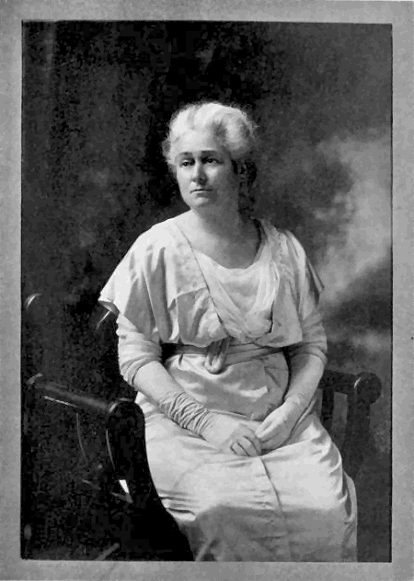
FLORENCE MERRIAM BAILEY
Her largest and most valuable contribution to the literature of ornithology is her “Handbook of Birds of the Western United States,” first published in 1902. From the day of its appearance, this was hailed as the most practical and useful book on our western birds that had ever been published, and for many years to come it will be regarded as the standard work on the subject. No serious student of bird-life in the western United States would think of being without this valuable book on his study-table.
NEW MEMBERS AND CONTRIBUTORS
Enrolled from January 1 to March 1, 1916.
Life Members. Agnew, Miss Alice G. Andrews, J. Sherlock Arnold, Edward W. C. Barr, James H. Black, R. Clifford Blake, Mrs. Francis Brackenridge, George W. Burnham, William Butler, Mrs. Paul Butterworth, Mrs. William Campbell, John B. Childs, Eversley Clark, George H. Clementson, Mrs. Sidney Colgate, Richard M. Covell, Dr. H. H. Dahlstrom, Mrs. C. A. Dodge, Cleveland H. Doepke, Mrs. William F. Eddison, Charles Glazier, Henry S. Hamlin, Mrs. Eva S. Hanna, Mrs. H. M., Jr. Haskell, J. Amory Higginson, Mrs. James J. “Iowa Friend” Jenkins, Mrs. Joseph W. Keen, Miss Florence Keith, Mrs. D. M. Kingsbury, Miss Alice E. Langdon, Woodbury G. Lansing, Mrs. G. Y. Lawrence, Rosewell B. Low, Miss Nathalie F. MacLean, Mrs. Charles F. Marmon, Mrs. Elizabeth C. Miller, Mrs. E. C. T. Mitchell, Miss Mary Moore, Mrs. William H. Neave, Miss Jane C. Newberry, W. F. Oliver, Mrs. James B. Osborn, Mrs. William C. Prentiss, F. F. Rathborne, Richard C. Remsen, Miss Elizabeth Rodewald, F. L. Sanger, Mrs. C. R. Severance, John L. Stetson, Francis L. Stillman, B. G. Stillman, Chauncey D. Thaw, J. C. Upson, Mrs. Henry S. Weld, Miss Elizabeth F. White, Windsor T. Woolman, Edward Sustaining Members. Adams, Mrs. Maud W. Aims, Miss Edith M. Allen, Charles D. Allen, Mrs. D. P. Armstrong, Mrs. C. R. Audubon Society of Illinois. Audubon Society of New Hampshire. Barber, Mrs. H. Barrows, Ira. Bayne, Howard Beacom, M. W. Benton, Andrew A. Biays, Miss Katherine Billard, Mrs. J. L. Bispham, David Boettger, Mrs. Theodore Booth, Mrs. Henry M. Brunswick, Mrs. E. Burton, Mrs. Robert M. Carey, Mrs. Frederic F. Cerf, Mrs. L. A. Choate, Miss Caroline Church, F. S. Clark, F. Ambrose Clark, George C. Clements, Mrs. G. H. Cochran, G. D. Cohn, Julius M. Colfelt, Mrs. R. McM. Colorado Audubon Society Cory, Daniel W. de Bary, A. Delta Duck Club DeMilt, Miss Aida R. deRham, H. Casimir Dinsmore, Mrs. W. B. Emerson, William Flint, Mrs. Austin Ford, Mrs. Bruce Foshay, Dr. P. Maxwell Fraser, Miss Ann C. Fuld, Solomon
Gale, C. C. Gates, Dr. Milo H. Gavit, E. P. Godwin, Mrs. H. Gouinlock, Miss Mary S. Haggin, Mrs. Ben Ali Haines, Charles D. Hall, A. Neely Hatch, Miss Cornelia C. Havemeyer, Henry O. Hawes, Miss M. M. Hawkes, Miss Eva Herz, Mrs. F. W. Heyn, Miss Emma Hibbs, Mrs. Russell A. Hitchcock, Master Frank Hoening, Mrs. C. Hooper, Mrs. Newlin Hopkins, Mrs. George B. Hotchkiss, Frank A. Houghton, Mrs. Grace N. Howland, Dr. John Hoyt, Miss Rosina S. Hyde, Mrs. Clarence M. Imbrie, Mrs. James Irwin, John V. Jaretzki, Mrs. Alfred Jenkins, A. W. Jennings, Mrs. Oliver G. Jewett, William K. Judd, Mrs. M. E. Judson, Mrs. A. L. Keck, Miss Margaret W. Kennedy, David A. Kennedy, Mrs. N. Van Rensselaer Kent, Edwin C. Keyes, Mrs. Edward L., Jr. Kimball, Mrs. Reuel B. King, Mrs. Willard V. Kinne, Miss Helen Klingenstein, Charles Lamb, Gilbert D. Lane, James Warren, Jr. Lansburgh, Miss Edith Rosalie Ledoux, Mrs. Albert R. Lehmaier, Mrs. Louis A. Lehman, Meyer H. Lewis, Richard V. Lieb, Dr. Charles C. Lilienthal, Dr. Howard Louis, Charles H. McHugh, Joseph P. Maron, Otto Massey, Miss H. F. Mather, Charles M. Mayer, Louis Merriam, F. L. Meyn, Mrs. Heinrich Miller, Mrs. R. T. Miller, Mrs. Seaman Mills, Frederic C. Mills, Miss Jean Moore, Miss K. T. Moorhead, Horace R. Morton, Mrs. Levi P. Moses, Mrs. E. Muendel, Miss Christina Nelson, Charles W. New Bedford Bird Club Newell, Mrs. G. T. Nicoll, Mrs. Fancher Oregon Audubon Society Palmer, Nicholas F. Peck, Dr. Charles H. Pomeroy, Daniel E. Poor, Roger M. Pope, Miss Edith A. Pratt, Mrs. Frederic B. Procter, Mrs. Wm. Cooper Proctor, Thomas R. Puffer, Miss Isabel Putney, Miss E. C. Redmond, Master Henry S. Reese, Mrs. R. G. Rehling-Qvistgaard, J. W. V. Renard, Fred O. Reynolds, Mrs. G. W. Riley, Mrs. W. W. Robbins, Allan Appleton Rogers, Mrs. Francis Romenus, Albert Rumsey, Lawrence Dana Rupprecht, Frederick K. Ryle, Miss Julia Sachs, Dr. Bernard Savage, James Sawtelle, Mrs. E. M. Schanck, George E. Scofield, Miss Marion Seaman, William W. Sharpe, Miss Elizabeth M. Shaw, Miss Louise Sherman, Miss Julia Frances Siegel, William Simmons, Mrs. Warren H. Simonson, Mrs. William A. Simpson, Miss Jean W. Smillie, James C. Smith, Mrs. A. G. Smith, Miss Emeline C. Smith, Mrs. Rufus B. Smith, William Wharton Snook, Mrs. T. E. Soule, Elizabeth P. Stafford, Mrs. William F. Staudt, John Steers, James R. Steinway, F. T. Stephens, Mrs. Nassau S. Stillman, Mrs. E. G. Stone, Miss Elizabeth B. Strauss, Albert Stubner, C. J. Stursberg, Julius A. Swan, William D. Taylor, Mrs. W. R. K. Thomson, John F. Topliff, Miss Anna E.
Townsend, Eugene L. Tucker, Carill Tuxbury, Miss L. E. Varicle, Miss Renée Vassar Wake Robin Club Watson, Miss Emily A. White, Mrs. Stanford Whitson, Abraham U. Wiborg, F. B. Williams, Alexander S. Williams, Mrs. Sydney M. Wilson, Mrs. M. Orme Wing, Frank L. Winston-Salem Audubon Society Zabriskie, Mrs. Cornelius New Contributors. Evans, Miss Mildred French, Daniel C. Harron, Master Halie I. Haueisen, William C. Jeremiah, J. Kellogg, Miss M. W. Macdonald, James A. Mix, Robert J. Newcomer, Miss Nannie I. Parker, Forrest H. Perrin, Marshall L. Post, Mrs. E. J. Townsend, Mrs. Charles Wheeler, Mrs. L. F. Contributors to Egret Fund Previously acknowledged $1,01626 Abbott, Mrs. T. J. 500 Adams, William C. 100 Ames, Mrs. J. B. 500 Auchincloss, Mrs. E. S. 500 Barclay, Miss Emily 500 Barri, Mrs. John A. 500 Baxter, Lucy W. 500 Beebe, Mrs. William H. II. 300 Bernheimer, Mrs. J. S. 1000 Bignell, Mrs. Effie 100 Bird-Lover 500 Blackwelder, Eliot 100 Bliss, Miss Lucy B. 700 Bonham, Miss Elizabeth S. 500 Bonham, Mrs. Horace 1000 Boynton, Mrs. C. H. 100 Brent, Mrs. Duncan K. 200 Brooks, Mrs. Shepherd 1000 Brown, D. J. 200 Burgess, E. Phillips 300 Burt, Miss Edith 200 Button, Conyers 2500 Carse, Miss Harriet 200 Case, Mrs. James B. 1000 Clarke, Mrs. E. A. S. 500 Clerk, Mrs. A. G. 100 Cleveland, Mrs. Clement 100 Collins, Miss Gertrude 500 Cristy, Mrs. H. W. 100 Curie, Charles 500 Cutter, Ralph L. 500 Davis, William T. 500 Dawes, Miss Elizabeth B. 1000 DeForest, Mrs. Robert W. 500 Delafield, Mrs. John R. 200 Dwight, Mrs. M. E. 200 Early, Charles H. 200 Eastman, George 5000 Ellis, William D. 1000 Emmons, 2nd, Mrs. R. W. 1000 Evans, William B. 400 Fergusson, Alexander C. 200 Field, E. B. 200 Foot, James D. 200 Franklin, Mrs. M. L. 1000 Friedman, Mrs. Max 200 Fries, Miss Emilie 100 Frothingham, John W. 3500 Fuguet, Stephen 500 Garst, Julius 300 Godeffroy, Mrs. E. H. 1000 Goodwin, Geo. R. 500 Greene, Miss Caroline S. 100 Haskell, Miss Helen P. 200 Hathaway, Harry S. 200 Hodgman, Miss Edith M. 500 Hopkins, Miss Augusta D. 300 Horr, Miss Elizabeth 500 Hoyt, Miss G. L. 500 Hunter, Mrs. W. H. 200 Jackson, P. T., Jr. 600 Jennings, Dr. George H. 300 Jordan, A. H. B. 2000 Joslin, Ada L. 200 Jube, Albert B. 300 Kennedy, Mrs. John S. 500 Kerr, Mrs. T. B. 100 Lewis, Mrs. August 1000 Lewis, Mrs. Herman E. 500 Mackey, Oscar T. 500 Mann, J. R. 100 Marrs, Mrs. Kingsmill 500 Marsh, Spencer S. 100 Mason, G. A. 500 Mason, H. L., Jr. 500 Meigs, Miss Hester 125 Mellns, J. T. 200 Merritt, Mrs. James H. 200 Mills, Dr. Herbert R. 2000 Montell, Mr. and Mrs. F. M. 250 Moore, Alfred 500 Morganthau, Mrs. M. L. 100 Mott, Miss Marian 500 Murray, J. Irwin, Jr. 100 Nice, Mrs. Margaret M. 300 Noyes, Raymond 300 Oliver, Dr. Henry K. 1000 Osborne, Arthur A. 100 Pagenstecher, Miss Friede 500 Parker, Edward L. 2500 Parker, Mrs. W. R. 300 Patton, Mrs. Margaret S. 1000 Peck, Dr. Elizabeth L. 100
Penfold, Edmund 1000 Petty, E. R. 200 Phelps, Mrs. Frances von R. 1000 Pott, Miss Emma 100 Pusey, Mrs. Howard 200 Raymond, Charles II. 500 Rhoads, S. N. 100 Righter, William S. 500 Robbins, Miss N. P. H. 300 Robbins, Mr. and Mrs. R. E. 2000 Sampson, Miss Lucy S. 100 Saunders, Charles G. 100 Schweppe, Mrs. H. M. 100 Scofield, Miss Marion. 1000 Shattuck, Miss Gertrude A. 100 Simpkins, Miss M. W. 1000 Small, Miss A. M. 200 Spackman, Miss Emily S. 100 Spalter, Mrs. F. B. 100 Stanton, Mrs. T. G. 200 Stevens, F. E. 200 Stimson, William B. 300 Thorndike, Mrs. Augustus 100 Timmerman, Miss Edith 150 Tower, Mrs. Kate D. 100 Troescher, A. F. 1000 Vaillant, Mrs. G. H. 300 Von Zedlitz, Mrs. Anna 200 Walker, Miss Mary A. 200 White, Horace 500 Willcox, Prof. M. A. 1000 Williams, George F. 500 Winslow, Miss Maria L. C. 600 Woodward, Dr. S. B. 500 Wright, Miss Mary A. 200 Zimmerman, Dr. M. W. 500 Total $1,70151
THE VIRGINIA GAME BILL PASSES
By a vote of twenty-four to nine, the Senate of the Virginia Legislature has passed the bill of the Farmers’ Union and the Audubon Society for the establishment of a Commission of Fisheries and Game. The bill was signed by the Governor on March 13, 1916. Thus ends a fight which the Audubon Society has led in the Virginia Legislature, session after session, for many years.
Mr. M. D. Hart, President of the Virginia Audubon Society, and others who have labored hard for the successful passage of this measure, are to be congratulated. Now, at least, we may hope for some good bird-and-game protection in that state, for the commissioner will have power to employ wardens, and will have funds with which to pay them.
The methods of selecting the local wardens is rather unusual: From a list of ten names, submitted by the boards of supervisors of the counties and the councils of cities, the commissioner will select wardens—one for each county and city in the commonwealth. In communities of less than 20,000 inhabitants these officers will be paid a salary not to exceed $50 a month. In more populous communities their monthly pay will not be in excess of $60. Special wardens may be appointed to serve for not more than $3 a day. The commissioner or any of his wardens may serve original processes as sheriffs and constables. Every hunter who leaves his own premises or those adjoining his will be required to obtain from the commissioner a hunter’s license. Residents will be charged $1 for the privilege of hunting in their county, and $3 for a state range. Non-residents may hunt anywhere in Virginia on payment of $10.
The victory in Virginia leaves only two states in the Union that have no game-warden system. These states are Florida and Mississippi, which still vie with each other for the honor of being the Rip Van Winkle state in the matter of bird-protection.
SPRING ARRIVALS LOOKING FOR HOMES From a drawing by Walter M. Dunk
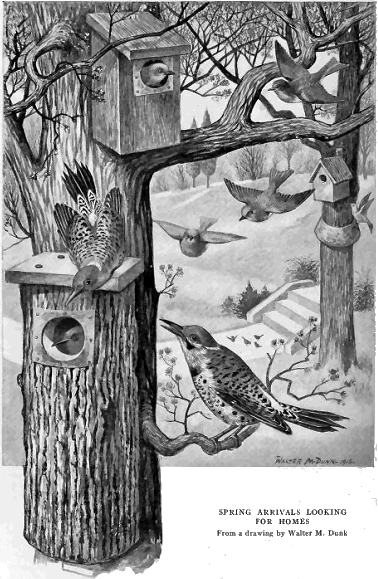
NOTES FROM THE FIELD
Birds Beautifying Cemeteries
Some time ago, the Secretary happened to visit a suburban cemetery, where landscape-gardening and sculptural art had done what they could to make the scene beautiful and comforting, but he was impressed by the absence of singing birds. Alien Sparrows were chattering, and the gurgling of a Grackle was heard in the distance, but none of the sweet voices and pretty forms of the native birds charmed the ear or gladdened the eye of a visitor. This seemed strange, for the varied trees and shrubbery, with sunny spaces among them, quiet and guarded against noisy intrusion, would be exceedingly attractive and favorable to bird-life; and it occurred to him that in no place would an invitation to the birds to make themselves at home in summer be so likely to be accepted; nor could anything be more appropriate than their cheerful presence. They will prove useful, too.
These thoughts induced him to write a brief essay, entitled “Cemeteries as Bird-Sanctuaries,” which has been published by the National Association as Circular No. 2, and distributed to many persons likely to be interested. The response has been most encouraging. Associations and individuals all over the country have written for this circular, and are taking measures to furnish cemeteries with shelters, nesting-boxes and feeding-stations for birds under instruction from the Association. The great Forest Lawn Cemetery near Omaha, for example, is putting up 100 nest-boxes as a beginning. The Rosehill Cemetery and others about Chicago are undertaking similar enterprises, and the Cemetery Beautifying Association of San Francisco is planning this addition to its methods of making more attractive the resting-place of the dead. Blue Bird announces that the Lake View Cemetery at Cleveland, Ohio, will erect many feeding-tables and nest-boxes, in its grounds. The matter has been taken up by the Lexington Kentucky Audubon Society. Other instances might be mentioned.
It is greatly to be hoped that many others will follow their example. The movement we think is worth while, for the sake of humanity as well as for the birds.
The Oregon Audubon Society
The Oregon Audubon Society has recently established headquarters in the Young Men’s Christian Association building, in Portland. The room occupied by the Society has been tastefully decorated with pictures, and contains cabinets of specimens for study. It is planned to give lectures regularly on Saturday evenings.
Mr. William L. Finley, President of the Society, and the Pacific Coast field-agent for the National Association, in company with Mrs. Finley, has this spring been spending several weeks in the East, where he has been constantly engaged in giving lectures illustrated with moving pictures of sea-birds, Sage Grouse, sea-lions, cougars, black bears, antelopes, and other interesting forms of western wild life.
Work Along Columbia River
The Federation of Women’s Clubs in the State of Washington has been notable among such organizations for that practical interest in bird-life which arises from an appreciation of their usefulness as well as their beauty. It has recently testified to this most substantially by becoming a member of this Association. Last year, and to a less extent in the previous year, the Federation was represented largely at the State Fair by an exhibition that was called the “Bird Court,” in which all sorts of ornithological things were displayed to great advantage. The success of these exhibitions was due largely to the wisdom and energy of Mrs. G. R. Pike, of North Yakima, who has been indefatigable in her efforts to spread the study of birds in the schools. She has been traveling and lecturing throughout the state for some time, under the auspices of the State Federation, which has supported this agency generously. The National Association has coöperated in all these matters, and feels that it is abundantly rewarded by results. It has now enabled Mrs. Pike to extend her work, and it anticipates still larger results in the organization of Junior Classes, and in the stimulation of a general interest in the cause throughout the Columbia Valley.
Feather Importation In Canada
It may not be generally known to the readers of Bird-Lore that, immediately following the passage of the Tariff Act in Washington, on October 3, 1913, which prohibited the importation of feathers to this country, the Canadian Parliament, largely through the efforts of Dr. C. Gordon Hewitt, passed a somewhat similar measure. The Canadian law prohibits the importation of:
“Aigrettes, Egret plumes, or so-called Osprey plumes, and the feathers, quills, heads, wings, tails, skins, or parts of skins, of wild birds, either raw or manufactured; but this provision shall not come into effect until January 1, 1915, and shall not apply to the feathers or plumes of Ostriches; the plumage of the English Pheasant and the Indian Peacock; the plumage of wild birds ordinarily used as articles of diet; the plumage of birds imported alive, nor to specimens imported under regulations of the Minister of Customs for any natural-history or other museum, or for educational purposes.”
Allan Brooks a Soldier
Allan Brooks, the artist, many of whose colored pictures of birds have appeared in Bird-Lore, is with the English Army “somewhere in France.” In the summer of 1915 he wrote the office that he would not be able to do further work for the Association for some time, as he was going to Europe to study. Almost immediately after his arrival in England war broke out. He at once returned to Canada and enlisted in a company at his home in British Columbia. He has been promoted from the rank of Lieutenant to that of Captain. Last December, when Captain Brooks had attained the distinction of the longest continuous trench service of any officer of the Canadian army, he was offered a more restful position behind the lines, but he declined it.
In a letter received by one of his friends a short time ago he stated that he had thus far escaped injury with the exception of deafness in one ear, as a result of a shell-explosion; and that, if he survived the war, he would return to America and hoped to paint better pictures than before.
Deer-Killing Dogs
A lady writes from a village in northern New York of the evil of loose dogs in rural communities; and of her care for winter-birds:
“On Sunday morning, January 23, two dogs chased a deer (a young doe), that strayed down from the mountains, and attacked it most viciously until it sank exhausted and wounded on the grounds of the summer home of the church of the Heavenly Rest, of which my husband is gardener and caretaker. He and my son rescued the deer from the dogs, and a neighbor notified the supervisor, who gave permission for its removal to a barn, awaiting the arrival of the game warden. My three children are members of the Audubon Society, and are greatly interested in all wild things. They are heart-broken about the deer, and we try to protect everything wild that comes our way. We have many wild birds around our house, which we coaxed around by putting little houses in the branches of nearby trees, and putting crumbs and scraps in them. We also fixed some branches of hemlock on the windowsill of our dining-room, on which my husband ties pieces of suet, doughnut, bones, and pieces of a pudding I make especially for them, of suet, currants, raisins, bread-crumbs, and scraps of meat; and oh, how they enjoy it!”—Mrs. John W. Payne.
The Kind That Win Birds
Dodson Bird Houses Don’t delay. Birds will soon be here. Put out Dodson Bird Houses now and have Bluebirds, Wrens, Martins, Flickers, etc. living in your garden. Buy houses made by a bird-lover. Mr. Dodson has loved and worked for Native Birds all his life. Dodson Bird Houses (20 styles—for all kinds of birds) used by birds in every state. Martin House (illustrated here), $12; Wren House $5; Bluebird House, $5; Flicker House, $2.50 to $5; Chickadee House, $1.50 and $2.50; Bird Baths, $6 to $17. Prices f.o.b. Kankakee, Illinois.
FREE PICTURE Of bird in Natural Colors, with descriptive folder of Nature Neighbors, the best set of books about birds published. Write for this—now. FREE BOOKLET Telling How to Win Native Birds, and illustrating the famous Dodson Bird Houses, Shelters, Baths, etc. Write for it. The Famous Dodson Sparrow Trap. No other trap like this. Double funnel and automatic drop trap combined. Works all the time. Price, $6. If you’re interested in birds, write to the “Man the Birds Love.”
JOSEPH H. DODSON, 712 S. Harrison Ave., Kankakee, Ill. Mr. Dodson is a Director of the Illinois Audubon Society
Edmanson Martin House. 28 rooms. Price $10 f.o.b. Chicago; 26 rooms, $8.50. Will last a lifetime. Attract the birds. Provide cozy little homes for them. There is no better way of getting tree and shrub insurance. Birds will work for you free of cost every day in the year. Edmanson Bird Houses are used by thousands of America’s foremost lovers of birds—endorsed by the Audubon Societies. 5,000 Bird Houses in Stock—Already Seasoned Ready for Immediate Use—Birds Arrive This Month We have been manufacturing Bird Houses for 20 years. Our prices are lowest. Bluebird House, $5; Houses for Purple Martins, $8.50; for Flickers, $3; for Chickadees, 70 cts.; for Swallows, $2.50; Cement Bird Bath, $11; the famous Edmanson Sparrow Trap, electric welded, automatic, none better, $1.75. BIRD BOOKS by recognized authorities. We can save you money on books. Handsomely illustrated catalog free. Write for it today. E. E. EDMANSON & COMPANY 616 South Norton Street Chicago, Illinois Edmanson Wren House. 4 rooms. Price $4.50 f.o.b. Chicago. Edmanson Feedery. Price $1 f.o.b. Chicago. Feeds grain, also suet.

Agents Wanted
To handle Subscriptions for
The National
Humane Review
A high-grade publication devoted especially to the subject of child and animal protection. Carefully edited. Well illustrated.